Market Minds Advisory
Sugar-Free Syrups Market

Sugar-Free Syrups Market: The Contest Is Viscosity, Not Sweetness

Anybody can make a syrup taste sweet without sugar, and almost nobody makes one that pours like sugar, which is why body rather than flavour decides who holds a foodservice contract.

Lead Analyst

Lisa Gevelber

Published

September 2026

Make Smarter Decisions with Customized Research Insights

Request a free sample report and evaluate market opportunities, growth trends, and competitive dynamics relevant to your business needs.

2025 MARKET VALUE$1.3BMarket Size 2025
2036 FORECAST VALUE$3.1BBase Case , 2026 to 2036
CAGR 2026 TO 20368.4 %Bull 9.6% / Bear 7.2%
INCREMENTAL OPPORTUNITY$1.7BNet 10- year value creation
EXPANSION MULTIPLE2.24x2036 value over 2026 base
Strategic Levers
M&A Pipeline
Regional Outlook
Country Rankings
Competitive Intelligence
Segmental Deep-dive
Call-Us : 91 93563 13602

Executive Snapshot and Market Trajectory

Sweetness is the easy part here and it is where everybody competes. A conventional syrup sits at around 65 degrees Brix and carries real body, while a high-intensity sweetened version delivers roughly a third of that viscosity and pours like flavoured water. It behaves nothing like syrup.
That matters commercially because 68% of volume goes through foodservice, where syrup is dispensed by a calibrated pump delivering about 10 millilitres per actuation. A thin syrup over-doses and a thick one under-doses, so viscosity is an equipment specification rather than a sensory preference, and a barista notices within a single shift. Foodservice contracts run around three years. Agreements run around three years and reopen decisively rather than gradually.
Preservation is the other overlooked constraint. Sugar at 65 Brix suppresses water activity and preserves the syrup by itself, and taking it out forces preservatives, hot filling or aseptic packing. The clean label sugar-free syrup that marketing keeps requesting is close to a contradiction in formulation terms, and several launches have quietly discovered it. Glycerine and fibre solids restore part of what sugar was doing, which addresses body and shelf stability at the same time.
Market Definition
Liquid sweetened syrups formulated without added sugars, covering coffee and beverage flavouring syrups, table and pancake syrups, dessert and ice cream toppings, cocktail and bar syrups, pharmaceutical and nutraceutical syrup bases, and industrial and food manufacturing syrups. Measured at manufacturer selling value. Excludes reduced-sugar syrups still containing sucrose, beverage concentrates sold for dilution as drinks, honey and maple syrup, powdered flavourings, and sweetener ingredients sold separately.
Base Year Value
$1.3B in 2025 (MMA Primary Research Dataset, August 2026)
Forecast Period
2026 to 2036, eleven discrete annual values
CAGR
8.4% base case. Bull 9.6%. Bear 7.2%.
Fastest Growth Segment
Coffee and Beverage Flavouring Syrups: 12.6% CAGR
Fastest Growth Country
China: 14.8% CAGR
Fastest Growth Region
South Asia and Pacific: 10.6% CAGR
Largest Region
North America: 30% of 2025 global value
Market Leaders
Monin, Torani, Kerry Group, B and G Foods, Fabbri 1905. Source: MMA Primary Research Dataset, July 2026.
Primary Survey
n=3,800 procurement and R&D decision-makers, Q4 2025, six countries
Methodology
Demand-side build-up, cross-validated against public data, 47 expert interviews

Sugar-Free Syrups Market Forecast Scenarios

sugar-free-syrups-market-trends-size-forecast-scenario-1787639519577
Growth ran near 7.0% between 2020 and 2025 and the channel mix shifted considerably beneath it. Coffee shop reopening drove foodservice volume back strongly while retail table syrup stayed flat, and erythritol formulations lost ground as crystallisation out of solution proved a recurring failure in syrup specifically. Allulose entered formulation for body rather than sweetness, which was not how anybody had expected to use it.
Base case 8.4% rests on three mechanisms. Coffee and beverage flavouring syrups grow at 12.6% as specialty coffee chains expand and add sugar-free options across whole menus rather than as single line extensions. Cocktail and bar syrups grow at 10.8% on low and no alcohol drinking. And China grows fastest of any country at 14.8% as coffee chain buildout continues at a pace no other market approaches. None of the three depends on retail syrup demand at all.
The bull case at 9.6% assumes viscosity systems improving enough that foodservice operators stop treating sugar-free as a compromise line and put it on the main menu. The bear case at 7.2% is continued reliance on thin formulations and preservative-heavy labels, which keeps the category in a secondary position that operators stock rather than promote.

Body Is What the Pump Measures

Making a syrup sweet without sugar is nearly trivial, which is exactly why it differentiates nobody. A few drops of sucralose or a steviol glycoside blend deliver all the sweetness required and the resulting liquid has roughly 34% of the viscosity of a conventional syrup at 65 degrees Brix. It pours thin, it disappears into milk without carrying flavour, and it behaves nothing like the product it replaced.
TOP FIVE CONCENTRATION44%Foodservice contracts concentrate supply among a few established houses
CONVENTIONAL SYRUP BRIX65Dissolved solids level that makes ordinary syrup self preserving
PUMP DOSE PER ACTUATION10 mlVolume a calibrated foodservice dispensing pump delivers each time
RELATIVE VISCOSITY34%Body achieved by a high intensity sweetened formulation
FOODSERVICE VOLUME SHARE68%Portion sold through cafes, bars and catering operators
SUPPLY CONTRACT TERM3 yearsTypical duration of a foodservice syrup supply agreement
In foodservice that is a mechanical problem rather than a matter of taste. Around 68% of volume moves through cafes, bars and catering where syrup is dispensed by a pump calibrated to deliver about 10 millilitres per actuation, and that calibration assumes a particular viscosity. Too thin and the pump over-delivers, wasting product and oversweetening the drink. A barista notices inside a shift and the operator switches back.
Preservation is the constraint fewest people anticipate. Sugar at 65 Brix suppresses water activity enough to make a syrup self-preserving on an open bar shelf, and removing it means adding preservatives, hot filling or packing aseptically. Each option costs money or costs label, which is why the clean label sugar-free syrup marketing keeps requesting remains a request rather than a product.
"Every brief I see asks for better flavour and the operator complaint is always about the pour. Fix the body and you are selling a syrup; leave it thin and you are selling flavoured water that a cafe stocks for one customer and stops reordering by the spring."
Director, Beverage Ingredients and Foodservice Practice · MMA Agriculture and Food Practice · August 2026

Market Trends

Viscosity systems replacing sweetness as the technical contest

A high-intensity sweetened syrup reaches roughly 34% of conventional viscosity, which fails both the pump calibration in foodservice and the sensory expectation of anybody who has poured a real syrup. Gums, soluble fibres, glycerine and allulose are being combined to rebuild body rather than sweetness, and formulation differentiation has moved almost entirely into that work. Suppliers still competing on flavour range are competing on the dimension operators complain about least when they stop reordering. Operators complain about the pour long before they complain about the flavour, and the complaint that ends an account is almost always the first one.
Market Impact: China growing fastest at 14.8%

Specialty coffee chains adding sugar-free across whole menus

Coffee chains have moved from stocking one sugar-free syrup as a courtesy to offering the option across a full flavour menu, which multiplies the number of stock keeping units an operator carries and the volume a supplier ships. Coffee and beverage flavouring syrups grow at 12.6% on that shift. It also raises the technical bar, since every flavour in the range now has to hold body and stability rather than just the one line nobody watched closely. Central specification by chain head offices means a single decision now moves a supplier into or out of hundreds of outlets at once.
Market Impact: Bar syrups growing at 10.8%

Market Opportunities and Growth Drivers

Chinese coffee chain buildout expanding faster than anywhere

China grows fastest of any country at 14.8% as domestic coffee chains open outlets at a pace no other market approaches, and those chains specify syrup ranges centrally rather than store by store. Central specification means a supplier wins or loses hundreds of outlets in a single decision, which raises both the prize and the risk considerably. Sugar-free options are being built into menus from the outset rather than added later as a retrofit. Supplier selection therefore happens years before an individual outlet opens, which rewards presence at head office over any distributor relationship.
Market Impact: Restores solids toward 65 Brix

Low and no alcohol drinking lifting cocktail syrup demand

Bars building serious low and no alcohol menus need syrups that carry structure and mouthfeel, because a drink without alcohol has lost body as well as flavour and syrup is where that gets rebuilt. Cocktail and bar syrups grow at 10.8% on that requirement, and sugar-free versions appeal to exactly the customer already declining alcohol for health reasons. Bar operators buy on how a drink builds rather than on any nutrition claim. Bartender specification also travels with the person rather than the venue, which spreads a winning formulation across a city faster than any sales effort could.
Market Impact: Surfaces around 6 weeks later

Market Restraints and Challenges

Water activity forcing preservatives or costly packing formats

Sugar at 65 degrees Brix suppresses water activity enough that a conventional syrup preserves itself on an open bar shelf for months. Removing it leaves a product that requires preservatives, hot filling or aseptic packing, and each of those costs either margin or label. The root cause is physical chemistry rather than any formulation shortcut. Commercially it makes the clean label sugar-free syrup extremely difficult. Glycerine and fibre solids that partly restore solids content are the practical mitigation. It contributes body at the same time, which addresses two problems at once.
Market Impact: Recovers viscosity below 34%

Erythritol crystallising out of solution in stored syrups

Erythritol offers bulk and clean taste but has limited solubility, and syrups formulated with it crystallise in the bottle over storage, particularly at cooler temperatures in a cafe back store. The root cause is solubility rather than formulation error, and it appears weeks after production rather than in a laboratory trial. Commercially it produces returns and lost accounts. Allulose, glycerine and blended polyol systems are the routes formulators have taken instead. Cool back store conditions make it worse rather than better, and a supplier discovers it through returns rather than through any trial it has run itself.
Market Impact: Flavouring syrups growing at 12.6%
4 additional market trends, 3 additional growth drivers, and 2 additional restraints and challenges are covered in the full report. Contact sales@marketmindsadvisory.com to access the complete intelligence.

Segment CAGR and Growth Architecture

Six segments are split by application, because application determines the viscosity and dispensing requirement, the stability regime, the buyer being sold to and the contract structure that follows. Flavour variants sit inside each application rather than beside them. Sweetener system and channel are handled separately in the framework instead. Contract term follows application as well.
sugar-free-syrups-market-trends-market-share-analysis-1787639520128

Coffee and Beverage Flavouring Syrups

Growing at 12.6%, half again the market rate of 8.4%, these syrups are dispensed by calibrated pumps delivering around 10 millilitres per actuation, which makes viscosity a mechanical specification rather than a sensory preference. Coffee chains have moved from stocking one sugar-free line to offering the option across whole menus, multiplying stock keeping units and volume together. Central specification by chain head offices means a single decision moves hundreds of outlets, which raises both the prize and the risk of losing a contract at renewal considerably. Viscosity parity is the entry condition rather than a differentiator, and most sugar-free formulations still fail it outright. Range breadth is what a chain head office actually evaluates alongside it.
CAGR 12.6%

Cocktail and Bar Syrups

At 10.8% these syrups build structure into mixed drinks, and demand has risen sharply with serious low and no alcohol menus where removing spirit removes body as well as flavour. Syrup is where bartenders rebuild both, so mouthfeel matters more here than in almost any other application. Sugar-free versions appeal directly to the customer already declining alcohol on health grounds. Bar operators evaluate how a drink builds in the glass rather than any nutrition claim, which rewards viscosity work over sweetener marketing entirely. Low and no alcohol programmes are being written now rather than defended, which makes this an easier entry point than displacing an incumbent in an established cocktail list would ever be.
CAGR 10.8%
Full segment breakdown across 6 segments available in the complete report.

Regional Architecture and Country Demand Map

North America holds 30% of value because table syrup is a North American category and coffee shop density is the highest anywhere. East Asia follows at 24% on coffee chain expansion running faster than any other region. South Asia and Pacific grows fastest of the seven regions.

North America

Table and pancake syrup is a North American category with essentially no equivalent elsewhere, and sugar-free variants there are a mature retail business rather than a novelty. Coffee shop density is the highest anywhere, which makes foodservice flavouring syrup the larger and faster part of regional demand. Chain specification is centralised, so contracts are large and lost decisively rather than gradually. Growth at 7.4% reflects a mature base where menu expansion rather than outlet growth drives the additional volume. Independent operators still hold a meaningful share of outlets, which keeps distributor relationships commercially valuable alongside the chain contracts. Sugar-free table syrup is a mature retail business here and behaves quite differently from the growing foodservice side of the same category.
Share: 30% | CAGR: 7.4% (2026 to 2036)

Western Europe

Cafe culture here predates the chain model and independent operators hold a larger share of outlets than in North America, which fragments purchasing and slows sugar-free menu adoption considerably. European sweetener regulation excludes allulose from non-sugar treatment, which removes the ingredient that best rebuilds body and pushes formulators toward gums and fibres instead. Cocktail syrup demand is growing on low alcohol drinking. Growth of 6.8% is the slowest anywhere on fragmentation and formulation constraint together. Independent operators buy through distributors rather than centrally, which makes the market slower and more expensive to serve than chain-led regions are. Cocktail syrup demand is the one genuinely fast growing part of regional consumption, driven by low alcohol menus rather than coffee shop expansion.
Share: 21% | CAGR: 6.8% (2026 to 2036)
Regional intelligence for 5 additional markets available in the complete report: East Asia, South Asia and Pacific, Latin America, Middle East and Africa, Eastern Europe. Contact sales@marketmindsadvisory.com.
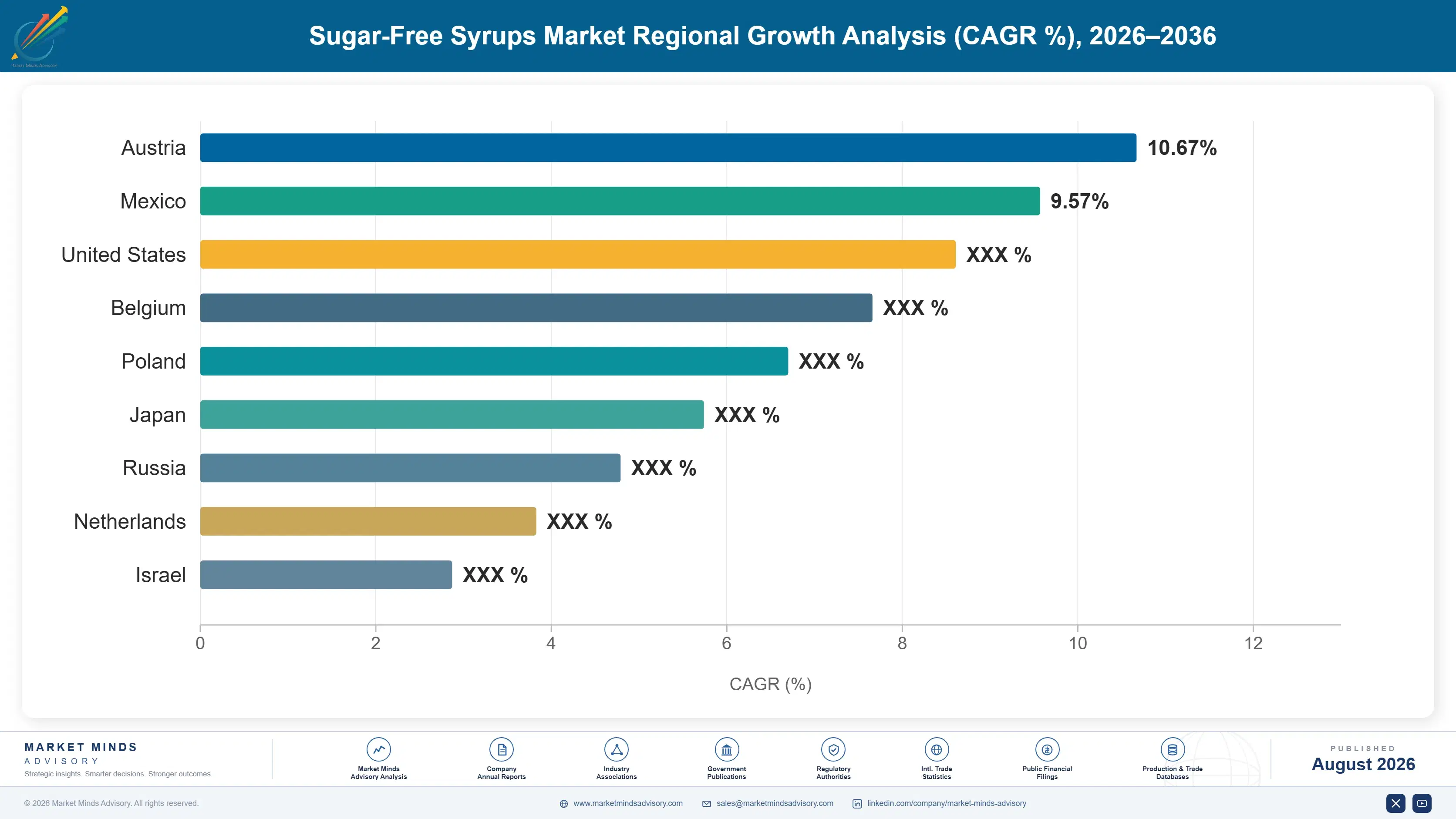
sugar-free-syrups-market-trends-country-cagr-analysis-1787639520685

Four Moves the Pump Will Notice

Sweetness costs pennies and differentiates nobody, while body costs formulation work and decides whether a cafe reorders. Every move worth making rebuilds viscosity, solves the stability problem that removing sugar creates, or reaches the chain head office where a single specification decision moves hundreds of outlets at once. The pour decides the rest. Sweetness is settled.

Rebuild viscosity to match pump calibration exactly

Foodservice pumps deliver around 10 millilitres per actuation on a calibration that assumes conventional syrup body, and a formulation at 34% of that viscosity over-delivers on every single drink. Matching the pour rather than the sweetness is what keeps an account through the first month. Gums, soluble fibres, glycerine and allulose combine to get there, and the work is unglamorous formulation rather than anything a marketing claim can substitute for. A five point improvement in retention through the first quarter is worth more than any flavour launch, and it holds across every account rather than one line.
Market Impact: Matches the existing 10 millilitre pump dose calibration

Win chain head office specification rather than outlets

Coffee chains specify syrup ranges centrally, so a single decision moves hundreds of outlets and a three year contract with it. Selling outlet by outlet in a chain market is effort spent on people who do not hold the decision. Head office evaluation weighs pour consistency, stability across a long supply chain and flavour range breadth together, which is a different pitch entirely from anything a distributor sales call delivers. A single Chinese chain specification can carry several hundred outlets and roughly 3 years of committed volume, which no amount of distributor selling reaches.
Market Impact: Secures 3 year foodservice supply contracts awarded centrally

Solve shelf stability without a preservative-heavy label

Removing sugar removes the water activity suppression that made conventional syrup self-preserving at 65 Brix, and the usual answers cost either margin or label. Glycerine and soluble fibre solids restore part of the solids content while contributing body at the same time, which addresses two problems with one ingredient decision. Operators reading a long preservative list on a bar shelf notice, and so do the retail shoppers this category also serves. Preservative lists on a bar shelf are read by operators and by retail shoppers alike, so the label benefit reaches both channels from one formulation change.
Market Impact: Restores solids content back toward 65 degrees Brix

Build into low and no alcohol bar programmes early

Cocktail and bar syrups grow at 10.8% because removing spirit from a drink removes body, and syrup is where a bartender rebuilds it. That makes mouthfeel the deciding property in exactly the application where sugar-free formulations are weakest. A supplier solving it reaches bar programmes being written now rather than displacing an incumbent later, and bartender specification tends to follow the person rather than the venue. Entry is cheaper now than displacement will be later, since these menus are being written rather than defended. Mouthfeel is the whole evaluation here.
Market Impact: Serves the 10.8% annual growth in bar syrups

Who Controls the Margin Pool

Participation is measured on annual syrup volume in litres supplied across foodservice and retail, and the top five hold 44%. Concentration is moderate because foodservice contracts consolidate supply among established houses while retail carries a long tail of challenger brands. Monin and Torani lead through chain specification positions and flavour range breadth rather than through any sweetener technology advantage. The gap to challengers is range breadth rather than any single product advantage.
Competition runs on three fronts. Pour consistency decides whether a foodservice account renews, and it is where most sugar-free formulations fail. Flavour range breadth decides chain specification, since an operator wants one supplier across a whole menu. And price decides retail, where own label and challenger brands compete hard. Pour consistency has become the deciding technical criterion, and it is where most challengers fail before price is even discussed.

Pressure ahead comes from viscosity systems separating capable formulators from the rest, and from chain expansion in Asia concentrating decisions into fewer, larger contracts. Expect established houses to defend on range and consistency. Rankings shift on who wins the Chinese chain specifications now being written. Concentration should rise as chain contracts consolidate volume.
sugar-free-syrups-market-trends-company-positioning-matrix-1787639521228

Competitive Moat and Risk Dimensions

MONIN

Moat: Flavour range and chain specification

Flavour range breadth across hundreds of variants lets a chain specify one supplier for a whole menu rather than assembling several, which is what head office evaluation actually rewards. Combined with established specification positions and three year contract terms, that produces relationships a challenger cannot enter without waiting for a renewal cycle to come around.
MONIN

Risk: European allulose formulation constraint

European sweetener regulation excludes allulose from non-sugar treatment, which removes the single best ingredient for rebuilding body and leaves European formulation dependent on gums and fibres that perform less well. That constraint is regulatory rather than technical, and it disadvantages European production against American competitors in exactly the fastest growing application.
TORANI

Moat: North American foodservice distribution depth

Distribution depth across North American cafes, including the independent operators that chains do not cover, reaches the fragmented half of the largest regional market where a chain-focused competitor has no presence at all. That network took decades to build through distributors and cannot be replicated by any amount of product development alone.
TORANI

Risk: Regional concentration exposure

Heavy North American weighting ties the business to a mature market growing at 7.4% while Asian chain expansion runs several points faster and specifies suppliers centrally. Building presence in those markets means winning head office decisions rather than distributor relationships, which is a different capability from the one the business has spent decades developing.

Players Tracked

Prominent Players

Monin
Torani
Kerry Group
B and G Foods
Fabbri 1905

Other Key Players

Routin
Giffard
Sweetbird
Toschi Vignola
ODK Orsa Drinks
Amoretti
Jordan's Skinny Mixes
Lakanto
ChocZero
Walden Farms
Hershey
Conagra Brands
McCormick
Dr Oetker
Nestle

Recent Developments

FEBRUARY 2026

Coffee chain specifies sugar-free option across full flavour menu

A coffee chain specified sugar-free variants across its entire flavour syrup menu rather than the single line it had previously stocked, multiplying the stock keeping units carried per outlet. Pour consistency across the whole range was a stated condition of the specification decision. Stock keeping units per outlet roughly doubled.
Signal: Menu-wide adoption raises the technical bar because every flavour now has to pour correctly every time
SEPTEMBER 2025

Operator returns sugar-free syrup batch after crystallisation in storage

A cafe operator returned a sugar-free syrup batch after erythritol crystallised out of solution during cool back store storage, several weeks after production and long past any laboratory stability trial the supplier had run. The supplier had run only accelerated stability trials at ambient temperature. Returns followed across several accounts.
Signal: Solubility failures surface in the back store rather than in any production stability testing at all
DECEMBER 2025

Bar group builds low alcohol menu around syrup mouthfeel performance

A bar group built a low and no alcohol cocktail menu selecting syrups on mouthfeel and how the drink assembled in the glass, rather than on flavour range or nutrition positioning. Sugar-free lines that poured thin were excluded from the programme entirely. Nutrition positioning was not part of the evaluation.
Signal: Removing alcohol removes body, and syrup is the only place a bartender rebuilds it into the drink

Sweeteners, Solids and Glass

Sweetener and bulking systems carry around 31% of ingredient cost, well above the roughly 9% sucrose represents in a conventional syrup, because body and sweetness require separate ingredients here. Flavours and extracts take about 24%. Glycerine, gums and soluble fibres account for around 14%. Glass bottles, closures, pumps and outbound freight absorb the balance, and packaging weighs unusually heavily in a liquid product.
Glass and freight costs rose sharply through recent years alongside energy pricing, per IEA industrial energy reporting and Kerry Group Annual Report 2025 commentary on packaging and distribution costs. Syrup is heavy relative to its value and ships in glass, so those movements hit this category harder than most food categories, and several manufacturers moved partly to lighter formats in response. Foodservice bulk formats absorbed the movement considerably better than retail glass did.

Exposure divides on formulation and format rather than on scale. A gum and fibre formulator carries hydrocolloid pricing that moves on agricultural drivers. An allulose formulation carries specialist sweetener pricing from few suppliers. Everybody carries glass and freight, and a manufacturer shipping bulk foodservice formats carries far less packaging cost per litre than one filling retail bottles for the same product.
sugar-free-syrups-market-trends-cost-volatility-analysis-1787639521451

Shift foodservice volume into bulk and lightweight formats

Packaging and freight weigh unusually heavily in a liquid product shipped in glass, and foodservice operators do not need retail presentation. Bulk pouches and lightweight formats cut both cost lines substantially without touching the product, and operators generally welcome the reduced storage bulk and waste that comes with them. Storage bulk falls for the operator too.

Use glycerine and fibre solids to serve two functions at once

Glycerine and soluble fibres contribute body and restore solids content that suppresses water activity, which addresses viscosity and shelf stability with one ingredient decision rather than two. That reduces both preservative content and total ingredient count, improving the label while cutting cost against separate gum and preservative systems. Ingredient count falls alongside the cost.

Contract specialist sweetener supply on multi-year terms

Allulose and steviol glycoside supply comes from far fewer producers than sucrose, which makes availability a genuine risk alongside price. Multi-year contracting secures both and matters most for the newer systems that actually deliver the body advantage these formulations need to hold foodservice accounts at renewal. Availability is the binding risk here. Few producers exist.

Portfolio Architecture for Margin Defence

Margin here follows contract structure rather than formulation cost, because a three year foodservice agreement and a retail promotional cycle produce entirely different economics from the same liquid. Retail table and pancake syrup earns margins in the high single digits to mid teens, where own label competition and promotional depth leave very little room to work with. Promotional depth sets the ceiling there.
Branded retail flavouring and dessert syrups do better in the high teens to high twenties, because brand recognition supports pricing and the shopper is buying an occasional treat rather than a weekly staple, which reduces the price sensitivity that governs the table syrup fixture entirely. Conventional syrup sits on the same shelf, which makes the price comparison unavoidable for any shopper standing in front of both.

Foodservice chain contracts hold the strongest position, reaching into the mid thirties, where pour consistency and range breadth decide specification and the agreement runs for years rather than reopening each promotional cycle. Those margins reflect formulation quality and contract term rather than any advantage in ingredient cost or manufacturing scale. Very few manufacturers have solved the pour well enough to hold those contracts through a full renewal cycle.

Retail Table and Pancake Syrups

Retail staples competing against own label with deep promotional cycles. The seven point range reflects brand strength and promotional depth rather than any formulation difference a shopper would actually be able to detect.
Gross Margin: 9-16%

Branded Retail Flavouring and Dessert Syrups

Occasional purchase products where brand recognition supports pricing above the staple fixture. The ten point range reflects brand permission and how far the product competes against conventional syrup on the same shelf.
Gross Margin: 18-28%

Foodservice Chain Contract Supply

Multi-year chain agreements where pour consistency and range breadth decide specification centrally. The ten point range reflects contract term, range breadth and how demanding the operator's viscosity requirements actually are.
Gross Margin: 26-36%
sugar-free-syrups-market-trends-portfolio-architecture-1787639522095

High-value Sub-segments and Strategic Watch-out

Foodservice Chain Contracts

High value and growing at 12.6% as chains adopt sugar-free across whole menus rather than single lines. Central specification means one decision moves hundreds of outlets, and agreements run around three years before reopening. Pour consistency across the whole range decides it. Range breadth matters equally.
Gross Margin: 28-36%

Cocktail and Bar Syrups

High value and growing at 10.8% on low and no alcohol menus where removing spirit removes body. Mouthfeel decides selection, which rewards viscosity formulation work far more than any nutrition positioning. Bartender specification travels with the person rather than the venue. Nutrition claims barely feature.
Gross Margin: 26-34%

Retail Table Syrups

The volume core in North America, competing against own label through deep promotional cycles where price decides almost everything. Formulation differentiation is difficult to communicate at that fixture at all. Own label competition sets the pricing ceiling here. Differentiation is hard to communicate at that fixture.
Gross Margin: 9-16%

Viscosity and Stability Exposure

The strategic watch-out. Formulations at 34% of conventional viscosity fail pump calibration and crystallisation surfaces weeks later, and the range reflects how far a manufacturer has solved body and water activity together. Returns rather than trials are how suppliers find out. Pump calibration is unforgiving.
Gross Margin: 7-34%

Head Office Buys, Baristas Judge

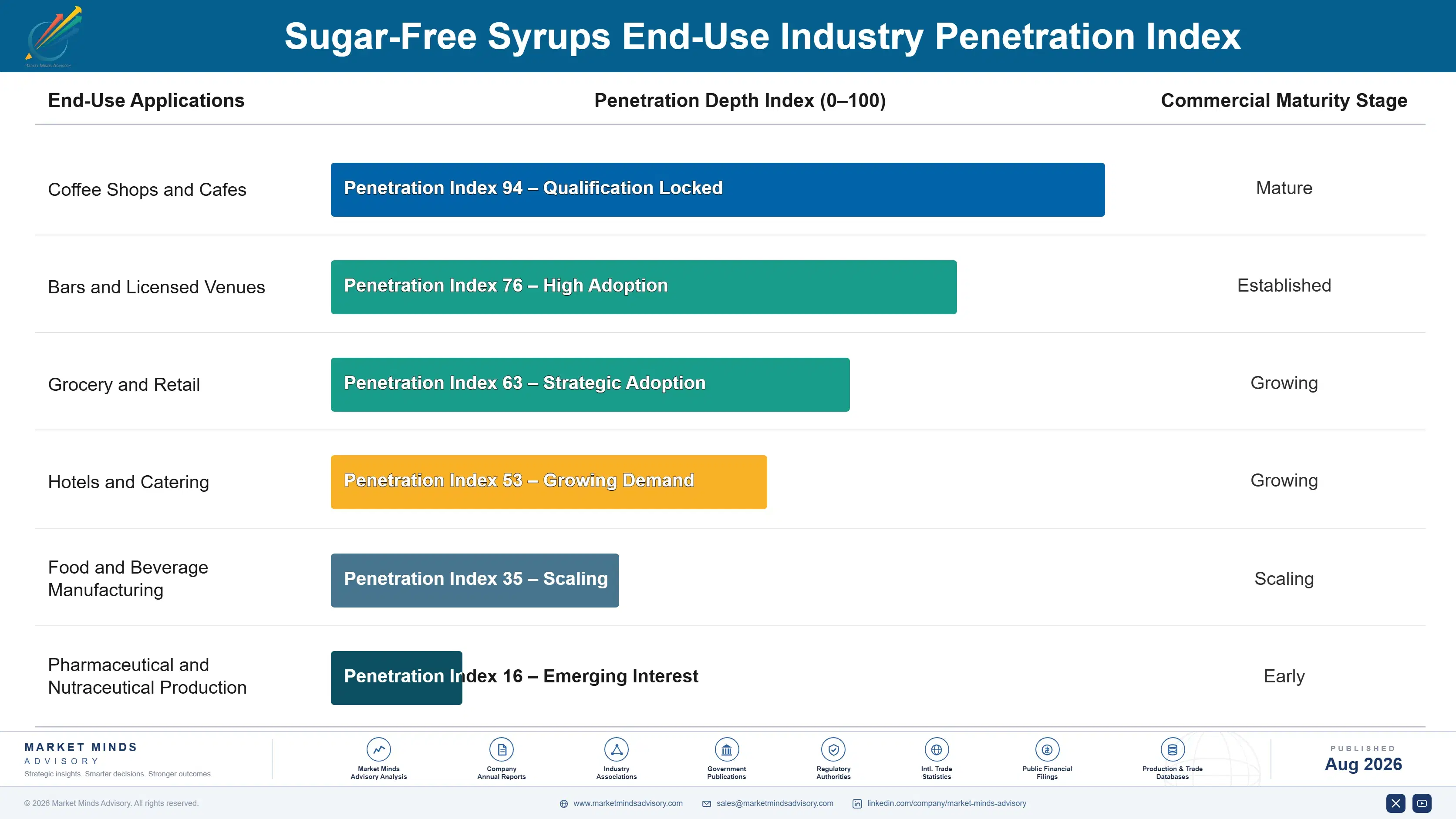
Demand splits between an operator who specifies and a person who uses, and they evaluate on different things entirely. A chain head office weighs range breadth, supply reliability and cost per serving across a three year horizon. The barista pulling the pump judges how it pours, how it holds in the drink and whether the bottle behaved in the back store, and their complaints decide whether the contract renews.
Stickiness follows the contract rather than the preference. Foodservice agreements run around three years and reopen decisively rather than gradually, so a supplier holds everything or loses everything at a single review. Retail positions reopen at every promotional cycle and range review. Independent cafe accounts sit between the two and follow the distributor relationship more than the brand.

The deciding voices have broadened as sugar-free moved from courtesy line to menu-wide option. Range decisions once sat with a beverage development function alone and now involve operations, who care about back store stability, and finance, who notice pump over-delivery in cost per serving. A supplier answering only the flavour question is addressing one of three people in the room.
sugar-free-syrups-market-trends-end-use-penetration-index-1787639522622

Where We Would Put Effort

These are among the four positions where our research anticipates prominent divergence between winners and laggards over the coming forecast period. Each is grounded in the demand model, the regulatory perimeter, and the announced capacity pipeline.
01 / VISCOSITY FORMULATION WORK

The pump was calibrated for real syrup

Foodservice dispensing pumps deliver around 10 millilitres per actuation on a calibration built for conventional syrup body, and a formulation at 34% of that viscosity over-delivers on every drink poured through it. That shows up as waste and oversweetening within a single shift, which is precisely how these accounts end up being lost. Gums, soluble fibres, glycerine and allulose all rebuild the body, and the work is ordinary formulation rather than anything a new flavour launch could ever substitute for.
02 / CHAIN SPECIFICATION SELLING

One decision moves hundreds of outlets

Coffee chains specify syrup ranges centrally and sign agreements running around three years, so a single head office decision carries hundreds of outlets with it in either direction. Selling outlet by outlet into a chain market spends effort on people who hold no part of the decision at all in a chain market. Head office evaluation weighs pour consistency, supply reliability and range breadth together, which is a materially different pitch from anything a distributor sales call is able to deliver.
03 / WATER ACTIVITY SOLUTIONS

Sugar was preserving it, not just sweetening

Conventional syrup at 65 degrees Brix suppresses water activity enough to sit safely on an open bar shelf for months without needing any preservative in it at all. Taking the sugar out removes that protection and forces preservatives, hot filling or aseptic packing, each of which costs either margin or label space. Glycerine and soluble fibre solids restore part of the solids content while also contributing body, which addresses two separate problems through a single ingredient decision rather than two separate ones.
04 / LOW ALCOHOL PROGRAMME ENTRY

No spirit means no body either

Cocktail and bar syrups grow at 10.8% against a market rate of 8.4% because removing alcohol from a drink removes mouthfeel as well as flavour, and syrup is the only place a bartender rebuilds either. That makes body the deciding property in precisely the application where sugar-free formulations currently perform at their very worst. Programmes are being written now rather than being defended, and bartender specification tends to travel with the person rather than staying with the venue they left.

Engagement Snapshot From the Field

A live engagement with an industry participant carrying material or product regulatory and market exposure ahead of a defining policy shift, showing how our research translates into a defensible multi-year portfolio strategy.
MARKET MINDS ADVISORY · CLIENT ENGAGEMENT SUMMARY
Sugar-Free Syrups Producer Strategic Portfolio Review and Transition Roadmap 2026·Investment Scenario on Sugar-Free Syrups Exposure Evaluation 2025-26
CLIENT PROFILE
A European syrup manufacturer supplying flavouring syrups to independent cafes and regional coffee chains across nine countries, at annual revenue near 120 million euros with sugar-free lines contributing a growing minority (client-reported, unverified by MMA). Distribution ran almost entirely through wholesalers rather than direct chain relationships. Direct chain relationships were minimal. Sugar-free retention was not tracked.
STRATEGIC CHALLENGE
Sugar-free lines were being trialled by operators and dropped within months at a rate management could not explain, while chain contracts in Asia were being awarded to competitors the business had never encountered. Two commercial problems appeared unrelated and needed diagnosing before budget was committed. A budget decision was due that quarter.
MMA APPROACH
MMA interviewed operators who had dropped the client's sugar-free lines to establish why, measured viscosity and pump delivery across the client's range against conventional syrup and competing products, mapped how Asian chain specification decisions were actually being made, and assessed shelf stability performance in back store conditions. Interviews with 47 experts covered beverage formulation, cafe operations and foodservice distribution.
KEY FINDINGS
  1. Operators dropped the lines on pour behaviour rather than flavour in almost every case examined, with pump over-delivery and thin mouthfeel cited far more often than taste.
  2. The client's sugar-free formulations delivered roughly a third of conventional viscosity, which the existing pump calibration was never designed to accommodate at any setting.
  3. Asian chain contracts were awarded centrally on range breadth and pour consistency, and the client's wholesaler-led model reached nobody involved in those decisions at all.
  4. Two flavours in the range had crystallised in cool storage during the previous year, which the client had recorded as isolated complaints rather than a formulation problem.
CLIENT PROFILE
A European syrup manufacturer supplying flavouring syrups to independent cafes and regional coffee chains across nine countries, at annual revenue near 120 million euros with sugar-free lines contributing a growing minority (client-reported, unverified by MMA). Distribution ran almost entirely through wholesalers rather than direct chain relationships. Direct chain relationships were minimal. Sugar-free retention was not tracked.
STRATEGIC CHALLENGE
Sugar-free lines were being trialled by operators and dropped within months at a rate management could not explain, while chain contracts in Asia were being awarded to competitors the business had never encountered. Two commercial problems appeared unrelated and needed diagnosing before budget was committed. A budget decision was due that quarter.
MMA APPROACH
MMA interviewed operators who had dropped the client's sugar-free lines to establish why, measured viscosity and pump delivery across the client's range against conventional syrup and competing products, mapped how Asian chain specification decisions were actually being made, and assessed shelf stability performance in back store conditions. Interviews with 47 experts covered beverage formulation, cafe operations and foodservice distribution.
KEY FINDINGS
  1. Operators dropped the lines on pour behaviour rather than flavour in almost every case examined, with pump over-delivery and thin mouthfeel cited far more often than taste.
  2. The client's sugar-free formulations delivered roughly a third of conventional viscosity, which the existing pump calibration was never designed to accommodate at any setting.
  3. Asian chain contracts were awarded centrally on range breadth and pour consistency, and the client's wholesaler-led model reached nobody involved in those decisions at all.
  4. Two flavours in the range had crystallised in cool storage during the previous year, which the client had recorded as isolated complaints rather than a formulation problem.
RECOMMENDED STRATEGY
Phase 1: Phase one: reformulate the sugar-free range for viscosity parity, since pour behaviour rather than flavour is what ends these accounts within months. Phase 2: Phase two: build direct chain specification capability for Asian markets, where central decisions are being made that wholesalers cannot reach at all. Phase 3: Phase three: replace erythritol systems with glycerine and fibre solids, addressing crystallisation and water activity through one formulation change. One change addresses both.
OUTCOME
The manufacturer reformulated its sugar-free range during 2026 and reported operator retention improving materially on the reformulated lines (client-reported, unverified by MMA). A direct chain specification team was established for Asian markets, and erythritol was removed from the portfolio. Wholesaler-led selling was retained for independent operators only.

Frequently Asked Questions

Foundational context covering the market sizes, CAGR, scope, country, region and competition that inform every finding below. This section is provided to cover basics and most often pre-purchase conversations, answered from the MMA Primary Research Dataset.

What is the current size of the Sugar-Free Syrups Market?

MMA sizes it at USD 1.28 billion in 2025, rising to USD 1.39 billion in 2026. The figure covers liquid syrups formulated without added sugars at manufacturer selling value across all applications.

How large will the Sugar-Free Syrups Market be by 2036?

USD 3.11 billion by 2036, an incremental USD 1.72 billion over the 2026 base and an expansion multiple of 2.24 times. Coffee and beverage flavouring accounts for a disproportionate share.

What is the CAGR for the Sugar-Free Syrups Market 2026 to 2036?

8.4% in the base case, with a bull case at 9.6% and a bear case at 7.2%. The spread turns on whether viscosity systems improve enough for menu-wide foodservice adoption.

Which segment is growing fastest?

Coffee and beverage flavouring syrups at 12.6%, half again the market rate of 8.4%. Chains have moved from stocking one sugar-free line to offering the option across whole menus.

Who are the major companies in the Sugar-Free Syrups Market?

Monin, Torani, Kerry Group, B and G Foods and Fabbri 1905 lead on syrup volume supplied. Fifteen further participants are profiled in the full report on that same basis.

Which country is growing fastest?

China at 14.8%, as domestic coffee chains open outlets faster than any other market and specify sugar-free options into menus centrally from the outset. Specification happens centrally.

Report Segmentation Architecture

The full report scope spans multiple orthogonal segmentation dimensions, with cross-tabulated demand data provided for each dimension pair. Coverage extends further to regional breakdowns, trend trajectories, and the competitive detail needed to support segment-level decision-making.

By Application

  • Coffee and Beverage Flavouring Syrups
  • Table and Pancake Syrups
  • Dessert and Ice Cream Toppings
  • Cocktail and Bar Syrups
  • Pharmaceutical and Nutraceutical Syrup Bases
  • Industrial and Food Manufacturing Syrups

By End-Use Industry

  • Coffee Shops and Cafes
  • Bars and Licensed Venues
  • Grocery and Retail
  • Hotels and Catering
  • Food and Beverage Manufacturing
  • Pharmaceutical and Nutraceutical Production

By Commercial Dimension

  • Chain Contract Supply
  • Foodservice Distributor Channels
  • Branded Retail Supply
  • Retailer Own Label Manufacture
  • Direct to Consumer Sales
  • Export and Cross-Border Supply

By Region

  • North America
  • Western Europe
  • East Asia
  • South Asia and Pacific
  • Latin America
  • Middle East and Africa
  • Eastern Europe

Scope, Methodology, and Coverage

Every figure in this report is reproducible from documented input assumptions. The scope below maps the historical period, the forecast horizon, the segmentation dimensions, and the countries covered, alongside the underlying primary and qualitative methodology.
Historical Period
2020 to 2025
Forecast Period
2026 to 2036
Base Year
2025 (USD billions; MMA Primary Research Dataset, August 2026)
Market Definition
Liquid sweetened syrups formulated without added sugars, covering coffee and beverage flavouring syrups, table and pancake syrups, dessert and ice cream toppings, cocktail and bar syrups, pharmaceutical and nutraceutical syrup bases, and industrial and food manufacturing syrups. Measured at manufacturer selling value. Reduced-sugar syrups still containing sucrose, beverage concentrates sold for dilution as drinks, honey and maple syrup, powdered flavourings, and sweetener ingredients sold separately are excluded from scope.
Quantitative Units
USD billions (current prices); million litres supplied; USD per litre by application
Segmentation Dimensions
Application; end-use industry; commercial dimension; region
Regions Covered
North America, Western Europe, East Asia, South Asia and Pacific, Latin America, Middle East and Africa, Eastern Europe
Countries Covered
United States, Canada, Mexico, France, United Kingdom, Germany, Italy, Spain, China, Japan, South Korea, India, Indonesia, Australia, Brazil, Argentina, Saudi Arabia, United Arab Emirates, Poland, Czech Republic
Key Companies Profiled
Monin, Torani, Kerry Group, B and G Foods, Fabbri 1905, Routin, Giffard, Sweetbird, Toschi Vignola, ODK Orsa Drinks, Amoretti, Jordan's Skinny Mixes, Lakanto, ChocZero, Walden Farms, Hershey, Conagra Brands, McCormick, Dr Oetker, Nestle
Quantitative Methodology
Primary survey, n=3,800 respondents, Q4 2025, six countries; demand-side model with trade association cross-validation
Qualitative Methodology
47 expert interviews, Q4 2025; applied to validate demand model assumptions, identify emerging dynamics, and assess competitive positioning
Report Format
PDF and XLSX data workbook (Word format preview document)
Publisher
Market Minds Advisory
Report Code
MMA-2026-AGR-193
Published
August 2026
Contact
sales@marketmindsadvisory.com | www.marketmindsadvisory.com

Purchase the full Sugar-Free Syrups Market Report (2026 to 2036).

The full report treats viscosity as the deciding commercial property in this category, because pour behaviour rather than flavour is what ends foodservice accounts within months of trial. It sizes all six applications independently through 2036, measures formulation body against pump calibration requirements, and maps how chain specification decisions are made across the fastest growing markets. Regional chapters cover all seven regions with foodservice and retail demand separated throughout. Competitive profiling covers 20 participants on one consistent litre volume basis. Contract renewal cycles are mapped by chain across all regions.
Six applications sized independently through 2036
Viscosity performance measured against foodservice pump calibration requirements
Chain specification decision processes mapped across major markets
Water activity and stability constraints assessed by formulation system
Foodservice and retail demand separated across all seven regions
Twenty participants profiled on one consistent litre volume basis

Built For The People Who Decide

From boardroom strategy to bench-side execution, this report is read cover-to-cover by leaders shaping the next decade of their industry, turning demand scenarios, market dynamics and valuation benchmarks into decisions.
CXOs/ Presidents/ VPs/ Managers
M&A and Corporate Development
Strategy Teams and R&D Heads
Procurement and Product Directors
Regulatory and Compliance Leaders
Investor Relations and Equity Analysts