Market Minds Advisory
Sugar-Free Cookies Market

Sugar-Free Cookies Market: Removing One Ingredient Breaks Four Different Things

Sugar in a biscuit delivers bulk, browning, spread and shelf life before it delivers any sweetness, so taking it out means replacing four separate functions and paying for all of them.

Lead Analyst

Lisa Gevelber

Published

September 2026

Make Smarter Decisions with Customized Research Insights

Request a free sample report and evaluate market opportunities, growth trends, and competitive dynamics relevant to your business needs.

2025 MARKET VALUE$3.4BMarket Size 2025
2036 FORECAST VALUE$7.6BBase Case , 2026 to 2036
CAGR 2026 TO 20367.6 %Bull 8.8% / Bear 6.4%
INCREMENTAL OPPORTUNITY$4.0BNet 10- year value creation
EXPANSION MULTIPLE2.08x2036 value over 2026 base
Strategic Levers
M&A Pipeline
Regional Outlook
Country Rankings
Competitive Intelligence
Segmental Deep-dive
Call-Us : 91 93563 13602

Executive Snapshot and Market Trajectory

Sugar is not mainly a sweetener in a biscuit. It provides bulk, browning, spread across the baking sheet and moisture binding that holds texture through shelf life, so removing it obliges a formulator to replace four separate functions with four different ingredients. All four cost money.
That arithmetic explains the pricing and the failure rate. These products retail around twice a conventional equivalent and only about 38% of first-time buyers come back, because texture and aftertaste usually disappoint before any health benefit registers. Allulose solves more of the problem than anything else available, growing at 11.4%, and Europe cannot legally use it. A brand selling into both markets ends up running two separate recipes that produce two noticeably different biscuits.
The buyer has changed too, which very few manufacturers have noticed. Appetite suppressing medication is producing shoppers who want smaller, denser, protein-forward formats rather than a permissive treat, and diabetic households in India drive the fastest country growth anywhere at 12.6%. Neither group is the calorie-counting dieter this category was originally built to serve. The category was built for a shopper who no longer stands in front of it.
Market Definition
Sweet biscuits and cookies formulated without added sugars, covering polyol-based systems, allulose and rare sugar systems, stevia and steviol glycoside blends, monk fruit based systems, fibre-bulked systems, and sucralose and high-intensity sweetener systems. Measured at manufacturer selling value. Excludes reduced-sugar and no-added-sugar products still containing sucrose, savoury biscuits and crackers, cakes and pastries, protein bars, and sweetener ingredients sold separately.
Base Year Value
$3.4B in 2025 (MMA Primary Research Dataset, August 2026)
Forecast Period
2026 to 2036, eleven discrete annual values
CAGR
7.6% base case. Bull 8.8%. Bear 6.4%.
Fastest Growth Segment
Allulose and Rare Sugar Systems: 11.4% CAGR
Fastest Growth Country
India: 12.6% CAGR
Fastest Growth Region
South Asia and Pacific: 9.8% CAGR
Largest Region
East Asia: 28% of 2025 global value
Market Leaders
Mondelez International, Britannia Industries, Lotus Bakeries, Voortman Bakery, Zydus Wellness. Source: MMA Primary Research Dataset, July 2026.
Primary Survey
n=3,800 procurement and R&D decision-makers, Q4 2025, six countries
Methodology
Demand-side build-up, cross-validated against public data, 47 expert interviews

Sugar-Free Cookies Market Forecast Scenarios

sugar-free-cookies-market-trends-size-forecast-scenario-1787639501143
Growth ran near 6.4% between 2020 and 2025 and the composition shifted more than the total did. Polyol-based products lost share as consumers encountered the gastrointestinal effects that bulk doses produce, while stevia and monk fruit blends gained on clean label positioning. Allulose entered American formulation seriously once labelling treatment settled, and reformulated mainstream biscuits took share from the dedicated category throughout.
Base case 7.6% rests on three mechanisms. Allulose and rare sugar systems grow at 11.4% because allulose bulks, browns and behaves close enough to sucrose to fix the texture problem that limits repeat purchase. Appetite suppressing medication is creating demand for smaller and denser formats rather than permissive treats. And India grows fastest of any country at 12.6% on diabetic household consumption within an enormous packaged biscuit market. Only one of the three is about dieting at all.
The bull case at 8.8% assumes European regulatory treatment of allulose resolving, which would let manufacturers build one formulation for both major western markets instead of two. The bear case at 6.4% is mainstream biscuits reformulating down to thirty percent less sugar and tasting better than the sugar-free alternative, which removes the reason for a shopper to pay double.

Four Jobs and Only One Ingredient

Ask a baker what sugar does and sweetness comes fourth. It provides the bulk that fills the recipe, the reducing sugars that brown the surface through Maillard reaction, the melt that lets a cookie spread on the sheet, and the water binding that keeps the crumb soft for weeks. A high-intensity sweetener replaces one of those four jobs, which is why removing sugar is a reformulation rather than a substitution.
TOP FIVE CONCENTRATION31%Private label and specialists keep the field genuinely wide
RETAIL PRICE PREMIUM2.0xPricing against a conventional equivalent biscuit on shelf
SUGAR FUNCTIONS REPLACED4Roles a formulator must recover after removing the sugar
POLYOL ADVISORY THRESHOLD10%Content above which a laxative advisory becomes required
REPEAT PURCHASE RATE38%Buyers returning to the same product after first trial
RELATIVE SHELF LIFE72%Stable period achieved against a fully sugared equivalent
The consequences show up on shelf. These products sell at around twice conventional pricing because four replacement ingredients cost more than one commodity one, and repeat purchase sits near 38% because texture and aftertaste disappoint before any health benefit becomes apparent to the buyer. Shelf life runs around 72% of a sugared equivalent, which retailers notice even if consumers do not.
Allulose is the closest thing to an answer anybody has found, since it bulks and browns like sucrose at roughly a tenth of the calories. It grows at 11.4% and it is not permitted as a non-sugar in European formulation, which means the same brand cannot make the same product on both sides of the Atlantic. The category has bifurcated on a regulatory decision rather than a consumer one.
"The shopper who buys once and never returns is the single most expensive fact in this category, and it is a texture problem rather than a marketing one. Fix the crumb and the repeat rate does more for revenue than any amount of shelf space ever will."
Director, Bakery and Sweetener Systems Practice · MMA Agriculture and Food Practice · August 2026

Market Trends

Allulose availability splitting the category across regulatory lines

Allulose bulks, browns and behaves closely enough to sucrose to address the texture problem that limits repeat purchase, which is why systems built around it grow at 11.4%. It is permitted in American and Japanese formulation and not treated as a non-sugar in Europe, so a manufacturer selling into both must run two different recipes producing noticeably different products. That divergence is regulatory rather than technical, and it now shapes where formulation investment actually goes. Manufacturers running a single global recipe end up imposing the European formulation everywhere, which sacrifices texture advantage in the market that permits it.
Market Impact: India growing fastest at 12.6%
Appetite suppressing medication reshaping format and portion demand

Consumers on appetite suppressing medication eat less in total and want density and protein rather than a permissive treat, which turns a large sharing pack into an unwanted purchase and a small high-protein format into a repeat one. Manufacturers still building around indulgence cues and family packs are addressing a shopper who has changed. The shift is recent, measurable in basket data and largely unaddressed by the incumbent brands in this category. Packs below one hundred grams with meaningful protein content answer the need directly, and specialist brands have been quicker to build them than any incumbent has.
Market Impact: Premium sits near 2.0 times

Market Opportunities and Growth Drivers

Diabetic household consumption within very large biscuit markets

India grows fastest of any country at 12.6%, because a very large diagnosed diabetic population sits inside one of the world's biggest packaged biscuit markets and sugar-free variants have become an established mainstream sub-category rather than a specialist one. Purchase is frequently made for the household rather than the individual, which lifts volume per buyer considerably. Price sensitivity keeps polyol and sucralose systems dominant there rather than the newer sweeteners. Manufacturers applying western formulation and pricing assumptions to that market arrive with entirely the wrong product on the shelf. Price points differ entirely.
Market Impact: Advisory triggered above 10% content

Retailer own label expanding the category shelf considerably

Retailers have expanded own label sugar-free biscuit ranges because the category carries a price premium near twice conventional pricing and therefore contributes margin that ordinary biscuits cannot. That expansion grows total category shelf space and normalises the products for shoppers who would not have sought them out. It also compresses branded pricing, since an own label product sitting alongside at a lower premium reframes what the shopper considers reasonable. Total category volume rises while branded margin falls, which is an uncomfortable combination for anybody holding a premium position on shelf.
Market Impact: Mainstream cuts 30% of sugar

Market Restraints and Challenges

Polyol tolerance limits capping bulk replacement doses

Maltitol and sorbitol replace sugar bulk effectively and cause gastrointestinal distress at the doses required, with advisory labelling triggered above roughly 10% content in most jurisdictions. The root cause is that polyols are incompletely absorbed, which is also why they carry fewer calories. Commercially it caps how much sugar bulk can be replaced this way and produces poor first experiences that suppress repeat purchase. Allulose, erythritol blends and fibre bulking are the routes formulators are taking instead. None of them fully matches sucrose bulk at comparable cost. Each carries its own cost or labelling burden.
Market Impact: Allulose systems growing at 11.4%

Reformulated mainstream biscuits competing on taste and price

Sugar taxes and nutrition profiling have pushed mainstream manufacturers to cut sugar by around thirty percent while keeping enough for browning and texture, which produces a biscuit that tastes better than a sugar-free one and costs half as much. The root cause is that partial reduction preserves the functions full removal destroys. Commercially it removes the reason for many shoppers to pay double. Genuine texture parity is the only mitigation that answers it. Nothing short of genuine texture parity changes that calculation for a shopper standing at the fixture with both products in view.
Market Impact: Cuts pack size below 100 grams
3 additional market trends, 4 additional growth drivers, and 2 additional restraints and challenges are covered in the full report. Contact sales@marketmindsadvisory.com to access the complete intelligence.

Segment CAGR and Growth Architecture

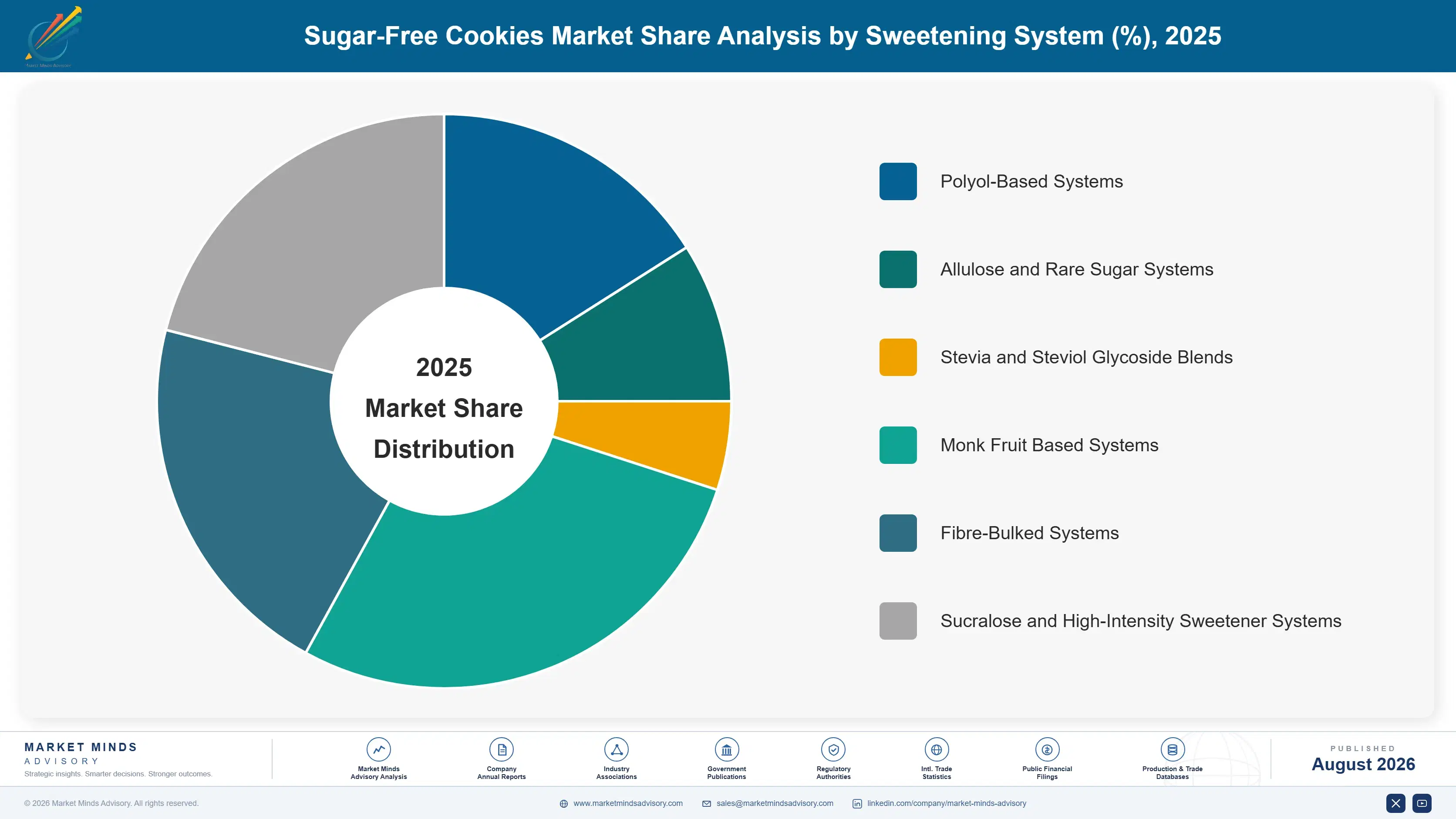
Six segments are split by sweetening system, because the system determines which of sugar's four functions get replaced and how, the regulatory status in each market, the cost structure and the sensory result a shopper actually experiences. Format and flavour variants sit inside each system. Channel and buyer type are handled separately in the framework.
sugar-free-cookies-market-trends-market-share-analysis-1787639501679

Allulose and Rare Sugar Systems

Growing at 11.4%, half again the market rate of 7.6%, allulose is the only widely available sweetener that bulks, browns and melts close enough to sucrose to recover most of what removal destroys, at roughly a tenth of the calories. That addresses the texture failure limiting repeat purchase across the rest of the category. Permitted status in American and Japanese formulation and its absence from European non-sugar treatment mean a brand selling into both runs two recipes producing visibly different products, which is a formulation and inventory burden nobody wanted. Cost per kilogram sits well above sucrose and above polyols, which limits its use to markets whose retail price points can support it.
CAGR 11.4%

Stevia and Steviol Glycoside Blends

At 9.2% steviol glycoside blends carry sweetness with a clean label position that polyols and sucralose cannot match, which matters to shoppers reading ingredient lists rather than nutrition panels. Sweetness is all they deliver, so bulk, browning and moisture binding must come from fibres, polyols or protein alongside them, which makes these multi-ingredient systems rather than single substitutions. Newer glycoside fractions have reduced the lingering bitterness that limited earlier generations, and blend formulation is where most of the technical differentiation now sits. Clean label positioning is what these systems sell on, and it matters to a shopper who reads the ingredient list rather than the nutrition panel, which is an increasing share of this category's buyers.
CAGR 9.2%
Full segment breakdown across 6 segments available in the complete report.

Regional Architecture and Country Demand Map

East Asia holds 28% of value on very large diabetic populations sitting inside the world's biggest packaged biscuit markets. North America follows at 27%, where allulose availability has moved formulation further than anywhere else. South Asia and Pacific grows fastest of the seven regions. All shares stay in band.

North America

Allulose availability has moved formulation further here than anywhere, because it recovers bulk and browning rather than sweetness alone and therefore addresses the texture failure that suppresses repeat purchase. Appetite suppressing medication has reshaped basket composition faster than in other markets, favouring smaller and protein-forward formats over sharing packs. Retailer own label ranges are extensive and compress branded pricing. Growth at 8.2% reflects reformulation quality improving rather than any expansion in the number of shoppers entering the category. Specialist brands with better texture are taking share from broad-range incumbents, which is a reversal of how this category behaved for most of the previous decade. Own label ranges are extensive and growing.
Share: 27% | CAGR: 8.2% (2026 to 2036)

Western Europe

Regulatory treatment of allulose leaves European formulators working with polyols, steviol glycosides and fibre systems that recover sweetness far better than they recover texture, which caps how good these products can be here. Mainstream biscuit reformulation under nutrition profiling has been aggressive and produces a cheaper product that tastes better than the sugar-free alternative. Clean label scrutiny disadvantages sucralose and polyols specifically. Growth of 6.2% is the slowest anywhere, held back by both regulation and mainstream competition. Manufacturers here are effectively competing with one hand tied, and several have concentrated formulation investment in markets where the better sweetener is actually permitted. Clean label scrutiny disadvantages sucralose and polyols specifically, which narrows the options further still.
Share: 22% | CAGR: 6.2% (2026 to 2036)
Regional intelligence for 5 additional markets available in the complete report: East Asia, South Asia and Pacific, Latin America, Middle East and Africa, Eastern Europe. Contact sales@marketmindsadvisory.com.
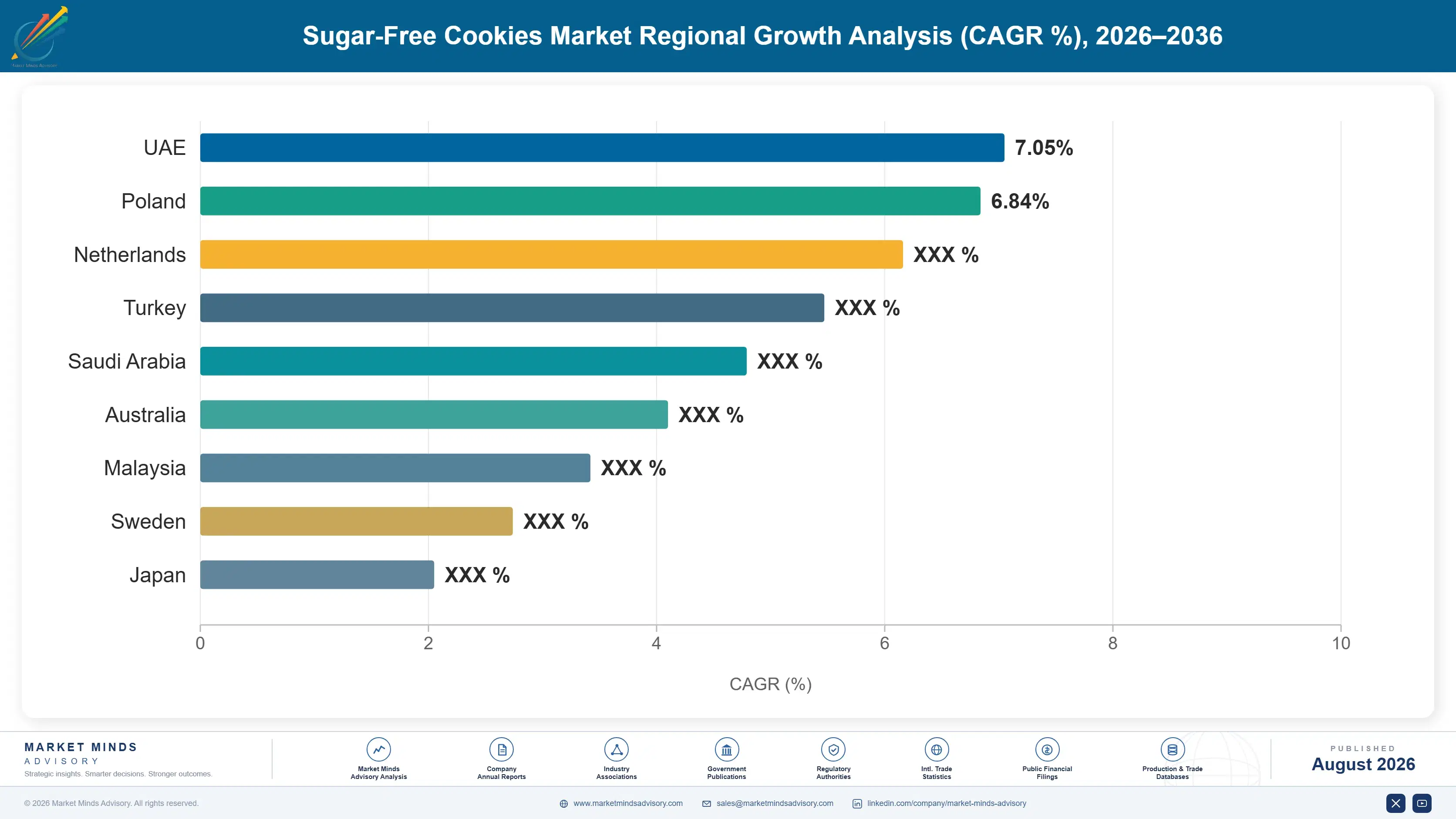
sugar-free-cookies-market-trends-country-cagr-analysis-1787639502191

Four Moves Toward the Second Purchase

Only about 38% of buyers come back, which means this category spends heavily to acquire shoppers it then loses on texture within a single pack. Every move worth making improves what happens after the first bite, or finds the buyer whose reason for being here is not dieting at all. Both are within reach now.

Fix texture before spending anything on acquisition

Repeat purchase near 38% means roughly two in three shoppers are acquired once and lost, which makes texture the most expensive unresolved problem in this category. Allulose, fibre bulking and fat system work all address the bulk and moisture functions that high-intensity sweeteners leave uncovered. A five point improvement in repeat rate is worth more than any comparable spend on promotion, and it compounds across every subsequent period rather than resetting. Promotional spending that lifts trial without moving repeat is funding a leaking bucket, which is what most of this category currently does.
Market Impact: Lifts repeat rate above the 38% current baseline

Build formats around appetite suppressed consumption

Consumers on appetite suppressing medication want smaller, denser and protein-forward products rather than sharing packs, and they are a growing share of the shoppers actually in this aisle. Packs below 100 grams with meaningful protein content answer that directly. Incumbent brands are still building around indulgence cues and family formats, which leaves a genuinely new buyer under-served by everybody currently on shelf. These consumers take direction from clinical and online community sources that no biscuit manufacturer currently participates in or appears to be watching at all. Reaching them requires being present where they actually decide.
Market Impact: Targets pack formats below 100 grams each time

Run separate formulations rather than one compromise recipe

Allulose is available in American and Japanese formulation and absent from European non-sugar treatment, and manufacturers trying to run one global recipe end up with the European compromise everywhere. That sacrifices the texture advantage in the market where it is permitted, to save an inventory complication. Two recipes cost more to manage and produce a materially better product in the market growing at 8.2%, which is the right trade. Manufacturing complexity is the cost and a materially better product in the larger premium market is what it buys, which is a straightforward trade once stated plainly.
Market Impact: Serves 8.2% growth in the North American market

Target diabetic household purchase in large biscuit markets

India grows at 12.6% because sugar-free variants have become mainstream inside an enormous biscuit market, and purchase is often made for a whole household rather than one person, which lifts volume per buyer considerably. Price points there require polyol and sucralose systems rather than allulose economics. Manufacturers applying western formulation and pricing assumptions to that market are addressing it with the wrong product entirely. Household rather than individual purchase is the mechanism, and it lifts volume per buyer well beyond what western consumption patterns would suggest to a planner. The product itself has to change.
Market Impact: Follows 12.6% Indian demand growth in every year

Who Controls the Margin Pool

Participation is measured on annual retail sales value of sugar-free biscuit products, and the top five hold 31%. Concentration is low because retailer own label carries substantial share and specialist brands enter easily through contract manufacture. Mondelez International and Britannia Industries lead through distribution reach rather than any formulation advantage, and the gap to challengers is shelf access rather than product capability. Contract manufacture lowers the barrier further for challengers.
Competition runs on three fronts. Formulation quality decides repeat purchase, which is where most of the category's value is currently being lost. Distribution reach decides trial, and mainstream grocery access is what separates the leaders. And price decides against reformulated mainstream biscuits, which is a contest the category generally loses on cost alone. Format innovation has become a fourth front as medicated consumers enter the category with quite different requirements.

Pressure ahead comes from mainstream reformulation narrowing the reason to pay a premium, and from own label compressing branded pricing. Expect specialists with better texture to take share from broad-range incumbents. Rankings shift on who solves the second purchase rather than who buys the most display space. Concentration should stay low while own label keeps expanding.
sugar-free-cookies-market-trends-company-positioning-matrix-1787639502712

Competitive Moat and Risk Dimensions

MONDELEZ INTERNATIONAL

Moat: Distribution reach and brand permission

Mainstream grocery distribution at a scale specialists cannot approach delivers trial volume that no amount of product quality generates on its own, and established biscuit brands carry permission to extend into sugar-free without the credibility problem a new name faces. That combination converts shelf presence into repeat trial across a very large shopper base.
MONDELEZ INTERNATIONAL

Risk: Mainstream reformulation cannibalisation

The same portfolio includes conventional biscuits being reformulated down by around thirty percent in sugar, which taste better and cost half as much, so the company competes against itself in the aisle. That tension is unavoidable given the portfolio breadth, and it caps how hard the sugar-free range can be pushed without damaging the core.
BRITANNIA INDUSTRIES

Moat: Indian scale and price capability

Manufacturing and distribution scale across the fastest growing country in this category, combined with formulation built for Indian retail price points rather than adapted down from western recipes, addresses a market growing at 12.6% that western manufacturers consistently misjudge. Household purchase behaviour there also lifts volume per buyer well beyond western norms.
BRITANNIA INDUSTRIES

Risk: Polyol system quality ceiling

Price points that work in Indian retail require polyol and sucralose systems rather than allulose, which caps achievable texture and leaves the products exposed if consumer expectations rise with income. Migrating to better sweetener systems means either raising price points or absorbing cost, and neither is comfortable in that market.

Players Tracked

Prominent Players

Mondelez International
Britannia Industries
Lotus Bakeries
Voortman Bakery
Zydus Wellness

Other Key Players

Nestle
Kellanova
Ferrero
Bahlsen
Griesson de Beukelaer
Parle Products
ITC Limited
Orion Corporation
Lotte Wellfood
Meiji Holdings
Ezaki Glico
Want Want China
Quest Nutrition
Catalina Crunch
HighKey Snacks

Recent Developments

MARCH 2026

Manufacturer reformulates American range onto allulose bulking system

A biscuit manufacturer reformulated its American sugar-free range onto an allulose bulking system to recover browning and crumb texture, keeping the existing polyol and steviol recipe for European supply. Two separate formulations now run for what had previously been a single global product. Inventory complexity rose accordingly.
Signal: Regulatory divergence is forcing two separate recipes where manufacturers had wanted only one to manage properly
SEPTEMBER 2025

Retailer expands own label sugar-free biscuit range on margin

A grocery retailer expanded its own label sugar-free biscuit range, citing category margin contribution well above conventional biscuits given the price premium these products carry. Branded pricing in the same fixture came under pressure within the following two quarters. Category shelf space expanded overall. Branded share fell modestly.
Signal: Own label expansion grows the category shelf and compresses the branded premium simultaneously at the same time
DECEMBER 2025

Brand launches small format protein biscuit for medicated consumers

A specialist brand launched a sub-hundred gram high-protein sugar-free biscuit format aimed explicitly at consumers using appetite suppressing medication, replacing sharing pack formats that had been performing poorly with that shopper group in basket data. Sharing formats were withdrawn from that range entirely. Basket data drove the decision.
Signal: Format rather than recipe is what this newer buyer group is actually responding to so far

Sweeteners, Fats and Flour

Sweetener systems carry around 29% of ingredient cost, far above the roughly 8% sucrose represents in a conventional biscuit, because four functions require several ingredients rather than one. Fats and oils take about 22% and matter more here since they compensate for lost moisture binding. Flour and fibre bulking account for around 19%. Protein additions, flavours, packaging and energy absorb the balance across most manufacturers.
Edible oil pricing moved sharply through recent seasons alongside energy costs, per USDA oilseed market reporting and Mondelez International Annual Report 2025 commentary on commodity exposure. Sugar-free formulations absorbed that movement more heavily than conventional biscuits because fat content is generally higher, which compressed margins in a category already carrying elevated ingredient cost. Several manufacturers absorbed rather than passed through the increase, given how visible the price gap already was.

Exposure divides on sweetener system rather than on manufacturing scale. A polyol-based producer carries relatively stable and commoditised sweetener pricing at low cost. An allulose formulation carries a specialist ingredient with fewer suppliers and thinner supply, priced well above sucrose. Steviol glycoside and monk fruit systems carry agricultural extract pricing that behaves differently again, and blends carry all three exposures at once.
sugar-free-cookies-market-trends-cost-volatility-analysis-1787639502907

Contract specialist sweetener supply on multi-year terms

Allulose, steviol glycosides and monk fruit extracts come from far fewer suppliers than sucrose and carry thinner supply chains, which makes availability as much a risk as price. Multi-year contracting secures both, and it matters most for exactly the newer systems that deliver the texture advantage this category depends on for repeat purchase. Availability matters as much as price.

Reduce fat dependence through fibre and protein bulking

Fat compensates for the moisture binding sugar used to provide, which leaves these formulations more exposed to edible oil pricing than conventional biscuits are. Soluble fibre and protein systems recover part of that function at lower fat inclusion, cutting the exposure while improving the nutrition panel that this category's buyer actually reads. The nutrition panel improves alongside it.

Match sweetener system to regional retail price points

Allulose economics do not work at Indian or Latin American retail price points, while polyol systems cap achievable texture in premium western markets. Running the right system per market rather than one global recipe costs complexity and delivers both the margin and the product quality each market can actually support. One global recipe serves neither market well.

Portfolio Architecture for Margin Defence

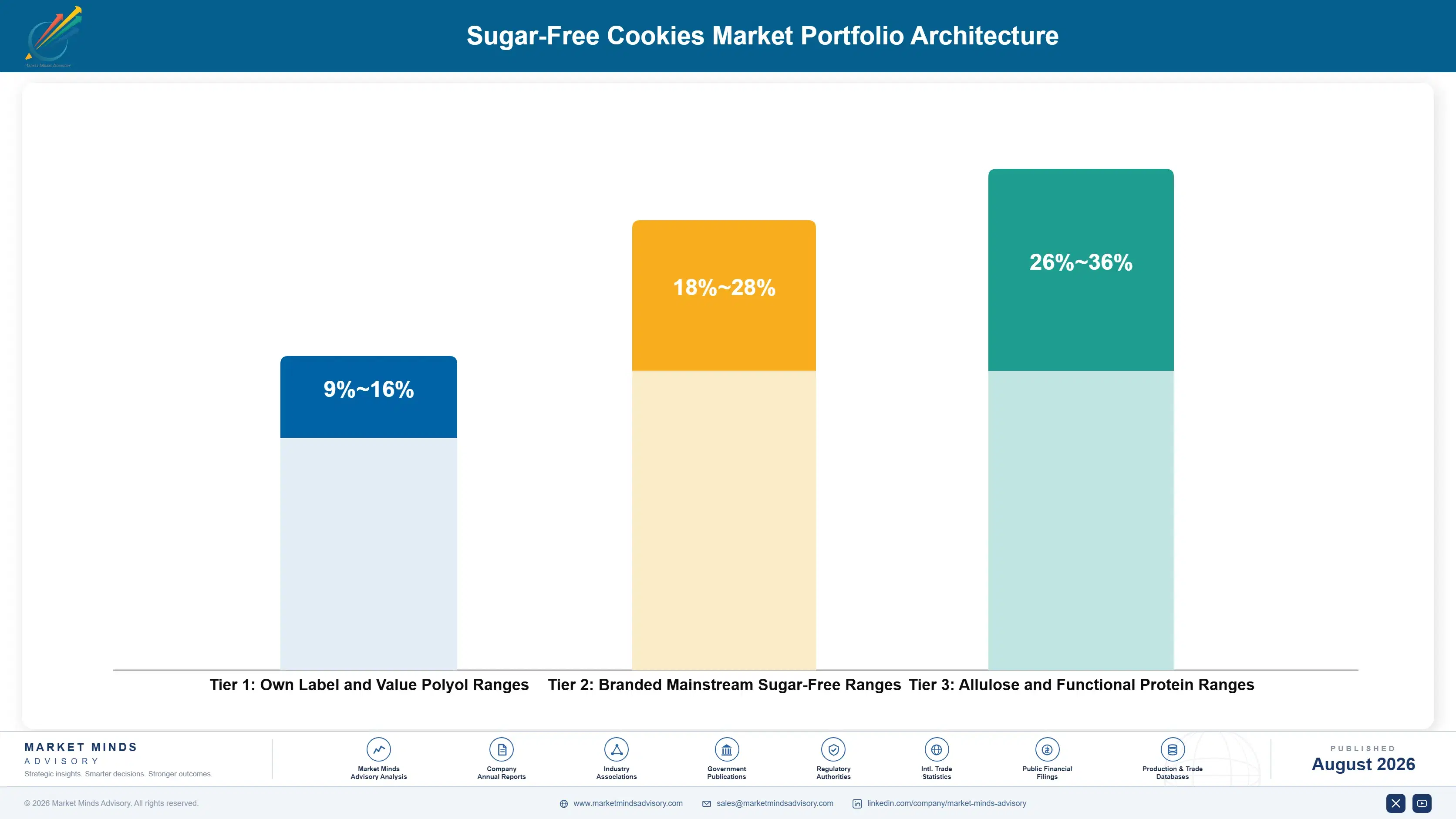
Margin here follows repeat purchase rather than price premium, because a product sold once at twice the price earns less over a year than one sold monthly at a smaller uplift. Own label and value polyol-based ranges earn margins in the high single digits to mid teens, where retailer pricing power and commoditised sweetener systems leave very little room to work with. Volume without repeat is not worth much here. Retailers hold the pricing power.
Branded mainstream sugar-free ranges do better in the high teens to high twenties, because brand permission supports the premium and distribution reach delivers trial volume, though mainstream reformulation is steadily narrowing the reason a shopper pays the difference at all. That competition sits in the same fixture, which makes the comparison unavoidable for any shopper standing there.

Allulose formulated and functional protein-forward ranges hold the strongest position, reaching into the mid thirties, where texture parity supports both the premium and the second purchase. Those margins reflect formulation quality and buyer specificity rather than any advantage in manufacturing cost or distribution scale. Very few manufacturers have built products for a buyer they have actually identified.

Own Label and Value Polyol Ranges

Retailer own label and value branded products built on commoditised polyol systems. The seven point range reflects retailer pricing power and ingredient cost position rather than any meaningful difference in the eating experience delivered.
Gross Margin: 9-16%

Branded Mainstream Sugar-Free Ranges

Established biscuit brands extending into sugar-free with distribution reach behind them. The ten point range reflects brand permission and how directly the range competes with reformulated conventional products in the same fixture.
Gross Margin: 18-28%

Allulose and Functional Protein Ranges

Texture-parity formulations and protein-forward formats built for medicated and diabetic consumers specifically. The ten point range reflects formulation quality and how precisely the format matches the buyer it was designed for.
Gross Margin: 26-36%
sugar-free-cookies-market-trends-portfolio-architecture-1787639503409

High-value Sub-segments and Strategic Watch-out

Allulose Formulated Ranges

High value and the fastest growth at 11.4%, because allulose recovers bulk and browning rather than sweetness alone and lifts the repeat purchase rate that limits everything else. European regulatory treatment excludes it from half the western market. Cost per kilogram remains well above polyols.
Gross Margin: 28-36%

Protein-Forward Small Formats

High value and growing quickly on consumers using appetite suppressing medication who want density rather than permission. Packs below 100 grams answer that directly, and incumbent brands are still building sharing formats instead. These buyers are newer than the category's own assumptions. Specialists reached them first.
Gross Margin: 27-35%

Own Label Polyol Ranges

The volume core, where retailer pricing power and commoditised sweetener systems leave little margin and advisory labelling above ten percent polyol content caps how much sugar bulk can actually be replaced. Retailer pricing power decides almost everything here. Advisory labelling caps the polyol dose that can be used.
Gross Margin: 9-16%

Repeat Purchase Exposure

The strategic watch-out. Only around 38% of first-time buyers return, and the range reflects how far a manufacturer has solved the texture problem rather than continuing to buy trial it cannot convert into habit. Trial spending without repeat conversion is simply wasted. Texture is where the loss happens.
Gross Margin: 7-34%

Three Buyers, One Fixture

Demand here comes from three quite different shoppers standing in front of the same shelf. A diagnosed diabetic buys on medical necessity and returns reliably as long as the product is tolerable. A calorie-conscious shopper buys on aspiration and abandons the category the moment texture disappoints. A consumer on appetite suppressing medication wants density and protein rather than permission, and is newer than either. All three stand at the same fixture.
Stickiness follows necessity rather than preference. Medical purchase repeats for years, since the alternative is doing without, and household buying in markets like India multiplies that volume considerably. Aspirational purchase is the trial the category keeps paying for and losing, at a repeat rate near 38%. Medicated consumers repeat where format matches and disappear where it does not.

The deciding influences have shifted as well. Diabetic purchase increasingly follows dietitian or pharmacist guidance rather than shelf browsing. Aspirational purchase responds to front-of-pack claims and price against reformulated mainstream products. Medicated consumers take direction from clinical and online community sources that no biscuit manufacturer currently participates in or appears to be watching. Nobody in this category is present in that conversation.
sugar-free-cookies-market-trends-end-use-penetration-index-1787639503901

Where We Would Put Effort

These are among the four positions where our research anticipates prominent divergence between winners and laggards over the coming forecast period. Each is grounded in the demand model, the regulatory perimeter, and the announced capacity pipeline.
01 / TEXTURE PARITY INVESTMENT

Two in three buyers never come back

Repeat purchase near 38% means this category acquires shoppers expensively and loses most of them inside a single pack, on texture rather than on price or on any failure of health messaging. Allulose bulking, fibre systems and fat structure work all address the functions a high-intensity sweetener leaves uncovered when sugar comes out. A five point repeat improvement outperforms any comparable promotional spend and it compounds every period rather than resetting to zero each time a promotional period comes to its end.
02 / MEDICATED CONSUMER FORMATS

The newest buyer wants a different product

Consumers on appetite suppressing medication eat less overall and want small, dense and protein-forward products rather than permissive sharing formats, which makes a large pack an actively unwanted purchase for them. They are a growing share of shoppers in this fixture and almost nobody has built for them. Packs below one hundred grams with real protein content answer the need directly, and incumbent brands remain committed to indulgence cues and sharing formats instead of building anything for them at all.
03 / REGIONAL RECIPE DISCIPLINE

One global recipe means the European compromise

Allulose is permitted in American and Japanese formulation and absent from European non-sugar treatment, so any manufacturer that insists on running a single worldwide recipe ends up imposing the weaker European formulation everywhere it happens to sell. That sacrifices texture advantage in a market growing at 8.2% purely in order to avoid an inventory complication. Running two separate formulations costs some manufacturing complexity and delivers a materially better product in the market where regulation actually permits one to be made properly.
04 / HOUSEHOLD PURCHASE TARGETING

India buys for a family, not a diet

India grows fastest of any country at 12.6% because sugar-free variants sit in mainstream biscuit fixtures rather than in specialist ones, and purchase is frequently made for an entire household rather than one diagnosed individual. That lifts volume per buyer far above anything western consumption patterns would suggest. Retail price points there require polyol and sucralose systems, so manufacturers applying western formulation and pricing assumptions arrive with entirely the wrong product at entirely the wrong price point for that shopper.

Engagement Snapshot From the Field

A live engagement with an industry participant carrying material or product regulatory and market exposure ahead of a defining policy shift, showing how our research translates into a defensible multi-year portfolio strategy.
MARKET MINDS ADVISORY · CLIENT ENGAGEMENT SUMMARY
Sugar-Free Cookies Producer Strategic Portfolio Review and Transition Roadmap 2026·Investment Scenario on Sugar-Free Cookies Exposure Evaluation 2025-26
CLIENT PROFILE
A branded biscuit manufacturer selling sugar-free ranges across North American and European grocery retail alongside a larger conventional biscuit portfolio, at annual revenue near 190 million dollars from the sugar-free range (client-reported, unverified by MMA). One global recipe was used across both regions to simplify manufacturing. Promotional spending had been rising for three years. Repeat purchase was not tracked.
STRATEGIC CHALLENGE
Sugar-free revenue had grown on distribution expansion while repeat purchase stayed stubbornly low, and promotional spend was rising to hold volume. Management could not tell whether the problem was awareness, price or the product itself, and a reformulation decision was overdue. The board wanted an answer within the quarter. Capital was already committed.
MMA APPROACH
MMA measured repeat purchase against blind sensory testing across the client's range and competing products, quantified where the single global recipe was underperforming allulose formulated competitors, sized the medicated consumer segment from basket data, and compared category performance against reformulated conventional biscuits in the same fixtures. Interviews with 47 experts covered bakery formulation, sweetener systems and grocery category management.
KEY FINDINGS
  1. Repeat purchase tracked sensory scores almost exactly, and promotional spend lifted trial without moving repeat at all across every market examined in the study.
  2. The single global recipe imposed European formulation constraints on American production, where allulose formulated competitors scored materially higher on texture and held better repeat rates.
  3. Consumers on appetite suppressing medication were buying small formats from specialist brands and skipping the client's sharing packs entirely, which basket data showed clearly.
  4. Reformulated conventional biscuits in the same fixture outscored the client's sugar-free range on taste at roughly half the shelf price, which explained much of the abandoned trial.
CLIENT PROFILE
A branded biscuit manufacturer selling sugar-free ranges across North American and European grocery retail alongside a larger conventional biscuit portfolio, at annual revenue near 190 million dollars from the sugar-free range (client-reported, unverified by MMA). One global recipe was used across both regions to simplify manufacturing. Promotional spending had been rising for three years. Repeat purchase was not tracked.
STRATEGIC CHALLENGE
Sugar-free revenue had grown on distribution expansion while repeat purchase stayed stubbornly low, and promotional spend was rising to hold volume. Management could not tell whether the problem was awareness, price or the product itself, and a reformulation decision was overdue. The board wanted an answer within the quarter. Capital was already committed.
MMA APPROACH
MMA measured repeat purchase against blind sensory testing across the client's range and competing products, quantified where the single global recipe was underperforming allulose formulated competitors, sized the medicated consumer segment from basket data, and compared category performance against reformulated conventional biscuits in the same fixtures. Interviews with 47 experts covered bakery formulation, sweetener systems and grocery category management.
KEY FINDINGS
  1. Repeat purchase tracked sensory scores almost exactly, and promotional spend lifted trial without moving repeat at all across every market examined in the study.
  2. The single global recipe imposed European formulation constraints on American production, where allulose formulated competitors scored materially higher on texture and held better repeat rates.
  3. Consumers on appetite suppressing medication were buying small formats from specialist brands and skipping the client's sharing packs entirely, which basket data showed clearly.
  4. Reformulated conventional biscuits in the same fixture outscored the client's sugar-free range on taste at roughly half the shelf price, which explained much of the abandoned trial.
RECOMMENDED STRATEGY
Phase 1: Phase one: reformulate the American range onto an allulose bulking system, accepting two recipes rather than imposing the European constraint on both markets. Phase 2: Phase two: launch sub-hundred gram protein-forward formats aimed at medicated consumers, who are currently buying from specialists the client does not track. Phase 3: Phase three: redirect promotional spend from trial generation into formulation work, since trial without repeat has been funding a leaking bucket.
OUTCOME
The manufacturer reformulated its American range during 2026 and reported repeat purchase improving several points on the reformulated products (client-reported, unverified by MMA). Promotional spend was reduced and redirected, and small format launches were scheduled for the following year. Distribution expansion was paused while formulation work completed.

Frequently Asked Questions

Foundational context covering the market sizes, CAGR, scope, country, region and competition that inform every finding below. This section is provided to cover basics and most often pre-purchase conversations, answered from the MMA Primary Research Dataset.

What is the current size of the Sugar-Free Cookies Market?

MMA sizes it at USD 3.4 billion in 2025, rising to USD 3.66 billion in 2026. The figure covers biscuits formulated without added sugars at manufacturer selling value across all sweetener systems.

How large will the Sugar-Free Cookies Market be by 2036?

USD 7.61 billion by 2036, an incremental USD 3.95 billion over the 2026 base and an expansion multiple of 2.08 times. Allulose systems account for a disproportionate share of that.

What is the CAGR for the Sugar-Free Cookies Market 2026 to 2036?

7.6% in the base case, with a bull case at 8.8% and a bear case at 6.4%. The spread turns on texture improvement against mainstream biscuits reformulating to lower sugar.

Which segment is growing fastest?

Allulose and rare sugar systems at 11.4%, half again the market rate of 7.6%. Allulose bulks and browns like sucrose, which recovers the texture that high-intensity sweeteners cannot.

Who are the major companies in the Sugar-Free Cookies Market?

Mondelez International, Britannia Industries, Lotus Bakeries, Voortman Bakery and Zydus Wellness lead on retail sales value. Fifteen further participants are profiled in the full report.

Which country is growing fastest?

India at 12.6%, where a very large diagnosed diabetic population sits inside an enormous packaged biscuit market and sugar-free variants have become mainstream rather than specialist.

Report Segmentation Architecture

The full report scope spans multiple orthogonal segmentation dimensions, with cross-tabulated demand data provided for each dimension pair. Coverage extends further to regional breakdowns, trend trajectories, and the competitive detail needed to support segment-level decision-making.

By Sweetening System

  • Polyol-Based Systems
  • Allulose and Rare Sugar Systems
  • Stevia and Steviol Glycoside Blends
  • Monk Fruit Based Systems
  • Fibre-Bulked Systems
  • Sucralose and High-Intensity Sweetener Systems

By End-Use Industry

  • Grocery Retail
  • Pharmacy and Health Retail
  • Convenience and Impulse Retail
  • Online and Direct to Consumer
  • Foodservice and Institutional Catering
  • Clinical and Hospital Nutrition

By Commercial Dimension

  • Branded Manufacturer Supply
  • Retailer Own Label Manufacture
  • Specialist and Challenger Brands
  • Contract and Co-Manufacture
  • Direct to Consumer Subscription
  • Export and Cross-Border Supply

By Region

  • North America
  • Western Europe
  • East Asia
  • South Asia and Pacific
  • Latin America
  • Middle East and Africa
  • Eastern Europe

Scope, Methodology, and Coverage

Every figure in this report is reproducible from documented input assumptions. The scope below maps the historical period, the forecast horizon, the segmentation dimensions, and the countries covered, alongside the underlying primary and qualitative methodology.
Historical Period
2020 to 2025
Forecast Period
2026 to 2036
Base Year
2025 (USD billions; MMA Primary Research Dataset, August 2026)
Market Definition
Sweet biscuits and cookies formulated without added sugars, covering polyol-based systems, allulose and rare sugar systems, stevia and steviol glycoside blends, monk fruit based systems, fibre-bulked systems, and sucralose and high-intensity sweetener systems. Measured at manufacturer selling value. Reduced-sugar and no-added-sugar products still containing sucrose, savoury biscuits and crackers, cakes and pastries, protein bars, and sweetener ingredients sold separately are excluded from scope.
Quantitative Units
USD billions (current prices); thousand tonnes produced; USD per kilogram by sweetening system
Segmentation Dimensions
Sweetening system; retail channel; commercial dimension; region
Regions Covered
North America, Western Europe, East Asia, South Asia and Pacific, Latin America, Middle East and Africa, Eastern Europe
Countries Covered
United States, Canada, Mexico, United Kingdom, Germany, France, Spain, Italy, China, Japan, South Korea, India, Indonesia, Australia, Brazil, Argentina, Saudi Arabia, South Africa, Poland, Czech Republic
Key Companies Profiled
Mondelez International, Britannia Industries, Lotus Bakeries, Voortman Bakery, Zydus Wellness, Nestle, Kellanova, Ferrero, Bahlsen, Griesson de Beukelaer, Parle Products, ITC Limited, Orion Corporation, Lotte Wellfood, Meiji Holdings, Ezaki Glico, Want Want China, Quest Nutrition, Catalina Crunch, HighKey Snacks
Quantitative Methodology
Primary survey, n=3,800 respondents, Q4 2025, six countries; demand-side model with trade association cross-validation
Qualitative Methodology
47 expert interviews, Q4 2025; applied to validate demand model assumptions, identify emerging dynamics, and assess competitive positioning
Report Format
PDF and XLSX data workbook (Word format preview document)
Publisher
Market Minds Advisory
Report Code
MMA-2026-AGR-192
Published
August 2026
Contact
sales@marketmindsadvisory.com | www.marketmindsadvisory.com

Purchase the full Sugar-Free Cookies Market Report (2026 to 2036).

The full report treats repeat purchase as the central commercial problem in this category, because a repeat rate near 38% means most acquisition spending funds shoppers who never return. It sizes all six sweetening systems independently through 2036, quantifies how allulose regulatory divergence splits formulation between markets, and measures sugar-free products against reformulated conventional biscuits in the same fixtures. Regional chapters cover all seven regions with buyer type analysed separately from volume. Competitive profiling covers 20 participants on one consistent retail value basis. Format performance is analysed by buyer type throughout.
Six sweetening systems sized independently through 2036
Repeat purchase measured against blind sensory performance by system
Allulose regulatory divergence mapped across formulation and market
Medicated consumer segment sized from basket level data
Sugar-free products benchmarked against reformulated conventional biscuits
Twenty participants profiled on one consistent retail value basis

Built For The People Who Decide

From boardroom strategy to bench-side execution, this report is read cover-to-cover by leaders shaping the next decade of their industry, turning demand scenarios, market dynamics and valuation benchmarks into decisions.
CXOs/ Presidents/ VPs/ Managers
M&A and Corporate Development
Strategy Teams and R&D Heads
Procurement and Product Directors
Regulatory and Compliance Leaders
Investor Relations and Equity Analysts