Market Minds Advisory
Sugar-Free Candy Market

Sugar-Free Candy Market: Polyol Tolerance Limits, Format Difficulty and Mainstream Repositioning, 2026 to 2036

Sugar alcohols carry a laxation warning above ten grams in a single serving, which quietly caps portion size and explains why this category never escaped the pharmacy aisle for thirty years.

Lead Analyst

Lisa Gevelber

Published

September 2026

Make Smarter Decisions with Customized Research Insights

Request a free sample report and evaluate market opportunities, growth trends, and competitive dynamics relevant to your business needs.

2025 MARKET VALUE$2.8BMarket Size 2025
2036 FORECAST VALUE$6.0BBase Case , 2026 to 2036
CAGR 2026 TO 20367.2 %Bull 8.4% / Bear 6.0%
INCREMENTAL OPPORTUNITY$3.0BNet 10- year value creation
EXPANSION MULTIPLE2.00x2036 value over 2026 base
Strategic Levers
M&A Pipeline
Regional Outlook
Country Rankings
Competitive Intelligence
Segmental Deep-dive
Call-Us : 91 93563 13602

Executive Snapshot and Market Trajectory

This category has stopped selling only to diabetics and started selling to just about everybody. Sugar-free confectionery spent three decades positioned in pharmacy and dietetic aisles, and its recent growth comes almost entirely from mainstream shoppers buying a sugar reduction claim rather than managing a condition.
Sugar-free gummies and jellies grow at 10.8%, a full 1.50 times the market rate, because gummies were the hardest format of all to build without sugar, and solving that opened the fastest-growing confectionery format anywhere to the category. East Asia holds 30% of global value, the largest single share, on Japanese sugar-free mint and candy consumption combined with Chinese sugar reduction reformulation that has moved remarkably quickly since 2021.
Concentration is moderate at 39% for the top five, and the field splits cleanly between global confectioners treating sugar-free as a line extension and specialists who built entire brands upon it. The constraint that everybody in the category shares is polyol tolerance. Above roughly ten grams in a single serving, laxation warnings apply across several jurisdictions, which caps pack format and portion size in ways that sugared confectionery never has to face at all.
Market Definition
The market covers confectionery manufactured without added sugars, spanning sugar-free gummies and jellies, chocolate, hard boiled candy, mints and pastilles, and caramels and chews sold through retail and foodservice channels. It excludes sugar-free chewing gum, reduced-sugar rather than sugar-free formulations, medicated lozenges and throat products sold as medicines, sugar-free bakery and dessert products, and sweetener ingredients sold to manufacturers.
Base Year Value
$2.8B in 2025 (MMA Primary Research Dataset, August 2026)
Forecast Period
2026 to 2036, eleven discrete annual values
CAGR
7.2% base case. Bull 8.4%. Bear 6.0%.
Fastest Growth Segment
Sugar-Free Gummies and Jellies: 10.8% CAGR
Fastest Growth Country
India: 11.0% CAGR
Fastest Growth Region
South Asia and Pacific: 9.5% CAGR
Largest Region
East Asia: 30% of 2025 global value
Market Leaders
Mondelez International, Perfetti Van Melle, Mars Wrigley, Haribo, August Storck. Source: MMA Primary Research Dataset, July 2026.
Primary Survey
n=3,800 procurement and R&D decision-makers, Q4 2025, six countries
Methodology
Demand-side build-up, cross-validated against public data, 47 expert interviews

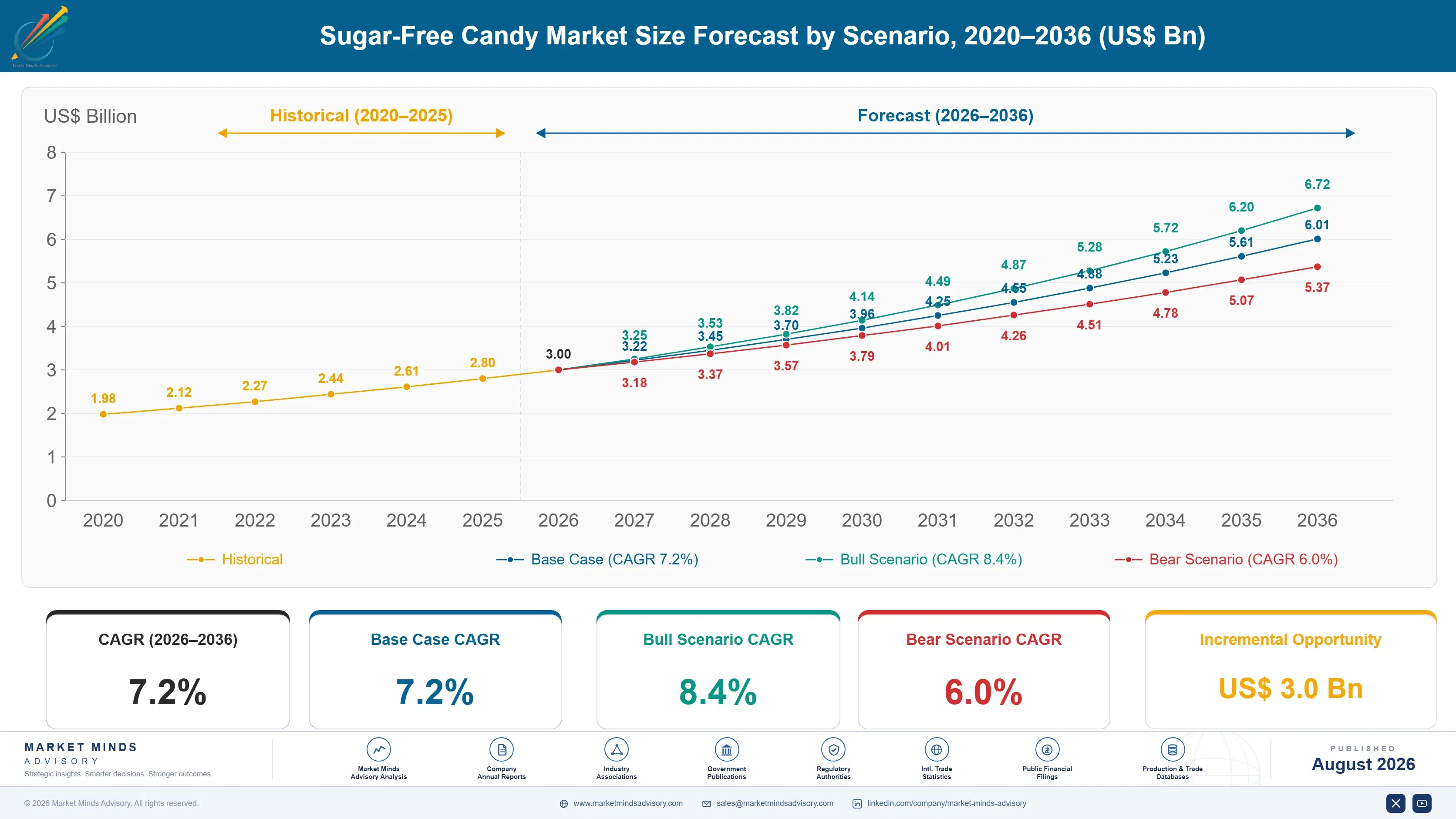
Sugar-Free Candy Market Forecast Scenarios

sugar-free-candy-market-trends-size-forecast-scenario-1787312639448
The market compounded at 6.0% between 2020 and 2025, and the composition of that growth changed entirely across the period. Traditional diabetic and dental positioning stagnated while mainstream sugar reduction claims grew quickly, particularly in gummies where new formats reached shoppers who had never bought sugar-free confectionery before. Polyol pricing rose sharply through 2022 and compressed margins across the category.
The 7.2% base case rests on three mechanisms. First, mainstream repositioning continues as sugar reduction becomes an ordinary purchase consideration rather than a medical requirement. Second, allulose and rare sugars are replacing polyols in premium formulations, which removes the tolerance warning and the portion cap that came with it. Third, confectionery sugar taxes are spreading beyond beverages across a growing number of markets, which changes relative shelf economics in the category's favour.
The bull case at 8.4% assumes rare sugar cost falls enough for mainstream gummy and chocolate reformulation while confectionery sugar taxes widen as proposed. The bear case at 6.0% turns on taste and tolerance together: if consumers who tried sugar-free gummies on a health claim experience the laxation effect and do not return, the category loses exactly the mainstream trial it spent five years building at considerable expense.

Why Tolerance Limits Shape The Category

Sugar performs three jobs in confectionery and sweetness is the least difficult of them. It provides bulk, controls water activity, sets crystallisation behaviour and delivers the mouthfeel that makes a caramel chewy or a hard candy glassy. Removing it means rebuilding the product from the structure outward.
TOP FIVE CONCENTRATION39%Combined position of the five largest sugar-free confectionery makers
AVERAGE RETAIL PRICE$14 per kilogramTypical shelf price across the sugar-free confectionery formats
PREMIUM TO SUGARED1.7 timesMultiple of equivalent sugared confectionery shelf price paid
POLYOL INPUT SHARE31% of COGSSugar alcohol and bulk sweetener share of ingredient cost
TOLERANCE WARNING THRESHOLD10 gramsPolyol intake per serving above which labelling warnings apply
SUGAR REDUCTION LAUNCH SHARE34%Portion of confectionery launches carrying a sugar reduction claim
Polyols solve most of that, being bulk sweeteners rather than high-intensity ones, occupying similar volume and behaving similarly in a boiling pan. What they do not solve is tolerance. Maltitol, sorbitol and isomalt all ferment in the colon, and intake above roughly ten grams per serving triggers labelling warnings in the European Union and causes real discomfort in many consumers. That single fact caps portion size, dictates pack format and limited the category to occasions where people eat a piece or two.
Rare sugars are what change the arithmetic. Allulose and tagatose deliver bulk and sweetness without the laxation threshold, which permits pack formats and eating occasions polyols never allowed. They cost considerably more, so they appear first in premium chocolate and gummy lines rather than value hard candy. Whether the category reaches mainstream volume depends on that cost falling far enough, which is a question about rare sugar capacity rather than confectionery.
"For thirty years this category told people it was for diabetics, then wondered why nobody else bought it. The brands growing now removed every clinical signal from the pack and sell a sweet that happens to have less sugar. That is a marketing decision rather than a technical one, and it has done more for volume than any sweetener development."
Principal Analyst, Confectionery and Sweet Treats Practice · MMA Agriculture Pra

Market Trends

Mainstream Repositioning Replaces Clinical Shelf Placement

Brands have moved sugar-free confectionery out of pharmacy and dietetic fixtures and into mainstream confectionery aisles, removing diabetic and dental language from packaging in favour of ordinary sugar reduction claims. That repositioning has done more for volume than any sweetener improvement. Roughly 34% of confectionery launches now carry a sugar reduction claim of some kind, against about 18% five years earlier. The shoppers buying these products increasingly have no clinical reason to do so, which changes the size of the addressable audience by something close to an order of magnitude.
Market Impact: Covers 19 national markets
Rare Sugars Displace Polyols In Premium Formulations

Allulose and tagatose deliver bulk and sweetness without the laxation threshold that caps polyol inclusion at roughly ten grams per serving, which permits larger pack formats and the sharing occasions this category has never previously been able to serve. Ingredient cost runs three to five times maltitol, so adoption concentrates in premium chocolate and gummy lines where the price point can genuinely absorb it. Roughly 12% of sugar-free confectionery volume now uses rare sugars as the principal bulk sweetener, and that share rises fastest in exactly the formats already growing fastest across the category.
Market Impact: Represents 28% of category volume

Market Opportunities and Growth Drivers

Confectionery Sugar Taxes Spread Beyond Beverages

Sugar taxation began with soft drinks and has extended into confectionery across several markets, with Mexico, Chile, Colombia and parts of the Gulf now applying levies or front-of-pack warning labels to high-sugar sweets. Those measures change relative shelf economics directly rather than waiting for consumer preference to shift on its own. Roughly 19 national markets now apply some form of fiscal or labelling measure to sugar confectionery specifically. Manufacturers reformulating products to stay below those thresholds create sugar-free and reduced-sugar volume that would simply not otherwise have existed at all.
Market Impact: Warns above 10 grams per serving

Gummy Format Growth Pulls The Whole Category

Gummies have grown faster than any other confectionery format for a decade, driven by texture preference, vitamin and supplement crossover and social media visibility. Sugar-free gummies were technically difficult because sugar sets the gel structure alongside the gelatin or pectin, and solving that opened the fastest-growing format to the category. Gummies now represent roughly 28% of sugar-free confectionery volume, against under 15% five years earlier. Format growth rather than sugar-free positioning is doing most of the work, which is both an unusual and a genuinely useful position for any category to occupy.
Market Impact: Prices at 1.7 times sugared equival

Market Restraints and Challenges

Polyol Tolerance Caps Pack Format And Occasion

Maltitol, sorbitol and isomalt ferment in the colon, and intake above roughly ten grams per serving triggers labelling warnings across the European Union and causes genuine discomfort in a meaningful proportion of consumers. The root cause is the same incomplete absorption that makes these sweeteners low calorie, so the two cannot be separated. Commercially this caps pack size, rules out sharing formats and it limits repeat purchase sharply among any consumer who has experienced the effect. Participants are addressing it through rare sugar substitution, blended sweetener systems and deliberately smaller portion pack architecture.
Market Impact: Reaches 34% of confectionery launch

Price Premium Deters Mainstream Repeat Purchase

Sugar-free confectionery sells at roughly 1.7 times the shelf price of equivalent sugared product, driven by polyol and rare sugar ingredient cost rather than by any processing difference. The root cause is that sugar is among the cheapest food ingredients in existence and every substitute costs multiples of it. Commercially this limits the category to shoppers who value the claim enough to pay, which is a narrower group than trial data suggests. Participants respond through smaller pack sizes that lower the absolute price point, and through premium positioning that justifies the difference.
Market Impact: Reaches 12% of category volume
4 additional market trends, 3 additional growth drivers, and 2 additional restraints and challenges are covered in the full report. Contact sales@marketmindsadvisory.com to access the complete intelligence.

Segment CAGR and Growth Architecture

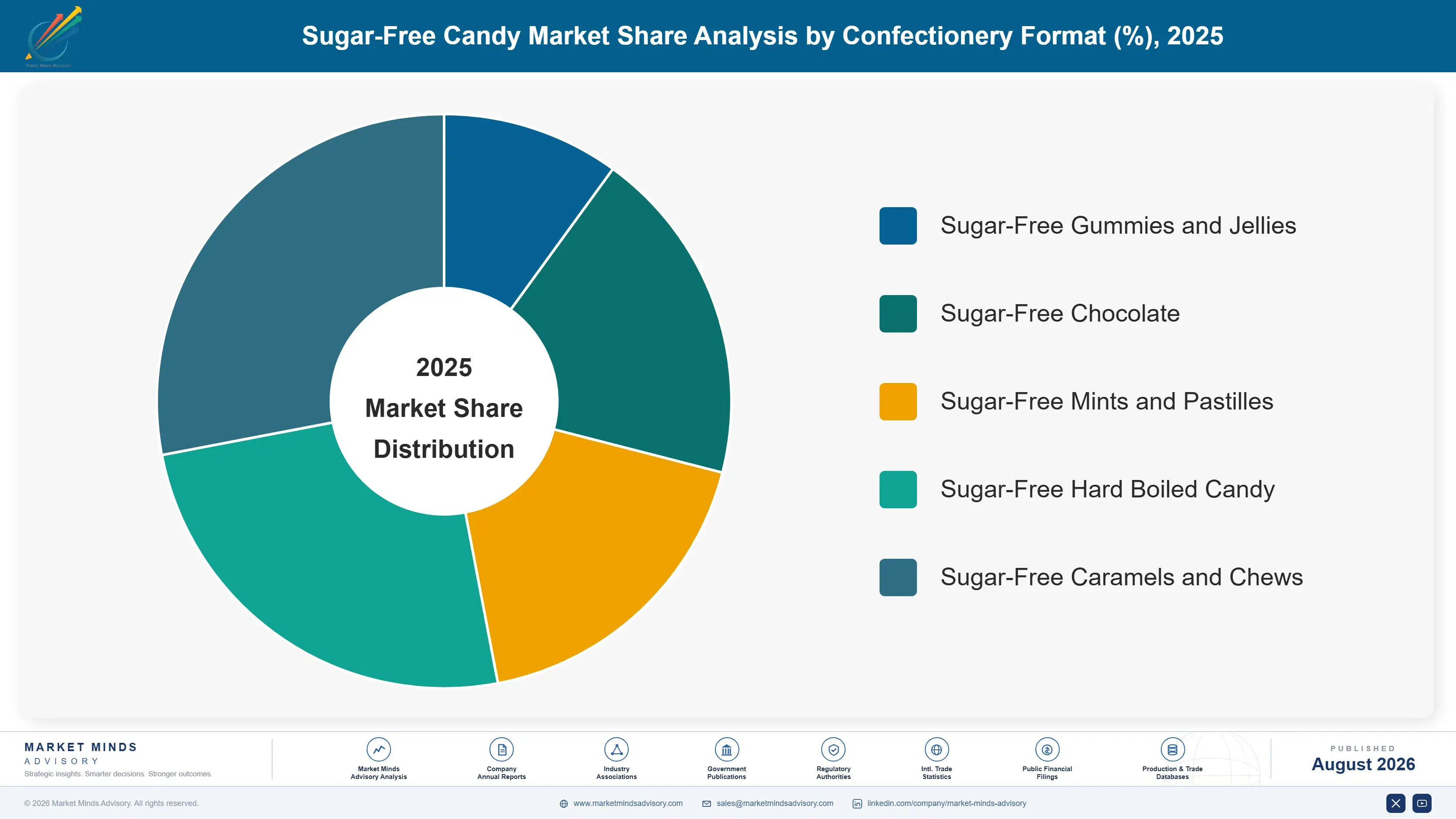
Segmentation follows confectionery format, meaning the product type as a shopper recognises it on shelf. That single dimension determines how difficult the sugar removal actually is, which bulk sweetener systems work, what price point the format can carry, and whether the product is competing directly against sugared confectionery or against very little at all.
sugar-free-candy-market-trends-market-share-analysis-1787312640032

Sugar-Free Gummies and Jellies

The fastest segment at 10.8%, a full 1.50 times the market rate, covering both pectin and gelatin gummies and jellies formulated entirely without added sugars. The technical difficulty here was entirely genuine: sugar sets the gel structure and controls water activity alongside the hydrocolloid, so removing it means rebuilding texture, shelf stability and the characteristic chew simultaneously. Solving that problem gave the category access to the fastest-growing confectionery format of the past decade, and gummies now take roughly 28% of all sugar-free volume. Vitamin and supplement gummy crossover adds a second demand stream that behaves quite differently from ordinary confectionery purchasing, and it brings shoppers who were never confectionery buyers.
CAGR 10.8%

Sugar-Free Chocolate

Growing at 9.3% each year on chocolate formulated with polyols, rare sugars or fibre-based bulking agents in place of sucrose, spanning tablets, countlines and boxed assortments right across the range. Chocolate suits sugar-free reformulation better than most formats, because cocoa flavour carries the eating experience while the sugar contributes bulk and crystallisation behaviour rather than any dominant taste. Premium positioning also absorbs the ingredient cost premium far more comfortably than any value confectionery format ever can. Maltitol remains the volume workhorse across the segment, though it carries the tolerance warning with it, and rare sugar chocolate is where the most interesting product development work and the highest realised pricing both currently sit.
CAGR 9.3%
Full segment breakdown across 5 segments available in the complete report.

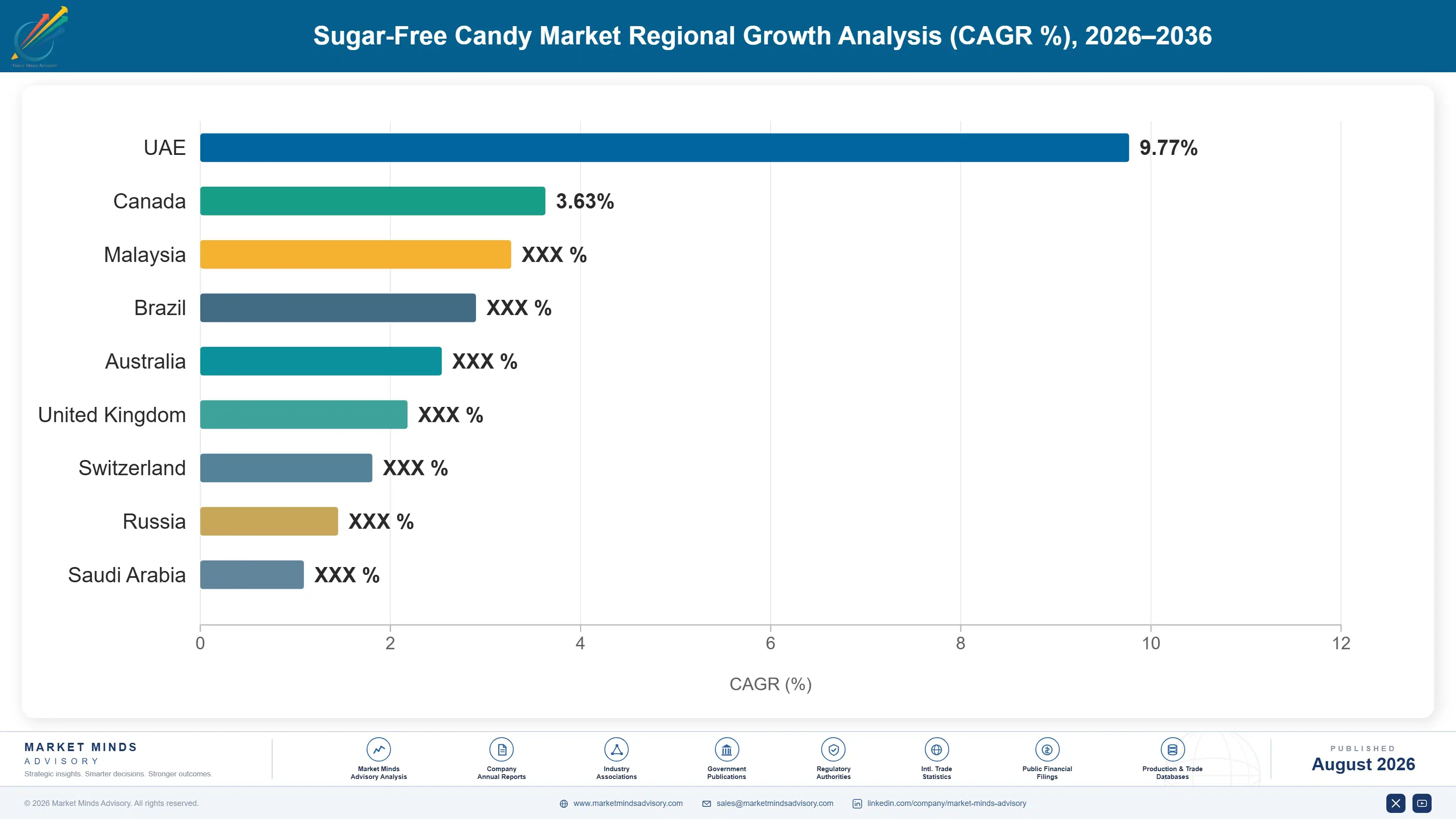
Regional Architecture and Country Demand Map

East Asia leads on established Japanese sugar-free candy consumption combined with rapid Chinese sugar reduction reformulation. South Asia and Pacific grows fastest of all as Indian confectionery modernises and organised retail expands. Western Europe holds the deepest historical penetration and the strictest tolerance labelling requirements.

East Asia

Thirty percent of global value, the largest single regional share, and it rests on two quite different foundations. Japanese consumers have bought sugar-free candies, mints and pastilles as ordinary confectionery for decades without any clinical framing, and per-capita consumption is among the highest anywhere. Chinese sugar reduction reformulation has moved very quickly since 2021 as health consciousness rose across urban markets and domestic manufacturers responded. Korean demand is smaller but premium-weighted. Growth of 8.4% reflects Chinese volume expansion far more than Japanese, where the category is already mature and well established. Clinical framing has never applied here in the way it did across Western markets. Mint and pastille formats dominate Japanese volume.
Share: 30% | CAGR: 8.4% (2026 to 2036)

Western Europe

Twenty-seven percent of value on 5.6% growth, the slowest of the major regions but with the deepest historical penetration anywhere in the world. German and Swiss manufacturers built sugar-free confectionery positions decades ago on dental and dietetic grounds, and those brands remain substantial. European Union labelling requires an excessive consumption warning above defined polyol thresholds, which is stricter than any other regime and directly shapes pack architecture. Growth is slow because the base is large and mature rather than because demand is weak. Rare sugar reformulation is furthest advanced here on regulatory grounds. Own-label sugar-free lines are unusually strong across discount retail here. Pack architecture follows the labelling threshold closely.
Share: 27% | CAGR: 5.6% (2026 to 2036)
Regional intelligence for 5 additional markets available in the complete report: North America, South Asia and Pacific, Latin America, Middle East and Africa, Eastern Europe. Contact sales@marketmindsadvisory.com.
sugar-free-candy-market-trends-country-cagr-analysis-1787312640597

Where Confectionery Margin Actually Accumulates

Four commercial moves separate the brands building genuine mainstream volume from those still selling only to a clinical audience. Each depends on solving something competitors have left alone: the tolerance ceiling, the shelf placement that signals who the product is for, format difficulty in gummies, or pack architecture that manages the absolute price point.

Move Out Of The Dietetic Aisle Entirely

Shelf placement signals who a product is intended for far more powerfully than any packaging claim does, and sugar-free confectionery merchandised in pharmacy or dietetic fixtures reaches only those shoppers already actively looking for it. Brands that secured mainstream confectionery placement and removed all clinical language from packaging report rate of sale improving 60% to 90% on entirely identical product. The change itself costs a packaging revision and a retailer negotiation rather than any reformulation at all, which makes it comfortably the highest-return commercial decision available anywhere in this category today.
Market Impact: Improves rate of sale by up to 90%

Reformulate Premium Lines Onto Rare Sugars

Allulose and tagatose both remove the ten gram tolerance threshold that caps polyol pack sizes, which permits the sharing formats and eating occasions this category has never served. Ingredient cost runs three to five times maltitol, so this works in premium chocolate and gummy lines where the price point absorbs it rather than in value hard candy. Brands doing it realise 25% to 35% above polyol-formulated equivalents and gain access to pack architecture that competitors simply cannot match. The reformulation work itself typically takes nine to fifteen months to complete properly.
Market Impact: Realises up to 35% above polyol-for

Solve Gummy Texture Before Competitors Do

Gummies are the fastest-growing confectionery format anywhere and were also the hardest of all to build without sugar, because sucrose sets the gel structure and water activity alongside the hydrocolloid rather than merely providing sweetness. Brands that solved the texture problem entered a format growing at 10.8% against very limited competition, and gummies now take 28% of total category volume. The development work is genuinely difficult and takes eighteen to thirty months, which is exactly why the competitive field in sugar-free gummies remains considerably narrower than in any other confectionery format.
Market Impact: Enters the fastest growing format a

Design Pack Architecture Around Absolute Price

Sugar-free confectionery sells at roughly 1.7 times the sugared equivalent per kilogram, and shoppers respond to the absolute figure printed on the pack rather than to any price per kilogram comparison they might make. Smaller formats offered at accessible absolute price points convert trial far better than value packs carrying a visible premium, and they also keep polyol intake per serving conveniently below the tolerance threshold. Brands adopting smaller pack architecture deliberately report trial conversion 35% to 50% better than those matching sugared pack sizes at visibly premium shelf prices.
Market Impact: Improves trial conversion by up to

Who Controls the Margin Pool

Concentration is moderate at 39% for the top five, measured on sugar-free confectionery revenue across all participants, and the field divides between global confectioners treating this as a line extension and specialists who built entire brands on it. Mondelez leads on the breadth of its sugar-free positions across formats, and the gap to the second tier is widest in retail distribution rather than in formulation capability.
Competition runs on three dimensions. Shelf placement decides most outcomes, since mainstream confectionery fixtures reach an audience an order of magnitude larger than dietetic aisles. Format capability decides participation in gummies specifically, where the technical barrier remains genuine. Price competition is fiercest in hard candy and mints, where formulation is straightforward, own-label competes directly and the category's oldest positions sit largely undefended.

Two pressures are building. Specialist brands built entirely on sugar-free positioning have proved far better at mainstream repositioning than incumbents extending existing lines, because they carry no clinical brand heritage to overcome. Meanwhile rare sugar availability determines who can build sharing formats, and access to allulose supply is uneven across regions. Rankings shift where mainstream distribution meets rare sugar access, since one without the other limits what a brand can actually sell.
sugar-free-candy-market-trends-company-positioning-matrix-1787312641140

Competitive Moat and Risk Dimensions

MONDELEZ INTERNATIONAL

Moat: Broadest mainstream retail distribution

Distribution across mainstream confectionery fixtures worldwide gives the company shelf access that specialist sugar-free brands spend years and considerable trade investment obtaining. In a category where placement determines audience size more than product quality does, that distribution is worth more than any formulation advantage a competitor could develop.
MONDELEZ INTERNATIONAL

Risk: Cannibalising much larger sugared brands

Sugar-free lines compete directly with sugared brands generating revenue many times larger, and internal enthusiasm for accelerating that substitution is understandably limited. Investment decisions weigh against a core business the same shoppers buy. Specialist competitors carry no such conflict and pursue the opportunity with a commitment incumbents have consistently struggled to match.
PERFETTI VAN MELLE

Moat: Deepest sugar-free format expertise

Long-standing technical capability across sugar-free hard candy, mints and pastilles gives the company formulation depth built over decades rather than acquired recently. That expertise transfers into newer formats, and it shows in texture and shelf stability consistency that competitors entering the category more recently have found genuinely difficult to match.
PERFETTI VAN MELLE

Risk: Strength in slowest growing formats

The company's deepest positions sit in hard candy, mints and pastilles, which grow at roughly half the rate of gummies and chocolate. Building comparable capability in gummies means competing against specialists who solved that texture problem first. Format expertise is genuine but it is concentrated where the category is expanding most slowly of all.

Players Tracked

Prominent Players

Mondelez International
Perfetti Van Melle
Mars Wrigley
Haribo
August Storck

Other Key Players

Hershey
Ferrero
Nestle
Lotte
Meiji
Ricola
Katjes
Cloetta
Fini Group
SmartSweets
Lily's Sweets
Russell Stover
Jelly Belly
Zollipops
Hsu Fu Chi

Recent Developments

JANUARY 2025

SmartSweets expands allulose gummy range into mainstream retail

An extended allulose-sweetened sugar-free gummy range secured mainstream confectionery fixture placement across several of the largest North American grocery chains during the period, moving the range decisively out of the natural and dietetic sections where sugar-free confectionery has historically been merchandised by grocery retailers everywhere.
Signal: Shelf placement rather than any reformulat
MAY 2025

Mondelez launches rare sugar chocolate across European markets

A premium chocolate range using rare sugar bulk sweeteners rather than conventional maltitol was introduced across several major European markets during the year, removing the excessive consumption warning that polyol formulations must carry and permitting the sharing pack formats that those products simply cannot offer.
Signal: Rare sugars are now being adopted specific
SEPTEMBER 2025

Haribo introduces sugar-free gummy line in additional markets

Sugar-free gummy manufacturing and distribution were both extended into a number of further European and Asian markets during the year, targeting directly the fastest-growing confectionery format anywhere with a texture solution that had taken the company several years of development work to bring to genuinely commercial quality.
Signal: Gummy texture capability remains the one g

What Drives Delivered Confectionery Cost

Bulk sweeteners account for roughly 31% of cost of goods, principally maltitol, isomalt and sorbitol, rising sharply where allulose or tagatose replace them. Cocoa and dairy contribute 22% across chocolate formats. Gelatin, pectin and starch add 11% in gummies, packaging contributes 14%, and manufacturing conversion a further 13% at the modest volumes typical of this category.
The 2022 polyol episode compressed margins across the whole category. Maltitol and sorbitol pricing rose sharply as European starch processing costs climbed with energy, and confectionery manufacturers holding annual retail price agreements absorbed most of the increase before recovering it. Mondelez reporting for the period documented substantial input cost pressure across its confectionery portfolio. Cocoa pricing then rose to record levels through 2024, compounding the problem for sugar-free chocolate specifically.

The competitive disadvantage mechanism runs through sweetener choice and scale. A brand using rare sugars carries ingredient cost three to five times maltitol and needs a premium price point to survive. One using polyols carries the tolerance warning and the pack size cap that follows. Small specialist brands producing at low volume carry conversion costs global confectioners absorb into existing lines, which is why so many promising brands stall.
sugar-free-candy-market-trends-cost-volatility-analysis-1787312641341

Blend rare sugars with polyols to manage cost

Full rare sugar formulation costs three to five times maltitol and very few confectionery price points absorb that. Blended systems place enough allulose to keep total polyol content below the tolerance threshold while retaining bulk economics, which delivers most of the pack format benefit at a small fraction of the ingredient cost increase involved.

Contract polyol supply across multiple origins

Maltitol and sorbitol pricing follows European and Asian starch processing economics, and the 2022 episode showed how sharply both move when energy costs rise. Contracting across European, Chinese and Southeast Asian suppliers together costs a modest premium over spot pricing and it removes a volatility exposure sitting on almost a third of total ingredient cost.

Use contract manufacture until volumes justify lines

Dedicated sugar-free production at specialist brand volumes produces poor utilisation and conversion costs that the global confectioners never have to carry. Contract manufacture on somebody else's existing lines converts that fixed cost into a variable one, and it preserves the flexibility to change format entirely as the category settles on which products actually sell well.

Portfolio Architecture for Margin Defence

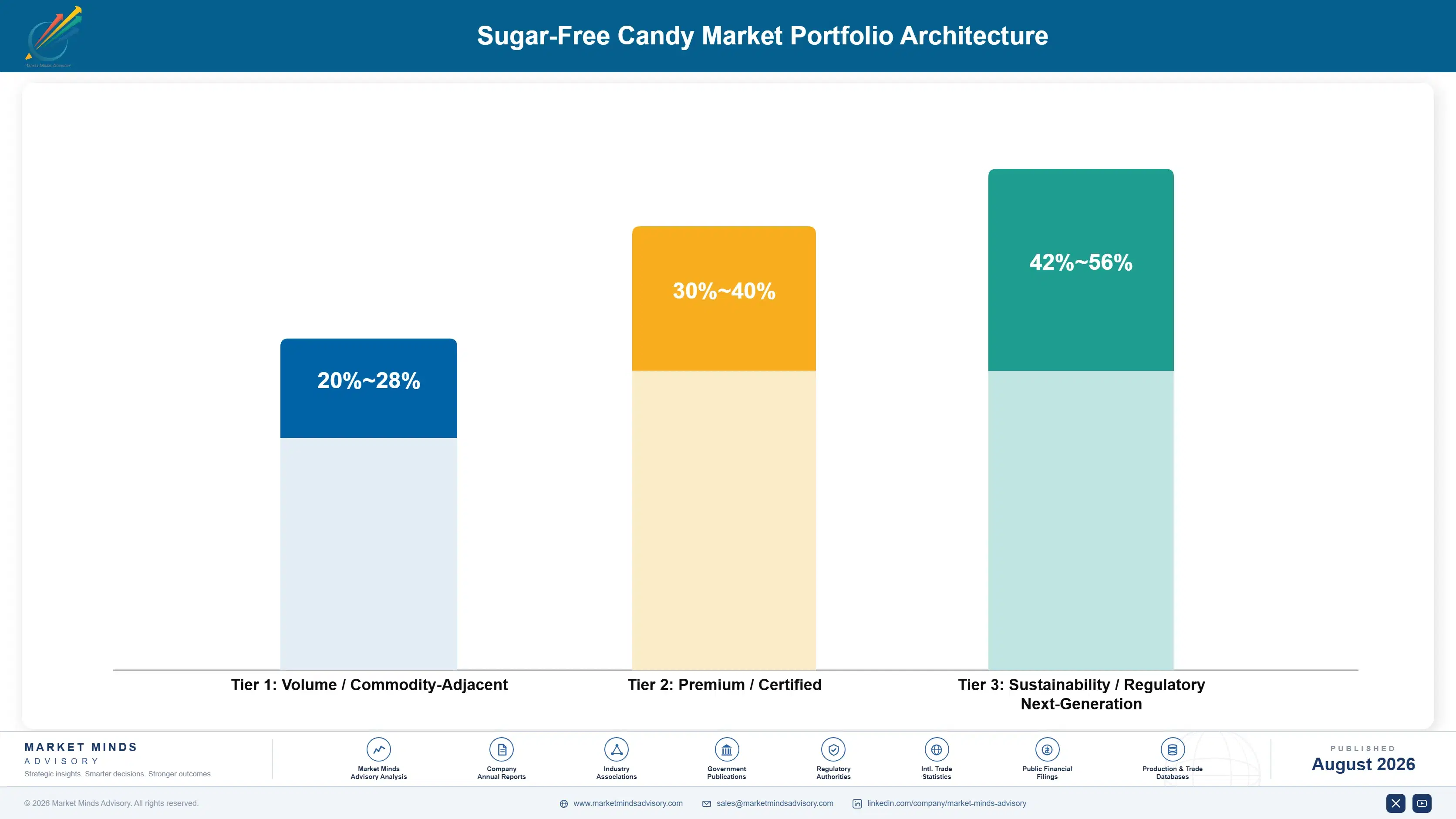
Margin architecture tracks format difficulty and shelf placement rather than sweetener choice. Sugar-free hard candy and mints run at gross margins in the low twenties, because formulation is straightforward, own-label competes directly and the positions are decades old and largely undefended. Gummies and premium chocolate earn roughly double.
The volume-versus-premium tension is unusual because the easy formats are the mature ones. Hard candy and mints provide the volume that justifies a manufacturer's presence in the category and the retailer relationships that carry everything else, yet they are precisely where own-label bites hardest and where growth is slowest. Brands that abandon them lose scale and shelf negotiating position; brands that rely on them watch the category grow past them in formats they cannot make.

Value concentrates where technical difficulty or ingredient cost excludes competitors. Sugar-free gummies sit at the top because the texture problem took years to solve and the format grows fastest. Rare sugar chocolate sits alongside on ingredient access and pack format logic. Hard candy sits at the other extreme, where any confectioner with a boiling pan and a maltitol contract can compete and the shopper compares directly on price.

Volume / Commodity-Adjacent

Sugar-free hard boiled candy, mints and pastilles where polyol formulation is straightforward and own-label competes directly. Positions are decades old, growth is slow and shoppers compare on price. This volume provides scale and retailer relationships rather than meaningful margin.
Gross Margin: 20-28%

Premium / Certified

Polyol-formulated chocolate, caramels and standard gummy lines sold through mainstream confectionery fixtures. Format capability and brand positioning support pricing above commodity formats. Range reflects the spread between own-label manufacture and branded retail supply.
Gross Margin: 30-40%

Sustainability / Regulatory / Next-Generation

Rare sugar formulations across gummies and premium chocolate, sold in sharing formats that polyol tolerance thresholds prevent. Ingredient access, texture capability and freedom from the consumption warning justify the pricing achieved throughout this tier.
Gross Margin: 42-56%
sugar-free-candy-market-trends-portfolio-architecture-1787312641952

High-value Sub-segments and Strategic Watch-out

Rare Sugar Sharing Formats

High value on genuinely high growth, because removing the ten gram tolerance threshold opens up pack sizes and eating occasions this category has never once served. Allulose access is uneven across regions, which severely limits how many brands can actually build these formats at all today.
Gross Margin: 44-56%

Sugar-Free Gummies

Strong margins on the fastest growth in the category at 10.8%, protected by a texture problem that takes anywhere from eighteen to thirty months of development work to solve properly. Vitamin and supplement gummy crossover adds a second demand stream that behaves quite differently from confectionery.
Gross Margin: 36-46%

Hard Candy And Mints

The scale and shelf relationship foundation underneath any confectioner's presence in this category, earning gross margins in the low twenties against direct own-label competition. Formulation here is straightforward, the positions are decades old and growth here runs at roughly half the rate of the category overall.
Gross Margin: 20-28%

Polyol-Formulated Chocolate

The strategic watch-out sitting squarely in this portfolio. Maltitol chocolate remains the volume workhorse and the economics work, but it carries the excessive consumption warning and the pack size cap, and rare sugar alternatives will steadily make that limitation more visible on the shelf beside them.
Gross Margin: 30-40%

How This Demand Actually Repeats

Confectionery demand recurs through habit and impulse rather than through any planned purchase. A shopper who adopts a sugar-free brand returns to it without deliberating, which makes trial conversion the single most valuable thing in the category and repeat failure the most damaging.
Stickiness varies considerably by buyer motivation. Consumers managing diabetes or dental advice are the tightest, purchasing the same products for years with almost no consideration. Mainstream shoppers buying a sugar reduction claim are moderately sticky, holding a brand while it satisfies but switching readily on promotion. Trial buyers who experienced polyol laxation are the opposite of sticky, since a single uncomfortable experience ends the relationship permanently and often removes the whole category from consideration rather than just the brand.

Buyer profiles have shifted decisively. Category decisions once sat with pharmacy and dietetic buyers assessing a clinical range. They now sit with mainstream confectionery category managers evaluating rate of sale against sugared alternatives on the same fixture. Brands whose commercial approach still leads with diabetic and dental credentials find themselves presenting to buyers who measure them purely on how fast the product leaves a mainstream shelf.
sugar-free-candy-market-trends-end-use-penetration-index-1787312642527

Where To Place Capital

These are among the four positions where our research anticipates prominent divergence between winners and laggards over the coming forecast period. Each is grounded in the demand model, the regulatory perimeter, and the announced capacity pipeline.
01 / SHELF PLACEMENT STRATEGY

The dietetic aisle is where volume goes to die

Shelf placement signals who a product is intended for more powerfully than any claim printed on the pack does, and sugar-free confectionery merchandised in pharmacy or dietetic fixtures reaches only those shoppers who are already searching for it. Brands securing mainstream confectionery placement and removing all clinical language report rate of sale improving 60% to 90% on entirely identical product. The change costs a packaging revision and a retailer negotiation rather than any reformulation work whatsoever, which makes the return exceptional.
02 / GUMMY FORMAT CAPABILITY

Texture development is the real competitive barrier

Sugar sets gel structure and water activity alongside the hydrocolloid, so removing it from a gummy means rebuilding texture, shelf stability and the characteristic chew simultaneously rather than merely substituting sweetness. That development work takes eighteen to thirty months, and it is precisely why the sugar-free gummy field remains considerably narrower than any other format. Gummies grow at 10.8% and already take 28% of total category volume, which together make the investment case straightforward to justify to almost any board.
03 / RARE SUGAR ADOPTION TIMING

Escape the tolerance ceiling before competitors do

Allulose and tagatose remove the ten gram threshold that caps polyol pack sizes, permitting the sharing formats and eating occasions that this category has never once served at all. Ingredient cost runs three to five times maltitol, so this works in premium chocolate and gummies rather than in value hard candy at all. Brands that do it realise 25% to 35% above polyol-formulated equivalents, and regional allulose availability rather than any formulation skill currently decides which brands can even attempt it.
04 / PACK ARCHITECTURE DESIGN

Shoppers read the price, not the price per kilo

Sugar-free confectionery sells at roughly 1.7 times sugared equivalents per kilogram, and shoppers respond to the absolute figure printed on the pack rather than to any unit price comparison. Smaller formats offered at accessible price points convert trial 35% to 50% better than value packs carrying a visibly higher premium, and they also conveniently keep polyol intake per serving below the tolerance threshold. That is two entirely separate problems solved by a single packaging decision that requires no reformulation whatsoever.

Engagement Snapshot From the Field

A live engagement with an industry participant carrying material or product regulatory and market exposure ahead of a defining policy shift, showing how our research translates into a defensible multi-year portfolio strategy.
MARKET MINDS ADVISORY · CLIENT ENGAGEMENT SUMMARY
Sugar-Free Candy Producer Strategic Portfolio Review and Transition Roadmap 2026·Investment Scenario on Sugar-Free Candy Exposure Evaluation 2025-26
CLIENT PROFILE
A European confectionery manufacturer with annual revenue near $280 million (client-reported, unverified by MMA), of which roughly 22% came from a sugar-free range built over three decades on dental and dietetic positioning. That range was almost entirely hard candy, mints and pastilles, merchandised in pharmacy and dietetic fixtures, with no gummy capability and no rare sugar formulation anywhere in the portfolio.
STRATEGIC CHALLENGE
Sugar-free revenue had grown at barely two percent for four years while the wider category grew at six, and two retail customers had reduced dietetic fixture space in favour of mainstream confectionery. Management needed to decide whether to invest in gummy capability, reformulate onto rare sugars, or reposition the existing range, with capital sufficient for roughly one of the three.
MMA APPROACH
MMA analysed rate of sale by fixture placement across the client's retail customers, sized the gummy and rare sugar opportunities against realistic development timelines, and modelled contribution under three investment scenarios. Findings were tested against 47 expert interviews covering grocery confectionery buying practice, sugar-free texture development and allulose supply availability across Europe.
KEY FINDINGS
  1. Identical products achieved rate of sale 71% higher in mainstream confectionery fixtures than in dietetic sections at the same retailers, a gap nobody internally had measured.
  2. Gummy capability would take approximately twenty-six months and $9.4 million to reach commercial texture quality (client-reported estimate, unverified by MMA), which was longer than the board had assumed.
  3. The existing hard candy and mint range was contributing the retailer relationships and scale that any new format would depend upon, so reducing it would have undermined the whole plan.
  4. Rare sugar reformulation was viable on the premium end of the range at modest cost, but allulose supply in Europe was tighter than in North America and constrained pack format ambition.
CLIENT PROFILE
A European confectionery manufacturer with annual revenue near $280 million (client-reported, unverified by MMA), of which roughly 22% came from a sugar-free range built over three decades on dental and dietetic positioning. That range was almost entirely hard candy, mints and pastilles, merchandised in pharmacy and dietetic fixtures, with no gummy capability and no rare sugar formulation anywhere in the portfolio.
STRATEGIC CHALLENGE
Sugar-free revenue had grown at barely two percent for four years while the wider category grew at six, and two retail customers had reduced dietetic fixture space in favour of mainstream confectionery. Management needed to decide whether to invest in gummy capability, reformulate onto rare sugars, or reposition the existing range, with capital sufficient for roughly one of the three.
MMA APPROACH
MMA analysed rate of sale by fixture placement across the client's retail customers, sized the gummy and rare sugar opportunities against realistic development timelines, and modelled contribution under three investment scenarios. Findings were tested against 47 expert interviews covering grocery confectionery buying practice, sugar-free texture development and allulose supply availability across Europe.
KEY FINDINGS
  1. Identical products achieved rate of sale 71% higher in mainstream confectionery fixtures than in dietetic sections at the same retailers, a gap nobody internally had measured.
  2. Gummy capability would take approximately twenty-six months and $9.4 million to reach commercial texture quality (client-reported estimate, unverified by MMA), which was longer than the board had assumed.
  3. The existing hard candy and mint range was contributing the retailer relationships and scale that any new format would depend upon, so reducing it would have undermined the whole plan.
  4. Rare sugar reformulation was viable on the premium end of the range at modest cost, but allulose supply in Europe was tighter than in North America and constrained pack format ambition.
RECOMMENDED STRATEGY
Phase 1: Phase one: reposition the existing range into mainstream confectionery fixtures with revised packaging, since it costs least and addresses the largest measured gap. Phase 2: Phase two: begin gummy texture development immediately, accepting the twenty-six month timeline rather than deferring a decision the category will not wait for. Phase 3: Phase three: reformulate premium lines onto rare sugars as European allulose supply allows, prioritising the formats where pack size limits bind hardest.
OUTCOME
The client completed repositioning within seven months and reported sugar-free range rate of sale rising roughly 58% at the two retailers that moved it into mainstream fixtures (client-reported, unverified by MMA). Gummy development was approved and is proceeding, and the hard candy range was deliberately retained for scale rather than reduced as originally proposed.

Frequently Asked Questions

Foundational context covering the market sizes, CAGR, scope, country, region and competition that inform every finding below. This section is provided to cover basics and most often pre-purchase conversations, answered from the MMA Primary Research Dataset.

What is the current size of the Sugar-Free Candy Market?

The market was worth $2.8 billion in 2025 and is forecast to reach $3.00 billion in 2026. This excludes sugar-free chewing gum, which is treated as a separate category.

How large will the Sugar-Free Candy Market be by 2036?

MMA forecasts $6.01 billion by 2036, an expansion multiple of 2.00 times the 2026 base. That represents $3.01 billion of incremental value across the forecast period.

What is the CAGR for the Sugar-Free Candy Market 2026 to 2036?

The base case compound annual growth rate is 7.2%, with a bull case of 8.4% and a bear case of 6.0%. Historical growth from 2020 to 2025 also ran at 6.0%.

Which segment is growing fastest?

Sugar-free gummies and jellies at 10.8%, a full 1.50 times the market rate. Gummies were the hardest format to build without sugar and the fastest growing once solved.

Who are the major companies in the Sugar-Free Candy Market?

Mondelez International, Perfetti Van Melle, Mars Wrigley, Haribo and August Storck lead with 39% between them. Fifteen further manufacturers hold meaningful format or regional positions.

Which country is growing fastest?

India at 11.0% annually, as confectionery modernises, diabetes prevalence rises and organised retail carries formats that traditional sweet shops had never once offered to consumers.

Report Segmentation Architecture

The full report scope spans multiple orthogonal segmentation dimensions, with cross-tabulated demand data provided for each dimension pair. Coverage extends further to regional breakdowns, trend trajectories, and the competitive detail needed to support segment-level decision-making.

By Confectionery Format

  • Sugar-Free Gummies and Jellies
  • Sugar-Free Chocolate
  • Sugar-Free Mints and Pastilles
  • Sugar-Free Hard Boiled Candy
  • Sugar-Free Caramels and Chews

By End-Use Industry

  • Grocery and Supermarket Retail
  • Pharmacy and Health Retail
  • Convenience and Impulse Retail
  • Online and Direct-to-Consumer
  • Foodservice and Hospitality
  • Travel Retail and Duty Free

By Commercial Dimension

  • Branded Manufacturer Supply
  • Retailer Own-Label Manufacture
  • Specialist Sugar-Free Brand Supply
  • Contract Manufacture for Emerging Brands
  • Export and International Distributor Channel

By Region

  • North America
  • Western Europe
  • East Asia
  • South Asia and Pacific
  • Latin America
  • Middle East and Africa
  • Eastern Europe

Scope, Methodology, and Coverage

Every figure in this report is reproducible from documented input assumptions. The scope below maps the historical period, the forecast horizon, the segmentation dimensions, and the countries covered, alongside the underlying primary and qualitative methodology.
Historical Period
2020 to 2025
Forecast Period
2026 to 2036
Base Year
2025 (USD billions; MMA Primary Research Dataset, August 2026)
Market Definition
This report covers confectionery manufactured without added sugars, spanning sugar-free gummies and jellies, chocolate, hard boiled candy, mints and pastilles, and caramels and chews sold through retail and foodservice channels. Coverage includes both polyol-formulated and rare sugar formulated products, and both branded and retailer own-label manufacture. Sugar-free chewing gum, reduced-sugar rather than sugar-free formulations, medicated lozenges and throat products sold as medicines, sugar-free bakery and dessert products, and sweetener ingredients sold to manufacturers are excluded from scope.
Quantitative Units
USD billions at retail and foodservice value; volume in thousand tonnes; gross margin percentages and shelf price premiums by tier.
Segmentation Dimensions
Confectionery format, retail and foodservice channel, commercial dimension, region.
Regions Covered
North America, Western Europe, East Asia, South Asia and Pacific, Latin America, Middle East and Africa, Eastern Europe
Countries Covered
Japan, China, South Korea, India, Australia, Thailand, Indonesia, United States, Canada, Mexico, Germany, United Kingdom, Switzerland, France, Netherlands, Brazil, Chile, Poland, Turkey, Saudi Arabia.
Key Companies Profiled
Mondelez International, Perfetti Van Melle, Mars Wrigley, Haribo, August Storck, Hershey, Ricola, Katjes, SmartSweets, Lotte, and ten further manufacturers.
Quantitative Methodology
Primary survey, n=3,800 respondents, Q4 2025, six countries; demand-side model with trade association cross-validation
Qualitative Methodology
47 expert interviews, Q4 2025; applied to validate demand model assumptions, identify emerging dynamics, and assess competitive positioning
Report Format
PDF and XLSX data workbook (Word format preview document)
Publisher
Market Minds Advisory
Report Code
MMA-2026-AGR-830
Published
August 2026
Contact
sales@marketmindsadvisory.com | www.marketmindsadvisory.com

Purchase the full Sugar-Free Candy Market Report (2026 to 2036).

The full report sets out ten-year forecasts for sugar-free confectionery by format, channel and commercial model across seven regions. It quantifies rate of sale by fixture placement, isolating how much of the category's performance is decided by merchandising rather than by product. Competitive assessment covers twenty manufacturers on a consistent revenue basis, mapping format capability and rare sugar access separately from distribution reach. Polyol tolerance thresholds are compared across regulatory jurisdictions with the pack architecture consequences quantified. Findings draw on a quantitative survey of 3,800 respondents across six countries and 47 expert interviews conducted during the fourth quarter of 2025.
Ten-year forecasts by confectionery format and region
Rate of sale quantified by retail fixture placement
Polyol tolerance thresholds compared across regulatory jurisdictions
Twenty-manufacturer assessment on consistent revenue basis
Rare sugar availability mapped against format ambition by region
Margin architecture across three commercial portfolio tiers

Built For The People Who Decide

From boardroom strategy to bench-side execution, this report is read cover-to-cover by leaders shaping the next decade of their industry, turning demand scenarios, market dynamics and valuation benchmarks into decisions.
CXOs/ Presidents/ VPs/ Managers
M&A and Corporate Development
Strategy Teams and R&D Heads
Procurement and Product Directors
Regulatory and Compliance Leaders
Investor Relations and Equity Analysts