Market Minds Advisory
Sugar Beet Pectin Market

Sugar Beet Pectin Market: The Pectin That Cannot Gel, Sold as Something Else

For decades it was judged a failed substitute for citrus pectin because it will not gel, and its real value is as an emulsifier replacing gum arabic from a supply base nobody can rely on.

Lead Analyst

Lisa Gevelber

Published

September 2026

Make Smarter Decisions with Customized Research Insights

Request a free sample report and evaluate market opportunities, growth trends, and competitive dynamics relevant to your business needs.

2025 MARKET VALUE$0.1BMarket Size 2025
2036 FORECAST VALUE$0.2BBase Case , 2026 to 2036
CAGR 2026 TO 20368.6 %Bull 9.8% / Bear 7.4%
INCREMENTAL OPPORTUNITY$0.1BNet 10- year value creation
EXPANSION MULTIPLE2.30x2036 value over 2026 base
Strategic Levers
M&A Pipeline
Regional Outlook
Country Rankings
Competitive Intelligence
Segmental Deep-dive
Call-Us : 91 93563 13602

Executive Snapshot and Market Trajectory

Judged as a pectin, this material fails. Acetylation near 24% stops it forming the gel networks citrus pectin makes, which is why it spent decades being treated as a cheap and disappointing substitute for something it was never going to be in the first place.
Judged as an emulsifier it is rather good. The protein rich regions on its backbone anchor at oil and water interfaces and hold acidic beverage emulsions stable for around 12 months, which is the job gum arabic does. Beverage emulsion stabilisation grows at 12.9%, and it is not competing with citrus pectin at all. Thirty years of evaluation asked the wrong question, and the answer was always no.
Supply security is what makes the case. Around 72% of world gum arabic originates in the Sahel, where conflict has repeatedly interrupted collection and shipment, and a manufacturer swapping it for beet pectin changes one permitted additive for another with no label penalty. That combination of performance and provenance is the whole commercial argument here. Extraction capacity rather than demand is what limits this market now, and it cannot be built quickly.
Market Definition
Pectin extracted from sugar beet pulp and supplied as a food and industrial hydrocolloid, covering beverage emulsion stabilisation, dairy and acidified protein drinks, bakery and confectionery, meat and savoury applications, encapsulation and flavour delivery, and personal care and pharmaceutical use. Measured at producer selling value. Excludes citrus and apple pectin, gum arabic and other exudate gums, beet pulp sold as animal feed, sugar, and betaine or other refinery co-products.
Base Year Value
$0.1B in 2025 (MMA Primary Research Dataset, August 2026)
Forecast Period
2026 to 2036, eleven discrete annual values
CAGR
8.6% base case. Bull 9.8%. Bear 7.4%.
Fastest Growth Segment
Beverage Emulsion Stabilisation: 12.9% CAGR
Fastest Growth Country
China: 14.2% CAGR
Fastest Growth Region
South Asia and Pacific: 10.8% CAGR
Largest Region
Western Europe: 26% of 2025 global value
Market Leaders
CP Kelco, Herbstreith and Fox, Cargill, Givaudan, Andre Pectin. Source: MMA Primary Research Dataset, July 2026.
Primary Survey
n=3,800 procurement and R&D decision-makers, Q4 2025, six countries
Methodology
Demand-side build-up, cross-validated against public data, 47 expert interviews

Sugar Beet Pectin Market Forecast Scenarios

sugar-beet-pectin-market-trends-size-forecast-scenario-1787595444600
Growth ran near 7.2% between 2020 and 2025 and the reason changed completely partway through. Early demand came from formulators seeking a cheaper pectin and finding it did not gel, which limited adoption badly. Gum arabic supply disruption from Sahel conflict then redirected attention toward beet pectin as an emulsifier rather than a gelling agent, and adoption accelerated on grounds nobody had originally intended.
Base case 8.6% rests on three mechanisms. Beverage emulsion stabilisation grows at 12.9% as manufacturers reduce dependence on gum arabic sourced from a single conflict affected region. Dairy and acidified protein drinks grow at 10.4% as high protein beverages expand and require acid stable stabilisation. And China grows fastest of any country at 14.2% on beverage and protein drink production expanding quickly. None of the three has anything to do with citrus pectin.
The bull case at 9.8% assumes gum arabic supply remaining disrupted long enough that reformulation becomes permanent rather than temporary, since a manufacturer that has requalified rarely goes back. The bear case at 7.4% is Sahel supply normalising while beet extraction capacity remains too small and too seasonal to hold the positions that disruption briefly opened up.

A Failed Gelling Agent Finds Its Job

Sugar beet pectin spent thirty years being measured against the wrong benchmark. Acetylation around 24% and lower molecular weight prevent the calcium bridged gel networks that make citrus pectin useful in jams and confectionery, so every comparison concluded that beet pectin was an inferior version of a familiar ingredient. It is not an inferior pectin but a different material sharing a name.
TOP FIVE CONCENTRATION68%Extraction requires refinery co-location that very few hold
ACETYLATION DEGREE24%Substitution level preventing any conventional gel network formation
SAHEL GUM ARABIC SHARE72%World gum arabic originating from one conflict affected region
BEET CAMPAIGN LENGTH110 daysAnnual period a refinery processes beet for extraction
VALUE AGAINST FEED PULP18xExtracted pectin worth against the same pulp as feed
EMULSION SHELF STABILITY12 monthsPeriod an acidic beverage emulsion holds without visible separation
What the acetyl groups and the protein rich regions on the backbone actually do is anchor at an oil and water interface, which makes this an emulsifier rather than a gelling agent. Acidic beverage emulsions stabilised with it hold for around 12 months without visible separation, which is the performance gum arabic delivers. That reframing is recent, and most of the demand growth in this market follows directly from it.
Provenance finishes the argument. Roughly 72% of world gum arabic comes from the Sahel, where conflict has repeatedly interrupted collection and export, and a beverage manufacturer that reformulates onto beet pectin is exchanging one permitted additive for another with no labelling consequence at all. Extraction capacity is the constraint rather than demand, since it requires co-location with a refinery running a beet campaign of about 110 days.
"Every technical paper for three decades asked whether it gels, and the answer was always no, so everybody stopped reading. The formulators who found it during the gum arabic shortage were not looking for pectin at all, which is exactly why they saw what it was good at."
Director, Hydrocolloids and Food Ingredients Practice · MMA Agriculture and Food Practice · August 2026

Market Trends

Gum arabic supply risk redirecting emulsifier selection permanently

Around 72% of world gum arabic originates in the Sahel, where conflict has interrupted collection, processing and export repeatedly, and beverage manufacturers exposed to that concentration have been reformulating rather than waiting for normalisation. Beet pectin holds acidic beverage emulsions for roughly 12 months and carries the same additive status, so the switch costs formulation work rather than any labelling penalty. Manufacturers that complete requalification very rarely reverse it, which makes each conversion effectively permanent. Extraction capacity is now the binding constraint rather than demand, since the process requires co-location with a refinery and cannot be added quickly at all.
Market Impact: Protein drinks growing at 10.4%
Reframing the material as emulsifier rather than gelling agent

Acetylation near 24% prevents the calcium bridged networks citrus pectin forms, which meant three decades of evaluation concluded this material was a poor pectin. The protein rich regions that block gelation are precisely what anchor it at oil and water interfaces, making it a capable emulsifier instead. That reframing is recent and most current demand growth follows from it directly, which means the technical literature a formulator finds first is frequently still asking the wrong question. Suppliers whose own catalogues list the material as a pectin variant are reinforcing exactly the comparison that held adoption back for three decades.
Market Impact: Earns 18 times feed value

Market Opportunities and Growth Drivers

High protein beverages needing acid stable stabilisation systems

Acidified protein drinks and dairy based beverages grow steadily and present a genuinely difficult stabilisation problem, since protein aggregates near its isoelectric point and separates without an effective stabiliser. Beet pectin performs there at 10.4% growth and offers supply security that gum arabic cannot match. Chinese and Southeast Asian production of these beverages is expanding fastest, with China growing at 14.2%, and formulators there are less committed to incumbent hydrocolloid choices than European ones. Separation is a visible failure on a shelf, which makes a formulator who has solved it reluctant to reopen the recipe for any modest saving.
Market Impact: Campaign runs only 110 days

Refinery co-products earning far more than feed pulp does

Beet pulp currently sells as animal feed, and pectin extracted from the same material is worth roughly eighteen times as much per tonne of feedstock, which gives a sugar refiner a genuine reason to invest in extraction capacity. European refiners facing margin pressure on sugar itself have begun evaluating that arithmetic seriously. Extraction requires co-location and works only through a beet campaign of about 110 days, which constrains how quickly capacity can actually arrive. Refiners are increasingly running that arithmetic themselves rather than selling pulp cheaply into feed channels as they have always done.
Market Impact: Holds emulsions for 12 months

Market Restraints and Challenges

Seasonal extraction against year-round customer requirements

Beet campaigns run around 110 days a year and extraction has to happen while pulp is fresh, which means a producer manufactures for a third of the year and supplies customers for all of it. The root cause is agronomic rather than commercial and no process change removes it. Commercially it forces substantial inventory and working capital that small producers struggle to carry. Campaign extension and stabilised pulp storage are the mitigations under investigation. Customer volume commitments help spread the burden. Working capital is the real burden, and it falls hardest on smaller producers.
Market Impact: Reduces 72% Sahel supply exposure

Legacy technical literature still asking whether it gels

Three decades of published evaluation measured this material against citrus pectin and concluded it failed, which is the first thing a formulator finds when searching for it. The root cause is that the comparison was framed by the name and the additive number rather than by function. Commercially it means suppliers spend the first conversation correcting an impression the literature created. Application data and side by side emulsion trials against gum arabic are the practical answer. Publishing that comparison costs very little and removes the first objection a supplier currently faces in every new customer meeting.
Market Impact: Acetylation near 24% blocks gelling
3 additional market trends, 4 additional growth drivers, and 2 additional restraints and challenges are covered in the full report. Contact sales@marketmindsadvisory.com to access the complete intelligence.

Segment CAGR and Growth Architecture

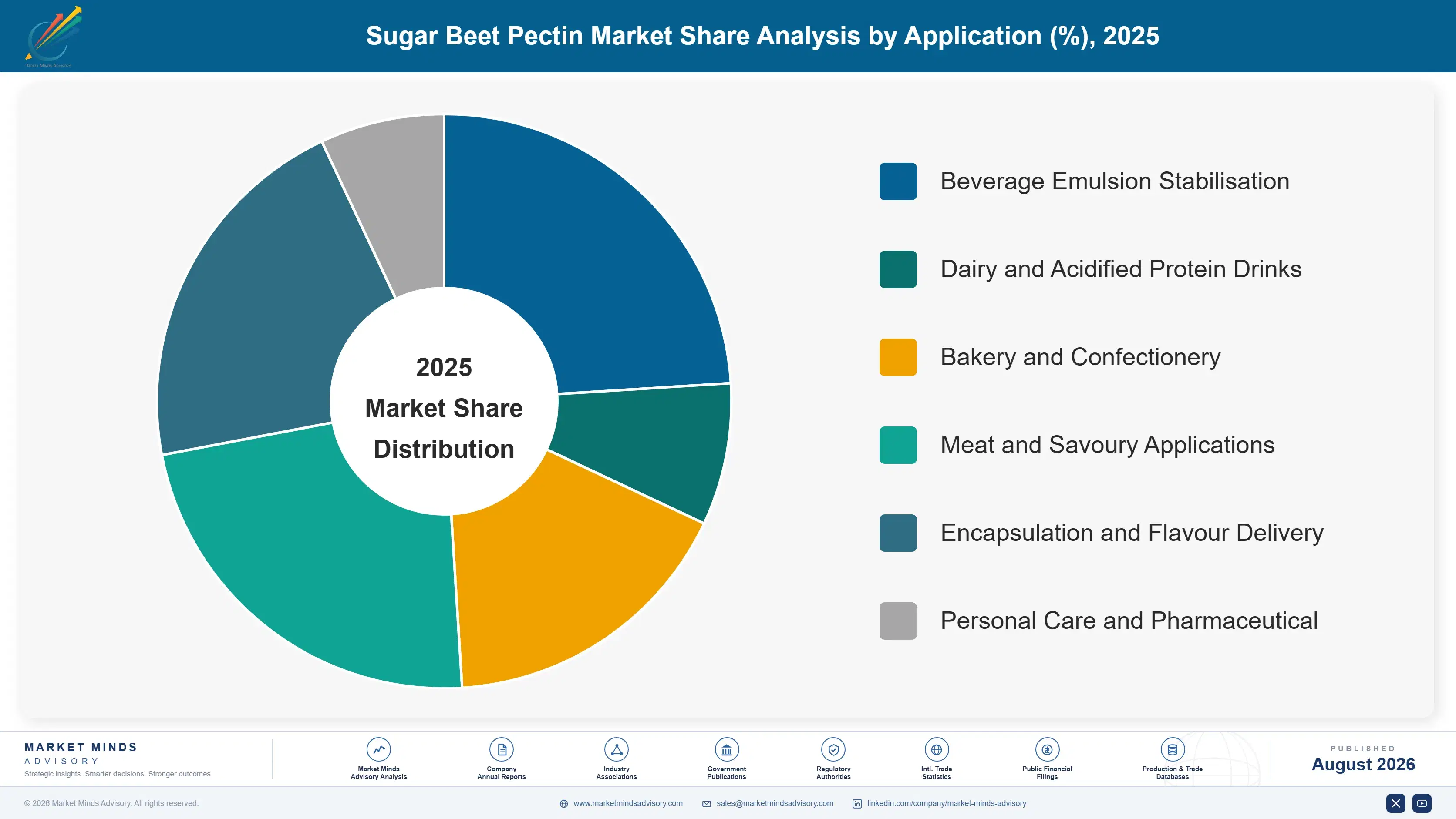
Six segments are split by application, because application determines whether the material is being asked to emulsify, stabilise or texture, which additive it is actually replacing, the qualification a manufacturer imposes and the price it will support. Grade variants sit inside each application. Extraction route and channel are handled separately in the framework. Campaign timing shapes supply too.
sugar-beet-pectin-market-trends-market-share-analysis-1787595445150

Beverage Emulsion Stabilisation

Growing at 12.9%, half again the market rate of 8.6%, this covers flavour and cloud emulsions in acidic soft drinks, where the material holds oil droplets dispersed for around 12 months without visible separation. It is replacing gum arabic rather than citrus pectin, which matters because roughly 72% of gum arabic originates in a conflict affected region and beverage manufacturers have been reducing that exposure deliberately. Both carry permitted additive status, so reformulation costs technical work rather than any labelling penalty, and completed conversions very rarely reverse afterwards. Extraction capacity is the binding constraint here rather than any question of formulator willingness to adopt. Formulators are already willing; supply is what stops them.
CAGR 12.9%

Dairy and Acidified Protein Drinks

At 10.4% this covers acidified milk drinks and high protein beverages, where protein aggregates near its isoelectric point and separates unless an effective stabiliser holds it dispersed through shelf life. The material performs well in that duty and brings supply security that gum arabic cannot offer at present. Chinese and Southeast Asian production of these beverages is expanding fastest anywhere, and formulators in those markets carry considerably less attachment to incumbent hydrocolloid choices than European product developers generally do. Separation is a visible failure on a shelf rather than a marginal quality issue, which makes a solved formulation unusually durable once trials have confirmed it holds across the intended shelf life.
CAGR 10.4%
Full segment breakdown across 6 segments available in the complete report.

Regional Architecture and Country Demand Map

Western Europe holds 26% of value because sugar beet is a temperate crop and European refiners are the only ones extracting pectin from its pulp at scale. North America and East Asia follow closely on demand rather than production. South Asia and Pacific grows fastest of the seven.

North America

Beverage manufacturers here reformulated away from gum arabic earlier and more decisively than most, having experienced supply interruption directly across several product lines. Domestic sugar beet processing exists at scale but pectin extraction capacity does not, so most material is imported from European producers. Acidified protein drink formulation is well developed and demanding. Clean label pressure favours a plant derived additive with a familiar number. Growth at 7.8% reflects mature beverage volumes against continuing reformulation activity. Extraction capacity investment has not followed the demand, which leaves North American manufacturers dependent on European supply that is already constrained by campaign seasonality. Import dependence is total. European campaign seasonality limits it further.
Share: 24% | CAGR: 7.8% (2026 to 2036)

Western Europe

Sugar beet is a temperate crop and European refiners hold essentially all the extraction capacity, since the process requires co-location with a refinery running a campaign of around 110 days. That gives the region its production position, not a demand advantage. Sugar margin pressure has made co-product value attractive, with extracted pectin worth roughly eighteen times the pulp as feed does. Additive documentation requirements are demanding. Growth of 7.2% is the slowest anywhere on mature beverage demand. Formulator attachment to incumbent hydrocolloid choices is stronger here than anywhere, which slows conversion despite the region holding the production. Co-product investment is being evaluated more seriously than at any point in the past decade, driven by sugar economics rather than hydrocolloid demand.
Share: 26% | CAGR: 7.2% (2026 to 2036)
Regional intelligence for 5 additional markets available in the complete report: East Asia, South Asia and Pacific, Latin America, Middle East and Africa, Eastern Europe. Contact sales@marketmindsadvisory.com.
sugar-beet-pectin-market-trends-country-cagr-analysis-1787595445673

Four Moves Away From Citrus

Thirty years of comparison against citrus pectin taught this material's own industry to sell it as a cheaper gelling agent, which it is not and never was. Every worthwhile move now positions it against gum arabic, secures the extraction capacity to supply that demand, and stops answering a question nobody should be asking. Capacity decides the rest.

Position against gum arabic rather than citrus pectin

Beverage emulsion stabilisation grows at 12.9% because this material replaces gum arabic, not citrus pectin, and roughly 72% of gum arabic comes from a conflict affected region that manufacturers are actively de-risking. Selling it as a pectin invites a gelling comparison it will always lose. Selling it as a secure emulsifier with the same additive status wins a conversation the incumbent cannot answer on provenance at all. The catalogue itself is frequently the obstacle, since listing the material beside citrus pectin invites precisely the comparison the supplier needs the customer to avoid making.
Market Impact: Displaces 72% of Sahel sourced gum arabic supply

Invest in extraction capacity at existing beet refineries

Pectin extracted from beet pulp is worth roughly eighteen times the same pulp sold as animal feed, which is a compelling co-product argument for refiners facing margin pressure on sugar itself. Extraction needs co-location and a campaign of about 110 days, so capacity cannot arrive quickly and demand is currently running ahead of it. Refiners moving now secure positions before conversions elsewhere are locked to competing suppliers. Demand is currently running ahead of capacity, which is an unusual and temporary position worth acting on before it closes. Refiners are already doing the arithmetic themselves.
Market Impact: Earns roughly 18 times the feed pulp value

Replace legacy literature with emulsion trial data

A formulator searching this material finds thirty years of work concluding it does not gel, which is accurate and entirely beside the point. Side by side emulsion trials against gum arabic, showing around 12 months of stability in acidic beverage systems, answer the question that actually matters. Publishing that data costs very little and removes the first objection every supplier currently spends a meeting overcoming with new customers. The literature is accurate and entirely beside the point, which is a rare problem to have and a cheap one to fix.
Market Impact: Demonstrates a full 12 month emulsion shelf stability

Target Chinese and Southeast Asian formulators first

China grows fastest of any country at 14.2% and regional formulators carry considerably less attachment to incumbent hydrocolloid choices than European product developers, which lowers the adoption barrier substantially. Beverage and protein drink production is expanding there at the same time. Winning those formulations now costs less than displacing an established gum arabic position in a mature European market ever will. Beverage and acidified protein output is expanding fastest in exactly those markets, so the conversion and the growth arrive together rather than sequentially. Incumbent attachment is weakest precisely where growth is strongest.
Market Impact: Follows 14.2% Chinese demand growth in every year

Who Controls the Margin Pool

Participation is measured on annual extracted pectin tonnage supplied, and the top five hold 68%. Concentration is high because extraction requires co-location with a sugar refinery running a seasonal beet campaign, which is a position very few participants hold and none can build quickly. CP Kelco and Herbstreith and Fox lead through extraction capacity combined with application development capability for emulsion systems. The gap to challengers is extraction access rather than formulation capability.
Competition runs on three fronts. Extraction capacity decides who can supply at all, and it is genuinely scarce. Application development decides whether a formulator adopts, since the material needs explaining before it needs pricing. And supply security decides against gum arabic, which is the argument that opened this market rather than any performance claim. Supply security has become the deciding argument, and it is one no gum arabic supplier can currently answer at all.

Pressure ahead comes from demand running ahead of extraction capacity, and from beet refiners evaluating co-product investment on their own account. Expect established hydrocolloid groups to secure refinery partnerships rather than build capacity alone. Rankings shift on who locks extraction capacity before the conversions complete. Concentration should stay high while capacity remains scarce.
sugar-beet-pectin-market-trends-company-positioning-matrix-1787595446191

Competitive Moat and Risk Dimensions

CP KELCO

Moat: Extraction capacity and application depth

Holding both beet pectin extraction capacity and hydrocolloid application development capability addresses the two things this market actually needs, since the material requires explaining to formulators before it can be sold to them. Extraction demands refinery co-location that cannot be assembled quickly, and application depth takes years of accumulated formulation work across beverage systems.
CP KELCO

Risk: Seasonal campaign supply constraint

Extraction happens across a beet campaign of roughly 110 days while customers require supply throughout the year, which forces substantial inventory and leaves little flexibility if demand runs ahead of a season's production. That constraint is agronomic rather than operational, and no process improvement removes it from the business model.
HERBSTREITH AND FOX

Moat: Pectin specialisation and technical service

Deliberate specialisation in pectin across decades has built application knowledge and customer relationships that generalist hydrocolloid suppliers cannot match, particularly where a formulator needs the material explained rather than merely quoted. That technical service capability is what converts the gum arabic argument into an actual reformulation project at a customer.
HERBSTREITH AND FOX

Risk: Citrus pectin portfolio association

A portfolio built around citrus pectin invites customers to evaluate beet pectin as a variant of the same product, which reproduces exactly the gelling comparison that held this material back for three decades. Repositioning it as an emulsifier competing with gum arabic requires undoing an association the company's own catalogue reinforces.

Players Tracked

Prominent Players

CP Kelco
Herbstreith and Fox
Cargill
Givaudan
Andre Pectin

Other Key Players

IFF
Silvateam
Pektowin
Ceamsa
Lucid Colloids
Tate and Lyle
Ingredion
Kerry Group
Nexira
Alland and Robert
Nordzucker
Sudzucker
Tereos
Royal Cosun
Fiberstar

Recent Developments

MARCH 2026

Beverage manufacturer completes gum arabic reformulation across portfolio

A beverage manufacturer completed reformulation of flavour emulsions away from gum arabic across a product portfolio, citing supply concentration in a conflict affected region rather than cost or performance. Both ingredients carry permitted additive status, so no labelling change was required at all. Reformulation work took roughly a year.
Signal: Provenance rather than performance is driving these conversions, and completed ones rarely reverse once completed afterwards
OCTOBER 2025

Sugar refiner evaluates pectin extraction as co-product investment

A European sugar refiner began evaluating pectin extraction from beet pulp as a co-product investment, on arithmetic showing extracted pectin worth many multiples of the same pulp sold into animal feed. Campaign seasonality was identified as the principal engineering constraint. Sugar margin pressure prompted the review.
Signal: Refiners are now doing the co-product arithmetic themselves rather than selling pulp cheaply into animal feed
JULY 2025

Protein drink formulator selects beet pectin on acid stability

A protein beverage formulator selected beet pectin for an acidified high protein drink after stability trials across shelf life, where protein aggregation near the isoelectric point had defeated alternative stabilisation systems. Supply security formed part of the selection rationale alongside performance. Shelf life trials ran across the full intended period.
Signal: Acid stability and supply security are being evaluated together rather than as separate questions by formulators

Pulp, Extraction Energy and Season

Beet pulp feedstock carries around 21% of extraction cost, priced against its alternative value as animal feed rather than as a waste stream. Extraction energy, acid and process chemicals take about 34%, since the process is thermally intensive. Purification, drying and standardisation account for roughly 26%. Inventory carrying cost across the non-campaign months absorbs the balance, which is unusual and material here.
Industrial energy pricing across Europe moved sharply through 2022 and has stayed elevated, per IEA industrial energy reporting alongside published European sugar sector commentary and Sudzucker annual reporting for 2025. Thermally intensive extraction absorbed that movement more heavily than most food ingredient processes, and the same period compressed sugar margins, which is partly why refiners began examining co-product value. Co-product economics look considerably better in that light than they did a decade ago.

Exposure divides on integration and campaign management. A refiner extracting its own pulp carries feedstock at internal transfer value and energy at whatever the site already runs, while a standalone extractor buys pulp against feed pricing and carries full energy cost. Everybody carries inventory across roughly nine non-campaign months, and that working capital burden falls hardest on smaller producers with limited balance sheet capacity.
sugar-beet-pectin-market-trends-cost-volatility-analysis-1787595446385

Integrate extraction into refinery energy and utility systems

Extraction is thermally intensive and a sugar refinery already runs steam and utility systems through the campaign, so integrating the two removes a substantial share of standalone energy cost. That integration is only available to a co-located operation, which is one more reason extraction capacity concentrates where refineries already exist rather than near customers.

Fund campaign inventory through customer commitment

Manufacturing for around 110 days and supplying for 365 forces inventory that ties up working capital for most of the year. Annual volume commitments from customers, priced to reflect the carrying cost, convert a producer's balance sheet problem into a shared one and give the customer supply security it currently lacks with gum arabic.

Investigate stabilised pulp storage to extend extraction window

Extraction has to happen while pulp is fresh, which is what confines the process to the campaign. Stabilised storage that preserved pulp for later processing would extend the window and cut inventory carrying cost substantially. The work is unresolved and the prize is large enough that it deserves more attention than it currently receives.

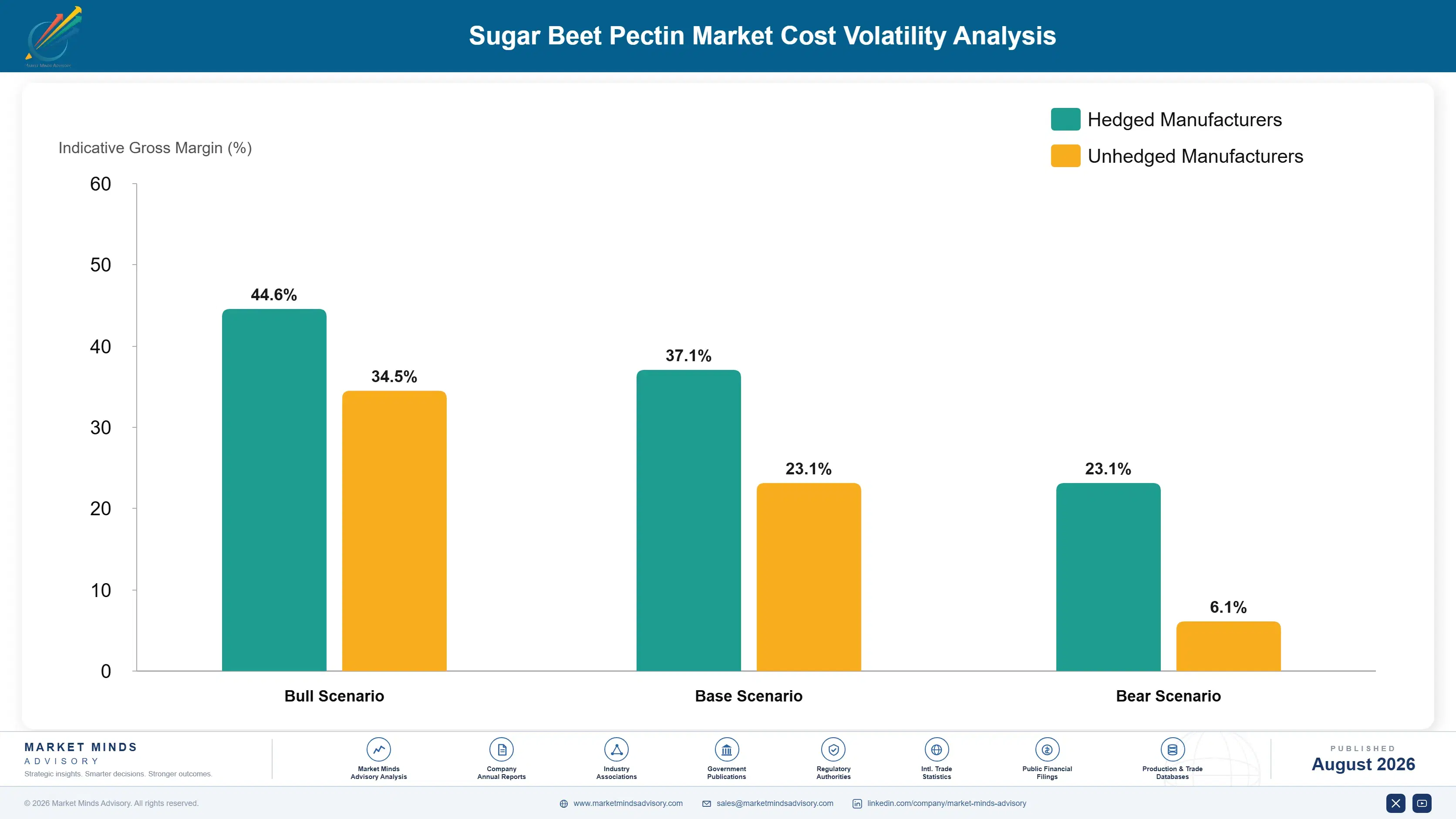
Portfolio Architecture for Margin Defence

Margin here follows which ingredient the material is actually replacing, which sounds obvious and has been widely ignored for three decades. Bakery, confectionery and general texturising applications earn margins in the low to high teens, because there the material is compared against citrus pectin on gelling performance it cannot deliver and price becomes the only remaining argument. Nothing else is left to argue about there.
Dairy and acidified protein drink stabilisation does better in the mid twenties to mid thirties, because acid stable protein stabilisation is genuinely difficult, alternatives perform inconsistently, and a formulator who has solved a separation problem does not reopen the formulation to save a small amount per tonne. Shelf visible separation makes the stakes high enough that supply security features alongside performance in the decision.

Beverage emulsion stabilisation holds the strongest position, reaching into the low forties, where the material replaces gum arabic on both performance and provenance and supply security carries real value. Those margins reflect what the alternative costs and risks rather than any advantage in extraction efficiency or feedstock position. Extraction capacity rather than formulation capability decides who can actually hold that position.

Bakery, Confectionery and Texturising

Applications where the material gets compared against citrus pectin on gelling it cannot deliver. The seven point range reflects extraction cost position rather than any performance difference, since price is the only argument available.
Gross Margin: 12-19%

Dairy and Acidified Protein Stabilisation

Acid stable stabilisation for protein beverages where alternatives perform inconsistently and separation is a visible failure. The eleven point range reflects application difficulty and how firmly the formulation has been locked after successful trials.
Gross Margin: 24-35%

Beverage Emulsion Stabilisation

Flavour and cloud emulsions replacing gum arabic on both performance and supply security grounds. The twelve point range reflects how acutely a customer feels its exposure to Sahel sourced supply at the time of conversion.
Gross Margin: 30-42%
sugar-beet-pectin-market-trends-portfolio-architecture-1787595446874

High-value Sub-segments and Strategic Watch-out

Beverage Emulsion Stabilisation

High value and the fastest growth at 12.9%, replacing gum arabic sourced roughly 72% from a conflict affected region. Both carry permitted additive status, so reformulation costs technical work rather than any labelling penalty at all. Completed conversions rarely reverse afterwards. Requalification costs exceed any saving.
Gross Margin: 32-42%

Dairy and Acidified Protein Drinks

High value and growing at 10.4% on high protein beverages that separate near the isoelectric point without effective stabilisation. Formulators who solve a separation problem do not reopen it to save a modest amount per tonne. Supply security features alongside performance here. Reopening a solved recipe is rare.
Gross Margin: 26-35%

Bakery and Texturising Applications

The volume core by tradition rather than by logic, where the material is judged against citrus pectin on gelling it cannot deliver. Price is the only argument left and it is not a strong one. The comparison itself is the problem. Tradition rather than logic sustains it.
Gross Margin: 12-19%

Extraction Capacity Constraint

The strategic watch-out. Extraction needs refinery co-location and a campaign of about 110 days, and the range reflects whether a supplier has secured capacity or is selling demand it cannot reliably supply. Demand is currently running ahead of available capacity. Co-location cannot be built quickly.
Gross Margin: 10-40%

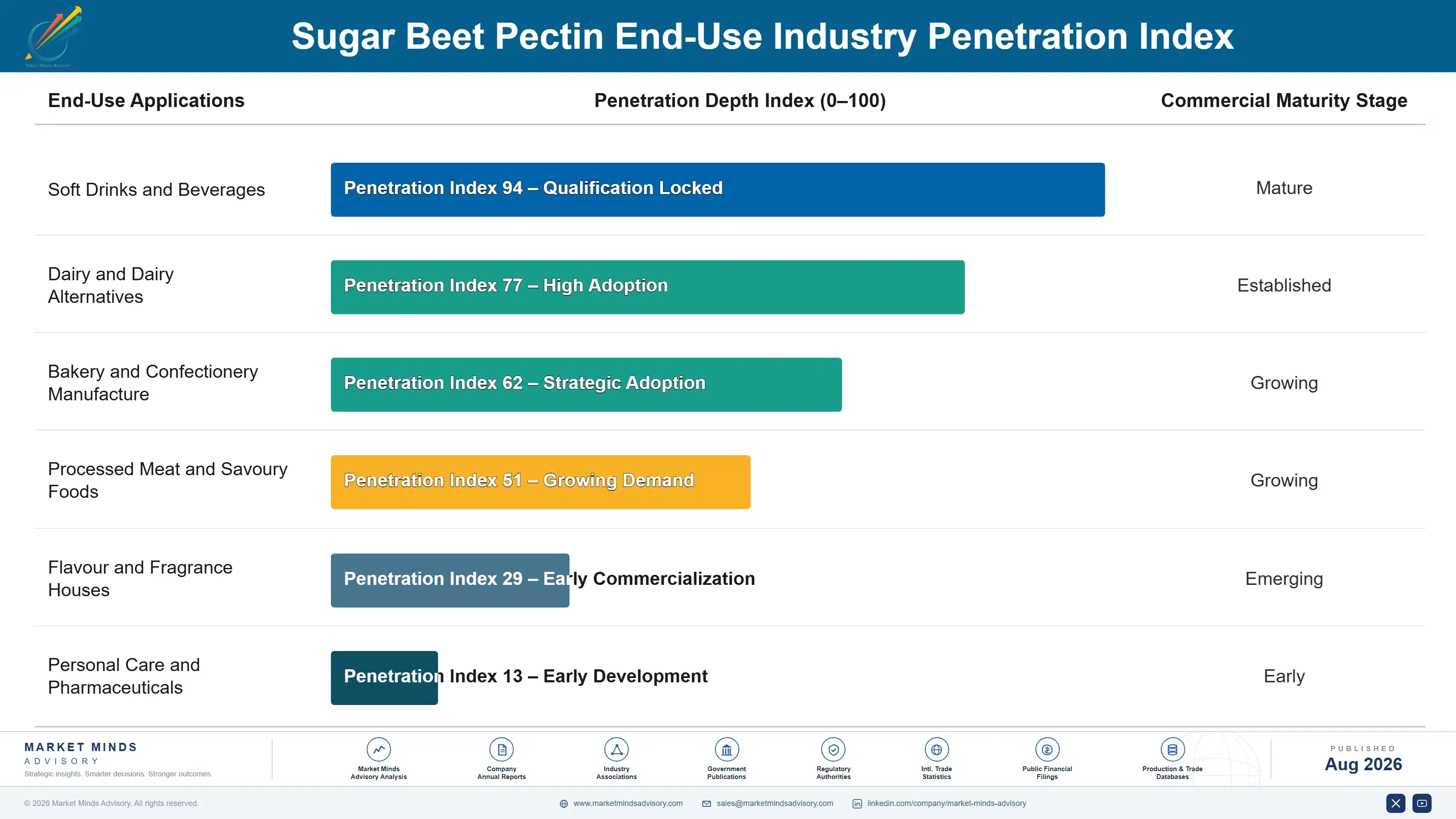
Replacing Two Different Ingredients

Demand here comes from formulators solving two unrelated problems, and the material's commercial position depends entirely on which one they arrived with. A developer looking for cheaper pectin evaluates gelling, finds none and leaves. A developer de-risking gum arabic supply or fixing protein separation evaluates emulsion stability and frequently adopts. Same material, same data sheet, opposite outcomes. The framing decides the outcome.
Stickiness follows the difficulty of the problem solved. Texturising applications reopen on price at every review, since the material is doing an ordinary job an alternative could also do. Emulsion and protein stabilisation positions hold for years, because reformulating a beverage means shade matching, shelf life trials and consumer testing that nobody repeats to save a small amount per tonne.

Deciding functions have shifted as supply risk entered the conversation. Ingredient selection once sat entirely with product development comparing technical performance. Gum arabic disruption brought procurement and supply risk functions into the same decision, which is why provenance now features alongside stability data. Suppliers presenting only technical performance are answering half of a question that now has two halves. Most suppliers still present only the first half.
sugar-beet-pectin-market-trends-end-use-penetration-index-1787595447364

Where We Would Put Effort

These are among the four positions where our research anticipates prominent divergence between winners and laggards over the coming forecast period. Each is grounded in the demand model, the regulatory perimeter, and the announced capacity pipeline.
01 / CATEGORY POSITION REPOSITIONING

Stop selling it as a pectin entirely

Acetylation near 24% prevents the gel networks citrus pectin forms, so every comparison framed by the name and the additive number concludes this material has failed at a job it was never suited to. Positioned against gum arabic instead, it competes on emulsion stability near 12 months and on provenance the incumbent cannot answer. Beverage emulsion stabilisation grows at 12.9% against a market rate of 8.6% entirely because of that reframing rather than any change at all in the material itself.
02 / EXTRACTION CAPACITY SECURITY

Demand is running ahead of supply

Extraction requires co-location with a sugar refinery running a beet campaign of roughly 110 days, which makes capacity genuinely scarce and impossible to add quickly in response to demand. Pectin from beet pulp is worth around eighteen times the same pulp sold as animal feed, which gives refiners under sugar margin pressure a compelling reason to invest. Securing that capacity before conversions lock to competing suppliers is the single most decisive commercial move available to anybody operating in this market today.
03 / TECHNICAL FRAMING CORRECTION

Publish the trial the literature never ran

A formulator researching this material finds thirty years of work concluding it does not gel, which is accurate and completely irrelevant to what it is now being bought for. Side by side emulsion stability trials against gum arabic in acidic beverage systems answer the question that actually decides a purchase. Publishing that comparison data costs almost nothing at all and removes an objection every supplier currently spends its first customer meeting working to overcome before any serious commercial discussion can even begin.
04 / ASIAN FORMULATOR TARGETING

Convert where habits are not yet set

China grows fastest of any country at 14.2% and formulators across Chinese and Southeast Asian beverage production carry considerably less attachment to their incumbent hydrocolloid choices than European product developers across the sector generally do. Beverage and acidified protein drink output is also expanding very quickly in exactly those markets at the same time. Winning a formulation there costs materially less than displacing an established gum arabic position in a mature European market ever will, and those conversions complete considerably faster too.

Engagement Snapshot From the Field

A live engagement with an industry participant carrying material or product regulatory and market exposure ahead of a defining policy shift, showing how our research translates into a defensible multi-year portfolio strategy.
MARKET MINDS ADVISORY · CLIENT ENGAGEMENT SUMMARY
Sugar Beet Pectin Producer Strategic Portfolio Review and Transition Roadmap 2026·Investment Scenario on Sugar Beet Pectin Exposure Evaluation 2025-26
CLIENT PROFILE
A European hydrocolloid supplier producing beet pectin alongside a larger citrus pectin business, selling both through a common technical sales organisation at annual revenue near 74 million euros (client-reported, unverified by MMA). Beet pectin was catalogued and sold as a lower cost pectin variant rather than as an emulsifier. No emulsion comparison data had ever been published.
STRATEGIC CHALLENGE
Beet pectin volumes had grown unexpectedly through gum arabic supply disruption while the sales organisation continued positioning the product against citrus pectin. Management could not tell whether the growth was a temporary supply anomaly or a genuine change worth investing extraction capacity behind. A capacity decision was due within the year.
MMA APPROACH
MMA traced why each beet pectin customer had actually adopted the material, sized gum arabic exposure across beverage manufacturers independently, assessed extraction capacity availability against forecast conversion demand, and reviewed how the client's own technical literature framed the product. Interviews with 47 experts covered hydrocolloid formulation, beverage development and sugar refining.
KEY FINDINGS
  1. Every recent beet pectin adoption had been driven by gum arabic supply concerns rather than by any comparison against citrus pectin, which the sales material did not mention at all.
  2. Customers who had completed reformulation showed no intention of reverting even if gum arabic supply normalised, because requalification costs exceed any realistic ingredient saving.
  3. Extraction capacity across the industry was insufficient for forecast conversion demand, and refinery co-location requirements meant new capacity could not arrive quickly at all.
  4. The client's own product literature led with pectin comparisons, reproducing exactly the framing that had limited adoption of the material for the preceding three decades.
CLIENT PROFILE
A European hydrocolloid supplier producing beet pectin alongside a larger citrus pectin business, selling both through a common technical sales organisation at annual revenue near 74 million euros (client-reported, unverified by MMA). Beet pectin was catalogued and sold as a lower cost pectin variant rather than as an emulsifier. No emulsion comparison data had ever been published.
STRATEGIC CHALLENGE
Beet pectin volumes had grown unexpectedly through gum arabic supply disruption while the sales organisation continued positioning the product against citrus pectin. Management could not tell whether the growth was a temporary supply anomaly or a genuine change worth investing extraction capacity behind. A capacity decision was due within the year.
MMA APPROACH
MMA traced why each beet pectin customer had actually adopted the material, sized gum arabic exposure across beverage manufacturers independently, assessed extraction capacity availability against forecast conversion demand, and reviewed how the client's own technical literature framed the product. Interviews with 47 experts covered hydrocolloid formulation, beverage development and sugar refining.
KEY FINDINGS
  1. Every recent beet pectin adoption had been driven by gum arabic supply concerns rather than by any comparison against citrus pectin, which the sales material did not mention at all.
  2. Customers who had completed reformulation showed no intention of reverting even if gum arabic supply normalised, because requalification costs exceed any realistic ingredient saving.
  3. Extraction capacity across the industry was insufficient for forecast conversion demand, and refinery co-location requirements meant new capacity could not arrive quickly at all.
  4. The client's own product literature led with pectin comparisons, reproducing exactly the framing that had limited adoption of the material for the preceding three decades.
RECOMMENDED STRATEGY
Phase 1: Phase one: reposition beet pectin against gum arabic in all technical literature and sales training, since that is what customers are actually replacing. Phase 2: Phase two: secure extraction capacity through refinery partnership, given that demand is running ahead of supply and co-location cannot be built quickly. Phase 3: Phase three: target Chinese and Southeast Asian formulators, where incumbent hydrocolloid attachment is weakest and beverage output is growing fastest.
OUTCOME
The supplier rewrote its technical positioning during 2026 and entered a refinery extraction partnership, reporting beet pectin enquiries rising sharply once the material stopped being catalogued as a pectin variant (client-reported, unverified by MMA). Asian commercial effort was expanded. Extraction volumes were committed forward for two campaigns.

Frequently Asked Questions

Foundational context covering the market sizes, CAGR, scope, country, region and competition that inform every finding below. This section is provided to cover basics and most often pre-purchase conversations, answered from the MMA Primary Research Dataset.

What is the current size of the Sugar Beet Pectin Market?

MMA sizes it at USD 0.09 billion in 2025, rising to USD 0.10 billion in 2026. The figure covers pectin extracted from sugar beet pulp at producer selling value across all applications.

How large will the Sugar Beet Pectin Market be by 2036?

USD 0.23 billion by 2036, an incremental USD 0.13 billion over the 2026 base and an expansion multiple of 2.30 times. Beverage emulsion stabilisation accounts for a disproportionate share.

What is the CAGR for the Sugar Beet Pectin Market 2026 to 2036?

8.6% in the base case, with a bull case at 9.8% and a bear case at 7.4%. The spread turns largely on gum arabic supply conditions and on extraction capacity arriving in time.

Which segment is growing fastest?

Beverage emulsion stabilisation at 12.9%, half again the market rate of 8.6%. The material replaces gum arabic there rather than citrus pectin, on both performance and supply security.

Who are the major companies in the Sugar Beet Pectin Market?

CP Kelco, Herbstreith and Fox, Cargill, Givaudan and Andre Pectin lead on extracted tonnage supplied. Fifteen further participants are profiled in the full report on that basis.

Which country is growing fastest?

China at 14.2%, on beverage and acidified protein drink production expanding quickly and formulators carrying less attachment to incumbent hydrocolloid choices than European developers. Beverage output is expanding rapidly there.

Report Segmentation Architecture

The full report scope spans multiple orthogonal segmentation dimensions, with cross-tabulated demand data provided for each dimension pair. Coverage extends further to regional breakdowns, trend trajectories, and the competitive detail needed to support segment-level decision-making.

By Application

  • Beverage Emulsion Stabilisation
  • Dairy and Acidified Protein Drinks
  • Bakery and Confectionery
  • Meat and Savoury Applications
  • Encapsulation and Flavour Delivery
  • Personal Care and Pharmaceutical

By End-Use Industry

  • Soft Drinks and Beverages
  • Dairy and Dairy Alternatives
  • Bakery and Confectionery Manufacture
  • Processed Meat and Savoury Foods
  • Flavour and Fragrance Houses
  • Personal Care and Pharmaceuticals

By Commercial Dimension

  • Direct Manufacturer Supply
  • Ingredient Distributor Channels
  • Flavour House Supply Agreements
  • Refinery Integrated Extraction Supply
  • Contract Development Arrangements
  • Export and Cross-Border Supply

By Region

  • North America
  • Western Europe
  • East Asia
  • South Asia and Pacific
  • Latin America
  • Middle East and Africa
  • Eastern Europe

Scope, Methodology, and Coverage

Every figure in this report is reproducible from documented input assumptions. The scope below maps the historical period, the forecast horizon, the segmentation dimensions, and the countries covered, alongside the underlying primary and qualitative methodology.
Historical Period
2020 to 2025
Forecast Period
2026 to 2036
Base Year
2025 (USD billions; MMA Primary Research Dataset, August 2026)
Market Definition
Pectin extracted from sugar beet pulp and supplied as a food and industrial hydrocolloid, covering beverage emulsion stabilisation, dairy and acidified protein drinks, bakery and confectionery, meat and savoury applications, encapsulation and flavour delivery, and personal care and pharmaceutical use. Measured at producer selling value. Citrus and apple pectin, gum arabic and other exudate gums, beet pulp sold as animal feed, sugar, and betaine or other refinery co-products are excluded from scope.
Quantitative Units
USD billions (current prices); thousand tonnes extracted; USD per kilogram by application grade
Segmentation Dimensions
Application; end-use industry; commercial dimension; region
Regions Covered
North America, Western Europe, East Asia, South Asia and Pacific, Latin America, Middle East and Africa, Eastern Europe
Countries Covered
Germany, France, Netherlands, Denmark, Belgium, United Kingdom, United States, Canada, Mexico, China, Japan, South Korea, India, Thailand, Indonesia, Brazil, Turkey, Egypt, Poland, Ukraine
Key Companies Profiled
CP Kelco, Herbstreith and Fox, Cargill, Givaudan, Andre Pectin, IFF, Silvateam, Pektowin, Ceamsa, Lucid Colloids, Tate and Lyle, Ingredion, Kerry Group, Nexira, Alland and Robert, Nordzucker, Sudzucker, Tereos, Royal Cosun, Fiberstar
Quantitative Methodology
Primary survey, n=3,800 respondents, Q4 2025, six countries; demand-side model with trade association cross-validation
Qualitative Methodology
47 expert interviews, Q4 2025; applied to validate demand model assumptions, identify emerging dynamics, and assess competitive positioning
Report Format
PDF and XLSX data workbook (Word format preview document)
Publisher
Market Minds Advisory
Report Code
MMA-2026-AGR-191
Published
August 2026
Contact
sales@marketmindsadvisory.com | www.marketmindsadvisory.com

Purchase the full Sugar Beet Pectin Market Report (2026 to 2036).

The full report treats beet pectin as a gum arabic replacement rather than a pectin variant, because that reframing explains essentially all of the recent demand growth and none of the existing literature does. It sizes all six applications independently through 2036, quantifies gum arabic supply exposure across beverage manufacturers by region, and models extraction capacity availability against forecast conversion demand. Regional chapters cover all seven regions with extraction capacity assessed separately from consumption. Competitive profiling covers 20 participants on one consistent extracted tonnage basis.
Six applications sized independently through 2036 with adoption drivers
Gum arabic supply exposure quantified across beverage manufacturers by region
Extraction capacity modelled against forecast conversion demand
Reformulation reversal risk assessed from completed customer conversions
Refinery co-product economics compared against feed pulp value
Twenty participants profiled on one consistent extracted tonnage basis

Built For The People Who Decide

From boardroom strategy to bench-side execution, this report is read cover-to-cover by leaders shaping the next decade of their industry, turning demand scenarios, market dynamics and valuation benchmarks into decisions.
CXOs/ Presidents/ VPs/ Managers
M&A and Corporate Development
Strategy Teams and R&D Heads
Procurement and Product Directors
Regulatory and Compliance Leaders
Investor Relations and Equity Analysts