Market Minds Advisory
Sucrose Stearate Market

Sucrose Stearate Market: Sucrose Stearate Market: Monoester Variance, Emulsion Stability Trade-Offs and Palm Feedstock Dependence, 2026 to 2036

The mildest emulsifier a formulator can buy is also among the weakest, and the ones who only heard the first half of that sentence spend a year fixing stability afterwards.

Lead Analyst

Published

September 2026

Make Smarter Decisions with Customized Research Insights

Request a free sample report and evaluate market opportunities, growth trends, and competitive dynamics relevant to your business needs.

2025 MARKET VALUE$0.4BMarket Size 2025
2036 FORECAST VALUE$0.8BBase Case , 2026 to 2036
CAGR 2026 TO 20366.6 %Bull 7.8% / Bear 5.4%
INCREMENTAL OPPORTUNITY$0.4BNet 10- year value creation
EXPANSION MULTIPLE2.00x2036 value over 2026 base
Strategic Levers
M&A Pipeline
Regional Outlook
Country Rankings
Competitive Intelligence
Segmental Deep-dive
Call-Us : 91 93563 13602

Executive Snapshot and Market Trajectory.

Sucrose stearate is sold on mildness and it earns that reputation honestly. It is also a weak emulsifier, needing roughly 2.3 times the loading of a conventional nonionic system and failing accelerated stability testing 27% of the time when used alone. Only one half gets quoted.
High HLB monoester-rich grades grow at 9.9%, half again the market rate of 6.6%, because sensitive skin formulation needs the water-soluble end of the range and Korean development teams have adopted it faster than anybody. Ultra-purified pharmaceutical grades follow at 8.4%. Both sit at the demanding end of a purification process that most producers cannot run consistently. Technical grades grow at barely a third of that pace.
The batch problem sits underneath everything. HLB is set by monoester content, and that content moves by around nine points between lots of the same nominal grade, so two deliveries of the same specification can behave differently in the same formula. Formulators discover this during scale-up rather than during development, which is the worst possible moment. Formulators are starting to write guaranteed monoester ranges into purchase specifications instead. Producers meeting them take the work.
Market Definition
This market covers sucrose stearate, the sucrose ester of stearic acid, supplied across high HLB monoester-rich grades, ultra-purified pharmaceutical grades, medium HLB balanced ester grades, blended multi-ester systems, low HLB polyester-rich grades, and technical and industrial grades. It excludes other sucrose esters based on different fatty acids, sorbitan and polyglyceryl esters, alkyl polyglucosides, other nonionic emulsifier chemistries, and finished formulated products.
Base Year Value
$0.4B in 2025 (MMA Primary Research Dataset, September 2026)
Forecast Period
2026 to 2036, eleven discrete annual values
CAGR
6.6% base case. Bull 7.8%. Bear 5.4%.
Fastest Growth Segment
High HLB Monoester-Rich Grades: 9.9% CAGR
Fastest Growth Country
South Korea: 11.4% CAGR
Fastest Growth Region
South Asia and Pacific: 8.6% CAGR
Largest Region
East Asia: 38% of 2025 global value
Market Leaders
Mitsubishi Chemical Group, Sisterna, Compass Foods, Stearinerie Dubois, and Croda International lead the field. Source: MMA Primary Research Dataset, July 2026.
Primary Survey
n=3,800 procurement and R&D decision-makers, Q4 2025, six countries
Methodology
Demand-side build-up, cross-validated against public data, 47 expert interviews

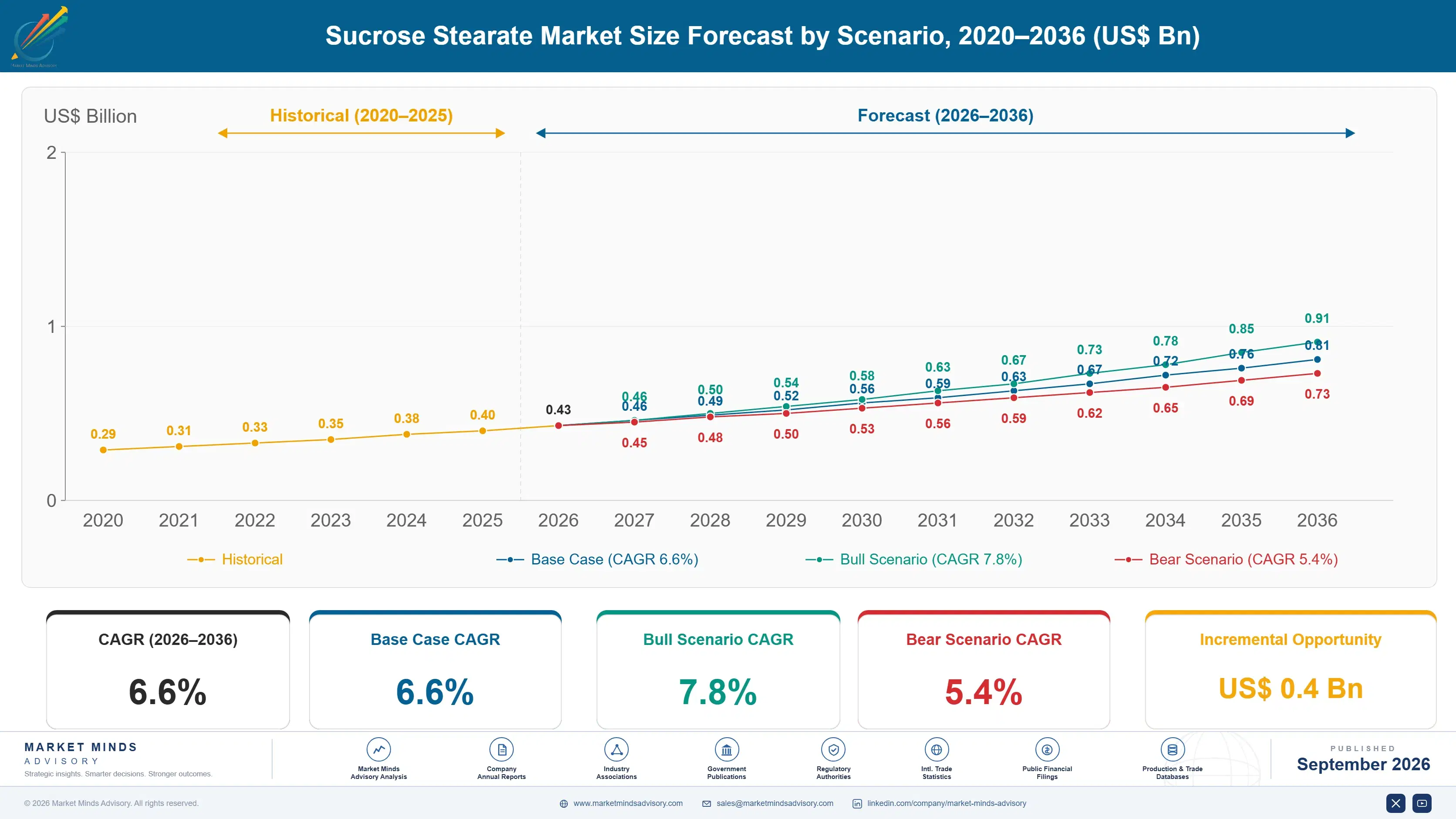
Sucrose Stearate Market Forecast Scenarios

sucrose-stearate-market-size-forecast-scenario-1790013469680
Between 2020 and 2025 the category grew at 5.5% on two quite separate stories running at once. Food application, which is the larger volume base, grew steadily with bakery and beverage manufacture. Personal care grew considerably faster on sensitive skin and clean formulation positioning, and it now carries far more value per tonne than food does despite the smaller tonnage moved.
The base case at 6.6% rests on three mechanisms. Sensitive skin and barrier-focused skincare keeps expanding, and the high HLB grades are the natural choice for it. Pharmaceutical excipient use grows as oral and topical formulations adopt sucrose esters for solubilisation. And Korean and Japanese formulation development continues setting the direction that brands elsewhere then follow into their own ranges. None of the three requires food application volumes to grow at all.
The bull case at 7.8% depends on producers narrowing monoester distribution enough that batch variance stops being a formulation risk, which would remove the main practical objection. The bear case at 5.4% is palm feedstock: roughly 81% of the stearic acid comes from palm, and any tightening of certified supply or shift in sustainability requirements moves cost and availability together in a direction producers cannot hedge.

Mild, Weak, And Variable

The mildness is real. Sucrose esters are non-ionic, non-irritating at use level, and they leave a light skin feel that ethoxylated emulsifiers rarely match. That is the whole reason sensitive skin formulation reaches for them. The other half of the picture is that they emulsify weakly, so a formula needs around 2.3 times conventional loading plus a co-emulsifier and a gum to hold together.
TOP FIVE CONCENTRATION62%Share of category revenue held by the leading producers
MONOESTER CONTENT VARIANCE9 pointsBatch to batch spread within a single nominal grade
USE LEVEL VERSUS CONVENTIONAL2.3 timesLoading needed against a standard nonionic emulsifier system
PALM DERIVED FEEDSTOCK SHARE81%Stearic acid originating from palm rather than other sources
STABILITY FAILURE RATE27%Accelerated testing failures on sole emulsifier formulations tested
FOOD APPLICATION VOLUME SHARE58%Tonnage consumed by food rather than personal care
Batch variance compounds that. HLB in this chemistry is a function of monoester content, and monoester content moves by roughly nine points between lots carrying the same nominal grade designation. A formula sitting close to its stability limit passes with one delivery and separates with the next. Formulators typically find this at scale-up rather than in development, when the recipe is fixed and the launch date is not.
The natural positioning also describes only half the molecule. Sucrose supplies the head group and stearic acid supplies the tail, and roughly 81% of that stearic acid is palm derived. The ingredient is legitimately sugar-based and it is also a palm derivative, and brands leading with the first fact while omitting the second are making a choice rather than a statement of chemistry.
"Everybody quotes the mildness data and nobody quotes the loading. You are buying an emulsifier that needs more than twice the use level, a co-emulsifier, and a gum, and whose HLB wanders between drums. It is worth all of that for sensitive skin work, and formulators should be told before they design around it."
Practice Director, Specialty Surfactants and Formulation Ingredients · MMA Chemicals and Materials Practice · September 2026

Market Trends

Sensitive Skin Formulation Pulls The High HLB End

High HLB monoester-rich grades grow at 9.9%, the fastest rate here, because barrier-focused and sensitive skin skincare needs a water-soluble emulsifier that will not disturb the stratum corneum. Korean development teams adopted the chemistry earliest and most aggressively, and Korean growth of 11.4% leads every country covered. The purification required to reach high monoester content is where most producers struggle, which keeps this part of the market considerably narrower than the chemistry alone would suggest. Chinese producers have entered aggressively at the technical end and are working upward; purification depth has kept them out of the high monoester grades.
Market Impact: Country grows at 11.4%

Batch Variance Becomes A Specification Conversation

Monoester content moves by around nine points between lots of the same nominal grade, which changes effective HLB and therefore emulsion behaviour in formulas sitting near their stability limit. Formulators have begun writing tighter monoester specifications into purchase agreements rather than accepting the nominal grade designation. Producers able to narrow the distribution are winning that work, and those quoting a nominal HLB without a monoester range are increasingly being asked to explain themselves. Producers who can narrow the distribution are winning that work. Producers quoting a nominal figure with no monoester range attached are increasingly asked to justify the omission.
Market Impact: Segment grows at 8.4%

Market Opportunities and Growth Drivers

Korean Development Sets Direction Brands Elsewhere Follow

South Korean growth of 11.4% leads every country covered, driven by sensitive skin and barrier repair formulation that adopted sucrose esters years before Western brands took an interest in them. Korean contract manufacturers formulating for brands headquartered elsewhere then export that ingredient choice into ranges sold across every major market. The direction of influence in this category runs from Seoul outward, which is the reverse of most cosmetic ingredient adoption patterns. Japanese producers supplied that development from the outset, which is why the reference grades everybody benchmarks against are Japanese rather than European or American in origin.
Market Impact: Requires 2.3 times loading

Pharmaceutical Excipient Use Broadens Beyond Emulsification

Ultra-purified grades grow at 8.4% as oral and topical pharmaceutical formulations adopt sucrose esters for solubilisation, permeation enhancement, and taste masking rather than for emulsification alone. Regulatory acceptance is well established in several major markets, which shortens the qualification path considerably compared with a novel excipient. Purity requirements are far stricter than cosmetic grades demand, and only a small number of producers can meet them consistently across successive batches. Prices sit well above cosmetic equivalents and the resulting customer relationships run far longer, since changing an excipient triggers regulatory work that nobody undertakes willingly.
Market Impact: Covers 81% of feedstock

Market Restraints and Challenges

Weak Emulsification Raises Loading And Formulation Cost

A formula built on sucrose stearate needs roughly 2.3 times the loading of a conventional nonionic system, and 27% of sole-emulsifier formulations fail accelerated stability testing outright. The root cause is that sucrose esters form weaker interfacial films than ethoxylated emulsifiers do. Commercially it raises both ingredient cost and formulation complexity. Producers respond with co-emulsifier system recommendations, with pre-blended multi-ester packages, and with formulation support that most competitors do not offer. None of that removes the underlying weakness, which formulators accept because the mildness is worth it. The mildness is worth the trouble to most formulators.
Market Impact: Segment grows at 9.9%

Palm Feedstock Dependence Undercuts The Natural Claim

About 81% of the stearic acid used here is palm derived, and the root cause is that palm stearin is by a wide margin the cheapest and most available source of the fatty acid required. Commercially it exposes producers to certified supply availability and to brands whose sustainability positions exclude palm entirely. Producers respond by qualifying certified sustainable supply, and a few by offering shea and rapeseed derived stearic acid at considerably higher cost. Brands leading with a sugar-based story frequently do not know the other half of the molecule.
Market Impact: Variance spans 9 points
4 additional market trends, 3 additional growth drivers, and 2 additional restraints and challenges are covered in the full report. Contact sales@marketmindsadvisory.com to access the complete intelligence.

Segment CAGR and Growth Architecture

Segmentation follows ester composition and purity across six grade families: high HLB monoester-rich grades, ultra-purified pharmaceutical grades, medium HLB balanced ester grades, blended multi-ester systems, low HLB polyester-rich grades, and technical and industrial grades. Application, physical form, and feedstock origin are treated as separate dimensions entirely. Co-emulsifiers supplied alongside are counted within the blended system.
sucrose-stearate-market-market-share-analysis-1790013470220

High HLB Monoester-Rich Grades

High HLB grades grow at 9.9%, half again the market rate of 6.6%, on sensitive skin and barrier repair formulation that needs a water-soluble emulsifier which will not disturb the skin barrier. Reaching high monoester content demands purification most producers cannot run consistently, which keeps supply narrower than demand would suggest. The same grades carry the widest batch variance problem, since monoester content is exactly what defines them and it moves by around nine points between lots. Formulators writing tighter monoester specifications into purchase agreements are addressing that directly rather than accepting nominal designations. Producers meeting those ranges consistently are taking the specification work. Chinese entrants have not yet reached this end of the range.
CAGR 9.9%

Ultra-Purified Pharmaceutical Grades

Pharmaceutical grades grow at 8.4% as oral and topical formulations adopt sucrose esters for solubilisation, permeation enhancement, and taste masking rather than emulsification alone. Regulatory acceptance in several major markets is established enough to shorten the qualification path considerably against any novel excipient. Purity and residual solvent requirements far exceed what cosmetic grades demand, and only a handful of producers meet them batch after batch. Prices sit well above cosmetic equivalents, and the customer relationships that result are correspondingly long since excipient changes trigger regulatory work nobody wants. Residual solvent limits are the specific hurdle, since several historical esterification routes used solvents that pharmaceutical specifications will not tolerate at any level.
CAGR 8.4%
Full segment breakdown across 6 segments available in the complete report.

Regional Architecture and Country Demand Map

Regional shares here reflect where sucrose stearate is actually produced and then formulated into finished products rather than where those products are eventually consumed by anybody. Four regions sit outside the standard bands, for reasons named in their paragraphs and summarised below for operator review.

East Asia

At 38% this region sits above the standard band, and the justification runs on both sides of the trade: Japanese production established the reference grades that the rest of the industry benchmarks against, and Korean and Chinese formulation consumes more of the output than anywhere else. Korean growth of 11.4% leads every country covered. Chinese food manufacture provides the tonnage base while Korean and Japanese personal care provides the value. Chinese producers are also entering aggressively on price at the technical end. Purification depth is what has so far kept those entrants out of the high monoester grades, and that barrier is narrowing rather than holding. Japanese grades remain the reference the industry measures against.
Share: 38% | CAGR: 7.6% (2026 to 2036)

Western Europe

Dutch and French production accounts for most of the region's supply, and both have built positions in the purification required for high monoester content rather than competing on the technical grades. Growth of 5.1% is the slowest of the seven regions, reflecting a mature personal care market and food manufacture growing slowly. Certified sustainable palm requirements are enforced more actively here than anywhere, which shapes feedstock sourcing across the whole regional supply base. European formulators were also the first to write guaranteed monoester ranges into purchase specifications rather than accepting nominal grade designations, which put commercial pressure on producers to narrow their distributions. That pressure has narrowed distributions measurably. Producers responded rather than losing the accounts.
Share: 23% | CAGR: 5.1% (2026 to 2036)
Regional intelligence for 5 additional markets available in the complete report: North America, South Asia and Pacific, Latin America, Middle East and Africa, Eastern Europe. Contact sales@marketmindsadvisory.com.
sucrose-stearate-market-country-cagr-analysis-1790013470747

Where Producers Win Formulation Work

Four commercial moves separate producers holding formulation positions from those selling a mildness claim and losing the account when stability fails at scale-up. Each addresses one of the honest weaknesses in this chemistry rather than working around it or hoping the formulator does not notice. Two of the four cost nothing beyond disclosure and tighter process control.

Specify Monoester Range Not Nominal HLB

Monoester content moves by roughly nine points between lots of the same nominal grade, which changes effective HLB and destabilises formulas sitting near their limit. Producers publishing a guaranteed monoester range rather than a nominal figure report specification retention 2.9 times higher through scale-up. It costs tighter process control and it removes the failure that most often ends a supply relationship, which is a formula that worked in development and separated in production. That failure ends more supply relationships than price ever has. Tighter process control is the whole cost involved.
Market Impact: Raises specification retention rates to 2.9 times higher

Sell The Co-Emulsifier System Not The Ester

A sucrose stearate formula needs about 2.3 times conventional loading plus a co-emulsifier and a gum, and 27% of sole-emulsifier attempts fail accelerated stability outright. Producers supplying validated system recommendations report formulation success rates 3.4 times higher than those shipping the ester with a data sheet. The formulator is solving a system problem and the producer generally knows the answer, so withholding it costs an account that a competitor then wins. The formulator is solving a system problem rather than an ingredient one. Withholding the answer simply hands the account away.
Market Impact: Raises formulation success rates to 3.4 times higher

State The Palm Position Before Anybody Asks

Roughly 81% of the stearic acid used here is palm derived, and brands leading with a sugar-based story frequently do not know that. Producers disclosing feedstock origin and certification status up front report late-stage supplier rejections 4.2 times lower than those leaving it to a sustainability audit. The discovery arriving during a brand review is considerably more damaging than the fact itself, and disclosure costs only a line in the technical documentation. A line in the technical documentation is the entire cost of avoiding it. Discovery at audit does far more damage than the fact.
Market Impact: Cuts late-stage supplier rejections to 4.2 times lower

Build Purification Depth For Pharmaceutical Grades

Ultra-purified grades grow at 8.4% and only a handful of producers meet residual solvent and purity requirements batch after batch. Producers holding that capability report gross margins 18 to 26 points above cosmetic grade equivalents, and the relationships last far longer because an excipient change triggers regulatory work customers actively avoid. Purification capability is expensive to build and it protects a position that price competition simply cannot reach. Very few producers hold that capability at present. Adding reactor capacity without it simply produces more technical grade material into the least rewarding end of this market.
Market Impact: Adds 18 to 26 gross margin points overall

Who Controls the Margin Pool

Concentration is high. Five producers hold 62% of category revenue, measured consistently on that basis across all participants, and the gap between those with purification depth and those making technical grades is wide in both capability and pricing. Purification rather than esterification is what separates the field, since the reaction itself is not difficult to run. Barriers to entry are therefore about purification investment rather than about reaction know-how, which is why Chinese entrants arrived at the technical end first.
Competition currently turns on three dimensions: monoester distribution control, which decides whether a formulator trusts successive deliveries; purification capability for pharmaceutical grades; and formulation system support, where producers who supply co-emulsifier recommendations hold accounts that ester-only suppliers routinely lose. Feedstock certification has become a fourth dimension as brands with exclusionary palm positions audit their supply chains more actively.

Pressure builds from two directions. Chinese producers are competing hard at the technical end and moving upward. Meanwhile alkyl polyglucosides and polyglyceryl esters contest the same mildness positioning. Rankings will shift toward producers holding purification depth and published monoester ranges, since neither can be assembled quickly. Published monoester ranges have become the clearest signal of which producers hold real process control.
sucrose-stearate-market-company-positioning-matrix-1790013471271

Competitive Moat and Risk Dimensions

MITSUBISHI CHEMICAL GROUP

Moat: Reference Grade Process Depth

Decades of purification and process control produce the monoester distribution consistency that the rest of the industry benchmarks against, and formulators writing tight specifications frequently write them around this producer's typical output. That reference position is worth considerably more than any single performance property, and it took a very long time to establish.
MITSUBISHI CHEMICAL GROUP

Risk: Price Exposure At Technical End

Chinese producers now compete effectively on technical and medium HLB grades where purification depth adds little, and that part of the portfolio carries real price exposure. Defending it on quality arguments that customers cannot detect in those applications is difficult, and the volume involved is not trivial.
SISTERNA

Moat: High HLB Specialisation Focus

Concentration on the high monoester end of the range aligns the business with the fastest growing part of this market and with the sensitive skin formulation driving it. Focus also means the purification investment is spread across exactly the grades where it matters commercially, rather than diluted across technical products that do not reward it.
SISTERNA

Risk: Narrow Grade Range Held

Specialisation in high HLB grades leaves the business without the technical and blended volume that smooths demand across cycles, and customers wanting a full range must qualify a second supplier anyway. Competitors offering the whole HLB ladder can serve a formulator's entire portfolio from one qualification.

Players Tracked

Prominent Players

Mitsubishi Chemical Group
Sisterna
Compass Foods
Stearinerie Dubois
Croda International

Other Key Players

Zhejiang Synose Tech
Wuxi Best Chemical
Guangzhou Cardlo Biochemical
Nihon Surfactant Kogyo
Kao Corporation
DKS Co
Evonik Industries
Clariant
Gattefosse
Seppic
Lubrizol
BASF
Nikko Chemicals
Sino Lion
Hangzhou Ruijiang Performance Material

Recent Developments

MARCH 2026

Mitsubishi Chemical Publishes Guaranteed Monoester Ranges Across Grades

Mitsubishi Chemical Group began publishing guaranteed monoester content ranges rather than nominal HLB designations across its sucrose ester grades, addressing the batch variance that destabilises formulas sitting near their stability limits. The change applies across cosmetic and pharmaceutical grades alike. Competitors quoting nominal figures now face pressure to match it.
Signal: Specification tightening moves from customer request to published supply standard. Competitors must now match the disclosure or explain themselves.
OCTOBER 2025

Sisterna Expands High HLB Grade Purification Capacity

Sisterna completed an organic capacity expansion for high monoester content grade purification, funded internally with no partner involved, after sensitive skin formulation demand across European and Korean accounts outran available purification throughput. The expansion targets purification specifically rather than esterification, which had not been the limiting step.
Signal: Purification rather than esterification capacity is the binding constraint here. Reaction capacity was never the constraint in this chemistry.
MAY 2025

Croda International Signs Certified Stearic Acid Feedstock Agreement

Croda International entered a multi-year supply agreement covering certified sustainable stearic acid feedstock for sucrose ester production, addressing the palm dependence that brands with exclusionary sustainability positions increasingly question at audit. The agreement covers the producer's whole sucrose ester range. Brands excluding palm had begun raising it at audit.
Signal: Palm certification now moves from being a selling point to a basic condition of any supply.

What Sucrose Esters Cost

Three input groups dominate cost. Stearic acid and fatty acid feedstock runs 34% to 42% of cost of goods sold, and the eight-point range separates commodity palm stearin from certified sustainable and non-palm alternatives. Sucrose takes 14% to 20%. Esterification process, solvent recovery, and purification add 28% to 36%, with high monoester and pharmaceutical grades sitting firmly at the top of that range.
Palm stearin pricing moved considerably through 2024 and 2025 as production conditions and biodiesel demand competed for the same output, and United States Department of Agriculture oilseed data documented the underlying movement across both years. Several producers described the resulting margin pressure in their annual reports. Sucrose pricing followed sugar markets on an entirely separate path, driven by harvest conditions in unrelated growing regions. Neither input responded to anything happening in this application.

The competitive disadvantage mechanism runs through purification yield rather than through reaction chemistry. Esterification is not difficult to run, and a producer without the purification capability to reach high monoester content is confined to technical grades where Chinese competition sets the price. Exposure varies sharply by grade mix: technical producers carry full price exposure while pharmaceutical grade specialists face almost none of it.
sucrose-stearate-market-cost-volatility-analysis-1790013471469

Invest In Purification Before Esterification Capacity

The esterification reaction itself is not the difficult part of this process, and adding reactor capacity without purification depth simply produces more technical grade material into the part of the market where Chinese producers already set the price. Purification capability is what opens the grades that reward the investment properly. The investment case is straightforward once framed that way.

Qualify Non-Palm Stearic Acid Sources Early

Palm supplies roughly 81% of the stearic acid used in this chemistry, and brands with exclusionary sustainability positions are asking about it at audit rather than at specification. Shea and rapeseed derived alternatives cost considerably more and having them qualified before a customer asks is worth the premium. Qualification takes longer than most producers expect.

Contract Sucrose And Fatty Acid Separately

Sucrose follows sugar harvest conditions while stearic acid tracks palm production and biodiesel demand, and the two behave independently across almost every year. Managing both exposures on separate contracting cycles avoids the familiar error of renewing everything at a single moment that suits neither input. Sugar harvests and palm production have no relationship to one another whatsoever.

Portfolio Architecture for Margin Defence

Margin follows purification depth almost exactly. Technical and industrial grades compete on price against Chinese producers with adequate quality for the application. Medium HLB and blended systems earn moderately on formulation convenience. High HLB monoester-rich grades earn well on purification difficulty, and ultra-purified pharmaceutical grades earn most, because very few producers meet the requirements consistently across successive batches. The margin spread across those four groups is exceptionally wide for one chemistry.
The tension between volume and premium runs through application. Food manufacture takes 58% of tonnage at prices that reward scale and nothing else, since the performance requirement is undemanding and alternatives exist. Personal care and pharmaceutical take far less tonnage at multiples of the price, because in those applications the mildness and purity are exactly what is being purchased.

High-value pools concentrate where purity or consistency is genuinely difficult: pharmaceutical excipient supply, high HLB grades for sensitive skin formulation, and any account writing guaranteed monoester ranges into a purchase specification. Where the requirement is an anti-crystallisation agent in bakery, price decides and the technical grades compete on nothing else at all. That divide follows application rather than customer size.

Volume / Commodity-Adjacent

Technical and industrial grades supplied into food and general applications where performance requirements are undemanding and alternatives exist. The ten-point range reflects esterification scale and feedstock purchasing rather than any capability a customer would pay more for.
Gross Margin: 20% to 30%

Premium / Certified

Medium HLB and blended multi-ester systems supplied with co-emulsifier recommendations and formulation support for personal care. The twelve-point range separates producers offering validated system guidance from those shipping the ester with a technical data sheet attached.
Gross Margin: 34% to 46%

Sustainability / Regulatory / Next-Generation

High HLB monoester-rich and ultra-purified pharmaceutical grades supplied with guaranteed monoester ranges and certified feedstock. The eighteen-point range reflects purification depth, which very few producers hold and which price competition cannot reach.
Gross Margin: 50% to 68%
sucrose-stearate-market-portfolio-architecture-1790013471965

High-value Sub-segments and Strategic Watch-out

Ultra-Purified Pharmaceutical Grades

Highest value in the category, where residual solvent and purity requirements exclude most producers from qualifying at all. The sixteen-point range reflects batch consistency, since an excipient failing specification triggers regulatory consequences no customer will tolerate twice. Relationships here run longer than anywhere else. Qualification is slow and rarely repeated.
Gross Margin: 54% to 70%

High HLB Monoester-Rich Grades

High value growing at 9.9% on sensitive skin formulation that needs the water-soluble end of the range. The fourteen-point range reflects whether a guaranteed monoester range accompanies supply or the customer accepts a nominal grade designation. Purification depth decides who can supply it. Korean formulation drives most of the demand.
Gross Margin: 44% to 58%

Blended Multi-Ester Systems

Volume core supplied with co-emulsifier recommendations that address the weak emulsification the chemistry cannot avoid. The ten-point range reflects formulation support depth, which is what distinguishes these products from the esters they contain. Most producers ship the ester and a data sheet, and lose the account at scale-up.
Gross Margin: 34% to 44%

Technical And Industrial Grades

The strategic watch-out. Chinese producers supply adequate material at prices established Western producers cannot match, and the application asks nothing that purification depth would improve. The ten-point range reflects feedstock purchasing and scale alone. Nothing here rewards purification investment at all. Chinese supply sets the achievable price here.
Gross Margin: 18% to 28%

How This Demand Repeats

Revenue locks in at qualification and then persists for the life of the formulation, which in personal care runs three to five years and in pharmaceutical applications considerably longer. Stability work is the expensive part of adopting this chemistry, so a formulator who has completed it does not revisit the supplier decision for a modest price difference. The switching cost sits in retesting rather than in the ingredient itself.
Attachment depth varies enormously by application. Pharmaceutical excipient accounts are the deepest, since an excipient change triggers regulatory work that customers actively avoid for years at a time. Personal care sits in the middle, held by stability validation and formulation support. Food application attaches barely at all, with buyers switching between qualified sources on price at every contract review without hesitation.

The buyer profile has moved from purchasing toward formulation development. Sucrose esters were bought against a specification and are now selected during formulation design, because the loading, the co-emulsifier system, and the batch consistency all have to be planned together rather than assumed. That shift favours producers offering formulation support over those competing on delivered price alone.
sucrose-stearate-market-end-use-penetration-index-1790013472463

Where This Market Rewards

These are among the four positions where our research anticipates prominent divergence between winners and laggards over the coming forecast period. Each is grounded in the demand model, the regulatory perimeter, and the announced capacity pipeline.
01 / MONOESTER RANGE GUARANTEE

Nominal HLB is not a specification

Monoester content moves by roughly nine points between lots of the same nominal grade, which shifts effective HLB and destabilises formulas already sitting close to their limits. Producers publishing a guaranteed monoester range rather than a nominal figure report specification retention 2.9 times higher through scale-up. It removes the failure that most often ends a supply relationship, which is a formula that worked in development and separated in production, and that single failure ends more supply relationships in this market than price ever has.
02 / SYSTEM RATHER THAN INGREDIENT

Sell the co-emulsifier package too

A sucrose stearate formula needs around 2.3 times the conventional loading, plus a co-emulsifier and a gum alongside it, and 27% of sole-emulsifier attempts fail accelerated stability testing outright. Producers supplying validated co-emulsifier system recommendations report formulation success rates 3.4 times higher than competitors shipping the ester with a technical data sheet. The producer generally knows the answer already, so withholding it simply hands the account to somebody else, generally to a competitor who was willing to supply the whole system instead.
03 / FEEDSTOCK ORIGIN DISCLOSURE

Half this molecule comes from palm

About 81% of the stearic acid in this chemistry is palm derived, and brands leading with a sugar-based story frequently do not know that when they specify it. Producers disclosing feedstock origin and certification status up front report late-stage supplier rejections 4.2 times lower than those leaving it for a sustainability audit. The discovery arriving during a brand review damages far more than the underlying fact ever would, and a line in the technical documentation is the entire cost of preventing it.
04 / PURIFICATION CAPABILITY BUILDING

The reaction is easy, purification is not

Esterification in this chemistry is not technically difficult, and a producer without purification depth stays confined to technical grades where Chinese competition already sets the achievable price. Producers who hold pharmaceutical grade purification capability now report gross margins 18 to 26 points above their cosmetic grade equivalents built on exactly the same base chemistry. Adding reactor capacity without purification simply produces more material into the least rewarding part of this market, where Chinese producers already compete effectively on price against everybody.

Engagement Snapshot From the Field

A live engagement with an industry participant carrying material or product regulatory and market exposure ahead of a defining policy shift, showing how our research translates into a defensible multi-year portfolio strategy.
MARKET MINDS ADVISORY · CLIENT ENGAGEMENT SUMMARY
Sucrose Stearate Producer Strategic Portfolio Review and Transition Roadmap 2026·Investment Scenario on Sucrose Stearate Exposure Evaluation 2025-26
CLIENT PROFILE
A personal care formulator supplying sensitive skin ranges to eleven brand owners, with annual revenue near USD 240 million (client-reported, unverified by MMA). Three products built on sucrose stearate had separated during production scale-up after passing every development stability test, and two launches had already slipped by a full quarter. The board wanted the cause established before further schedule slippage.
STRATEGIC CHALLENGE
The technical team attributed the failures to manufacturing conditions and had begun revalidating process parameters across the affected lines. Nobody had compared the monoester content of the development material against the production deliveries, or asked the supplier what range the nominal grade designation actually covered. The two explanations pointed at entirely different remedies and very different costs.
MMA APPROACH
MMA analysed monoester content across retained samples from development and production batches, correlated it against stability outcomes, benchmarked four suppliers on published specification tightness, and modelled reformulation cost against a tightened purchase specification for the incumbent material. Manufacturing records were reviewed alongside to establish whether process conditions had genuinely varied between passing and failing batches at all.
KEY FINDINGS
  1. Monoester content varied by 8.6 points across the deliveries examined, and every failed batch used material at the low end of that range against development samples at the high end.
  2. The supplier's nominal grade designation carried no monoester specification at all, only a nominal HLB figure that the varying composition made effectively meaningless.
  3. Two of the four suppliers benchmarked published guaranteed monoester ranges, and neither had been approached because procurement compared only price and nominal HLB.
  4. Process revalidation would have found nothing, since manufacturing conditions were identical across the passing and failing batches examined in the review. The engineering programme would have found nothing.
CLIENT PROFILE
A personal care formulator supplying sensitive skin ranges to eleven brand owners, with annual revenue near USD 240 million (client-reported, unverified by MMA). Three products built on sucrose stearate had separated during production scale-up after passing every development stability test, and two launches had already slipped by a full quarter. The board wanted the cause established before further schedule slippage.
STRATEGIC CHALLENGE
The technical team attributed the failures to manufacturing conditions and had begun revalidating process parameters across the affected lines. Nobody had compared the monoester content of the development material against the production deliveries, or asked the supplier what range the nominal grade designation actually covered. The two explanations pointed at entirely different remedies and very different costs.
MMA APPROACH
MMA analysed monoester content across retained samples from development and production batches, correlated it against stability outcomes, benchmarked four suppliers on published specification tightness, and modelled reformulation cost against a tightened purchase specification for the incumbent material. Manufacturing records were reviewed alongside to establish whether process conditions had genuinely varied between passing and failing batches at all.
KEY FINDINGS
  1. Monoester content varied by 8.6 points across the deliveries examined, and every failed batch used material at the low end of that range against development samples at the high end.
  2. The supplier's nominal grade designation carried no monoester specification at all, only a nominal HLB figure that the varying composition made effectively meaningless.
  3. Two of the four suppliers benchmarked published guaranteed monoester ranges, and neither had been approached because procurement compared only price and nominal HLB.
  4. Process revalidation would have found nothing, since manufacturing conditions were identical across the passing and failing batches examined in the review. The engineering programme would have found nothing.
RECOMMENDED STRATEGY
Phase 1: Phase one: halt process revalidation and write a guaranteed monoester range into the purchase specification for every affected formulation immediately. Phase 2: Phase two: qualify a second supplier already publishing monoester ranges, rather than relying on the incumbent tightening its own process. Phase 3: Phase three: add a co-emulsifier to formulas sitting closest to their stability limit, widening the tolerance the formulation can absorb.
OUTCOME
No further separation occurred across the following five production quarters (client-reported, unverified by MMA). Both delayed launches shipped within two months of the specification change. Process revalidation was abandoned, saving most of an engineering programme. Procurement now specifies monoester range on every sucrose ester purchase across the business.

Frequently Asked Questions

Foundational context covering the market sizes, CAGR, scope, country, region and competition that inform every finding below. This section is provided to cover basics and most often pre-purchase conversations, answered from the MMA Primary Research Dataset.

What is the current size of the Sucrose Stearate Market?

The market was worth USD 0.4 billion in 2025 and stands at USD 0.4 billion in 2026. Value covers all grades supplied across personal care, food, and pharmaceutical applications.

How large will the Sucrose Stearate Market be by 2036?

MMA forecasts USD 0.8 billion by 2036, an increase of USD 0.4 billion across the forecast period. That represents 2.00 times the 2026 base of USD 0.4 billion.

What is the CAGR for the Sucrose Stearate Market 2026 to 2036?

The base case compound annual growth rate is 6.6%, with a bull case at 7.8% and a bear case at 5.4%. Historical growth from 2020 to 2025 ran at 5.5%.

Which segment is growing fastest?

High HLB monoester-rich grades grow at 9.9%, half again the market rate of 6.6%. Sensitive skin formulation needs the water-soluble end of the range specifically.

Who are the major companies in the Sucrose Stearate Market?

Mitsubishi Chemical Group, Sisterna, Compass Foods, Stearinerie Dubois, and Croda International lead. Together they hold 62% of revenue, with purification depth separating them from the rest.

Which country is growing fastest?

South Korea grows at 11.4%, the fastest of any country covered here. Sensitive skin and barrier repair formulation there adopted sucrose esters years before Western brands took any interest.

Report Segmentation Architecture

The full report scope spans multiple orthogonal segmentation dimensions, with cross-tabulated demand data provided for each dimension pair. Coverage extends further to regional breakdowns, trend trajectories, and the competitive detail needed to support segment-level decision-making.

By Ester Composition And Purity

  • High HLB Monoester-Rich Grades
  • Ultra-Purified Pharmaceutical Grades
  • Medium HLB Balanced Ester Grades
  • Blended Multi-Ester Systems
  • Low HLB Polyester-Rich Grades
  • Technical and Industrial Grades

By End-Use Industry

  • Sensitive Skin and Facial Skincare
  • Body Care and Sun Care
  • Colour Cosmetics and Cleansing
  • Bakery and Confectionery
  • Beverage and Dairy
  • Pharmaceutical Oral and Topical

By Commercial Dimension

  • Brand Owner Direct Supply
  • Contract Formulator Supply
  • Specialty Ingredient Distribution
  • Food Ingredient Distribution
  • Pharmaceutical Excipient Supply
  • Formulation Support Contracts

By Region

  • East Asia
  • Western Europe
  • North America
  • South Asia and Pacific
  • Latin America
  • Middle East and Africa
  • Eastern Europe

Scope, Methodology, and Coverage

Every figure in this report is reproducible from documented input assumptions. The scope below maps the historical period, the forecast horizon, the segmentation dimensions, and the countries covered, alongside the underlying primary and qualitative methodology.
Historical Period
2020 to 2025
Forecast Period
2026 to 2036
Base Year
2025 (USD billions; MMA Primary Research Dataset, September 2026)
Market Definition
This market covers sucrose stearate, the sucrose ester of stearic acid, supplied across high HLB monoester-rich grades, ultra-purified pharmaceutical grades, medium HLB balanced ester grades, blended multi-ester systems, low HLB polyester-rich grades, and technical and industrial grades. It excludes sucrose esters of other fatty acids, sorbitan and polyglyceryl esters, alkyl polyglucosides, other nonionic emulsifier chemistries, and finished formulated products.
Quantitative Units
USD billions, revenue at producer selling price
Segmentation Dimensions
Ester composition and purity, end-use industry, commercial dimension, region
Regions Covered
East Asia, Western Europe, North America, South Asia and Pacific, Latin America, Middle East and Africa, Eastern Europe
Countries Covered
Japan, South Korea, China, Taiwan, Netherlands, France, Germany, United Kingdom, Italy, Spain, Switzerland, Poland, Czechia, United States, Canada, Mexico, India, Indonesia, Thailand, Vietnam, Australia, Brazil, Colombia, Chile, Argentina, Saudi Arabia, United Arab Emirates, Egypt, Nigeria, South Africa
Key Companies Profiled
Mitsubishi Chemical Group, Sisterna, Compass Foods, Stearinerie Dubois, Croda International, Zhejiang Synose Tech, Wuxi Best Chemical, Guangzhou Cardlo Biochemical, Nihon Surfactant Kogyo, Kao Corporation, DKS Co, Evonik Industries, Clariant, Gattefosse, Seppic, Lubrizol, BASF, Nikko Chemicals, Sino Lion, Hangzhou Ruijiang Performance Material
Quantitative Methodology
Primary survey, n=3,800 respondents, Q4 2025, six countries; demand-side model with trade association cross-validation
Qualitative Methodology
47 expert interviews, Q4 2025; applied to validate demand model assumptions, identify emerging dynamics, and assess competitive positioning
Report Format
PDF and XLSX data workbook (Word format preview document)
Publisher
Market Minds Advisory
Report Code
MMA-2026-CHM-251
Published
September 2026
Contact
sales@marketmindsadvisory.com | www.marketmindsadvisory.com

Purchase the full Sucrose Stearate Market Report (2026 to 2036).

The full report sizes the sucrose stearate market across six grade families, seven regions, and thirty countries, with forecasts to 2036 under base, bull, and bear cases. It quantifies the batch variance in monoester content that destabilises formulations at scale-up, sets out the loading and co-emulsifier costs behind the mildness claim, and traces the palm feedstock dependence sitting behind a sugar-based positioning. Competitive analysis covers twenty participants evaluated consistently on category revenue, with detailed treatment of purification capability by producer. Cost structure, purification yield economics, and application-level margin architecture are analysed throughout. Primary research includes 3,800 survey responses and 47 expert interviews.
Six grade families sized and forecast separately
Twenty participants evaluated on category revenue consistently
Monoester content variance measured across suppliers and grades
Emulsion loading and stability costs quantified against conventional systems
Palm feedstock dependence and certified supply positions mapped
Purification capability assessed by producer and grade family

Built For The People Who Decide

From boardroom strategy to bench-side execution, this report is read cover-to-cover by leaders shaping the next decade of their industry, turning demand scenarios, market dynamics and valuation benchmarks into decisions.
CXOs/ Presidents/ VPs/ Managers
M&A and Corporate Development
Strategy Teams and R&D Heads
Procurement and Product Directors
Regulatory and Compliance Leaders
Investor Relations and Equity Analysts