Market Minds Advisory
Subsea Power Grid Systems Market

Subsea Power Grid Systems Market: Submarine Cables, Offshore Substations, and Grid Interconnection Infrastructure

Offshore wind developers are racing to secure HVDC export cable and subsea substation capacity as European and Asian yards book out through 2030, turning grid hardware into the critical path for gigawatt-scale commissioning schedules.

Lead Analyst

David Horsley

Published

September 2026

Make Smarter Decisions with Customized Research Insights

Request a free sample report and evaluate market opportunities, growth trends, and competitive dynamics relevant to your business needs.

2025 MARKET VALUE$9.5BMarket Size 2025
2036 FORECAST VALUE$26.5BBase Case , 2026 to 2036
CAGR 2026 TO 20369.8 %Bull 11.1% / Bear 8.5%
INCREMENTAL OPPORTUNITY$16.1BNet 10- year value creation
EXPANSION MULTIPLE2.55x2036 value over 2026 base
Strategic Levers
M&A Pipeline
Regional Outlook
Country Rankings
Competitive Intelligence
Segmental Deep-dive
Call-Us : 91 93563 13602

Executive Snapshot and Market Trajectory

Cable-lay vessel and factory capacity, not turbine supply, is now the binding constraint on offshore wind timelines, and developers that secured subsea cable and substation slots two years ago are commissioning on schedule while later entrants face multi-year delivery queues at every major European and Asian manufacturing yard.
China now installs more offshore wind capacity annually than the rest of the world combined, pulling subsea substation and export cable demand toward Chinese yards even as European developers scramble for the same limited pool of qualified cable-lay vessels. Dynamic power cables for floating wind are the fastest-growing product class, still a small base today but critical to reaching deep-water sites off Japan, Korea, and the US West Coast that fixed-bottom foundations cannot reach.
Five suppliers, Prysmian, Nexans, NKT, Hitachi Energy, and Sumitomo Electric, control most of the world's high-voltage subsea cable manufacturing capacity, and that concentration is intentional: qualifying a new cable factory to offshore-grade standards takes years and hundreds of millions of dollars, leaving new entrants confined mostly to lower-voltage array cables. EU grid interconnection standardisation and rising interconnector investment between national grids are pulling subsea substation demand beyond offshore wind alone.
Market Definition
The subsea power grid systems market covers submarine power cables, subsea substations, transformer platforms, switchgear, and connector systems used to transmit and distribute electrical power under water for offshore wind, oil and gas, and grid interconnector applications. It excludes onshore transmission infrastructure, offshore wind turbine generators themselves, and subsea telecommunications cables.
Base Year Value
$9.5B in 2025 (MMA Primary Research Dataset, August 2026)
Forecast Period
2026 to 2036, eleven discrete annual values
CAGR
9.8% base case. Bull 11.1%. Bear 8.5%.
Fastest Growth Segment
Dynamic Power Cables: 13.5% CAGR
Fastest Growth Country
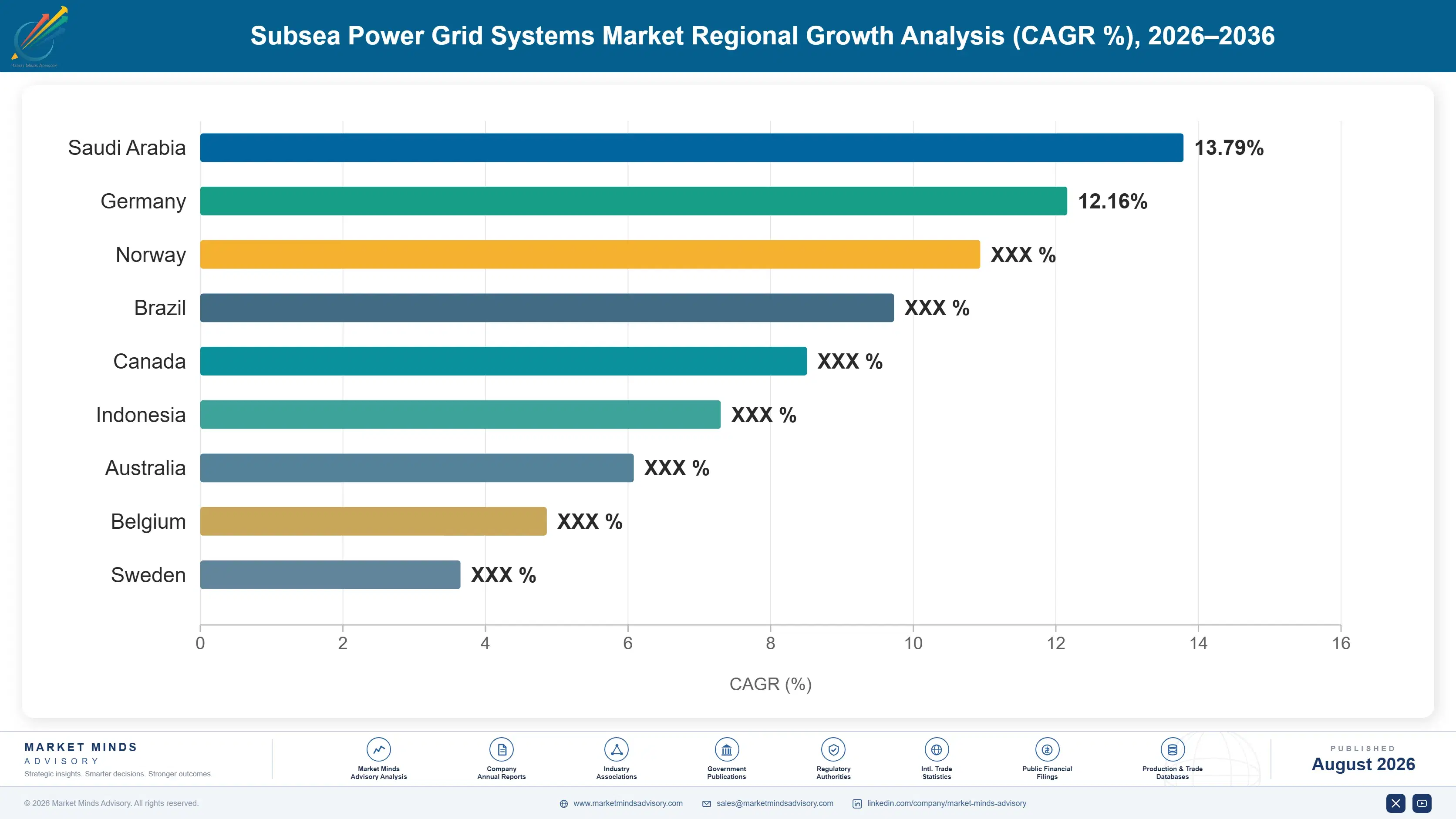
Taiwan: 13.2% CAGR
Fastest Growth Region
South Asia and Pacific: 11.8% CAGR
Largest Region
East Asia: 29% of 2025 global value
Market Leaders
Prysmian Group, Nexans, NKT, Hitachi Energy, Sumitomo Electric Industries. Source: MMA Analysis based on company annual reports and investor filings.
Primary Survey
n=3,800 procurement and R&D decision-makers, Q4 2025, six countries
Methodology
Demand-side build-up, cross-validated against public data, 47 expert interviews

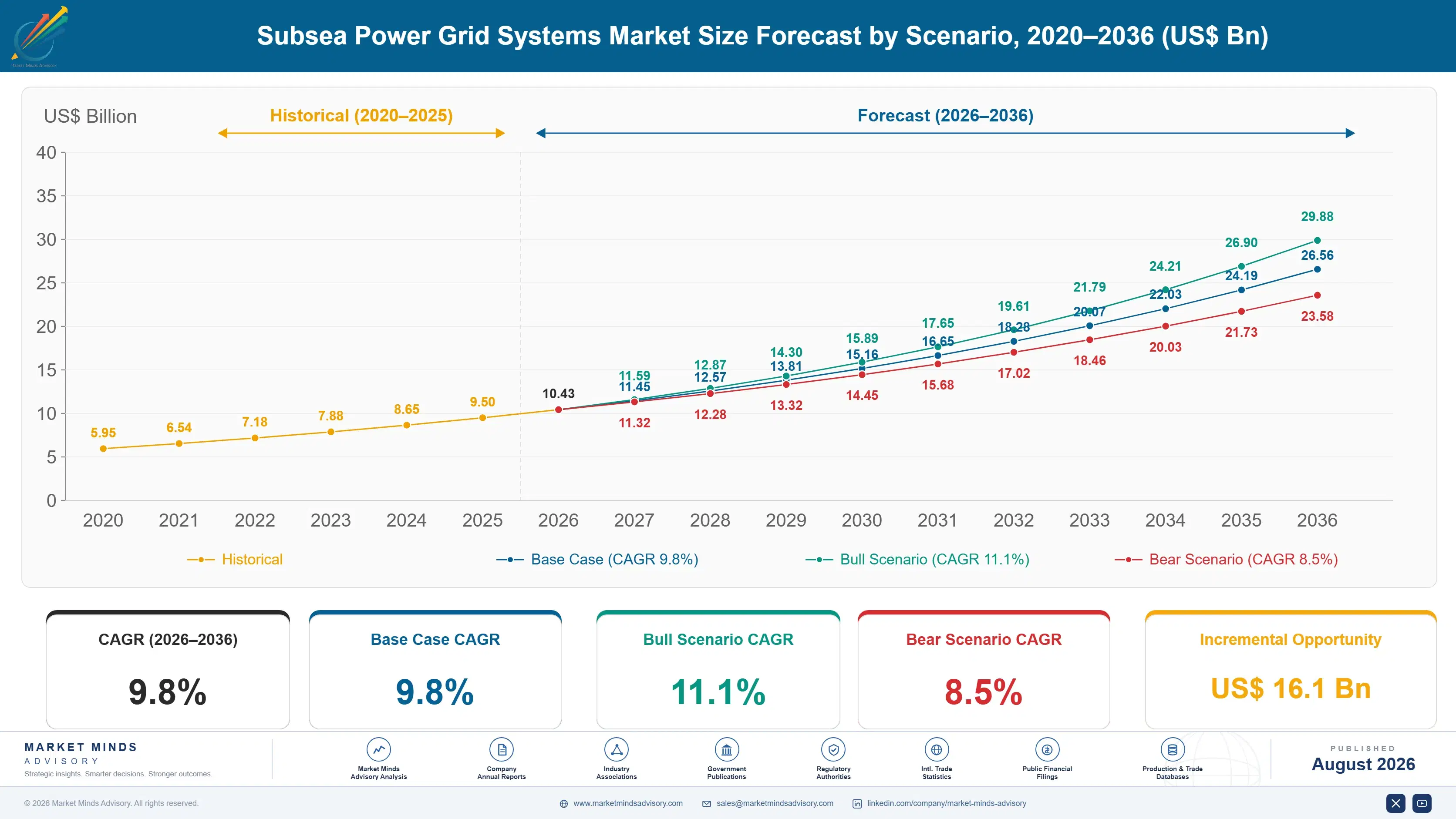
Subsea Power Grid Systems Market Forecast Scenarios

subsea-power-grid-systems-market-size-forecast-scenario-1787300047839
Subsea power grid investment accelerated steadily from 2020 through 2025 as European offshore wind auctions cleared record volumes and China's five-year plan targets pulled domestic cable and substation manufacturing capacity into rapid expansion. Vessel and factory bottlenecks emerged only toward the end of the period, and the segment grew at roughly an 8.8 percent historical compound rate.
MMA's base case assumes 9.8 percent compound growth through 2036, anchored in three mechanisms. First, gigawatt-scale offshore wind auctions across the UK, Germany, Netherlands, and China keep booking export cable and substation capacity years in advance. Second, national grid operators are financing subsea interconnectors between countries to balance renewable intermittency, a demand stream independent of wind farm construction cycles. Third, floating wind pilot zones off Japan, Korea, and California are pulling dynamic cable manufacturers to scale production ahead of confirmed commercial-scale orders.
A bull scenario near 11.1 percent follows if floating wind reaches commercial scale before 2032, forcing rapid dynamic-cable capacity expansion across every qualified yard simultaneously. The bear case near 8.5 percent materialises if interest-rate pressure delays final investment decisions on multiple gigawatt-scale wind farms, pushing already-booked cable and substation orders into later delivery slots and softening near-term factory utilisation.

Vessel and Factory Capacity as the Binding Constraint

Subsea power grid systems have shifted from a specialised offshore engineering niche into critical-path infrastructure that determines whether gigawatt-scale wind farms hit their commissioning dates. Vessel and factory capacity, not permitting or turbine supply, is now the tightest constraint across the value chain, and developers that locked in cable and substation slots early are shielded from delays rattling later entrants across every major market. That shift alone is reshaping how procureme
MARKET CONCENTRATION68%Five suppliers dominate high-voltage cable manufacturing capacity worldwide
AVERAGE CABLE COST$2.1M/kmReflects high-voltage direct current export cable installed pricing
CHINA PRODUCTION SHARE41%Chinese yards now supply a leading share of new capacity
VESSEL UTILISATION RATE94%Cable-lay vessel fleet runs near full booked capacity globally
ORDER BACKLOG COVERAGE3.4 yearsConfirmed orders extend well beyond typical project delivery windows
TRADE INTENSITYHighCable and substation components move across borders before installation
Commercial activity concentrates in high-voltage direct current export cables and offshore substation platforms, where technical qualification barriers keep the supplier base narrow and order books full years in advance. Dynamic power cables for floating wind remain a smaller but fast-scaling category, drawing capital from cable makers positioning early for deep-water markets off Japan, Korea, and the US Pacific coast that fixed-bottom foundations cannot reach.
The next decade will be shaped less by cable technology breakthroughs than by how fast vessel fleets and factory capacity scale to match auction volumes. Suppliers that expand capacity ahead of confirmed demand capture multi-year order books; those that wait find themselves quoting into an already-booked market with little room left to compete on schedule.
"The bottleneck in offshore wind was never the turbine. It has always been whether anyone can actually get the power to shore."
Director, Offshore Energy Infrastructure Practice · MMA Energy Infrastructure &

Market Trends

HVDC Interconnectors Scale Beyond Offshore Wind Applications

National grid operators across Northern Europe are financing subsea high-voltage direct current interconnectors to balance renewable intermittency between countries, a demand stream independent of offshore wind farm construction schedules. The North Sea Wind Power Hub initiative and bilateral interconnector projects between the UK, Norway, and Denmark are booking cable and converter station capacity years ahead of commissioning, competing with offshore wind developers for the same qualified factory slots. Suppliers report that interconnector contracts carry longer lead times and higher unit values than typical export cable orders, shifting commercial priority within order books toward these standalone grid projects.
Market Impact: Books 4.2 years of forward capacity
Floating Wind Pilot Zones Drive Dynamic Cable Investment

Floating offshore wind pilot zones off Japan, South Korea, and California's central coast require dynamic power cables engineered to withstand continuous motion and fatigue loading that fixed-bottom array cables never experience. Cable manufacturers including Nexans and JDR Cable Systems are scaling dedicated dynamic cable production lines ahead of confirmed commercial-scale orders, betting that early qualification wins position them for the first wave of gigawatt-scale floating projects expected later this decade. Dynamic cable failure rates in early pilot installations have run higher than fixed-cable benchmarks, keeping insurers and developers cautious even as manufacturing capacity expands to meet anticipated demand.
Market Impact: Adds $3.8B in interconnector orders

Market Opportunities and Growth Drivers

Gigawatt-Scale Offshore Wind Auctions Lock In Multi-Year Orders

The UK's Contracts for Difference rounds, Germany's centralised offshore wind tenders, and China's provincial offshore wind targets are together clearing gigawatt-scale capacity annually, and each awarded project books export cable and substation capacity years before construction begins. Developers now treat cable and substation procurement as a first-mover advantage rather than a late-stage engineering task, since delaying the order risks losing a manufacturing slot to a competing project. That shift has pulled procurement timelines forward across the industry, with some developers securing capacity before finalising turbine supply agreements, inverting the traditional project sequencing that put cables last.
Market Impact: Caps installation throughput by roughly 18%

Grid Interconnector Investment Diversifies Demand Beyond Wind

National transmission operators are financing subsea interconnectors between countries specifically to balance renewable intermittency and arbitrage electricity prices across borders, a demand stream that exists independent of offshore wind construction cycles. The Viking Link between the UK and Denmark and similar projects under development across the Baltic and North Sea regions represent multi-billion-dollar single contracts that rival the largest wind farm cable packages in scale. This diversification insulates suppliers from wind-specific policy risk, since interconnector projects are typically backed by regulated transmission tariffs rather than merchant wind farm economics, giving cable makers a more stable revenue base across policy cycles.
Market Impact: Limits new entrant qualifications to 2-3

Market Restraints and Challenges

Cable-Lay Vessel Shortage Caps Industry-Wide Delivery Capacity

The global fleet of vessels capable of laying high-voltage subsea cable at commercial scale numbers only a few dozen, and the root cause is economic: a single specialised cable-lay vessel costs several hundred million dollars and takes years to build, so operators expand the fleet cautiously. That scarcity means fully manufactured cable can sit in storage awaiting an available vessel slot, delaying project commissioning. Vessel operators including Subsea 7 and Prysmian's own installation fleet are ordering new vessels to add installation capacity, but new vessel deliveries remain years away from easing the constraint.
Market Impact: Adds 14pp to non-wind demand

Technical Qualification Barriers Slow New Manufacturer Entry

Qualifying a new high-voltage subsea cable factory to offshore-grade reliability standards takes several years and hundreds of millions of dollars in testing, certification, and reference-project track record, which is the root cause of the industry's narrow five-supplier core. That barrier protects incumbent margins but limits how quickly total industry capacity can expand to meet rising demand, leaving developers exposed to delivery queues. Chinese manufacturers including Zhongtian Technology Group and Hengtong Group are mitigating the constraint by qualifying new capacity under domestic project requirements, building the track record needed to compete for international export cable contracts outside China.
Market Impact: Lifts dynamic cable orders by 22%
4 additional market trends, 3 additional growth drivers, and 4 additional restraints and challenges are covered in the full report. Contact sales@marketmindsadvisory.com to access the complete intelligence.

Segment CAGR and Growth Architecture

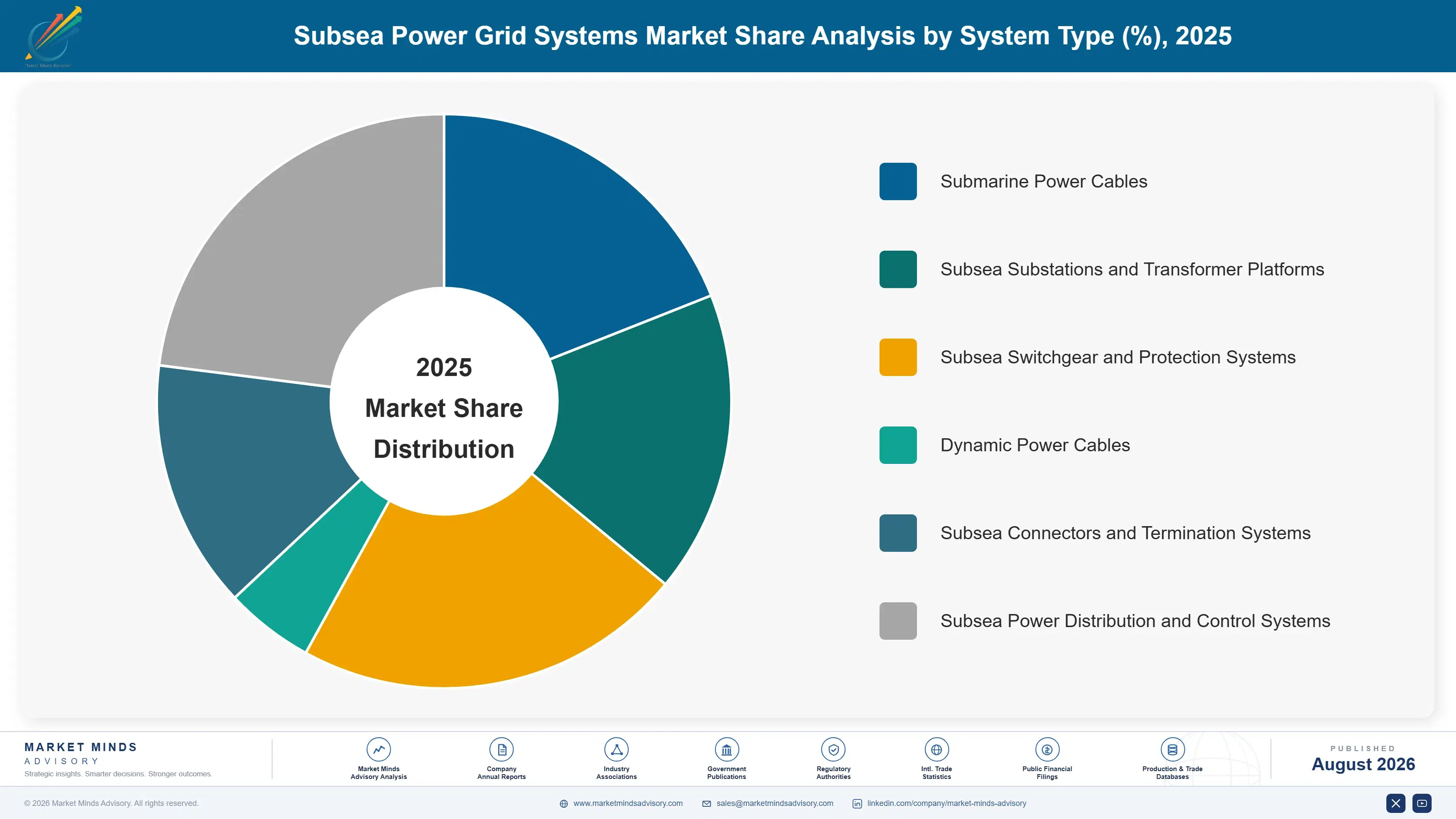
MMA segments the subsea power grid systems market by system type, the classification engineering, procurement, and construction contractors actually specify and tender against, rather than by end application or voltage class alone. Six system types cover the addressable market, each with distinct manufacturing processes, qualification requirements, and installation methods across offshore wind, interconnector, and oil and gas projects.
subsea-power-grid-systems-market-market-share-analysis-1787300048777

Dynamic Power Cables

Dynamic power cables, engineered to withstand continuous motion and fatigue loading as floating platforms shift with wind and waves, are growing fastest because floating offshore wind is moving from single-turbine pilots toward gigawatt-scale commercial zones off Japan, South Korea, and California. Unlike fixed array cables, dynamic cables require specialised armouring and bend-stiffener systems that only a handful of manufacturers, including Nexans and JDR Cable Systems, produce at qualified reliability standards. Early pilot installations have shown higher fatigue-related failure rates than fixed-bottom benchmarks, which keeps insurers cautious and pricing elevated. Manufacturers that establish a strong reliability track record early stand to capture a disproportionate share of the commercial-scale floating wind buildout expected later this decade.
CAGR 13.5%

Subsea Substations and Transformer Platforms

Subsea and offshore substation platforms, which step up voltage for long-distance transmission and house switchgear and protection equipment, are the second-fastest-growing segment as gigawatt-scale wind farms move further from shore and require intermediate voltage conversion to keep transmission losses manageable. Hitachi Energy and Siemens Energy dominate offshore HVDC converter platform supply, a segment where a single project can represent a contract worth several hundred million dollars. Fabrication yards in South Korea and China are scaling platform assembly capacity to serve this segment, since platform construction requires heavy marine fabrication infrastructure that most Western yards cannot expand. Growth here tracks with how far offshore wind farms are sited, since distance from shore is the single biggest driver of substation specification complexity.
CAGR 11.8%
Full segment breakdown across 6 segments available in the complete report.

Regional Architecture and Country Demand Map

East Asia leads subsea power grid demand as China's offshore wind buildout outpaces the rest of the world combined, while Western Europe retains the deepest installed base of qualified cable manufacturers and vessel operators. South Asia and Pacific is scaling fastest behind Taiwan and South Korea's aggressive offshore wind targets.

North America

The United States' offshore wind pipeline has slowed relative to earlier projections, but grid interconnector investment along the East Coast and California's floating wind pilot zones keep subsea cable demand steady even as individual project timelines shift. Dominion Energy's Coastal Virginia Offshore Wind project and several Northeastern state procurement rounds continue to anchor near-term export cable orders, while Canadian offshore wind development remains largely exploratory. California's deep-water floating wind lease areas represent the region's longest-term growth driver, since fixed-bottom foundations cannot reach the Pacific coast's steep continental shelf, making dynamic cable qualification a prerequisite for any commercial-scale West Coast buildout planned for the next decade. Interconnector proposals linking Atlantic wind hubs to onshore grids add a further layer of demand.
Share: 22% | CAGR: 9.8% (2026 to 2036)

Western Europe

The North Sea remains the world's most mature subsea grid market, anchored by the UK, Germany, Netherlands, and Denmark's overlapping offshore wind and interconnector build programmes that keep Prysmian, Nexans, and NKT's European factories running at near-full capacity. The North Sea Wind Power Hub initiative, a multi-country effort to build shared offshore grid infrastructure rather than country-by-country connections, represents the region's most ambitious long-term project and could meaningfully change how future cable and substation capacity gets allocated. Norway's growing role as an interconnector hub, linking Nordic hydropower to continental European grids, adds a second demand stream layered on top of the region's core offshore wind buildout. Denmark's Energy Islands programme is pioneering a new offshore grid hub architecture.
Share: 25% | CAGR: 8.3% (2026 to 2036)
Regional intelligence for 5 additional markets available in the complete report: East Asia, South Asia and Pacific, Latin America, Middle East and Africa, Eastern Europe. Contact sales@marketmindsadvisory.com.
subsea-power-grid-systems-market-country-cagr-analysis-1787300049623

Capacity Booking Premiums and Interconnector Diversification

Suppliers extract value less through per-kilometre cable pricing than through securing multi-year capacity bookings, diversifying into interconnector projects independent of wind policy cycles, and capturing higher-margin substation and dynamic cable segments ahead of competitors. The levers below describe how each part of the value chain is capturing its share of a market where demand now outstrips available capacity.

Multi-Year Capacity Booking Locks In Premium Pricing

Suppliers are increasingly requiring developers to book manufacturing and vessel capacity years in advance with binding deposits, converting what was once competitive per-project bidding into a capacity-reservation model that favours whoever commits earliest. Prysmian and Nexans both report that capacity booked 3-plus years ahead carries meaningfully firmer pricing than spot-availability orders, since developers are effectively paying for certainty in a supply-constrained market. This shift has moved commercial negotiations earlier in the project lifecycle, with some developers now securing cable capacity before finalising environmental permits, inverting the traditional project sequencing that treated cables as a late-stage procurement item.
Market Impact: Adds a 15-20% premium for early capacity bookings

Interconnector Contracts Diversify Away From Wind Policy Risk

Cable makers are pursuing grid interconnector contracts alongside offshore wind orders because interconnectors are backed by regulated transmission tariffs rather than merchant wind economics, insulating a portion of the order book from renewable subsidy policy swings. A single interconnector project can be worth more than $2 billion in cable and converter station value, comparable to the largest offshore wind cable packages, but with a different and more predictable risk profile. Suppliers with interconnector track records, including Prysmian's role in Viking Link, are using that positioning to win regulated-tariff projects across Northern Europe without competing on price against wind-sector rivals.
Market Impact: Diversifies roughly 20% of order book into interconnectors

Substation Platform Bundling Captures Higher-Margin Scope

Suppliers that bundle offshore substation platform fabrication with cable supply, rather than selling cables alone, capture a larger share of total project value since platform contracts carry meaningfully higher margins than cable manufacturing alone. Hitachi Energy and Siemens Energy have both expanded platform fabrication capacity to compete for these bundled scopes rather than ceding the higher-margin work to marine engineering contractors. As wind farms move further from shore, the substation share of total project value, now above 30 percent on far-shore projects, keeps rising, making this bundling strategy central to overall project economics for suppliers positioned to deliver it.
Market Impact: Captures an 8-12pp higher margin via bundled scope

Early Dynamic Cable Qualification Positions For Floating Wind

Manufacturers investing in dynamic cable qualification now, ahead of confirmed commercial-scale floating wind orders, are positioning to capture a disproportionate share of a segment expected to scale once Japan, Korea, and California move projects to final investment decision. Nexans and JDR Cable Systems have both run pilot installations to build the fatigue-performance track record that developers and insurers require before committing to commercial-scale orders. That positioning is difficult for later entrants to replicate, since qualification requires 5-plus years of in-water performance data that cannot be compressed by capital investment alone, giving first movers a durable advantage as the segment matures.
Market Impact: Positions for 30%-plus share of dynamic cable orders

Who Controls the Margin Pool

Five suppliers, Prysmian, Nexans, NKT, Hitachi Energy, and Sumitomo Electric, control roughly 68 percent of global high-voltage subsea cable manufacturing capacity, a concentration driven by qualification barriers rather than market design. The gap to challengers like LS Cable & System or JDR Cable Systems is narrowing, since Asian manufacturers are qualifying new capacity under domestic project requirements that skip the export-market track record incumbents needed worldwide.
Current competitive activity centres on three fronts: securing multi-year capacity bookings that lock in demand years ahead of construction, bundling substation fabrication with cable supply for higher-margin scope, and racing to qualify dynamic cable production for floating wind. Suppliers are also quickly expanding vessel fleets, recognising that manufacturing capacity no longer guarantees delivery when vessel availability is the binding constraint.

Emerging pressure comes from Chinese manufacturers including Zhongtian Technology Group and Hengtong Group, qualifying export-grade capacity faster than expected and beginning to compete internationally beyond domestic projects. Rankings shift most in the dynamic cable segment, where no incumbent holds the multi-decade track record anchoring the HVDC export cable hierarchy, leaving floating wind open to whichever manufacturer proves reliability first.
subsea-power-grid-systems-market-company-positioning-matrix-1787300050480

Competitive Moat and Risk Dimensions

PRYSMIAN GROUP

Moat: Largest Installed Cable Manufacturing Base

Prysmian operates the largest network of high-voltage subsea cable factories and its own cable-lay vessel fleet, letting it offer integrated manufacturing-plus-installation contracts that few rivals can match end to end. That vertical integration is difficult and capital-intensive to replicate, and it underpins Prysmian's position on the largest interconnector and offshore wind export cable contracts awarded globally.
PRYSMIAN GROUP

Risk: Vessel Fleet Capacity Constraints

Even Prysmian's own vessel fleet cannot fully absorb the current surge in order volume, and the company has had to charter third-party vessels at premium rates during peak periods. If competitors expand dedicated fleets faster, Prysmian's installation-bundling advantage could narrow relative to specialists focused purely on vessel capacity.
NEXANS

Moat: Deep Dynamic Cable Technical Lead

Nexans has run more dynamic cable pilot installations for floating wind than any competitor, building a fatigue-performance track record that developers and insurers increasingly require before committing to commercial-scale orders. That early-mover position in a still-nascent segment gives Nexans a credible claim to leadership as floating wind moves toward gigawatt scale.
NEXANS

Risk: Concentrated European Manufacturing Footprint

Nexans' manufacturing base remains more concentrated in Europe than some rivals, leaving it comparatively less positioned to compete on cost or local-content requirements in China, Korea, and Taiwan, where domestic supply mandates increasingly favour regional manufacturers over European exporters. That geographic imbalance could widen further if Asian domestic-content rules tighten faster than Nexans can localise production.

Players Tracked

Prominent Players

Prysmian Group
Nexans
NKT
Hitachi Energy
Sumitomo Electric Industries

Other Key Players

LS Cable & System
JDR Cable Systems
TFKable
Siemens Energy
ABB
Aker Solutions
Subsea 7
Saipem
TechnipFMC
McDermott International
Baker Hughes
Zhongtian Technology Group
Hengtong Group
Taihan Electric Wire
LS Eco Energy

Recent Developments

FEBRUARY 2026

Prysmian Commissions New HVDC Cable Factory in the Netherlands

Prysmian commissioned a new high-voltage direct current export cable factory in the Netherlands in February 2026, adding capacity for North Sea offshore wind and interconnector projects. The facility expands Prysmian's European manufacturing footprint to address order backlogs that had pushed some customer delivery dates past 2029.
Signal: Confirms that even the largest suppliers see current capacity as meaningfully insufficient for already-booked demand levels.
SEPTEMBER 2025

Hitachi Energy Wins Major Offshore Substation Platform Contract

Hitachi Energy was awarded a contract to design and fabricate an offshore HVDC converter substation platform for a North Sea wind farm in September 2025, one of the largest substation awards in the segment. The contract underscores substation platforms' growing share of offshore wind grid connection project value.
Signal: Signals that offshore substation scope is capturing a steadily rising share of total project contract value overall.
MAY 2025

Zhongtian Technology Group Qualifies Export-Grade HVDC Cable Production

Zhongtian Technology Group completed export-grade qualification testing for its high-voltage direct current subsea cable production line in May 2025, positioning the Chinese manufacturer to bid on international offshore wind and interconnector projects beyond its domestic Chinese customer base. The qualification milestone followed several years of dedicated testing investment.
Signal: Marks the clearest sign yet that Chinese cable suppliers are moving seriously toward international export-market competition beyond Asia.

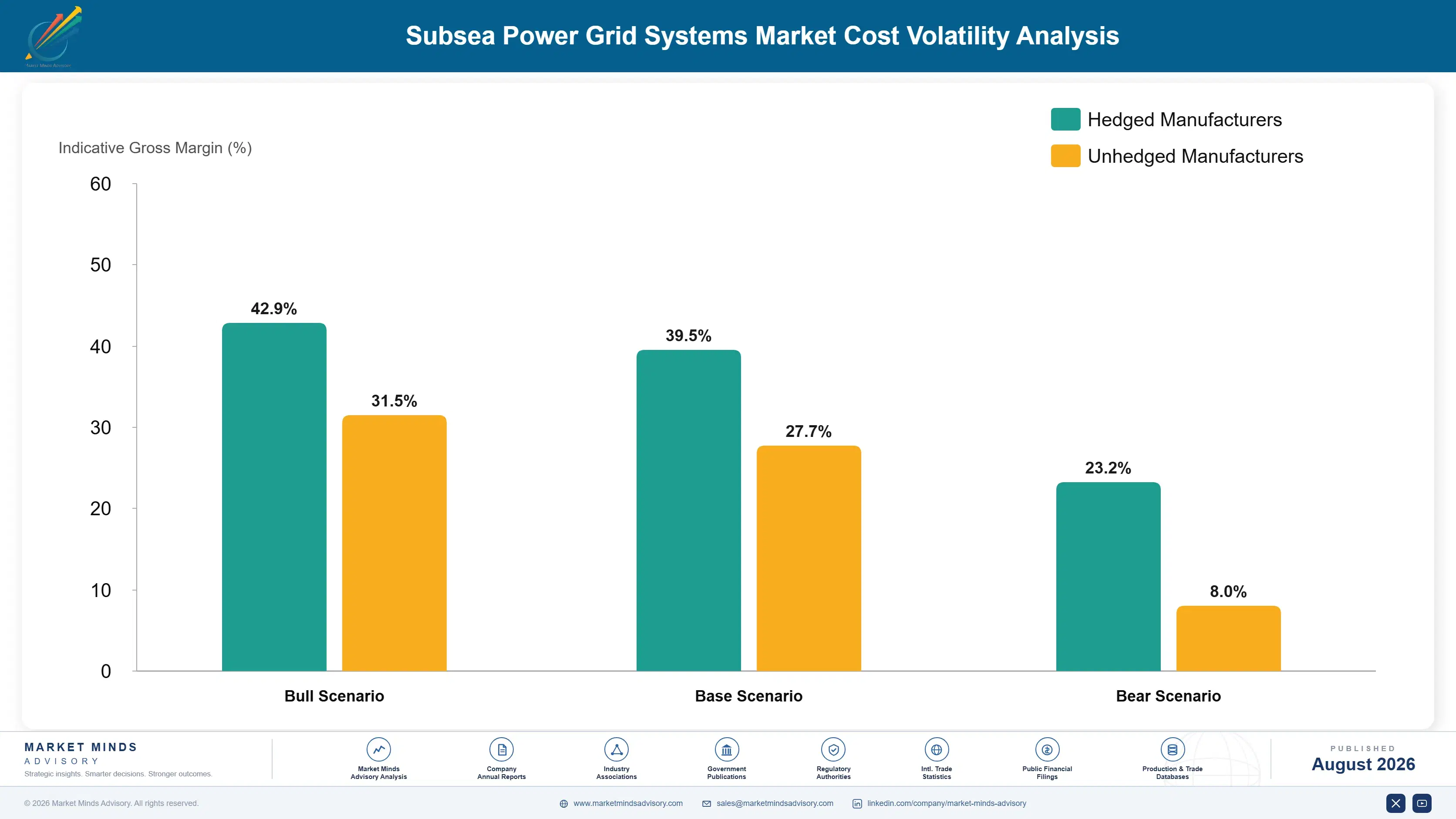
Copper and Vessel Capacity Cost Exposure

Copper conductor material represents the single largest cost input for high-voltage subsea cables, accounting for roughly 40 percent of finished cable cost, sourced primarily from Chilean and Peruvian mining output refined through global commodity exchanges. Cross-linked polyethylene insulation and steel armouring wire add meaningful secondary cost exposure, both sourced from a smaller and more geographically concentrated supplier base than copper itself.
Copper prices rose sharply through 2024 and into 2025 as global demand from electrification and grid infrastructure projects outpaced mine supply growth, and Prysmian's fiscal year 2024 annual report cited elevated raw material costs as a meaningful drag on cable segment margins despite record order volumes. Cable manufacturers responded by adding copper price-escalation clauses to new contracts, shifting a larger share of commodity price risk onto developers rather than absorbing it within fixed contract pricing.

Vertically integrated suppliers with their own vessel fleets, including Prysmian and to a lesser extent Nexans, absorb installation cost volatility more predictably than manufacturers who charter third-party vessel capacity at spot rates that spike during periods of fleet scarcity. That gap gives integrated suppliers a cost-stability advantage over smaller manufacturers and Asian entrants who are still building installation capability alongside their manufacturing qualification.
subsea-power-grid-systems-market-cost-volatility-analysis-1787300050790

Copper Price-Escalation Clauses in New Contracts

Suppliers are increasingly writing copper price-escalation clauses into new cable supply contracts, passing a defined share of commodity price movement through to developers rather than absorbing it within fixed pricing. This shifts commodity risk toward parties better positioned to hedge it financially and keeps manufacturers focused on execution risk, though developers have pushed back on the broadest proposed escalation terms.

Long-Term Copper Offtake and Hedging Agreements

Larger manufacturers are signing multi-year copper supply agreements directly with mining companies and using financial hedging instruments to lock in a portion of forward input costs, reducing exposure to spot market volatility during periods of tight availability. Smaller manufacturers without comparable scale remain more exposed to short-term price swings than their larger, better-capitalised competitors.

Expanding Vessel Fleet Capacity Through New Orders

Major suppliers and independent marine contractors are ordering new cable-lay vessels to expand industry-wide installation capacity, though new vessel deliveries take several years and will not meaningfully ease the current bottleneck before the end of the decade. Chartering agreements and shared-vessel consortiums offer a faster but more expensive near-term workaround for developers unwilling to wait for dedicated fleet expansion.

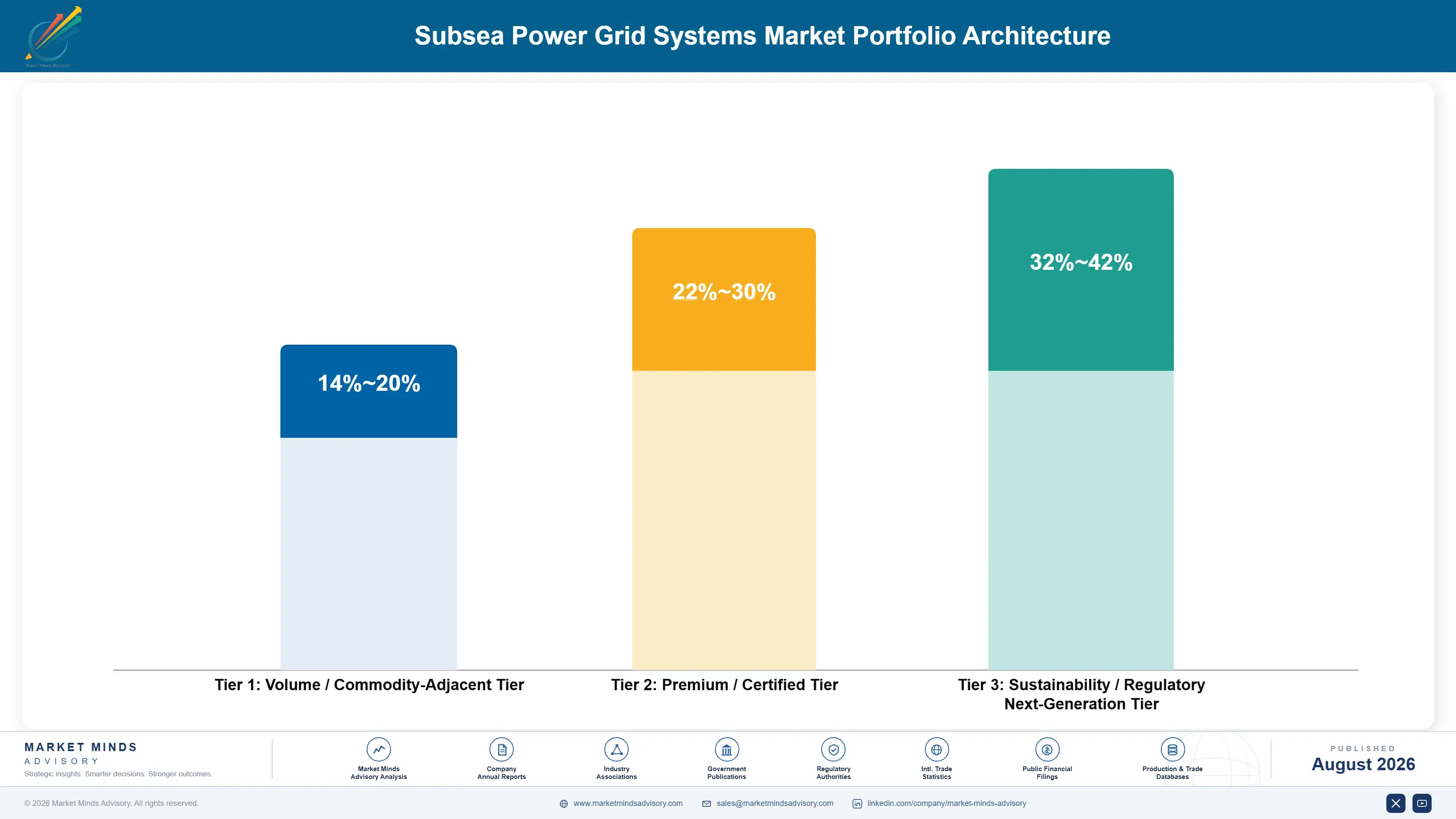
Portfolio Architecture for Margin Defence

Subsea power grid suppliers operate across three margin tiers built around technical complexity rather than simple volume. Commodity-adjacent array cable and standard switchgear sit at the volume base, HVDC export cable and interconnector contracts occupy the middle at meaningfully firmer margins, and dynamic cable and next-generation substation platforms sit at the top, commanding premium pricing for technical risk few suppliers can absorb. Most suppliers participate across all three tiers, wei
The volume-premium tension plays out in how suppliers allocate scarce vessel and factory capacity: every hour spent on standard array cable is an hour not spent on higher-margin HVDC export or interconnector work, so suppliers prioritise premium contracts even when it means turning away lower-margin array cable orders that smaller regional players are happy to absorb.

High-value margin pools concentrate in dynamic cables for floating wind and in bundled substation-plus-cable project scopes, both of which command pricing closer to specialised marine engineering economics than to commodity cable manufacturing. Suppliers that can move a customer from standalone cable supply into a bundled platform-and-cable contract capture meaningfully more of total project value across the life of a single award.

Volume / Commodity-Adjacent Tier

Standard array cable and conventional switchgear sold at scale into offshore wind farm inter-array connections, priced close to established cable manufacturing benchmarks with limited technical differentiation between qualified suppliers. This tier competes mainly on delivery reliability and price.
Gross Margin: 14-20%

Premium / Certified Tier

HVDC export cable and grid interconnector contracts requiring extensive qualification and long-term reliability guarantees, commanding a defensible premium over standard cable given the scale and criticality of each individual award.
Gross Margin: 22-30%

Sustainability / Regulatory / Next-Generation Tier

Dynamic cable for floating wind and next-generation offshore substation platforms carrying the highest technical risk and the deepest engineering support, sold primarily into pilot and early-commercial floating wind projects. Pricing power here remains strong given the shortage of qualified suppliers.
Gross Margin: 32-42%
subsea-power-grid-systems-market-portfolio-architecture-1787300051626

High-value Sub-segments and Strategic Watch-out

Dynamic Cable for Floating Wind

Dynamic cables for floating wind carry the category's highest margins and fastest growth, driven by Japan, Korea, and California moving pilot projects toward commercial scale, though thin current volume and elevated technical risk keep absolute revenue contribution modest for now. Early movers stand to capture outsized share.
Gross Margin: 32-42%

Grid Interconnector Contracts

Interconnector contracts carry strong margins and steady rather than explosive growth, anchored in regulated transmission tariffs that insulate this segment from the wind subsidy policy swings affecting other parts of the market. National grid operators renew supplier relationships repeatedly, giving incumbents durable revenue visibility across multiple project cycles.
Gross Margin: 24-30%

Standard Offshore Wind Array Cable

Array cable connecting individual turbines within a wind farm remains the category's volume anchor, growing steadily with overall installed capacity but carrying commodity-level margins that make it a scale rather than profit driver. Suppliers defend this tier mainly to preserve factory utilisation between larger, higher-margin awards.
Gross Margin: 14-20%

Chinese Export-Grade Cable Qualification

Chinese manufacturers qualifying export-grade HVDC cable production represent a long-term competitive threat to established suppliers' pricing power, particularly as domestic content requirements across Asia increasingly favour regional manufacturers over European incumbents. European suppliers that fail to localise production risk losing share across the region's largest growth markets.
Gross Margin: 18-26%

From One-Off Projects to Booked Capacity

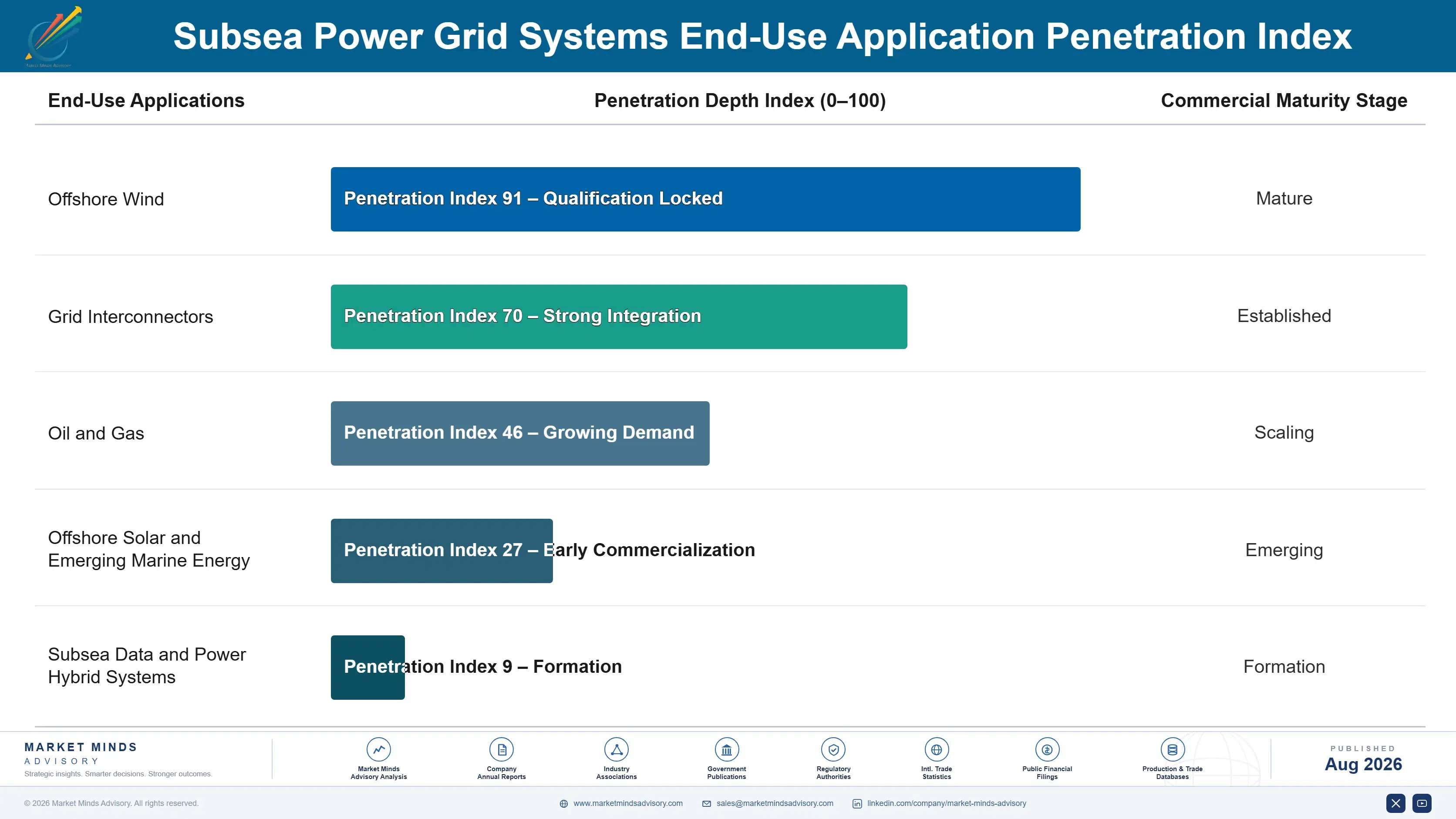
Subsea grid procurement is shifting from a one-off, project-by-project bidding process toward multi-year capacity booking that resembles an annuity relationship more than a series of discrete transactions. Developers now compete for manufacturing and vessel slots years before construction begins, and suppliers that can offer credible long-term delivery commitments capture outsized share of the pipeline regardless of whether they offer the lowest per-kilometre price on any individual bid. That sh
Adoption depth varies sharply by application. Offshore wind developers show the deepest reliance on booked capacity relationships, since a single missed delivery slot can delay a gigawatt-scale project by years. Interconnector and oil and gas subsea power customers show steadier but less urgent demand, planning further ahead and facing less exposure to the auction-driven timing pressure that makes offshore wind procurement so booking-sensitive.

A generational shift among procurement teams is reinforcing the trend. Developers who entered the sector during the recent auction boom treat early capacity booking as standard practice, while legacy teams accustomed to traditional competitive tendering are adapting more slowly, occasionally losing manufacturing slots to faster-moving competitors as a result.
subsea-power-grid-systems-market-end-use-penetration-index-1787300052419

Where MMA Sees the Real Opportunity

These are among the four positions where our research anticipates prominent divergence between winners and laggards over the coming forecast period. Each is grounded in the demand model, the regulatory perimeter, and the announced capacity pipeline.
01 / CAPACITY BOOKING PRIORITY

Secure multi-year manufacturing and vessel capacity now

Suppliers and developers that lock in manufacturing and vessel capacity years ahead of construction are insulated from delivery queues that are already stretching past 2029 at several major European and Asian yards alike. This positioning matters more than negotiating marginal per-kilometre price improvements, since capacity itself, not price, is now the binding constraint across nearly every part of the industry. MMA recommends prioritising capacity commitments over price optimisation in the current three-year window, particularly for developers targeting commissioning dates before 2030 across any major offshore market.
02 / DYNAMIC CABLE QUALIFICATION

Invest in dynamic cable qualification ahead of floating wind scale

Dynamic cables for floating wind are growing at roughly 1.4 times the category average, and early qualification track record is proving difficult for later entrants to replicate given the multi-year in-water testing floating wind reliability requires. Suppliers without a credible pilot-phase track record risk being excluded entirely from the first wave of commercial-scale floating wind contracts expected later this decade. MMA views dynamic cable qualification investment as the highest-return capital allocation available within the category over the next five years.
03 / INTERCONNECTOR REVENUE DIVERSIFICATION

Pursue interconnector contracts to diversify beyond wind policy risk

Grid interconnector contracts, backed by regulated transmission tariffs rather than merchant wind economics, offer suppliers meaningful insulation from renewable subsidy policy swings that periodically disrupt offshore wind auction volumes across different markets and political cycles. Suppliers concentrated purely in offshore wind cable supply carry more revenue volatility than those with an established interconnector track record and customer base built over many years. MMA recommends building interconnector relationships now, since regulated transmission operators tend to award repeat contracts to proven suppliers rather than re-tendering competitively each time a project arises.
04 / SUBSTATION BUNDLING STRATEGY

Bundle substation fabrication with cable supply for higher margin

Suppliers that bundle offshore substation platform fabrication with cable supply capture meaningfully more total project value than those selling cable alone, since platform contracts carry meaningfully different margin economics tied to marine engineering complexity rather than commodity cable manufacturing. Suppliers still selling cable as a standalone product are ceding this higher-margin scope to competitors already positioned to deliver bundled contracts. MMA recommends expanding platform fabrication capability as a priority investment for suppliers seeking a larger share of total project value going forward.

Engagement Snapshot From the Field

A live engagement with an industry participant carrying material or product regulatory and market exposure ahead of a defining policy shift, showing how our research translates into a defensible multi-year portfolio strategy.
MARKET MINDS ADVISORY · CLIENT ENGAGEMENT SUMMARY
Subsea Power Grid Systems Producer Strategic Portfolio Review and Transition Roadmap 2026·Investment Scenario on Subsea Power Grid Systems Exposure Evaluation 2025-26
CLIENT PROFILE
The client is a mid-sized independent power producer developing two gigawatt-scale offshore wind projects in the North Sea, with additional projects in earlier development stages across Northern Europe. The company reported project capital budgets in the low billions of dollars per project (client-reported, unverified by MMA) and had historically procured export cable capacity through competitive tendering rather than early capacity booking.
STRATEGIC CHALLENGE
The client's traditional late-stage cable procurement approach put its projects at risk of multi-year delivery delays as competing developers increasingly booked manufacturing and vessel capacity years in advance. Management needed a revised procurement strategy that secured capacity early enough to protect commissioning timelines without overcommitting capital before final investment decisions were confirmed across the full project portfolio.
MMA APPROACH
MMA's engagement team benchmarked the client's procurement timeline against industry capacity booking patterns, interviewed major cable and substation suppliers to map available near-term capacity windows, and modelled the cost and schedule tradeoffs across three procurement-timing scenarios. The team recommended a phased early-booking strategy that secured capacity options ahead of final investment decision while limiting binding financial commitment until project milestones were confirmed.
KEY FINDINGS
  1. Suppliers were willing to hold capacity options for a modest reservation fee (client-reported, unverified by MMA) rather than requiring full binding commitment years before construction.
  2. Competing developers who had already booked capacity early secured meaningfully firmer delivery date commitments than the client's historical late-stage procurement approach had achieved.
  3. Vessel availability, not factory capacity, represented the tighter near-term constraint across both of the client's projects, requiring separate early engagement with installation contractors.
  4. Interconnector projects competing for the same supplier capacity carried longer lead times than the client's own offshore wind projects, intensifying competition for available slots.
CLIENT PROFILE
The client is a mid-sized independent power producer developing two gigawatt-scale offshore wind projects in the North Sea, with additional projects in earlier development stages across Northern Europe. The company reported project capital budgets in the low billions of dollars per project (client-reported, unverified by MMA) and had historically procured export cable capacity through competitive tendering rather than early capacity booking.
STRATEGIC CHALLENGE
The client's traditional late-stage cable procurement approach put its projects at risk of multi-year delivery delays as competing developers increasingly booked manufacturing and vessel capacity years in advance. Management needed a revised procurement strategy that secured capacity early enough to protect commissioning timelines without overcommitting capital before final investment decisions were confirmed across the full project portfolio.
MMA APPROACH
MMA's engagement team benchmarked the client's procurement timeline against industry capacity booking patterns, interviewed major cable and substation suppliers to map available near-term capacity windows, and modelled the cost and schedule tradeoffs across three procurement-timing scenarios. The team recommended a phased early-booking strategy that secured capacity options ahead of final investment decision while limiting binding financial commitment until project milestones were confirmed.
KEY FINDINGS
  1. Suppliers were willing to hold capacity options for a modest reservation fee (client-reported, unverified by MMA) rather than requiring full binding commitment years before construction.
  2. Competing developers who had already booked capacity early secured meaningfully firmer delivery date commitments than the client's historical late-stage procurement approach had achieved.
  3. Vessel availability, not factory capacity, represented the tighter near-term constraint across both of the client's projects, requiring separate early engagement with installation contractors.
  4. Interconnector projects competing for the same supplier capacity carried longer lead times than the client's own offshore wind projects, intensifying competition for available slots.
RECOMMENDED STRATEGY
Phase 1: Phase 1 (Months 1 to 4): Secure early capacity options with key suppliers for both projects, limiting binding commitment ahead of final investment decision confirmation. Phase 2: Phase 2 (Months 5 to 10): Engage cable-lay vessel operators directly and separately from cable manufacturers, since vessel capacity emerged as the tighter constraint. Phase 3: Phase 3 (Months 11 to 18): Convert capacity options into binding orders as each project reached final investment decision, sequencing commitments to match confirmed funding.
OUTCOME
Following the engagement, the client reported securing manufacturing and vessel capacity commitments meaningfully earlier than its historical procurement pattern, protecting both projects' commissioning timelines against the delivery queues affecting later-moving competitors (client-reported, unverified by MMA). The phased options approach limited binding capital commitment ahead of final investment decision while still preserving priority access to constrained capacity.

Frequently Asked Questions

Foundational context covering the market sizes, CAGR, scope, country, region and competition that inform every finding below. This section is provided to cover basics and most often pre-purchase conversations, answered from the MMA Primary Research Dataset.

What is the current size of the Subsea Power Grid Systems Market?

The global subsea power grid systems market reached approximately $10.4 billion in 2026. Demand is concentrated in offshore wind export cables and substations, with East Asia now the largest regional contributor.

How large will the Subsea Power Grid Systems Market be by 2036?

MMA projects the market will reach approximately $26.5 billion by 2036. That represents more than a doubling of 2026 revenue across the ten-year forecast period.

What is the CAGR for the Subsea Power Grid Systems Market 2026 to 2036?

The base case compound annual growth rate is 9.8 percent. Bull and bear scenarios range from roughly 8.5 percent to 11.1 percent depending on floating wind and interest-rate developments.

Which segment is growing fastest?

Dynamic power cables for floating wind are growing fastest, at roughly 1.4 times the overall market rate. Floating wind pilot zones off Japan, Korea, and California are driving that outperformance.

Who are the major companies in the Subsea Power Grid Systems Market?

Prysmian Group, Nexans, NKT, Hitachi Energy, and Sumitomo Electric Industries lead the market. Together they hold roughly 68 percent of high-voltage cable manufacturing capacity worldwide.

Which country is growing fastest?

Taiwan is the fastest-growing major market, driven by aggressive offshore wind capacity targets and mandatory local content requirements. Its subsea power grid demand is expanding at roughly 13.2 percent annually.

Report Segmentation Architecture

The full report scope spans multiple orthogonal segmentation dimensions, with cross-tabulated demand data provided for each dimension pair. Coverage extends further to regional breakdowns, trend trajectories, and the competitive detail needed to support segment-level decision-making.

By System Type

  • Submarine Power Cables
  • Subsea Substations and Transformer Platforms
  • Subsea Switchgear and Protection Systems
  • Dynamic Power Cables
  • Subsea Connectors and Termination Systems
  • Subsea Power Distribution and Control Systems

By End-Use Application

  • Offshore Wind
  • Grid Interconnectors
  • Oil and Gas
  • Offshore Solar and Emerging Marine Energy
  • Subsea Data and Power Hybrid Systems

By Commercial Dimension

  • Manufacturing-Only Supply
  • Bundled Manufacturing and Installation
  • Engineering, Procurement and Construction Contracts
  • Long-Term Capacity Booking Agreements

By Region

  • North America
  • Western Europe
  • East Asia
  • South Asia and Pacific
  • Latin America
  • Middle East and Africa
  • Eastern Europe

Scope, Methodology, and Coverage

Every figure in this report is reproducible from documented input assumptions. The scope below maps the historical period, the forecast horizon, the segmentation dimensions, and the countries covered, alongside the underlying primary and qualitative methodology.
Historical Period
2020 to 2025
Forecast Period
2026 to 2036
Base Year
2025 (USD billions; MMA Primary Research Dataset, August 2026)
Market Definition
The subsea power grid systems market covers submarine power cables, subsea substations, transformer platforms, switchgear, and connector systems used to transmit and distribute electrical power under water for offshore wind, oil and gas, and grid interconnector applications. It excludes onshore transmission infrastructure, offshore wind turbine generators themselves, and subsea telecommunications cables.
Quantitative Units
USD billions (current prices); circuit kilometres of installed subsea cable where applicable
Segmentation Dimensions
By System Type; By End-Use Application; By Commercial Dimension; By Region
Regions Covered
North America, Western Europe, East Asia, South Asia and Pacific, Latin America, Middle East and Africa, Eastern Europe
Countries Covered
USA, China, Germany, France, UK, Japan, South Korea, India, Australia, Canada, Brazil, Mexico, Indonesia, Vietnam, Thailand, Malaysia, UAE, Saudi Arabia, South Africa, Nigeria, Turkey, Poland, Netherlands, Italy, Spain, Sweden, Switzerland, Argentina, Colombia, Singapore, and additional markets relevant to this sector
Key Companies Profiled
Prysmian Group, Nexans, NKT, Hitachi Energy, Sumitomo Electric Industries, LS Cable & System, JDR Cable Systems, TFKable, Siemens Energy, ABB, Aker Solutions, Subsea 7, Saipem, TechnipFMC, McDermott International, Baker Hughes, Zhongtian Technology Group, Hengtong Group, Taihan Electric Wire, LS Eco Energy
Quantitative Methodology
Primary survey, n=3,800 respondents, Q4 2025, six countries; demand-side model with trade association cross-validation
Qualitative Methodology
47 expert interviews, Q4 2025; applied to validate demand model assumptions, identify emerging dynamics, and assess competitive positioning
Report Format
PDF and XLSX data workbook (Word format preview document)
Publisher
Market Minds Advisory
Report Code
MMA-2026-ENE-115
Published
August 2026
Contact
sales@marketmindsadvisory.com | www.marketmindsadvisory.com

Purchase the full Subsea Power Grid Systems Market Report (2026 to 2036).

The full report delivers a complete quantitative and qualitative assessment of the global subsea power grid systems market across all seven regions. It includes detailed country-level sizing for the fifteen largest offshore wind and interconnector markets, full profiles of all twenty companies named in the competitive landscape, and a complete database of corporate developments tracked over the trailing eighteen months. Analysts provide segment-by-segment margin benchmarking derived from primary interviews with forty-seven offshore energy infrastructure experts, alongside a vessel fleet and factory capacity tracker covering major suppliers. Buyers receive access to underlying data tables and a ninety-minute analyst briefing call included with purchase.
Country-level sizing for fifteen major producing markets
Full profiles of all twenty companies profiled
Vessel fleet and factory capacity tracker updated quarterly
Segment-level margin benchmarking from primary expert interviews
Eighteen-month corporate development and capacity expansion database
Ninety-minute analyst briefing call included with purchase

Built For The People Who Decide

From boardroom strategy to bench-side execution, this report is read cover-to-cover by leaders shaping the next decade of their industry, turning demand scenarios, market dynamics and valuation benchmarks into decisions.
CXOs/ Presidents/ VPs/ Managers
M&A and Corporate Development
Strategy Teams and R&D Heads
Procurement and Product Directors
Regulatory and Compliance Leaders
Investor Relations and Equity Analysts