Market Minds Advisory
Subsea and Offshore Services Market

Subsea and Offshore Services Market: Offshore Wind Installation as the New Growth Engine

Offshore wind developers now compete directly with oil and gas operators for subsea vessels, decommissioning obligations accelerate across mature North Sea fields, and contractors without integrated cable-laying and IRM capability lose multi-year framework agreements outright.

Lead Analyst

David Horsley

Published

September 2026

Make Smarter Decisions with Customized Research Insights

Request a free sample report and evaluate market opportunities, growth trends, and competitive dynamics relevant to your business needs.

2025 MARKET VALUE$18.5BMarket Size 2025
2036 FORECAST VALUE$38.1BBase Case , 2026 to 2036
CAGR 2026 TO 20366.8 %Bull 8.0% / Bear 5.5%
INCREMENTAL OPPORTUNITY$18.4BNet 10- year value creation
EXPANSION MULTIPLE1.93x2036 value over 2026 base
Strategic Levers
M&A Pipeline
Regional Outlook
Country Rankings
Competitive Intelligence
Segmental Deep-dive
Call-Us : 91 93563 13602

Executive Snapshot and Market Trajectory

Offshore wind installation demand now competes directly with oil and gas operators for the same limited pool of specialized subsea vessels, since certified vessel availability increasingly determines which contractors actually win multi-year framework agreements across most major offshore basins simultaneously and without costly requalification delay across every affected project timeline.
Offshore wind subsea services lead growth at 12.5%, roughly 1.84 times the overall rate, as cable-laying and foundation installation demand expands faster than traditional oil and gas subsea construction alone can satisfy across every project pipeline and regional development timeline. East Asia now holds the largest regional share at 28%, driven by China's dominant offshore wind installation volume despite legacy subsea engineering expertise concentrating elsewhere across the value chain and vessel fleet entirely.
Competitive intensity stays moderate at 42% held by five contractors, since capital-intensive vessel fleets and specialized engineering talent fragment share less than most other marine services categories, concentrating supply around a handful of integrated contractors rather than dozens of regional operators competing on day rate alone. Buyers increasingly select contractors on integrated project delivery rather than lowest bid alone across most major framework agreements and long-term maintenance contracts.
Market Definition
This report covers subsea and offshore marine services spanning engineering, installation, inspection, repair, maintenance, and decommissioning for both oil and gas and offshore wind infrastructure. It excludes onshore energy infrastructure and vessel manufacturing.
Base Year Value
$18.5B in 2025 (MMA Primary Research Dataset, August 2026)
Forecast Period
2026 to 2036, eleven discrete annual values
CAGR
6.8% base case. Bull 8.0%. Bear 5.5%.
Fastest Growth Segment
Offshore Wind Subsea Services: 12.5% CAGR
Fastest Growth Country
China: 8.4% CAGR
Fastest Growth Region
South Asia and Pacific: 8.9% CAGR
Largest Region
East Asia: 28% of 2025 global value
Market Leaders
TechnipFMC, Subsea7, Saipem, McDermott International, Aker Solutions. Source: MMA Analysis, July 2026.
Primary Survey
n=3,800 procurement and R&D decision-makers, Q4 2025, six countries
Methodology
Demand-side build-up, cross-validated against public data, 47 expert interviews

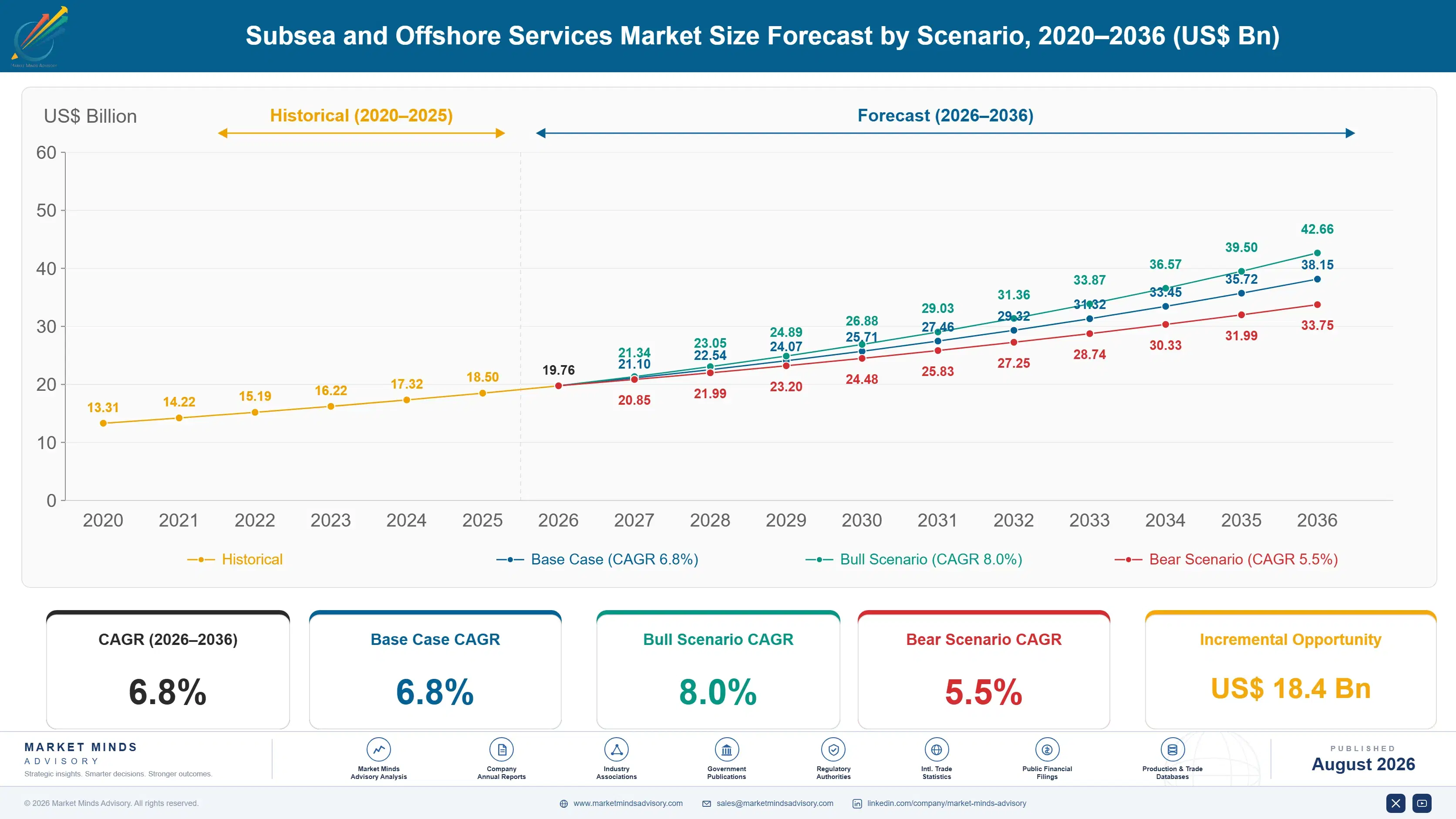
Subsea and Offshore Services Market Forecast Scenarios

subsea-offshore-services-market-size-forecast-scenario-1787302845099
Between 2020 and 2025 the market grew at an estimated 5.8% annually, as post-pandemic oil price recovery and early offshore wind capacity buildout pushed operators toward expanded subsea vessel bookings faster than the industry's typical multi-year contracting cycle would otherwise dictate across most major offshore basins worldwide, a pace that held steady even through commodity price volatility.
Three mechanisms carry the base case to 6.8%. First, offshore wind capacity keeps expanding globally, and every new wind farm requires certified subsea cable-laying and foundation installation vessels for project completion. Second, mature North Sea and Gulf of Mexico fields keep entering decommissioning, adding plug and abandonment demand that supplements traditional construction work. Third, deepwater exploration keeps recovering as operators sanction new projects requiring specialized subsea engineering and installation capability.
The bull case at 8.0% assumes accelerating offshore wind capacity additions and deepwater project sanctioning across additional major markets pulls forward subsea vessel demand faster than currently planned by most operators. The bear case at 5.5% assumes budget-constrained offshore capital programs delay planned installation schedules, slowing the pace of new subsea services demand growth across affected basins and their broader capital budgets.

Vessel Fleet Capacity Decides Subsea Project Winners

Subsea and offshore services sit at an unusual junction between two demand pools that used to run on separate cycles: oil and gas capital spending and offshore wind capacity buildout. Contractors now book the same specialized vessels against both project types, and vessel availability, not raw engineering headcount, increasingly determines which contractor actually wins a given framework agreement.
MARKET CONCENTRATION42%Top five contractors hold less than half global capacity
AVERAGE VESSEL DAY RATE$185,000/dayReflects specialized construction vessel charter rates across major basins
TOP FLEET COUNTRY SHARE24%One country dominates the specialized installation vessel fleet base
VESSEL UTILIZATION RATE81%Specialized vessels run near full booking across peak seasons
PROJECT BACKLOG COVERAGE2.4 yearsFramework agreements now extend well beyond typical annual planning cycles
OFFSHORE WIND REVENUE SHARE31%Wind-related project work now rivals traditional oil and gas installation
Demand now splits along two distinct tracks. Traditional offshore oil and gas operators need proven deepwater installation and inspection capability, while offshore wind developers need high-volume cable-laying and foundation installation delivered on tight construction-season timelines. These tracks compete directly for the same finite vessel fleet, since building a new specialized construction vessel takes years and cannot respond quickly to either segment's short-term demand surge.
Supply discipline remains tight because vessel newbuild orders take three to five years to deliver, while decommissioning obligations across mature basins keep adding demand that construction-focused contractors cannot always absorb. That gap keeps day rates elevated and rewards contractors who diversified their fleet mix early. Framework agreements are lengthening as operators lock in vessel capacity years ahead, pushing smaller regional contractors toward niche inspection and maintenance work instead.
"Vessel availability, not engineering talent, is the real bottleneck in this market today. Contractors who diversified into offshore wind early are now booking both fleets years in advance."
Director, Offshore Energy and Marine Services Practice · MMA Energy / Offshore S

Market Trends

Offshore Wind Buildout Strains Specialized Vessel Availability

Offshore wind developers now compete directly with oil and gas operators for the same limited pool of cable-laying vessels, foundation installation ships, and heavy-lift crane barges, since neither segment can quickly commission new capacity. This shift accelerated as several governments committed to expanding offshore wind capacity to 300 gigawatts globally by 2030, pushing developers to book vessel capacity years ahead of actual construction windows. Contractors lacking a diversified fleet are being squeezed out of major tenders even when their day rates beat integrated competitors, since developers increasingly treat guaranteed vessel access as a non-negotiable qualification requirement.
Market Impact: Deepwater sanctioning adds 3.5 GW y
Decommissioning Wave Accelerates Across Mature Offshore Basins

Mature offshore basins including the North Sea and Gulf of Mexico are entering a sustained decommissioning phase as fields depleted decades ago finally reach regulatory end-of-life deadlines, creating a distinct demand pool separate from new construction work entirely. This trend directly benefits contractors with plug and abandonment expertise, forcing specialists to lean harder on legacy platform removal contracts where construction-focused competitors lack proven regulatory experience. Roughly 2,000 platforms globally now require decommissioning within the next fifteen years, a backlog that keeps expanding each year as fields near their planned retirement age faster than removal capacity can absorb.
Market Impact: Offshore wind adds 45 GW yearly

Market Opportunities and Growth Drivers

Deepwater Exploration Recovery Sustains Construction Demand

Global deepwater exploration activity keeps recovering as operators sanction new projects following several years of capital discipline, and each new field development requires specialized subsea construction and installation capability that shallow-water alternatives cannot substitute. Operators are locking in multi-year vessel framework agreements well ahead of production startup, since installation vessel qualification and mobilization take twelve to eighteen months and cannot be rushed once first oil nears. Operators targeting deepwater and ultra-deepwater fields continue specifying integrated engineering and installation contractors precisely because project complexity and depth still demand specialized capability most regional contractors cannot provide.
Market Impact: Newbuild vessels take 3-5 years

Offshore Wind Capacity Targets Add New Demand Channel

Government offshore wind capacity targets are emerging as a genuinely new demand channel for subsea contractors, distinct from the oil and gas market that has historically dominated fleet bookings. Developers deploying fixed-bottom and floating wind installations increasingly favor contractors with proven cable-laying and foundation installation track records, which keeps demand for specialized vessels elevated even as some markets shift toward standardized turbine platforms. Corporate renewable energy commitments are accelerating buildout well beyond prior utility planning cycles, and developers increasingly favor multi-year framework contracts that lock in vessel capacity ahead of construction schedules.
Market Impact: Labor shortages delay 15% of projec

Market Restraints and Challenges

Vessel Newbuild Shortage Constrains Capacity Growth

Specialized subsea construction vessels require three to five years from order to delivery, and shipyard capacity for these highly customized ships remains limited relative to combined oil and gas plus offshore wind demand growth. The root cause is capital intensity: a single heavy-lift installation vessel can cost several hundred million dollars, and few shipyards worldwide have the specialized capability to build them. Contractors face real risk of turning away qualified work simply because no vessel is available. Major contractors are now co-investing in newbuild orders with long-term charter commitments from offshore wind developers to secure capacity.
Market Impact: Offshore wind pipeline nears 300 GW

Skilled Offshore Labor Shortage Limits Project Throughput

The subsea services sector faces a persistent shortage of qualified offshore engineers, ROV pilots, and certified divers, since the specialized training pipeline has not kept pace with rapidly expanding offshore wind and deepwater project volume. The root cause is demographic: an aging workforce is retiring faster than training programs can certify replacements, and offshore work's demanding conditions limit the pool of interested candidates. This shortage delays project schedules and inflates labor costs across affected contracts. Contractors are responding by expanding apprenticeship programs and increasing automation through remote-operated and autonomous vehicle technology to reduce dependence on scarce specialized personnel.
Market Impact: Over 2,000 platforms need decommiss
3 additional market trends, 4 additional growth drivers, and 3 additional restraints and challenges are covered in the full report. Contact sales@marketmindsadvisory.com to access the complete intelligence.

Segment CAGR and Growth Architecture

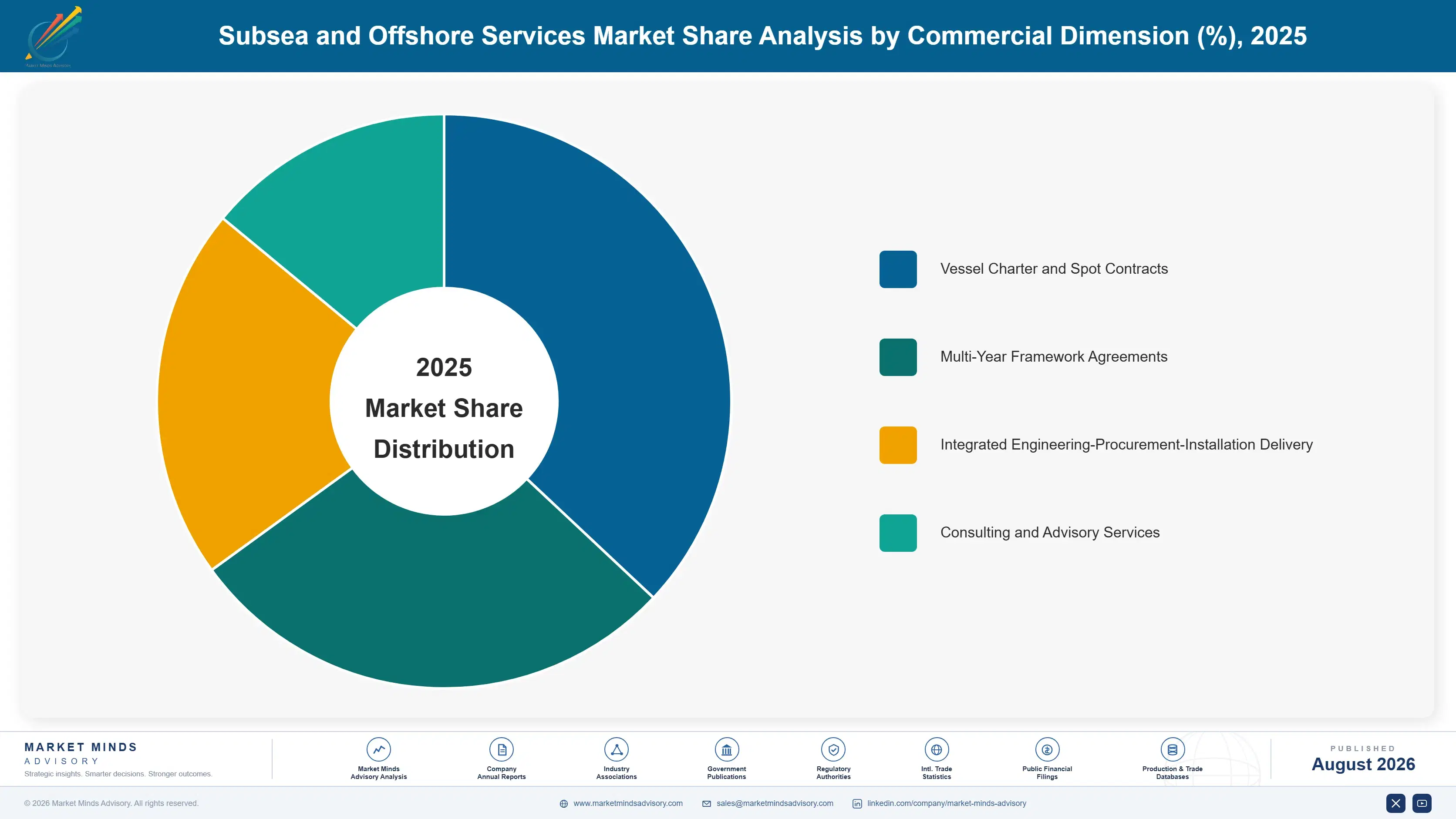
Subsea and offshore services split by service type rather than end-market, since the same contractor pool serves both oil and gas and offshore wind clients across most service categories. Six segments span engineering design, construction and installation, inspection and maintenance, vehicle operations, wind-specific services, and decommissioning, each carrying distinct fleet requirements and margin profiles.
subsea-offshore-services-market-market-share-analysis-1787302845680

Offshore Wind Subsea Services

Offshore wind subsea services are expanding faster than any other segment as governments worldwide commit to ambitious offshore wind capacity targets that require cable-laying, foundation installation, and inter-array connection work at a scale traditional oil and gas construction never demanded before. Contractors are converting existing installation vessels and ordering purpose-built wind-service ships to capture this demand, since fixed-bottom and floating wind projects both require specialized capability that generalist marine contractors increasingly cannot provide without significant fleet investment. Developers increasingly favor contractors with proven wind-specific track records, and several major oil and gas services firms have restructured entire divisions specifically around this fast-growing opportunity as government capacity targets keep climbing steadily worldwide.
CAGR 12.5%

Decommissioning and Plug and Abandonment Services

Decommissioning and plug and abandonment services are growing quickly as mature basins including the North Sea, Gulf of Mexico, and offshore Southeast Asia reach the regulatory end-of-life stage for platforms installed several decades ago across multiple producing regions worldwide today. This segment's growth tracks regulatory deadlines rather than commodity pricing directly, giving it a demand profile more predictable than construction work tied to exploration cycles. Producers increasingly value contractors with proven decommissioning track records because environmental liability and regulatory compliance risk make this specialized work fundamentally different from routine construction, requiring dedicated equipment and certified expertise that generalist construction contractors typically lack entirely, particularly for complex subsea infrastructure removal work.
CAGR 9.5%
Full segment breakdown across 6 segments available in the complete report.

Regional Architecture and Country Demand Map

Subsea services value distribution is shifting toward East Asia as offshore wind installation volume scales rapidly, while Western Europe's North Sea legacy still anchors deep engineering expertise, and Latin America's pre-salt basins sustain steady construction demand across the wider region and its growing vessel fleet.

North America

The Gulf of Mexico anchors most of North America's demand, where deepwater exploration recovery and an accelerating decommissioning wave shape which contractors actually win multi-year framework agreements across major operators. Offshore wind development along the Atlantic coast is adding a genuinely new demand pool distinct from the region's traditional oil and gas focus, pushing several contractors toward expanded cable-laying capability. Canada's East Coast offshore sector follows comparable procurement patterns at smaller absolute scale, anchored by its own regulatory framework. Growth of 7.2% outpaces the global rate as decommissioning volume and early offshore wind construction compound across an already substantial installed base spanning multiple operators and their extensive existing vessel charter relationships nationwide.
Share: 24% | CAGR: 7.2% (2026 to 2036)

Western Europe

North Sea decommissioning defines Western Europe's demand more than any other single factor, as UK and Norwegian platforms installed decades ago finally reach regulatory end-of-life deadlines requiring specialized plug and abandonment expertise. European Union offshore wind targets are pulling forward substantial cable-laying and foundation installation investment, particularly across German and Dutch North Sea wind zones under aggressive national buildout timelines. Aberdeen and Stavanger's engineering talent base still anchors global subsea design work regardless of where actual construction occurs today. Growth of 5.2% trails the global average because the region's mature basin base has already driven most feasible construction volume, leaving decommissioning and offshore wind as the primary growth vectors going forward.
Share: 23% | CAGR: 5.2% (2026 to 2036)
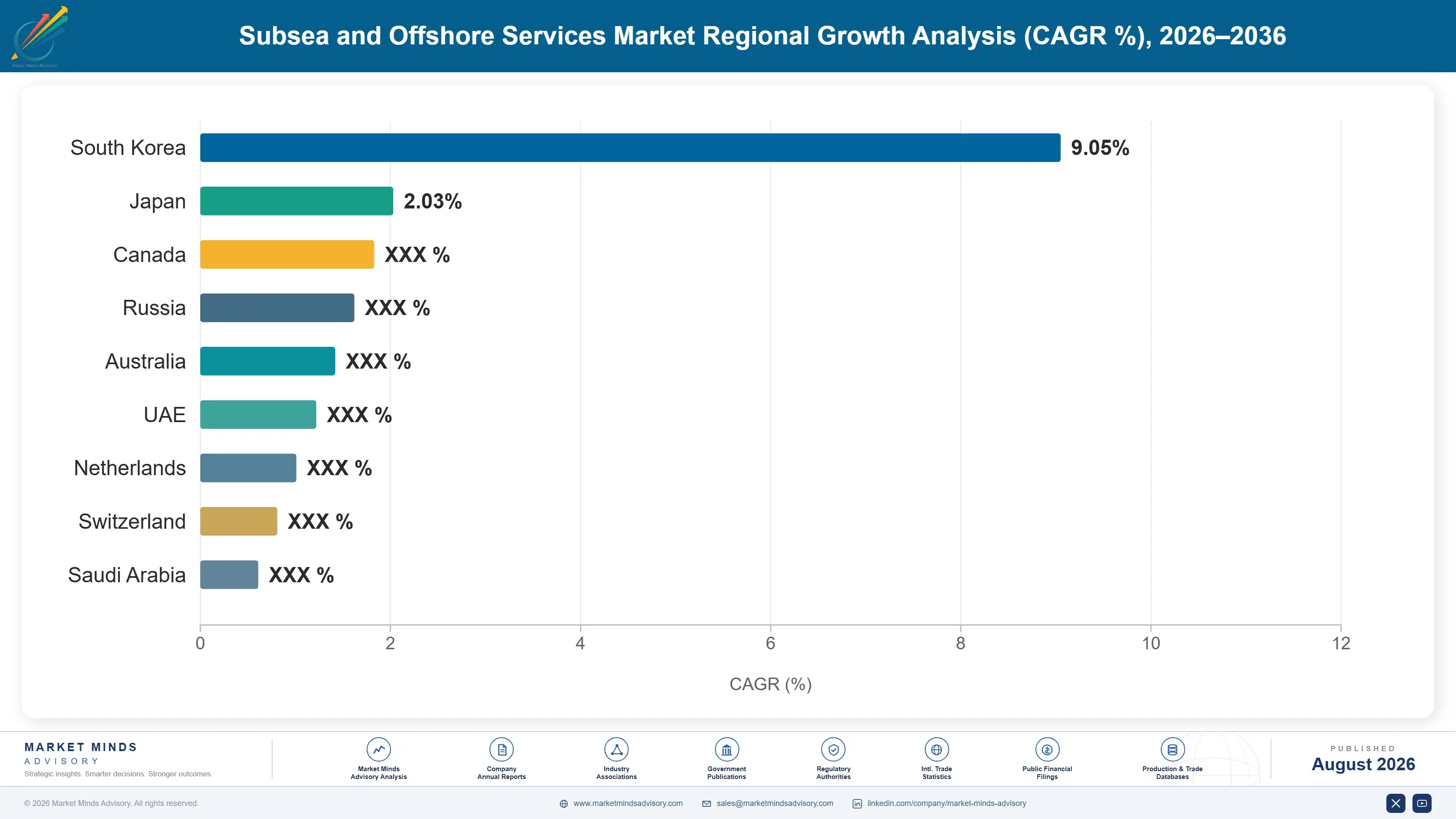
Regional intelligence for 5 additional markets available in the complete report: East Asia, South Asia and Pacific, Latin America, Middle East and Africa, Eastern Europe. Contact sales@marketmindsadvisory.com.
subsea-offshore-services-market-country-cagr-analysis-1787302846201

Where Subsea Contractors Can Actually Defend Margin

Subsea contractors capture margin unevenly across service lines, and the biggest opportunities sit in fleet diversification, integrated project delivery, and decommissioning specialization rather than day-rate competition alone. Four commercial levers stand out as genuinely actionable across most contractor types, regardless of whether the underlying fleet primarily serves oil and gas or offshore wind clients.

Diversify Fleet Across Oil and Gas and Wind

Contractors who diversify their vessel fleet to serve both oil and gas construction and offshore wind installation capture utilization advantages that single-market specialists cannot match. Building even modest wind-capable capacity into an existing fleet lets a contractor bid into offshore wind tenders at day rates roughly 12 to 18 percent above single-purpose competitors, while also reducing exposure to either market's cyclical downturns. The capital outlay is meaningful and conversion timelines run twelve to eighteen months, but contractors who have made this shift report materially higher fleet utilization than oil-and-gas-only peers.
Market Impact: Diversified fleets earn 12 to 18% d

Bundle Integrated Engineering and Installation Delivery

Contractors who offer integrated engineering, procurement, and installation delivery rather than standalone vessel charter capture premium pricing from operators who increasingly prefer a single accountable contractor for complete project delivery from design through commissioning. This premium currently runs roughly 10 to 15 percent above component-only pricing and is widening as operators simplify their contractor base following years of fragmented multi-vendor project delays and cost overruns. Building this capability requires meaningful engineering investment, and contractors who delay risk losing framework agreements entirely to competitors already offering integrated delivery across every major basin.
Market Impact: Integrated delivery earns a 10 to 1

Build Decommissioning Specialization Ahead of the Wave

Contractors who invest early in plug and abandonment certification and specialized decommissioning equipment are positioning ahead of a predictable regulatory wave that construction-focused competitors are not preparing for adequately today across most basins. Roughly 2,000 platforms require decommissioning within fifteen years, and contractors with proven regulatory track records are already commanding premium pricing on early contracts as operators prioritize proven expertise over unproven capability across every affected basin. This specialization also provides revenue resilience during oil and gas construction downturns, since decommissioning demand tracks regulatory deadlines rather than commodity price cycles.
Market Impact: Global decommissioning backlog now

Expand Remote and Autonomous Vehicle Operations

Contractors who invest in remote-operated and autonomous underwater vehicle technology reduce dependence on scarce certified divers while expanding inspection and maintenance capacity at relatively low incremental capital cost per additional vehicle deployed across the wider fleet base today. Autonomous inspection can lift technician productivity by 30 to 45 percent compared with diver-dependent methods, effectively adding higher-margin inspection revenue that requires no proportional headcount increase. This lever is particularly attractive because it monetizes existing vessel assets more intensively, and payback periods typically run under two years for most qualifying fleet operators.
Market Impact: Autonomous inspection lifts product

Who Controls the Margin Pool

Concentration sits at forty-two percent held by five contractors, evaluated on revenue from subsea and offshore installation services specifically. TechnipFMC and Subsea7 lead decisively on integrated fleet scale and engineering depth, while Saipem, McDermott, and Aker Solutions compete across different regional footprints and application specialties, leaving a meaningful gap between the top two and everyone else.
Current competitive activity centers on three dimensions. Contractors are racing to convert or newbuild vessels capable of serving both oil and gas and offshore wind clients, since fleet flexibility increasingly determines tender eligibility. Integrated engineering-procurement-installation delivery has become a genuine differentiator, with several contractors investing heavily in single-contract project models to win framework agreements. And decommissioning certification is the third, as contractors race to build regulatory track records ahead of the coming removal wave.

Emerging pressure comes from Chinese state-linked contractors, who are scaling fleet capacity fast enough to challenge established Western players for offshore wind installation share within the next several years. Rankings could shift if a major Chinese contractor secures a large Western framework agreement, combining cost competitiveness with credibility pure domestic players lack. Specialized decommissioning firms riding the North Sea removal wave also stand to gain share from generalist contractors.
subsea-offshore-services-market-company-positioning-matrix-1787302846728

Competitive Moat and Risk Dimensions

TECHNIPFMC PLC

Moat: Integrated Fleet and Engineering Scale

TechnipFMC combines subsea equipment manufacturing with installation and engineering services under one roof, giving it end-to-end project control that pure installation contractors cannot replicate. This integration lets the company capture margin across the full project lifecycle, from front-end design through installation and commissioning, while smoothing revenue across commodity price cycles.
TECHNIPFMC PLC

Risk: Exposure to Oil Price Cycles

The company's substantial oil and gas exposure leaves it more sensitive than diversified peers to sustained commodity price downturns, which have historically triggered project deferrals and vessel idle time. Building offshore wind capability helps diversify this exposure, but the transition is still incomplete relative to the company's overall revenue base.
SUBSEA7 S.A.

Moat: Broadest Vessel Fleet Diversity

Subsea7 operates one of the industry's most diversified vessel fleets spanning construction, inspection, and offshore wind installation, letting it bid competitively across nearly every subsea project type regardless of client sector. This flexibility gives the company resilience that single-focus competitors genuinely lack during either market's periodic downturns.
SUBSEA7 S.A.

Risk: Vessel Fleet Aging and Renewal

Portions of Subsea7's fleet are approaching an age where renewal or major refurbishment becomes necessary, requiring substantial capital investment at a time when newbuild costs and shipyard lead times have both increased meaningfully. Delaying this renewal risks ceding technically demanding contracts to competitors operating newer, more capable vessels.

Players Tracked

Prominent Players

TechnipFMC plc
Subsea7 S.A.
Saipem S.p.A.
McDermott International, Ltd.
Aker Solutions ASA

Other Key Players

Oceaneering International, Inc.
Baker Hughes Company
Halliburton Company
SLB (Schlumberger Limited)
DOF Group ASA
Royal Boskalis Westminster N.V.
Van Oord
Fugro N.V.
Bibby Marine
Ocean Installer AS
Helix Energy Solutions Group, Inc.
John Wood Group PLC
NOV Inc.
Petrofac Limited
Acteon Group

Recent Developments

APRIL 2026

TechnipFMC Signs North Sea Offshore Wind Framework Agreement

TechnipFMC signed a multi-year framework agreement with a major European offshore wind developer, committing dedicated cable-laying and foundation installation vessel capacity to a large North Sea wind farm project. The agreement extends the company's offshore wind services portfolio meaningfully, reinforcing its diversification strategy beyond traditional oil and gas installation work.
Signal: Signals traditional oil and gas contractor
SEPTEMBER 2025

Subsea7 Acquires Specialized North Sea Decommissioning Provider

Subsea7 completed the acquisition of a specialized decommissioning services provider with proven North Sea plug and abandonment experience, for an undisclosed sum. The acquisition was a full corporate purchase, not a joint venture or licensing arrangement, giving Subsea7 direct ownership of specialized decommissioning equipment and certified personnel.
Signal: Indicates contractors increasingly acquiri
JANUARY 2026

Saipem Secures Long-Term Gulf of Mexico Vessel Charter

Saipem entered a long-term vessel charter agreement with a Gulf of Mexico deepwater operator, securing dedicated installation vessel capacity across multiple planned field developments through the end of the decade. The arrangement was a charter agreement, not an acquisition or merger, extending Saipem's deepwater customer relationships meaningfully.
Signal: Signals deepwater operators increasingly p

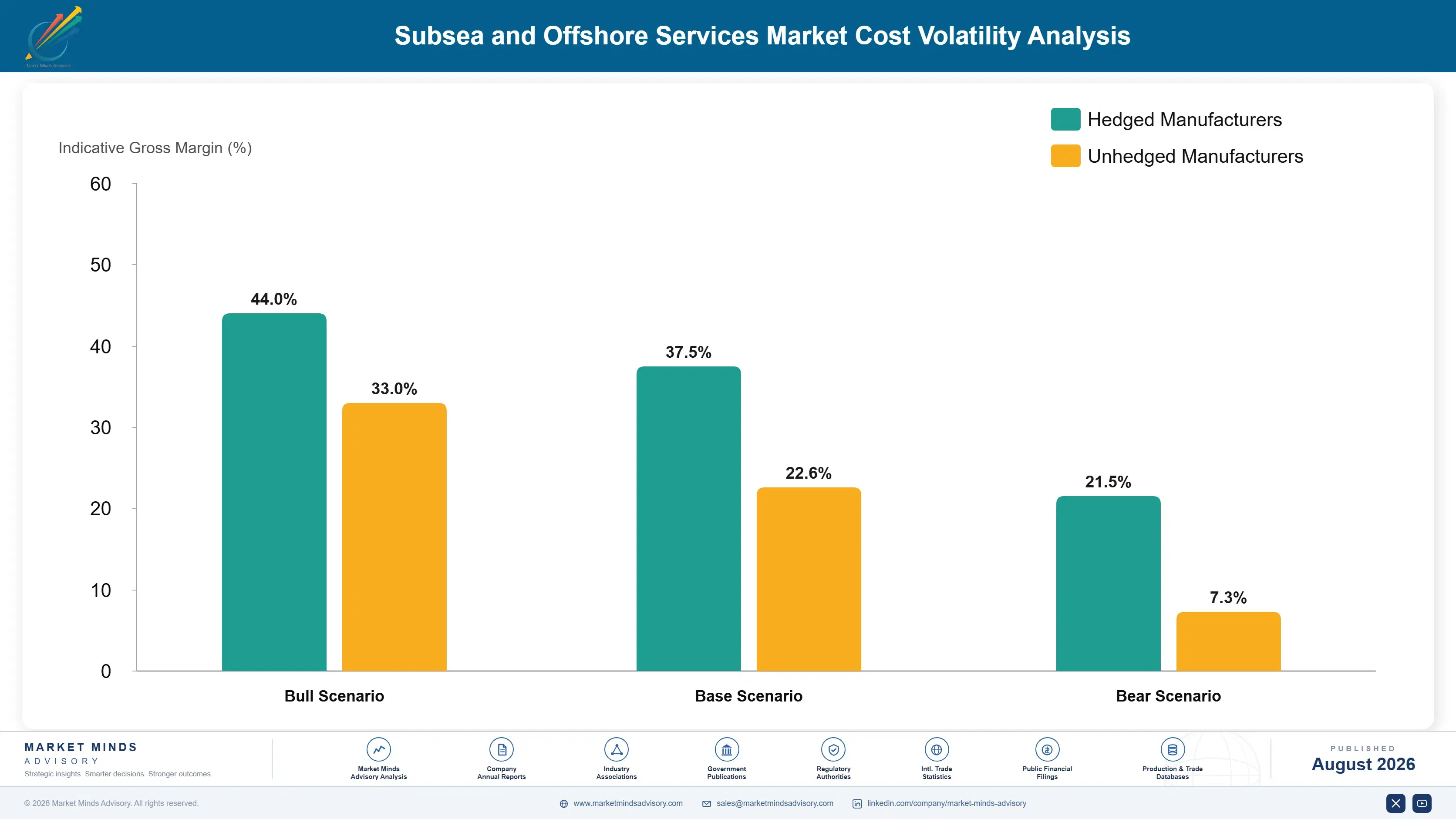
Vessel Charter Cost Sets the Project Ceiling

Vessel charter and crew costs typically represent roughly 45% to 55% of subsea project delivery cost, driven by specialized construction vessel day rates and certified offshore labor availability across major basins. Fuel and marine logistics add a further meaningful share, while engineering, project management, and regulatory compliance contribute the remainder across most contract structures and project types.
Vessel day rates spiked sharply through 2024 and into 2025 as offshore wind developers competed directly with oil and gas operators for the same limited construction vessel pool, according to IEA offshore energy market reporting. Subsea7's 2024 annual report disclosed rising charter and mobilization costs attributable to tight vessel availability, noting that day rate inflation outpaced the company's ability to pass costs through on fixed-price legacy contracts without meaningful margin compression.

Contractors with owned vessel fleets absorb charter cost volatility far more easily than those reliant on third-party spot charters, since fleet ownership locks in predictable capital costs regardless of market tightness. Contractors with diversified oil and gas plus offshore wind client bases also carry lower effective exposure than single-market specialists, widening the competitive gap. Smaller regional contractors lacking either advantage face the sharpest margin compression during vessel-tight periods.
subsea-offshore-services-market-cost-volatility-analysis-1787302846927

Lock Vessel Capacity Through Multi-Year Charters

Vessel day rates are the largest single volatile cost across most subsea project types and increasingly competed for by both oil and gas and offshore wind demand simultaneously. Multi-year charter agreements with fixed or collared pricing, common practice among larger diversified contractors, smooth quarter-to-quarter volatility and let commercial teams quote customer contracts with genuine confidence.

Diversify Fleet Across Client Sectors

Reliance on a single client sector concentrates both utilization and pricing risk unnecessarily across an entire vessel fleet and crew base. Qualifying fleet capability across both oil and gas and offshore wind applications, even at modestly higher conversion cost, protects continuity when either sector faces a sudden demand pullback or capital spending slowdown period.

Invest in Owned Fleet Over Spot Charter

Contractors relying heavily on third-party spot vessel charters face the sharpest exposure to sudden day rate spikes during periods of tight vessel availability. Building owned fleet capacity, even gradually, locks in predictable capital costs and reduces dependence on a spot market that has repeatedly proven volatile during simultaneous oil and gas and offshore wind demand surges.

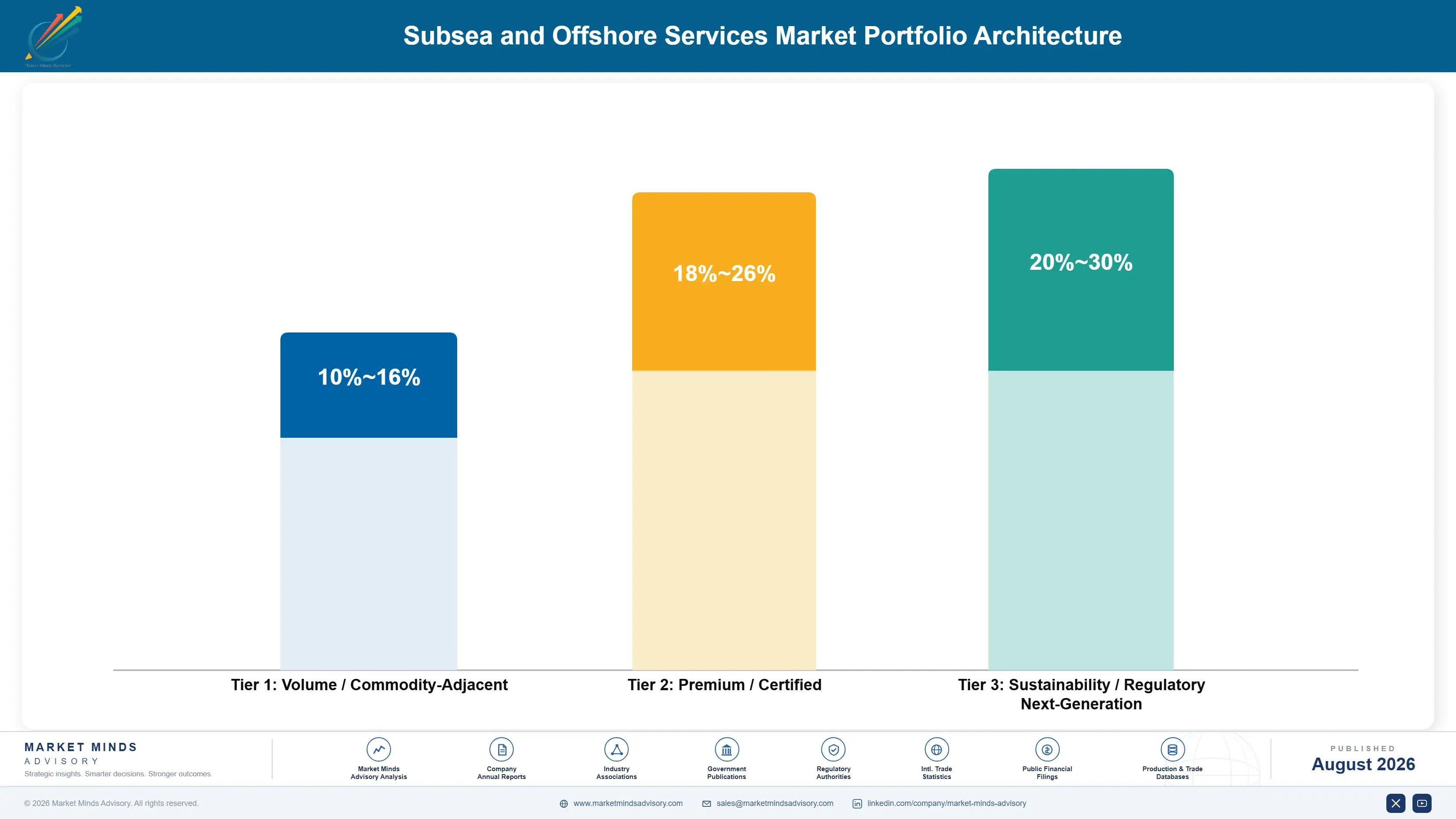
Portfolio Architecture for Margin Defence

The subsea services portfolio splits into three tiers with meaningful margin separation tied to service complexity and client sector. Volume tier services carry standard vessel charter and routine inspection work, competing largely on day rate against a crowded field of regional operators. Premium certified services carry integrated engineering-procurement-installation delivery and specialized decommissioning work. Sustainability-linked services, including offshore wind installation, attract the
The tension between volume and premium runs through nearly every contractor's fleet strategy. Volume charter work funds the vessel scale premium services eventually depend on, yet volume day rates keep compressing as more operators enter routine inspection and maintenance work. Contractors that under-invest in premium engineering capability risk commoditization within their own fleet category, while those chasing premium exclusively struggle to fund the vessel base needed to serve routine demand.

High-value margin pools concentrate specifically in offshore wind installation and decommissioning, where certification depth and integrated delivery carry the largest commercial stakes and where fleet flexibility commands genuine pricing power. Conventional inspection and maintenance work generates steadier volume but thinner margin, since that segment competes against a wider set of lower-cost regional operators.

Volume / Commodity-Adjacent

Standard vessel charter, routine inspection, and general maintenance work competing largely on day rate against a crowded field of regional operators offering broadly comparable service quality and vessel availability across most major basins.
Gross Margin: 10-16%

Premium / Certified

Integrated engineering-procurement-installation delivery and specialized decommissioning services backed by proven regulatory track records and certified project management capability across demanding deepwater and complex offshore installation applications requiring dedicated technical expertise.
Gross Margin: 18-26%

Sustainability / Regulatory / Next-Generation

Offshore wind installation and cable-laying services positioned as the sector's highest-growth category, riding government capacity target commitments and long-term framework agreements that reward early fleet diversification and specialization investment strategies.
Gross Margin: 20-30%
subsea-offshore-services-market-portfolio-architecture-1787302847426

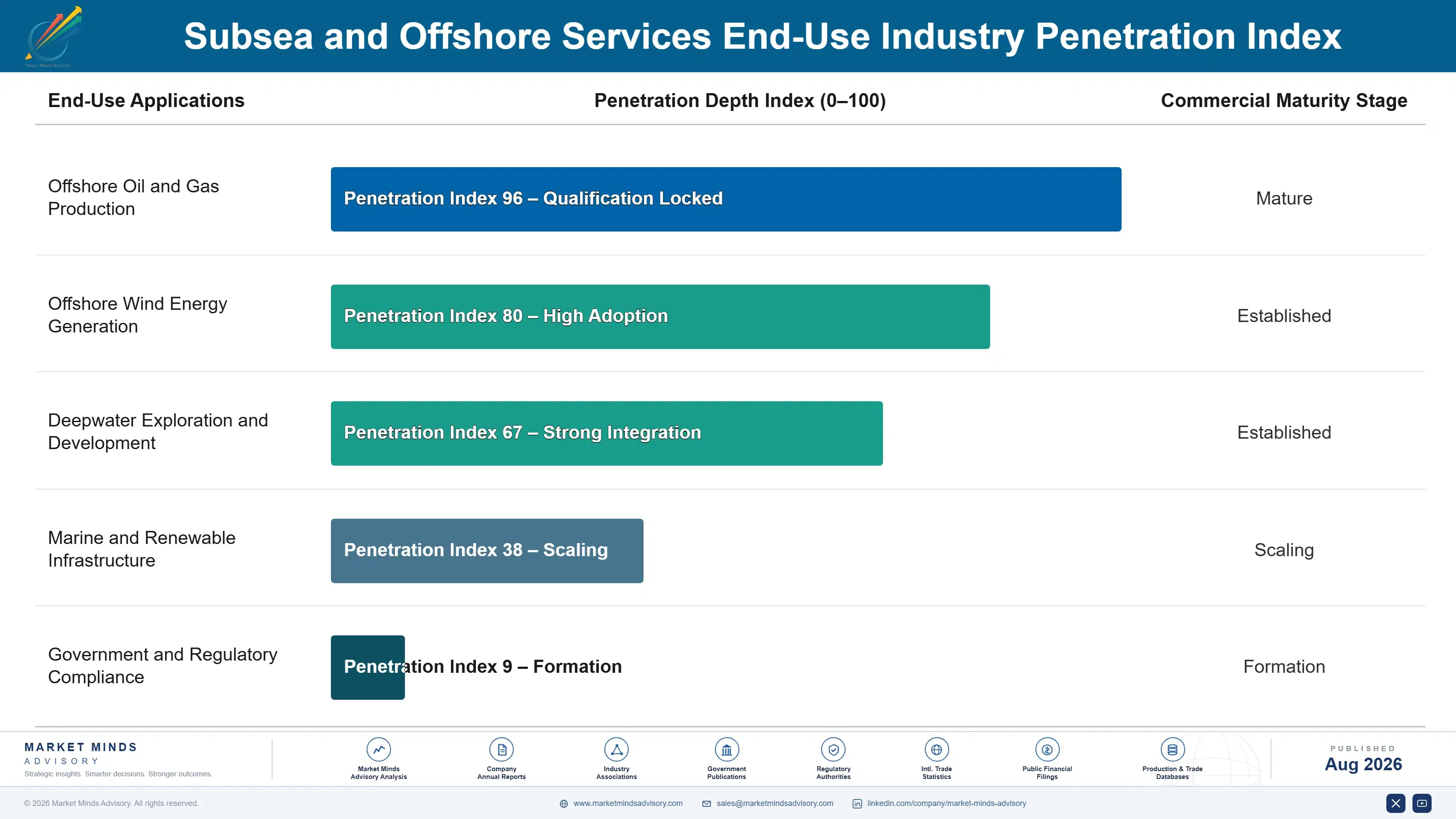
Subsea's Framework Agreement Lock-In Economics

Subsea services demand carries genuine annuity-like characteristics once a contractor wins a multi-year framework agreement, since operators rarely re-tender mid-contract given the cost and schedule risk of switching vessel providers partway through a project. A single framework agreement typically locks in three to seven years of predictable project volume, giving qualified contractors revenue visibility that spot-charter competitors simply do not have.
Adoption depth varies sharply by end-use vertical. Deepwater oil and gas demand is deep but cyclical, since operators can and do defer projects during commodity downturns without severe long-term consequence. Offshore wind demand is shallower in project count but far stickier, since developers commit to multi-year construction schedules tied to government subsidy timelines that cannot easily be delayed once financing closes and turbine orders are placed with manufacturers.

Buyer profiles are shifting generationally as sustainability officers and project risk teams gain real influence over contractor selection once handled purely by procurement on day rate alone. This newer buyer cohort weighs fleet flexibility and decommissioning readiness alongside price, fundamentally reshaping which contractors even reach the final tender shortlist regardless of how competitive their headline day rate might otherwise appear.
subsea-offshore-services-market-end-use-penetration-index-1787302847917

Where Subsea Strategy Should Focus Next

These are among the four positions where our research anticipates prominent divergence between winners and laggards over the coming forecast period. Each is grounded in the demand model, the regulatory perimeter, and the announced capacity pipeline.
01 / FLEET DIVERSIFICATION PRIORITY

Convert fleet capacity toward offshore wind before rivals lock in capacity

Offshore wind developers are finalizing multi-year vessel bookings well ahead of construction windows, and contractors lacking wind-capable fleet capacity are already being excluded from major tenders regardless of oil and gas track record. Conversion investment pays back through a 12 to 18 percent day rate premium plus continued market access, while delay risks permanent exclusion from the fastest-growing demand pool that increasingly defines this market's most profitable framework agreements. The window for cost-effective conversion is narrowing as shipyard capacity fills with other operators' newbuild orders.
02 / INTEGRATED DELIVERY POSITIONING

Standalone vessel charter carries genuinely weaker margin defensibility

Contractors who offer integrated engineering-procurement-installation delivery capture premium pricing that standalone vessel charter operators cannot access, since operators increasingly prefer a single accountable contractor for complete project delivery from design through commissioning. New capability investment should prioritize integrated delivery over pure fleet expansion, since operators are simplifying their contractor base and standalone charter providers risk exclusion from the largest framework agreements as this consolidation continues. Engineering talent acquisition, not vessel ownership alone, increasingly separates the winners from the also-rans in this maturing market.
03 / DECOMMISSIONING CAPABILITY BUILD

Decommissioning certification now positions contractors ahead of the platform removal wave

Roughly 2,000 platforms require decommissioning within fifteen years, and the segment is growing faster than conventional construction work as mature basins reach regulatory end-of-life deadlines on a predictable schedule that rewards early preparation and planning. Contractors who build certified plug and abandonment capability now will capture disproportionate share once removal volumes reach peak scale later this decade. Latecomers will find themselves competing for scarce specialized equipment against already-established regulatory relationships and long-standing operator trust built over multiple prior decommissioning campaigns.
04 / AUTONOMOUS TECHNOLOGY INVESTMENT

Autonomous vehicle investment reduces exposure to the certified diver shortage

The persistent shortage of qualified offshore divers and ROV pilots is delaying project schedules and inflating labor costs across the industry in ways that autonomous inspection technology can directly and cost-effectively address. Investment in autonomous underwater vehicle capability, though capital intensive upfront, offers genuine insulation from labor availability constraints that will only intensify as the existing certified workforce ages toward retirement. Early movers are already securing preferential contracts from operators seeking schedule certainty that diver-dependent competitors increasingly cannot guarantee reliably.

Engagement Snapshot From the Field

A live engagement with an industry participant carrying material or product regulatory and market exposure ahead of a defining policy shift, showing how our research translates into a defensible multi-year portfolio strategy.
MARKET MINDS ADVISORY · CLIENT ENGAGEMENT SUMMARY
Subsea and Offshore Services Producer Strategic Portfolio Review and Transition Roadmap 2026·Investment Scenario on Subsea and Offshore Services Exposure Evaluation 2025-26
CLIENT PROFILE
The client is an independent deepwater operator with several producing and development-stage fields across the Gulf of Mexico, managing a portfolio of both mature production assets and new field developments requiring specialized subsea installation support. The company generated approximately 640 million dollars in annual revenue (client-reported, unverified by MMA) and faced escalating vessel charter costs threatening its next major project sanction.
STRATEGIC CHALLENGE
The client's existing vessel sourcing strategy relied on spot-market charters that had grown increasingly expensive and unreliable as offshore wind developers competed for the same limited vessel pool. Leadership needed to determine whether a multi-year charter commitment or continued spot-market reliance offered better economics, and how exposed the company's development timeline was to vessel availability risk.
MMA APPROACH
MMA conducted a vessel market assessment benchmarking the client's historical charter costs against current framework agreement pricing across five qualified contractors, drawing on primary interviews with vessel operators and fleet planning executives. The engagement modeled total project cost under both sourcing strategies across the client's planned five-year development timeline, incorporating vessel availability risk explicitly.
KEY FINDINGS
  1. Spot-market vessel costs had risen 34 percent over eighteen months, well above the client's original project budget assumptions and available contingency reserves.
  2. A three-year framework agreement with a diversified contractor locked in day rates 19 percent below the client's projected spot-market exposure over the same period.
  3. Two of five candidate contractors lacked sufficient Gulf of Mexico deepwater experience for the client's specific well configuration and water depth requirements.
  4. Framework agreement terms including priority scheduling reduced the client's exposure to weather-driven schedule slippage compared with spot-market vessel access during peak season.
CLIENT PROFILE
The client is an independent deepwater operator with several producing and development-stage fields across the Gulf of Mexico, managing a portfolio of both mature production assets and new field developments requiring specialized subsea installation support. The company generated approximately 640 million dollars in annual revenue (client-reported, unverified by MMA) and faced escalating vessel charter costs threatening its next major project sanction.
STRATEGIC CHALLENGE
The client's existing vessel sourcing strategy relied on spot-market charters that had grown increasingly expensive and unreliable as offshore wind developers competed for the same limited vessel pool. Leadership needed to determine whether a multi-year charter commitment or continued spot-market reliance offered better economics, and how exposed the company's development timeline was to vessel availability risk.
MMA APPROACH
MMA conducted a vessel market assessment benchmarking the client's historical charter costs against current framework agreement pricing across five qualified contractors, drawing on primary interviews with vessel operators and fleet planning executives. The engagement modeled total project cost under both sourcing strategies across the client's planned five-year development timeline, incorporating vessel availability risk explicitly.
KEY FINDINGS
  1. Spot-market vessel costs had risen 34 percent over eighteen months, well above the client's original project budget assumptions and available contingency reserves.
  2. A three-year framework agreement with a diversified contractor locked in day rates 19 percent below the client's projected spot-market exposure over the same period.
  3. Two of five candidate contractors lacked sufficient Gulf of Mexico deepwater experience for the client's specific well configuration and water depth requirements.
  4. Framework agreement terms including priority scheduling reduced the client's exposure to weather-driven schedule slippage compared with spot-market vessel access during peak season.
RECOMMENDED STRATEGY
Phase 1: Phase 1 (Months 1-2): Complete a vessel market benchmarking assessment across five qualified deepwater contractors and their currently available fleets. Phase 2: Phase 2 (Months 3-4): Negotiate a three-year framework agreement with the selected contractor, prioritizing priority scheduling terms over lowest headline rate. Phase 3: Phase 3 (Months 5-6): Finalize project sequencing and mobilize vessel capacity well ahead of the client's planned development timeline milestones.
OUTCOME
The client signed a three-year framework agreement that secured vessel capacity at rates below prevailing spot-market pricing, protecting the project's sanctioned economics through a period of continued vessel market tightness. The client reported (client-reported, unverified by MMA) that priority scheduling terms proved particularly valuable during an unplanned weather delay, avoiding a costly schedule slip.

Frequently Asked Questions

Foundational context covering the market sizes, CAGR, scope, country, region and competition that inform every finding below. This section is provided to cover basics and most often pre-purchase conversations, answered from the MMA Primary Research Dataset.

What is the current size of the Subsea and Offshore Services Market?

The global subsea and offshore services market is valued at $18.5 billion in 2025. Growth is driven primarily by offshore wind installation demand and North Sea decommissioning volume.

How large will the Subsea and Offshore Services Market be by 2036?

MMA projects the market will reach approximately $38.15 billion by 2036. This represents a 1.93 times expansion over the ten-year forecast period beginning in 2026.

What is the CAGR for the Subsea and Offshore Services Market 2026 to 2036?

The base case CAGR is 6.8%, with a bull case of 8.0% and a bear case of 5.5%. Offshore wind and decommissioning segments grow meaningfully faster than this average.

Which segment is growing fastest?

Offshore wind subsea services lead at 12.5% CAGR, roughly 1.84 times the overall market rate. Government capacity targets and cable-laying demand drive this accelerating pace.

Who are the major companies in the Subsea and Offshore Services Market?

Leading participants include TechnipFMC, Subsea7, Saipem, McDermott International, and Aker Solutions. Together these five leading contractors hold roughly forty-two percent of the total global market.

Which country is growing fastest?

China leads regional growth at 8.4% CAGR, driven by its dominant offshore wind installation volume and rapidly expanding specialized vessel construction and shipyard capacity nationwide.

Report Segmentation Architecture

The full report scope spans multiple orthogonal segmentation dimensions, with cross-tabulated demand data provided for each dimension pair. Coverage extends further to regional breakdowns, trend trajectories, and the competitive detail needed to support segment-level decision-making.

By Primary Market Dimension

  • Subsea Engineering and Front-End Design Services
  • Subsea Construction and Installation Services
  • Inspection, Repair, and Maintenance (IRM) Services
  • ROV and Autonomous Underwater Vehicle (AUV) Operations
  • Offshore Wind Subsea Services
  • Decommissioning and Plug and Abandonment Services

By End-Use Industry

  • Offshore Oil and Gas Production
  • Offshore Wind Energy Generation
  • Deepwater Exploration and Development
  • Marine and Renewable Infrastructure
  • Government and Regulatory Compliance

By Commercial Dimension

  • Vessel Charter and Spot Contracts
  • Multi-Year Framework Agreements
  • Integrated Engineering-Procurement-Installation Delivery
  • Consulting and Advisory Services

By Region

  • North America
  • Western Europe
  • East Asia
  • South Asia and Pacific
  • Latin America
  • Middle East and Africa
  • Eastern Europe

Scope, Methodology, and Coverage

Every figure in this report is reproducible from documented input assumptions. The scope below maps the historical period, the forecast horizon, the segmentation dimensions, and the countries covered, alongside the underlying primary and qualitative methodology.
Historical Period
2020 to 2025
Forecast Period
2026 to 2036
Base Year
2025 (USD billions; MMA Primary Research Dataset, August 2026)
Market Definition
This report covers global subsea and offshore marine services spanning engineering, construction, installation, inspection, repair, maintenance, and decommissioning for both oil and gas and offshore wind infrastructure. It excludes onshore energy infrastructure, vessel manufacturing, and finished turbine or platform equipment sales.
Quantitative Units
USD billions (current prices); vessel day rate benchmarks where applicable
Segmentation Dimensions
By Primary Market Dimension; By End-Use Industry; By Commercial Dimension; By Region
Regions Covered
North America, Western Europe, East Asia, South Asia and Pacific, Latin America, Middle East and Africa, Eastern Europe
Countries Covered
USA, China, Germany, France, UK, Japan, South Korea, India, Australia, Canada, Brazil, Mexico, Indonesia, Vietnam, Thailand, Malaysia, UAE, Saudi Arabia, South Africa, Nigeria, Turkey, Poland, Netherlands, Italy, Spain, Sweden, Switzerland, Argentina, Colombia, Singapore, and additional markets relevant to this sector
Key Companies Profiled
TechnipFMC plc, Subsea7 S.A., Saipem S.p.A., McDermott International, Ltd., Aker Solutions ASA, Oceaneering International, Inc., Baker Hughes Company, Halliburton Company, SLB (Schlumberger Limited), DOF Group ASA, Royal Boskalis Westminster N.V., Van Oord, Fugro N.V., Bibby Marine, Ocean Installer AS, Helix Energy Solutions Group, Inc., John Wood Group PLC, NOV Inc., Petrofac Limited, Acteon Group
Quantitative Methodology
Primary survey, n=3,800 respondents, Q4 2025, six countries; demand-side model with trade association cross-validation
Qualitative Methodology
47 expert interviews, Q4 2025; applied to validate demand model assumptions, identify emerging dynamics, and assess competitive positioning
Report Format
PDF and XLSX data workbook (Word format preview document)
Publisher
Market Minds Advisory
Report Code
MMA-2026-ENE-406
Published
August 2026
Contact
sales@marketmindsadvisory.com | www.marketmindsadvisory.com

Purchase the full Subsea and Offshore Services Market Report (2026 to 2036).

The full Subsea and Offshore Services Market report delivers comprehensive analysis across all seven MMA-covered regions. It provides complete segment-level sizing and forecasts through 2036, plus detailed competitive profiling of twenty leading global contractors across the construction, inspection, and decommissioning value chain. The report includes proprietary MMA primary survey data drawn from 3,800 respondents and forty-seven expert interviews conducted in the fourth quarter of 2025. It also delivers detailed vessel cost analysis, revenue lever assessment, and portfolio tier economics. Buyers receive full data tables, editable charts, and a structured executive briefing deck.
Full seven-region market sizing and forecast tables
Twenty-company competitive profiling and benchmarking analysis
Editable data tables and full chart package
Segment-level CAGR and value breakdowns detailed
Vessel cost structure and day rate analysis
Executive-ready briefing deck for board presentations

Built For The People Who Decide

From boardroom strategy to bench-side execution, this report is read cover-to-cover by leaders shaping the next decade of their industry, turning demand scenarios, market dynamics and valuation benchmarks into decisions.
CXOs/ Presidents/ VPs/ Managers
M&A and Corporate Development
Strategy Teams and R&D Heads
Procurement and Product Directors
Regulatory and Compliance Leaders
Investor Relations and Equity Analysts