Market Minds Advisory
Subsea Mining Equipment Market

Subsea Mining Equipment Market: Built And Tested, Waiting On A Permit

Collectors, risers, and surface vessels have all been tested at depth and none of it can operate commercially, because the regulatory code governing international waters is still unfinished. Nobody in the supply chain controls that.

Lead Analyst

David Horsley

Published

September 2026

Make Smarter Decisions with Customized Research Insights

Request a free sample report and evaluate market opportunities, growth trends, and competitive dynamics relevant to your business needs.

2025 MARKET VALUE$0.4BMarket Size 2025
2036 FORECAST VALUE$1.6BBase Case , 2026 to 2036
CAGR 2026 TO 203613.1 %Bull 14.4% / Bear 11.8%
INCREMENTAL OPPORTUNITY$1.1BNet 10- year value creation
EXPANSION MULTIPLE3.43x2036 value over 2026 base
Strategic Levers
M&A Pipeline
Regional Outlook
Country Rankings
Competitive Intelligence
Segmental Deep-dive
Call-Us : 91 93563 13602

Executive Snapshot and Market Trajectory

The engineering is largely finished and the permission is not. Collector vehicles, vertical transport risers, and dewatering systems have all been tested at 4,000 metres, while the mining code governing international waters remains unadopted after more than a decade. The technical objections are largely settled; the political ones are not.
Growth runs at 13.1% and monitoring leads it. Environmental monitoring and plume management systems grow at 19.65%, exactly 1.50 times the market rate, because every regulator and every contractor now treats plume dispersion evidence as the condition on which any permission depends. South Asia and Pacific holds 24%, far outside band, since Pacific island sponsoring states and Australian engineering both concentrate there. Monitoring is the one category insulated from that binary.
Concentration is high at 63% across the top five measured on delivered equipment value, and the customer base explains it. Fewer than a dozen organisations worldwide are building this equipment at all, and most orders come from contractors who have not yet been permitted to use what they buy. Roughly 38 states back a pause on extraction. The addressable market could therefore expand quickly or disappear entirely.
Market Definition
This market covers equipment supplied for seafloor mineral collection and vertical transport, spanning seafloor collector and cutter vehicles, vertical transport and riser systems, surface production vessel systems and dewatering plant, environmental monitoring and plume management systems, and subsea power, control and umbilical systems. Onshore processing and refining plant, mineral exploration and survey services, offshore oil and gas production equipment, dredging equipment for shallow aggregate recovery, and vessel chartering contracted separately fall outside scope.
Base Year Value
$0.4B in 2025 (MMA Primary Research Dataset, August 2026)
Forecast Period
2026 to 2036, eleven discrete annual values
CAGR
13.1% base case. Bull 14.4%. Bear 11.8%.
Fastest Growth Segment
Environmental Monitoring and Plume Management Systems: 19.6% CAGR
Fastest Growth Country
Norway: 17.4% CAGR
Fastest Growth Region
South Asia and Pacific: 15.4% CAGR
Largest Region
South Asia and Pacific: 24% of 2025 global value
Market Leaders
Allseas, Soil Machine Dynamics, Royal IHC, Kongsberg Maritime, MacArtney. Source: MMA Analysis based on company annual reports.
Primary Survey
n=3,800 procurement and R&D decision-makers, Q4 2025, six countries
Methodology
Demand-side build-up, cross-validated against public data, 47 expert interviews

Subsea Mining Equipment Market Forecast Scenarios

subsea-mining-equipment-market-size-forecast-scenario-1787302782057
The 2020 to 2025 period ran at 11.6% from a very small base and consisted almost entirely of prototype and test campaign spending rather than production equipment. A collector system was trialled at depth in the Clarion-Clipperton Zone, several contractors funded environmental baseline programmes, and Norwegian and Japanese national programmes advanced separately. No commercial extraction occurred anywhere across the period.
Three mechanisms carry the 13.1% base case. Environmental monitoring and baseline work is the largest, since it is the one category of spending that proceeds regardless of whether extraction is ever permitted. National programmes within territorial waters are the second, where sponsoring states control their own permitting. And equipment readiness spending is the third, as contractors position for a code whose timing nobody can predict. Subsea control and umbilical demand follows all three without leading any of them.
The 14.4% bull case rests on the mining code being adopted with workable conditions, which would convert a decade of prototype spending into production equipment orders across several contractors simultaneously. The 11.8% bear case is a moratorium hardening into a durable position across enough sponsoring states, which would leave the equipment base as sunk cost and collapse orders to monitoring alone.

Engineering Finished, Permission Pending

This is an equipment market waiting on a decision it does not control. Collector vehicles have driven on the seafloor at 4,000 metres, risers have lifted nodules 4.5 kilometres to a surface vessel, and dewatering plant has processed the result. The technical questions that dominated the last decade are largely settled. The permission question is not, and the mining code for international waters remains unadopted.
TOP FIVE CONCENTRATION63%High, because very few organisations build this equipment at all
TESTED OPERATING DEPTH4,000 metresReached by collector systems during at-sea trial campaigns already
MONITORING SHARE OF SPEND31%Of equipment spending going to environmental measurement rather than extraction
MORATORIUM SUPPORTING STATES38Backing a pause or ban on commercial seabed extraction
RISER VERTICAL LIFT4.5 kmOf continuous transport between the seafloor and surface vessel
BASELINE STUDY DURATION5 yearsOf environmental data typically required before any permit consideration
That has produced an unusual spending pattern. Around 31% of equipment spending now goes to environmental monitoring and plume measurement rather than to anything that extracts a mineral, because evidence about sediment plume behaviour is the condition on which permitting will turn. Contractors are funding the science that will either permit them or refuse them, which is a position with few parallels in industrial equipment.
Concentration at 63% reflects an extremely narrow supply and customer base together. Fewer than a dozen organisations worldwide build this equipment, and the buyers are a handful of contractors backed by sponsoring states and strategic investors. Roughly 38 states now support a pause or ban, which means the addressable market could expand very quickly or disappear almost entirely.
"Clients ask us when this market takes off. The honest answer is that it does not depend on anything an engineer or an investor controls. It depends on a negotiation in Kingston that has run for over a decade."
Director, Subsea Technology and Marine Minerals Practice · MMA Subsea Technology

Market Trends

Environmental Monitoring Becomes The Larger Spending Category

Plume measurement, benthic imaging, sediment sampling, and long-term ecological monitoring now account for roughly 31% of equipment spending and grow at 19.65% against 13.1% for the market. That is the one category funded regardless of whether extraction proceeds, since sponsoring states, regulators, and contractors all need the evidence. Suppliers of oceanographic instrumentation are participating in this market far more than collector vehicle builders currently are. Contractors are effectively funding the science that will either permit them or refuse them. There are few parallels for that anywhere in industrial equipment. Nobody chose the arrangement.
Market Impact: Trials reached 4,000 metres depth
National Waters Advance While International Code Stalls

Norway, Japan, the Cook Islands, and several other states control permitting inside their own exclusive economic zones and can proceed without the international code that governs the high seas. Those programmes are smaller than the Clarion-Clipperton Zone opportunity and they are real, funded, and moving. Equipment specified for national waters differs in depth rating and scale, which suits some suppliers considerably better than others. A supplier configured only for Clarion-Clipperton depths cannot simply redirect its offering toward shallower national waters. Depth rating and scale both differ. Redesign rather than repositioning is required.
Market Impact: Risers lift material 4.5 km

Market Opportunities and Growth Drivers

Battery Metal Supply Concentration Sustains Political Interest

Nickel, cobalt, and manganese refining concentration in a small number of countries keeps seabed nodules politically interesting to states seeking supply diversification, regardless of whether the economics work at current metal prices. That interest funds programmes and sponsorships that commercial returns alone would not support. It also means the market's prospects move with geopolitics rather than with metal prices, which few equipment suppliers have properly internalised. Programmes and sponsorships proceed on supply security grounds that commercial returns alone would never support. Metal prices matter less here than geopolitics does. Few suppliers have internalised that properly.
Market Impact: Roughly 38 states back moratorium

Technical Readiness Removes The Engineering Objection

Collector vehicles have operated at 4,000 metres, risers have lifted material 4.5 kilometres, and dewatering has been demonstrated at sea, which removes technical feasibility from the argument entirely. Opponents now argue environmental consequence rather than engineering possibility, and that is a different debate with different evidence requirements. Equipment suppliers have effectively finished the job they were asked to do and are waiting on everybody else. Opponents now argue environmental consequence rather than engineering possibility, which is a different debate entirely. The evidence requirements differ completely. Equipment suppliers cannot resolve either of them.
Market Impact: Baselines require about 5 years

Market Restraints and Challenges

Regulatory Uncertainty Prevents Any Production Ordering

The mining code governing international waters remains unadopted after more than a decade, and the root cause is that sponsoring states, opposing states, and scientific advisers have not converged on acceptable environmental thresholds. Commercial impact is that contractors cannot order production fleets against a permit that may never arrive. Mitigation runs through national waters programmes where states control permitting, monitoring equipment that sells regardless, and staged designs that scale from trial to production. Several offshore engineering firms have already deprioritised the sector after a decade without commercial orders. Patience across the supply base is finite.
Market Impact: Monitoring is 31% of spending

Plume Evidence Requirements Extend Every Timeline

Baseline environmental studies typically require around five years of data before any permit is seriously considered, and the root cause is that deep ocean seabed communities recover slowly enough that short observation windows prove very little. Commercial impact is that even a favourable code adoption does not produce immediate equipment orders. Mitigation runs through starting baseline programmes early, sharing monitoring data across contractors, and designing plume management into collectors rather than adding it later. Even a favourable code adoption therefore produces no immediate equipment orders at all. Baseline data has to exist first. Contractors who started early hold that advantage.
Market Impact: Around 38 states back a pause
3 additional market trends, 4 additional growth drivers, and 2 additional restraints and challenges are covered in the full report. Contact sales@marketmindsadvisory.com to access the complete intelligence.

Segment CAGR and Growth Architecture

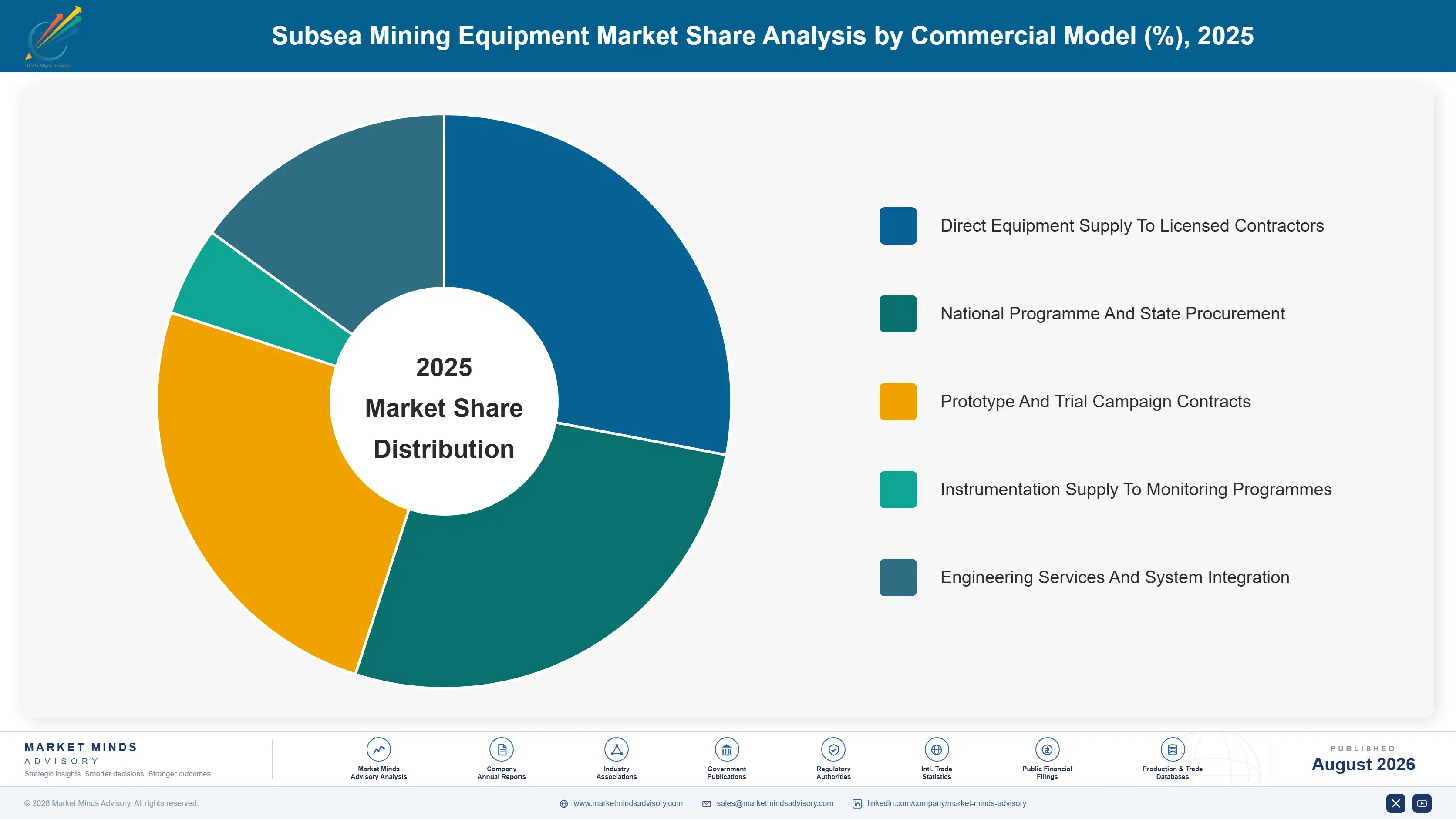
Segmentation follows the equipment system and the function it performs in the extraction chain, because each has a distinct engineering discipline, depth rating, supplier base, and dependence on permitting. Mineral type and water depth both cut across every system rather than separating them, which makes either a weaker primary dimension here. Permitting exposure differs sharply between them.
subsea-mining-equipment-market-market-share-analysis-1787302782584

Environmental Monitoring And Plume Management Systems

The fastest system at 19.65%, exactly 1.50 times the market rate, covering plume measurement instrumentation, benthic imaging, sediment samplers, acoustic monitoring, and the data systems that process it. Around 31% of equipment spending goes here and it is the only category that proceeds whether or not extraction is ever permitted, since regulators, sponsoring states, and opponents all need evidence. Oceanographic instrument suppliers with no interest in mining participate in this market fully, which makes the competitive field wider and considerably less exposed than collector vehicle building. Sponsoring states, regulators, and opponents all need the same evidence, which is why this demand does not depend on any permitting outcome. Nothing else in the market shares that property.
CAGR 19.6%

Seafloor Collector And Cutter Vehicles

Second fastest at 14.8%, covering the tracked or hydraulic collector vehicles that gather nodules or cut crusts and seafloor massive sulphides at depths reaching 4,000 metres. Trial campaigns have demonstrated the engineering and the remaining development work concerns plume generation, seabed disturbance footprint, and reliability across long production campaigns rather than basic capability. Orders are prototype and pre-production rather than fleet quantities, and they will stay that way until a permitting pathway becomes visible to the contractors funding them. Plume containment designed into the vehicle rather than bolted on afterwards is what separates the current generation from the last. Regulators will assess exactly that. Retrofitting it would require redesign. Few builders anticipated it.
CAGR 14.8%
Full segment breakdown across 5 segments available in the complete report.

Regional Architecture and Country Demand Map

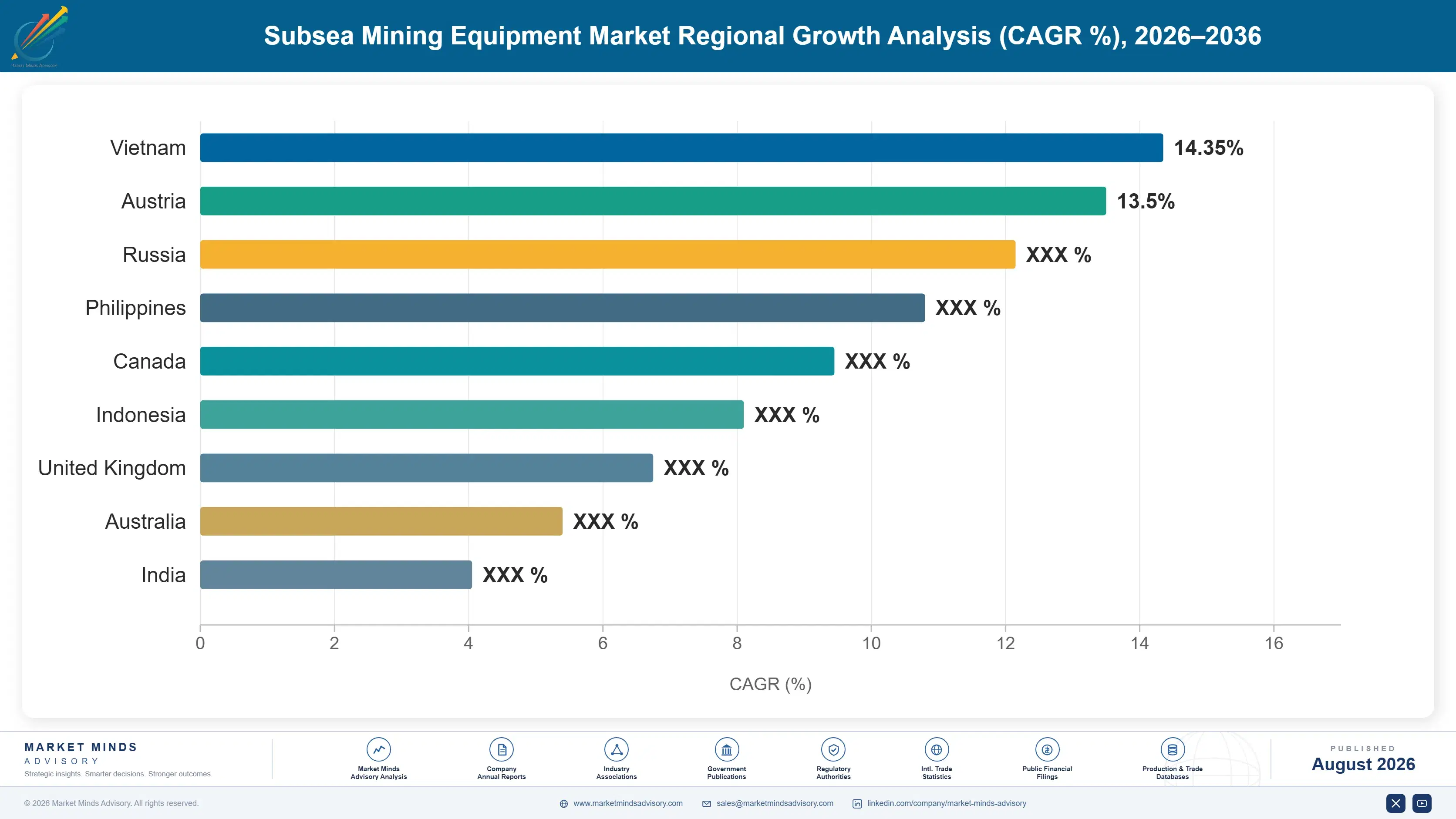
South Asia and Pacific leads at 24%, far outside band, because Pacific sponsoring states and Australian engineering both concentrate there. Western Europe follows on equipment building. Norway grows fastest. Three regional shares sit outside their framework bands. Sponsoring state and engineering geography explain them. Resource geography explains none of it.

South Asia and Pacific

Twenty-four percent, far outside the framework band, and justified because Pacific island states including Nauru, Tonga, and the Cook Islands sponsor most of the Clarion-Clipperton Zone contractors while Australian subsea engineering supplies much of the equipment. Cook Islands seabed within its own exclusive economic zone can be permitted nationally, which several contractors are pursuing while the international code stalls. Indian national programmes add separate activity. Growth at 15.4% runs above the market rate on national waters programmes advancing. Sponsorship rather than equipment supply drives most of the regional figure, since the states involved hold licences rather than engineering capability. Australian suppliers provide much of the hardware. The two rarely appear in the same analysis.
Share: 24% | CAGR: 15.4% (2026 to 2036)

Western Europe

Twenty-three percent, and the region builds a disproportionate share of the equipment rather than holding the mineral resource, with Dutch, Norwegian, and British engineering companies supplying collectors, risers, and control systems. Norwegian seabed minerals within national waters have their own permitting pathway and considerable political contention around it. European opposition to high seas extraction is also strongest here, which places suppliers and policy in direct tension. Growth at 11.5% is the slowest of any region, reflecting that contention. Suppliers here are building equipment their own governments may ultimately prohibit from operating on the high seas, which is an uncomfortable commercial position. Several have reduced their exposure quietly. Others have not.
Share: 23% | CAGR: 11.5% (2026 to 2036)
Regional intelligence for 5 additional markets available in the complete report: East Asia, North America, Latin America, Middle East and Africa, Eastern Europe. Contact sales@marketmindsadvisory.com.
subsea-mining-equipment-market-country-cagr-analysis-1787302783103

Monitoring, National Waters And Staging

Monitoring carries 31% of spending and grows at 19.65%, roughly 38 states back a moratorium, baselines run five years, and trials have reached 4,000 metres. Value comes from monitoring exposure, from national waters programmes, and from designs that stage rather than commit. Engineering readiness is no longer the question. Permission is the only question left.

Weight Toward Monitoring Rather Than Extraction Equipment

Environmental monitoring and plume management carries roughly 31% of equipment spending and grows at 19.65% against 13.1% for the market, and it is the only category funded whether or not extraction is ever permitted. Regulators, sponsoring states, contractors, and opponents all need the same evidence. A supplier weighted to collectors and risers carries the full permitting risk, while one weighted to monitoring carries almost none of it. Around 38 states back a moratorium, which makes extraction exposure genuinely binary rather than merely cyclical. No commercial decision hedges that. Monitoring revenue does.
Market Impact: Monitoring carries fully 31% of the total spending

Pursue National Waters Programmes Ahead Of The Code

Norway, Japan, the Cook Islands, and several other states permit within their own exclusive economic zones without waiting for the international mining code that has stalled for over a decade. Those programmes are smaller and they are funded and moving now. Equipment specified for national waters differs in depth rating and scale, so a supplier configured only for Clarion-Clipperton depths cannot simply redirect its offering there. Trials have proven systems at 4,000 metres while national waters work sits considerably shallower. That changes pressure housings, power, and lift design. Redesign takes real engineering time.
Market Impact: Roughly 38 states are now backing a moratorium

Design Systems That Stage From Trial To Production

Contractors cannot order production fleets against a permit that may never arrive, so equipment designed to work at trial scale and extend to production without redesign is the only structure that matches how buyers can actually commit. Suppliers offering production-scale systems alone are asking for a decision nobody can make. Staged designs cost more engineering and win the orders that exist rather than the ones that might. Trial systems proven at 4,000 metres extend to production far more readily when the design anticipated it. Retrofitting scale afterwards rarely works. Buyers can see which approach was taken.
Market Impact: Trials have already reached a 4,000 metre depth

Build Plume Management Into Collectors From The Start

Sediment plume behaviour is the evidence on which permitting will turn, and baseline studies run around five years before any permit is seriously considered. A collector designed with plume containment and measurement built in produces evidence continuously rather than requiring separate campaigns. Suppliers treating environmental performance as a bolt-on are building equipment that will need modification before it can ever be permitted anywhere. Baseline studies run around 5 years, so a collector generating evidence continuously shortens nothing and improves everything. Bolt-on monitoring produces weaker data. Regulators will notice the difference.
Market Impact: Baseline studies typically run about 5 years each

Who Controls the Margin Pool

Concentration is high at 63% across the top five measured on delivered equipment value, and an extremely narrow supply base explains it rather than any competitive dynamic. Fewer than a dozen organisations worldwide build seafloor collectors, deep vertical transport risers, or the surface handling systems around them, and most arrived from offshore oil and gas or dredging engineering rather than from mining. The leader to challenger gap is widest in vertical transport and
Competitive activity runs on three fronts. Monitoring and instrumentation capability is the first and the least exposed, since it sells whether or not extraction proceeds. National waters positioning is the second, where permitting is controlled by a single state rather than an international negotiation. And staged design capability is the third, matching how contractors can actually commit capital under this much uncertainty.

Pressure arrives from two directions. Oceanographic instrument suppliers with no mining interest are taking the monitoring growth. And several offshore engineering firms have quietly deprioritised the sector after a decade without commercial orders. Rankings shift on regulatory developments rather than on anything the suppliers do. Neither pressure affects the handful of organisations that have demonstrated vertical transport at depth, since nothing substitutes for that engineering.
subsea-mining-equipment-market-company-positioning-matrix-1787302783626

Competitive Moat and Risk Dimensions

ALLSEAS

Moat: Demonstrated integrated system at depth

Having operated a complete collection and vertical transport system in the Clarion-Clipperton Zone gives engineering evidence and operating data that no competitor holds from analysis alone. Deep offshore installation heritage supplied the vessel and handling capability that made the trial possible. Both would take a competitor years and a comparable campaign to replicate at any cost.
ALLSEAS

Risk: Full exposure to permitting outcome

Integrated extraction system capability is worth a great deal if the mining code is adopted and close to nothing if a moratorium hardens across enough sponsoring states. Roughly 38 states currently back a pause. That is a binary exposure no engineering or commercial decision inside the company can hedge or influence.
KONGSBERG MARITIME

Moat: Monitoring and control system breadth

Positions across subsea positioning, acoustic monitoring, and control systems serve environmental measurement demand that grows at 19.65% regardless of whether extraction is permitted anywhere. Those products also sell into offshore energy, survey, and defence markets, which makes participation here an extension rather than a commitment. Very little of the position depends on the mining code.
KONGSBERG MARITIME

Risk: Limited share of extraction systems

A monitoring and control weighted position captures relatively little of the value if the code is adopted and production fleets are ordered, since collectors, risers, and surface plant carry most of that spending. Insulation from the downside costs participation in the upside. Building extraction system capability afterwards would start from behind.

Players Tracked

Prominent Players

Allseas
Soil Machine Dynamics
Royal IHC
Kongsberg Maritime
MacArtney

Other Key Players

Saipem
Fugro
Teledyne Marine
Sonardyne
Van Oord
Boskalis
DEME
Damen Shipyards
Mitsubishi Heavy Industries
Kawasaki Heavy Industries
Hyundai Heavy Industries
Oceaneering International
Forum Energy Technologies
Bluefin Robotics
Ocean Infinity

Recent Developments

JANUARY 2025

Sponsoring state advances national waters permitting framework

A Pacific state progressed a permitting framework for seabed mineral collection inside its own exclusive economic zone, proceeding independently of the international mining code that has remained unadopted for over a decade. The framework was a national regulatory decision rather than any international agreement or commercial arrangement.
Signal: National waters permitting is advancing steadily while the international code negotiation itself still continues to stall
APRIL 2025

Contractor commissions extended plume monitoring campaign

A seabed minerals contractor funded a multi-year plume dispersion and benthic recovery monitoring campaign covering its exploration area, adding to baseline data that regulators will assess before considering any extraction permit application. The campaign was environmental evidence gathering rather than any technical trial or commercial development.
Signal: Contractors are now funding the very science that will either permit them or refuse them entirely
AUGUST 2025

Offshore engineering firm deprioritises seabed minerals development

An offshore engineering company reduced its seabed minerals equipment development after a decade without commercial orders, redirecting engineering resource toward offshore wind and conventional subsea work. The decision was internal capital allocation rather than any technical failure, dispute, or exit from the sector entirely. The programme was reduced
Signal: A decade of readiness spending without any orders is exhausting supplier patience right across the sector

Steel, Subsea Components and Trials

Equipment cost divides between fabricated structure, pressure housings, and machined components at roughly 33%, subsea electrical, hydraulic, and control components near 26%, engineering and design across long development cycles around 22%, at-sea trial campaigns and vessel time about 12%, and certification, insurance, and overhead the balance. Trial cost is unusual here because every system must be proven at depth before any customer will commit further.
Subsea component lead times and pricing both moved sharply through 2022 and 2023 as offshore energy activity recovered and competed for the same connectors, thrusters, and control hardware, and several subsea engineering companies disclosed procurement pressure in filings covering those years. Steel costs moved separately and less severely. Neither could be recovered easily on prototype contracts where scope changes were already the norm. Prototype contracts absorb very little of either.

The competitive disadvantage mechanism runs through engineering amortisation rather than through component purchasing. Subsea components cost broadly the same for every builder, while development engineering spread across one or two prototype units carries a burden that no volume relieves. Suppliers with adjacent offshore energy or dredging businesses amortise that engineering across other products, and independent seabed mining specialists simply cannot.
subsea-mining-equipment-market-cost-volatility-analysis-1787302783823

Amortise engineering across adjacent subsea product lines

Engineering and design carry roughly 22% of equipment cost across development cycles measured in years, and prototype volumes relieve none of it. Suppliers with offshore energy, survey, or dredging businesses spread that burden across products with actual volume. Independent specialists carry it alone, which is a large part of why several have deprioritised the sector after a decade

Share trial vessel campaigns across multiple equipment tests

At-sea trials and vessel time carry around 12% of equipment cost and a deep water campaign is expensive whether one system or several are tested. Coordinating trials so that collectors, monitoring instruments, and control systems are proven in the same campaign spreads that cost. The coordination is difficult across separate contractors and it is considerably cheaper than separate mobilisations.

Qualify alternate subsea component sources during design

Subsea electrical, hydraulic, and control components carry around 26% of cost and compete directly with offshore energy demand for the same connectors, thrusters, and housings. Designs locked to single-source components face lead times set by an unrelated market cycle. Qualifying alternates during design costs engineering time and preserves schedule when offshore activity tightens supply again.

Portfolio Architecture for Margin Defence

Three tiers describe this business and the spread follows permitting exposure rather than engineering difficulty. Monitoring instrumentation sits at the bottom on margin and at the top on certainty, since it sells regardless of whether extraction proceeds. Subsea power, control, and umbilical systems occupy the middle. Collectors, risers, and surface production systems sit at the top on margin and carry the entire regulatory risk.
The tension is unusually stark. Extraction equipment carries the best margin and the possibility of no market at all, while monitoring carries thinner margin and a demand base that both proponents and opponents fund. A supplier weighted to extraction has spent a decade building capability against a permit that may never arrive. One weighted to monitoring has a real business and captures little of any upside.

High-value pools concentrate where the engineering has no substitute. Vertical transport risers lifting material 4.5 kilometres are the clearest case, since no established offshore technology does that at the required rate, and the handful of organisations that have demonstrated it hold something nobody can buy. Collector plume management is the second such pool, where the design decision determines whether a permit is achievable at all.

Volume / Commodity-Adjacent Tier

Environmental monitoring instrumentation, sensors, and sampling equipment sold into a demand base that both proponents and opponents fund. Thinner margin and by far the most certain revenue in this market.
Gross Margin: 26-34%

Premium / Certified Tier

Subsea power, control, umbilical, and positioning systems adapted from offshore energy heritage. Engineering amortises across adjacent product lines, which independent seabed specialists cannot manage at all. Offshore energy heritage supplies most of the capability.
Gross Margin: 32-42%

Sustainability / Regulatory / Next-Generation Tier

Collector vehicles, vertical transport risers, and surface production and dewatering systems. Best margin available, no established substitute technology, and the entire regulatory risk sits here. A decade of readiness has produced no fleet orders.
Gross Margin: 40-52%
subsea-mining-equipment-market-portfolio-architecture-1787302784322

High-value Sub-segments and Strategic Watch-out

Environmental Monitoring Instrumentation

Fastest growth at 19.65%, exactly 1.50 times the market rate, and the only category funded whether or not extraction is ever permitted anywhere. Instrument suppliers with no mining interest are taking most of that growth. Both sides of the argument fund it. Specialists are losing it.
Gross Margin: 26-34%

Vertical Transport Riser Systems

Strong growth and the least substitutable engineering in the market, lifting material 4.5 kilometres at rates no established offshore technology matches. Very few organisations have demonstrated it at sea at all. Nothing substitutes for that capability. Demonstrating it takes a campaign at sea and years of engineering.
Gross Margin: 40-52%

Seafloor Collector Vehicles

The volume core in a market with very little volume, ordered as prototypes rather than fleets while contractors wait for permitting clarity. Plume generation rather than basic capability is the remaining development question. Fleet orders await a permitting pathway. Prototypes are all anybody can commit to.
Gross Margin: 40-52%

Regulatory Outcome Exposure

The strategic watch-out, since roughly 38 states back a moratorium and the international mining code remains unadopted after more than a decade. No engineering or commercial decision inside any supplier hedges that. The exposure is genuinely binary. No engineering decision touches it at all. Nothing hedges it.
Gross Margin: 40-52%

Contractors, Sponsors and Codes

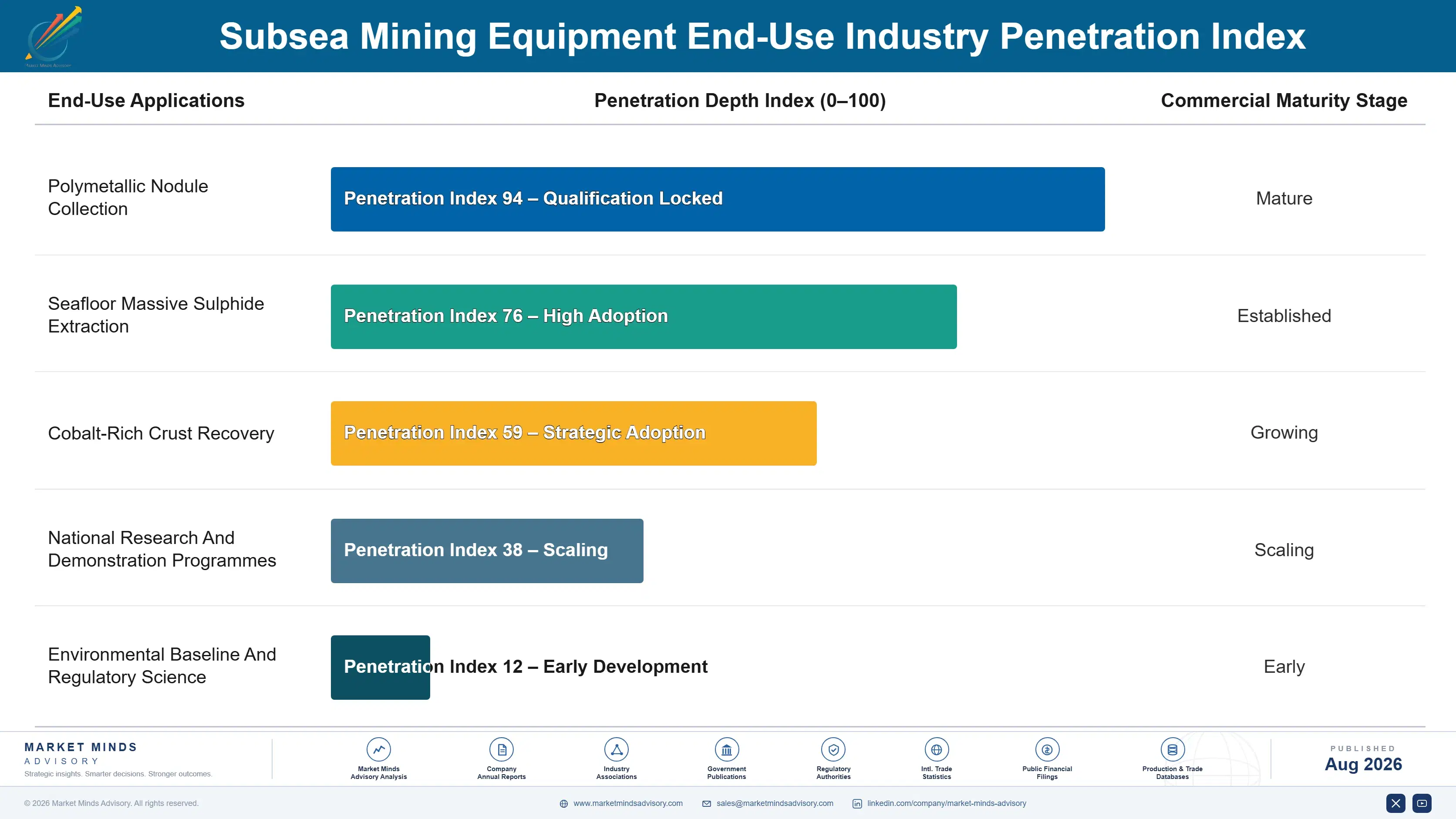
Demand arrives from a handful of contractors backed by sponsoring states and strategic investors rather than from any conventional customer base, which makes this market unusually legible and unusually fragile. Every order traces to a licence area, a sponsoring state, and a funding position that can change with a single political decision. Suppliers can name every potential customer they have, which is rare and not entirely comforting.
Stickiness runs through engineering integration rather than through commercial relationships. A collector designed around a specific riser and surface handling system cannot be replaced independently, so system-level positions hold once established. Monitoring instrumentation is far looser and is procured competitively on measurement capability. Sponsoring state relationships sit outside both and matter more than either during a permitting process. Sponsoring state relationships outweigh both during any permitting process.

Buyer profiles have shifted as the sector matured without commercialising. The earlier buyer was a contractor's chief engineer specifying prototype capability against a technical challenge. The current conversation increasingly involves an environmental affairs lead specifying monitoring equipment, or an investor asking how much further capital the equipment programme needs before any permitting decision arrives.
subsea-mining-equipment-market-end-use-penetration-index-1787302784816

What We Would Tell a Board

These are among the four positions where our research anticipates prominent divergence between winners and laggards over the coming forecast period. Each is grounded in the demand model, the regulatory perimeter, and the announced capacity pipeline.
01 / PERMITTING EXPOSURE BALANCE

Monitoring pays whether or not mining happens

Environmental monitoring and plume management carries roughly 31% of equipment spending and grows at 19.65% against 13.1% for the wider market, funded by regulators, sponsoring states, contractors, and their opponents alike without exception. It is the only category anywhere in this market whose demand does not depend on a permitting decision that nobody in the supply chain controls. A supplier weighted entirely toward collectors and risers is carrying a binary exposure that no commercial or engineering decision available to it can hedge.
02 / NATIONAL WATERS POSITIONING

Some states can permit without waiting for anybody

Norway, Japan, the Cook Islands, and several other states control permitting entirely inside their own exclusive economic zones and are proceeding while the international mining code remains unadopted after more than a decade. Those programmes are considerably smaller than the Clarion-Clipperton opportunity and they are funded, permitted, and moving right now. Equipment specified for national waters differs in both depth rating and scale from high seas systems, so redesign rather than commercial repositioning is what reaching those programmes actually requires.
03 / STAGED DESIGN DISCIPLINE

Sell what a contractor can actually commit to

Contractors cannot order production fleets against a permit that may never be granted, which means production-scale offerings are asking buyers for a commitment that nobody in this sector is presently able to make. Equipment designed to work at trial scale and then extend to full production without any redesign matches how capital can actually be committed today. That costs additional engineering effort and wins the orders that genuinely exist today rather than the far larger ones that might exist eventually.
04 / ENGINEERING AMORTISATION REALITY

Standalone seabed programmes cannot carry the engineering

Engineering and design carry roughly 22% of equipment cost across development cycles measured in years, and prototype volumes relieve absolutely none of that burden for anybody involved. Suppliers holding offshore energy, survey, or dredging businesses alongside can spread that engineering burden across other products which actually ship in real volume. Independent seabed specialists carry that whole burden entirely alone, which is precisely why several of them have now quietly deprioritised the sector altogether after a decade without any commercial orders.

Engagement Snapshot From the Field

A live engagement with an industry participant carrying material or product regulatory and market exposure ahead of a defining policy shift, showing how our research translates into a defensible multi-year portfolio strategy.
MARKET MINDS ADVISORY · CLIENT ENGAGEMENT SUMMARY
Subsea Mining Equipment Producer Strategic Portfolio Review and Transition Roadmap 2026·Investment Scenario on Subsea Mining Equipment Exposure Evaluation 2025-26
CLIENT PROFILE
A subsea equipment engineering firm with approximately 120 million dollars in annual revenue (client-reported, unverified by MMA), of which a seabed minerals development programme had consumed substantial engineering resource for six years without producing a commercial order. Monitoring instrumentation capability existed but had never been marketed into the sector separately from the collector programme. Board patience had visibly thinned.
STRATEGIC CHALLENGE
The board wanted to decide whether to continue the seabed minerals programme, and needed an honest assessment of permitting timelines rather than the optimistic sector commentary that had informed every previous review of it. Nobody internally had assessed the monitoring revenue available without any permitting outcome at all. It had never been separated.
MMA APPROACH
We assessed international mining code progress against the positions of sponsoring and opposing states rather than against announced timelines. National waters permitting pathways were mapped by jurisdiction. The client's monitoring capability was benchmarked against instrument specialists, and engineering amortisation was modelled across its adjacent product lines. Staged design options were then costed against the current programme.
KEY FINDINGS
  1. Code adoption timelines assumed in every previous internal review had already slipped repeatedly, and the state positions underlying that stall showed no evidence of converging.
  2. The client's monitoring instrumentation was competitive against specialists and had never been offered separately, leaving revenue available that required no permitting outcome at all.
  3. Engineering amortisation across adjacent offshore product lines was possible but had not been organised, so the seabed programme carried its full development cost alone.
  4. Two national waters programmes had equipment requirements the client could serve with modest redesign, and neither had been approached commercially. Modest redesign was all either required.
CLIENT PROFILE
A subsea equipment engineering firm with approximately 120 million dollars in annual revenue (client-reported, unverified by MMA), of which a seabed minerals development programme had consumed substantial engineering resource for six years without producing a commercial order. Monitoring instrumentation capability existed but had never been marketed into the sector separately from the collector programme. Board patience had visibly thinned.
STRATEGIC CHALLENGE
The board wanted to decide whether to continue the seabed minerals programme, and needed an honest assessment of permitting timelines rather than the optimistic sector commentary that had informed every previous review of it. Nobody internally had assessed the monitoring revenue available without any permitting outcome at all. It had never been separated.
MMA APPROACH
We assessed international mining code progress against the positions of sponsoring and opposing states rather than against announced timelines. National waters permitting pathways were mapped by jurisdiction. The client's monitoring capability was benchmarked against instrument specialists, and engineering amortisation was modelled across its adjacent product lines. Staged design options were then costed against the current programme.
KEY FINDINGS
  1. Code adoption timelines assumed in every previous internal review had already slipped repeatedly, and the state positions underlying that stall showed no evidence of converging.
  2. The client's monitoring instrumentation was competitive against specialists and had never been offered separately, leaving revenue available that required no permitting outcome at all.
  3. Engineering amortisation across adjacent offshore product lines was possible but had not been organised, so the seabed programme carried its full development cost alone.
  4. Two national waters programmes had equipment requirements the client could serve with modest redesign, and neither had been approached commercially. Modest redesign was all either required.
RECOMMENDED STRATEGY
Phase 1: Phase 1 (months one to nine): market monitoring instrumentation separately into the sector, immediately and independently of the collector programme. Phase 2: Phase 2 (months nine to twenty-four): reduce collector development to a staged design that extends from trial to production without redesign. Phase 3: Phase 3 (months twenty-four to forty-eight): pursue the two national waters programmes rather than waiting for international code adoption. Treat the code as optional upside.
OUTCOME
Monitoring instrumentation was marketed separately within two quarters and produced its first sector orders that year. Collector development was reduced and restaged rather than cancelled, and both national waters programmes were approached commercially (client-reported, unverified by MMA). Board review of the programme moved to an annual rather than quarterly cycle.

Frequently Asked Questions

Foundational context covering the market sizes, CAGR, scope, country, region and competition that inform every finding below. This section is provided to cover basics and most often pre-purchase conversations, answered from the MMA Primary Research Dataset.

What is the current size of the Subsea Mining Equipment Market?

The market is valued at USD 0.42 billion in 2025, rising to USD 0.47 billion in 2026. Scope covers seafloor collection and vertical transport equipment, not onshore processing, exploration services, or vessel chartering.

How large will the Subsea Mining Equipment Market be by 2036?

MMA forecasts USD 1.61 billion by 2036, an increase of USD 1.14 billion over the 2026 base. That represents an expansion multiple of 3.43 times across the forecast period.

What is the CAGR for the Subsea Mining Equipment Market 2026 to 2036?

The base case CAGR is 13.1%, with a bull case of 14.4% and a bear case of 11.8%. The historical rate from 2020 to 2025 was 11.6%, entirely from prototype and trial spending.

Which segment is growing fastest?

Environmental monitoring and plume management systems at 19.65%, exactly 1.50 times the market rate. It is the only category funded whether or not extraction is ever permitted anywhere.

Who are the major companies in the Subsea Mining Equipment Market?

Allseas, Soil Machine Dynamics, Royal IHC, Kongsberg Maritime, and MacArtney lead on delivered equipment value. The top five hold 63%, because fewer than a dozen organisations build this equipment.

Which country is growing fastest?

Norway at 17.4%, where seabed minerals within national waters have a domestic permitting pathway that does not depend on the international code. Political contention around it remains considerable.

Report Segmentation Architecture

The full report scope spans multiple orthogonal segmentation dimensions, with cross-tabulated demand data provided for each dimension pair. Coverage extends further to regional breakdowns, trend trajectories, and the competitive detail needed to support segment-level decision-making.

By Equipment System And Function

  • Seafloor Collector And Cutter Vehicles
  • Vertical Transport And Riser Systems
  • Surface Production Vessel Systems And Dewatering Plant
  • Environmental Monitoring And Plume Management Systems
  • Subsea Power, Control And Umbilical Systems

By End-Use Industry

  • Polymetallic Nodule Collection
  • Seafloor Massive Sulphide Extraction
  • Cobalt-Rich Crust Recovery
  • National Research And Demonstration Programmes
  • Environmental Baseline And Regulatory Science

By Commercial Model

  • Direct Equipment Supply To Licensed Contractors
  • National Programme And State Procurement
  • Prototype And Trial Campaign Contracts
  • Instrumentation Supply To Monitoring Programmes
  • Engineering Services And System Integration

By Region

  • South Asia and Pacific
  • Western Europe
  • East Asia
  • North America
  • Latin America
  • Middle East and Africa
  • Eastern Europe

Scope, Methodology, and Coverage

Every figure in this report is reproducible from documented input assumptions. The scope below maps the historical period, the forecast horizon, the segmentation dimensions, and the countries covered, alongside the underlying primary and qualitative methodology.
Historical Period
2020 to 2025
Forecast Period
2026 to 2036
Base Year
2025 (USD billions; MMA Primary Research Dataset, August 2026)
Market Definition
This market comprises equipment supplied for seafloor mineral collection, vertical transport, and associated environmental monitoring, measured at supplier revenue across contractor, state programme, prototype, instrumentation, and engineering service channels. Coverage spans seafloor collector and cutter vehicles, vertical transport and riser systems including pumping and lift equipment, surface production vessel systems and dewatering plant, environmental monitoring and plume management instrumentation, and subsea power, control and umbilical systems. Onshore mineral processing, smelting and refining plant, geological exploration and resource survey services, offshore oil and gas production and drilling equipment, shallow water dredging and aggregate recovery equipment, vessel construction and chartering contracted separately from equipment supply, and legal, permitting and consenting advisory services fall outside scope.
Quantitative Units
USD billions (current prices); delivered equipment value; systems supplied by function; monitoring share of programme spending
Segmentation Dimensions
By Equipment System And Function; By End-Use Industry; By Commercial Model; By Region
Regions Covered
South Asia and Pacific, Western Europe, East Asia, North America, Latin America, Middle East and Africa, Eastern Europe
Countries Covered
Nauru, Tonga, Kiribati, Cook Islands, Papua New Guinea, Australia, India, Japan, South Korea, China, Netherlands, Norway, United Kingdom, Belgium, Germany, France, United States, Canada, Mexico, Brazil, Chile, Saudi Arabia, Namibia, South Africa, Poland, Russia, and additional markets relevant to this sector
Key Companies Profiled
Allseas, Soil Machine Dynamics, Royal IHC, Kongsberg Maritime, MacArtney, Saipem, Fugro, Teledyne Marine, Sonardyne, Van Oord, Boskalis, DEME, Damen Shipyards, Mitsubishi Heavy Industries, Kawasaki Heavy Industries, Hyundai Heavy Industries, Oceaneering International, Forum Energy Technologies, Bluefin Robotics, Ocean Infinity
Quantitative Methodology
Primary survey, n=3,800 respondents, Q4 2025, six countries; demand-side model with trade association cross-validation
Qualitative Methodology
47 expert interviews, Q4 2025; applied to validate demand model assumptions, identify emerging dynamics, and assess competitive positioning
Report Format
PDF and XLSX data workbook (Word format preview document)
Publisher
Market Minds Advisory
Report Code
MMA-2026-ENE-875
Published
August 2026
Contact
sales@marketmindsadvisory.com | www.marketmindsadvisory.com

Purchase the full Subsea Mining Equipment Market Report (2026 to 2036).

The full report sizes subsea mining equipment across five system types, five application areas, five commercial models, and seven regions, with permitting exposure assessed separately for every equipment category throughout. International code progress is tracked against sponsoring and opposing state positions rather than against announced timelines. National waters permitting pathways are mapped jurisdiction by jurisdiction. Competitive profiling covers twenty suppliers on delivered equipment value, and monitoring instrumentation capability is assessed separately from extraction system engineering. Regional figures reflect sponsoring state and engineering geography rather than any resource endowment.
Permitting exposure assessed separately for every equipment category
International code progress tracked against actual state positions
National waters permitting pathways mapped jurisdiction by jurisdiction
Monitoring instrumentation assessed separately from extraction system engineering
Engineering amortisation modelled across adjacent subsea product lines
Contractor funding positions tracked by licence area and sponsor

Built For The People Who Decide

From boardroom strategy to bench-side execution, this report is read cover-to-cover by leaders shaping the next decade of their industry, turning demand scenarios, market dynamics and valuation benchmarks into decisions.
CXOs/ Presidents/ VPs/ Managers
M&A and Corporate Development
Strategy Teams and R&D Heads
Procurement and Product Directors
Regulatory and Compliance Leaders
Investor Relations and Equity Analysts