Market Minds Advisory
Submersible Pump Market

Submersible Pump Market: Water Scarcity and Solar Electrification Redraw Agricultural and Municipal Demand

Government solar irrigation subsidies and municipal wastewater infrastructure spending are pulling submersible pump demand toward electrified, off-grid formats across Asia's agricultural belts and drought-pressured municipal networks worldwide, reshaping decades-old procurement patterns.

Lead Analyst

David Horsley

Published

September 2026

Make Smarter Decisions with Customized Research Insights

Request a free sample report and evaluate market opportunities, growth trends, and competitive dynamics relevant to your business needs.

2025 MARKET VALUE$15.2BMarket Size 2025
2036 FORECAST VALUE$30.1BBase Case , 2026 to 2036
CAGR 2026 TO 20366.4 %Bull 7.6% / Bear 5.2%
INCREMENTAL OPPORTUNITY$13.9BNet 10- year value creation
EXPANSION MULTIPLE1.86x2036 value over 2026 base
Strategic Levers
M&A Pipeline
Regional Outlook
Country Rankings
Competitive Intelligence
Segmental Deep-dive
Call-Us : 91 93563 13602

Executive Snapshot and Market Trajectory

Solar-powered submersible pumps are pulling capital away from grid-tied designs faster than any single subsidy program can fully explain, as farmers and utilities alike chase energy independence in regions where the electrical grid remains unreliable, expensive, or simply absent entirely across huge swaths of farmland worldwide right now.
Agricultural irrigation and municipal water infrastructure anchor the bulk of unit volume, but wastewater and dewatering applications carry the higher price points that manufacturers now chase for margin. East Asia and South Asia together account for more than two-fifths of global demand, reflecting both China's manufacturing scale and India's enormous irrigated farmland base expanding under national subsidy schemes rolled out since 2019 across most eligible states nationwide.
Competition remains genuinely fragmented at 35 percent five-firm concentration, leaving room for regional manufacturers in China and India to undercut incumbents on price across most price-sensitive channels and public tenders reviewed. European players defend share through efficiency certification and total cost of ownership arguments built over decades of client relationships. Groundwater depletion regulation and rural electrification programs are simultaneously reshaping which pump technology wins each new tender issued globally this cycle and the next.
Market Definition
The submersible pump market covers electrically driven pumps designed to operate fully submerged in the fluid being pumped, spanning borewell, sewage, dewatering, slurry, solar-powered, and sump applications across agricultural, municipal, industrial, and residential end uses. It excludes surface-mounted and above-ground centrifugal pumps that are not designed for submerged operation.
Base Year Value
$15.2B in 2025 (MMA Primary Research Dataset, August 2026)
Forecast Period
2026 to 2036, eleven discrete annual values
CAGR
6.4% base case. Bull 7.6%. Bear 5.2%.
Fastest Growth Segment
Solar-Powered Submersible Pumps: 10.8% CAGR
Fastest Growth Country
India: 9.4% CAGR
Fastest Growth Region
South Asia and Pacific: 8.6% CAGR
Largest Region
East Asia: 29% of 2025 global value
Market Leaders
Xylem Inc, Grundfos Holding A/S, KSB SE and Co KGaA, Sulzer Ltd, Ebara Corporation. Source: MMA Analysis based on company annual reports.
Primary Survey
n=3,800 procurement and R&D decision-makers, Q4 2025, six countries
Methodology
Demand-side build-up, cross-validated against public data, 47 expert interviews

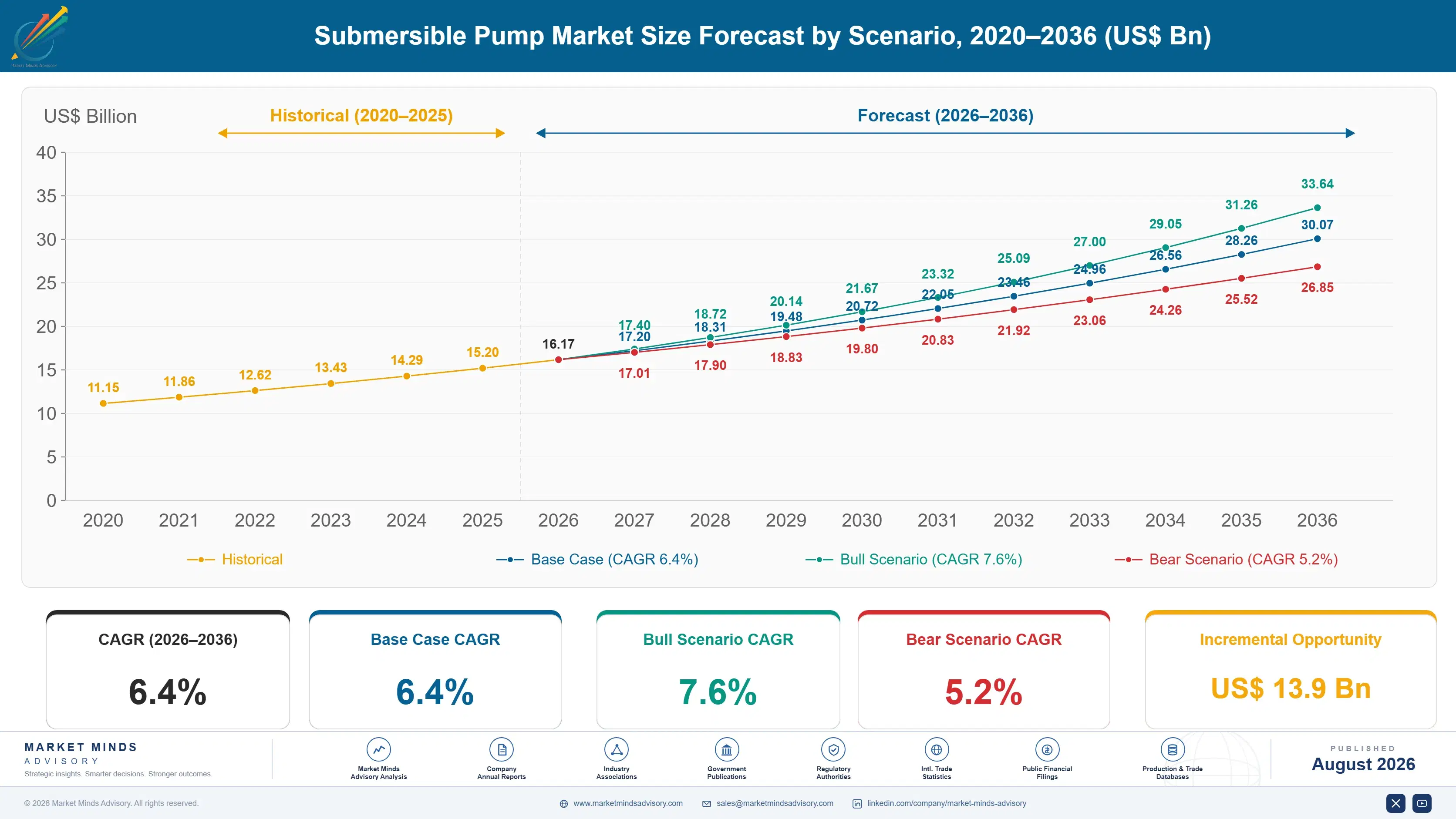
Submersible Pump Market Forecast Scenarios

submersible-pump-market-size-forecast-scenario-1787300596395
Between 2020 and 2025 the market grew at a steady 5.4 percent as post-pandemic infrastructure spending and expanding irrigated farmland offset commodity price volatility in steel and copper inputs across most producing regions. Growth accelerated modestly in the final two years as solar subsidy programs in India and East Africa began translating into meaningful order volume for manufacturers serving those markets directly.
The base case assumes continued expansion of solar irrigation subsidy programs across South Asia and Africa, tightening municipal wastewater treatment regulation in East Asia and Europe, and a steady replacement cycle as aging borewell fleets installed during the 2000s reach end of service life across major agricultural regions. These three mechanisms together sustain above-historical growth through 2036 even as mature markets in North America and Western Europe grow closer to GDP-linked replacement rates over time.
A bull scenario depends on accelerated groundwater depletion regulation forcing municipal utilities toward deeper, more efficient submersible installations across water-stressed regions worldwide. The bear case centers on a commodity cost spike in copper windings and stainless steel casings that pushes unit prices high enough to delay replacement purchases across price-sensitive agricultural buyers in emerging markets specifically.

Electrification and Depth Economics Reshape Pump Demand

Three forces are reshaping this historically stable category at once. Groundwater tables are falling in the world's most farmed regions, forcing pumps deeper and rewarding efficiency over raw price at the point of purchase across most affected watersheds and river basins. Solar electrification is displacing diesel and unreliable grid power across huge swaths of agricultural demand worldwide. And municipal wastewater regulation is tightening steadily across both mature and emerging markets simult
MARKET CONCENTRATIONCR5 35%fragmented across regional manufacturers and global incumbents alike
AVERAGE SELLING PRICEUSD 620/unitblended price masks wide spread across application tiers
TOP PRODUCING COUNTRY SHAREChina 26%concentrated manufacturing capacity serves both domestic and export demand
CAPACITY UTILISATION71%meaningful headroom exists before new plant investment triggers
TRADE INTENSITY38% exportedsubstantial cross-border flow from Chinese and European manufacturing hubs
METAL COST SHARE34% of COGSmetal input volatility directly compresses manufacturer gross margins
Commercially, the market splits cleanly between a high-volume, price-competitive agricultural segment dominated by regional manufacturers and a lower-volume, higher-margin municipal and industrial segment where global incumbents defend share through certification, service contracts, and total cost of ownership data that regional competitors cannot yet match credibly at scale across most tender categories and procurement boards evaluated.
The next decade will be defined by how fast solar-powered formats displace grid-tied and diesel alternatives across emerging agricultural markets worldwide, and by how aggressively regional Chinese and Indian manufacturers expand beyond their home markets into price-sensitive export territories where European incumbents have historically held durable, defensible share for decades running now.
"Submersible pumps used to be the most boring line item in a water infrastructure budget. Solar subsidies and groundwater depletion just made pump selection a genuinely strategic decision for the first time in decades."
Director, Industrial Equipment and Fluid Handling Practice · MMA Construction an

Market Trends

Solar Irrigation Subsidies Reshape Agricultural Procurement

India's PM-KUSUM scheme has targeted installation of over 3.5 million standalone solar-powered agricultural pumps, according to Ministry of New and Renewable Energy program data, fundamentally altering how farmers evaluate pump purchases against a lifetime energy cost basis rather than upfront capital price alone. Manufacturers report solar-compatible submersible pump orders growing far faster than grid-tied equivalents across every Indian state participating in the subsidy rollout since 2023. Similar programs are now expanding across East Africa and parts of Southeast Asia, following India's subsidy design closely, extending this shift well beyond its original South Asian origin.
Market Impact: Adds 1.1 points to base CAGR
Groundwater Depletion Forces Deeper Well Installations

USGS and equivalent national survey data show water table declines exceeding one meter annually across parts of the North China Plain, the Indo-Gangetic basin, and the American Southwest, forcing agricultural and municipal buyers toward pumps rated for greater installation depth and correspondingly higher stage counts across nearly every affected watershed. Deeper installations carry meaningfully higher unit prices and favor manufacturers with proven multistage engineering credentials over low-cost entrants competing purely on shallow-well pricing alone. Utilities in affected regions increasingly specify minimum depth ratings in tender documents that effectively exclude budget competitors from bidding at all on new contracts.
Market Impact: Adds 1.4 points to base CAGR

Market Opportunities and Growth Drivers

Municipal Wastewater Regulation Tightens Across Regions

The European Union's revised Urban Wastewater Treatment Directive, entering force with expanded scope in 2025, extends mandatory treatment requirements to smaller municipalities previously exempt, creating a wave of new submersible sewage pump procurement across roughly 5,000 additional treatment sites region-wide according to European Commission implementation estimates. China's Ministry of Ecology and Environment has pursued parallel tightening under its own wastewater discharge standards, driving comparable procurement across provincial treatment infrastructure. Utilities facing new compliance deadlines are prioritizing proven reliability over lowest bid price, a shift that favors established manufacturers with long service-life track records.
Market Impact: Compresses gross margin 3 points

Rural Electrification Expands the Addressable Agricultural Base

The International Energy Agency estimates roughly 685 million people worldwide still lack reliable grid electricity access, concentrated heavily in Sub-Saharan Africa and parts of South Asia, representing a substantial agricultural population that solar-powered submersible pumps can now serve without waiting for grid infrastructure to arrive. National electrification programs across Nigeria, Kenya, and Ethiopia have begun bundling solar pump financing with broader rural electrification investment, according to national energy ministry program disclosures. This expands the addressable market well beyond regions already connected to reliable power, opening genuinely new agricultural procurement volume.
Market Impact: Erodes 6 points of value

Market Restraints and Challenges

Copper and Steel Volatility Compresses Manufacturer Margins

Copper windings and stainless steel casings together represent roughly 34 percent of cost of goods sold for a typical submersible pump, and both inputs have shown double-digit price swings within single fiscal years recently. The root cause is direct exposure to the same industrial metals markets that serve electric vehicle and renewable energy production, sectors now competing for the same refined copper supply globally. The impact falls hardest on regional manufacturers without hedging infrastructure or long-term supply contracts. Several larger manufacturers now pass volatility through via quarterly price adjustment clauses instead of fixed annual pricing.
Market Impact: Solar segment orders up 14 points

Counterfeit and Substandard Units Undercut Certified Products

Informal manufacturing of uncertified submersible pumps, particularly across rural distribution channels in South Asia and parts of Africa, has created a substantial gray market that undercuts certified manufacturers on price while delivering shorter service life and higher failure rates. The root cause is weak enforcement of electrical safety and efficiency certification standards at the point of rural retail sale, where buyers often cannot verify authenticity before purchase. The impact shows up as brand dilution and warranty disputes for manufacturers whose products get confused with counterfeits. Industry associations are piloting QR-code authentication as an emerging fix.
Market Impact: Deep-well segment ASP up 22 percent
4 additional market trends, 3 additional growth drivers, and 3 additional restraints and challenges are covered in the full report. Contact sales@marketmindsadvisory.com to access the complete intelligence.

Segment CAGR and Growth Architecture

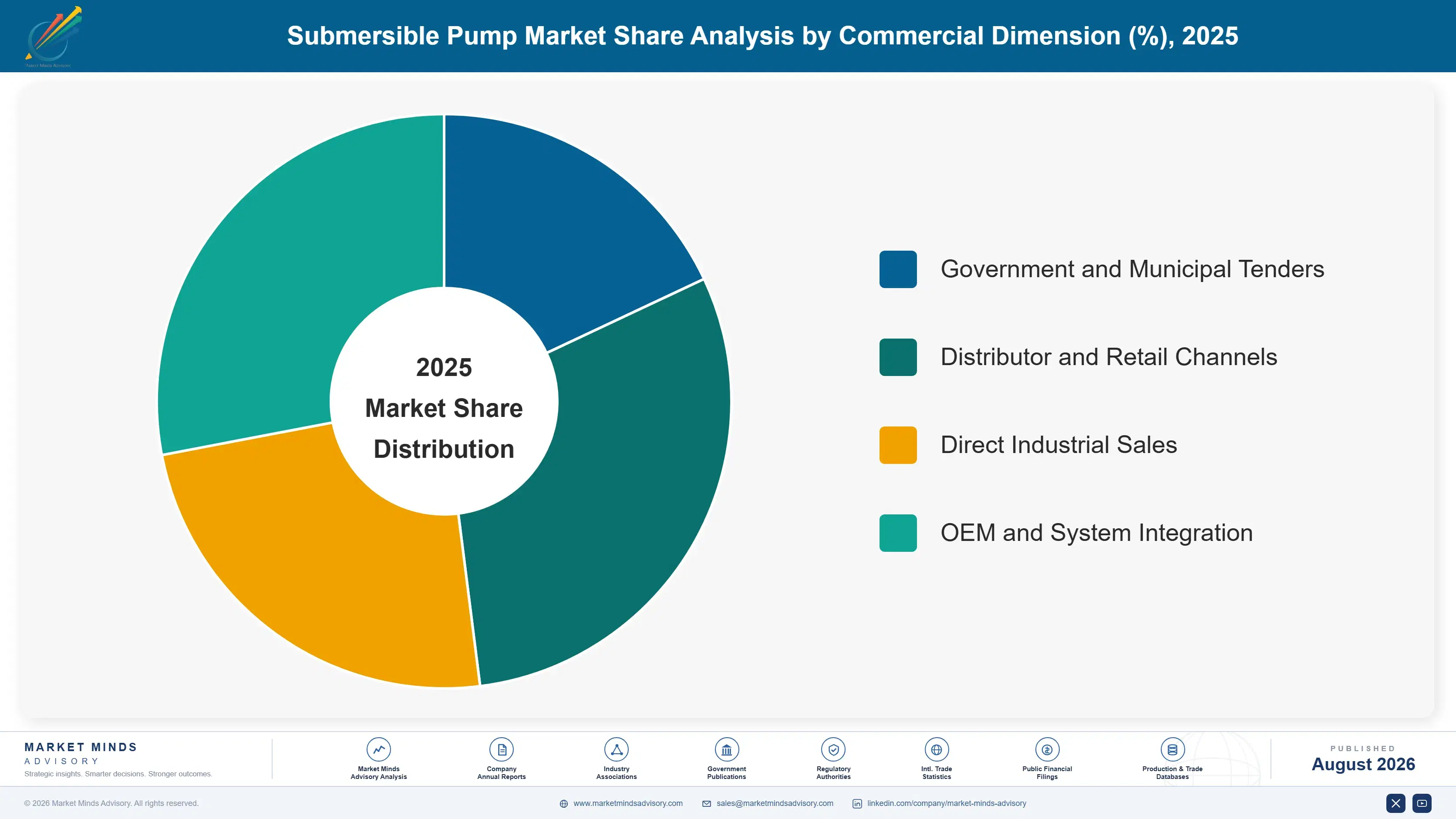
Segmentation follows pump technology and functional design, the classification engineers specify against site conditions and application requirements, distinguishing borewell, sewage, dewatering, slurry, solar-powered, and sump pump architectures across every end-use vertical and geography served by manufacturers globally today across all tender categories, distribution channels, and procurement processes tracked closely by MMA analysts each quarter.
submersible-pump-market-market-share-analysis-1787300596931

Solar-Powered Submersible Pumps

Solar-powered submersible pumps are the category's clearest growth story, expanding fastest wherever grid electricity is unreliable, absent, or simply too expensive relative to diesel alternatives that farmers have relied on for decades. Government subsidy programs across India, Kenya, Nigeria, and Ethiopia have compressed payback periods to under three years in many installations, a threshold that has genuinely changed farmer purchasing psychology toward treating them as the default choice for new installations. Manufacturers who paired photovoltaic integration with variable frequency drive controllers report the strongest adoption, since these systems handle intermittent solar power output far more gracefully than fixed-speed motors could manage. Supply chains increasingly favor manufacturers with in-house power electronics capability over pure mechanical pump specialists.
CAGR 10.8%

Sump and Drainage Submersible Pumps

Sump and drainage pumps are benefiting from two converging forces: rising extreme precipitation events that push residential and commercial basement flooding risk higher across temperate regions, and expanding construction of underground parking and transit infrastructure in dense East Asian and Middle Eastern cities that requires permanent dewatering installations throughout the build. Insurance industry data increasingly links basement flood claims to inadequate or absent sump pump installations, a linkage beginning to influence building code requirements in several American states and Canadian provinces. Manufacturers serving this segment compete heavily on battery backup reliability, since sump pump failure during power outages is precisely when flooding risk peaks and warranty claims concentrate most heavily.
CAGR 7.2%
Full segment breakdown across 6 segments available in the complete report.

Regional Architecture and Country Demand Map

East Asia leads on manufacturing scale and municipal infrastructure spend, South Asia and Pacific posts the fastest growth on India's solar irrigation program, and North America and Western Europe hold steady replacement-driven demand across mature, largely electrified installed bases already firmly in place across most service territories.

North America

Aging municipal water infrastructure across the American Midwest and Northeast is driving a genuine replacement wave, with utilities specifying higher-efficiency submersible units to meet state-level energy code updates rolled out since 2023 across multiple jurisdictions. Agricultural demand across California's Central Valley remains tied directly to groundwater depletion regulation under the state's Sustainable Groundwater Management Act, which is forcing farmers toward deeper, more expensive installations even as overall irrigated acreage holds roughly flat statewide. Canada's mining sector sustains steady dewatering pump demand across its northern operations and remote sites. Growth trails the fastest-growing regions because the installed base here is already mature and largely electrified, leaving less room for the solar-driven volume expansion happening elsewhere globally right now.
Share: 23% | CAGR: 5.6% (2026 to 2036)

Western Europe

Germany and the Netherlands anchor regional demand through stringent municipal wastewater treatment requirements under the European Union's revised Urban Wastewater Treatment Directive, which is extending mandatory upgrades to thousands of smaller municipalities previously exempt from compliance. France's agricultural sector, concentrated in irrigation-dependent regions, has been slower to adopt solar-powered formats than comparable markets in Asia, reflecting Europe's more reliable grid infrastructure overall. The region's replacement cycle economics favor premium, energy-efficient units over budget alternatives, sustaining higher average selling prices than nearly anywhere else globally. Growth trails East Asia and South Asia because the region's irrigated farmland base is not expanding, unlike the rapid acreage growth happening across parts of Asia and Africa.
Share: 18% | CAGR: 4.8% (2026 to 2036)
Regional intelligence for 5 additional markets available in the complete report: East Asia, South Asia and Pacific, Latin America, Middle East and Africa, Eastern Europe. Contact sales@marketmindsadvisory.com.
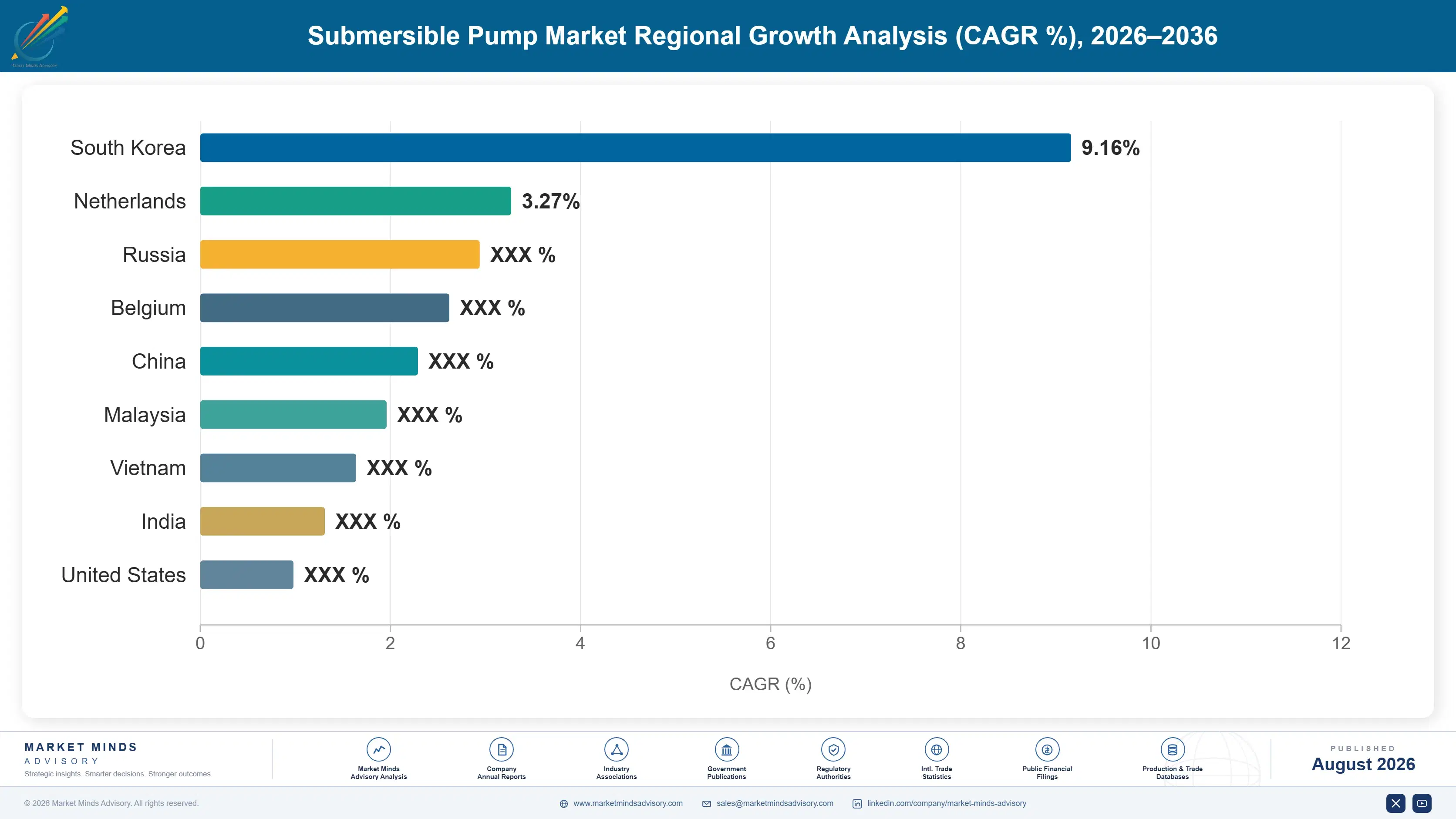
submersible-pump-market-country-cagr-analysis-1787300597439

Where Pump Manufacturers Can Expand Margin

Manufacturers face a market splitting between price-driven agricultural volume and specification-driven municipal and industrial demand, creating several distinct paths to margin expansion beyond simply competing on unit price across every tender, channel, and geography served today across the wider sector, its evolving procurement rules, and rapidly changing eligibility standards worldwide across most jurisdictions tracked closely.

Bundle Solar Panels With Pump Financing

Packaging photovoltaic panels, controllers, and financing directly with the pump itself lets manufacturers capture a larger share of the total installation value rather than competing purely on pump hardware price against commoditized competitors. Manufacturers offering integrated financing report farmer adoption rates roughly 18 percentage points higher than those selling pumps alone and requiring separate solar procurement, since farmers value the simplified purchasing process highly. The approach requires partnerships with microfinance institutions or government subsidy administrators in emerging markets, a capability that favors manufacturers already embedded in rural distribution networks over pure equipment exporters entering fresh.
Market Impact: Lifts adoption rate by 18 total points overall

Expand Service Contracts for Municipal Installations

Multi-year maintenance and monitoring contracts tied to municipal wastewater and water supply installations generate recurring revenue that smooths the cyclicality of pure equipment sales, while also deepening customer relationships ahead of the next replacement cycle bid. Manufacturers offering remote monitoring sensors alongside service contracts report renewal rates roughly 4 to 6 points above equipment-only relationships, since utilities value predictive maintenance data highly enough to justify the premium. This lever requires investment in IoT sensor integration and a trained field service organization, both of which favor established incumbents with existing municipal relationships over new market entrants lacking local service infrastructure.
Market Impact: Adds 4 to 6 points of recurring margin

Certify for Deep-Well and High-Salinity Applications

Engineering certification for extreme installation depth and high groundwater salinity conditions opens access to premium tender categories that budget manufacturers cannot credibly bid against, since utilities and mining operators increasingly specify minimum depth and material ratings explicitly in procurement documents. Manufacturers with proven multistage and corrosion-resistant engineering credentials report average selling prices 40 percent above standard product lines in these specification-driven segments. The certification investment is meaningful but pays back quickly once a manufacturer wins its first several deep-well municipal contracts, since reference installations then become the credibility basis for future bids and renewals.
Market Impact: Deep-well ASP runs 40 points higher on average

Localize Manufacturing Inside High-Growth Subsidy Markets

Establishing assembly or full manufacturing operations within India, Nigeria, or Kenya directly reduces import tariff exposure and shipping cost while qualifying manufacturers for local-content requirements attached to many government subsidy programs in these markets specifically. Manufacturers with local manufacturing presence report winning 2 to 3 times more government tender volume than pure importers competing from outside, since procurement rules increasingly favor domestic value-added content. The upfront capital investment is substantial, but manufacturers who move early are securing preferred supplier status before competitors catch up to the same local-content requirements now spreading across additional subsidy programs nationwide and abroad.
Market Impact: Wins 2 to 3x more tender volume overall

Who Controls the Margin Pool

Five companies hold 35 percent of the category, a concentration low enough that regional Chinese and Indian manufacturers compete credibly for meaningful volume against global incumbents. The gap between global leaders and regional challengers is widest in specification-driven municipal and industrial segments, narrower in price-sensitive agricultural volume where local manufacturing cost advantages matter more than brand.
Competitive activity currently plays out across three dimensions: solar integration capability as manufacturers race to pair photovoltaic electronics with pump hardware, service contract expansion into municipal accounts to build recurring revenue, and local manufacturing investment inside high-growth subsidy markets to capture tender-eligible volume. Global incumbents are increasingly acquiring or partnering with regional manufacturers rather than building local capacity from scratch, given how long organic market entry timelines run.

Pressure is building most visibly from Chinese manufacturers expanding export volume into Africa and Southeast Asia at price points European incumbents cannot match without local production. At the same time, Indian manufacturers are moving up the value chain into higher-specification municipal and industrial segments previously the exclusive territory of global incumbents, a shift that could meaningfully reshape competitive rankings within the next several years.
submersible-pump-market-company-positioning-matrix-1787300597957

Competitive Moat and Risk Dimensions

XYLEM INC

Moat: Municipal service relationships

Xylem's decades of embedded municipal utility relationships, reinforced by remote monitoring and service contract infrastructure, give it renewal advantages pure equipment competitors struggle to replicate, particularly in large North American and European wastewater accounts requiring long-term reliability guarantees and proven track records over many years.
XYLEM INC

Risk: Price pressure from Asian entrants

Xylem's premium positioning leaves it exposed in price-sensitive agricultural and emerging market segments where Chinese and Indian manufacturers increasingly compete on both price and improving quality, forcing difficult decisions about where to defend margin versus where to concede volume entirely across contested accounts and territories.
GRUNDFOS HOLDING A/S

Moat: Energy efficiency engineering depth

Grundfos has built a reputation for efficiency-leading motor and hydraulic design that resonates strongly with European and North American utilities facing tightening energy codes, giving it a genuine technical edge in specification-driven tenders where lifetime energy cost outweighs upfront price considerations by a wide margin.
GRUNDFOS HOLDING A/S

Risk: Slower emerging market penetration

Grundfos has been slower than some competitors to establish local manufacturing inside high-growth subsidy markets like India and Nigeria, risking share loss in the fastest-growing segments of the category to manufacturers already embedded in those local tender networks and distribution channels built over many years of relationships.

Key Players

Xylem Inc
Grundfos Holding A/S
KSB SE and Co KGaA
Sulzer Ltd
Ebara Corporation

Others

Wilo SE
Franklin Electric Co Inc
Flowserve Corporation
Weir Group PLC
Kirloskar Brothers Limited
Shanghai KaiQuan Pump Group Co Ltd
Shimge Pump Industry Group Co Ltd
Tsurumi Manufacturing Co Ltd
Pentair plc
Caprari S.p.A
Zoeller Pump Company
Grindex AB
Hidrostal AG
Atlas Copco AB
CRI Pumps Private Limited

Recent Developments

FEBRUARY 2026

Grundfos Opens Local Manufacturing Plant in India

Grundfos opened a dedicated solar-powered submersible pump assembly plant in Gujarat, India, targeting local-content requirements attached to the national PM-KUSUM subsidy program and reducing lead times for domestic tender fulfillment across participating Indian states significantly ahead of the next bidding cycle scheduled for later this year.
Signal: Confirms local manufacturing as the required strategy for competing in subsidy-driven emerging markets going forward across the sector.
OCTOBER 2025

Xylem Acquires Remote Monitoring Sensor Startup

Xylem completed the acquisition of a privately held IoT sensor developer specializing in submersible pump condition monitoring, adding predictive maintenance capability to its municipal service contract offering across North American and European wastewater treatment accounts already under long-term service agreements and existing multi-year renewal contracts signed previously.
Signal: Signals service contract differentiation is shifting from a marketing claim to genuine sensor-backed infrastructure investment industry-wide today.
MAY 2025

Shimge Pump Signs Distribution Agreement in Kenya

Shimge Pump Industry Group signed a multi-year distribution and local assembly agreement with a Kenyan rural electrification contractor, positioning the Chinese manufacturer to compete directly for government solar irrigation tender volume across East Africa's expanding subsidy programs and adjacent regional markets nearby and further beyond.
Signal: Marks accelerating Chinese manufacturer expansion into African subsidy-driven agricultural pump markets and government tenders happening steadily.

Copper Windings and Steel Casing Exposure

Copper motor windings and stainless steel casings together represent roughly 34 percent of cost of goods sold for a typical submersible pump, sourced primarily from refiners and steel mills across Chile, China, and South Korea. Cast iron and engineered polymer add a further 16 percent, giving vertically integrated manufacturers a genuine cost advantage over those purchasing components from third parties.
Copper prices rose approximately 24 percent through 2024 as electric vehicle and renewable energy demand competed directly with industrial pump manufacturers for refined supply, according to Grundfos's 2024 annual report, which specifically cited copper cost inflation as a meaningful margin headwind across its global motor manufacturing operations. This overlap between EV-grade and industrial-grade copper demand is a genuinely new competitive dynamic pump manufacturers had not previously priced into procurement contracts at all.

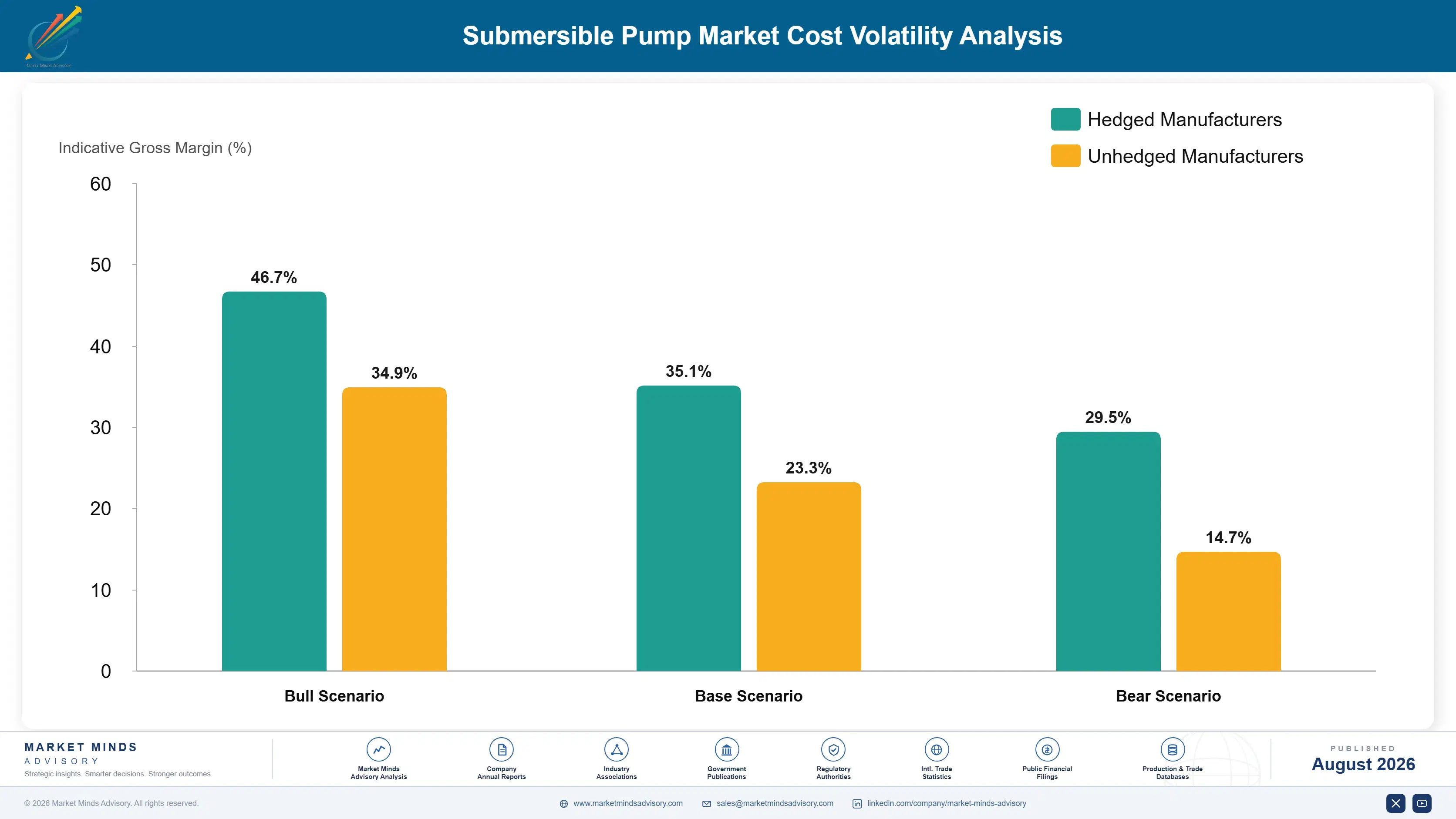
Exposure varies considerably by manufacturer scale. Large incumbents with long-term supply contracts and hedging programs have absorbed volatility more effectively than smaller regional manufacturers purchasing on spot markets, widening the cost gap between global leaders and price-competitive regional entrants. Manufacturers with in-house motor winding capability retain more pricing control than those outsourcing motor assembly entirely to third-party suppliers exposed to the same spot volatility.
submersible-pump-market-cost-volatility-analysis-1787300598152

Long-Term Copper Supply Contracts

Locking multi-year fixed-volume agreements with refiners reduces spot market exposure meaningfully, though it requires balance sheet commitment that smaller regional manufacturers often cannot match against larger incumbents with stronger credit access and negotiating leverage across global sourcing relationships and multiple supplier regions simultaneously, a persistent competitive gap that keeps widening steadily each fiscal year and cycle.

Vertical Integration of Motor Winding

Bringing motor winding production in-house reduces dependency on third-party component suppliers exposed to the same copper volatility, a strategy several mid-sized manufacturers have pursued specifically to protect margin during recent price spikes across the category and its many product lines, subsidiaries, and export territories served worldwide today, this fiscal year, and going forward steadily.

Aluminum Winding Substitution Research

Several manufacturers are researching aluminum winding alternatives for lower-specification pumps where copper's superior conductivity matters less, potentially reducing input cost exposure for budget product lines without compromising performance meaningfully in less demanding residential and agricultural applications served today across most price-sensitive markets, tenders, distribution channels, and many export territories worldwide, a genuinely promising avenue currently.

Portfolio Architecture for Margin Defence

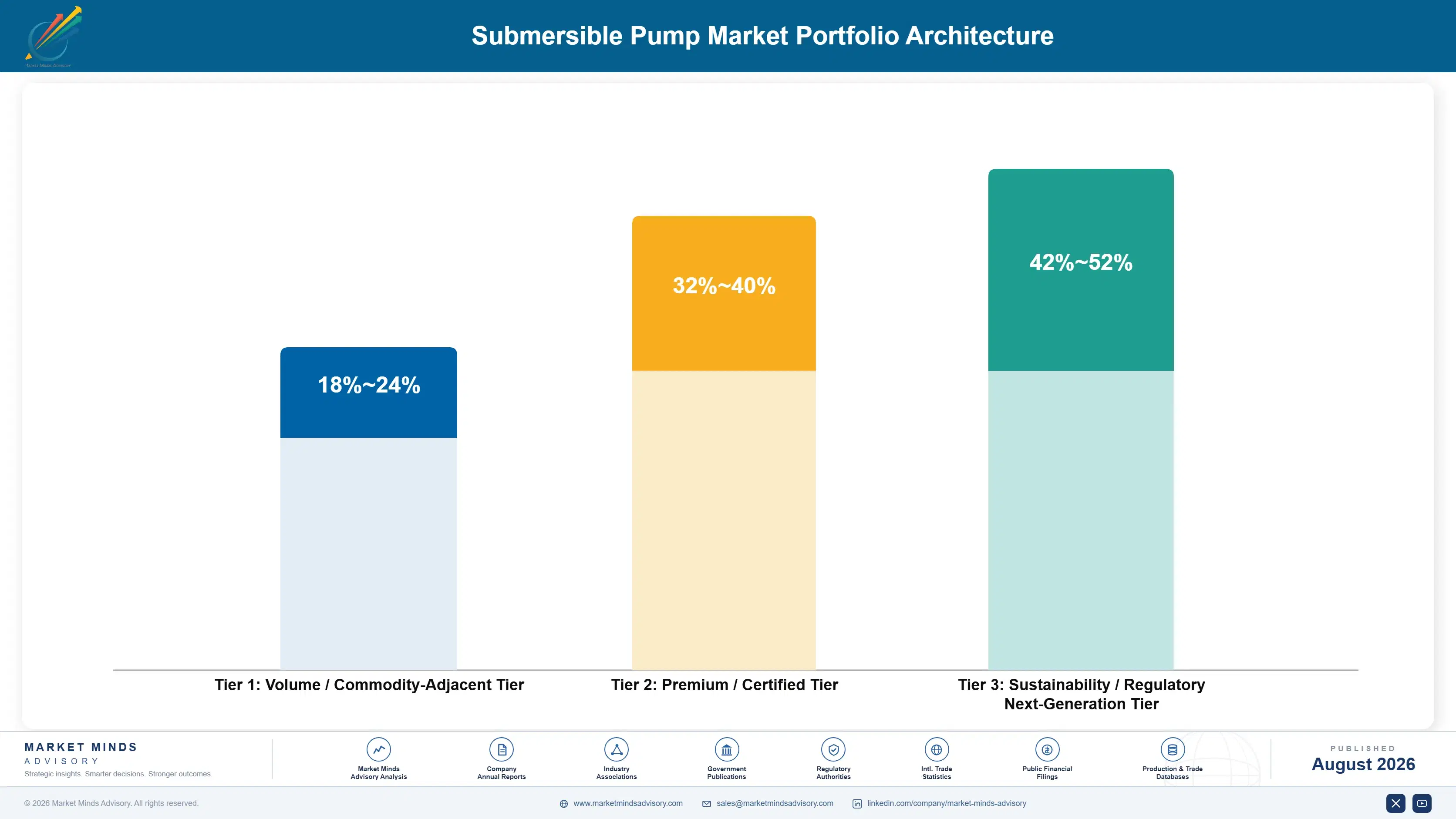
Three tiers structure manufacturer portfolios today, each serving genuinely different buyers with distinct purchasing logic and evaluation criteria applied at tender review. Commodity-adjacent agricultural and residential pumps sit at the volume base with thin margins, certified municipal and industrial pumps occupy a specification-driven middle tier, and solar-integrated and deep-well engineered systems anchor a next-generation tier where technical differentiation, not manufacturing scale, sets
The tension between volume and premium shows up clearly in how manufacturers allocate capital: regional players chase agricultural volume through aggressive pricing while global incumbents concentrate investment in certification, service infrastructure, and solar electronics that justify premium positioning against increasingly capable low-cost competitors entering steadily from Asia and elsewhere across nearly every export market tracked.

High-value margin pools concentrate in solar-integrated systems and deep-well municipal installations carrying certification and service contract attachments, where gross margins run meaningfully above the category average across nearly every tracked region and tender category. Standard agricultural and residential pumps increasingly compete on price alone as Chinese and Indian manufacturing capacity continues expanding rapidly across most export markets served today.

Volume / Commodity-Adjacent Tier

Standard agricultural and residential borewell pumps sold primarily on unit price into distributor and retail channels, with limited technical differentiation and thin margins across most price-sensitive regional markets, tenders, and distribution networks worldwide.
Gross Margin: 18-24%

Premium / Certified Tier

Municipal and industrial pumps carrying efficiency certification and depth ratings, positioned for tender contracts requiring documented performance data and multi-year service commitments from established, well-capitalized manufacturers with proven track records.
Gross Margin: 32-40%

Sustainability / Regulatory / Next-Generation Tier

Solar-integrated and deep-well engineered systems with power electronics and remote monitoring capability, priced at the top of the category range consistently across nearly every geography, tender category, and manufacturer segment served today.
Gross Margin: 42-52%
submersible-pump-market-portfolio-architecture-1787300598656

High-value Sub-segments and Strategic Watch-out

Solar-Integrated Agricultural Pumps

Highest growth segment in the category, favored wherever grid access is unreliable or subsidy programs compress payback periods enough to shift farmer purchasing behavior decisively toward electrified installations over diesel alternatives across major agricultural regions and export territories worldwide, a shift accelerating fast this decade.
Gross Margin: 38-46%

Certified Deep-Well Municipal Pumps

Strong growth with solid margins, driven by groundwater depletion regulation forcing utilities toward deeper installations that command meaningfully higher specification-driven pricing across most tracked regions and municipal tender categories reviewed each contracting cycle nationwide and internationally as well today across most jurisdictions and procurement boards evaluated.
Gross Margin: 34-42%

Standard Agricultural Borewell Pumps

The volume core of the category, generating stable revenue but facing continuous margin compression as Chinese and Indian manufacturing capacity expands and price competition intensifies across every distribution channel and export territory served worldwide today and increasingly tomorrow as demand grows further still across most markets tracked.
Gross Margin: 18-24%

Uncertified Gray Market Units

A strategic watch-out segment: cheap and widely available through informal rural distribution, but eroding brand value and warranty confidence for certified manufacturers whose products get confused with counterfeit alternatives sold nearby at rural retail outlets regularly and quite consistently across most affected regions and countries.
Gross Margin: 10-16%

Replacement Cycles Anchor Recurring Volume

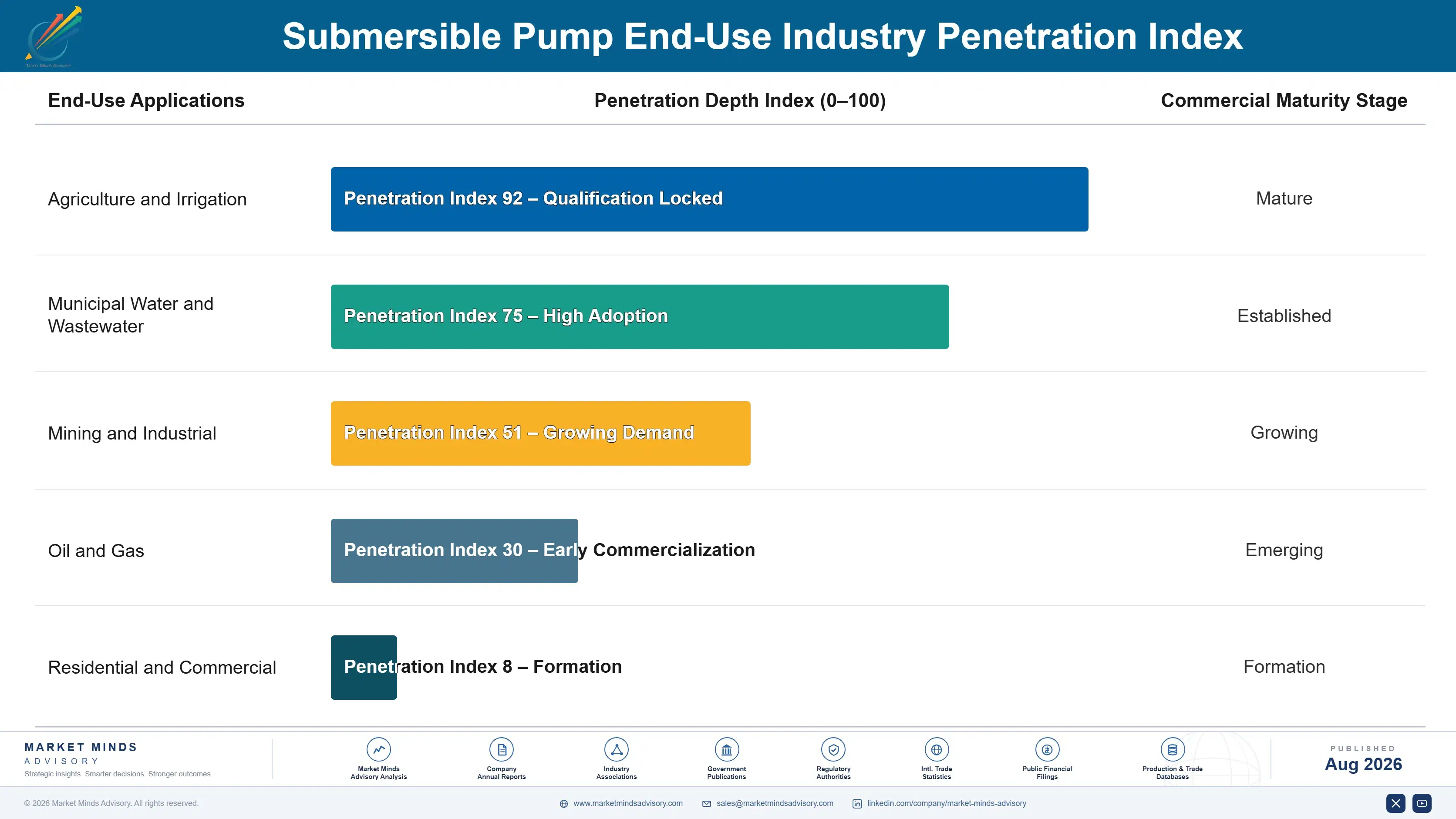
Submersible pump demand behaves like a replacement annuity once an installation base matures across a given territory and its irrigation network. A typical agricultural borewell pump operates for eight to twelve years before failure or efficiency decline prompts replacement, generating predictable recurring volume that dwarfs new-installation demand across mature agricultural regions with established irrigation infrastructure already firmly in place today across most watersheds.
Adoption depth varies sharply by end-use vertical across the category and its many distinct buyer types and channels. Municipal utilities adopt certified premium pumps fastest because service reliability and regulatory compliance carry direct budget consequences, agricultural buyers adopt more gradually as subsidy programs and payback economics slowly shift purchasing psychology, and residential buyers lag furthest behind, often replacing failed units with whatever the nearest retailer happens to stock that day.

A generational shift is underway in buyer profiles: younger farmers increasingly research pump specifications and financing options online before purchasing, a meaningful departure from the retailer-recommendation-driven purchasing pattern that dominated agricultural markets for decades past across most regions, and this cohort weighs total lifetime energy cost far more heavily than their predecessors ever did before them.
submersible-pump-market-end-use-penetration-index-1787300599145

Where MMA Sees the Category Heading

These are among the four positions where our research anticipates prominent divergence between winners and laggards over the coming forecast period. Each is grounded in the demand model, the regulatory perimeter, and the announced capacity pipeline.
01 / SOLAR ELECTRIFICATION POSITIONING

Manufacturers without solar integration risk losing the fastest segment

Solar-powered submersible pumps have moved from a niche subsidy-dependent category to the default choice across huge swaths of agricultural demand in regions with unreliable grid power access. Any manufacturer whose portfolio depends entirely on grid-tied designs should expect to lose share steadily in exactly the markets generating the fastest unit volume growth globally right now. Building genuine photovoltaic and power electronics capability, not just badge-engineering a third-party solar kit, is close to a survival requirement in these markets going forward.
02 / LOCAL MANUFACTURING INVESTMENT

Tender eligibility increasingly requires local production presence

Government subsidy programs across India, Kenya, and Nigeria increasingly attach local-content requirements to procurement eligibility, which locks pure importers out of the fastest-growing tender volume regardless of product quality or competitive pricing offered from abroad markets. Manufacturers establishing local assembly now, ahead of competitors, are securing preferred supplier status that will be difficult and costly for latecomers to dislodge once firmly established. This has become a genuine market access decision as much as a manufacturing cost decision for most global incumbents today.
03 / SERVICE CONTRACT EXPANSION

Municipal recurring revenue offers the most defensible margin

Equipment sales alone leave manufacturers exposed to commodity price competition from increasingly capable regional entrants, while service contracts tied to remote monitoring and predictive maintenance build switching costs that pure hardware competitors cannot easily replicate or undercut at scale. Manufacturers investing in IoT sensor integration now are building genuine competitive moats around their existing municipal installed base and relationships. The window for establishing this differentiation narrows as monitoring technology costs continue falling and become accessible to smaller competitors too over time.
04 / INPUT COST MANAGEMENT

Copper exposure will keep separating winners from laggards

Rising copper prices driven by overlapping electric vehicle and renewable energy demand are compressing margins hardest for manufacturers without long-term supply contracts or vertically integrated motor winding capability in place already at scale. This cost asymmetry will keep widening the margin gap between well-hedged incumbents and exposed regional competitors over successive fiscal years and commodity cycles that lie ahead of us. Vertical integration and aluminum winding research both offer partial relief, but neither fully eliminates the underlying exposure facing the category overall today.

Engagement Snapshot From the Field

A live engagement with an industry participant carrying material or product regulatory and market exposure ahead of a defining policy shift, showing how our research translates into a defensible multi-year portfolio strategy.
MARKET MINDS ADVISORY · CLIENT ENGAGEMENT SUMMARY
Submersible Pump Producer Strategic Portfolio Review and Transition Roadmap 2026·Investment Scenario on Submersible Pump Exposure Evaluation 2025-26
CLIENT PROFILE
The client is a regional municipal water and wastewater utility serving approximately 2.1 million residents across a drought-affected American Southwest metropolitan area (client-reported, unverified by MMA), operating over 400 submersible pump installations across its water supply, wastewater, and stormwater infrastructure network spanning multiple counties, jurisdictions, and a decades-old capital planning process overdue for a comprehensive renewal cycle.
STRATEGIC CHALLENGE
The utility faced rising energy costs and an aging pump fleet installed predominantly during the 1990s and early 2000s, while state-level groundwater depletion regulation was forcing deeper well installations that its existing procurement standards and long-standing vendor relationships had not been designed to specify or evaluate properly at all under the new rules.
MMA APPROACH
MMA benchmarked the utility's existing fleet against current efficiency standards, modeled total cost of ownership across three manufacturer options weighted by depth rating and service contract terms, and evaluated financing structures including performance-based contracts tying vendor payment directly to measured energy savings achieved over a multi-year implementation horizon and rollout schedule.
KEY FINDINGS
  1. The existing fleet operated at efficiency levels roughly 22 percent below current best-available technology, representing a substantial and previously unquantified annual energy cost opportunity across the network.
  2. Deep-well certified pumps carried a 35 percent price premium over standard units but delivered payback within four years through measured energy savings alone, before counting reduced failure-related service costs.
  3. Vendor service contract terms varied far more than expected across the three evaluated manufacturers, with meaningful differences in response time guarantees during peak drought-season demand periods specifically.
  4. Staff training and change management, not procurement price itself, emerged as the primary barrier to faster fleet modernization across the utility's decentralized regional operations structure.
CLIENT PROFILE
The client is a regional municipal water and wastewater utility serving approximately 2.1 million residents across a drought-affected American Southwest metropolitan area (client-reported, unverified by MMA), operating over 400 submersible pump installations across its water supply, wastewater, and stormwater infrastructure network spanning multiple counties, jurisdictions, and a decades-old capital planning process overdue for a comprehensive renewal cycle.
STRATEGIC CHALLENGE
The utility faced rising energy costs and an aging pump fleet installed predominantly during the 1990s and early 2000s, while state-level groundwater depletion regulation was forcing deeper well installations that its existing procurement standards and long-standing vendor relationships had not been designed to specify or evaluate properly at all under the new rules.
MMA APPROACH
MMA benchmarked the utility's existing fleet against current efficiency standards, modeled total cost of ownership across three manufacturer options weighted by depth rating and service contract terms, and evaluated financing structures including performance-based contracts tying vendor payment directly to measured energy savings achieved over a multi-year implementation horizon and rollout schedule.
KEY FINDINGS
  1. The existing fleet operated at efficiency levels roughly 22 percent below current best-available technology, representing a substantial and previously unquantified annual energy cost opportunity across the network.
  2. Deep-well certified pumps carried a 35 percent price premium over standard units but delivered payback within four years through measured energy savings alone, before counting reduced failure-related service costs.
  3. Vendor service contract terms varied far more than expected across the three evaluated manufacturers, with meaningful differences in response time guarantees during peak drought-season demand periods specifically.
  4. Staff training and change management, not procurement price itself, emerged as the primary barrier to faster fleet modernization across the utility's decentralized regional operations structure.
RECOMMENDED STRATEGY
Phase 1: Phase 1 (Months 1 to 4): Replace the highest-failure-risk 15 percent of the fleet with deep-well certified units, prioritizing sites with the greatest measured efficiency gap. Phase 2: Phase 2 (Months 5 to 12): Negotiate a performance-based service contract tying vendor payment partly to measured energy savings across the newly replaced installations. Phase 3: Phase 3 (Months 13 to 24): Extend fleet modernization system-wide, incorporating remote monitoring sensors to build a predictive replacement schedule going forward.
OUTCOME
Within eighteen months of beginning fleet modernization, the utility reported measurably lower energy costs across replaced installations and a marked reduction in unplanned failure events during peak drought-season demand periods (client-reported, unverified by MMA), while staff reported greater confidence in procurement decisions under the new evaluation framework MMA helped establish.

Frequently Asked Questions

Foundational context covering the market sizes, CAGR, scope, country, region and competition that inform every finding below. This section is provided to cover basics and most often pre-purchase conversations, answered from the MMA Primary Research Dataset.

What is the current size of the Submersible Pump Market?

The global submersible pump market reached an estimated USD 15.2 billion in 2025, spanning borewell, sewage, dewatering, slurry, solar-powered, and sump applications across agricultural, municipal, and industrial end uses.

How large will the Submersible Pump Market be by 2036?

MMA projects the market will reach approximately USD 30.07 billion by 2036, nearly doubling from its 2026 base as solar electrification and groundwater depletion regulation both accelerate demand.

What is the CAGR for the Submersible Pump Market 2026 to 2036?

The base case CAGR is 6.4 percent, with a bull scenario of 7.6 percent and a bear scenario of 5.2 percent depending largely on commodity input cost trajectories.

Which segment is growing fastest?

Solar-powered submersible pumps are growing fastest at a 10.8 percent CAGR, roughly 1.69 times the overall market rate, as subsidy programs compress payback periods across emerging agricultural markets.

Who are the major companies in the Submersible Pump Market?

Xylem, Grundfos, KSB, Sulzer, and Ebara lead the category, together holding just over one third of global market share across all pump types and applications tracked.

Which country is growing fastest?

India is growing fastest at an estimated 9.4 percent CAGR, driven by the PM-KUSUM solar irrigation subsidy program targeting millions of new agricultural pump installations.

Report Segmentation Architecture

The full report scope spans multiple orthogonal segmentation dimensions, with cross-tabulated demand data provided for each dimension pair. Coverage extends further to regional breakdowns, trend trajectories, and the competitive detail needed to support segment-level decision-making.

By Pump Type and Technology

  • Borewell and Water Well Pumps
  • Sewage and Wastewater Pumps
  • Dewatering Pumps
  • Slurry and Solids-Handling Pumps
  • Solar-Powered Pumps
  • Sump and Drainage Pumps

By End-Use Industry

  • Agriculture and Irrigation
  • Municipal Water and Wastewater
  • Mining and Industrial
  • Oil and Gas
  • Residential and Commercial

By Commercial Dimension

  • Government and Municipal Tenders
  • Distributor and Retail Channels
  • Direct Industrial Sales
  • OEM and System Integration

By Region

  • North America
  • Western Europe
  • East Asia
  • South Asia and Pacific
  • Latin America
  • Middle East and Africa
  • Eastern Europe

Scope, Methodology, and Coverage

Every figure in this report is reproducible from documented input assumptions. The scope below maps the historical period, the forecast horizon, the segmentation dimensions, and the countries covered, alongside the underlying primary and qualitative methodology.
Historical Period
2020 to 2025
Forecast Period
2026 to 2036
Base Year
2025 (USD billions; MMA Primary Research Dataset, August 2026)
Market Definition
The submersible pump market covers electrically driven pumps designed to operate fully submerged in the fluid being pumped, spanning borewell, sewage, dewatering, slurry, solar-powered, and sump applications across agricultural, municipal, industrial, and residential end uses. It excludes surface-mounted and above-ground centrifugal pumps not designed for submerged operation.
Quantitative Units
USD billions (current prices); unit volumes in millions of pumps where applicable
Segmentation Dimensions
By Pump Type and Technology; By End-Use Industry; By Commercial Dimension; By Region
Regions Covered
North America, Western Europe, East Asia, South Asia and Pacific, Latin America, Middle East and Africa, Eastern Europe
Countries Covered
USA, China, Germany, France, UK, Japan, South Korea, India, Australia, Canada, Brazil, Mexico, Indonesia, Vietnam, Thailand, Malaysia, UAE, Saudi Arabia, South Africa, Nigeria, Turkey, Poland, Netherlands, Italy, Spain, Sweden, Switzerland, Argentina, Colombia, Singapore, and additional markets relevant to this sector
Key Companies Profiled
Xylem Inc, Grundfos Holding A/S, KSB SE and Co KGaA, Sulzer Ltd, Ebara Corporation, Wilo SE, Franklin Electric Co Inc, Flowserve Corporation, Weir Group PLC, Kirloskar Brothers Limited, Shanghai KaiQuan Pump Group Co Ltd, Shimge Pump Industry Group Co Ltd, Tsurumi Manufacturing Co Ltd, Pentair plc, Caprari S.p.A, Zoeller Pump Company, Grindex AB, Hidrostal AG, Atlas Copco AB, CRI Pumps Private Limited
Quantitative Methodology
Primary survey, n=3,800 respondents, Q4 2025, six countries; demand-side model with trade association cross-validation
Qualitative Methodology
47 expert interviews, Q4 2025; applied to validate demand model assumptions, identify emerging dynamics, and assess competitive positioning
Report Format
PDF and XLSX data workbook (Word format preview document)
Publisher
Market Minds Advisory
Report Code
MMA-2026-CON-102
Published
August 2026
Contact
sales@marketmindsadvisory.com | www.marketmindsadvisory.com

Purchase the full Submersible Pump Market Report (2026 to 2036).

The full report delivers a complete competitive and commercial analysis of the submersible pump market across all seven regions and six technology segments tracked. It includes detailed company profiles for twenty manufacturers, solar subsidy and regulatory policy tracking across major markets, and a ten-year forecast model with bull and bear scenario sensitivity built in. Buyers receive underlying segmentation data by country and pump type alongside the full qualitative analysis. A dedicated appendix tracks recent acquisitions, local manufacturing investments, and tender wins relevant to competitive strategy planning.
Ten-year revenue and volume forecast model
Solar subsidy and regulatory policy tracker
Twenty-company competitive profile database and scorecard
Technology-level segmentation broken out by country
Copper and steel cost sensitivity model
Quarterly market update subscription option for buyers

Built For The People Who Decide

From boardroom strategy to bench-side execution, this report is read cover-to-cover by leaders shaping the next decade of their industry, turning demand scenarios, market dynamics and valuation benchmarks into decisions.
CXOs/ Presidents/ VPs/ Managers
M&A and Corporate Development
Strategy Teams and R&D Heads
Procurement and Product Directors
Regulatory and Compliance Leaders
Investor Relations and Equity Analysts