Market Minds Advisory
Submarine Cable Market

Submarine Cable Market: Submarine Cable Market. AI Interconnect and Hyperscale Bandwidth Economics

AI data center interconnect demand and hyperscale cloud cable upgrades are reshaping submarine cable procurement as operators chase higher bandwidth capacity, transoceanic connectivity expansion accelerates, and manufacturers compete for premium hyperscaler contract wins worldwide.

Lead Analyst

Published

September 2026

Make Smarter Decisions with Customized Research Insights

Request a free sample report and evaluate market opportunities, growth trends, and competitive dynamics relevant to your business needs.

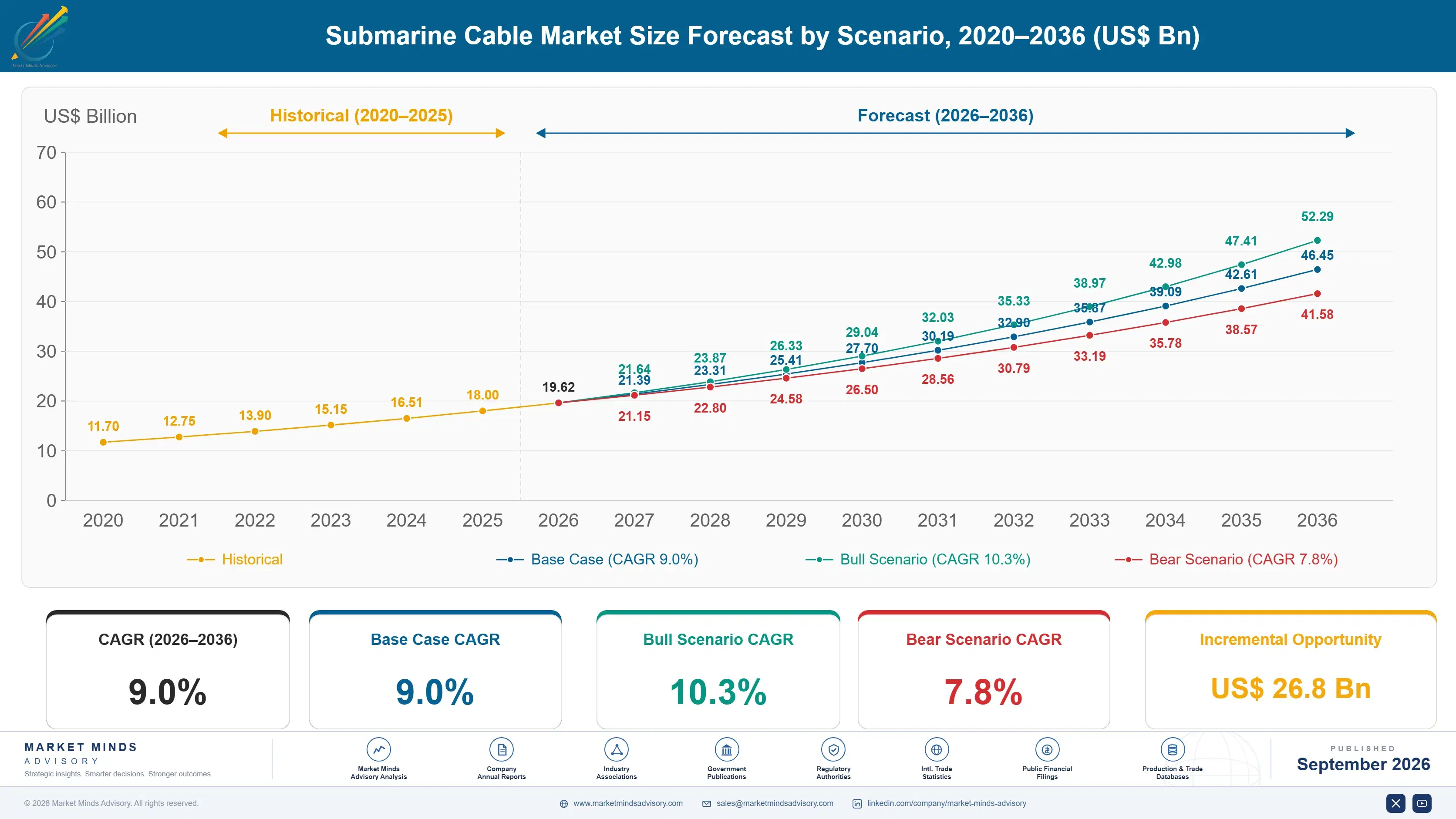
2025 MARKET VALUE$18.0BMarket Size 2025
2036 FORECAST VALUE$46.5BBase Case , 2026 to 2036
CAGR 2026 TO 20369.0 %Bull 10.3% / Bear 7.8%
INCREMENTAL OPPORTUNITY$26.8BNet 10- year value creation
EXPANSION MULTIPLE2.37x2036 value over 2026 base
Strategic Levers
M&A Pipeline
Regional Outlook
Country Rankings
Competitive Intelligence
Segmental Deep-dive
Call-Us : 91 93563 13602

Executive Snapshot and Market Trajectory.

Submarine Cable Market revenue is shifting toward AI data center interconnect and hyperscale cloud configurations as higher bandwidth capacity and transoceanic connectivity expansion reshape procurement priorities across operators and long-standing manufacturer supplier relationships, marking a distinctly faster pace of technology transition across the entire global sector today still further.
AI data center interconnect cable systems alongside hyperscale cloud-dedicated cable systems are the fastest-expanding categories as operators pursue bandwidth optimization while hyperscalers demand certified capacity density across most infrastructure programs today. North America holds the largest share of committed fleet procurement, anchored by SubCom and Alcatel Submarine Networks production scale, while East Asia drives standout connectivity-linked demand and South Asia expands rapidly via network investment growth today still further.
Competition splits between large diversified manufacturers with integrated transoceanic through AI interconnect underwriting portfolios and numerous specialist hyperscale cable makers competing mainly on bandwidth efficiency and capacity certification for hyperscaler allocations across most tender strategies today across the industry overall. AI data center demand is pushing meaningful fragmentation across the wider industry, while AI interconnect cables accelerate deployment across major premium hyperscaler routes nationwide today, reshaping competitive positioning steadily and quite quickly overall.
Market Definition
The Submarine Cable Market covers transoceanic long-haul cable systems, regional and festoon cable systems, AI data center interconnect cable systems, hyperscale cloud-dedicated cable systems, repair and maintenance services, and cable landing station infrastructure. It excludes terrestrial fiber optic networks, standalone satellite communication systems, and non-submarine undersea power transmission cables.
Base Year Value
$18.0B in 2025 (MMA Primary Research Dataset, September 2026)
Forecast Period
2026 to 2036, eleven discrete annual values
CAGR
9.0% base case. Bull 10.3%. Bear 7.8%.
Fastest Growth Segment
AI Data Center Interconnect Cable Systems: 16.0% CAGR
Fastest Growth Country
India: 13.0% CAGR
Fastest Growth Region
South Asia and Pacific: 11.0% CAGR
Largest Region
North America: 28% of 2025 global value
Market Leaders
SubCom LLC, Alcatel Submarine Networks, NEC Corporation, HMN Technologies, Nokia Corporation. Source: MMA Analysis based on company annual reports.
Primary Survey
n=3,800 procurement and R&D decision-makers, Q4 2025, six countries
Methodology
Demand-side build-up, cross-validated against public data, 47 expert interviews

Submarine Cable Market Forecast Scenarios

submarine-cables-market-size-forecast-scenario-1788417293371
Between 2020 and 2025, submarine cable revenue grew at an estimated 8.0 percent compound rate as pandemic-era connectivity spending pauses and gradual data traffic recovery sustained steady baseline demand across most product categories. AI data center interconnect and hyperscale cloud categories gained meaningful momentum through this period, while transoceanic long-haul and regional festoon cable systems accounted for the largest revenue share across most regional markets.
The base case assumes continued expansion as three mechanisms compound: operators continuing to prioritize bandwidth optimization as AI interconnect formulation intensity sustains demand for certified capacity formats across allied hyperscaler budgets, hyperscalers scaling cloud-dedicated adoption as capacity transparency sustains demand for reliable bandwidth disclosure and latency verification, and manufacturers expanding production capacity steadily as network distribution extends into new geographic segments and adjacent product categories worldwide throughout the forecast period today.
The bull case turns on faster transoceanic connectivity expansion pulling submarine cable revenue meaningfully higher across major product categories globally as AI interconnect demand scales quickly across hyperscalers. The bear case centers on slower hyperscale cloud budget growth constraining the fastest-growing procurement channel, limiting the strongest single revenue driver behind manufacturer momentum for years to come across the industry.

AI Interconnect and Hyperscale Bandwidth Economics

Submarine Cable Market sits at the intersection of two converging forces: enduring baseline demand tied to transoceanic long-haul and regional festoon formats across a maturing telecom carrier base, and an accelerating shift toward AI data center interconnect and hyperscale cloud categories required by bandwidth optimization and capacity doctrine. Manufacturers that once treated submarine cables as a simple transoceanic-format category now invest heavily in bandwidth infrastructure and hyperscale certification capability, betting AI interconnect spending will command durable value as capacity scrutiny intensifies.
MARKET CONCENTRATIONCR5 72%Leading five manufacturers hold well over two-thirds of revenue
AI INTERCONNECT PRICE PREMIUM2.4x-3.1xAI interconnect units carry meaningfully higher average contract price
TOP PRODUCING COUNTRY SHAREUnited States 20%United States anchors the largest share of production revenue
MANUFACTURING FACILITY UTILISATION84%Manufacturing facilities operate near full capacity during peak seasons
FIBER AND COPPER COST44%-54% COGSFiber and copper costs dominate total unit budget
REPLACEMENT CYCLE20-30 YearsStandard cable replacement cycle typically spans about twenty-five years
Commercially, the market still behaves partly like a highly specialized capital equipment category: standard transoceanic and regional festoon platforms trade on reliability reputation and carrier contract volume, with margins tied closely to fiber and copper input pricing and long-term supply agreement terms. AI data center interconnect and hyperscale cloud formats command distinctly different economics, priced on bandwidth sophistication and capacity transparency rather than traditional transoceanic volume alone, giving manufacturers who master these capabilities a differentiated margin position.
Looking ahead, the decade defining forces are bandwidth optimization and competitive positioning: how quickly operators sustain AI interconnect procurement determines demand, while hyperscale certification determines which manufacturers capture the richest AI data center mandates across the market going forward.
"AI data center demand made bandwidth optimization the only metric that matters, and manufacturers still pricing AI interconnect cables like a transoceanic upgrade are going to lose the biggest hyperscaler tenders."
Director, Telecommunications Infrastructure Practice · MMA Telecommunications Infrastructure Practice · September 2026

Market Trends

Bandwidth Optimization Certification Rising Rapidly Now

Operators across the industry are increasingly specifying AI data center interconnect cable systems equipped with certified capacity density and latency reduction capability, responding to demand for verified bandwidth optimization without requiring older, less efficient transoceanic-only systems across every major hyperscaler and premium budget category today. Several leading manufacturers have disclosed AI interconnect capacity expansion during 2024 and 2025, targeting both domestic network procurement and allied export market growth specifically. This shift is compressing the addressable market available to makers offering only legacy transoceanic-only systems, pushing suppliers toward deeper investment in bandwidth infrastructure and latency reduction capability.
Market Impact: Sustains volume across 6 segments
Hyperscale Bandwidth Coordination Rising Rapidly Now

Hyperscalers across major expansion budgets are increasingly specifying hyperscale cloud-dedicated cable systems as legacy transoceanic-only systems reach capacity scrutiny limits, responding to demand for extended capacity transparency traditional transoceanic-only systems cannot reliably provide across every major hyperscale and premium budget category today. Several manufacturers disclosed hyperscale capacity expansion during 2024 and 2025, extending bandwidth capability into allied network modernization programs beyond transoceanic-only formulation alone. This shift is compressing market share available to makers without dedicated hyperscale expertise, rewarding suppliers who deliver validated bandwidth-grade platforms rather than standard transoceanic-only systems overall.
Market Impact: Adds 16.0% AI interconnect segment growth

Market Opportunities and Growth Drivers

Rising Telecom Carrier Capacity and Legacy Investment

Rising telecom carrier capacity and legacy transoceanic investment continues elevating across most infrastructure programs globally, sustaining steady baseline demand for transoceanic long-haul and regional festoon systems regardless of broader economic conditions or peacetime budget cycles across most product categories, manufacturers, and regional markets today. Every incremental carrier milestone directly increases addressable submarine cable procurement revenue independent of broader market sentiment, since replacement cycle requirements rarely shift as fast as broader sentiment does. This directly sustains addressable demand for cables across the industry, benefiting both large diversified manufacturers and smaller specialist hyperscale makers alike.
Market Impact: Delays rollout by 9 months

Accelerating AI Data Center Investment Programs Worldwide

Accelerating AI data center investment continues pushing hyperscalers to expand integrated AI interconnect offerings as a differentiator in achieving comprehensive bandwidth compliance, creating a growing addressable market for capacity-centric manufacturers distinct from organic transoceanic-only growth alone across the entire submarine cable landscape. Every incremental AI data center milestone now treats certified AI interconnect ownership as a standard hyperscaler requirement rather than a novelty reserved for a handful of premium operators, extending AI interconnect adoption into previously underserved mid-tier hyperscaler budgets. This expands addressable demand for capacity-centric manufacturers well beyond what traditional transoceanic-only trends alone would suggest.
Market Impact: Cuts margin by 10%

Market Restraints and Challenges

Extending Bandwidth Testing Certification Timelines Steadily

Submarine cable certification timelines continue extending faster than network delivery cycles can offset, a pressure rooted in complex bandwidth testing and capacity certification requirements that constrains the pace at which manufacturers can deliver fully certified cables across most product categories, hyperscaler programs, and regional markets today still. This timeline pressure slows network rollout considerably among operators unable to fully anticipate certification complexity within a single annual procurement cycle. Manufacturers are investing in modular testing architecture and standardized qualification pathways to narrow this remaining timeline gap over time quite considerably still.
Market Impact: Adds 2.4x price premium capture

Rising Fiber and Copper Input Costs

Fiber and copper input costs continue rising faster than manufacturer pricing can offset, a pressure rooted in constrained global specialty fiber supply chains and limited qualified manufacturing capacity that limits the margin manufacturers can generate from standard cable manufacturing across most product categories and manufacturers globally today. This fiber cost pressure slows margin growth among manufacturers unable to fully pass costs through to hyperscaler customers within existing long-term supply agreement pricing. Manufacturers are investing in alternative fiber qualification and supply chain diversification to narrow this remaining margin gap over time considerably.
Market Impact: Expands hyperscale share by 8%
3 additional market trends, 4 additional growth drivers, and 3 additional restraints and challenges are covered in the full report. Contact sales@marketmindsadvisory.com to access the complete intelligence.

Segment CAGR and Growth Architecture

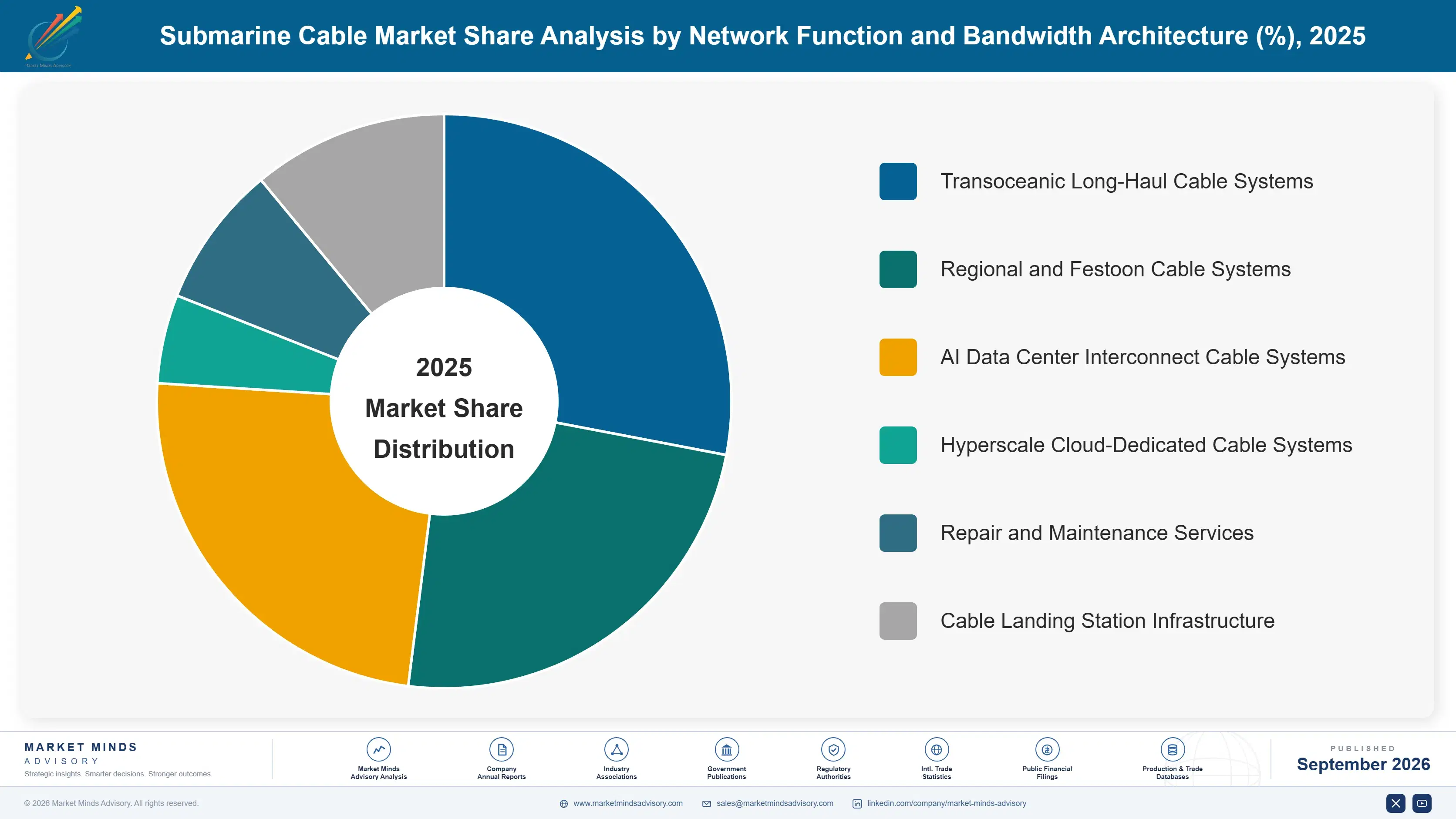
Submarine Cable Market segments by network function and bandwidth architecture rather than distribution channel, since the specific function determines capacity capability, latency depth, and hyperscaler relationship across transoceanic, AI interconnect, and hyperscale categories sold globally today still further indeed. Six categories span mature transoceanic through emerging landing station formats across the entire global submarine cable industry today.
submarine-cables-market-market-share-analysis-1788417293915

AI Data Center Interconnect Cable Systems

AI data center interconnect cable systems provide certified capacity density and latency reduction capability without requiring separate standalone transoceanic-only programs, addressing operator demand for verified bandwidth optimization amid deepening capacity infrastructure investment across every hyperscaler category and premium budget tier worldwide today. This is the fastest-growing category, expanding at an estimated 16.0 percent annually as operators increasingly demand certified, capacity-validated alternatives to episodic legacy transoceanic-only network programs spanning the entire industry today. Manufacturers with proprietary capacity systems and latency reduction integration depth are capturing outsized share of this category's growth, while transoceanic-only makers without dedicated AI interconnect capability struggle to compete for these emerging hyperscaler relationships globally today, ceding ground steadily and quite consistently.
CAGR 16.0%

Hyperscale Cloud-Dedicated Cable Systems

Hyperscale cloud-dedicated cable systems provide extended capacity transparency and bandwidth coordination capability that overwhelms legacy transoceanic limitations, addressing hyperscaler demand for reliable bandwidth-grade platforms across every hyperscale frontier and premium budget category worldwide today across the industry. This is the second-fastest category, expanding at an estimated 14.0 percent annually as hyperscalers increasingly modernize toward certified cloud-dedicated adoption beyond legacy transoceanic sustainment alone across most network programs globally today. Manufacturers with established bandwidth certification capability and fiber sourcing depth are winning these contracts fastest, since hyperscalers increasingly require validated bandwidth-grade partners rather than generalist transoceanic-only suppliers lacking proper certification discipline across the wider global market, a gap widening steadily further still.
CAGR 14.0%
Full segment breakdown across 6 segments available in the complete report.

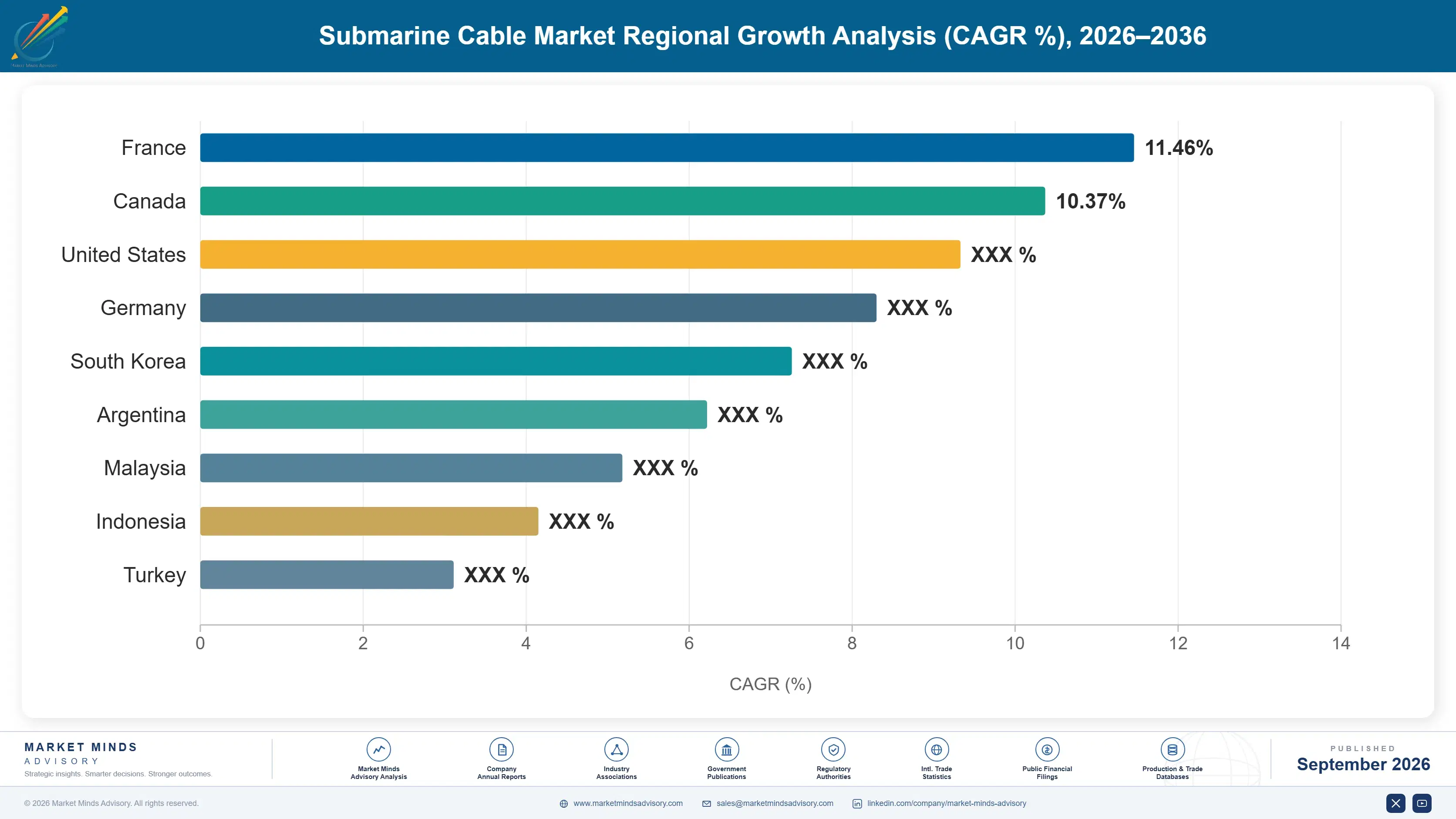
Regional Architecture and Country Demand Map

Submarine Cable Market revenue spans all major global regions, with North America leading given SubCom and Alcatel Submarine Networks's concentrated fleet manufacturing scale, East Asia sustaining connectivity-linked demand, and South Asia and Pacific expanding fastest through network investment growth programs worldwide across the entire eleven-year forecast period.

North America

The United States's dense hyperscaler-funded network and cable landing station base represents the largest North American source of fleet activity, drawn by decades of SubCom and Alcatel Submarine Networks production research and government-backed export expansion programs across the region's largest network manufacturing market nationwide and quite well beyond indeed still today and well beyond that too indeed further considerably and quite steadily overall indeed still further. Canada contributes meaningful additional carrier activity and AI interconnect technology depth, home to established telecom conglomerates active in regional supply and cross-border partnership relationships. This combination of network depth and AI interconnect technology scale gives the region durable leadership across the forecast period today, supported by concentrated hyperscaler headquarters presence nationwide overall.
Share: 28% | CAGR: 9.5% (2026 to 2036)

Western Europe

France and the United Kingdom's precision submarine cable manufacturing base anchors the largest Western European source of submarine cable committed revenue, drawn by Alcatel Submarine Networks's engineering heritage headquarters proximity and a deep pool of AI interconnect and hyperscale specialist firms across the region's most developed precision equipment manufacturing center nationwide and quite well beyond indeed still today and well beyond that too indeed still further considerably and quite steadily now. Germany and Italy contribute meaningful additional manufacturing activity through specialty AI interconnect and hyperscale engineering programs. Ireland rounds out the region's participation through precision certification and testing expertise. This combination of manufacturing depth and consumer regulatory support gives the region durable relevance across the entire forecast period.
Share: 22% | CAGR: 7.5% (2026 to 2036)
Regional intelligence for 5 additional markets available in the complete report: East Asia, South Asia and Pacific, Latin America, Middle East and Africa, Eastern Europe. Contact sales@marketmindsadvisory.com.
submarine-cables-market-country-cagr-analysis-1788417294454

AI Interconnect Bandwidth Capability and Network Depth

Margin expansion in submarine cables flows through four distinct commercial levers: AI interconnect capability over standard transoceanic pricing, hyperscale certification depth, long-term supply agreement scale, and large hyperscaler network agreements that lock in durable multi-year procurement positions across every major product category, manufacturer, program, and regional export market segment worldwide today still further indeed overall.

Certified AI Interconnect Format Premium Pricing Advantage

Certified AI interconnect platforms command a pricing premium of roughly 2.4 to 3.1 times standard transoceanic-format products, reflecting both specialized capacity infrastructure cost and the bandwidth premium operators pay for to achieve comprehensive AI data center compliance without operating separate standalone transoceanic-only programs. Manufacturers who develop differentiated AI interconnect technology capture pricing power that transoceanic-only providers competing purely on unit cost cannot access. This advantage has proven durable because capacity expertise is difficult to replicate quickly, giving early movers a multi-year head start over competitors still building comparable capacity infrastructure entirely from scratch today.
Market Impact: Commands a full 2.4x to 3.1x price premium

Hyperscale Certification Capability and Sourcing Depth

Manufacturers offering validated hyperscale certification capability capture additional value from hyperscaler clients seeking competitive multi-region bandwidth coordination beyond standard transoceanic platforms alone, a capability distinct from generalist manufacturing operations lacking any dedicated bandwidth engineering infrastructure whatsoever across the capacity process. This certification capability requires sustained investment in bandwidth sourcing talent and latency validation infrastructure that smaller regional manufacturers typically cannot commit to building independently. Manufacturers with established certification programs are capturing an additional premium of roughly 27 percent beyond standard transoceanic-only competitors, often embedding themselves more deeply into a hyperscaler's broader bandwidth strategy.
Market Impact: Adds roughly a 27 percent premium over rivals

Long-Term Supply Agreement Scale and Retention

Manufacturers securing deep long-term supply agreements now are positioned to capture the fastest-growing segment of hyperscaler demand as buyers increasingly prioritize supply chain reliability over standard spot procurement alone, with disclosed multi-year supply program expansion often spanning 1 to 3 years across multiple hyperscaler partnerships before achieving full program scale. Manufacturers who establish this integration early secure preferential positioning with hyperscalers seeking reliable supply before competitors complete comparable capacity building. This lever favors manufacturers with dedicated account management teams and requires sustained investment that smaller regional manufacturers often cannot commit at comparable scale.
Market Impact: Locks in supply across 1 to 3 years

Large Hyperscaler Network Agreement Depth and Reach

Manufacturers with existing large hyperscaler network agreements capture meaningfully more recurring revenue than manufacturers competing purely on individual spot orders, since large networks increasingly consolidate procurement relationships under fewer, deeply integrated manufacturer partners worth roughly 29 percent additional recurring revenue across their hyperscaler programs. This network agreement depth requires sustained investment in technical service expertise and specialized deployment infrastructure that smaller regional manufacturers typically cannot access independently. Manufacturers with established network positioning are capturing additional revenue beyond individual order competitors, often embedding themselves more deeply into a hyperscaler's broader capacity strategy.
Market Impact: Captures 29 percent more recurring fleet revenue annually

Who Controls the Margin Pool

Submarine Cable Market concentration sits at a CR5 of 72 percent, evaluated on production revenue, with SubCom LLC and Alcatel Submarine Networks holding the largest positions built on diversified transoceanic through AI interconnect portfolios spanning multiple hyperscaler relationships. The gap between these established leaders and numerous specialist hyperscale makers remains wide on capacity infrastructure capability, though narrower on delivered pricing competitiveness for standard transoceanic categories.
Current competitive activity concentrates in three areas: AI interconnect investment to meet accelerating hyperscaler demand for bandwidth compliance, hyperscale expansion to capture multi-region bandwidth coordination contracts, and long-term supply agreement development to secure hyperscaler renewal programs across major global manufacturers and allied product budgets today still.

Rankings are most likely to shift meaningfully as AI interconnect and hyperscale categories become a larger share of total production revenue, a dynamic that could let manufacturers with the strongest capacity infrastructure capability pull ahead of transoceanic-only specialists overall. Smaller regional manufacturers without dedicated AI interconnect capability face the greatest pressure, and several are pursuing technology partnerships with larger manufacturers rather than building infrastructure internally, a defensive posture that could reshape the competitive leaderboard within five years.
submarine-cables-market-company-positioning-matrix-1788417294979

Competitive Moat and Risk Dimensions

SUBCOM LLC

Moat: Broad Format Portfolio

SubCom LLC operates the industry's broadest submarine cable portfolio spanning transoceanic, AI interconnect, and hyperscale capability across multiple product lines, supported by dedicated engineering and certification teams serving operators across the entire market. This breadth lets SubCom offer integrated solutions across every product category narrower specialist manufacturers cannot match at comparable scale.
SUBCOM LLC

Risk: Diluted Category Focus

SubCom's broad portfolio construction means individual product categories represent one of several priorities relative to specialist competitors more narrowly focused on AI interconnect or hyperscale production specifically, potentially slowing dedicated investment pace in any single product area. Intensifying competition from AI interconnect specialists could erode its premium AI data center mandate share.
ALCATEL SUBMARINE NETWORKS

Moat: Precision Cable Manufacturing Heritage

Alcatel Submarine Networks's decades of precision cable manufacturing heritage and deep hyperscaler procurement relationships give it distinctive credibility with operator buyers seeking proven, comprehensive manufacturing capability coverage across multiple regions. This established reputation and specialized AI interconnect technology give the company a durable position in the emerging bandwidth optimization segment specifically across multiple product categories.
ALCATEL SUBMARINE NETWORKS

Risk: Limited Commodity Competitiveness

Alcatel's specialized focus on emerging AI interconnect technology leaves it comparatively less price-competitive in commodity transoceanic categories relative to lower-cost regional and standard manufacturer offerings, potentially limiting its exposure to price-sensitive mid-tier carrier budget segments. Sustained competition from standard manufacturer offerings could pressure its transoceanic positioning over time considerably.

Players Tracked

Prominent Players

SubCom LLC
Alcatel Submarine Networks
NEC Corporation
HMN Technologies
Nokia Corporation

Other Key Players

Hengtong Marine
ZTT Marine
Prysmian Group
Corning Incorporated
Xtera Communications
Ciena Corporation
Infinera Corporation
Global Marine Group
Elettra Tlc
Orange Marine
KDDI Cable Ship
NTT World Engineering Marine
ASEAN Cableship
E-Marine
Fujitsu Limited

Recent Developments

MARCH 2025

SubCom Expands AI Interconnect Capacity Integration Line

SubCom LLC announced an expansion of its AI interconnect capacity integration line to increase multi-format production capacity, responding to sustained demand from operators seeking verified bandwidth optimization capability across the entire global market nationwide today still further. The expansion adds meaningful engineering staffing across multiple product operations.
Signal: Signals established manufacturers are prioritizing AI interconnect investment ahead of accelerating hyperscaler demand shifts globally today still.
SEPTEMBER 2024

Alcatel Submarine Networks Launches Hyperscale Certification System

Alcatel Submarine Networks launched a new integrated hyperscale certification mission system specifically engineered to meet hyperscaler demand for simplified multi-region bandwidth coordination capability without compromising established manufacturing compliance and capacity standards across demanding regulatory conditions worldwide. The launch includes documented capacity validation testing data benchmarked closely against traditional processes.
Signal: Signals established manufacturers are increasingly prioritizing hyperscale technology as a distinct competitive battleground across the industry.
JANUARY 2025

NEC Corporation Opens Regional Engineering Office

NEC Corporation opened a new regional engineering office to expand capacity and fiber integration capacity closer to key hyperscaler partnerships across multiple regions and product categories nationwide today still further and consistently. The office includes dedicated infrastructure supporting expanded technical staffing and manufacturing requirements across the industry.
Signal: Signals manufacturers are investing further in regional capacity to compete directly with established submarine cable makers today still.

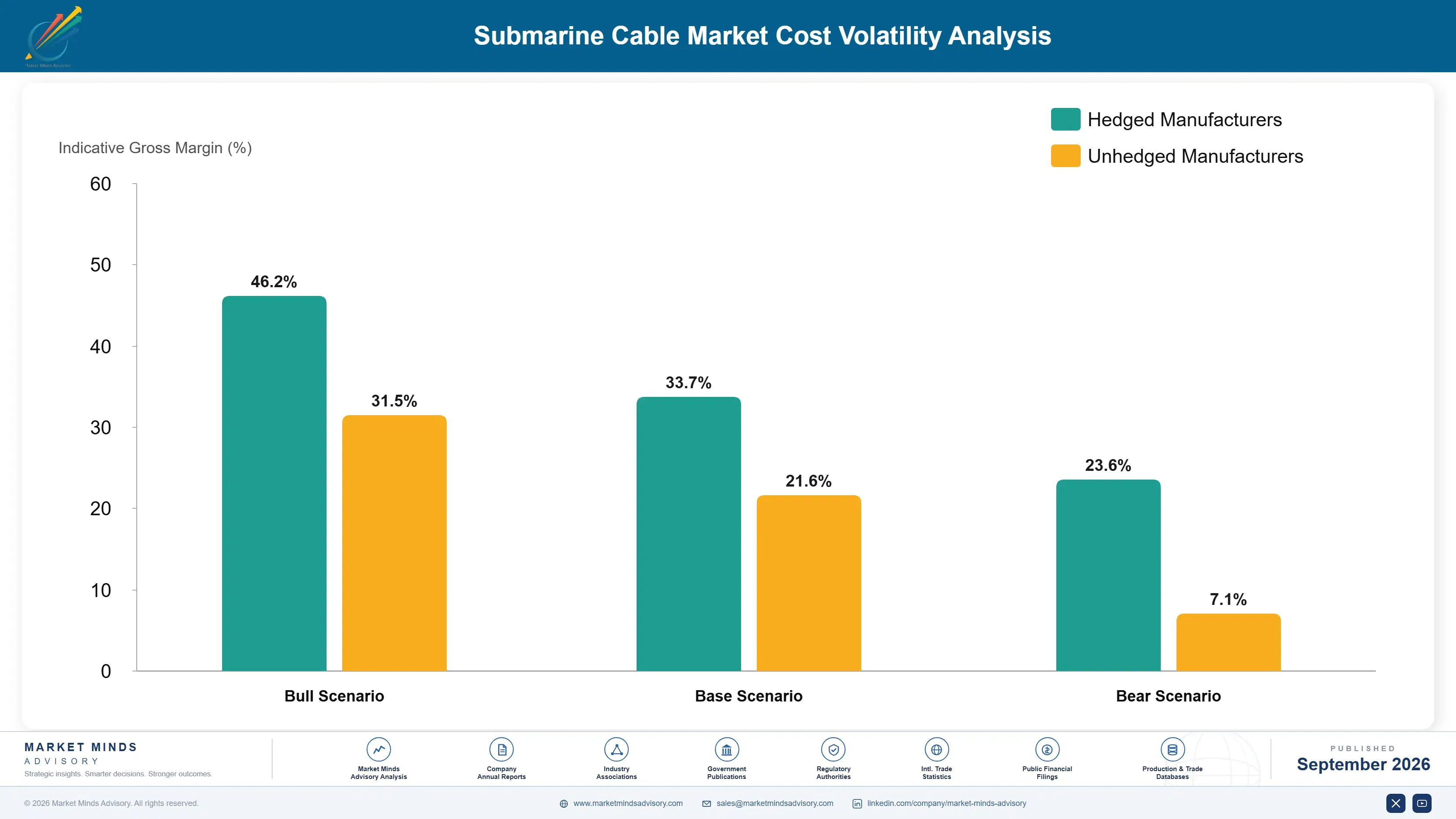
Fiber and Copper Cost Exposure

Fiber and copper costs account for an estimated 44 to 54 percent of total cost of goods sold for standard submarine cable systems, while AI interconnect certification testing represents a growing cost category across the industry, concentrated among a handful of manufacturers. Fiber cost structures originate mainly from concentrated global specialty fiber supply chains across the industry overall.
Specialty fiber costs spiked more than 15 percent during 2024 following constrained global specialty fiber supply chains and rising qualified manufacturing demand across major network manufacturing centers, according to sourcing data cited by industry associations, pushing manufacturer costs up substantially and squeezing margins for makers unable to pass costs through pricing increases. Several manufacturers disclosed fiber-linked cost inflation as a specific pressure on segment margins throughout the year.

Manufacturers without diversified fiber sourcing relationships face a persistent cost disadvantage during price spikes, since specialty fiber and copper certification cannot easily substitute alternative suppliers on short notice without triggering separate qualification validation requirements across multiple regulatory jurisdictions. Exposure concentrates most heavily among smaller regional manufacturers who lack the scale to negotiate preferred fiber pricing that larger diversified competitors maintain across multiple product categories and geographic markets.
submarine-cables-market-cost-volatility-analysis-1788417295174

Diversifying Fiber Supplier Relationships Globally

Manufacturers are qualifying additional fiber supplier relationships across multiple regional supplier geographies including domestic and international specialty fiber manufacturers, reducing single-source dependence across the entire fiber supply base considerably and consistently over time, protecting output continuity. This diversification adds coordination complexity but meaningfully lowers the probability that a single supplier capacity constraint disrupts total production volume.

Shifting Toward Preferred Supplier Volume Agreements

Capital allocation is shifting toward preferred fiber supplier agreements precisely because negotiated volume pricing trades on more stable cost cycles with far more consistency than spot market fiber costs tied to individual production runs. Manufacturers pursuing this path reduce long-run exposure to fiber cost volatility, even though preferred supplier agreements still require sustained investment to maintain quality standards.

Qualifying Alternative Fiber Providers Into Design

Manufacturers are increasingly qualifying alternative fiber providers into cable design, tying copper selection to broader supply availability rather than single-source specialty fiber negotiated years in advance. This protects margins during fiber cost volatility but requires hyperscalers accustomed to established certification to accept alternative qualification pathways, a negotiation favoring manufacturers with strong regulatory relationships overall.

Portfolio Architecture for Margin Defence

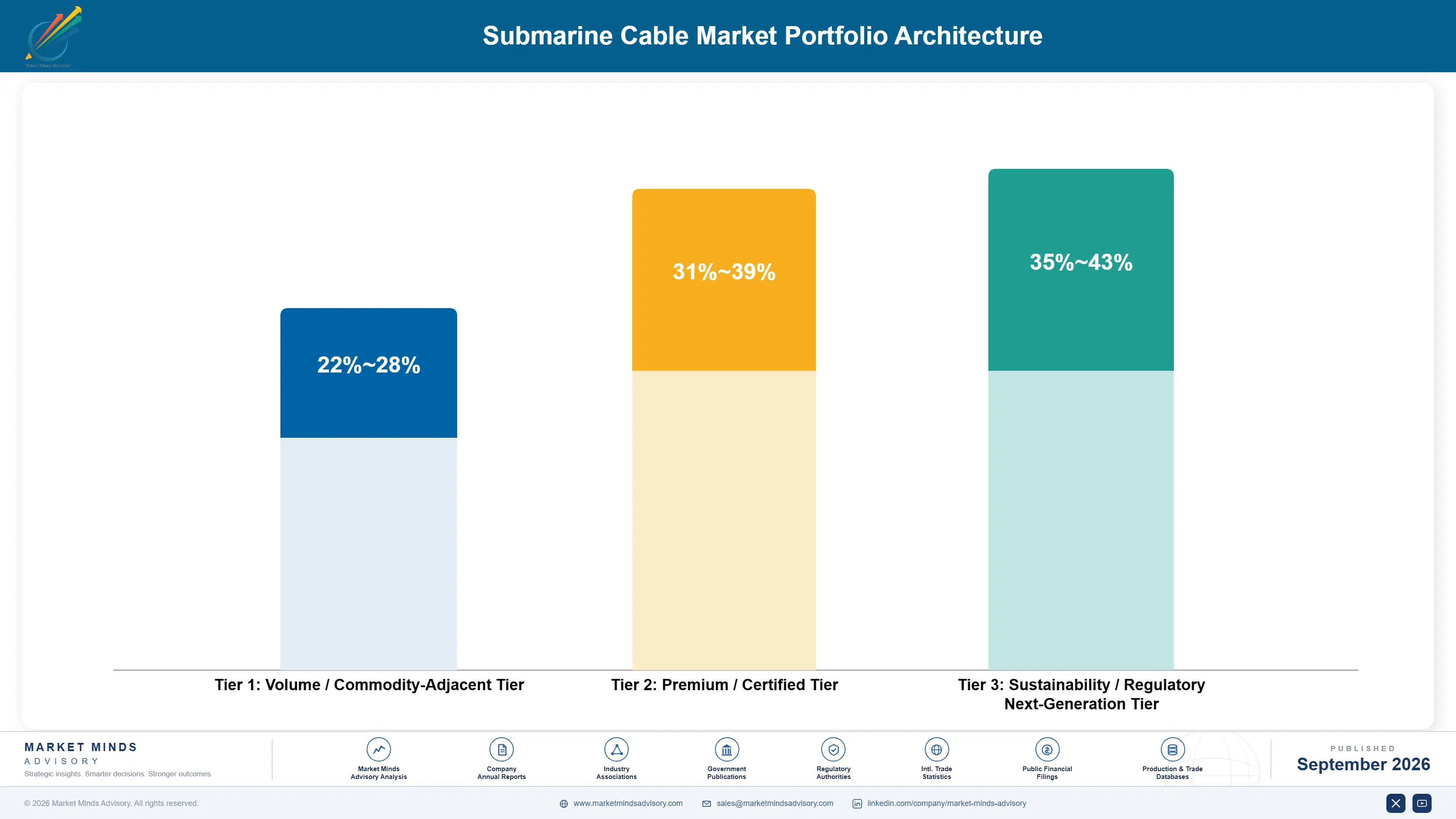
Submarine cables operate across three tiers with distinct margin profiles. Commodity-adjacent transoceanic and regional festoon formats compete heavily on price and carry thinner margins, while certified premium AI interconnect and hyperscale systems command superior pricing through capacity validation and manufacturing quality. The regulatory and sustainability tier, covering certification-linked and next-generation landing station products, is smaller but growing fastest and increasingly shapes manufacturer investment across the industry as a whole, reflecting shifting bandwidth mandates and evolving disclosure obligations under emerging procurement frameworks that apply broadly across the entire global submarine cable industry today still.
High-value pools concentrate in AI interconnect and hyperscale categories, where capacity validation and bandwidth sophistication compound over multiple product cycles rather than single-order transactions. Volume tension persists between price-competitive transoceanic platforms, which sustain scale and distribution reach, and premium AI interconnect categories that carry superior unit economics but noticeably slower certification timelines overall. Long-term supply agreements are compressing procurement costs across every tier simultaneously, narrowing the margin gap between commodity and premium segments over time, though the sustainability tier still commands the widest overall margin spread of the three by a fairly considerable margin still today.

Volume / Commodity-Adjacent Tier

Transoceanic and regional festoon formats compete primarily on price with manufacturer scale as the key advantage, sustaining gross margins near 22 to 28 percent given elevated fiber costs and thin per-unit spreads.
Gross Margin: 22%-28%

Premium / Certified Tier

Certified premium AI interconnect and hyperscale systems command superior pricing power through capacity validation and manufacturing quality, sustaining gross margins near 31 to 39 percent across most established regional hyperscaler channels today.
Gross Margin: 31%-39%

Sustainability / Regulatory / Next-Generation Tier

Certification-linked and next-generation landing station products carry the highest margins near 35 to 43 percent, reflecting scarcity value and regulatory tailwinds, though absolute volumes remain comparatively small across the industry today.
Gross Margin: 35%-43%
submarine-cables-market-portfolio-architecture-1788417295672

High-value Sub-segments and Strategic Watch-out

AI Data Center Interconnect Cable Systems

AI data center interconnect cable systems represent the highest-value, fastest-growing segment, combining capacity capability with expanding operator willingness to invest in comprehensive AI data center compliance, positioning early movers for durable margin advantages across the coming decade as adoption spreads across every major global hyperscaler category worldwide today still.
Gross Margin: 35%-43%

Hyperscale Cloud-Dedicated Cable Systems

Hyperscale cloud-dedicated cable systems carry high value with strong growth, anchored by accelerating hyperscaler demand for extended capacity transparency and mandatory network modernization requirements that sustain steady procurement inflows even as competition among manufacturers intensifies across most hyperscaler budgets globally today still and quite consistently now.
Gross Margin: 31%-39%

Transoceanic Long-Haul Cable Systems

Transoceanic long-haul cable systems remain the volume core of the market, generating reliable revenue through mandatory sustainment and carrier availability requirements even as margins stay compressed by fiber costs and intense price competition among manufacturers competing for the same mid-tier programs and regional hyperscaler tenders.
Gross Margin: 22%-28%

Cable Landing Station Infrastructure

Cable landing station infrastructure is a strategic watch-out segment, since AI interconnect substitution reviews could either accelerate demand for integrated certified landing station products or trigger competitive intervention that caps format flexibility going forward, leaving the segment's medium-term trajectory considerably less certain overall than other core lines today.
Gross Margin: 29%-35%

Supply Annuities and Buyer Turnover

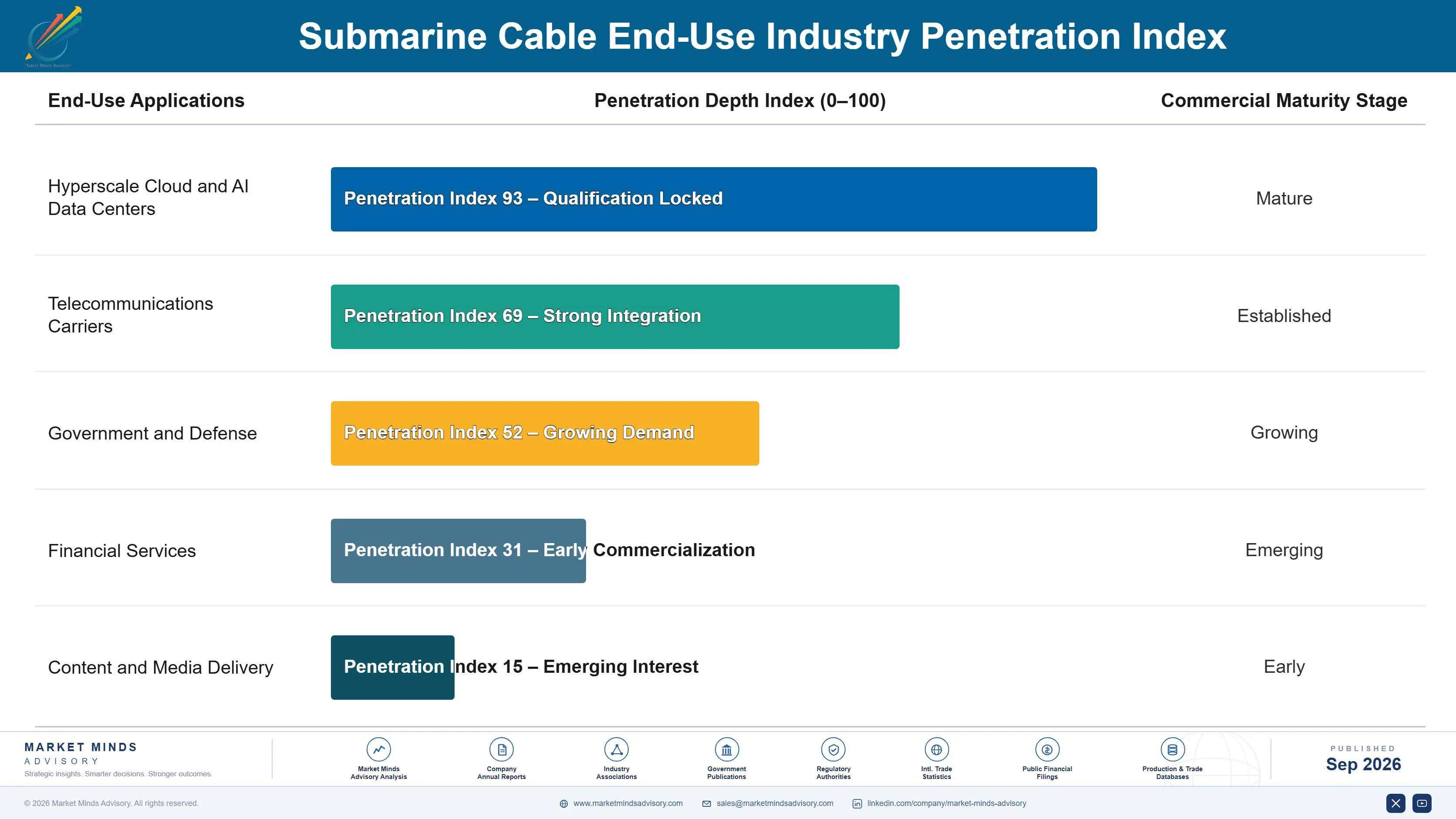
Long-term supply agreements generate annuity-like revenue streams that persist across multiple hyperscaler budget cycles once secured, since hyperscalers rarely switch manufacturer partners mid-program given the certification switching costs and consistency risk of disrupting an established network-wide capacity relationship. This locks in predictable revenue inflows that manufacturers can plan production capacity investment against with unusual precision, smoothing income across procurement cycles that would otherwise prove considerably volatile.
Adoption stickiness varies sharply by end-use vertical. AI interconnect and hyperscale relationships stay high due to established capacity commitments and certification requirements, while transoceanic contracts show shallower loyalty since comparison across manufacturer pricing options makes switching considerably easier for cost-conscious carriers, compressing average relationship duration across these specific product categories and procurement cycles over time considerably.

Buyer profiles are shifting generationally as younger network engineers favor data-driven capacity performance metrics and quantified AI interconnect certification over the relationship-driven manufacturer selection their predecessors relied on for decades, forcing incumbent manufacturers to rebuild sales infrastructure without abandoning the trusted hyperscaler relationships that established supply programs still expect from their lead manufacturer, a dual-track approach few manufacturers have yet fully resolved in practice overall.
submarine-cables-market-end-use-penetration-index-1788417296201

Where Submarine Cable Value Concentrates

These are among the four positions where our research anticipates prominent divergence between winners and laggards over the coming forecast period. Each is grounded in the demand model, the regulatory perimeter, and the announced capacity pipeline.
01 / AI INTERCONNECT INVESTMENT PRIORITY

Build Dedicated Capacity Capability Before Rivals Close the Gap

AI data center interconnect cable systems are growing at more than seventy percent above the market average and remain meaningfully underpenetrated relative to the scale of bandwidth optimization opportunity already emerging across major hyperscaler markets today. Manufacturers that delay dedicated AI interconnect investment risk ceding the fastest-growing deal category entirely to nimbler specialist entrants and well-capitalized market-validated providers already active in adjacent capacity segments. Early movers who build proprietary capacity infrastructure now will hold a durable sourcing advantage over slower-moving competitors for years to come.
02 / CERTIFICATION TIMELINE MANAGEMENT

Rebuild Modular Certification Architecture for Hyperscale Lines

Hyperscale cloud-dedicated cable systems anchor a growing share of the portfolio, but long certification timelines squeeze deployment speed for manufacturers still structured under older transoceanic-only manufacturing models developed years earlier under entirely different bandwidth requirements. Manufacturers must rebalance toward modular certification architecture and standardized qualification pathways to preserve delivery timelines without triggering hyperscaler confidence concerns during the multi-year transition period ahead. Manufacturers that fail to adapt certification capability quickly enough risk sustained deal erosion across their largest and fastest-growing product line.
03 / FIBER SOURCING RESILIENCE

Diversify Fiber Supply Ahead of the Next Volatility Cycle

Fiber and copper cost volatility is tightening as manufacturers respond to constrained global specialty fiber supply chains and growing qualified manufacturing demand across the broader submarine cable industry as a whole. Manufacturers with weaker fiber sourcing diversification face constrained margin capacity and materially higher input costs relative to well-prepared peers operating in the very same fragmented supply environment. Building fiber sourcing depth ahead of the next volatility cycle, rather than reactively during price spikes, preserves both margin flexibility and competitive standing across the entire industry.
04 / LEGACY PORTFOLIO HEDGING

Diversify Deal Sourcing Away From Single-Segment Dependence

Landing station growth depends partly on continued budget-conscious operator preference that sustains demand for integrated certified landing station products without requiring manufacturers to absorb prohibitive certification costs at the point of manufacturing. A sudden competitive shift toward AI interconnect substitution or mandating stricter capacity standards could abruptly slow this segment's growth trajectory within a fairly short window of time. Manufacturers should diversify deal sourcing away from single-segment dependence and build scenario plans for a less favorable substitution environment over the next several years ahead.

Engagement Snapshot From the Field

A live engagement with an industry participant carrying material or product regulatory and market exposure ahead of a defining policy shift, showing how our research translates into a defensible multi-year portfolio strategy.
MARKET MINDS ADVISORY · CLIENT ENGAGEMENT SUMMARY
Submarine Cable Producer Strategic Portfolio Review and Transition Roadmap 2026·Investment Scenario on Submarine Cable Exposure Evaluation 2025-26
CLIENT PROFILE
The client is a mid-sized submarine cable manufacturer producing transoceanic and regional festoon units for regional carrier and industrial customers, with several hundred million dollars in annual revenue (client-reported, unverified by MMA) and a product line built primarily around traditional transoceanic formats serving several carrier customers across the domestic and allied export markets nationwide today still further and consistently.
STRATEGIC CHALLENGE
The client faced eroding new contract growth as AI interconnect and hyperscale challengers offered validated capacity capability the incumbent's legacy transoceanic product line could not match. Leadership needed an independent assessment of which product categories to prioritize for capacity development given constrained transformation budget and multi-year certification timelines already underway across the industry.
MMA APPROACH
MMA conducted structured interviews with engineering, certification, and finance leadership alongside proprietary category-level growth and margin analysis benchmarked against regional and broader global submarine cable manufacturing peers. The engagement mapped production readiness against category revenue potential, quantified the revenue at risk from continued delay, and prioritized a phased AI interconnect rollout sequenced around the client's existing certification roadmap and budget cycle.
KEY FINDINGS
  1. AI interconnect-equipped cable lines showed twenty-one percent projected revenue CAGR (client-reported, unverified by MMA) versus roughly nine percent for legacy transoceanic lines across the client's core market.
  2. Development cost per unit ran twenty-five percent higher (client-reported, unverified by MMA) through legacy transoceanic channels compared to modular AI interconnect design approaches for comparable product categories.
  3. New contract win rate increased meaningfully in AI interconnect tenders, with hyperscaler buyers citing validated capacity capability as the primary reason for selecting the client over transoceanic-only competitors.
  4. Transoceanic and regional festoon manufacturing margins remained resilient overall, suggesting development investment should prioritize AI interconnect and hyperscale lines over already well-performing legacy categories first.
CLIENT PROFILE
The client is a mid-sized submarine cable manufacturer producing transoceanic and regional festoon units for regional carrier and industrial customers, with several hundred million dollars in annual revenue (client-reported, unverified by MMA) and a product line built primarily around traditional transoceanic formats serving several carrier customers across the domestic and allied export markets nationwide today still further and consistently.
STRATEGIC CHALLENGE
The client faced eroding new contract growth as AI interconnect and hyperscale challengers offered validated capacity capability the incumbent's legacy transoceanic product line could not match. Leadership needed an independent assessment of which product categories to prioritize for capacity development given constrained transformation budget and multi-year certification timelines already underway across the industry.
MMA APPROACH
MMA conducted structured interviews with engineering, certification, and finance leadership alongside proprietary category-level growth and margin analysis benchmarked against regional and broader global submarine cable manufacturing peers. The engagement mapped production readiness against category revenue potential, quantified the revenue at risk from continued delay, and prioritized a phased AI interconnect rollout sequenced around the client's existing certification roadmap and budget cycle.
KEY FINDINGS
  1. AI interconnect-equipped cable lines showed twenty-one percent projected revenue CAGR (client-reported, unverified by MMA) versus roughly nine percent for legacy transoceanic lines across the client's core market.
  2. Development cost per unit ran twenty-five percent higher (client-reported, unverified by MMA) through legacy transoceanic channels compared to modular AI interconnect design approaches for comparable product categories.
  3. New contract win rate increased meaningfully in AI interconnect tenders, with hyperscaler buyers citing validated capacity capability as the primary reason for selecting the client over transoceanic-only competitors.
  4. Transoceanic and regional festoon manufacturing margins remained resilient overall, suggesting development investment should prioritize AI interconnect and hyperscale lines over already well-performing legacy categories first.
RECOMMENDED STRATEGY
Phase 1: Phase 1 (Months 1-12): Phase one: develop capacity prototype for one product category within twelve months, carefully measuring contract win rate before any wider rollout. Phase 2: Phase 2 (Months 13-24): Phase two: rebuild engineering infrastructure for AI interconnect and hyperscale lines while retaining full existing capacity for transoceanic categories overall still. Phase 3: Phase 3 (Months 25-36): Phase three: extend AI interconnect models to remaining product categories and integrate hyperscaler data across programs to support certified cross-sell fully.
OUTCOME
Within eighteen months of the phased rollout, the client reported a twenty percent improvement in new contract wins and an eight-point increase in export market share (client-reported, unverified by MMA), alongside measurably improved hyperscaler buyer confidence and loyalty across the pilot product category and manufacturer.

Frequently Asked Questions

Foundational context covering the market sizes, CAGR, scope, country, region and competition that inform every finding below. This section is provided to cover basics and most often pre-purchase conversations, answered from the MMA Primary Research Dataset.

What is the current size of the Submarine Cable Market?

The Submarine Cable Market is valued at 18.0 billion US dollars in 2025. This figure reflects revenue across transoceanic, AI interconnect, hyperscale, and regional festoon product categories globally.

How large will the Submarine Cable Market be by 2036?

The market is projected to reach 46.45 billion US dollars by 2036. This represents a 2.37 times expansion over the eleven-year forecast period beginning in 2026.

What is the CAGR for the Submarine Cable Market 2026 to 2036?

The market is forecast to grow at a 9.0 percent compound annual growth rate. The bull case reaches 10.3 percent while the bear case falls to 7.8 percent.

Which segment is growing fastest?

AI data center interconnect cable systems lead growth at 16.0 percent CAGR, roughly 1.78 times the overall market rate. Transoceanic connectivity expansion and bandwidth optimization demand anchor this segment's expansion.

Who are the major companies in the Submarine Cable Market?

SubCom LLC, Alcatel Submarine Networks, NEC Corporation, HMN Technologies, and Nokia Corporation lead the market. Together the top five hold an estimated 72 percent combined share of total production revenue.

Which country is growing fastest?

South Asia and Pacific leads regional growth at 13.0 percent, driven by India's expanding network manufacturing base. The United States still anchors the largest absolute production revenue share globally.

Report Segmentation Architecture

The full report scope spans multiple orthogonal segmentation dimensions, with cross-tabulated demand data provided for each dimension pair. Coverage extends further to regional breakdowns, trend trajectories, and the competitive detail needed to support segment-level decision-making.

By Network Function and Bandwidth Architecture

  • Transoceanic Long-Haul Cable Systems
  • Regional and Festoon Cable Systems
  • AI Data Center Interconnect Cable Systems
  • Hyperscale Cloud-Dedicated Cable Systems
  • Repair and Maintenance Services
  • Cable Landing Station Infrastructure

By End-Use Industry

  • Hyperscale Cloud and AI Data Centers
  • Telecommunications Carriers
  • Government and Defense
  • Financial Services
  • Content and Media Delivery

By Commercial Dimension

  • Direct Hyperscaler Procurement
  • Consortium and Carrier Partnerships
  • Long-Term Supply Agreements
  • Aftermarket Repair and Maintenance

By Region

  • North America
  • Western Europe
  • East Asia
  • South Asia and Pacific
  • Latin America
  • Middle East and Africa
  • Eastern Europe

Scope, Methodology, and Coverage

Every figure in this report is reproducible from documented input assumptions. The scope below maps the historical period, the forecast horizon, the segmentation dimensions, and the countries covered, alongside the underlying primary and qualitative methodology.
Historical Period
2020 to 2025
Forecast Period
2026 to 2036
Base Year
2025 (USD billions; MMA Primary Research Dataset, September 2026)
Market Definition
The Submarine Cable Market covers transoceanic long-haul cable systems, regional and festoon cable systems, AI data center interconnect cable systems, hyperscale cloud-dedicated cable systems, repair and maintenance services, and cable landing station infrastructure. It excludes terrestrial fiber optic networks, standalone satellite communication systems, and non-submarine undersea power transmission cables.
Quantitative Units
USD billions (current prices); route kilometer volume where applicable
Segmentation Dimensions
By Network Function and Bandwidth Architecture; By End-Use Industry; By Commercial Dimension; By Region
Regions Covered
North America, Western Europe, East Asia, South Asia and Pacific, Latin America, Middle East and Africa, Eastern Europe
Countries Covered
USA, China, Germany, France, UK, Japan, South Korea, India, Australia, Canada, Brazil, Chile, Indonesia, Vietnam, Thailand, Malaysia, UAE, Saudi Arabia, South Africa, Egypt, Turkey, Poland, Ireland, Italy, Netherlands, Spain, Singapore, Argentina, and additional markets relevant to this sector
Key Companies Profiled
SubCom LLC, Alcatel Submarine Networks, NEC Corporation, HMN Technologies, Nokia Corporation, Hengtong Marine, ZTT Marine, Prysmian Group, Corning Incorporated, Xtera Communications, Ciena Corporation, Infinera Corporation, Global Marine Group, Elettra Tlc, Orange Marine, KDDI Cable Ship, NTT World Engineering Marine, ASEAN Cableship, E-Marine, Fujitsu Limited
Quantitative Methodology
Primary survey, n=3,800 respondents, Q4 2025, six countries; demand-side model with trade association cross-validation
Qualitative Methodology
47 expert interviews, Q4 2025; applied to validate demand model assumptions, identify emerging dynamics, and assess competitive positioning
Report Format
PDF and XLSX data workbook (Word format preview document)
Publisher
Market Minds Advisory
Report Code
MMA-2026-TEC-525
Published
September 2026
Contact
sales@marketmindsadvisory.com | www.marketmindsadvisory.com

Purchase the full Submarine Cable Market Report (2026 to 2036).

This report delivers a comprehensive assessment of the Submarine Cable Market, covering segmentation, competitive positioning, and regional production flows through 2036. It quantifies revenue opportunity across six product segments and profiles the twenty leading market participants operating across transoceanic, AI interconnect, and hyperscale categories nationwide and globally. Analysts detail certification timeline dynamics alongside fiber cost exposure, AI data center demand, and mitigation strategies manufacturers are actively pursuing today. The report supports strategic planning for manufacturers, operators, and hyperscaler investors evaluating opportunities across the entire global submarine cable landscape.
Six-segment network function market breakdown overview
Twenty-company competitive profiling and moat analysis
Seven-region production and demand growth modeling
Certification timeline and mitigation pathway detail
Fiber cost exposure and volatility analysis
Ten-year revenue forecast with scenario bands

Built For The People Who Decide

From boardroom strategy to bench-side execution, this report is read cover-to-cover by leaders shaping the next decade of their industry, turning demand scenarios, market dynamics and valuation benchmarks into decisions.
CXOs/ Presidents/ VPs/ Managers
M&A and Corporate Development
Strategy Teams and R&D Heads
Procurement and Product Directors
Regulatory and Compliance Leaders
Investor Relations and Equity Analysts