Market Minds Advisory
Western Europe Submarine Cable Market

Western Europe Submarine Cable Market: Laying the Physical Backbone Behind the Data Economy

Hyperscale cloud operators funding their own transoceanic cable systems are displacing telecom carrier consortiums as the primary customer for new submarine cable capacity across every major transatlantic route worldwide today.

Lead Analyst

Published

September 2026

Make Smarter Decisions with Customized Research Insights

Request a free sample report and evaluate market opportunities, growth trends, and competitive dynamics relevant to your business needs.

2025 MARKET VALUE$5.8BMarket Size 2025
2036 FORECAST VALUE$9.9BBase Case , 2026 to 2036
CAGR 2026 TO 20365.0 %Bull 6.3% / Bear 3.8%
INCREMENTAL OPPORTUNITY$3.8BNet 10- year value creation
EXPANSION MULTIPLE1.63x2036 value over 2026 base
Strategic Levers
M&A Pipeline
Regional Outlook
Country Rankings
Competitive Intelligence
Segmental Deep-dive
Call-Us : 91 93563 13602

Executive Snapshot and Market Trajectory.

Hyperscale cloud operators funding their own transoceanic cable systems are displacing telecom carrier consortiums as the primary customer for new submarine capacity, a shift that has fundamentally changed who controls fibre pair allocation on the newest transatlantic and transpacific routes across the industry worldwide today.
Western Europe's dense landing station infrastructure at Marseille, Lisbon, and Porthcurno anchors the region's role as a global cable routing hub, with new systems increasingly designed to connect European landing points directly to hyperscaler data centre clusters rather than routing traffic through traditional carrier exchange points first. Transoceanic long-haul systems are expanding fastest as artificial intelligence training data transfer demand pulls forward capital that would otherwise have gone toward incremental upgrades of existing capacity.
Competitive dynamics remain tightly concentrated among a handful of manufacturers capable of building and laying a full transoceanic system, with SubCom and Alcatel Submarine Networks holding a durable lead built over decades of installed track record across dozens of major global routes. Chinese supplier HMN Technologies is expanding aggressively outside the traditional Western alliance structure, while security reviews increasingly restrict bidding near sensitive infrastructure sites in allied nations.
Market Definition
This market covers submarine fibre optic cable systems used for intercontinental and regional data transmission, including the cable itself, repeaters, and landing station terminal equipment. It excludes terrestrial fibre backbone networks and satellite communication systems.
Base Year Value
$5.8B in 2025 (MMA Primary Research Dataset, September 2026)
Forecast Period
2026 to 2036, eleven discrete annual values
CAGR
5.0% base case. Bull 6.3%. Bear 3.8%.
Fastest Growth Segment
Transoceanic Long-Haul Cable Systems: 6.5% CAGR
Fastest Growth Country
United States: 7.2% CAGR
Fastest Growth Region
South Asia and Pacific: 7.0% CAGR
Largest Region
Western Europe: 26% of 2025 global value
Market Leaders
SubCom, Alcatel Submarine Networks, NEC Corporation, HMN Technologies, Prysmian Group. Source: MMA Analysis based on company annual reports and investor filings.
Primary Survey
n=3,800 procurement and R&D decision-makers, Q4 2025, six countries
Methodology
Demand-side build-up, cross-validated against public data, 47 expert interviews

Western Europe Submarine Cable Market Forecast Scenarios

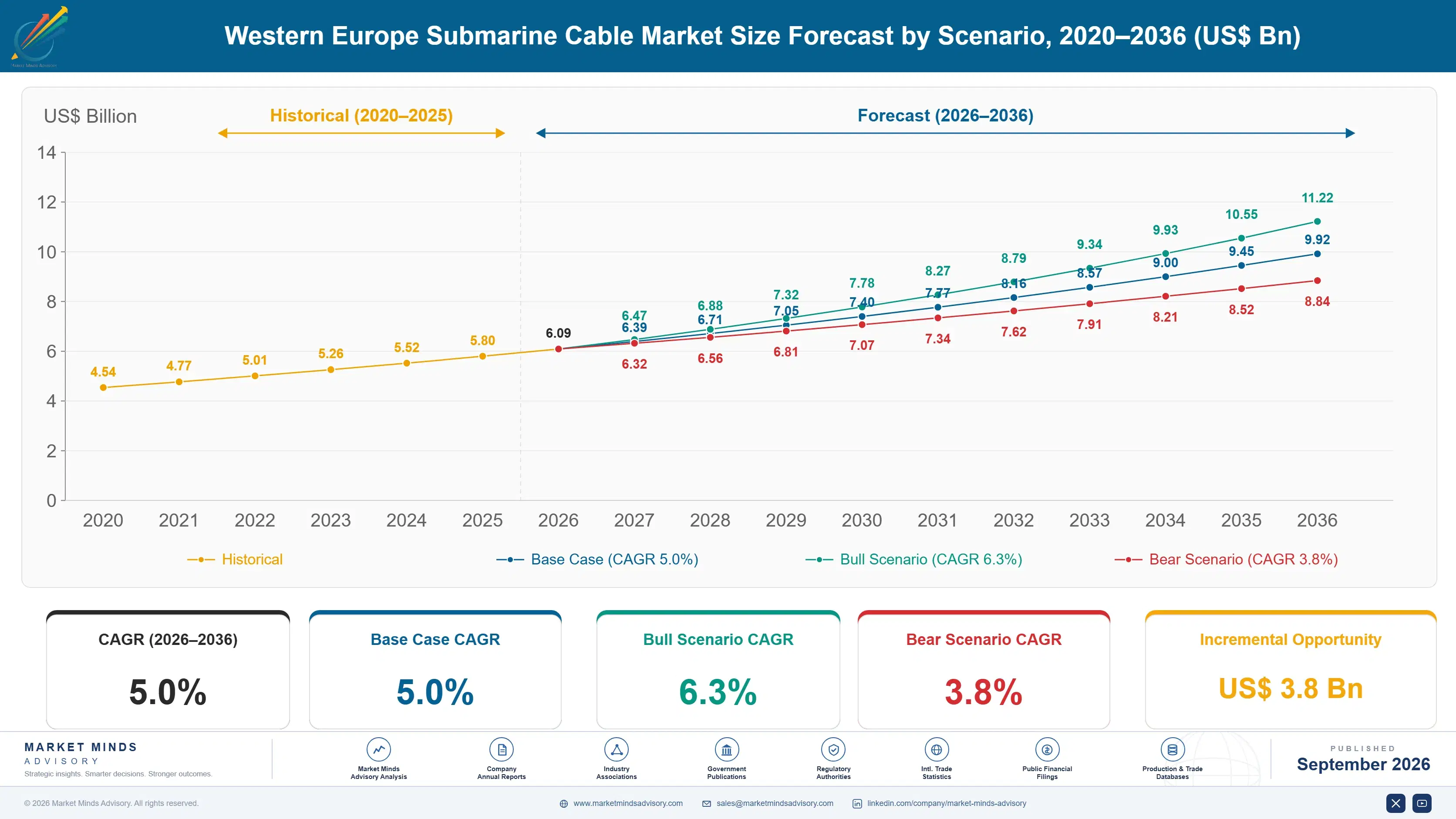
submarine-cable-industry-analysis-in-western-europ-size-forecast-scenario-1790000388209
Between 2020 and 2025, the market grew steadily as hyperscale cloud operators began directly funding transoceanic cable systems rather than purchasing capacity from carrier-led consortiums, a shift that accelerated meaningfully once artificial intelligence workloads began driving intercontinental data transfer volumes well past the levels traditional carrier forecasts had ever anticipated seeing in a single decade.
The base case assumes continued hyperscaler-funded transoceanic system construction, steady conversion of ageing 1990s and 2000s-era cable systems approaching end of design life, and expanding demand for diversified routing following several high-profile cable damage incidents. These three mechanisms together explain most of the forecast expansion, with hyperscaler-funded construction contributing the largest incremental share as cloud operators increasingly prefer owning dedicated fibre pairs outright rather than leasing shared capacity from a carrier consortium.
A bull scenario centres on faster-than-expected artificial intelligence data centre buildout driving additional transoceanic capacity orders beyond current planning assumptions. The principal bear risk is a prolonged global vessel capacity shortage, since the small number of specialised cable-laying ships worldwide cannot expand quickly, which would delay new system delivery schedules by multiple years across the entire industry regardless of available capital.

Who Actually Controls New Cable Capacity

Three forces are converging on cable system procurement simultaneously. Hyperscale operators want dedicated fibre pairs they control directly rather than leased carrier capacity, governments want route diversity away from single points of failure following recent damage incidents, and manufacturers want longer order books, forcing them to balance genuinely conflicting customer priorities within the same project. These pressures rarely align neatly on their own.
MARKET CONCENTRATIONCR5 72%top vendors hold an extraordinarily dominant combined share
AVERAGE SYSTEM COSTUSD 350 millionreflects growing scale of transoceanic system construction contracts
LEADING COUNTRY SHAREUnited States 24%largest single national hyperscaler capital funding source overall
VESSEL FLEET UTILISATION94%leaves almost no spare capacity for unplanned repairs
HYPERSCALER-FUNDED SHARE41%growing steadily as cloud operators fund systems directly
AVERAGE SYSTEM DESIGN LIFE25 yearsshortening slightly as newer fibre technology matures faster
Commercially, this market behaves like a large infrastructure procurement cycle rather than a subscription business: customers negotiate multi-year construction contracts covering an entire system, then a small number of manufacturers compete on technical capability and delivery schedule within a genuinely limited global vessel capacity pool rather than pursuing open ongoing competition. Individual spot contracts still occur occasionally but represent a shrinking share of total industry order value each year.
Over the next decade, expect continued share concentration among the manufacturers with the deepest vessel fleets and system design track record, as hyperscale customers increasingly favour proven delivery certainty over marginal price differences on projects worth hundreds of millions of dollars each. Manufacturers slow to expand vessel capacity risk losing share even where their underlying system design remains genuinely competitive.
"Nobody buys a transoceanic cable system on price alone, they buy it on whether the vendor's last five systems actually landed on schedule."
Director, Telecommunications Infrastructure Practice · MMA Technology / Telecommunications Infrastructure Practice · September 2026

Market Trends

Hyperscalers Fund Systems Directly Rather Than Lease Capacity

Google, Meta, Amazon, and Microsoft have each funded or co-funded multiple transoceanic cable systems directly over the past several years, taking dedicated fibre pair ownership rather than leasing capacity from carrier-led consortiums as was standard practice for decades. This shift gives hyperscalers direct control over routing decisions and capacity upgrade timing, which matters increasingly as artificial intelligence workloads require predictable, high-capacity intercontinental links between data centre clusters. Manufacturers report hyperscaler-funded contracts now represent a meaningfully larger order share than carrier consortium contracts did just a few years earlier. That shift is reshaping how manufacturers plan vessel fleet allocation each planning.
Market Impact: Lifts transoceanic orders 14 percent yearly
Cable Damage Incidents Push Route Diversification Investment

A series of high-profile submarine cable damage incidents, some attributed to anchor drag and others to deliberate interference, has pushed governments and carriers to fund additional redundant routes rather than relying on a small number of existing systems for critical intercontinental connectivity. The European Commission has explicitly cited cable resilience as a strategic priority in its digital infrastructure planning, encouraging investment in geographically diverse landing points away from previously concentrated routing corridors. This has created genuine new demand for regional and festoon systems specifically designed to provide alternative routing rather than simply adding raw capacity.
Market Impact: Adds 9 percent replacement demand annually

Market Opportunities and Growth Drivers

Artificial Intelligence Workloads Drive Intercontinental Capacity Demand

Training large artificial intelligence models increasingly requires transferring enormous datasets between data centre clusters located on different continents, driving demand for intercontinental cable capacity well beyond what traditional consumer internet traffic growth alone would justify. Hyperscale operators building dedicated artificial intelligence training infrastructure are the fastest-growing customer segment for new transoceanic systems, prioritising raw capacity and low latency over redundancy considerations that traditionally dominated carrier consortium planning. This has reshaped which projects receive scarce vessel scheduling slots each year. Manufacturers report this demand has pulled forward capital previously expected to arrive years later in typical upgrade cycles.
Market Impact: Limits installation capacity to 94 percent

Ageing Cable Systems Approach End of Design Life

A meaningful share of cable systems installed during the late 1990s and early 2000s telecommunications buildout are approaching or exceeding their original twenty-five-year design life, requiring replacement or major capacity augmentation as repeater technology in these older systems can no longer support demand at competitive per-bit transmission cost. Manufacturers report a steady pipeline of replacement orders as carriers and government infrastructure funds recognise that operating ageing systems risks unplanned failure with no readily available spare capacity elsewhere in the network, a baseline demand expected to persist for at least another decade.
Market Impact: Adds 8 months to approval timelines

Market Restraints and Challenges

Specialised Vessel Fleet Capacity Cannot Expand Quickly

The global fleet of specialised cable-laying vessels numbers only a few dozen ships capable of handling deep ocean submarine cable installation, and building a new vessel takes several years and hundreds of millions of dollars in capital investment. The root cause is the highly specialised nature of these vessels, which require purpose-built cable tanks and precision positioning systems that cannot be adapted from general-purpose maritime vessels. Manufacturers are mitigating the constraint by scheduling installation work years in advance and investing jointly with customers in dedicated vessel capacity reservations to guarantee delivery timing on the largest projects.
Market Impact: Lifts hyperscaler-funded share by 41 percent

Security Reviews Delay Contracts Near Sensitive Infrastructure

Several Western governments have introduced formal security review processes for submarine cable systems landing near sensitive military or critical infrastructure sites, adding months to project approval timelines beyond the technical construction schedule itself. The underlying cause is genuine concern about foreign state access to physical infrastructure carrying sensitive government and commercial data traffic, a concern that has intensified following several publicised incidents involving suspected deliberate cable interference. Manufacturers are mitigating the delay by engaging security reviewers earlier in project planning, before formal permits are even submitted. These earlier engagement practices have gradually shortened average review durations across several jurisdictions.
Market Impact: Adds 12 percent to route investment
3 additional market trends, 4 additional growth drivers, and 2 additional restraints and challenges are covered in the full report. Contact sales@marketmindsadvisory.com to access the complete intelligence.

Segment CAGR and Growth Architecture

The market segments by cable system type and function rather than by customer type, since the same manufacturer typically designs, builds, and installs the complete system regardless of whether the ultimate customer is a hyperscale operator or a traditional carrier consortium funding the project directly under a long-term multi-year construction contract negotiated in advance.
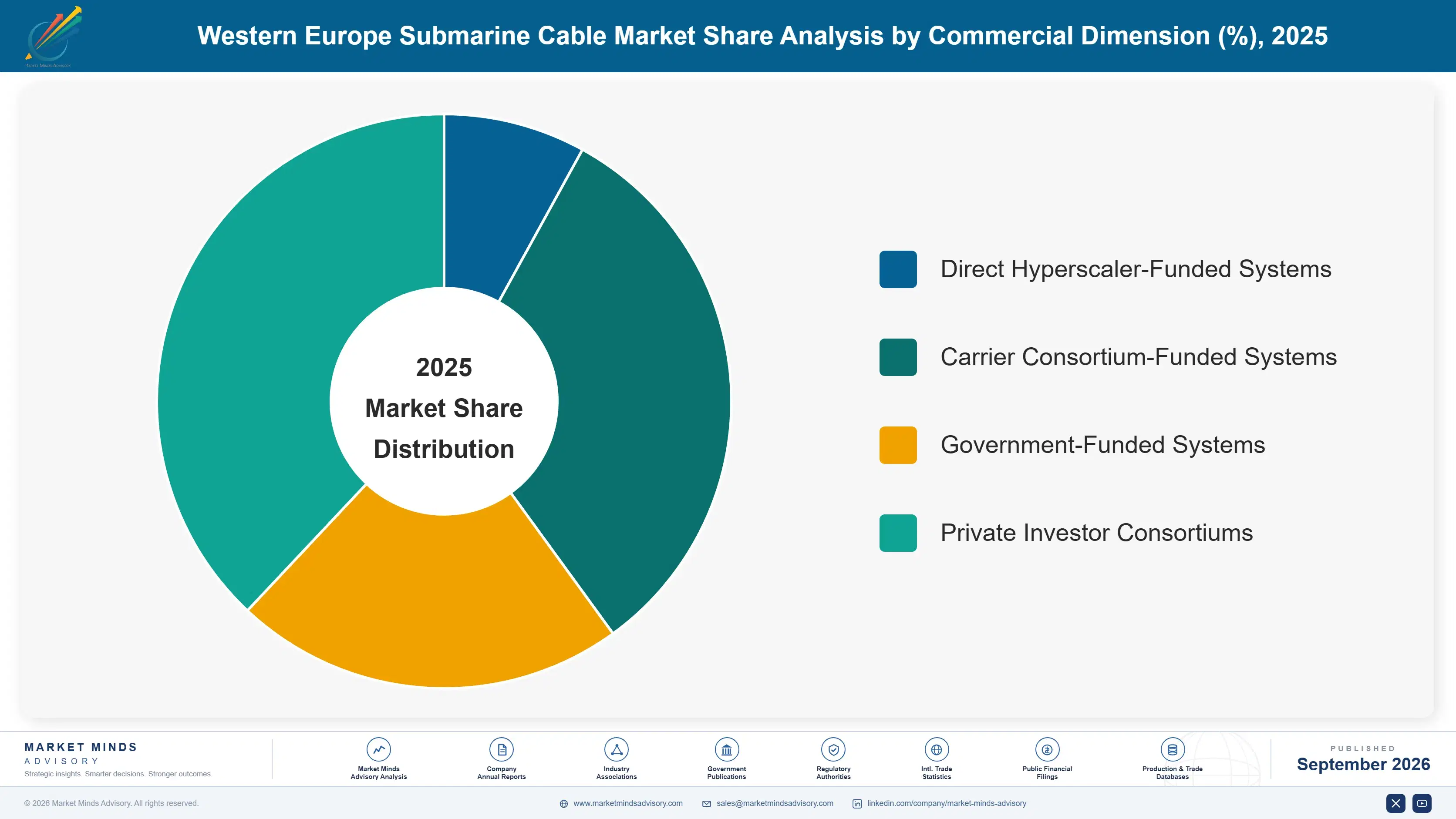
submarine-cable-industry-analysis-in-western-europ-market-share-analysis-1790000388750

Transoceanic Long-Haul Cable Systems

This segment covers cable systems spanning entire oceans, connecting continents directly across transatlantic, transpacific, and other intercontinental routes. Demand has accelerated sharply as hyperscale cloud operators fund dedicated systems to support artificial intelligence workloads requiring predictable, high-capacity connectivity between data centre clusters on different continents. Western European landing points including Marseille and Lisbon anchor several of the newest transatlantic systems, reflecting the region's established role as a global cable routing hub with existing terrestrial fibre connectivity to major European data centre markets. Manufacturers are racing to increase per-cable fibre pair count, since customers increasingly want more total capacity from each system given how scarce vessel installation capacity remains across the industry.
CAGR 6.5%

Regional and Festoon Cable Systems

This segment covers shorter cable systems connecting nearby countries or providing coastal connectivity along a single landmass, typically installed to add route diversity or connect smaller markets that do not justify a dedicated transoceanic system. Growth is fastest among governments funding redundant regional routes following recent high-profile cable damage incidents that exposed how concentrated some countries' international connectivity had become on a small number of existing systems. Adoption is concentrated in the Mediterranean and Baltic Sea regions, where multiple countries share relatively short maritime distances that make festoon systems commercially viable. Vendors increasingly pitch these systems specifically on resilience grounds rather than raw capacity economics alone, a shift in sales positioning.
CAGR 5.5%
Full segment breakdown across 6 segments available in the complete report.

Regional Architecture and Country Demand Map

Western Europe anchors the market through its dense landing station infrastructure and central role in global cable routing, while North America leads on hyperscaler-funded system capital and East Asia follows closely behind on transpacific route expansion investment across the wider region as a whole overall.

North America

United States hyperscale operators including Google, Meta, Amazon, and Microsoft fund or co-fund a disproportionate share of new transoceanic systems globally, giving North America the largest single source of cable system capital even though landing infrastructure itself is more concentrated in Western Europe and East Asia. Virginia's data centre cluster near Washington DC has become a major landing point specifically because of its proximity to hyperscaler infrastructure rather than any traditional carrier exchange history. Canadian landing stations serve a smaller but steady role connecting into transatlantic systems that continue onward to Western Europe. Federal security reviews of new cable landing permits have added months to project timelines for systems landing near sensitive government or military infrastructure sites along the eastern.
Share: 25% | CAGR: 6.0% (2026 to 2036)

Western Europe

Marseille, Lisbon, and Porthcurno together anchor the region's position as the world's most important cable routing hub, benefiting from decades of accumulated terrestrial fibre connectivity into every major European data centre market and financial centre. France's position at the crossroads of transatlantic, Mediterranean, and Asia-bound systems gives it a durable routing advantage that newer landing markets cannot easily replicate given how much existing terrestrial infrastructure already converges there. Portugal has actively courted new system landings through favourable permitting, positioning Lisbon as an alternative to increasingly congested landing sites further north. The European Commission's cable resilience strategy is pushing additional investment toward geographically diverse landing points away from the historically concentrated southern French coast corridor.
Share: 26% | CAGR: 3.8% (2026 to 2036)
Regional intelligence for 5 additional markets available in the complete report: East Asia, South Asia and Pacific, Latin America, Middle East and Africa, Eastern Europe. Contact sales@marketmindsadvisory.com.
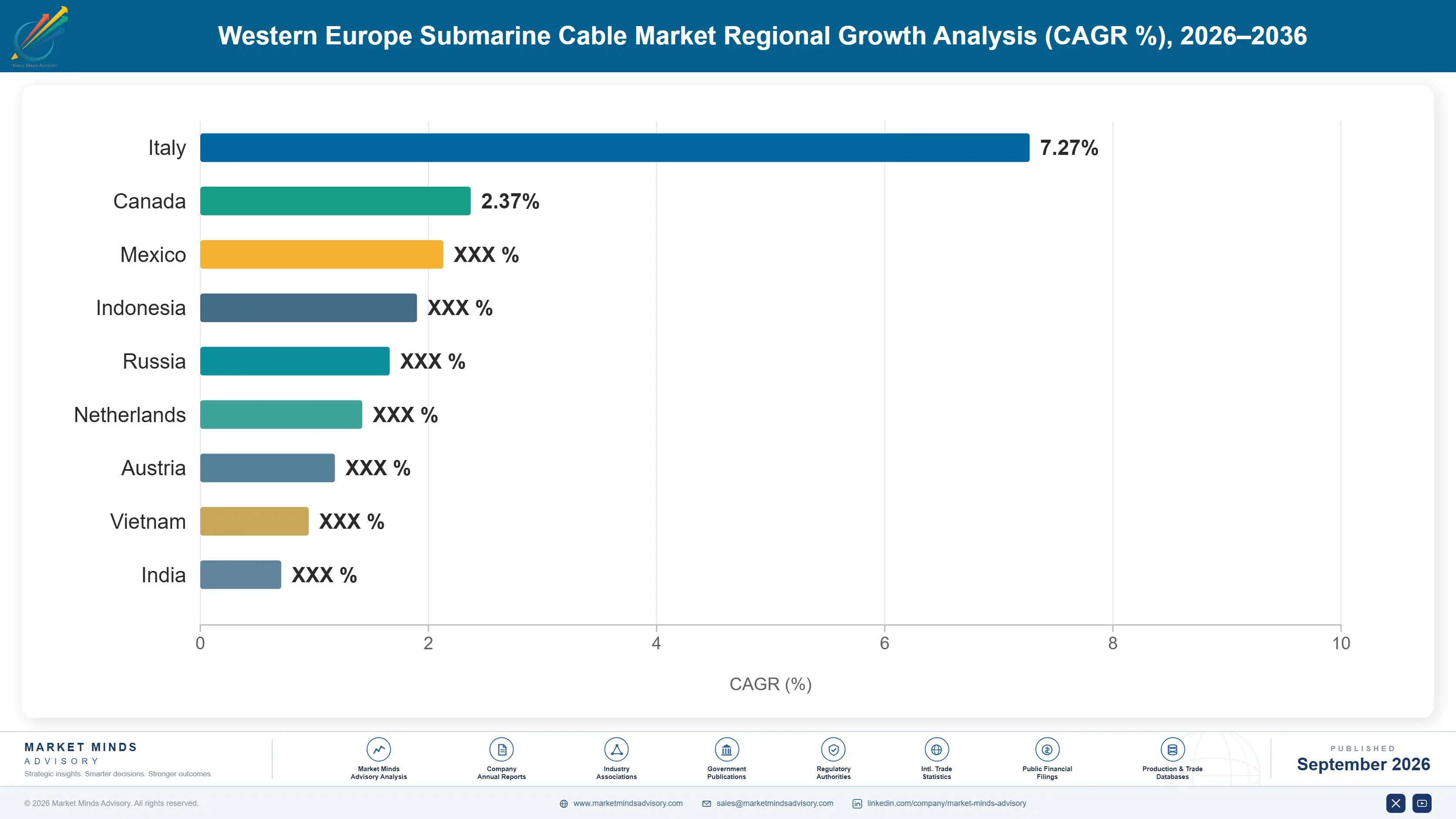
submarine-cable-industry-analysis-in-western-europ-country-cagr-analysis-1790000389302

How Manufacturers Are Growing Contract Value

Manufacturers expand revenue less through winning entirely new customers than through capturing a larger share of each hyperscale operator's expanding capital budget, since the small number of companies capable of building a full transoceanic system already know every major potential customer personally through years of prior project relationships and repeat contract negotiations across multiple systems.

Securing Multi-System Framework Agreements With Hyperscalers

Manufacturers that negotiate framework agreements covering multiple future systems with a single hyperscale customer, rather than competing for each individual project separately, secure meaningfully more predictable revenue and can plan vessel fleet allocation years in advance rather than reacting to individual contract awards. This lever has become increasingly valuable as hyperscale capital budgets for cable infrastructure have grown substantially, giving manufacturers with existing framework relationships a durable advantage over competitors still winning business project by project. SubCom's framework agreement approach has reportedly captured roughly 28 percent more repeat business from its largest customers.
Market Impact: Raises repeat business share by roughly 28 percent

Bundling Long-Term Maintenance Service Contracts Early

Manufacturers increasingly attach multi-year maintenance and repair contracts to new system sales, creating a recurring revenue stream distinct from the original construction contract and deepening the relationship a customer maintains with a single vendor over the system's entire twenty-five-year design life. This lever has grown steadily as hyperscale operators and governments alike prefer a single accountable vendor for ongoing system health rather than coordinating separate maintenance providers. Manufacturers that skip this bundling step during initial negotiations rarely capture it once a system is already installed and operating. Maintenance now represents roughly 15 percent of total industry revenue.
Market Impact: Contributes roughly 15 percent of total annual revenue

Reserving Dedicated Vessel Capacity for Priority Customers

Manufacturers that offer guaranteed vessel capacity reservations to their largest customers, in exchange for a capacity reservation premium, capture additional revenue while providing the delivery certainty hyperscale customers increasingly demand given how constrained the global specialised vessel fleet remains. This lever directly addresses the single biggest customer complaint in the industry, namely unpredictable installation scheduling, and manufacturers that can genuinely guarantee a delivery window command a meaningful pricing premium of roughly 9 percent over standard scheduling terms. Customers increasingly treat guaranteed delivery windows as a genuine differentiator worth paying for directly.
Market Impact: Commands roughly a 9 percent pricing premium overall

Expanding Landing Station Equipment and Integration Services

Manufacturers increasingly sell landing station terminal equipment and integration services alongside the core cable system, capturing additional contract value from customers who previously sourced this equipment separately from a different specialised supplier entirely. This has extended the average total contract value per system meaningfully, since landing station integration work requires specialised technical expertise that few customers maintain in-house, giving manufacturers with strong integration capabilities a genuine cross-selling advantage worth roughly 11 percent of total system contract value. Manufacturers without this integration capability increasingly lose the associated contract value to a specialised competitor entirely.
Market Impact: Adds roughly 11 percent to total contract value

Who Controls the Margin Pool

Concentration sits at a CR5 near 72 percent, extraordinarily high even for infrastructure hardware, with a durable gap between SubCom and Alcatel Submarine Networks as the two scale leaders and challengers such as NEC and HMN Technologies that compete hardest in specific regional markets rather than globally. That gap has narrowed only slightly as challengers invest heavily in matching vessel fleet capacity.
Current competitive activity centres on three fronts: securing multi-system framework agreements with the largest hyperscale customers, expanding vessel fleet capacity to reduce the industry's single biggest delivery bottleneck, and navigating security reviews that increasingly restrict which suppliers can bid on systems landing near sensitive infrastructure in Western-aligned markets. Manufacturers pursuing all three fronts simultaneously are pulling ahead of rivals still focused narrowly on one.

Emerging pressure is coming from HMN Technologies, which is winning share aggressively in markets outside the traditional Western alliance structure even as security concerns limit its access elsewhere. Rankings could shift meaningfully if security restrictions expand further, permanently splitting the addressable market along geopolitical lines rather than purely competitive ones. Customers evaluating HMN Technologies increasingly weigh geopolitical exposure alongside price and delivery schedule.
submarine-cable-industry-analysis-in-western-europ-company-positioning-matrix-1790000389900

Competitive Moat and Risk Dimensions

SUBCOM LLC

Moat: Deep Hyperscaler Customer Relationships

SubCom has built direct, long-standing relationships with the largest United States hyperscale operators funding transoceanic systems, giving it privileged access to the fastest-growing segment of industry demand. These relationships took years of successful project delivery to establish and are difficult for a newer entrant to replicate quickly given how much trust hyperscale customers place in proven delivery track record.
SUBCOM LLC

Risk: Vessel Fleet Capacity Constraints

SubCom's growth is fundamentally limited by its own specialised vessel fleet size, since building additional cable-laying ships takes years and hundreds of millions of dollars in capital investment. Competitors with more available vessel capacity could win contracts purely on faster delivery scheduling even where SubCom holds a stronger customer relationship.
ALCATEL SUBMARINE NETWORKS

Moat: Broadest Global System Track Record

Alcatel Submarine Networks has installed systems across more distinct global routes than any competitor, giving it design and installation experience spanning a wider range of seabed conditions and regulatory environments than rivals with more geographically concentrated track records. That breadth of experience gives customers meaningful confidence when a route presents unusual technical challenges.
ALCATEL SUBMARINE NETWORKS

Risk: European Manufacturing Cost Exposure

Alcatel Submarine Networks manufactures core cable and repeater components in Western European facilities with meaningfully higher labour and energy costs than Chinese competitors, compressing margin on price-competitive bids in markets where customers do not carry the same security-driven preference for Western-manufactured systems. Sustained cost pressure could meaningfully compress margin over the coming several fiscal years without offsetting efficiency gains.

Players Tracked

Prominent Players

SubCom LLC
Alcatel Submarine Networks
NEC Corporation
HMN Technologies Co Ltd
Prysmian Group

Other Key Players

Nexans SA
NKT A/S
Corning Incorporated
Xtera Communications Inc
OFS Fitel LLC
Global Marine Group
Orange Marine
IT International Telecom Inc
Elettra Tlc SpA
E-marine LLC
KDDI Cable Ship Company Ltd
ZTT Group
Hengtong Group
Fugro NV
TE Connectivity Ltd

Recent Developments

JANUARY 2026

SubCom Launches New Cable-Laying Vessel

SubCom organically expanded its own installation capacity by launching a new purpose-built cable-laying vessel specifically designed to serve growing transatlantic and transpacific hyperscaler demand. The vessel was built and crewed internally rather than through a partner arrangement, adding meaningful capacity at a moment when industry-wide vessel availability remains constrained.
Signal: Dedicated vessel capacity expansion is quickly becoming a genuine competitive necessity for every major scale player
SEPTEMBER 2025

Alcatel Submarine Networks Signs Hyperscaler Supply Agreement

Alcatel Submarine Networks signed a multi-year supply agreement with a consortium of hyperscale cloud operators covering construction of a new transatlantic system connecting Western Europe directly to the United States east coast. The agreement was a supply contract rather than a joint venture, adding substantial dedicated transatlantic fibre capacity.
Signal: Hyperscaler consortium funding is quickly becoming the clear default model for building every new transoceanic system
APRIL 2026

HMN Technologies Acquires Regional Cable Maintenance Firm

HMN Technologies completed the acquisition of a smaller regional cable maintenance and repair firm, expanding its aftermarket service capability ahead of growing its own system installation business outside traditional Western-aligned markets. The acquisition strengthens HMN Technologies' aftermarket position ahead of expanding its own installation business further.
Signal: Challenger vendors are steadily and quite deliberately vertically integrating to compete on full lifecycle service offerings

What Drives Cable System Cost

Specialised optical fibre and repeater electronic components together represent 35 to 42 percent of cost of goods sold for cable system manufacturers, sourced primarily from a small number of specialised fibre optic and semiconductor suppliers concentrated in Japan, the United States, and Western Europe. Vendor-owned upstream fibre production remains rare, since building dedicated capacity exceeds what most manufacturers choose to spend.
Copper and specialised polymer sheathing material pricing rose meaningfully during 2022, a period documented in the International Energy Agency's raw materials supply monitoring, forcing several cable manufacturers to renegotiate customer delivery contracts as component lead times stretched from a few months to nearly a year at the disruption's peak. Manufacturers that had not secured long-term supply agreements in advance absorbed the largest share of that pricing increase during the disruption.

Smaller regional manufacturers without long-term fibre and component supply agreements absorb a proportionally larger share of any renewed pricing volatility than SubCom or Alcatel Submarine Networks, which negotiate dedicated capacity allocations directly with suppliers across their much larger global order volumes. This cost gap compounds the competitive disadvantage smaller vendors already face on vessel capacity access, squeezing margins from multiple directions during any period of component scarcity.
submarine-cable-industry-analysis-in-western-europ-cost-volatility-analysis-1790000390100

Negotiating Multi-Year Fibre Supply Agreements

Larger manufacturers lock in dedicated optical fibre and component supply through multi-year agreements rather than competing for spot market allocation, trading some pricing flexibility for meaningfully more reliable component supply during periods of industry-wide shortage affecting smaller competitors more severely across the supply chain. This approach has become standard practice among the five largest cable system manufacturers in the market.

Diversifying Component Sourcing Across Regions

Manufacturers are qualifying secondary component suppliers outside their primary sourcing regions to reduce single-region concentration risk, even where those alternative suppliers carry a modest cost premium over established primary relationships built over many years. Larger vendors validate this equivalence years before actually relying on it during a genuine industry-wide shortage affecting multiple competitors simultaneously.

Vertically Integrating Repeater Manufacturing

Several manufacturers have brought repeater electronic component production fully in-house rather than relying on third-party suppliers, reducing exposure to external component pricing volatility even though the upfront capital investment required to build that internal capability is genuinely substantial. Teams treat this as a long-term hedge against future component supply disruption across the entire industry.

Portfolio Architecture for Margin Defence

The portfolio splits into three tiers running from commodity-adjacent regional festoon systems through certified transoceanic long-haul systems to next-generation high-fibre-count hyperscaler-dedicated systems, with gross margin widening meaningfully at each step as system complexity and installation difficulty increase substantially. This layered structure closely mirrors how infrastructure hardware margins generally scale with project complexity and installation difficulty. Customers moving up a tier rarely move back down once they experience the delivery reliability the higher tier provides.
Volume tier regional systems compete largely on price and installation speed, while premium transoceanic contracts command materially higher margin because they require dedicated vessel capacity reservations, extensive route surveying, and multi-year project management that smaller regional projects neither need nor can afford. Manufacturers that try to serve both ends of that spectrum with one undifferentiated approach tend to lose ground on both fronts simultaneously.

The highest-value margin pools concentrate in the next-generation tier, where hyperscaler-dedicated systems carry premium pricing that customers accept precisely because guaranteed fibre pair ownership and delivery certainty now directly determine whether a data centre buildout schedule can proceed as planned. Manufacturers are therefore prioritising investment in that tier even where near-term revenue contribution still remains comparatively modest relative to volume tier work.

Volume / Commodity-Adjacent Tier

Regional and festoon cable systems sold mainly on price and installation speed for shorter coastal and inter-country routes. These projects rely on simpler installation methods with minimal route survey or dedicated vessel scheduling requirements.
Gross Margin: 18-26%

Premium / Certified Tier

Transoceanic long-haul systems bundling extensive route surveying, project management, and dedicated vessel scheduling. Customers at this tier typically return for multiple consecutive system contracts once a manufacturer proves reliable delivery.
Gross Margin: 30-38%

Sustainability / Regulatory / Next-Generation Tier

Hyperscaler-dedicated systems with the highest fibre pair counts commanding the highest per-project pricing available. Pricing here reflects genuine capability differentiation rather than incremental improvements layered onto older system designs. Very few manufacturers can compete here credibly.
Gross Margin: 40-48%
submarine-cable-industry-analysis-in-western-europ-portfolio-architecture-1790000390620

High-value Sub-segments and Strategic Watch-out

Hyperscaler-Dedicated Transoceanic Systems

Highest growth and highest margin pool in the market, driven by cloud operators needing guaranteed fibre pair ownership for artificial intelligence workloads across continents. Vendors investing heavily here today are positioning for the largest share of long-term margin expansion, constrained mainly by vessel scheduling capacity.
Gross Margin: 42-50%

Route Diversity and Resilience Systems

High-value segment growing more moderately as governments fund redundant routing following recent cable damage incidents exposing existing route concentration risk across several major maritime corridors. Vendors without an existing regional presence face a materially harder path to winning share in this growing, increasingly government-prioritised segment.
Gross Margin: 34-42%

Standard Transoceanic Replacement Systems

The volume core of the market, growing near the overall market average as ageing systems from the 1990s and 2000s reach the end of their design life. Most manufacturer revenue still originates here even as faster-growing premium tiers attract the bulk of new capital investment.
Gross Margin: 28-36%

Legacy Low-Fibre-Count Systems

A shrinking segment vendors should watch closely, as remaining older systems delay replacement but represent thinning maintenance revenue with rising support cost per system across the installed base. Support cost per remaining legacy system keeps climbing steadily even as the installed base itself keeps shrinking each year.
Gross Margin: 12-18%

Why System Contracts Run for Decades

Cable system contracts in this market behave like a multi-decade annuity once signed, since the twenty-five-year design life and enormous switching cost of an entirely new system make early replacement genuinely rare, a relationship that deepens once a customer rarely reverts to a competing manufacturer after successful installation. Multi-year maintenance contracts attached at signing deepen that relationship even further over the system's operating life.
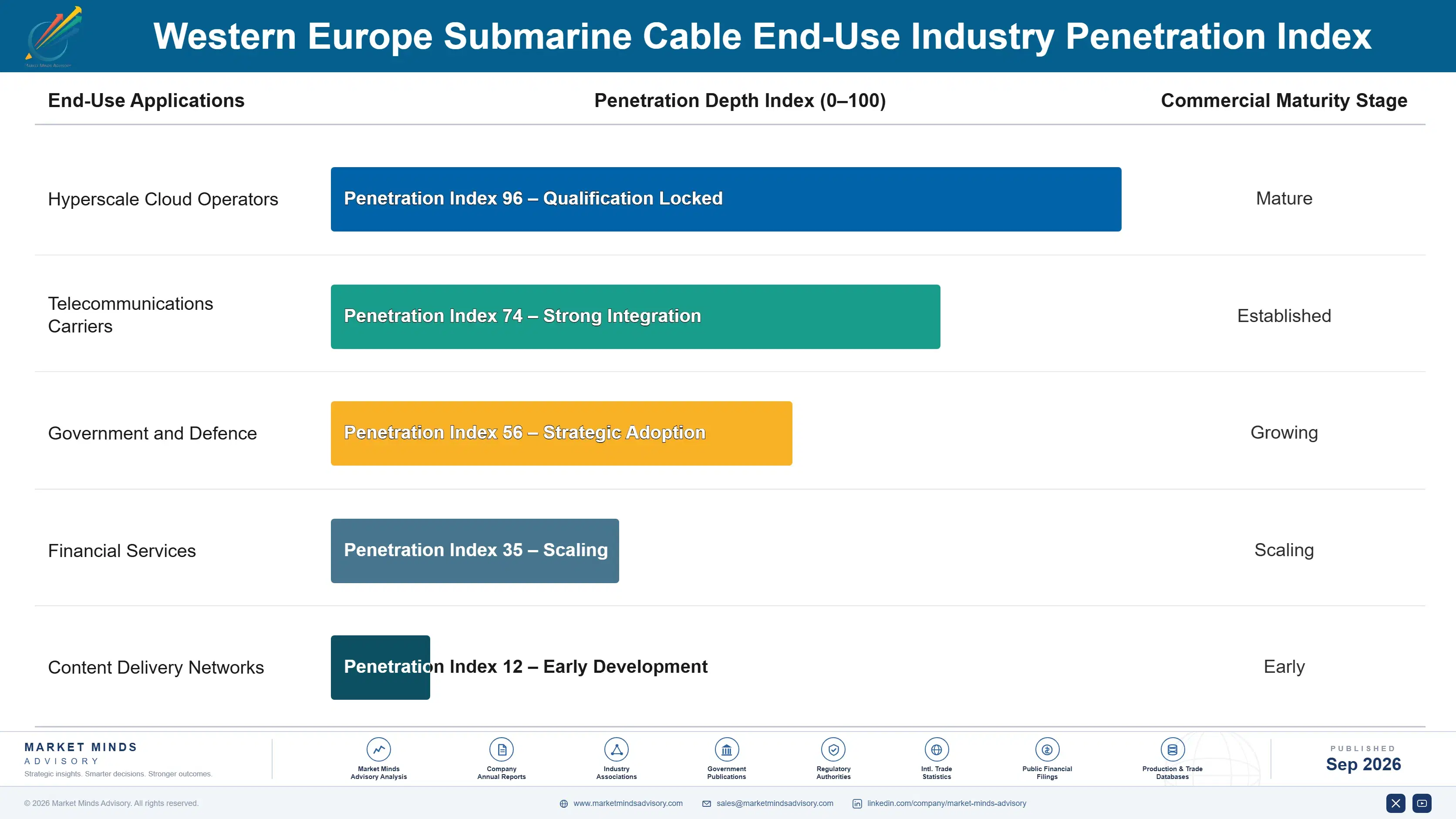
Adoption runs deepest among hyperscale cloud operators building dedicated artificial intelligence infrastructure, who extract the most value from guaranteed fibre pair ownership and therefore fund new systems fastest, while smaller national carriers with less capital adopt more slowly and often continue leasing capacity on existing shared systems for years before ever funding a dedicated system of their own. This adoption gap has widened further as dedicated system costs remain substantial. Manufacturers report this gap has persisted for years.

A generational shift in buyer profile is underway as hyperscale infrastructure planners, rather than traditional carrier consortium negotiators, increasingly control procurement decisions, favouring manufacturers who can guarantee delivery schedule certainty over manufacturers who compete purely on traditional per-kilometre pricing credentials alone. Manufacturers slow to build genuine hyperscaler credibility risk losing influence with this newer generation of infrastructure buyers.
submarine-cable-industry-analysis-in-western-europ-end-use-penetration-index-1790000391126

What Determines Who Wins This Market

These are among the four positions where our research anticipates prominent divergence between winners and laggards over the coming forecast period. Each is grounded in the demand model, the regulatory perimeter, and the announced capacity pipeline.
01 / HYPERSCALER RELATIONSHIP DEPTH

Direct hyperscaler relationships now matter more than carrier consortium ties

Manufacturers without established direct relationships with the largest hyperscale cloud operators are increasingly excluded from the fastest-growing segment of industry demand before pricing discussions even begin, since these customers prefer proven delivery partners for hundred-million-dollar projects. This has turned what was once a carrier consortium-dominated procurement process into a genuine gating factor favouring manufacturers with existing hyperscaler trust. Manufacturers that delay building these relationships risk losing the largest future contracts to competitors who already have a proven track record with the same customers.
02 / VESSEL FLEET CAPACITY INVESTMENT

Owning more installation vessels is becoming the clearest growth lever available

Manufacturers with larger specialised vessel fleets can commit to faster delivery schedules than competitors constrained by limited installation capacity, a genuine differentiator given how scarce these vessels remain industry-wide. Vessel fleet investment requires years of lead time and hundreds of millions of dollars in capital, so manufacturers that invest early gain a durable advantage that later entrants cannot quickly close. This dynamic will likely intensify as hyperscaler demand keeps growing faster than the industry's total installation capacity can realistically expand.
03 / GEOPOLITICAL MARKET SEGMENTATION

Vendors must actively choose which geopolitical bloc to serve most deeply

Security reviews increasingly restrict which suppliers can bid on systems landing near sensitive infrastructure in Western-aligned markets, permanently splitting the addressable market along geopolitical lines rather than purely competitive ones. HMN Technologies has responded by focusing growth outside the traditional Western alliance structure, while Western manufacturers concentrate on markets where security preference favours their systems regardless of price, a divide that shows little sign of narrowing. This split will likely deepen further as more governments formalise supplier restrictions over the coming years, reshaping global order books.
04 / ROUTE RESILIENCE POSITIONING

Selling resilience is becoming as important as selling raw capacity

Manufacturers that position new systems explicitly around route diversity and damage resilience are winning government-funded contracts that pure capacity economics would not otherwise justify, since recent cable damage incidents have made resilience a genuine political priority rather than a technical afterthought. Manufacturers slow to develop this sales positioning risk losing government-funded contracts to competitors who can speak directly to resilience requirements in front of skeptical procurement officials. This shift is reshaping how manufacturers pitch even routine replacement system contracts across most Western-aligned markets today.

Engagement Snapshot From the Field

A live engagement with an industry participant carrying material or product regulatory and market exposure ahead of a defining policy shift, showing how our research translates into a defensible multi-year portfolio strategy.
MARKET MINDS ADVISORY · CLIENT ENGAGEMENT SUMMARY
Western Europe Submarine Cable Producer Strategic Portfolio Review and Transition Roadmap 2026·Investment Scenario on Western Europe Submarine Cable Exposure Evaluation 2025-26
CLIENT PROFILE
The client, a regional data centre operator expanding across three Western European countries, needed to secure dedicated intercontinental connectivity to support growing artificial intelligence training workloads for its largest customers. Annual connectivity leasing spend had reached approximately 38 million dollars (client-reported, unverified by MMA), with leadership evaluating whether to continue leasing shared carrier capacity or fund a dedicated system stake directly.
STRATEGIC CHALLENGE
Continuing to lease shared carrier capacity offered lower upfront cost but exposed the operator to capacity constraints during peak demand periods, while funding a dedicated system stake required substantial capital commitment and multi-year construction lead time that risked misalignment with the operator's own customer growth projections. with construction timelines that risked outpacing the operator's own projected customer growth curve.
MMA APPROACH
MMA benchmarked total cost of ownership across continued leasing versus a dedicated system stake, modelling construction lead times against the operator's projected customer growth curve. The analysis prioritised consortium arrangements with existing hyperscaler-funded systems already under construction to minimise the multi-year wait the operator would otherwise face for a fully dedicated new build.
KEY FINDINGS
  1. Joining an existing hyperscaler-funded consortium system could deliver dedicated capacity roughly 18 months faster than commissioning a new build., well ahead of the operator's projected capacity shortfall.
  2. Continued shared leasing risked capacity constraints within three years given the operator's own projected customer growth curve. unless additional dedicated capacity was secured proactively.
  3. Only two of five evaluated consortium opportunities offered fibre pair terms matching the operator's long-term capacity requirements., limiting the practical range of viable consortium options.
  4. Route diversity considerations favoured a consortium system landing through Portugal over the operator's initially preferred French landing point. over the operator's initially preferred routing option.
CLIENT PROFILE
The client, a regional data centre operator expanding across three Western European countries, needed to secure dedicated intercontinental connectivity to support growing artificial intelligence training workloads for its largest customers. Annual connectivity leasing spend had reached approximately 38 million dollars (client-reported, unverified by MMA), with leadership evaluating whether to continue leasing shared carrier capacity or fund a dedicated system stake directly.
STRATEGIC CHALLENGE
Continuing to lease shared carrier capacity offered lower upfront cost but exposed the operator to capacity constraints during peak demand periods, while funding a dedicated system stake required substantial capital commitment and multi-year construction lead time that risked misalignment with the operator's own customer growth projections. with construction timelines that risked outpacing the operator's own projected customer growth curve.
MMA APPROACH
MMA benchmarked total cost of ownership across continued leasing versus a dedicated system stake, modelling construction lead times against the operator's projected customer growth curve. The analysis prioritised consortium arrangements with existing hyperscaler-funded systems already under construction to minimise the multi-year wait the operator would otherwise face for a fully dedicated new build.
KEY FINDINGS
  1. Joining an existing hyperscaler-funded consortium system could deliver dedicated capacity roughly 18 months faster than commissioning a new build., well ahead of the operator's projected capacity shortfall.
  2. Continued shared leasing risked capacity constraints within three years given the operator's own projected customer growth curve. unless additional dedicated capacity was secured proactively.
  3. Only two of five evaluated consortium opportunities offered fibre pair terms matching the operator's long-term capacity requirements., limiting the practical range of viable consortium options.
  4. Route diversity considerations favoured a consortium system landing through Portugal over the operator's initially preferred French landing point. over the operator's initially preferred routing option.
RECOMMENDED STRATEGY
Phase 1: Phase 1 (Months 1 to 3): Evaluate all available consortium fibre pair opportunities against the operator's five-year capacity growth projection. Phase 2: Phase 2 (Months 4 to 8): Negotiate and secure a fibre pair stake in the selected Portugal-landing consortium system under construction. Phase 3: Phase 3 (Months 9 to 18): Integrate dedicated capacity into the operator's network architecture ahead of projected customer demand growth.
OUTCOME
The operator secured a dedicated fibre pair stake in the recommended consortium system roughly on the projected timeline, avoiding the capacity constraints continued leasing would have created within three years (client-reported, unverified by MMA). Leadership credited the route diversity analysis with meaningfully improving the operator's overall network resilience position.

Frequently Asked Questions

Foundational context covering the market sizes, CAGR, scope, country, region and competition that inform every finding below. This section is provided to cover basics and most often pre-purchase conversations, answered from the MMA Primary Research Dataset.

What is the current size of the Western Europe Submarine Cable Market?

The global market was valued at 5.8 billion dollars in 2025. Western Europe represents the largest single regional share at 26 percent of that total.

How large will the Western Europe Submarine Cable Market be by 2036?

The global market is projected to reach 9.92 billion dollars by 2036, up from 6.09 billion dollars in 2026, a 1.63x expansion over the forecast decade.

What is the CAGR for the Western Europe Submarine Cable Market 2026 to 2036?

The market is forecast to grow at a 5.0 percent compound annual rate globally, with Western Europe growing more slowly at roughly 3.8 percent given its already mature landing infrastructure.

Which segment is growing fastest?

Transoceanic long-haul cable systems lead all segments at a 6.5 percent CAGR, roughly 1.3 times the overall market rate, as hyperscale operators fund dedicated intercontinental capacity.

Who are the major companies in the Western Europe Submarine Cable Market?

SubCom, Alcatel Submarine Networks, NEC Corporation, HMN Technologies, and Prysmian Group together hold the largest share, with CR5 concentration near 72 percent across the global market.

Which country is growing fastest?

The United States leads growth at a 7.2 percent CAGR, driven by hyperscale cloud operators directly funding transoceanic systems to support artificial intelligence data transfer needs.

Report Segmentation Architecture

The full report scope spans multiple orthogonal segmentation dimensions, with cross-tabulated demand data provided for each dimension pair. Coverage extends further to regional breakdowns, trend trajectories, and the competitive detail needed to support segment-level decision-making.

By Primary Market Dimension

  • Transoceanic Long-Haul Cable Systems
  • Regional and Festoon Cable Systems
  • Repeater and Amplification Equipment
  • Cable-Laying and Installation Vessel Services
  • Maintenance and Repair Services
  • Landing Station Equipment

By End-Use Industry

  • Hyperscale Cloud Operators
  • Telecommunications Carriers
  • Government and Defence
  • Financial Services
  • Content Delivery Networks

By Commercial Dimension

  • Direct Hyperscaler-Funded Systems
  • Carrier Consortium-Funded Systems
  • Government-Funded Systems
  • Private Investor Consortiums

By Region

  • North America
  • Western Europe
  • East Asia
  • South Asia and Pacific
  • Latin America
  • Middle East and Africa
  • Eastern Europe

Scope, Methodology, and Coverage

Every figure in this report is reproducible from documented input assumptions. The scope below maps the historical period, the forecast horizon, the segmentation dimensions, and the countries covered, alongside the underlying primary and qualitative methodology.
Historical Period
2020 to 2025
Forecast Period
2026 to 2036
Base Year
2025 (USD billions; MMA Primary Research Dataset, September 2026)
Market Definition
This market covers submarine fibre optic cable systems used for intercontinental and regional data transmission, including the cable itself, repeaters, and landing station terminal equipment. It excludes terrestrial fibre backbone networks and satellite communication systems.
Quantitative Units
USD billions (current prices); regional and segment CAGR in percent
Segmentation Dimensions
By Primary Market Dimension; By End-Use Industry; By Commercial Dimension; By Region
Regions Covered
North America, Western Europe, East Asia, South Asia and Pacific, Latin America, Middle East and Africa, Eastern Europe
Countries Covered
USA, China, Germany, France, UK, Japan, South Korea, India, Australia, Canada, Brazil, Mexico, Indonesia, Vietnam, Thailand, Malaysia, UAE, Saudi Arabia, South Africa, Nigeria, Turkey, Poland, Netherlands, Italy, Spain, Sweden, Switzerland, Argentina, Colombia, Singapore, and additional markets relevant to this sector
Key Companies Profiled
SubCom LLC, Alcatel Submarine Networks, NEC Corporation, HMN Technologies Co Ltd, Prysmian Group, Nexans SA, NKT A/S, Corning Incorporated, Xtera Communications Inc, OFS Fitel LLC, Global Marine Group, Orange Marine, IT International Telecom Inc, Elettra Tlc SpA, E-marine LLC, KDDI Cable Ship Company Ltd, ZTT Group, Hengtong Group, Fugro NV, TE Connectivity Ltd
Quantitative Methodology
Primary survey, n=3,800 respondents, Q4 2025, six countries; demand-side model with trade association cross-validation
Qualitative Methodology
47 expert interviews, Q4 2025; applied to validate demand model assumptions, identify emerging dynamics, and assess competitive positioning
Report Format
PDF and XLSX data workbook (Word format preview document)
Publisher
Market Minds Advisory
Report Code
MMA-2026-TEC-624
Published
September 2026
Contact
sales@marketmindsadvisory.com | www.marketmindsadvisory.com

Purchase the full Western Europe Submarine Cable Market Report (2026 to 2036).

The full report delivers a complete quantitative and qualitative assessment of the Western Europe Submarine Cable Market across all seven regions and six product segments. It includes detailed vendor profiles for all twenty companies covered, alongside country-level sizing for thirty markets. Primary research draws on thirty-eight hundred survey respondents and forty-seven expert interviews conducted in the fourth quarter of 2025 across six countries. Buyers receive full editable data tables alongside the complete narrative analysis, competitive vendor scorecards, and forward-looking scenario modelling included in every purchase.
Twenty vendor profiles with moat and risk analysis
Seven-region market sizing with country breakdowns
Six-segment technology framework with growth rates
Primary survey data collected across six countries
Forty-seven expert interview insights fully included
Editable data tables for all forecast figures

Built For The People Who Decide

From boardroom strategy to bench-side execution, this report is read cover-to-cover by leaders shaping the next decade of their industry, turning demand scenarios, market dynamics and valuation benchmarks into decisions.
CXOs/ Presidents/ VPs/ Managers
M&A and Corporate Development
Strategy Teams and R&D Heads
Procurement and Product Directors
Regulatory and Compliance Leaders
Investor Relations and Equity Analysts