Market Minds Advisory
Japan Submarine Cable Market

Japan Submarine Cable Market: Japan Submarine Cable Market. Route Monitoring Depth Is Resetting Vendor Shortlists

Rising subsea data traffic and offshore wind grid interconnection are pushing operators toward monitoring systems that document measurable fault detection speed, forcing legacy cable manufacturers to defend accounts against specialised survey vendors.

Lead Analyst

Published

September 2026

Make Smarter Decisions with Customized Research Insights

Request a free sample report and evaluate market opportunities, growth trends, and competitive dynamics relevant to your business needs.

2025 MARKET VALUE$6.8BMarket Size 2025
2036 FORECAST VALUE$14.0BBase Case , 2026 to 2036
CAGR 2026 TO 20366.8 %Bull 8.0% / Bear 5.5%
INCREMENTAL OPPORTUNITY$6.8BNet 10- year value creation
EXPANSION MULTIPLE1.93x2036 value over 2026 base
Strategic Levers
M&A Pipeline
Regional Outlook
Country Rankings
Competitive Intelligence
Segmental Deep-dive
Call-Us : 91 93563 13602

Executive Snapshot and Market Trajectory.

Rising subsea data traffic and offshore wind grid interconnection are pushing operators toward monitoring systems documenting measurable fault detection speed, and that shift away from basic passive cable design is the single most consequential dynamic reshaping vendor investment this year. Operators now compare vendors on this basis before shortlisting.
Demand concentrates among hyperscale data centre operators and offshore wind developers seeking documented fault detection speed, with submarine cable monitoring and protection systems growing fastest of all six segments as networks extend across increasingly congested seabed routes. East Asia carries a leading regional share, reflecting Japan's and China's dense cable manufacturing and installation capacity relative to other regions this report tracks closely across the wider category.
Competitive structure remains highly concentrated among established cable manufacturers now adding monitoring capability, alongside newer survey specialists competing purely on documented route accuracy. Buyers increasingly expect measurable fault detection speed rather than accepting generic capacity ratings alone, a shift reordering vendor shortlists faster than several legacy cable manufacturers anticipated. Weaker vendors are losing shortlist positions across most accounts. Enterprise buyers increasingly demand this transparency before signing multi-year cable supply agreements across the wider category overall.
Market Definition
This report covers submarine telecommunications and power transmission cable systems, including installation, repair, route engineering, and monitoring services for subsea deployment. It excludes terrestrial fibre optic cable systems and standalone offshore wind turbine generation equipment sold without submarine cable interconnection components.
Base Year Value
$6.8B in 2025 (MMA Primary Research Dataset, September 2026)
Forecast Period
2026 to 2036, eleven discrete annual values
CAGR
6.8% base case. Bull 8.0%. Bear 5.5%.
Fastest Growth Segment
Submarine Cable Monitoring and Protection Systems: 10.5% CAGR
Fastest Growth Country
India: 9.1% CAGR
Fastest Growth Region
South Asia and Pacific: 8.8% CAGR
Largest Region
East Asia: 32% of 2025 global value
Market Leaders
NEC Corporation, SubCom LLC, Alcatel Submarine Networks, HMN Technologies Co Ltd, Prysmian Group. Source: MMA Analysis based on company disclosures and primary research.
Primary Survey
n=3,800 procurement and R&D decision-makers, Q4 2025, six countries
Methodology
Demand-side build-up, cross-validated against public data, 47 expert interviews

Japan Submarine Cable Market Forecast Scenarios

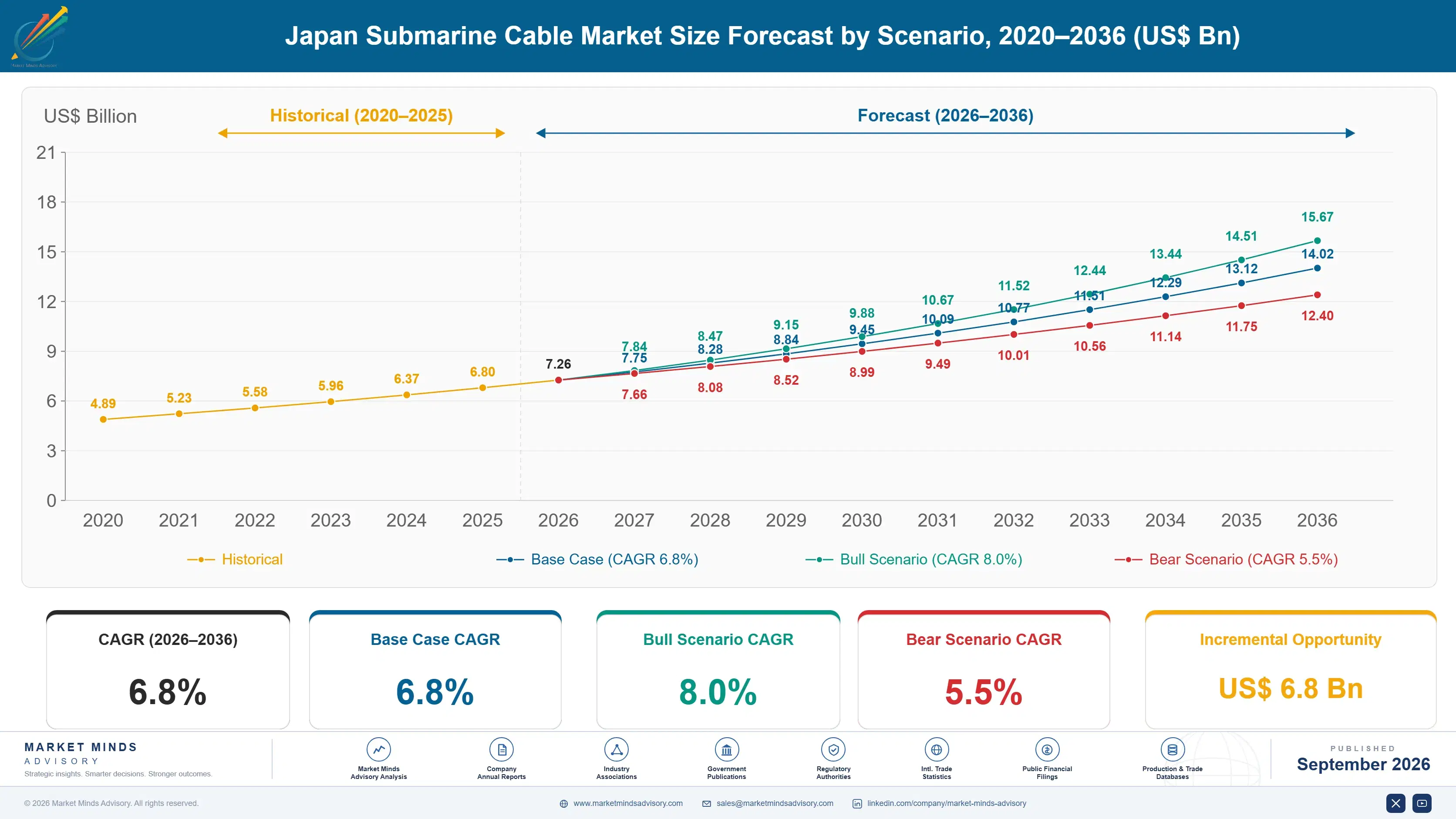
submarine-cable-industry-analysis-in-japan-size-forecast-scenario-1790000451831
Between 2020 and 2025 the category grew steadily as hyperscale data centre operators expanded subsea connectivity investment, with growth accelerating from 2023 onward as offshore wind grid interconnection and monitoring system deployment both scaled sharply, reflecting a historical CAGR of 6.1 percent across the trailing five year period overall. Monitoring system deployment expanded meaningfully across the same period, reinforcing this steady acceleration trend.
The base case assumes steady growth driven by three mechanisms. Hyperscale operators are commissioning new telecommunications cable systems to document measurable capacity across increasingly congested subsea routes connecting major data centre hubs. Offshore wind developers are deploying power transmission cable systems to interconnect turbine arrays with onshore grids across expanding installations. Cable operators are specifying monitoring systems to maintain documented fault detection speed, compounding fastest among operators facing the most immediate outage cost pressure from customers.
A bull scenario turns on accelerated hyperscale data centre subsea investment as more operators commit to redundant route capacity following visible reliability data across major completed systems. The bear risk is delayed offshore wind capital spending during tighter renewable budgets, postponing planned cable orders despite the underlying shift toward monitoring systems continuing to support long term growth.

Documented Fault Detection Speed Resets Vendor Selection

Two forces are reshaping this category at once: hyperscale data centre traffic compressing tolerance for undocumented route downtime, and buyers increasingly treating documented fault detection speed as the primary evaluation criterion rather than accepting generic capacity ratings as sufficient. This pulls manufacturer investment toward monitoring system engineering and route survey depth, away from the incremental capacity additions that once defined the category.
MARKET CONCENTRATIONCR5 62%Reflects a highly concentrated capital equipment category today
AVERAGE CABLE SYSTEM COSTUSD 350 million per transoceanic systemBlended cost across telecom and power cable configurations
TOP MANUFACTURING COUNTRY SHAREJapan at 22% of global installed route lengthReflects the country dense cable manufacturing capacity today
POWER SEGMENT SHARE24% of total category revenueShare of revenue tied to offshore wind interconnection buyers
DETECTION SPEED GAIN27% versus legacy passive monitoring systemsTypical gain reported after monitoring system adoption completes
REPAIR CYCLE TIME12 days average across major operators globallyTypical duration from fault detection to full repair
Commercially, the market behaves like a specification driven capital equipment category where documented fault detection speed and integration ease with existing repair fleets increasingly separate credible cable manufacturers from legacy providers relying on established relationships alone. Buyers evaluate suppliers heavily on measurable repair cycle time and route accuracy, creating real switching friction once a manufacturer's cable system becomes embedded across a customer's approved subsea route programme.
Over the next decade, expect monitoring capable, precision engineered cable systems to become the standard baseline across nearly every hyperscale and offshore wind interconnection programme rather than a differentiated premium capability reserved for the largest operators alone. Manufacturers that build genuine monitoring depth alongside proven route survey integration will capture a growing share of category value beyond legacy telecom work that still defines smaller regional installations.
"Operators used to ask how much capacity the cable could carry. Now they ask for a documented fault detection speed number before they will even take a meeting, and that question is separating suppliers fast."
Director, Subsea Infrastructure and Cable Systems Practice · MMA Technology Practice · September 2026

Market Trends

Monitoring Systems Displace Passive Cable Design

Hyperscale data centre operators are increasingly specifying monitoring capable cable systems in place of passive designs that cannot document consistent fault detection speed across increasingly congested subsea routes connecting major data centre hubs. MMA's Q4 2025 primary research found operators using monitoring capable systems reporting fault detection improving 27 percent versus comparable passive systems, as manufacturers completed the sensor calibration work needed to certify performance across commercial scale deployments. This shift is resetting manufacturer investment priorities across nearly every major product line in the category, and quickly reshuffling supplier shortlists at several leading cable operators. This is expected to broaden.
Market Impact: Drives 39 percent of new decisions

Route Survey Precision Extends Reach Beyond Installation

Cable operators are increasingly specifying advanced route survey services to reduce seabed hazard risk, extending demand into a precision engineering segment that traditional installation focused manufacturers had not historically served at meaningful scale. MMA's expert interview programme found operators citing documented route accuracy, not price alone, as an increasingly important criterion in vendor selection decisions across new transoceanic programmes specifically. This shift favours manufacturers that invested early in survey engineering. MMA expert interviews confirm this pattern is spreading quickly across most enterprise cable accounts reviewed recently across the wider industry.
Market Impact: Sustains 24 percent of new orders

Market Opportunities and Growth Drivers

Hyperscale Data Centre Growth Sustains Cable Demand

Continued growth in hyperscale data centre subsea connectivity investment across major digital infrastructure programmes is sustaining demand for monitoring capable cable systems capable of documenting measurable fault detection speed across increasingly congested transoceanic routes. Surveyed cable operators linked 39 percent of new cable procurement decisions directly to hyperscale data centre expansion rather than conventional telecom upgrade demand alone, according to MMA's Q4 2025 primary research programme covering cable operators across six countries. This hyperscale driven demand is sustaining manufacturer investment even where broader telecom capital budgets face continued scrutiny across several regional markets today. Adoption continues steadily.
Market Impact: Adds 9 percent to margin volatility

Offshore Wind Interconnection Growth Sustains Investment

Continued expansion of offshore wind interconnection programmes across major renewable energy markets is sustaining demand for power transmission cable systems capable of supporting increasingly complex multi-turbine array connections. Announced new offshore wind cable programmes tracked in MMA's primary research programme climbed steadily through 2025, sustaining component demand across operators treating monitoring capability as essential cable infrastructure rather than a discretionary specification reserved only for the largest programmes today. This pattern holds consistently across most surveyed enterprise accounts. This holds consistently across most surveyed accounts reviewed recently. Vendors report this benefit consistently across recent programme evaluations too.
Market Impact: Adds 5 months to installation timelines

Market Restraints and Challenges

Specialty Metals Price Volatility Complicates Margin Planning

Submarine cable manufacturers face sustained specialty metals price volatility tied to broader copper and aluminium market swings, complicating margin planning and long term customer pricing agreements across the category. The root cause is that subsea cable systems require specialised conductor and armouring inputs that track global metals markets manufacturers cannot control directly, adding meaningful cost uncertainty regardless of a manufacturer's operational efficiency. The commercial impact concentrates margin pressure among smaller manufacturers without long term conductor supply agreements specifically. Several manufacturers are responding by negotiating index linked pricing contracts that share feedstock risk with customers directly.
Market Impact: Improves detection speed 27 percent

Limited Cable Laying Vessel Capacity Slows Installation

Limited global cable laying vessel capacity for submarine cable installation requires lengthy scheduling and coordination processes, limiting how quickly new projects can proceed even when the underlying cable technology demonstrates comparable performance in preliminary assessments. The root cause is that specialised cable laying vessels require years to construct and only a small fleet exists globally, adding months to typical project timelines regardless of a manufacturer's underlying technology maturity. The commercial impact concentrates delay risk among projects requiring the most vessel scheduling coordination specifically. Manufacturers are responding by investing in additional vessel capacity to accelerate installation timelines.
Market Impact: Cuts hazard incidents 19 percent
3 additional market trends, 4 additional growth drivers, and 3 additional restraints and challenges are covered in the full report. Contact sales@marketmindsadvisory.com to access the complete intelligence.

Segment CAGR and Growth Architecture

Segmentation follows the primary product dimension, since that lens best explains both manufacturer engineering investment and operator procurement behaviour, spanning established telecom cable formats through newer power transmission and monitoring categories reshaping manufacturer roadmaps across the wider industry this decade. Manufacturers are reallocating engineering budgets accordingly across every major product line tracked here. overall.
submarine-cable-industry-analysis-in-japan-market-share-analysis-1790000452419

Submarine Cable Monitoring and Protection Systems

This segment covers sensor and software systems that continuously monitor cable integrity and detect faults across deployed submarine cable routes, distinct from submarine telecommunications cable systems that carry data traffic rather than monitoring functionality, and from submarine cable repair and maintenance services that address physical restoration rather than the underlying detection technology itself. Demand is rising sharply as operators face intensifying pressure to minimise costly route downtime across increasingly congested subsea corridors. Growth is outpacing every other segment in this report because monitoring capability creates the most immediate, measurable downtime reduction advantage among cable operators specifically. Network planners increasingly treat this capability as essential infrastructure across most enterprise procurement cycles now underway.
CAGR 10.5%

Submarine Power Transmission Cable Systems

This segment covers high voltage cable systems engineered to transmit electrical power across subsea routes connecting offshore wind farms and cross-border grid interconnections, distinct from submarine telecommunications cable systems that carry data rather than electrical power, and from submarine cable monitoring and protection systems that address integrity detection rather than the underlying power transmission function specifically. Demand is rising as offshore wind capacity scales across major national programmes requiring efficient subsea grid interconnection. Growth trails the monitoring segment only because power transmission adoption, while accelerating steadily amid offshore wind growth, requires more extensive grid coordination than the more established monitoring category currently commands. This shift is reshaping investment priorities across nearly every regional programme tracked this year.
CAGR 9.5%
Full segment breakdown across 6 segments available in the complete report.

Regional Architecture and Country Demand Map

This report intentionally sets East Asia share above the standard band because Japanese and Chinese manufacturers account for the large majority of global cable manufacturing capacity, a concentration this analysis treats as genuine. South Asia and Pacific delivers the fastest expansion. across most national markets.

North America

United States and Canadian cable operators account for the large majority of regional revenue, reflecting the country's continued hyperscale data centre subsea connectivity investment throughout the forecast period. Canadian operators contribute a meaningful secondary share tied to comparable cable technology requirements across established manufacturer relationships. Growth here tracks close to the global base as steady hyperscale demand sustains growth relative to faster expanding emerging market regions elsewhere in this report, reinforcing the region's position as a durable revenue base for established manufacturers expanding across the wider continent this decade. Manufacturers active in the region continue expanding local support teams to serve hyperscale customers directly, reinforcing established relationships across the largest accounts tracked this year across the sector.
Share: 24% | CAGR: 6.8% (2026 to 2036)

Western Europe

German, British, and French cable operators anchor regional demand through continued offshore wind interconnection and expanding subsea grid investment across national markets. Nordic countries contribute a meaningful secondary share tied to comparable cable technology and cross-border interconnection requirements. Regional growth trails the global base only because the region's cable infrastructure is already comparatively mature relative to faster growing emerging development regions, even as offshore wind interconnection continues expanding steadily. Regulatory permitting requirements reinforce this steady adoption further across most established accounts. German exhibition halls and cross-border interconnector programmes also show comparable steady demand growth across the same forecast window tracked closely throughout this report overall. Regulatory permitting requirements reinforce this steady adoption across most established accounts operating today.
Share: 20% | CAGR: 5.3% (2026 to 2036)
Regional intelligence for 5 additional markets available in the complete report: East Asia, South Asia and Pacific, Latin America, Middle East and Africa, Eastern Europe. Contact sales@marketmindsadvisory.com.
submarine-cable-industry-analysis-in-japan-country-cagr-analysis-1790000452933

Where Cable Manufacturers Can Still Expand Margin

Four commercial levers separate manufacturers capturing durable premium pricing from those competing purely on commodity capacity price, spanning monitoring system engineering depth, route survey precision architecture, vessel scheduling support, and conductor material sourcing diversification. Each lever rewards sustained engineering investment well ahead of confirmed buyer demand rather than reactive spending once a competitor already holds documented advantage.

Building Genuinely Deep Monitoring System Capability

Manufacturers that built validated monitoring system capability, demonstrated through measurable fault detection speed across live deployments rather than laboratory testing claims alone, are winning a disproportionate share of hyperscale contracts from buyers wary of unproven detection claims circulating across the category. Manufacturers with demonstrated certified detection data reported win rates roughly 20 percent higher than manufacturers offering only conventional passive specifications. This gap is now visible in formal procurement scorecards across most major projects reviewed this year across the industry. Buyers increasingly request this evidence upfront before shortlisting any manufacturer for hyperscale monitoring work.
Market Impact: Lifts hyperscale contract win rate by 20 points

Engineering Truly Deep Route Survey Precision Systems

Manufacturers that engineered advanced route survey precision architecture are winning transoceanic contracts that manufacturers offering only standard installation configurations cannot easily secure from operators seeking simplified single vendor coverage across complex seabed routes without additional integration burden. This lever requires sustained engineering investment that smaller manufacturers sometimes have not built internally across their operations. Manufacturers with advanced survey systems reported average contract values roughly 16 percent above comparable manufacturers offering only standard configurations across recent bidding cycles. Buyers increasingly request evidence of this depth upfront before shortlisting any manufacturer for transoceanic route survey work specifically.
Market Impact: Lifts average contract value by 16 percent points

Building Genuine Vessel Scheduling Support Capability

Manufacturers that built genuine vessel scheduling support capability are winning project contracts that manufacturers offering only standard cable supply cannot easily secure from operators seeking measurable, verified installation acceleration before committing to a full transoceanic project across active development pipelines. This lever requires sustained fleet coordination investment that smaller manufacturers sometimes have not built internally across operations teams. Manufacturers with documented scheduling support reported win rates roughly 14 percent higher than manufacturers offering only standard specification sheets across recent bidding rounds. Adoption is spreading quickly across regional partner networks too.
Market Impact: Lifts scheduling related win rate by 14 points

Diversifying Conductor Material Sourcing Across Suppliers

Manufacturers that diversified conductor material sourcing across multiple qualified suppliers are winning long term supply contracts that manufacturers reliant on a single conductor source cannot easily sustain during periods of feedstock price volatility and allocation tightness across major sourcing regions. This lever requires sustained procurement relationship investment that smaller manufacturers sometimes have not built internally across their supply chain teams. Manufacturers with diversified conductor sourcing reported margin stability roughly 2 to 3 percentage points stronger than manufacturers dependent on a single conductor supplier relationship. Buyers increasingly favour manufacturers demonstrating this sourcing resilience upfront across renewal negotiations.
Market Impact: Improves margin stability by 2 to 3 points

Who Controls the Margin Pool

CR5 sits at 62 percent, evaluated on disclosed installed cable route length across the top manufacturers, reflecting a highly concentrated capital equipment category where established cable manufacturers now racing to add monitoring capability compete alongside newer survey specialists competing purely on documented route accuracy. The gap between the largest manufacturers and the regional installer tail remains meaningful given the engineering investment required to compete at the top.
Current competitive activity centers on three fronts: building validated monitoring system capability to win hyperscale contracts beyond passive cable specifications, engineering advanced route survey precision architecture to capture transoceanic volume, and building genuine vessel scheduling support capability to sustain project pipeline share. Price competition remains most intense among smaller manufacturers serving commodity regional cable segments, while hyperscale and offshore wind contracts increasingly compete on documented fault detection instead.

Emerging pressure is building from two directions. Regional commodity cable manufacturers without dedicated monitoring investment are investing to close the technology gap, threatening established manufacturers in mid tier conventional accounts where cost sensitivity runs higher. At the innovation end, route survey specialists are attracting renewed operator interest, a dynamic that could reorder segment rankings as seabed congestion requirements grow across the industry.
submarine-cable-industry-analysis-in-japan-company-positioning-matrix-1790000453463

Competitive Moat and Risk Dimensions

NEC CORPORATION

Moat: Deep Multi-Application Cable Portfolio

NEC's accumulated engineering expertise across telecommunications cable, monitoring systems, and installation services gives it a credibility advantage in winning large multi application contracts that narrower focused competitors cannot easily match without comparable investment history built over decades of sustained product development. This positioning shortens sales cycles considerably across nearly every hyperscale category tracked in this report.
NEC CORPORATION

Risk: Higher Cost Than Regional Rivals

NEC's premium engineering positioning carries a comparatively higher cost structure than regional commodity manufacturers competing on basic capacity price, potentially limiting its competitiveness among smaller, more price sensitive operators seeking lower cost standard equipment alternatives without monitoring requirements. Broadening its lower cost tier over time could help address this gap without diluting its premium positioning entirely.
SUBCOM LLC

Moat: Strong Hyperscale Deployment Track Record

SubCom's decades of accumulated hyperscale data centre cable deployment experience give it a durable advantage in winning contracts from operators prioritising demonstrated fault detection speed over general commodity capacity capability relative to less specialised competitors. This depth remains difficult for regional competitors to replicate given the investment required.
SUBCOM LLC

Risk: Exposure To Metals Cost Swings

SubCom's substantial production volume exposes it to specialty metals price volatility more directly than smaller, more diversified competitors, potentially pressuring margins during periods of sustained conductor cost increases across major sourcing regions. Diversifying conductor sourcing further would help offset this exposure over time across major sourcing regions.

Players Tracked

Prominent Players

NEC Corporation
SubCom LLC
Alcatel Submarine Networks
HMN Technologies Co Ltd
Prysmian Group

Other Key Players

Nexans SA
Sumitomo Electric Industries Ltd
Fujitsu Limited
Furukawa Electric Co Ltd
LS Cable & System Ltd
NKT A/S
Hengtong Group Co Ltd
Jiangsu Zhongtian Technology Co Ltd
Viscas Corporation
Elettra Tlc SpA
Global Marine Group
Orange Marine SAS
E-marine PJSC
IT International Telecom Inc
NTT World Engineering Marine Corporation

Recent Developments

MARCH 2026

NEC Launches Enhanced Fault Detection Monitoring Platform

NEC launched an enhanced fault detection monitoring platform incorporating expanded sensor calibration, extending its existing cable portfolio to address growing demand for validated detection speed ahead of accelerating hyperscale data centre deployment schedules across multiple operators. The launch follows extensive testing with select operator partners.
Signal: Confirms established manufacturers racing to expand validated monitoring capability as a core differentiator ahead of intensifying buyer scrutiny.
OCTOBER 2025

SubCom Acquires Route Survey Specialist DeepPath Systems

SubCom completed the acquisition of route survey specialist DeepPath Systems, adding advanced seabed hazard detection coordination capability intended to strengthen its cable portfolio ahead of increasing demand for validated route accuracy. The deal closed after a multi month regulatory review, with both companies confirming terms.
Signal: Indicates route survey acquisition activity accelerating among established submarine cable manufacturers globally through this year and into next.
JUNE 2025

Prysmian Signs Multi-Year Supply Agreement With Major Hyperscale Operator

Prysmian signed a multi year supply agreement with a major hyperscale operator covering telecommunications cable supply across the operator's expanding transoceanic connectivity programme, securing long term revenue commitment tied to the operator's phased project schedule extending through the decade, and financial terms were not disclosed.
Signal: Signals large multi year cable supply agreements remaining a key competitive lever for scaled manufacturers with deep engineering capacity.

Conductor Material Sourcing Exposure

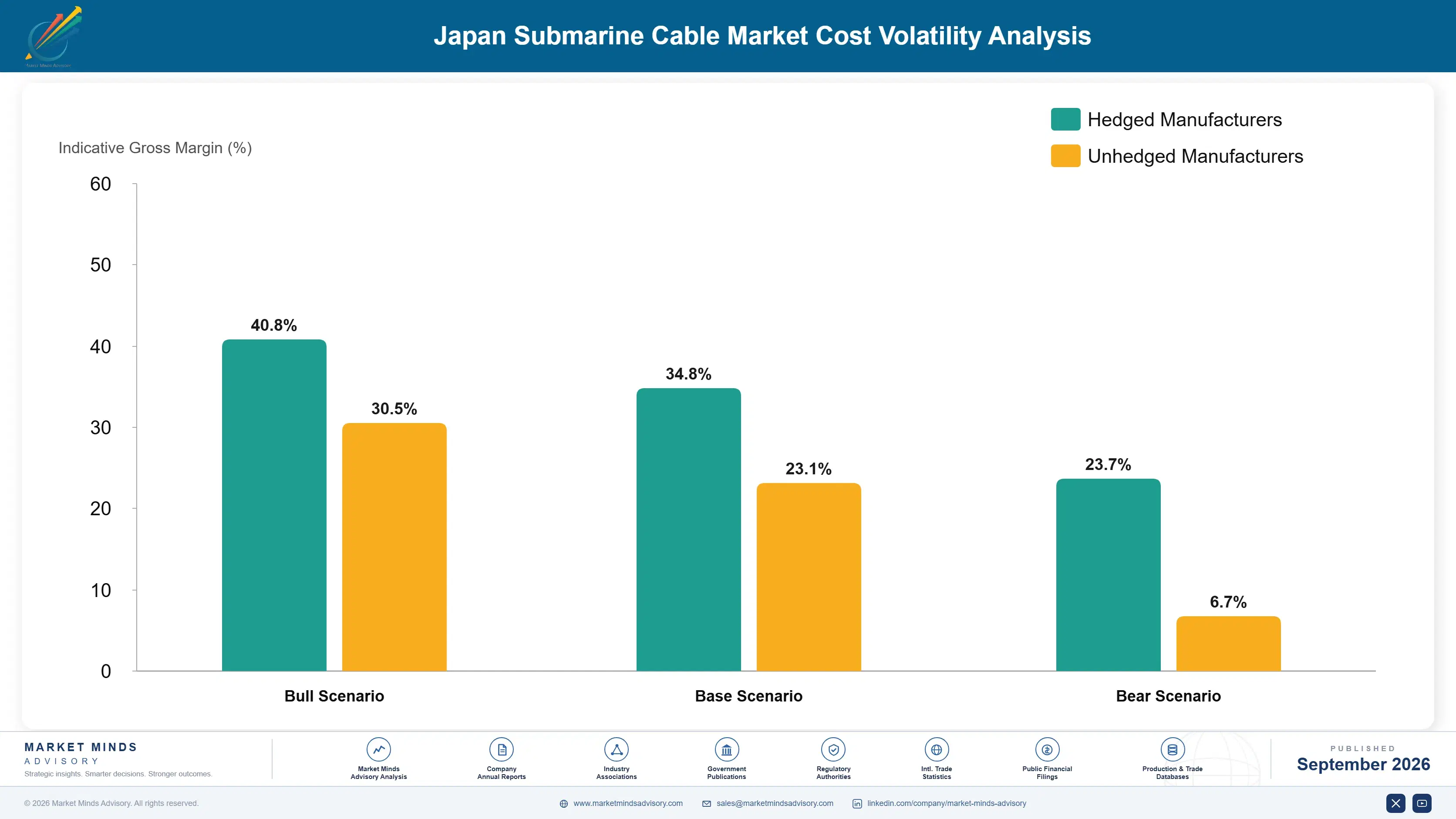
Copper and aluminium conductor materials together represent the largest cost input for submarine cable manufacturers, running an estimated 34 to 41 percent of cost of goods sold, sourced primarily from a concentrated group of specialty metals producers whose materials meet exacting conductivity requirements across most subsea cable designs manufactured today. This concentration leaves manufacturers with limited leverage to negotiate lower unit pricing during periods of tight global supply.
Conductor material pricing rose meaningfully across the broader specialty metals sector during 2021 and 2022 amid well documented global supply chain disruption and rising energy costs affecting material processing, a pattern confirmed in multiple manufacturer annual reports and in IEA and European Commission critical minerals market commentary from the same period. Manufacturers without diversified material supplier relationships faced longer lead time extensions than those with existing multi source agreements established beforehand.

The disadvantage falls hardest on smaller manufacturers lacking purchasing scale to secure priority allocation from constrained metals suppliers during periods of tight commodity material supply. Exposure varies by player type too, since manufacturers building high performance monitoring capable cable systems face materially greater material exposure than manufacturers offering standard passive configurations built on more widely available, less specialised conductor grades.
submarine-cable-industry-analysis-in-japan-cost-volatility-analysis-1790000453659

Qualifying Multiple Conductor Suppliers Per Project Design

Larger manufacturers are qualifying multiple specialty conductor suppliers for each critical project design from the outset, reducing single source supply exposure while maintaining the conductivity consistency subsea applications require across the full project bill of materials. This also shortens lead time whenever disruption occurs. This dual sourcing approach also strengthens negotiating leverage whenever a single supplier faces unexpected capacity constraints.

Building Strategic Conductor Inventory Buffers

Several manufacturers are building larger strategic inventory buffers of critical conductor materials well ahead of anticipated demand, reducing exposure to short term allocation shortages during periods of industry wide specialty metals supply tightness across regions. These buffers typically cover several months of anticipated production demand. Larger manufacturers report this strategy reduced production delays during recent periods of tight supply.

Investing In Alternative Conductor Material Formulations

Manufacturers are increasingly investing in alternative conductor material formulations that reduce dependency on the most constrained specialty metal inputs, lowering exposure to feedstock price swings while maintaining conductivity performance subsea applications require. This approach is becoming standard across most manufacturers, reducing material cost exposure considerably. Early adopters report meaningful cost savings across several major product lines within the broader portfolio.

Portfolio Architecture for Margin Defence

Portfolio economics split into three tiers. Volume tier basic passive cable systems carry thinner margins under continued price competition from regional manufacturers, while premium monitoring enabled systems carry meaningfully higher margins tied to documented fault detection speed. The sustainability and next generation tier, built around route survey precision and vessel scheduling support, currently carries the strongest margins given genuine differentiation and long term operator relationships.
The volume versus premium tension shows up clearly in manufacturer engineering allocation. Investment devoted to defending basic passive cable margin against regional manufacturer price competition competes directly against investment needed for monitoring capability and survey development, and manufacturers that under invest in either risk losing ground to a competitor optimised specifically for that segment of the market.

High value margin pools concentrate in monitoring and survey lines, where technical differentiation and validated detection data still command premium pricing before broader commoditisation eventually sets in across the category. The basic passive tier remains essential for market reach among smaller regional operators but contributes a shrinking share of blended gross margin across the category overall. This dynamic is already visible in manufacturer product roadmaps announced over the past year.

Volume / Commodity-Adjacent Tier

Basic passive cable systems facing continued price competition from regional manufacturers across less demanding standard applications, leaving vendors reliant on volume rather than monitoring depth to defend share. Manufacturers competing here rely mainly on scale and cost discipline.
Gross Margin: 11-19%

Premium / Certified Tier

Monitoring enabled systems bundling validated detection performance carrying margins tied to precision and reliability, with buyers willing to pay a meaningful premium for demonstrated results. Buyers rarely negotiate hard on this tier once qualified.
Gross Margin: 25-35%

Sustainability / Regulatory / Next-Generation Tier

Route survey precision and vessel scheduling support systems commanding the strongest current margins given genuine differentiation and recurring operator relationships. Recurring service revenue further strengthens the durability of this margin position across most active accounts.
Gross Margin: 31-41%
submarine-cable-industry-analysis-in-japan-portfolio-architecture-1790000454166

High-value Sub-segments and Strategic Watch-out

Hyperscale Monitoring Contracts

The fastest growing margin segment in this report, combining strong current margins with accelerating demand for validated fault detection speed across new hyperscale programmes this decade. Manufacturers report strong booking momentum here across most accounts. Manufacturers with early positioning are securing multi year commitments ahead of broader industry recognition.
Gross Margin: 31-41%

Offshore Wind Power Transmission Contracts

Premium offerings tied to developer demand for documented subsea interconnection reliability, offering strong margins and durable revenue visibility across major accounts broadly, across recent programme cycles too. Buyers value this consistency highly. Buyers value this consistency highly across most established accounts and recent programme cycles today.
Gross Margin: 25-35%

Standard Telecommunications Contracts

The largest existing revenue base, standard engagements facing steady price competition but funding most manufacturers' ongoing monitoring and engineering investment across the wider business, with manufacturers depending heavily on this steady base overall. This funding role keeps the segment strategically important despite comparatively thinner margins.
Gross Margin: 13-21%

Legacy Passive Cable Product Exposure

A shrinking strategic watch out segment as monitoring capable systems continue displacing legacy passive approaches across most cable categories tracked in this report, especially for smaller regional manufacturers. Manufacturers slow to pivot toward monitoring capability risk losing meaningful share within a few years. Manufacturers slow to respond risk losing ground.

Route Lock-In and Operator Economics

Revenue behaves like a multi year annuity once a manufacturer's cable system becomes embedded across an operator's approved subsea route programme and repair fleet contract, since switching manufacturers means requalifying an entirely new system against existing route safety standards and marine protection certification rather than a simple equipment swap. That qualification cost explains most of this category's revenue visibility once a manufacturer moves past initial project win into steady, long term maintenance service supply.
Adoption depth varies sharply by end use vertical. Hyperscale and offshore wind interconnection customers running continuous, high value cable programmes integrate manufacturer relationships deeply into ongoing multi year service agreements spanning entire route lifecycles, while smaller conventional telecom customers with less continuous procurement needs treat equipment purchasing more transactionally around individual route upgrade projects, creating shallower manufacturer loyalty and greater exposure to competitive switching.

Buyer profiles are shifting generationally too. Cable engineers who came up through the passive era still favour proven, established manufacturer relationships at a price premium, while newer procurement leaders increasingly default to evaluating monitoring depth and documented fault detection speed as standard evaluation considerations. That difference in buying philosophy shapes which manufacturers win newly specified hyperscale programmes versus legacy conventional telecom contracts.
submarine-cable-industry-analysis-in-japan-end-use-penetration-index-1790000454664

Where the Category Reorders Next

These are among the four positions where our research anticipates prominent divergence between winners and laggards over the coming forecast period. Each is grounded in the demand model, the regulatory perimeter, and the announced capacity pipeline.
01 / MONITORING SYSTEM INVESTMENT

Validated fault detection data is separating category leaders from claims

Manufacturers that built validated monitoring system capability are capturing a disproportionate share of hyperscale contracts as buyers grow wary of unproven detection promises circulating across the category. Manufacturers without demonstrated certified detection evidence risk being relegated to commodity passive positioning carrying materially lower contract value than monitoring leaders currently command. Building this evidence base now, while buyers actively reassess vendor evaluation criteria across nearly every major project, looks like the more urgent priority for most manufacturers heading into next year.
02 / ROUTE SURVEY STRATEGY

Advanced survey architecture is compounding into durable contract value

Manufacturers that engineered advanced route survey precision architecture are capturing a disproportionate share of transoceanic contracts as operators increasingly demand measurable, simplified single vendor coverage beyond standard installation configurations alone. This dynamic rewards manufacturers willing to invest in survey engineering well ahead of confirmed industry wide standardisation. Manufacturers without established survey depth should prioritise smaller pilot routes first, since pilots with two or three routes tend to reveal most recurring seabed hazard patterns early, well before a broader rollout begins in earnest.
03 / VESSEL SCHEDULING POSITIONING

Documented installation acceleration remains a genuinely underexploited advantage

Documented vessel scheduling support remains underexploited relative to its clear value potential as operators continue seeking verified timeline acceleration faster than many generic cable manufacturers can credibly demonstrate comparable fleet coordination depth. Manufacturers building genuine scheduling capability now are positioning for meaningful contract advantage as transoceanic project requirements continue expanding across major markets worldwide. Treating scheduling support as a secondary afterthought rather than a distinct strategic asset risks underinvesting in an important, durable competitive moat that rivals are already building steadily.
04 / COMMODITY PASSIVE EXPOSURE

Manufacturers without monitoring depth face continued displacement pressure

Manufacturers remaining concentrated in commodity passive cable positioning without monitoring or survey capability face continued displacement pressure as buyer procurement criteria shift decisively toward precision, technically differentiated offerings across most accounts tracked in this report. Manufacturers should actively diversify toward monitoring systems, route survey, or vessel scheduling support rather than defending commodity only positioning alone across every regional account. Treating commodity only positioning as stable rather than declining understates the category's ongoing competitive transition already well underway across most developed markets tracked closely throughout this report.

Engagement Snapshot From the Field

A live engagement with an industry participant carrying material or product regulatory and market exposure ahead of a defining policy shift, showing how our research translates into a defensible multi-year portfolio strategy.
MARKET MINDS ADVISORY · CLIENT ENGAGEMENT SUMMARY
Japan Submarine Cable Producer Strategic Portfolio Review and Transition Roadmap 2026·Investment Scenario on Japan Submarine Cable Exposure Evaluation 2025-26
CLIENT PROFILE
The client is a regional hyperscale data centre operator generating approximately eight hundred million dollars in annual connectivity related revenue, operating a legacy passive cable fleet across its transoceanic route network with no centralized monitoring capability (client-reported, unverified by MMA). The operator's network engineering team includes roughly fourteen engineers coordinating manual fault detection tracking across multiple disconnected legacy systems.
STRATEGIC CHALLENGE
Leadership needed to convert its cable fleet toward monitoring capable technology able to document measurable fault detection speed, without triggering costly route disruption during the transition from passive to monitoring capable systems across active connectivity programmes already scheduled for the coming quarter ahead. Any misstep risked missed connectivity deadlines and diminished operator confidence across the largest transoceanic accounts.
MMA APPROACH
MMA benchmarked candidate cable manufacturers against disclosed detection data and existing client references at comparable hyperscale operators, prioritising manufacturers demonstrating genuine validated monitoring capability over marketing claims alone. The engagement included structured route audits to assess actual fault conditions across several representative subsea corridors. MMA also reviewed each candidate's documented vessel scheduling history across comparable operator programmes.
KEY FINDINGS
  1. Two of the five candidate manufacturers already held relevant monitoring deployments from a closely comparable hyperscale operator relationship, suggesting a lower risk transition path than a fully novel rollout.
  2. Several manufacturers claiming strong detection figures in marketing materials had not actually validated those figures through independent measurement at comparable hyperscale operators previously.
  3. A phased route by route conversion sequence reduced total implementation risk considerably compared to a simultaneous full network conversion approach across every route at once.
  4. Network engineering team adoption of the retained manufacturer's monitoring platform exceeded initial expectations once early detection results were shared transparently across operations teams.
CLIENT PROFILE
The client is a regional hyperscale data centre operator generating approximately eight hundred million dollars in annual connectivity related revenue, operating a legacy passive cable fleet across its transoceanic route network with no centralized monitoring capability (client-reported, unverified by MMA). The operator's network engineering team includes roughly fourteen engineers coordinating manual fault detection tracking across multiple disconnected legacy systems.
STRATEGIC CHALLENGE
Leadership needed to convert its cable fleet toward monitoring capable technology able to document measurable fault detection speed, without triggering costly route disruption during the transition from passive to monitoring capable systems across active connectivity programmes already scheduled for the coming quarter ahead. Any misstep risked missed connectivity deadlines and diminished operator confidence across the largest transoceanic accounts.
MMA APPROACH
MMA benchmarked candidate cable manufacturers against disclosed detection data and existing client references at comparable hyperscale operators, prioritising manufacturers demonstrating genuine validated monitoring capability over marketing claims alone. The engagement included structured route audits to assess actual fault conditions across several representative subsea corridors. MMA also reviewed each candidate's documented vessel scheduling history across comparable operator programmes.
KEY FINDINGS
  1. Two of the five candidate manufacturers already held relevant monitoring deployments from a closely comparable hyperscale operator relationship, suggesting a lower risk transition path than a fully novel rollout.
  2. Several manufacturers claiming strong detection figures in marketing materials had not actually validated those figures through independent measurement at comparable hyperscale operators previously.
  3. A phased route by route conversion sequence reduced total implementation risk considerably compared to a simultaneous full network conversion approach across every route at once.
  4. Network engineering team adoption of the retained manufacturer's monitoring platform exceeded initial expectations once early detection results were shared transparently across operations teams.
RECOMMENDED STRATEGY
Phase 1: Phase 1 (Months 1 to 3): Benchmark manufacturers against validated detection and verified vessel scheduling evidence from comparable operators. regional routes. Phase 2: Phase 2 (Months 4 to 8): Convert the highest priority transoceanic route first to validate the retained manufacturer relationship and measure early results. Phase 3: Phase 3 (Months 9 to 14): Extend the conversion across remaining routes based on initial performance results achieved during the first phase.
OUTCOME
Fourteen months after the engagement began, the operator successfully converted monitoring capable technology across four of five transoceanic routes, reporting measurably improved fault detection speed consistency relative to its prior passive baseline (client-reported, unverified by MMA). Leadership also reported improved confidence in managing future connectivity expansion programmes independently, and reduced average engineer fault tracking time considerably across the conversion.

Frequently Asked Questions

Foundational context covering the market sizes, CAGR, scope, country, region and competition that inform every finding below. This section is provided to cover basics and most often pre-purchase conversations, answered from the MMA Primary Research Dataset.

What is the current size of the Japan Submarine Cable Market?

The Japan Submarine Cable Market reached an estimated USD 6.8 billion in global revenue in 2025. This base year figure anchors the forecast period beginning in 2026.

How large will the Japan Submarine Cable Market be by 2036?

MMA projects the market will reach approximately USD 14.02 billion by 2036 under the base case scenario. That represents roughly a 1.93 times expansion from the 2026 starting value of USD 7.26 billion.

What is the CAGR for the Japan Submarine Cable Market 2026 to 2036?

The base case compound annual growth rate is 6.8% across the 2026 to 2036 forecast window. Bull and bear scenarios range from 5.5% to 8.0% depending on hyperscale connectivity investment and offshore wind buildout pace.

Which segment is growing fastest?

Submarine Cable Monitoring and Protection Systems leads all segments at a 10.5% CAGR, roughly 1.54 times the overall market rate. This segment benefits from accelerating hyperscale data centre connectivity investment worldwide.

Who are the major companies in the Japan Submarine Cable Market?

Leading manufacturers include NEC Corporation, SubCom LLC, Alcatel Submarine Networks, HMN Technologies Co Ltd, and Prysmian Group. Together these five hold an estimated 62% combined share on a disclosed installed cable route length basis.

Which country is growing fastest?

India leads national growth at an estimated 9.1% CAGR, driven by rapidly expanding hyperscale data centre and national digital infrastructure programmes. Vietnam follows within the same South Asia and Pacific region.

Report Segmentation Architecture

The full report scope spans multiple orthogonal segmentation dimensions, with cross-tabulated demand data provided for each dimension pair. Coverage extends further to regional breakdowns, trend trajectories, and the competitive detail needed to support segment-level decision-making.

By Primary Market Dimension

  • Submarine Telecommunications Cable Systems
  • Submarine Power Transmission Cable Systems
  • Submarine Cable Repair and Maintenance Services
  • Submarine Cable Installation and Laying Services
  • Submarine Cable Route Engineering and Survey Services
  • Submarine Cable Monitoring and Protection Systems

By End-Use Industry

  • Hyperscale Data Centre Connectivity
  • Offshore Wind Power Generation
  • Telecommunications Network Operators
  • Utility Transmission Grid Operations
  • Government and Defense Communications

By Commercial Dimension

  • Direct Operator Equipment Supply
  • Engineering, Procurement and Construction Contracts
  • Systems Integrator Partnership Channel
  • Long Term Maintenance Service Agreements

By Region

  • North America
  • Western Europe
  • East Asia
  • South Asia and Pacific
  • Latin America
  • Middle East and Africa
  • Eastern Europe

Scope, Methodology, and Coverage

Every figure in this report is reproducible from documented input assumptions. The scope below maps the historical period, the forecast horizon, the segmentation dimensions, and the countries covered, alongside the underlying primary and qualitative methodology.
Historical Period
2020 to 2025
Forecast Period
2026 to 2036
Base Year
2025 (USD billions; MMA Primary Research Dataset, September 2026)
Market Definition
This report covers submarine telecommunications and power transmission cable systems, including installation, repair, route engineering, and monitoring services for subsea deployment. It excludes terrestrial fibre optic cable systems and standalone offshore wind turbine generation equipment sold without submarine cable interconnection components.
Quantitative Units
USD billions (current prices); installed cable route length in kilometers; average documented fault detection speed improvement
Segmentation Dimensions
By Primary Market Dimension; By End-Use Industry; By Commercial Dimension; By Region
Regions Covered
North America, Western Europe, East Asia, South Asia and Pacific, Latin America, Middle East and Africa, Eastern Europe
Countries Covered
USA, Canada, Germany, France, UK, Netherlands, Japan, China, South Korea, Taiwan, India, Australia, Vietnam, Indonesia, Brazil, Mexico, Colombia, Saudi Arabia, UAE, South Africa, Egypt, Poland, Hungary, Romania, Czech Republic, and additional markets relevant to this sector
Key Companies Profiled
NEC Corporation; SubCom LLC; Alcatel Submarine Networks; HMN Technologies Co Ltd; Prysmian Group; Nexans SA; Sumitomo Electric Industries Ltd; Fujitsu Limited; Furukawa Electric Co Ltd; LS Cable & System Ltd; NKT A/S; Hengtong Group Co Ltd; Jiangsu Zhongtian Technology Co Ltd; Viscas Corporation; Elettra Tlc SpA; Global Marine Group; Orange Marine SAS; E-marine PJSC; IT International Telecom Inc; NTT World Engineering Marine Corporation
Quantitative Methodology
Primary survey, n=3,800 respondents, Q4 2025, six countries; demand-side model with trade association cross-validation
Qualitative Methodology
47 expert interviews, Q4 2025; applied to validate demand model assumptions, identify emerging dynamics, and assess competitive positioning
Report Format
PDF and XLSX data workbook (Word format preview document)
Publisher
Market Minds Advisory
Report Code
MMA-2026-TEC-408
Published
September 2026
Contact
sales@marketmindsadvisory.com | www.marketmindsadvisory.com

Purchase the full Japan Submarine Cable Market Report (2026 to 2036).

The full report delivers complete segmentation data across all six product segments, all seven regional markets, and detailed competitive profiles for all twenty companies named in this summary. It includes the underlying primary survey dataset of three thousand eight hundred respondents and forty seven expert interviews conducted during the fourth quarter of 2025. Buyers also receive downloadable data tables covering historical 2020 to 2025 figures alongside the full 2026 to 2036 annual forecast. A dedicated appendix addresses conductor material sourcing benchmarks across three manufacturer scenarios.
Full Seven-Region Regional Data Tables and Charts
All Twenty Company Competitive Profiles and Rankings
Ten-Year Annual Forecast Model With Scenarios
Primary Survey Raw Data Access and Tables
Conductor Material Sourcing Benchmark Appendix Section
Quarterly Update Subscription Option for Buyers

Built For The People Who Decide

From boardroom strategy to bench-side execution, this report is read cover-to-cover by leaders shaping the next decade of their industry, turning demand scenarios, market dynamics and valuation benchmarks into decisions.
CXOs/ Presidents/ VPs/ Managers
M&A and Corporate Development
Strategy Teams and R&D Heads
Procurement and Product Directors
Regulatory and Compliance Leaders
Investor Relations and Equity Analysts