Market Minds Advisory
Stretchable Conductive Material Market

Stretchable Conductive Material Market: The Trace Was Never the Hard Part

Fifteen years of published stretch-to-failure curves and almost nothing at all on the joint where a soft trace meets a rigid chip, which is exactly where the prototypes keep failing.

Lead Analyst

Bilal Shaikh

Published

September 2026

Make Smarter Decisions with Customized Research Insights

Request a free sample report and evaluate market opportunities, growth trends, and competitive dynamics relevant to your business needs.

2025 MARKET VALUE$0.4BMarket Size 2025
2036 FORECAST VALUE$1.9BBase Case , 2026 to 2036
CAGR 2026 TO 203614.6 %Bull 16.0% / Bear 13.2%
INCREMENTAL OPPORTUNITY$1.4BNet 10- year value creation
EXPANSION MULTIPLE3.90x2036 value over 2026 base
Strategic Levers
M&A Pipeline
Regional Outlook
Country Rankings
Competitive Intelligence
Segmental Deep-dive
Call-Us : 91 93563 13602

Executive Snapshot and Market Trajectory

This field has been demonstrating the wrong thing for fifteen years. Around 71% of prototype failures happen at the joint between a stretchable trace and a rigid component, and almost every published result measures the trace instead of the joint that actually breaks.
That misplaced attention explains why so little ships. Liquid metal alloys grow fastest at 21.9% precisely because they tolerate the interconnect problem better than filled inks do, not because they conduct better. The material that eventually wins will be the one with a qualified assembly process behind it rather than the best elongation figure on a data sheet. That distinction has been visible for years and remains largely unaddressed.
One application already ships in volume and nobody talks about it. Disposable skin adhesive medical devices take around 62% of shipped material, in a regulated single-use business with biocompatibility qualification behind it. That is a different commercial model from the consumer wearables the field keeps promising, and it is where the revenue is. Suppliers organised around consumer timelines and pricing are addressing a market that has not arrived and ignoring the one already paying.
Market Definition
Electrically conductive materials engineered to retain conduction under mechanical strain, covering silver filled elastomeric inks and pastes, liquid metal alloys, metal nanowire composites, conductive polymer systems, carbon nanotube and graphene composites, and stretchable metal foil and serpentine structures. Measured at material supplier selling value. Excludes rigid printed electronics inks, flexible but non-stretchable circuits, finished wearable devices, substrate films, and assembly or contract manufacturing services.
Base Year Value
$0.4B in 2025 (MMA Primary Research Dataset, August 2026)
Forecast Period
2026 to 2036, eleven discrete annual values
CAGR
14.6% base case. Bull 16.0%. Bear 13.2%.
Fastest Growth Segment
Liquid Metal Alloys: 21.9% CAGR
Fastest Growth Country
South Korea: 19.8% CAGR
Fastest Growth Region
South Asia and Pacific: 16.8% CAGR
Largest Region
East Asia: 30% of 2025 global value
Market Leaders
DuPont, Henkel, Heraeus, Toyobo, Creative Materials. Source: MMA Primary Research Dataset, July 2026.
Primary Survey
n=3,800 procurement and R&D decision-makers, Q4 2025, six countries
Methodology
Demand-side build-up, cross-validated against public data, 47 expert interviews

Stretchable Conductive Material Market Forecast Scenarios

stretchable-conductive-material-market-size-forecast-scenario-1787595426016
Growth ran near 13.4% between 2020 and 2025, and almost all of it came from one application rather than from the many that get demonstrated. Disposable medical skin patches scaled on continuous monitoring and cardiac telemetry, while e-textiles and soft robotics stayed in prototype. Silver pricing moved sharply across the period and mattered more than most participants expected, given how much metal these formulations carry.
Base case 14.6% rests on three mechanisms. Liquid metal alloys grow at 21.9% because they tolerate the rigid component interface that defeats filled inks. Metal nanowire composites grow at 17.4% on transparent stretchable electrode demand for display and sensing. And South Korea grows fastest of any country at 19.8% as display and device manufacturers move stretchable structures from research into pilot production lines. Only one of the three depends on consumer wearables arriving at all.
The bull case at 16.0% assumes a qualified interconnect assembly process reaching commercial availability, which would move several stalled applications out of prototype simultaneously. The bear case at 13.2% is the medical patch application remaining the only volume outlet while e-textiles continue failing launder testing and soft robotics stays confined to research budgets. Neither scenario turns on conductivity improving.

Everybody Measures the Wrong Failure

Fifteen years of research output in this field measures how far a conductive trace stretches before it stops conducting, which is a genuinely interesting question and not the one that decides whether a product ships. Around 71% of prototype failures occur where the trace meets a rigid component, because a chip does not stretch and strain concentrates at that boundary. Almost nobody publishes on the joint.
TOP FIVE CONCENTRATION36%Specialty formulators and chemical groups share a fragmented field
SILVER COST SHARE64%Metal filler portion of stretchable conductive ink cost
INTERCONNECT FAILURE SHARE71%Prototype failures occurring at the rigid component joint
LAUNDER CYCLE REQUIREMENT40Wash cycles a garment integrated conductor must survive
STRAIN TOLERANCE50%Elongation held without meaningful loss of electrical conduction
MEDICAL PATCH VOLUME SHARE62%Shipped material going into disposable skin adhesive devices
That explains the material rankings better than conductivity does. Liquid metal alloys grow fastest at 21.9% not because they conduct better than silver filled inks but because a liquid conductor cannot crack at an interface, which sidesteps the failure mode rather than resisting it. Whichever material eventually carries volume will be the one with a qualified assembly process behind it, and the data sheet elongation figure will have very little to do with it.
Meanwhile one application has quietly been shipping all along. Disposable skin adhesive medical devices take around 62% of material volume, in continuous glucose monitors, cardiac telemetry patches and wearable therapy devices. That is a regulated, single-use, biocompatibility qualified business with locked-down supply and long approval cycles, which is nothing like the consumer wearables market the field keeps describing.
"I have read hundreds of papers reporting elongation at failure and almost none reporting what happened at the connector. That asymmetry is the whole story of this market, and it is why a material with mediocre conductivity and a solved joint will beat a brilliant one without."
Director, Advanced Materials and Flexible Electronics Practice · MMA Technology and Electronics Practice · August 2026

Market Trends

Interconnect failure quietly deciding which materials survive

Around 71% of prototype failures occur at the boundary between a stretchable conductor and a rigid component, where strain concentrates because a chip cannot deform. Materials that sidestep that boundary rather than resisting it are winning on grounds nobody publishes about, which is why liquid metal alloys grow at 21.9% despite offering no conductivity advantage. Suppliers competing on elongation figures are competing on a specification that does not determine whether a product reaches production at all. The gap persists because the problem sits between materials science and assembly engineering, so no discipline treats it as its own responsibility.
Market Impact: Consumes 62% of material volume

Medical patch volume carrying a field that discusses wearables

Disposable skin adhesive medical devices take around 62% of shipped material across continuous glucose monitoring, cardiac telemetry and wearable therapy, in a regulated single-use business with biocompatibility qualification and locked supply chains. Consumer wearables, which occupy most of the field's attention, ship comparatively little. Suppliers organised around consumer electronics timelines and pricing are addressing a market that has not arrived while ignoring the one that already pays. Medical positions hold for years once approved, because requalification means regulatory documentation and possibly a new submission, which no device maker undertakes to save money on an input.
Market Impact: Korea growing fastest at 19.8%

Market Opportunities and Growth Drivers

Continuous physiological monitoring expanding disposable device volume

Continuous glucose monitoring, cardiac telemetry and wearable therapy devices all attach to skin, deform with it and get thrown away after a few days, which produces recurring material consumption rather than a one-off fitting. Volume grows with diagnosed patient populations rather than with any consumer electronics cycle. Biocompatibility qualification and regulatory approval lock supply for years once established, which makes these positions considerably more durable than anything in the consumer segment. Consumer wearable programmes, by contrast, ship comparatively little material and change supplier freely between generations. That difference matters commercially more than volume alone suggests.
Market Impact: Fails before 20 wash cycles

Korean display makers moving stretchable structures toward production

South Korea grows fastest of any country at 19.8% as display and device manufacturers move stretchable structures from research programmes into pilot production lines, which requires material qualified for process rather than demonstrated in a laboratory. Transparent stretchable electrodes drive metal nanowire composite demand at 17.4% behind that. Qualification through a Korean manufacturer tends to propagate into overseas plants those same companies operate, which multiplies the eventual volume considerably. Very few suppliers track that propagation deliberately or resource the demand that follows from it several years later. The signal arrives well ahead of the demand itself.
Market Impact: Silver carries 64% of cost

Market Restraints and Challenges

Launder durability defeating garment integrated conductors

Garment integrated conductors need to survive around 40 wash cycles to be commercially acceptable and most systems degrade well before twenty, as mechanical agitation, detergent chemistry and heat combine to attack both the conductor and its encapsulation. The root cause is that laundering applies several failure mechanisms at once. Commercially it has kept e-textiles in demonstration for over a decade. Improved encapsulation and intrinsically stretchable conductors are the pathways being pursued without resolution yet. Programmes keep being halted rather than redesigned. Encapsulation failure rather than conductor fatigue is usually the limiting mechanism identified in test series.
Market Impact: Causes 71% of prototype failures

Silver loading making these materials expensive rather than cheap

Silver carries around 64% of stretchable conductive ink cost, and loading per unit area exceeds rigid printed electronics because percolation must survive a deforming matrix. The root cause is physics rather than formulation inefficiency. Commercially it undermines the printed electronics cost story these materials are frequently sold with, since they are expensive rather than cheap. Nanowire and liquid metal systems reduce metal content, and both carry their own qualification barriers instead. Reducing loading without losing strain performance is the only route that changes the economics rather than merely shifting where the cost sits in a formulation.
Market Impact: Takes 62% of shipped volume
4 additional market trends, 3 additional growth drivers, and 2 additional restraints and challenges are covered in the full report. Contact sales@marketmindsadvisory.com to access the complete intelligence.

Segment CAGR and Growth Architecture

Six segments are split by material class, because material class determines the conduction mechanism, the strain behaviour, the processing route a device maker must adopt and how the material behaves at the rigid component boundary where most designs actually fail. Formulation variants sit inside each class. Application and channel are handled separately in the framework.
stretchable-conductive-material-market-market-share-analysis-1787595426571

Liquid Metal Alloys

Growing at 21.9%, half again the market rate of 14.6%, gallium based liquid alloys conduct as a fluid, which means they cannot crack at the rigid component boundary where around 71% of prototype failures occur. That sidesteps the dominant failure mode rather than resisting it, and it explains the growth far better than any conductivity comparison does. Containment, encapsulation and gallium's tendency to attack aluminium are the practical problems, and they are engineering problems with known approaches rather than the open research question the interconnect has been. Device makers qualifying these systems are doing so on interface behaviour rather than on any conductivity comparison at all. Conductivity comparisons miss the point entirely.
CAGR 21.9%

Metal Nanowire Composites

At 17.4% silver nanowire networks embedded in elastomer deliver transparent stretchable conduction, which serves display electrodes, touch sensing and optical applications that filled inks cannot address at all. Metal loading is far below silver flake systems, which matters when silver carries around 64% of ink cost. Korean and Japanese display manufacturers moving stretchable structures toward pilot production are the demand driver, and qualification through those manufacturers propagates into their overseas plants. Junction resistance and long-term network stability under repeated strain remain the technical constraints. Qualification for line processing rather than laboratory demonstration is what separates suppliers here, and it has excluded several that appeared competitive on published specifications alone. Junction stability remains the open question.
CAGR 17.4%
Full segment breakdown across 6 segments available in the complete report.

Regional Architecture and Country Demand Map

East Asia holds 30% of value on Korean and Japanese display and device manufacturing moving stretchable structures toward production. North America follows at 28% on medical device manufacture, which is where volume actually ships. South Asia and Pacific grows fastest of the seven regions. Scope covers all seven.

North America

Disposable medical device manufacture drives most regional consumption, with continuous glucose monitoring and cardiac telemetry patches shipping at genuine volume rather than in pilot quantities. Biocompatibility qualification and regulatory approval lock material supply for years once established, which makes these the most durable positions available anywhere in this market. Research funding for soft robotics and stretchable displays is substantial but converts to material volume slowly. Growth at 13.8% reflects steady medical expansion rather than any breakthrough application arriving. Suppliers organised around consumer wearable timelines are addressing a segment that ships far less material than the medical business they tend to overlook. Medical qualification is where the durable positions sit, and it takes years of regulatory work to establish.
Share: 28% | CAGR: 13.8% (2026 to 2036)

Western Europe

Medical device manufacture and automotive interior sensing account for most regional demand, alongside a research base in soft robotics that has produced more publications than production volume. Regulatory requirements for medical materials are demanding, which favours suppliers with established biocompatibility documentation over newer formulators. E-textile programmes here have repeatedly stalled on launder durability rather than on conduction performance. Growth of 13.0% is the slowest anywhere, held back by applications that remain in demonstration. Automotive interior sensing programmes are progressing more steadily than either e-textiles or soft robotics, though volumes remain modest against medical device consumption. Medical device manufacture remains the only regional application shipping material at genuine volume, and regulatory documentation rather than performance decides which suppliers hold those positions.
Share: 22% | CAGR: 13.0% (2026 to 2036)
Regional intelligence for 5 additional markets available in the complete report: East Asia, South Asia and Pacific, Latin America, Middle East and Africa, Eastern Europe. Contact sales@marketmindsadvisory.com.
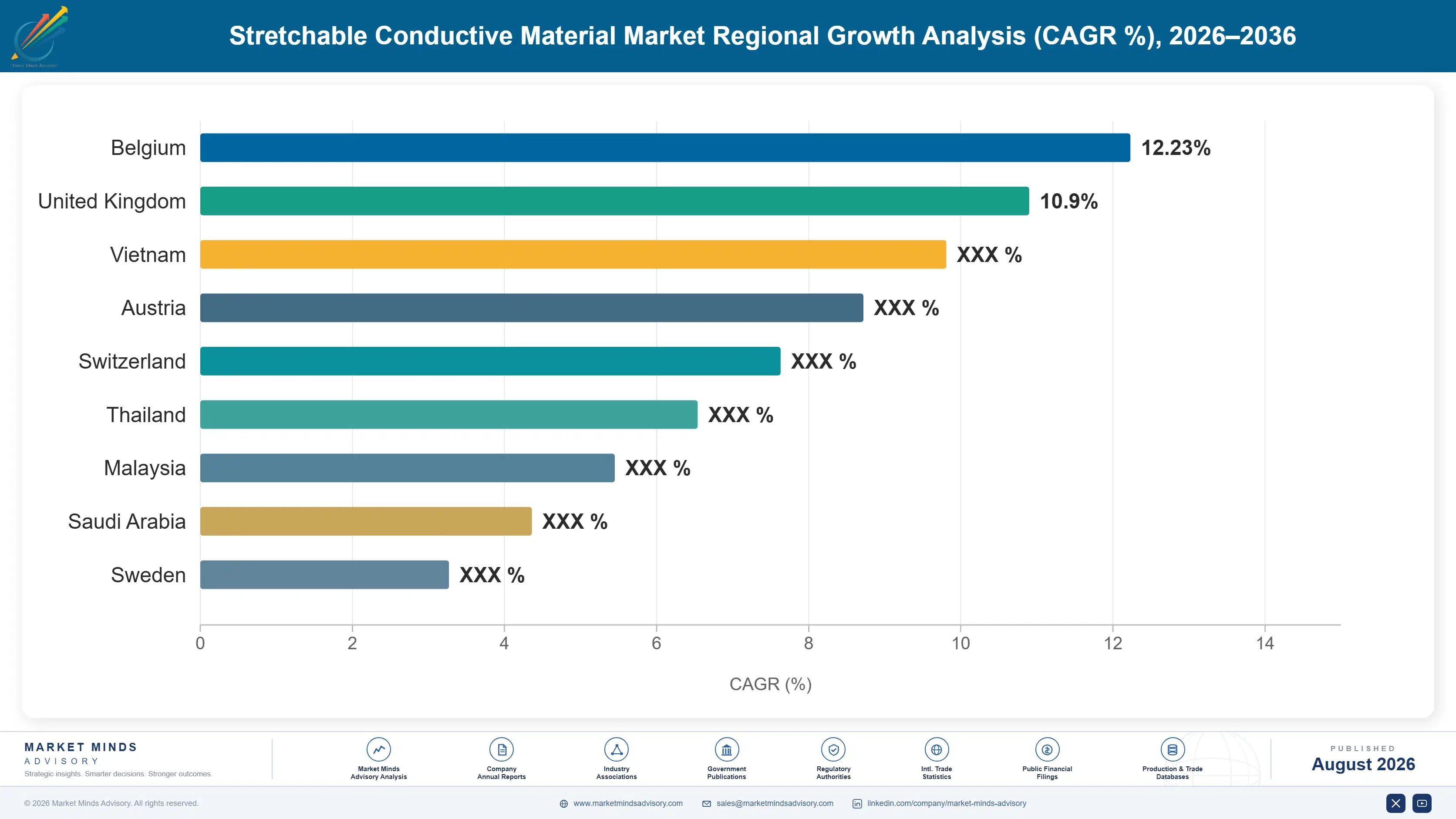
stretchable-conductive-material-market-country-cagr-analysis-1787595427094

Four Moves Past the Demonstration Loop

This field has spent fifteen years improving a number that does not decide whether products ship, while the joint that actually fails goes largely unstudied. The commercial moves worth making solve the interconnect, serve the application already buying, and stop pricing these materials as though they were cheap. None of them requires a better trace.

Solve the interconnect and sell the assembly process

Around 71% of prototype failures happen at the rigid component boundary, and a supplier arriving with a qualified joining process rather than a better trace addresses the problem that actually stops products reaching production. That work sits between materials and assembly, which is precisely why nobody owns it. Whoever does own it will define how devices get built rather than merely supplying one material into somebody else's design. It is unglamorous engineering work sitting outside conventional materials research, which is exactly why the position remains open to whoever decides to take it seriously first.
Market Impact: Addresses 71% of all the observed prototype failures

Serve the medical patch application that already ships

Disposable skin adhesive devices take around 62% of shipped material in a regulated business with biocompatibility qualification and locked supply chains, while the field's attention sits on consumer wearables that ship comparatively little. Those medical positions hold for years once approved because requalification requires regulatory work nobody undertakes casually. It is an unglamorous application and it is where the revenue currently is. Biocompatibility qualification is achievable within most established formulation capabilities, and the barrier is willingness to do regulatory work rather than any technical limitation on the material itself. Nobody else is competing for it.
Market Impact: Serves 62% of the currently shipped material volume

Reduce silver content rather than defending the formulation

Silver carries around 64% of ink cost and loading exceeds rigid printed electronics because percolation must survive a deforming matrix, which makes these materials expensive rather than cheap. Nanowire and liquid metal systems cut metal content substantially and carry their own qualification barriers. A supplier that lowers metal loading without losing strain performance changes the economics of every application currently priced out. Nanowire and liquid metal systems already demonstrate what lower metal content makes possible, and both carry qualification barriers that a silver filled formulator has already cleared elsewhere. The physics sets the floor, not habit.
Market Impact: Cuts into the 64% silver cost share directly

Qualify through Korean manufacturers moving into production

South Korea grows fastest at 19.8% as display and device manufacturers move stretchable structures from research into pilot lines, which requires material qualified for a process rather than demonstrated in a laboratory. Qualification through those manufacturers propagates into overseas plants they operate, multiplying volume well beyond the original programme. Very few suppliers track that propagation deliberately or resource what follows from it. Process qualification excludes suppliers that laboratory demonstration had made look entirely competitive, which narrows the field considerably for anybody who clears it early. Propagation into overseas plants follows automatically once the qualification holds.
Market Impact: Follows 19.8% Korean demand growth in every year

Who Controls the Margin Pool

Participation is measured on annual material volume supplied into device manufacture, and the top five hold 36%. Concentration is moderate because established chemical groups hold formulation and qualification depth while a long tail of specialist developers competes on novel material classes. DuPont and Henkel lead through medical qualification history and manufacturing scale rather than through any advantage in strain performance. The gap to challengers is qualification history rather than material capability.
Competition runs on three fronts. Medical biocompatibility qualification decides access to the only application shipping at volume. Process qualification with display and device manufacturers decides the emerging production programmes. And material performance decides research and prototype supply, which generates publications rather than revenue. Nobody currently competes on the interconnect at all, which leaves the deciding technical problem commercially unowned.

Pressure ahead comes from liquid metal and nanowire systems addressing failure modes that filled inks cannot, and from silver pricing weighing on conventional formulations. Expect established suppliers to defend on qualification history rather than material novelty. Rankings shift on whoever first offers a qualified interconnect solution. Concentration should rise as production qualification separates the field.
stretchable-conductive-material-market-company-positioning-matrix-1787595427618

Competitive Moat and Risk Dimensions

DUPONT

Moat: Medical qualification and manufacturing scale

Biocompatibility documentation and regulatory qualification history across disposable medical device manufacture create positions that competitors cannot bid for, since requalification requires regulatory work a device maker undertakes only when forced. Combined with manufacturing scale that specialist developers cannot match, it holds the application currently taking most of the shipped volume in this market.
DUPONT

Risk: Filled ink silver cost exposure

Conventional silver filled formulations carry metal across roughly two thirds of cost and face competition from nanowire and liquid metal systems using far less of it. That exposure is material chemistry rather than manufacturing efficiency, so no operating programme addresses it, and silver pricing movements hit these formulations considerably harder than the alternatives.
HENKEL

Moat: Assembly materials and joining capability

Holding both conductive materials and the adhesives and encapsulants used at component boundaries positions the business closest to the interconnect problem that causes most prototype failures. That combination is unusual, since most conductive material suppliers stop at the trace, and it offers a route into owning the assembly process rather than supplying one input to it.
HENKEL

Risk: Application timing uncertainty

Most demonstrated applications for these materials remain in prototype, and the commercial timing depends on device makers rather than material suppliers, which makes capacity and development investment difficult to phase. Committing ahead of applications that stall wastes resource, and committing behind them concedes qualification positions that then hold for years.

Players Tracked

Prominent Players

DuPont
Henkel
Heraeus
Toyobo
Creative Materials

Other Key Players

Vorbeck Materials
C3Nano
Cambrios Advanced Materials
Liquid Wire
Dycotec Materials
NovaCentrix
Agfa-Gevaert
Nagase ChemteX
Panasonic Industry
Asahi Kasei
Sekisui Chemical
Zhejiang Kaifu
Bando Chemical
Elantas
Parker Hannifin

Recent Developments

FEBRUARY 2026

Device maker qualifies liquid metal conductor for interconnect tolerance

A device manufacturer qualified a gallium based liquid metal conductor specifically for its behaviour at rigid component boundaries rather than for conductivity or elongation, after repeated failures at that joint with filled ink systems. Containment and encapsulation were engineered around the material choice. Conductivity was explicitly a secondary criterion.
Signal: The joint rather than the trace decided a material selection, which is a genuine departure from convention
OCTOBER 2025

Continuous monitoring maker locks multi-year conductive material supply

A continuous glucose monitoring manufacturer locked multi-year conductive material supply following biocompatibility requalification, citing regulatory documentation and batch consistency rather than material performance or delivered price as the deciding factors in the arrangement. The arrangement covers several product generations and effectively removes the material from competitive review for the duration.
Signal: Medical qualification produces supply positions that hold for years and very rarely reopen for any competitor
JULY 2025

E-textile programme halted after repeated launder durability failures

A garment integrated sensing programme was halted after conductive traces degraded well before the forty wash cycles required for commercial acceptance, with encapsulation failure rather than conductor fatigue identified as the primary cause across the test series. Conductor fatigue was not the limiting factor at all.
Signal: Laundering applies several failure mechanisms at once, which encapsulation has still not solved for anybody yet

Silver, Gallium and Elastomer

Silver carries around 64% of filled ink cost, with loading per unit area above rigid printed electronics because conductive percolation must survive a deforming matrix. Elastomer binder systems take about 14%. Solvents, dispersants and rheology modifiers account for around 9%. Gallium and indium in liquid metal systems price on entirely separate minor metal markets, and nanowire synthesis carries process cost rather than metal cost.
Silver pricing moved sharply across recent years alongside broader precious metal movements, per USGS mineral commodity reporting and DuPont Annual Report 2025 commentary on electronic materials input costs. Formulators holding fixed price development agreements absorbed the movement entirely, and several smaller specialist developers found their published cost projections for target applications no longer viable at all. Indexation has since become considerably more common in development agreements across the field.

Exposure divides on material class rather than on scale. A silver filled ink formulator carries metal pricing across nearly two thirds of cost with limited reduction available without losing strain performance. A liquid metal supplier carries gallium pricing on a minor metal market with quite different dynamics and much thinner liquidity. Nanowire producers carry synthesis process cost, which is an operating exposure rather than a commodity one.
stretchable-conductive-material-market-cost-volatility-analysis-1787595427813

Reduce silver loading through particle and network engineering

Silver at around 64% of ink cost is the dominant exposure and loading is set by percolation requirements under strain rather than by formulation habit. Particle morphology and network engineering that maintain conduction at lower loading cut the exposure permanently rather than repricing it, and they improve the application economics at the same time.

Hold minor metal positions against liquid metal programmes

Gallium and indium trade on thin minor metal markets where liquidity is limited and pricing moves on supply decisions taken well outside this industry. Suppliers scaling liquid metal systems need forward positions sized against committed programmes, because spot exposure on a thin market is a genuinely different risk to manage. Thin markets punish spot exposure.

Price development agreements with material cost indexation

Fixed price development agreements written before the last silver movement left formulators absorbing metal cost across multi-year programmes with no recovery mechanism. Indexation is straightforward to negotiate with device makers who understand the metal content, and it protects the development work that these programmes actually exist to fund. Device makers generally understand the metal content.

Portfolio Architecture for Margin Defence

Margin here follows qualification standing rather than material performance, because a laboratory result and a production position are very different commercial assets. Research and prototype supply earns margins in the low to high teens, since volumes are small, buyers are comparing published specifications and nothing about the relationship carries forward into production. Nothing about it carries forward commercially.
Process qualified display and industrial supply does better in the mid twenties to mid thirties, because qualification for line processing excludes suppliers that laboratory demonstration had made look competitive, and device makers do not reopen a qualified material without cause once a line is running. That exclusion is what makes the position worth holding, since it removes competitors rather than merely disadvantaging them on price.

Medical biocompatibility qualified supply holds the strongest position, reaching into the mid forties, where regulatory documentation and batch consistency decide supply and requalification requires work a device maker will not undertake casually. Those margins reflect regulatory standing rather than any advantage in conductivity, strain tolerance or material cost. Very few suppliers hold that documentation, and building it takes years rather than quarters.

Research and Prototype Supply

Small volume material for laboratory and prototype work compared on published specifications. The seven point range reflects material class and formulation complexity rather than any commercial position, since nothing here carries into production.
Gross Margin: 12-19%

Process Qualified Display and Industrial Supply

Material qualified for manufacturing line processing rather than laboratory demonstration. The eleven point range reflects qualification depth and whether the position propagates into overseas plants the same manufacturer operates. Line behaviour decides it.
Gross Margin: 24-35%

Medical Biocompatibility Qualified Supply

Regulatory qualified material for disposable skin adhesive devices with full biocompatibility documentation. The twelve point range reflects regulatory depth and how firmly the position is locked into an approved device design.
Gross Margin: 33-45%
stretchable-conductive-material-market-portfolio-architecture-1787595428313

High-value Sub-segments and Strategic Watch-out

Medical Biocompatibility Qualified Supply

High value and taking around 62% of shipped volume across continuous monitoring and cardiac telemetry patches. Regulatory documentation locks supply for years, and requalification is work no device maker undertakes without being forced into it. Documentation rather than performance decides it. Approval locks it in place.
Gross Margin: 35-45%

Liquid Metal Alloy Systems

High value and the fastest growth at 21.9%, winning because a fluid conductor cannot crack at the rigid component boundary where most prototypes fail. Containment engineering rather than conduction is the remaining problem to solve. Gallium attacking aluminium is a known engineering constraint. Containment is engineering, not research.
Gross Margin: 30-42%

Research and Prototype Supply

The volume core by account number rather than by revenue, where published specifications decide selection and nothing carries into production. It generates papers and pipeline visibility rather than any durable commercial position. Material changes freely between projects. Papers rather than revenue come out of it.
Gross Margin: 12-19%

Interconnect Problem Exposure

The strategic watch-out. Around 71% of prototype failures occur at the rigid component joint, and the range reflects whether a supplier is addressing that boundary or still competing on elongation figures nobody is buying. Nobody currently owns that problem commercially. Elongation figures are not what buyers need.
Gross Margin: 10-44%

Papers Now, Production Later

Demand here divides between buyers running experiments and buyers running production lines, and the two behave nothing alike. A research group selects on published elongation and conductivity, buys small quantities and changes material freely. A device manufacturer qualifies a material for a process or a regulatory submission, then holds it for years because changing it means repeating work nobody wants to repeat.
Stickiness follows qualification depth exactly. Research supply carries nothing forward, since the next project starts from the literature again. Process qualified positions hold as long as a production line runs. Medical positions hold longest of all, because a change means regulatory documentation and potentially a new submission, which is a cost no device maker accepts to save money on an input.

Deciding functions differ just as sharply. Research purchasing sits with a principal investigator comparing specifications. Process qualification sits with manufacturing engineering, who care about line behaviour rather than peak performance. Medical qualification sits with regulatory affairs, who care about documentation and batch consistency. A supplier running one technical pitch across all three is only ever right by accident. Most suppliers in this field run exactly one.
stretchable-conductive-material-market-end-use-penetration-index-1787595428801

Where We Would Put Effort

These are among the four positions where our research anticipates prominent divergence between winners and laggards over the coming forecast period. Each is grounded in the demand model, the regulatory perimeter, and the announced capacity pipeline.
01 / INTERCONNECT PROBLEM OWNERSHIP

Own the joint everybody else ignores

Around 71% of prototype failures happen at the boundary between a stretchable conductor and a rigid component, and fifteen years of published work has measured the trace instead. That gap exists because the problem sits between materials science and assembly engineering, which means nobody currently owns it. A supplier arriving with a qualified joining process rather than a better elongation figure would define how these devices get built rather than supplying one input into a design that somebody else controls entirely.
02 / MEDICAL APPLICATION FOCUS

The unglamorous application pays the bills

Disposable skin adhesive medical devices take around 62% of shipped material in a regulated single-use business with biocompatibility qualification and firmly locked supply chains sitting behind it. Consumer wearables occupy most of the field's attention while shipping comparatively little material at all by comparison. Medical positions hold for years once approved, because requalification means regulatory documentation and possibly a new submission, which no device maker undertakes simply to save money on a single material input somewhere inside the bill of materials.
03 / METAL LOADING REDUCTION

These materials are expensive, not cheap

Silver carries around 64% of filled ink cost with loading above rigid printed electronics, because conductive percolation has to survive a matrix that deforms continuously in use. That undermines the printed electronics cost story these materials are routinely sold with, since these materials are genuinely expensive rather than cheap. Reducing metal loading without losing strain performance changes the economics of every application currently priced out of consideration entirely at present, and that list is considerably longer than most participants assume.
04 / KOREAN PROCESS QUALIFICATION

Pilot lines are where the volume starts

South Korea grows fastest of any country at 19.8% as display and device manufacturers move stretchable structures from research programmes into pilot production lines, which demands material qualified for process rather than demonstrated in a laboratory. That distinction excludes a considerable number of suppliers who had looked entirely competitive on published data. Qualification through those manufacturers also propagates into overseas plants they operate, multiplying the eventual volume well beyond whatever volume the original qualifying programme itself actually happened to require.

Engagement Snapshot From the Field

A live engagement with an industry participant carrying material or product regulatory and market exposure ahead of a defining policy shift, showing how our research translates into a defensible multi-year portfolio strategy.
MARKET MINDS ADVISORY · CLIENT ENGAGEMENT SUMMARY
Stretchable Conductive Material Producer Strategic Portfolio Review and Transition Roadmap 2026·Investment Scenario on Stretchable Conductive Material Exposure Evaluation 2025-26
CLIENT PROFILE
A specialty materials developer producing silver filled stretchable inks for research institutions and device prototyping programmes across three continents, at annual revenue near 14 million dollars (client-reported, unverified by MMA). No medical biocompatibility qualification existed and prototype supply accounted for most of the customer base. Fixed price development agreements covered most of the revenue. Margins had eroded steadily.
STRATEGIC CHALLENGE
Revenue had grown steadily for six years without any customer reaching production volume, and silver price movements had eliminated margin on fixed price development agreements. Management wanted to know whether production volume was ever coming or whether the model needed changing. A funding round was due within two quarters. The board wanted clarity.
MMA APPROACH
MMA traced what actually happened to prototype programmes the client had supplied over five years, established where those programmes failed technically, sized medical device material consumption independently of prototype activity, and assessed biocompatibility qualification requirements against existing capability. Interviews with 47 experts covered flexible electronics, medical device engineering and materials formulation.
KEY FINDINGS
  1. Most supplied prototype programmes failed at the rigid component interconnect rather than in the conductor, and the client had no visibility of that failure mode at all.
  2. No prototype customer in five years had reached production volume, and the revenue growth reflected more prototypes rather than any progression toward manufacturing.
  3. Medical device material consumption exceeded the client's entire addressable prototype market several times over, and required qualification the client could achieve within existing capability.
  4. Fixed price development agreements had transferred the full silver price movement to the client, with no indexation in any of the contracts examined across the period.
CLIENT PROFILE
A specialty materials developer producing silver filled stretchable inks for research institutions and device prototyping programmes across three continents, at annual revenue near 14 million dollars (client-reported, unverified by MMA). No medical biocompatibility qualification existed and prototype supply accounted for most of the customer base. Fixed price development agreements covered most of the revenue. Margins had eroded steadily.
STRATEGIC CHALLENGE
Revenue had grown steadily for six years without any customer reaching production volume, and silver price movements had eliminated margin on fixed price development agreements. Management wanted to know whether production volume was ever coming or whether the model needed changing. A funding round was due within two quarters. The board wanted clarity.
MMA APPROACH
MMA traced what actually happened to prototype programmes the client had supplied over five years, established where those programmes failed technically, sized medical device material consumption independently of prototype activity, and assessed biocompatibility qualification requirements against existing capability. Interviews with 47 experts covered flexible electronics, medical device engineering and materials formulation.
KEY FINDINGS
  1. Most supplied prototype programmes failed at the rigid component interconnect rather than in the conductor, and the client had no visibility of that failure mode at all.
  2. No prototype customer in five years had reached production volume, and the revenue growth reflected more prototypes rather than any progression toward manufacturing.
  3. Medical device material consumption exceeded the client's entire addressable prototype market several times over, and required qualification the client could achieve within existing capability.
  4. Fixed price development agreements had transferred the full silver price movement to the client, with no indexation in any of the contracts examined across the period.
RECOMMENDED STRATEGY
Phase 1: Phase one: pursue biocompatibility qualification for disposable medical device supply, since the application ships volume today and the capability requirement is achievable. Phase 2: Phase two: develop interconnect joining capability alongside the conductor, addressing the failure mode that has stopped every supplied prototype programme reaching production. Phase 3: Phase three: renegotiate development agreements with silver cost indexation, since fixed pricing has been transferring metal risk entirely to the client.
OUTCOME
The developer began biocompatibility qualification during 2026 and started interconnect joining development alongside it (client-reported, unverified by MMA). Development agreements were repriced with metal indexation, and prototype supply was retained rather than expanded. Headcount was redirected toward regulatory and joining work rather than formulation research.

Frequently Asked Questions

Foundational context covering the market sizes, CAGR, scope, country, region and competition that inform every finding below. This section is provided to cover basics and most often pre-purchase conversations, answered from the MMA Primary Research Dataset.

What is the current size of the Stretchable Conductive Material Market?

MMA sizes it at USD 0.42 billion in 2025, rising to USD 0.48 billion in 2026. The figure covers all material classes at supplier selling value into device manufacture.

How large will the Stretchable Conductive Material Market be by 2036?

USD 1.87 billion by 2036, an incremental USD 1.39 billion over the 2026 base and an expansion multiple of 3.90 times. Liquid metal alloys account for a disproportionate share.

What is the CAGR for the Stretchable Conductive Material Market 2026 to 2036?

14.6% in the base case, with a bull case at 16.0% and a bear case at 13.2%. The spread turns largely on whether a qualified interconnect solution reaches commercial availability.

Which segment is growing fastest?

Liquid metal alloys at 21.9%, half again the market rate of 14.6%. A fluid conductor cannot crack at the rigid component boundary where most prototypes actually fail.

Who are the major companies in the Stretchable Conductive Material Market?

DuPont, Henkel, Heraeus, Toyobo and Creative Materials lead on material volume supplied. Fifteen further participants are profiled in the full report on that same consistent basis.

Which country is growing fastest?

South Korea at 19.8%, as display and device manufacturers move stretchable structures out of research programmes and into pilot production lines requiring process qualified material.

Report Segmentation Architecture

The full report scope spans multiple orthogonal segmentation dimensions, with cross-tabulated demand data provided for each dimension pair. Coverage extends further to regional breakdowns, trend trajectories, and the competitive detail needed to support segment-level decision-making.

By Material Class

  • Silver Filled Elastomeric Inks and Pastes
  • Liquid Metal Alloys
  • Metal Nanowire Composites
  • Conductive Polymer Systems
  • Carbon Nanotube and Graphene Composites
  • Stretchable Metal Foil and Serpentine Structures

By End-Use Industry

  • Medical Devices and Diagnostics
  • Consumer Wearable Electronics
  • Displays and Optical Devices
  • Soft Robotics and Actuation
  • Automotive Interior Sensing
  • Smart Textiles and Apparel

By Commercial Dimension

  • Direct Device Manufacturer Supply
  • Research and Prototype Supply
  • Regulated Medical Supply Agreements
  • Process Qualified Production Contracts
  • Distributor and Reseller Channels
  • Joint Development Arrangements

By Region

  • North America
  • Western Europe
  • East Asia
  • South Asia and Pacific
  • Latin America
  • Middle East and Africa
  • Eastern Europe

Scope, Methodology, and Coverage

Every figure in this report is reproducible from documented input assumptions. The scope below maps the historical period, the forecast horizon, the segmentation dimensions, and the countries covered, alongside the underlying primary and qualitative methodology.
Historical Period
2020 to 2025
Forecast Period
2026 to 2036
Base Year
2025 (USD billions; MMA Primary Research Dataset, August 2026)
Market Definition
Electrically conductive materials engineered to retain conduction under mechanical strain, covering silver filled elastomeric inks and pastes, liquid metal alloys, metal nanowire composites, conductive polymer systems, carbon nanotube and graphene composites, and stretchable metal foil and serpentine structures. Measured at material supplier selling value. Rigid printed electronics inks, flexible but non-stretchable circuits, finished wearable devices, substrate films, and assembly or contract manufacturing services are excluded from scope.
Quantitative Units
USD billions (current prices); tonnes and litres supplied; USD per kilogram by material class
Segmentation Dimensions
Material class; end-use industry; commercial dimension; region
Regions Covered
North America, Western Europe, East Asia, South Asia and Pacific, Latin America, Middle East and Africa, Eastern Europe
Countries Covered
United States, Canada, Mexico, Germany, United Kingdom, France, Netherlands, Switzerland, South Korea, Japan, China, Taiwan, India, Singapore, Australia, Brazil, Israel, United Arab Emirates, Poland, Czech Republic
Key Companies Profiled
DuPont, Henkel, Heraeus, Toyobo, Creative Materials, Vorbeck Materials, C3Nano, Cambrios Advanced Materials, Liquid Wire, Dycotec Materials, NovaCentrix, Agfa-Gevaert, Nagase ChemteX, Panasonic Industry, Asahi Kasei, Sekisui Chemical, Zhejiang Kaifu, Bando Chemical, Elantas, Parker Hannifin
Quantitative Methodology
Primary survey, n=3,800 respondents, Q4 2025, six countries; demand-side model with trade association cross-validation
Qualitative Methodology
47 expert interviews, Q4 2025; applied to validate demand model assumptions, identify emerging dynamics, and assess competitive positioning
Report Format
PDF and XLSX data workbook (Word format preview document)
Publisher
Market Minds Advisory
Report Code
MMA-2026-TEC-118
Published
August 2026
Contact
sales@marketmindsadvisory.com | www.marketmindsadvisory.com

Purchase the full Stretchable Conductive Material Market Report (2026 to 2036).

The full report treats the rigid component interconnect as the central commercial question, because that is where most prototypes fail and almost nothing has been published about it. It sizes all six material classes independently through 2036, traces what actually happened to prototype programmes across five years, and separates medical device consumption from the research and prototype activity that generates most of the field's attention. Regional chapters cover all seven regions with production qualification assessed separately. Competitive profiling covers 20 participants on one consistent material volume basis.
Six material classes sized independently through 2036
Prototype programme outcomes traced across five years of supply
Interconnect failure modes analysed by material class and application
Medical device consumption separated from research and prototype activity
Process qualification requirements mapped across display manufacturing programmes
Twenty participants profiled on one consistent material volume basis

Built For The People Who Decide

From boardroom strategy to bench-side execution, this report is read cover-to-cover by leaders shaping the next decade of their industry, turning demand scenarios, market dynamics and valuation benchmarks into decisions.
CXOs/ Presidents/ VPs/ Managers
M&A and Corporate Development
Strategy Teams and R&D Heads
Procurement and Product Directors
Regulatory and Compliance Leaders
Investor Relations and Equity Analysts