Market Minds Advisory
Stretch Marks Treatment Market

Stretch Marks Treatment Market: The Window Closes Before Anybody Arrives

Red striae respond to treatment and white striae barely do, which gives a window of roughly nine months. Median time from marks appearing to anybody seeking treatment is about four years.

Lead Analyst

Alice Ballenger

Published

September 2026

Make Smarter Decisions with Customized Research Insights

Request a free sample report and evaluate market opportunities, growth trends, and competitive dynamics relevant to your business needs.

2025 MARKET VALUE$3.4BMarket Size 2025
2036 FORECAST VALUE$8.3BBase Case , 2026 to 2036
CAGR 2026 TO 20368.4 %Bull 9.6% / Bear 7.2%
INCREMENTAL OPPORTUNITY$4.6BNet 10- year value creation
EXPANSION MULTIPLE2.24x2036 value over 2026 base
Strategic Levers
M&A Pipeline
Regional Outlook
Country Rankings
Competitive Intelligence
Segmental Deep-dive
Call-Us : 91 93563 13602

Executive Snapshot and Market Trajectory

Striae respond to treatment while they are still red and inflamed, which lasts roughly nine months. Once they mature into white atrophic scars the response collapses. Median time between the marks appearing and anybody seeking treatment is around four years, which means this market treats the stage that responds least.
Growth runs at 8.4% on aesthetic procedure volume rather than on clinical evidence, since 97% of spending is out of pocket and nothing here is reimbursed in any health system anywhere in the world. Radiofrequency microneedling grows fastest at 12.6%, exactly 1.50 times the market rate, on device availability outside dermatology clinics. Injectable biostimulator and polynucleotide procedures follow at 11.4% from a smaller base.
Concentration reaches only 18% across the top five measured on annual revenue from products and systems marketed for striae treatment, which is extremely low and reflects a category spanning consumer skincare brands, aesthetic device makers, and independent clinics that share almost no competitive ground with each other at all. East Asia holds 32%, above its framework band, on procedure volume that no other region approaches, and China grows fastest at 11.8%.
Market Definition
This market covers products, devices, and procedures used to treat striae distensae, measured at realised prices to the consumer or patient, spanning over-the-counter topical preparations, prescription topical retinoids, fractional and ablative laser procedures, radiofrequency microneedling, injectable biostimulator and polynucleotide procedures, and chemical peel and manual microneedling. General moisturisers without striae indication, surgical excision and abdominoplasty, cosmetic camouflage products, and tattooing services fall outside scope.
Base Year Value
$3.4B in 2025 (MMA Primary Research Dataset, August 2026)
Forecast Period
2026 to 2036, eleven discrete annual values
CAGR
8.4% base case. Bull 9.6%. Bear 7.2%.
Fastest Growth Segment
Radiofrequency Microneedling Procedures: 12.6% CAGR
Fastest Growth Country
China: 11.8% CAGR
Fastest Growth Region
South Asia and Pacific: 10.4% CAGR
Largest Region
East Asia: 32% of 2025 global value
Market Leaders
Union Swiss, E.T. Browne Drug, Candela, InMode, Cynosure Lutronic. Source: MMA Analysis based on company annual reports.
Primary Survey
n=3,800 procurement and R&D decision-makers, Q4 2025, six countries
Methodology
Demand-side build-up, cross-validated against public data, 47 expert interviews

Stretch Marks Treatment Market Forecast Scenarios

stretch-marks-treatment-market-size-forecast-scenario-1787299866154
The 2020 to 2025 period ran at 7.2% and the composition shifted from topicals toward procedures. Consumer topical volume grew steadily on postpartum demand, which is stable and predictable. Energy-based procedures grew far faster as radiofrequency microneedling platforms reached medical spas and non-dermatology clinics at prices that made striae an economic indication for the first time. Injectable approaches arrived commercially in Asia before anywhere else.
Three mechanisms carry the 8.4% base case. Device access outside dermatology is the largest, since radiofrequency microneedling platforms now sit in aesthetic clinics that would never have bought a fractional laser. Asian medical aesthetics expansion is the second, particularly Chinese clinic construction and Korean procedure volume per capita. And male presentation is the third, a small but genuinely growing group treating striae from rapid muscle gain and from adolescent growth spurts.
The 9.6% bull case rests on postpartum pathways reaching women while striae are still red, which would move treatment into the window where response is meaningful rather than marginal. The 7.2% bear case is published evidence tightening around modest effect sizes, since 24% average texture improvement on mature striae is defensible clinically and difficult to sell against consumer expectation.

Treating the Stage That Responds Least

Striae have two clinical phases and only one of them is treatable in any meaningful sense. Striae rubra are red, raised, and inflamed, with active fibroblast populations that respond to laser, radiofrequency, and topical retinoid work. Striae alba are white, atrophic, and depleted of the cellular machinery any of those treatments act on. The transition takes roughly nine months, and after it the same treatments deliver an average texture improvement around 24% in published work rather than anyth
TOP FIVE CONCENTRATION18%Extremely fragmented across consumer brands, device makers, and clinics
TREATABLE WINDOW LENGTH9 monthsWhile the marks remain red before maturing to white
MEDIAN PRESENTATION DELAY4 yearsBetween the marks appearing and any treatment being sought
OUT-OF-POCKET SHARE97%Of spending funded directly by patients without any insurance
REPORTED IMPROVEMENT AVERAGE24%Average texture improvement across published trials of mature striae
POSTPARTUM TRIGGER SHARE63%Of new striae presentations following pregnancy rather than other causes
The commercial problem is that median presentation runs about four years after the marks appeared. By the time somebody has decided the marks bother them enough to pay, researched options, and booked an appointment, the window has closed by several years. Practically the whole market is therefore treating striae alba, which is the stage where every modality performs worst and where expectation management becomes the actual clinical skill.
Nothing here is reimbursed. With 97% of spending out of pocket, this behaves as a consumer category wearing medical dress: price-elastic, marketing-driven, and fragmented at 18% concentration across skincare brands, device manufacturers, and clinics that compete for the same wallet without competing with each other.
"We have a treatment window of about nine months and an average patient who shows up four years late. Everybody in this industry is optimising the treatment and nobody is working on the timing, which is the only variable with a real effect size in it."
Director, Aesthetic Dermatology and Consumer Skin Health Practice · MMA Healthca

Market Trends

Radiofrequency Platforms Reached Clinics Outside Dermatology

A fractional carbon dioxide laser costs enough, and carries enough downtime and complication risk, that it stays inside dermatology and plastic surgery practices. Radiofrequency microneedling platforms cost considerably less, are safer across darker skin phototypes, and require shorter training, which put them into medical spas and general aesthetic clinics that would never have bought a laser. Striae became an economically viable indication in those settings for the first time. Growth runs at 12.6% against 8.4% for the market, driven almost entirely by where the device physically sits. Evidence had very little to do with it.
Market Impact: 63% of presentations follow pregnancy

Darker Phototypes Finally Have Treatment Options

Ablative and fractional laser treatment on Fitzpatrick phototypes four to six carries genuine risk of post-inflammatory hyperpigmentation, which meant much of the world's population was effectively excluded from device treatment of striae. Radiofrequency delivers energy through insulated needles below the epidermis, largely bypassing melanin, and that changed the addressable population enormously. Adoption has been fastest across South and Southeast Asia, Latin America, and the Middle East. The clinical literature is thinner than the commercial enthusiasm, which is a familiar pattern in aesthetics. Adoption nonetheless keeps running well ahead of the published data, which is a familiar sequence in this field.
Market Impact: China grows at 11.8% annually

Market Opportunities and Growth Drivers

Postpartum Demand Is Large, Predictable And Repeating

Around 63% of new striae presentations follow pregnancy, and unlike most aesthetic triggers this one arrives on a schedule that can be anticipated years in advance from birth registrations. The population is large, motivated, and reached easily through antenatal and postnatal channels that already exist. It also repeats, since second and third pregnancies produce further striae in women already sensitised to the issue. Almost nothing in aesthetic dermatology has demand this forecastable, and remarkably little commercial effort targets the channel directly. The channel exists and sits almost entirely uncontested. Nobody is really using it.
Market Impact: Delay of 4 years closes window

Chinese Aesthetic Clinic Construction Continues At Pace

Medical aesthetics clinic numbers in China have grown rapidly over a decade, and each new clinic buys a platform capable of treating striae alongside its primary indications. Regulatory tightening on unlicensed practice has consolidated volume into licensed clinics rather than reducing it, which raises average device quality and price realisation together. China contributes the fastest national growth rate in this forecast at 11.8%. Domestic device manufacturers now supply a substantial share of that equipment at prices imported platforms cannot match. Striae treatment rides on platforms bought for other indications entirely.
Market Impact: 97% of spending out of pocket

Market Restraints and Challenges

Median Presentation Is Four Years Too Late

Striae respond while red and inflamed, a phase lasting roughly nine months, and median time to seeking treatment runs about four years. The root cause is behavioural rather than clinical: people wait to see whether the marks fade, then wait to decide whether they mind, then research and book. Commercial impact is that essentially the whole market treats striae alba, where average published texture improvement sits near 24% rather than anything higher. Mitigation runs through antenatal and postnatal pathways that reach women inside the window rather than years afterward. Nobody has built that pathway at scale yet.
Market Impact: Growing at 12.6% annually

Nothing Is Reimbursed Anywhere In Any System

With 97% of spending out of pocket, every purchase competes against discretionary consumer alternatives rather than against other medical options. The root cause is that striae are classified as cosmetic in every major health system, which is clinically defensible and commercially decisive. Commercial impact is severe price elasticity, sharp sensitivity to economic conditions, and a marketing burden that medical categories with reimbursement never carry. Participants are responding with instalment financing, package pricing across multiple sessions, and combination offers that spread the cost. None of that changes the underlying elasticity, it only spreads the payment across more months.
Market Impact: Opens 4 additional phototypes
3 additional market trends, 4 additional growth drivers, and 2 additional restraints and challenges are covered in the full report. Contact sales@marketmindsadvisory.com to access the complete intelligence.

Segment CAGR and Growth Architecture

Segmentation follows treatment modality, because modality determines who administers it, what the patient pays per episode, which skin phototypes can be treated safely, and whether the clinical response is meaningful or marginal. Body site and striae aetiology both cut across every modality rather than separating them, which makes either a weak primary dimension for this market.
stretch-marks-treatment-market-market-share-analysis-1787299866686

Radiofrequency Microneedling Procedures

The fastest modality at 12.6%, exactly 1.50 times the market rate, and the growth has less to do with clinical superiority than with where the machines physically sit. Insulated needles deliver radiofrequency energy into the dermis below the epidermis, which largely bypasses melanin and makes treatment viable across Fitzpatrick phototypes four to six that ablative lasers exclude. Platform cost, training requirement, and downtime are all lower than fractional laser, so medical spas and general aesthetic clinics buy them. Single-use tip cartridges at meaningful cost per treatment are where manufacturers actually earn, rather than on the platform sale itself. Placement count therefore matters more than platform margin does. Platform margin is the wrong number to manage.
CAGR 12.6%

Injectable Biostimulator And Polynucleotide Procedures

Second fastest at 11.4% from a considerably smaller base, and the modality where the evidence is thinnest relative to commercial enthusiasm. Poly-L-lactic acid, calcium hydroxylapatite, and polynucleotide preparations are injected into the dermis to provoke collagen synthesis in tissue that has lost it, which is a coherent mechanism for atrophic striae alba where energy devices struggle most. Korean and Chinese clinics adopted these earliest and use them most heavily. Published controlled evidence remains limited, session costs are high, and outcomes appear operator-dependent to a degree that troubles anybody reading the literature carefully. Growth here is running well ahead of what the controlled evidence currently supports, which is worth stating plainly.
CAGR 11.4%
Full segment breakdown across 6 segments available in the complete report.

Regional Architecture and Country Demand Map

Aesthetic procedure volume rather than population or income sets the shape of this market, and that volume concentrates far more heavily than either would predict. East Asia sits above its framework band on clinic density and procedure frequency that no other region comes close to matching.

East Asia

Thirty-two percent, above the framework band, and the justification is procedure frequency rather than population: South Korea has the highest aesthetic clinic density anywhere in the world, and Chinese medical aesthetics has expanded from almost nothing into an enormous licensed sector within a decade. Treatment is normalised across both markets in ways it is not elsewhere, so presentation happens earlier and repeat treatment is routine. China contributes the fastest national growth rate in this forecast at 11.8%. Japanese demand is smaller and more conservative. Growth at 9.6% runs above the global rate on clinic construction and on domestic device supply together. Korean clinics also export protocol practice across the region.
Share: 32% | CAGR: 9.6% (2026 to 2036)

North America

Twenty-four percent, and the character here is heavy consumer topical spending alongside a substantial procedure market concentrated in dermatology and plastic surgery practices. Topical products aimed at pregnancy are a mainstream retail category, purchased preventively by a majority of expectant mothers despite evidence that prevention works poorly. Device procedures skew toward fractional laser in dermatology settings and radiofrequency in medical spas. Presentation delay here is close to the global median. Growth at 7.6% sits below the global rate, reflecting a mature consumer segment and procedure pricing under pressure from clinic proliferation. Presentation delay is close to the global median and nothing in the commercial model shortens it. Clinic proliferation has pushed procedure pricing down steadily.
Share: 24% | CAGR: 7.6% (2026 to 2036)
Regional intelligence for 5 additional markets available in the complete report: Western Europe, South Asia and Pacific, Latin America, Middle East and Africa, Eastern Europe. Contact sales@marketmindsadvisory.com.
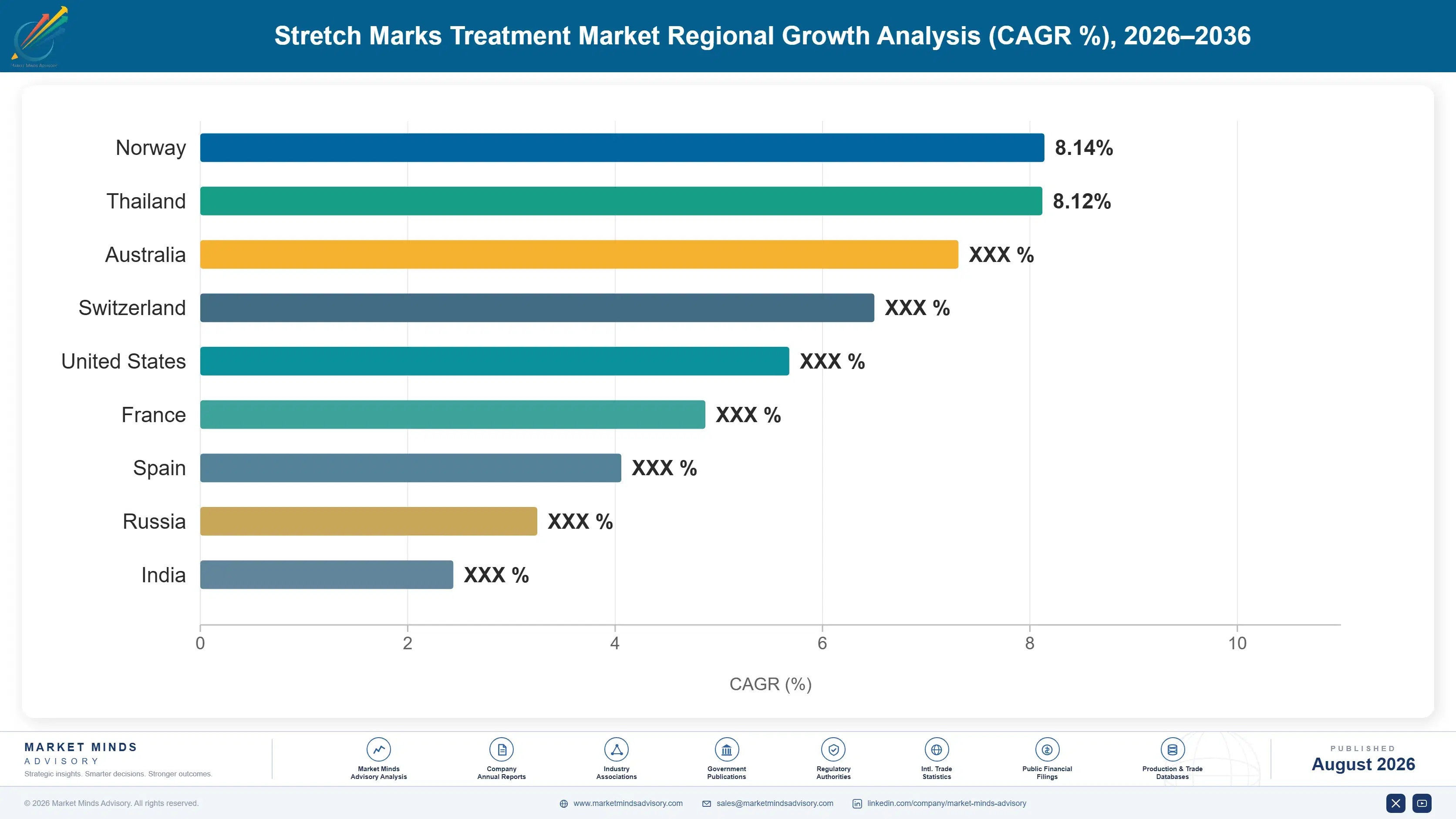
stretch-marks-treatment-market-country-cagr-analysis-1787299867214

Fixing Timing Rather Than Technology

Response depends on treating striae while they are still red, a window of roughly nine months, and median presentation runs about four years too late. Value comes from reaching women through postnatal pathways, from pricing courses rather than single sessions, from earning on consumable tips rather than on platforms, and from managing expectation honestly.

Reach Women Through Postnatal Rather Than Retail Channels

Around 63% of striae follow pregnancy, and the treatable red phase falls precisely in the months after birth when nobody is booking aesthetic appointments. Reaching that population through antenatal classes, midwifery contact, and postnatal check-ups puts the message inside the window rather than years outside it. A national postnatal channel programme costs perhaps 4 million dollars annually and addresses the only variable in this market with a genuinely large effect size. Every competitor is instead spending on retail and social advertising that reaches people whose striae matured years ago. That is a straightforward misallocation.
Market Impact: Postnatal programme costs around 4 million dollars annually

Price Multi-Session Courses Rather Than Individual Treatments

Meaningful improvement on striae requires three to six sessions and a single treatment reliably disappoints, yet clinics keep quoting per session because it looks cheaper on a price list. Patients who complete a course report satisfaction far above those who stop after one, and course pricing with instalment finance raises completion rates by roughly 40% where it has been introduced. It also removes the drop-off that generates negative word of mouth. Brazilian clinics have run this model for years and Western clinics have been slow to copy it. The economics are not difficult to see.
Market Impact: Course pricing raises completion rates by about 40%

Earn On Consumable Tips Rather Than Platform Sales

A radiofrequency microneedling platform sells once into a clinic and then generates recurring revenue only through single-use tip cartridges, which run between 150 and 250 dollars per treatment. Manufacturers who priced platforms aggressively to place them and earn on tips have annuity revenue that survives an equipment purchasing pause entirely. Those who priced for margin on the platform placed fewer units and earn nothing between sales. Placement count rather than platform margin is the number that should be managed here. Very few manufacturers manage it that way. The annuity compounds across a platform's whole working life.
Market Impact: Tip cartridges cost 150 to 250 dollars each

Set Expectation Against Published Effect Sizes Honestly

Average texture improvement on mature striae runs near 24% across published work, which is a real result and nothing like the restoration marketing imagery implies. Clinics that show honest before and after photography at that level of improvement report higher satisfaction and more repeat business than those promising more and delivering the same thing. The category's reputational problem is entirely self-inflicted, and in a market where 97% of spending is discretionary, word of mouth carries more weight than any advertising budget can. Most dissatisfaction traces to expectation rather than to outcome.
Market Impact: Published improvement averages about 24% on mature striae

Who Controls the Margin Pool

Concentration reaches only 18% across the top five measured on annual revenue from products and systems marketed for striae treatment, which is exceptionally low and reflects a category that is really three markets sharing one indication. Consumer skincare brands, aesthetic device manufacturers, and independent clinics all take money from the same person for the same problem while competing with each other almost not at all. Any leaderboard here is an accounting exercise rather than a descriptio
Competitive activity runs on three fronts. Distribution into non-dermatology clinics is the first, since device placement rather than clinical evidence determines which modality a patient is offered. Consumable tip economics is the second, where device manufacturers actually earn. Channel access to postpartum women is the third, and it is almost entirely uncontested despite being the only route into the treatable window.

Pressure comes from two directions. Domestic Chinese and Korean device manufacturers are taking platform volume at prices Western manufacturers cannot match, and they are doing it in the fastest growing market. And consumer scepticism about modest published effect sizes is growing wherever regulators have tightened permitted claims, which hits the topical tier hardest.
stretch-marks-treatment-market-company-positioning-matrix-1787299867741

Competitive Moat and Risk Dimensions

UNION SWISS

Moat: Category-defining consumer brand recognition

A topical product that most expectant mothers know by name before they have any striae at all occupies the position everything else in the category competes against. That recognition was built over decades of pregnancy-channel presence and is reinforced every time somebody recommends it to a friend. Nothing in the device segment enjoys comparable unprompted awareness.
UNION SWISS

Risk: Topical evidence base is weak

Published support for topical prevention and treatment of striae is thin, effect sizes are small, and regulators in several markets have tightened what may be claimed. A brand built on consumer belief rather than clinical evidence is exposed whenever that belief is publicly examined. Procedure modalities with better data are also becoming affordable to the same buyer.
CANDELA

Moat: Installed clinical device base

A large installed platform population across dermatology and plastic surgery practices generates recurring consumable and service revenue and puts the manufacturer inside clinics when treatment protocols are decided. Striae are one indication among several on those platforms, which means the placement is justified by a broader case mix rather than depending on this category alone. That breadth is genuinely protective.
CANDELA

Risk: Growth sits outside dermatology

The fastest growing modality at 12.6% is reaching medical spas and general aesthetic clinics that never bought a laser and are unlikely to start. A position built on clinical practices is strong in the settings where it exists and absent from the settings expanding fastest. Serving that customer set requires different pricing, training, and support models entirely.

Players Tracked

Prominent Players

Union Swiss
E.T. Browne Drug
Candela
InMode
Cynosure Lutronic

Other Key Players

Bayer
Haleon
Laboratoires Expanscience
Beiersdorf
Johnson & Johnson
Galderma
Alma Lasers
Lumenis
Sciton
Bausch Health
Cutera
Jeisys Medical
Classys
Endymed
Venus Concept

Recent Developments

MARCH 2025

Device maker launches radiofrequency platform priced for non-dermatology clinics

An aesthetic device manufacturer introduced a radiofrequency microneedling platform priced and configured for medical spas and general aesthetic clinics rather than dermatology practices, with shorter training requirements. The launch was a product introduction rather than any joint venture, acquisition, or distribution partnership with a clinic group.
Signal: Where the device physically sits determines which modality a patient is offered far more than evidence does
JUNE 2025

Regulator tightens permitted claims on topical striae preparations

A national advertising regulator restricted claims that topical preparations prevent or remove striae, requiring substantiation that most marketed products could not provide from published evidence. The ruling was a regulatory decision rather than any litigation settlement, industry agreement, or voluntary code adopted by manufacturers. Enforcement began immediately.
Signal: Claim restriction hits consumer topicals hardest and pushes exactly the same buyer toward procedure modalities instead
SEPTEMBER 2025

Chinese manufacturer expands domestic radiofrequency platform production

A Chinese aesthetic device manufacturer expanded production of radiofrequency microneedling platforms and consumable tips for the domestic licensed clinic market, which has grown rapidly following regulatory consolidation. The expansion was organic capital investment rather than any joint venture, licensing arrangement, or acquisition of foreign capability.
Signal: Platform volume in the fastest growing national market is shifting decisively toward domestic manufacture and pricing

Marketing Costs More Than Goods

Cost structure differs completely between the two halves of this market. Across consumer topicals, plant-derived emollient oils and actives run about 22% of cost of goods with packaging near 17%, while marketing absorbs a considerably larger share of revenue than manufacturing does. Across device procedures, single-use tip cartridges at 150 to 250 dollars per treatment carry the recurring cost.
Cosmetic-grade emollient oil supply was the exposure that mattered most recently. USDA oilseed reporting documented substantial disruption to sunflower and rapeseed availability through 2022 and into 2023, and cosmetic-grade fractions compete with food and industrial demand for the same crop output. Formulators holding single-origin specifications absorbed the increase, since substituting a plant oil in a registered cosmetic formulation requires stability and safety work taking months.

The competitive disadvantage mechanism runs through formulation flexibility rather than through purchasing scale. A brand with two qualified oil sources or a formulation tolerant of blend variation moves supply when one origin tightens, while a single-origin marketing claim locks the formulator into whatever the crop produced. Device manufacturers carry a different exposure entirely, concentrated in electronics and needle array supply rather than in agricultural output.
stretch-marks-treatment-market-cost-volatility-analysis-1787299867937

Qualify a second origin for every plant-derived emollient

Cosmetic-grade plant oils compete with food and industrial demand for the same crop, and a single growing region can lose output to weather or conflict in one season. Holding a validated second origin lets a formulator move rather than pay whatever is asked. The stability and safety work takes months and cannot be started once supply has already tightened somewhere.

Avoid single-origin claims that remove sourcing flexibility

Marketing a specific origin for an ingredient sounds distinctive on a label and permanently removes the ability to substitute when that origin fails. Brands making the claim discovered they had traded a modest positioning advantage for a supply exposure with no upper bound. Generic ingredient descriptions preserve the flexibility that matters more across a full product life.

Price device platforms to place them and earn on tips

Platform margin sells fewer units into fewer clinics, while aggressive placement pricing builds an installed base generating recurring consumable revenue at 150 to 250 dollars per treatment. That annuity survives an equipment purchasing pause entirely, which platform revenue does not. Placement count rather than platform margin is the number worth managing across an economic cycle.

Portfolio Architecture for Margin Defence

Three tiers describe this market and the spread is set by who administers the treatment rather than by what it costs to produce. Consumer topical preparations sit at the bottom, sold at retail against heavy marketing spend and increasingly constrained claims. Clinic-administered energy procedures sit far higher on session pricing. Injectable and combination protocols occupy a third tier where session cost is highest and evidence thinnest.
The tension is that topicals bring people into the category. Almost every woman who eventually pays for a procedure bought a cream first, usually during pregnancy, and that purchase is where awareness of striae as a treatable problem begins. Brands that abandoned topicals for procedure economics lost the entry point, and clinics that never had one depend entirely on advertising to generate the same awareness at far higher cost.

High-value pools concentrate where the patient is inside the treatable window. Postpartum women with red striae respond meaningfully rather than marginally, and the satisfaction gap between treating rubra and alba is larger than any difference between competing modalities. Nobody has built a commercial model around that pool, because reaching it requires clinical rather than retail channels and almost every participant here is organised for retail.

Volume / Commodity-Adjacent Tier

Over-the-counter topical preparations sold at retail and pharmacy, with modest evidence and tightening permitted claims across several regulators. Margin after marketing is thin, but this is where almost every eventual procedure patient first encounters striae as something treatable.
Gross Margin: 24-28%

Premium / Certified Tier

Clinic-administered radiofrequency microneedling and fractional laser courses priced per session or per package. Margin reflects clinical administration, device consumables, and the multi-session structure that meaningful improvement genuinely requires rather than any product cost.
Gross Margin: 52-57%

Sustainability / Regulatory / Next-Generation Tier

Injectable biostimulator and polynucleotide protocols, often combined with energy modalities in staged treatment courses. Best margin on the highest session pricing in the category, though published controlled evidence remains thinner than the commercial positioning suggests.
Gross Margin: 60-66%
stretch-marks-treatment-market-portfolio-architecture-1787299868442

High-value Sub-segments and Strategic Watch-out

Radiofrequency Microneedling Procedures

Fastest growth at 12.6%, exactly 1.50 times the market rate, driven by platforms reaching clinics that never bought a laser and by safety across darker phototypes. Consumable tip revenue rather than platform margin is where manufacturers actually earn from this. Placement count decides the annuity.
Gross Margin: 52-57%

Early Postpartum Treatment Windows

The highest satisfaction pool anywhere in this market, since striae rubra respond meaningfully where mature striae alba improve around 24% on average. Almost entirely uncontested commercially, because reaching women in that window requires clinical rather than retail channels. Whoever builds those channels first takes the outcomes advantage.
Gross Margin: 52-57%

Over-The-Counter Topical Preparations

The volume core at thin margin after marketing, facing tightening claim restrictions across several regulators simultaneously. It nonetheless supplies the entry point through which almost every eventual procedure patient first learns that striae are treatable at all. Abandoning it removes the funnel above every other tier.
Gross Margin: 24-28%

Injectable Biostimulator Protocols

The strategic watch-out here, carrying the best margin and the thinnest published controlled evidence in this whole category at exactly the same time. Outcomes appear notably operator-dependent across the published series, and any regulatory or reputational shock would hit the highest-priced tier hardest of all.
Gross Margin: 60-66%

How This Demand Arrives

Demand here is event-triggered rather than continuous. Pregnancy accounts for roughly 63% of new striae, adolescent growth and rapid weight or muscle change account for most of the remainder, and each event creates a person who may or may not become a customer years later. The trigger is predictable and the purchase is not, which is why this market has enormous latent demand and a conversion rate nobody in it seems able to move meaningfully in either direction.
Stickiness varies by modality and by satisfaction rather than by any switching cost. Topical purchasers repeat during pregnancy and stop afterward. Procedure patients who complete a full course return for other indications and recommend the clinic; those who stop after one session tell people it did not work, which in a category where 97% of spending is discretionary matters more than any advertising. Injectable patients are the most loyal and the smallest group by a wide margin.

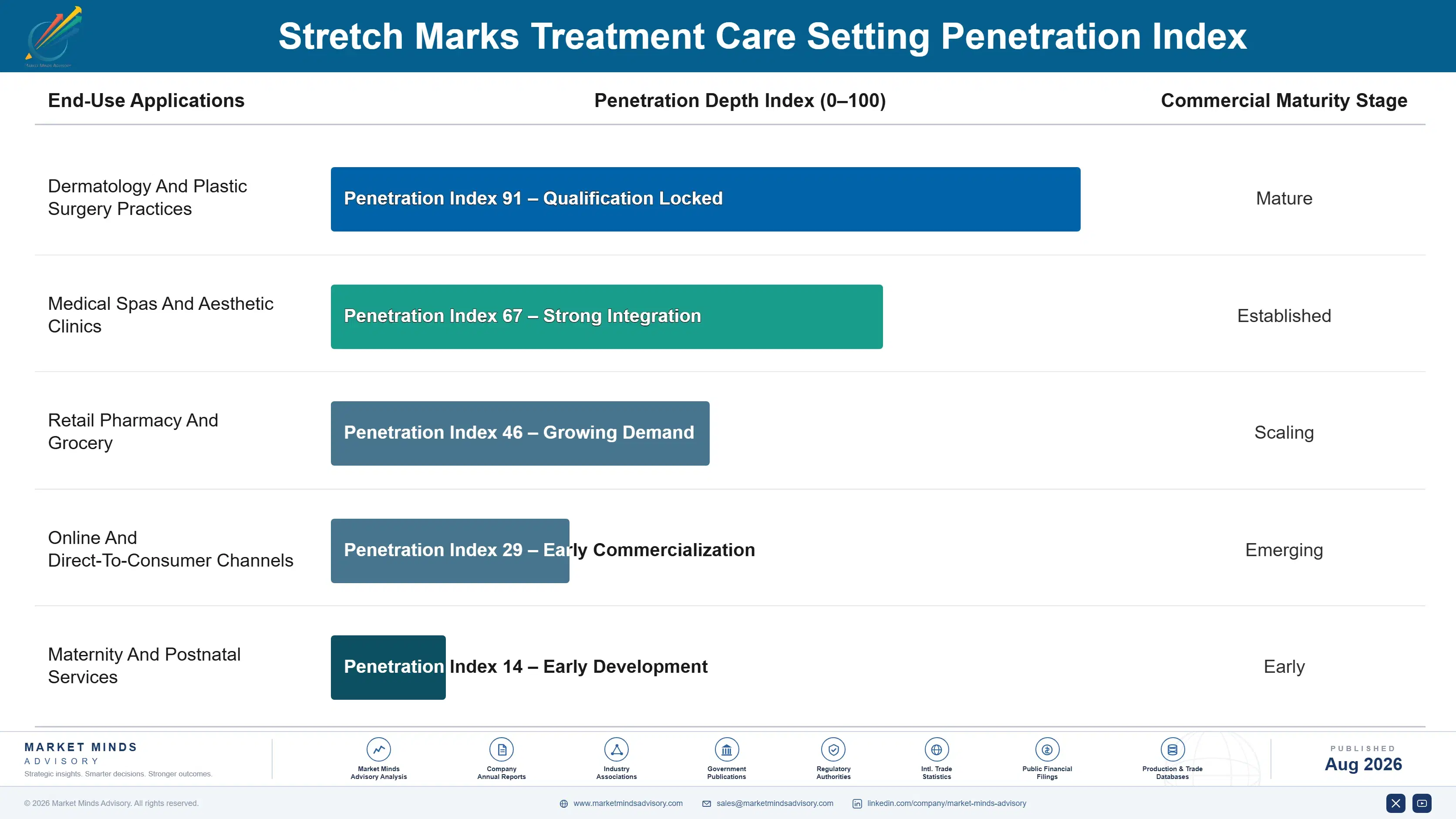
Buyer profiles are shifting slowly. Postpartum women remain the core, while male presentation from rapid muscle gain and adolescent growth is small, growing, and served by nobody in particular. That group presents even later than women do.
stretch-marks-treatment-market-end-use-penetration-index-1787299868933

What We Would Tell a Board

These are among the four positions where our research anticipates prominent divergence between winners and laggards over the coming forecast period. Each is grounded in the demand model, the regulatory perimeter, and the announced capacity pipeline.
01 / TREATMENT WINDOW ACCESS

Timing beats technology and nobody is working on it

Striae respond while red and inflamed, a phase lasting roughly nine months, while median time to seeking treatment runs about four years, which means practically the entire market treats the stage that responds least. Reaching postpartum women through antenatal and midwifery channels costs perhaps 4 million dollars annually across a major market and addresses the only variable here with a genuinely large effect size. Every competitor instead spends on retail and social advertising aimed at people whose striae matured years earlier.
02 / COURSE PRICING STRUCTURE

Single sessions disappoint and generate the bad reviews

Meaningful improvement takes three to six sessions and one treatment reliably underwhelms, yet clinics keep quoting per session because a lower headline number is easier to advertise to a price-sensitive buyer. Patients who complete a course report substantially higher satisfaction, and course pricing with instalment finance lifts completion by around 40% where it has been introduced properly. In a category where 97% of spending is discretionary, the word of mouth from abandoned courses costs considerably more than any pricing gain the lower headline number ever produced.
03 / CONSUMABLE REVENUE DESIGN

Place the platform, earn on the cartridges afterward

A radiofrequency microneedling system sells once into a clinic and then generates recurring revenue only through single-use tip cartridges running 150 to 250 dollars per treatment across the platform's whole working life. Manufacturers pricing platforms for margin place fewer units and earn nothing between sales, while those pricing for placement build an annuity that survives an equipment purchasing pause. Placement count rather than platform margin is the number that should be managed here, and it compounds across the whole working life of every unit installed.
04 / EXPECTATION MANAGEMENT HONESTY

Twenty-four percent is a real result, not a failure

Average texture improvement on mature striae runs near 24% across published work, which is a genuine clinical result and nothing at all like the restoration that category marketing imagery keeps implying to consumers. Clinics showing honest before and after photography at that level report higher satisfaction and more repeat business than those promising more and delivering identically. This category's reputational problem is entirely self-inflicted, and word of mouth carries far more weight here than any advertising budget a participant could realistically fund.

Engagement Snapshot From the Field

A live engagement with an industry participant carrying material or product regulatory and market exposure ahead of a defining policy shift, showing how our research translates into a defensible multi-year portfolio strategy.
MARKET MINDS ADVISORY · CLIENT ENGAGEMENT SUMMARY
Stretch Marks Treatment Producer Strategic Portfolio Review and Transition Roadmap 2026·Investment Scenario on Stretch Marks Treatment Exposure Evaluation 2025-26
CLIENT PROFILE
An aesthetic clinic group with approximately 74 million dollars in annual revenue (client-reported, unverified by MMA), operating thirty-one clinics across two countries with striae treatment as a meaningful share of energy device utilisation. The group priced treatments per session, acquired patients almost entirely through social advertising, and had no clinical referral relationships of any kind.
STRATEGIC CHALLENGE
Striae treatment revenue per patient had fallen for two years while enquiry volume rose, and online reviews mentioning disappointing results had increased sharply. Management proposed investing in a newer device platform. The board wanted an independent read on whether equipment was the problem before committing capital across thirty-one separate clinic sites simultaneously.
MMA APPROACH
We analysed treatment records by striae maturity at presentation, sessions completed, and satisfaction recorded at follow-up. Patient journeys were traced from first enquiry back to when the marks had appeared. Pricing structures were compared against clinics using course models, and the postnatal referral channel was sized against the group's existing catchment populations.
KEY FINDINGS
  1. Fewer than one in twelve patients presented with striae rubra, so the overwhelming majority were being treated at the stage where every available modality performs worst.
  2. Around 58% of patients stopped after a single session, and negative reviews came almost entirely from that group rather than from anybody who completed a course.
  3. Session pricing made the first treatment look affordable and the full course look expensive, which was precisely the wrong way round for a modality needing repetition.
  4. Maternity units within catchment collectively saw enough births each year to supply the group's entire striae caseload from inside the treatable window.
CLIENT PROFILE
An aesthetic clinic group with approximately 74 million dollars in annual revenue (client-reported, unverified by MMA), operating thirty-one clinics across two countries with striae treatment as a meaningful share of energy device utilisation. The group priced treatments per session, acquired patients almost entirely through social advertising, and had no clinical referral relationships of any kind.
STRATEGIC CHALLENGE
Striae treatment revenue per patient had fallen for two years while enquiry volume rose, and online reviews mentioning disappointing results had increased sharply. Management proposed investing in a newer device platform. The board wanted an independent read on whether equipment was the problem before committing capital across thirty-one separate clinic sites simultaneously.
MMA APPROACH
We analysed treatment records by striae maturity at presentation, sessions completed, and satisfaction recorded at follow-up. Patient journeys were traced from first enquiry back to when the marks had appeared. Pricing structures were compared against clinics using course models, and the postnatal referral channel was sized against the group's existing catchment populations.
KEY FINDINGS
  1. Fewer than one in twelve patients presented with striae rubra, so the overwhelming majority were being treated at the stage where every available modality performs worst.
  2. Around 58% of patients stopped after a single session, and negative reviews came almost entirely from that group rather than from anybody who completed a course.
  3. Session pricing made the first treatment look affordable and the full course look expensive, which was precisely the wrong way round for a modality needing repetition.
  4. Maternity units within catchment collectively saw enough births each year to supply the group's entire striae caseload from inside the treatable window.
RECOMMENDED STRATEGY
Phase 1: Phase 1 (months one to six): cancel the platform investment, move to course pricing with instalment finance, and reset before and after imagery honestly. Phase 2: Phase 2 (months six to eighteen): build postnatal referral relationships with maternity services across every clinic catchment area served. Midwifery contact is the entry point. Phase 3: Phase 3 (months eighteen to thirty): reweight practitioner training and capacity toward early-phase striae protocols. Early-phase striae respond differently and need different settings.
OUTCOME
The platform investment was cancelled. Course completion rose above three quarters within four quarters under instalment pricing, negative review volume fell sharply, and referral pathways at eleven maternity units began delivering patients inside the responsive window (client-reported, unverified by MMA). Revenue per patient recovered above the prior peak.

Frequently Asked Questions

Foundational context covering the market sizes, CAGR, scope, country, region and competition that inform every finding below. This section is provided to cover basics and most often pre-purchase conversations, answered from the MMA Primary Research Dataset.

What is the current size of the Stretch Marks Treatment Market?

The market is valued at USD 3.4 billion in 2025, rising to USD 3.69 billion in 2026. Scope covers topicals, devices, and procedures, with 97% of spending funded out of pocket.

How large will the Stretch Marks Treatment Market be by 2036?

MMA forecasts USD 8.26 billion by 2036, an increase of USD 4.57 billion over the 2026 base. That represents an expansion multiple of 2.24 times across the forecast period.

What is the CAGR for the Stretch Marks Treatment Market 2026 to 2036?

The base case CAGR is 8.4%, with a bull case of 9.6% and a bear case of 7.2%. The historical rate from 2020 to 2025 was 7.2%, so growth is accelerating.

Which segment is growing fastest?

Radiofrequency microneedling at 12.6%, exactly 1.50 times the market rate. Lower platform cost and safety across darker phototypes put it into clinics that never bought a laser.

Who are the major companies in the Stretch Marks Treatment Market?

Union Swiss, Browne Drug, Candela, InMode, and Cynosure Lutronic lead on annual revenue from products and systems marketed for striae. The top five hold only 18% between them, which is exceptionally fragmented.

Which country is growing fastest?

China at 11.8%, driven by licensed medical aesthetics clinic construction across the country and by domestic device manufacture supplying platforms at prices imported systems cannot match.

Report Segmentation Architecture

The full report scope spans multiple orthogonal segmentation dimensions, with cross-tabulated demand data provided for each dimension pair. Coverage extends further to regional breakdowns, trend trajectories, and the competitive detail needed to support segment-level decision-making.

By Treatment Modality

  • Over-The-Counter Topical Preparations
  • Prescription Topical Retinoids
  • Fractional And Ablative Laser Procedures
  • Radiofrequency Microneedling Procedures
  • Injectable Biostimulator And Polynucleotide Procedures
  • Chemical Peel And Manual Microneedling

By Care Setting

  • Dermatology And Plastic Surgery Practices
  • Medical Spas And Aesthetic Clinics
  • Retail Pharmacy And Grocery
  • Online And Direct-To-Consumer Channels
  • Maternity And Postnatal Services

By Payment Model

  • Single Session Self-Pay
  • Multi-Session Course Packages
  • Instalment And Consumer Finance
  • Clinic Membership And Subscription
  • Retail Product Purchase

By Region

  • East Asia
  • North America
  • Western Europe
  • South Asia and Pacific
  • Latin America
  • Middle East and Africa
  • Eastern Europe

Scope, Methodology, and Coverage

Every figure in this report is reproducible from documented input assumptions. The scope below maps the historical period, the forecast horizon, the segmentation dimensions, and the countries covered, alongside the underlying primary and qualitative methodology.
Historical Period
2020 to 2025
Forecast Period
2026 to 2036
Base Year
2025 (USD billions; MMA Primary Research Dataset, August 2026)
Market Definition
This market comprises products, devices, and procedures used to treat striae distensae in both the erythematous rubra and mature alba phases, measured at realised prices to the consumer or patient across retail and clinical channels. Modality coverage spans over-the-counter topical preparations, prescription topical retinoids, fractional and ablative laser procedures, radiofrequency microneedling including consumable tip cartridges, injectable biostimulator and polynucleotide procedures, and chemical peel and manual microneedling. General moisturisers without a striae indication, surgical excision and abdominoplasty, cosmetic camouflage and self-tanning products, paramedical tattooing, and scar treatments unrelated to striae fall outside scope.
Quantitative Units
USD billions (current prices); treatment episodes per year; realised price per session; sessions completed per course
Segmentation Dimensions
By Treatment Modality; By Care Setting; By Payment Model; By Region
Regions Covered
East Asia, North America, Western Europe, South Asia and Pacific, Latin America, Middle East and Africa, Eastern Europe
Countries Covered
China, South Korea, Japan, Taiwan, India, Thailand, Vietnam, Indonesia, Australia, USA, Canada, Mexico, Brazil, Colombia, Argentina, Chile, Germany, France, Italy, Spain, UK, Netherlands, Belgium, Poland, Czechia, Romania, Turkey, Saudi Arabia, UAE, Egypt, South Africa, and additional markets relevant to this sector
Key Companies Profiled
Union Swiss, E.T. Browne Drug, Candela, InMode, Cynosure Lutronic, Bayer, Haleon, Laboratoires Expanscience, Beiersdorf, Johnson & Johnson, Galderma, Alma Lasers, Lumenis, Sciton, Bausch Health, Cutera, Jeisys Medical, Classys, Endymed, Venus Concept
Quantitative Methodology
Primary survey, n=3,800 respondents, Q4 2025, six countries; demand-side model with trade association cross-validation
Qualitative Methodology
47 expert interviews, Q4 2025; applied to validate demand model assumptions, identify emerging dynamics, and assess competitive positioning
Report Format
PDF and XLSX data workbook (Word format preview document)
Publisher
Market Minds Advisory
Report Code
MMA-2026-HLT-441
Published
August 2026
Contact
sales@marketmindsadvisory.com | www.marketmindsadvisory.com

Purchase the full Stretch Marks Treatment Market Report (2026 to 2036).

The full report sizes striae treatment across six modalities, five care settings, five payment models, and seven regions, with country detail for the thirty largest markets. Presentation timing is quantified against striae maturity, since response depends on treating the erythematous phase and median presentation arrives years after it closes. Course completion rates and satisfaction are analysed against pricing structure across clinic models. Competitive profiling covers twenty companies on annual revenue from products and systems marketed for striae. Consumable tip economics are modelled across installed radiofrequency platforms by region.
Presentation timing quantified against striae maturity phase
Course completion rates analysed against clinic pricing structure
Consumable tip economics modelled across installed platform bases
Phototype suitability mapped across competing treatment modalities
Published effect sizes compiled by modality and striae phase
Postnatal channel access assessed across major health systems

Built For The People Who Decide

From boardroom strategy to bench-side execution, this report is read cover-to-cover by leaders shaping the next decade of their industry, turning demand scenarios, market dynamics and valuation benchmarks into decisions.
CXOs/ Presidents/ VPs/ Managers
M&A and Corporate Development
Strategy Teams and R&D Heads
Procurement and Product Directors
Regulatory and Compliance Leaders
Investor Relations and Equity Analysts