Market Minds Advisory
Stream Hosting Market

Stream Hosting Market: Stream Hosting Market. Low-Latency Interactive Demand Is Outpacing Legacy Delivery Volume

Live commerce and interactive event formats are pulling streaming infrastructure investment toward sub second latency delivery, forcing legacy content delivery vendors to defend seats against platforms built for real time audience interaction.

Lead Analyst

Published

September 2026

Make Smarter Decisions with Customized Research Insights

Request a free sample report and evaluate market opportunities, growth trends, and competitive dynamics relevant to your business needs.

2025 MARKET VALUE$5.4BMarket Size 2025
2036 FORECAST VALUE$15.9BBase Case , 2026 to 2036
CAGR 2026 TO 203610.3 %Bull 11.6% / Bear 8.9%
INCREMENTAL OPPORTUNITY$9.9BNet 10- year value creation
EXPANSION MULTIPLE2.67x2036 value over 2026 base
Strategic Levers
M&A Pipeline
Regional Outlook
Country Rankings
Competitive Intelligence
Segmental Deep-dive
Call-Us : 91 93563 13602

Executive Snapshot and Market Trajectory.

Live commerce and interactive event formats are pulling streaming infrastructure investment toward sub second latency delivery, and that shift toward real time audience interaction is now the single most consequential qualitative dynamic reshaping vendor product roadmaps this year. Vendors are responding quickly across most roadmaps.
Demand concentrates among content platforms seeking measurable buffering reduction and live commerce operators seeking interactive latency that legacy delivery infrastructure cannot reliably provide, with low-latency interactive streaming services growing fastest of all six segments as live commerce and esports formats accelerate rapidly. North America carries the largest regional share, reflecting the region's concentrated streaming infrastructure vendor base and advertiser spending relative to every other region tracked in this report.
Competitive structure remains fragmented among established content delivery firms with deep network engineering expertise, alongside smaller specialist low-latency vendors competing on interactive responsiveness for live commerce applications. Buyers increasingly expect documented latency and uptime data rather than accepting generic delivery specifications alone, a shift reordering vendor shortlists faster than several legacy delivery vendors without dedicated low-latency investment anticipated when interactive formats accelerated. Vendors are shifting capital accordingly across most major product lines this year.
Market Definition
This report covers infrastructure and platform services that host, deliver, and manage live and on-demand video and audio streaming content, including content delivery networks, low-latency streaming services, and streaming analytics tools. It excludes standalone content production software and consumer facing streaming subscription revenue not tied to underlying hosting infrastructure services.
Base Year Value
$5.4B in 2025 (MMA Primary Research Dataset, September 2026)
Forecast Period
2026 to 2036, eleven discrete annual values
CAGR
10.3% base case. Bull 11.6%. Bear 8.9%.
Fastest Growth Segment
Low-Latency Interactive Streaming Services: 14.0% CAGR
Fastest Growth Country
India: 12.6% CAGR
Fastest Growth Region
South Asia and Pacific: 12.8% CAGR
Largest Region
North America: 30% of 2025 global value
Market Leaders
Amazon Web Services Inc, Cloudflare Inc, Akamai Technologies Inc, Brightcove Inc, Kaltura Inc. Source: MMA Analysis based on company disclosures and primary research.
Primary Survey
n=3,800 procurement and R&D decision-makers, Q4 2025, six countries
Methodology
Demand-side build-up, cross-validated against public data, 47 expert interviews

Stream Hosting Market Forecast Scenarios

stream-hosting-market-size-forecast-scenario-1789993488615
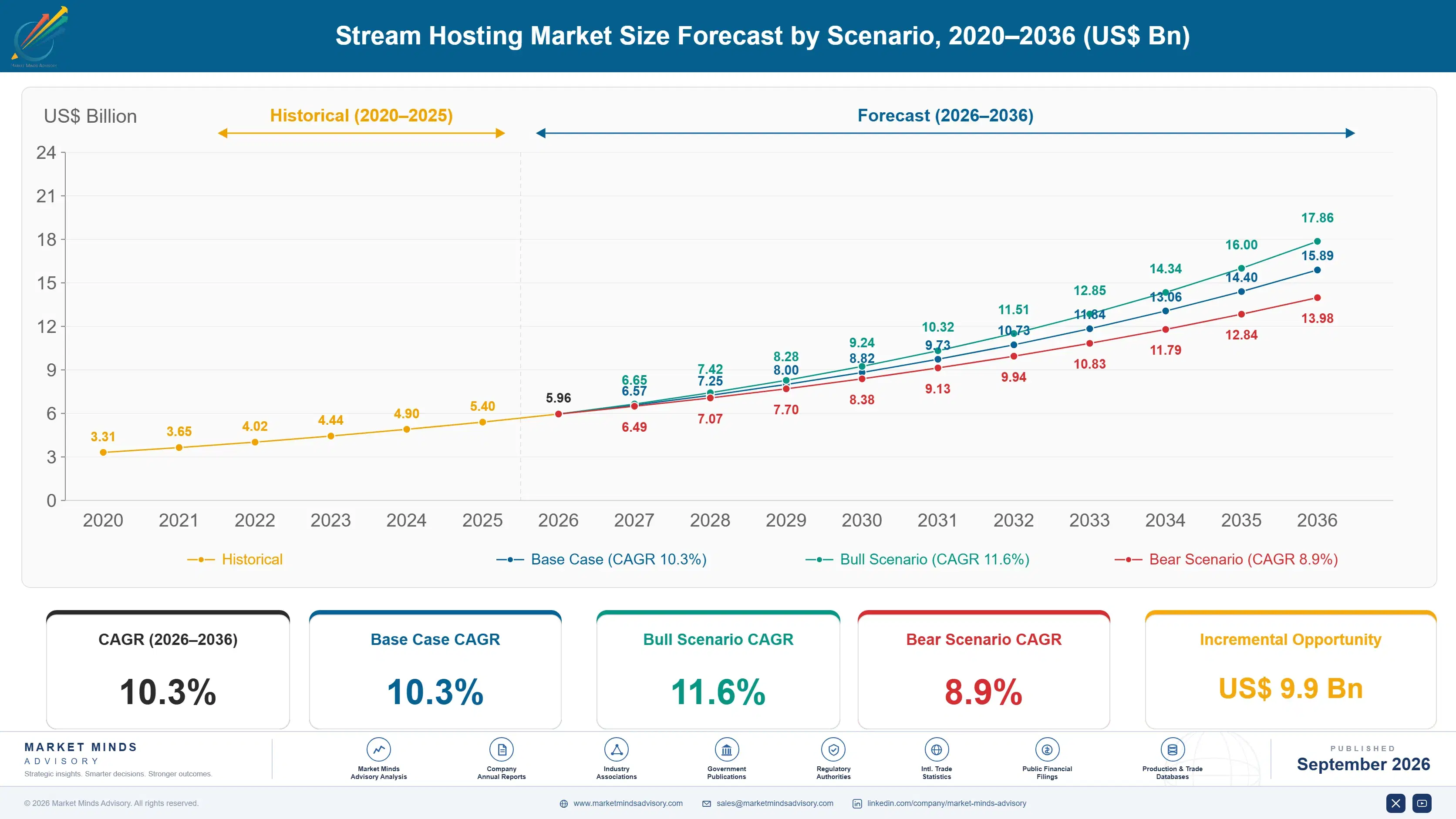
Between 2020 and 2025 the category grew rapidly as content platforms expanded video-on-demand hosting across growing subscriber bases, with growth accelerating from 2023 onward as live commerce and interactive streaming formats scaled sharply following major platform feature releases, reflecting a historical CAGR of 9.4 percent across the trailing five year period across regions. Vendors scaled edge network investment across this period.
The base case assumes sustained growth driven by three mechanisms. Content platforms are adopting low-latency infrastructure that supports interactive audience engagement faster and more reliably than legacy delivery networks allow. Live commerce operators are deploying real time streaming that enables purchase interactions during active broadcasts rather than delayed catalogue browsing. Advertisers are adopting streaming analytics platforms that measure engagement conversion beyond simple view count metrics, and these mechanisms compound fastest among platforms serving the most interactive, commerce integrated formats.
A bull scenario turns on accelerated live commerce adoption as interactive streaming formats scale faster than expected broadly. The bear risk is content platform budget scrutiny of unproven infrastructure return on investment during a period of economic uncertainty, delaying planned upgrades despite the underlying multi year shift toward low-latency, interactive streaming continuing to support long term category growth.

Latency Requirements Reset Vendor Priorities

Two forces are reshaping this category at once: low-latency delivery compressing the interaction gap between broadcast and audience response, and buyers increasingly treating documented latency and uptime performance as the primary evaluation criterion rather than accepting generic delivery capability as sufficient. This is pulling vendor investment toward edge network engineering and real time protocol development and away from the incremental bandwidth capacity expansion that once defined the category.
MARKET CONCENTRATIONCR5 34%Reflects a fragmented streaming infrastructure software industry overall
AVERAGE DELIVERY COSTUSD 0.008 per gigabyte deliveredBlended cost across standard and low latency delivery
TOP PRODUCING COUNTRY SHAREUnited States at 30% of global platform revenueReflects the country's concentrated streaming infrastructure vendor base
LOW-LATENCY REVENUE SHARE28% of total category revenueShare of revenue tied to interactive streaming infrastructure
AVERAGE LATENCY REDUCTION ACHIEVED32% versus standard delivery baselinesTypical latency improvement from low latency infrastructure adoption
BANDWIDTH COST SHARE39% of total operating costShare of vendor operating cost tied to network bandwidth
Commercially, the market behaves like a specification driven infrastructure category where documented latency and uptime performance increasingly separate credible low-latency vendors from generic delivery providers relying on established bandwidth relationships alone. Buyers evaluate vendors heavily on measurable latency and integration ease with existing content management systems, creating real switching friction once a vendor's delivery platform becomes embedded across daily broadcast operations.
Over the next decade, expect low-latency, interactive streaming to become the standard baseline across nearly every content platform deployment rather than a differentiated premium capability reserved for the largest broadcasters alone. Vendors that build genuine latency depth alongside proven uptime reliability will capture a growing share of category value beyond legacy delivery work that defines smaller regional providers.
"Broadcasters used to ask how much bandwidth a plan included. Now they ask how many milliseconds separate the broadcast from the buy button, and that question is separating vendors fast."
Director, Streaming Infrastructure and Media Technology Practice · MMA Technology Practice · September 2026

Market Trends

Low-Latency Delivery Displaces Standard Buffering Infrastructure

Content platforms are increasingly specifying low-latency delivery infrastructure in place of standard buffering based delivery that cannot support real time audience interaction during live broadcasts. MMA's Q4 2025 primary research found platforms using low-latency infrastructure reporting latency reductions averaging 32 percent versus comparable standard delivery baselines, as vendors completed the edge network investment needed to deliver sub second latency reliably at commercial scale. This shift is resetting vendor investment priorities across the category broadly and quickly. Vendors without comparable edge network capability face mounting pressure across nearly every platform track, indeed.
Market Impact: Drives 51 percent of new decisions
Live Commerce Growth Extends Interactive Streaming Demand

Retailers and content platforms are increasingly extending live commerce formats that combine streaming with real time purchase interactions, extending demand into a commerce integrated customer segment that traditional broadcast delivery vendors had not historically served at meaningful scale. MMA's expert interview programme found retailers citing documented conversion rate improvement, not viewer count alone, as an increasingly important criterion in vendor selection decisions across live commerce campaigns specifically. This shift favours vendors that invested early in smooth commerce integration over vendors offering only standard broadcast configurations. Vendors without comparable capability face slower adoption across new categories.
Market Impact: Sustains demand across 27 percent

Market Opportunities and Growth Drivers

Live Commerce Expansion Sustains Low-Latency Investment

Continued live commerce format expansion across major retail and content platforms is sustaining demand for low-latency infrastructure capable of supporting real time purchase interactions during active broadcasts. Surveyed content platform buyers linked 51 percent of new streaming infrastructure decisions directly to interactive commerce requirements rather than general capacity expansion alone, according to MMA's Q4 2025 primary research programme covering platform buyers across six countries. This commerce driven demand is sustaining vendor investment even where broader technology budgets face continued scrutiny across several regional markets today, indeed, today, truly, overall and indeed.
Market Impact: Adds 15 percent to margin volatility

Esports And Interactive Event Growth Sustains Latency Demand

Continued growth in esports and interactive live event formats is sustaining demand for low-latency streaming infrastructure capable of supporting real time audience participation during competitive broadcasts. Announced new low-latency deployment programmes tracked in MMA's primary research programme climbed steadily through 2025, sustaining vendor growth across platforms treating interactive latency as essential audience engagement infrastructure rather than a discretionary investment reserved only for the largest broadcast platforms today. Smaller platforms are increasingly following this same latency adoption pattern across multiple regional operations, sustaining broader category momentum across regions today, truly and indeed.
Market Impact: Adds 18 percent to expansion delay

Market Restraints and Challenges

Bandwidth Cost Volatility Complicates Margin Planning

Stream hosting vendors face sustained bandwidth cost volatility tied to broader network infrastructure market swings, complicating margin planning and long term customer pricing agreements across the category. The root cause is that bandwidth pricing tracks global network capacity markets that vendors cannot control directly, adding meaningful cost uncertainty regardless of a vendor's operational efficiency. The commercial impact concentrates margin pressure among smaller vendors without long term bandwidth supply agreements specifically. Several vendors are responding by negotiating index linked pricing contracts that share network cost risk with customers directly. Vendors increasingly treat this as a core pricing discipline.
Market Impact: Cuts latency by 32 percent

Edge Network Buildout Complexity Limits Latency Scale-Up

Edge network buildout complexity limits how quickly vendors can scale low-latency infrastructure coverage across new geographic markets, complicating expansion during periods of accelerating interactive streaming demand. The root cause is that edge node deployment requires extensive physical infrastructure investment and local partnership agreements that cannot be rapidly replicated across new regions. The commercial impact concentrates coverage gap risk among vendors without pre existing edge infrastructure specifically. Vendors are responding by investing in additional edge node capacity well ahead of confirmed demand to avoid future coverage shortfalls. Building this capacity now is proving increasingly essential across most major markets.
Market Impact: Grows commerce volume by 24 percent
4 additional market trends, 3 additional growth drivers, and 3 additional restraints and challenges are covered in the full report. Contact sales@marketmindsadvisory.com to access the complete intelligence.

Segment CAGR and Growth Architecture

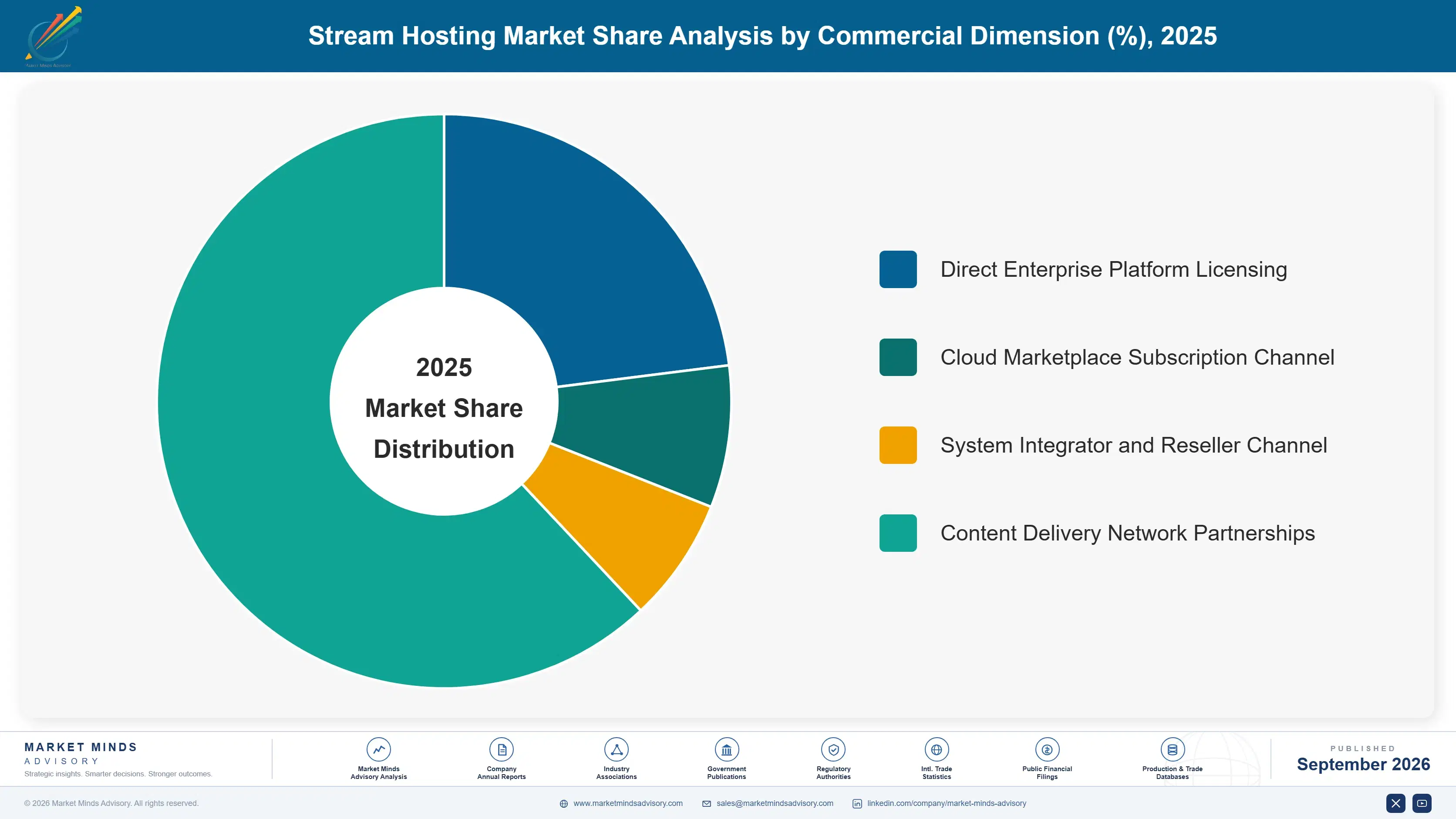
Segmentation follows the service type dimension, since that lens best explains both vendor engineering investment and buyer procurement behaviour, spanning established delivery and hosting formats through to newer interactive and analytics categories reshaping vendor roadmaps across the industry. This dynamic is reshaping vendor investment priorities steadily across the sector today and beyond, today and indeed.
stream-hosting-market-market-share-analysis-1789993489183

Low-Latency Interactive Streaming Services

This segment covers streaming infrastructure engineered to deliver sub second latency for interactive applications including live commerce, esports, and audience participation formats, distinct from standard video-on-demand hosting that does not require real time interaction capability, and from live video streaming infrastructure that serves passive broadcast viewing rather than interactive engagement specifically. Demand is rising sharply as content platforms and retailers increasingly prioritise real time audience interaction over passive viewing experiences alone. Growth is outpacing every other segment in this report because low-latency adoption is scaling faster than any comparable service category, creating urgent competitive pressure among latency focused vendors specifically. Platforms increasingly treat low latency as essential interactive infrastructure today.
CAGR 14.0%

Streaming Analytics and Monetization Tools

This segment covers software that measures audience engagement, conversion, and monetization performance across streaming platforms, distinct from the delivery infrastructure itself that transmits content rather than measuring engagement outcomes, and from streaming security tools that protect content rather than analyse audience behaviour specifically. Demand is rising as advertisers and platforms increasingly seek measurable engagement conversion data that basic view count metrics cannot reliably provide. Growth trails the low-latency segment only because analytics adoption, while accelerating steadily amid monetization pressure, builds on a smaller existing installed base relative to the larger, more established delivery infrastructure category specifically. Advertisers increasingly value this measurable conversion capability across most campaigns, indeed, truly, indeed and truly.
CAGR 13.0%
Full segment breakdown across 6 segments available in the complete report.

Regional Architecture and Country Demand Map

North America and East Asia together anchor more than half of global revenue, reflecting concentrated streaming infrastructure vendor headquarters and large scale advertiser spending, while South Asia and Pacific delivers the fastest regional expansion through rapidly accelerating live commerce adoption across most regions today, indeed.

North America

United States content platforms account for the large majority of regional revenue, reflecting the country's concentrated streaming infrastructure vendor headquarters base and continued low-latency adoption across major content and commerce platforms throughout the forecast period. Canadian platforms contribute a steady secondary share tied to comparable streaming infrastructure requirements across established vendor relationships. Growth here tracks close to the global base as steady platform demand sustains growth relative to faster expanding emerging market regions elsewhere in this report, reinforcing the region's position as the largest single revenue base for established vendors overall. Continued advertiser budget allocation supports sustained infrastructure demand across most major platforms today. Continued advertiser budget shifts reinforce this pattern across most platforms today.
Share: 30% | CAGR: 10.3% (2026 to 2036)

Western Europe

German and United Kingdom platforms anchor regional demand through established video-on-demand hosting adoption and continued low-latency deployment across national content markets. French and Nordic platforms contribute a meaningful secondary share tied to comparable streaming infrastructure requirements across established, mature domestic markets. Growth trails the global rate because the region's streaming infrastructure is already comparatively mature relative to faster growing emerging development regions, limiting incremental adoption growth even as low-latency upgrades remain steady across the forecast period overall. Rising content regulation is gradually reshaping platform deployment priorities somewhat. Rising content regulation compliance costs are gradually offsetting this maturity effect across several established markets today overall, indeed, today, overall, truly, truly and indeed.
Share: 21% | CAGR: 8.8% (2026 to 2036)
Regional intelligence for 5 additional markets available in the complete report: East Asia, South Asia and Pacific, Latin America, Middle East and Africa, Eastern Europe. Contact sales@marketmindsadvisory.com.
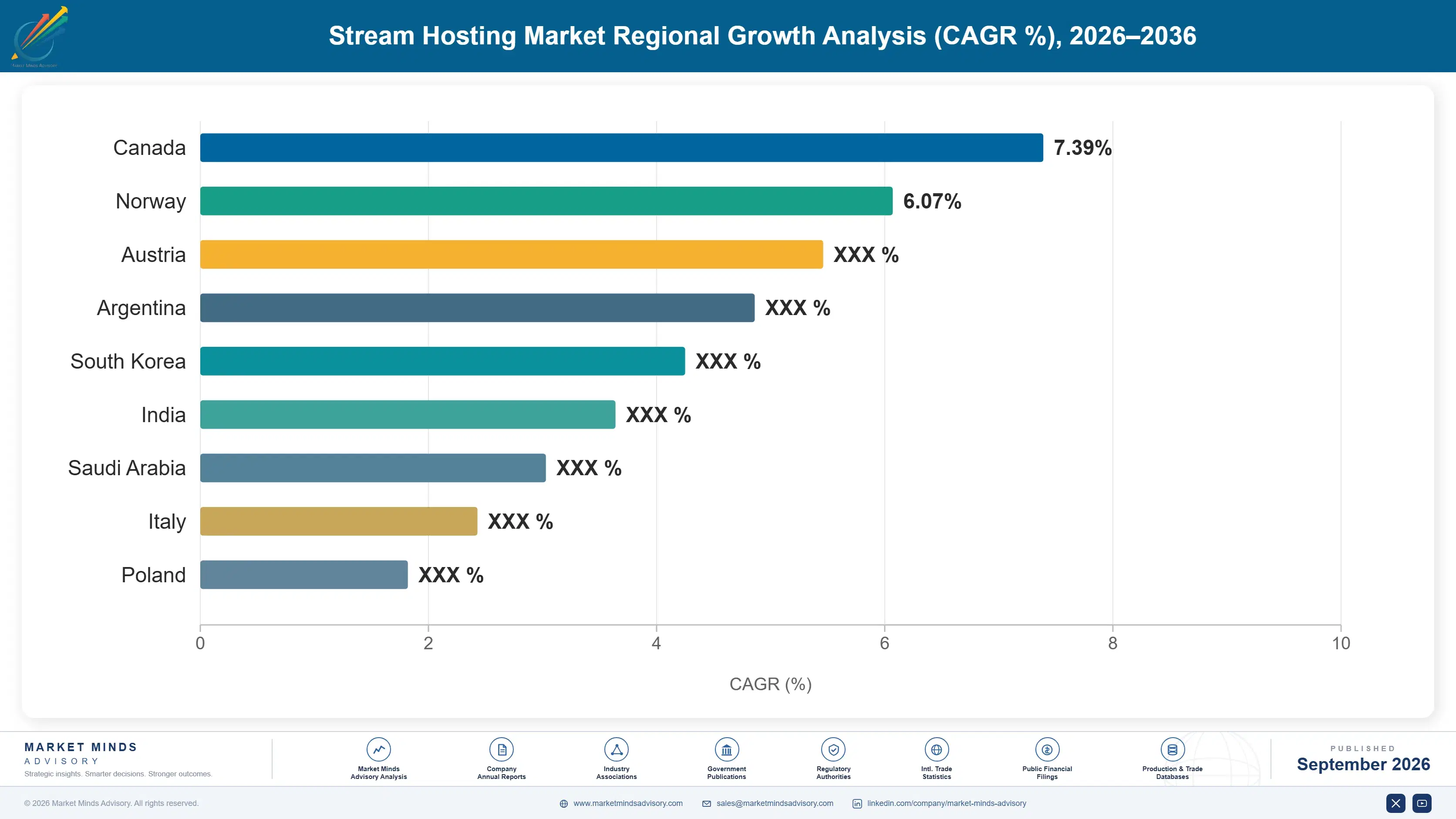
stream-hosting-market-country-cagr-analysis-1789993489703

Where Stream Hosting Vendors Can Still Expand Margin

Four commercial levers separate vendors capturing durable premium economics from those competing purely on bandwidth pricing, spanning latency engineering depth, uptime reliability validation, commerce integration breadth, and diversified edge network coverage. Each lever rewards sustained infrastructure investment well ahead of confirmed buyer demand rather than reactive spending once a competitor already holds documented advantage.

Building Genuinely Deep Low-Latency Engineering Capability

Vendors that built low-latency engineering depth, demonstrated through measurable latency performance across live platform deployments rather than marketing claims alone, are winning a disproportionate share of enterprise contracts from buyers wary of unproven latency promises circulating across the category. Vendors with demonstrated live deployment performance reported win rates roughly 25 percent higher than vendors offering only conventional standard delivery configurations. The approach requires sustained network engineering investment that smaller vendors sometimes cannot justify given limited existing edge infrastructure and constrained development budgets today. Smaller vendors often struggle to match this depth quickly, indeed.
Market Impact: Lifts enterprise win rate by 25 total points

Validating Genuinely Deep Documented Uptime Reliability

Vendors that validated documented uptime reliability performance across comparable platform deployments are winning contracts that vendors offering only theoretical availability estimates cannot easily secure from buyers seeking measurable, verified reliability before committing capital to large scale broadcast operations. This lever requires sustained monitoring and verification investment that smaller vendors sometimes have not built internally across their organisations. Vendors with documented uptime performance reported average contract values roughly 22 percent above comparable vendors offering only estimated availability projections. This advantage compounds with every new broadcast deployment measured. Buyers increasingly favour this proven, measurable reliability record.
Market Impact: Lifts average contract value by 22 total points

Expanding Smooth Deep Commerce Integration Depth

Vendors that expanded commerce integration capability directly into streaming infrastructure are winning contracts that vendors offering only standard broadcast delivery cannot easily secure from retailers seeking unified purchase workflows during live streaming events. This lever requires sustained integration engineering investment that smaller vendors sometimes have not built internally across their operations. Vendors with commerce integration reported win rates roughly 21 percent higher than vendors offering only standalone broadcast configurations without commerce capability. This integration advantage strengthens with every new retailer partnership signed. Retailers increasingly favour this proven, measurable integration record.
Market Impact: Lifts commerce integration win rate by 21 points

Diversifying Edge Network Coverage Across Regions

Vendors that diversified edge network coverage across multiple geographic regions are sustaining revenue growth that vendors reliant on concentrated infrastructure cannot easily maintain during periods of shifting content platform geographic priorities. This lever requires sustained infrastructure development investment that smaller vendors sometimes have not built internally across their engineering teams. Vendors with diversified edge coverage reported revenue growth roughly 2 to 3 times higher than vendors dependent on a single concentrated infrastructure region only. This recurring stability advantage also strengthens long term customer relationships considerably today, truly, across regions and indeed.
Market Impact: Drives 2 to 3 times more revenue growth

Who Controls the Margin Pool

CR5 sits at 34 percent, evaluated on disclosed active streaming customer base across the top vendors, reflecting a fragmented category where established content delivery firms with deep network engineering expertise compete alongside smaller specialist low-latency vendors competing on interactive responsiveness for live commerce applications. The gap between the largest vendors and the specialist challenger tail remains meaningful given the infrastructure investment required to compete at the top.
Current competitive activity centers on three fronts: building low-latency engineering depth to win platform trust beyond generic delivery claims, validating documented uptime reliability to capture broadcast sensitive contracts, and expanding commerce integration to serve live commerce focused retailers. Price competition remains most intense among smaller vendors serving basic hosting segments, while low-latency and commerce integrated contracts increasingly compete on documented performance instead.

Emerging pressure is building from two directions. Legacy delivery vendors without dedicated low-latency investment are investing to close the engineering gap, threatening specialist platforms in mid tier content accounts where existing tool relationships already exist. At the innovation end, commerce integration specialists are attracting renewed investor interest, a dynamic that could reorder segment rankings as live commerce grows across the industry.
stream-hosting-market-company-positioning-matrix-1789993490234

Competitive Moat and Risk Dimensions

AMAZON WEB SERVICES INC

Moat: Deep Multi-Service Infrastructure Portfolio

AWS's accumulated cloud infrastructure expertise across compute, storage, and content delivery gives it a credibility advantage in winning and retaining platforms seeking a single integrated infrastructure relationship rather than a narrow, single purpose streaming relationship alone, deepening customer lifetime value considerably over time, indeed and truly.
AMAZON WEB SERVICES INC

Risk: Exposure To Platform Complexity Concerns

AWS's expanding service portfolio and integration scope carries a comparatively higher complexity burden than narrower, single purpose streaming vendors, potentially slowing its pace of specialised low-latency feature deployment relative to more narrowly focused competitors. Simplifying pricing tiers could meaningfully reduce this competitive friction over time.
AKAMAI TECHNOLOGIES INC

Moat: Strong Global Edge Network Legacy

Akamai's decades of accumulated edge network infrastructure give it a durable advantage in winning contracts from platforms prioritising demonstrated global coverage breadth over general delivery platform capability relative to less geographically diversified competitors. This trust advantage compounds with every additional broadcast deployment completed truly indeed.
AKAMAI TECHNOLOGIES INC

Risk: Exposure To Hyperscaler Price Competition

Akamai's specialised infrastructure focused pricing model exposes it to intensifying price competition from hyperscale cloud providers offering comparable delivery capability bundled into broader infrastructure agreements, potentially pressuring margins during periods of platform consolidation. Diversifying into commerce integration could meaningfully reduce this exposure over time truly.

Players Tracked

Prominent Players

Amazon Web Services Inc
Cloudflare Inc
Akamai Technologies Inc
Brightcove Inc
Kaltura Inc

Other Key Players

Vimeo Inc
Wowza Media Systems LLC
Mux Inc
Dacast Inc
JW Player LLC
Bitmovin GmbH
Agora Inc
Twilio Inc
Google LLC
Microsoft Corporation
Edgio Inc
Fastly Inc
Panopto Inc
Restream Inc
Switchboard Live Inc

Recent Developments

MARCH 2026

Cloudflare Launches Enhanced Low-Latency Interactive Streaming Suite

Cloudflare launched an enhanced low-latency interactive streaming suite incorporating expanded sub second delivery capability, extending its existing edge network portfolio to address growing demand for validated interactive latency ahead of accelerating platform deployment schedules across multiple customers. The launch follows extensive pilot testing with select platforms.
Signal: Confirms established vendors racing to expand validated low-latency capability as a core differentiator ahead of intensifying platform scrutiny.
OCTOBER 2025

Brightcove Acquires Commerce Integration Specialist LiveShop Systems

Brightcove completed the acquisition of commerce integration specialist LiveShop Systems, adding embedded purchase workflow capability intended to strengthen its live commerce portfolio ahead of increasing demand for validated commerce integration. The deal closed after a multi month regulatory review, with both companies confirming terms. Both companies confirmed terms.
Signal: Indicates commerce integration acquisition activity accelerating among established streaming vendors globally this year. This trend should continue steadily.
JUNE 2025

Akamai Signs Multi-Year Platform Agreement With Major Media Broadcaster

Akamai signed a multi year platform agreement with a major media broadcaster covering low-latency streaming deployment across the broadcaster's expanding live event portfolio, securing long term revenue commitment tied to the broadcaster's phased infrastructure upgrade schedule extending through the decade. Financial terms were not disclosed.
Signal: Signals large multi year broadcast platform agreements remaining a key competitive lever for scaled vendors with deep engineering capacity.

Bandwidth and Edge Infrastructure Exposure

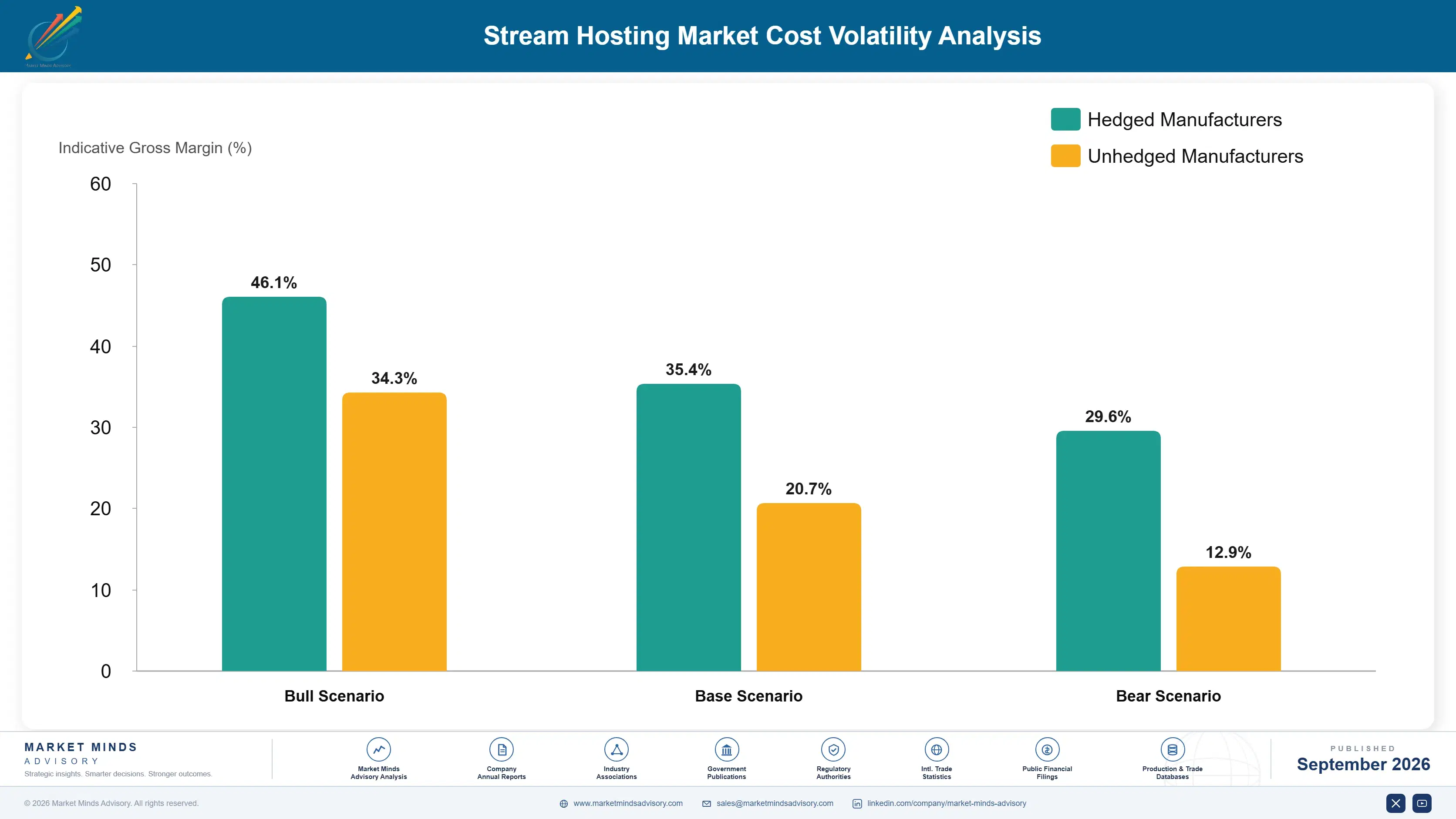
Network bandwidth and edge infrastructure hardware together represent the largest cost input for stream hosting vendors, running an estimated 42 to 49 percent of total operating cost, sourced primarily from a concentrated group of network capacity providers whose pricing tracks broader telecom infrastructure markets closely across most vendor operations globally today, indeed, truly, today and overall.
Network bandwidth costs rose meaningfully across the broader telecom infrastructure sector during 2022 and 2023 amid well documented network capacity constraints and rising demand for high definition and interactive streaming bandwidth, a pattern confirmed in multiple vendor annual reports and in EIA and European Commission telecom infrastructure commentary from the same period. Vendors without diversified network capacity relationships faced larger cost increases than those with existing multi source agreements established beforehand across their infrastructure base.

The competitive disadvantage falls hardest on smaller vendors without the purchasing scale to secure favourable bandwidth pricing during periods of tight network capacity. Exposure varies by vendor type too, since vendors running high definition, low-latency delivery infrastructure face materially greater bandwidth cost sensitivity than vendors offering primarily standard definition, buffered delivery without heavy real time processing requirements.
stream-hosting-market-cost-volatility-analysis-1789993490430

Diversifying Network Capacity Relationships Across Regions

Larger vendors are diversifying network bandwidth capacity relationships across multiple regions from the outset, reducing single source dependency exposure while maintaining the consistent delivery performance that low-latency applications require across the full network pipeline. This diversification also shortens replacement time whenever a single provider faces disruption. This also strengthens negotiating leverage across future contract cycles considerably.

Negotiating Volume Based Bandwidth Pricing Agreements

Several vendors are negotiating volume based bandwidth pricing agreements tied to their growing delivery scale, reducing per gigabyte cost exposure that smaller vendors without comparable volume cannot easily secure from network providers. These agreements are now standard practice across most large scale vendors today. These agreements help stabilise costs during volatile capacity constraint cycles.

Investing In Edge Caching Efficiency Technology

Vendors are increasingly investing in edge caching efficiency technology that reduces bandwidth consumption per delivered stream, lowering exposure to bandwidth cost increases while maintaining the latency performance that platforms increasingly expect. This approach is becoming standard across most major vendors globally, reducing overall bandwidth cost exposure considerably today. This approach reduces overall bandwidth cost exposure considerably.

Portfolio Architecture for Margin Defence

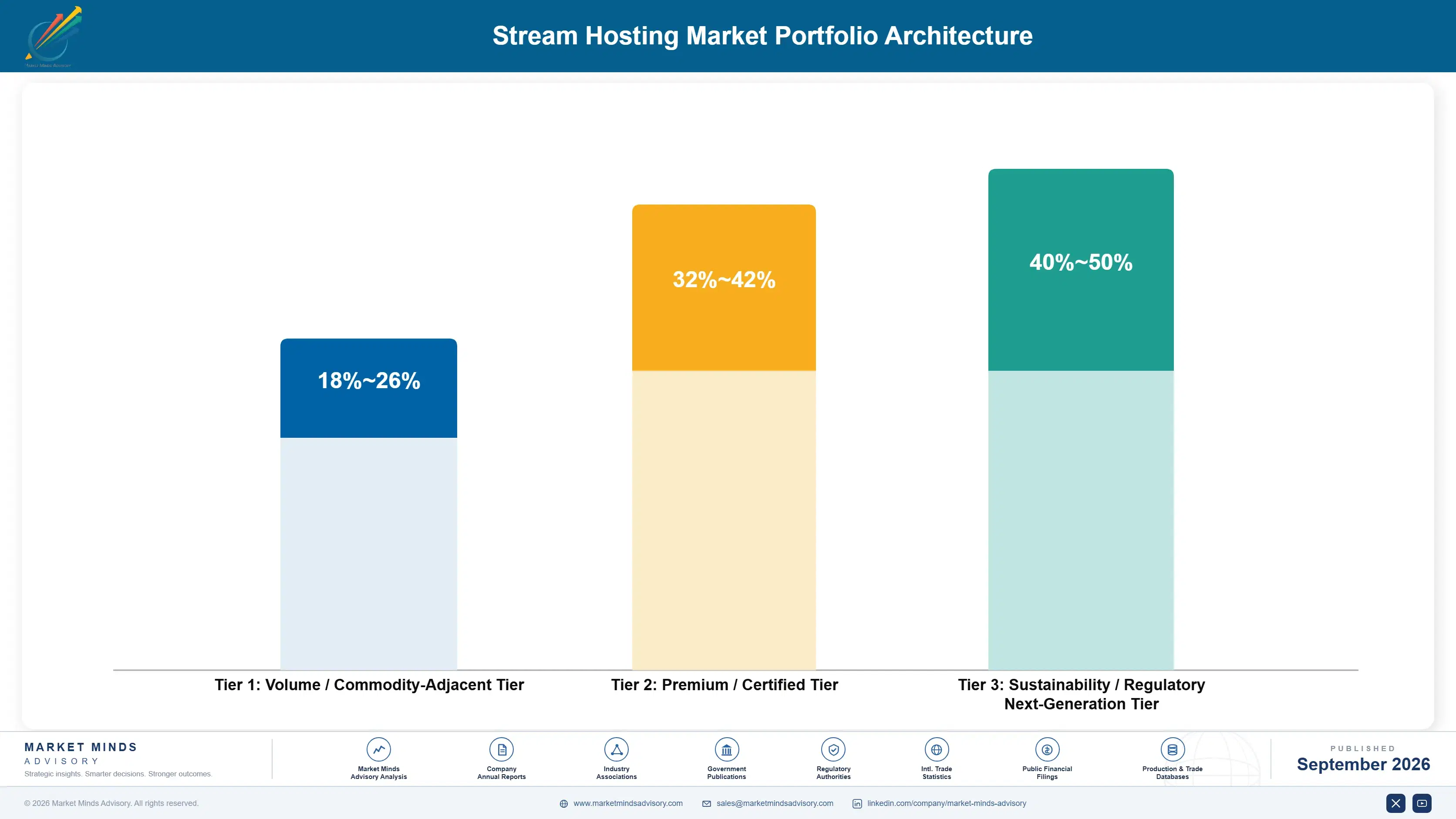
Portfolio economics split into three tiers. Volume tier basic video-on-demand hosting carries thinner margins under continued price competition from generic delivery alternatives, while premium low-latency and commerce integrated services carry meaningfully higher margins tied to documented latency and reliability performance. The sustainability and next generation tier, built around edge network expansion and validated commerce integration, currently carries the strongest margins given genuine differentiation and long term platform relationships.
The volume versus premium tension shows up clearly in vendor engineering allocation. Investment devoted to defending basic hosting margin against generic alternative competition competes directly against investment needed for low-latency and commerce integration capability, and vendors that under invest in either risk losing ground to a competitor optimised specifically for that segment of the market.

High value margin pools concentrate in low-latency and commerce integrated lines, where technical differentiation and validated performance still command premium pricing before broader commoditisation eventually sets in across the category. The basic hosting tier remains essential for platform reach among smaller content budgets but contributes a shrinking share of blended gross margin across the category overall. This dynamic is already visible in vendor product roadmaps announced over the past year.

Volume / Commodity-Adjacent Tier

Basic video-on-demand hosting facing continued price competition from generic delivery alternatives, leaving vendors reliant on volume rather than latency depth to defend share today overall, indeed, truly, across most standard applications.
Gross Margin: 18-26%

Premium / Certified Tier

Low-latency and commerce integrated services bundling validated performance carrying margins tied to reliability and precision, with buyers willing to pay a meaningful premium for demonstrated results. Enterprises increasingly value speed and precision.
Gross Margin: 32-42%

Sustainability / Regulatory / Next-Generation Tier

Edge network expansion and validated commerce integration systems commanding the strongest current margins given genuine differentiation and recurring platform relationships overall today truly, for licensed technology partners today and beyond.
Gross Margin: 40-50%
stream-hosting-market-portfolio-architecture-1789993490937

High-value Sub-segments and Strategic Watch-out

Low-Latency Interactive Platform Contracts

The fastest growing margin segment in this report, combining strong current margins with accelerating platform demand for validated interactive latency across new deployment programmes this decade, across most rollouts today overall. Platforms increasingly demand this option globally, across most enterprise deployments this decade today, truly.
Gross Margin: 40-50%

Live Commerce Integration Contracts

Premium offerings tied to retailer demand for documented purchase conversion, offering strong margins and durable revenue visibility across major commerce focused accounts broadly, across recent renewal cycles too across established regional markets today. Retailers increasingly favour proven results, across recent renewal cycles too across established markets.
Gross Margin: 32-42%

Standard Video-On-Demand Hosting Contracts

The largest existing revenue base, standard engagements facing steady price competition but funding most vendors' ongoing latency and engineering investment across the wider business, and vendors depend heavily on this steady base overall. Vendors depend heavily on this steady base, even as growth slows gradually overall.
Gross Margin: 20-28%

Legacy Buffered Delivery Exposure

A shrinking strategic watch out segment as low-latency infrastructure continues displacing legacy buffered delivery approaches across most content categories tracked in this report, across the category broadly for smaller technology budgets too, who risk losing ground without meaningful investment soon today, across most content categories.

Platform Lock-In and Latency Economics

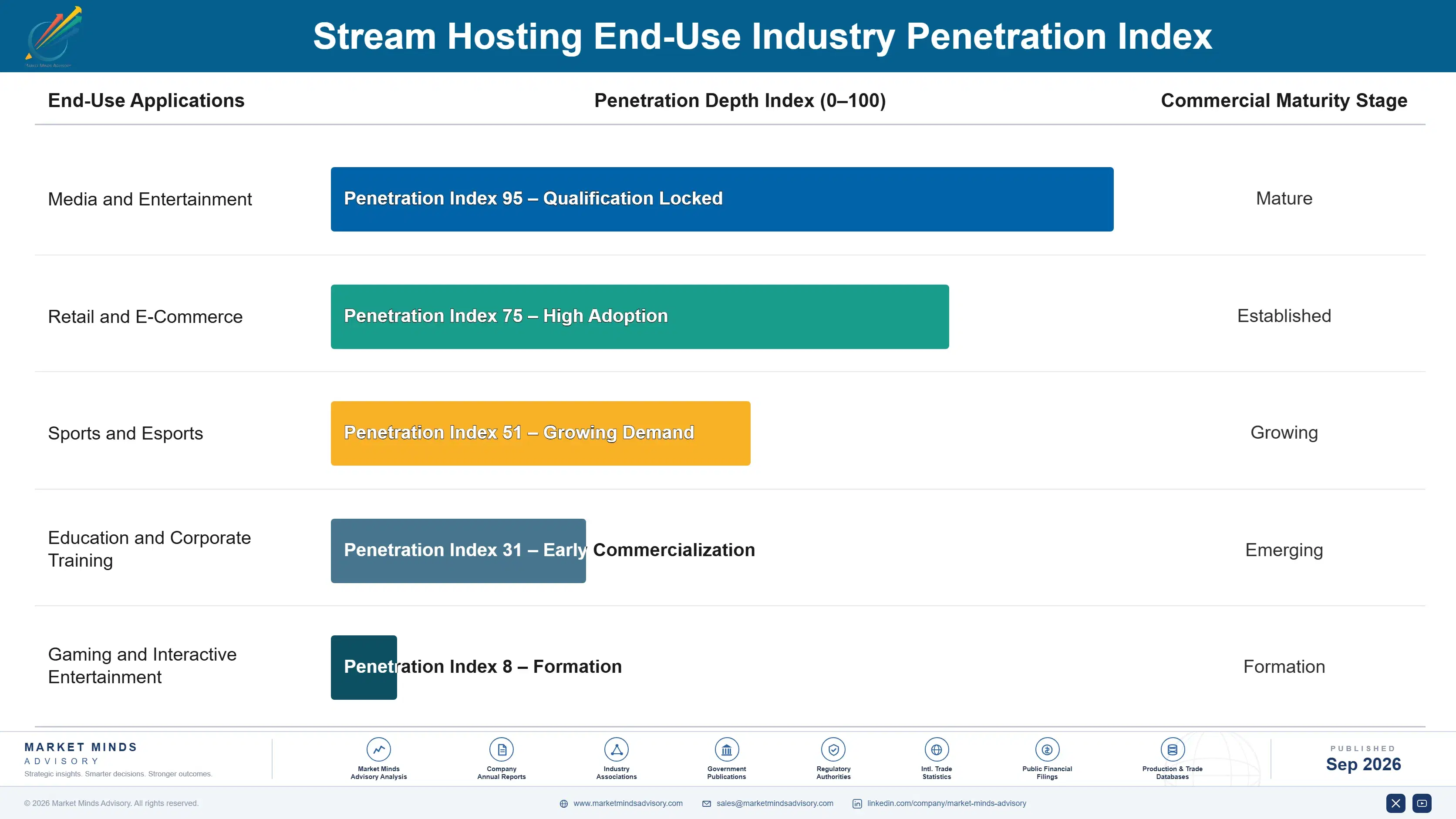
Revenue behaves like a multi year annuity once a vendor's delivery platform becomes embedded across a content operator's daily broadcast operations, since switching stream hosting vendors means rebuilding integration with existing content management systems and retraining broadcast staff rather than a simple software swap. That switching cost explains most of this category's revenue visibility once a vendor moves past initial deployment into steady, ongoing delivery service.
Adoption depth varies sharply by platform segment. Large content platforms running continuous, high value broadcast operations integrate vendor relationships deeply into ongoing multi year infrastructure contracts spanning entire content libraries, creating durable vendor relationships, while smaller platforms with less continuous streaming needs treat hosting adoption more transactionally around individual events, creating shallower vendor loyalty and greater exposure to competitive switching.

Buyer profiles are shifting generationally too. Broadcast leaders who came up through the standard delivery era still favour proven, established vendor relationships at a price premium, while newer platform leaders increasingly default to evaluating latency depth and documented uptime as standard selection considerations. That difference in buying philosophy is shaping which vendors win newly emerging interactive segments versus established legacy delivery relationships.
stream-hosting-market-end-use-penetration-index-1789993491428

Where the Category Reorders Next

These are among the four positions where our research anticipates prominent divergence between winners and laggards over the coming forecast period. Each is grounded in the demand model, the regulatory perimeter, and the announced capacity pipeline.
01 / LOW-LATENCY ENGINEERING INVESTMENT

Validated latency depth is separating category leaders from claims

Vendors that built low-latency engineering depth are capturing a disproportionate share of enterprise contracts as buyers grow wary of unproven latency promises circulating across the category. Vendors without demonstrated live deployment evidence risk being relegated to generic delivery positioning carrying materially lower contract value than latency leaders currently command. Building this evidence base now, while buyers actively reassess vendor evaluation criteria across nearly every major account, looks like the more urgent priority for most vendors heading into next year, ahead of faster moving competitors already gaining ground.
02 / UPTIME RELIABILITY STRATEGY

Documented availability is compounding into durable contract value

Vendors that validated documented uptime reliability are capturing a disproportionate share of contracts as buyers increasingly demand measurable returns beyond theoretical availability projections alone. This dynamic rewards vendors willing to invest in monitoring and verification well ahead of confirmed industry wide reliability standardisation. Vendors without established validation depth should prioritise smaller pilot broadcasts first, since pilot programmes with two or three platforms tend to reveal most recurring reliability requirements early, well before a broader, portfolio wide rollout begins in earnest.
03 / COMMERCE INTEGRATION POSITIONING

Unified purchase workflow depth remains a genuinely underexploited advantage

Commerce integration depth remains underexploited relative to its clear value potential as retailers continue seeking unified purchase workflows faster than many standalone vendors can credibly demonstrate comparable integration depth. Vendors building genuine integration now are positioning for meaningful contract advantage as live commerce continues broadening across content categories worldwide. Treating commerce integration as a secondary afterthought rather than a distinct strategic asset risks underinvesting in an important, durable competitive moat that rivals are already beginning to build out steadily across their own platforms.
04 / LEGACY DELIVERY EXPOSURE

Vendors without latency depth face continued displacement pressure

Vendors remaining concentrated in generic delivery positioning without low-latency or commerce differentiation face continued displacement pressure as buyer procurement criteria shift decisively toward precision, technically differentiated offerings across most accounts tracked in this report. Vendors should actively diversify toward low-latency engineering, uptime validation, or commerce integration rather than defending delivery only positioning alone across every content segment. Treating delivery only positioning as stable rather than declining understates the category's ongoing competitive transition already well underway across most developed markets tracked closely throughout this report.

Engagement Snapshot From the Field

A live engagement with an industry participant carrying material or product regulatory and market exposure ahead of a defining policy shift, showing how our research translates into a defensible multi-year portfolio strategy.
MARKET MINDS ADVISORY · CLIENT ENGAGEMENT SUMMARY
Stream Hosting Producer Strategic Portfolio Review and Transition Roadmap 2026·Investment Scenario on Stream Hosting Exposure Evaluation 2025-26
CLIENT PROFILE
The client is a global media broadcaster generating approximately three billion dollars in annual revenue, operating live event and content streaming across a dozen countries with historically standard buffered delivery infrastructure inherited from decades of legacy broadcast technology investment (client-reported, unverified by MMA). The client's technology organisation includes roughly thirty five engineers coordinating infrastructure deployment across multiple regional broadcast operations.
STRATEGIC CHALLENGE
Leadership needed to deploy low-latency streaming infrastructure across its live event portfolio to support interactive audience engagement, without triggering costly service disruption during the transition from standard delivery to interactive infrastructure across active broadcast operations. Any misstep risked costly viewer attrition during the client's highest revenue generating live events overall.
MMA APPROACH
MMA benchmarked candidate stream hosting vendors against disclosed latency performance data and existing client references at comparable global broadcasters, prioritising vendors demonstrating genuine validated performance over marketing claims alone. The engagement included structured technical testing to assess actual latency reduction across representative live events. MMA also reviewed each candidate's documented deployment history across comparable broadcast programmes.
KEY FINDINGS
  1. Two of the four candidate vendors already held integration experience with the client's existing content management system, suggesting a lower risk deployment path than a fully custom integration build.
  2. Several vendors claiming strong latency performance in marketing materials had not actually validated those figures through independent measurement at comparable broadcast operators previously.
  3. A phased event category by event category deployment sequence reduced total service disruption risk considerably compared to a simultaneous full portfolio conversion approach across every broadcast at once.
  4. Broadcast team adoption of the retained vendor's low-latency platform exceeded initial expectations once early performance results were shared transparently across regional teams.
CLIENT PROFILE
The client is a global media broadcaster generating approximately three billion dollars in annual revenue, operating live event and content streaming across a dozen countries with historically standard buffered delivery infrastructure inherited from decades of legacy broadcast technology investment (client-reported, unverified by MMA). The client's technology organisation includes roughly thirty five engineers coordinating infrastructure deployment across multiple regional broadcast operations.
STRATEGIC CHALLENGE
Leadership needed to deploy low-latency streaming infrastructure across its live event portfolio to support interactive audience engagement, without triggering costly service disruption during the transition from standard delivery to interactive infrastructure across active broadcast operations. Any misstep risked costly viewer attrition during the client's highest revenue generating live events overall.
MMA APPROACH
MMA benchmarked candidate stream hosting vendors against disclosed latency performance data and existing client references at comparable global broadcasters, prioritising vendors demonstrating genuine validated performance over marketing claims alone. The engagement included structured technical testing to assess actual latency reduction across representative live events. MMA also reviewed each candidate's documented deployment history across comparable broadcast programmes.
KEY FINDINGS
  1. Two of the four candidate vendors already held integration experience with the client's existing content management system, suggesting a lower risk deployment path than a fully custom integration build.
  2. Several vendors claiming strong latency performance in marketing materials had not actually validated those figures through independent measurement at comparable broadcast operators previously.
  3. A phased event category by event category deployment sequence reduced total service disruption risk considerably compared to a simultaneous full portfolio conversion approach across every broadcast at once.
  4. Broadcast team adoption of the retained vendor's low-latency platform exceeded initial expectations once early performance results were shared transparently across regional teams.
RECOMMENDED STRATEGY
Phase 1: Phase 1 (Months 1 to 3): Benchmark vendors against validated latency performance and verified deployment evidence from comparable broadcasters and existing system compatibility. Phase 2: Phase 2 (Months 4 to 8): Deploy the highest priority event category first to validate the retained vendor relationship and measure early results. Phase 3: Phase 3 (Months 9 to 14): Extend deployment across remaining event categories based on initial performance results achieved during the first phase.
OUTCOME
Fourteen months after the engagement began, the client successfully deployed low-latency infrastructure across three of four event categories, reporting measurably improved audience engagement consistency relative to its prior standard delivery baseline (client-reported, unverified by MMA). Leadership also reported improved confidence in managing future infrastructure deployment independently, and reduced average service disruption time considerably across the transition.

Frequently Asked Questions

Foundational context covering the market sizes, CAGR, scope, country, region and competition that inform every finding below. This section is provided to cover basics and most often pre-purchase conversations, answered from the MMA Primary Research Dataset.

What is the current size of the Stream Hosting Market?

The Stream Hosting Market reached an estimated USD 5.4 billion in global revenue in 2025. This base year figure anchors the forecast period beginning in 2026.

How large will the Stream Hosting Market be by 2036?

MMA projects the market will reach approximately USD 15.88 billion by 2036 under the base case scenario. That represents roughly a 2.67 times expansion from the 2026 starting value of USD 5.96 billion.

What is the CAGR for the Stream Hosting Market 2026 to 2036?

The base case compound annual growth rate is 10.3% across the 2026 to 2036 forecast window. Bull and bear scenarios range from 8.9% to 11.6% depending on live commerce adoption pace and platform budget scrutiny.

Which segment is growing fastest?

Low-Latency Interactive Streaming Services leads all segments at a 14.0% CAGR, roughly 1.36 times the overall market rate. This segment benefits from platforms prioritising real time audience interaction.

Who are the major companies in the Stream Hosting Market?

Leading vendors include Amazon Web Services Inc, Cloudflare Inc, Akamai Technologies Inc, Brightcove Inc, and Kaltura Inc. Together these five hold an estimated 34% combined share on a disclosed active customer base.

Which country is growing fastest?

India leads national growth at an estimated 12.6% CAGR, driven by rapidly expanding live commerce and OTT platform adoption. Vietnam follows within the same South Asia and Pacific region.

Report Segmentation Architecture

The full report scope spans multiple orthogonal segmentation dimensions, with cross-tabulated demand data provided for each dimension pair. Coverage extends further to regional breakdowns, trend trajectories, and the competitive detail needed to support segment-level decision-making.

By Primary Market Dimension

  • Live Video Streaming Infrastructure and CDN Services
  • Video-on-Demand Hosting and Delivery Platforms
  • Low-Latency Interactive Streaming Services
  • Audio and Podcast Streaming Hosting Platforms
  • Streaming Analytics and Monetization Tools
  • Streaming Security and DRM Services

By End-Use Industry

  • Media and Entertainment
  • Retail and E-Commerce
  • Sports and Esports
  • Education and Corporate Training
  • Gaming and Interactive Entertainment

By Commercial Dimension

  • Direct Enterprise Platform Licensing
  • Cloud Marketplace Subscription Channel
  • System Integrator and Reseller Channel
  • Content Delivery Network Partnerships

By Region

  • North America
  • Western Europe
  • East Asia
  • South Asia and Pacific
  • Latin America
  • Middle East and Africa
  • Eastern Europe

Scope, Methodology, and Coverage

Every figure in this report is reproducible from documented input assumptions. The scope below maps the historical period, the forecast horizon, the segmentation dimensions, and the countries covered, alongside the underlying primary and qualitative methodology.
Historical Period
2020 to 2025
Forecast Period
2026 to 2036
Base Year
2025 (USD billions; MMA Primary Research Dataset, September 2026)
Market Definition
This report covers infrastructure and platform services that host, deliver, and manage live and on-demand video and audio streaming content, including content delivery networks, low-latency streaming services, and streaming analytics tools. It excludes standalone content production software and consumer facing streaming subscription revenue not tied to underlying hosting infrastructure services.
Quantitative Units
USD billions (current prices); data delivered in petabytes; average latency reduction achieved
Segmentation Dimensions
By Primary Market Dimension; By End-Use Industry; By Commercial Dimension; By Region
Regions Covered
North America, Western Europe, East Asia, South Asia and Pacific, Latin America, Middle East and Africa, Eastern Europe
Countries Covered
USA, Canada, UK, Germany, France, Sweden, China, Japan, South Korea, India, Australia, Vietnam, Indonesia, Brazil, Mexico, Colombia, UAE, Saudi Arabia, South Africa, Kenya, Poland, Romania, and additional markets relevant to this sector
Key Companies Profiled
Amazon Web Services Inc; Cloudflare Inc; Akamai Technologies Inc; Brightcove Inc; Kaltura Inc; Vimeo Inc; Wowza Media Systems LLC; Mux Inc; Dacast Inc; JW Player LLC; Bitmovin GmbH; Agora Inc; Twilio Inc; Google LLC; Microsoft Corporation; Edgio Inc; Fastly Inc; Panopto Inc; Restream Inc; Switchboard Live Inc
Quantitative Methodology
Primary survey, n=3,800 respondents, Q4 2025, six countries; demand-side model with trade association cross-validation
Qualitative Methodology
47 expert interviews, Q4 2025; applied to validate demand model assumptions, identify emerging dynamics, and assess competitive positioning
Report Format
PDF and XLSX data workbook (Word format preview document)
Publisher
Market Minds Advisory
Report Code
MMA-2026-TEC-406
Published
September 2026
Contact
sales@marketmindsadvisory.com | www.marketmindsadvisory.com

Purchase the full Stream Hosting Market Report (2026 to 2036).

The full report delivers complete segmentation data across all six service type segments, all seven regional markets, and detailed competitive profiles for all twenty companies named in this summary. It includes the underlying primary survey dataset of three thousand eight hundred respondents and forty seven expert interviews conducted during the fourth quarter of 2025. Buyers also receive downloadable data tables covering historical 2020 to 2025 figures alongside the full 2026 to 2036 annual forecast. A dedicated appendix addresses bandwidth cost benchmarks across three vendor scenarios.
Full Seven-Region Regional Data Tables and Charts
All Twenty Company Competitive Profiles and Rankings
Ten-Year Annual Forecast Model With Scenarios
Primary Survey Raw Data Access and Tables
Bandwidth Cost Benchmark Appendix and Guide
Quarterly Update Subscription Option for Buyers

Built For The People Who Decide

From boardroom strategy to bench-side execution, this report is read cover-to-cover by leaders shaping the next decade of their industry, turning demand scenarios, market dynamics and valuation benchmarks into decisions.
CXOs/ Presidents/ VPs/ Managers
M&A and Corporate Development
Strategy Teams and R&D Heads
Procurement and Product Directors
Regulatory and Compliance Leaders
Investor Relations and Equity Analysts