Market Minds Advisory
Stoma/Ostomy Care Market

Stoma/Ostomy Care Market: The Product Is Skin, Not the Pouch

Around two in five ostomates suffer skin breakdown around the stoma, and that single failure drives switching, accessory consumption, and abandonment. The pouch is the visible product; the adhesive chemistry is the actual one.

Lead Analyst

Alice Ballenger

Published

September 2026

Make Smarter Decisions with Customized Research Insights

Request a free sample report and evaluate market opportunities, growth trends, and competitive dynamics relevant to your business needs.

2025 MARKET VALUE$3.7BMarket Size 2025
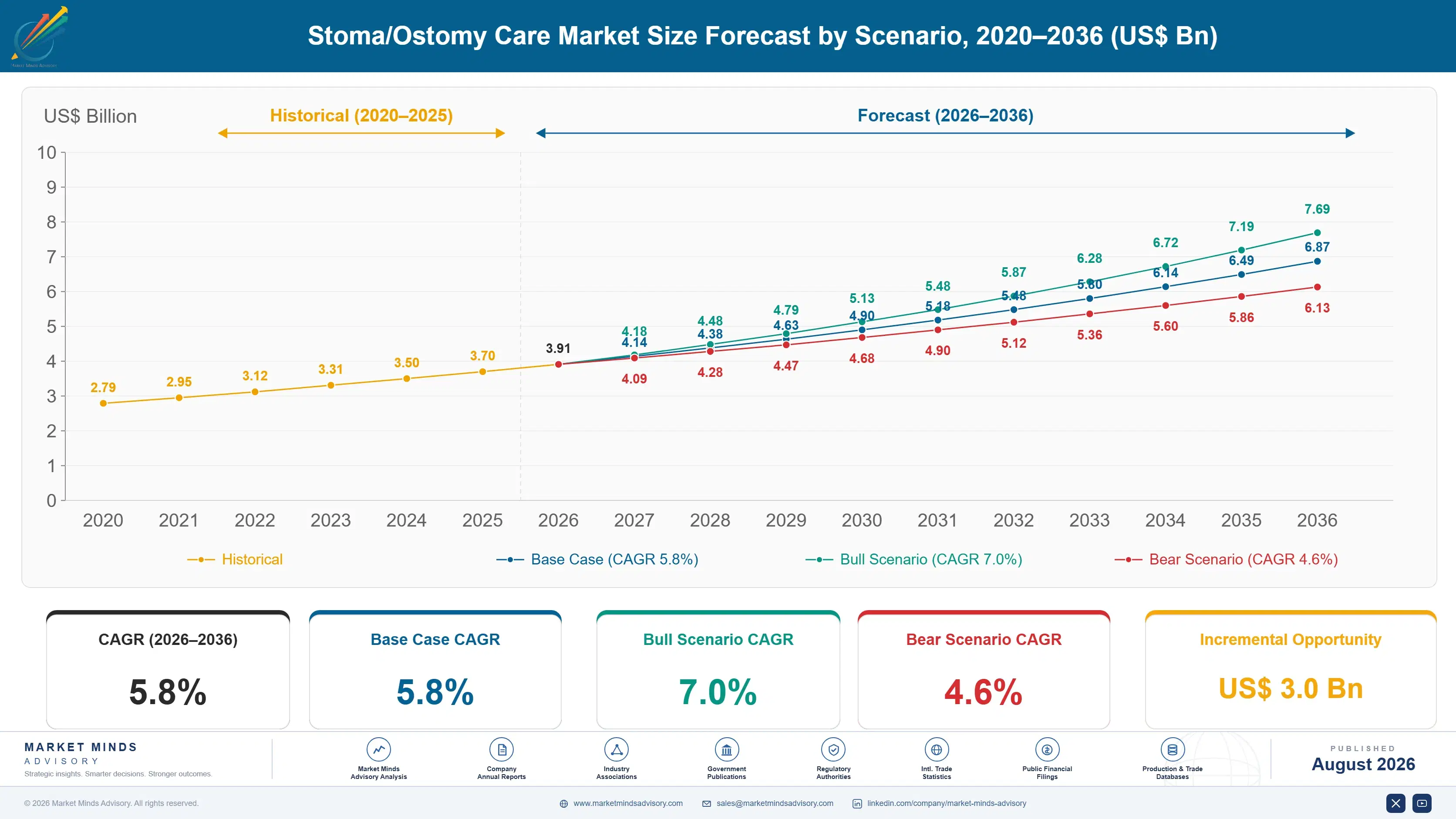
2036 FORECAST VALUE$6.9BBase Case , 2026 to 2036
CAGR 2026 TO 20365.8 %Bull 7.0% / Bear 4.6%
INCREMENTAL OPPORTUNITY$3.0BNet 10- year value creation
EXPANSION MULTIPLE1.76x2036 value over 2026 base
Strategic Levers
M&A Pipeline
Regional Outlook
Country Rankings
Competitive Intelligence
Segmental Deep-dive
Call-Us : 91 93563 13602

Executive Snapshot and Market Trajectory

Everybody outside this market thinks it sells pouches. It sells adhesive chemistry that has to stay attached to inflamed, moving, output-exposed skin for several days at a time. Roughly 42% of ostomates experience peristomal skin breakdown anyway, and that single failure is what drives every product change in the category.
Growth runs at 5.8% on a treated population expanding with colorectal cancer surgery and inflammatory bowel disease rather than on any price movement at all. Skin barrier accessories grow fastest at 8.7%, exactly 1.50 times the market rate, because that is precisely where the actual clinical problem sits. Adhesive and securement accessories follow at 8.1%. Western Europe holds 34% on accessory provision found nowhere else in the world.
Concentration reaches 76% across the top five measured on annual ostomy appliance and accessory revenue, which is very high for a consumable of this technical simplicity. The explanation is the discharge moment: 81% of patients still use the brand a specialist nurse issued them in hospital, because relearning an application routine on a changed body is something almost nobody volunteers for. China grows fastest at 9.4%, from a very low accessory base.
Market Definition
This market covers appliances and accessories used in the management of colostomies, ileostomies, and urostomies, measured at manufacturer realised prices, spanning one-piece pouching systems, two-piece pouching systems, convex pouching systems, skin barrier accessories, adhesive and securement accessories, and irrigation and continence systems. Stoma-forming surgery, surgical staplers and instruments, specialist nursing services, incontinence products unrelated to stomas, and general wound dressings fall outside scope.
Base Year Value
$3.7B in 2025 (MMA Primary Research Dataset, August 2026)
Forecast Period
2026 to 2036, eleven discrete annual values
CAGR
5.8% base case. Bull 7.0%. Bear 4.6%.
Fastest Growth Segment
Skin Barrier Accessories: 8.7% CAGR
Fastest Growth Country
China: 9.4% CAGR
Fastest Growth Region
South Asia and Pacific: 7.9% CAGR
Largest Region
Western Europe: 34% of 2025 global value
Market Leaders
Coloplast, Convatec, Hollister, B. Braun, Salts Healthcare. Source: MMA Analysis based on company annual reports.
Primary Survey
n=3,800 procurement and R&D decision-makers, Q4 2025, six countries
Methodology
Demand-side build-up, cross-validated against public data, 47 expert interviews

Stoma/Ostomy Care Market Forecast Scenarios

stoma-ostomy-care-market-size-forecast-scenario-1787299853425
The 2020 to 2025 period ran at 5.0% and accessory consumption grew considerably faster than appliance volume inside that. Colorectal cancer surgery volumes recovered after pandemic deferral and then continued rising, while inflammatory bowel disease surgery added a younger and longer-horizon cohort. Convex systems moved from a specialist option toward routine use for retracted stomas. Payers in several systems began questioning accessory quantities in the same window.
Three mechanisms carry the 5.8% base case. Treated population growth is the largest, since colorectal cancer incidence rises with ageing and inflammatory bowel disease keeps climbing in younger adults who then live with a stoma for decades. Accessory intensity is the second, growing at 8.7% as clinical practice recognised that skin protection determines everything else. And Asian surgical volume is the third, expanding from a base with almost no accessory use at all.
The 7.0% bull case rests on payers reclassifying skin barrier accessories as prevention rather than as consumables subject to monthly caps, which would lift accessory intensity across every reimbursed market at once. The 4.6% bear case is quantity limits tightening further, since accessories are the visible line in a prescription budget while the resulting complication cost lands elsewhere.

Where the Real Engineering Lives

The engineering problem here is genuinely difficult and almost entirely invisible. A hydrocolloid barrier has to adhere to skin that is warm, moist, and moving, seal against output that is enzymatically aggressive in the case of an ileostomy, remain in place for three to five days, and then come off without stripping the epidermis. Roughly 42% of ostomates still experience skin breakdown, which tells you how narrow the margin is between adhering well and adhering too well.
TOP FIVE CONCENTRATION76%Very high for a consumable of this technical simplicity
PERISTOMAL SKIN COMPLICATIONS42%Of ostomates experiencing skin breakdown around the stoma site
ACCESSORY SHARE OF SPEND23%Of product revenue against pouches and barriers combined
TEMPORARY OSTOMY SHARE37%Of new stomas formed with reversal intended within months
DISCHARGE BRAND PERSISTENCE81%Of patients still using the brand issued at discharge
SPECIALIST NURSE CASELOAD220 patientsSupported by each specialist stoma nurse in developed systems
That failure rate is the commercial engine of the whole category. Skin complications drive appliance changes, accessory purchases, unscheduled nurse visits, and in a meaningful minority of cases they drive people to stop leaving the house. Accessories now carry 23% of product spend and grow at 8.7%, which is the market recognising that the barrier alone does not solve it.
Selection happens once and rarely changes. Around 81% of patients still use the brand a specialist nurse fitted them with in hospital, because relearning an application routine on a body they are still coming to terms with is aversive enough that most people simply do not. The discharge moment is therefore the entire commercial event in this market.
"Every commercial plan I see in this category talks about pouch features. Patients talk about whether their skin is sore. Those are the same conversation and almost nobody in the industry has noticed they are having the wrong half of it."
Director, Ostomy and Continence Care Practice · MMA Medical Devices and Chronic

Market Trends

Accessories Moved From Optional To Clinically Expected

Barrier rings, protective films, powders, and pastes were treated for years as a preference some nurses had and others did not. Evidence linking their use to lower peristomal skin complication rates changed that, and specialist nursing guidance now treats skin protection as part of the fitting rather than as an add-on. Accessories carry 23% of product spend and grow at 8.7% against 5.8% for the market. The commercial consequence is that a company without a full accessory range is now incomplete at the discharge conversation rather than merely narrower. Range breadth now decides the conversation.
Market Impact: Fifty year horizon, 20% of stomas
Convexity Moved From Specialist Option To Routine Fitting

A stoma that sits flush or retracted below the skin surface leaks under a flat barrier, and for years the answer was pastes, belts, and patience. Convex barriers press the peristomal skin down and the stoma outward, and they have moved from a specialist product used after failure toward a routine first fitting where stoma profile indicates it. That shift raised realised price per appliance meaningfully. It also raised the technical demand on the fitting nurse, since inappropriate convexity causes its own pressure injuries. Fitting judgment matters more than it did, and the education burden rose with it.
Market Impact: China grows at 9.4% annually

Market Opportunities and Growth Drivers

Inflammatory Bowel Disease Creates Very Long Horizons

Colorectal cancer surgery produces most new stomas and skews older, but inflammatory bowel disease surgery produces stomas in people in their twenties and thirties who will then use these products for fifty years. That cohort behaves entirely differently: they are active, they swim and exercise, they care intensely about profile under clothing, and they research products themselves rather than accepting whatever arrives. Incidence keeps climbing across developed and developing markets alike. Suppliers who design only for the older cancer cohort are steadily losing the more valuable one. That cohort is smaller and worth considerably more.
Market Impact: Accessories capped below 23% share

Chinese Colorectal Surgery Volume Is Expanding Rapidly

Colorectal cancer incidence in China has risen sharply with dietary and demographic change, and surgical volumes have followed, producing a large and growing permanent colostomy population. Later stage presentation means sphincter-preserving surgery is less often possible than in Western practice, which raises the permanent stoma proportion further. China contributes the fastest national growth rate in this forecast at 9.4%. Accessory use there remains minimal, so the growth is presently in appliance volume with considerable headroom above it in skin protection products. Skin protection is the obvious next expansion, and nobody has built the nursing education for it.
Market Impact: 37% leave the market entirely

Market Restraints and Challenges

Monthly Quantity Caps Fall Hardest On Accessories

Most reimbursement systems allow a fixed monthly quantity of pouches and barriers, with a separate and usually tighter allowance for accessories, which is precisely where skin protection lives. The root cause is that accessories look discretionary on a prescription line while pouches obviously do not. Commercial impact is direct suppression of the fastest growing part of the market at 8.7%. Suppliers are responding with health economic evidence linking accessory use to lower complication and unscheduled care cost, which persuades only where those budgets are held together. Few systems have combined those budgets so far.
Market Impact: Growing at 8.7% annually

Thirty-Seven Percent Of Stomas Are Meant To Be Reversed

Loop ileostomies formed to protect a bowel anastomosis are intended for reversal within months, and roughly 37% of new stomas fall into that group. Those patients consume products briefly, often never see a specialist nurse more than twice, and disappear from the market entirely on reversal. The root cause is surgical practice rather than anything commercial. Commercial impact is that a headline stoma formation figure badly overstates durable demand. Suppliers separating temporary from permanent cohorts forecast accurately; those using one number do not. Surgical coding separates the two cohorts easily, and remarkably few companies have done it.
Market Impact: Convex systems grow at 7.2%
3 additional market trends, 4 additional growth drivers, and 2 additional restraints and challenges are covered in the full report. Contact sales@marketmindsadvisory.com to access the complete intelligence.

Segment CAGR and Growth Architecture

Segmentation follows product category, because category determines who selects it, which reimbursement allowance pays for it, how frequently it is consumed, and whether the clinical purpose is containment or skin protection. Stoma type and surgical indication both cut across every category rather than separating them, which leaves either a weak choice as the primary dimension for this market.
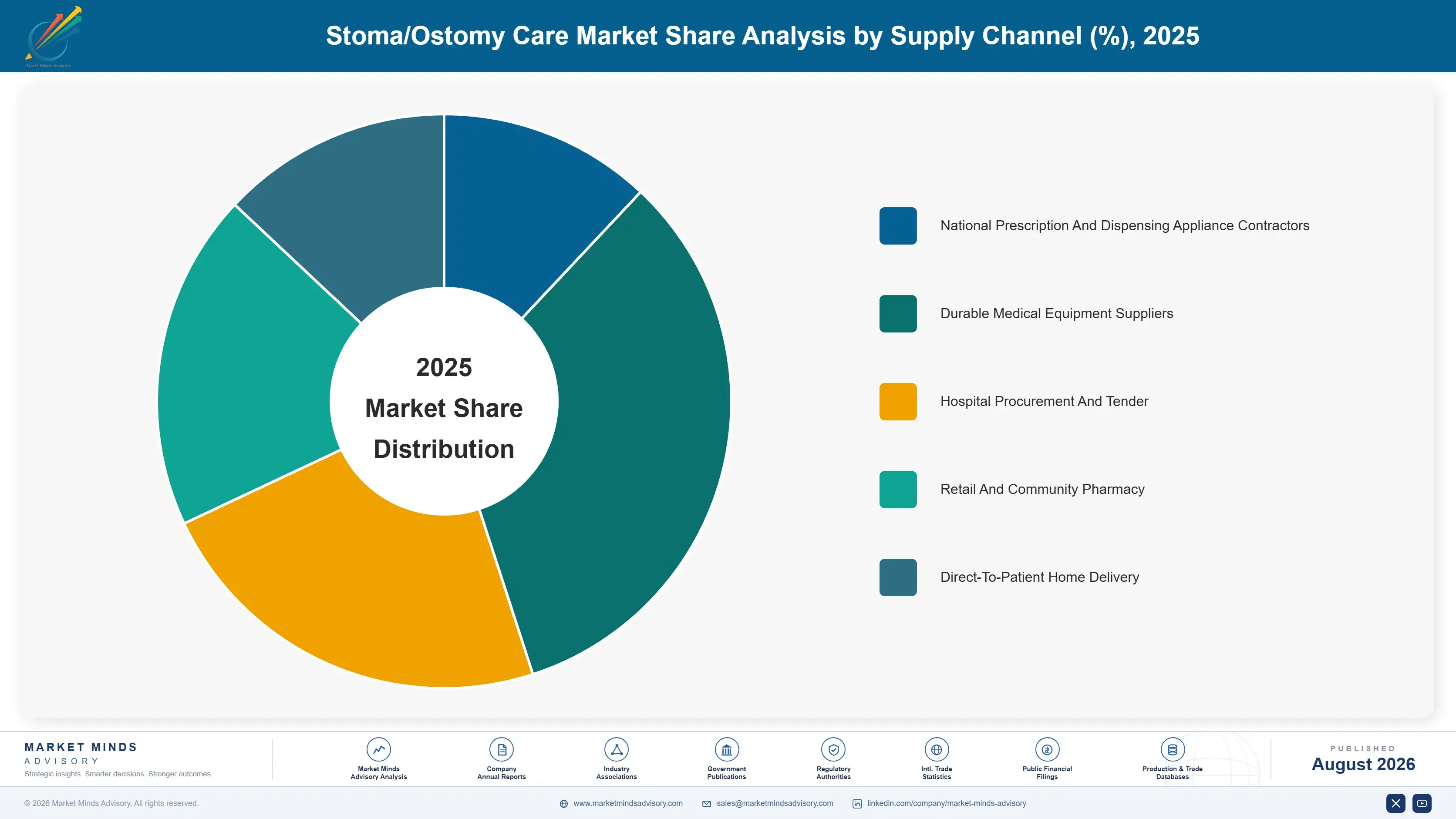
stoma-ostomy-care-market-market-share-analysis-1787299854240

Skin Barrier Accessories

The fastest category at 8.7%, exactly 1.50 times the market rate, and the one addressing the problem that actually defines this market. Barrier rings, protective films, powders, and pastes fill uneven peristomal contours, absorb moisture, and shield skin from output that would otherwise erode it, which matters because 42% of ostomates experience skin breakdown regardless. Specialist nursing guidance now treats these as part of the fitting rather than as an optional extra, which changed adoption sharply. Reimbursement is the constraint rather than clinical acceptance, since accessory allowances are usually tighter than appliance allowances in the same system. That single policy line decides how fast this category can grow anywhere. Nobody disputes the clinical case any more.
CAGR 8.7%

Adhesive And Securement Accessories

Second fastest at 8.1%, covering adhesive removers, securing tapes, belts, filters, and deodorising products, and growing for a reason that has little to do with clinical guidance. Younger ostomates from inflammatory bowel disease surgery are active, swim, exercise, and care about profile and odour under clothing in ways the older cancer cohort historically did not raise with anybody. Adhesive removers in particular have moved from optional to routine, since repeated peeling of a hydrocolloid barrier strips epidermis and causes exactly the skin damage the barrier was meant to prevent in the first place. Growth here follows patient demographics rather than clinical guidance, which makes it harder to forecast. Demographics rather than guidance drive it.
CAGR 8.1%
Full segment breakdown across 6 segments available in the complete report.

Regional Architecture and Country Demand Map

Accessory provision rather than surgical volume determines the value here, and those two things diverge quite sharply. Western Europe sits above its framework band because its prescription systems apply the least restrictive accessory allowances found anywhere and support much the densest specialist stoma nurse network.

Western Europe

Thirty-four percent, above the framework band, and the justification is accessory provision rather than surgical volume: British, Danish, Dutch, German, and Swedish prescription systems apply the least restrictive accessory allowances of any developed market, and accessories are the fastest growing part of this category. The specialist stoma nurse network here is also the densest anywhere, with caseloads around 220 patients, and that nurse is who selects the product at discharge. Danish and British manufacturing sits in the same countries, which shortens development feedback loops considerably. Growth at 4.4% is the slowest of any region on a mature and well-served base. What remains to be won here is share rather than new patients.
Share: 34% | CAGR: 4.4% (2026 to 2036)

North America

Twenty-eight percent, within the framework band, and the character here is high appliance provision with tighter accessory limits than European systems apply. Medicare allows specified monthly quantities of pouches and barriers, and accessory allowances sit below what specialist nursing practice would recommend, which suppresses precisely the fastest growing category. Distribution runs largely through durable medical equipment suppliers rather than pharmacy, which inserts a party between manufacturer and patient. Specialist nurse coverage is thinner than in Western Europe. Growth at 5.2% sits below the global rate, held back by accessory limits rather than by any shortage of treated patients. Reimbursement policy rather than clinical practice separates this region from Western Europe on accessory intensity.
Share: 28% | CAGR: 5.2% (2026 to 2036)
Regional intelligence for 5 additional markets available in the complete report: East Asia, South Asia and Pacific, Latin America, Eastern Europe, Middle East and Africa. Contact sales@marketmindsadvisory.com.
stoma-ostomy-care-market-country-cagr-analysis-1787299855178

Winning At The Discharge Bedside

Around 81% of patients still use the brand a specialist nurse issued them at discharge, and 42% of them will experience skin breakdown whatever product they use. Value comes from owning the discharge conversation, from arguing accessories as prevention rather than consumables, from separating temporary and permanent cohorts, and from designing for younger ostomates.

Invest Where The Selection Actually Happens

Product choice is made in hospital by a specialist nurse during the first fitting, and 81% of patients never change afterward because relearning an application routine on a changed body is genuinely aversive. That makes the discharge bedside worth more than any retail or direct-to-patient activity a company can fund. Specialist nurse education programmes, fitting support, and sample provision cost around 6 million dollars annually across a major market and determine a revenue stream lasting decades per patient. Most companies spend more on patient-facing advertising that reaches people whose choice is already fixed.
Market Impact: Nurse education programme costs about 6 million dollars

Argue Accessories As Prevention Not Consumption

Payers cap accessory quantities because the line looks discretionary, while the resulting skin complications generate unscheduled nurse visits, appliance wastage, and occasional admissions charged to entirely different budgets. With 42% of ostomates experiencing skin breakdown, the arithmetic favours provision comfortably. Building that evidence costs roughly 2.5 million dollars per major market in health economic work using existing complication registries. It persuades only where prescription and community nursing budgets are held together, which makes choosing the target system as important as the evidence itself. Most companies have never attempted the calculation.
Market Impact: Health economic evidence costs about 2.5 million dollars

Separate Temporary And Permanent Patient Cohorts

Roughly 37% of new stomas are loop ileostomies intended for reversal within months, and those patients consume briefly and then leave the market entirely. Forecasting from total stoma formation therefore overstates durable demand by more than a third, which distorts capacity planning, territory allocation, and the value assigned to winning any given hospital. Splitting the two cohorts is straightforward using surgical coding data most health systems publish. Companies that have done it target education spending at the units forming permanent stomas rather than spreading it evenly across every ward. The data is free to obtain.
Market Impact: Overstates durable demand by roughly 37% overall here

Design For The Ostomate Who Is Thirty

Inflammatory bowel disease surgery creates stomas in people who will use these products for fifty years, who swim and exercise, and who care about profile and odour in ways the older cancer cohort rarely raised. That group also researches independently and will request a specific product by name, which is the one route around the discharge lock-in. Products designed around an older, less active patient fit them poorly. The cohort is smaller in numbers and worth several times more per patient across a lifetime of consumption. Roughly 20% of new permanent stomas come from this group.
Market Impact: Around 20% of all new permanent stomas formed

Who Controls the Margin Pool

Concentration reaches 76% across the top five measured on annual ostomy appliance and accessory revenue, which is remarkably high for a consumable whose manufacturing is not especially complex. The barrier is not technology but the discharge moment: with 81% brand persistence after first fitting, a competitor has to reach the specialist nurse before the patient rather than the patient afterward. Leader and challenger sit close together on revenue and further apart on accessory range breadth.
Competitive activity runs on three fronts. Specialist nurse education and fitting support is the first, since that relationship determines what a patient is discharged with. Accessory range completeness is the second, because a company lacking barrier rings or protective films is incomplete at exactly the conversation that matters. Adhesive formulation is the third, and it is the only genuine technical contest here.

Pressure comes from two directions. Domestic Asian manufacturers are taking appliance volume in their own rapidly growing markets at prices Western suppliers cannot match on a straightforward flat system. And patient-led product research among younger ostomates is beginning to break the discharge lock-in that has protected incumbents for decades, which is where rankings will move first.
stoma-ostomy-care-market-company-positioning-matrix-1787299856030

Competitive Moat and Risk Dimensions

COLOPLAST

Moat: Specialist nurse relationship depth

Long-established education and fitting support programmes put company representatives alongside specialist stoma nurses at the moment product selection actually happens, which with 81% brand persistence is worth decades of consumption per patient. That network took many years to build and is reinforced by nurses trained on those products themselves. Reaching the patient afterward is a far weaker position.
COLOPLAST

Risk: Exposure to accessory allowance caps

A strong position in the fastest growing part of the market is also the part payers restrict most tightly, since accessory quantities look discretionary on a prescription line in a way pouches never do. Every allowance review threatens the growth rather than the base. Health economic evidence answers it only where budgets sit together.
CONVATEC

Moat: Adhesive and barrier formulation

Hydrocolloid chemistry that adheres reliably to warm moist skin, resists ileostomy output, and releases without stripping epidermis is the only genuine technical contest in this category. Formulation improvements translate directly into fewer of the skin complications affecting 42% of ostomates, and specialist nurses notice that quickly across a caseload of roughly 220 patients each.
CONVATEC

Risk: Discharge access limits formulation advantage

A better barrier only matters if it reaches the first fitting, and 81% of patients never change afterward regardless of what becomes available later. Technical advantage therefore converts to revenue at the pace of nurse relationships rather than at the pace of product development. Competitors with weaker chemistry and stronger hospital access can outsell a better product for years.

Players Tracked

Prominent Players

Coloplast
Convatec
Hollister
B. Braun
Salts Healthcare

Other Key Players

Welland Medical
Pelican Healthcare
Marlen Manufacturing
Nu-Hope Laboratories
Cymed
Torbot Group
Genairex
Flexicare Medical
Alcare
Trio Healthcare
Perma-Type
Safe n Simple
Oakmed
Medline Industries
Cardinal Health

Recent Developments

FEBRUARY 2025

Manufacturer launches ceramide-infused barrier for compromised peristomal skin

An ostomy care manufacturer introduced a hydrocolloid barrier incorporating ceramide intended to support skin barrier function in patients with existing peristomal damage. The launch was a product introduction rather than any joint venture, licensing arrangement, or acquisition of a dermatological formulation business. Existing accessory ranges were unaffected.
Signal: Formulation improvements aimed at the skin rather than the seal show where the category now competes
MAY 2025

Health system reclassifies barrier accessories outside monthly consumable cap

A national prescription system moved skin barrier rings and protective films outside the monthly consumable quantity limit, treating them as complication prevention rather than as routine consumables. The change was a reimbursement policy decision rather than any procurement agreement or arrangement with a manufacturer. Appliance allowances were left unchanged.
Signal: Reclassifying accessories as prevention rather than consumption removes the cap on the fastest growing category here
SEPTEMBER 2025

Chinese manufacturer expands ostomy appliance production for domestic demand

A Chinese medical device manufacturer expanded ostomy appliance production capacity aimed at rapidly growing domestic colostomy volumes following colorectal cancer surgery. The expansion was organic capital investment rather than any joint venture, licensing arrangement, or acquisition of an established Western supplier. Export volumes were not disclosed publicly.
Signal: Appliance volume in the fastest growing national market is moving toward domestic manufacture rather than imports

Citrus Peel Holds the Pouch On

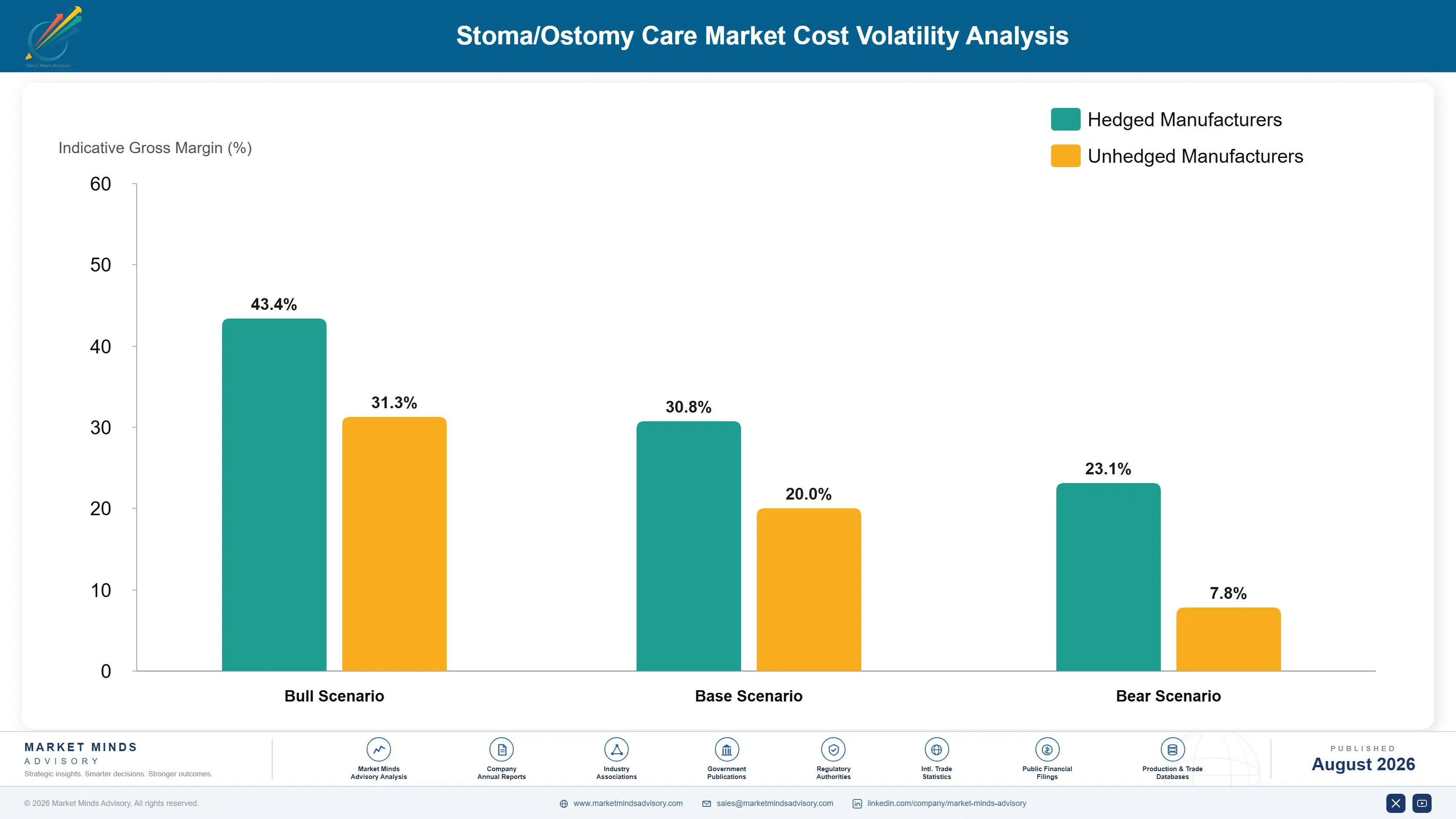
Hydrocolloid adhesive formulation dominates at roughly 33% of cost of goods, and its principal components are pectin extracted from citrus peel, gelatin derived from animal collagen, and carboxymethylcellulose. Odour-barrier pouch film adds about 21%, sourced from specialist multilayer extruders in Europe and Asia. Converting and assembly carry roughly 18%, with packaging, filters, and quality release taking the remainder of the cost base.
Citrus supply is the exposure nobody outside the industry expects. USDA citrus production reporting documented substantial declines in Florida and Brazilian output through recent seasons on disease and weather, and pectin extraction depends directly on peel availability from juice processing. Prices for high-grade pectin moved sharply, and because a hydrocolloid reformulation requires biocompatibility and adhesion testing, manufacturers absorbed the increase rather than substituting the input.

The competitive disadvantage mechanism runs through formulation qualification rather than through purchasing scale. A manufacturer holding two qualified pectin grades or an alternative hydrocolloid system already validated can move between them when supply tightens, while a single-source formulation simply pays whatever is asked. Exposure also varies by range breadth, since a company with several barrier formulations spreads the risk across them rather than concentrating it on one.
stoma-ostomy-care-market-cost-volatility-analysis-1787299856334

Qualify a second pectin grade or hydrocolloid system

Adhesion performance and skin compatibility both depend on the specific hydrocolloid used, so substitution requires testing that takes months and cannot be started once supply has already tightened. Holding a validated alternative lets production move rather than pay. The qualification cost is modest against a season of pectin price movement driven by citrus disease nobody in this industry can influence.

Contract peel-derived inputs across two producing regions

Pectin extraction depends on peel from citrus juice processing, and that supply is concentrated in a small number of growing regions exposed to the same disease and weather events at the same time. Contracting across producing regions in different hemispheres removes the correlated failure that single-region sourcing carries. Growers and extractors both prefer the volume commitment.

Standardise barrier formulations across the appliance range

Maintaining several distinct hydrocolloid formulations across one and two-piece systems multiplies qualification work, splits purchasing volume, and slows any substitution when an input tightens. Consolidating onto fewer formulations concentrates buying power and shortens the validation path considerably. It also makes second-source qualification affordable to maintain rather than a project undertaken only in a crisis.

Portfolio Architecture for Margin Defence

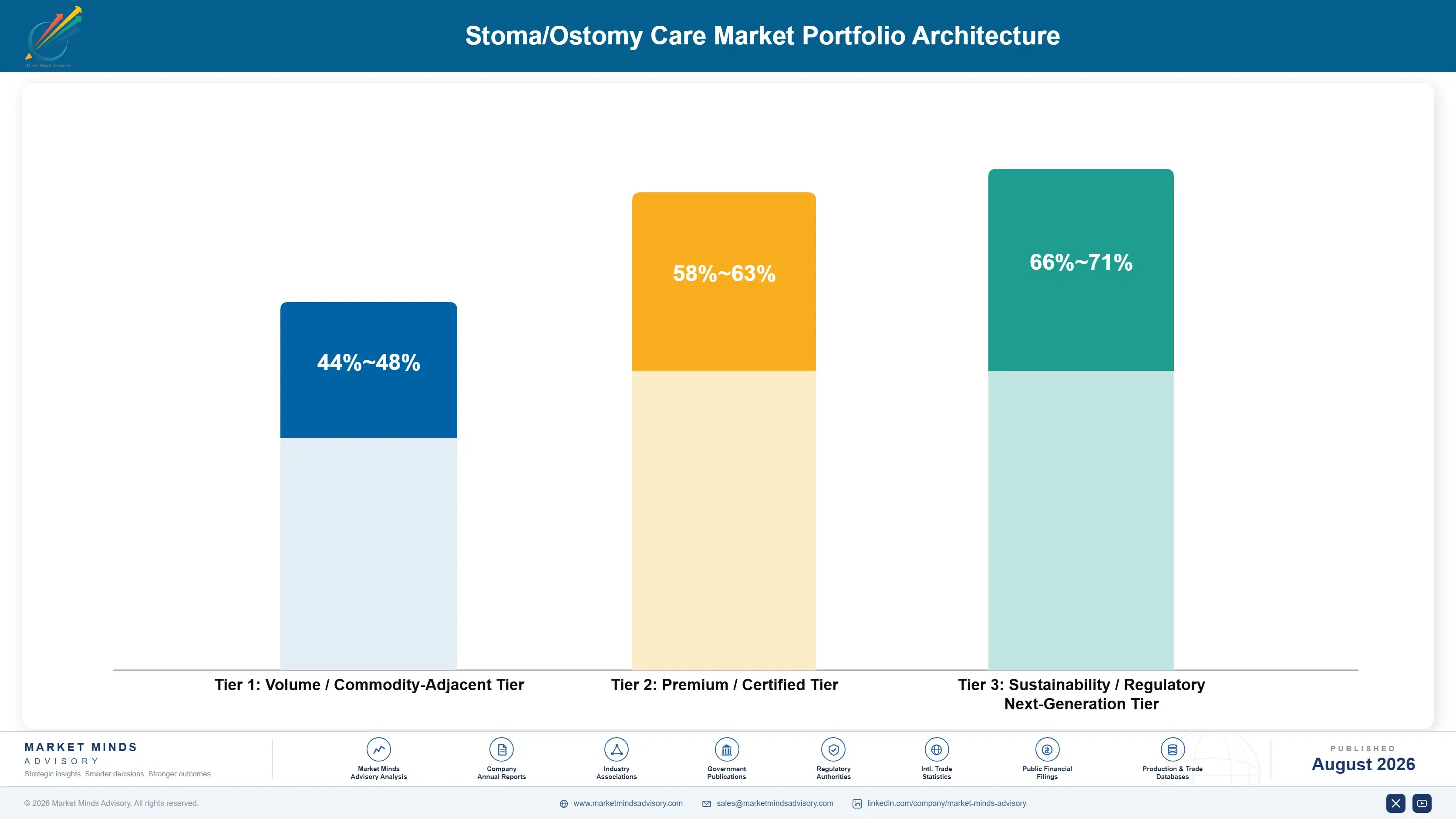
Three tiers describe this business and the spread is set by clinical selection rather than by manufacturing cost. Standard flat one and two-piece appliances sit at the bottom, tendered and increasingly served by domestic manufacturers in growth markets. Convex systems and advanced barrier formulations sit higher, chosen by a specialist nurse against a specific stoma profile. Skin barrier accessories occupy a third tier on clinical necessity and reorder frequency.
The tension is that the appliance is what secures the patient. Accessories carry the better margin and the faster growth, but nobody is issued a barrier ring without first being fitted with a pouching system, and the company that fits the system captures the accessories that follow almost automatically. Suppliers who led with accessories into accounts fitted by competitors found the attachment far weaker than the margin suggested.

High-value pools concentrate where the stoma is difficult. Retracted, flush, hernia-affected, and irregularly sited stomas need convexity, filling, and shaping, and those patients consume several times the product of a straightforward case while rarely re-tendering anything. Finding a configuration that works takes weeks of trial, and nobody who has been through that starts again.

Volume / Commodity-Adjacent Tier

Standard flat one-piece and two-piece pouching systems for straightforward stomas, tendered on price and increasingly supplied by domestic manufacturers in growth markets. Thin margin, but the fitting that secures every accessory reorder afterward for the life of the patient.
Gross Margin: 44-48%

Premium / Certified Tier

Convex systems and advanced barrier formulations selected by a specialist nurse against a specific stoma profile rather than tendered. Margin reflects clinical fitting judgment and formulation performance on skin, which a procurement comparison of unit prices cannot capture at all.
Gross Margin: 58-63%

Sustainability / Regulatory / Next-Generation Tier

Skin barrier accessories including rings, protective films, powders, and pastes, reordered continuously and clinically expected rather than optional. Best margin and fastest growth, constrained by reimbursement allowances rather than by any clinical hesitation about using them.
Gross Margin: 66-71%
stoma-ostomy-care-market-portfolio-architecture-1787299857246

High-value Sub-segments and Strategic Watch-out

Skin Barrier Accessories

Best margin and fastest growth at 8.7%, exactly 1.50 times the market rate, addressing the skin breakdown that affects 42% of ostomates regardless of appliance quality. Reimbursement allowances rather than clinical acceptance are the binding constraint on how fast this can grow. Clinical acceptance is already complete.
Gross Margin: 66-71%

Difficult Stoma Fittings

Strong margin from retracted, flush, hernia-affected, and irregularly sited stomas that require convexity, filling, and shaping products all used together in combination. These patients consume several times a straightforward case, demand the most specialist nursing time available anywhere, and they almost never change supplier afterward.
Gross Margin: 58-63%

Standard Flat Appliances

The volume core at compressing margin, tendered on price and increasingly served by domestic manufacturers across Asian and Latin American markets. It nonetheless delivers the first fitting that secures accessory reorders for decades, which makes exiting it far more costly than it appears. Nobody has exited it profitably.
Gross Margin: 44-48%

Temporary Loop Ileostomy Patients

The strategic watch-out, since roughly 37% of new stomas are formed for reversal within months and those patients leave the market entirely rather than converting to long-term consumption. Forecasting from total stoma formation overstates durable demand by more than a third. Education spending aimed at these wards returns nothing durable.
Gross Margin: 44-48%

How This Consumption Locks In

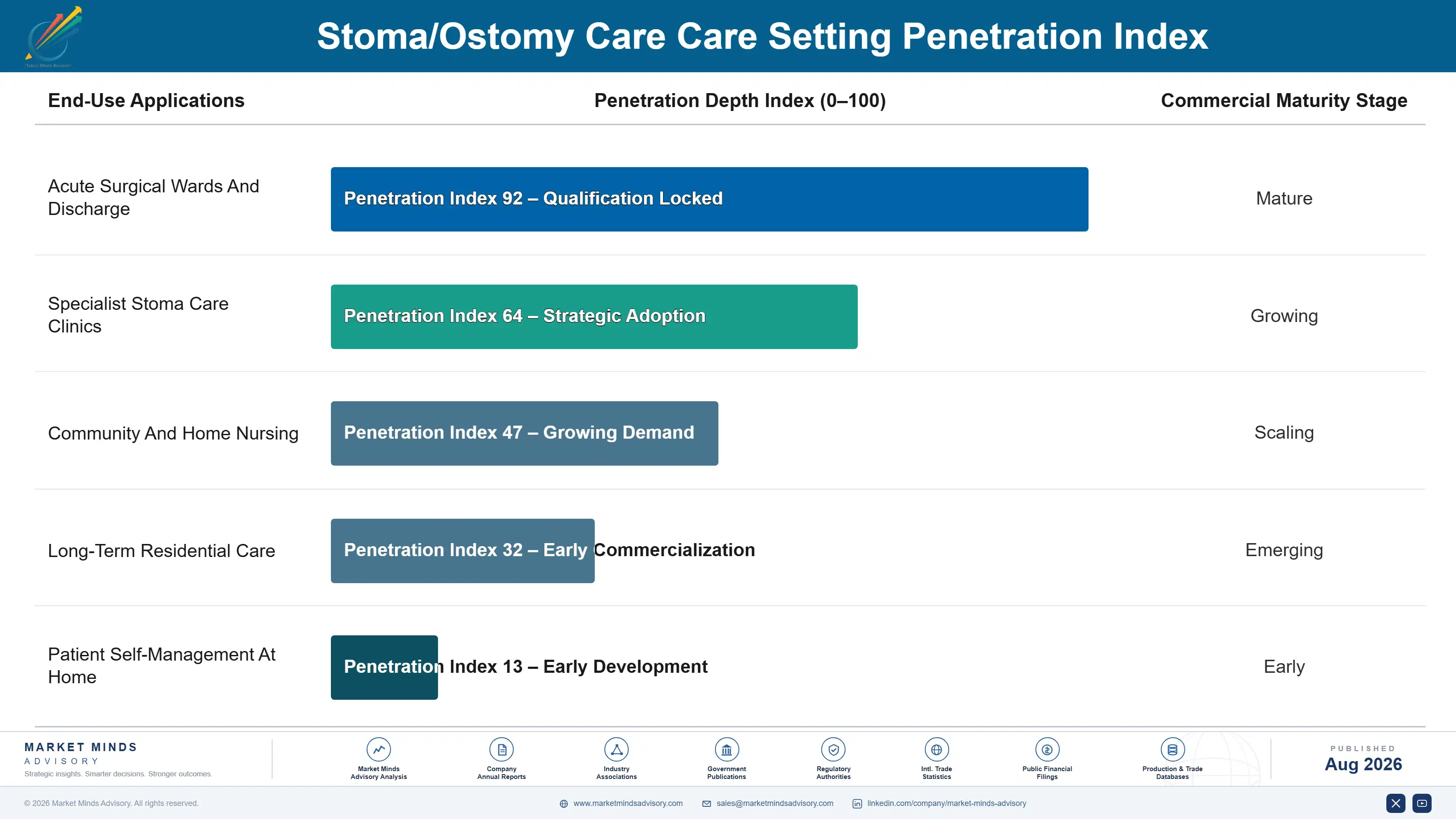
Consumption here is daily and it starts at a single moment. A specialist nurse fits the first appliance in hospital, teaches the routine, and 81% of patients are still using that brand years later, because changing means relearning a procedure performed every few days on a body they are still adjusting to. That makes revenue per patient enormously durable and makes the discharge conversation worth more than every other commercial activity a company funds put together.
Stickiness varies by cohort more than by product. Permanent ostomates from cancer or inflammatory bowel disease surgery lock in for decades and rarely change without a skin problem forcing it. Temporary loop ileostomy patients, roughly 37% of new stomas, consume for months and then leave entirely. Younger ostomates are the exception in both directions: they research independently, request products by name, and will change if something fits their life better.

Buyer profiles have barely moved in thirty years. The specialist nurse decides, the payer sets quantities, and the patient lives with both, which is an unusual arrangement in any consumer-facing category. It also means every commercial argument has to be made to somebody other than the person consuming the product.
stoma-ostomy-care-market-end-use-penetration-index-1787299858122

What We Would Tell a Board

These are among the four positions where our research anticipates prominent divergence between winners and laggards over the coming forecast period. Each is grounded in the demand model, the regulatory perimeter, and the announced capacity pipeline.
01 / DISCHARGE ACCESS PRIORITY

Everything is decided at the first fitting bedside

A specialist nurse selects the appliance in hospital and 81% of patients never change afterward, because relearning an application routine on a body they are still adjusting to is genuinely aversive to almost everybody. That single conversation determines decades of daily consumption per patient, which makes it worth more than any patient-facing marketing a company can buy. Nurse education, fitting support, and sample provision cost around 6 million dollars annually across a major market and return far more than advertising to people whose choice is already fixed.
02 / ACCESSORY REIMBURSEMENT REFRAMING

Capped as consumption, they should be funded as prevention

Payers restrict accessory quantities because the line looks discretionary next to pouches, while the skin breakdown affecting 42% of ostomates generates unscheduled nurse visits, wasted appliances, and occasional admissions charged to entirely separate budgets. Building health economic evidence from existing complication registries costs roughly 2.5 million dollars per major market and reframes the category from consumption to prevention. It only persuades where prescription and community nursing budgets sit together, so choosing which system to target matters as much as the evidence.
03 / COHORT SEPARATION DISCIPLINE

A third of new stomas are going to be reversed

Roughly 37% of new stomas are loop ileostomies formed to protect an anastomosis and intended for reversal within months, after which those patients leave this market completely rather than converting to any long-term consumption. Forecasting from total stoma formation therefore overstates durable demand by more than a third and misdirects education spending across wards that produce no lasting revenue. Surgical coding data published by most health systems separates the two cohorts easily, and remarkably few companies have ever done the split.
04 / YOUNGER OSTOMATE DESIGN

The thirty-year-old is worth five times the seventy-year-old

Inflammatory bowel disease surgery creates stomas in people in their twenties and thirties who will consume these products daily for fifty years, swim, exercise, and care intensely about profile and odour under clothing. They also research independently and request products by name, which is the one reliable route around the discharge selection lock-in that otherwise protects whoever fitted first. Products designed around an older and less active cancer cohort serve them poorly, and almost nobody has redesigned anything specifically for them.

Engagement Snapshot From the Field

A live engagement with an industry participant carrying material or product regulatory and market exposure ahead of a defining policy shift, showing how our research translates into a defensible multi-year portfolio strategy.
MARKET MINDS ADVISORY · CLIENT ENGAGEMENT SUMMARY
Stoma/Ostomy Care Producer Strategic Portfolio Review and Transition Roadmap 2026·Investment Scenario on Stoma/Ostomy Care Exposure Evaluation 2025-26
CLIENT PROFILE
An ostomy care manufacturer with approximately 310 million dollars in annual revenue (client-reported, unverified by MMA), supplying appliances and a partial accessory range across Europe and North America. The business ran a substantial patient-facing marketing budget, maintained a modest hospital education team, and forecast demand from published stoma formation statistics without separating permanent from temporary patient cohorts at any point.
STRATEGIC CHALLENGE
New patient acquisition had been flat for three years despite rising surgical volumes across every market served. Management proposed increasing patient-facing advertising and direct-to-consumer sampling substantially. The board wanted an independent read on where product selection actually happened before approving a marketing increase built on the assumption that patients were choosing.
MMA APPROACH
We traced product selection across forty hospital pathways, establishing who chose, when, and whether patients ever changed afterward. Brand persistence was measured from reorder records over five years. Stoma formation data was separated into temporary and permanent cohorts using published surgical coding, and accessory attachment rates were compared between accounts the client had fitted and those it had not.
KEY FINDINGS
  1. Selection was made by a specialist nurse at first fitting in every pathway reviewed, and 81% of patients were still reordering the same brand five years afterward without any reconsideration.
  2. Patient-facing advertising reached people whose product had already been chosen for them, and reorder records showed no measurable switching attributable to any campaign run.
  3. Around 37% of stomas in the client's demand model were temporary loop ileostomies destined for reversal, which had inflated the forecast and misdirected territory coverage.
  4. Accessory attachment ran roughly four times higher in accounts where the client had fitted the original appliance than in accounts fitted by a competitor.
CLIENT PROFILE
An ostomy care manufacturer with approximately 310 million dollars in annual revenue (client-reported, unverified by MMA), supplying appliances and a partial accessory range across Europe and North America. The business ran a substantial patient-facing marketing budget, maintained a modest hospital education team, and forecast demand from published stoma formation statistics without separating permanent from temporary patient cohorts at any point.
STRATEGIC CHALLENGE
New patient acquisition had been flat for three years despite rising surgical volumes across every market served. Management proposed increasing patient-facing advertising and direct-to-consumer sampling substantially. The board wanted an independent read on where product selection actually happened before approving a marketing increase built on the assumption that patients were choosing.
MMA APPROACH
We traced product selection across forty hospital pathways, establishing who chose, when, and whether patients ever changed afterward. Brand persistence was measured from reorder records over five years. Stoma formation data was separated into temporary and permanent cohorts using published surgical coding, and accessory attachment rates were compared between accounts the client had fitted and those it had not.
KEY FINDINGS
  1. Selection was made by a specialist nurse at first fitting in every pathway reviewed, and 81% of patients were still reordering the same brand five years afterward without any reconsideration.
  2. Patient-facing advertising reached people whose product had already been chosen for them, and reorder records showed no measurable switching attributable to any campaign run.
  3. Around 37% of stomas in the client's demand model were temporary loop ileostomies destined for reversal, which had inflated the forecast and misdirected territory coverage.
  4. Accessory attachment ran roughly four times higher in accounts where the client had fitted the original appliance than in accounts fitted by a competitor.
RECOMMENDED STRATEGY
Phase 1: Phase 1 (months one to nine): redirect patient-facing marketing spend into specialist nurse education, fitting support, and hospital sample provision. Phase 2: Phase 2 (months nine to twenty-four): rebuild demand forecasting on permanent stoma formation only and reallocate territory coverage to surgical units accordingly. Phase 3: Phase 3 (months twenty-four to forty): complete the accessory range and build health economic evidence for prevention-based reimbursement. Prevention framing is the argument.
OUTCOME
Patient-facing advertising was substantially reduced and the hospital education team roughly tripled. New patient acquisition rose in the reallocated territories within three quarters, accessory attachment improved as the range completed, and forecast accuracy improved materially once temporary cohorts were removed (client-reported, unverified by MMA). Marketing mix was rebuilt entirely.

Frequently Asked Questions

Foundational context covering the market sizes, CAGR, scope, country, region and competition that inform every finding below. This section is provided to cover basics and most often pre-purchase conversations, answered from the MMA Primary Research Dataset.

What is the current size of the Stoma/Ostomy Care Market?

The market is valued at USD 3.7 billion in 2025, rising to USD 3.91 billion in 2026. Scope covers appliances and accessories rather than stoma-forming surgery or specialist nursing services.

How large will the Stoma/Ostomy Care Market be by 2036?

MMA forecasts USD 6.88 billion by 2036, an increase of USD 2.97 billion over the 2026 base. That represents an expansion multiple of 1.76 times across the forecast period.

What is the CAGR for the Stoma/Ostomy Care Market 2026 to 2036?

The base case CAGR is 5.8%, with a bull case of 7.0% and a bear case of 4.6%. The historical rate from 2020 to 2025 was 5.0%, so growth is accelerating modestly.

Which segment is growing fastest?

Skin barrier accessories at 8.7%, exactly 1.50 times the market rate. They address the peristomal skin breakdown affecting around 42% of ostomates regardless of appliance quality.

Who are the major companies in the Stoma/Ostomy Care Market?

Coloplast, Convatec, Hollister, Braun, and Salts Healthcare lead on annual appliance and accessory revenue. The top five hold 76% between them, protected by brand persistence after the first fitting rather than by technology.

Which country is growing fastest?

China at 9.4%, driven by rising colorectal cancer surgery volumes and later stage presentation that makes permanent colostomy more common than in Western surgical practice.

Report Segmentation Architecture

The full report scope spans multiple orthogonal segmentation dimensions, with cross-tabulated demand data provided for each dimension pair. Coverage extends further to regional breakdowns, trend trajectories, and the competitive detail needed to support segment-level decision-making.

By Product Category

  • One-Piece Pouching Systems
  • Two-Piece Pouching Systems
  • Convex Pouching Systems
  • Skin Barrier Accessories
  • Adhesive And Securement Accessories
  • Irrigation And Continence Systems

By Care Setting

  • Acute Surgical Wards And Discharge
  • Specialist Stoma Care Clinics
  • Community And Home Nursing
  • Long-Term Residential Care
  • Patient Self-Management At Home

By Supply Channel

  • National Prescription And Dispensing Appliance Contractors
  • Durable Medical Equipment Suppliers
  • Hospital Procurement And Tender
  • Retail And Community Pharmacy
  • Direct-To-Patient Home Delivery

By Region

  • Western Europe
  • North America
  • East Asia
  • South Asia and Pacific
  • Latin America
  • Eastern Europe
  • Middle East and Africa

Scope, Methodology, and Coverage

Every figure in this report is reproducible from documented input assumptions. The scope below maps the historical period, the forecast horizon, the segmentation dimensions, and the countries covered, alongside the underlying primary and qualitative methodology.
Historical Period
2020 to 2025
Forecast Period
2026 to 2036
Base Year
2025 (USD billions; MMA Primary Research Dataset, August 2026)
Market Definition
This market comprises appliances and accessories used in the daily management of colostomies, ileostomies, and urostomies, measured at manufacturer realised prices across every supply channel. Category coverage spans one-piece pouching systems, two-piece pouching systems, convex pouching systems, skin barrier accessories including rings, protective films, powders and pastes, adhesive and securement accessories including removers, tapes, belts, filters and deodorisers, and irrigation and continence management systems. Stoma-forming surgery and surgical instruments, specialist stoma nursing services, incontinence products unrelated to stomas, general wound dressings, and enteral feeding devices fall outside scope.
Quantitative Units
USD billions (current prices); prevalent ostomate population; appliances consumed per patient year; accessory attachment rate
Segmentation Dimensions
By Product Category; By Care Setting; By Supply Channel; By Region
Regions Covered
Western Europe, North America, East Asia, South Asia and Pacific, Latin America, Eastern Europe, Middle East and Africa
Countries Covered
UK, Denmark, Germany, France, Netherlands, Sweden, Norway, Italy, Spain, Belgium, Switzerland, Austria, Ireland, Poland, Czechia, Romania, Turkey, USA, Canada, Mexico, China, Japan, South Korea, Taiwan, India, Australia, Brazil, Argentina, Colombia, Saudi Arabia, UAE, Israel, South Africa, and additional markets relevant to this sector
Key Companies Profiled
Coloplast, Convatec, Hollister, B. Braun, Salts Healthcare, Welland Medical, Pelican Healthcare, Marlen Manufacturing, Nu-Hope Laboratories, Cymed, Torbot Group, Genairex, Flexicare Medical, Alcare, Trio Healthcare, Perma-Type, Safe n Simple, Oakmed, Medline Industries, Cardinal Health
Quantitative Methodology
Primary survey, n=3,800 respondents, Q4 2025, six countries; demand-side model with trade association cross-validation
Qualitative Methodology
47 expert interviews, Q4 2025; applied to validate demand model assumptions, identify emerging dynamics, and assess competitive positioning
Report Format
PDF and XLSX data workbook (Word format preview document)
Publisher
Market Minds Advisory
Report Code
MMA-2026-MED-434
Published
August 2026
Contact
sales@marketmindsadvisory.com | www.marketmindsadvisory.com

Purchase the full Stoma/Ostomy Care Market Report (2026 to 2036).

The full report sizes stoma and ostomy care across six product categories, five care settings, five supply channels, and seven regions, with country detail for the thirty largest markets. Prevalent ostomate populations are separated into permanent and temporary cohorts using surgical coding, since roughly a third of stomas are reversed within months and forecasting from total formation overstates durable demand badly. Accessory attachment rates and reimbursement allowances are quantified by country. Competitive profiling covers twenty companies on annual appliance and accessory revenue. Peristomal skin complication rates are compared against accessory provision levels across health systems.
Permanent and temporary ostomate cohorts separated by coding
Accessory allowances and attachment rates quantified by country
Peristomal complication rates compared against accessory provision
Specialist stoma nurse caseloads benchmarked across health systems
Brand persistence after first fitting measured from reorder records
Hydrocolloid input cost exposure modelled by formulation type

Built For The People Who Decide

From boardroom strategy to bench-side execution, this report is read cover-to-cover by leaders shaping the next decade of their industry, turning demand scenarios, market dynamics and valuation benchmarks into decisions.
CXOs/ Presidents/ VPs/ Managers
M&A and Corporate Development
Strategy Teams and R&D Heads
Procurement and Product Directors
Regulatory and Compliance Leaders
Investor Relations and Equity Analysts