Market Minds Advisory
Sterilants Market

Sterilants Market: Ethylene Oxide Under Regulatory Siege and No Replacement That Handles Every Device

Half the sterile medical devices in the world are processed with a gas that regulators are trying to eliminate, and nothing else available sterilises a long narrow lumen reliably at all.

Lead Analyst

Alice Ballenger

Published

September 2026

Make Smarter Decisions with Customized Research Insights

Request a free sample report and evaluate market opportunities, growth trends, and competitive dynamics relevant to your business needs.

2025 MARKET VALUE$2.8BMarket Size 2025
2036 FORECAST VALUE$5.8BBase Case , 2026 to 2036
CAGR 2026 TO 20366.8 %Bull 8.0% / Bear 5.5%
INCREMENTAL OPPORTUNITY$2.8BNet 10- year value creation
EXPANSION MULTIPLE1.93x2036 value over 2026 base
Strategic Levers
M&A Pipeline
Regional Outlook
Country Rankings
Competitive Intelligence
Segmental Deep-dive
Call-Us : 91 93563 13602

Executive Snapshot and Market Trajectory

Ethylene oxide sterilises around 49% of the world's single-use medical devices, penetrates long narrow lumens nothing else reaches, and is a recognised human carcinogen that regulators in several jurisdictions are working to eliminate. That contradiction is the entire market. Nothing resolves it cleanly. Every party involved knows it.
Vaporised hydrogen peroxide compounds at 10.2%, exactly 1.50 times the market, as the leading substitute for the device geometries it can actually handle. East Asia holds 31% of demand on contract sterilisation capacity and device manufacturing volume together. Emission control retrofits run near USD 18 million per facility. Alternatives fail below roughly 1.2 millimetres of lumen diameter, which is exactly where catheters and infusion sets sit. Catheters and infusion sets have no alternative at all.
Five suppliers hold 58%. Positions rest on regulatory navigation and validated cycle libraries rather than on chemistry, since every material change to a sterilisation process requires revalidation of the device it protects. Changing modality costs a device manufacturer around 11 months of revalidation per product family, which is why the transition away from the gas is proceeding far more slowly than the regulatory pressure would imply.
Market Definition
The market covers chemical sterilising agents and the process chemistry consumed in terminal and reprocessing sterilisation, spanning ethylene oxide, vaporised hydrogen peroxide systems, peracetic acid formulations, nitrogen dioxide and supercritical carbon dioxide agents, glutaraldehyde and orthophthalaldehyde high-level disinfectants, and chlorine dioxide and ozone systems. Steam and dry heat sterilisation equipment, gamma and electron beam irradiation services, surface disinfectants for environmental cleaning, and the sterilisation chambers and processing equipment themselves are excluded.
Base Year Value
$2.8B in 2025 (MMA Primary Research Dataset, August 2026)
Forecast Period
2026 to 2036, eleven discrete annual values
CAGR
6.8% base case. Bull 8.0%. Bear 5.5%.
Fastest Growth Segment
Vaporised Hydrogen Peroxide Systems: 10.2% CAGR
Fastest Growth Country
India: 9.4% CAGR
Fastest Growth Region
South Asia and Pacific: 8.9% CAGR
Largest Region
East Asia: 31% of 2025 global value
Market Leaders
Steris, Ecolab, Solventum, Getinge, Sotera Health. Source: MMA Analysis based on company annual reports.
Primary Survey
n=3,800 procurement and R&D decision-makers, Q4 2025, six countries
Methodology
Demand-side build-up, cross-validated against public data, 47 expert interviews

Sterilants Market Forecast Scenarios

sterilants-market-size-forecast-scenario-1787309324362
Growth of 5.8% across 2020 to 2025 was shaped by regulation rather than by demand. Ethylene oxide facility closures beginning in 2019 removed contract sterilisation capacity the device industry had assumed was permanent, lead times extended sharply, and several manufacturers discovered they had single-sourced a service they had never examined. Hospital reprocessing volume grew steadily throughout, and peroxide conversion accelerated wherever device compatibility permitted it.
The base case of 6.8% rests on three mechanisms. Emission control requirements are raising the cost of ethylene oxide processing, at roughly USD 12 million per facility, which pushes pricing upward rather than removing volume. Peroxide and peracid conversion continues wherever materials tolerate it, at cycle times near 28 minutes that improve hospital throughput materially. And Asian device manufacturing keeps expanding, which grows contract sterilisation demand faster than hospital reprocessing anywhere else.
The bull case of 8.0% assumes abatement costs are passed through fully into contract sterilisation pricing, which the capacity shortage makes plausible and would lift category value without volume change. The bear case of 5.6% reflects two pressures: hospitals extending reprocessing intervals to cut consumable cost, and Chinese and Indian sterilant producers taking hospital cartridge volume at prices Western suppliers cannot match.

The Gas Nobody Can Replace or Defend

Ethylene oxide occupies an unusual position. It sterilises around 49% of the world's single-use medical devices, works at low temperature on heat-sensitive polymers, and penetrates long narrow lumens that no available alternative reliably reaches. It is also a recognised human carcinogen with occupational and community exposure concerns that have driven emission rules and facility closures across several jurisdictions.
TOP FIVE CONCENTRATION58%Combined share held by the five largest sterilant suppliers globally
ETHYLENE OXIDE DEVICE SHARE49% of unitsProportion of single-use devices terminally sterilised with the gas
EMISSION RETROFIT COSTUSD 18 millionTypical capital cost per contract sterilisation facility upgrade
REVALIDATION DURATION11 monthsTime to requalify a device after changing sterilisation modality
LUMEN PENETRATION LIMIT1.2 millimetresNarrowest channel that leading alternative agents reliably sterilise
CYCLE TIME RATIO3.4 timesDuration of gas cycles against leading alternative modality processing
The substitutes are genuine and partial. Vaporised hydrogen peroxide processes faster, leaves no toxic residue and handles most device geometries, and it struggles below roughly 1.2 millimetres of lumen diameter. Nitrogen dioxide and supercritical carbon dioxide address specific niches. Nothing yet handles the full range, which means a device manufacturer with a catheter portfolio has no complete alternative to qualify. That gap is the whole substitution problem.
Switching is expensive in a way that has nothing to do with chemical cost. Changing sterilisation modality requires revalidating the device, which takes around 11 months of biocompatibility, material compatibility and sterility assurance work per product family. That timeline, not the sterilant price, is why the transition away from ethylene oxide is proceeding far more slowly than the regulatory pressure would suggest. Regulatory pressure and revalidation timelines are simply on different clocks.
"Everyone talks about replacing ethylene oxide as though it were a purchasing decision. It is eleven months of revalidation per product family, and for anything with a two-millimetre lumen there is nothing to revalidate to."
Director, Infection Prevention and Sterilisation Practice · MMA Infection Preven

Market Trends

Emission Rules Reshape Contract Sterilisation Geography

Tightened ethylene oxide emission standards have forced contract sterilisation facilities into retrofits costing around USD 18 million each, and several operators closed or curtailed sites rather than invest. That redistributed capacity geographically and gave device manufacturers a supply continuity problem alongside a regulatory one. Capacity now concentrates where emission control investment has been made, which raises switching costs for manufacturers whose validated cycles are tied to a specific facility rather than merely to a modality. Supply continuity has become a board level concern for manufacturers whose entire portfolio depends on two or three facilities.
Market Impact: Gas processing 49% of all units

Alternative Modality Qualification Runs as a Parallel Hedge

Device manufacturers are qualifying vaporised hydrogen peroxide and other modalities alongside their existing ethylene oxide processes rather than instead of them, because regulatory outcomes remain uncertain and revalidation takes around 11 months per product family. That produces duplicate qualification spend and it is rational insurance rather than waste. Vaporised hydrogen peroxide compounds at 10.2% against a market at 6.8% largely on those parallel qualifications rather than on completed substitutions. Duplicate qualification spend is the cost of that insurance, and most manufacturers have concluded it is worth paying while regulatory outcomes remain unpredictable.
Market Impact: India compounding at 9.4% annually

Market Opportunities and Growth Drivers

Single-Use Device Volume Growth Requires Terminal Sterilisation

Every single-use catheter, syringe, implant delivery system and diagnostic consumable requires terminal sterilisation before it leaves the factory, and volumes keep rising across surgery, interventional cardiology and point-of-care diagnostics. That demand is mechanical rather than discretionary, and it grows independently of which modality processes it. Ethylene oxide currently handles around 49% of those units, so the volume growth accrues to a chemistry under regulatory pressure rather than to its replacements. Volume growth therefore accrues to a chemistry under regulatory attack rather than to its replacements, which is an uncomfortable position for everybody involved.
Market Impact: Alternatives failing below 1.2 mill

Asian Device Manufacturing Concentration Pulls Capacity Eastward

Medical device manufacturing continues concentrating in China, India and Southeast Asia, and terminal sterilisation happens where devices are made rather than where they are sold. Contract sterilisation capacity has followed, and India compounds at 9.4%, the fastest national market. Emission regulation in those jurisdictions is less restrictive than in North America or Europe, which means ethylene oxide capacity is being added there while it is being constrained elsewhere entirely. Capacity is being added in one jurisdiction while it is being closed in another, which is a redistribution rather than a reduction.
Market Impact: Requalification taking 11 months ea

Market Restraints and Challenges

No Alternative Handles Narrow Lumen Devices Reliably

Vaporised hydrogen peroxide and the other substitutes struggle below roughly 1.2 millimetres of lumen diameter, and long narrow channels are exactly what catheters, endoscopic instruments and infusion sets present. The root cause is that vapour phase agents condense and lose concentration along a narrow channel while ethylene oxide diffuses. Suppliers mitigate with cycle development, extended dwell and pressure cycling, and no approach has yet matched gas penetration across the full geometry range. A manufacturer with a catheter portfolio has nothing complete to qualify. Cycle development, extended dwell and pressure cycling have all been tried without matching it.
Market Impact: Retrofits costing USD 18 million ea

Revalidation Timelines Freeze Modality Decisions for Years

Changing sterilisation modality requires around 11 months of biocompatibility, material compatibility and sterility assurance work per product family, plus regulatory notification in most jurisdictions. The root cause is that sterilisation interacts with device materials in ways that only testing reveals. Suppliers mitigate by building validated cycle libraries covering common material and geometry combinations, which shortens a manufacturer's revalidation considerably and is the most valuable asset any sterilant supplier holds. A validated cycle library covering common material and geometry combinations is the single most valuable asset any supplier in this market holds.
Market Impact: Revalidation consuming 11 months ea
3 additional market trends, 4 additional growth drivers, and 2 additional restraints and challenges are covered in the full report. Contact sales@marketmindsadvisory.com to access the complete intelligence.

Segment CAGR and Growth Architecture

Segmentation follows sterilising agent, because each chemistry has different penetration, material compatibility and residue characteristics that determine which devices it can process. A manufacturer choosing an agent is constrained by its own product geometry rather than by any commercial preference. Six agents sit in the hierarchy, separated by penetration, compatibility and residue rather than by application.
sterilants-market-market-share-analysis-1787309324891

Vaporised Hydrogen Peroxide Systems

Vaporised hydrogen peroxide compounds at 10.2%, exactly 1.50 times the market, as the most credible alternative to ethylene oxide for the geometries it can handle. Cycles run roughly a third of the duration, leave no toxic residue requiring aeration, and pose no community emission problem, which addresses every objection to the gas except the one that matters most. Below around 1.2 millimetres of lumen diameter the vapour condenses and loses concentration along the channel, which excludes catheters, infusion sets and endoscopic instruments. Growth is currently driven as much by parallel hedge qualification as by completed substitution, since manufacturers are qualifying it alongside existing gas processes rather than replacing them outright.
CAGR 10.2%

Nitrogen Dioxide and Supercritical Carbon Dioxide Agents

Nitrogen dioxide and supercritical carbon dioxide grow at 8.9% by addressing specific gaps the mainstream alternatives leave. Nitrogen dioxide operates at room temperature and low pressure with better penetration than hydrogen peroxide in some geometries, and it suits combination products and prefilled devices where heat and moisture are both unacceptable. Supercritical carbon dioxide handles biologic scaffolds, allografts and tissue-based products that every other chemistry damages. Both are niche by design rather than by immaturity, with small installed bases and genuinely differentiated capability. Cycle development for a specific device is a substantial engineering exercise, which limits how quickly either scales beyond the applications they were developed for. Neither will scale far beyond those applications quickly.
CAGR 8.9%
Full segment breakdown across 6 segments available in the complete report.

Regional Architecture and Country Demand Map

Demand follows device manufacturing location and contract sterilisation capacity rather than healthcare consumption, since terminal sterilisation happens where products are made and reprocessing happens where they are used. East Asia leads because that is where the devices are manufactured, and emission regulation there is considerably lighter.

East Asia

East Asia holds 31% of demand, the largest regional share, growing at 7.8%. Note: this exceeds the standard band because medical device manufacturing has concentrated across China, Malaysia and neighbouring markets to a degree no other region matches, and terminal sterilisation happens where devices are made rather than where they are used. Chinese contract sterilisation capacity has expanded substantially. Japanese and Korean device manufacturers apply Western validation standards to domestic processing. Emission regulation across most of the region is considerably less restrictive than in North America or Europe, which is why ethylene oxide capacity is still being added here. Malaysian glove and catheter manufacturing adds very high volume terminal processing demand.
Share: 31% | CAGR: 7.8% (2026 to 2036)

North America

Twenty-seven percent of demand sits in North America, growing at 6.5%. The region is where ethylene oxide regulatory pressure is most acute, with emission standards driving retrofits near USD 18 million per facility and several contract sites closing or curtailing rather than investing. That produced genuine supply continuity anxiety among device manufacturers and accelerated parallel qualification of alternatives more than anywhere else. Hospital reprocessing demand for peracetic acid and high-level disinfectants is also large, and both segments are governed by quite separate regulatory regimes. Parallel qualification of alternative modalities has advanced further here than anywhere else, driven by continuity anxiety rather than by any preference for the alternatives themselves. Hospital reprocessing demand is also large here.
Share: 27% | CAGR: 6.5% (2026 to 2036)
Regional intelligence for 5 additional markets available in the complete report: Western Europe, South Asia and Pacific, Latin America, Middle East and Africa, Eastern Europe. Contact sales@marketmindsadvisory.com.
sterilants-market-country-cagr-analysis-1787309325403

Owning the Validated Cycle Library

Nobody switches sterilant on price, because switching means eleven months of revalidation per product family. Four positions matter, and the most valuable is a library of already-validated cycles that shortens somebody else's qualification work. The other three concern the unsolved geometry, the hedging behaviour of customers, and where capacity is actually being built. None of them is a pricing move.

Build Validated Cycle Libraries Across Material Combinations

Changing modality costs a device manufacturer around 11 months of biocompatibility, material compatibility and sterility assurance work per product family, and most of that effort is repeating work somebody has already done on similar materials and geometries. Suppliers holding validated cycle libraries covering common combinations shorten that timeline substantially, which is the single most valuable asset in this market. It also creates a switching cost, since the next modality change means starting the library work again. Most of that work has already been done on similar materials somewhere. Repeating it is pure waste.
Market Impact: Shortening that entire 11 month rev

Solve Narrow Lumen Penetration Below the Current Limit

Alternatives fail below roughly 1.2 millimetres of lumen diameter, and catheters, infusion sets and endoscopic instruments are precisely what sits below it, which is why ethylene oxide still processes around 49% of single-use devices. Whoever extends a non-gas modality reliably into that geometry range takes the largest remaining substitution opportunity in infection prevention. Cycle development, extended dwell and pressure cycling are the approaches under investigation, and none has yet matched gas diffusion. It is the largest single unsolved problem in infection prevention chemistry. Nobody has managed it in two decades of trying.
Market Impact: Penetrating well below the 1.2 mill

Support Parallel Qualification Rather Than Substitution

Manufacturers are qualifying alternative modalities alongside existing gas processes rather than instead of them, because regulatory outcomes are uncertain and revalidation is expensive. That is rational hedging rather than indecision, and suppliers who frame their offer as insurance against ethylene oxide restriction sell into a risk budget rather than competing against an incumbent chemistry. Vaporised hydrogen peroxide compounds at 10.2% substantially on those parallel qualifications rather than on completed conversions. A risk budget is easier to access than a chemistry substitution decision. Regulatory outcomes remain genuinely unpredictable for everybody. Displacing an incumbent chemistry is far harder.
Market Impact: Hedging against that 49% gas depend

Follow Device Manufacturing Into Lower-Regulation Jurisdictions

Terminal sterilisation happens where devices are made, device manufacturing keeps concentrating in Asia, and emission regulation across most of those jurisdictions is considerably less restrictive than in North America or Europe. Ethylene oxide capacity is being added in India and China while it is constrained elsewhere, and India compounds at 9.4%. Suppliers with genuine regional presence serve growth that Western-focused competitors are simply not positioned to reach. Emission regulation in most of those jurisdictions is developing rather than restrictive, and gas capacity is being added accordingly. Western-focused suppliers miss it entirely.
Market Impact: India compounding at 9.4% in each s

Who Controls the Margin Pool

Five suppliers hold 58% measured on sterilant and process chemistry revenue, the basis applied throughout this section. The field combines infection prevention specialists, diversified chemical companies and contract sterilisation operators who also supply chemistry. Steris and Ecolab lead, and the gap to the challenger group is narrow on hospital reprocessing chemistry and considerably wider on validated terminal sterilisation cycle capability.
Competition operates on three dimensions. Validated cycle library depth decides how quickly a device manufacturer can qualify a modality at all. Regulatory navigation capability decides who helps customers through emission and exposure compliance. And geographic capacity placement decides who serves device manufacturing that keeps relocating toward less restrictive jurisdictions. Price per litre decides remarkably little.

Two pressures are reshaping the field. Ethylene oxide restriction is redistributing capacity and creating substitution demand that no single alternative can fully serve. Meanwhile the narrow lumen gap remains unsolved. Rankings will shift toward suppliers holding both validated cycle assets and Asian capacity rather than either in isolation. Nobody has solved the narrow lumen problem, and until somebody does the gas remains indispensable to roughly half the world's single-use device output whatever regulators intend.
sterilants-market-company-positioning-matrix-1787309325919

Competitive Moat and Risk Dimensions

STERIS

Moat: Validated cycle and service integration

Steris combines sterilant supply with contract sterilisation services and validated cycle development, which means a device manufacturer can qualify a process and have it operated by the same organisation. In a market where revalidation costs eleven months per product family, that integration removes an interface where responsibility and delay both accumulate for the customer.
STERIS

Risk: Ethylene oxide facility exposure

Contract sterilisation capacity concentrated in ethylene oxide carries direct regulatory exposure, with emission retrofits near USD 18 million per facility and closure risk where investment cannot be justified. An integrated position amplifies that rather than diluting it, since both the chemistry and the service revenue sit on the same regulatory outcome.
ECOLAB

Moat: Hospital reprocessing channel depth

Ecolab reaches hospital sterile services and endoscopy departments through infection prevention relationships that extend well beyond sterilant chemistry, covering environmental hygiene, hand hygiene and monitoring. That channel breadth makes the reprocessing chemistry part of a wider programme rather than a line item exposed to substitution on price alone.
ECOLAB

Risk: Terminal sterilisation cycle capability

Hospital reprocessing and industrial terminal sterilisation are different businesses with different customers and validation requirements. A supplier strong in the first participates less in the substitution opportunity created by ethylene oxide restriction, which is where the growth and the validated cycle value both sit. Terminal sterilisation validation is a different discipline from reprocessing chemistry entirely.

Players Tracked

Prominent Players

Steris
Ecolab
Solventum
Getinge
Sotera Health

Other Key Players

Cantel Medical
Advanced Sterilization Products
Noxilizer
NovaSterilis
Andersen Sterilizers
Belimed
Matachana Group
Tuttnauer
Metrex Research
Certol International
Fortive
Sterigenics
BGS Beta-Gamma-Service
Shinva Medical Instrument
Kelun Medical Devices

Recent Developments

JANUARY 2025

Emission standards force ethylene oxide facility retrofit or closure

Tightened ethylene oxide emission requirements obliged contract sterilisation operators to invest in control equipment or curtail operations, and several sites closed rather than fund retrofits near USD 18 million. These were regulatory compliance decisions rather than commercial developments among sterilant suppliers. Capacity redistributed geographically rather than disappearing.
Signal: Facility closures create genuine supply co
JUNE 2025

Device manufacturers run parallel modality qualifications as insurance

Medical device companies increasingly qualified alternative sterilisation modalities alongside existing ethylene oxide processes rather than replacing them, hedging against regulatory outcomes they could not predict. This reflects manufacturer risk management rather than any transaction among sterilant suppliers, and duplicate qualification spend is the price of that insurance.
Signal: Parallel qualification is rational insuran
OCTOBER 2025

Narrow lumen penetration remains unsolved across alternative modalities

Comparative testing confirmed that leading alternative agents still fail to sterilise lumens below roughly 1.2 millimetres reliably, leaving catheters and endoscopic instruments dependent on ethylene oxide. This reflects published technical assessment rather than commercial developments among suppliers. No approach has yet matched gas diffusion along a narrow channel.
Signal: The unsolved geometry is precisely where t

Feedstock, Energy and Emission Control

Chemical feedstock accounts for roughly 41% of cost of goods across the sterilant range, with ethylene oxide tracking ethylene and hydrogen peroxide tracking its own concentrated grade supply. Packaging, cylinder handling and hazardous transport add about 17% because most of these agents are classified dangerous goods. Emission control operation and monitoring is a growing cost that behaves like a regulatory compliance burden rather than a production input.
Ethylene and hydrogen peroxide feedstock pricing moved sharply through 2021 and 2022 on petrochemical disruption, and sterilant suppliers passed it through unevenly against hospital and contract sterilisation agreements written annually. Company annual reports across the infection prevention suppliers disclose the resulting margin effects. Energy Information Administration data on petrochemical feedstock pricing documents the underlying movement through that period. Hospital agreements proved harder to reopen than industrial ones.

Exposure divides by chemistry and by regulatory position. Ethylene oxide suppliers carry feedstock cost plus escalating emission control and monitoring obligations that only increase. Hydrogen peroxide suppliers carry concentrated grade supply exposure with no equivalent compliance burden. Contract sterilisation operators carry both the chemistry cost and the facility retrofit capital, which is why several exited rather than invest.
sterilants-market-cost-volatility-analysis-1787309326113

Index hospital and contract agreements to feedstock references

Annual sterilant supply agreements written against monthly petrochemical feedstock movement transfer the whole cycle onto the supplier. Indexing to a published ethylene or peroxide reference with a defined reset period matches pass-through to real exposure, and industrial customers accept the mechanism more readily than hospital purchasing departments do. Hospital purchasing resists it hardest. Industrial customers accept it faster.

Treat emission control cost as a permanent standing addition

Emission control operation and monitoring is not a one-off retrofit but a recurring obligation that regulators will continue tightening. Building it into ethylene oxide pricing as a standing element, rather than absorbing it and hoping requirements stabilise, keeps the chemistry viable and signals honestly to customers what the modality now costs. Requirements will not stabilise.

Fund cycle library development from qualification service revenue

Validated cycle libraries shorten a customer's eleven month revalidation and are the most valuable asset a supplier holds, yet development is frequently absorbed as a cost of sale. Charging for qualification support separately converts library building into a funded activity and makes visible how much of the customer relationship rests on it. Most suppliers absorb it invisibly.

Portfolio Architecture for Margin Defence

The portfolio separates on what each agent can process and what regulatory burden it carries. Ethylene oxide handles everything and carries the heaviest compliance load. Vaporised hydrogen peroxide handles most geometries cleanly. Nitrogen dioxide and supercritical carbon dioxide handle specific niches nothing else reaches. Peracetic acid and the aldehydes serve hospital reprocessing under a separate regulatory regime entirely. Chlorine dioxide and ozone sit outside all of it on compatibility gr
The tension is that the indispensable chemistry is the one under attack. Ethylene oxide processes around 49% of single-use devices and is the only agent reaching narrow lumens, while facing emission rules, occupational limits and facility closures. Suppliers cannot abandon it without abandoning the volume, and cannot defend it indefinitely either. Running both sides of the transition is the only coherent position available.

High-value pools concentrate where validation work is hard. Validated cycle libraries, narrow lumen capability if anybody achieves it, and niche agents for tissue and combination products all qualify, and none competes on price per litre. What they share is a validation barrier rather than a price, which is the only reliable defence in a market where the chemistry itself is largely commoditised.

Volume / Commodity-Adjacent Tier

Glutaraldehyde and basic high-level disinfectants for hospital reprocessing, sold on price into price-sensitive markets. Progressively displaced on occupational exposure grounds in regulated jurisdictions and still widely used where enforcement is lighter.
Gross Margin: 24-36%

Premium / Certified Tier

Ethylene oxide with validated cycle support, plus peracetic acid and orthophthalaldehyde reprocessing chemistry. Indispensable for narrow lumen geometries, carrying escalating emission and occupational compliance obligations that only increase over time.
Gross Margin: 34-48%

Sustainability / Regulatory / Next-Generation Tier

Vaporised hydrogen peroxide, nitrogen dioxide, supercritical carbon dioxide and chlorine dioxide systems. The wide margin range separates established peroxide positions from niche agents whose cycle development remains a substantial engineering exercise per device.
Gross Margin: 38-64%
sterilants-market-portfolio-architecture-1787309326613

High-value Sub-segments and Strategic Watch-out

Vaporised Hydrogen Peroxide Systems

Compounding at 10.2% as the credible alternative for geometries it handles, running roughly a third of the cycle duration with no toxic residue. Below 1.2 millimetres of lumen it condenses and loses concentration, which excludes the largest device categories. Parallel hedge qualification drives much of the current growth.
Gross Margin: 44-64%

Nitrogen Dioxide and Supercritical Carbon Dioxide

Growing at 8.9% in niches nothing else serves, including tissue-based products and combination devices intolerant of heat and moisture. Niche by design rather than immaturity, with cycle development a substantial engineering exercise per device. Small installed bases and genuinely differentiated capability throughout both of these segments.
Gross Margin: 42-60%

Ethylene Oxide

The indispensable core at 5.4%, processing roughly 49% of single-use devices and the only agent reaching narrow lumens reliably. Emission rules, occupational limits and facility closures all attack it while nothing available replaces it. Suppliers can neither abandon this chemistry nor defend it indefinitely either.
Gross Margin: 34-48%

Chlorine Dioxide and Ozone Systems

The strategic watch-out. Both offer favourable residue and environmental profiles and both present genuine material compatibility problems with common device polymers, which has confined them to specialised applications for two decades. Two decades of specialised application is the record, and material compatibility with common device polymers remains the reason.
Gross Margin: 30-56%

Consumed Per Cycle, Locked By Validation

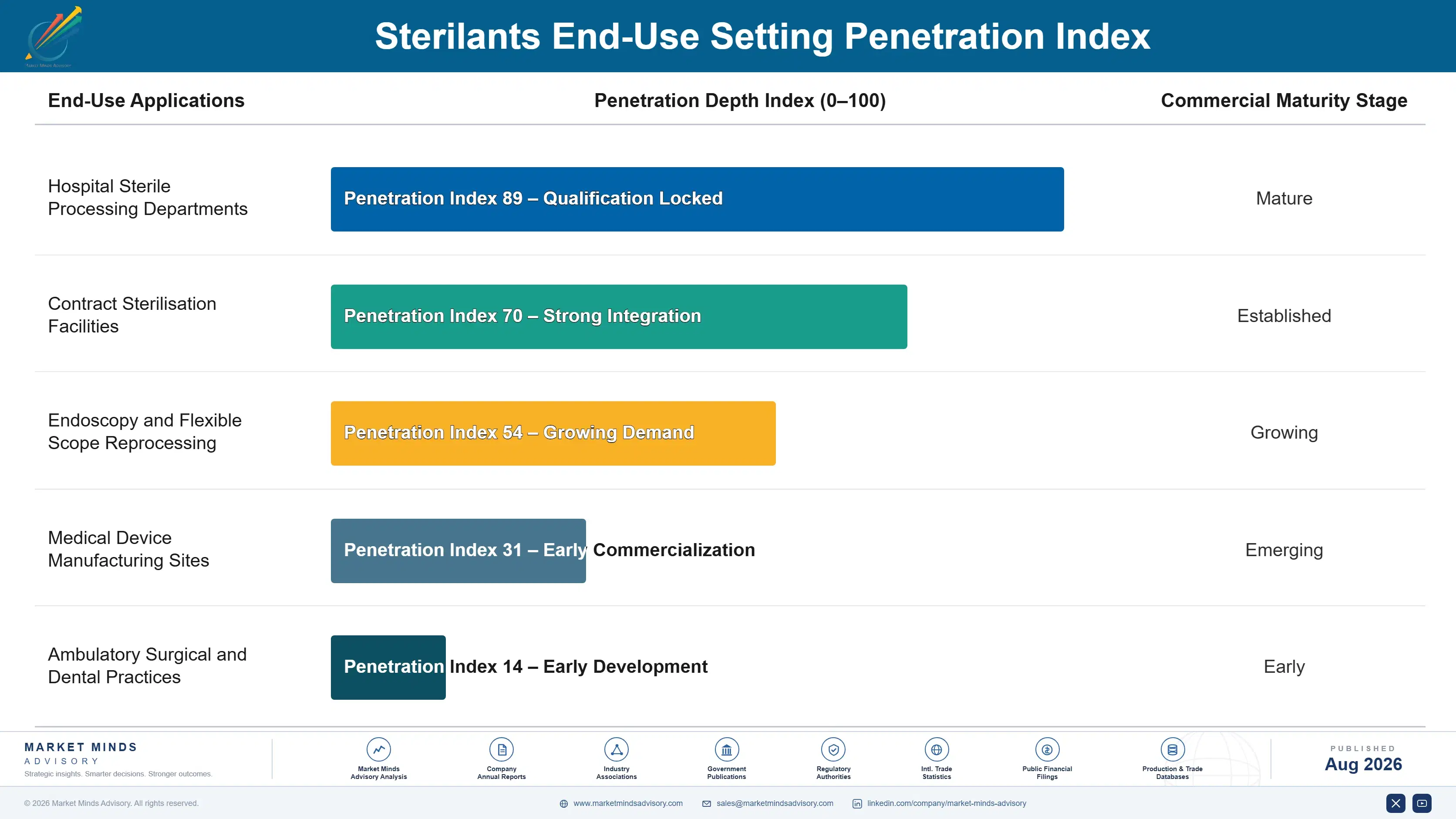
Revenue is consumption-linked and validation-locked, which is an unusually strong combination. Sterilant is consumed with every processing cycle, so volumes track device manufacturing output or hospital reprocessing activity directly. The lock is that changing supplier or modality requires revalidation costing around 11 months per product family, so a qualified position persists for years without any commercial defence being necessary. Consumption and validation lock together unusually well here
Depth varies by geometry and by regulatory regime. Device manufacturers with narrow lumen products have essentially no alternative to ethylene oxide and buy accordingly. Manufacturers with simple geometries have real choice and are qualifying alternatives in parallel. Hospital sterile services buy reprocessing chemistry under separate regulation entirely. Tissue and combination product manufacturers buy niche agents at high value and low volume.

The deciding function is quality and regulatory rather than procurement. Sterilisation modality is a regulatory filing element, so changing it involves quality assurance, regulatory affairs and validation engineering, with procurement negotiating inside a decision already made. That structure rewards suppliers who help customers through validation and offers very little to those competing on price per litre. Procurement negotiates inside a decision already taken elsewhere.
sterilants-market-end-use-penetration-index-1787309327098

Where Sterilant Suppliers Win

These are among the four positions where our research anticipates prominent divergence between winners and laggards over the coming forecast period. Each is grounded in the demand model, the regulatory perimeter, and the announced capacity pipeline.
01 / VALIDATED CYCLE ASSET BUILDING

Eleven months of revalidation is the real switching cost

Changing sterilisation modality costs a device manufacturer around 11 months of biocompatibility, material compatibility and sterility assurance work per product family, and most of that repeats work already done on similar materials and geometries. Suppliers holding validated cycle libraries shorten that timeline substantially, which is the most valuable asset available in this market. It also builds a switching cost, since the next change restarts the library work entirely, and the library is expensive to build and almost impossible to copy quickly.
02 / NARROW LUMEN CAPABILITY

Below 1.2 millimetres there is still nothing else

Alternative modalities fail below roughly 1.2 millimetres of lumen diameter, and catheters, infusion sets and endoscopic instruments sit precisely in that range, which is why ethylene oxide still processes around 49% of single-use devices. Whoever extends a non-gas modality reliably into that geometry takes the largest remaining substitution opportunity in infection prevention. Cycle development, extended dwell and pressure cycling are all being tried, and none has yet matched gas diffusion, which is why the gas survives every regulatory attempt to remove it.
03 / PARALLEL HEDGE POSITIONING

Sell insurance rather than compete against the incumbent

Device manufacturers are qualifying alternative modalities alongside existing gas processes rather than instead of them, because regulatory outcomes are unpredictable and revalidation is expensive to repeat. That is rational hedging rather than any kind of commercial indecision on their part. Suppliers who frame their offer as insurance against ethylene oxide restriction sell into a risk budget rather than displacing an incumbent chemistry, which is a materially easier commercial conversation to have, and it reaches a budget that exists precisely for unpredictable regulatory outcomes.
04 / JURISDICTION FOLLOWING CAPACITY

Sterilisation happens where devices are made, not sold

Terminal sterilisation occurs at the point of manufacture, device manufacturing keeps concentrating across China, India and Southeast Asia, and emission regulation in those jurisdictions is considerably less restrictive than in North America or Europe. Ethylene oxide capacity is being added there while it is constrained elsewhere, and India compounds at 9.4%. Suppliers holding genuine regional presence serve growth that Western-focused competitors are simply not positioned to reach at all, and the capacity being built there is genuinely new rather than transferred.

Engagement Snapshot From the Field

A live engagement with an industry participant carrying material or product regulatory and market exposure ahead of a defining policy shift, showing how our research translates into a defensible multi-year portfolio strategy.
MARKET MINDS ADVISORY · CLIENT ENGAGEMENT SUMMARY
Sterilants Producer Strategic Portfolio Review and Transition Roadmap 2026·Investment Scenario on Sterilants Exposure Evaluation 2025-26
CLIENT PROFILE
A cardiovascular device manufacturer producing catheters, guidewires and delivery systems across three plants, with roughly USD 1.3 billion in revenue and every product family terminally sterilised with ethylene oxide at two contract facilities (client-reported, unverified by MMA). One of those facilities had announced curtailment following emission requirements it declined to fund. No alternative modality had been qualified anywhere in the portfolio.
STRATEGIC CHALLENGE
The announced curtailment placed around 40% of product volume at risk within eighteen months, and the assumed response was to transfer those cycles to the remaining facility. Nobody had established whether that facility had capacity, or whether any alternative modality could process the narrow lumen products at all. Nobody had checked either assumption before committing to it.
MMA APPROACH
MMA assessed every product family by lumen diameter and material composition against the validated capability of each available modality, then mapped remaining contract capacity by facility and region. Revalidation timelines and costs were estimated per product family for each feasible transfer route. Validation standards at each candidate facility were assessed against the client's existing regulatory filings.
KEY FINDINGS
  1. Sixty-two percent of product families had lumens below 1.2 millimetres, which excluded every available alternative modality and left ethylene oxide as the only feasible option for them.
  2. The remaining contract facility had capacity for roughly half the transferring volume, which meant the transfer strategy leadership had assumed was arithmetically impossible from the outset.
  3. Two Asian contract facilities held validation standards acceptable to the client's regulatory filings and had substantial available ethylene oxide capacity at lower processing cost.
  4. Revalidation for the simple-geometry product families to vaporised hydrogen peroxide was costed at eleven months and was feasible for 38% of volume, which relieved pressure on gas capacity.
CLIENT PROFILE
A cardiovascular device manufacturer producing catheters, guidewires and delivery systems across three plants, with roughly USD 1.3 billion in revenue and every product family terminally sterilised with ethylene oxide at two contract facilities (client-reported, unverified by MMA). One of those facilities had announced curtailment following emission requirements it declined to fund. No alternative modality had been qualified anywhere in the portfolio.
STRATEGIC CHALLENGE
The announced curtailment placed around 40% of product volume at risk within eighteen months, and the assumed response was to transfer those cycles to the remaining facility. Nobody had established whether that facility had capacity, or whether any alternative modality could process the narrow lumen products at all. Nobody had checked either assumption before committing to it.
MMA APPROACH
MMA assessed every product family by lumen diameter and material composition against the validated capability of each available modality, then mapped remaining contract capacity by facility and region. Revalidation timelines and costs were estimated per product family for each feasible transfer route. Validation standards at each candidate facility were assessed against the client's existing regulatory filings.
KEY FINDINGS
  1. Sixty-two percent of product families had lumens below 1.2 millimetres, which excluded every available alternative modality and left ethylene oxide as the only feasible option for them.
  2. The remaining contract facility had capacity for roughly half the transferring volume, which meant the transfer strategy leadership had assumed was arithmetically impossible from the outset.
  3. Two Asian contract facilities held validation standards acceptable to the client's regulatory filings and had substantial available ethylene oxide capacity at lower processing cost.
  4. Revalidation for the simple-geometry product families to vaporised hydrogen peroxide was costed at eleven months and was feasible for 38% of volume, which relieved pressure on gas capacity.
RECOMMENDED STRATEGY
Phase 1: Phase 1 (months 1 to 5): Qualify the two Asian contract facilities for the narrow lumen product families that have no alternative modality available. Phase 2: Phase 2 (months 5 to 16): Begin vaporised hydrogen peroxide revalidation for the simple-geometry families to relieve gas capacity pressure. Phase 3: Phase 3 (months 16 to 28): Establish dual-facility qualification for every product family in order to remove single-site continuity risk permanently.
OUTCOME
Both Asian facilities were qualified within seven months and absorbed the at-risk volume before the curtailment took effect (client-reported, unverified by MMA). Peroxide revalidation completed for four product families covering 31% of volume, and processing cost per unit fell by approximately 22% on the transferred gas volume (client-reported, unverified by MMA). Dual-facility qualification is now standard practice.

Frequently Asked Questions

Foundational context covering the market sizes, CAGR, scope, country, region and competition that inform every finding below. This section is provided to cover basics and most often pre-purchase conversations, answered from the MMA Primary Research Dataset.

What is the current size of the Sterilants Market?

The global market was worth USD 2.8 billion in 2025, reaching USD 2.99 billion in 2026. East Asia holds the largest regional share at 31% of demand.

How large will the Sterilants Market be by 2036?

MMA forecasts USD 5.77 billion by 2036, an expansion multiple of 1.93 times the 2026 base. That represents roughly USD 2.78 billion of incremental value.

What is the CAGR for the Sterilants Market 2026 to 2036?

The base case compounds at 6.8% annually, with a bull case of 8.0% and a bear case of 5.5%. Historical growth from 2020 to 2025 ran at 5.6%.

Which segment is growing fastest?

Vaporised hydrogen peroxide systems compound at 10.2%, exactly 1.50 times the market rate. It is the credible alternative for the device geometries it can actually handle.

Who are the major companies in the Sterilants Market?

Steris, Ecolab, Solventum, Getinge and Sotera Health hold a combined 58% of the market. Validated cycle capability and regulatory navigation sustain those positions rather than chemistry.

Which country is growing fastest?

India compounds at 9.4%, ahead of every other national market. Device manufacturing growth and new contract sterilisation capacity additions together drive that demand steadily upward.

Report Segmentation Architecture

The full report scope spans multiple orthogonal segmentation dimensions, with cross-tabulated demand data provided for each dimension pair. Coverage extends further to regional breakdowns, trend trajectories, and the competitive detail needed to support segment-level decision-making.

By Sterilising Agent

  • Ethylene Oxide
  • Vaporised Hydrogen Peroxide Systems
  • Peracetic Acid Formulations
  • Nitrogen Dioxide and Supercritical Carbon Dioxide Agents
  • Glutaraldehyde and Orthophthalaldehyde High-Level Disinfectants
  • Chlorine Dioxide and Ozone Systems

By End-Use Industry

  • Single-Use Medical Device Manufacturing
  • Hospital Sterile Services and Endoscopy
  • Pharmaceutical and Biologic Manufacturing
  • Tissue Banking and Combination Products
  • Laboratory and Research Facilities

By Commercial Dimension

  • Contract Sterilisation Operator Supply
  • Direct Device Manufacturer Supply
  • Hospital and Distributor Channel
  • Validation and Qualification Services

By Region

  • North America
  • Western Europe
  • East Asia
  • South Asia and Pacific
  • Latin America
  • Middle East and Africa
  • Eastern Europe

Scope, Methodology, and Coverage

Every figure in this report is reproducible from documented input assumptions. The scope below maps the historical period, the forecast horizon, the segmentation dimensions, and the countries covered, alongside the underlying primary and qualitative methodology.
Historical Period
2020 to 2025
Forecast Period
2026 to 2036
Base Year
2025 (USD billions; MMA Primary Research Dataset, August 2026)
Market Definition
The market covers chemical sterilising agents and the process chemistry consumed in terminal and reprocessing sterilisation, spanning ethylene oxide, vaporised hydrogen peroxide systems, peracetic acid formulations, nitrogen dioxide and supercritical carbon dioxide agents, glutaraldehyde and orthophthalaldehyde high-level disinfectants, and chlorine dioxide and ozone systems, together with the validation and cycle qualification services supplied alongside them. Steam and dry heat sterilisation equipment, gamma and electron beam irradiation services, ultraviolet disinfection systems, surface disinfectants for environmental cleaning, hand hygiene products, and the sterilisation chambers and processing equipment themselves are excluded. Sizing is measured at supplier revenue in current prices.
Quantitative Units
USD billions (current prices); agent volumes, processing cycles and validated device families where applicable
Segmentation Dimensions
By Sterilising Agent; By End-Use Industry; By Commercial Dimension; By Region
Regions Covered
North America, Western Europe, East Asia, South Asia and Pacific, Latin America, Middle East and Africa, Eastern Europe
Countries Covered
China, USA, India, Malaysia, Germany, Japan, South Korea, Ireland, Mexico, France, UK, Italy, Spain, Canada, Brazil, Costa Rica, Dominican Republic, Thailand, Vietnam, Indonesia, Singapore, Australia, Turkey, Saudi Arabia, UAE, South Africa, Egypt, Poland, Czech Republic, Hungary, and additional markets relevant to this sector
Key Companies Profiled
Steris, Ecolab, Solventum, Getinge, Sotera Health, Cantel Medical, Advanced Sterilization Products, Noxilizer, NovaSterilis, Andersen Sterilizers, Belimed, Matachana Group, Tuttnauer, Metrex Research, Certol International, Fortive, Sterigenics, BGS Beta-Gamma-Service, Shinva Medical Instrument, Kelun Medical Devices
Quantitative Methodology
Primary survey, n=3,800 respondents, Q4 2025, six countries; demand-side model with trade association cross-validation
Qualitative Methodology
47 expert interviews, Q4 2025; applied to validate demand model assumptions, identify emerging dynamics, and assess competitive positioning
Report Format
PDF and XLSX data workbook (Word format preview document)
Publisher
Market Minds Advisory
Report Code
MMA-2026-CHM-976
Published
August 2026
Contact
sales@marketmindsadvisory.com | www.marketmindsadvisory.com

Purchase the full Sterilants Market Report (2026 to 2036).

The full report sizes sterilants across six agent categories, three commercial dimensions and seven regions, with annual forecasts to 2036 under base, bull and bear scenarios. Modality capability is mapped against device lumen diameter and material composition, which is what actually determines whether a substitution is possible at all. Revalidation timelines and costs are quantified by product family type and target modality. Emission and occupational regulation is tracked by jurisdiction against contract capacity location. Parallel qualification activity is measured across the device manufacturing base, and twenty suppliers are profiled on a consistent sterilant revenue basis.
Modality capability mapped against lumen diameter and materials
Revalidation timelines quantified by product family and target modality
Emission and occupational regulation tracked against capacity location
Contract sterilisation capacity mapped by facility and region
Parallel qualification activity measured across device manufacturers
Feedstock cost pass-through compared across agent chemistries

Built For The People Who Decide

From boardroom strategy to bench-side execution, this report is read cover-to-cover by leaders shaping the next decade of their industry, turning demand scenarios, market dynamics and valuation benchmarks into decisions.
CXOs/ Presidents/ VPs/ Managers
M&A and Corporate Development
Strategy Teams and R&D Heads
Procurement and Product Directors
Regulatory and Compliance Leaders
Investor Relations and Equity Analysts