Market Minds Advisory
Stereotactic Planning Software Market

Stereotactic Planning Software Market: Trajectory Automation, Licence Economics and the Contest for the Neurosurgical Workstation

Planning software now decides which stereotactic procedures a centre can offer at all, yet vendors still price it as a machine accessory while automated trajectory tools quietly reset what a neurosurgical seat is worth.

Lead Analyst

Alice Ballenger

Published

September 2026

Make Smarter Decisions with Customized Research Insights

Request a free sample report and evaluate market opportunities, growth trends, and competitive dynamics relevant to your business needs.

2025 MARKET VALUE$0.5BMarket Size 2025
2036 FORECAST VALUE$1.3BBase Case , 2026 to 2036
CAGR 2026 TO 20369.4 %Bull 10.7% / Bear 8.1%
INCREMENTAL OPPORTUNITY$0.8BNet 10- year value creation
EXPANSION MULTIPLE2.45x2036 value over 2026 base
Strategic Levers
M&A Pipeline
Regional Outlook
Country Rankings
Competitive Intelligence
Segmental Deep-dive
Call-Us : 91 93563 13602

Executive Snapshot and Market Trajectory

Software has quietly become the constraint on stereotactic practice rather than the machine. A centre with an ageing planning platform cannot offer single-isocentre multiple metastasis treatment or automated lead trajectory checking, regardless of what hardware sits in the vault downstairs. Procurement has not caught up with that inversion yet.
Functional neurosurgery and deep brain stimulation trajectory planning compounds at 14.1%, exactly 1.50 times the market, as lead placement moves from frame-based to image-guided workflows. East Asia holds 29% of global spend, the largest regional position, carried by Japanese radiosurgery density and Chinese installation volume. Average perpetual seat pricing sits near USD 96,000 before service. Auto-contouring is now routine at 44% of centres. Neurosurgery, not radiation oncology, holds the budget for that fastest segment.
Five vendors control 72% of the installed planning licence base, and most of that position was won by bundling software with the accelerator or radiosurgery unit rather than by selling it. Recurring service and support contracts already contribute 38% of vendor planning revenue. Independent software companies are attacking the contouring and quality assurance layers where hardware neutrality is an advantage rather than a handicap.
Market Definition
Covers commercially supplied treatment and trajectory planning software used to define stereotactic targets, dose distributions and instrument paths, including cranial radiosurgery, stereotactic body radiotherapy, functional neurosurgery, biopsy, brachytherapy and intraoperative navigation planning applications. Sizing captures licence, subscription and associated service revenue. Excludes the linear accelerators, radiosurgery units, frames, robots and navigation hardware the software drives, along with general radiology image management and hospital information systems.
Base Year Value
$0.5B in 2025 (MMA Primary Research Dataset, August 2026)
Forecast Period
2026 to 2036, eleven discrete annual values
CAGR
9.4% base case. Bull 10.7%. Bear 8.1%.
Fastest Growth Segment
Functional Neurosurgery and DBS Lead Trajectory Planning: 14.1% CAGR
Fastest Growth Country
India: 12.4% CAGR
Fastest Growth Region
South Asia and Pacific: 11.6% CAGR
Largest Region
East Asia: 29% of 2025 global value
Market Leaders
Elekta, Varian Medical Systems, Brainlab, Medtronic, RaySearch Laboratories. Source: MMA Analysis based on company annual reports.
Primary Survey
n=3,800 procurement and R&D decision-makers, Q4 2025, six countries
Methodology
Demand-side build-up, cross-validated against public data, 47 expert interviews

Stereotactic Planning Software Market Forecast Scenarios

stereotactic-planning-software-market-size-forecast-scenario-1787309318479
Growth of 9.0% across 2020 to 2025 tracked stereotactic treatment volume rather than software innovation. Hypofractionation moved from clinical trial evidence into routine practice across lung, prostate, spine and brain metastasis indications, and each conversion raised the planning workload per patient because stereotactic plans demand tighter margins and more careful organ-at-risk delineation. Autonomous contouring arrived toward the end of the period and has not yet worked through installed bases.
The base case of 10.2% rests on three mechanisms. Autonomous contouring is being adopted because radiation oncology staffing shortages make planning time the binding constraint on department throughput rather than machine availability. Adaptive replanning is moving from research into clinical workflow as on-treatment imaging improves. And Asian and Indian stereotactic capacity is expanding quickly, with planning software purchased alongside every machine installation rather than as any separate decision at all.
The bull case of 11.5% assumes autonomous contouring reaches regulatory clearance for genuinely unsupervised use rather than clinician-reviewed assistance, which would change department staffing models and software value simultaneously. The bear case of 8.9% reflects two pressures: machine vendors bundling planning software into system pricing to protect hardware margins, and hospital capital constraints extending replacement well beyond eight years.

Why the Workstation Now Matters More Than the Vault

Stereotactic planning software has an awkward commercial history. It was given away, effectively, as the thing that made an expensive machine usable, and hospitals learned to treat it as included. That legacy still shapes procurement: capital committees scrutinise a linear accelerator line item for months and approve the planning licence attached to it without discussion. Vendors have spent the last five years trying to unpick that, with mixed success and a good deal of resistance from the same
TOP FIVE CONCENTRATION72%Installed planning licence base held by leading vendors
AVERAGE SEAT PRICEUSD 96,000Perpetual licence before service, support and training contracts
JAPAN INSTALLED DENSITY4.1 per millionRadiosurgery units per head of population, highest anywhere
SERVICE REVENUE SHARE38%Recurring maintenance within total vendor planning software income
AUTO-CONTOURING ADOPTION44%Share of centres using algorithmic organ delineation routinely
PLATFORM REPLACEMENT CYCLE7.5 yearsMedian interval between major planning platform migrations at centres
The commercial character is closest to specialised engineering software sold into a regulated clinical setting. Switching costs are enormous, and not for technical reasons. A medical physics team that has validated dose calculation against a decade of measurement data does not migrate platforms casually, because revalidation consumes months of physicist time nobody has. That inertia protects incumbents far more effectively than any feature does.
Two forces shape the next decade. Automated contouring and trajectory generation are moving into the tender specification, which favours vendors with clinical data volume to train on. And hardware-neutral independents are proving that the planning layer can be unbundled from the machine, an argument that would have sounded eccentric in 2015.
"Everybody assumes the barrier to switching planning software is technical. It is not. It is that revalidating dose calculation against a decade of local measurement data costs a physics team six months it does not have, and no procurement committee has ever put that on a business case. The incumbents are protected by unpaid overtime."
Director, Clinical Software and Digital Health Practice · MMA Technology / Clini

Market Trends

Automated trajectory generation moves into tender specifications

Lead and electrode trajectory planning was until recently a manual exercise, with the surgeon drawing a path and checking it against vessels slice by slice. Algorithmic trajectory generation now proposes candidate paths ranked by vessel proximity and grey matter traversal, and FDA clearances for such tools have accumulated steadily since 2021. Centres that have adopted them report planning time falling by roughly half on multi-lead cases. The commercial consequence is that trajectory automation has moved from a differentiator into a line item on tender documents, which changes who can credibly bid.
Market Impact: Adds over 240 new licensed sites

Subscription pricing replaces perpetual licences across the installed base

Vendors are converting planning software from a capital purchase into an annual subscription bundling upgrades, support and module access. Hospitals dislike it and physicists mostly prefer it, since continuous upgrade removes the five-year version stagnation that used to leave centres unable to run current techniques. Recurring service and subscription revenue now accounts for 38% of vendor planning income against a considerably lower figure five years ago. The transition also changes competitive dynamics, because subscription renewal is an annual decision point where perpetual licensing offered none. Renewal is a decision point where perpetual licensing offered none.
Market Impact: Grows implant volume around 40%

Market Opportunities and Growth Drivers

Radiosurgery installation across Asia carries planning licences with it

Every radiosurgery unit or stereotactic-capable accelerator commissioned needs planning software, and installation across China, India and Southeast Asia has continued through a period when Western installation was largely replacement-driven. Japanese density remains the highest anywhere at 4.1 radiosurgery units per million population, which sets the reference other systems measure against. Chinese provincial oncology capacity expansion has added stereotactic capability at hospitals that previously referred those cases away. Each of those installations represents a first planning licence rather than an upgrade, which is a materially better sale. First licences also pull module attachments that upgrades rarely do.
Market Impact: Extends replacement cycle past 7.5

Deep brain stimulation indication expansion widens the planning population

Deep brain stimulation began as a movement disorder therapy and has expanded into epilepsy, obsessive compulsive disorder and treatment-resistant depression through successive regulatory approvals. Each new indication brings surgical teams that need trajectory planning capability they did not previously own. Directional lead designs have made the planning problem harder and the software more necessary, since orientation now matters as much as position. Implant volumes across the largest developed systems have grown by roughly 40% since 2019, and every one of those cases is planned on software. None of that volume existed as addressable software demand a decade ago.
Market Impact: Holds bundled pricing near 30% disc

Market Restraints and Challenges

Dose calculation revalidation blocks platform migration for years

A medical physics team that changes planning platform must revalidate dose calculation against local measurement data before clinical use, and the root cause is regulatory: commissioning evidence is site-specific and cannot transfer with the licence. That work consumes months of physicist time at departments already short of physicists. Centres therefore defer migration until hardware replacement forces it, which stretches the effective cycle beyond 7.5 years. Vendors are responding with pre-validated beam model libraries and remote commissioning support, and a few now fund contract physics resource outright to remove the bottleneck.
Market Impact: Cuts multi-lead planning time 50%

Hardware bundling suppresses standalone software pricing

Planning software has historically been quoted inside a machine purchase, and hospitals consequently believe it costs very little. The root cause is vendor behaviour: bundling won hardware deals, and the discount taken on software was invisible against a multi-million dollar accelerator. Standalone independents now compete against that inherited price expectation rather than against genuine cost. Mitigation is running through subscription conversion, which resets the reference point away from a capital line item, and through modules priced on clinical capability rather than seat count. Capability-tiered pricing is the other route being tested, since it prices clinical practice rather than a workstation.
Market Impact: Lifts recurring revenue to 38% shar
3 additional market trends, 4 additional growth drivers, and 2 additional restraints and challenges are covered in the full report. Contact sales@marketmindsadvisory.com to access the complete intelligence.

Segment CAGR and Growth Architecture

Segmentation follows the planned procedure, since that determines which regulatory clearance the software needs, which clinical team buys it and how it gets priced. Module architecture and deployment model matter commercially but cut across every procedure type, so they sit in later discussion. Six procedure classes cover the category without overlap. Each carries its own clearance requirement.
stereotactic-planning-software-market-market-share-analysis-1787309319007

Functional Neurosurgery and DBS Lead Trajectory Planning

Trajectory planning for deep brain stimulation, laser ablation and stereo-electroencephalography electrodes grows at 14.1%, exactly 1.50 times the market rate. Three things drive it. Indication expansion into epilepsy and psychiatric disorders keeps adding surgical teams that need the capability. Directional lead designs have made orientation clinically meaningful, so manual planning no longer suffices. And algorithmic path generation has given the software something to do that a surgeon with a ruler genuinely cannot. The buyer is neurosurgery rather than radiation oncology, which matters commercially because it is a different budget, a different tender process and a vendor relationship that radiotherapy incumbents mostly do not hold. Radiotherapy vendors are buying their way in rather than selling their way in.
CAGR 14.1%

Stereotactic Biopsy and Catheter Trajectory Planning

Planning for frame-based and frameless biopsy, catheter placement and drug delivery trajectories grows at 11.3% from a modest base. Volume comes from neuro-oncology diagnosis, where tissue confirmation now precedes molecular characterisation as a matter of routine rather than exception. Convection-enhanced delivery and intratumoural therapy trials have added a small but demanding planning requirement, since catheter placement determines whether the trial arm means anything. The segment sits awkwardly for vendors: licence values are lower than radiosurgery planning, procedure volumes are considerably higher, and the software often runs on navigation platforms rather than radiotherapy workstations. Vendors with a neurosurgical channel therefore reach it far more easily. Volume growth here is steadier than radiosurgery and considerably less visible in vendor reporting.
CAGR 11.3%
Full segment breakdown across 6 segments available in the complete report.

Regional Architecture and Country Demand Map

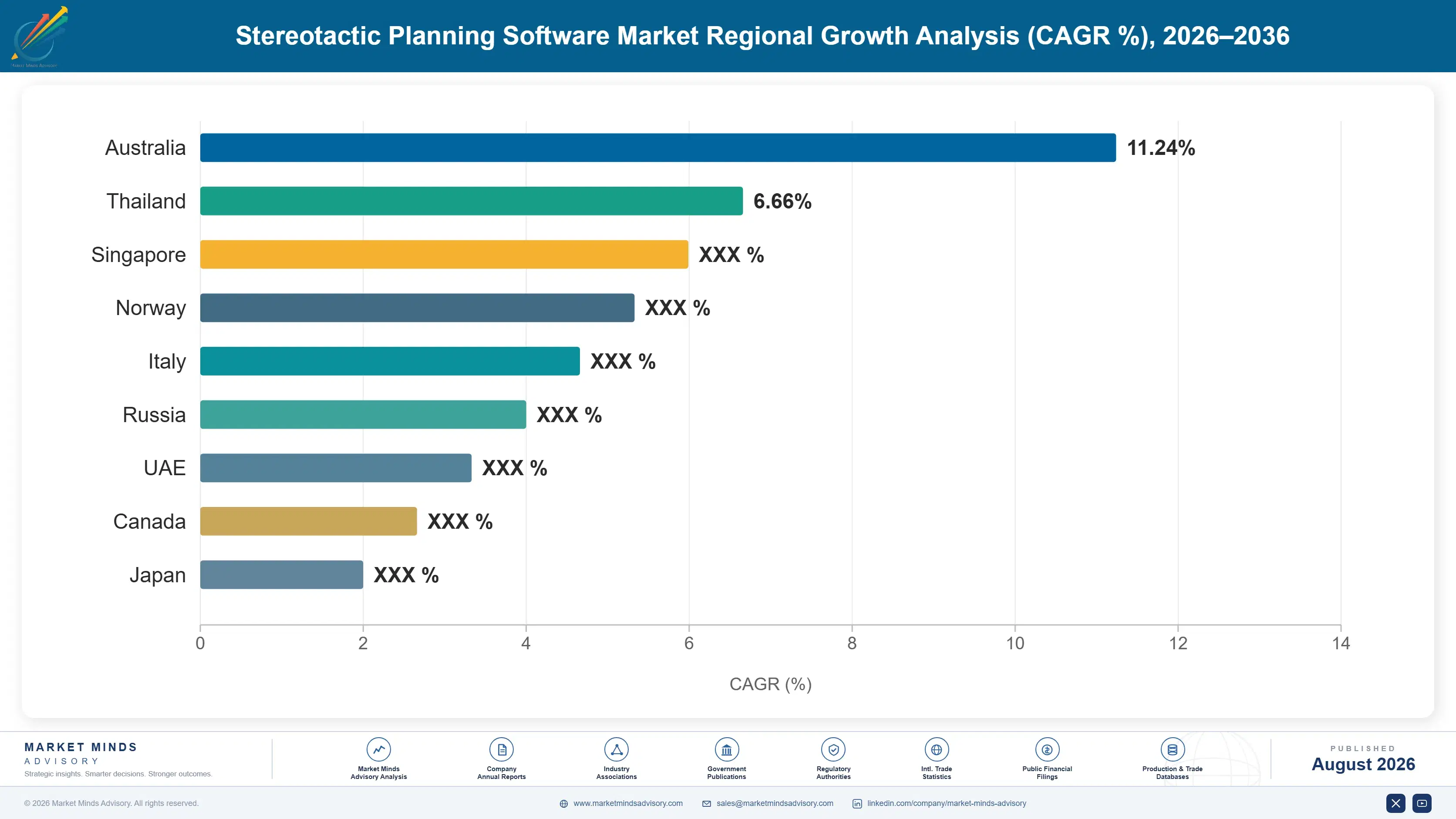
East Asia leads at 29% of spend, an unusual position for clinical software, carried by Japanese radiosurgery density and Chinese installation volume. North America follows at 27% on licence pricing rather than unit count. South Asia and Pacific grows fastest, led by India at 12.4%.

North America

Twenty-seven percent of global spend sits in North America, growing at 8.6%, and the position rests on licence and subscription pricing rather than on installed unit count. United States academic medical centres run the largest concentration of stereo-electroencephalography and deep brain stimulation programmes anywhere, which makes it the primary market for functional planning modules. Medicare reimbursement for stereotactic radiosurgery has been stable enough that centres plan capital cycles against it with confidence. Group purchasing organisations and integrated delivery networks negotiate enterprise licensing across multiple sites, which suppresses per-seat pricing while enlarging deal size. Canadian provincial cancer agencies procure centrally, producing fewer but considerably larger tenders than the fragmented American pattern.
Share: 27% | CAGR: 8.6% (2026 to 2036)

Western Europe

Growth of 7.8% is the slowest anywhere, and 21% of spend reflects a mature installed base upgrading rather than expanding. Germany carries the largest share through university hospital neurosurgery departments and a dense private radiotherapy sector. The Nordic countries punch far above their population in functional neurosurgery, and Elekta's Swedish origins gave the region an installed base and physicist community oriented toward that vendor for decades. National procurement frameworks in the United Kingdom and centralised tendering in the Netherlands both push toward enterprise agreements rather than departmental purchases. Medical device regulation under the European framework has slowed module clearance timelines noticeably, which delays revenue recognition on features already shipping in North America.
Share: 21% | CAGR: 7.8% (2026 to 2036)
Regional intelligence for 5 additional markets available in the complete report: East Asia, South Asia and Pacific, Latin America, Middle East and Africa, Eastern Europe. Contact sales@marketmindsadvisory.com.
stereotactic-planning-software-market-country-cagr-analysis-1787309319517

Four Ways To Repricing This Software

The commercial problem here is not capability. It is that hospitals learned to treat planning software as included with the machine, and every vendor now competes against that inherited expectation. Each lever below has been executed by at least one participant, and each carries a quantified return MMA has tested against disclosed segment economics.

Fund the physics resource that blocks migration

Revalidation of dose calculation is the single reason centres do not switch platforms, and it costs a department months of physicist time nobody has budgeted. Vendors that fund contract physics resource for the commissioning period remove the actual obstacle rather than arguing around it. Win rates on competitive replacement tenders run roughly 25 points higher where commissioning support is included in the bid, and the cost of that support is a fraction of first-year licence value. It also shortens time to revenue recognition by two quarters or more. Nobody else is offering this.
Market Impact: Raises competitive win rates roughl

Price modules on clinical capability, not seat count

Seat-based licensing prices a workstation, which is the wrong unit. A centre running single-isocentre multiple metastasis treatment derives far more value from the software than one planning single lesions, and per-seat pricing charges both the same. Capability-tiered pricing captures that difference, and vendors that moved to it report average realised revenue per site roughly 35% above flat seat schedules. It requires the licence server to enforce capability tiers, which most already do, and a sales conversation about clinical practice rather than headcount. Physicists accept the logic more readily than procurement committees do, which is where the real resistance sits.
Market Impact: Lifts realised revenue per site aro

Enter through neurosurgery rather than radiation oncology

Functional trajectory planning is bought by neurosurgery, a different budget and tender process from radiation oncology, and most radiotherapy incumbents hold no relationship there. Vendors that built a neurosurgical channel reach the fastest growing segment in the category at 14.1% while competitors wait for radiotherapy procurement cycles. Building that channel is slow and comparatively cheap, since neurosurgical teams are small and concentrated in academic centres. Roughly 60 institutions worldwide account for the majority of stereo-electroencephalography volume, which makes the target list genuinely finite. Radiotherapy sales teams cannot simply be redirected into it, because the clinical vocabulary is different.
Market Impact: Reaches a segment now growing 14.1%

Convert perpetual installed base to annual subscription

A perpetual licence sold in 2018 generates support revenue and nothing else, while the customer runs software that cannot support current technique. Subscription conversion restores annual revenue and removes the version stagnation that drives competitive displacement. Vendors reaching subscription across their installed base report recurring revenue near 38% of planning income with visibly better renewal economics. The conversion is unpopular with capital-funded hospitals, so it works where the offer includes continuous upgrade and removes a capital request the department would otherwise have to make. Converting the installed base is slower than signing new sites and considerably more valuable.
Market Impact: Moves recurring revenue toward a 38

Who Controls the Margin Pool

Five vendors hold 72% of the installed planning licence base, the basis on which MMA assesses every participant here, and concentration is higher than in almost any adjacent clinical software category. Elekta and Varian lead on radiotherapy planning seats. Brainlab and Medtronic hold the neurosurgical workstation, which is a different building.
Competitive activity runs along three lines. Automated contouring and trajectory generation are being acquired rather than built, since clinical training data is the scarce input and independents accumulated it first. Subscription conversion is under way across every major installed base, with varying customer resistance. And hardware-neutral independents are winning the quality assurance and secondary check layers, where being unaffiliated with the accelerator vendor is the entire value proposition.

Pressure is arriving from two directions. Chinese accelerator manufacturers bundling domestic planning software are resetting price expectations across Asia, and that expectation travels to tenders elsewhere. Independent software companies are unbundling the planning layer from the machine, an argument the market would have dismissed a decade ago. Rankings shift if functional neurosurgery grows as forecast, because the vendors holding that channel are not the ones leading radiotherapy planning seats.
stereotactic-planning-software-market-company-positioning-matrix-1787309320038

Competitive Moat and Risk Dimensions

ELEKTA

Moat: Radiosurgery planning installed base

Leksell GammaPlan has planned cranial radiosurgery cases for decades, and the physicist community trained on it represents a switching barrier no feature comparison overcomes. Validated beam models, published dose data and institutional protocols all reference the platform. Combined with the Gamma Knife installed base it drives, this gives the company the deepest position in the highest-value planning application.
ELEKTA

Risk: Weak functional neurosurgery channel

The company's relationships sit with radiation oncology and medical physics rather than with neurosurgical theatres, which is where the fastest growing segment is bought. Trajectory planning for stimulation leads and depth electrodes is procured by different people, on different budgets, against different tender criteria. Building that channel takes years, and Brainlab and Medtronic already occupy it.
VARIAN MEDICAL SYSTEMS

Moat: Accelerator bundling reach

Planning software travels with every accelerator sold, which gives the company distribution no independent can match and a seat position in the majority of radiotherapy departments worldwide. Eclipse validation data exists at thousands of sites. Integration with the treatment delivery chain and the oncology information system makes displacement a departmental project rather than a software purchase.
VARIAN MEDICAL SYSTEMS

Risk: Bundling suppresses software pricing

The same bundling that built the installed base taught hospitals that planning software is nearly free, and unwinding that expectation is considerably harder than establishing it was. Standalone module pricing now competes against an inherited reference point the company itself created. Independents selling hardware-neutral tools face no such history and quote accordingly.

Players Tracked

Prominent Players

Elekta
Varian Medical Systems
Brainlab
Medtronic
RaySearch Laboratories

Other Key Players

Accuray
Philips Healthcare
MIM Software
Mirada Medical
Therapanacea
Limbus AI
Radformation
Renishaw
inomed Medizintechnik
Stryker
ScandiDos
Standard Imaging
Sun Nuclear
Neusoft Medical Systems
United Imaging Healthcare

Recent Developments

MAY 2025

Elekta released automated multi-target optimisation in its radiosurgery planning platform

The release added algorithmic optimisation for single-isocentre treatment of multiple cranial metastases, a technique older platform versions could not support clinically. It was a product release rather than an acquisition or partnership, and it gives existing licence holders a reason to move onto current versions.
Signal: Technique capability, not feature comparis
NOVEMBER 2025

Brainlab acquired a functional neurosurgery trajectory planning developer

The acquisition brought algorithmic trajectory generation and vessel avoidance capability into Brainlab's navigation planning suite, along with the clinical training data behind it. Terms were undisclosed. It was an outright acquisition rather than a licensing arrangement, which suggests the training data mattered as much as the software.
Signal: Clinical training data is now being bought
MARCH 2026

Medtronic signed co-development agreement with Japanese academic neurosurgery centre

The agreement covers directional lead orientation planning and post-implant programming prediction, using case data from the centre's stimulation programme. It is a co-development agreement rather than a joint venture or equity investment, with intellectual property terms shared between the parties rather than transferred. Case data access runs for the term.
Signal: Academic case volume is now the input vend

Where the Cost Base Actually Sits

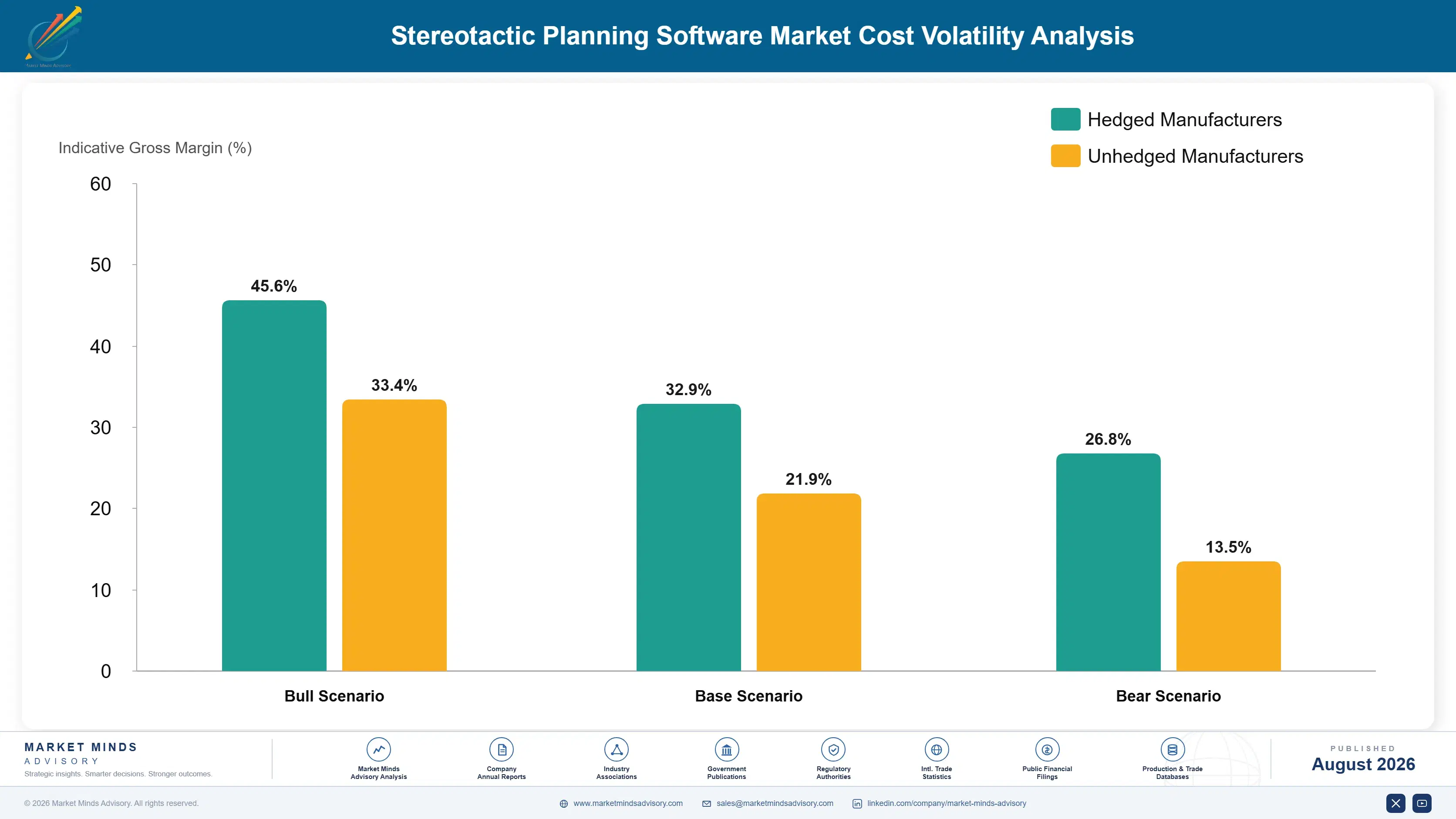
This is a software business, so the cost base is people and regulation rather than materials. Clinical and regulatory affairs staff, medical physicists and software engineers together account for roughly 58% of operating cost, concentrated in Sweden, Germany, the United States and India. Regulatory submission and post-market surveillance add another 11%. Cloud hosting and computation for automated contouring add a growing 7% that barely registered five years ago.
European medical device regulation demonstrated how quickly regulatory cost transmits. Notified body capacity constraints extended conformity assessment timelines from 2021, and vendors reported delayed module launches and duplicated submission work as a result. Elekta and Brainlab both disclosed elevated regulatory and quality expenditure in annual reports for that period. The commercial impact was revenue deferral rather than direct cost: features shipping in North America sat unavailable in Europe for additional quarters.

Exposure varies sharply by vendor type: fixed regulatory overhead spread across revenue. A vendor with one cleared module carries nearly the same submission and surveillance burden as one with twenty, so unit regulatory cost falls steeply with portfolio breadth. Small independents therefore carry a permanent cost disadvantage. Vendors outside Europe defer that burden until European revenue justifies it.
stereotactic-planning-software-market-cost-volatility-analysis-1787309320233

Concentrate regulatory submissions into platform clearances

Submitting modules individually multiplies the fixed burden that dominates small vendor cost structures. Platform-level clearances covering a family of planning functions spread that cost across far more revenue, and predicate-based strategies shorten timelines further. Vendors that restructured submissions this way reported regulatory cost per cleared function falling by roughly a third within two years.

Move computation to per-case cloud pricing

Automated contouring and plan optimisation demand computation that fluctuates with clinical volume, and provisioning owned infrastructure for peak load wastes most of it. Per-case cloud pricing converts that fixed cost into a variable one recovered directly in module pricing. It requires clinical data handling that satisfies both European and American privacy frameworks, which is genuinely non-trivial.

Locate engineering where clinical physicists are affordable

Software engineering can sit anywhere, but clinical validation needs physicists who understand dose calculation, and those are expensive in Sweden and Germany. Building validation capability in India and Poland, where the physics graduate pool is deep and cost roughly half, reduces the largest single cost block without moving regulatory accountability offshore. Regulatory accountability stays where the clearances are held.

Portfolio Architecture for Margin Defence

Portfolio economics here separate on regulatory burden and switching cost rather than on development effort. Core planning platforms carry gross margins in the high seventies once the installed base is established, because incremental licence cost is nearly zero and the switching barrier holds pricing. Automated contouring and optimisation modules earn more again, since they are priced on clinical capability rather than seat count. Quality assurance and secondary check tools sit lower, competing
The tension is that platform revenue funds the company while modules generate the growth, and they attract different customers within the same hospital. Physicists buy the platform and defend it. Clinicians want the modules and rarely control the budget. Vendors that push modules hard at the expense of platform relationships find the physics team quietly evaluating alternatives at the next hardware cycle, which is an expensive way to grow.

High-value pools concentrate in three places: functional neurosurgery trajectory planning where the clinical need is unambiguous, automated contouring where labour substitution is measurable, and enterprise agreements at large integrated networks. None is large in seat count. Each is defended by something other than software features, which is exactly why the margins hold.

Volume / Commodity-Adjacent Tier

Quality assurance, secondary dose check and basic contouring tools competing against departmental scripts, open-source alternatives and bundled vendor utilities. Pricing is set by what a physicist would otherwise write themselves, which caps it firmly regardless of engineering quality.
Gross Margin: 52-60%

Premium / Certified Tier

Core cranial and extracranial planning platforms with validated dose calculation and full regulatory clearance. Margin comes from the revalidation barrier rather than from features, and the nine-point range reflects the difference between established installed bases and platforms still buying market entry.
Gross Margin: 74-83%

Sustainability / Regulatory / Next-Generation Tier

Automated trajectory generation, algorithmic contouring and adaptive re-planning modules where clinical training data is the scarce input. The twelve-point range reflects the gap between mature contouring products and trajectory tools still recovering clearance and data acquisition cost.
Gross Margin: 76-88%
stereotactic-planning-software-market-portfolio-architecture-1787309320724

High-value Sub-segments and Strategic Watch-out

Functional neurosurgery trajectory modules

The fastest growing pool in the category and the one radiotherapy incumbents reach least easily, because neurosurgery procures separately. Clinical need is unambiguous with directional leads. The constraint is channel access rather than product capability, and channel access takes years to build properly. Price is not the contest here.
Gross Margin: 80-88%

Automated contouring and optimisation

Growing steadily and defensible while clinical training data remains scarce, with measurable labour substitution that makes the business case straightforward for any centre short of dosimetrists. Competition is intensifying quickly as independents accumulate comparable datasets and price aggressively against incumbents. Labour substitution is the argument.
Gross Margin: 76-84%

Core cranial radiosurgery planning

The revenue foundation, growing at roughly 8.4% and protected by revalidation cost more than by capability. It funds everything else and generates limited growth on its own. Displacement risk is low in any given year and cumulative across hardware replacement cycles. Hardware replacement is when that protection lapses.
Gross Margin: 74-82%

Bundled domestic Asian platforms

Chinese accelerator manufacturers supplying planning software alongside locally built hardware at prices Western vendors cannot approach. It looks confined to domestic markets today. The price expectation it creates travels into tenders across Southeast Asia, the Gulf and Latin America already. Answering on price concedes the margin too.
Gross Margin: 40-50%

How Planning Demand Actually Repeats

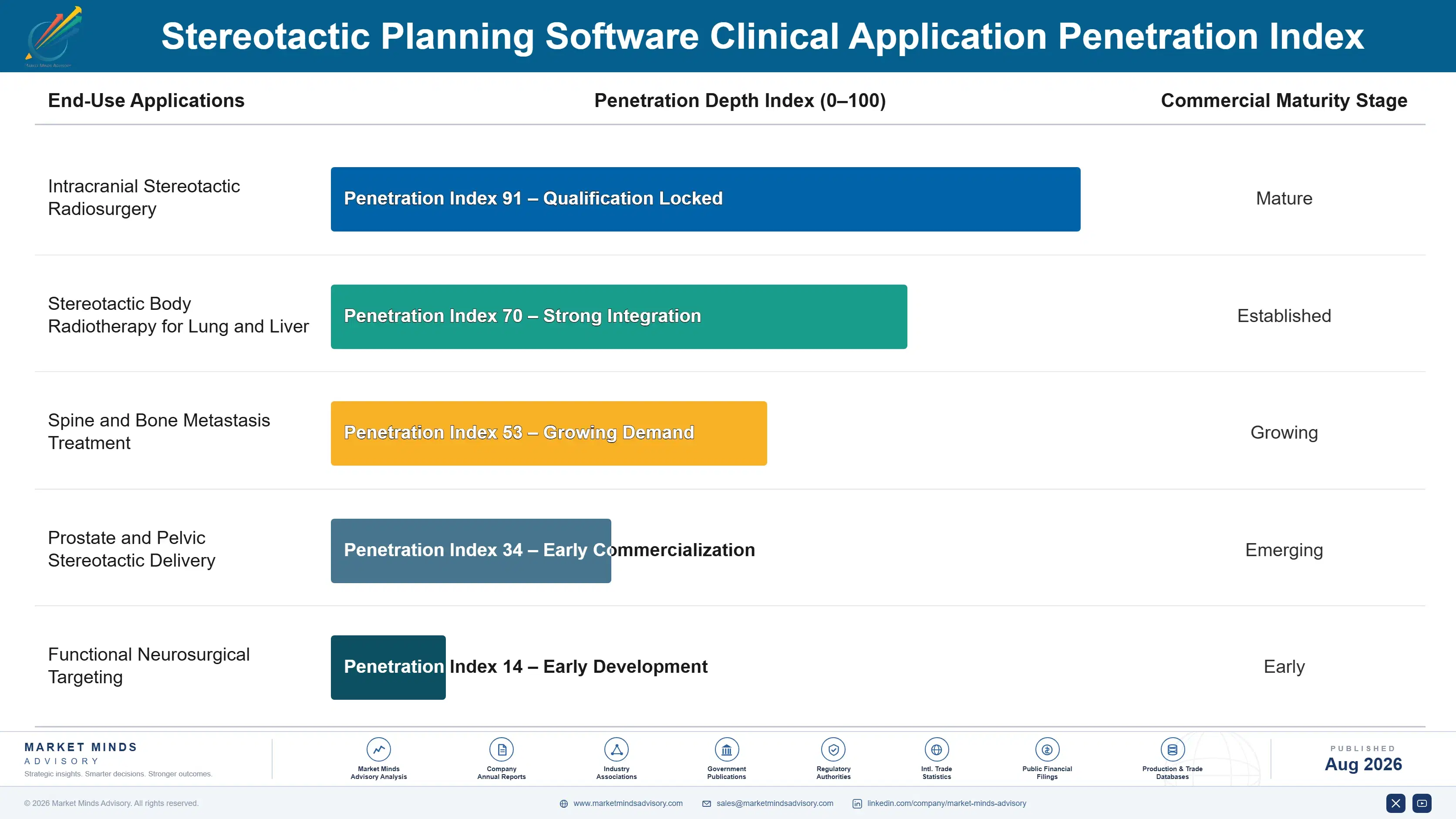
The annuity here is unusually strong and unusually quiet. Support and maintenance contracts renew almost automatically because a department cannot run clinically on unsupported planning software, and subscription conversion is turning that into a larger recurring number. Recurring revenue already accounts for 38% of vendor planning income. What varies is not whether renewal happens but whether the vendor uses the renewal conversation to sell capability or simply invoices for another year of the
Adoption depth differs sharply by clinical setting. Academic neurosurgery adopts trajectory automation deepest, since case complexity justifies it and residents learn on whatever the department runs. Large private radiotherapy networks adopt contouring automation fastest, because dosimetrist labour is their binding cost. Community radiotherapy centres adopt shallowly, running core planning and little else, constrained by physicist availability rather than by budget. Public systems in cost-constrained markets adopt almost nothing beyond the platform the machine arrived with.

Buyer profiles are shifting in a way that favours module vendors. Physicists trained in the last decade expect scripting access, open interfaces and continuous upgrade, and they treat closed platforms as a limitation rather than a reassurance. The generation retiring now built its careers validating single platforms exhaustively.
stereotactic-planning-software-market-end-use-penetration-index-1787309321212

What We Would Do Here

These are among the four positions where our research anticipates prominent divergence between winners and laggards over the coming forecast period. Each is grounded in the demand model, the regulatory perimeter, and the announced capacity pipeline.
01 / NEUROSURGICAL CHANNEL ACCESS

Build the neurosurgery relationship before functional planning consolidates

Functional trajectory planning compounds at 14.1%, exactly 1.50 times the market, and it is procured by neurosurgery on budgets radiotherapy incumbents never touch. Roughly 60 institutions account for the majority of stereo-electroencephalography volume, which makes the target list finite and the channel investment modest against the prize. Vendors waiting for radiotherapy procurement cycles to deliver this segment will find Brainlab and Medtronic already installed, and displacement in neurosurgery is harder than in radiotherapy, because the trained resident cohort works exactly like a validated physics platform.
02 / MIGRATION BARRIER REMOVAL

Fund the physics revalidation that blocks every competitive replacement

Dose calculation revalidation, not product capability, is why centres run platforms for over 7.5 years, and no procurement document has ever costed the physicist months it consumes. Vendors funding contract physics resource for commissioning win competitive replacement tenders roughly 25 points more often, at a cost well below first-year licence value. The barrier protecting incumbents is unpaid overtime, which means it can be bought, and remarkably few challengers have tried buying it, which is the cheapest competitive advantage available anywhere in this category.
03 / CAPABILITY TIERED PRICING

Stop pricing a workstation and start pricing clinical capability

Seat-based licensing charges a centre treating single lesions the same as one running single-isocentre multiple metastasis technique, which discards most of the value the software delivers. Capability tiering has raised realised revenue per site roughly 35% for vendors that implemented it, using licence enforcement most already possess. The obstacle is a sales conversation about clinical practice rather than headcount, and that is considerably cheaper to fix than any product gap, which is why the pricing change should precede the next development cycle entirely.
04 / ASIAN PRICE DEFENCE

Answer bundled domestic platforms on capability, never on price

Chinese accelerator manufacturers supplying planning software with locally built hardware quote at levels Western vendors cannot approach, and that expectation is already appearing in Gulf and Latin American tenders. Competing on price concedes the argument and the margin together. The defensible answer is clinical capability that domestic platforms do not yet support, backed by published outcome data, and vendors should expect roughly five years before that gap narrows meaningfully, by which point published outcome data will be the only defence still standing.

Engagement Snapshot From the Field

A live engagement with an industry participant carrying material or product regulatory and market exposure ahead of a defining policy shift, showing how our research translates into a defensible multi-year portfolio strategy.
MARKET MINDS ADVISORY · CLIENT ENGAGEMENT SUMMARY
Stereotactic Planning Software Producer Strategic Portfolio Review and Transition Roadmap 2026·Investment Scenario on Stereotactic Planning Software Exposure Evaluation 2025-26
CLIENT PROFILE
A mid-sized clinical software vendor supplying radiotherapy planning and quality assurance tools to roughly 340 centres across North America and Western Europe, with annual revenue near USD 78 million (client-reported, unverified by MMA). The company held strong physicist loyalty, hardware-neutral positioning it had built deliberately, seat-based perpetual licensing across most of the installed base, and no meaningful presence in functional neurosurgery planning.
STRATEGIC CHALLENGE
Revenue per site had been flat for four years despite steady module development, and the board could not establish why. Competitive losses were rare, renewal rates were high, and yet growth came almost entirely from new site additions in a market where new sites were becoming scarce. Management had proposed acquiring a contouring developer to restart growth, without first testing whether product was the constraint.
MMA APPROACH
MMA rebuilt realised revenue per site by capability level rather than by seat count, which had never been examined that way internally. Forty-seven expert interviews with medical physicists and neurosurgeons across both regions established what drove module purchase decisions and who actually controlled the budgets involved. Existing clearances were catalogued against the functional neurosurgery requirement to test how far the portfolio already reached.
KEY FINDINGS
  1. Centres running the most advanced techniques paid the same per seat as those planning single lesions, meaning the client captured almost none of the value its own most capable customers derived from the software.
  2. Renewal rates were high because unsupported planning software cannot be used clinically, not because customers valued the relationship, so retention data had been badly misread as satisfaction.
  3. Two existing cleared modules already covered most of the functional neurosurgery trajectory requirement, but no neurosurgeon interviewed had ever been called on by the client's sales team.
  4. Contouring acquisition targets were priced against clinical training datasets the client could partly assemble from its own installed base at a fraction of the acquisition cost.
CLIENT PROFILE
A mid-sized clinical software vendor supplying radiotherapy planning and quality assurance tools to roughly 340 centres across North America and Western Europe, with annual revenue near USD 78 million (client-reported, unverified by MMA). The company held strong physicist loyalty, hardware-neutral positioning it had built deliberately, seat-based perpetual licensing across most of the installed base, and no meaningful presence in functional neurosurgery planning.
STRATEGIC CHALLENGE
Revenue per site had been flat for four years despite steady module development, and the board could not establish why. Competitive losses were rare, renewal rates were high, and yet growth came almost entirely from new site additions in a market where new sites were becoming scarce. Management had proposed acquiring a contouring developer to restart growth, without first testing whether product was the constraint.
MMA APPROACH
MMA rebuilt realised revenue per site by capability level rather than by seat count, which had never been examined that way internally. Forty-seven expert interviews with medical physicists and neurosurgeons across both regions established what drove module purchase decisions and who actually controlled the budgets involved. Existing clearances were catalogued against the functional neurosurgery requirement to test how far the portfolio already reached.
KEY FINDINGS
  1. Centres running the most advanced techniques paid the same per seat as those planning single lesions, meaning the client captured almost none of the value its own most capable customers derived from the software.
  2. Renewal rates were high because unsupported planning software cannot be used clinically, not because customers valued the relationship, so retention data had been badly misread as satisfaction.
  3. Two existing cleared modules already covered most of the functional neurosurgery trajectory requirement, but no neurosurgeon interviewed had ever been called on by the client's sales team.
  4. Contouring acquisition targets were priced against clinical training datasets the client could partly assemble from its own installed base at a fraction of the acquisition cost.
RECOMMENDED STRATEGY
Phase 1: Phase 1 (0 to 6 months): Restructure licensing into capability tiers enforced through the existing licence server, and reprice renewals at the next contract anniversary rather than immediately. Phase 2: Phase 2 (6 to 18 months): Build a small neurosurgical sales channel targeting the sixty highest-volume functional centres, positioning the two existing cleared modules. Phase 3: Phase 3 (18 to 36 months): Assemble a contouring training dataset from consenting installed-base sites instead of acquiring one, and fund commissioning physics support on competitive tenders.
OUTCOME
The contouring acquisition was abandoned. Capability tiering lifted realised revenue per site by roughly 29% across renewed contracts within five quarters (client-reported, unverified by MMA). Nineteen functional neurosurgery centres were added as first-time customers. Competitive replacement win rates improved materially once commissioning physics support was funded within bids.

Frequently Asked Questions

Foundational context covering the market sizes, CAGR, scope, country, region and competition that inform every finding below. This section is provided to cover basics and most often pre-purchase conversations, answered from the MMA Primary Research Dataset.

What is the current size of the Stereotactic Planning Software Market?

MMA sizes the global stereotactic planning software market at USD 0.48 billion in 2025, rising to USD 0.53 billion in 2026. That covers licence, subscription and associated service revenue, excluding the hardware the software drives.

How large will the Stereotactic Planning Software Market be by 2036?

MMA forecasts USD 1.30 billion by 2036, an expansion multiple of 2.45 times the 2026 base. That represents roughly USD 0.77 billion of incremental value over the forecast period.

What is the CAGR for the Stereotactic Planning Software Market 2026 to 2036?

The base case compounds at 9.4% annually, with a bull case of 10.7% and a bear case of 8.1%. Subscription conversion and module pricing account for more of that growth than new installations do.

Which segment is growing fastest?

Functional neurosurgery and DBS lead trajectory planning compounds at 14.1%, exactly 1.50 times the market rate. Indication expansion and directional lead designs have made trajectory software clinically necessary rather than optional.

Who are the major companies in the Stereotactic Planning Software Market?

Elekta, Varian Medical Systems, Brainlab, Medtronic and RaySearch Laboratories together hold 72% of the installed planning licence base. Fifteen further participants including Accuray, MIM Software, Therapanacea and Radformation are profiled.

Which country is growing fastest?

India compounds at 12.4%, ahead of every other national market MMA tracks. Private hospital groups installing stereotactic capability as a service differentiator drive almost all of that growth.

Report Segmentation Architecture

The full report scope spans multiple orthogonal segmentation dimensions, with cross-tabulated demand data provided for each dimension pair. Coverage extends further to regional breakdowns, trend trajectories, and the competitive detail needed to support segment-level decision-making.

By Planned Procedure Type

  • Cranial Radiosurgery Planning
  • Extracranial Stereotactic Body Radiotherapy Planning
  • Functional Neurosurgery and DBS Lead Trajectory Planning
  • Stereotactic Biopsy and Catheter Trajectory Planning
  • Stereotactic Brachytherapy and Implant Planning
  • Intraoperative Stereotactic Navigation Planning

By End-Use Setting

  • Academic Medical Centres
  • Private Radiotherapy Networks
  • Community Hospital Radiotherapy Departments
  • Specialist Neurosurgical Centres
  • Public Cancer Agencies and Ministry Programmes

By Commercial Model

  • Perpetual Seat Licence
  • Annual Subscription
  • Hardware-Bundled Supply
  • Enterprise and Network Agreements

By Region

  • North America
  • Western Europe
  • East Asia
  • South Asia and Pacific
  • Latin America
  • Middle East and Africa
  • Eastern Europe

Scope, Methodology, and Coverage

Every figure in this report is reproducible from documented input assumptions. The scope below maps the historical period, the forecast horizon, the segmentation dimensions, and the countries covered, alongside the underlying primary and qualitative methodology.
Historical Period
2020 to 2025
Forecast Period
2026 to 2036
Base Year
2025 (USD billions; MMA Primary Research Dataset, August 2026)
Market Definition
The market comprises commercially supplied software used to define stereotactic targets, dose distributions and instrument trajectories, spanning cranial radiosurgery, stereotactic body radiotherapy, functional neurosurgery and lead trajectory, biopsy and catheter, brachytherapy implant, and intraoperative navigation planning applications. Sizing captures perpetual licence, subscription, module and associated service and support revenue at vendor realised prices. Excluded are linear accelerators, radiosurgery units, stereotactic frames, surgical robots and navigation hardware, along with general radiology image management, oncology information systems and hospital administrative software.
Quantitative Units
USD billions (current prices); installed planning licence seats; USD per seat realised where applicable
Segmentation Dimensions
By Planned Procedure Type; By End-Use Setting; By Commercial Model; By Region
Regions Covered
North America, Western Europe, East Asia, South Asia and Pacific, Latin America, Middle East and Africa, Eastern Europe
Countries Covered
USA, China, Germany, France, UK, Japan, South Korea, India, Australia, Canada, Brazil, Mexico, Indonesia, Vietnam, Thailand, Malaysia, UAE, Saudi Arabia, South Africa, Nigeria, Turkey, Poland, Netherlands, Italy, Spain, Sweden, Switzerland, Argentina, Colombia, Singapore, and additional markets relevant to this sector
Key Companies Profiled
Elekta, Varian Medical Systems, Brainlab, Medtronic, RaySearch Laboratories, Accuray, Philips Healthcare, MIM Software, Mirada Medical, Therapanacea, Limbus AI, Radformation, Renishaw, inomed Medizintechnik, Stryker, ScandiDos, Standard Imaging, Sun Nuclear, Neusoft Medical Systems, United Imaging Healthcare.
Quantitative Methodology
Primary survey, n=3,800 respondents, Q4 2025, six countries; demand-side model with trade association cross-validation
Qualitative Methodology
47 expert interviews, Q4 2025; applied to validate demand model assumptions, identify emerging dynamics, and assess competitive positioning
Report Format
PDF and XLSX data workbook (Word format preview document)
Publisher
Market Minds Advisory
Report Code
MMA-2026-TEC-025
Published
August 2026
Contact
sales@marketmindsadvisory.com | www.marketmindsadvisory.com

Purchase the full Stereotactic Planning Software Market Report (2026 to 2036).

The full report sizes the stereotactic planning software market across six planned procedure types, five end-use settings, four commercial models and seven regions, with annual forecasts to 2036 in revenue and installed licence seats. It quantifies realised revenue per site by capability level rather than by seat count, which is where most vendors misread their own economics. Twenty vendors are assessed on a consistent installed licence base, with regulatory clearance portfolios mapped against each procedure type. Subscription conversion progress and the physics revalidation barrier are modelled explicitly, since together they determine how quickly competitive displacement is possible.
Six planned procedure types sized and forecast
Revenue per site modelled by capability level
Twenty vendors on consistent licence base
Regulatory clearance portfolios mapped by procedure
Subscription conversion progress quantified by vendor
Physics revalidation barrier modelled explicitly by market

Built For The People Who Decide

From boardroom strategy to bench-side execution, this report is read cover-to-cover by leaders shaping the next decade of their industry, turning demand scenarios, market dynamics and valuation benchmarks into decisions.
CXOs/ Presidents/ VPs/ Managers
M&A and Corporate Development
Strategy Teams and R&D Heads
Procurement and Product Directors
Regulatory and Compliance Leaders
Investor Relations and Equity Analysts