Market Minds Advisory
Stent Graft Balloon Catheter Market

Stent Graft Balloon Catheter Market: The Accessory That Decides Whether the Implant Seals

A five hundred dollar balloon decides whether a fifteen thousand dollar aortic graft seals against the vessel wall. Only a small minority of hospitals ever purchase it as a deliberate decision.

Lead Analyst

Alice Ballenger

Published

September 2026

Make Smarter Decisions with Customized Research Insights

Request a free sample report and evaluate market opportunities, growth trends, and competitive dynamics relevant to your business needs.

2025 MARKET VALUE$0.5BMarket Size 2025
2036 FORECAST VALUE$0.9BBase Case , 2026 to 2036
CAGR 2026 TO 20366.2 %Bull 7.4% / Bear 5.0%
INCREMENTAL OPPORTUNITY$0.4BNet 10- year value creation
EXPANSION MULTIPLE1.82x2036 value over 2026 base
Strategic Levers
M&A Pipeline
Regional Outlook
Country Rankings
Competitive Intelligence
Segmental Deep-dive
Call-Us : 91 93563 13602

Executive Snapshot and Market Trajectory

The graft is the implant, and the balloon is an accessory used for perhaps two minutes at the very end of the case. It is also what presses the graft into the aortic wall, and therefore what decides whether the seal holds at all.
Growth runs at 6.2%, carried by thoracic and complex aortic repair volume rather than by elective infrarenal work, which has been flat to declining across several health systems since long-term durability data arrived. Trilobed flow-preserving balloons grow fastest at 9.3%, exactly 1.50 times the market rate, because they mould without fully interrupting aortic flow. Branch and fenestration moulding balloons follow at 8.5% on complex branched repair growth.
Concentration reaches 74% across the top five measured on annual moulding balloon units shipped alongside aortic graft procedures, which is very high and follows directly from the balloon arriving inside the graft supplier's box rather than from any engineering advantage whatsoever. Only 12% of hospitals purchase it outside the graft contract at all. North America holds 34%, above its framework band, on procedure rate and on device pricing, while China grows fastest at 9.6%.
Market Definition
This market covers balloon catheters used to mould, seat, and seal aortic stent grafts during endovascular aneurysm and dissection repair, measured at manufacturer realised prices, spanning single-lobe compliant, trilobed flow-preserving, branch and fenestration, low-profile small-access, reinforced high-pressure, and steerable shaped-tip designs. Stent grafts themselves, delivery systems, angioplasty and drug-coated balloons for peripheral or coronary use, resuscitative aortic occlusion balloons, and imaging equipment fall outside scope.
Base Year Value
$0.5B in 2025 (MMA Primary Research Dataset, August 2026)
Forecast Period
2026 to 2036, eleven discrete annual values
CAGR
6.2% base case. Bull 7.4%. Bear 5.0%.
Fastest Growth Segment
Trilobed Flow-Preserving Balloons: 9.3% CAGR
Fastest Growth Country
China: 9.6% CAGR
Fastest Growth Region
South Asia and Pacific: 8.4% CAGR
Largest Region
North America: 34% of 2025 global value
Market Leaders
Medtronic, W. L. Gore & Associates, Cook Medical, Terumo Aortic, Endologix. Source: MMA Analysis based on company annual reports.
Primary Survey
n=3,800 procurement and R&D decision-makers, Q4 2025, six countries
Methodology
Demand-side build-up, cross-validated against public data, 47 expert interviews

Stent Graft Balloon Catheter Market Forecast Scenarios

stent-graft-balloon-catheter-market-size-forecast-scenario-1787299656540
The 2020 to 2025 period ran at 5.2% and the underlying procedure mix changed more than the total did. Elective infrarenal aneurysm repair flattened and in several systems fell, as long-term follow-up data prompted guideline bodies to reconsider endovascular repair in younger fitter patients. Thoracic and complex branched repair grew steadily against that. Secondary interventions on previously repaired patients became a meaningful volume in their own right.
Three mechanisms carry the 6.2% base case. Thoracic and complex repair growth is the largest, since those procedures use more balloons per case and demand designs that mould around branches and fenestrations. Secondary intervention volume is the second, with roughly 18% of repaired patients returning for a further endovascular procedure that consumes another balloon. And Asian procedure expansion is the third, particularly type B dissection repair in China where volumes are already very large.
The 7.4% bull case rests on trilobed flow-preserving designs becoming standard practice rather than a preference, which would lift realised price across the majority of procedures. The 5.0% bear case is elective infrarenal repair contracting further as more health systems act on durability evidence, since that population still accounts for the largest single block of procedures using these devices.

Two Minutes That Decide the Repair

The economics of this device are upside down and worth stating plainly. An aortic stent graft costs a hospital somewhere between ten and fifteen thousand dollars. The compliant balloon used to press it against the vessel wall costs a few hundred, arriving as roughly 3.4% of the device spend for that case. What it does in those two minutes decides whether the proximal seal holds, and a Type I endoleak means the repair has not worked at all.
TOP FIVE CONCENTRATION74%Very high because the balloon arrives with the graft
ACCESSORY SHARE OF PROCEDURE3.4%Of device spend against the implant it actually seats
TYPE ONE ENDOLEAK RATE6%Of repairs showing seal failure at the proximal landing
SECONDARY INTERVENTION RATE18%Of patients returning for a further endovascular procedure later
OCCLUSION TIME PER INFLATION22 secondsOf interrupted aortic flow during a conventional moulding inflation
SEPARATE TENDER SHARE12%Of hospitals purchasing this accessory outside the graft contract
That mismatch shapes procurement in a way few categories experience. Only 12% of hospitals purchase moulding balloons outside the graft contract, because the balloon arrives in the box and nobody in supply chain has a reason to look at it separately. Independent balloon makers are therefore competing for a decision that formally does not exist, which explains concentration at 74% far better than any technical advantage does.
The clinical argument that does travel concerns flow. A conventional single-lobe balloon occludes the aorta completely for around 22 seconds per inflation, which produces a transient pressure and cardiac load that older patients tolerate poorly. Trilobed designs allow blood past the balloon while still moulding, and they grow at 9.3% for exactly that reason.
"Ask a vascular surgeon which moulding balloon they prefer and you get a detailed answer. Ask the hospital who supplies it and you often get a shrug, because it came in the box. That gap between preference and purchasing is the whole commercial problem here."
Director, Endovascular Devices and Aortic Intervention Practice · MMA Medical De

Market Trends

Flow-Preserving Designs Address The Occlusion Problem

A conventional compliant balloon seals the aorta completely while it moulds, interrupting flow for around 22 seconds per inflation and producing a transient pressure surge above the balloon with reduced perfusion below it. Older patients with limited cardiac reserve tolerate that poorly, and repeated inflations compound the effect across a long case. Trilobed designs mould the graft while allowing blood to pass between the lobes, which removes the occlusion entirely. Growth runs at 9.3% against 6.2% for the market, driven by surgeon preference rather than by any procurement decision. Procurement rarely knows the difference exists at all.
Market Impact: Reintervention affects 18% of patients
Complex Branched Repair Uses More Balloons Per Case

A straightforward infrarenal repair needs one moulding balloon and sometimes none at all. A fenestrated or branched repair involving renal and visceral vessels requires moulding at each branch, at every stent junction, and at both landing zones, which routinely consumes three or four balloons in a single procedure. As complex repair grows and elective infrarenal work flattens, units per procedure rise even where the total procedure count does not. Branch and fenestration designs grow at 8.5%, well ahead of the market as a whole. Manufacturers planning on case counts rather than units consumed understate their own volume.
Market Impact: China grows at 9.6% annually

Market Opportunities and Growth Drivers

Secondary Interventions Create A Second Device Market

Roughly 18% of patients treated with an endovascular aortic repair return for a further procedure, most commonly to address an endoleak, component separation, or graft migration identified on surveillance imaging. Each of those procedures consumes another moulding balloon and frequently more than one, since sealing a proximal extension cuff demands the same moulding step as the original repair did. That reintervention population accumulates every year on top of new procedures, which makes it a compounding volume rather than a fixed proportion. Surveillance imaging identifies most of them years in advance, which makes this unusually forecastable volume.
Market Impact: Only 12% purchase separately

Chinese Dissection Repair Volume Is Already Very Large

Type B aortic dissection presents far more frequently in China than in Western populations, and thoracic endovascular repair has become the standard response across a hospital network that has expanded rapidly. Procedure volumes there rival or exceed anything in North America or Europe, though realised device prices sit far below Western levels. China contributes the fastest national growth rate in this forecast at 9.6%, driven by that volume alongside domestic manufacturers taking an increasing share of the accessories used in it. Western manufacturers hold a shrinking position within it. That share keeps shrinking.
Market Impact: Affects largest procedure block, 6% endoleak

Market Restraints and Challenges

Only Twelve Percent Of Hospitals Buy It Separately

Moulding balloons arrive bundled or on consignment with the graft in the overwhelming majority of cases, and only 12% of hospitals run a separate purchasing decision on them at all. The root cause is that supply chain functions evaluate the implant and treat everything else in the box as included. Commercial impact is that independent balloon makers compete for a decision nobody formally takes, regardless of clinical preference. Mitigation runs through surgeon-led product requests, separate coding in hospital catalogues, and evidence that the balloon affects outcomes. None of that happens without somebody funding the administrative work.
Market Impact: Removes 22 seconds of occlusion

Elective Infrarenal Repair Volume Has Stopped Growing

Long-term follow-up showing late reintervention and mortality convergence against open repair prompted several guideline bodies to restrict endovascular repair in younger fitter patients with infrarenal aneurysms. The root cause is durability evidence rather than any device failure, and it arrived only after two decades of follow-up were available. Commercial impact falls on the largest single procedure block using these devices. Manufacturers are responding by concentrating development on thoracic, branched, and fenestrated work where the clinical argument remains unambiguous. Thoracic and dissection repair carry the growth instead, and both use more balloons per case.
Market Impact: Uses 3 to 4 balloons
3 additional market trends, 4 additional growth drivers, and 2 additional restraints and challenges are covered in the full report. Contact sales@marketmindsadvisory.com to access the complete intelligence.

Segment CAGR and Growth Architecture

Segmentation follows balloon architecture, because architecture determines whether aortic flow is interrupted during moulding, which anatomy the device can reach, how many are consumed per procedure, and what a manufacturer can realise on price. Procedure type and access route both cut across every architecture rather than separating them cleanly, which leaves either a weak primary dimension.
stent-graft-balloon-catheter-market-market-share-analysis-1787299657069

Trilobed Flow-Preserving Balloons

The fastest architecture at 9.3%, exactly 1.50 times the market rate, and the only one that solves the problem surgeons actually complain about. Three lobes press the graft against the vessel wall while leaving channels for blood to pass between them, which removes the roughly 22 seconds of complete aortic occlusion a conventional single-lobe inflation requires. Patients with limited cardiac reserve tolerate that far better, and long thoracic cases involving several inflations benefit most of all. Adoption is driven almost entirely by surgeon preference, since no procurement process in most hospitals ever considers the choice at all. Where separate coding exists, this design wins most comparisons it enters. Elsewhere the better design never reaches the room.
CAGR 9.3%

Branch And Fenestration Moulding Balloons

Second fastest at 8.5%, and the architecture growing with complex aortic repair rather than with total procedure counts. Fenestrated and branched grafts require moulding at each renal and visceral vessel junction as well as at both landing zones, which needs smaller diameters, shorter working lengths, and shaft designs that track around a branch without displacing the stent already placed. A single complex case consumes three or four of these where an infrarenal repair uses one. Manufacturers without a branched graft platform struggle to enter, since the balloon is developed alongside the implant it has to seat. That coupling closes the segment rather than merely making it competitive. Balloon capability alone counts for nothing here.
CAGR 8.5%
Full segment breakdown across 6 segments available in the complete report.

Regional Architecture and Country Demand Map

Two different things drive the regional picture and they do not point the same way. Procedure volume is heavily weighted toward Asian dissection repair, while realised value follows North American pricing and elective repair rates, which is why the shares diverge from any procedure count.

North America

Thirty-four percent, above the framework band, and two things justify it together: the highest elective endovascular repair rate per capita anywhere, and device pricing that runs at multiples of Asian levels for equivalent products. Screening programmes for abdominal aortic aneurysm identify candidates earlier than in most systems, which sustains elective volume even as guideline debate continues. Complex branched and fenestrated repair is concentrated in a modest number of high-volume centres. Growth at 5.2% sits below the global rate, reflecting a mature elective base and the beginnings of the same durability debate now reshaping European practice. Reintervention volume on a very large repaired population adds a further block of units that manufacturers here have historically not counted separately in their planning.
Share: 34% | CAGR: 5.2% (2026 to 2036)

East Asia

Procedure volume rather than pricing gives this region its position, and the dominant driver is type B aortic dissection, which presents far more frequently across East Asian populations than Western ones. Chinese thoracic endovascular repair volumes rival or exceed anything performed in North America, delivered through a hospital network that expanded very quickly over the past decade. China contributes the fastest national growth rate in this forecast at 9.6%. Japanese practice is mature, high in complex repair, and well documented. Growth at 7.6% runs above the global rate on volume expansion and on rising complex case share across both markets. Domestic manufacturers now supply a substantial share of the accessories used in Chinese procedures.
Share: 24% | CAGR: 7.6% (2026 to 2036)
Regional intelligence for 5 additional markets available in the complete report: Western Europe, South Asia and Pacific, Latin America, Middle East and Africa, Eastern Europe. Contact sales@marketmindsadvisory.com.
stent-graft-balloon-catheter-market-country-cagr-analysis-1787299657589

Selling What Nobody Formally Buys

Only 12% of hospitals purchase this device outside the graft contract, which means the commercial problem here is creating a purchasing decision rather than winning one. Value comes from arming surgeons to request a product by name, from building real outcome evidence, from following complex repair growth, and from serving the reintervention population deliberately.

Create The Purchasing Decision That Does Not Exist

Independent balloon makers lose most of their potential volume before any comparison happens, because the device arrives in the graft box and no separate line ever reaches procurement. Getting a distinct catalogue code established, and a surgeon willing to request it by name, converts a non-decision into a decision the product can actually win. Hospitals that adopted separate coding moved from 12% to well above half on considered selection within two years. The work is administrative rather than clinical and almost nobody funds it properly. Distributors will not fund it either, since the benefit accrues to the manufacturer.
Market Impact: Considered selection rises above 50% within two years

Build Outcome Evidence On Seal Quality

Type I endoleak occurs in roughly 6% of repairs and means the procedure has not achieved what it set out to do, yet almost no published work links moulding technique or balloon design to that rate. A registry study connecting the two would cost in the region of 3 million dollars and would convert a preference argument into a procurement argument for the first time. It would also be usable in every market simultaneously. Manufacturers have avoided it because the finding might not favour them, which is exactly why the first mover gains most.
Market Impact: A registry study costs around 3 million dollars

Follow Complex Repair Rather Than Elective Volume

Elective infrarenal repair has flattened and in several systems declined, while fenestrated and branched work grows and consumes 3 to 4 balloons per case instead of one. Development and commercial attention weighted toward the shrinking block is a straightforward misallocation that several manufacturers are still making. Complex repair also concentrates in high-volume centres, which means a smaller and more reachable customer set to cover. Units per procedure rather than procedures themselves is the number that should drive planning here, and almost nobody plans that way. Coverage models still follow the old geography.
Market Impact: Complex cases use 3 to 4 balloons each

Serve The Reintervention Population As A Deliberate Target

Around 18% of repaired patients return for a further endovascular procedure, and that population accumulates every year on top of new cases rather than replacing them. Each reintervention consumes another moulding balloon, frequently under more difficult anatomy than the original repair presented. Manufacturers tracking only primary procedure volume understate their addressable units by roughly a fifth and plan capacity accordingly. Surveillance imaging registries identify these patients years before they return, which makes the volume unusually forecastable for a device business. Territory planning built on primary cases alone therefore misses a fifth of the units available in every market.
Market Impact: Understates addressable units by roughly 18% per market

Who Controls the Margin Pool

Concentration reaches 74% across the top five measured on annual moulding balloon units shipped alongside aortic graft procedures, which is very high for a device of this technical simplicity. The explanation is distribution rather than engineering: the balloon arrives inside the graft supplier's box, and with only 12% of hospitals purchasing separately, a competitor with a better product has no route to the case. The gap between leader and challenger tracks graft market position almost exactly
Competitive activity runs on three fronts. Graft platform position is the first and it decides most of the outcome before any clinical comparison occurs. Flow preservation is the second, where trilobed designs have genuine surgeon preference behind them at 9.3% growth. And branched compatibility is the third, since a balloon that cannot mould at a renal fenestration is unusable in the fastest growing procedure type.

Pressure comes from two directions. Chinese domestic manufacturers are taking accessory volume within their own very large dissection repair market. And separate catalogue coding, where hospitals adopt it, opens a decision that graft bundling has closed for two decades.
stent-graft-balloon-catheter-market-company-positioning-matrix-1787299658107

Competitive Moat and Risk Dimensions

MEDTRONIC

Moat: Balloon travels with graft platform

A large installed aortic graft position means the moulding balloon reaches the case automatically, without competing for a purchasing decision that most hospitals never formally make. That distribution advantage is worth considerably more than any design difference, and it renews with every graft contract. Competitors with better balloons still have no route into the procedure at all.
MEDTRONIC

Risk: Tied to elective repair volume

A position that depends on graft bundling inherits whatever happens to graft volume, and elective infrarenal repair has flattened as durability evidence reshaped guidelines. Growth now sits in complex branched work and in Asian dissection repair, which are different customer sets. Bundling that protects share also transmits every decline in the underlying procedure directly through to the accessory.
W. L. GORE & ASSOCIATES

Moat: Flow-preserving design leadership

Trilobed designs that mould without occluding the aorta answer the objection surgeons raise most often, particularly in long thoracic cases requiring several inflations in patients with limited cardiac reserve. That preference is genuine and clinician-led, which makes it durable in a way that a procurement advantage is not. It also grows at 9.3% against 6.2% for the market overall.
W. L. GORE & ASSOCIATES

Risk: Preference without purchasing authority

Surgeon preference converts into revenue only where a hospital makes a separate purchasing decision, and just 12% currently do. A clinically superior product competing against a bundled one loses on process rather than on merit. Building the catalogue coding and requisition pathway that turns preference into orders is administrative work that clinical strength does not accomplish by itself.

Players Tracked

Prominent Players

Medtronic
W. L. Gore & Associates
Cook Medical
Terumo Aortic
Endologix

Other Key Players

Becton Dickinson
Getinge
Artivion
MicroPort
Lifetech Scientific
Bentley InnoMed
Merit Medical Systems
Teleflex
Cardinal Health
B. Braun
Biotronik
iVascular
Sino Medical Sciences Technology
Grikin Advanced Materials
Cordis

Recent Developments

JANUARY 2025

Manufacturer launches low-profile moulding balloon for branched repair

A device manufacturer introduced a smaller diameter moulding balloon with a shorter working length designed to seat branch stents at renal and visceral fenestrations without displacing components already placed. The launch was a product introduction rather than any joint venture, licensing arrangement, or acquisition of a competing accessory business.
Signal: Complex repair consumes three or four balloons per case, which is where units per procedure actually grow
APRIL 2025

Hospital group establishes separate catalogue coding for moulding balloons

A multi-hospital group created distinct purchasing codes for aortic moulding balloons, removing them from bundled graft contracts so that clinical preference could be recorded and compared across sites. The change was an internal procurement policy decision rather than any supply agreement or arrangement with a device manufacturer.
Signal: Separate coding opens a purchasing decision that graft bundling has quietly closed for the last two decades
AUGUST 2025

Chinese manufacturer expands aortic accessory production for domestic dissection repair

A Chinese device manufacturer expanded production of aortic moulding balloons and related accessories aimed at the domestic thoracic endovascular repair market, where type B dissection volumes are very large. The expansion was organic capital investment rather than any joint venture, technology licensing, or acquisition of foreign capability.
Signal: Accessory volume inside the largest dissection repair market is now moving steadily toward domestic manufacture instead

What A Moulding Balloon Costs

Medical grade polymer dominates at roughly 34% of cost of goods, split between the balloon material itself, usually a polyamide or polyurethane blend, and the catheter shaft extrusion. Those grades come from a small number of qualified compounders in Europe and North America. Sterilisation adds about 15%, radiopaque marker bands and hub components around 13%, and packaging with quality release carries the remainder of it.
European polymer availability through 2022 and 2023 was the exposure that mattered, since energy costs and feedstock tightness moved medical grade production alongside industrial grades. IEA reporting on European industrial electricity prices documented the underlying movement in detail. The device-specific problem was that a medical grade resin cannot simply be substituted: biocompatibility testing and regulatory change notification take months, so manufacturers with one qualified grade held production rather than switching.

The competitive disadvantage mechanism runs through regulatory qualification rather than through purchasing scale. A manufacturer holding two qualified polymer grades on the same device moves between them when supply tightens, while a single-grade manufacturer stops and waits. Exposure also varies by portfolio breadth, since a company making one balloon design carries the whole risk on one qualification while a broader range spreads it across several.
stent-graft-balloon-catheter-market-cost-volatility-analysis-1787299658302

Qualify a second medical grade polymer on every design

Biocompatibility testing and regulatory change notification take months and cannot be compressed once a supply problem has already arrived, which is why the work has to be done well in advance of needing it. Holding two qualified grades lets production move between them when one tightens. The qualification cost is modest against finished goods held waiting.

Validate more than one sterilisation route per product

Contract sterilisation capacity has tightened repeatedly as emissions controls reduced available ethylene oxide throughput across several regions. Qualifying gamma or electron beam alongside it on the same device lets volume move when one route constrains. Manufacturers who treated a single validated route as sufficient discovered the cost of that assumption in held inventory rather than in the qualification budget.

Standardise shaft and hub components across the balloon range

Designing each balloon around bespoke shaft extrusion and hub tooling multiplies component cost, lengthens qualification, and removes any purchasing scale on the parts that are not clinically differentiating. Standardising them across the range concentrates volume on fewer part numbers and shortens the change notification path considerably. It also makes second-source qualification far cheaper to maintain over time.

Portfolio Architecture for Margin Defence

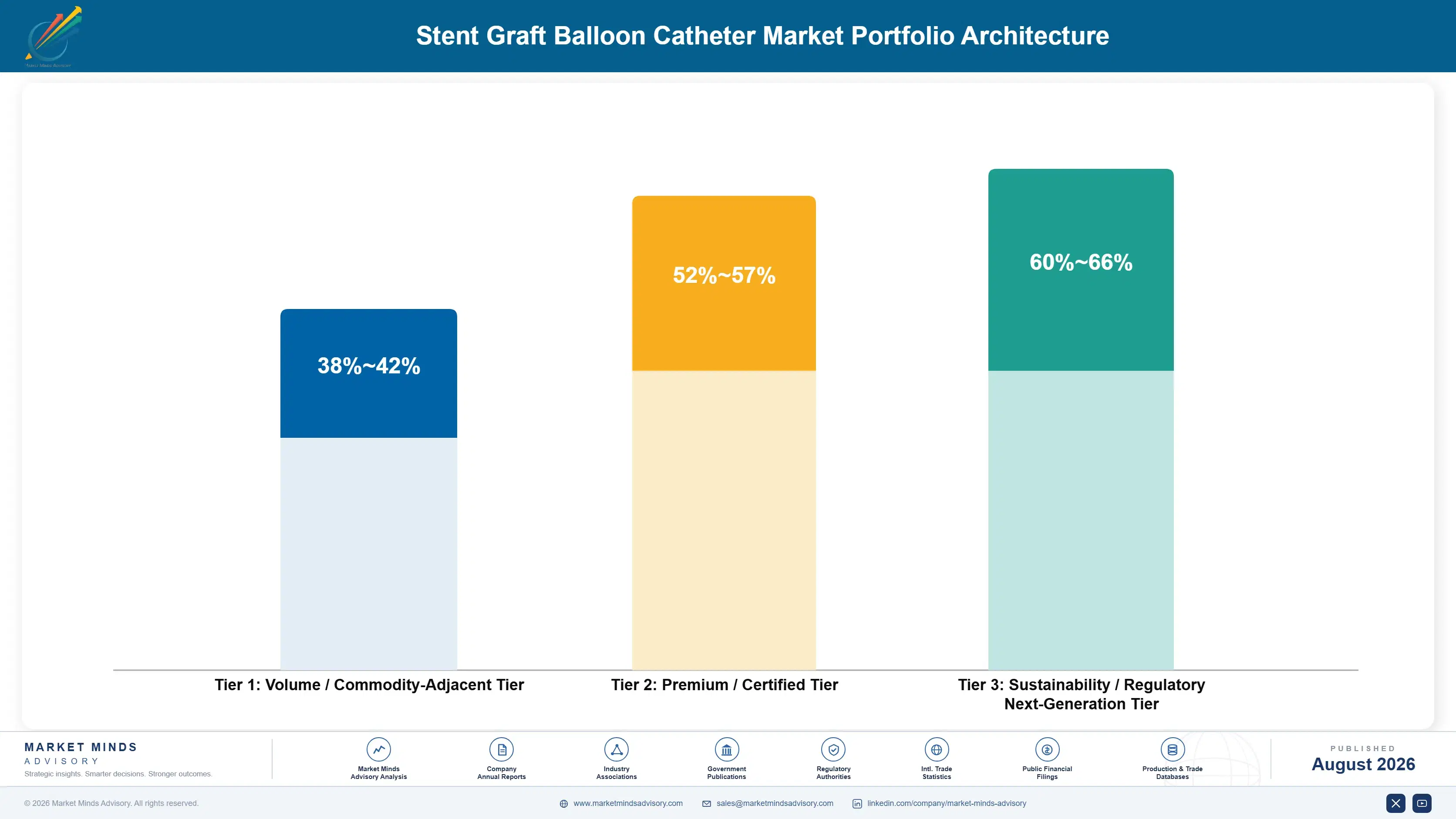
Three tiers describe this business and the spread is set by whether the device reaches the case on merit or in a box. Basic single-lobe moulding balloons sit at the bottom, bundled with grafts and effectively priced inside the implant contract. Flow-preserving trilobed designs sit higher where surgeon preference is genuine and separate coding exists. Branch and fenestration balloons occupy a third tier developed alongside complex graft platforms.
The tension is that the bundled tier carries the volume that funds everything. Manufacturing scale, polymer qualification, and sterilisation validation all need throughput underneath them, and basic moulding balloons supplied with graft contracts provide it. Manufacturers who tried to compete only on premium flow-preserving designs found their unit costs uncompetitive on the very products where they had a genuine clinical advantage to sell.

High-value pools concentrate where the balloon cannot be separated from the implant platform. Branch and fenestration designs are developed with the graft they seat, which locks out any manufacturer lacking a complex aortic platform of its own regardless of balloon capability. That coupling is the most durable protection anywhere in this category, and it does not depend on any patent or on any procurement decision going the right way.

Volume / Commodity-Adjacent Tier

Single-lobe compliant moulding balloons supplied bundled or on consignment with aortic graft contracts. Effectively priced inside the implant, with thin realised margin, but the throughput that funds polymer qualification, sterilisation validation, and manufacturing scale for everything else.
Gross Margin: 38-42%

Premium / Certified Tier

Trilobed flow-preserving designs selected on surgeon preference where separate catalogue coding allows a genuine choice. Margin reflects clinical differentiation on aortic occlusion time rather than manufacturing complexity, which is modest across every design in this category.
Gross Margin: 52-57%

Sustainability / Regulatory / Next-Generation Tier

Branch and fenestration moulding balloons developed alongside complex aortic graft platforms and sold into the fastest growing procedure type. Best margin because the device cannot be supplied by anybody lacking the graft platform it was designed to seat.
Gross Margin: 60-66%
stent-graft-balloon-catheter-market-portfolio-architecture-1787299658800

High-value Sub-segments and Strategic Watch-out

Branch And Fenestration Balloons

Best margin and 8.5% growth, developed alongside the complex graft platforms they seat and therefore closed to any manufacturer without one. Complex cases consume three or four units where an infrarenal repair uses one, so units per procedure rise independently of case counts. Nobody else can supply them.
Gross Margin: 60-66%

Trilobed Flow-Preserving Balloons

Fastest growth at 9.3%, exactly 1.50 times the market rate, and the only design answering the objection that surgeons actually raise about aortic occlusion during a moulding inflation. Preference is genuine and clinician-led, but it converts to revenue only where separate purchasing coding already exists.
Gross Margin: 52-57%

Bundled Single-Lobe Balloons

The volume core at compressed realised margin, priced effectively inside the graft contract and increasingly served by domestic manufacturers in Asian markets. It nonetheless funds the qualification and manufacturing scale that the differentiated tiers above it entirely depend upon. Exiting it would raise unit cost everywhere else.
Gross Margin: 38-42%

Elective Infrarenal Procedure Exposure

The strategic watch-out, since that procedure block still supplies the largest share of units while guideline bodies keep reconsidering endovascular repair in younger fitter patients. Any further contraction removes volume that complex repair growth does not fully replace. Manufacturers weighted here should already be reweighting toward complex work.
Gross Margin: 38-42%

How These Units Actually Accrue

Demand accrues per procedure rather than per patient, and the two diverge more than most device categories. A straightforward infrarenal repair consumes one balloon or none. A fenestrated or branched case consumes three or four, moulding at each visceral junction and at both landing zones. Then roughly 18% of repaired patients return for a secondary intervention consuming further units, and that reintervention population accumulates annually rather than replacing anything, which makes total unit
Stickiness depends entirely on how the device reached the case. Bundled balloons stick exactly as long as the graft contract does and no longer, transferring wholesale when a hospital changes implant supplier. Devices selected on surgeon preference under separate coding stick far harder, because a clinician who has adopted a technique around a specific design does not readily change it. Complex branch balloons stick hardest of all, being inseparable from the graft platform they were built for.

Buyer profiles are split awkwardly. Surgeons hold clear preferences and almost no purchasing authority, while supply chain holds the authority and rarely examines the item at all. Bridging that gap is administrative work rather than clinical, and it is what decides who actually wins.
stent-graft-balloon-catheter-market-end-use-penetration-index-1787299659290

What We Would Tell a Board

These are among the four positions where our research anticipates prominent divergence between winners and laggards over the coming forecast period. Each is grounded in the demand model, the regulatory perimeter, and the announced capacity pipeline.
01 / PURCHASING DECISION CREATION

You cannot win a decision nobody actually makes

Only 12% of hospitals purchase moulding balloons outside the graft contract, which means most potential volume is lost before any clinical or commercial comparison ever happens at all. Establishing a distinct catalogue code and a surgeon willing to request the product by name converts a non-decision into a contest the product can win on merit. Hospitals adopting separate coding moved considered selection above half within two years, and the work involved is administrative rather than clinical, which is exactly why nobody has funded it properly.
02 / SEAL OUTCOME EVIDENCE

Nobody has linked balloon practice to endoleak rates

Type I endoleak occurs in roughly 6% of repairs and means the procedure failed to achieve what it was performed to do, yet almost no published work connects moulding technique or balloon design to that outcome. A registry study linking the two would cost around 3 million dollars, apply in every market at once, and convert a surgeon preference into an argument procurement departments can actually act upon. Manufacturers have avoided it because the answer might not favour them, which is precisely why moving first matters.
03 / COMPLEX REPAIR WEIGHTING

Units per procedure, not procedures, drives this business

Elective infrarenal repair has flattened and declined in several systems while fenestrated and branched work grows and consumes three to four balloons per case rather than one. Development and commercial attention still weighted toward the contracting block is a straightforward misallocation that several manufacturers continue to make year after year. Complex repair also concentrates in high-volume centres, which makes the customer set smaller, more reachable, and considerably cheaper to serve properly than the scattered elective population ever was to reach.
04 / REINTERVENTION VOLUME PLANNING

A fifth of patients come back and nobody counts them

Around 18% of patients treated endovascularly return for a further procedure, and that population accumulates every year on top of new cases rather than substituting for any of them. Each return consumes another moulding balloon under anatomy usually more difficult than the original repair presented. Manufacturers tracking primary procedure volume alone understate addressable units by roughly a fifth, and surveillance imaging registries identify these patients years ahead of their return, which makes this volume unusually forecastable for a device business of any kind.

Engagement Snapshot From the Field

A live engagement with an industry participant carrying material or product regulatory and market exposure ahead of a defining policy shift, showing how our research translates into a defensible multi-year portfolio strategy.
MARKET MINDS ADVISORY · CLIENT ENGAGEMENT SUMMARY
Stent Graft Balloon Catheter Producer Strategic Portfolio Review and Transition Roadmap 2026·Investment Scenario on Stent Graft Balloon Catheter Exposure Evaluation 2025-26
CLIENT PROFILE
An endovascular device manufacturer with approximately 95 million dollars of annual revenue in aortic accessories (client-reported, unverified by MMA), supplying moulding balloons and related devices across Europe and North America without holding an aortic graft platform of its own. The product range was clinically well regarded, sold through distributors, and carried no published outcome evidence of any kind.
STRATEGIC CHALLENGE
Unit volume had been flat for four years despite consistently favourable surgeon feedback in every market surveyed by the company. Management proposed a substantial price reduction to win position inside graft supplier bundles. The board wanted an independent view on whether price was genuinely the obstacle before approving a margin reduction across the entire range.
MMA APPROACH
We traced how moulding balloons actually reached the procedure across sixty hospitals, separating bundled supply from consignment and from separate purchase. Surgeon preference was surveyed against what was physically available in the room. Procedure mix was analysed by units consumed rather than by case count, and the reintervention population was sized from surveillance registry data across the client's markets.
KEY FINDINGS
  1. Only seven of the sixty hospitals reviewed operated any separate purchasing code for moulding balloons, and in the remainder the device simply arrived with the graft.
  2. Surgeon preference favoured the client's flow-preserving design in a clear majority of responses, while actual usage tracked whichever graft supplier held the implant contract almost exactly.
  3. Units consumed per complex branched case ran three to four times an infrarenal repair, and the client's commercial coverage was weighted toward the declining elective block.
  4. Reintervention procedures across the client's markets represented roughly a fifth of addressable units and appeared nowhere in the demand forecast or the territory plan.
CLIENT PROFILE
An endovascular device manufacturer with approximately 95 million dollars of annual revenue in aortic accessories (client-reported, unverified by MMA), supplying moulding balloons and related devices across Europe and North America without holding an aortic graft platform of its own. The product range was clinically well regarded, sold through distributors, and carried no published outcome evidence of any kind.
STRATEGIC CHALLENGE
Unit volume had been flat for four years despite consistently favourable surgeon feedback in every market surveyed by the company. Management proposed a substantial price reduction to win position inside graft supplier bundles. The board wanted an independent view on whether price was genuinely the obstacle before approving a margin reduction across the entire range.
MMA APPROACH
We traced how moulding balloons actually reached the procedure across sixty hospitals, separating bundled supply from consignment and from separate purchase. Surgeon preference was surveyed against what was physically available in the room. Procedure mix was analysed by units consumed rather than by case count, and the reintervention population was sized from surveillance registry data across the client's markets.
KEY FINDINGS
  1. Only seven of the sixty hospitals reviewed operated any separate purchasing code for moulding balloons, and in the remainder the device simply arrived with the graft.
  2. Surgeon preference favoured the client's flow-preserving design in a clear majority of responses, while actual usage tracked whichever graft supplier held the implant contract almost exactly.
  3. Units consumed per complex branched case ran three to four times an infrarenal repair, and the client's commercial coverage was weighted toward the declining elective block.
  4. Reintervention procedures across the client's markets represented roughly a fifth of addressable units and appeared nowhere in the demand forecast or the territory plan.
RECOMMENDED STRATEGY
Phase 1: Phase 1 (months one to nine): cancel the price reduction and fund catalogue coding and requisition pathway work at the highest-volume aortic centres. Phase 2: Phase 2 (months nine to twenty-four): commission registry analysis linking moulding practice and balloon design to proximal seal failure rates. Phase 3: Phase 3 (months twenty-four to forty): reweight commercial coverage toward complex repair centres and the reintervention population. Units per procedure should drive coverage.
OUTCOME
The price reduction was cancelled. Separate catalogue coding was established at nineteen centres within four quarters and unit volume in those accounts rose sharply, registry analysis was commissioned, and territory planning was rebuilt on units per procedure rather than case counts (client-reported, unverified by MMA).

Frequently Asked Questions

Foundational context covering the market sizes, CAGR, scope, country, region and competition that inform every finding below. This section is provided to cover basics and most often pre-purchase conversations, answered from the MMA Primary Research Dataset.

What is the current size of the Stent Graft Balloon Catheter Market?

The market is valued at USD 0.48 billion in 2025, rising to USD 0.51 billion in 2026. Scope covers moulding balloons used to seat aortic stent grafts, not the grafts themselves.

How large will the Stent Graft Balloon Catheter Market be by 2036?

MMA forecasts USD 0.93 billion by 2036, an increase of USD 0.42 billion over the 2026 base. That represents an expansion multiple of 1.82 times across the forecast period.

What is the CAGR for the Stent Graft Balloon Catheter Market 2026 to 2036?

The base case CAGR is 6.2%, with a bull case of 7.4% and a bear case of 5.0%. The historical rate from 2020 to 2025 was 5.2%, so growth is accelerating modestly.

Which segment is growing fastest?

Trilobed flow-preserving balloons at 9.3%, exactly 1.50 times the market rate. They mould the graft while allowing blood past the lobes, removing around 22 seconds of aortic occlusion.

Who are the major companies in the Stent Graft Balloon Catheter Market?

Medtronic, Gore, Cook Medical, Terumo Aortic, and Endologix lead on annual units shipped alongside graft procedures. The top five hold 74% between them, almost entirely through graft bundling rather than product advantage.

Which country is growing fastest?

China at 9.6%, driven by type B aortic dissection repair volumes that rival or exceed anything in North America, alongside domestic manufacturers taking accessory share within that market.

Report Segmentation Architecture

The full report scope spans multiple orthogonal segmentation dimensions, with cross-tabulated demand data provided for each dimension pair. Coverage extends further to regional breakdowns, trend trajectories, and the competitive detail needed to support segment-level decision-making.

By Balloon Architecture

  • Single-Lobe Compliant Moulding Balloons
  • Trilobed Flow-Preserving Balloons
  • Branch And Fenestration Moulding Balloons
  • Low-Profile Small-Access Balloons
  • Reinforced High-Pressure Moulding Balloons
  • Steerable And Shaped-Tip Balloon Catheters

By Procedure Type

  • Infrarenal Endovascular Aneurysm Repair
  • Thoracic Endovascular Aortic Repair
  • Fenestrated And Branched Complex Repair
  • Type B Aortic Dissection Repair
  • Secondary And Revision Endovascular Procedures

By Purchasing Channel

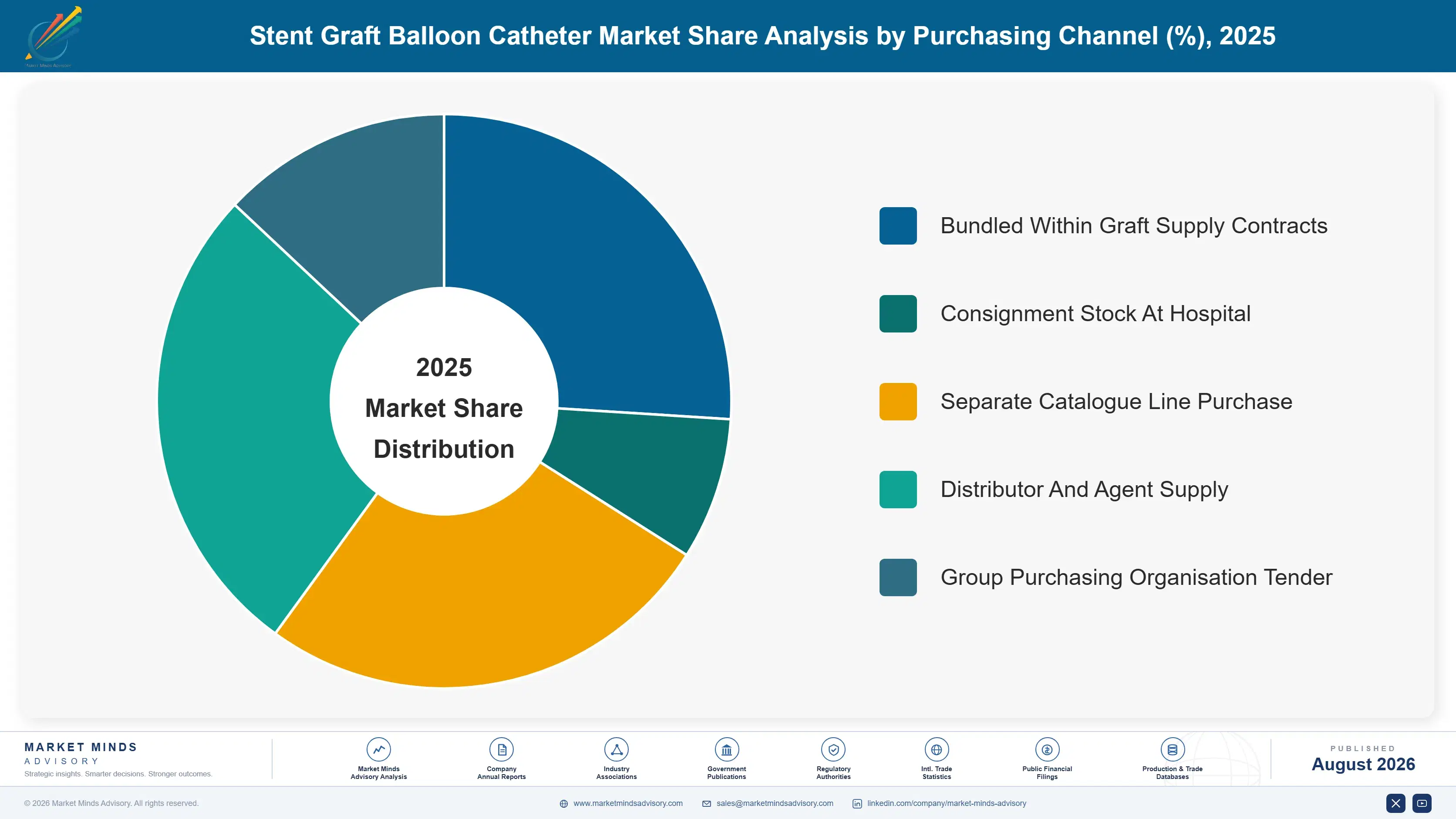
  • Bundled Within Graft Supply Contracts
  • Consignment Stock At Hospital
  • Separate Catalogue Line Purchase
  • Distributor And Agent Supply
  • Group Purchasing Organisation Tender

By Region

  • North America
  • East Asia
  • Western Europe
  • South Asia and Pacific
  • Latin America
  • Middle East and Africa
  • Eastern Europe

Scope, Methodology, and Coverage

Every figure in this report is reproducible from documented input assumptions. The scope below maps the historical period, the forecast horizon, the segmentation dimensions, and the countries covered, alongside the underlying primary and qualitative methodology.
Historical Period
2020 to 2025
Forecast Period
2026 to 2036
Base Year
2025 (USD billions; MMA Primary Research Dataset, August 2026)
Market Definition
This market comprises balloon catheters used to mould, seat, and seal aortic stent grafts during endovascular aneurysm and dissection repair procedures, measured at manufacturer realised prices whether supplied separately, on consignment, or bundled within a graft contract. Architecture coverage spans single-lobe compliant moulding balloons, trilobed flow-preserving designs, branch and fenestration balloons, low-profile devices for small access vessels, reinforced high-pressure moulding balloons, and steerable or shaped-tip catheters. Stent grafts and their delivery systems, angioplasty and drug-coated balloons for peripheral, coronary, or venous use, resuscitative aortic occlusion catheters, guidewires and sheaths, and intraprocedural imaging equipment fall outside scope.
Quantitative Units
USD billions (current prices); units shipped per year; units consumed per procedure; realised price per unit
Segmentation Dimensions
By Balloon Architecture; By Procedure Type; By Purchasing Channel; By Region
Regions Covered
North America, East Asia, Western Europe, South Asia and Pacific, Latin America, Middle East and Africa, Eastern Europe
Countries Covered
USA, Canada, Mexico, Germany, France, Italy, Spain, UK, Netherlands, Belgium, Sweden, Switzerland, Austria, Poland, Czechia, Romania, Turkey, China, Japan, South Korea, Taiwan, India, Australia, Singapore, Malaysia, Thailand, Brazil, Argentina, Chile, Colombia, Saudi Arabia, UAE, Israel, South Africa, and additional markets relevant to this sector
Key Companies Profiled
Medtronic, W. L. Gore & Associates, Cook Medical, Terumo Aortic, Endologix, Becton Dickinson, Getinge, Artivion, MicroPort, Lifetech Scientific, Bentley InnoMed, Merit Medical Systems, Teleflex, Cardinal Health, B. Braun, Biotronik, iVascular, Sino Medical Sciences Technology, Grikin Advanced Materials, Cordis
Quantitative Methodology
Primary survey, n=3,800 respondents, Q4 2025, six countries; demand-side model with trade association cross-validation
Qualitative Methodology
47 expert interviews, Q4 2025; applied to validate demand model assumptions, identify emerging dynamics, and assess competitive positioning
Report Format
PDF and XLSX data workbook (Word format preview document)
Publisher
Market Minds Advisory
Report Code
MMA-2026-MED-427
Published
August 2026
Contact
sales@marketmindsadvisory.com | www.marketmindsadvisory.com

Purchase the full Stent Graft Balloon Catheter Market Report (2026 to 2036).

The full report sizes stent graft balloon catheters across six architectures, five procedure types, five purchasing channels, and seven regions, with country detail for the thirty largest markets. Units consumed per procedure are modelled by repair complexity, since complex branched work uses three to four balloons where an infrarenal repair uses one and that ratio drives units far more than case counts do. Purchasing channel is quantified by country, separating bundled and consignment supply from genuine separate selection. Competitive profiling covers twenty companies on annual units shipped. Reintervention populations are sized from surveillance registry data.
Units consumed per procedure modelled by repair complexity
Purchasing channel quantified separating bundled from separate selection
Reintervention populations sized from national surveillance registries
Aortic occlusion times compared across competing balloon architectures
Elective repair guideline changes tracked by national health system
Domestic Asian accessory manufacture assessed against imported supply

Built For The People Who Decide

From boardroom strategy to bench-side execution, this report is read cover-to-cover by leaders shaping the next decade of their industry, turning demand scenarios, market dynamics and valuation benchmarks into decisions.
CXOs/ Presidents/ VPs/ Managers
M&A and Corporate Development
Strategy Teams and R&D Heads
Procurement and Product Directors
Regulatory and Compliance Leaders
Investor Relations and Equity Analysts