Market Minds Advisory
Standby Construction Generator Sets Market

Standby Construction Generator Sets Market: Standby Construction Generator Sets Market. Mobile and Trailer-Mounted Backup Power for Construction and Infrastructure Projects

Construction fleets increasingly rent trailer-mounted diesel and hybrid generator sets rather than buy, as tightening emissions rules and volatile fuel costs reshape standby power procurement across residential, commercial, and infrastructure job sites worldwide.

Lead Analyst

Published

September 2026

Make Smarter Decisions with Customized Research Insights

Request a free sample report and evaluate market opportunities, growth trends, and competitive dynamics relevant to your business needs.

2025 MARKET VALUE$4.2BMarket Size 2025
2036 FORECAST VALUE$8.7BBase Case , 2026 to 2036
CAGR 2026 TO 20366.8 %Bull 8.0% / Bear 5.5%
INCREMENTAL OPPORTUNITY$4.2BNet 10- year value creation
EXPANSION MULTIPLE1.93x2036 value over 2026 base
Strategic Levers
M&A Pipeline
Regional Outlook
Country Rankings
Competitive Intelligence
Segmental Deep-dive
Call-Us : 91 93563 13602

Executive Snapshot and Market Trajectory.

Construction contractors are shifting from owned diesel generator fleets toward flexible rental agreements, driven by tightening emissions standards and unpredictable multi-year project timelines that make outright ownership an increasingly risky balance sheet commitment for mid-sized builders managing several concurrent job sites. Financing terms now favor short-term rental over long-term ownership.
Rental operators command growing pricing power as project financing timelines compress and contractors increasingly outsource temporary power planning entirely rather than managing it in-house. Infrastructure and civil engineering projects concentrate demand across South Asia, East Asia, and hurricane-exposed North American coastal states, where emergency disaster recovery deployment now rivals scheduled construction demand in some regional fleets during peak storm seasons. Depots positioned near active storm corridors stage inventory well ahead of landfall.
The competitive field spans global equipment majors and thousands of regional rental operators, with consolidation accelerating as larger players acquire smaller fleet operators purely for geographic reach and depot density. Tier 4 Final and Stage V emissions rules are reshaping which units remain legally deployable across jurisdictions, forcing older fleets into early retirement or costly retrofit programs. Storm-corridor depots now stage inventory months ahead of hurricane season.
Market Definition
This market covers mobile and trailer-mounted diesel, gas, and hybrid generator sets deployed as temporary or standby power at construction and infrastructure project sites, including both rental fleet units and contractor-owned equipment. It excludes permanent standby generators installed at fixed facilities and marine or aviation auxiliary power units.
Base Year Value
$4.2B in 2025 (MMA Primary Research Dataset, September 2026)
Forecast Period
2026 to 2036, eleven discrete annual values
CAGR
6.8% base case. Bull 8.0%. Bear 5.5%.
Fastest Growth Segment
Emergency and Disaster Recovery Deployment: 11.0% CAGR
Fastest Growth Country
India: 9.8% CAGR
Fastest Growth Region
South Asia and Pacific: 8.8% CAGR
Largest Region
East Asia: 29% of 2025 global value
Market Leaders
Caterpillar, Cummins, Generac Power Systems, Atlas Copco, Aggreko. Source: MMA Analysis based on company annual reports.
Primary Survey
n=3,800 procurement and R&D decision-makers, Q4 2025, six countries
Methodology
Demand-side build-up, cross-validated against public data, 47 expert interviews

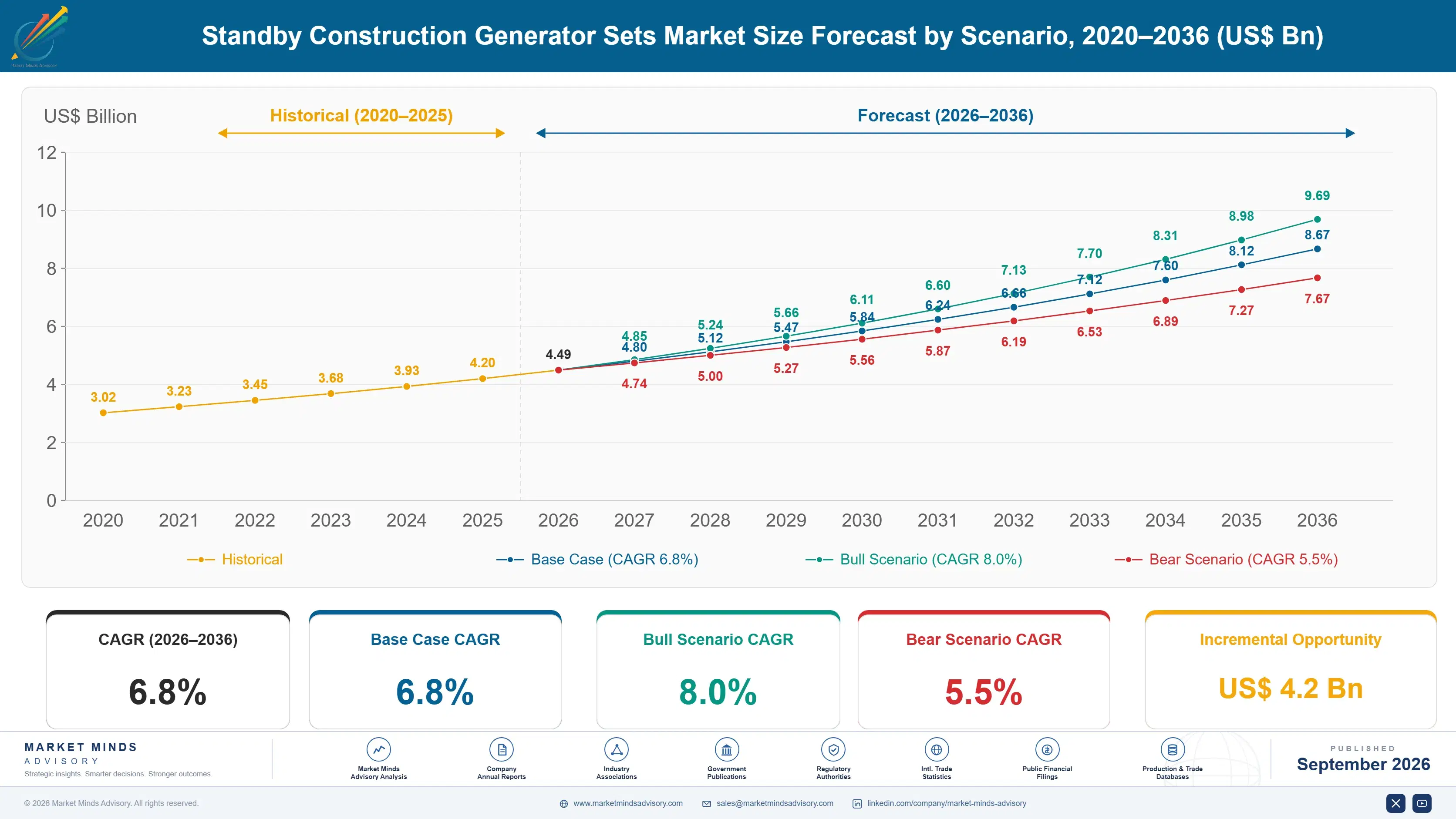
Standby Construction Generator Sets Market Forecast Scenarios

standby-construction-generator-sets-market-size-forecast-scenario-1788413276605
Standby construction generator demand grew steadily between 2020 and 2025 as infrastructure stimulus programs and post-pandemic construction backlogs pushed rental fleet utilization to multi-year highs across most major construction markets worldwide, with the historical growth rate holding near 5.8 percent annually through the period. Rental penetration climbed meaningfully across this window as more general contractors reassessed the total cost of fleet ownership against depot-based rental economics.
The base case assumes continued fleet electrification pressure, rising infrastructure spending commitments across South Asia and East Asia, and growing rental penetration as contractors avoid capital-intensive ownership amid tightening equipment financing conditions. These three commercial mechanisms together sustain a forecast compound annual growth rate of 6.8 percent through 2036, with rental operators capturing a steadily rising share of total construction power spend across nearly every regional market that MMA tracks.
A bull scenario assumes accelerating disaster recovery deployment following more frequent severe weather events across coastal and hurricane-prone regions, pushing growth toward 8.0 percent. A bear scenario assumes faster-than-expected grid resilience investment and permanent microgrid adoption displacing temporary generation demand, pulling growth down toward 5.5 percent across the most affected regional rental markets. Both scenarios assume the underlying emissions transition proceeds broadly on schedule.

Rental Economics Reshape Temporary Power Procurement

Three converging forces define this market today: tightening emissions compliance deadlines that retire older diesel units early, financing conditions that increasingly favor short-term rental over capital-intensive ownership, and rising storm-driven emergency demand that periodically strains fleet availability across entire regions simultaneously during peak hurricane and monsoon seasons. Contractors that once viewed ownership as a fixed cost now treat it as a variable expense to optimize project by project.
RENTAL PENETRATION RATE58%share of units deployed through rental channels today
FLEET UTILIZATION RATE71%average utilization rate across major regional rental fleets
DIESEL COST SHARE34%fuel and lubricant input cost as share of COGS
AVERAGE RENTAL DURATION5.4 monthstypical deployment length per active construction project site
EMISSIONS-COMPLIANT FLEET SHARE62%units currently meeting Tier Four Final compliance rules
TOP COUNTRY SHARE24%leading country share of global unit deployment volume
Commercially, the business increasingly resembles a logistics operation rather than pure equipment manufacturing, with depot density, delivery speed, and maintenance turnaround time determining which rental operators win repeat multi-site contracts from large general contractors managing dozens of concurrent job sites across a single metropolitan region. Larger operators are consolidating regional depots into fewer, better-stocked hubs to shorten average delivery windows without sacrificing total fleet coverage across sprawling service territories.
Over the next decade, electrification of smaller units and hybrid battery integration will reshape which fleets remain competitive, while tightening emissions rules push older diesel units toward accelerated retirement across most regulated jurisdictions, forcing sustained capital reinvestment across the entire rental industry. Manufacturers that lag compliance timelines risk losing rental fleet orders to competitors with cleaner product lines already certified.
"The operators winning share right now are not the ones with the newest engines. They are the ones who can get a unit to a flooded job site within six hours."
Director, Industrial Equipment and Infrastructure Practice · MMA Temporary and Standby Power Equipment for Construction Sites Practice · September 2026

Market Trends

Tier Four Final and Stage V Rules Retire Older Units

US EPA Tier Four Final and EU Stage V emissions standards are forcing rental fleet operators to retire or retrofit diesel units built before roughly 2015, since these regulations restrict deployment of non-compliant equipment across an expanding list of regulated urban construction zones. Operators face a choice between costly selective catalytic reduction retrofits, which run into tens of thousands of dollars per unit, or accelerated fleet replacement. Roughly 38 percent of the global rental fleet still falls below current compliance thresholds, creating a multi-year replacement cycle that favors manufacturers with certified inventory ready for immediate delivery.
Market Impact: 18-month rental backlogs in key corridors
Hybrid Battery Integration Expands Into Mid-Range Units

Manufacturers are increasingly pairing diesel generators with lithium-ion battery packs in the 20 to 150 kilowatt range, allowing units to run the engine intermittently while the battery covers baseline load, cutting fuel consumption by up to 40 percent on typical construction duty cycles. Early hybrid adopters report meaningfully lower noise output, which matters increasingly for urban night-shift construction subject to local noise ordinances. Rental fleets are adding hybrid units at a faster pace than diesel-only equivalents, and several major operators now report hybrid units make up a growing share of new fleet purchases.
Market Impact: 9 percent added to order volume

Market Opportunities and Growth Drivers

Infrastructure Spending Commitments Sustain Order Backlogs

Government infrastructure programs across South Asia, East Asia, and North America are sustaining multi-year construction pipelines that require temporary power at every project phase, from site clearance through final commissioning. India's National Infrastructure Pipeline alone earmarks well over one trillion dollars in cumulative project value through the early 2030s, much of it in road, rail, and port construction that requires standby generation before permanent grid connections are established. Rental operators serving these corridors report backlogs extending 12 to 18 months, giving fleet operators unusual pricing confidence when negotiating new multi-year framework agreements with large contractors.
Market Impact: 25 percent diesel price swings annually

Grid Instability Drives Emergency Backup Contracting

Aging transmission infrastructure across multiple regions increasingly fails to support construction-site electrical draw reliably, particularly during peak summer cooling demand when utilities implement rolling brownouts near dense urban construction clusters. Contractors increasingly contract standby generation as a default risk mitigation measure rather than an emergency-only backup, adding it directly into project budgets from the outset. This shift has added an estimated 9 percent to average annual rental fleet order volume across markets with documented grid reliability problems, according to MMA primary survey data collected from contractor respondents in affected regions.
Market Impact: 2-week maintenance delays during peak demand

Market Restraints and Challenges

Diesel Price Volatility Compresses Rental Operator Margins

Diesel prices have swung by more than 25 percent within single calendar years repeatedly over the past five years, driven by refining capacity constraints and geopolitical supply disruptions that ripple into pump prices. The root cause is rental operators' limited ability to pass volatility through mid-contract, since most agreements lock pricing for the full deployment period once signed. This compresses margins during spike periods and forces operators to absorb losses or renegotiate terms with contractors resistant to mid-project increases. Some larger operators now use fuel cost escalation clauses as a mitigation pathway.
Market Impact: 38 percent of fleet needs replacement

Skilled Technician Shortage Delays Fleet Maintenance Turnaround

A persistent shortage of diesel technicians certified to service modern emissions-compliant engines is extending average maintenance turnaround times across major rental depots, with some operators reporting delays exceeding two weeks during peak seasonal demand. The root cause traces to an aging technician workforce and thin vocational training capacity relative to fleet growth, particularly for the selective catalytic reduction systems newer compliant units require. This directly reduces effective fleet availability when demand is highest across the network. Several rental chains now fund in-house technician training academies as a mitigation pathway to build capacity internally.
Market Impact: 40 percent fuel savings, hybrid units
3 additional market trends, 4 additional growth drivers, and 3 additional restraints and challenges are covered in the full report. Contact sales@marketmindsadvisory.com to access the complete intelligence.

Segment CAGR and Growth Architecture

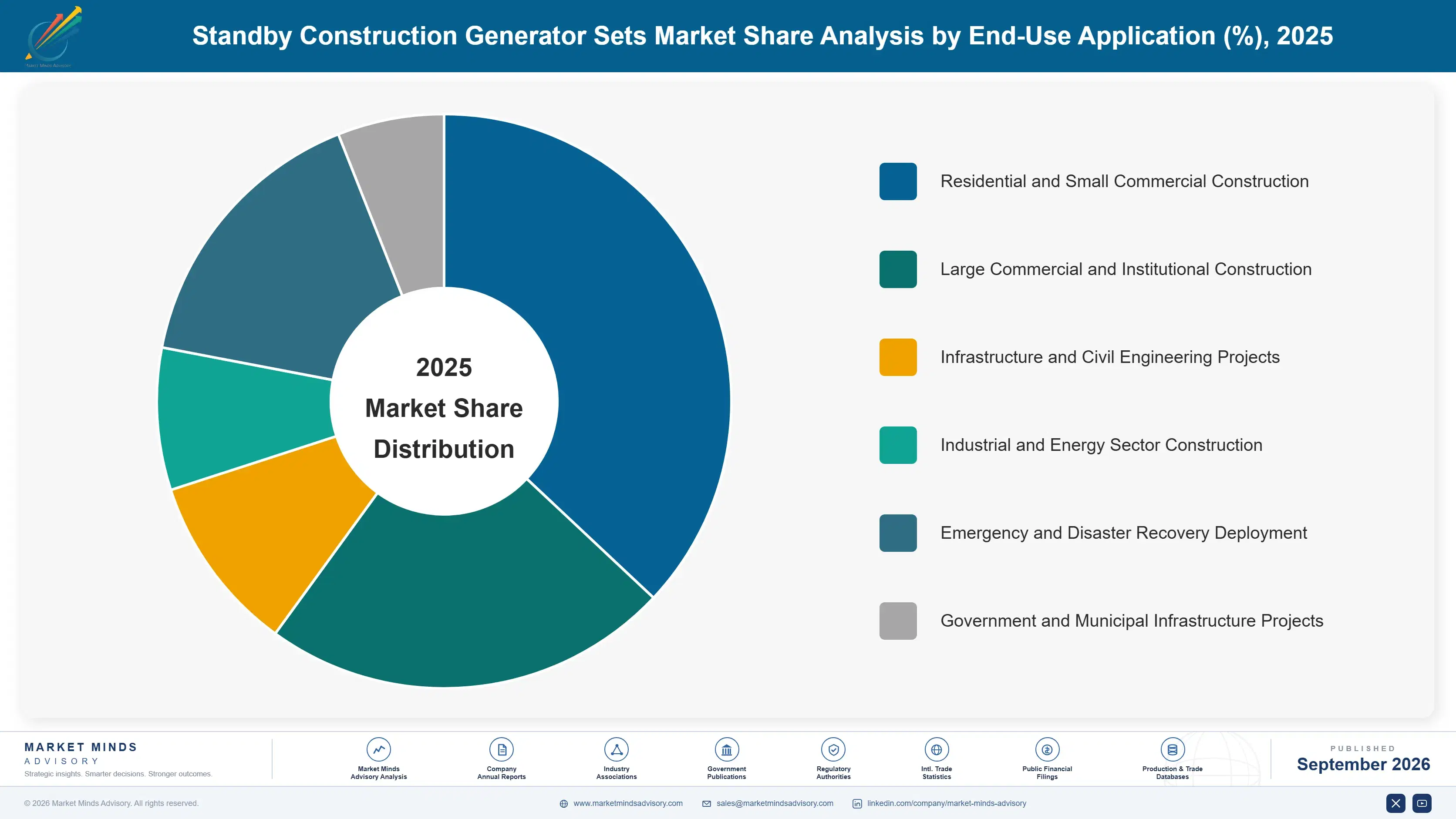
MMA segments this market by end-use project type, since standby generator specifications, rental duration, and fuel type requirements vary meaningfully by construction category rather than by generator size or ownership model alone, making end-use the most commercially decisive lens for demand analysis across regions worldwide. Six categories together span demand from single-site residential builds through multi-year national infrastructure programs.
standby-construction-generator-sets-market-market-share-analysis-1788413277558

Emergency and Disaster Recovery Deployment

This segment covers generator sets deployed for emergency backup power following hurricanes, floods, wildfires, and grid failures affecting active construction sites and adjacent infrastructure. Demand here is inherently volatile but expanding fastest of any category as severe weather events grow more frequent across coastal and wildfire-exposed regions, pushing rental operators to pre-position inventory well ahead of seasonal risk windows. Insurance carriers increasingly require documented backup power plans for large project sites in high-risk zones, adding a compliance dimension to what was once purely discretionary spending. Operators serving this segment command premium day rates given the urgency of deployment, though utilization outside active disaster windows remains comparatively lower than scheduled construction demand.
CAGR 11.0%

Infrastructure and Civil Engineering Projects

This segment covers generator sets deployed on road, rail, port, bridge, and utility infrastructure projects, typically requiring larger capacity units and extended rental durations spanning multiple project phases compared with smaller commercial builds. Government infrastructure spending programs across South Asia and East Asia are the primary demand driver, with multi-year project pipelines supporting long-term rental contracts that give operators unusual revenue visibility. These projects frequently occur in areas without established grid connections, making standby generation essential rather than supplementary through much of the construction timeline. Fleet operators serving this segment increasingly bid for multi-year framework agreements directly with government contractors and their prime engineering partners. Rental pricing here reflects steady demand visibility rather than storm-driven urgency pricing.
CAGR 9.0%
Full segment breakdown across 6 segments available in the complete report.

Regional Architecture and Country Demand Map

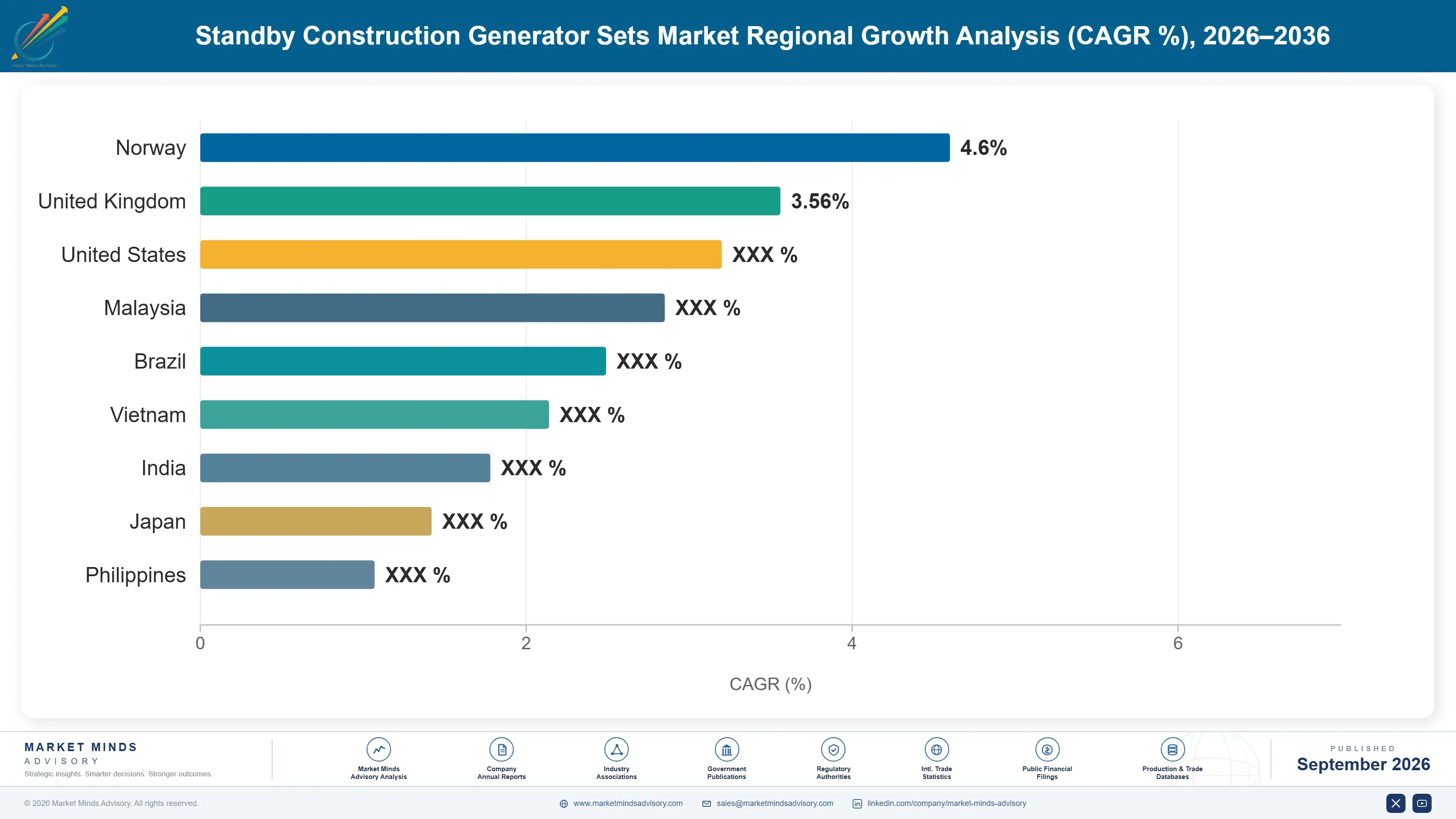
East Asia leads global demand given China's unmatched construction volume, followed closely by North America, where hurricane-driven emergency deployment and steady commercial activity sustain the world's most diversified rental fleet base. Eastern Europe and the Middle East contribute smaller but meaningful volume. Rental penetration varies meaningfully by region.

North America

North America's demand reflects two distinct drivers operating simultaneously: steady commercial and residential construction activity across major metropolitan corridors, and recurring hurricane-driven emergency deployment across Gulf Coast and Atlantic Seaboard states that periodically spikes rental utilization well above baseline. Fleet operators serving this region maintain the largest average depot inventory per capita of any region MMA tracks, reflecting the need to cover both scheduled construction demand and unpredictable disaster response within the same operating footprint. Tier Four Final compliance deadlines are already reshaping which units remain deployable in major metropolitan construction zones, forcing accelerated fleet turnover among regional operators competing for large general contractor accounts. Data center construction is increasingly adding a third demand driver alongside commercial and disaster-recovery deployment.
Share: 27% | CAGR: 7.2% (2026 to 2036)

Western Europe

Western European demand centers on renovation and infrastructure modernization projects rather than new-build construction, since most major metropolitan areas have limited greenfield development remaining within their urban boundaries. Stage V emissions compliance is further along here than in most other regions, meaning fleet operators have already absorbed much of the retrofit and replacement cost that other markets still face ahead of them. Rental penetration is the highest of any region tracked, since contractors operating on tight urban sites rarely have space to store owned equipment between projects. Growth trails the global average given the region's comparatively mature and already-consolidated rental market structure. Fleet operators here increasingly export used equipment to Eastern European markets once domestic units near retirement age.
Share: 19% | CAGR: 5.3% (2026 to 2036)
Regional intelligence for 5 additional markets available in the complete report: East Asia, South Asia and Pacific, Latin America, Middle East and Africa, Eastern Europe. Contact sales@marketmindsadvisory.com.
standby-construction-generator-sets-market-country-cagr-analysis-1788413278380

Where Rental Operators Can Capture Margin

Beyond core rental volume growth, several commercial mechanisms let operators and manufacturers capture disproportionate margin as emissions compliance and climate-driven demand reshape fleet economics across regional markets over the coming decade. These mechanisms span product design, fleet positioning, and service bundling, rewarding operators who invest ahead of visible demand rather than reacting once competitors have moved.

Accelerate Emissions-Compliant Fleet Replacement Capital Investment

Operators replacing non-compliant units ahead of regulatory deadlines capture premium rates from contractors needing certified equipment for permitted urban sites, while avoiding the retrofit costs competitors face closer to compliance deadlines. Generac and Atlas Copco have both expanded certified product lines targeting this transition directly, covering at least 45 percent of forecast replacement demand. Early movers also avoid the capacity crunch that typically hits replacement demand in the final year before enforcement deadlines take effect across major jurisdictions. Contractors bidding on public infrastructure increasingly require documented compliance before award, widening the gap between certified and non-certified operators.
Market Impact: Captures premium pricing on 45 percent of replacement demand

Build Dedicated Regional Storm-Season Pre-Positioning Programs

Rental operators that pre-position generator inventory near hurricane and monsoon corridors ahead of peak season capture emergency deployment revenue that latecomers miss entirely once local inventory sells out during active disaster response windows. This requires forecasting discipline, but operators executing it well report utilization exceeding 85 percent during active storm windows, above the 71 percent baseline. The approach also builds durable customer relationships with disaster response contractors who return for future deployments once trust is established. Insurance-driven contract requirements increasingly favor operators who can demonstrate documented pre-positioning plans ahead of each hurricane season.
Market Impact: Utilization above 85 percent during active storm windows

Expand Hybrid and Battery-Integrated Product Lines

Manufacturers expanding hybrid diesel-battery lines capture rental customers seeking lower fuel costs and reduced noise for urban night-shift construction work, differentiating against diesel-only competitors on total operating cost. Fuel savings of up to 40 percent on typical duty cycles translate directly into a compelling rental value proposition that operators can price at a premium over standard diesel units. Cummins and Caterpillar have both accelerated hybrid unit development, targeting availability covering at least 20 percent of new mid-range shipments within the forecast period. Distributors report growing willingness to pay a modest premium once fuel savings are demonstrated over a rental period.
Market Impact: 20 percent of new shipments hybrid by design

Offer Bundled Maintenance and Technician Service Contracts

Rental operators bundling scheduled maintenance and priority technician dispatch into standard rental agreements capture recurring service revenue while addressing the technician shortage that increasingly frustrates contractors managing their own generator maintenance schedules. This shifts revenue from a single transaction toward a longer relationship built on service reliability, addressing one of the sector's most persistent pain points. Operators offering bundled service report contract renewal rates meaningfully above those offering equipment rental alone, covering at least 30 percent of large-account rental revenue. Smaller regional operators lacking dedicated technician staff increasingly struggle to compete for these larger, stickier accounts.
Market Impact: Covers at least 30 percent of large-account revenue

Who Controls the Margin Pool

The top five players hold a combined 42 percent share on a unit shipment volume basis, leaving a wide gap between global equipment majors with certified compliant product lines and thousands of small regional rental operators competing mainly on price, local availability, and delivery speed rather than brand or technical differentiation. Basis of assessment is annual unit shipment volume, held consistently across all companies profiled.
Current competitive activity centers on three dimensions simultaneously: emissions-compliant product certification racing ahead of enforcement deadlines, geographic depot expansion pursued through acquisition of regional operators, and hybrid battery integration aimed at capturing fuel-conscious contractors well ahead of the broader industry's compliance transition timeline across major regulated jurisdictions. Several manufacturers are also piloting telematics-based remote fleet monitoring to reduce technician dispatch time and improve preventive maintenance scheduling.

Emerging pressure is coming from regional operators consolidating into larger platforms backed by private equity capital, which is compressing pricing in previously fragmented mid-sized metropolitan markets. Rankings could shift meaningfully over the next several years as smaller manufacturers without certified compliant product lines steadily lose orders to better-capitalized competitors with broader dealer networks. Private equity-backed platforms are proving willing to underprice legacy operators temporarily to capture share.
standby-construction-generator-sets-market-company-positioning-matrix-1788413279442

Competitive Moat and Risk Dimensions

CATERPILLAR

Moat: Global Dealer Network Scale

Caterpillar's dealer network spans nearly every major construction market worldwide, giving it unmatched parts and service reach that smaller manufacturers cannot replicate without years of dedicated investment in distribution infrastructure and technician training programs. This depth of coverage matters enormously to large contractors who need guaranteed same-day parts availability across dozens of simultaneous job sites spanning multiple states or provinces.
CATERPILLAR

Risk: Slower Compliance Product Cycles

Caterpillar's scale sometimes slows new product introduction relative to smaller, more focused competitors moving faster on emissions-compliant and hybrid product lines, creating openings for challengers in the fastest-growing segments of the market. Nimbler manufacturers focused exclusively on hybrid and compliant technology have occasionally reached market with certified units months ahead of Caterpillar's broader, more deliberate product rollout schedule.
CUMMINS

Moat: Engine Technology Leadership

Cummins holds deep engineering expertise across diesel, natural gas, and hybrid powertrains, giving it credibility with large fleet operators evaluating long-term compliance roadmaps rather than just near-term unit pricing across competing manufacturer bids. This technical credibility increasingly translates into multi-year framework agreements with large infrastructure contractors who value engine reliability over marginal upfront price differences across comparable unit classes.
CUMMINS

Risk: Component Supply Chain Exposure

Cummins remains exposed to semiconductor and specialty component supply disruptions that periodically extend lead times on its most technically advanced hybrid and emissions-control product lines relative to simpler competitor offerings. These disruptions occasionally force Cummins to prioritize allocation across regions, frustrating some rental operators who had counted on committed delivery windows for planned fleet expansion.

Players Tracked

Prominent Players

Caterpillar
Cummins
Generac Power Systems
Atlas Copco
Aggreko

Other Key Players

Kohler Power Systems
Himoinsa
FG Wilson
Doosan Portable Power
Multiquip
Wacker Neuson
Sunbelt Rentals
United Rentals
Herc Rentals
Ashtead Group
Mahindra Powerol
Mitsubishi Heavy Industries Engine and Turbocharger
SDMO Industries
Pramac
Yanmar Power Technology

Recent Developments

FEBRUARY 2026

Aggreko Expands Hybrid Fleet Capacity

Aggreko announced a major hybrid battery-generator fleet expansion targeting urban construction sites subject to noise ordinances, adding several hundred hybrid units across its North American and European rental depots over the coming year. The expansion follows growing municipal restrictions on diesel-only equipment operating near residential areas during overnight hours.
Signal: Signals accelerating rental operator investment in hybrid capacity ahead of tightening urban noise and emissions rules
OCTOBER 2025

United Rentals Acquires Regional Fleet Operator

United Rentals acquired a mid-sized regional generator rental operator to expand its depot density across underserved secondary metropolitan markets, adding immediate fleet inventory and established local contractor relationships to its existing network. The deal extends coverage into three states where it previously relied on subcontracted providers.
Signal: Reflects continued industry consolidation as larger platforms acquire regional operators for geographic reach across secondary metros
JUNE 2025

Generac Signs Emissions Compliance Supply Agreement

Generac entered a supply agreement with a selective catalytic reduction component manufacturer to secure priority allocation ahead of tightening Tier Four Final enforcement deadlines across major regulated construction markets in North America. The agreement should shorten component lead times relative to competitors sourcing through standard channels.
Signal: Indicates growing manufacturer focus on securing compliance component supply chains ahead of enforcement deadlines across North America

Diesel and Engine Component Cost Exposure

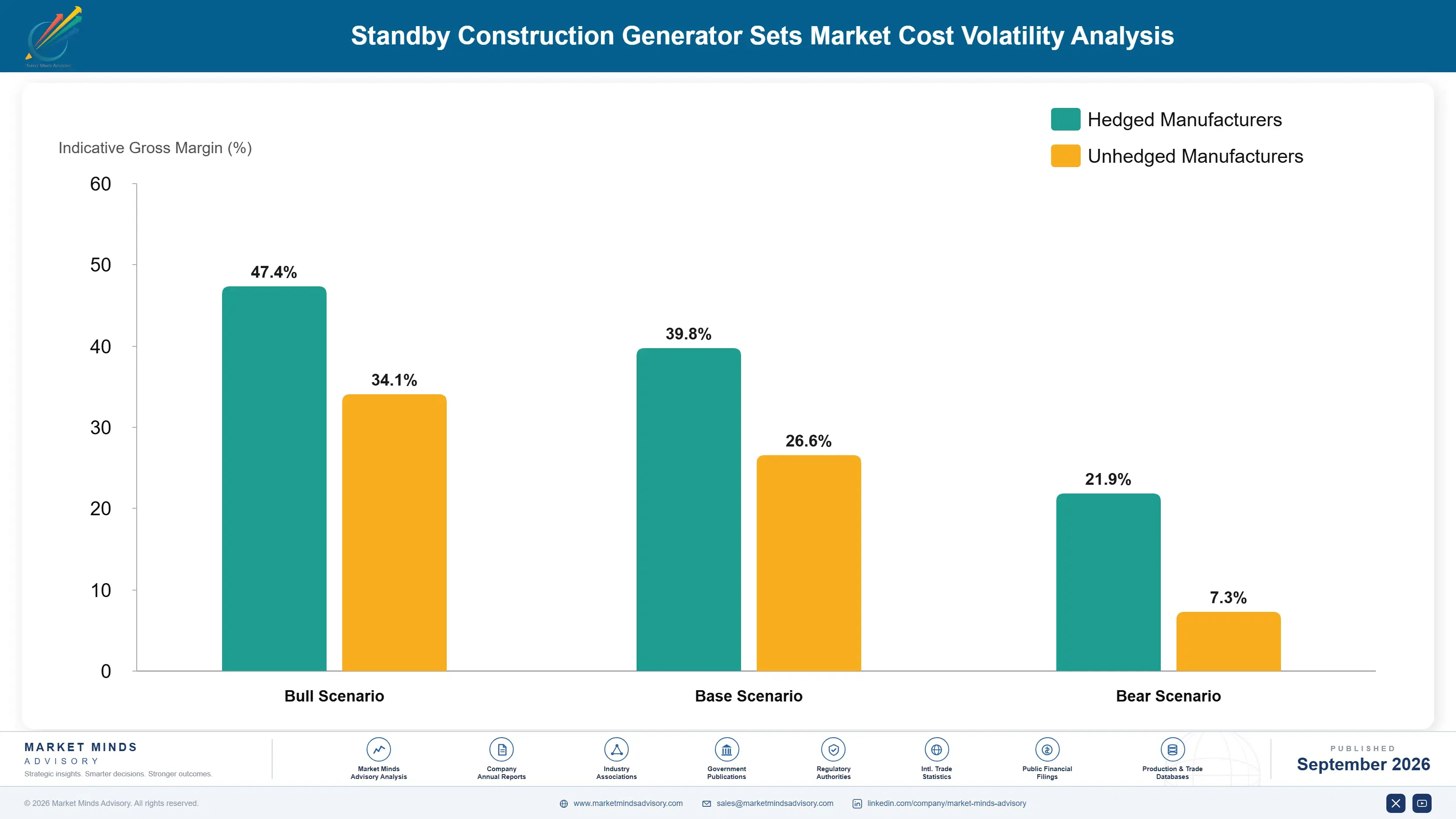
Diesel fuel and lubricants together represent roughly 34 percent of total cost of goods sold for rental fleet operators, sourced primarily through regional distributor networks tied to benchmark crude oil pricing that varies meaningfully by continent, local refining capacity, and prevailing transportation logistics costs across each regional market. Engine oil and coolant round out the remainder, at far smaller volumes.
Global diesel prices spiked more than 28 percent within a six-month window during 2022 following refining capacity constraints and geopolitical supply disruption, according to EIA weekly petroleum status reports, forcing many rental operators to renegotiate long-term contract pricing terms mid-cycle across affected North American and European markets simultaneously, an unusual occurrence in an industry accustomed to stable annual pricing cycles. Operators without hedging arrangements bore the full brunt of that swing directly.

This exposure disadvantages smaller regional operators lacking hedging capability far more than global majors with treasury desks and forward-purchasing programs, since smaller firms typically buy fuel at spot prices and absorb volatility directly into thinner operating margins across most of their fleet, a persistent gap that increasingly favors consolidation toward better-capitalized operators over time. MMA's primary survey confirms this pattern across every region tracked.
standby-construction-generator-sets-market-cost-volatility-analysis-1788413279980

Layered Forward Fuel Contracts

Operators lock a rolling portion of projected annual diesel consumption through forward contracts, smoothing input costs across budget cycles and protecting quoted rental pricing on multi-month deployment commitments. This approach best suits operators with predictable multi-year contracts where consumption can be forecast with reasonable confidence. Larger operators increasingly formalize this as a treasury function.

Fuel Cost Escalation Clauses

Larger operators increasingly embed fuel cost escalation clauses tied to published benchmark indices directly into rental agreements, passing a defined share of volatility through to customers transparently. This transparency helps preserve operator margins during volatile periods while giving customers advance visibility into how their final costs may move. Adoption remains uneven but is growing steadily across large national accounts.

Regional Fuel Sourcing Diversification

Operators diversify diesel sourcing across multiple regional suppliers rather than relying on a single distributor, reducing exposure to localized supply disruptions and improving negotiating leverage on volume pricing. Diversification also gives operators stronger negotiating leverage during periods when a single supplier faces localized capacity constraints or delivery disruption. Smaller operators often lack the scale to negotiate multi-supplier terms effectively.

Portfolio Architecture for Margin Defence

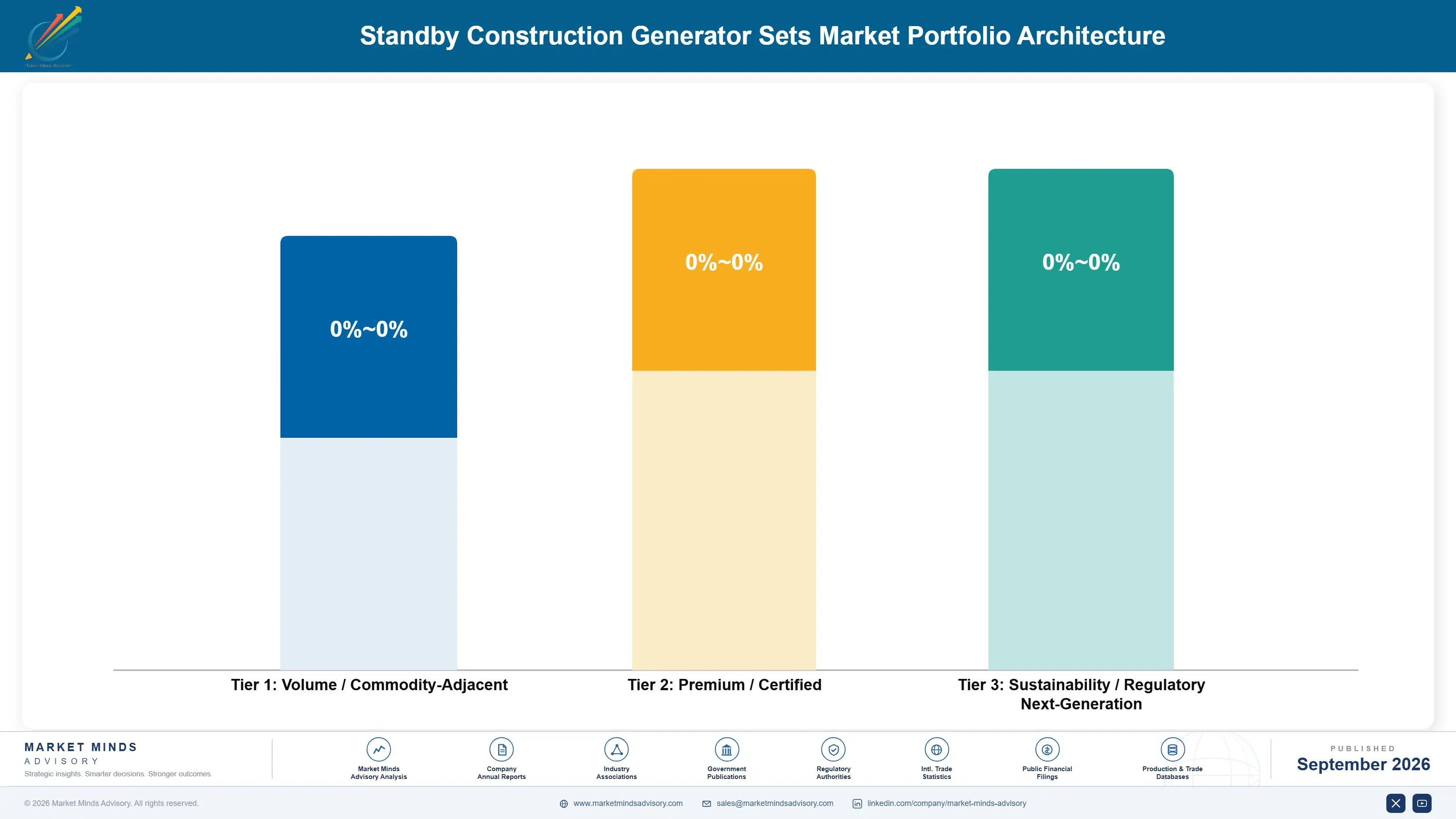
Portfolio economics split across three tiers: volume-commodity-adjacent diesel units competing mainly on price and availability, premium certified units serving contractors who need documented emissions compliance, and next-generation hybrid units capturing customers focused on fuel savings and noise reduction. Manufacturers with diversified portfolios weather commodity cycles better than single-tier specialists relying on one product category. Getting this balance right shapes long-term operator profitability considerably across an entire regional fleet.
Volume tension is real: contractors on tight project budgets default to the cheapest available unit meeting minimum specifications, while larger general contractors managing brand and compliance risk increasingly specify certified or hybrid units regardless of marginal cost difference. Operators leaning too heavily into commodity volume risk ceding the fastest-growing premium tenders to better-equipped, certified competitors.

High-value margin pools concentrate in emergency disaster deployment and hybrid product lines, where urgency pricing and technical differentiation both support meaningfully wider margins than standard scheduled construction rental agreements. Operators positioning across both dimensions simultaneously capture the strongest blended portfolio economics available in this market today. The gap versus operators competing purely on volume continues widening steadily across most regional markets MMA tracks.

Volume / Commodity-Adjacent

Standard diesel units meeting minimum emissions requirements, rented primarily on price and availability for smaller residential and commercial job sites. Manufacturing and fleet utilization here mainly serve fixed cost recovery rather than driving margin expansion.
Gross Margin: 18 to 24%

Premium / Certified

Tier Four Final and Stage V certified diesel units serving contractors on regulated urban sites requiring documented compliance for permitting purposes. This tier increasingly commands the largest share of operator capital allocation decisions.
Gross Margin: 26 to 33%

Sustainability / Regulatory / Next-Generation

Hybrid diesel-battery units offering fuel savings and reduced noise output, increasingly specified for urban night-shift construction subject to local noise ordinances. This is the fastest-growing margin tier across the entire fleet landscape.
Gross Margin: 32 to 40%
standby-construction-generator-sets-market-portfolio-architecture-1788413281445

High-value Sub-segments and Strategic Watch-out

Emergency and Disaster Recovery Deployment

The clearest high-value high-growth pocket in this market, combining urgency pricing with the fastest segment CAGR tracked, as severe weather events grow more frequent across coastal and wildfire-exposed regions. Capital allocation here should continue rising through the forecast period. Priority allocation continues expanding steadily across fleets.
Gross Margin: 35 to 45%

Hybrid and Battery-Integrated Units

A high-value moderate-growth pool where fuel savings and noise reduction command strong margins even as broader diesel unit growth moderates across already well-served core national markets. Operators with established hybrid inventory hold a durable edge. Institutional customers increasingly favor bundled hybrid contracts over standalone diesel procurement.
Gross Margin: 30 to 38%

Infrastructure and Civil Engineering Projects

The volume core of this market, providing steady multi-year revenue at thinner margins that fund fleet utilization without materially expanding overall profitability across cycles. Operators rely on this segment mainly to keep fleet assets productively utilized. Margins here rarely exceed the mid-twenties even in favorable pricing years.
Gross Margin: 20 to 26%

Residential and Small Commercial Construction

A strategic watch-out segment losing share to larger operators as price competition intensifies among numerous small regional fleets, forcing marginal operators to plan consolidation before margins compress further. Early consolidation planning reduces stranded fleet capacity risk considerably. Revenue pressure here should build steadily through the forecast period.
Gross Margin: 15 to 20%

Recurring Fleet Cycles Sustain Rental Revenue

Standby generator rental behaves like an annuity tied to project starts rather than a single purchase, since every new construction phase requires fresh equipment deployment regardless of which operator ultimately wins the contract. Operators that secure early positions with large general contractors capture repeat orders across multi-phase build-outs spanning years, and disaster response deployment adds an unpredictable but recurring secondary revenue layer tied to seasonal weather patterns.
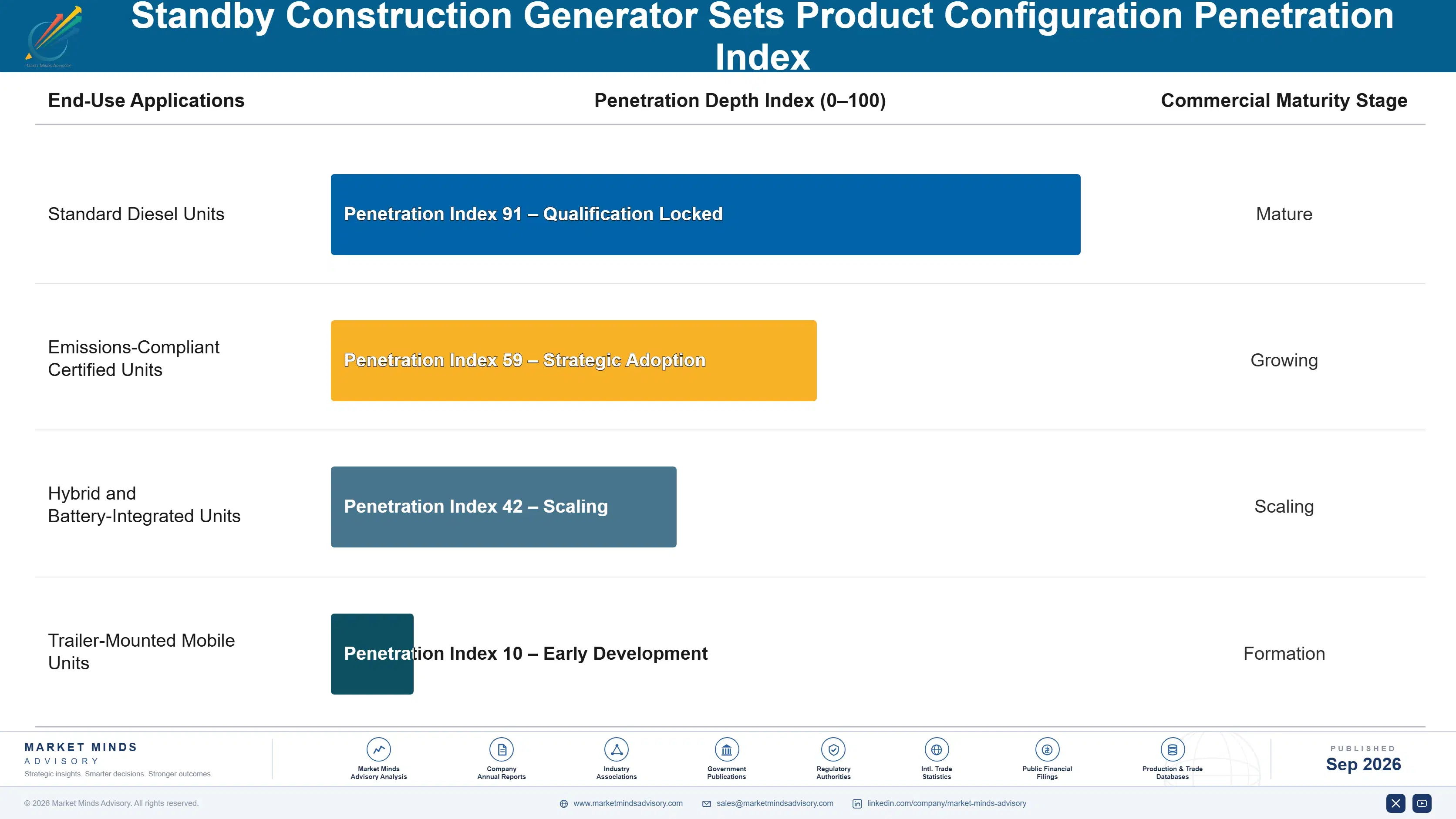
Infrastructure and civil engineering contractors show the highest adoption stickiness, since multi-year framework agreements rarely change operators mid-project once equipment specifications and delivery logistics clear initial vetting. Commercial and residential contractors show markedly lower stickiness, chasing whichever operator offers the best combination of price and immediate availability for shorter, less predictable project timelines. Emergency deployment customers show minimal loyalty during active crises, prioritizing speed above all else.

Procurement authority is shifting from site-level project managers toward centralized equipment procurement teams at national contractors, who increasingly negotiate volume framework agreements directly with operators rather than letting individual site managers select equipment independently. Younger procurement professionals increasingly favor digital rental marketplaces over relationship-based sales calls, rewarding operators that offer transparent online availability and pricing.
standby-construction-generator-sets-market-end-use-penetration-index-1788413282982

Where MMA Sees the Opportunity

These are among the four positions where our research anticipates prominent divergence between winners and laggards over the coming forecast period. Each is grounded in the demand model, the regulatory perimeter, and the announced capacity pipeline.
01 / COMPLIANCE-DRIVEN FLEET INVESTMENT

Accelerate certified fleet replacement ahead of enforcement deadlines

Roughly 38 percent of the global rental fleet still falls below current Tier Four Final and Stage V compliance thresholds, meaning operators that replace units early capture premium rates from contractors needing certified equipment for permitted urban job sites. Generac and Atlas Copco have both expanded certified product lines to meet this demand ahead of the broader industry replacement cycle, positioning themselves for preferred-vendor status. Operators that wait risk losing large contractor accounts to better-positioned, certified competitors within a few short years as enforcement tightens further.
02 / STORM CORRIDOR POSITIONING

Build pre-positioned inventory ahead of hurricane and monsoon seasons

Emergency and disaster recovery deployment is the fastest-growing segment in this market at an 11.0 percent CAGR, and operators that pre-position inventory near storm corridors capture premium urgency pricing that latecomers miss entirely once local inventory sells out during active disaster response windows each season. This requires forecasting discipline and dedicated working capital committed well ahead of active storm windows, but the payoff compounds across repeated deployment cycles. Operators executing this well report utilization rates well above the fleet-wide baseline average during peak seasonal deployment periods.
03 / FUEL HEDGING DISCIPLINE

Lock diesel exposure through layered forward contracts

Diesel and lubricants together represent roughly 34 percent of total operator cost of goods sold, and price swings exceeding 25 percent within single years have repeatedly compressed margins during volatile trading periods across the past several years of tracked market activity. Firms without hedging programs absorb volatility directly into thinner operating margins, disadvantaging them against better-capitalized global majors that maintain dedicated treasury functions for fuel procurement. Layered forward contracts covering a rolling annual window smooth input costs and protect quoted pricing on multi-month deployment commitments across the fleet.
04 / HYBRID PRODUCT DEVELOPMENT

Expand hybrid battery product lines to capture fuel-conscious demand

Hybrid diesel-battery units cut fuel consumption by up to 40 percent on typical construction duty cycles, and rental customers seeking lower operating costs and reduced noise increasingly favor operators with expanded hybrid inventory over diesel-only equivalents across urban night-shift construction sites subject to local noise ordinances. Cummins and Caterpillar have both accelerated hybrid development targeting mid-range unit classes specifically, aiming to capture this shift ahead of smaller competitors. Manufacturers and operators that build this capability now differentiate meaningfully against competitors still selling diesel-only equipment purely on price.

Engagement Snapshot From the Field

A live engagement with an industry participant carrying material or product regulatory and market exposure ahead of a defining policy shift, showing how our research translates into a defensible multi-year portfolio strategy.
MARKET MINDS ADVISORY · CLIENT ENGAGEMENT SUMMARY
Standby Construction Generator Sets Producer Strategic Portfolio Review and Transition Roadmap 2026·Investment Scenario on Standby Construction Generator Sets Exposure Evaluation 2025-26
CLIENT PROFILE
The client is a regional generator rental operator serving commercial and infrastructure construction sites across four Gulf Coast states, with a fleet of roughly six hundred diesel units and a growing exposure to hurricane-driven emergency deployment demand that had begun outpacing its scheduled construction rental business in several recent storm seasons. Leadership was evaluating whether to expand into adjacent states or first strengthen its existing regional position.
STRATEGIC CHALLENGE
Rising emissions compliance costs and unpredictable storm-season demand spikes were straining the client's capital planning process, while its existing fleet mix left it unable to fully capture premium urgency pricing during active disaster response windows without pulling equipment away from committed scheduled construction contracts. Board leadership needed a defensible multi-year capital plan before committing to further fleet expansion.
MMA APPROACH
MMA conducted a fleet composition benchmarking exercise against five comparable regional operators, modeled optimal pre-positioning inventory levels against ten years of historical storm data, and evaluated compliance investment timing against enforcement deadlines to build a phased capital allocation roadmap for the client's leadership team. Findings were validated against three years of historical dispatch and utilization records.
KEY FINDINGS
  1. Pre-positioning roughly 15 percent of fleet inventory near historical storm landfall zones ahead of peak season could capture meaningfully more emergency deployment revenue.
  2. Two of five benchmarked competitors had already secured certified compliant fleet shares above 70 percent, well ahead of the client's compliance position.
  3. Scheduled infrastructure contracts covering a rolling twelve-month backlog provided sufficient revenue visibility to support phased compliance capital investment. ahead of the next enforcement milestone.
  4. Operators with dedicated storm-response account teams reported measurably higher contract renewal rates than those treating emergency deployment as purely opportunistic. over multi-year contract periods.
CLIENT PROFILE
The client is a regional generator rental operator serving commercial and infrastructure construction sites across four Gulf Coast states, with a fleet of roughly six hundred diesel units and a growing exposure to hurricane-driven emergency deployment demand that had begun outpacing its scheduled construction rental business in several recent storm seasons. Leadership was evaluating whether to expand into adjacent states or first strengthen its existing regional position.
STRATEGIC CHALLENGE
Rising emissions compliance costs and unpredictable storm-season demand spikes were straining the client's capital planning process, while its existing fleet mix left it unable to fully capture premium urgency pricing during active disaster response windows without pulling equipment away from committed scheduled construction contracts. Board leadership needed a defensible multi-year capital plan before committing to further fleet expansion.
MMA APPROACH
MMA conducted a fleet composition benchmarking exercise against five comparable regional operators, modeled optimal pre-positioning inventory levels against ten years of historical storm data, and evaluated compliance investment timing against enforcement deadlines to build a phased capital allocation roadmap for the client's leadership team. Findings were validated against three years of historical dispatch and utilization records.
KEY FINDINGS
  1. Pre-positioning roughly 15 percent of fleet inventory near historical storm landfall zones ahead of peak season could capture meaningfully more emergency deployment revenue.
  2. Two of five benchmarked competitors had already secured certified compliant fleet shares above 70 percent, well ahead of the client's compliance position.
  3. Scheduled infrastructure contracts covering a rolling twelve-month backlog provided sufficient revenue visibility to support phased compliance capital investment. ahead of the next enforcement milestone.
  4. Operators with dedicated storm-response account teams reported measurably higher contract renewal rates than those treating emergency deployment as purely opportunistic. over multi-year contract periods.
RECOMMENDED STRATEGY
Phase 1: Phase 1 (near-term): reallocate 15 percent of fleet toward pre-positioned storm-corridor inventory ahead of the next season. with dedicated logistics support. Phase 2: Phase 2 (medium-term): accelerate certified compliant unit purchases to close the gap with better-positioned regional competitors. over the following two years. Phase 3: Phase 3 (longer-term): build a dedicated emergency response account team to formalize storm-season customer relationships. reporting directly to senior leadership.
OUTCOME
Within the first storm season after implementation, the client reported (client-reported, unverified by MMA) a meaningful increase in emergency deployment revenue capture and improved contract renewal rates among its largest scheduled construction accounts, attributing the gains directly to the phased fleet and compliance roadmap MMA developed.

Frequently Asked Questions

Foundational context covering the market sizes, CAGR, scope, country, region and competition that inform every finding below. This section is provided to cover basics and most often pre-purchase conversations, answered from the MMA Primary Research Dataset.

What is the current size of the Standby Construction Generator Sets Market?

The standby construction generator sets market reached an estimated $4.2 billion in global value in 2025, driven by rental penetration growth and rising emergency deployment demand across construction sites worldwide.

How large will the Standby Construction Generator Sets Market be by 2036?

MMA projects the market will reach approximately $8.67 billion by 2036, nearly doubling in value as infrastructure spending and climate-driven emergency deployment continue expanding across every major regional market.

What is the CAGR for the Standby Construction Generator Sets Market 2026 to 2036?

The market is forecast to grow at a 6.8 percent compound annual growth rate between 2026 and 2036, with bull and bear scenarios ranging from 5.5 to 8.0 percent.

Which segment is growing fastest?

Emergency and disaster recovery deployment leads segment growth at an 11.0 percent CAGR, roughly 1.6 times the overall market rate, as severe weather events grow more frequent across coastal regions.

Who are the major companies in the Standby Construction Generator Sets Market?

Caterpillar, Cummins, Generac Power Systems, Atlas Copco, and Aggreko lead the market, together holding an estimated 42 percent combined share on a unit shipment volume basis.

Which country is growing fastest?

India is growing fastest at a 9.8 percent CAGR, driven by its National Infrastructure Pipeline and extensive road, rail, and port construction requiring standby power ahead of grid connection.

Report Segmentation Architecture

The full report scope spans multiple orthogonal segmentation dimensions, with cross-tabulated demand data provided for each dimension pair. Coverage extends further to regional breakdowns, trend trajectories, and the competitive detail needed to support segment-level decision-making.

By End-Use Application

  • Residential and Small Commercial Construction
  • Large Commercial and Institutional Construction
  • Infrastructure and Civil Engineering Projects
  • Industrial and Energy Sector Construction
  • Emergency and Disaster Recovery Deployment
  • Government and Municipal Infrastructure Projects

By Product Configuration

  • Standard Diesel Units
  • Emissions-Compliant Certified Units
  • Hybrid and Battery-Integrated Units
  • Trailer-Mounted Mobile Units

By Commercial Dimension

  • Rental Fleet Deployment
  • Direct Contractor Ownership
  • Government and Institutional Procurement
  • Online Rental Marketplace Booking

By Region

  • North America
  • Western Europe
  • East Asia
  • South Asia and Pacific
  • Latin America
  • Middle East and Africa
  • Eastern Europe

Scope, Methodology, and Coverage

Every figure in this report is reproducible from documented input assumptions. The scope below maps the historical period, the forecast horizon, the segmentation dimensions, and the countries covered, alongside the underlying primary and qualitative methodology.
Historical Period
2020 to 2025
Forecast Period
2026 to 2036
Base Year
2025 (USD billions; MMA Primary Research Dataset, September 2026)
Market Definition
This report covers mobile and trailer-mounted diesel, gas, and hybrid generator sets deployed as temporary or standby power at construction and infrastructure project sites, including both rental fleet units and contractor-owned equipment. It excludes permanent standby generators installed at fixed facilities and marine or aviation auxiliary power units.
Quantitative Units
USD billions (current prices); unit shipment and fleet deployment volume where applicable
Segmentation Dimensions
By End-Use Application; By Product Configuration; By Commercial Dimension; By Region
Regions Covered
North America, Western Europe, East Asia, South Asia and Pacific, Latin America, Middle East and Africa, Eastern Europe
Countries Covered
USA, China, Germany, France, UK, Japan, South Korea, India, Australia, Canada, Brazil, Mexico, Indonesia, Vietnam, Thailand, Malaysia, UAE, Saudi Arabia, South Africa, Nigeria, Turkey, Poland, Netherlands, Italy, Spain, Sweden, Switzerland, Argentina, Colombia, Singapore, and additional markets relevant to this sector
Key Companies Profiled
Caterpillar, Cummins, Generac Power Systems, Atlas Copco, Aggreko, Kohler Power Systems, Himoinsa, FG Wilson, Doosan Portable Power, Multiquip, Wacker Neuson, Sunbelt Rentals, United Rentals, Herc Rentals, Ashtead Group, Mahindra Powerol, Mitsubishi Heavy Industries Engine and Turbocharger, SDMO Industries, Pramac, Yanmar Power Technology
Quantitative Methodology
Primary survey, n=3,800 respondents, Q4 2025, six countries; demand-side model with trade association cross-validation
Qualitative Methodology
47 expert interviews, Q4 2025; applied to validate demand model assumptions, identify emerging dynamics, and assess competitive positioning
Report Format
PDF and XLSX data workbook (Word format preview document)
Publisher
Market Minds Advisory
Report Code
MMA-2026-CON-227
Published
September 2026
Contact
sales@marketmindsadvisory.com | www.marketmindsadvisory.com

Purchase the full Standby Construction Generator Sets Market Report (2026 to 2036).

This report provides a comprehensive assessment of the standby construction generator sets market, covering demand drivers across residential, commercial, infrastructure, and emergency deployment segments through 2036. It includes detailed competitive benchmarking of twenty leading manufacturers and rental operators evaluated on a unit shipment volume basis. Regional demand architecture is mapped across all seven global regions, with particular depth on East Asian and North American dynamics. Diesel input cost exposure and hedging strategy are analyzed alongside revenue lever prioritization for both manufacturers and rental operators. The report is designed for rental fleet executives, equipment manufacturers, and infrastructure procurement leaders evaluating positioning within this expanding global market.
Ten-year global market sizing and forecast
Seven-region global regional demand architecture breakdown
Twenty-company detailed competitive benchmarking and profiling
Diesel input cost exposure and hedging modeling
Revenue lever prioritization and margin framework
Anonymized regional operator fleet strategy case study

Built For The People Who Decide

From boardroom strategy to bench-side execution, this report is read cover-to-cover by leaders shaping the next decade of their industry, turning demand scenarios, market dynamics and valuation benchmarks into decisions.
CXOs/ Presidents/ VPs/ Managers
M&A and Corporate Development
Strategy Teams and R&D Heads
Procurement and Product Directors
Regulatory and Compliance Leaders
Investor Relations and Equity Analysts