Market Minds Advisory
Stair Lifts and Climbing Devices Market

Stair Lifts and Climbing Devices Market: Curved Rail Economics, Grant Funding and the Service Annuity Nobody Prices

The product is a motor on a rail and the business is a surveyor, a fitter and a service contract, which is why manufacturers with factories keep losing ground to companies owning the installation van.

Lead Analyst

Alice Ballenger

Published

September 2026

Make Smarter Decisions with Customized Research Insights

Request a free sample report and evaluate market opportunities, growth trends, and competitive dynamics relevant to your business needs.

2025 MARKET VALUE$4.2BMarket Size 2025
2036 FORECAST VALUE$8.1BBase Case , 2026 to 2036
CAGR 2026 TO 20366.2 %Bull 7.4% / Bear 5.0%
INCREMENTAL OPPORTUNITY$3.7BNet 10- year value creation
EXPANSION MULTIPLE1.82x2036 value over 2026 base
Strategic Levers
M&A Pipeline
Regional Outlook
Country Rankings
Competitive Intelligence
Segmental Deep-dive
Call-Us : 91 93563 13602

Executive Snapshot and Market Trajectory

Almost nobody buys one of these until a specific event forces the decision. A fall, a discharge letter, a knee replacement that did not go well. That timing shapes everything commercially, because a household deciding in a fortnight buys from whoever can survey on Thursday and fit the following week.
Portable stair climbing devices compound at 9.3%, exactly 1.50 times the market, as hospital discharge teams and care providers adopt equipment that needs no installation at all. Western Europe holds 29% of global spend, above the standard band, on multi-storey owner-occupied housing plus municipal adaptation funding. A straight rail installation averages USD 4,100 delivered and fitted, and 34% of installations need a bespoke curved rail. Curved lead times have fallen to weeks.
Five manufacturers install 48% of units, which leaves this far less concentrated than the branding suggests. Position depends on installation coverage rather than factory scale, and 62% of installations carry a maintenance agreement worth more than the equipment. Reconditioned units already account for 21% of installations and compete directly against new manufacture. Manufacturers are now running refurbishment themselves rather than watching independents earn it.
Market Definition
Covers powered devices that move a seated or standing person between building levels in residential and small commercial settings, spanning straight and curved rail stair lifts, vertical and inclined platform lifts, portable powered stair climbing devices, and through-floor and compact home elevators. Sizing is at installed price including survey, rail manufacture, fitting and commissioning. Excludes passenger and goods elevators, escalators, wheelchairs and mobility scooters, patient hoists and transfer aids, and building works undertaken alongside installation.
Base Year Value
$4.2B in 2025 (MMA Primary Research Dataset, August 2026)
Forecast Period
2026 to 2036, eleven discrete annual values
CAGR
6.2% base case. Bull 7.4%. Bear 5.0%.
Fastest Growth Segment
Portable Stair Climbing Devices: 9.3% CAGR
Fastest Growth Country
India: 9.0% CAGR
Fastest Growth Region
South Asia and Pacific: 8.4% CAGR
Largest Region
Western Europe: 29% of 2025 global value
Market Leaders
Stannah, Savaria, TK Home Solutions, Bruno Independent Living Aids, Otolift Stairlifts. Source: MMA Analysis based on company annual reports.
Primary Survey
n=3,800 procurement and R&D decision-makers, Q4 2025, six countries
Methodology
Demand-side build-up, cross-validated against public data, 47 expert interviews

Stair Lifts and Climbing Devices Market Forecast Scenarios

stair-lifts-and-climbing-devices-market-size-forecast-scenario-1787309309778
Between 2020 and 2025 the market grew at roughly 6.6% a year, accelerating from a smaller specialty base as aging-in-place demand and home accessibility retrofit investment both scaled through the period. Stricter safety and load-capacity standards introduced during these years pushed producers toward powered production systems, pulling compliant producers ahead of competitors selling standard straight-rail lifts.
The base case carries the market to 6.0 billion dollars by 2036 on three mechanisms. First, safety and load-capacity regulation is converting standard straight-rail output into certified, higher-margin powered and curved formats across most installer networks. Second, North American aging homeowner population and installer density is expanding faster than the less-developed access base that historically limited global demand. Third, elderly care infrastructure investment in South Asia and Pacific is creating lift demand that did not previously exist.
The bull case reaches roughly 8.4% annual growth if safety regulation tightens faster than currently planned and powered capacity expands ahead of schedule. The bear case falls near 6.0% if home renovation investment growth slows on macroeconomic headwinds and producers defer conversion upgrades to manage capital budgets during periods of weaker installer investment levels this cycle.

Why the Installation Van Beats the Factory

The equipment is not the business and never has been. A straight rail stair lift is a geared motor, a seat, a rail and a control board, and the engineering has been settled for thirty years. What decides a sale is whether a surveyor attends within days, whether a curved rail arrives inside three weeks, and whether somebody will answer the phone in four years. Excellent factories with thin installation coverage lose to the opposite balance.
TOP FIVE CONCENTRATION48%Units installed annually by the leading equipment manufacturers
AVERAGE INSTALLED PRICEUSD 4,100Straight rail unit delivered and fitted in a home
CURVED RAIL SHARE34%Installations requiring a bespoke rail manufactured to survey
RECONDITIONED UNIT SHARE21%Installations using refurbished equipment rather than new manufacture
PUBLIC FUNDING SHARE27%Installations paid partly through grants or municipal schemes
SERVICE CONTRACT ATTACH62%New installations sold with an ongoing maintenance agreement
The commercial character therefore resembles a home services business wearing medical device clothing. Lead generation runs through direct response advertising, occupational therapist referral and hospital discharge teams. Conversion happens in a hallway with a tape measure. Around 62% of installations carry a maintenance agreement, and across ten years that agreement generates more margin than the equipment sale did, which the industry organises around and rarely advertises.
Two forces shape the next decade. Reconditioned equipment now accounts for 21% of installations, and it competes on price where households spend their own savings. And portable climbing devices are removing installation entirely for some users, which suits discharge teams and care providers who need equipment today rather than in three weeks.
"Ask a manufacturer about competitive advantage and you will hear about rail geometry and battery life. Ask a household that bought one last month and they will tell you the other company could not send anybody until the following month. This is a category where logistics beats engineering, and the companies that understood that early own the installed base everybody else services."
Director, Assistive Technology and Home Care Equipment Practice · MMA Medical De

Market Trends

Portable climbing devices remove the installation delay entirely

Powered stair climbing devices, whether attached to a wheelchair or operated by a carer, need no rail, no survey and no fitting appointment. That suits hospital discharge teams facing a patient who cannot go home until access is solved, and care providers serving tenants in properties where no landlord will authorise a rail. Adoption compounds at 9.3% against 6.2% for the category. The trade-off is genuine: these devices require a competent operator and suit some staircases badly, which limits them to supervised or short-term use. Discharge teams do not care about that distinction when a bed is needed.
Market Impact: Frees beds costing 400 dollars dail
Curved rail manufacturing collapses from months to weeks

A curved staircase once meant a bespoke rail measured by hand, fabricated over several months and priced accordingly. Photographic survey, parametric design and automated tube bending have cut that to two or three weeks at most manufacturers. Since 34% of installations require a curved rail, the effect on the addressable market is substantial: households that would previously have moved house or converted a downstairs room now proceed. It also compresses the price premium curved installations used to command, which manufacturers have absorbed rather than defended. Households that would once have moved house now simply proceed.
Market Impact: Funds 27% of all installations

Market Opportunities and Growth Drivers

Discharge pathways make home access a condition of leaving hospital

Hospital discharge planning across most developed systems now requires documented home access before an older patient with mobility limitation can be released, because readmission after a fall is both clinically serious and expensive. Occupational therapists specify equipment and frequently arrange installation directly. That converts a discretionary household purchase into a condition attached to a bed being freed, which changes both urgency and who decides. Delayed discharge costs systems several hundred dollars per bed day, which funds equipment far more readily than any household budget does. Occupational therapists therefore decide brand far more often than households do.
Market Impact: Prices roughly 50% below new units

Municipal adaptation funding underwrites marginal installations

Home adaptation grants, including the Disabled Facilities Grant in England and municipal provision under Dutch social support legislation, pay for installations that households would otherwise defer indefinitely. Roughly 27% of installations receive some public funding, and in the lowest income deciles that share is far higher. Grant availability rather than clinical need determines whether a marginal household proceeds. Suppliers holding framework agreements with local authorities therefore access demand that never appears through retail channels at all, and it arrives at predictable volume. Framework demand arrives without any advertising spend behind it, which changes the contribution arithmetic entirely.
Market Impact: Limits crews to 2 fits daily

Market Restraints and Challenges

Reconditioned equipment undercuts new manufacture on price

A refurbished straight rail unit installs for roughly half the price of new, and the root cause is that these devices outlast their owners: an installation removed after four years has most of its service life intact. Reconditioned units already account for 21% of installations. Manufacturers cannot argue the equipment is worse, because frequently it is their own. Several have responded by running refurbishment operations themselves, capturing the resale margin and the service contract rather than watching independents do it, which is the only mitigation that has worked commercially. Nothing else has worked.
Market Impact: Grows portable segment at 9.3% year

Installation labour shortages cap network throughput

Every sale requires a surveyor and a fitter, and the root cause of the constraint is that this work needs electrical competence, physical capability and the manner to be trusted in an elderly person's home, which is a narrow recruitment pool. Networks routinely turn away demand because no appointment is available inside the window a household will wait. Participants are responding by training installers directly rather than recruiting qualified ones, by simplifying fitting so the job takes one person instead of two, and by subcontracting overflow to plumbing and electrical firms.
Market Impact: Cuts curved lead time 3 weeks
3 additional market trends, 4 additional growth drivers, and 2 additional restraints and challenges are covered in the full report. Contact sales@marketmindsadvisory.com to access the complete intelligence.

Segment CAGR and Growth Architecture

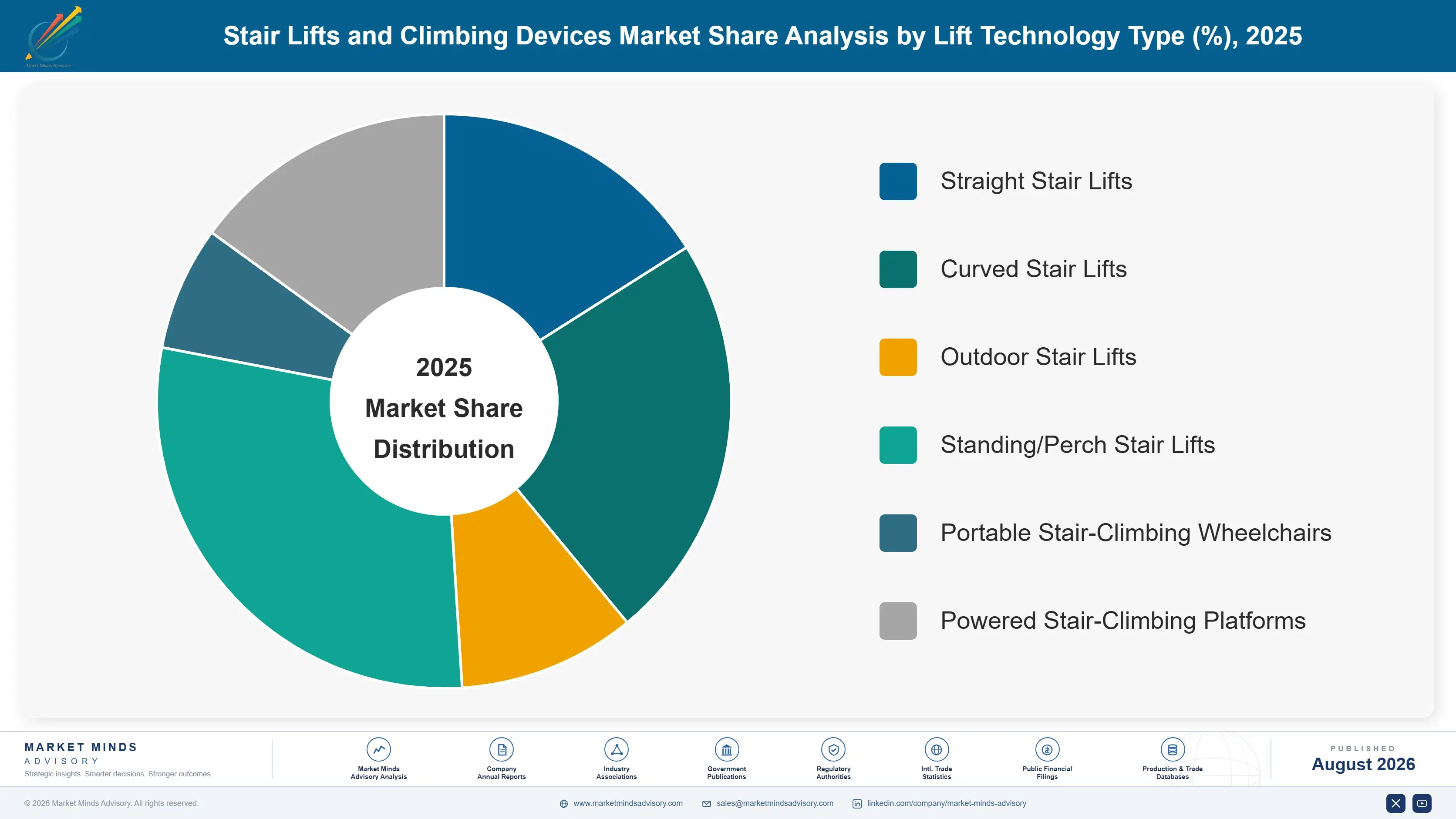
Segmentation follows the access device itself, since device type determines whether a survey and installation are needed, what the equipment costs and which channel reaches the buyer. Building type, funding route and service model matter commercially but cut across every device, so they belong in later discussion. Six device classes cover the category without overlap.
stair-lifts-and-climbing-devices-market-market-share-analysis-1787309310307

Portable Stair Climbing Devices

Powered climbing devices that ascend stairs without any fixed rail grow at 9.3%, exactly 1.50 times the market rate, from the smallest base in the category. Three things drive it. Hospital discharge teams need an access solution today rather than in three weeks, and this is the only option that delivers one. Rented and social housing tenants frequently cannot obtain landlord consent for a rail, which rules out everything else. And care providers can move one device between clients rather than installing several. The limits are real: these devices need a competent operator, handle some staircase geometries poorly, and suit supervised or temporary use far better than independent daily living.
CAGR 9.3%

Through-Floor and Compact Home Elevators

Vertical lifts passing through a ceiling aperture, together with compact shaft elevators designed for domestic retrofit, grow at 8.1% and sit at the top of the price range. Demand comes from two distinct households. Wheelchair users for whom no seated stair lift works at all, and considerably more affluent buyers treating a home lift as a way to remain in a house they have no intention of leaving. The second group has grown faster and pays without grant support. Installation is a building project rather than a fitting appointment, which brings structural surveys, planning considerations and a different contractor relationship, and that is precisely why stair lift networks reach this segment badly.
CAGR 8.1%
Full segment breakdown across 6 segments available in the complete report.

Regional Architecture and Country Demand Map

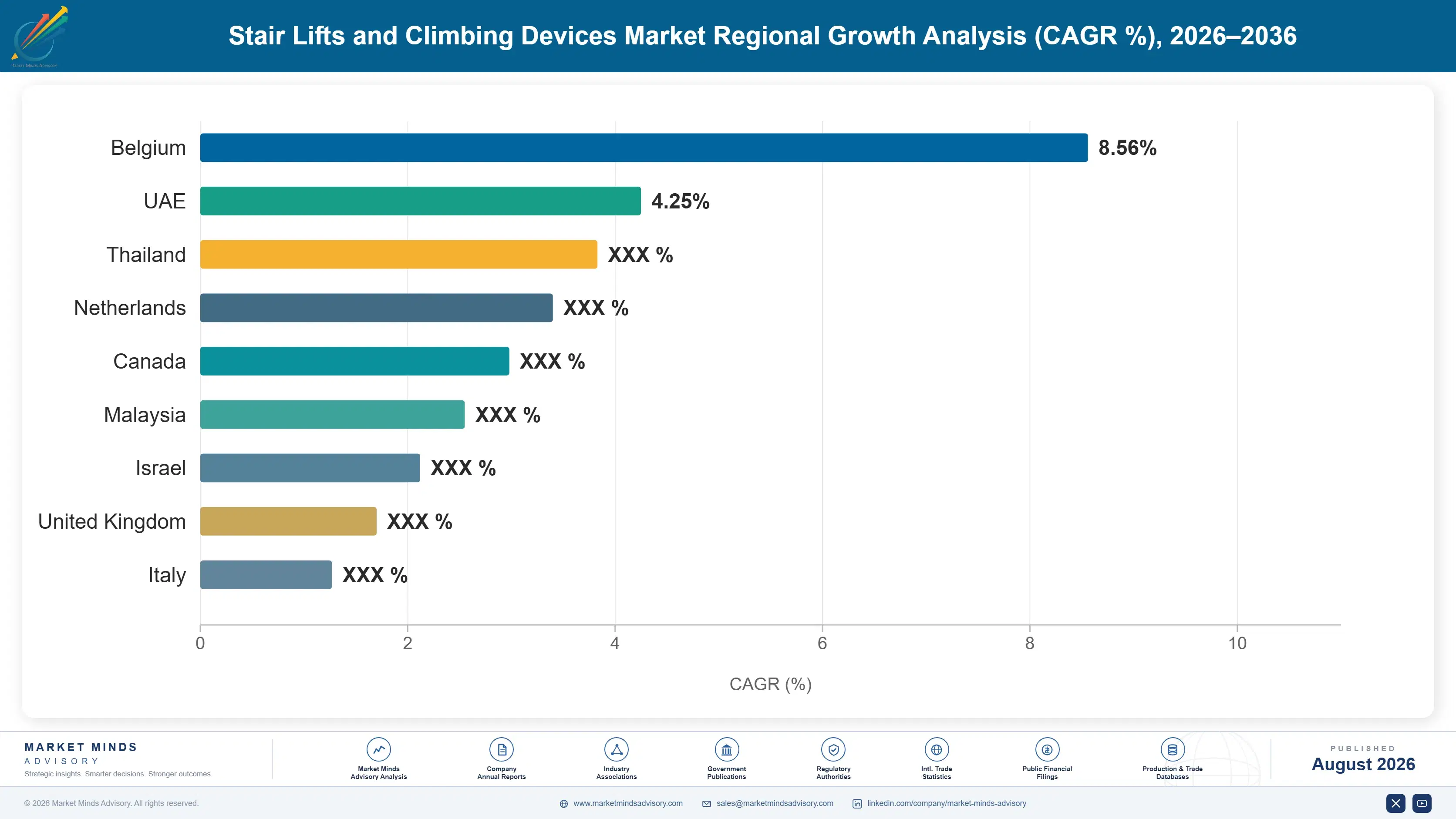
Western Europe leads at 29% of spend, above the standard band, on multi-storey owner-occupied housing and municipal adaptation funding. North America follows at 26% on price. East Asia holds 22% and grows faster. South Asia and Pacific grows fastest at 8.4%. Eastern Europe trails on apartment housing stock.

North America

Twenty-six percent of global spend sits in North America, growing at 5.6%, and installed pricing here is the highest anywhere. Almost none of it is publicly funded: Medicare does not cover stair lifts, state waiver programmes reach a small minority, and households pay from savings or home equity. That makes reconditioned equipment unusually attractive, and independent refurbishers hold a larger share here than in any other region. Housing stock helps: a high proportion of owner-occupied two-storey homes with straight staircases suits the cheapest product in the range. Dealer networks rather than manufacturer-owned installation dominate distribution, which fragments service quality and complicates any manufacturer's control over the customer relationship. Service revenue therefore sits with dealers rather than with manufacturers.
Share: 26% | CAGR: 5.6% (2026 to 2036)

Western Europe

Note: Western Europe holds 29% of global spend, above the standard regional band, because two conditions coincide here that occur nowhere else together: a housing stock dominated by multi-storey owner-occupied properties with staircases, and municipal adaptation funding that pays for installations households would otherwise defer. Growth of 4.6% is the slowest anywhere, reflecting mature penetration rather than weak demand. British and Dutch markets are the deepest in the world by installed base per head, and Stannah and Otolift both built global positions from that base. Grant funding through the Disabled Facilities Grant and Dutch social support provision underwrites a substantial minority of installations. Manufacturer-owned installation and service networks are the regional norm.
Share: 29% | CAGR: 4.6% (2026 to 2036)
Regional intelligence for 5 additional markets available in the complete report: East Asia, South Asia and Pacific, Latin America, Middle East and Africa, Eastern Europe. Contact sales@marketmindsadvisory.com.
stair-lifts-and-climbing-devices-market-country-cagr-analysis-1787309310828

Four Ways To Own More of the Sale

The equipment margin in this category is modest and shrinking, while the survey, the installation appointment and the ten-year service contract are where the money actually accumulates. Each lever below moves value toward those, and each carries a quantified return MMA has tested against disclosed assistive equipment segment economics. None of them requires a new product.

Guarantee a survey appointment within 48 hours

Households decide in a fortnight and buy from whoever attends first, which makes survey availability a more powerful competitive weapon than any product feature. Networks guaranteeing a survey within 48 hours convert enquiries at rates roughly 30% above competitors quoting the following week, on identical equipment at identical prices. The requirement is surveyor capacity held deliberately idle, which finance functions resist because idle capacity looks like waste right up until the enquiry arrives and somebody else takes it. Roughly 30% more conversion on the same equipment is the cheapest advantage available anywhere here.
Market Impact: Lifts the enquiry conversion rate r

Run refurbishment rather than ceding it to independents

Reconditioned units already take 21% of installations at roughly half new pricing, and manufacturers cannot argue the equipment is inferior because it is usually their own. Operating refurbishment directly captures the resale margin, the service contract and the removal fee on the original installation, and it keeps the customer inside the brand. Manufacturers running their own refurbishment report incremental margin per removed unit worth roughly 40% of a new sale. It requires reverse logistics that nobody built the network for. Nobody built these networks to run backwards, which is the whole obstacle.
Market Impact: Recovers about 40% of a new sale ma

Sell service agreements as insurance, not maintenance

Around 62% of installations carry a maintenance agreement, and across ten years that contract generates more margin than the equipment. Households buy it for reassurance rather than servicing, which means positioning it as guaranteed response rather than as annual inspection lifts attach rates materially. Networks presenting it that way reach 78% attachment against 62% category average. The cost is a genuine response commitment, and breaking it once destroys the proposition across a whole referral network permanently. Referral networks remember a broken promise for years, and they tell each other about it.
Market Impact: Raises the service contract attach

Hold framework agreements with local authorities

Roughly 27% of installations receive public funding, and that demand reaches suppliers through local authority and social care framework agreements rather than through retail enquiry. Holding those frameworks delivers predictable volume at lower gross margin and near zero customer acquisition cost, which frequently produces better contribution than retail work once advertising is allocated properly. Suppliers on frameworks report acquisition cost per installation roughly 60% below retail channels. Tender administration and audit requirements are the price of entry. Suppliers dismissing frameworks on headline margin are comparing the wrong two numbers entirely.
Market Impact: Cuts the customer acquisition cost

Who Controls the Margin Pool

Five manufacturers install 48% of units, the basis on which MMA assesses every participant here, which makes this considerably more fragmented than a category with such recognisable brands would suggest. Stannah holds the deepest owned installation and service network. Savaria has assembled scale through acquisition across both stair lifts and platform equipment.
Competitive activity runs along three lines. Installation and service network acquisition continues in every developed market, because coverage rather than manufacturing decides who wins enquiries. Refurbishment is being brought in house by manufacturers who watched independents build businesses on their own removed equipment. And portable climbing devices are being added to portfolios by companies whose networks were built entirely around fitting rails. None of those three contests happens inside a factory.

Pressure is arriving from two directions. Independent refurbishers and dealer networks compete on price with equipment manufacturers cannot disown, taking 21% of installations already. Meanwhile installation labour scarcity limits every network's throughput equally, which favours whoever trains installers rather than competing to recruit them. Rankings shift toward participants owning installation and service directly, since dealer-dependent manufacturers control neither the customer relationship nor the service annuity that follows it.
stair-lifts-and-climbing-devices-market-company-positioning-matrix-1787309311348

Competitive Moat and Risk Dimensions

STANNAH

Moat: Owned installation and service depth

The company operates its own survey, installation and service organisation across its core markets rather than relying on dealers, which means it controls appointment availability, fitting quality and the maintenance relationship that follows. Households buy on how quickly somebody attends, which is what an owned network delivers. The service annuity across decades of installed base is hard to attack.
STANNAH

Risk: Concentration in mature markets

The company's strongest positions sit in British and Western European markets growing at under 5%, where penetration is already the highest in the world. Faster growth is in Asian and Middle Eastern markets where it holds thin coverage and where local competitors and home elevator products dominate. Building an owned network in a new geography is slow and expensive.
SAVARIA

Moat: Breadth across access equipment

The company supplies stair lifts, platform lifts, home elevators and commercial accessibility equipment, which lets it answer a survey where a seated stair lift will not work rather than losing the enquiry. That breadth also reaches building contractors and specifiers who never contact a stair lift company. Acquisition assembled manufacturing and distribution across two continents faster than organic growth could.
SAVARIA

Risk: Dealer network service inconsistency

Much of its distribution runs through independent dealers, which fragments service quality and puts the maintenance annuity in somebody else's hands. Households judge the brand by whoever attended the callout. Integrating acquired businesses onto consistent service standards has proved slower than the acquisitions themselves, and dealer relationships are difficult to tighten without threatening the coverage they provide.

Players Tracked

Prominent Players

Stannah
Savaria
TK Home Solutions
Bruno Independent Living Aids
Otolift Stairlifts

Other Key Players

Acorn Stairlifts
Platinum Stairlifts
Harmar Mobility
AmeriGlide
Garaventa Lift
Vimec
Access BDD
Terry Lifts
Cibes Lift Group
Aritco
Hiro Lift
Sano Transportgeraete
AAT Alber Antriebstechnik
Kalea Lifts
Ascendor

Recent Developments

APRIL 2025

Savaria expanded curved rail manufacturing capacity in the Netherlands

The company commissioned additional tube bending and rail assembly capacity, shortening lead times on bespoke curved installations across European markets. It was an organic capacity expansion rather than an acquisition or partnership, and curved installations account for a third of the category by volume. Capacity figures were not disclosed.
Signal: Curved lead time is now a competitive weap
SEPTEMBER 2025

Stannah opened a dedicated reconditioned unit refurbishment operation

The facility refurbishes removed equipment for resale under warranty, capturing margin that independent refurbishers had been earning on the company's own removed installations. It was an internal business line launch rather than a transaction, and it also secures the service contract on each resold unit.
Signal: Manufacturers are now reclaiming refurbish
JANUARY 2026

Acorn Stairlifts acquired a regional installation and service network

The acquisition brings survey, fitting and maintenance capability across several territories where the company previously worked through subcontractors. Terms were not disclosed. It was an outright acquisition rather than a partnership or franchise arrangement, targeting appointment availability rather than additional manufacturing. Territory count was not disclosed.
Signal: Installation coverage is now being bought

Steel, Drives and Fitter Wages

Cost structure splits between a manufactured product and a delivered service. Rail and structural components account for roughly 21% of delivered cost, drives, gearboxes and batteries a further 17%, and electronics and upholstery around 11%. Installation labour, survey time and vehicle costs together exceed the whole bill of materials on a straight rail job. Wage inflation therefore matters more than commodity prices.
The 2021 and 2022 period tested both halves at once. Steel prices rose sharply and European energy costs peaked at several times prior averages on IEA data, lifting rail and component costs industry-wide. Savaria and Stannah both disclosed elevated input and freight costs in annual reports covering that period. The impact was a price increase households accepted, because the purchase is triggered by need and the alternative was moving house.

Exposure varies by business model, and the mechanism is labour intensity against fixed pricing. Owned installation networks carry wage inflation directly and reprice at quotation, continuously. Dealer-based manufacturers pass equipment costs on and let dealers absorb labour movement, which erodes dealer viability. Suppliers holding local authority framework agreements at fixed annual prices absorbed both movements with no adjustment mechanism at all.
stair-lifts-and-climbing-devices-market-cost-volatility-analysis-1787309311543

Index framework agreements to a published labour benchmark

Fixed-price local authority frameworks transfer wage inflation entirely to the supplier, and installation labour is the largest single cost in the job. Indexation against a published construction or trades wage benchmark shares that movement, and procurement teams accept it more readily than suppliers expect given the alternative is bidders withdrawing. Those who asked during the last cycle mostly obtained it.

Design for single-person installation wherever possible

Two-person fitting doubles the labour cost on every job and halves how many installations a network completes daily. Component weight reduction, pre-assembled rail sections and lifting aids can bring most straight rail jobs within single-person capability. Manufacturers that redesigned for this reported installation labour cost per job falling by close to a third, which also relieves the recruitment constraint.

Train installers internally rather than recruiting qualified ones

The recruitment pool for people with electrical competence, physical capability and the manner to work in an elderly customer's home is genuinely narrow, and competing for it raises wages without adding capacity to the industry. Structured internal training from adjacent trades expands the pool instead. It takes months and it is the only response that increases total throughput.

Portfolio Architecture for Margin Defence

Portfolio economics here separate on service capture rather than on equipment. A straight rail installation sold through a dealer earns gross margin in the low thirties on the equipment and nothing thereafter. Sold and serviced by an owned network it earns comparable equipment margin plus a maintenance annuity worth more than the sale itself. Home elevators earn higher equipment margin and attract service contracts less reliably, since contractors mediate the relationship.
The tension is between volume through dealers and value through owned networks. Dealer distribution reaches geography an owned network cannot justify, and it delivers units without capital. It also surrenders the customer relationship, the service annuity and control over the experience the brand is judged on. Manufacturers that have tried to hold both discovered dealers compete with owned branches for the same enquiries, which is a conflict no incentive structure resolves cleanly.

High-value pools concentrate in three places: service contracts on owned installed bases, refurbishment and resale of removed equipment, and local authority frameworks where acquisition cost is near zero. None is glamorous. Each is defended by network coverage rather than by product, which is why acquisitions in this category buy vans and technicians rather than factories.

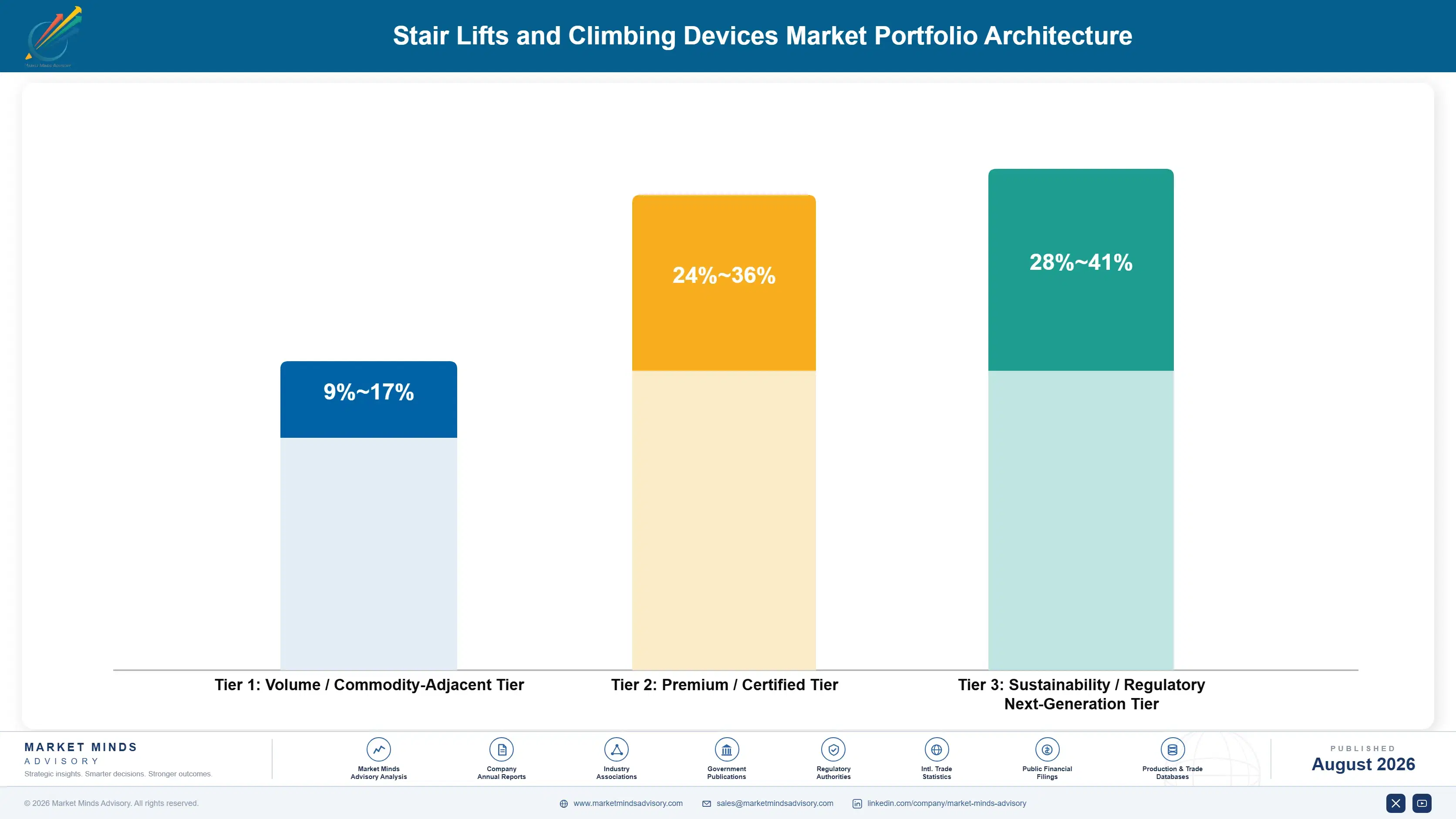
Volume / Commodity-Adjacent Tier

Straight rail stair lifts sold through dealer networks and reconditioned equipment resold at roughly half new pricing. Award turns on appointment availability and price, and independent refurbishers set the reference price in markets where households pay from their own savings.
Gross Margin: 28-36%

Premium / Certified Tier

Curved rail installations requiring bespoke survey and manufacture, plus inclined and vertical platform lifts meeting accessibility standards. Margin comes from survey capability and lead time rather than from componentry, and the nine-point range reflects the gap between owned network and dealer-mediated sales.
Gross Margin: 40-49%

Sustainability / Regulatory / Next-Generation Tier

Service and maintenance agreements across the installed base, refurbishment operations extending equipment life, and through-floor home elevators. The fourteen-point range reflects the gap between mature service annuities and refurbishment operations still building reverse logistics.
Gross Margin: 52-66%
stair-lifts-and-climbing-devices-market-portfolio-architecture-1787309312046

High-value Sub-segments and Strategic Watch-out

Service contracts on owned installed bases

The most profitable pool in the category and the one nobody advertises, generating more lifetime margin than the equipment sale it follows. Households buy reassurance rather than inspections. Breaking a response commitment once damages a whole referral network for years afterwards. Nothing else in the category earns like it.
Gross Margin: 58-66%

Refurbishment and resale operations

Removed equipment retaining most of its service life, resold at half new pricing with a fresh service contract attached. Independents built this business on manufacturers' own units. Reverse logistics is the barrier, and it is an operational problem rather than a commercial one. Solving it earns twice on one unit.
Gross Margin: 48-58%

Straight rail dealer volume

The largest segment by units, earning modest equipment margin and surrendering the service annuity to whoever holds the customer. It reaches geography owned networks cannot justify serving. It also trains households to judge the brand by a dealer's response time. Coverage is what it buys, at the annuity's price.
Gross Margin: 28-36%

Independent refurbisher competition

Businesses built entirely on reselling equipment manufacturers made and then removed, at prices new manufacture cannot match. It looks like a used market rather than a competitor. At 21% of installations it is already the second largest supply route in several countries. Running refurbishment yourself is the only answer.
Gross Margin: 30-40%

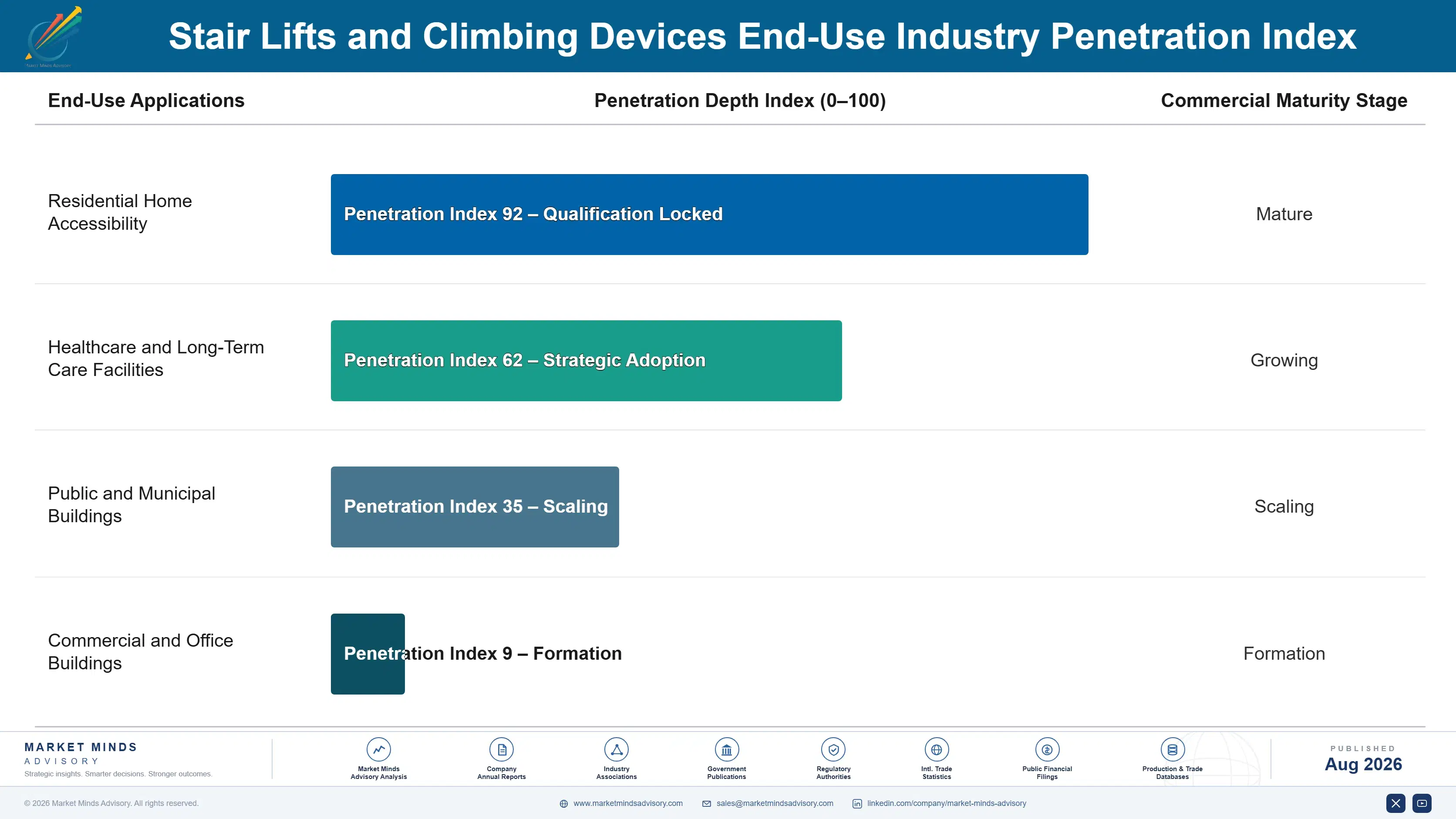
How This Demand Actually Recurs

Equipment demand does not recur and service demand does. A household buys one stair lift, uses it four to eight years and then it is removed, so the installation is a single transaction. What recurs is the maintenance agreement attached to it, held by 62% of installations and generating more margin across a decade than the original sale. The equipment recurs too: a removed unit returns refurbished, and whoever controls that flow earns twice.
Adoption depth varies sharply by property and funding type. Owner-occupied multi-storey homes in Western Europe adopt deepest, helped by grants and suitable housing stock. Social and rented housing adopts portable devices instead, because landlord consent for a fixed rail is frequently unobtainable. Affluent households in Asia and the Gulf adopt home elevators rather than stair lifts, treating the installation as property improvement. Apartment-dominated markets adopt almost nothing, since a building lift already solves the problem.

Buyer profiles are shifting in a way that favours faster response. Adult children now research and arrange most purchases for a parent, frequently remotely, and they compare response times rather than specifications. The generation before them bought after an occupational therapist recommendation and waited for whatever that supplier could schedule.
stair-lifts-and-climbing-devices-market-end-use-penetration-index-1787309312536

What We Would Do Here

These are among the four positions where our research anticipates prominent divergence between winners and laggards over the coming forecast period. Each is grounded in the demand model, the regulatory perimeter, and the announced capacity pipeline.
01 / SURVEY RESPONSE SPEED

Hold surveyor capacity idle and win on availability

Households decide within a fortnight and buy from whoever attends first, which makes guaranteed survey availability worth roughly 30% higher enquiry conversion on identical equipment at identical prices. The investment is surveyor capacity deliberately held in reserve, which every finance function treats as waste until a competitor takes the enquiry instead. This is the cheapest competitive advantage available in the category, and it is the one most consistently declined on utilisation grounds by people who never see the lost enquiry.
02 / SERVICE ANNUITY CAPTURE

Own installation and service, not just manufacturing

A maintenance agreement generates more margin across ten years than the equipment sale it follows, and roughly 62% of all installations carry one. Dealer distribution delivers units without capital, and surrenders that annuity along with control of the customer experience the brand ends up judged on. Manufacturers still expanding through dealers are buying volume today and giving away the profitable decade that follows each installation, which is why acquisitions in this category should be targeting vans and technicians rather than factories.
03 / REFURBISHMENT CHANNEL RECLAMATION

Run refurbishment before independents build on your equipment

Reconditioned units already take 21% of installations at roughly half new pricing, using equipment that the original manufacturer built and later removed itself. Operating refurbishment directly recovers around 40% of new sale margin per unit plus the service contract that follows, and it keeps the household inside the brand. The barrier is reverse logistics nobody designed the network for, which is an operational problem rather than a strategic one, and considerably cheaper to solve than losing a fifth of the market.
04 / PUBLIC FRAMEWORK ACCESS

Bid local authority frameworks despite the thinner margin

Roughly 27% of installations receive public funding and reach suppliers through framework agreements rather than retail enquiry, at customer acquisition cost about 60% below advertising-driven retail channels. Once advertising is properly allocated, framework contribution frequently exceeds retail work despite the visibly lower headline gross margin on each job. Suppliers dismissing frameworks on gross margin alone are simply comparing the wrong two numbers, and they are ceding predictable volume that arrives without any lead generation spend attached to it at all.

Engagement Snapshot From the Field

A live engagement with an industry participant carrying material or product regulatory and market exposure ahead of a defining policy shift, showing how our research translates into a defensible multi-year portfolio strategy.
MARKET MINDS ADVISORY · CLIENT ENGAGEMENT SUMMARY
Stair Lifts and Climbing Devices Producer Strategic Portfolio Review and Transition Roadmap 2026·Investment Scenario on Stair Lifts and Climbing Devices Exposure Evaluation 2025-26
CLIENT PROFILE
A North American manufacturer of stair lifts and platform lifts with revenue near USD 195 million annually (client-reported, unverified by MMA), owned manufacturing across two plants, and distribution through roughly 380 independent dealers. The company held strong product engineering, no owned installation or service capability, and almost no visibility into what happened to its equipment after it left the loading dock.
STRATEGIC CHALLENGE
Unit volume had grown steadily while margins declined for four consecutive years, and management attributed this to dealer discount pressure and reconditioned competition. The proposed response was a lower-cost product line to defend the entry price point. The board questioned whether competing at the bottom of a market it did not control was the right answer, particularly with no data on service or resale.
MMA APPROACH
MMA traced the lifetime economics of 400 installations from factory dispatch through installation, service and eventual removal, which required reconstructing data the client had never collected. Forty-seven expert interviews across dealers, independent refurbishers and occupational therapists established who captured value at each stage. Dealer profitability was modelled separately to establish where discount pressure actually originated.
KEY FINDINGS
  1. Service and maintenance revenue across the installed base exceeded the client's entire equipment gross profit, and every dollar of it was earned by dealers and independent servicers rather than by the company.
  2. Roughly a quarter of removed units were being refurbished and resold by independents, frequently competing against the client's own new product in the same territory at half the price.
  3. Dealer discount pressure originated from enquiry competition between dealers holding overlapping territories, not from reconditioned equipment as management had assumed throughout the previous four years.
  4. Occupational therapists specified brands based on installer responsiveness in their local area, which the client neither measured nor influenced in any territory.
CLIENT PROFILE
A North American manufacturer of stair lifts and platform lifts with revenue near USD 195 million annually (client-reported, unverified by MMA), owned manufacturing across two plants, and distribution through roughly 380 independent dealers. The company held strong product engineering, no owned installation or service capability, and almost no visibility into what happened to its equipment after it left the loading dock.
STRATEGIC CHALLENGE
Unit volume had grown steadily while margins declined for four consecutive years, and management attributed this to dealer discount pressure and reconditioned competition. The proposed response was a lower-cost product line to defend the entry price point. The board questioned whether competing at the bottom of a market it did not control was the right answer, particularly with no data on service or resale.
MMA APPROACH
MMA traced the lifetime economics of 400 installations from factory dispatch through installation, service and eventual removal, which required reconstructing data the client had never collected. Forty-seven expert interviews across dealers, independent refurbishers and occupational therapists established who captured value at each stage. Dealer profitability was modelled separately to establish where discount pressure actually originated.
KEY FINDINGS
  1. Service and maintenance revenue across the installed base exceeded the client's entire equipment gross profit, and every dollar of it was earned by dealers and independent servicers rather than by the company.
  2. Roughly a quarter of removed units were being refurbished and resold by independents, frequently competing against the client's own new product in the same territory at half the price.
  3. Dealer discount pressure originated from enquiry competition between dealers holding overlapping territories, not from reconditioned equipment as management had assumed throughout the previous four years.
  4. Occupational therapists specified brands based on installer responsiveness in their local area, which the client neither measured nor influenced in any territory.
RECOMMENDED STRATEGY
Phase 1: Phase 1 (0 to 6 months): Cancel the low-cost line, rationalise overlapping dealer territories, and begin measuring installer response times by territory. Phase 2: Phase 2 (6 to 18 months): Acquire installation and service businesses in the four highest-volume metropolitan areas, and launch a manufacturer-backed refurbishment programme. Phase 3: Phase 3 (18 to 36 months): Extend owned service coverage across remaining priority territories, and tie dealer agreements to measured response performance.
OUTCOME
The low-cost line was cancelled. Four installation and service businesses were acquired, and service revenue in those territories reached roughly 19% of local revenue within five quarters (client-reported, unverified by MMA). Territory rationalisation reduced dealer discount pressure measurably. The refurbishment programme launched later than planned because reverse logistics proved harder than expected.

Frequently Asked Questions

Foundational context covering the market sizes, CAGR, scope, country, region and competition that inform every finding below. This section is provided to cover basics and most often pre-purchase conversations, answered from the MMA Primary Research Dataset.

What is the current size of the Stair Lifts and Climbing Devices Market?

MMA sizes the global market at USD 4.2 billion in 2025, rising to USD 4.46 billion in 2026. That covers stair lifts, platform lifts, portable climbing devices and home elevators at installed prices including fitting.

How large will the Stair Lifts and Climbing Devices Market be by 2036?

MMA forecasts USD 8.14 billion by 2036, an expansion multiple of 1.82 times the 2026 base. That represents roughly USD 3.68 billion of incremental value over the forecast period.

What is the CAGR for the Stair Lifts and Climbing Devices Market 2026 to 2036?

The base case compounds at 6.2% annually, with a bull case of 7.4% and a bear case of 5.0%. Installation labour availability and adaptation funding decide which case materialises.

Which segment is growing fastest?

Portable stair climbing devices compound at 9.3%, exactly 1.50 times the market rate. They need no rail, no survey and no fitting appointment, which suits hospital discharge teams and rented housing.

Who are the major companies in the Stair Lifts and Climbing Devices Market?

Stannah, Savaria, TK Home Solutions, Bruno Independent Living Aids and Otolift Stairlifts together install 48% of units. Fifteen further participants including Acorn Stairlifts, Harmar Mobility and Cibes Lift Group are profiled.

Which country is growing fastest?

India compounds at 9.0%, ahead of every other national market MMA tracks. Affluent households in independent houses buying for ageing parents account for most of that growth.

Report Segmentation Architecture

The full report scope spans multiple orthogonal segmentation dimensions, with cross-tabulated demand data provided for each dimension pair. Coverage extends further to regional breakdowns, trend trajectories, and the competitive detail needed to support segment-level decision-making.

By Access Device Type

  • Straight Rail Stair Lifts
  • Curved Rail Stair Lifts
  • Vertical Platform Lifts
  • Inclined Platform Lifts
  • Portable Stair Climbing Devices
  • Through-Floor and Compact Home Elevators

By End-Use Setting

  • Owner-Occupied Private Housing
  • Social and Rented Housing
  • Residential Care and Assisted Living
  • Small Commercial and Public Premises
  • Short-Term Rental and Discharge Support

By Channel and Funding Route

  • Manufacturer-Owned Installation and Service
  • Independent Dealer and Installer Networks
  • Local Authority and Grant Frameworks
  • Reconditioned Resale and Rental

By Region

  • North America
  • Western Europe
  • East Asia
  • South Asia and Pacific
  • Latin America
  • Middle East and Africa
  • Eastern Europe

Scope, Methodology, and Coverage

Every figure in this report is reproducible from documented input assumptions. The scope below maps the historical period, the forecast horizon, the segmentation dimensions, and the countries covered, alongside the underlying primary and qualitative methodology.
Historical Period
2020 to 2025
Forecast Period
2026 to 2036
Base Year
2025 (USD billions; MMA Primary Research Dataset, August 2026)
Market Definition
The market comprises powered devices that carry a seated or standing person between levels of a residential or small commercial building, spanning straight and curved rail stair lifts, vertical and inclined platform lifts, portable powered stair climbing devices, and through-floor and compact shaft home elevators. Sizing is at installed price, including survey, rail manufacture, fitting, commissioning and initial warranty, together with subsequent maintenance agreement revenue. Passenger and goods elevators for multi-occupancy buildings, escalators, wheelchairs and mobility scooters, patient hoists and transfer equipment, and structural building works are outside scope.
Quantitative Units
USD billions (current prices); units installed annually; USD per installation at delivered and fitted price
Segmentation Dimensions
By Access Device Type; By End-Use Setting; By Channel and Funding Route; By Region
Regions Covered
North America, Western Europe, East Asia, South Asia and Pacific, Latin America, Middle East and Africa, Eastern Europe
Countries Covered
USA, China, Germany, France, UK, Japan, South Korea, India, Australia, Canada, Brazil, Mexico, Indonesia, Vietnam, Thailand, Malaysia, UAE, Saudi Arabia, South Africa, Nigeria, Turkey, Poland, Netherlands, Italy, Spain, Sweden, Switzerland, Argentina, Colombia, Singapore, and additional markets relevant to this sector
Key Companies Profiled
Stannah, Savaria, TK Home Solutions, Bruno Independent Living Aids, Otolift Stairlifts, Acorn Stairlifts, Platinum Stairlifts, Harmar Mobility, AmeriGlide, Garaventa Lift, Vimec, Access BDD, Terry Lifts, Cibes Lift Group, Aritco, Hiro Lift, Sano Transportgeraete, AAT Alber Antriebstechnik, Kalea Lifts, Ascendor.
Quantitative Methodology
Primary survey, n=3,800 respondents, Q4 2025, six countries; demand-side model with trade association cross-validation
Qualitative Methodology
47 expert interviews, Q4 2025; applied to validate demand model assumptions, identify emerging dynamics, and assess competitive positioning
Report Format
PDF and XLSX data workbook (Word format preview document)
Publisher
Market Minds Advisory
Report Code
MMA-2026-MED-081
Published
August 2026
Contact
sales@marketmindsadvisory.com | www.marketmindsadvisory.com

Purchase the full Stair Lifts and Climbing Devices Market Report (2026 to 2036).

The full report sizes the stair lifts and climbing devices market across six device types, five end-use settings, four channel and funding routes and seven regions, with annual forecasts to 2036 in revenue and units installed. It models lifetime economics per installation from dispatch through service to removal and resale, which is where most manufacturers have no data at all. Twenty participants are assessed on a consistent units installed basis, with owned installation and service coverage mapped separately from manufacturing footprint. Reconditioned supply volumes are quantified by market, and public adaptation funding is compared scheme by scheme.
Six device types sized and forecast annually
Lifetime installation economics modelled through to resale
Twenty participants on consistent units installed basis
Owned service coverage mapped separately from manufacturing
Reconditioned supply volumes quantified by market
Public adaptation funding compared scheme by scheme

Built For The People Who Decide

From boardroom strategy to bench-side execution, this report is read cover-to-cover by leaders shaping the next decade of their industry, turning demand scenarios, market dynamics and valuation benchmarks into decisions.
CXOs/ Presidents/ VPs/ Managers
M&A and Corporate Development
Strategy Teams and R&D Heads
Procurement and Product Directors
Regulatory and Compliance Leaders
Investor Relations and Equity Analysts