

Market Minds Advisory
Stadium Lighting Market

Stadium Lighting Market: Stadium Lighting Market: System Classes, Broadcast Requirements and Show Integration 2026 to 2036

Stadium lighting stopped being illumination and became broadcast infrastructure. The specification is written by whoever holds the television rights, and every venue in the competition simply has to meet it.

Lead Analyst

Published

September 2026

Make Smarter Decisions with Customized Research Insights

Request a free sample report and evaluate market opportunities, growth trends, and competitive dynamics relevant to your business needs.

2025 MARKET VALUE$1.9BMarket Size 2025
2036 FORECAST VALUE$4.2BBase Case , 2026 to 2036
CAGR 2026 TO 20367.6 %Bull 8.9% / Bear 6.4%
INCREMENTAL OPPORTUNITY$2.2BNet 10- year value creation
EXPANSION MULTIPLE2.08x2036 value over 2026 base
Strategic Levers
M&A Pipeline
Regional Outlook
Country Rankings
Competitive Intelligence
Segmental Deep-dive
Call-Us : 91 93563 13602

Executive Snapshot and Market Trajectory.

The specification for stadium lighting is written by broadcasters rather than by venues. Super slow motion capture at 1000 frames per second needs light that does not flicker, which discharge lamps cannot provide. Hosting rights rather than electricity drove the conversion. No venue anywhere writes its own specification now.
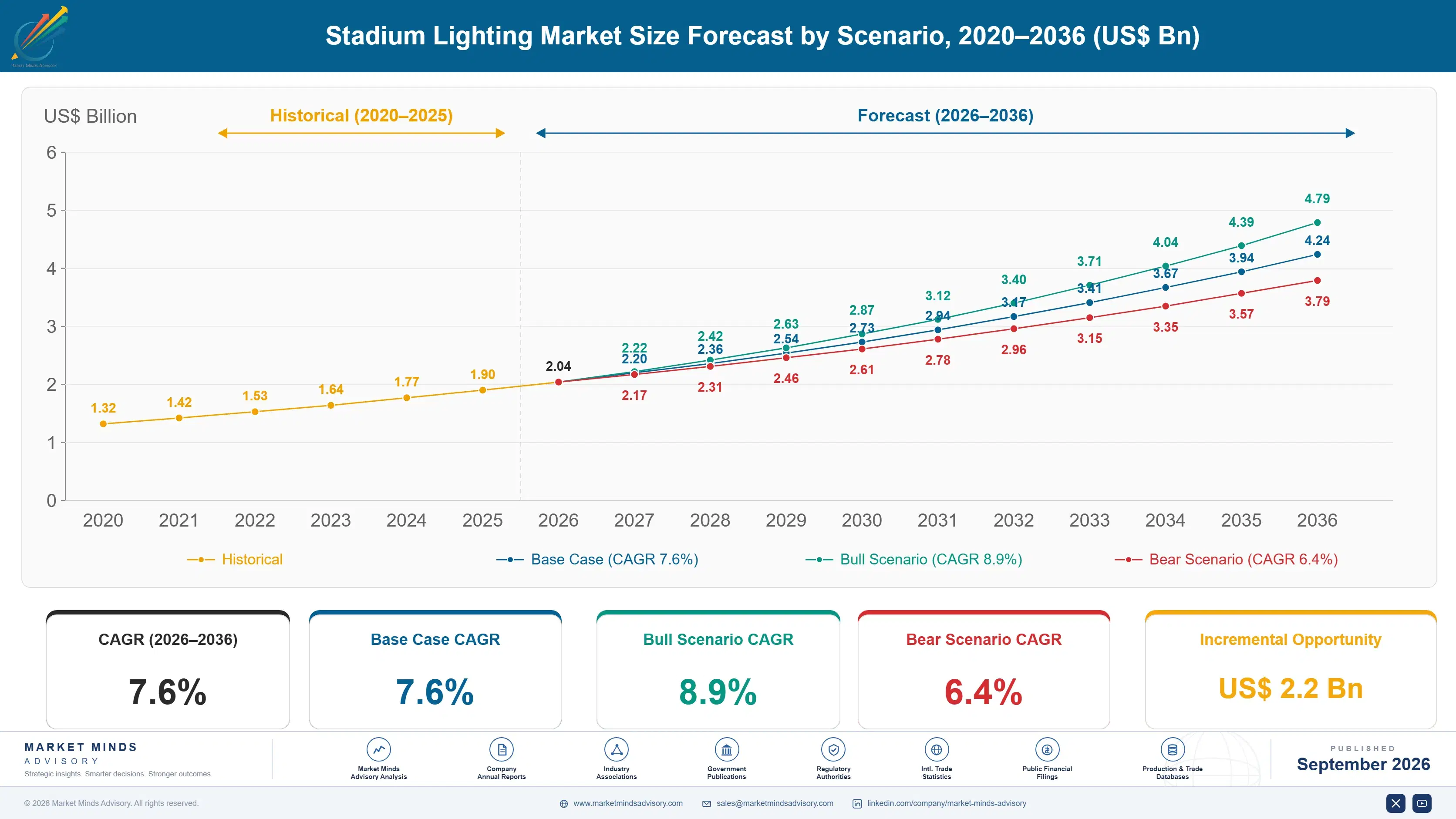
The market reaches USD 2.04 billion in 2026 and USD 4.24 billion by 2036, a 2.08 times expansion at 7.6%. Dynamic show and entertainment lighting grows at 11.4%, half again the market rate of 7.6%, because addressable fixtures became part of the production rather than only illuminating it. East Asia holds 24% of system revenue on venue construction volume, and Morocco compounds fastest at 17.4%. Fixed hosting dates remove every deferral risk.
Five suppliers hold 57% of system revenue, split between general lighting majors and sports venue specialists who do very little else. Signify, Acuity Brands, ams OSRAM and Zumtobel operate across lighting broadly. Musco Lighting built its position entirely on sports venues, where photometric design and camera glare control matter considerably more than any luminaire specification does, and general lighting suppliers keep discovering that late.
Market Definition
This report covers lighting systems installed at sports and entertainment venues: broadcast grade light emitting diode field lighting, dynamic show and entertainment lighting, architectural and facade lighting, spectator bowl and concourse lighting, lighting control and management systems, and conventional metal halide field lighting. It excludes video display boards and scoreboards, general building services lighting outside the venue envelope, temporary event lighting hire, broadcast camera equipment, and stadium construction itself.
Base Year Value
$1.9B in 2025 (MMA Primary Research Dataset, September 2026)
Forecast Period
2026 to 2036, eleven discrete annual values
CAGR
7.6% base case. Bull 8.9%. Bear 6.4%.
Fastest Growth Segment
Dynamic Show And Entertainment Lighting: 11.4% CAGR
Fastest Growth Country
Morocco: 17.4% CAGR
Fastest Growth Region
South Asia and Pacific: 9.6% CAGR
Largest Region
East Asia: 24% of 2025 global value
Market Leaders
Signify, Musco Lighting, Acuity Brands, ams OSRAM and Zumtobel Group lead on stadium and sports venue lighting system revenue. Source: MMA Analysis.
Primary Survey
n=3,800 procurement and R&D decision-makers, Q4 2025, six countries
Methodology
Demand-side build-up, cross-validated against public data, 47 expert interviews

Stadium Lighting Market Forecast Scenarios

stadium-lighting-market-size-forecast-scenario-1789993929418
Between 2020 and 2025 the category compounded at 6.5%, and broadcast requirements rather than efficiency drove nearly all of it. Super slow motion replay became standard across major sports and the flicker that discharge lighting produces is visible at high capture rates, which made conversion a competition requirement instead of a facility decision. Venues without it lost hosting rights rather than lost money on electricity.
The base case holds 7.6% on three mechanisms. Broadcast illuminance requirements keep rising toward 2,000 lux vertical, which obliges upgrades at venues converted only recently. Show lighting has become part of the event experience itself, and venues now specify it alongside illumination rather than treating it as an afterthought. And tournament hosting programmes across the Gulf, North Africa and Asia are building and renovating venues against fixed hosting dates that nobody can move.
The bull case at 8.9% assumes show lighting spreads from major venues into second tier sport, widening a segment confined to flagship stadiums. The bear case at 6.4% is conversion completing faster than replacement demand arrives: with 61% of professional venues already converted and light emitting diode fixtures lasting far longer than discharge lamps, the retrofit wave has a visible end.

Lighting Written By The Broadcaster

Nobody in this market writes their own specification anymore. Broadcasters capturing super slow motion at 1000 frames per second need light with no visible flicker, and discharge lamps operating on alternating current cannot provide it at any price. Vertical illuminance requirements have risen toward 2,000 lux for top tier production. A venue failing the broadcast standard loses hosting rights, which is a sharper argument than energy.
TOP FIVE CONCENTRATION57%Concentrated among lighting majors and dedicated sports venue specialists
BROADCAST FRAME RATE REQUIREMENT1000 per secondSuper slow motion capture that lighting must support flicker free
ANNUAL VENUE OPERATING HOURS410 hoursPitch lighting used across a typical professional venue year
MAST LAMP REPLACEMENT COSTUSD 2,800Access and labour for a single fixture at height
FIELD ILLUMINANCE REQUIREMENT2,000 luxVertical level demanded for top tier broadcast production today
LED CONVERSION PENETRATION61%Professional venues converted from conventional discharge lighting so far
The energy case that vendors lead with is the weakest one available. Pitch lighting runs perhaps 410 hours in a year at a professional venue, so the electricity saved by conversion is genuinely modest against the capital involved. What justifies it is replacing a lamp on a forty metre mast at around USD 2,800 in access and labour each time, and never doing it again for a decade or more.
Once fixtures became individually addressable the lighting joined the show. A rig that can strobe, chase and change colour in time with events is used at every stoppage, in warm up and in pre-match production, which turned illumination into a production element. Venues now specify show capability alongside compliance, and an event producer writes that part.
"A stadium director asked me about the payback on energy. I asked how much a lamp change on the masts costs them and whether they had lost a fixture during a match. The conversation changed completely and we never mentioned electricity again."
Director, Venue Systems and Entertainment Technology Practice · MMA Construction and Industrial Equipment Practice · September 2026

Market Trends

Broadcast Requirements Now Write The Whole Specification

Super slow motion capture at 1000 frames per second makes any flicker plainly visible, which discharge lighting operating on alternating current produces and cannot avoid at any price. Vertical illuminance requirements for top tier production have risen toward 2,000 lux alongside that. A venue failing the standard loses hosting rights rather than merely operating inefficiently, which is why conversion ran on a broadcast timetable and not an energy one. Around 61% of professional venues have converted and the remainder are mostly those without top tier hosting ambitions. Hosting rights rather than efficiency drove the whole conversion.
Market Impact: Morocco compounds at 17.4% yearly
Addressable Fixtures Turned Lighting Into Production

Once every fixture became individually controllable the rig stopped being illumination and became part of the show, used at every stoppage, in warm up and throughout pre-match production. Dynamic show and entertainment lighting compounds at 11.4% against 7.6% for the market on that shift. The commercially significant part is who now writes the specification, since an event producer evaluating a rig on what it can do during a broadcast asks entirely different questions from a facility engineer evaluating it on illuminance uniformity and maintenance access. That specifier holds an event budget rather than a capital programme.
Market Impact: Lamp changes cost USD 2,800 each

Market Opportunities and Growth Drivers

Tournament Programmes Build Against Dates That Cannot Move

Major tournament hosting commits a country to delivering venues by a fixed date years in advance, and lighting is among the last systems installed before commissioning and testing. Morocco compounds at 17.4%, ahead of every other market, on a stadium building and renovation programme sized against hosting commitments rather than domestic demand. Gulf and Asian programmes follow comparable logic. Fixed dates remove the deferral risk that characterises every other part of this market, which makes tournament demand unusually reliable for suppliers. Tournament demand is unusually reliable for suppliers as a result.
Market Impact: About 61% already converted

Access Cost Rather Than Energy Justifies Conversion

Replacing a single failed fixture on a forty metre mast costs around USD 2,800 in access equipment and labour, and discharge lamps fail often enough that venues budget for it every season. Light emitting diode fixtures rated for tens of thousands of hours remove that expense almost entirely across a decade of operation. Pitch lighting runs only around 410 hours a year, so energy savings are genuinely modest, and maintenance avoidance carries the business case wherever it has been made honestly. Maintenance avoidance carries the case wherever anybody has made it honestly.
Market Impact: Lighting runs only 410 hours yearly

Market Restraints and Challenges

Conversion Completes And Replacement Arrives Slowly

Around 61% of professional venues have already converted from discharge lighting and the remainder are largely those without top tier hosting ambitions or budgets. The root cause is that light emitting diode fixtures last far longer than the lamps they replaced, so a converted venue generates no replacement demand for a decade or more. Commercially this means the retrofit wave that carried the industry has a visible end. Mitigation runs through show lighting upgrades, control system replacement and broadcast requirement increases that oblige earlier renewal. Rising broadcast requirements are the only reliable renewal driver.
Market Impact: Capture runs at 1000 frames

Venue Capital Follows Hosting Rather Than Operations

Lighting investment at most venues happens during construction, major renovation or in preparation for a specific hosting requirement, rather than as any routine operational decision. The root cause is that a working lighting installation generates no internal pressure to replace it, however far behind current standards it falls. Commercially this makes demand lumpy and tied to events years in advance. Mitigation runs through tracking hosting awards and renovation programmes rather than venue operating budgets, which very few suppliers do systematically. Tracking hosting awards rather than venue budgets is what suppliers should do, and very few do it systematically at all.
Market Impact: Show lighting compounds at 11.4%
3 additional market trends, 4 additional growth drivers, and 2 additional restraints and challenges are covered in the full report. Contact sales@marketmindsadvisory.com to access the complete intelligence.

Segment CAGR and Growth Architecture

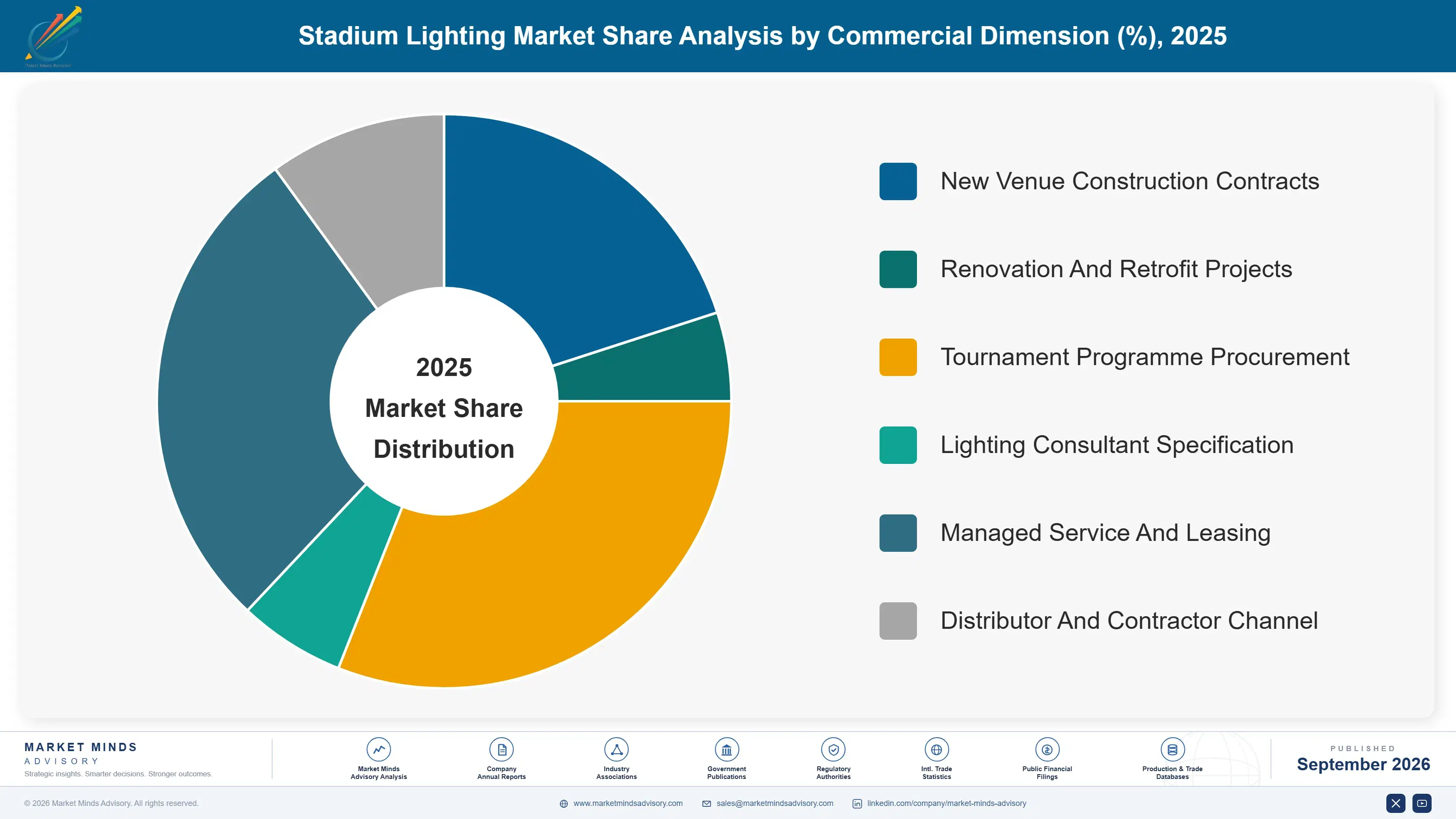
Segmentation follows lighting system class, since what a system does determines who specifies it and whether a broadcaster holds any view on it. Six classes cover the market: dynamic show lighting, broadcast grade field lighting, lighting control, architectural and facade lighting, spectator bowl lighting, and conventional metal halide field lighting. Venue type is a separate dimension.
stadium-lighting-market-market-share-analysis-1789993929960

Dynamic Show And Entertainment Lighting

Dynamic show and entertainment lighting grows at 11.4%, half again the market rate of 7.6%, because addressable fixtures turned the rig into a production element rather than illumination. A system that strobes, chases and changes colour in time with events gets used at every stoppage, during warm up and throughout pre-match production, which is a completely different value proposition from lighting a pitch adequately. The commercially important consequence is the specifier: an event producer evaluating what a rig can do during a broadcast asks entirely different questions from a facility engineer assessing illuminance uniformity and maintenance access on a mast. Neither buyer really talks to the other. Illumination was never the point.
CAGR 11.4%

Broadcast Grade LED Field Lighting

Broadcast grade field lighting compounds at 9.8% on requirements that venues do not write and cannot negotiate. Super slow motion capture at 1000 frames per second makes flicker visible, which discharge lamps operating on alternating current produce inherently, and vertical illuminance demands have risen toward 2,000 lux for top tier production. A venue failing that standard loses hosting rights. Around 61% of professional venues have converted, which means the retrofit opportunity is finite, though rising broadcast requirements keep obliging upgrades at venues that converted only a few years earlier. Requirements keep rising, which obliges renewal at venues that converted only a few years earlier and thought the question settled. The opportunity is finite.
CAGR 9.8%
Full segment breakdown across 6 segments available in the complete report.

Regional Architecture and Country Demand Map

East Asia leads at 24% of system revenue on venue construction and renovation volume larger than any other region delivers. Middle East and Africa sits at 13%, far above band, because tournament hosting programmes there are building and renovating venues against fixed dates that cannot be moved.

East Asia

East Asia holds 24% of system revenue on venue construction and renovation volume that no other region matches. Chinese municipal stadium and sports centre building continues at a scale reflecting policy commitments to sports participation rather than professional demand alone, and Chinese manufacturers including Sansi supply much of that domestically. Japanese and Korean venues run high broadcast standards and renovate on regular cycles. The region also manufactures a substantial share of the light emitting diode components every supplier worldwide depends upon. Growth at 8.6% sits above the global rate on continued construction volume. Component manufacture and venue construction sit in the same region here. Policy rather than professional demand drives Chinese building.
Share: 24% | CAGR: 8.6% (2026 to 2036)

Western Europe

Twenty-two percent of system revenue reaches Western Europe, where football broadcast requirements have driven conversion further than anywhere else. European competition rules specify lighting standards that clubs must meet to host matches, which removes discretion from the venue entirely and makes the specification a competition requirement. Signify, Zumtobel, ams OSRAM, Thorn and Schreder all operate here. Venue renovation rather than new construction dominates, since most major grounds already exist. Growth at 6.2% is the slowest of any region, reflecting conversion that is already substantially complete across the top divisions. Competition rules remove discretion from the venue entirely, since a club failing the standard cannot host at all. Renovation dominates over new construction.
Share: 22% | CAGR: 6.2% (2026 to 2036)
Regional intelligence for 5 additional markets available in the complete report: North America, South Asia and Pacific, Latin America, Middle East and Africa, Eastern Europe. Contact sales@marketmindsadvisory.com.
stadium-lighting-market-country-cagr-analysis-1789993930492

What Actually Justifies A Rig

Broadcasters write the whole specification, the energy argument that every vendor leads with is the weakest one available, and venue capital follows hosting commitments rather than operating budgets. Each of the four levers below responds to one of those rather than to an efficiency case that has never really persuaded anybody in this market.

Sell Access Cost Rather Than Energy Savings

Pitch lighting runs around 410 hours a year at a professional venue, so the electricity a conversion saves is genuinely modest against the capital involved and everybody doing the arithmetic knows it. Replacing a single failed fixture on a forty metre mast costs around USD 2,800 in access and labour, and discharge lamps fail often enough to budget for every season. Light emitting diode fixtures remove that expense for a decade. Vendors leading with kilowatt hours are making the weakest argument available to them. Everybody doing the arithmetic knows it already.
Market Impact: Each mast replacement costs around USD 2,800 alone

Reach The Broadcaster Before The Venue

Super slow motion capture at 1000 frames per second and vertical illuminance approaching 2,000 lux are requirements broadcasters set and venues simply have to meet, since failing them costs hosting rights rather than money. Suppliers engaged with broadcast bodies and competition organisers as requirements are written influence a specification every venue then has to buy against. That is a completely different commercial position from bidding against a specification somebody else shaped, and remarkably few lighting suppliers pursue it at all. It is available and largely unpursued. Bidding against somebody else's specification is a weaker position entirely.
Market Impact: Capture at 1000 frames now sets the standard

Follow Hosting Awards Rather Than Venue Budgets

Lighting investment happens at construction, major renovation or in preparation for specific hosting, and almost never as a routine operational decision, because a working installation generates no internal pressure to replace it. Morocco compounds at 17.4% on a programme sized entirely against hosting commitments. Those awards are announced years ahead and the delivery dates cannot move, which removes the deferral risk present everywhere else in this market. Suppliers tracking venue operating budgets are watching the wrong signal completely. Awards are public and the dates are fixed. Suppliers watching operating budgets follow the wrong signal.
Market Impact: Morocco compounds at 17.4% on hosting programmes alone

Sell Show Capability To Event Producers

Dynamic show lighting compounds at 11.4% against 7.6% for the market, and the person specifying it is an event producer rather than a facility engineer. Those two buyers evaluate a rig on entirely different criteria, one on what it can do during a broadcast and the other on illuminance uniformity and maintenance access. Suppliers organised around facility engineering are absent from the conversation growing fastest, and the producer signs against an event budget rather than a capital programme. That producer signs against an event budget rather than a capital programme, and decides considerably faster than a facility engineer ever does.
Market Impact: Show lighting compounds at 11.4% every single year

Who Controls the Margin Pool

Five suppliers hold 57% of stadium and sports venue lighting system revenue, divided between general lighting majors and specialists who work on very little else. Signify, Acuity Brands, ams OSRAM and Zumtobel Group operate across lighting broadly and reach venues through that breadth. Musco Lighting built its entire position on sports venues, where photometric design and camera glare control matter more than luminaire specification. All participants are assessed on venue lighting system revenue.
Competition runs on photometric design rather than on fixtures, which surprises people entering from general lighting. Meeting 2,000 lux vertical uniformly across a pitch while controlling glare toward cameras and players is a geometry problem solved before any luminaire is selected, and the design determines how many fixtures the venue buys. Specialists win on that work and general suppliers frequently discover it late.

Rankings shift toward whoever serves show lighting credibly, since that segment grows fastest and reaches an entirely different specifier. The second pressure is conversion completing: with 61% of professional venues already converted, suppliers dependent on retrofit face a finite opportunity and are competing for tournament programmes that a handful of countries control.
stadium-lighting-market-company-positioning-matrix-1789993931021

Competitive Moat and Risk Dimensions

MUSCO LIGHTING

Moat: Sports Photometric Design Depth

Musco solves the geometry problem before selecting any fixture, delivering uniform vertical illuminance while controlling glare toward cameras and players across venue shapes that differ every time. That capability accumulated across thousands of installations and it determines how many luminaires a venue needs. General suppliers frequently discover the fixture was never the difficult part.
MUSCO LIGHTING

Risk: Conversion Wave Ending

Around 61% of professional venues have already converted and light emitting diode fixtures last long enough that replacement demand arrives slowly. A specialist without adjacent lighting markets has nothing to carry it once retrofit completes. Tournament programmes offer genuine volume and a handful of countries control when and where those awards land.
SIGNIFY

Moat: Control Platform And Breadth

Signify supplies field, architectural, concourse and show lighting on one control platform, so a venue manages every system through a single interface rather than integrating several. That breadth matters more as show lighting becomes part of the production and control integration becomes the difficult part. Assembling comparable coverage requires product across four genuinely distinct lighting disciplines.
SIGNIFY

Risk: Specialist Design Competition

Sports photometric design determines fixture count and therefore project value, and specialists who do nothing else consistently produce better solutions with fewer luminaires. A general lighting supplier competing on product breadth can lose on a design comparison before pricing is ever discussed. That capability is difficult to build inside an organisation serving many lighting markets.

Players Tracked

Prominent Players

Signify
Musco Lighting
Acuity Brands
ams OSRAM
Zumtobel Group

Other Key Players

Abacus Lighting
Cree Lighting
Eaton
Schreder
Thorn Lighting
Sansi
Leadsun
Ephesus Lighting
Anolis
Claypaky
Robe Lighting
Martin Professional
ETC
LEDVANCE
Fagerhult

Recent Developments

MARCH 2025

Signify Extends Integrated Show And Field Lighting Control

Signify extended integrated control across field, architectural and show lighting systems within venue installations, an organic product development rather than an acquisition or joint venture. Addressable fixtures turned the rig into a production element used at every stoppage, and control integration became the difficult part of a venue installation.
Signal: Control integration matters considerably more than the luminaires once every fixture in a venue is addressable.
SEPTEMBER 2024

Musco Expands Photometric Design Services For Tournament Venues

Musco Lighting expanded photometric design capability supporting tournament venue programmes, an organic expansion rather than any transaction. Delivering 2,000 lux vertical uniformly while controlling glare toward cameras and players is a geometry problem solved before fixture selection, and it determines how many luminaires a venue needs.
Signal: The photometric design determines the fixture count, which in turn determines project value before anybody quotes.
JUNE 2025

Moroccan Stadium Programme Specifies Broadcast Lighting Across Venues

Moroccan tournament venue programmes specified broadcast grade lighting across both new and renovated stadiums, which is a procurement development rather than any kind of corporate transaction whatsoever. Hosting commitments fix delivery dates years in advance, removing the deferral risk that otherwise characterises venue lighting investment everywhere.
Signal: Fixed hosting dates make tournament demand the only genuinely reliable forecast anybody in this market holds.

What A Venue Rig Costs

Light emitting diode packages and drivers account for roughly 36% of luminaire cost, with high output packages carrying most of the value. Optical assemblies and housings carry around 22%, since sports fixtures must control beam distribution far more precisely than general lighting does. Photometric design and commissioning absorb about 14%, and installation at height plus structural work take most of the remaining balance.
Light emitting diode package pricing continued falling through 2023 and 2024 while high output components used in sports fixtures fell more slowly than general lighting equivalents, since volumes are far smaller. Signify Annual Report 2024 and Acuity Brands Annual Report 2024 both record component sourcing and project delivery as operating variables. Suppliers on fixed price venue contracts absorbed movements directly, since a project priced at tender does not reprice.

The competitive disadvantage mechanism is design capability rather than component cost. Photometric design determines how many fixtures a venue needs to meet 2,000 lux vertical uniformly, and a better design delivers the standard with fewer luminaires at lower total cost. Exposure concentrates among suppliers competing on fixture price without design depth, since they quote more product for the same result.
stadium-lighting-market-cost-volatility-analysis-1789993931219

Invest In Photometric Design Before Fixture Development

Photometric design and commissioning run around 14% of project cost and determine how many of the remaining fixtures a venue actually requires. A better design meets 2,000 lux vertical with fewer luminaires, which reduces total project cost while improving supplier margin simultaneously. Suppliers investing in luminaire efficiency while neglecting design capability are optimising the smaller variable in the equation.

Share High Output Package Sourcing With Industrial Lighting

Light emitting diode packages run about 36% of luminaire cost and sports fixtures use high output components at volumes far below general lighting equivalents. Aligning component selection with high bay industrial products inside the same organisation improves both pricing and availability considerably. Suppliers specifying sports specific packages pay for low volume where volume sets pricing.

Index Venue Contracts Across Long Build Programmes

Tournament venue projects are priced at tender and delivered across build programmes running years, during which component and labour costs move considerably in either direction. Most contracts carry fixed pricing with no indexation at all. Negotiating indexation at tender costs nothing when a programme has a date it cannot move, and it removes an exposure no supplier can hedge.

Portfolio Architecture for Margin Defence

Margin architecture separates on whether a specification writer outside the venue is involved. Conventional metal halide and spectator bowl lighting earn least, since both are commodity products meeting no external standard anybody enforces. Architectural and facade lighting sits in the middle on design content. Broadcast grade field lighting, show lighting and control systems earn most, because each meets a requirement the venue does not control and cannot negotiate away.
The volume versus premium tension is between two specifiers who barely speak. A facility engineer buys illuminance, uniformity and maintenance access on a capital programme evaluated over decades. An event producer buys what the rig can do during a broadcast on an event budget evaluated over a season. Suppliers organised around the first are absent from the segment growing fastest, and the second buyer decides considerably faster.

High-value pools concentrate in show lighting and in photometric design, and neither is reached by improving a luminaire. Show lighting requires control capability and a relationship with event production. Photometric design requires accumulated experience across venue geometries that differ every time. Both determine project value before any fixture is quoted, which is why the specialists hold positions that product breadth has not displaced.

Volume / Commodity-Adjacent

Conventional metal halide field lighting and spectator bowl and concourse lighting, meeting no external standard that anybody enforces on the venue. The ten point spread separates suppliers with venue project delivery capability from those supplying fixtures into somebody else's installation contract.
Gross Margin: 18% to 28%

Premium / Certified

Architectural and facade lighting sold on design content and visual outcome rather than on measurable performance. The twelve point spread tracks how much design work a supplier performs rather than supplying against a specification that an architect or consultant has already written in full.
Gross Margin: 32% to 44%

Sustainability / Regulatory / Next-Generation

Broadcast grade field lighting, dynamic show lighting and control systems, each meeting a requirement the venue does not control and cannot negotiate. The fourteen point spread reflects photometric design capability, which determines fixture count and therefore project value before anybody quotes a price.
Gross Margin: 48% to 62%
stadium-lighting-market-portfolio-architecture-1789993931748

High-value Sub-segments and Strategic Watch-out

Dynamic Show And Entertainment Lighting

Grows at 11.4% because addressable fixtures turned the rig into a production element used at every stoppage and in warm up. The fourteen point spread reflects control capability. An event producer rather than a facility engineer now writes this part of the specification. Two buyers who barely speak.
Gross Margin: 48% to 62%

Broadcast Grade LED Field Lighting

Grows at 9.8% on requirements venues neither write nor can negotiate, with capture at 1000 frames making any flicker plainly visible. The fourteen point spread reflects design depth. Failing the standard costs hosting rights rather than merely costing money. Requirements keep rising steadily. Rights, not money.
Gross Margin: 48% to 62%

Lighting Control And Management Systems

Grows at 8.4% as integrating field, architectural and show systems on one platform becomes the difficult part of any venue installation. The fourteen point spread reflects integration breadth. Control matters more than luminaires once every fixture is individually addressable. Integration is the difficult part now.
Gross Margin: 48% to 62%

Conventional Metal Halide Field Lighting

Grows at 0.9%, slowest of the six classes, serving venues without top tier hosting ambitions and replacement on installations nobody will convert. The ten point spread reflects project capability. Flicker at 1000 frames rules it out of any broadcast venue permanently. Broadcast venues cannot use it at all.
Gross Margin: 18% to 28%

Why Venue Relationships Last Decades

The annuity is the installation rather than any contract, and it lasts as long as the structure. Lighting fixed to masts and roof structures at a venue is designed against that specific geometry, and replacing it means repeating the photometric work, the structural assessment and the access planning from the start. Fixtures rated for tens of thousands of hours across 410 operating hours annually outlast several venue managers.
Depth varies by how much of the venue a supplier holds. A system covering field, architectural, concourse and show lighting on one control platform is effectively permanent, since replacing any part means addressing the integration. A field lighting installation alone is replaced at the next major renovation or hosting requirement. A single concourse fixture supply is genuinely competitive and gets rebid whenever anybody asks.

The buyer split and most suppliers still address one half. A facility engineer specifies illuminance, uniformity and maintenance access against a capital programme measured in decades. An event producer specifies show capability against an event budget measured in seasons. The second holds the faster growing requirement, decides quickly and appears on no traditional customer list.
stadium-lighting-market-end-use-penetration-index-1789993932235

What Wins Venue Lighting Work

These are among the four positions where our research anticipates prominent divergence between winners and laggards over the coming forecast period. Each is grounded in the demand model, the regulatory perimeter, and the announced capacity pipeline.
01 / MAINTENANCE COST ARGUMENT

Sell The Mast Climb, Not The Meter

Pitch lighting at a professional venue runs around 410 hours a year, so the electricity that a conversion saves is genuinely modest against the capital involved and every venue finance director doing the arithmetic works that out quickly. Replacing a single failed fixture on a forty metre mast costs around USD 2,800 in access equipment and labour, and discharge lamps fail often enough that venues budget for it every season. Vendors leading with kilowatt hours make the weakest argument available.
02 / STANDARDS BODY ENGAGEMENT

Shape The Specification Being Written

Super slow motion capture at 1000 frames per second and vertical illuminance approaching 2,000 lux are requirements that broadcasters set and venues simply have to meet, because failing them costs hosting rights rather than merely costing money. Suppliers engaged with broadcast bodies and competition organisers while those requirements are drafted influence a specification that every venue in the competition subsequently has to buy against. Remarkably few lighting suppliers pursue that position at all, and it remains genuinely available to anybody who does.
03 / HOSTING PIPELINE TRACKING

Follow The Awards, Not The Budgets

Lighting investment happens at construction, major renovation or in preparation for a specific hosting requirement, and almost never as a routine operational decision, because a working installation creates no internal pressure to replace it. Morocco compounds at 17.4% on a stadium programme sized entirely against hosting commitments rather than domestic demand. Those awards are announced years ahead with delivery dates that cannot move, which removes the deferral risk that is present everywhere else in this market, and suppliers watching operating budgets miss it entirely.
04 / PRODUCER CHANNEL ACCESS

Call On The People Running The Show

Dynamic show lighting compounds at 11.4% against 7.6% for the market, and the person specifying it is an event producer rather than a facility engineer holding a capital programme. Those two buyers evaluate a rig against entirely different criteria, one on what it can do live during a broadcast and the other on illuminance uniformity and maintenance access at considerable height. Suppliers organised around facility engineering are simply absent from the conversation growing fastest, and the event producer signs faster from a completely different budget.

Engagement Snapshot From the Field

A live engagement with an industry participant carrying material or product regulatory and market exposure ahead of a defining policy shift, showing how our research translates into a defensible multi-year portfolio strategy.
MARKET MINDS ADVISORY · CLIENT ENGAGEMENT SUMMARY
Stadium Lighting Producer Strategic Portfolio Review and Transition Roadmap 2026·Investment Scenario on Stadium Lighting Exposure Evaluation 2025-26
CLIENT PROFILE
A European football club operating a 42,000 seat stadium with discharge lighting installed during a renovation eleven years earlier, facing a competition requirement increase that its current installation could not meet. Three suppliers had quoted conversion and the proposals differed by a wide margin in both fixture count and price. The board could not explain the difference.
STRATEGIC CHALLENGE
The facility team evaluated proposals on fixture specification and unit price, which favoured the cheapest quotation by a considerable margin. The commercial team wanted show lighting capability for concerts and pre-match production and had no view on the field lighting question. Nobody had assessed whether the cheapest proposal actually met the competition standard across the whole pitch.
MMA APPROACH
MMA assessed each proposal's photometric design against the competition requirement, checking vertical illuminance and uniformity at camera positions rather than accepting headline figures. We modelled total cost including access and maintenance across fifteen years, and priced show lighting capability as an increment against separate later installation. The work drew on 47 expert interviews conducted in Q4 2025 with venues, suppliers and broadcast production specialists.
KEY FINDINGS
  1. The cheapest proposal met the standard at only 3 of the 8 camera positions, and would have required additional fixtures after commissioning to pass inspection.
  2. The best photometric design achieved the requirement with roughly 20% fewer fixtures than the cheapest quotation proposed using (client-reported, unverified by MMA).
  3. Access and maintenance avoided across fifteen years exceeded the entire energy saving by around 4 times, and only one proposal had quantified it.
  4. Adding show capability during the same installation cost about a third of retrofitting it separately two seasons later, as had originally been planned.
CLIENT PROFILE
A European football club operating a 42,000 seat stadium with discharge lighting installed during a renovation eleven years earlier, facing a competition requirement increase that its current installation could not meet. Three suppliers had quoted conversion and the proposals differed by a wide margin in both fixture count and price. The board could not explain the difference.
STRATEGIC CHALLENGE
The facility team evaluated proposals on fixture specification and unit price, which favoured the cheapest quotation by a considerable margin. The commercial team wanted show lighting capability for concerts and pre-match production and had no view on the field lighting question. Nobody had assessed whether the cheapest proposal actually met the competition standard across the whole pitch.
MMA APPROACH
MMA assessed each proposal's photometric design against the competition requirement, checking vertical illuminance and uniformity at camera positions rather than accepting headline figures. We modelled total cost including access and maintenance across fifteen years, and priced show lighting capability as an increment against separate later installation. The work drew on 47 expert interviews conducted in Q4 2025 with venues, suppliers and broadcast production specialists.
KEY FINDINGS
  1. The cheapest proposal met the standard at only 3 of the 8 camera positions, and would have required additional fixtures after commissioning to pass inspection.
  2. The best photometric design achieved the requirement with roughly 20% fewer fixtures than the cheapest quotation proposed using (client-reported, unverified by MMA).
  3. Access and maintenance avoided across fifteen years exceeded the entire energy saving by around 4 times, and only one proposal had quantified it.
  4. Adding show capability during the same installation cost about a third of retrofitting it separately two seasons later, as had originally been planned.
RECOMMENDED STRATEGY
Phase 1: Phase one: evaluate every proposal on verified photometric performance at camera positions rather than on fixture specification and unit price. Phase 2: Phase two: include show lighting capability in the same installation, since retrofitting it later costs roughly three times as much. Phase 3: Phase three: present the business case on access and maintenance avoidance rather than on energy, which is the weaker argument by far.
OUTCOME
The club selected on photometric performance rather than price and included show capability in the original scope (client-reported, unverified by MMA). The installation passed competition inspection without additional fixtures and concert revenue rose in the first season. Lighting proposals are now assessed on verified camera position performance, which is the change that outlasted the engagement.

Frequently Asked Questions

Foundational context covering the market sizes, CAGR, scope, country, region and competition that inform every finding below. This section is provided to cover basics and most often pre-purchase conversations, answered from the MMA Primary Research Dataset.

What is the current size of the Stadium Lighting Market?

Global value reaches USD 2.04 billion in 2026, measured as stadium and sports venue lighting system revenue across six classes. The 2025 base is USD 1.9 billion.

How large will the Stadium Lighting Market be by 2036?

System revenue reaches USD 4.24 billion by 2036, an increase of USD 2.20 billion over the forecast period. That represents 2.08 times expansion from the 2026 base.

What is the CAGR for the Stadium Lighting Market 2026 to 2036?

The base case runs at 7.6% annually, with a bull case at 8.9% if show lighting spreads into second tier sport and a bear case at 6.4% if conversion completes faster than replacement arrives.

Which segment is growing fastest?

Dynamic show and entertainment lighting grows at 11.4%, half again the market rate of 7.6%. Addressable fixtures turned the rig into a production element used at every stoppage rather than only illuminating the pitch.

Who are the major companies in the Stadium Lighting Market?

Signify, Musco Lighting, Acuity Brands, ams OSRAM and Zumtobel Group lead on venue lighting system revenue, together holding 57%. Abacus Lighting, Schreder and Ephesus Lighting hold smaller positions.

Which country is growing fastest?

Morocco leads at 17.4%, on a stadium building and renovation programme sized against tournament hosting commitments rather than domestic demand. Saudi Arabia and India follow on comparable programmes.

Report Segmentation Architecture

The full report scope spans multiple orthogonal segmentation dimensions, with cross-tabulated demand data provided for each dimension pair. Coverage extends further to regional breakdowns, trend trajectories, and the competitive detail needed to support segment-level decision-making.

By Lighting System Class

  • Dynamic Show And Entertainment Lighting
  • Broadcast Grade LED Field Lighting
  • Lighting Control And Management Systems
  • Architectural And Facade Lighting
  • Spectator Bowl And Concourse Lighting
  • Conventional Metal Halide Field Lighting

By End-Use Industry

  • Football And Multi-Sport Stadiums
  • Indoor Arenas And Basketball Venues
  • Cricket And Baseball Grounds
  • Motorsport And Racing Circuits
  • Collegiate And Community Facilities
  • Concert And Entertainment Venues

By Commercial Dimension

  • New Venue Construction Contracts
  • Renovation And Retrofit Projects
  • Tournament Programme Procurement
  • Lighting Consultant Specification
  • Managed Service And Leasing
  • Distributor And Contractor Channel

By Region

  • North America
  • Western Europe
  • East Asia
  • South Asia and Pacific
  • Latin America
  • Middle East and Africa
  • Eastern Europe

Scope, Methodology, and Coverage

Every figure in this report is reproducible from documented input assumptions. The scope below maps the historical period, the forecast horizon, the segmentation dimensions, and the countries covered, alongside the underlying primary and qualitative methodology.
Historical Period
2020 to 2025
Forecast Period
2026 to 2036
Base Year
2025 (USD billions; MMA Primary Research Dataset, September 2026)
Market Definition
This report covers lighting systems installed at sports and entertainment venues: broadcast grade light emitting diode field lighting, dynamic show and entertainment lighting, architectural and facade lighting, spectator bowl and concourse lighting, lighting control and management systems, and conventional metal halide field lighting. It excludes video display boards and scoreboards, general building services lighting outside the venue envelope, temporary event lighting hire, broadcast camera equipment, and stadium construction itself.
Quantitative Units
USD millions, venue lighting system revenue basis; equipped venues; vertical illuminance in lux; annual operating hours; fixture replacement access cost in USD.
Segmentation Dimensions
Lighting system class; venue type; commercial procurement route; geography across seven regions.
Regions Covered
North America, Western Europe, East Asia, South Asia and Pacific, Latin America, Middle East and Africa, Eastern Europe
Countries Covered
China, Japan, South Korea, India, Australia, Indonesia, United States, Canada, Mexico, Brazil, Argentina, United Kingdom, Germany, Spain, France, Netherlands, Poland, Romania, Morocco, Saudi Arabia.
Key Companies Profiled
Signify, Musco Lighting, Acuity Brands, ams OSRAM, Zumtobel Group, Abacus Lighting, Cree Lighting, Schreder, Thorn Lighting, Sansi, Ephesus Lighting, Claypaky, Robe Lighting, ETC, Fagerhult.
Quantitative Methodology
Primary survey, n=3,800 respondents, Q4 2025, six countries; demand-side model with trade association cross-validation
Qualitative Methodology
47 expert interviews, Q4 2025; applied to validate demand model assumptions, identify emerging dynamics, and assess competitive positioning
Report Format
PDF and XLSX data workbook (Word format preview document)
Publisher
Market Minds Advisory
Report Code
MMA-2026-CON-131
Published
September 2026
Contact
sales@marketmindsadvisory.com | www.marketmindsadvisory.com

Purchase the full Stadium Lighting Market Report (2026 to 2036).

This report sizes the global stadium lighting market from 2026 to 2036 across six system classes, six venue types and seven regions. It explains why broadcasters rather than venues write the specification, how capture at 1000 frames per second made discharge lighting unusable at any price, and why access cost near USD 2,800 per fixture rather than energy justifies conversion across only 410 operating hours a year. Cost composition is sourced to company annual reports, with photometric design analysed as the determinant of project value. Regional analysis explains why Middle East and Africa sits at 13% on hosting programmes.
Six lighting system classes sized through to 2036
Broadcast requirements modelled as the specification mechanism
Luminaire and design cost composition from company filings
Twenty named suppliers assessed on system revenue
Four revenue levers with quantified commercial impact
Anonymised football club lighting replacement engagement included fully

Built For The People Who Decide

From boardroom strategy to bench-side execution, this report is read cover-to-cover by leaders shaping the next decade of their industry, turning demand scenarios, market dynamics and valuation benchmarks into decisions.
CXOs/ Presidents/ VPs/ Managers
M&A and Corporate Development
Strategy Teams and R&D Heads
Procurement and Product Directors
Regulatory and Compliance Leaders
Investor Relations and Equity Analysts