Market Minds Advisory
SQL Server Transformation Market

SQL Server Transformation Market: SQL Server Transformation Market. Trends and Forecast 2026 to 2036

End-of-support deadlines and AI workload demands are forcing enterprises to modernize legacy SQL Server estates, but migration complexity and licensing cost uncertainty keep many organizations delaying the transition past their own stated timelines.

Lead Analyst

Published

September 2026

Make Smarter Decisions with Customized Research Insights

Request a free sample report and evaluate market opportunities, growth trends, and competitive dynamics relevant to your business needs.

2025 MARKET VALUE$8.9BMarket Size 2025
2036 FORECAST VALUE$29.5BBase Case , 2026 to 2036
CAGR 2026 TO 203611.5 %Bull 12.8% / Bear 10.2%
INCREMENTAL OPPORTUNITY$19.5BNet 10- year value creation
EXPANSION MULTIPLE2.97x2036 value over 2026 base
Strategic Levers
M&A Pipeline
Regional Outlook
Country Rankings
Competitive Intelligence
Segmental Deep-dive
Call-Us : 91 93563 13602

Executive Snapshot and Market Trajectory.

Every SQL Server end-of-support deadline triggers the same scramble, and the current cycle is colliding with a separate, unrelated pressure to modernize database infrastructure for AI workloads that nobody planned around simultaneously across most enterprise IT budgets, roadmaps, staffing plans, and existing vendor contracts.
Enterprises running legacy SQL Server versions face a compounding pressure to migrate as Microsoft support deadlines approach while AI and analytics workloads demand modern, cloud-native database architectures that legacy on-premises deployments cannot efficiently support at any meaningful scale whatsoever. North America and Western Europe concentrate the largest share of transformation spending, driven respectively by dense enterprise IT services capacity and stringent data residency regulation shaping migration architecture choices across every industry vertical served.
Competitive character centers on migration automation depth and cloud platform integration rather than raw database licensing revenue, since the services and tooling layer increasingly determines which vendors win large enterprise transformation contracts across every industry vertical served today. Regulatory pressure around data sovereignty is pushing organizations toward hybrid architectures that keep sensitive workloads on-premises while migrating less sensitive systems to public cloud platforms operated by major providers globally.
Market Definition
The SQL Server Transformation Market covers migration, modernization, and optimization services and software that move enterprise SQL Server database workloads from legacy on-premises deployments to cloud, hybrid, or upgraded on-premises architectures. It excludes general database administration services unrelated to migration or modernization and non-Microsoft database platform migration services.
Base Year Value
$8.9B in 2025 (MMA Primary Research Dataset, September 2026)
Forecast Period
2026 to 2036, eleven discrete annual values
CAGR
11.5% base case. Bull 12.8%. Bear 10.2%.
Fastest Growth Segment
AI-Driven Database Migration Automation Tools: 17.0% CAGR
Fastest Growth Country
India: 14.0% CAGR
Fastest Growth Region
South Asia and Pacific: 13.5% CAGR
Largest Region
North America: 34% of 2025 global value
Market Leaders
Leading participants include Microsoft, Accenture, Deloitte, Amazon Web Services, and Google Cloud.
Primary Survey
n=3,800 procurement and R&D decision-makers, Q4 2025, six countries
Methodology
Demand-side build-up, cross-validated against public data, 47 expert interviews

SQL Server Transformation Market Forecast Scenarios

sql-server-transformation-market-size-forecast-scenario-1789998859983
Between 2020 and 2025, the market grew steadily as cloud migration initiatives accelerated following pandemic-era digital transformation budgets, while successive SQL Server end-of-support deadlines created recurring waves of forced migration demand across most enterprise segments. Growth moderated somewhat during periods of enterprise IT budget tightening in the middle of the period, before recovering toward the end.
The base case assumes continued Microsoft end-of-support deadline pressure, expanding enterprise adoption of AI-driven migration automation tools, and growing hybrid cloud architecture adoption balancing data sovereignty requirements against cloud scalability benefits across every industry. Systems integrators will keep expanding managed migration service offerings, cloud providers will continue investing in native SQL Server compatibility layers that simplify migration, and enterprises will increasingly treat database modernization as a prerequisite for AI workload deployment.
A bull scenario emerges if AI-driven migration automation tools mature enough to compress typical multi-year migration timelines into a matter of months, pulling forward transformation spending across the entire enterprise segment. The bear risk is that migration complexity and hidden costs discovered mid-project cause enterprises to delay planned transformations indefinitely, extending legacy system support costs instead of committing capital.

Where Migration Complexity Determines Vendor Value

SQL Server transformation is converting a periodic, deadline-driven upgrade cycle into a continuous modernization discipline, as enterprises increasingly treat database architecture as living infrastructure requiring ongoing optimization rather than a project completed once every several years and then forgotten entirely until the next deadline arrives. This shift is reshaping how enterprise IT teams budget and staff for database operations going forward across every planning cycle.
MARKET CONCENTRATIONCR5 48%Top five vendors control just under half of revenue
AVERAGE PROJECT COST$420,000Typical total spend for a mid-size enterprise migration
TOP ADOPTING REGION SHARE36%North America leads global transformation service spending overall
CLOUD MIGRATION SUCCESS RATE68-78%Share of projects completing within their original planned scope
AI TOOLING ATTACH RATE42%Portion of projects using automated database migration software tools
AVERAGE PROJECT DURATION8-14 monthsTypical span from initial planning through full production cutover
Vendors compete on migration automation depth and post-migration optimization capability rather than raw database licensing revenue, since the services and tooling layer increasingly determines customer retention and expansion revenue well beyond the initial transformation project itself. Systems integrators that can demonstrate measurable downtime reduction increasingly win larger, multi-year modernization mandates from enterprise customers seeking a single accountable vendor for the entire program.
The next decade will be shaped by AI-driven migration automation reducing project timelines, growing hybrid architecture adoption balancing sovereignty and scalability requirements, and continued end-of-support deadline cycles creating recurring forced migration demand across every enterprise segment served worldwide today. Regulatory attention to data residency will likely intensify considerably as more workloads move across international borders and cloud regions.
"A migration project that hits its deadline but breaks three downstream reports isn't actually finished, it's just moved the failure to a different quarter's budget."
Director, Enterprise Data Infrastructure and Cloud Migration Practice · MMA Technology Practice · September 2026

Market Trends

AI Automation Compresses Migration Project Timelines

AI-driven migration automation tools now handle schema conversion, dependency mapping, and code translation tasks that previously required weeks of manual database administrator effort, compressing typical enterprise migration timelines significantly compared to traditional manual approaches. Several major systems integrators have reported completing complex multi-terabyte migrations in a fraction of the time previously required, driven by automated testing and validation capability that catches compatibility issues before production cutover rather than after. This capability shift is changing how enterprises budget and staff transformation projects, since faster timelines reduce both direct project cost and extended dual-running costs.
Market Impact: Adds extended support costs of 75%
Hybrid Architecture Adoption Balances Sovereignty Needs

Enterprises facing data sovereignty regulations increasingly adopt hybrid architectures that keep regulated or sensitive workloads on modernized on-premises infrastructure while migrating less sensitive systems to public cloud platforms, rather than pursuing an all-or-nothing cloud migration strategy. This hybrid approach has become the default architecture recommendation from major systems integrators serving regulated industries including financial services and healthcare, where data residency requirements complicate full cloud migration. Vendors offering unified management tools spanning both on-premises and cloud SQL Server deployments report strong demand growth as hybrid architectures become the norm rather than a transitional state.
Market Impact: Represents 30% of new engagements

Market Opportunities and Growth Drivers

Microsoft End-of-Support Deadlines Force Migration Waves

Microsoft's periodic end-of-support deadlines for older SQL Server versions eliminate ongoing security patch availability, forcing enterprises still running unsupported versions to migrate or accept mounting security and compliance risk that most regulated industries cannot tolerate at all. Enterprises delaying migration past support deadlines face extended security support contract costs running substantially above standard licensing, creating a strong financial incentive to complete migration before the deadline rather than pay ongoing premiums indefinitely. Systems integrators report deadline-driven engagements consistently represent the single largest source of new transformation project bookings in any given year.
Market Impact: Extends timelines by over 50%

AI Workload Requirements Drive Database Modernization

Enterprises deploying AI and advanced analytics applications increasingly find legacy on-premises SQL Server architectures unable to support the compute elasticity and data pipeline integration these workloads require, creating modernization demand entirely independent of any end-of-support deadline pressure whatsoever across most industries. Organizations report that AI initiatives frequently surface database modernization as a blocking prerequisite only after the AI project is already underway, creating urgent, unplanned transformation demand. This AI-driven demand channel has grown to represent a meaningful share of new transformation engagements, expanding the addressable market well beyond deadline-driven migration alone.
Market Impact: Delays 25% of migration decisions

Market Restraints and Challenges

Underestimated Migration Complexity Causes Project Delays

Enterprise SQL Server environments frequently contain years of accumulated custom code, stored procedures, and undocumented dependencies that complicate migration far beyond what initial project scoping assessments typically identify, leading to schedule overruns and budget increases mid-project. The root cause is that legacy database environments accumulate technical debt gradually without corresponding documentation investment, leaving migration teams to discover critical dependencies only during active testing rather than upfront planning. Industry surveys suggest a substantial share of enterprise migration projects exceed their original timeline estimates by more than fifty percent. Vendors are responding with more thorough automated dependency discovery tools.
Market Impact: Cuts migration timelines by 40%

Cloud Licensing Cost Uncertainty Delays Decisions

Enterprises evaluating cloud migration face genuine uncertainty about total licensing cost under consumption-based cloud pricing models compared to predictable on-premises perpetual licensing, making budget approval more difficult even when migration offers clear technical benefits. The underlying cause is that cloud consumption costs scale with actual usage patterns that are difficult to forecast accurately before migration, unlike fixed on-premises licensing costs enterprises have budgeted against for years. This uncertainty has delayed migration decisions at many enterprises that would otherwise proceed based purely on technical merit. Vendors are responding with cost modeling tools and guaranteed pricing programs.
Market Impact: Drives hybrid adoption above 60%
3 additional market trends, 4 additional growth drivers, and 2 additional restraints and challenges are covered in the full report. Contact sales@marketmindsadvisory.com to access the complete intelligence.

Segment CAGR and Growth Architecture

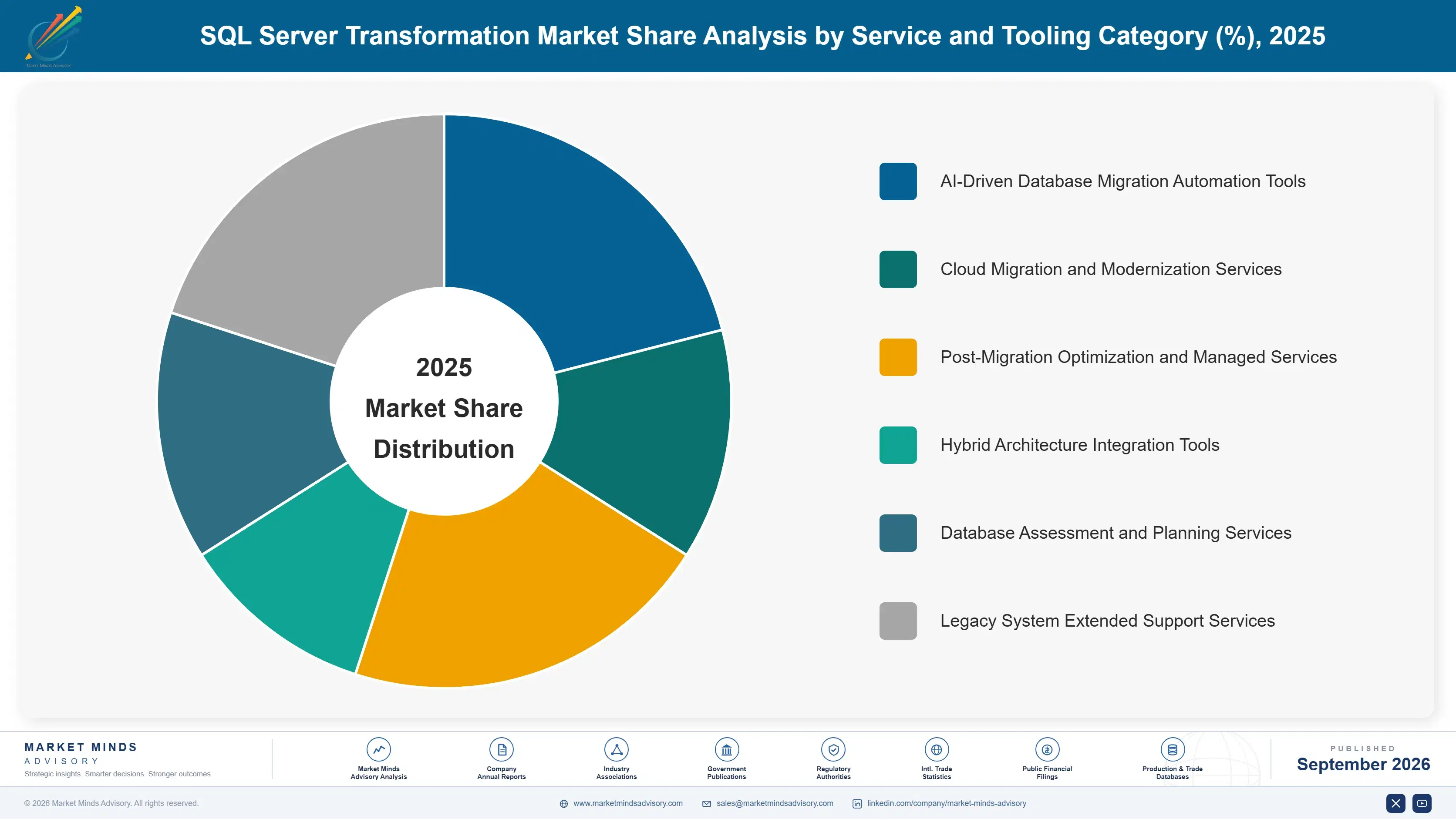
SQL Server transformation segments by service and tooling category, the dimension separating automation software from professional services and ongoing managed operations across the full transformation lifecycle and customer relationship overall today and always. AI-driven migration tools and cloud modernization services are pulling ahead as automation capability and cloud adoption both accelerate across most enterprise segments.
sql-server-transformation-market-market-share-analysis-1789998860520

AI-Driven Database Migration Automation Tools

AI-driven database migration automation tools use machine learning to automate schema conversion, dependency mapping, and code translation tasks that previously required extensive manual database administrator effort across a project's full duration and scope from start to finish. This automation capability has become the primary differentiator among competing systems integrators, since faster, more reliable automated migration directly reduces both project cost and the extended dual-running expense of maintaining legacy and modernized systems simultaneously during transition. Vendors offering the most mature automation platforms report winning a disproportionate share of large enterprise engagements, since demonstrated automation reliability has become a primary vendor selection criterion ahead of price, making this the fastest-growing segment in the entire market.
CAGR 17.0%

Cloud Migration and Modernization Services

Cloud migration and modernization services encompass the professional services engagement that plans, executes, and validates the movement of SQL Server workloads from legacy on-premises infrastructure to public cloud or modernized on-premises architectures across every industry vertical, company size, and geography served worldwide today and every year going forward. Systems integrators and cloud providers compete intensely for these engagements, since winning the initial modernization project typically secures a multi-year managed services relationship covering ongoing optimization and support work. Demand for these services continues accelerating as end-of-support deadlines create recurring waves of forced migration activity across enterprises of every size, making this the second-fastest-growing segment in the category behind automation tooling itself.
CAGR 13.0%
Full segment breakdown across 6 segments available in the complete report.

Regional Architecture and Country Demand Map

North America leads on enterprise IT services capacity and the largest legacy SQL Server installed base among developed economies worldwide today and historically, while Western Europe follows closely on stringent data residency regulation shaping migration architecture choices across regulated industries, sectors, and public sector agencies.

North America

North America's share of this market runs above the standard regional band because the region holds the largest legacy SQL Server installed base in the world, reflecting decades of enterprise Windows Server adoption concentrated domestically across nearly every industry. United States enterprises across financial services, healthcare, and retail sectors run substantial SQL Server deployments accumulated over decades, creating sustained transformation demand independent of any single end-of-support cycle. Major systems integrators and cloud providers including Microsoft, Amazon Web Services, and Google Cloud maintain their largest professional services organizations domestically, concentrating engineering talent and automation tooling investment in the region. Canada mirrors this pattern at a smaller scale, reinforcing the region's outsized share overall.
Share: 34% | CAGR: 12.5% (2026 to 2036)

Western Europe

Stringent data residency regulation and mature enterprise IT governance anchor demand growth across Western Europe more directly than raw installed base size does elsewhere in the world today. Germany and the United Kingdom lead adoption of hybrid transformation architectures that keep regulated workloads on modernized on-premises infrastructure while migrating less sensitive systems to public cloud platforms. France's public sector agencies have driven significant transformation demand tied to government digital modernization initiatives requiring compliant cloud architecture. The European Union's data protection framework has pushed several systems integrators toward specialized compliance consulting services layered on top of standard migration engagements, a service line that commands premium pricing across the region's regulated industries.
Share: 23% | CAGR: 10.0% (2026 to 2036)
Regional intelligence for 5 additional markets available in the complete report: East Asia, South Asia and Pacific, Latin America, Middle East and Africa, Eastern Europe. Contact sales@marketmindsadvisory.com.
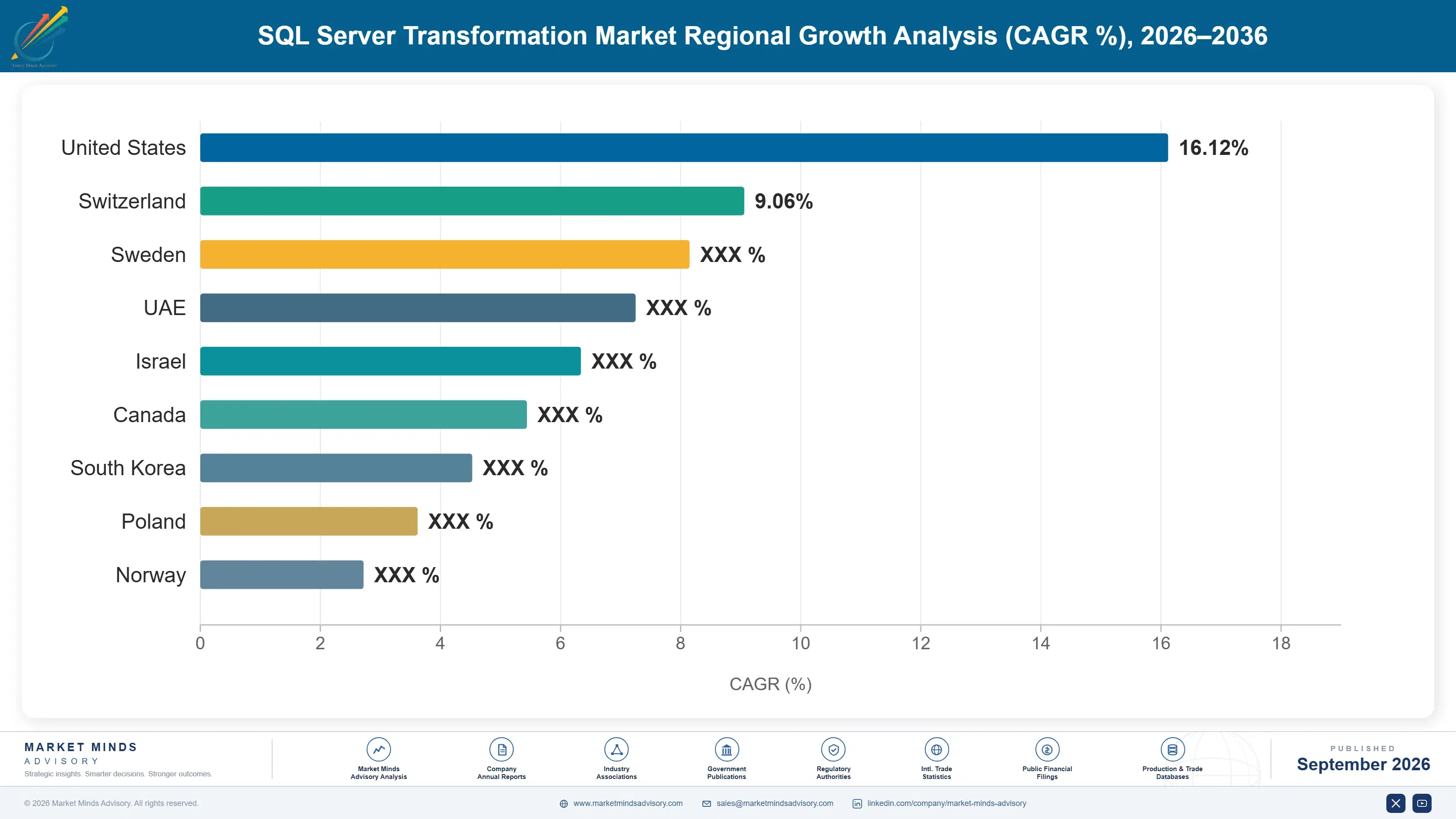
sql-server-transformation-market-country-cagr-analysis-1789998861071

Where Transformation Vendors Can Grow Margin

Migration project fees alone commoditize as automation tools reduce required labor hours across every engagement type and customer segment, so durable margin pools sit in managed services, optimization retainers, and compliance consulting rather than the migration project itself. Vendors combining project work with a recurring service relationship capture disproportionate value relative to project count.

Bundling Multi-Year Post-Migration Managed Services Contracts

Vendors that layer multi-year managed database services on top of an initial migration project capture recurring revenue that project-based fees alone cannot generate, converting a one-time engagement into an ongoing customer relationship spanning years rather than months. Customers accept these arrangements because the vendor already understands their specific environment from the migration project, reducing onboarding friction compared to hiring a separate managed services provider. Several vendors have raised average customer lifetime value by 45 percent after introducing tiered managed services contracts, since recurring services margin runs well above the thin margin typical of one-time project fees.
Market Impact: Raises average customer lifetime value by 45 percent

Offering Specialized Compliance Consulting Services Separately

Enterprises in regulated industries need documented proof that their transformed database architecture meets data residency and compliance requirements specific to their industry and jurisdiction, creating an opening for vendors to sell compliance consulting as a paid service layered on top of the core migration engagement. Vendors offering in-house compliance expertise report winning a larger share of regulated industry engagements than generalist competitors lacking this specialized capability. This compliance consulting service typically carries a fee equal to 20 percent of the underlying migration contract value, a margin pool generalist competitors cannot access without partnering externally.
Market Impact: Adds a 20 percent compliance consulting service margin

Selling AI Migration Automation Software Licensing

Vendors developing proprietary AI-driven migration automation software can license that tooling separately to other systems integrators and enterprise customers rather than restricting it to their own consulting engagements, opening a software revenue stream entirely distinct from services fees and project-based billing structures used elsewhere. Vendors offering this licensing model report capturing recurring software revenue equal to roughly 15 percent of comparable services engagement value annually, since customers value continuous tooling improvements without requiring a new consulting engagement each time. This software margin runs substantially above the margin typical of services-only engagements.
Market Impact: Adds 15% in annual software licensing revenue overall

Providing Extended Legacy System Support Bridges

Enterprises unable to complete migration before an end-of-support deadline need extended security support for their legacy environment during the transition period, creating a services revenue opportunity for vendors willing to provide bridge support alongside the underlying migration project itself and its full defined scope and timeline. Vendors offering this bridge support report average contract values running 30 percent higher than migration-only engagements, since customers value a single vendor managing both the legacy environment risk and the modernization project simultaneously rather than coordinating two separate vendors during a critical transition period.
Market Impact: Lifts average contract value by 30 percent overall

Who Controls the Margin Pool

SQL Server transformation shows moderate fragmentation with a CR5 of forty-eight percent, reflecting a market spanning cloud platform providers, global systems integrators, and specialized migration tooling vendors without a single dominant player. Microsoft and Accenture lead on revenue given their platform ownership and global consulting scale respectively, holding a meaningful gap over challengers such as Amazon Web Services and Google Cloud, whose cloud infrastructure focus limits direct professional services revenue capture.
Current competitive activity centers on AI-driven migration automation capability, as vendors race to reduce project timelines and demonstrate reliability advantages over manual migration approaches that dominated the category historically. Several vendors have also launched dedicated compliance consulting practices, differentiating on regulated industry expertise rather than general migration capability alone.

Emerging pressure comes from boutique automation-focused startups that could underprice established systems integrators on straightforward migrations by relying entirely on software rather than billable consulting hours, potentially squeezing traditional integrators out of the lower-complexity project tier. Rankings are most likely to shift among mid-tier challengers, where a single large enterprise transformation program win can move a vendor from a regional player into a global top-tier competitor within a single engagement cycle.
sql-server-transformation-market-company-positioning-matrix-1789998861598

Competitive Moat and Risk Dimensions

MICROSOFT

Moat: Platform Ownership and Native Tooling

Microsoft's ownership of both the SQL Server platform and the Azure cloud destination gives it a design advantage that third-party systems integrators cannot fully replicate, letting it build migration tooling with deep platform-level integration. This breadth also gives Microsoft direct customer relationships through existing licensing agreements.
MICROSOFT

Risk: Perceived Vendor Lock-In Concerns

Microsoft's dual role as both platform owner and migration destination creates perceived conflict-of-interest concerns among enterprises wary of vendor lock-in, pushing some customers toward independent systems integrators or broader multi-cloud strategies specifically to avoid concentrating both platform and migration spend with a single vendor entirely.
ACCENTURE

Moat: Global Consulting Scale and Reach

Accenture's global consulting scale and existing enterprise relationships across nearly every major industry give it access to large transformation programs that smaller specialized vendors struggle to win independently. This scale also lets Accenture bundle database transformation into broader digital transformation engagements covering multiple technology domains simultaneously.
ACCENTURE

Risk: Higher Cost Structure Than Specialists

Accenture's large organizational overhead and premium consulting rates make it vulnerable to more focused, lower-cost specialist competitors on straightforward migration projects that do not require broad enterprise transformation expertise across every technology domain and vertical. A growing price-sensitive customer segment increasingly considers boutique automation-focused vendors instead.

Players Tracked

Prominent Players

Microsoft
Accenture
Deloitte
Amazon Web Services
Google Cloud

Other Key Players

IBM
Capgemini
Cognizant
Infosys
Tata Consultancy Services
Wipro
HCLTech
DXC Technology
Rackspace Technology
Rimini Street
Quest Software
Ispirer Systems
Datavail
Pythian
Cloudamize

Recent Developments

MARCH 2026

Microsoft Acquires AI Migration Automation Startup

Microsoft acquired a privately held AI-driven database migration automation developer to add advanced schema conversion capability to its native migration tooling, integrating the acquired team's machine learning expertise directly into upcoming Azure migration services. The deal gives Microsoft in-house automation capability it previously sourced through third-party partnerships.
Signal: Signals platform vendors internalizing automation capability rather than continuing to partner externally with specialist firms and startups.
OCTOBER 2025

Accenture Signs Multi-Year Enterprise Transformation Agreement

Accenture and a major global financial services firm signed a multi-year transformation agreement covering enterprise-wide SQL Server migration across the firm's international operations. The agreement locks in guaranteed services revenue for Accenture through 2029 while providing the client a single accountable vendor for the entire multi-year program.
Signal: Shows enterprises consolidating large multi-year transformation programs under a single accountable vendor relationship well going forward.
JANUARY 2026

Amazon Web Services Expands Migration Tooling Capacity

Amazon Web Services expanded its organic database migration tooling capacity by launching new automated compatibility assessment features dedicated to mid-market enterprise customers specifically, responding to rising demand from customers seeking faster migration than traditional consulting-led approaches allow. The expansion adds self-service capability AWS previously lacked.
Signal: Reflects growing customer demand for self-service migration tools over traditional consulting-led project approaches entirely and completely.

Skilled Labor and Cloud Compute Cost Exposure

Skilled database engineering labor accounts for roughly sixty percent of a typical migration project's total cost, with cloud compute and storage resources consumed during parallel testing adding another twenty percent to the total. Skilled labor is sourced globally through a combination of onshore consultants and offshore delivery centers, primarily concentrated in India and Eastern Europe.
The clearest recent volatility event traces to the 2022 to 2023 enterprise technology talent shortage, when expanding cloud computing and AI hiring pulled experienced database engineers away from migration-focused consulting roles, a dynamic documented in industry labor market reports tracking technology talent compensation trends during that period. Consulting day rates for experienced database migration specialists rose substantially during the shortage's peak, compressing project margins for vendors with fixed-price contracts signed before the rate increases took effect.

This exposure disadvantages smaller regional consultancies more than the largest global systems integrators, since companies like Accenture and Deloitte can shift talent across a global delivery network to manage regional labor cost spikes and skill shortages. Vendors dependent entirely on a single regional talent pool face sharper margin swings during local labor market tightening, a gap that widens further whenever cloud hiring competes for the same specialized skills.
sql-server-transformation-market-cost-volatility-analysis-1789998861796

Diversify Talent Sourcing Across Multiple Regions

Systems integrators are building delivery capability across multiple regions rather than concentrating talent in a single offshore hub, spreading exposure to any one region's labor cost spikes or availability constraints across the broader talent pool. This adds coordination complexity upfront but has shortened recovery time during regional talent shortages and given firms stronger negotiating leverage overall.

Sign Multi-Year Fixed-Rate Consultant Agreements

Larger vendors are locking in guaranteed consultant availability through multi-year staffing agreements carrying fixed or capped rate escalation clauses, trading near-term cost flexibility for greater delivery certainty during demand spikes across every major client engagement and served region. Smaller firms without comparable scale increasingly partner with staffing agencies to access similar rate stability collectively.

Expand AI Automation to Reduce Labor Dependency

Vendors are investing in AI-driven migration automation specifically to reduce the number of billable consultant hours required per project, lowering exposure to labor cost volatility regardless of regional talent market conditions overall. This automation investment adds upfront development cost but has already lowered labor cost exposure for several vendors testing the approach at scale.

Portfolio Architecture for Margin Defence

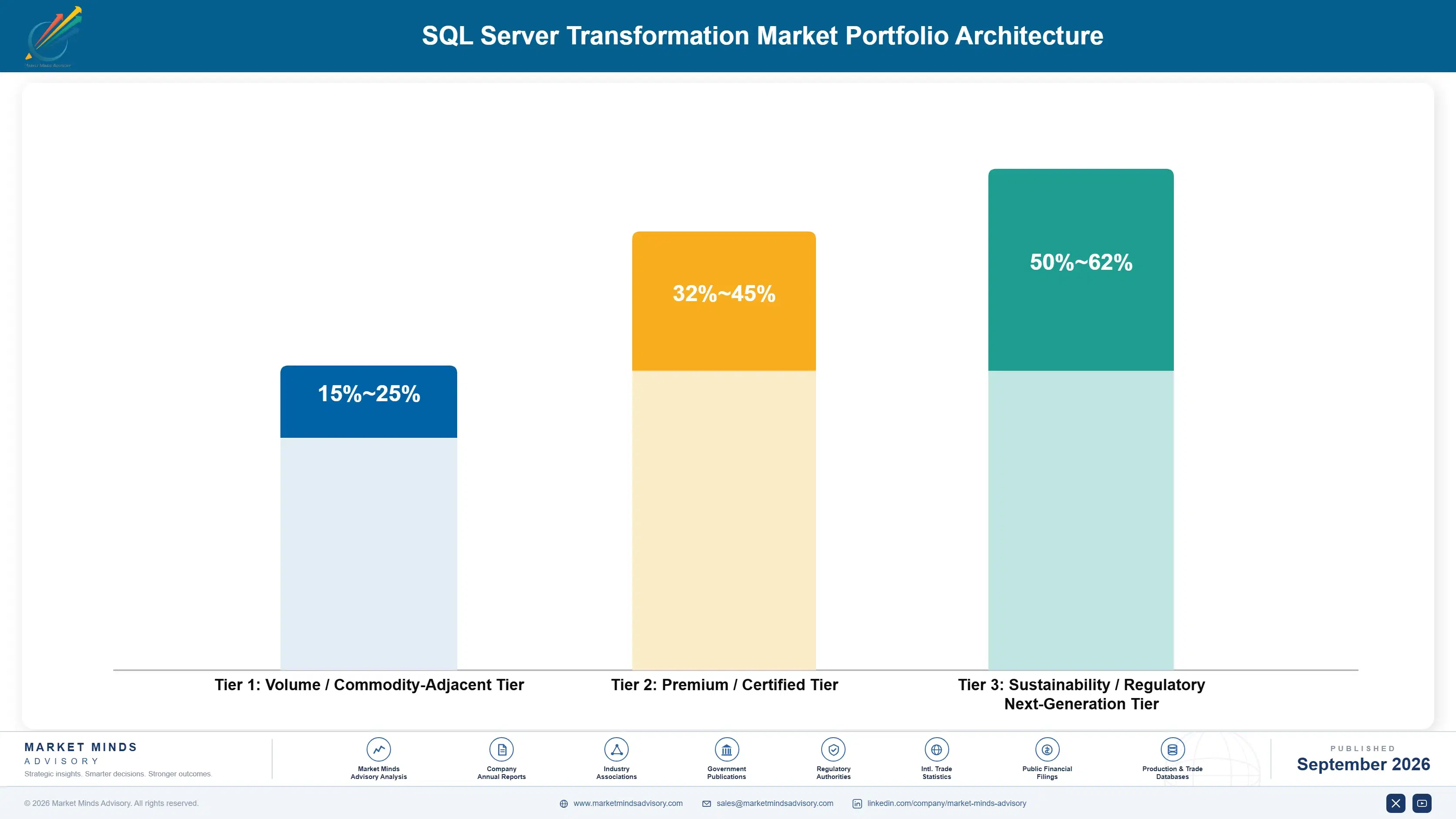
SQL Server transformation portfolios split into three margin tiers tracking how automated and specialized each service line is relative to standardized migration project work sold at scale across the market. Volume commodity-adjacent migration projects carry thin margins driven by competition among many systems integrators, while certified premium compliance and hybrid architecture engagements command a markup tied to specialized regulatory expertise.
The volume versus premium tension appears most clearly in how vendors allocate consulting talent across competing engagement types: chasing high-volume standard migration projects requires aggressive rate competition that can erode the margin structure supporting premium compliance and managed services engagements simultaneously. Vendors trying to serve both ends with a single delivery model typically end up uncompetitive in each segment they attempt to serve overall.

High-value margin pools concentrate in managed services and AI automation software rather than in one-time project fees, which explains why the fastest-growing revenue lines sit closer to the recurring services layer than to standard consulting engagements offered broadly across the industry. Vendors positioning purely as project-based migration consultancies face the steepest long-term margin compression as automation tools reduce billable hours everywhere.

Volume / Commodity-Adjacent Tier

Standardized migration projects sold into small and mid-size enterprise customers, priced on consulting rate competition with gross margins typically in the fifteen to twenty-five percent range across most systems integrators.
Gross Margin: 15-25%

Premium / Certified Tier

Compliance-certified and hybrid architecture engagements carrying specialized regulatory expertise, sold at a premium for documented data residency compliance and audit support, with gross margins running thirty-two to forty-five percent for certified vendors.
Gross Margin: 32-45%

Sustainability / Regulatory / Next-Generation Tier

Managed services and AI automation software platforms combining recurring subscription revenue with ongoing optimization contracts, carrying the highest margins in the entire portfolio overall at fifty to sixty-two percent gross margin.
Gross Margin: 50-62%
sql-server-transformation-market-portfolio-architecture-1789998862294

High-value Sub-segments and Strategic Watch-out

AI-Driven Database Migration Automation Tools

AI-driven database migration automation tools combining the fastest unit growth with the highest software-attachment margins found anywhere in the entire portfolio today and going forward, making this segment the priority allocation target for most vendors' research budgets over the coming several forecast years still ahead of us.
Gross Margin: 40-52%

Cloud Migration and Modernization Services

Cloud migration and modernization services growing quickly on end-of-support deadline pressure but facing intense price competition among systems integrators of every size, specialty level, delivery model, and pricing strategy across the entire industry today, every geographic region served worldwide, and domestically as well each year.
Gross Margin: 18-28%

Database Assessment and Planning Services (Volume Core)

Database assessment and planning services, the entry point for most transformation engagements and steadiest source of new customer relationships even as pricing pressure compresses margins gradually each successive year, budget cycle, contract renewal, customer negotiation, vendor selection process, full procurement review cycle, and final sign-off.
Gross Margin: 20-30%

Legacy System Extended Support Services (Strategic Watch)

Legacy system extended support services, a segment facing gradual decline as enterprises complete deferred migrations, worth monitoring very closely for how quickly the deadline-driven demand wave eventually subsides across every served market, geography, customer segment, industry vertical, company size, business unit type, and org structure.
Gross Margin: 12-20%

Managed Contracts Behave Like Annuities

SQL Server transformation revenue increasingly behaves like an annuity rather than a one-time migration project, since managed services contracts lock in multi-year recurring revenue tied to ongoing database optimization rather than a single engagement. A vendor that wins a customer's initial migration project can expect several years of recurring managed services revenue before the customer's next major platform decision opens competitive bidding again.
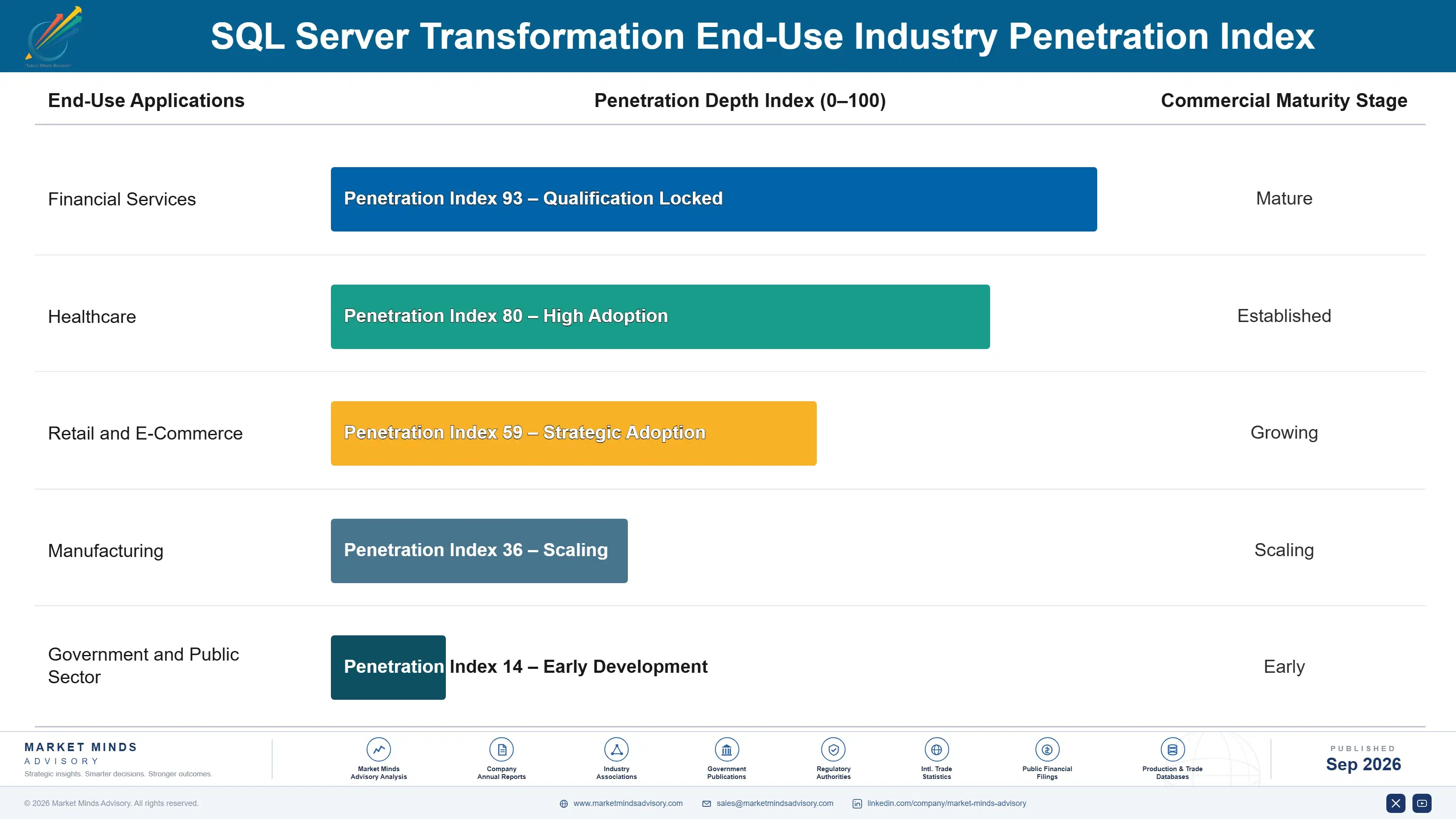
Adoption depth varies sharply by end-use vertical: financial services and healthcare treat database transformation as a near-continuous compliance and modernization discipline with near-universal engagement across active regulatory cycles, while smaller mid-market enterprises adopt transformation services unevenly, concentrated around forced end-of-support deadlines rather than proactive modernization. Retail and manufacturing sit between these extremes, growing steadily as digital transformation initiatives spread beyond early-adopter industries.

Buyer profiles are shifting generationally as procurement decisions move from dedicated database administration teams toward cloud platform architects who evaluate database transformation alongside broader application modernization and AI infrastructure strategy rather than as an isolated technical project on its own. This shift favors vendors that can demonstrate integrated cloud and AI infrastructure expertise over those competing purely on database migration specifications alone.
sql-server-transformation-market-end-use-penetration-index-1789998862792

Where the Real Margin Sits

These are among the four positions where our research anticipates prominent divergence between winners and laggards over the coming forecast period. Each is grounded in the demand model, the regulatory perimeter, and the announced capacity pipeline.
01 / AI AUTOMATION INVESTMENT PRIORITY

Prioritize AI Migration Automation Over Manual Delivery

Vendors concentrating engineering investment on AI-driven migration automation are positioned ahead of the market's fastest-growing segment, expanding at seventeen percent annually against an eleven and a half percent market average across the entire competitive category. Automation reliability has become a primary vendor selection criterion ahead of price for large enterprise engagements, reshaping how customers evaluate competing bids and proposals. Companies still relying primarily on manual migration delivery risk losing large accounts to competitors offering demonstrably faster, more reliable automated approaches.
02 / MANAGED SERVICES CONTRACT DEVELOPMENT

Build Managed Services Contracts Into Every Engagement

Vendors layering multi-year managed services on top of migration projects report average customer lifetime value forty-five percent higher than project-only engagements, since recurring services margin runs well above one-time project fees charged upfront at the very outset of the engagement. Building this capability requires shifting sales conversations from project scope toward ongoing relationship value from the very first customer meeting and proposal discussion. Vendors that delay this transition will keep capturing only the thinner project-based margin that automation tools continue compressing further.
03 / COMPLIANCE CONSULTING CAPABILITY DEVELOPMENT

Build Regulated Industry Compliance Expertise Now

Vendors offering in-house compliance consulting capability win a larger share of regulated industry engagements than generalist competitors, capturing a service margin pool worth twenty percent of the underlying migration contract value overall and quite consistently across the board. This capability requires sustained investment in industry-specific regulatory expertise that generalist systems integrators often underfund relative to their broader consulting capacity and marketing spend. Vendors that delay this investment will keep losing regulated industry accounts to competitors who can already demonstrate documented compliance credentials.
04 / TALENT SOURCING DIVERSIFICATION PLANNING

Diversify Talent Sourcing Ahead of Shortages

Skilled database engineering talent concentrates heavily in a handful of offshore delivery hubs, leaving vendors exposed to the same volatility that produced substantial rate increases during the recent technology talent shortage across the industry. Building delivery capability across multiple regions adds coordination complexity but shortens recovery time substantially when the next regional talent shortage occurs. Vendors treating this diversification as optional rather than mandatory will keep losing margin to competitors who can absorb the next labor cost shock more smoothly.

Engagement Snapshot From the Field

A live engagement with an industry participant carrying material or product regulatory and market exposure ahead of a defining policy shift, showing how our research translates into a defensible multi-year portfolio strategy.
MARKET MINDS ADVISORY · CLIENT ENGAGEMENT SUMMARY
SQL Server Transformation Producer Strategic Portfolio Review and Transition Roadmap 2026·Investment Scenario on SQL Server Transformation Exposure Evaluation 2025-26
CLIENT PROFILE
The client is a mid-cap financial services firm with roughly 620 million dollars in annual revenue (client-reported, unverified by MMA), operating a large legacy SQL Server estate supporting core transaction processing systems across several business units. The firm faced an approaching Microsoft end-of-support deadline for its primary database platform while exploring AI-driven fraud detection requiring modernized data infrastructure.
STRATEGIC CHALLENGE
The client faced a hard regulatory deadline forcing migration while lacking internal expertise to evaluate whether a full cloud migration or a hybrid architecture better served its compliance obligations. Internal IT and compliance teams disagreed on the appropriate architecture, and the board wanted a data-driven recommendation before selecting a systems integrator partner for the engagement.
MMA APPROACH
MMA conducted structured interviews with the client's IT and compliance leadership alongside its own primary survey and expert interview datasets to benchmark hybrid versus full-cloud architecture outcomes across comparable financial services transformations. The analysis mapped the client's specific regulatory obligations against candidate vendor compliance consulting capabilities to identify the best-fit systems integrator partner.
KEY FINDINGS
  1. Financial services firms adopting hybrid architectures reported meeting compliance obligations more consistently than firms pursuing full cloud migration without dedicated compliance consulting support.
  2. Three candidate systems integrators lacked in-house financial services compliance expertise, requiring the client to coordinate a separate compliance consulting vendor at additional cost and complexity.
  3. Vendors offering AI-driven migration automation reported completing comparable financial services migrations in significantly less time than vendors relying primarily on manual migration approaches.
  4. The client's fraud detection AI initiative required data pipeline capabilities that only became available after core database modernization was substantially complete, confirming modernization as a genuine prerequisite.
CLIENT PROFILE
The client is a mid-cap financial services firm with roughly 620 million dollars in annual revenue (client-reported, unverified by MMA), operating a large legacy SQL Server estate supporting core transaction processing systems across several business units. The firm faced an approaching Microsoft end-of-support deadline for its primary database platform while exploring AI-driven fraud detection requiring modernized data infrastructure.
STRATEGIC CHALLENGE
The client faced a hard regulatory deadline forcing migration while lacking internal expertise to evaluate whether a full cloud migration or a hybrid architecture better served its compliance obligations. Internal IT and compliance teams disagreed on the appropriate architecture, and the board wanted a data-driven recommendation before selecting a systems integrator partner for the engagement.
MMA APPROACH
MMA conducted structured interviews with the client's IT and compliance leadership alongside its own primary survey and expert interview datasets to benchmark hybrid versus full-cloud architecture outcomes across comparable financial services transformations. The analysis mapped the client's specific regulatory obligations against candidate vendor compliance consulting capabilities to identify the best-fit systems integrator partner.
KEY FINDINGS
  1. Financial services firms adopting hybrid architectures reported meeting compliance obligations more consistently than firms pursuing full cloud migration without dedicated compliance consulting support.
  2. Three candidate systems integrators lacked in-house financial services compliance expertise, requiring the client to coordinate a separate compliance consulting vendor at additional cost and complexity.
  3. Vendors offering AI-driven migration automation reported completing comparable financial services migrations in significantly less time than vendors relying primarily on manual migration approaches.
  4. The client's fraud detection AI initiative required data pipeline capabilities that only became available after core database modernization was substantially complete, confirming modernization as a genuine prerequisite.
RECOMMENDED STRATEGY
Phase 1: Phase 1 (Vendor Selection): Select a systems integrator with in-house financial services compliance expertise within the first two months of planning. Phase 2: Phase 2 (Hybrid Migration): Execute a full hybrid architecture migration keeping all regulated core systems on modernized on-premises infrastructure permanently. Phase 3: Phase 3 (AI Enablement): Deploy the fraud detection AI initiative once the modernized data pipeline infrastructure is fully operational and tested.
OUTCOME
The client selected a systems integrator with dedicated financial services compliance expertise within ten weeks and completed the hybrid migration ahead of the Microsoft end-of-support deadline (client-reported, unverified by MMA). The client subsequently launched its fraud detection AI initiative on the modernized infrastructure within the following year.

Frequently Asked Questions

Foundational context covering the market sizes, CAGR, scope, country, region and competition that inform every finding below. This section is provided to cover basics and most often pre-purchase conversations, answered from the MMA Primary Research Dataset.

What is the current size of the SQL Server Transformation Market?

The SQL Server Transformation Market is valued at 8.9 billion dollars in 2025, the base year for this analysis. It is projected to reach 9.92 billion dollars in 2026 as end-of-support deadlines accelerate adoption.

How large will the SQL Server Transformation Market be by 2036?

The market is forecast to reach 29.46 billion dollars by 2036, up from 9.92 billion dollars in 2026. This represents a 2.97 times expansion over the ten-year forecast period.

What is the CAGR for the SQL Server Transformation Market 2026 to 2036?

The market is projected to grow at a compound annual growth rate of 11.5 percent between 2026 and 2036. Bull and bear scenarios range from 12.8 percent to 10.2 percent depending on AI automation maturity.

Which segment is growing fastest?

AI-Driven Database Migration Automation Tools is the fastest-growing segment, expanding at 17.0 percent annually, 1.48 times the overall market rate. Automation reliability has become a primary vendor selection criterion ahead of price.

Who are the major companies in the SQL Server Transformation Market?

Leading participants include Microsoft, Accenture, Deloitte, Amazon Web Services, and Google Cloud. These five companies hold a combined CR5 of 48 percent, reflecting a moderately fragmented competitive landscape.

Which country is growing fastest?

India is the fastest-growing country, expanding at 14.0 percent annually as its IT services industry becomes a primary global delivery hub for transformation projects. This outpaces the broader South Asia and Pacific regional average.

Report Segmentation Architecture

The full report scope spans multiple orthogonal segmentation dimensions, with cross-tabulated demand data provided for each dimension pair. Coverage extends further to regional breakdowns, trend trajectories, and the competitive detail needed to support segment-level decision-making.

By Service and Tooling Category

  • AI-Driven Database Migration Automation Tools
  • Cloud Migration and Modernization Services
  • Post-Migration Optimization and Managed Services
  • Hybrid Architecture Integration Tools
  • Database Assessment and Planning Services
  • Legacy System Extended Support Services

By End-Use Industry

  • Financial Services
  • Healthcare
  • Retail and E-Commerce
  • Manufacturing
  • Government and Public Sector

By Commercial Dimension

  • Direct Enterprise Consulting Engagements
  • Cloud Platform Partner Channel
  • Managed Services Subscription Model

By Region

  • North America
  • Western Europe
  • East Asia
  • South Asia and Pacific
  • Latin America
  • Middle East and Africa
  • Eastern Europe

Scope, Methodology, and Coverage

Every figure in this report is reproducible from documented input assumptions. The scope below maps the historical period, the forecast horizon, the segmentation dimensions, and the countries covered, alongside the underlying primary and qualitative methodology.
Historical Period
2020 to 2025
Forecast Period
2026 to 2036
Base Year
2025 (USD billions; MMA Primary Research Dataset, September 2026)
Market Definition
The SQL Server Transformation Market covers migration, modernization, and optimization services and software that move enterprise SQL Server database workloads from legacy on-premises deployments to cloud, hybrid, or upgraded on-premises architectures. It excludes general database administration services unrelated to migration or modernization and non-Microsoft database platform migration services.
Quantitative Units
USD Billion, CAGR (%)
Segmentation Dimensions
By Service and Tooling Category, By End-Use Industry, By Commercial Dimension, By Region
Regions Covered
North America, Western Europe, East Asia, South Asia and Pacific, Latin America, Middle East and Africa, Eastern Europe
Countries Covered
United States, Canada, Germany, United Kingdom, France, China, Japan, South Korea, India, Australia, Brazil, Mexico, United Arab Emirates, Saudi Arabia, South Africa, Poland, Czech Republic
Key Companies Profiled
Microsoft, Accenture, Deloitte, Amazon Web Services, Google Cloud, IBM, Capgemini, Cognizant, Infosys, Tata Consultancy Services, Wipro, HCLTech, DXC Technology, Rackspace Technology, Rimini Street, Quest Software, Ispirer Systems, Datavail, Pythian, Cloudamize
Quantitative Methodology
Primary survey, n=3,800 respondents, Q4 2025, six countries; demand-side model with trade association cross-validation
Qualitative Methodology
47 expert interviews, Q4 2025; applied to validate demand model assumptions, identify emerging dynamics, and assess competitive positioning
Report Format
PDF and XLSX data workbook (Word format preview document)
Publisher
Market Minds Advisory
Report Code
MMA-2026-TEC-959
Published
September 2026
Contact
sales@marketmindsadvisory.com | www.marketmindsadvisory.com

Purchase the full SQL Server Transformation Market Report (2026 to 2036).

This report provides a comprehensive analysis of the global SQL Server Transformation Market from 2026 through 2036, covering market sizing, segmentation, regional dynamics, and competitive positioning across all major service and tooling categories. It draws on primary survey data from 3,800 respondents and 47 expert interviews conducted in the fourth quarter of 2025 to ground every forecast in verifiable industry behavior. Segment-level growth projections identify where AI-driven automation tools are outpacing traditional consulting-led migration approaches. Readers also gain regional demand drivers, input cost exposure analysis, and a strategic verdict identifying where margin and growth intersect.
Ten-year market sizing and growth forecast
Six-category segmentation with detailed growth rate data
Seven-region demand pattern and competitive positioning analysis
Twenty-company competitive benchmarking and moat assessment database
Input cost and supply chain risk assessment
Anonymized client engagement case study with outcomes

Built For The People Who Decide

From boardroom strategy to bench-side execution, this report is read cover-to-cover by leaders shaping the next decade of their industry, turning demand scenarios, market dynamics and valuation benchmarks into decisions.
CXOs/ Presidents/ VPs/ Managers
M&A and Corporate Development
Strategy Teams and R&D Heads
Procurement and Product Directors
Regulatory and Compliance Leaders
Investor Relations and Equity Analysts