Market Minds Advisory
Spray Cheese Market

Spray Cheese Market: Ambient Shelf Stability, Clean Label Constraints and Aerosol Packaging Economics, 2026 to 2036

Nobody buys spray cheese for the taste; they buy a dairy product that survives twenty-four months in a cupboard, and that single property is why the category has outlived every prediction of its demise.

Lead Analyst

Lisa Gevelber

Published

September 2026

Make Smarter Decisions with Customized Research Insights

Request a free sample report and evaluate market opportunities, growth trends, and competitive dynamics relevant to your business needs.

2025 MARKET VALUE$0.4BMarket Size 2025
2036 FORECAST VALUE$0.7BBase Case , 2026 to 2036
CAGR 2026 TO 20364.6 %Bull 5.8% / Bear 3.4%
INCREMENTAL OPPORTUNITY$0.2BNet 10- year value creation
EXPANSION MULTIPLE1.57x2036 value over 2026 base
Strategic Levers
M&A Pipeline
Regional Outlook
Country Rankings
Competitive Intelligence
Segmental Deep-dive
Call-Us : 91 93563 13602

Executive Snapshot and Market Trajectory

Shelf stability rather than flavour is the entire proposition. An aerosol cheese can sits unrefrigerated in a cupboard for twenty-four months, which is exactly why the format survives across camping supplies, emergency stores, military rations and convenience retail long after commentators declared it finished for good.
Nitrogen-propelled clean label aerosol grows at 6.9%, a full 1.50 times the market rate, because reformulating away from the emulsifying salts that consumers object to is genuinely difficult, and the brands managing it reach shoppers this category had lost entirely. North America holds 58% of global value, which is far outside the standard regional band, because spray cheese remains essentially an American product that never travelled convincingly anywhere.
Concentration is very high at 71% for the top five, reflecting both the specialised aerosol filling capability required and the narrow set of manufacturers who ever bothered to build it. Private label now takes 22% of volume and has grown steadily, which compresses branded pricing severely in a category where the branded proposition rests on familiarity rather than on any demonstrable product difference at all. That is a weak position to defend.
Market Definition
The market covers processed cheese products packaged in pressurised aerosol cans and dispensed as a spray or extruded ribbon, spanning standard branded, private label, flavoured, reduced-fat and reduced-sodium, and nitrogen-propelled clean label formulations. It excludes refrigerated cheese spreads in tubs and jars, squeeze bottle and pouch cheese sauces, bag-in-box foodservice cheese dispensing systems, aerosol whipped cream and dairy toppings, and natural cheese in any form.
Base Year Value
$0.4B in 2025 (MMA Primary Research Dataset, August 2026)
Forecast Period
2026 to 2036, eleven discrete annual values
CAGR
4.6% base case. Bull 5.8%. Bear 3.4%.
Fastest Growth Segment
Nitrogen-Propelled Clean Label Aerosol: 6.9% CAGR
Fastest Growth Country
India: 8.4% CAGR
Fastest Growth Region
South Asia and Pacific: 6.9% CAGR
Largest Region
North America: 58% of 2025 global value
Market Leaders
Mondelez International, Kraft Heinz, Bel Group, Land O'Lakes, Lactalis. Source: MMA Primary Research Dataset, July 2026.
Primary Survey
n=3,800 procurement and R&D decision-makers, Q4 2025, six countries
Methodology
Demand-side build-up, cross-validated against public data, 47 expert interviews

Spray Cheese Market Forecast Scenarios

spray-cheese-market-trends-size-forecast-scenario-1787312620155
The market compounded at 3.4% between 2020 and 2025, and the pandemic did more for it than any commercial initiative. Ambient shelf-stable food buying surged through 2020, spray cheese benefited alongside canned goods, and a portion of that trial persisted afterwards. Growth returned to its long-run pattern by 2023, with dairy and steel packaging costs both rising through the period.
The 4.6% base case rests on three mechanisms. First, ambient shelf stability keeps the format genuinely relevant across outdoor, emergency preparedness and convenience channels that refrigerated cheese cannot serve at all. Second, clean label reformulation reaches shoppers who had written the category off entirely on ingredient grounds. Third, international adoption grows slowly from a very small base as processed cheese formats spread steadily across Asian and Latin American convenience retail.
The bull case at 5.8% assumes clean label reformulation succeeds commercially while emergency preparedness purchasing stays elevated. The bear case at 3.4% turns on packaging: aerosol can recyclability regulation is tightening across Europe and parts of North America, steel and aluminium costs remain volatile, and if extended producer responsibility fees rise materially the format's cost structure worsens against squeeze bottle alternatives that carry no propellant at all.

Why Ambient Stability Sustains The Format

Spray cheese is easy to mock and hard to replace. Emulsifying salts, principally sodium phosphates and citrates, hold the fat and protein in a stable suspension that neither separates nor spoils at room temperature, and the pressurised can keeps oxygen out until the moment of use.
TOP FIVE CONCENTRATION71%Combined position of the five largest spray cheese manufacturers
AVERAGE RETAIL PRICE$16 per kilogramTypical shelf price on an equivalent cheese weight basis
LEADING COUNTRY SHARE51%United States share of global spray cheese consumption volume
AMBIENT SHELF LIFE24 monthsUnopened shelf life achieved without any refrigeration required
DAIRY INPUT SHARE38% of COGSCheese and dairy solids share of delivered manufacturing cost
PRIVATE LABEL VOLUME SHARE22%Portion of category volume sold under retailer own brands
That combination delivers something no natural cheese and no refrigerated spread can match: twenty-four months of ambient shelf life in a package that dispenses cleanly without utensils. Camping and outdoor retail, emergency preparedness stores, military and institutional rations, convenience formats without chilled space and long-haul travel catering all buy the format for exactly that reason. None of those buyers is choosing it over cheddar; they are choosing it over having no cheese at all.
The commercial difficulty is that the same emulsifying salts delivering the stability are precisely what consumers object to when they read the label. Reformulating them out means losing shelf life, sprayability or both, which is why clean label versions took so long to appear and why they command real premiums when they work. The category's future depends far more on solving that chemistry than on anything happening in cheese markets.
"Every few years somebody writes that spray cheese is finished, and every few years it grows again because a camper, a prepper or a convenience store without a chiller needs cheese that does not need a fridge. Judge it as cheese and it makes no sense at all. Judge it as shelf-stable protein in a dispensing package and the category is perfectly rational."
Senior Analyst, Dairy and Ambient Foods Practice · MMA Agriculture Practice

Market Trends

Clean Label Reformulation Finally Reaches The Category

Emulsifying salts are what make processed cheese sprayable and shelf stable, so removing them is a genuine technical problem rather than a substitution exercise. Manufacturers using dairy protein concentrates, natural citrate sources and modified processing conditions have produced versions that satisfy clean label criteria while retaining most of the shelf life. Those products command roughly 40% higher shelf prices and reach shoppers who had abandoned the category on ingredient grounds. Around 11% of category volume now carries a clean label positioning of some kind, against effectively none five years ago.
Market Impact: Takes 23% of category volume
Emergency Preparedness Buying Sustains Baseline Demand

Household emergency food stocking rose sharply through 2020 and has settled well above pre-pandemic levels, particularly across North America where extreme weather events and supply disruption have made preparedness purchasing more mainstream. Shelf-stable dairy is a small but persistent part of those household stocks, because ambient protein and fat options are genuinely limited. Emergency and outdoor channels now account for roughly 17% of category volume, against about 11% five years earlier, and that demand is genuinely non-discretionary in a way ordinary snacking purchases never are. It also repeats on a stocking cycle.
Market Impact: Accounts for 9% of stable volume

Market Opportunities and Growth Drivers

Convenience Retail Without Chilled Space Needs Ambient Dairy

Forecourt shops, vending operations, small-format convenience stores and travel retail frequently operate with very limited chilled capacity, and every chilled facing competes against beverages that turn faster. Ambient dairy formats that require no refrigeration at all therefore occupy shelf space that refrigerated cheese simply cannot access. Convenience and travel retail channels together take roughly 23% of total category volume. That demand grows with small-format retail expansion rather than with any cheese consumption trend, which insulates it almost entirely from whatever happens across the wider dairy aisle. Chiller space is the binding constraint.
Market Impact: Caps growth across 60% of grocery

Military And Institutional Rations Specify Ambient Protein

Field ration packs, disaster relief supplies and institutional feeding programmes specify ambient shelf-stable components with defined protein and fat content, and processed cheese in aerosol or pouch format meets those specifications where natural cheese cannot. Procurement here runs on multi-year contracts carrying volume commitments rather than through any retail promotional cycle. Institutional and military supply accounts for roughly 9% of volume at unusually stable pricing, and qualification requirements make those positions durable once won, since any specification change requires testing that procurement teams go out of their way to avoid repeating.
Market Impact: Adds fees across 14 jurisdictions

Market Restraints and Challenges

Ingredient Perception Blocks Mainstream Grocery Growth

Emulsifying salts, preservatives and the processed cheese designation itself place the category firmly outside how mainstream grocery shoppers now describe food they want to buy. The root cause is that the ingredients delivering shelf stability are exactly the ones consumers have learned to avoid. Commercially this caps grocery growth regardless of taste or convenience, and confines expansion to channels where the ambient property matters more than the label. Participants are addressing it through clean label reformulation, through smaller pack formats, and through deliberate repositioning around outdoor and preparedness use instead.
Market Impact: Reaches 11% of category volume

Aerosol Packaging Regulation Raises Cost And Complexity

Extended producer responsibility schemes across Europe and several North American jurisdictions charge higher fees for aerosol packaging on recyclability grounds, and several retailers have restricted aerosol formats from their ranges entirely. The root cause is that steel or aluminium cans with residual propellant complicate kerbside recycling streams. Commercially this raises cost meaningfully against squeeze bottle and pouch alternatives that carry no propellant at all. Participants respond through recyclable can design, through propellant disclosure programmes and by developing pouch and bottle formats that preserve the ambient stability without any aerosol can at all.
Market Impact: Supplies 17% of category volume
3 additional market trends, 2 additional growth drivers, and 4 additional restraints and challenges are covered in the full report. Contact sales@marketmindsadvisory.com to access the complete intelligence.

Segment CAGR and Growth Architecture

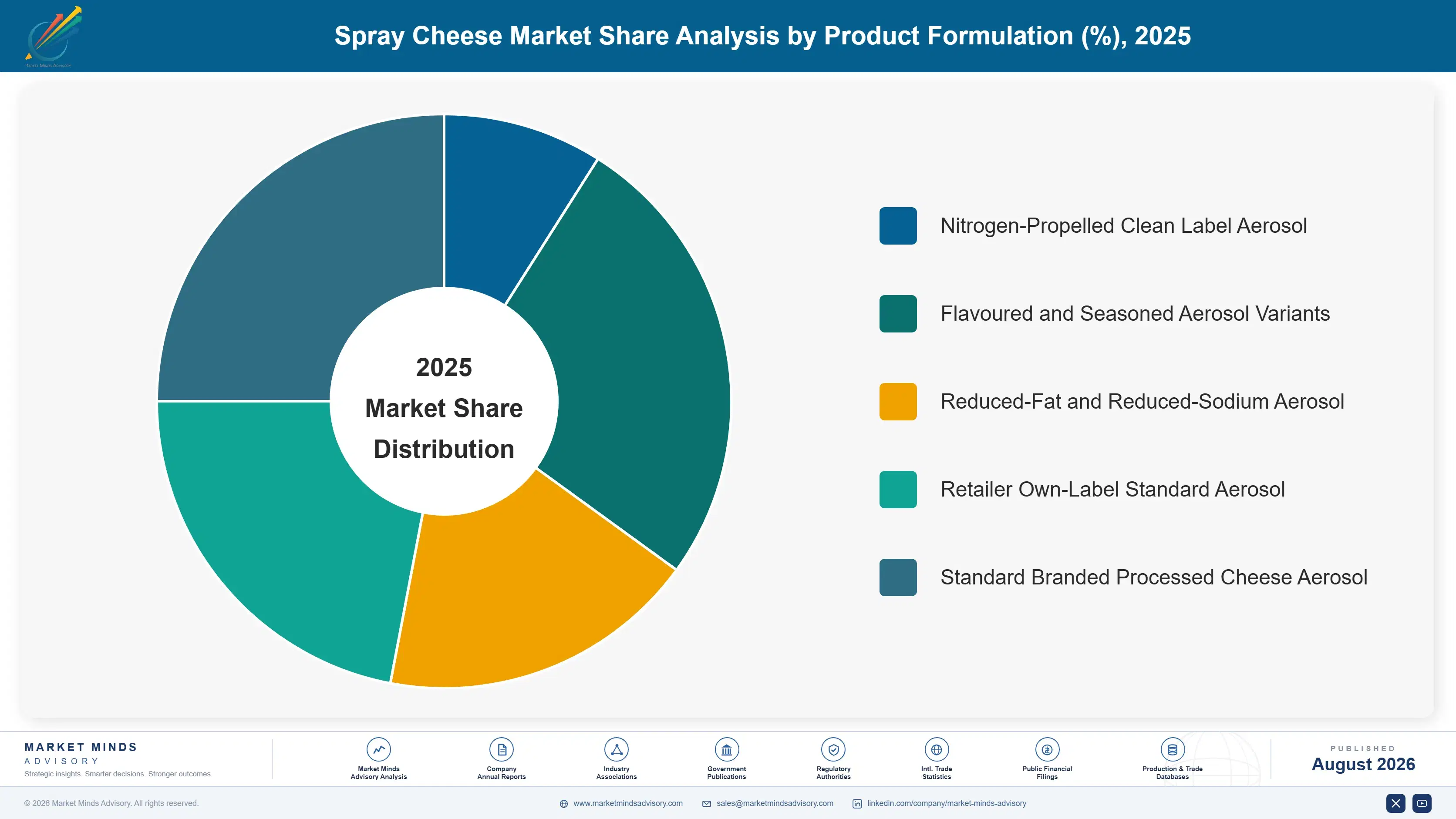
Segmentation here follows product formulation and positioning, meaning what is actually in the can and which shopper it was built for. That single dimension determines the ingredient declaration, achievable shelf life, propellant system, price point and ultimately whether a given product recruits genuinely new buyers into the category or simply serves the ones already there.
spray-cheese-market-trends-market-share-analysis-1787312620683

Nitrogen-Propelled Clean Label Aerosol

The fastest segment at 6.9%, a full 1.50 times the market rate, covering aerosol cheese reformulated without the emulsifying salts and preservatives that ordinary processed cheese requires, propelled instead by food-grade nitrogen rather than by any hydrocarbon system. The technical problem is real: those salts are precisely what deliver both sprayability and ambient stability, so removing them means rebuilding the emulsion using dairy protein concentrates and natural citrate sources instead. Shelf life falls somewhat as a result, typically to eighteen months rather than the full twenty-four. Realised pricing runs roughly 40% above standard aerosol formats, and the shoppers buying it had very largely abandoned this category entirely on ingredient grounds beforehand.
CAGR 6.9%

Flavoured and Seasoned Aerosol Variants

Growing at 5.9% annually on aerosol cheese carrying added flavour systems, running from jalapeno and bacon through to sharper cheddar profiles and seasonal limited editions. The commercial logic behind this is entirely straightforward: flavour variants recruit trial from shoppers who consider the standard product unremarkable, and they carry pricing above the base format without any change in manufacturing cost beyond the flavour system itself, which makes the arithmetic straightforward. Limited editions also secure incremental shelf facings that any single base product would never obtain on its own. The risk here is fragmentation, since each additional variant divides an already modest volume base across still more stock-keeping units and complicates production scheduling.
CAGR 5.9%
Full segment breakdown across 5 segments available in the complete report.

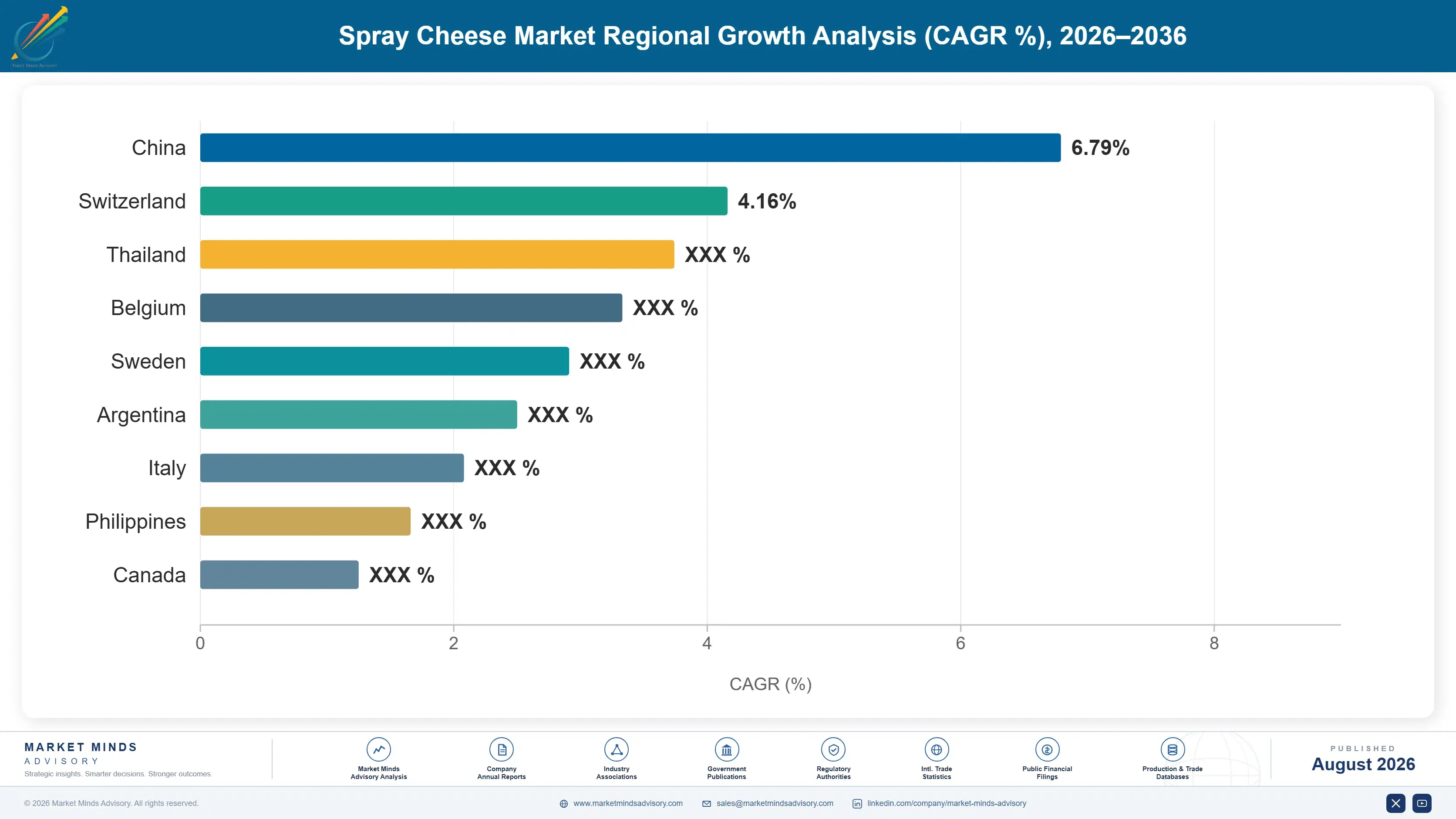
Regional Architecture and Country Demand Map

North America dominates to a degree almost no food category matches, since spray cheese is essentially an American product. South Asia and Pacific grows fastest as processed cheese formats spread through convenience retail. Western Europe faces the strictest aerosol packaging regulation found anywhere in the world.

North America

Fifty-eight percent of global value sits here. Note: this sits far outside the standard regional band because spray cheese is essentially an American invention that never travelled convincingly, and the United States alone accounts for 51% of world consumption volume. Demand splits between nostalgic household purchasing, camping and outdoor retail, emergency preparedness stocking and convenience formats without chilled capacity. Growth of 4.0% reflects that stable base rather than any expansion. Private label has grown steadily and now competes directly with the branded positions that defined the category for decades. Clean label reformulation is furthest advanced in this market. Outdoor and preparedness channels remain underdeveloped by most manufacturers. Nostalgia carries much of the grocery volume.
Share: 58% | CAGR: 4.0% (2026 to 2036)

Western Europe

Fourteen percent of global value. Note: this sits below the standard regional band because European consumers have never adopted aerosol cheese in the way Americans did, and the format competes against a far richer natural cheese culture. What demand exists concentrates in the United Kingdom, Netherlands and Germany, largely through convenience and travel retail rather than mainstream grocery. Growth of 3.0% is the slowest of any region. Extended producer responsibility schemes charging higher fees for aerosol packaging are stricter here than anywhere, and several retailers have restricted aerosol formats on recyclability grounds entirely. Natural cheese culture leaves very little room for the format to grow. Convenience and travel retail carry most of what remains.
Share: 14% | CAGR: 3.0% (2026 to 2036)
Regional intelligence for 5 additional markets available in the complete report: East Asia, South Asia and Pacific, Latin America, Middle East and Africa, Eastern Europe. Contact sales@marketmindsadvisory.com.
spray-cheese-market-trends-country-cagr-analysis-1787312621198

Where Category Margin Actually Sits

Four commercial moves separate the manufacturers defending a genuinely durable position from those simply managing a slow decline. Each one depends on serving the buyer for whom ambient stability is a genuine requirement rather than a curiosity: preparedness retail, institutional procurement, clean label shoppers, or the convenience formats operating with no chilled space at all.

Sell Ambient Stability Rather Than Cheese

Shoppers comparing spray cheese against cheddar will never choose it, while shoppers needing dairy that survives a cupboard for two years have almost no alternative. Brands merchandising into camping, outdoor and emergency preparedness retail rather than the dairy aisle report rate of sale 45% to 70% higher on identical product. Those channels also carry far less private label competition and deliver considerably better margin per unit. The change costs distribution effort and a packaging revision rather than any reformulation work whatsoever, which makes the return exceptional against anything else available.
Market Impact: Improves rate of sale by up to 70%

Solve Clean Label Without Losing Shelf Life

Emulsifying salts deliver both sprayability and ambient stability together, which is exactly why removing them is genuine reformulation work rather than any simple substitution. Manufacturers using dairy protein concentrates and natural citrate sources have reached eighteen month shelf life against twenty-four, and realise roughly 40% higher shelf prices for doing so. Development typically takes between twelve and twenty months to reach commercial quality. The reward is reaching the shoppers who abandoned this category on ingredient grounds years ago, and who represent the only genuinely new buyer pool still available to anyone.
Market Impact: Realises roughly 40% higher shelf p

Win Institutional And Military Ration Contracts

Field rations, disaster relief supply and institutional feeding programmes specify ambient shelf-stable protein and fat components, and processed cheese meets those specifications reliably where natural cheese simply cannot. Contracts run multi-year with volume commitments rather than through retail promotion, and pricing across them is unusually stable year to year. Institutional and ration supply already takes 9% of total category volume today. Qualification requires testing that buyers avoid repeating, which makes positions durable once won and insulates them almost entirely from the retail promotional pressures affecting everything else in the category.
Market Impact: Secures 9% of volume on multi-year

Develop Ambient Formats Without The Aerosol Can

Extended producer responsibility fees on aerosol packaging are now rising across fourteen separate jurisdictions, and several retailers have restricted the format outright on recyclability grounds. Pouch and squeeze bottle formats preserve exactly the ambient stability that actually sells the product, while removing both the propellant and the metal can entirely. Conversion costs between $8 million and $16 million for each individual filling line converted. The commercial question is whether the dispensing novelty or the ambient shelf stability is what buyers actually value, and the available evidence points firmly toward stability.
Market Impact: Avoids rising fees across 14 separa

Who Controls the Margin Pool

Concentration is very high at 71% for the top five, measured on spray cheese revenue across all participants, which reflects both the specialised aerosol filling capability required and the narrow set of manufacturers who ever built it. Mondelez leads on brand familiarity in the United States, and the gap to the second tier is widest in retail distribution rather than in any manufacturing advantage.
Competition runs on three dimensions. Brand familiarity decides mainstream grocery outcomes, since the product proposition is essentially nostalgic and no manufacturer can demonstrate meaningful product superiority. Channel access decides growth, because outdoor, preparedness and institutional buyers are reached quite differently from grocery shoppers. Price competition is fiercest against private label, which now takes 22% of volume and manufactures on the same equipment to a very similar specification.

Two pressures are building. Private label continues expanding in a category where the branded advantage rests on familiarity rather than demonstrable difference, which is a weak position to defend. Meanwhile aerosol packaging regulation is tightening faster than manufacturers are developing alternative ambient formats. Rankings shift where clean label capability meets non-grocery channel access, since grocery alone offers a shrinking and increasingly own-label pool.
spray-cheese-market-trends-company-positioning-matrix-1787312621715

Competitive Moat and Risk Dimensions

MONDELEZ INTERNATIONAL

Moat: Dominant United States brand familiarity

Decades of brand presence in the American market give the company recognition that no competitor can purchase, in a category where the purchase is substantially nostalgic and product differences are minimal. Shoppers reaching for spray cheese are frequently reaching for a specific remembered brand rather than evaluating alternatives on any merit.
MONDELEZ INTERNATIONAL

Risk: Exposure to private label substitution

The branded advantage rests on familiarity rather than on any demonstrable product superiority, which is exactly the position private label attacks most effectively. Own-label manufactures on comparable equipment to a similar specification at meaningfully lower shelf prices. Twenty-two percent volume share and rising suggests shoppers are more willing to substitute than the brand equity assumes.
KRAFT HEINZ

Moat: Integrated processed cheese platform

Operating processed cheese manufacturing across slices, spreads, sauces and aerosol formats lets the company absorb aerosol volumes into a much larger dairy processing base, spreading fixed cost in a way specialist producers cannot. Formulation capability also transfers directly across formats when clean label reformulation is required.
KRAFT HEINZ

Risk: Aerosol subordinate within portfolio

Spray cheese is a small line within a very large processed cheese and grocery portfolio, competing internally for capital and marketing attention against products many times its size. Investment in clean label reformulation or alternative ambient packaging can languish accordingly. In a category needing exactly that investment to escape decline, the inattention carries real cost.

Players Tracked

Prominent Players

Mondelez International
Kraft Heinz
Bel Group
Land O'Lakes
Lactalis

Other Key Players

Saputo
Arla Foods
Schreiber Foods
Leprino Foods
Great Lakes Cheese
Gay Lea Foods
Bongards Creameries
Hochland
Savencia Fromage et Dairy
Emmi
Sargento Foods
Glanbia
Fonterra
Meggle
Ornua

Recent Developments

FEBRUARY 2025

Land O'Lakes introduces clean label aerosol cheese formulation

A reformulated aerosol cheese product using dairy protein concentrates in place of conventional emulsifying salts entered North American retail distribution, accepting eighteen months of ambient shelf life rather than twenty-four in exchange for an ingredient declaration that mainstream grocery shoppers will actually accept on shelf.
Signal: Shelf life is now being traded deliberatel
JUNE 2025

Schreiber Foods expands private label aerosol cheese capacity

Additional aerosol filling capacity dedicated entirely to retailer own-label production entered commercial service during the year, responding directly to grocery chains steadily expanding their own-brand cheese ranges in a category where branded differentiation rests substantially on familiarity alone rather than on any demonstrable product advantage.
Signal: Private label is expanding fastest in exac
OCTOBER 2025

Bel Group trials ambient pouch cheese format in Europe

An ambient shelf-stable cheese pouch requiring neither propellant nor aerosol can was trialled across a selection of European convenience retail chains during the period, testing directly whether buyers value the dispensing novelty of an aerosol can or simply the ambient stability that both formats deliver equally well.
Signal: Manufacturers are now testing directly whe

What Drives Delivered Product Cost

Cheese and dairy solids account for roughly 38% of cost of goods and move with global dairy commodity markets. The aerosol can itself contributes 26%, an unusually high packaging share driven by steel or aluminium content and the pressure rating required. Emulsifying salts and other ingredients add 9%, filling and propellant charging 12%, and distribution the balance.
The 2022 packaging episode hurt more than the dairy one. Steel and aluminium pricing rose sharply following energy market disruption, and aerosol cans carry more metal per unit of product than almost any food package. Kraft Heinz reporting for the period documented substantial packaging cost pressure across its portfolio. Dairy commodity prices also rose, but the packaging component moved further and manufacturers holding annual retail agreements absorbed both before recovering either.

The competitive disadvantage mechanism runs through packaging share rather than through dairy purchasing. At 26% of cost of goods, the aerosol can exposes this category to metal markets far more than any other cheese format does, and no formulation change reduces it. Manufacturers with pouch or bottle alternatives carry a fraction of that exposure. Producer responsibility fees compound it, attaching to precisely the package that already costs most.
spray-cheese-market-trends-cost-volatility-analysis-1787312621909

Develop ambient formats that avoid the aerosol can

Packaging represents 26% of cost of goods and carries rising producer responsibility fees across fourteen jurisdictions. Pouch and squeeze bottle formats preserve the ambient shelf stability that genuinely sells the product while removing both the propellant and the metal can, which together cut packaging cost of goods by roughly nine percentage points on affected lines.

Contract metal packaging across supplier and origin

Aerosol can pricing follows the steel and aluminium markets that moved violently through 2022, and single-supplier arrangements offer a manufacturer no protection whatsoever against that. Contracting across several can makers and separate metal origins costs a modest premium and it removes concentration risk on the single largest packaging component sitting anywhere in this cost structure.

Run private label alongside branded on shared lines

Aerosol filling capacity is highly specialised and genuinely expensive to leave underutilised, while private label already accounts for 22% of total category volume. Manufacturing own-label alongside branded product on exactly the same lines improves utilisation materially, and refusing that work simply hands the throughput straight to a competitor who will happily accept it instead.

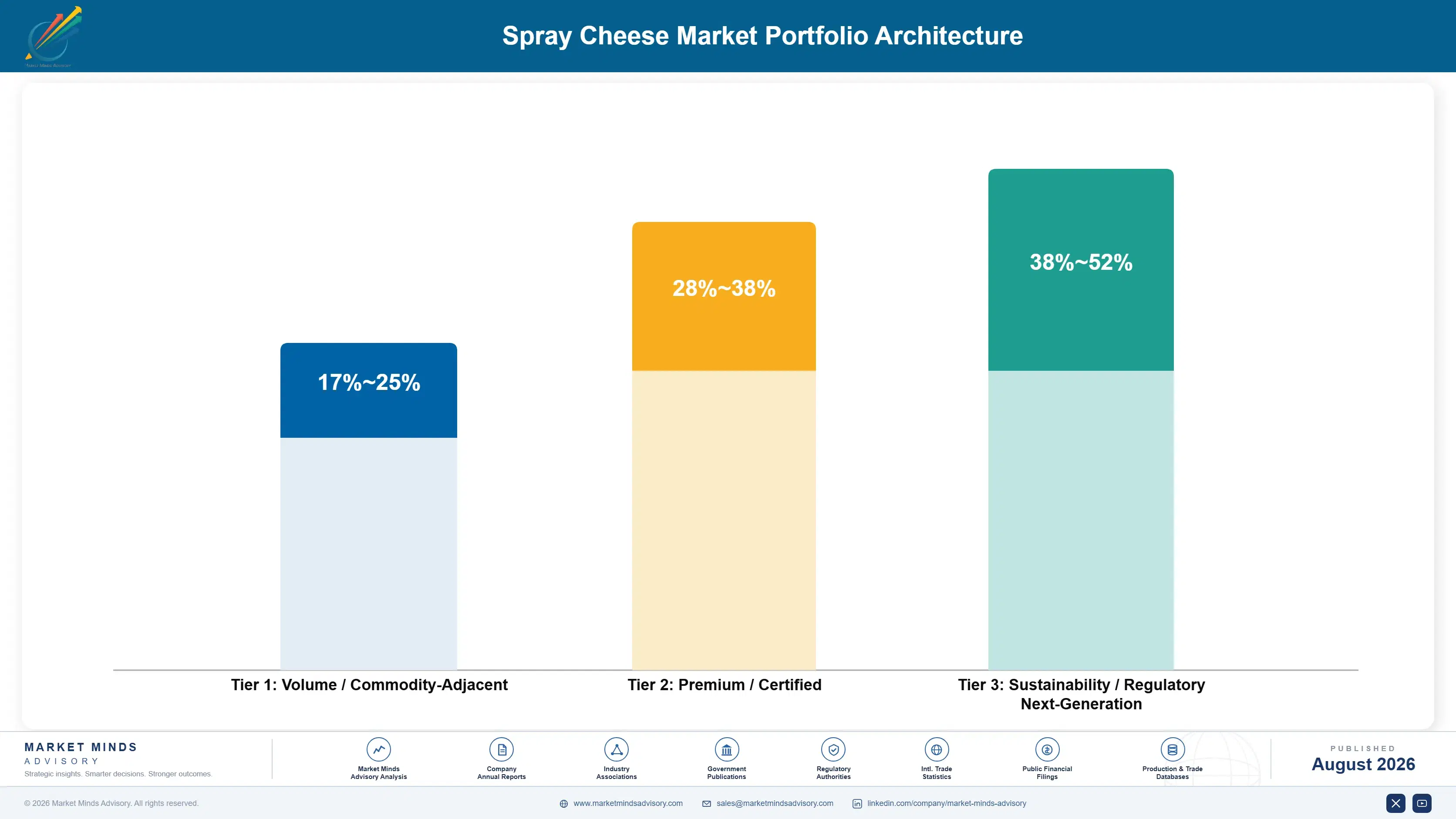
Portfolio Architecture for Margin Defence

Margin architecture separates on channel rather than on formulation. Mainstream grocery supply runs at gross margins in the high teens after trade investment, because private label competes directly at 22% of volume and the branded proposition rests on familiarity rather than any demonstrable difference. Specialist channels earn considerably more.
The volume-versus-premium tension is genuine because aerosol filling capacity is specialised and expensive to leave idle. Grocery and private label volume is what fills those lines, yet grocery is where margin is thinnest and where category perception is worst. Manufacturers refusing own-label work watch utilisation fall and hand throughput to competitors, while those relying on grocery alone find their category shrinking underneath them in the one channel that dislikes it most.

Value concentrates where ambient stability is a requirement rather than a curiosity. Institutional and military ration supply sits at the top, running on multi-year contracts with qualification barriers and pricing insulated from retail promotion. Outdoor and preparedness retail sits alongside on the same logic with better margins than grocery. Mainstream grocery sits at the other extreme, where the product competes against refrigerated cheese it can never beat on any measure shoppers care about.

Volume / Commodity-Adjacent

Mainstream grocery supply of standard branded and retailer own-label aerosol cheese. Private label competes directly on comparable equipment and specification, and shoppers compare against refrigerated alternatives. This volume exists to keep specialised aerosol filling capacity utilised.
Gross Margin: 17-25%

Premium / Certified

Flavoured and seasoned variants plus convenience and travel retail supply where ambient stability has genuine operational value. Format novelty and channel scarcity support pricing above grocery. Range reflects the spread between limited edition variants and standing convenience distribution.
Gross Margin: 28-38%

Sustainability / Regulatory / Next-Generation

Clean label nitrogen-propelled formulations plus institutional, military and emergency preparedness supply. Reformulation difficulty and procurement specification qualification, rather than anything about the cheese itself, justify the pricing achieved throughout this whole tier.
Gross Margin: 38-52%
spray-cheese-market-trends-portfolio-architecture-1787312622400

High-value Sub-segments and Strategic Watch-out

Institutional And Ration Supply

High value on steady and genuinely predictable growth, running on multi-year contracts carrying qualification barriers that procurement teams avoid repeating once a supplier has been formally approved for supply. Pricing here is insulated entirely from the retail promotional activity that governs everything else across this category.
Gross Margin: 40-52%

Clean Label Aerosol

Strong margins on the fastest growth at 6.9%, and it is the only available route back to those shoppers who abandoned the category on ingredient grounds. Reformulation is genuinely difficult, because the emulsifying salts deliver both sprayability and ambient shelf stability together rather than separately.
Gross Margin: 38-48%

Mainstream Grocery Volume

The utilisation base that keeps every specialised aerosol filling line running at all, earning gross margins in the high teens against private label competing on essentially identical equipment and specification. Branded advantage here rests entirely on familiarity rather than on any demonstrable product difference whatsoever.
Gross Margin: 17-25%

Standard Aerosol Formats

The strategic watch-out sitting squarely in this portfolio. The aerosol can alone is 26% of cost of goods and attracts rising producer responsibility fees across fourteen jurisdictions, while pouch alternatives now deliver exactly the same ambient stability without any propellant or metal can at all.
Gross Margin: 17-28%

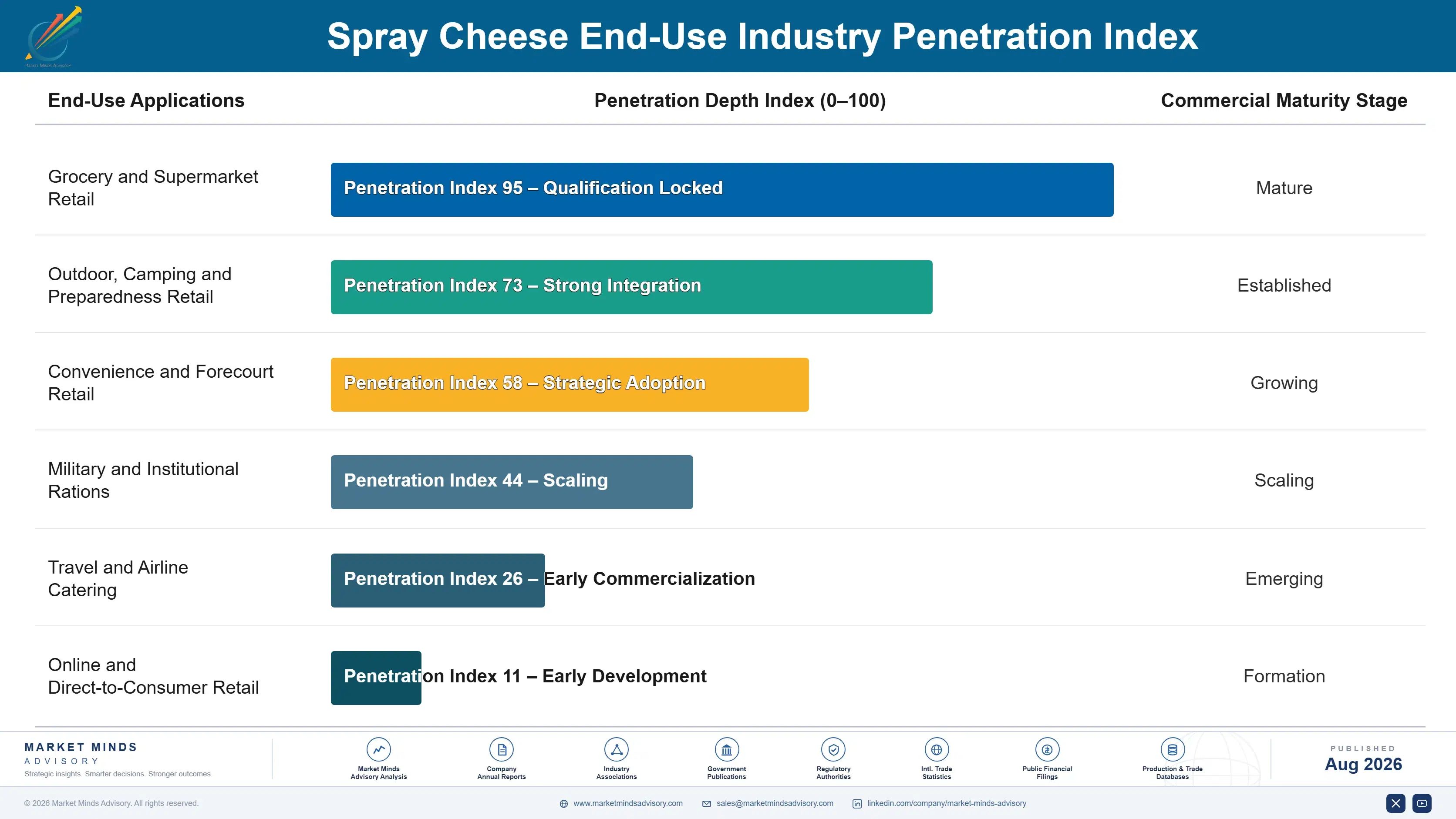
How This Demand Actually Repeats

Demand splits between buyers who need the product and buyers who remember it. Emergency stores, ration packs and chiller-free convenience formats require ambient dairy and return reliably. Grocery shoppers buy on nostalgia or novelty, repeat irregularly, and are the first to leave when a cheaper own-label appears beside it.
Stickiness varies accordingly. Institutional and military supply is the tightest, running on multi-year contracts with specification qualification that buyers will not repeat casually. Emergency preparedness and outdoor retail sits close behind, since the format has almost no substitute for that use. Convenience and travel retail is moderately sticky through distribution relationships rather than shopper loyalty. Mainstream grocery is barely sticky at all, with households buying occasionally and switching to private label without noticing they have done so.

Buyer profiles have changed less here than in most food categories, which is part of the problem. Grocery category managers still assess the product exactly as they did decades ago, on rate of sale against refrigerated cheese it cannot match. The buyers who genuinely value it, procurement teams specifying rations and outdoor retail buyers building preparedness ranges, are reached through channels most manufacturers still treat as marginal rather than as the category's actual foundation.
spray-cheese-market-trends-end-use-penetration-index-1787312622886

Where To Place Capital

These are among the four positions where our research anticipates prominent divergence between winners and laggards over the coming forecast period. Each is grounded in the demand model, the regulatory perimeter, and the announced capacity pipeline.
01 / CHANNEL REPOSITIONING PRIORITY

Leave the dairy aisle argument you cannot win

Shoppers comparing spray cheese against refrigerated cheddar will never choose it, while buyers needing dairy that survives two years in a cupboard have almost no realistic alternative available to them at all. Brands merchandising into camping, outdoor and preparedness retail report rate of sale 45% to 70% higher on identical product, with considerably less private label competition on shelf. The change costs distribution effort and a packaging revision rather than any reformulation work at all, which makes it the cheapest move available.
02 / CLEAN LABEL DEVELOPMENT

Reformulation is the only new-buyer route left

Emulsifying salts deliver both the sprayability and the ambient stability, which is why removing them is genuine reformulation work taking twelve to twenty months rather than anything resembling a simple substitution. Manufacturers reaching eighteen month shelf life without those salts realise roughly 40% higher shelf prices for having done so. More importantly it is the only route back to shoppers who abandoned the category on ingredient grounds, and they represent the single genuine new-buyer pool remaining anywhere in this category today.
03 / INSTITUTIONAL CONTRACT FOCUS

Ration procurement ignores every retail pressure

Field rations, disaster relief supply and institutional feeding programmes all specify ambient shelf-stable protein components that processed cheese meets and natural cheese cannot, and those contracts run over multiple years with volume commitments attached rather than through any promotional cycle. Institutional and ration supply already takes 9% of category volume at unusually stable pricing insulated from promotion. Qualification requires testing that procurement teams go out of their way to avoid repeating, which makes positions durable once won and insulates them from private label competition entirely.
04 / PACKAGING FORMAT MIGRATION

The can costs more than the cheese inside it

The aerosol can represents 26% of cost of goods, far above any other cheese format, and extended producer responsibility fees are rising across fourteen jurisdictions while several retailers now restrict the format outright on recyclability grounds. Pouch and bottle alternatives preserve exactly the ambient stability that actually sells the product, and they cut packaging cost of goods by roughly nine percentage points. The available evidence suggests buyers value the ambient shelf stability far more than they value the dispensing novelty.

Engagement Snapshot From the Field

A live engagement with an industry participant carrying material or product regulatory and market exposure ahead of a defining policy shift, showing how our research translates into a defensible multi-year portfolio strategy.
MARKET MINDS ADVISORY · CLIENT ENGAGEMENT SUMMARY
Spray Cheese Producer Strategic Portfolio Review and Transition Roadmap 2026·Investment Scenario on Spray Cheese Exposure Evaluation 2025-26
CLIENT PROFILE
A North American processed cheese manufacturer with annual revenue near $310 million (client-reported, unverified by MMA), of which roughly 18% came from aerosol cheese produced on two dedicated filling lines. That volume sold almost entirely through mainstream grocery, split between its own brand and retailer own-label, with no outdoor, preparedness or institutional distribution of any kind.
STRATEGIC CHALLENGE
Branded aerosol volume had declined for five consecutive years while own-label grew, leaving the lines running but the brand shrinking. Packaging costs had risen sharply through 2022 and producer responsibility fees were being introduced in two of the client's markets. The board wanted to know whether to invest in clean label reformulation, pursue new channels, or exit the format entirely.
MMA APPROACH
MMA analysed rate of sale by channel across comparable products, sized the outdoor, preparedness and institutional pools the client had never approached, and modelled contribution under three scenarios including full exit. Findings were tested against 47 expert interviews covering grocery dairy buying, outdoor retail assortment practice and institutional ration procurement requirements.
KEY FINDINGS
  1. Comparable aerosol cheese achieved rate of sale 62% higher in outdoor and camping retail than in grocery dairy fixtures, a channel the client had never once approached.
  2. Own-label manufacture was contributing the line utilisation that made the branded business viable, so exiting it would have worsened rather than improved the economics.
  3. Clean label reformulation would cost approximately $2.7 million and eighteen months (client-reported estimate, unverified by MMA), and realise pricing roughly 36% above the standard product.
  4. Institutional ration procurement required specification qualification the client could meet with existing product, and represented contracted volume insulated from retail promotion entirely.
CLIENT PROFILE
A North American processed cheese manufacturer with annual revenue near $310 million (client-reported, unverified by MMA), of which roughly 18% came from aerosol cheese produced on two dedicated filling lines. That volume sold almost entirely through mainstream grocery, split between its own brand and retailer own-label, with no outdoor, preparedness or institutional distribution of any kind.
STRATEGIC CHALLENGE
Branded aerosol volume had declined for five consecutive years while own-label grew, leaving the lines running but the brand shrinking. Packaging costs had risen sharply through 2022 and producer responsibility fees were being introduced in two of the client's markets. The board wanted to know whether to invest in clean label reformulation, pursue new channels, or exit the format entirely.
MMA APPROACH
MMA analysed rate of sale by channel across comparable products, sized the outdoor, preparedness and institutional pools the client had never approached, and modelled contribution under three scenarios including full exit. Findings were tested against 47 expert interviews covering grocery dairy buying, outdoor retail assortment practice and institutional ration procurement requirements.
KEY FINDINGS
  1. Comparable aerosol cheese achieved rate of sale 62% higher in outdoor and camping retail than in grocery dairy fixtures, a channel the client had never once approached.
  2. Own-label manufacture was contributing the line utilisation that made the branded business viable, so exiting it would have worsened rather than improved the economics.
  3. Clean label reformulation would cost approximately $2.7 million and eighteen months (client-reported estimate, unverified by MMA), and realise pricing roughly 36% above the standard product.
  4. Institutional ration procurement required specification qualification the client could meet with existing product, and represented contracted volume insulated from retail promotion entirely.
RECOMMENDED STRATEGY
Phase 1: Phase one: build outdoor, camping and preparedness retail distribution using existing product, since it addresses the largest measured gap at minimal cost. Phase 2: Phase two: pursue institutional and ration procurement qualification, which the current formulation already satisfies and which delivers contracted multi-year volume. Phase 3: Phase three: fund clean label reformulation for grocery, accepting shorter shelf life in exchange for an ingredient declaration mainstream shoppers will accept.
OUTCOME
The client secured outdoor and preparedness retail distribution within eight months and reported branded aerosol volume growing for the first time in six years (client-reported, unverified by MMA). Institutional qualification was completed the following year, own-label manufacture was deliberately retained for line utilisation, and clean label development was approved.

Frequently Asked Questions

Foundational context covering the market sizes, CAGR, scope, country, region and competition that inform every finding below. This section is provided to cover basics and most often pre-purchase conversations, answered from the MMA Primary Research Dataset.

What is the current size of the Spray Cheese Market?

The market was worth $0.4 billion in 2025 and is forecast to reach $0.42 billion in 2026. The United States alone accounts for 51% of global consumption volume.

How large will the Spray Cheese Market be by 2036?

MMA forecasts $0.66 billion by 2036, an expansion multiple of 1.57 times the 2026 base. That represents $0.24 billion of incremental value across the forecast period.

What is the CAGR for the Spray Cheese Market 2026 to 2036?

The base case compound annual growth rate is 4.6%, with a bull case of 5.8% and a bear case of 3.4%. Historical growth from 2020 to 2025 also ran at 3.4%.

Which segment is growing fastest?

Nitrogen-propelled clean label aerosol at 6.9%, a full 1.50 times the market rate. It is the only route back to shoppers who abandoned the category on ingredient grounds.

Who are the major companies in the Spray Cheese Market?

Mondelez International, Kraft Heinz, Bel Group, Land O'Lakes and Lactalis lead with 71% between them. Fifteen further manufacturers hold private label or regional positions across the category.

Which country is growing fastest?

India at 8.4% annually, as urban households adopt processed cheese formats and ambient stability proves genuinely valuable in markets where the retail cold chain remains uneven.

Report Segmentation Architecture

The full report scope spans multiple orthogonal segmentation dimensions, with cross-tabulated demand data provided for each dimension pair. Coverage extends further to regional breakdowns, trend trajectories, and the competitive detail needed to support segment-level decision-making.

By Product Formulation

  • Nitrogen-Propelled Clean Label Aerosol
  • Flavoured and Seasoned Aerosol Variants
  • Reduced-Fat and Reduced-Sodium Aerosol
  • Retailer Own-Label Standard Aerosol
  • Standard Branded Processed Cheese Aerosol

By End-Use Industry

  • Grocery and Supermarket Retail
  • Outdoor, Camping and Preparedness Retail
  • Convenience and Forecourt Retail
  • Military and Institutional Rations
  • Travel and Airline Catering
  • Online and Direct-to-Consumer Retail

By Commercial Dimension

  • Branded Manufacturer Supply
  • Retailer Own-Label Contract Manufacture
  • Institutional and Government Procurement
  • Specialist Outdoor Retail Distribution
  • Export and International Distributor Channel

By Region

  • North America
  • Western Europe
  • East Asia
  • South Asia and Pacific
  • Latin America
  • Middle East and Africa
  • Eastern Europe

Scope, Methodology, and Coverage

Every figure in this report is reproducible from documented input assumptions. The scope below maps the historical period, the forecast horizon, the segmentation dimensions, and the countries covered, alongside the underlying primary and qualitative methodology.
Historical Period
2020 to 2025
Forecast Period
2026 to 2036
Base Year
2025 (USD billions; MMA Primary Research Dataset, August 2026)
Market Definition
This report covers processed cheese products packaged in pressurised aerosol cans and dispensed as a spray or extruded ribbon, spanning standard branded, retailer own-label, flavoured and seasoned, reduced-fat and reduced-sodium, and nitrogen-propelled clean label formulations. Coverage includes retail, convenience, outdoor, institutional and military ration channels. Refrigerated cheese spreads in tubs and jars, squeeze bottle and pouch cheese sauces, bag-in-box foodservice cheese dispensing systems, aerosol whipped cream and dairy toppings, and natural cheese in any form are excluded from scope.
Quantitative Units
USD billions at retail and institutional value; volume in thousand tonnes and unit counts; gross margin percentages by portfolio tier.
Segmentation Dimensions
Product formulation, end-use channel, commercial dimension, region.
Regions Covered
North America, Western Europe, East Asia, South Asia and Pacific, Latin America, Middle East and Africa, Eastern Europe
Countries Covered
United States, Canada, Mexico, Brazil, Argentina, United Kingdom, Germany, Netherlands, France, Spain, Japan, South Korea, China, India, Australia, Indonesia, Poland, Turkey, Saudi Arabia, South Africa.
Key Companies Profiled
Mondelez International, Kraft Heinz, Bel Group, Land O'Lakes, Lactalis, Schreiber Foods, Saputo, Great Lakes Cheese, Hochland, Bongards Creameries, and ten further manufacturers.
Quantitative Methodology
Primary survey, n=3,800 respondents, Q4 2025, six countries; demand-side model with trade association cross-validation
Qualitative Methodology
47 expert interviews, Q4 2025; applied to validate demand model assumptions, identify emerging dynamics, and assess competitive positioning
Report Format
PDF and XLSX data workbook (Word format preview document)
Publisher
Market Minds Advisory
Report Code
MMA-2026-AGR-837
Published
August 2026
Contact
sales@marketmindsadvisory.com | www.marketmindsadvisory.com

Purchase the full Spray Cheese Market Report (2026 to 2036).

The full report sets out ten-year forecasts for spray cheese by product formulation, channel and commercial model across seven regions. It quantifies rate of sale by channel, isolating how much of the category's difficulty is a grocery merchandising problem rather than a product one. Competitive assessment covers twenty manufacturers on a consistent revenue basis, mapping clean label capability and non-grocery channel access separately from filling capacity. Aerosol packaging regulation is compared across jurisdictions with the cost consequences quantified per unit. Findings draw on a quantitative survey of 3,800 respondents across six countries and 47 expert interviews conducted during the fourth quarter of 2025.
Ten-year forecasts by product formulation and region
Rate of sale quantified by retail and specialist channel
Aerosol packaging regulation compared across named jurisdictions
Twenty-manufacturer assessment on consistent revenue basis
Institutional and ration procurement demand sized separately
Margin architecture across three commercial portfolio tiers

Built For The People Who Decide

From boardroom strategy to bench-side execution, this report is read cover-to-cover by leaders shaping the next decade of their industry, turning demand scenarios, market dynamics and valuation benchmarks into decisions.
CXOs/ Presidents/ VPs/ Managers
M&A and Corporate Development
Strategy Teams and R&D Heads
Procurement and Product Directors
Regulatory and Compliance Leaders
Investor Relations and Equity Analysts