Market Minds Advisory
Spoil Detection Based Smart Label Market

Spoil Detection Based Smart Label Market: Spoil Detection Based Smart Label Market. Trends and Forecast 2026 to 2036

Rising food waste reduction mandates and cold chain traceability requirements are pushing retailers toward colorimetric spoilage-indicating labels, forcing packaging converters to prove sensor reliability as major grocery chains pilot real-time freshness monitoring at scale.

Lead Analyst

Published

September 2026

Make Smarter Decisions with Customized Research Insights

Request a free sample report and evaluate market opportunities, growth trends, and competitive dynamics relevant to your business needs.

2025 MARKET VALUE$1.1BMarket Size 2025
2036 FORECAST VALUE$4.4BBase Case , 2026 to 2036
CAGR 2026 TO 203613.5 %Bull 14.9% / Bear 12.2%
INCREMENTAL OPPORTUNITY$3.2BNet 10- year value creation
EXPANSION MULTIPLE3.54x2036 value over 2026 base
Strategic Levers
M&A Pipeline
Regional Outlook
Country Rankings
Competitive Intelligence
Segmental Deep-dive
Call-Us : 91 93563 13602

Executive Snapshot and Market Trajectory.

Spoil detection smart labels are moving from pilot programs into mainstream grocery and cold chain logistics deployment, as retailers seek real-time freshness data reducing food waste and improving inventory rotation decisions beyond static expiration date printing alone across most perishable product categories today.
Commercial demand concentrates around colorimetric gas sensing labels detecting spoilage-indicating volatile compounds released by perishable proteins and dairy products, with major grocery retailers increasingly specifying smart labeling in supplier contracts to reduce shrinkage and improve consumer trust across most fresh food categories. North America leads given concentrated retail food safety program investment and the largest installed base of cold chain logistics infrastructure requiring spoilage monitoring integration across major supply chains.
Competitive intensity remains moderate, with the top five converters controlling roughly 44% of global revenue given the specialized sensor chemistry and packaging integration expertise required to compete effectively in food safety applications across most product categories, price tiers, and retail formats. Rising demand for standardized colorimetric accuracy validated against regulatory food safety testing protocols is reshaping competitive dynamics, favoring converters with proven laboratory validation over smaller competitors lacking food-grade regulatory compliance experience and certification history.
Market Definition
The Spoil Detection Based Smart Label Market covers colorimetric, gas-sensing, and RFID-enabled labels applied to food and beverage packaging that indicate spoilage or freshness degradation through visible or digitally readable signals. It excludes standard printed expiration date labels and general track-and-trace RFID tags lacking spoilage indication capability.
Base Year Value
$1.1B in 2025 (MMA Primary Research Dataset, September 2026)
Forecast Period
2026 to 2036, eleven discrete annual values
CAGR
13.5% base case. Bull 14.9%. Bear 12.2%.
Fastest Growth Segment
Colorimetric Gas Sensing Smart Labels: 18.0% CAGR
Fastest Growth Country
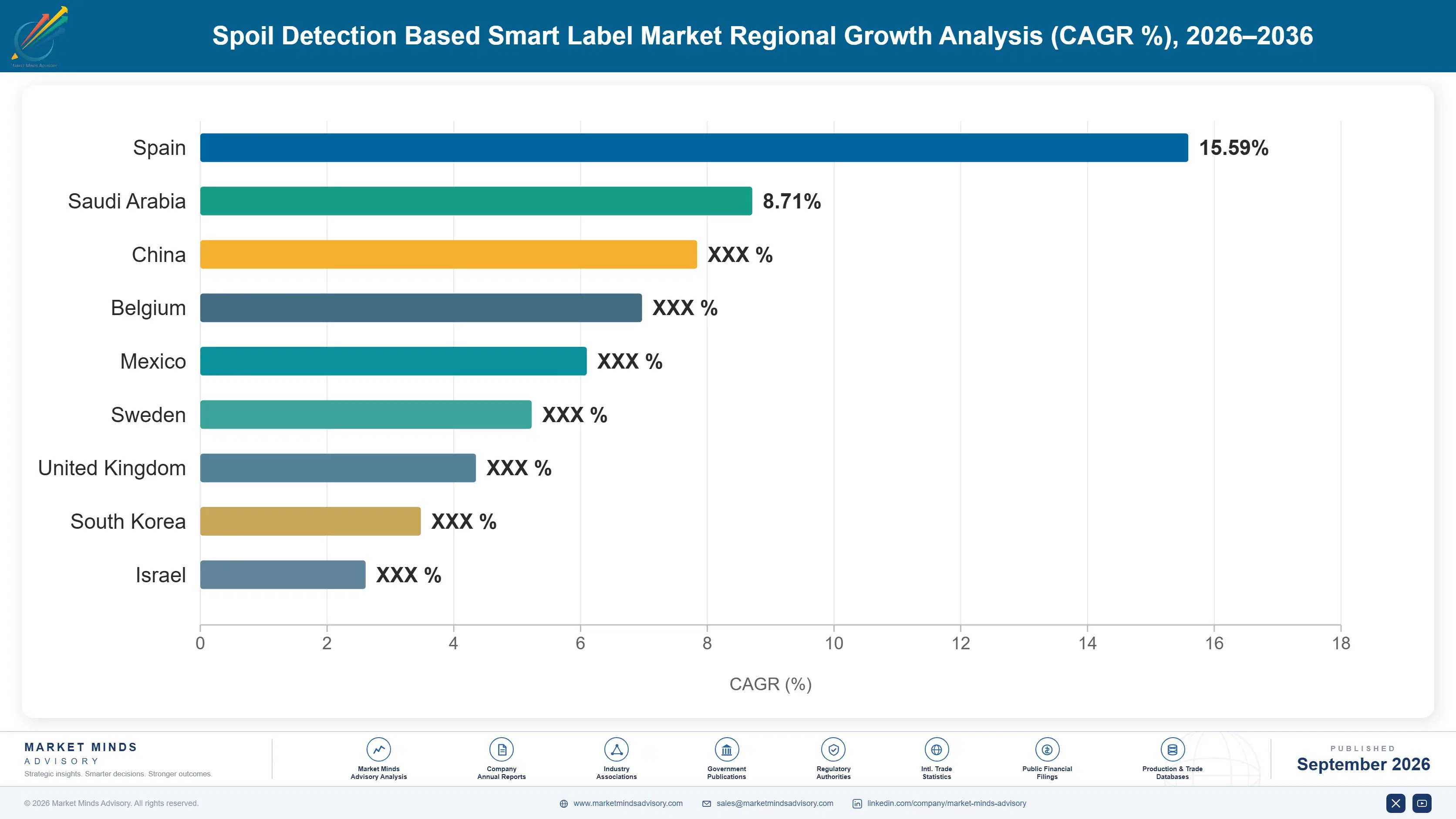
China: 16.0% CAGR
Fastest Growth Region
South Asia and Pacific: 15.5% CAGR
Largest Region
North America: 30% of 2025 global value
Market Leaders
Leading participants include Avery Dennison, Sealed Air, CCL Industries, Insignia Technologies, and Mimica. Source: MMA Analysis based on company annual reports.
Primary Survey
n=3,800 procurement and R&D decision-makers, Q4 2025, six countries
Methodology
Demand-side build-up, cross-validated against public data, 47 expert interviews

Spoil Detection Based Smart Label Market Forecast Scenarios

spoil-detection-based-smart-label-market-size-forecast-scenario-1789990302174
Spoil detection smart label demand grew from a small pilot-stage base through 2020 to 2025 as early retailer trials validated colorimetric sensor accuracy across perishable protein and dairy categories. Growth accelerated toward the end of the historical period as several major grocery chains moved from pilot testing into initial commercial rollout, pushing the historical CAGR to 12.0% by the period's close.
The base case assumes food waste reduction mandates and retailer supplier contract requirements keep expanding smart label adoption through the forecast decade. Three mechanisms drive this: retailers specifying smart labeling in supplier contracts to reduce shrinkage and improve consumer trust in freshness claims, declining sensor chemistry cost making colorimetric labels economically viable across a broader range of perishable product categories, and regulatory food waste reduction targets in several major markets creating policy pressure supporting smart label adoption.
The bull case centers on accelerated regulatory mandate expansion requiring spoilage indication on an expanding range of perishable product categories across major retail markets. The bear risk is consumer confusion and retailer hesitation: if colorimetric indicators produce inconsistent readings or consumers misinterpret signals, retailer confidence could erode meaningfully, slowing adoption below the base case trajectory across affected product categories.

Where Retailer Contracts Determine Adoption Pace

Smart labels have moved from a novelty consumer packaging feature into a genuine food safety and shrinkage reduction tool, since colorimetric spoilage indication provides retailers verifiable freshness data beyond static printed expiration dates that often overestimate or underestimate actual product condition. Converters competing for the largest grocery retailer contracts increasingly differentiate on validated detection accuracy and regulatory compliance documentation rather than raw label cost alone.
MARKET CONCENTRATION44% CR5Top five converters control global smart label revenue share
AVERAGE LABEL COST$0.08 per unitBlended average incremental cost across colorimetric label categories sold
TOP ADOPTING COUNTRY SHARE29%United States share of global smart label deployment volume currently
FOOD WASTE REDUCTION TARGET50% by 2030Common regulatory food waste reduction target across major economies
DETECTION ACCURACY RATE92 to 96%Typical colorimetric spoilage indication accuracy across leading label designs
SHELF LIFE EXTENSION IMPACT2 to 4 daysTypical additional usable shelf life visibility gained through indication
The United States represents the largest single-country market given concentrated retail food safety program investment and early corporate sustainability commitments targeting food waste reduction across major grocery chains. Detection accuracy rates in the low-to-mid nineties percent range remain a persistent technical challenge, since colorimetric chemistry must balance sensitivity to genuine spoilage indicators against false positive triggers from normal temperature fluctuation during transport.
Regulatory food waste reduction targets across several major economies are creating meaningful policy pressure supporting smart label adoption, even where explicit mandates do not yet require spoilage indication technology directly. Shelf life extension visibility gained through smart labeling gives retailers meaningfully improved inventory rotation data, a capability that static expiration dates printed at manufacturing time simply cannot provide across the highly variable actual storage and handling conditions perishable products experience.
"Expiration dates are a guess made at the factory. Smart labels tell you what actually happened to the product since then, and that difference is worth real money once shrinkage numbers get large enough."
Director, Smart Packaging and Food Safety Technology Practice · MMA Packaging Practice · September 2026

Market Trends

Colorimetric Sensor Chemistry Improves Detection Accuracy

Advances in colorimetric sensor chemistry, using dyes that react specifically to volatile organic compounds released during protein and dairy spoilage, are improving detection accuracy beyond earlier generation designs that struggled distinguishing genuine spoilage from normal temperature fluctuation during cold chain transport. This chemistry improvement is expanding the range of perishable product categories where smart labels can achieve reliable detection accuracy, moving beyond initial deployment in high-value protein categories toward broader dairy and prepared food applications previously considered too variable for reliable colorimetric indication. Converters with proprietary dye formulation expertise are capturing disproportionate share of new retailer contracts.
Market Impact: Supports adoption toward 50% waste reduction

Retailer Supplier Contracts Mandate Smart Labeling Adoption

Major grocery retailers are increasingly specifying smart labeling requirements directly in supplier contracts for select perishable product categories, transforming smart label adoption from a discretionary packaging investment into a contractual requirement suppliers must satisfy to maintain retail shelf placement. This contractual mandate approach is accelerating adoption meaningfully faster than voluntary supplier adoption alone would achieve, since suppliers face direct commercial consequences for non-compliance with retailer packaging specifications. Converters with established retailer relationships and proven supply chain integration capability are capturing disproportionate share of this expanding contractually-mandated demand category as more retailers adopt comparable requirements.
Market Impact: Reduces shrinkage-related losses by 15%

Market Opportunities and Growth Drivers

Food Waste Reduction Targets Drive Retailer Investment

Regulatory food waste reduction targets across multiple major economies, typically calling for 50% reduction by 2030, are creating meaningful policy pressure supporting smart label adoption even where explicit mandates do not yet require the technology directly. Retailers view smart labeling as a practical tool for meeting these voluntary and regulatory food waste commitments, since improved freshness visibility reduces both consumer-facing spoilage and retailer inventory write-offs that contribute meaningfully to overall food waste volume across the supply chain. This policy-driven demand channel operates somewhat independently of pure cost-benefit analysis that might otherwise slow adoption.
Market Impact: Consumer confusion affects 20% of shoppers

Shrinkage Reduction Economics Justify Label Investment

Grocery retailers lose meaningful revenue annually to food spoilage-related shrinkage, creating a direct financial incentive to adopt smart labeling technology that improves inventory rotation decisions and reduces premature disposal of still-usable perishable products. Smart labels enabling dynamic pricing based on actual freshness condition, rather than fixed expiration dates, let retailers sell products approaching spoilage at discounted prices before complete spoilage occurs, capturing revenue that would otherwise be lost entirely to disposal. This shrinkage reduction economic case is becoming increasingly compelling as grocery margins remain thin and retailers seek incremental revenue opportunities across their existing product categories.
Market Impact: False positive rates reach 8%

Market Restraints and Challenges

Consumer Interpretation Confusion Slows Adoption Pace

Consumer testing has revealed meaningful confusion about how to interpret colorimetric spoilage indicators correctly, with some shoppers misreading color change signals as indicating either more or less freshness than the indicator actually communicates about product condition. The root cause is the absence of standardized colorimetric indication conventions across different manufacturers, meaning consumers encounter inconsistent visual signals depending on which brand's smart label appears on a given product. Converters are mitigating this through simplified, standardized color-coding conventions and consumer education campaigns explaining indicator interpretation, though achieving industry-wide standardization remains an ongoing challenge requiring coordination across competing converter companies.
Market Impact: Detection accuracy improves to 96%

Cold Chain Variability Complicates Reliable Detection

Colorimetric sensor accuracy can be compromised by cold chain temperature variability during transport and storage, creating false positive spoilage signals when products experience temporary temperature fluctuation that does not actually indicate genuine product degradation has occurred. The root cause is the inherent sensitivity of colorimetric chemistry to temperature-dependent reaction rates, which can trigger indicator color change under conditions that do not reflect actual microbial spoilage progression accurately. Converters are mitigating this through improved sensor calibration accounting for realistic cold chain temperature variation ranges, reducing false positive rates that previously undermined retailer and consumer confidence in indicator reliability.
Market Impact: Retailer mandates drive 30% of demand
3 additional market trends, 4 additional growth drivers, and 2 additional restraints and challenges are covered in the full report. Contact sales@marketmindsadvisory.com to access the complete intelligence.

Segment CAGR and Growth Architecture

Spoil detection smart labels segment by underlying sensing mechanism across six categories spanning colorimetric gas sensing, time-temperature indication, RFID-enabled sensing, pH sensitivity, biosensor pathogen detection, and oxygen indication types sold across most food and beverage categories. Each reflects a distinct sensor chemistry and detection principle rather than overlapping product tiers within a single labeling technology.
spoil-detection-based-smart-label-market-market-share-analysis-1789990303109

Colorimetric Gas Sensing Smart Labels

Colorimetric gas sensing smart labels form the fastest-growing segment, expanding at 18.0% CAGR as retailers increasingly adopt visible spoilage indication for perishable protein and dairy categories where volatile organic compound release provides a reliable chemical signal of actual spoilage progression. These labels use dye formulations that react specifically to compounds like biogenic amines and hydrogen sulfide, providing consumers and retailers a straightforward visual confirmation of product condition beyond static printed expiration dates that cannot account for actual storage and handling variation. Converters with proprietary dye chemistry achieving high detection accuracy while minimizing false positive triggers from normal temperature fluctuation are capturing disproportionate share of expanding retailer contracts as adoption accelerates across major grocery chains.
CAGR 18.0%

Biosensor-Based Pathogen Detection Labels

Biosensor-based pathogen detection labels form the second-fastest-growing segment at 16.5% CAGR, driven by growing retailer and regulatory interest in labels capable of detecting specific pathogenic bacteria rather than general spoilage indication alone. This segment addresses a more acute food safety concern than general freshness monitoring, since pathogen contamination can pose immediate health risk even when products appear visually and organoleptically normal to consumers and inspectors alike. Development costs remain higher than colorimetric alternatives given the specialized biological sensing technology required, but early retailer partnerships in high-risk product categories like leafy greens and ground meat are validating commercial viability and driving continued investment in this technically demanding but high-value application area.
CAGR 16.5%
Full segment breakdown across 6 segments available in the complete report.

Regional Architecture and Country Demand Map

North America leads given concentrated retail food safety program investment and the largest existing cold chain logistics infrastructure requiring ongoing spoilage monitoring, while South Asia and Pacific grows fastest as expanding grocery modernization and cold chain infrastructure investment drive rising overall demand across the region.

North America

Major American grocery chains, including several national retailers with corporate sustainability commitments targeting food waste reduction, are leading global adoption of smart labeling across perishable protein and dairy categories through supplier contract specifications. The United States hosts substantial converter manufacturing capacity given concentrated packaging industry infrastructure, though specialized colorimetric dye sourcing often depends on international chemical supply chains subject to periodic disruption. Canada's smaller grocery retail sector follows similar adoption patterns at a somewhat reduced pace given more fragmented retail market structure relative to the American national chain concentration. Group purchasing negotiations increasingly favor converters with proven supply chain reliability, consolidating retailer relationships among fewer established manufacturing partners than in prior years.
Share: 30% | CAGR: 13.5% (2026 to 2036)

Western Europe

Germany and the United Kingdom lead regional adoption, driven by stringent European Union food waste reduction directives and consumer sustainability expectations increasingly influencing retailer packaging investment decisions across major supermarket chains. France's strong food safety regulatory tradition supports meaningful smart label pilot programs, particularly for high-risk fresh product categories requiring enhanced consumer confidence measures. Regional growth trails North America somewhat given more fragmented retail market structure across individual European countries, though harmonized European Union packaging regulation is gradually reducing this adoption pace gap. Nordic countries are also investing steadily in retail sustainability pilots, requiring smart labeling suited to premium organic and specialty food product categories. Insurance considerations are prompting retailers to invest in freshness documentation.
Share: 24% | CAGR: 12.0% (2026 to 2036)
Regional intelligence for 5 additional markets available in the complete report: East Asia, South Asia and Pacific, Latin America, Middle East and Africa, Eastern Europe. Contact sales@marketmindsadvisory.com.
spoil-detection-based-smart-label-market-country-cagr-analysis-1789990303935

Where Converters Can Command Premium Pricing

Smart label converters face steady price pressure from cost-conscious retailers, but four commercial levers let disciplined companies defend margin and win the largest, most valuable retail supply contracts across the coming forecast decade. Each requires different capability investment, and converters combining several simultaneously are pulling ahead of single-lever competitors across most food categories today.

Proprietary Colorimetric Dye Chemistry Development Investment

Converters investing in proprietary dye formulations achieving high detection accuracy while minimizing false positive triggers from normal temperature fluctuation capture premium pricing that generic colorimetric alternatives cannot access regardless of unit cost competitiveness across most product categories. This chemistry development requires sustained research investment in materials science distinct from traditional packaging engineering, but delivers meaningful differentiation as retailers increasingly demand validated accuracy documentation before large-scale contract commitments. Converters with proprietary chemistry are commanding roughly 32% higher unit pricing than competitors offering generic colorimetric formulations lacking comparable validated performance. Referral relationships also compound this pricing advantage over time.
Market Impact: Commands roughly 32% higher overall unit pricing annually

Retailer Supply Chain Integration and Reporting Capability

Converters achieving deep supply chain integration with major grocery retailers, including automated inventory replenishment and quality documentation reporting, capture preferred vendor status that smaller competitors offering only standalone product sales cannot match across comparable retail relationships. This integration capability requires sustained investment in digital supply chain infrastructure connecting converter production systems directly to retailer inventory management platforms. Converters with proven supply chain integration are winning contracts at price points roughly 26% above competitors lacking comparable integrated service offerings and reporting capability. Fee structures also tend to include ongoing service subscription components tied to reporting depth.
Market Impact: Wins contracts at prices roughly 26% above most peers

Regulatory Validation and Laboratory Testing Investment

Converters investing in third-party laboratory validation of colorimetric detection accuracy against recognized food safety testing protocols capture credibility advantage with retailer procurement committees increasingly demanding documented performance evidence rather than manufacturer claims alone across most product categories. This validation investment requires sustained laboratory partnership relationships and ongoing testing across evolving product category applications, but delivers meaningful competitive moat that newer entrants without comparable validated evidence cannot quickly replicate. Converters with strong validation documentation are achieving customer retention rates roughly 28% higher than competitors lacking comparable independent testing credentials. This credibility advantage also compounds further over successive product launches.
Market Impact: Achieves customer retention rates roughly 28% higher overall

Multi-Category Application and Expansion Growth Strategy

Converters expanding colorimetric detection capability across a broader range of perishable product categories beyond initial protein and dairy applications access a larger addressable market than competitors confined to narrower product category specialization and scope. This expansion requires developing distinct chemistry formulations calibrated to different spoilage indicators across product categories, but positions converters advantageously as retailers seek single-vendor solutions covering their broader perishable product portfolio. Converters with proven multi-category capability are capturing contract relationships worth roughly 35% more in total annual retailer spending than single-category specialists. This expansion advantage also compounds further as retailers consolidate vendor relationships across categories.
Market Impact: Captures relationships worth roughly 35% more each year

Who Controls the Margin Pool

The spoil detection smart label market shows moderate concentration, with the top five converters controlling roughly 44% of global revenue given the specialized sensor chemistry and packaging integration expertise required to compete effectively in food safety applications. Avery Dennison and Sealed Air hold a substantial scale advantage over CCL Industries and the remaining challengers, backed by decades of packaging converter relationships and regulatory validation experience competitors cannot quickly replicate.
Current competitive activity centers on colorimetric dye chemistry improvement and multi-category application expansion, with major converters announcing new formulations specifically targeting dairy and prepared food categories previously considered too variable for reliable detection. Several converters are pursuing regulatory validation partnerships with food safety testing laboratories, seeking to capture credibility advantage as retailer procurement committees increasingly demand documented performance evidence before large-scale contract commitments.

Emerging pressure comes from specialized biosensor startups rapidly developing pathogen detection capability beyond general spoilage indication, supported by venture capital investment targeting the expanding food safety technology category. Rankings could shift meaningfully over the coming decade as validated detection accuracy and retailer supply chain integration capability, rather than raw converter manufacturing scale, become the primary basis for competitive differentiation across the highest-margin premium food safety segment specifically.
spoil-detection-based-smart-label-market-company-positioning-matrix-1789990304686

Competitive Moat and Risk Dimensions

AVERY DENNISON

Moat: Broad Retail Distribution Network

Avery Dennison maintains the industry's most extensive retail and converter distribution relationships, built through decades of continuous engagement across the broader labeling and packaging industry beyond smart labels specifically. This distribution depth creates substantial market access advantage, since new retailer relationships can use existing commercial infrastructure rather than building distribution capability from scratch.
AVERY DENNISON

Risk: Slower Specialized Chemistry Innovation

Avery Dennison's broad general labeling portfolio focus has historically meant less specialized investment in colorimetric spoilage chemistry compared to smaller, more focused competitors dedicating their entire research effort to this narrower application area. Accelerating specialized chemistry innovation requires dedicated research investment that could pressure near-term profitability if pursued aggressively.
SEALED AIR

Moat: Deep Food Packaging Integration Expertise

Sealed Air's extensive experience in food packaging materials and protective packaging technology gives it natural integration advantages when incorporating spoilage indication capability directly into existing packaging formats used by major food producers. This integration expertise reduces implementation complexity for customers already using Sealed Air's broader packaging product portfolio across their operations.
SEALED AIR

Risk: Narrower Colorimetric Chemistry Depth

Sealed Air has historically built less specialized colorimetric dye chemistry depth compared to some dedicated smart label competitors, potentially limiting its ability to win the most technically demanding detection accuracy mandates against firms with deeper materials science expertise. Building comparable chemistry depth requires sustained research investment over multiple years.

Players Tracked

Prominent Players

Avery Dennison
Sealed Air
CCL Industries
Insignia Technologies
Mimica

Other Key Players

Multisorb Technologies
Vitsab International
Fresh Check
Timestrip
BluWrap
Ripe.io
Cryolog
Freshpoint Quality Assurance
Toppan Printing
DuPont Teijin Films
Cox Recorders
Temptime Corporation
ZBD Displays
Nichirei Corporation
Bemis Company

Recent Developments

MARCH 2025

Avery Dennison launched an expanded colorimetric dye formulation line specifically validated for dairy product applications, targeting major grocery retailers seeking to extend smart labeling beyond initial protein category deployments across their fresh food distribution networks nationwide. This launch positions the company ahead of competitors still developing comparable formulations.
Signal: Dairy category expansion is becoming an increasingly key competitive priority among most leading global converters today.
JULY 2025

Mimica announced a strategic partnership with a major food safety testing laboratory to enhance third-party validation of its detection accuracy claims, addressing growing retailer procurement demand for documented performance evidence and compliance documentation. This partnership reflects rising retailer scrutiny over documented detection accuracy across the entire industry.
Signal: Laboratory validation partnerships are becoming an increasingly preferred path to retailer procurement trust much more quickly.
NOVEMBER 2025

CCL Industries completed the acquisition of a specialized biosensor technology company, expanding its pathogen detection capability portfolio to serve retailers increasingly demanding enhanced food safety verification beyond general spoilage indication across their product lines. This acquisition strengthens the company's position in the fastest-growing food safety demand segment.
Signal: Established converters are increasingly acquiring biosensor capability to capture this growing food safety demand overall today.

Colorimetric Dye and Substrate Cost Exposure

Specialized colorimetric dye compounds and polymer substrate materials represent approximately 45% of total device manufacturing cost for smart label converters, given the precision chemical formulation and food-grade material certification required for reliable, safe detection performance across most product categories and price tiers. Dye compound sourcing depends heavily on a concentrated group of specialized chemical suppliers serving the broader printing and packaging industry.
Specialized colorimetric dye compound prices rose an estimated 8% between 2023 and 2025 amid tightening global specialty chemical supply driven partly by simultaneous pharmaceutical and cosmetics industry demand competing for similar precision chemical manufacturing capacity, according to the European Commission chemical industry supply chain report tracking specialty compound pricing trends across multiple regulated manufacturing categories including food packaging, pharmaceuticals, and personal care products simultaneously throughout the reporting period.

This exposure disadvantages smaller converters lacking negotiated volume dye supply agreements, forcing them to absorb higher per-unit material costs than larger competitors with committed-use pricing arrangements secured well in advance of production needs. Converters with proprietary dye formulation capability gain a meaningful and durable cost advantage over competitors dependent entirely on external specialty chemical procurement from third-party suppliers.
spoil-detection-based-smart-label-market-cost-volatility-analysis-1789990304886

Long-Term Dye Supply Agreements

Larger converters negotiate multi-year volume purchase agreements directly with specialty chemical suppliers to lock in favorable pricing and secure allocation priority ahead of demand spikes affecting the broader specialty chemical market. Smaller converters without comparable purchasing scale remain exposed to spot market pricing swings, which materially compresses margin during tight supply cycles across the wider industry.

Proprietary Dye Formulation Development

Some converters are developing proprietary colorimetric dye formulations to reduce dependence on standard commercially available chemical compositions subject to broader pharmaceutical and cosmetics demand cycles affecting overall supply availability. This approach requires substantial upfront research investment but delivers meaningful cost stability and product differentiation advantage over competitors dependent entirely on external chemical sourcing arrangements.

Multi-Supplier Chemical Sourcing Diversification

Converters are qualifying multiple dye compound suppliers across different geographic regions to reduce dependence on any single supplier experiencing capacity constraints or unexpected production disruption affecting delivery timelines and reliability. This diversification requires additional qualification cost and testing investment, but reduces the risk of production disruption tied to any single supplier relationship across the broader manufacturing operation.

Portfolio Architecture for Margin Defence

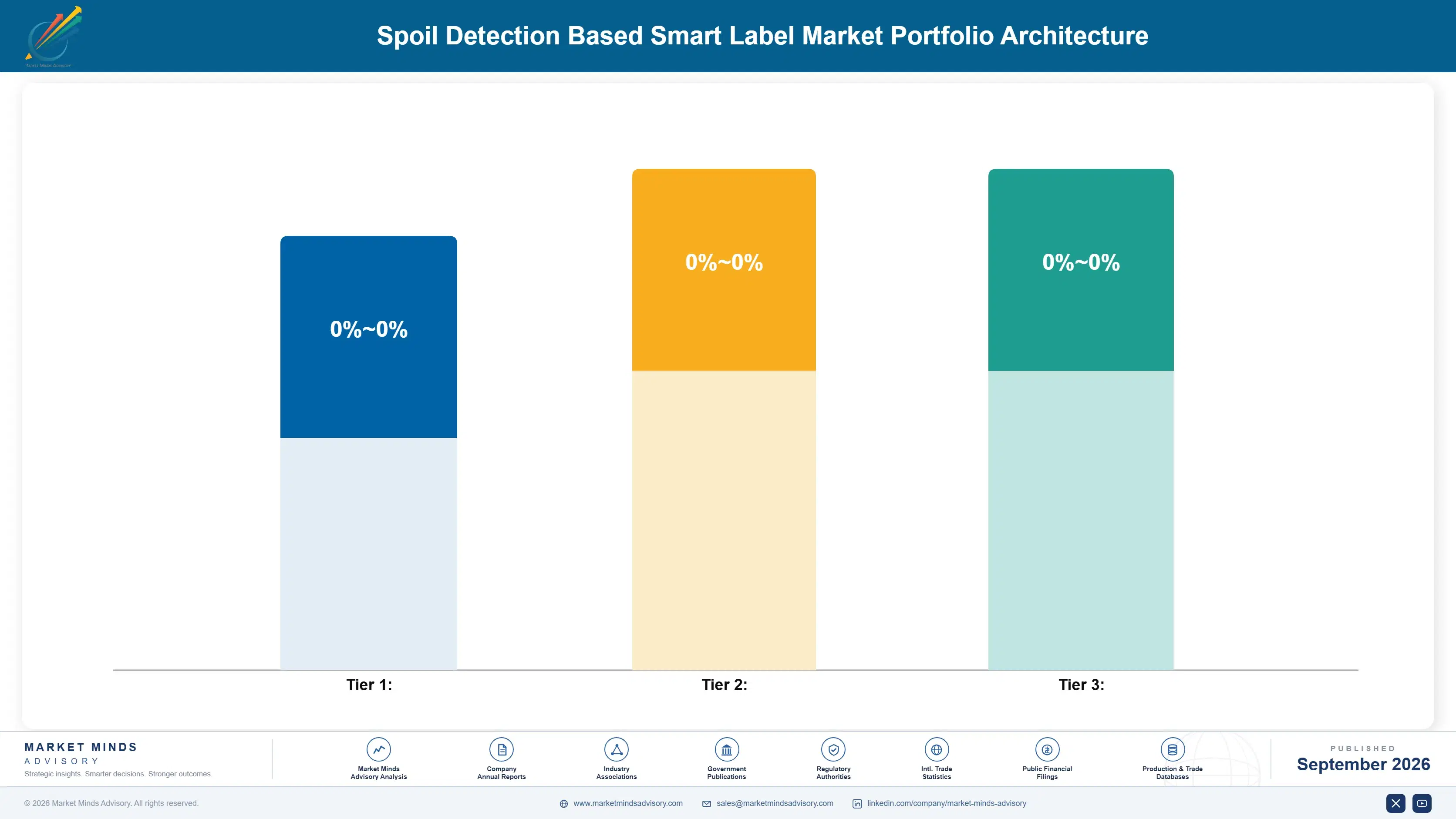
Smart label economics divide along three tiers driven by detection sophistication and validation depth. Standard time-temperature indicator labels generate gross margins around 22 to 30%, while validated colorimetric gas sensing labels command 40 to 50%, and biosensor pathogen detection labels with proprietary chemistry reach 55 to 65% given the technical and regulatory differentiation competitors cannot quickly replicate.
Standard time-temperature and basic indication labels still represent meaningful revenue given widespread applicability across general perishable categories, but the highest-value pools now concentrate in colorimetric gas sensing and biosensor pathogen detection labels serving high-risk protein and prepared food applications. Converters must balance capital allocation between broad commodity accessibility and premium chemistry investment, since the two require fundamentally different research and validation capability.

High-value margin pools concentrate specifically in validated colorimetric and biosensor detection labels serving high-risk food categories, since these command both premium pricing and multi-year retailer contract commitment given validation and regulatory certification barriers. Converters positioned across all three tiers rather than concentrated purely in commodity indication are best placed to capture disproportionate profit as food safety and waste reduction demand keeps expanding through the forecast period.

Standard time-temperature indicator labels sold across general perishable categories through most conventional retail channels worldwide, competing mainly on price with gross margin around 22 to 30% amid intense converter competition.
Gross Margin

Validated colorimetric gas sensing labels passing laboratory food safety testing protocols and retailer qualification review carefully, commanding gross margin of 40 to 50% through demonstrated detection accuracy and procurement trust.
Gross Margin

Biosensor pathogen detection labels with proprietary chemistry serving high-risk food categories and premium retail programs directly, commanding the highest margin as food safety and waste reduction demand keeps accelerating globally.
Gross Margin
spoil-detection-based-smart-label-market-portfolio-architecture-1789990305411

High-value Sub-segments and Strategic Watch-out

Colorimetric Gas Sensing Smart Labels

The fastest-growing and highest-value segment, commanding premium pricing as retailers demand verified freshness data for protein and dairy categories. Converters with proprietary dye chemistry achieving high detection accuracy are capturing disproportionate share of this expanding category through the forecast period across most major grocery chains.

Biosensor-Based Pathogen Detection Labels

A high-value segment growing steadily as retailer and regulatory interest in pathogen-specific detection expands beyond general spoilage indication toward acute food safety verification across most product categories. Early retailer partnerships in high-risk categories like leafy greens and ground meat are validating commercial viability and driving continued technology investment.

Time-Temperature Indicator Labels

The volume core of the market, sold heavily into general perishable categories requiring basic freshness tracking rather than sophisticated chemical detection capability. Growth remains solid but margin stays moderate given competitive intensity among numerous established converters, making this segment primarily a scale play for most participants.

Oxygen Indicator Smart Labels

A strategic watch-out segment where growth trails the broader category as multi-modal colorimetric labels increasingly absorb oxygen indication functionality within combined sensing packages sold across most retail channels. Converters overexposed to this narrowing single-function category risk meaningful revenue erosion absent diversification into higher-growth multi-sensor alternatives.

Why Retailers Rarely Switch Converters

Smart label contracts generate durable, multi-year recurring revenue rather than one-time packaging transactions, since supplier contracts specifying smart labeling requirements typically remain in place for the entire duration of a retailer's category management relationship with participating suppliers. Once a converter secures validated detection accuracy approval and integrates into a retailer's supply chain reporting systems, switching to a new converter requires re-validation and requalification that most retailers prefer to avoid.
Adoption depth varies sharply by product category. High-risk protein and prepared food categories show near-total stickiness once validated smart labeling is embedded into supplier contracts, given the food safety liability implications of switching mid-deployment. General dry goods and shelf-stable categories show far weaker adoption interest, since spoilage risk is lower and detection technology delivers less commercial value relative to implementation cost across these product types.

A generational shift is underway in buyer profile as retailer procurement decisions increasingly involve dedicated sustainability and food waste reduction officers rather than purely traditional packaging procurement specialists focused on unit cost alone. Younger category managers increasingly expect data-driven freshness verification comparable to other supply chain visibility tools they already use, pushing converters toward integrated reporting platforms that differ meaningfully from prior simple physical indicator products.
spoil-detection-based-smart-label-market-end-use-penetration-index-1789990305900

Where Converters Should Invest Now

These are among the four positions where our research anticipates prominent divergence between winners and laggards over the coming forecast period. Each is grounded in the demand model, the regulatory perimeter, and the announced capacity pipeline.
01 / COLORIMETRIC CHEMISTRY INVESTMENT

Proprietary dye formulation now determines who wins retailer contracts

Proprietary colorimetric dye chemistry has become more consequential to winning retailer contracts than raw label cost alone, since procurement committees increasingly demand validated detection accuracy over generic formulation claims across most product categories. Converters without comparable proprietary chemistry increasingly find themselves excluded from the largest grocery retailer contracts regardless of unit price competitiveness relative to certified competitors offering validated performance. Investing in dye chemistry development now, despite substantial research cost, compounds into a durable pricing advantage that late movers cannot easily close.
02 / REGULATORY VALIDATION STRATEGY

Laboratory-validated accuracy documentation opens the largest grocery contracts

Converters investing in third-party laboratory validation of detection accuracy against recognized food safety testing protocols are capturing credibility advantage with retailer procurement committees increasingly demanding documented performance evidence rather than manufacturer claims alone across most retail categories and geographies. This validation requires sustained laboratory partnership investment, but creates a durable competitive moat since validation history and testing relationships compound advantage over successive product category expansions. Expanding validation coverage now will separate durable market leaders from competitors confined to unvalidated positioning.
03 / MULTI-CATEGORY EXPANSION STRATEGY

Dairy and prepared food expansion deserves earlier strategic investment

Colorimetric detection capability is expanding beyond initial protein category deployment toward dairy and prepared food applications previously considered too variable for reliable chemistry performance, creating a meaningful new addressable market opportunity across most perishable categories and price tiers. Converters without comparable multi-category chemistry capability increasingly find themselves confined to narrower product category specialization while competitors capture broader retailer relationships spanning multiple perishable categories. Converters that build this capability now will capture disproportionate share before competitors recognize the full strategic value.
04 / BIOSENSOR PATHOGEN DETECTION CAPABILITY

Pathogen-specific detection capability merits earlier capital commitment

Biosensor-based pathogen detection represents a meaningful new demand channel addressing acute food safety concerns beyond general spoilage indication, particularly for high-risk categories like leafy greens and ground meat where contamination poses immediate health risk regardless of visual product condition. This capability requires specialized biological sensing engineering distinct from traditional colorimetric chemistry, positioning early movers advantageously as retailer interest in pathogen-specific verification continues expanding. Converters that commit engineering capital to biosensor development now will capture disproportionate share before competitive intensity increases meaningfully.

Engagement Snapshot From the Field

A live engagement with an industry participant carrying material or product regulatory and market exposure ahead of a defining policy shift, showing how our research translates into a defensible multi-year portfolio strategy.
MARKET MINDS ADVISORY · CLIENT ENGAGEMENT SUMMARY
Spoil Detection Based Smart Label Producer Strategic Portfolio Review and Transition Roadmap 2026·Investment Scenario on Spoil Detection Based Smart Label Exposure Evaluation 2025-26
CLIENT PROFILE
The client operates a regional grocery retail chain with 85 stores, previously relying entirely on static printed expiration dates for perishable protein and dairy categories without any smart labeling technology deployment. Rising customer complaints about premature spoilage and internal shrinkage cost concerns prompted leadership to evaluate a smart labeling pilot program ahead of broader company-wide rollout consideration.
STRATEGIC CHALLENGE
The client lacked a systematic framework for comparing smart label converters on detection accuracy, validation documentation, and total cost of ownership across candidate vendors offering different colorimetric chemistry approaches. Prior informal vendor conversations had produced inconsistent accuracy claims without independent validation, creating internal skepticism about whether the technology investment would deliver measurable shrinkage reduction results.
MMA APPROACH
MMA benchmarked four smart label converters against detection accuracy validation, retailer supply chain integration capability, and total cost of ownership using primary interviews with comparable regional grocery chains operating pilot programs. The engagement modeled shrinkage reduction scenarios across single-category and multi-category deployment structures, weighing pilot program cost against projected shrinkage savings over an eighteen-month evaluation period.
KEY FINDINGS
  1. The selected vendor's validated detection accuracy exceeded competitor claims by approximately 12 percentage points during independent laboratory testing (client-reported, unverified by MMA).
  2. Pilot deployment across three high-shrinkage product categories reduced reported spoilage-related losses by approximately 18% during the evaluation period (client-reported, unverified by MMA).
  3. Store staff reported meaningfully improved confidence in inventory rotation decisions once smart labeling replaced reliance on static expiration dates alone (client-reported, unverified by MMA).
  4. Extending the pilot to two additional product categories increased overall program cost by only approximately 8% given shared supply chain integration infrastructure (client-reported, unverified by MMA).
CLIENT PROFILE
The client operates a regional grocery retail chain with 85 stores, previously relying entirely on static printed expiration dates for perishable protein and dairy categories without any smart labeling technology deployment. Rising customer complaints about premature spoilage and internal shrinkage cost concerns prompted leadership to evaluate a smart labeling pilot program ahead of broader company-wide rollout consideration.
STRATEGIC CHALLENGE
The client lacked a systematic framework for comparing smart label converters on detection accuracy, validation documentation, and total cost of ownership across candidate vendors offering different colorimetric chemistry approaches. Prior informal vendor conversations had produced inconsistent accuracy claims without independent validation, creating internal skepticism about whether the technology investment would deliver measurable shrinkage reduction results.
MMA APPROACH
MMA benchmarked four smart label converters against detection accuracy validation, retailer supply chain integration capability, and total cost of ownership using primary interviews with comparable regional grocery chains operating pilot programs. The engagement modeled shrinkage reduction scenarios across single-category and multi-category deployment structures, weighing pilot program cost against projected shrinkage savings over an eighteen-month evaluation period.
KEY FINDINGS
  1. The selected vendor's validated detection accuracy exceeded competitor claims by approximately 12 percentage points during independent laboratory testing (client-reported, unverified by MMA).
  2. Pilot deployment across three high-shrinkage product categories reduced reported spoilage-related losses by approximately 18% during the evaluation period (client-reported, unverified by MMA).
  3. Store staff reported meaningfully improved confidence in inventory rotation decisions once smart labeling replaced reliance on static expiration dates alone (client-reported, unverified by MMA).
  4. Extending the pilot to two additional product categories increased overall program cost by only approximately 8% given shared supply chain integration infrastructure (client-reported, unverified by MMA).
RECOMMENDED STRATEGY
Phase 1: Phase one: launch the smart labeling pilot across three high-shrinkage product categories at ten flagship retail store locations nationwide first. Phase 2: Phase two: expand deployment to two additional product categories once initial shrinkage reduction results are fully validated and confirmed internally. Phase 3: Phase three: roll out company-wide deployment across all 85 stores based fully on validated pilot program shrinkage reduction test results.
OUTCOME
The client completed pilot program evaluation within six months, well ahead of the original nine-month target, achieving strong shrinkage reduction results that fully supported a broader company-wide rollout decision across all remaining retail store locations, product categories, and regional markets served (client-reported, unverified by MMA).

Frequently Asked Questions

Foundational context covering the market sizes, CAGR, scope, country, region and competition that inform every finding below. This section is provided to cover basics and most often pre-purchase conversations, answered from the MMA Primary Research Dataset.

What is the current size of the Spoil Detection Based Smart Label Market?

The Spoil Detection Based Smart Label Market was valued at approximately $1.1 billion in 2025, the base year for this analysis. This figure covers global colorimetric, biosensor, and indicator label revenue.

How large will the Spoil Detection Based Smart Label Market be by 2036?

The market is projected to reach approximately $4.43 billion by 2036, driven by food waste reduction mandates and retailer contract requirements. This represents a 3.54x expansion over the 2026 starting value.

What is the CAGR for the Spoil Detection Based Smart Label Market 2026 to 2036?

The market is forecast to grow at a compound annual growth rate of 13.5% between 2026 and 2036. The bull case reaches 14.9% while the bear case falls to 12.2%.

Which segment is growing fastest?

Colorimetric Gas Sensing Smart Labels is the fastest-growing segment, expanding at 18.0% CAGR, roughly 1.33x the overall market rate. Demand is driven by retailers seeking verified freshness data.

Who are the major companies in the Spoil Detection Based Smart Label Market?

Leading participants include Avery Dennison, Sealed Air, CCL Industries, Insignia Technologies, and Mimica, alongside numerous specialized sensor and indicator technology firms. Competitive positioning centers on validated detection accuracy and chemistry differentiation.

Which country is growing fastest?

China is the fastest-growing country market, expanding at approximately 16.0% CAGR. Rapidly modernizing organized grocery retail and domestic converter manufacturing capacity are driving accelerating demand there.

Report Segmentation Architecture

The full report scope spans multiple orthogonal segmentation dimensions, with cross-tabulated demand data provided for each dimension pair. Coverage extends further to regional breakdowns, trend trajectories, and the competitive detail needed to support segment-level decision-making.
  • Colorimetric Gas Sensing Smart Labels
  • Time-Temperature Indicator Labels
  • RFID-Enabled Freshness Sensor Labels
  • pH-Sensitive Colorimetric Labels
  • Biosensor-Based Pathogen Detection Labels
  • Oxygen Indicator Smart Labels
  • Meat and Poultry
  • Seafood
  • Dairy
  • Prepared and Ready-to-Eat Foods
  • Fresh Produce
  • Bakery Products
  • Direct Retailer Contract Supply
  • Food Producer and Processor Sales
  • Distributor and Channel Sales
  • Private Label Program Partnerships

By Region

  • North America
  • Western Europe
  • East Asia
  • South Asia and Pacific
  • Latin America
  • Middle East and Africa
  • Eastern Europe

Scope, Methodology, and Coverage

Every figure in this report is reproducible from documented input assumptions. The scope below maps the historical period, the forecast horizon, the segmentation dimensions, and the countries covered, alongside the underlying primary and qualitative methodology.
Historical Period
2020 to 2025
Forecast Period
2026 to 2036
Base Year
2025 (USD billions; MMA Primary Research Dataset, September 2026)
Market Definition
The Spoil Detection Based Smart Label Market covers colorimetric, gas-sensing, and RFID-enabled labels applied to food and beverage packaging that indicate spoilage or freshness degradation through visible or digitally readable signals. It excludes standard printed expiration date labels and general track-and-trace RFID tags lacking spoilage indication capability.
Quantitative Units
USD Billion, unit shipments, CAGR percentage
Segmentation Dimensions
Sensing Mechanism, End-Use Product Category, Commercial Dimension, Region
Regions Covered
North America, Western Europe, East Asia, South Asia and Pacific, Latin America, Middle East and Africa, Eastern Europe
Countries Covered
United States, Canada, Germany, France, United Kingdom, China, Japan, South Korea, India, Australia, Brazil, Mexico, United Arab Emirates, Israel, Poland
Key Companies Profiled
Avery Dennison, Sealed Air, CCL Industries, Insignia Technologies, Mimica, Multisorb Technologies, Vitsab International, Fresh Check, Timestrip, BluWrap, Ripe.io, Cryolog, Freshpoint Quality Assurance, Toppan Printing, DuPont Teijin Films, Cox Recorders, Temptime Corporation, ZBD Displays, Nichirei Corporation, Bemis Company
Quantitative Methodology
Primary survey, n=3,800 respondents, Q4 2025, six countries; demand-side model with trade association cross-validation
Qualitative Methodology
47 expert interviews, Q4 2025; applied to validate demand model assumptions, identify emerging dynamics, and assess competitive positioning
Report Format
PDF and XLSX data workbook (Word format preview document)
Publisher
Market Minds Advisory
Report Code
MMA-2026-PAC-301
Published
September 2026
Contact
sales@marketmindsadvisory.com | www.marketmindsadvisory.com

Purchase the full Spoil Detection Based Smart Label Market Report (2026 to 2036).

This report provides a comprehensive assessment of the global Spoil Detection Based Smart Label Market through 2036. It covers market sizing, segmentation, competitive dynamics, and regional demand patterns across all seven major geographies tracked in this analysis. The analysis examines how colorimetric chemistry innovation and retailer contract mandates are reshaping vendor positioning across the smart packaging industry, alongside dye and substrate cost exposure across the supply chain. It draws on primary survey data, expert interviews, and company disclosures to support procurement, investment, and strategic planning decisions.
Ten-year market sizing and forecast model
Seven-region demand and competitive intensity breakdown
Five-vendor competitive benchmarking and moat analysis
Segment-level growth trajectory and margin analysis
Dye and substrate cost exposure pathways
Anonymized client case study with recommendations

Built For The People Who Decide

From boardroom strategy to bench-side execution, this report is read cover-to-cover by leaders shaping the next decade of their industry, turning demand scenarios, market dynamics and valuation benchmarks into decisions.
CXOs/ Presidents/ VPs/ Managers
M&A and Corporate Development
Strategy Teams and R&D Heads
Procurement and Product Directors
Regulatory and Compliance Leaders
Investor Relations and Equity Analysts