Market Minds Advisory
Spirulina Powder Market

Spirulina Powder Market: The Protein Argument Failed and the Blue Pigment Paid

Nobody buys spirulina for protein at these prices, and the extracted blue pigment is worth roughly sixteen times the biomass, which means a colour molecule quietly decides the economics of every pond.

Lead Analyst

Lisa Gevelber

Published

September 2026

Make Smarter Decisions with Customized Research Insights

Request a free sample report and evaluate market opportunities, growth trends, and competitive dynamics relevant to your business needs.

2025 MARKET VALUE$0.5BMarket Size 2025
2036 FORECAST VALUE$1.1BBase Case , 2026 to 2036
CAGR 2026 TO 20368.2 %Bull 9.4% / Bear 7.0%
INCREMENTAL OPPORTUNITY$0.6BNet 10- year value creation
EXPANSION MULTIPLE2.19x2036 value over 2026 base
Strategic Levers
M&A Pipeline
Regional Outlook
Country Rankings
Competitive Intelligence
Segmental Deep-dive
Call-Us : 91 93563 13602

Executive Snapshot and Market Trajectory

The protein argument was always weak and the industry has finally stopped making it. Spirulina is expensive protein that tastes of pond water, and what actually sells is phycocyanin, the blue pigment inside it, worth roughly sixteen times the dried biomass it comes from. That fact reorders the business.
That reframes everything upstream. Phycocyanin extraction grows at 12.3% because it is the only natural blue that performs in confectionery and beverage, and the pigment degrades with heat and light, so drying method decides whether a grower has a colour product or animal feed. Most open pond producers are still selling the wrong product from the wrong process. Cultivation yield is the wrong thing to optimise here.
Contamination is the gate. Microcystins from co-occurring cyanobacteria can appear in open pond biomass, and the testing threshold near one part per billion is what separates food grade from feed grade and holds the two price levels apart. Around 78% of world production comes from open raceways, which is exactly where that risk lives and where testing discipline varies most. Testing discipline decides which side of that line a producer ends up on.
Market Definition
Spirulina biomass produced as dried powder and its primary derivatives, covering dietary supplements, natural colourant and phycocyanin extraction, food and beverage ingredient use, animal feed and aquaculture, cosmetics and personal care, and agricultural biostimulants. Measured at producer selling value across open pond and photobioreactor cultivation. Excludes chlorella and other microalgae, astaxanthin from Haematococcus, finished supplement brands, and cultivation equipment or engineering services.
Base Year Value
$0.5B in 2025 (MMA Primary Research Dataset, August 2026)
Forecast Period
2026 to 2036, eleven discrete annual values
CAGR
8.2% base case. Bull 9.4%. Bear 7.0%.
Fastest Growth Segment
Natural Colourant and Phycocyanin Extraction: 12.3% CAGR
Fastest Growth Country
India: 13.6% CAGR
Fastest Growth Region
South Asia and Pacific: 10.4% CAGR
Largest Region
East Asia: 30% of 2025 global value
Market Leaders
DIC Corporation, Cyanotech, Parry Nutraceuticals, Far East Bio-Tec, Yunnan Green A Biological Project. Source: MMA Primary Research Dataset, July 2026.
Primary Survey
n=3,800 procurement and R&D decision-makers, Q4 2025, six countries
Methodology
Demand-side build-up, cross-validated against public data, 47 expert interviews

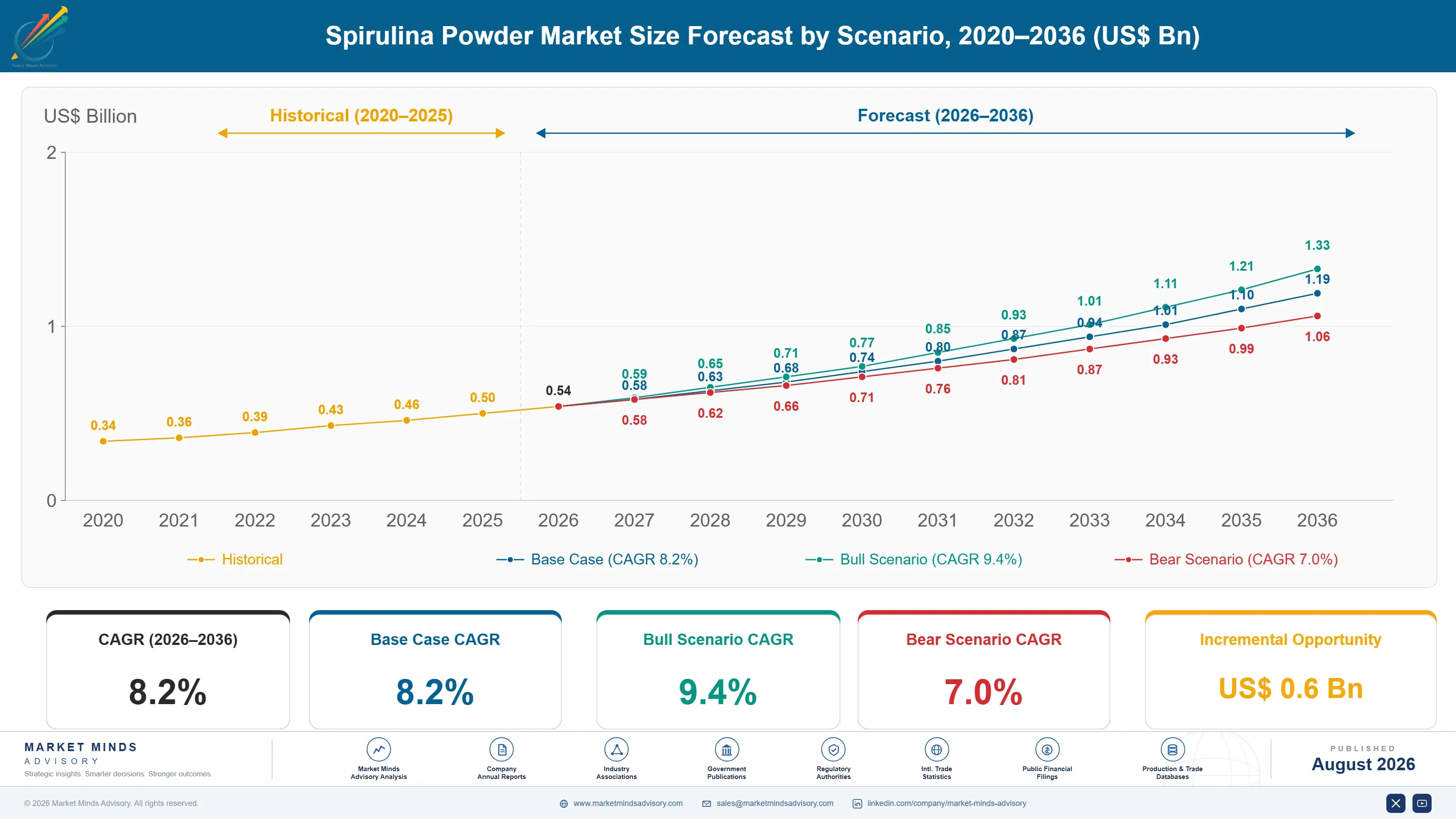
Spirulina Powder Market Forecast Scenarios

spirulina-powder-market-trends-size-forecast-scenario-1787595341243
Growth ran near 7.0% between 2020 and 2025 and the composition changed far more than the headline did. Supplement demand grew modestly and remained price sensitive, while phycocyanin extraction expanded quickly as food manufacturers removed synthetic blue colours from confectionery and beverage lines. Chinese open pond capacity expanded through the period and pulled biomass pricing down, which squeezed growers selling powder rather than pigment.
Base case 8.2% rests on three mechanisms. Phycocyanin extraction grows at 12.3% as synthetic colour removal continues across confectionery, dairy and beverage in markets where consumers read labels. Food and beverage ingredient use grows at 9.6% on the same clean label pressure. And India grows fastest of any country at 13.6% on Tamil Nadu cultivation expansion alongside rising domestic supplement consumption. None of the three depends on any protein argument at all.
The bull case at 9.4% assumes phycocyanin stability improving enough through formulation work that it enters heat processed applications currently closed to it. The bear case at 7.0% is a microcystin contamination incident reaching consumer media, which would damage food grade demand across the category regardless of which producer was actually responsible for it. Category risk is shared regardless of fault.

A Colour Molecule Decides the Pond

Two decades of marketing spirulina as a protein source achieved very little, for the sensible reason that it is expensive protein with a flavour most people dislike. The commercial reality is a pigment. Phycocyanin makes up around 14% of well grown dried biomass and sells for roughly sixteen times the powder it is extracted from, which means the economics of a cultivation operation are set by a colour molecule rather than by any nutritional claim.
TOP FIVE CONCENTRATION29%Cultivation barriers are low and the field stays wide
PIGMENT VALUE MULTIPLE16xExtracted pigment worth against equivalent dried biomass weight
OPEN POND PRODUCTION78%World output grown in open raceway cultivation systems
PHOTOBIOREACTOR COST RATIO5xCapital cost against equivalent open pond cultivation capacity
MICROCYSTIN THRESHOLD1 ppbContamination limit separating food grade from feed grade
PIGMENT CONTENT14%Phycocyanin share of dried biomass under good cultivation
That pigment is also fragile, which decides how the crop must be handled. Phycocyanin degrades with heat and light, so a grower who spray dries at high inlet temperature has produced animal feed regardless of what the pond yielded. Low temperature drying, controlled harvesting and rapid processing separate colour grade material from everything else, and most open pond operations have neither.
Contamination sets the other boundary. Microcystins produced by cyanobacteria that co-occur in open cultivation can appear in harvested biomass, and testing against thresholds near one part per billion is what divides food grade supply from feed grade. Around 78% of world production comes from open raceways, which is where that risk concentrates and where testing discipline varies most widely.
"Growers keep telling me about protein content and grams per serving. The buyer who actually pays properly is a confectionery formulator who needs a blue that survives the process, and they will pay sixteen times the powder price for it if you have not cooked the pigment out on the dryer."
Director, Algae Ingredients and Natural Colours Practice · MMA Agriculture and Food Practice · August 2026

Market Trends

Synthetic blue removal pulling phycocyanin into mainstream food

Confectionery, dairy and beverage manufacturers have been removing synthetic blue colours from consumer facing product lines, and phycocyanin is the only natural blue that performs acceptably across most of those applications. Demand grows at 12.3% on that substitution rather than on any nutritional argument for spirulina itself. The constraint is stability rather than supply, since the pigment degrades under heat and light, which keeps it out of processed applications where formulation work has not yet solved the problem. Producers who can document contamination testing and demonstrate shade stability are winning those specifications years before the reformulated product reaches a shelf.
Market Impact: Ingredient demand growing at 9.6%
Drying method separating colour grade from commodity biomass

Phycocyanin degrades with heat, so inlet temperature during drying decides whether harvested biomass becomes a colour ingredient worth roughly sixteen times the powder price or ordinary feed material. Low temperature and freeze drying preserve the pigment at considerable capital and energy cost, while conventional spray drying destroys much of it. Growers competing on cultivation yield while drying conventionally are optimising the wrong end of the process entirely, and most of them still are. The capital involved is modest against a value gap of roughly sixteen times, which makes it the cheapest improvement available anywhere in this business.
Market Impact: India growing fastest at 13.6%

Market Opportunities and Growth Drivers

Clean label pressure reaching processed food categories broadly

Consumer label scrutiny has moved beyond premium products into mainstream confectionery, dairy and beverage, which pushes manufacturers to replace synthetic colours across whole portfolios rather than in flagship lines alone. Food and beverage ingredient demand grows at 9.6% on that pressure. Reformulation programmes run on multi-year cycles and specify supply well in advance, which gives producers who can meet colour and contamination specifications an unusually long commercial runway to work with. Suppliers who arrive with stability data rather than a specification sheet are the ones written into those programmes. Very few suppliers arrive that way.
Market Impact: Threshold near 1 part per billion

Indian cultivation and supplement demand expanding together

India grows fastest of any country at 13.6%, with Tamil Nadu cultivation capacity expanding alongside domestic supplement consumption rising from a modest base. Climate suits open pond cultivation for most of the year, which keeps costs low, and domestic demand absorbs a growing share of output rather than relying entirely on export. Food grade certification and microcystin testing discipline remain the limiting factors on how much of that output reaches higher value applications. Batch level documentation rather than cultivation capacity is what will decide how far Indian output climbs the value ladder over the next decade.
Market Impact: Limits use above 60 degrees

Market Restraints and Challenges

Microcystin contamination risk concentrated in open cultivation

Cyanobacteria co-occurring in open raceway ponds can produce microcystins that appear in harvested biomass, and testing against thresholds near one part per billion separates food grade supply from feed grade entirely. The root cause is that open cultivation cannot exclude other organisms. Commercially it caps what an untested open pond producer can sell into and creates category risk for everybody if an incident reaches consumers. Routine batch testing and closed cultivation are the mitigations in use. Neither fully removes the risk from an open system. Category risk is shared by everybody regardless of fault.
Market Impact: Pigment demand growing at 12.3%

Pigment instability closing processed food applications

Phycocyanin degrades under heat, light and acidic conditions, which keeps it out of baked goods, retorted products and many beverages where a synthetic blue would work without difficulty. The root cause is molecular rather than anything a producer controls in cultivation. Commercially it limits the addressable market to applications the pigment survives. Encapsulation, protein complexing and formulation stabilisation systems are the mitigations several suppliers are pursuing with partial success. Whoever solves it properly will hold that position for several years, because the formulation work is genuinely difficult and nobody has finished it yet.
Market Impact: Preserves 16 times the value
4 additional market trends, 3 additional growth drivers, and 2 additional restraints and challenges are covered in the full report. Contact sales@marketmindsadvisory.com to access the complete intelligence.

Segment CAGR and Growth Architecture

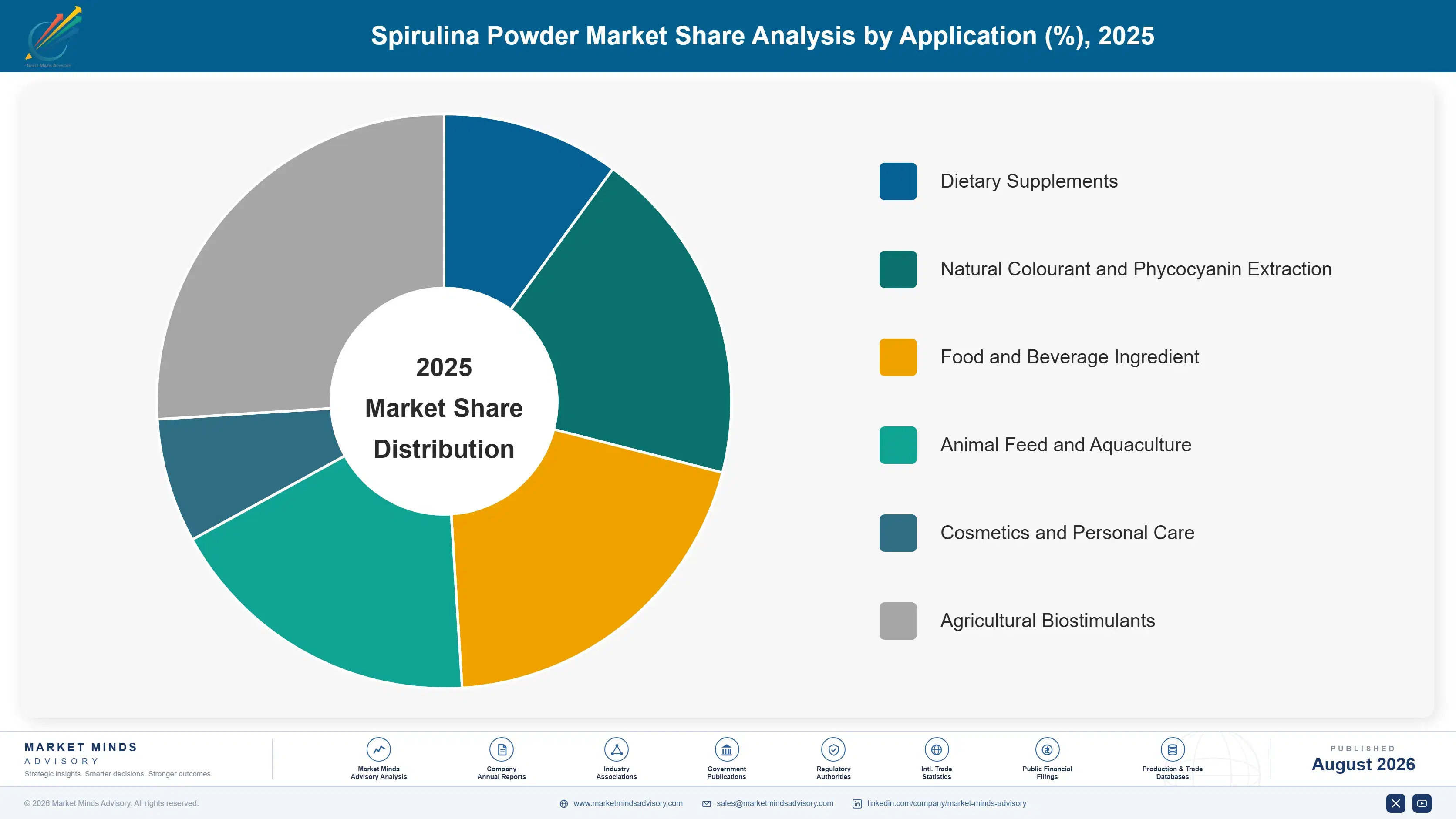
Six segments are split by application, because application determines the grade required, the certification and contamination testing imposed, the processing route the biomass must take and the price a producer can command. Format variants such as tablets and capsules sit inside each application. Cultivation method and channel are handled separately in the framework. Cultivation method sits there too.
spirulina-powder-market-trends-market-share-analysis-1787595341771

Natural Colourant and Phycocyanin Extraction

Growing at 12.3%, half again the market rate of 8.2%, this covers biomass grown and processed specifically for pigment extraction, where phycocyanin at around 14% of dried weight sells for roughly sixteen times the powder it came from. Confectionery, beverage and dairy manufacturers removing synthetic blue colours drive the demand rather than any nutritional claim about spirulina. Cultivation, harvesting and drying all have to be managed for pigment retention rather than biomass yield, which is a different operation entirely and one most open pond growers have not built. Application support and stability data rather than delivered price decide who supplies these customers, and reformulation programmes specify years ahead of first production.
CAGR 12.3%

Food and Beverage Ingredient

At 9.6% this covers whole spirulina used as a visible ingredient in beverages, snacks, plant based products and functional foods, where the colour and the label claim both matter to the manufacturer. Clean label pressure across mainstream categories drives it rather than any protein economics, since spirulina remains expensive protein by any comparison. Food grade certification and microcystin testing are the entry requirements, and they exclude a substantial share of open pond output. Flavour masking remains a genuine formulation constraint that limits inclusion rates in most applications. Reformulation programmes run on multi-year cycles and reopen rarely, which makes an established position here considerably more durable than supplement supply ever is.
CAGR 9.6%
Full segment breakdown across 6 segments available in the complete report.

Regional Architecture and Country Demand Map

East Asia holds 30% of value on Chinese cultivation scale that no other region approaches. North America follows at 25%, driven by phycocyanin extraction and premium supplement demand rather than by any cultivation advantage at all. South Asia and Pacific grows fastest of the seven regions.

North America

Value here concentrates in phycocyanin extraction and premium certified supplement supply rather than in cultivation volume, since Hawaiian and Californian operations are small against Chinese scale but hold contamination testing discipline that commands substantial pricing. Confectionery and beverage reformulation away from synthetic blue colours drives the pigment demand. Supplement consumption is mature and competes largely on certification and traceability rather than price. Growth at 7.4% reflects value migration toward pigment rather than any expansion in biomass produced. Buyers here are purchasing documented assurance rather than biomass, which is why the cost position against Chinese cultivation matters far less than it otherwise would. Cultivation volume is small and largely beside the point commercially.
Share: 25% | CAGR: 7.4% (2026 to 2036)

Western Europe

Regulatory scrutiny of contaminants and novel food status is tighter here than anywhere, which makes microcystin testing and heavy metal documentation the price of entry rather than a differentiator. Confectionery and dairy reformulation away from synthetic colours is well advanced and drives most phycocyanin demand. Cultivation capacity is minimal given climate, so almost all biomass is imported and certified on arrival. Growth of 6.6% is the slowest of any region on mature supplement demand and demanding compliance. Novel food and contaminant documentation costs enough that low cost imported powder rarely reaches food grade applications without a European certifier standing behind it. Imported biomass therefore arrives cheap and gets certified expensively before it reaches a food manufacturer at all.
Share: 20% | CAGR: 6.6% (2026 to 2036)
Regional intelligence for 5 additional markets available in the complete report: East Asia, South Asia and Pacific, Latin America, Middle East and Africa, Eastern Europe. Contact sales@marketmindsadvisory.com.
spirulina-powder-market-trends-country-cagr-analysis-1787595342281

Four Moves Toward the Pigment

Biomass yield per hectare is the metric this industry optimises and it is close to irrelevant to the money. Pigment retention, contamination testing and application stability decide whether a harvest sells for feed pricing or roughly sixteen times that, and all three are decided after the pond rather than in it. The pond is the easy part.

Redesign harvesting and drying for pigment retention

Phycocyanin degrades with heat, so a conventional spray dryer converts colour grade biomass into feed material before it ever reaches a customer. Low temperature and freeze drying preserve pigment worth roughly sixteen times the powder price, at capital and energy cost far below that gap. Growers competing on cultivation yield while drying conventionally are optimising the cheap end of a process where the expensive end decides the outcome entirely. Pigment content near 14% of dried weight is what is at stake, and conventional drying destroys most of it before anybody measures the result.
Market Impact: Protects roughly 16 times the biomass value directly

Build routine contamination testing into every batch

Microcystin testing against thresholds near one part per billion is what separates food grade supply from feed grade, and the price difference between them is several multiples rather than a margin. Batch testing costs a small fraction of that gap and opens applications an untested producer cannot approach at all. It also protects against the category level damage a contamination incident would do to every producer regardless of fault. Testing at batch level costs well under 1% of the value it protects, which is an unusually clear return. Untested producers cannot approach food grade at all.
Market Impact: Meets the 1 part per billion testing limit

Fund stability work to open heat processed applications

Phycocyanin fails above roughly 60 degrees and under acidic conditions, which closes baked goods, retorted products and many beverages where synthetic blue works without difficulty. Encapsulation and protein complexing systems have shown partial success and would materially expand the addressable market if solved properly. The formulation investment is modest against the applications it opens, and whoever solves it first will hold the position for several years. Encapsulation and protein complexing have both shown partial results already. Neither has been carried through to a commercial system that survives pasteurisation reliably, which leaves the position genuinely open.
Market Impact: Opens food applications running above 60 degrees Celsius

Sell to formulators rather than to supplement brands

Supplement buyers compare protein content and delivered price, which is a contest nobody wins profitably at these production costs. A confectionery or beverage formulator replacing synthetic blue is solving a labelling problem and pays roughly sixteen times powder pricing for material that performs. Reaching them requires application data and stability trials rather than a specification sheet, and comparatively few producers have built anything resembling that capability. Formulators pay roughly 16 times powder pricing and reopen supply rarely, which makes the position durable once established. Application data and stability trials are what get a supplier into those conversations.
Market Impact: Reaches formulation buyers paying 16 times more directly

Who Controls the Margin Pool

Participation is measured on annual dried biomass production volume, and the top five hold 29%. Concentration is unusually low because open pond cultivation carries modest technical and capital barriers, which has produced a long tail of small growers across Asia. DIC Corporation and Cyanotech lead through pigment extraction capability and contamination testing discipline rather than through cultivation scale. The gap to challengers is processing discipline rather than cultivation capability, which is unusual in an agricultural business.
Competition runs on three fronts. Pigment retention through harvesting and drying decides whether output reaches colour pricing at all. Contamination testing discipline decides access to food grade applications entirely. And delivered cost decides supplement and feed volume, where Chinese open pond production sets a floor nobody else can reach. Application support decides colour supply, and comparatively few producers offer anything resembling it.

Pressure ahead comes from Chinese producers adding extraction capacity closer to cultivation, and from stability formulation work opening applications currently closed. Expect certified producers to compete on application support rather than on price. Rankings shift on who solves heat stability and who avoids a contamination incident. Concentration should rise slowly as food grade requirements tighten.
spirulina-powder-market-trends-company-positioning-matrix-1787595342796

Competitive Moat and Risk Dimensions

DIC CORPORATION

Moat: Pigment extraction and application capability

Long established phycocyanin extraction combined with application development for confectionery and beverage customers puts the company into formulation programmes rather than ingredient tenders, which is a fundamentally different commercial position. That capability took decades to build alongside customers, and a cultivation operation cannot assemble it by adding processing equipment to an existing pond system.
DIC CORPORATION

Risk: Pigment stability application ceiling

Heavy exposure to phycocyanin ties the position to a molecule that fails above roughly 60 degrees and under acidic conditions, which closes a large share of processed food where synthetic colours work freely. Solving that requires formulation science outside conventional algae production, and a competitor solving it first would reset the competitive position quickly.
CYANOTECH

Moat: Certified cultivation and traceability discipline

Controlled Hawaiian cultivation with documented contamination testing and full traceability supports pricing that commodity open pond output cannot approach, because food grade buyers are purchasing assurance rather than biomass. Replicating that position requires both suitable cultivation conditions and years of documented testing history, neither of which can be acquired quickly at any price.
CYANOTECH

Risk: Cost position against Chinese cultivation

Production costs sit well above Chinese open pond operations, which limits the business to applications where certification genuinely commands a premium and leaves no route into volume supplement or feed supply. Any narrowing of the certification gap, through improved testing discipline among low cost producers, would compress that position directly.

Players Tracked

Prominent Players

DIC Corporation
Cyanotech
Parry Nutraceuticals
Far East Bio-Tec
Yunnan Green A Biological Project

Other Key Players

Hydrolina Biotech
Sochim International
Prolgae Spirulina Supplies
Algene Biotechnologies
Antenna Technologies
Fuqing King Dnarmsa Spirulina
Shandong Binzhou Tianjian
Inner Mongolia Rejuve Biotech
BlueBioTech
Necton
Allmicroalgae
Tianjin Norland Biotech
Zhejiang Binmei Biotechnology
Japan Algae
Nutrex Hawaii

Recent Developments

MARCH 2026

Confectionery manufacturer completes synthetic blue removal programme

A confectionery manufacturer completed removal of synthetic blue colours across a mainstream product portfolio, specifying phycocyanin supply on stability performance and contamination testing documentation. Delivered price entered the evaluation only after both technical requirements had been fully satisfied by shortlisted suppliers. Supply was contracted three years ahead of launch.
Signal: Reformulation programmes specify years ahead and reward stability data over any pricing advantage on offer anywhere
SEPTEMBER 2025

Producer commissions low temperature drying line for pigment grade

A spirulina producer commissioned a dedicated low temperature drying line to preserve phycocyanin content that conventional spray drying had been destroying, separating colour grade output from commodity powder. The investment was organic capacity expansion rather than any acquisition or partnership arrangement. Commodity powder output continued through the existing line.
Signal: Drying rather than cultivation decides whether biomass reaches colour pricing or feed pricing for the same biomass
DECEMBER 2025

Retailer tightens microcystin testing requirements on supplement supply

A retail group tightened microcystin and heavy metal testing requirements for private label spirulina supplements, requiring batch level certificates rather than annual supplier declarations. Several low cost suppliers were removed from the approved list because they could not provide batch documentation. Annual supplier declarations no longer satisfied the requirement.
Signal: Batch testing documentation rather than product quality is what removes suppliers from lists most often of all

Nutrients, Water and Drying Energy

Culture nutrients including sodium bicarbonate, nitrate and phosphate salts carry around 26% of production cost. Water and pond management take about 11%. Harvesting, filtration and dewatering account for around 18%. Drying energy carries roughly 23% and rises sharply where low temperature or freeze drying is used for pigment retention. Labour, testing and packaging absorb the balance across most producers.
Energy and fertiliser input pricing both moved sharply through 2022, per IEA industrial energy reporting alongside published agricultural input commentary and DIC Corporation Annual Report 2025 disclosures on algae business costs. Producers running freeze drying for pigment grade absorbed the energy movement far more heavily than those spray drying commodity powder, which briefly narrowed the economics of pigment production in a way nobody had modelled.

Exposure divides on drying route and cultivation method. A commodity open pond producer spray drying carries modest energy exposure and low nutrient cost, while a pigment focused operation carries drying energy across a much larger share of cost. Photobioreactor operations carry capital charges around five times open pond capacity, which only pigment pricing justifies and only where contamination control genuinely commands a premium.
spirulina-powder-market-trends-cost-volatility-analysis-1787595342990

Match drying route to the grade the batch will actually sell as

Freeze drying carries energy cost that only pigment pricing justifies, and applying it to biomass destined for supplements or feed simply burns margin. Sorting harvest by pigment content before drying, then routing high content batches to low temperature processing, captures the value where it exists without paying for it everywhere. Sorting before drying is the whole trick.

Contract nutrient supply against cultivation cycles

Culture nutrients at around 26% of cost move with fertiliser and chemical pricing that producers do not influence, and cultivation cycles are predictable enough to contract against. Forward positions across a season remove an exposure that caught several producers during the last input price movement with no recovery mechanism available. Cultivation cycles make that unusually straightforward.

Recover heat and use solar preheating in dewatering

Harvesting, dewatering and drying together carry over 40% of production cost and are the only elements a producer genuinely controls through engineering. Heat recovery and solar preheating in dewatering reduce the energy load permanently rather than repricing it, and the payback periods have shortened considerably since energy costs rose. Payback has shortened considerably since energy repriced.

Portfolio Architecture for Margin Defence

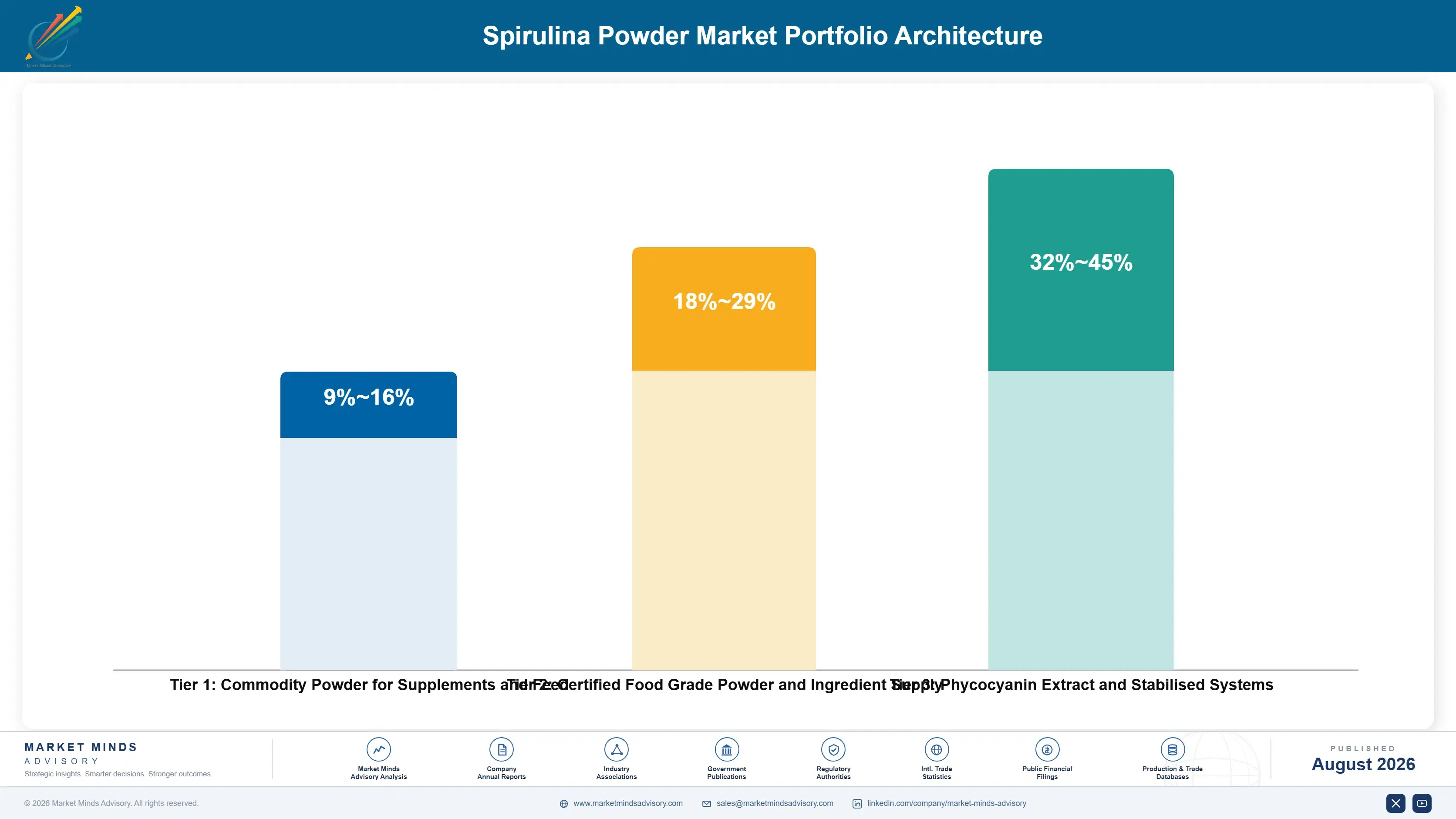
Margin here follows pigment retention and contamination documentation rather than cultivation efficiency. Commodity powder for supplements and feed earns margins in the high single digits to mid teens, because Chinese open pond output sets a delivered price floor and buyers compare protein content and price against a common specification at every renewal. Cultivation scale is the only lever available there.
Certified food grade powder and food ingredient supply do better in the high teens to high twenties, because batch level microcystin and heavy metal documentation excludes a substantial share of production and manufacturers are buying assurance alongside the material rather than simply buying biomass at the best price. Traceability documentation costs little and excludes a great deal of competing supply, which is an unusually efficient barrier.

Phycocyanin extract holds the strongest position, reaching into the mid forties, where pigment sells for roughly sixteen times the biomass it came from and application support decides supply rather than delivered cost. Those margins reflect drying discipline and formulation capability rather than any advantage in cultivation yield per hectare. Very few producers have built both the drying discipline and the formulation capability that position actually requires.

Commodity Powder for Supplements and Feed

Standard dried biomass sold on protein content and delivered price against Chinese open pond output. The seven point range reflects cultivation cost position and drying efficiency rather than any product quality difference buyers detect.
Gross Margin: 9-16%

Certified Food Grade Powder and Ingredient Supply

Batch tested material with microcystin and heavy metal documentation for food manufacturers. The eleven point range reflects testing discipline and traceability depth, both of which exclude a substantial share of open pond production entirely.
Gross Margin: 18-29%

Phycocyanin Extract and Stabilised Systems

Extracted pigment and stabilised colour systems sold into food formulation on performance rather than price. The thirteen point range reflects pigment retention through drying and whether the supplier offers stabilisation capability alongside supply.
Gross Margin: 32-45%
spirulina-powder-market-trends-portfolio-architecture-1787595343488

High-value Sub-segments and Strategic Watch-out

Phycocyanin Extract

High value and the fastest growth at 12.3% on synthetic blue removal across confectionery, dairy and beverage. Pigment sells for roughly sixteen times the biomass, and drying discipline rather than cultivation yield decides who can supply it. Application support decides supply rather than delivered price.
Gross Margin: 34-45%

Certified Food Ingredient Supply

High value and growing at 9.6% on clean label pressure reaching mainstream categories. Batch level contamination documentation excludes a large share of open pond production, which narrows the field considerably more than quality alone would. Manufacturers are buying assurance alongside the biomass itself. Documentation is the barrier.
Gross Margin: 20-29%

Commodity Supplement Powder

The volume core, where Chinese open pond output sets a delivered price floor and buyers compare protein content directly. There is no differentiation available and the protein argument has never worked commercially. Chinese cultivation scale sets the floor and holds it. Protein arguments have never worked.
Gross Margin: 9-16%

Contamination and Stability Exposure

The strategic watch-out. Microcystin incidents damage the whole category and pigment instability closes processed applications, and the range reflects how far a producer has invested in batch testing and formulation stabilisation work. One incident would damage every producer at once. Stability work remains unfinished across the industry.
Gross Margin: 5-40%

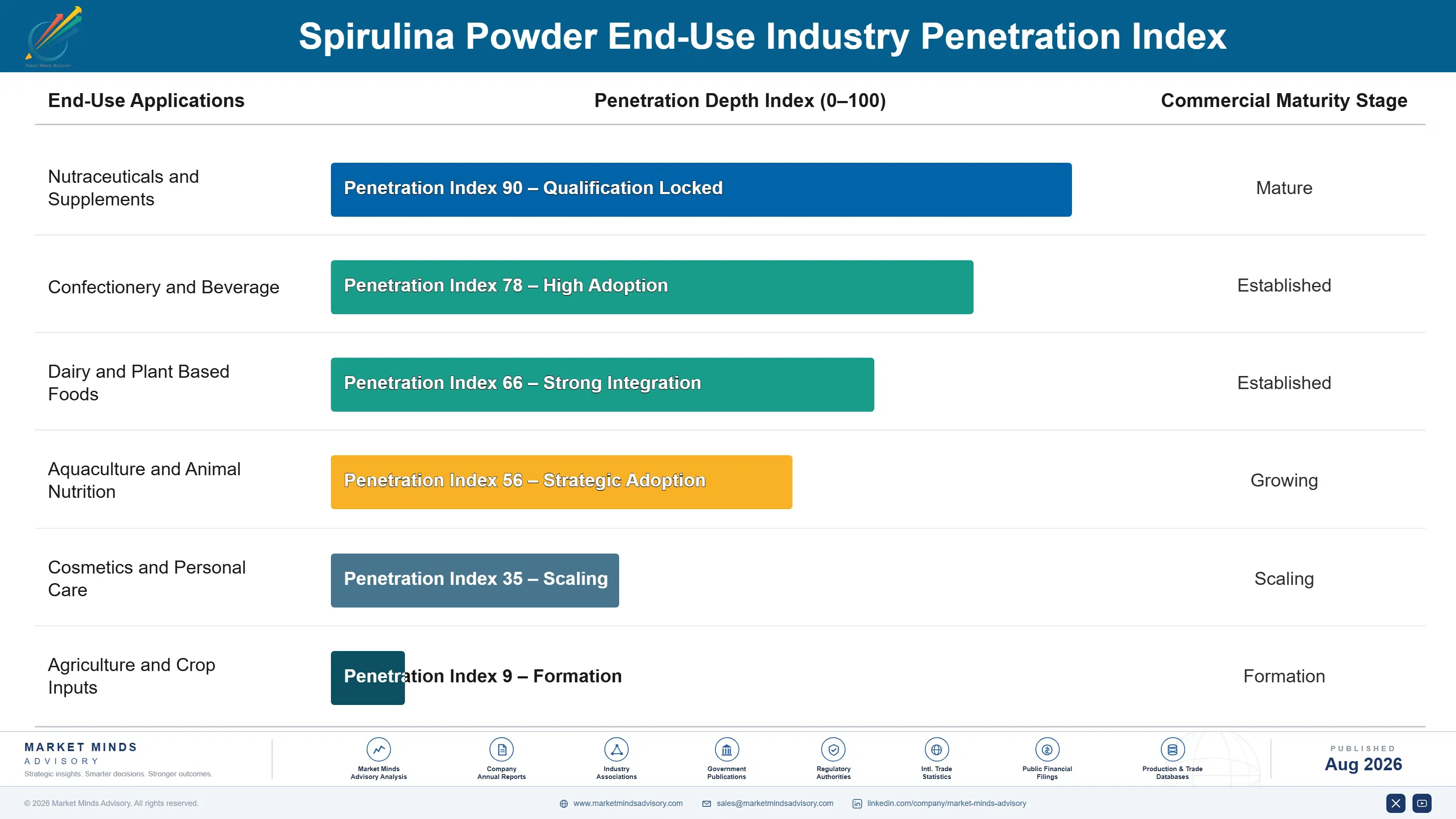
Two Buyers, Sixteen Times Apart

Demand here splits between buyers purchasing biomass and buyers purchasing a colour. A supplement brand compares protein content, certification and delivered price across interchangeable suppliers. A confectionery or beverage formulator replacing synthetic blue is solving a labelling problem and pays roughly sixteen times powder pricing for material that survives their process reliably. The two buyers share almost nothing beyond the raw material.
Stickiness follows that split precisely. Supplement supply switches on price at every renewal, since the material is genuinely comparable and Chinese output sets the floor. Colour supply holds for years, because a reformulated product line has been through shade matching, stability trials and consumer testing, and reopening the ingredient means repeating all of it for a saving that rarely justifies the work.

Deciding functions differ just as sharply. Supplement supply sits with purchasing and quality against a specification. Colour supply is decided by product development and food technology functions running reformulation programmes on multi-year cycles. A producer selling application data to a purchasing department, or a price list to a food technologist, is failing in both directions at once. Most producers in this industry are still doing exactly that.
spirulina-powder-market-trends-end-use-penetration-index-1787595343976

Where We Would Put Effort

These are among the four positions where our research anticipates prominent divergence between winners and laggards over the coming forecast period. Each is grounded in the demand model, the regulatory perimeter, and the announced capacity pipeline.
01 / PIGMENT RETENTION DISCIPLINE

The dryer decides what you actually sold

Phycocyanin degrades with heat, so a conventional spray dryer turns colour grade biomass into feed material before any customer ever sees it, whatever the pond actually yielded that season. Low temperature drying preserves pigment worth roughly sixteen times the powder price at capital and energy cost well below that gap. Growers optimising cultivation yield while drying conventionally are working hard at the cheap end of a process decided entirely at the expensive end, which nobody in the pond ever sees happen.
02 / CONTAMINATION TESTING INVESTMENT

Batch documentation is the entry ticket

Microcystin testing against thresholds near one part per billion separates food grade supply from feed grade, and the price difference between the two is several multiples rather than a matter of margin points. Batch level testing costs a small fraction of that gap and opens applications an untested producer cannot approach at all. It also protects against category level damage that a contamination incident would inflict on every producer regardless of who actually caused it or where it happened to originate.
03 / STABILITY FORMULATION WORK

Whoever solves heat holds it for years

Phycocyanin fails above roughly 60 degrees and under acidic conditions, which closes baked goods, retorted products and many beverages to a pigment that would otherwise replace synthetic blue across them. Encapsulation and protein complexing have shown partial success without anybody solving it properly yet. The required formulation investment is modest against the applications it would open, and the first supplier to solve it will hold that position for several years against competitors who hold no credible answer to it at all.
04 / FORMULATOR CHANNEL BUILDING

Stop selling protein to people buying colour

Supplement buyers compare protein content and delivered price, which is a contest Chinese open pond production wins and nobody else profits from at current cultivation costs. A confectionery or beverage formulator replacing synthetic blue pays roughly sixteen times powder pricing for material that performs through their process. Reaching them requires application data and stability trials rather than a specification sheet, and very few producers have built anything close to that capability, which is why the channel stays open to whoever builds it.

Engagement Snapshot From the Field

A live engagement with an industry participant carrying material or product regulatory and market exposure ahead of a defining policy shift, showing how our research translates into a defensible multi-year portfolio strategy.
MARKET MINDS ADVISORY · CLIENT ENGAGEMENT SUMMARY
Spirulina Powder Producer Strategic Portfolio Review and Transition Roadmap 2026·Investment Scenario on Spirulina Powder Exposure Evaluation 2025-26
CLIENT PROFILE
An Asian spirulina cultivation business operating open raceway ponds across roughly 40 hectares, selling dried powder into supplement and feed channels at annual revenue near 18 million dollars (client-reported, unverified by MMA). All output went through conventional spray drying, and no phycocyanin extraction capability existed anywhere in the operation. Contamination testing was conducted annually rather than by batch.
STRATEGIC CHALLENGE
Powder pricing had fallen for three consecutive years as Chinese cultivation capacity expanded, and the business was competing directly on cost against operations with genuine scale advantages it could not match. Management wanted to know whether expanding cultivation area or exiting the business entirely was the better option. A decision was needed within the season.
MMA APPROACH
MMA measured phycocyanin content across harvest batches before and after drying to quantify pigment loss, sized colour grade demand from confectionery and beverage reformulation programmes independently, assessed the client's contamination testing position against food grade requirements, and modelled low temperature drying economics against measured pigment retention. Interviews with 47 experts covered algae cultivation, natural colours and food formulation.
KEY FINDINGS
  1. Conventional spray drying was destroying most of the phycocyanin the ponds actually produced, converting colour grade biomass into commodity powder before any customer saw it.
  2. Colour grade material from the same ponds would have sold at roughly sixteen times the powder price, against low temperature drying costs a fraction of that difference.
  3. Contamination testing was conducted annually rather than by batch, which excluded the business from food grade supply regardless of the actual quality of its output.
  4. Expanding cultivation area would have deepened exposure to exactly the commodity pricing contest the business was already losing to larger Chinese operations.
CLIENT PROFILE
An Asian spirulina cultivation business operating open raceway ponds across roughly 40 hectares, selling dried powder into supplement and feed channels at annual revenue near 18 million dollars (client-reported, unverified by MMA). All output went through conventional spray drying, and no phycocyanin extraction capability existed anywhere in the operation. Contamination testing was conducted annually rather than by batch.
STRATEGIC CHALLENGE
Powder pricing had fallen for three consecutive years as Chinese cultivation capacity expanded, and the business was competing directly on cost against operations with genuine scale advantages it could not match. Management wanted to know whether expanding cultivation area or exiting the business entirely was the better option. A decision was needed within the season.
MMA APPROACH
MMA measured phycocyanin content across harvest batches before and after drying to quantify pigment loss, sized colour grade demand from confectionery and beverage reformulation programmes independently, assessed the client's contamination testing position against food grade requirements, and modelled low temperature drying economics against measured pigment retention. Interviews with 47 experts covered algae cultivation, natural colours and food formulation.
KEY FINDINGS
  1. Conventional spray drying was destroying most of the phycocyanin the ponds actually produced, converting colour grade biomass into commodity powder before any customer saw it.
  2. Colour grade material from the same ponds would have sold at roughly sixteen times the powder price, against low temperature drying costs a fraction of that difference.
  3. Contamination testing was conducted annually rather than by batch, which excluded the business from food grade supply regardless of the actual quality of its output.
  4. Expanding cultivation area would have deepened exposure to exactly the commodity pricing contest the business was already losing to larger Chinese operations.
RECOMMENDED STRATEGY
Phase 1: Phase one: install low temperature drying capacity for high pigment batches, since the value gap far exceeds the capital and energy cost involved. Phase 2: Phase two: move contamination testing to batch level documentation, which opens food grade applications the current output is excluded from entirely. Phase 3: Phase three: build application support capability to reach food formulators directly rather than selling powder into supplement channels. Stability data replaces the price list.
OUTCOME
The producer commissioned low temperature drying during 2026 and began batch level contamination testing, reporting first colour grade sales at multiples of previous powder pricing (client-reported, unverified by MMA). Cultivation area was held unchanged rather than expanded. Powder volumes were redirected toward the higher value channel across two harvests.

Frequently Asked Questions

Foundational context covering the market sizes, CAGR, scope, country, region and competition that inform every finding below. This section is provided to cover basics and most often pre-purchase conversations, answered from the MMA Primary Research Dataset.

What is the current size of the Spirulina Powder Market?

MMA sizes it at USD 0.48 billion in 2025, rising to USD 0.52 billion in 2026. The figure covers dried spirulina biomass and primary derivatives at producer selling value.

How large will the Spirulina Powder Market be by 2036?

USD 1.14 billion by 2036, an incremental USD 0.62 billion over the 2026 base and an expansion multiple of 2.19 times. Phycocyanin extraction accounts for a disproportionate share.

What is the CAGR for the Spirulina Powder Market 2026 to 2036?

8.2% in the base case, with a bull case at 9.4% and a bear case at 7.0%. The spread turns on pigment stability improvements against contamination incident risk across the category.

Which segment is growing fastest?

Natural colourant and phycocyanin extraction at 12.3%, half again the market rate of 8.2%. Confectionery, dairy and beverage manufacturers are removing synthetic blue colours from mainstream portfolios.

Who are the major companies in the Spirulina Powder Market?

DIC Corporation, Cyanotech, Parry Nutraceuticals, Far East Bio-Tec and Yunnan Green A Biological Project lead on biomass production. Fifteen further participants are profiled in the full report.

Which country is growing fastest?

India at 13.6%, with Tamil Nadu cultivation capacity expanding alongside domestic supplement consumption rising steadily from a comparatively modest starting base. Domestic demand absorbs a rising share of that output.

Report Segmentation Architecture

The full report scope spans multiple orthogonal segmentation dimensions, with cross-tabulated demand data provided for each dimension pair. Coverage extends further to regional breakdowns, trend trajectories, and the competitive detail needed to support segment-level decision-making.

By Application

  • Dietary Supplements
  • Natural Colourant and Phycocyanin Extraction
  • Food and Beverage Ingredient
  • Animal Feed and Aquaculture
  • Cosmetics and Personal Care
  • Agricultural Biostimulants

By End-Use Industry

  • Nutraceuticals and Supplements
  • Confectionery and Beverage
  • Dairy and Plant Based Foods
  • Aquaculture and Animal Nutrition
  • Cosmetics and Personal Care
  • Agriculture and Crop Inputs

By Commercial Dimension

  • Direct Manufacturer Supply
  • Ingredient Distributor Channels
  • Private Label Supplement Supply
  • Certified Food Grade Contracts
  • Contract Cultivation Arrangements
  • Export and Cross-Border Supply

By Region

  • North America
  • Western Europe
  • East Asia
  • South Asia and Pacific
  • Latin America
  • Middle East and Africa
  • Eastern Europe

Scope, Methodology, and Coverage

Every figure in this report is reproducible from documented input assumptions. The scope below maps the historical period, the forecast horizon, the segmentation dimensions, and the countries covered, alongside the underlying primary and qualitative methodology.
Historical Period
2020 to 2025
Forecast Period
2026 to 2036
Base Year
2025 (USD billions; MMA Primary Research Dataset, August 2026)
Market Definition
Spirulina biomass produced as dried powder and its primary derivatives, covering dietary supplements, natural colourant and phycocyanin extraction, food and beverage ingredient use, animal feed and aquaculture, cosmetics and personal care, and agricultural biostimulants. Measured at producer selling value across open pond and photobioreactor cultivation. Chlorella and other microalgae, astaxanthin from Haematococcus, finished supplement brands, and cultivation equipment or engineering services are excluded from scope.
Quantitative Units
USD billions (current prices); thousand tonnes dried biomass; USD per kilogram by grade
Segmentation Dimensions
Application; end-use industry; commercial dimension; region
Regions Covered
North America, Western Europe, East Asia, South Asia and Pacific, Latin America, Middle East and Africa, Eastern Europe
Countries Covered
United States, Canada, Mexico, Germany, France, Italy, Spain, Netherlands, China, Japan, South Korea, India, Thailand, Australia, Brazil, Chile, Turkey, South Africa, Poland, Hungary
Key Companies Profiled
DIC Corporation, Cyanotech, Parry Nutraceuticals, Far East Bio-Tec, Yunnan Green A Biological Project, Hydrolina Biotech, Sochim International, Prolgae Spirulina Supplies, Algene Biotechnologies, Antenna Technologies, Fuqing King Dnarmsa Spirulina, Shandong Binzhou Tianjian, Inner Mongolia Rejuve Biotech, BlueBioTech, Necton, Allmicroalgae, Tianjin Norland Biotech, Zhejiang Binmei Biotechnology, Japan Algae, Nutrex Hawaii
Quantitative Methodology
Primary survey, n=3,800 respondents, Q4 2025, six countries; demand-side model with trade association cross-validation
Qualitative Methodology
47 expert interviews, Q4 2025; applied to validate demand model assumptions, identify emerging dynamics, and assess competitive positioning
Report Format
PDF and XLSX data workbook (Word format preview document)
Publisher
Market Minds Advisory
Report Code
MMA-2026-AGR-189
Published
August 2026
Contact
sales@marketmindsadvisory.com | www.marketmindsadvisory.com

Purchase the full Spirulina Powder Market Report (2026 to 2036).

The full report treats phycocyanin as the commercial centre of this market rather than protein content, because the pigment is worth roughly sixteen times the biomass it comes from. It sizes all six applications independently through 2036, models pigment retention economics across drying routes, and quantifies how contamination testing discipline divides food grade from feed grade supply. Regional chapters cover all seven regions with cultivation capacity assessed separately from value captured. Competitive profiling covers 20 participants on one consistent biomass production basis. Drying route economics are modelled by grade throughout.
Six applications sized independently through 2036 with growth drivers
Pigment retention economics modelled across alternative drying routes
Contamination testing discipline assessed by producer and region
Phycocyanin stability constraints mapped against addressable food applications
Twenty participants profiled on one consistent biomass production basis
Cultivation cost curves compared across open pond and photobioreactor systems

Built For The People Who Decide

From boardroom strategy to bench-side execution, this report is read cover-to-cover by leaders shaping the next decade of their industry, turning demand scenarios, market dynamics and valuation benchmarks into decisions.
CXOs/ Presidents/ VPs/ Managers
M&A and Corporate Development
Strategy Teams and R&D Heads
Procurement and Product Directors
Regulatory and Compliance Leaders
Investor Relations and Equity Analysts