Market Minds Advisory
Spine Pain Industry

Spine Pain Industry: Imaging That Explains Nothing, Procedures That Work Sometimes and a Payer Losing Patience

Most people with disabling back pain have imaging that looks the same as people with none, which is why this industry keeps selling procedures that work for some patients and nobody can predict which.

Lead Analyst

Alice Ballenger

Published

September 2026

Make Smarter Decisions with Customized Research Insights

Request a free sample report and evaluate market opportunities, growth trends, and competitive dynamics relevant to your business needs.

2025 MARKET VALUE$14.6BMarket Size 2025
2036 FORECAST VALUE$33.0BBase Case , 2026 to 2036
CAGR 2026 TO 20367.7 %Bull 9.0% / Bear 6.4%
INCREMENTAL OPPORTUNITY$17.3BNet 10- year value creation
EXPANSION MULTIPLE2.10x2036 value over 2026 base
Strategic Levers
M&A Pipeline
Regional Outlook
Country Rankings
Competitive Intelligence
Segmental Deep-dive
Call-Us : 91 93563 13602

Executive Snapshot and Market Trajectory

Chronic spine pain is the largest cause of disability on earth and the least explained. Degenerative changes on imaging correlate poorly with symptoms, so the industry treats a complaint rather than a lesion, and the honest response rate for almost every intervention sits well under what marketing implies.
Basivertebral and radiofrequency ablation systems compound at 11.55%, exactly 1.50 times the market, because they target an identifiable pain generator rather than a structure that merely looks abnormal. East Asia holds 30% of spend on procedure volumes and expanding interventional capacity. Payers now demand documented conservative care first. Roughly 24% of interventional requests are refused on first submission, and 12 weeks of documented conservative care is now a standard precondition.
Five companies hold 47%. What separates them is evidence quality and patient selection support, since a payer refusing to fund a procedure removes revenue regardless of the device. Response rates near 58% are the honest number, and pretending otherwise is what invited the prior authorisation regime. Volume is redistributing toward categories that can document a responder. Every category that cannot is losing ground to utilisation management rather than to any competing device or manufacturer.
Market Definition
The market covers devices, implants and interventional systems used to treat chronic spine pain, spanning epidural and facet injection systems, radiofrequency and basivertebral nerve ablation, spinal cord and dorsal root ganglion stimulation, interspinous and minimally invasive decompression devices, vertebral augmentation systems, and interventional disc therapies. Instrumented spinal fusion for deformity and instability, spine surgical navigation and robotics, diagnostic imaging equipment, and oral analgesic pharmacotherapy are excluded.
Base Year Value
$14.6B in 2025 (MMA Primary Research Dataset, August 2026)
Forecast Period
2026 to 2036, eleven discrete annual values
CAGR
7.7% base case. Bull 9.0%. Bear 6.4%.
Fastest Growth Segment
Basivertebral and Radiofrequency Ablation Systems: 11.6% CAGR
Fastest Growth Country
China: 10.4% CAGR
Fastest Growth Region
South Asia and Pacific: 9.8% CAGR
Largest Region
North America: 30% of 2025 global value
Market Leaders
Medtronic, Boston Scientific, Abbott, Stryker, Relievant Medsystems. Source: MMA Analysis based on company annual reports.
Primary Survey
n=3,800 procurement and R&D decision-makers, Q4 2025, six countries
Methodology
Demand-side build-up, cross-validated against public data, 47 expert interviews

Spine Pain Industry Market Forecast Scenarios

spine-pain-industry-size-forecast-scenario-1787309303968
Growth of 6.5% across 2020 to 2025 was shaped by two forces pushing opposite ways. Elective deferral through 2020 removed a year of volume, and the recovery brought strong demand as patients who had waited presented worse. Against that, coverage policy tightened on epidural steroid injections in several large systems, and the opioid decline pushed patients toward interventions payers had not planned to fund.
The base case of 7.6% rests on three mechanisms. Closed-loop stimulation has given the implant segment its first genuine efficacy differentiation in a decade, which supports pricing and improves the trial conversion that determines revenue. Radiofrequency ablation keeps expanding into new targets, with basivertebral nerve ablation establishing a procedure that did not exist commercially five years ago. And regenerative injection demand keeps growing on patient willingness to pay directly, entirely outside any coverage framework.
The bull case of 8.8% assumes closed-loop stimulation evidence converts payers toward earlier implantation in the care pathway, which would move a large population from repeated injections into devices costing fifty times as much. The bear case of 6.4% reflects the familiar opposite: coverage restriction on injections and stimulation together, driven by revision rates near 22% and unkind comparative effectiveness evidence.

Treating Pain Without a Visible Cause

The central problem is diagnostic rather than technical. Disc degeneration, facet arthropathy and endplate changes appear on imaging in large numbers of people with no pain at all, and imaging matches the symptomatic level in only around 31% of cases. That means an interventionalist is frequently treating a plausible target rather than a proven one, and the response rate reflects it.
TOP FIVE CONCENTRATION47%Combined share held by the five largest device manufacturers globally
IMAGING CONCORDANCE31%Share of cases where imaging findings match the symptomatic level
MEANINGFUL RESPONSE RATE58%Proportion reporting clinically important relief across interventional categories
PRIOR AUTHORISATION DENIAL24% of requestsShare of interventional requests refused on first submission
CONSERVATIVE CARE REQUIREMENT12 weeksDocumented non-interventional management that payers demand before approving
REPEAT INTERVENTION RATE37% within two yearsPatients returning for further procedural treatment after initial therapy
Roughly 58% of patients report clinically meaningful relief across the interventional categories, which is a respectable figure for a condition this poorly understood and a poor one against how these procedures have historically been promoted. Payers noticed the gap. Prior authorisation now refuses about 24% of interventional requests on first submission, and 12 weeks of documented conservative care is a standard precondition. The gap invited the scrutiny.
What is changing is targeting. Basivertebral nerve ablation addresses a specific nerve carrying vertebrogenic pain, identified on a defined imaging finding, which is a fundamentally different proposition from injecting a joint that looks worn. That segment compounds at 11.55% because it can name its patient. Every category that cannot is losing ground to prior authorisation rather than to a competitor.
"The industry spent twenty years selling procedures on mechanism plausibility and imaging findings, and payers eventually read the trials. The categories that can identify their responder are growing. The rest are arguing with utilisation management."
Director, Interventional Pain and Spine Practice · MMA Interventional Pain Manag

Market Trends

Targeted Ablation Displaces Injections on Patient Selection

Basivertebral nerve ablation treats vertebrogenic pain identified by a specific endplate imaging finding, and radiofrequency ablation of medial branch nerves follows a diagnostic block that confirms the target before treatment. Both can name their responder, which epidural and facet injections largely cannot when imaging matches the symptomatic level in only around 31% of cases. The category compounds at 11.55% against a market at 7.7%, and the advantage is diagnostic discipline rather than any technological superiority. Payers refuse roughly 24% of interventional requests on first submission, and diagnostic discipline is what clears that hurdle.
Market Impact: Repeat treatment reaching 37% share

Prior Authorisation Reshapes Which Procedures Get Performed

Payers now refuse roughly 24% of interventional requests on first submission and require 12 weeks of documented conservative care beforehand, which has changed practice more than any clinical development. Procedures with randomised evidence and defined selection criteria clear authorisation; those justified on mechanism plausibility increasingly do not. The effect is to concentrate volume into categories that can document a responder, and to push practices toward administrative capability they never previously needed. Practices have had to build administrative capability they never previously needed, and much of the denial rate is documentation failure rather than genuine clinical disagreement about the patient.
Market Impact: Relief achieved in 58% of patients

Market Opportunities and Growth Drivers

Ageing Populations Enlarge the Symptomatic Denominator Relentlessly

Degenerative spine change accumulates with age in essentially everybody, and while imaging findings correlate poorly with pain, the symptomatic population still grows steadily as populations age across every developed and middle-income market. No intervention reduces that denominator. Roughly 37% of treated patients return for further procedural treatment within two years, which means the population under management compounds rather than clearing, and the industry serves a growing chronic caseload rather than a curable one. Interventions relieve pain rather than resolving pathology, so the managed caseload compounds rather than clearing. The industry serves a growing chronic caseload.
Market Impact: Concordance limited to 31% cases

Neuromodulation Advances Improve Durability of Relief

Closed-loop spinal cord stimulation adjusts output against measured spinal cord response rather than delivering fixed stimulation, and dorsal root ganglion targeting reaches focal neuropathic pain that conventional stimulation missed. Both address the durability problem that undermined earlier neuromodulation, where initial relief faded within months. Better durability improves the health economic case materially, which is what payers actually assess, and it separates neuromodulation from the injection categories now struggling with authorisation. Trial stimulation before permanent implant also gives both clinician and payer an objective response measure, which is the closest thing this industry has to a responder test anywhere.
Market Impact: Conservative care requiring 12 week

Market Restraints and Challenges

Imaging Cannot Identify Which Patient Will Respond

Degenerative findings appear in large numbers of asymptomatic people and match the symptomatic level in only around 31% of cases, so patient selection rests on clinical judgement rather than objective targeting. The root cause is that anatomical change and pain are only loosely related in the spine. Manufacturers mitigate by supporting diagnostic block protocols, funding responder-identification research and building selection criteria into their evidence packages, which is what distinguishes the growing categories from the contracting ones. That distinction separates the growing categories from the contracting ones. Selection capability is the whole differentiator now.
Market Impact: Concordance reaching only 31% overa

Utilisation Management Refuses Procedures Before They Happen

Roughly 24% of interventional requests are denied on first submission and 12 weeks of documented conservative care is required first, which removes revenue before any device is opened. The root cause is a historical gap between promoted and demonstrated benefit that payers eventually quantified. Manufacturers mitigate by funding randomised trials with hard endpoints, by supplying authorisation documentation support to practices, and by pursuing guideline inclusion rather than contesting individual denials. Guideline inclusion changes the default for every subsequent submission across a health system, which is worth considerably more than winning individual appeals.
Market Impact: Denials running 24% first submissio
3 additional market trends, 4 additional growth drivers, and 2 additional restraints and challenges are covered in the full report. Contact sales@marketmindsadvisory.com to access the complete intelligence.

Segment CAGR and Growth Architecture

Segmentation follows intervention mechanism, because each addresses a different presumed pain generator: an inflamed nerve root, a facet joint, a vertebral endplate, or the transmission pathway itself. A clinician choosing between them is choosing which hypothesis about the patient's pain to act on first. Six mechanisms sit in the hierarchy, separated by target rather than by anatomical region treated.
spine-pain-industry-market-share-analysis-1787309304525

Basivertebral and Radiofrequency Ablation Systems

Ablation systems compound at 11.55%, exactly 1.50 times the market, and the reason is patient selection rather than technology. Basivertebral nerve ablation treats vertebrogenic pain identified by a specific endplate imaging finding, and medial branch radiofrequency follows a diagnostic block that confirms the target before anything is destroyed. Both can therefore name their responder in a field where imaging matches the symptomatic level in only around 31% of cases. That diagnostic discipline is exactly what clears prior authorisation, where roughly 24% of interventional requests are refused on first submission. The clinical effect is durable relief lasting years rather than months, which improves the health economic case that payers actually assess rather than the mechanism story they no longer accept.
CAGR 11.6%

Spinal Cord and Dorsal Root Ganglion Stimulation

Neuromodulation grows at 10.0% on closed-loop systems that adjust output against measured spinal cord response and on dorsal root ganglion targeting that reaches focal neuropathic pain conventional stimulation missed. Both address the durability failure that undermined earlier generations, where good initial relief faded within months and left patients with an implant and no benefit. Device cost is the highest in the field by a wide margin, which makes the health economic argument unavoidable rather than optional, and trial stimulation periods give both clinician and payer an objective response measure before permanent implantation. That trial step is the closest thing this industry has to a responder test. Neuromodulation has consequently fared considerably better under utilisation management than the injection categories have.
CAGR 10.0%
Full segment breakdown across 6 segments available in the complete report.

Regional Architecture and Country Demand Map

Demand follows interventional pain capacity and reimbursement structure rather than back pain prevalence, which is broadly universal. Where procedures are funded and trained interventionalists practise determines almost all of the variation. East Asia and North America lead for entirely different reasons. Access expansion and established procedure rates respectively.

East Asia

East Asia holds 30% of spend, level with North America, growing at 8.7%. Chinese interventional pain capacity has expanded rapidly from a base where most patients received oral analgesia and nothing else, and China compounds at 10.4%, the fastest national market. Japanese practice is conservative and well evidenced, with neuromodulation adoption slower than device makers would like and injection use correspondingly higher. Korean interventional volumes are high relative to population and reimbursement is comparatively permissive. Regional procedure growth is genuine expansion of access rather than substitution between categories, which makes it the most attractive volume in the industry. Provincial programmes funding training and equipment at secondary hospitals are what convert prevalence into procedures.
Share: 30% | CAGR: 8.7% (2026 to 2036)

North America

North America accounts for 30% of spend and grows at 7.4%. The region has by far the highest procedure rate per capita and the most developed interventional pain speciality, and it is also where utilisation management has advanced furthest, refusing roughly 24% of requests on first submission and requiring 12 weeks of documented conservative care. Those two facts are related: high historical volumes on thin evidence invited the scrutiny. Neuromodulation and targeted ablation clear authorisation considerably better than injections, which is redistributing volume within the region rather than reducing it. Documentation capability inside a practice has become as commercially significant as clinical skill, since much of the denial rate reflects paperwork rather than clinical disagreement.
Share: 30% | CAGR: 7.4% (2026 to 2036)
Regional intelligence for 5 additional markets available in the complete report: Western Europe, South Asia and Pacific, Latin America, Middle East and Africa, Eastern Europe. Contact sales@marketmindsadvisory.com.
spine-pain-industry-country-cagr-analysis-1787309305035

Naming the Responder Before the Payer Asks

This industry lost the argument about mechanism plausibility and is now judged on whether it can identify who will benefit. Four positions matter, and every one of them is about evidence and selection rather than about device performance. Two concern evidence, one concerns practice administration, and one concerns where the uncontested volume actually is.

Build Responder Identification Into the Evidence Package

Imaging matches the symptomatic level in only around 31% of cases, so a procedure that cannot name its responder is arguing from mechanism alone, which payers stopped accepting. Manufacturers who fund diagnostic block protocols, endplate finding criteria or trial stimulation periods give clinicians and payers an objective selection step. That is precisely why ablation compounds at 11.55% while injection categories contest denials, and the capability transfers across every subsequent product launch. That capability transfers across every subsequent product launch a manufacturer makes. Ablation compounds at 11.55% for exactly this reason while injection categories contest denials.
Market Impact: Concordance limited to 31% of all i

Supply Authorisation Documentation Support to Practices

Roughly 24% of interventional requests are refused on first submission, and much of that is documentation failure rather than genuine clinical disagreement, since practices were never built to run utilisation management processes. Manufacturers who supply submission templates, conservative care documentation tools and appeal support convert denied procedures into approved ones. The revenue recovered is immediate and the switching cost this creates for the practice is considerable, which makes it unusually durable. Around 61% of denials are documentation deficiencies rather than clinical disputes, and most of those are overturned on appeal at considerable administrative cost.
Market Impact: Recovering revenue from that 24% fi

Pursue Guideline Inclusion Rather Than Individual Appeals

Contesting denials one at a time is expensive and reversible, while guideline inclusion changes the default for every submission across a health system. Randomised evidence with hard endpoints and defined selection criteria is what achieves it, and the categories that have invested there are the ones clearing 12 week conservative care requirements without difficulty. Guideline language outlasts any utilisation management contract and it applies to competitors' products too, which is the honest trade-off. Randomised evidence with hard endpoints is the only route to it. Categories that invested there now clear the 12 week requirement routinely.
Market Impact: Clearing 12 week documented conserv

Target Asian Access Expansion Rather Than Developed Substitution

Chinese, Indian and Southeast Asian interventional capacity is expanding from a base where most patients received oral analgesia and nothing procedural, which is genuine new volume rather than share taken from another category. China compounds at 10.4% and East Asia already holds 30% of spend. Device pricing is considerably lower, so unit growth exceeds value growth, but the volume is uncontested by utilisation management in a way developed market volume no longer is. Utilisation management does not yet apply to most of that volume at all. East Asia already holds 30% of global spend on that basis.
Market Impact: China compounding at 10.4% in every

Who Controls the Margin Pool

Five manufacturers hold 47% measured on interventional spine pain device revenue, the basis used throughout this section. Medtronic, Boston Scientific and Abbott lead on neuromodulation, where device value per patient is highest and health economic evidence is most developed. The gap to the challenger group is narrow on injection and radiofrequency hardware and considerably wider on implantable systems.
Competition operates on three dimensions. Randomised evidence quality decides which procedures clear prior authorisation at all. Responder identification capability decides whether a clinician can select patients rather than guess. And practice-level administrative support decides how much approved volume actually converts, given documentation failure drives much of the 24% denial rate. Device performance decides remarkably little of it.

Two pressures are moving position. Utilisation management keeps concentrating volume into evidence-backed categories, which favours neuromodulation and targeted ablation and steadily erodes injection-led businesses. Meanwhile Asian access expansion offers uncontested volume at lower price. Rankings will shift toward manufacturers holding both evidence depth and genuine emerging market presence. The manufacturers who invested in randomised evidence a decade ago are the ones now clearing authorisation, and that lead cannot be closed quickly by anybody who did not.
spine-pain-industry-company-positioning-matrix-1787309305551

Competitive Moat and Risk Dimensions

MEDTRONIC

Moat: Neuromodulation evidence and installed base

Medtronic holds the longest neuromodulation evidence base and the largest installed base of implanted systems, which generates replacement and revision revenue independent of new patient acquisition. Closed-loop capability and the health economic data behind it clear utilisation management where injection categories increasingly cannot, and that evidence took decades and considerable capital to assemble.
MEDTRONIC

Risk: Targeted ablation category shift

Basivertebral ablation compounds at 11.55% by identifying its responder from a defined imaging finding at a fraction of neuromodulation device cost, and it treats a population that would otherwise have progressed toward an implant. A cheaper procedure with a cleaner selection criterion competing for the same patient is a genuine threat to implant volume rather than an adjacent opportunity.
BOSTON SCIENTIFIC

Moat: Waveform and programming breadth

Boston Scientific offers the widest range of stimulation waveforms and programming approaches, which matters because response to neuromodulation varies between patients in ways nobody can predict beforehand. Trial stimulation with multiple available waveforms improves the proportion of patients who convert to permanent implant, and that conversion rate is the operative commercial metric in the category.
BOSTON SCIENTIFIC

Risk: Health economic scrutiny intensity

Neuromodulation carries the highest device cost in the field, which makes it the most exposed position whenever a payer reassesses value. With meaningful response rates near 58% across interventional care generally, an implant priced an order of magnitude above an ablation catheter has to demonstrate a durability advantage continuously rather than once at approval.

Players Tracked

Prominent Players

Medtronic
Boston Scientific
Abbott
Stryker
Relievant Medsystems

Other Key Players

Nevro
Saluda Medical
Avanos Medical
Stimwave Technologies
Nuvectra
Vertos Medical
SpineThera
Merit Medical Systems
Teleflex
Cook Medical
Elliquence
Diros Technology
Neurotherm
Shanghai MicroPort
Sanyou Medical

Recent Developments

FEBRUARY 2025

Payers extend conservative care documentation across interventional categories

Utilisation management programmes broadened twelve week documented conservative care requirements from injection procedures to cover most interventional spine pain categories. These were payer policy decisions rather than regulatory actions or commercial developments among device manufacturers themselves. Practices absorbed the administrative burden with no additional reimbursement for it.
Signal: A documentation requirement removes revenu
JUNE 2025

Basivertebral ablation gains guideline positioning on randomised evidence

Clinical guidance bodies positioned basivertebral nerve ablation for vertebrogenic pain identified by defined endplate imaging findings, citing randomised trial results with multi-year follow-up. These were guideline decisions rather than regulatory approvals or transactions among the companies involved. Multi-year follow-up data was what distinguished it from earlier interventional claims.
Signal: A procedure able to name its responder cle
OCTOBER 2025

Chinese interventional pain capacity expands under provincial programmes

Provincial health programmes across China funded interventional pain training and equipment at secondary hospitals, extending procedural access to populations previously managed with oral analgesia alone. These were public health investment decisions rather than corporate developments among device suppliers. Equipment purchases followed the training programmes at provincial level.
Signal: Access expansion produces uncontested volu

Implant Components, Trials and Sales Coverage

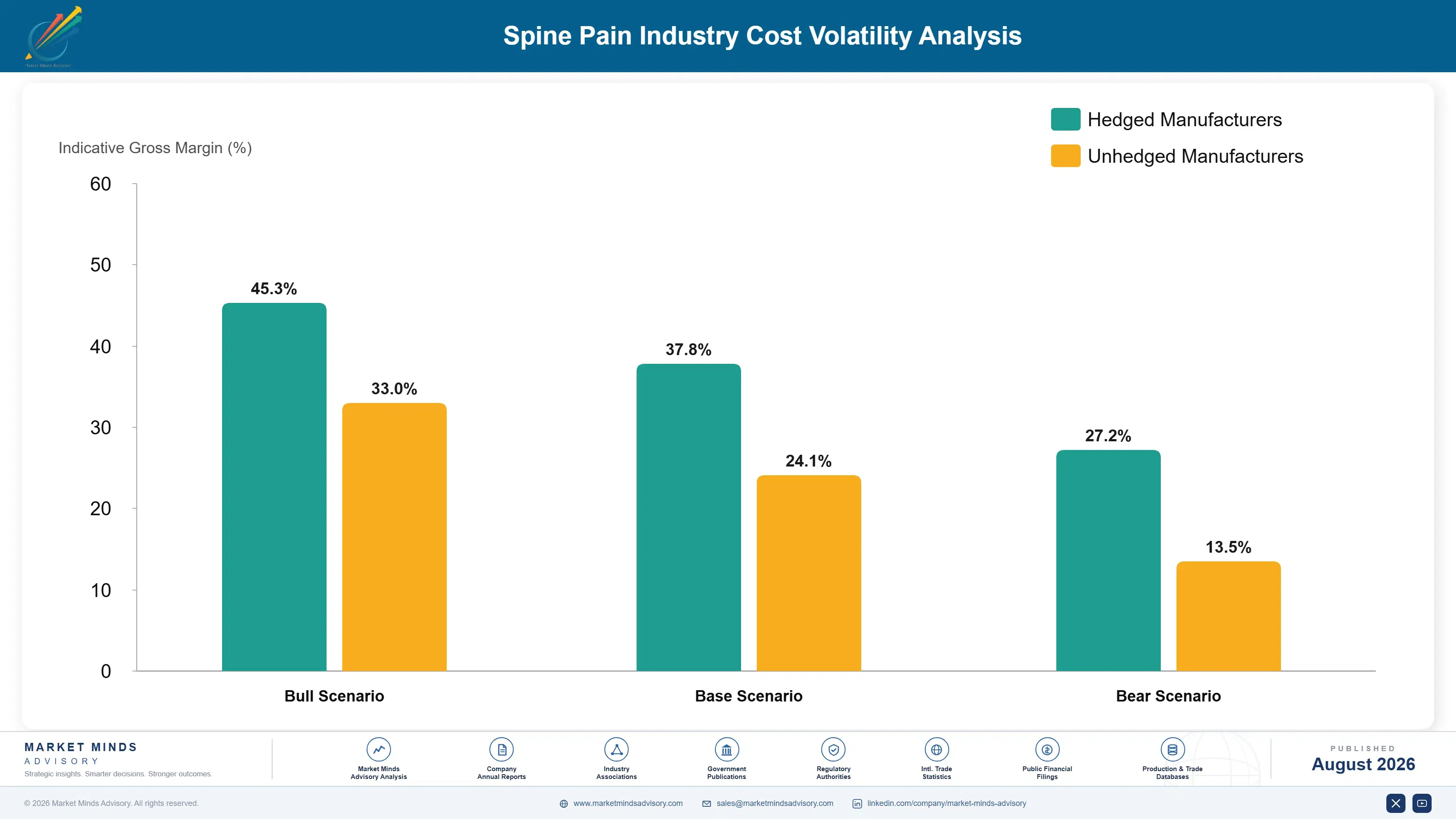
Implantable pulse generators, leads and electronics account for roughly 29% of cost of goods for neuromodulation systems, with battery cells, hermetic packaging and sterilisation dominating that figure. Radiofrequency and ablation consumables carry considerably lower material cost. The larger economic burden sits outside cost of goods entirely, in randomised trials with multi-year follow-up and in the field clinical support these procedures require.
Electronic component and battery cell supply tightened through 2021 and 2022, and implantable device manufacturers carried it worst because component substitution requires regulatory change control rather than a purchasing decision. Company annual reports across the neuromodulation manufacturers disclose the resulting cost per unit pressure and backlog effects. Energy Information Administration data on industrial input pricing documents the underlying commodity movement across the period. Substitution requires a regulatory filing rather than a purchase order.

Exposure divides by product architecture rather than by scale. Implant manufacturers carry component, battery and regulatory change control cost against device prices under continuous payer scrutiny. Ablation and injection suppliers carry modest consumable cost and face the harder problem of prior authorisation instead. Field clinical support is the largest controllable cost for implant businesses and it scales with procedures rather than with revenue.
spine-pain-industry-cost-volatility-analysis-1787309305746

Qualify alternate electronic components under change control early

Implantable component substitution requires regulatory change control, which cannot be completed inside a supply disruption. Qualifying second-source electronics and battery cells during initial design, rather than when supply tightens, preserves the option to substitute without a filing that takes longer than the shortage itself lasts. Very few manufacturers hold a qualified second source across both.

Scale field clinical support against procedure volume not revenue

Field clinical specialists attend trials, implants and programming sessions, so the cost scales with procedures rather than with the revenue those procedures generate. Staffing against procedure forecasts rather than sales targets prevents the persistent over-resourcing that appears whenever a high-value implant business expands into lower-value ablation work. Procedure and revenue forecasts diverge sharply whenever the mix shifts.

Fund randomised evidence as market access not research spend

Randomised trials with hard endpoints and multi-year follow-up are what clear prior authorisation and achieve guideline inclusion, which makes them a market access investment rather than a scientific one. Budgeting them accordingly keeps the spend protected when commercial reviews cut research lines, and it aligns trial design with the questions payers actually ask. Payers ask different questions from journals.

Portfolio Architecture for Margin Defence

The portfolio separates on whether the responder can be identified. Epidural and facet injections rest on mechanism plausibility and imaging findings that match symptoms in only around 31% of cases. Radiofrequency and basivertebral ablation follow a confirming diagnostic step. Neuromodulation offers trial stimulation before permanent implant. Vertebral augmentation and decompression devices address defined anatomical problems with clearer indications. Selection capability rather than mechanism i
The tension runs between procedure volume and evidence strength. Injections carry the largest procedure numbers and the weakest evidence, which is why they generate revenue today and lose ground to utilisation management every year. Ablation and neuromodulation carry better evidence at lower volume and higher value per patient. A manufacturer weighted toward injections is running a business the payers are actively dismantling.

High-value pools concentrate where a selection step exists. Basivertebral and radiofrequency ablation, closed-loop neuromodulation and any position supported by randomised evidence with defined criteria all qualify, and none of them competes on mechanism plausibility any longer. What they share is an objective step that identifies the patient before treatment, which is the only argument utilisation management now accepts from anybody in this industry.

Volume / Commodity-Adjacent Tier

Epidural and facet injection systems, needles and consumables sold on price into high procedure volumes. Evidence rests on mechanism plausibility, utilisation management is tightening steadily, and no manufacturer holds meaningful differentiation in the hardware.
Gross Margin: 24-36%

Premium / Certified Tier

Radiofrequency and basivertebral ablation systems supported by a confirming diagnostic step and randomised evidence. Guideline positioning and defined selection criteria qualify the supplier, and reusable generators create durable consumable revenue streams.
Gross Margin: 48-62%

Sustainability / Regulatory / Next-Generation Tier

Closed-loop spinal cord and dorsal root ganglion stimulation systems with measured response feedback. The wide margin range separates established implant franchises with health economic evidence from newer entrants still funding the trials payers demand.
Gross Margin: 52-74%
spine-pain-industry-portfolio-architecture-1787309306246

High-value Sub-segments and Strategic Watch-out

Basivertebral and Radiofrequency Ablation

Compounding at 11.55% because a confirming diagnostic step lets these procedures name their responder, which is what clears prior authorisation. Reusable generators with disposable probes also produce recurring consumable revenue rather than one-off capital sales. Guideline positioning followed on directly from the randomised evidence base.
Gross Margin: 50-62%

Closed-Loop Neuromodulation Systems

Growing at 10.0% on measured spinal cord response feedback that addresses the durability failure undermining earlier generations. Highest device cost in the field, which makes continuous health economic justification unavoidable rather than a one-time approval exercise. Trial conversion rate is the operative commercial metric in the category.
Gross Margin: 56-74%

Epidural and Facet Injection Systems

The volume core at 4.1%, carrying the largest procedure numbers and the weakest evidence base in the field. Utilisation management removes volume here every year, and no hardware differentiation exists to defend the position with. Procedure numbers remain very large in spite of the evidence problem.
Gross Margin: 24-36%

Interventional Disc Therapies

The strategic watch-out. Biologic and cellular disc treatments address the degeneration itself rather than the pain signal, and no approach has yet produced randomised evidence that payers or guideline bodies will act on. Mechanism plausibility is no longer sufficient for anybody, and these programmes have not yet produced anything better.
Gross Margin: 30-66%

Chronic Caseloads Rather Than Cures

Revenue here is recurring in an uncomfortable way. Roughly 37% of treated patients return for further procedural treatment within two years, because interventions relieve pain rather than resolving pathology. That produces predictable repeat volume and it also produces the outcome data payers use to question value. Neuromodulation adds genuine annuity revenue through device replacement, revision and programming across a decade or more per patient. Repeat volume and payer scepticism come from the
Depth varies by pain mechanism and by payer. Neuropathic and post-surgical pain patients receive the most intensive and expensive intervention, frequently progressing to neuromodulation. Vertebrogenic pain patients with defined endplate findings are the cleanest ablation candidates. Axial mechanical pain patients cycle through injections repeatedly with the poorest documented outcomes. Self-paying patients in Asia and Latin America face no utilisation management whatsoever.

The deciding party has shifted from clinician to payer. Interventional pain physicians once selected procedures on clinical judgement and imaging; utilisation management now refuses roughly 24% of requests on first submission and requires 12 weeks of documented conservative care. Manufacturers must therefore satisfy two audiences with different standards of evidence, and the payer is the harder one.
spine-pain-industry-end-use-penetration-index-1787309306732

Where Manufacturers Hold Ground

These are among the four positions where our research anticipates prominent divergence between winners and laggards over the coming forecast period. Each is grounded in the demand model, the regulatory perimeter, and the announced capacity pipeline.
01 / RESPONDER SELECTION EVIDENCE

Imaging matches the symptomatic level a third of the time

Degenerative findings appear throughout asymptomatic populations and concord with the painful level in only around 31% of cases, so a procedure without a confirming diagnostic step is arguing from mechanism alone. Payers stopped accepting that argument several years ago. Funding diagnostic block protocols, endplate criteria or trial stimulation gives clinicians and payers an objective selection step, which is exactly why ablation now compounds at 11.55% while the injection categories contest denials, and the capability transfers into every product a manufacturer launches afterwards.
02 / AUTHORISATION CONVERSION SUPPORT

A quarter of requests fail on paperwork, not medicine

Roughly 24% of interventional requests are refused on first submission, and much of that is documentation failure rather than genuine clinical disagreement, because practices were never built to run utilisation management processes. Supplying submission templates, conservative care documentation tools and appeal support converts denied procedures into approved ones immediately. The switching cost this creates inside a practice is considerable and it costs a manufacturer very little to provide, since around 61% of refusals turn out to be paperwork rather than medicine.
03 / GUIDELINE POSITION INVESTMENT

Guidelines change every submission, appeals change one

Contesting denials individually is expensive and reversible, while guideline inclusion changes the default for every subsequent submission across an entire health system. Randomised evidence with hard endpoints and clearly defined selection criteria is the only thing that achieves it, and categories that invested there now clear 12 week conservative care requirements routinely. The honest trade-off is that guideline language benefits competitors' comparable products too, and it still pays, because the alternative is contesting the same denial in perpetuity across every payer.
04 / UNCONTESTED VOLUME ACCESS

Asian expansion is new patients, not shifted share

Chinese, Indian and Southeast Asian interventional capacity is growing from a base where most patients received oral analgesia and no procedure at all, which is genuine new volume rather than share moved between categories. China compounds at 10.4% and East Asia already holds 30% of spend. Device pricing is considerably lower there, so unit growth exceeds value growth, and none of the volume faces utilisation management at all, which makes it the only genuinely uncontested growth left in the industry.

Engagement Snapshot From the Field

A live engagement with an industry participant carrying material or product regulatory and market exposure ahead of a defining policy shift, showing how our research translates into a defensible multi-year portfolio strategy.
MARKET MINDS ADVISORY · CLIENT ENGAGEMENT SUMMARY
Spine Pain Industry Producer Strategic Portfolio Review and Transition Roadmap 2026·Investment Scenario on Spine Pain Industry Exposure Evaluation 2025-26
CLIENT PROFILE
A twenty-two physician interventional pain group operating across nine sites and performing roughly 31,000 procedures annually, with about USD 118 million in revenue of which epidural and facet injections represented over half (client-reported, unverified by MMA). Prior authorisation denial rates had risen for three consecutive years across every payer contract. Nobody had analysed denials by procedure category.
STRATEGIC CHALLENGE
Revenue per physician had fallen despite rising procedure requests, and the group had responded by hiring additional administrative staff to contest denials. Leadership treated the problem as payer obstruction. Nobody had examined whether denials clustered by procedure category, or how the group's procedure mix compared with categories that were clearing authorisation.
MMA APPROACH
MMA analysed eighteen months of authorisation submissions by procedure category, payer and outcome, separating clinical denials from documentation deficiencies. Approved procedure mix was compared against published evidence positioning and guideline status for each category the group performed. Eligible patient volumes for categories the group did not perform were estimated from existing imaging records held across the nine sites.
KEY FINDINGS
  1. Denial rates ran at 34% for facet and epidural injections against 8% for radiofrequency ablation, and the group's mix was weighted almost entirely toward the categories being refused.
  2. Sixty-one percent of denials were documentation deficiencies rather than clinical disagreements, principally missing conservative care records, and roughly two-thirds of those were overturned on appeal after substantial administrative cost.
  3. No physician in the group performed basivertebral nerve ablation despite an estimated 900 eligible patients annually presenting with the defined endplate imaging findings.
  4. Administrative cost of contesting denials had risen to consume most of the revenue recovered through appeals, which nobody had calculated as a net figure.
CLIENT PROFILE
A twenty-two physician interventional pain group operating across nine sites and performing roughly 31,000 procedures annually, with about USD 118 million in revenue of which epidural and facet injections represented over half (client-reported, unverified by MMA). Prior authorisation denial rates had risen for three consecutive years across every payer contract. Nobody had analysed denials by procedure category.
STRATEGIC CHALLENGE
Revenue per physician had fallen despite rising procedure requests, and the group had responded by hiring additional administrative staff to contest denials. Leadership treated the problem as payer obstruction. Nobody had examined whether denials clustered by procedure category, or how the group's procedure mix compared with categories that were clearing authorisation.
MMA APPROACH
MMA analysed eighteen months of authorisation submissions by procedure category, payer and outcome, separating clinical denials from documentation deficiencies. Approved procedure mix was compared against published evidence positioning and guideline status for each category the group performed. Eligible patient volumes for categories the group did not perform were estimated from existing imaging records held across the nine sites.
KEY FINDINGS
  1. Denial rates ran at 34% for facet and epidural injections against 8% for radiofrequency ablation, and the group's mix was weighted almost entirely toward the categories being refused.
  2. Sixty-one percent of denials were documentation deficiencies rather than clinical disagreements, principally missing conservative care records, and roughly two-thirds of those were overturned on appeal after substantial administrative cost.
  3. No physician in the group performed basivertebral nerve ablation despite an estimated 900 eligible patients annually presenting with the defined endplate imaging findings.
  4. Administrative cost of contesting denials had risen to consume most of the revenue recovered through appeals, which nobody had calculated as a net figure.
RECOMMENDED STRATEGY
Phase 1: Phase 1 (months 1 to 4): Build conservative care documentation into intake workflow so records exist before any authorisation request is submitted. Phase 2: Phase 2 (months 4 to 12): Train and equip four physicians for basivertebral nerve ablation and identify eligible patients from existing imaging. Phase 3: Phase 3 (months 12 to 22): Rebalance procedure mix toward categories holding guideline positioning and reduce the appeal-focused administrative headcount.
OUTCOME
First-submission approval rates rose from 66% to 89% within six months of moving conservative care documentation into intake (client-reported, unverified by MMA). Basivertebral ablation reached roughly 340 annual procedures in the first year at materially higher reimbursement per case than injections (client-reported, unverified by MMA). Appeal-focused administrative headcount was reduced by a third without any loss of recovered revenue.

Frequently Asked Questions

Foundational context covering the market sizes, CAGR, scope, country, region and competition that inform every finding below. This section is provided to cover basics and most often pre-purchase conversations, answered from the MMA Primary Research Dataset.

What is the current size of the Spine Pain Industry?

The global market was worth USD 14.6 billion in 2025, reaching USD 15.72 billion in 2026. North America and East Asia each hold 30% of spend.

How large will the Spine Pain Industry be by 2036?

MMA forecasts USD 33.01 billion by 2036, an expansion multiple of 2.10 times the 2026 base. That represents roughly USD 17.29 billion of incremental value.

What is the CAGR for the Spine Pain Industry 2026 to 2036?

The base case compounds at 7.7% annually, with a bull case of 9.0% and a bear case of 6.4%. Historical growth from 2020 to 2025 ran at 6.5%.

Which segment is growing fastest?

Basivertebral and radiofrequency ablation systems compound at 11.55%, exactly 1.50 times the market rate. A confirming diagnostic step lets these procedures identify their likely responder.

Who are the major companies in the Spine Pain Industry?

Medtronic, Boston Scientific, Abbott, Stryker and Relievant Medsystems hold a combined 47% of the market. Evidence quality and patient selection support sustain those positions rather than hardware.

Which country is growing fastest?

China compounds at 10.4%, ahead of every other national market. Provincial programmes are extending interventional capacity to populations previously managed with oral analgesia and nothing else.

Report Segmentation Architecture

The full report scope spans multiple orthogonal segmentation dimensions, with cross-tabulated demand data provided for each dimension pair. Coverage extends further to regional breakdowns, trend trajectories, and the competitive detail needed to support segment-level decision-making.

By Intervention Mechanism

  • Epidural and Facet Injection Systems
  • Radiofrequency and Basivertebral Nerve Ablation
  • Spinal Cord and Dorsal Root Ganglion Stimulation
  • Interspinous and Minimally Invasive Decompression Devices
  • Vertebral Augmentation Systems
  • Interventional Disc Therapies

By End-Use Industry

  • Hospital Interventional Pain Services
  • Ambulatory Surgery Centres
  • Physician-Owned Pain Practices
  • Orthopaedic and Neurosurgical Spine Programmes
  • Rehabilitation and Musculoskeletal Services

By Commercial Dimension

  • Direct Hospital and Facility Supply
  • Physician Practice Channel
  • Group Purchasing and Tender Supply
  • Self-Pay and Private Insurance Markets

By Region

  • North America
  • Western Europe
  • East Asia
  • South Asia and Pacific
  • Latin America
  • Middle East and Africa
  • Eastern Europe

Scope, Methodology, and Coverage

Every figure in this report is reproducible from documented input assumptions. The scope below maps the historical period, the forecast horizon, the segmentation dimensions, and the countries covered, alongside the underlying primary and qualitative methodology.
Historical Period
2020 to 2025
Forecast Period
2026 to 2036
Base Year
2025 (USD billions; MMA Primary Research Dataset, August 2026)
Market Definition
The market covers devices, implants and interventional systems used to treat chronic spine pain, spanning epidural and facet injection systems, radiofrequency and basivertebral nerve ablation, spinal cord and dorsal root ganglion stimulation, interspinous and minimally invasive decompression devices, vertebral augmentation systems, and interventional disc therapies, together with the associated consumables and programming services. Instrumented spinal fusion for deformity and instability, spine surgical navigation and robotics, diagnostic imaging equipment and services, oral and topical analgesic pharmacotherapy, physiotherapy and rehabilitation services, and spinal deformity correction implants are excluded. Sizing is measured at manufacturer revenue in current prices.
Quantitative Units
USD billions (current prices); procedure volumes, implanted device counts and response rates where applicable
Segmentation Dimensions
By Intervention Mechanism; By End-Use Industry; By Commercial Dimension; By Region
Regions Covered
North America, Western Europe, East Asia, South Asia and Pacific, Latin America, Middle East and Africa, Eastern Europe
Countries Covered
USA, China, Japan, Germany, South Korea, France, UK, Italy, Spain, Canada, India, Australia, Brazil, Mexico, Taiwan, Thailand, Malaysia, Singapore, Indonesia, Turkey, Israel, Saudi Arabia, UAE, South Africa, Poland, Czech Republic, Netherlands, Sweden, Argentina, Colombia, and additional markets relevant to this sector
Key Companies Profiled
Medtronic, Boston Scientific, Abbott, Stryker, Relievant Medsystems, Nevro, Saluda Medical, Avanos Medical, Stimwave Technologies, Nuvectra, Vertos Medical, SpineThera, Merit Medical Systems, Teleflex, Cook Medical, Elliquence, Diros Technology, Neurotherm, Shanghai MicroPort, Sanyou Medical
Quantitative Methodology
Primary survey, n=3,800 respondents, Q4 2025, six countries; demand-side model with trade association cross-validation
Qualitative Methodology
47 expert interviews, Q4 2025; applied to validate demand model assumptions, identify emerging dynamics, and assess competitive positioning
Report Format
PDF and XLSX data workbook (Word format preview document)
Publisher
Market Minds Advisory
Report Code
MMA-2026-MED-913
Published
August 2026
Contact
sales@marketmindsadvisory.com | www.marketmindsadvisory.com

Purchase the full Spine Pain Industry Report (2026 to 2036).

The full report sizes the spine pain industry across six intervention mechanisms, three commercial dimensions and seven regions, with annual forecasts to 2036 under base, bull and bear scenarios. Prior authorisation denial rates are measured by procedure category and payer, which is what now determines which interventions actually get performed. Responder identification methods are compared across categories against published response rates. Guideline positioning is tracked by intervention and jurisdiction alongside Asian access expansion quantified against developed market substitution. Twenty manufacturers are profiled on a consistent interventional spine revenue basis.
Prior authorisation denial rates measured by procedure category and payer
Responder identification methods compared against published response rates
Guideline positioning tracked by intervention type and jurisdiction
Asian access expansion quantified against developed market substitution
Repeat intervention rates analysed by pain mechanism and category
Neuromodulation trial conversion rates compared across waveform approaches

Built For The People Who Decide

From boardroom strategy to bench-side execution, this report is read cover-to-cover by leaders shaping the next decade of their industry, turning demand scenarios, market dynamics and valuation benchmarks into decisions.
CXOs/ Presidents/ VPs/ Managers
M&A and Corporate Development
Strategy Teams and R&D Heads
Procurement and Product Directors
Regulatory and Compliance Leaders
Investor Relations and Equity Analysts