Market Minds Advisory
Spinal Stenosis Market

Spinal Stenosis Market: Decompression Without Fusion, Interspinous Devices and Surgery That Reverses Within Five Years

Decompressing a stenotic spine works well for about two years and then a third of patients are back where they started, which is why the argument is now about how little surgery you can do.

Lead Analyst

Alice Ballenger

Published

September 2026

Make Smarter Decisions with Customized Research Insights

Request a free sample report and evaluate market opportunities, growth trends, and competitive dynamics relevant to your business needs.

2025 MARKET VALUE$4.9BMarket Size 2025
2036 FORECAST VALUE$10.2BBase Case , 2026 to 2036
CAGR 2026 TO 20366.9 %Bull 8.1% / Bear 5.6%
INCREMENTAL OPPORTUNITY$5.0BNet 10- year value creation
EXPANSION MULTIPLE1.95x2036 value over 2026 base
Strategic Levers
M&A Pipeline
Regional Outlook
Country Rankings
Competitive Intelligence
Segmental Deep-dive
Call-Us : 91 93563 13602

Executive Snapshot and Market Trajectory

Lumbar stenosis is the commonest reason anybody over sixty-five has spine surgery, and the field has spent twenty years arguing about how much of it to do. Decompression alone, decompression with fusion, or a spacer that opens the canal without removing bone at all. The evidence never settled it.
Endoscopic and ultra-minimally invasive decompression compounds at 10.35%, exactly 1.50 times the market, because it treats the same pathology through an incision that lets a patient go home the same day. East Asia holds 30% of demand on procedure volume and on endoscopic technique adoption that Western surgeons have been slower to accept. Roughly 78% of endoscopic cases discharge the same day, and bed days matter more to a hospital than implant price.
Five manufacturers hold 52%. Fusion carries the highest revenue per case and the weakest evidence for adding it to decompression in uncomplicated stenosis, which is a position increasingly difficult to defend to payers auditing the indication. Payers now refuse around 19% of fusion authorisations where decompression alone would serve, and the refusals concentrate where documentation of instability is thin rather than where the clinical case is genuinely absent.
Market Definition
The market covers implants, instruments and devices used to treat degenerative lumbar and cervical spinal stenosis, spanning open decompression instrumentation, endoscopic and ultra-minimally invasive decompression systems, interspinous spacer devices, posterior lumbar fusion implants, interbody fusion devices used for stenosis indications, and motion-preserving posterior stabilisation. Interventional pain injections and neuromodulation, spinal deformity correction implants, tumour and trauma instrumentation, surgical navigation and robotics, and imaging equipment are excluded.
Base Year Value
$4.9B in 2025 (MMA Primary Research Dataset, August 2026)
Forecast Period
2026 to 2036, eleven discrete annual values
CAGR
6.9% base case. Bull 8.1%. Bear 5.6%.
Fastest Growth Segment
Endoscopic and Ultra-Minimally Invasive Decompression: 10.3% CAGR
Fastest Growth Country
China: 9.6% CAGR
Fastest Growth Region
South Asia and Pacific: 9.0% CAGR
Largest Region
East Asia: 30% of 2025 global value
Market Leaders
Medtronic, Johnson & Johnson MedTech, Stryker, Globus Medical, Joimax. Source: MMA Analysis based on company annual reports.
Primary Survey
n=3,800 procurement and R&D decision-makers, Q4 2025, six countries
Methodology
Demand-side build-up, cross-validated against public data, 47 expert interviews

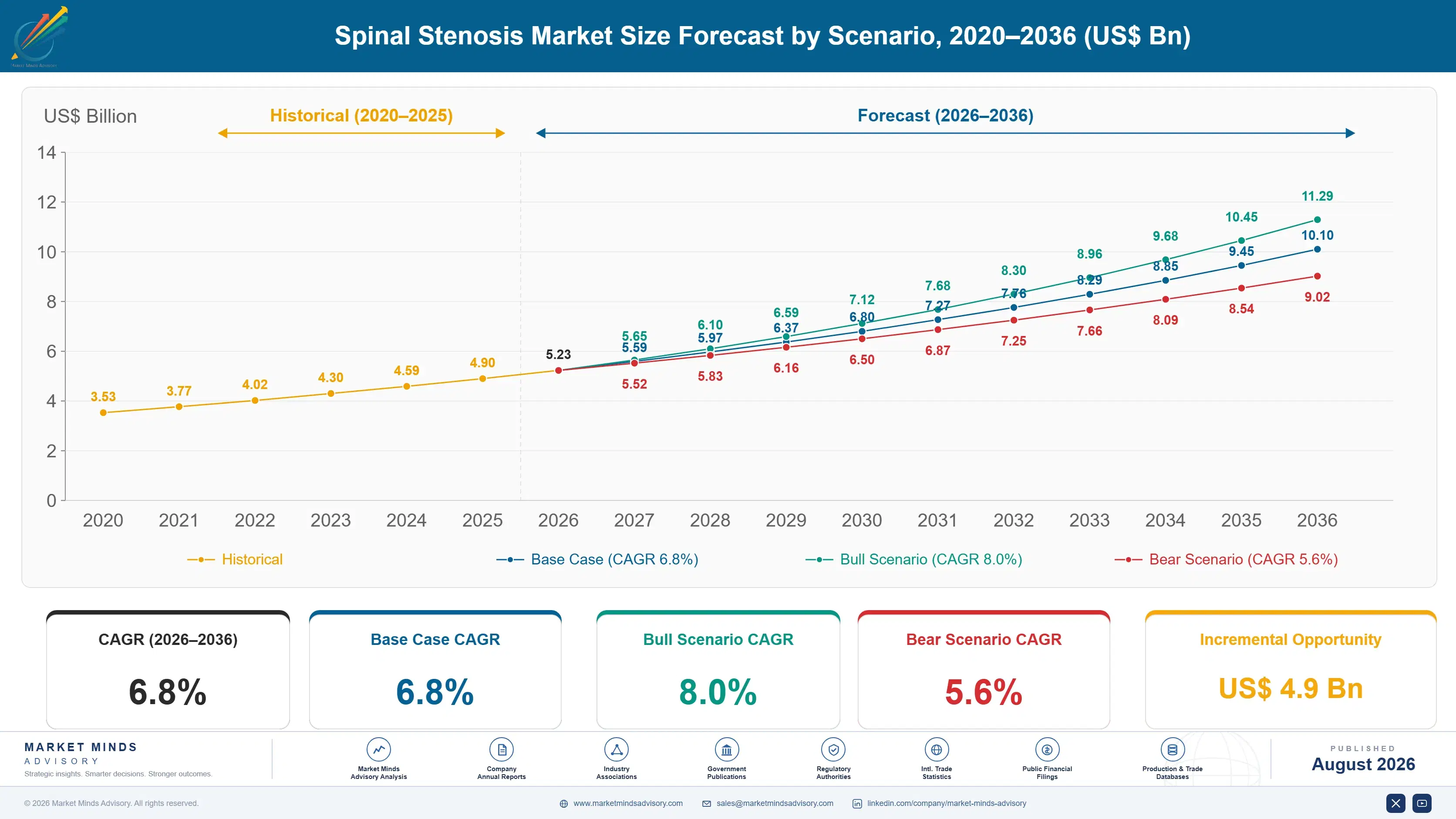
Spinal Stenosis Market Forecast Scenarios

spinal-stenosis-market-size-forecast-scenario-1787309296818
Growth of 5.8% across 2020 to 2025 tracked an ageing population against a procedure backlog. Elective spine surgery deferral through 2020 removed a year of volume, and patients who waited presented with worse function and shorter walking distances. What changed underneath was setting rather than technique: decompression migrated into ambulatory surgical centres, where reprocessing capability and length of stay both matter differently.
The base case of 6.8% rests on three mechanisms. Percutaneous image-guided decompression offers an intervention between injection and open surgery, which suits the large population that declines an operation but has exhausted conservative care. Ambulatory migration continues, at 44% of decompressions already, and favours single-use kits over reprocessed instrument trays. And Asian procedure volumes keep rising as spine surgical capability spreads beyond metropolitan centres in China and India. None depends on new evidence.
The bull case of 8.0% assumes percutaneous decompression secures broad coverage as a step before open surgery rather than as an alternative to injection, which would place it in a pathway carrying very large patient numbers. The bear case of 5.6% reflects the recurring problem: reoperation near 17% invites coverage restriction, and comparative evidence against conservative management has never been decisive here.

Arguing About How Little to Do

Lumbar stenosis is a mechanical problem with an unsatisfying surgical answer. Removing bone and ligament to widen the canal relieves leg pain reliably in the short term, and around 34% of patients are back at their preoperative symptom level within five years as degeneration continues. That recurrence rate is what has driven two decades of argument about whether to add fusion, add a spacer, or do less.
TOP FIVE CONCENTRATION52%Combined share held by the five largest spine device manufacturers
SYMPTOM RECURRENCE34% at five yearsShare returning to preoperative symptom levels after decompression
FUSION REVENUE MULTIPLE4.6 timesImplant revenue per case against decompression alone procedures
ENDOSCOPIC LEARNING CURVE45 casesProcedures before a surgeon reaches consistent operative times
DAY CASE DISCHARGE RATE78% endoscopicProportion discharged same day under minimally invasive approaches
FUSION AUDIT DENIAL RATE19% of requestsShare of fusion authorisations refused where decompression alone suffices
The commercial stakes sit in that argument. Adding fusion to a decompression multiplies implant revenue per case by roughly 4.6 times, and the evidence for doing it in uncomplicated stenosis without instability is genuinely weak. Payers have read the same trials and now refuse around 19% of fusion authorisations where decompression alone would serve, which is a direct attack on the highest-value part of the case mix.
Endoscopic decompression is the more interesting development. It treats the same pathology through a working channel rather than an open exposure, discharges roughly 78% of patients the same day, and compounds at 10.35%. The obstacle is the surgeon rather than the payer: consistent operative times take around 45 cases to reach, and an established surgeon with good open results has little incentive to work through that.
"The technique with the best recovery profile is held back by a forty-five case learning curve that no busy surgeon wants to climb. Adoption is happening fastest where surgeons trained on it from the start rather than had to convert."
Director, Spine Surgery and Interventional Devices Practice · MMA Spine Surgery

Market Trends

Endoscopic Decompression Converts Stenosis Into Day Surgery

Working through an endoscopic channel rather than an open exposure preserves the posterior ligamentous complex and discharges roughly 78% of patients the same day, which changes total episode cost more than implant pricing ever does. The technique compounds at 10.35% against a market at 6.9%. The constraint is a learning curve of around 45 cases before operative times become consistent, and an established surgeon with satisfactory open outcomes has limited incentive to accept a period of slower, harder operating. Adoption therefore runs fastest among surgeons who trained on the technique during fellowship rather than converting mid-career.
Market Impact: Recurrence reaching 34% at five yea
Payers Attack Fusion Added to Uncomplicated Decompression

Adding fusion to a decompression raises implant revenue per case by roughly 4.6 times, and the randomised evidence supporting it in stenosis without instability or deformity is genuinely thin. Payers now refuse around 19% of fusion authorisations where decompression alone would suffice, and the refusal rate rises where documentation of instability is weak. That pressure targets the most valuable part of the case mix directly and no amount of implant differentiation answers it. National guidance across several European systems discourages the addition explicitly, which suppresses it more effectively than audit does. No amount of implant differentiation answers either pressure.
Market Impact: Endoscopic discharging 78% same day

Market Opportunities and Growth Drivers

Ageing Populations Expand the Symptomatic Denominator Steadily

Degenerative stenosis is a consequence of disc height loss, facet hypertrophy and ligamentous thickening accumulating with age, and prevalence rises steeply after sixty-five in every population studied. Nothing in current practice reduces that denominator. Around 34% of surgically treated patients return to preoperative symptom levels within five years as degeneration continues around the treated level, which means the operated population also generates revisit demand rather than clearing permanently. The operated population therefore generates revision demand rather than clearing permanently, which is uncomfortable clinically and material commercially across a decade of follow-up.
Market Impact: Learning curve spanning 45 cases

Day Case Pathways Reduce Total Episode Cost Substantially

A stenosis decompression performed endoscopically and discharged the same day removes inpatient bed days, nursing hours and much of the rehabilitation pathway from the episode, and roughly 78% of endoscopic cases now discharge same day. Health systems under bed pressure value that far more than they value an implant discount. That argument reaches operational and finance leadership rather than the procurement function comparing device prices, which is a materially better audience. Health systems under inpatient bed pressure value that saving considerably above any implant discount a manufacturer can offer them.
Market Impact: Symptoms returning in 34% treated

Market Restraints and Challenges

The Endoscopic Learning Curve Deters Established Surgeons

Reaching consistent operative times endoscopically takes around 45 cases, during which the surgeon operates more slowly through a narrower field with worse ergonomics than the open approach they already perform well. The root cause is that the technique is genuinely harder rather than merely unfamiliar. Manufacturers mitigate with cadaveric training programmes, proctoring by experienced users and simulation, and adoption runs fastest among surgeons trained on it during fellowship rather than converting mid-career. Proctoring by an experienced user is the only intervention that reliably gets a converting surgeon through it. Fellowship training avoids the problem entirely.
Market Impact: Discharging 78% on the same day

Recurrence Undermines the Case for Any Surgical Approach

Roughly 34% of patients return to preoperative symptom levels within five years, which makes every surgical option look modest against conservative management in the medium term. The root cause is that surgery relieves compression without arresting the degeneration producing it. Manufacturers mitigate by supporting longer follow-up in trials, by positioning motion preservation as protective of adjacent levels, and by targeting patients whose symptoms are severe enough that even temporary relief is valuable. Surgery relieves compression without arresting the degeneration producing it, which is a limitation of the pathology rather than of any technique.
Market Impact: Refusing 19% of fusion requests
3 additional market trends, 4 additional growth drivers, and 2 additional restraints and challenges are covered in the full report. Contact sales@marketmindsadvisory.com to access the complete intelligence.

Segment CAGR and Growth Architecture

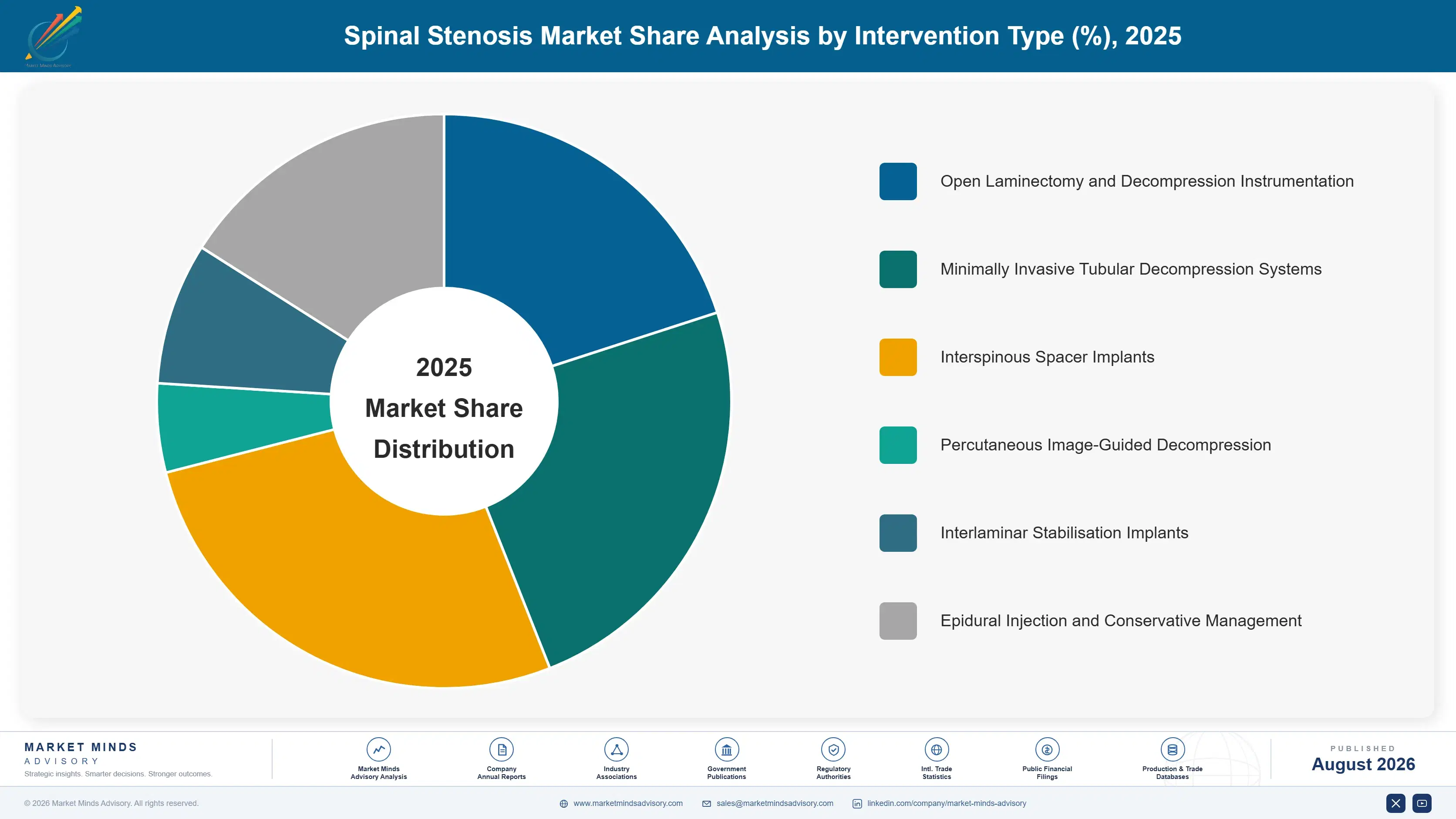
Segmentation follows surgical approach and implant burden, because those two variables determine operative time, recovery pathway and revenue per case together. A surgeon choosing between endoscopic decompression and instrumented fusion is choosing how much of the spine to alter permanently. Six approaches sit here, separated by how much is removed and replaced. Revenue per case follows directly from that choice.
spinal-stenosis-market-market-share-analysis-1787309297345

Endoscopic and Ultra-Minimally Invasive Decompression

Endoscopic decompression compounds at 10.35%, exactly 1.50 times the market, on a recovery profile no open technique matches. Working through a channel rather than an open exposure preserves the posterior ligamentous complex, limits muscle disruption and discharges roughly 78% of patients the same day, which removes bed days and rehabilitation from the episode entirely. Implant revenue per case is low and instrument system revenue is meaningful, so the commercial model differs from fusion substantially. The binding constraint is the surgeon: consistent operative times require around 45 cases, and a mid-career surgeon with good open results faces a period of slower and more difficult operating with no clinical reward. Adoption runs fastest where surgeons trained on it from the start.
CAGR 10.3%

Interspinous Spacer Devices

Interspinous spacers grow at 8.6% by opening the canal indirectly, holding the posterior elements apart to relieve compression without removing bone or ligament. The procedure is short, frequently performed under local anaesthesia and suits patients whose comorbidities make open surgery unattractive, which is a substantial share of the stenosis population over seventy-five. The clinical history is chequered: early devices had high revision rates and several were withdrawn, which left surgeons sceptical in a way the current generation still carries. Evidence for durability beyond four years remains thinner than for decompression. Where the alternative is no surgery at all rather than a decompression, the comparison is considerably more favourable than the trials against surgery suggest.
CAGR 8.6%
Full segment breakdown across 6 segments available in the complete report.

Regional Architecture and Country Demand Map

Demand follows surgical volume and reimbursement structure rather than stenosis prevalence, which is broadly universal after sixty-five. Whether a system funds fusion, endoscopy or neither determines almost all of the variation. East Asia leads on both procedure volume and on endoscopic technique adoption. Reimbursement decides the rest.

East Asia

East Asia holds 30% of demand, the largest regional share, growing at 7.9%. Chinese spine surgical volumes are the largest anywhere and capacity continues extending beyond tertiary academic centres into provincial hospitals, and China compounds at 9.6%, the fastest national market. Korean and Chinese surgeons adopted endoscopic decompression considerably earlier and more completely than Western practice did, and much of the technique development and training infrastructure sits in the region. Japanese practice is conservative on fusion and technically excellent. Regional demand growth is genuine capacity expansion rather than substitution between existing approaches. Much of the endoscopic training infrastructure serving the rest of the world also sits in the region, which reinforces the position further.
Share: 30% | CAGR: 7.9% (2026 to 2036)

North America

Twenty-eight percent of demand sits in North America, growing at 6.6%. Fusion penetration in stenosis is higher than any other region and it is the position under most pressure, with payers refusing around 19% of fusion authorisations where decompression alone would serve. Implant pricing is the highest globally and group purchasing organisations contest it continuously. Endoscopic adoption trails East Asia substantially because the established surgeon population has little incentive to accept a 45 case learning curve, and adoption is concentrated among recent fellowship graduates rather than converts. Adoption is concentrated among recent fellowship graduates rather than among converts from established open practice. Implant pricing is the highest globally and group purchasing organisations contest it continuously.
Share: 28% | CAGR: 6.6% (2026 to 2036)
Regional intelligence for 5 additional markets available in the complete report: Western Europe, South Asia and Pacific, Latin America, Middle East and Africa, Eastern Europe. Contact sales@marketmindsadvisory.com.
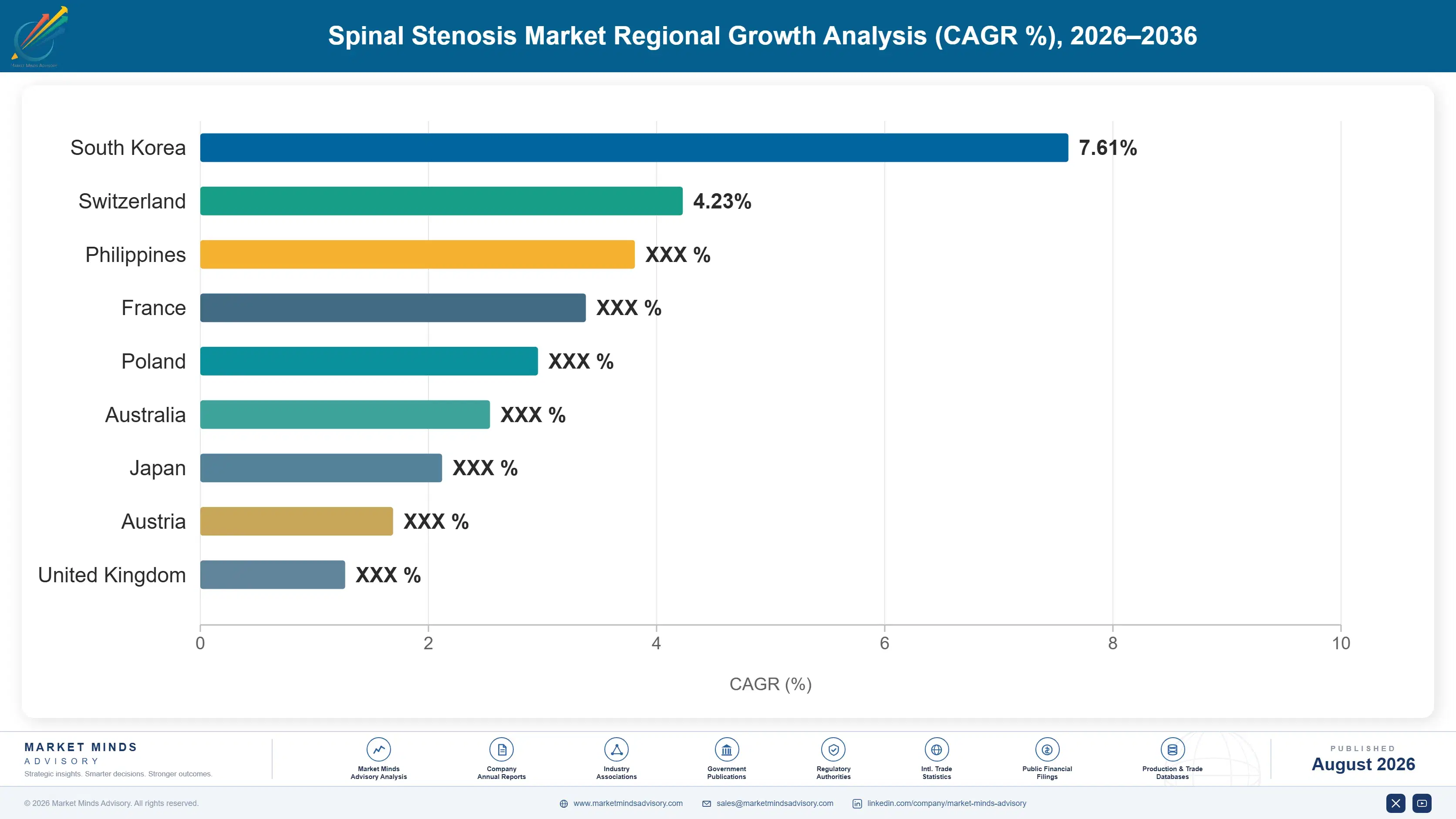
spinal-stenosis-market-country-cagr-analysis-1787309297860

Winning the Argument for Doing Less

Payers are attacking the highest-revenue procedure and the fastest-growing technique is held back by surgeons rather than by evidence. Four positions matter, and two of them mean selling something that generates less implant revenue per case. That is uncomfortable for any manufacturer assuming hardware in every case. The market is heading that way regardless of what any manufacturer would prefer.

Fund Structured Proctoring Through the Learning Curve

Consistent endoscopic operative times require around 45 cases, and a mid-career surgeon with good open results faces slower and harder operating with no clinical reward during that period. Manufacturers who fund cadaveric training, proctoring by experienced users and simulation convert surgeons who would otherwise never adopt. Endoscopic decompression compounds at 10.35%, and the surgeons who complete the curve become permanent users of one system rather than switching between instrument suppliers. Surgeons who complete the curve on one instrument system rarely switch afterwards, because transferring the technique means partly relearning it.
Market Impact: Proctoring across the full 45 case

Sell Bed Days Rather Than Implant Specifications

Roughly 78% of endoscopic decompressions discharge the same day, removing inpatient bed days, nursing hours and much of the rehabilitation pathway from the episode. Health systems under bed pressure value that far above any implant discount, and the saving lands with operational and finance leadership rather than with procurement. Framing the sale around episode cost rather than device price reaches a budget holder who is not comparing implant catalogues at all. Operational and finance leadership control bed capacity and rarely appear in an implant discussion at all. Implant discounts reach nobody who controls a bed.
Market Impact: Removing bed days for all the 78% d

Document Instability Before the Fusion Authorisation Request

Payers refuse around 19% of fusion authorisations in stenosis, and refusal rates rise sharply where documentation of instability or deformity is thin rather than where the clinical case is genuinely absent. Manufacturers who supply imaging and documentation protocols that evidence instability properly recover authorisations that would otherwise fail. Fusion raises implant revenue per case roughly 4.6 times, so each recovered authorisation is worth considerably more than any pricing concession. Imaging and documentation protocols supplied by the manufacturer recover authorisations that would otherwise simply fail on paperwork. Refusals concentrate on paperwork rather than on clinical merit.
Market Impact: Recovering from the 19% fusion deni

Position Spacers Against No Surgery Not Against Decompression

Interspinous spacers compare poorly against decompression in trials and rather well against conservative management, and a substantial share of the stenosis population over seventy-five is too comorbid for open surgery at all. Positioning the device against no intervention rather than against a decompression it will lose to changes the comparison entirely. Spacers grow at 8.6% largely in that population, and the early generation revision history is what surgeons still have to be talked past. Surgeon scepticism from the earlier device generation is the obstacle rather than the current evidence. Talking a surgeon past it takes evidence rather than promotion.
Market Impact: Spacers compounding at 8.6% in ever

Who Controls the Margin Pool

Five manufacturers hold 52% measured on stenosis-indicated implant and instrument revenue, the basis applied throughout this section. The large orthopaedic and spine companies dominate fusion and open decompression, while endoscopic systems are led by specialists who built the technique alongside the surgeons using it. Medtronic and Johnson & Johnson MedTech lead on fusion breadth rather than on any endoscopic position.
Competition operates on three dimensions. Fusion portfolio breadth decides participation in the highest-revenue procedure while it lasts. Endoscopic instrument capability and training infrastructure decide access to the fastest-growing technique. And documentation support for fusion authorisation decides how much of the fusion case mix actually gets approved rather than merely proposed. Implant specification decides almost none of it.

Two pressures are moving position. Payer scrutiny keeps compressing fusion in uncomplicated stenosis, which erodes the revenue base of the largest players. Meanwhile endoscopic adoption favours specialists with training networks built over a decade. Rankings will shift toward manufacturers holding credible endoscopic systems alongside their fusion portfolios. The large companies are building endoscopic systems of their own, which puts the specialists who developed the technique clinically at risk of being bundled out of accounts they created.
spinal-stenosis-market-company-positioning-matrix-1787309298378

Competitive Moat and Risk Dimensions

MEDTRONIC

Moat: Fusion portfolio and surgeon reach

Medtronic carries the broadest posterior and interbody fusion portfolio alongside the deepest spine surgeon relationships, and a hospital contracting for spine implants generally contracts across the whole range rather than device by device. That breadth holds the account even where individual product decisions go elsewhere, which is the strongest incumbency mechanism in spine.
MEDTRONIC

Risk: Endoscopic technique position

Endoscopic decompression compounds at 10.35% and reduces implant content per case substantially, so it is simultaneously the fastest-growing technique and the one that shrinks the revenue pool a fusion-led portfolio depends on. Specialists who built the technique alongside its surgeons hold the training relationships, and those are considerably harder to acquire than instrument designs.
JOIMAX

Moat: Endoscopic training network depth

Joimax built endoscopic instrument systems alongside a training and proctoring network developed over more than a decade, which addresses the 45 case learning curve that is the actual barrier to adoption. Surgeons who complete that curve on one system become durable users, since transferring the technique to another manufacturer's instruments means partly relearning it.
JOIMAX

Risk: Fusion portfolio absence

Hospitals contract for spine implants across a range rather than product by product, and a manufacturer without fusion and interbody options participates in only part of the conversation. As the large companies build credible endoscopic systems of their own, a specialist position risks being bundled out of accounts it developed clinically.

Players Tracked

Prominent Players

Medtronic
Johnson & Johnson MedTech
Stryker
Globus Medical
Joimax

Other Key Players

Zimmer Biomet
NuVasive
Orthofix
SeaSpine
Alphatec Holdings
RTI Surgical
Vertos Medical
Boston Scientific
Elliquence
RIWOspine
Karl Storz
Richard Wolf
Shanghai MicroPort
WEGO Orthopedic
Sanyou Medical

Recent Developments

FEBRUARY 2025

Payers tighten instability documentation requirements for fusion authorisation

Utilisation management programmes across several health systems raised documentation standards for demonstrating instability or deformity before approving fusion added to stenosis decompression. These were payer policy decisions rather than regulatory actions or commercial developments among device manufacturers. Refusal rates rose sharply wherever instability documentation was thin.
Signal: Documentation standards rather than any cl
JULY 2025

Endoscopic decompression enters national guidance for uncomplicated stenosis

Clinical guidance bodies positioned endoscopic decompression as an acceptable first-line surgical approach for uncomplicated lumbar stenosis, citing equivalent outcomes with shorter recovery. These were guideline decisions rather than regulatory approvals or transactions among the companies involved. Shorter recovery was the deciding consideration in every case.
Signal: Guideline positioning removes the last cli
NOVEMBER 2025

Day case spine pathways expand across bed-constrained health systems

Hospital systems under inpatient bed pressure extended day case pathways to lumbar decompression, favouring approaches discharging patients the same day over those requiring overnight admission. These were operational capacity decisions rather than commercial developments. Approaches requiring overnight admission lost throughput priority accordingly. Elective throughput priority followed the recovery profile directly.
Signal: Bed pressure makes recovery profile into a

Titanium, Instruments and Surgeon Training

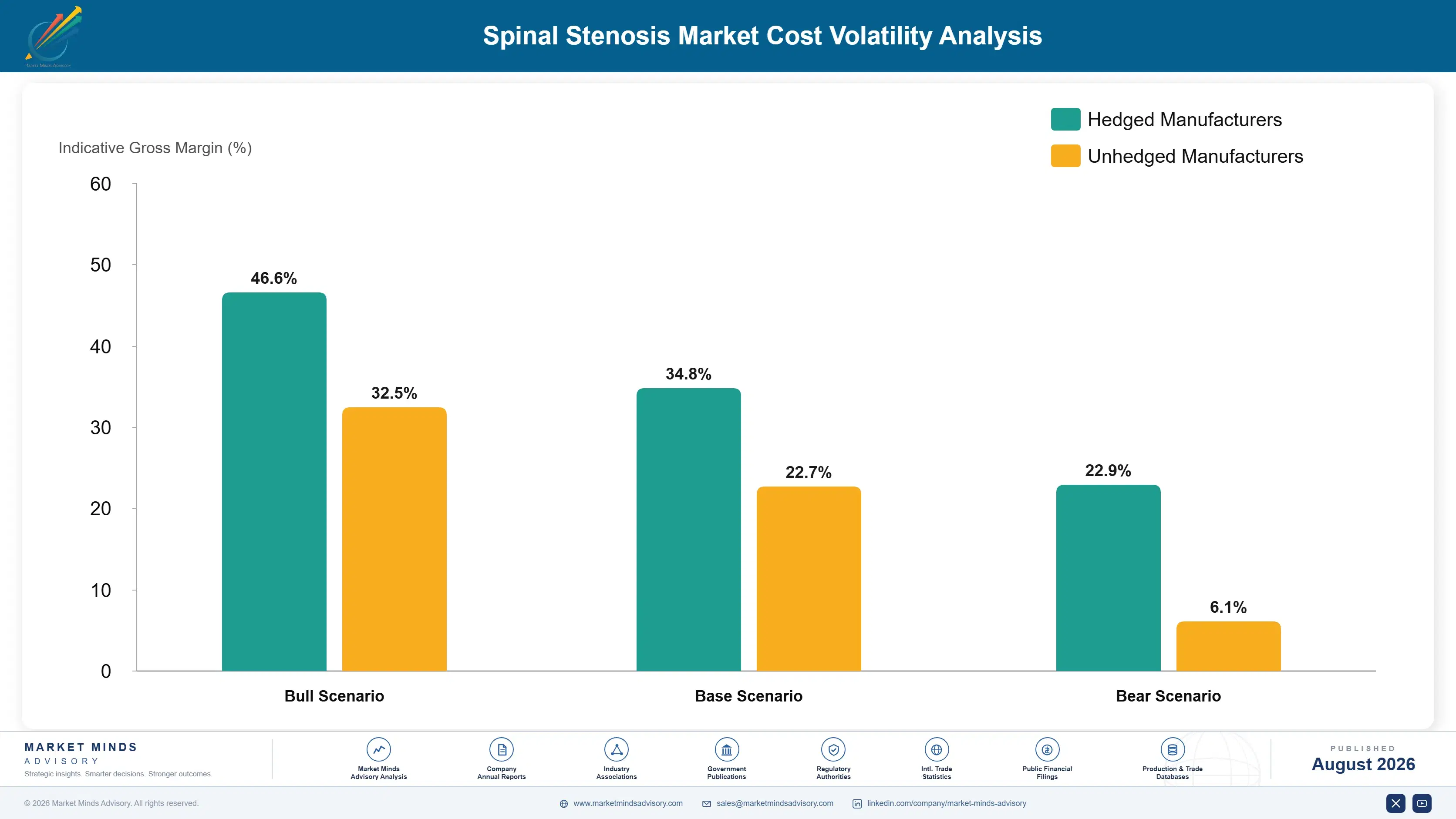
Implant materials and precision machining account for roughly 26% of cost of goods across fusion products, with medical grade titanium alloy, polyetheretherketone and surface treatment dominating that figure. Endoscopic instrument systems carry higher optics, camera and reusable instrument cost at around 31%. Surgeon training, proctoring and cadaveric programmes sit outside cost of goods and represent the largest controllable spend in the endoscopic segment.
Medical grade titanium and specialty polymer pricing rose sharply through 2021 and 2022, and spine manufacturers absorbed much of it against group purchasing agreements written annually with no adjustment mechanism. Company annual reports across the spine device manufacturers disclose the resulting margin compression. Energy Information Administration data on industrial metal and energy pricing documents the underlying commodity movement across the same period. Group agreements carried no adjustment mechanism at all.

Exposure divides by procedure mix rather than by scale. Fusion-weighted manufacturers carry implant material cost against pricing that group purchasing contests continuously. Endoscopic-weighted manufacturers carry optics and reusable instrument cost against capital sales plus a training obligation that scales with surgeon adoption rather than with revenue. Spacer manufacturers carry the lowest material cost and the heaviest burden of overcoming an earlier generation's revision history.
spinal-stenosis-market-cost-volatility-analysis-1787309298574

Index group purchasing agreements to published metal references

Annual implant agreements written without adjustment clauses against volatile titanium and polymer pricing put the whole cycle onto the manufacturer. Indexing to a published metal reference with a defined reset period matches pass-through to real exposure, and purchasing organisations accept the mechanism more readily on implants than most manufacturers assume they will. Very few manufacturers have asked for one.

Scale training investment against surgeon adoption not revenue

Proctoring and cadaveric programmes cost the same whether a surgeon becomes a high-volume user or abandons the technique after twelve cases. Selecting candidates on case volume and genuine commitment concentrates training spend where the 45 case curve will actually be completed. Candidate selection matters more than programme volume, since an abandoned conversion returns nothing.

Recover reusable instrument cost through service contracts

Endoscopic optics and reusable instruments degrade with repeated sterilisation cycles and require repair and replacement that hospitals rarely budget for at the point of purchase. Structuring a service contract into the capital sale recovers that cost predictably, and it stops the whole system falling out of clinical use the very first time an instrument fails.

Portfolio Architecture for Margin Defence

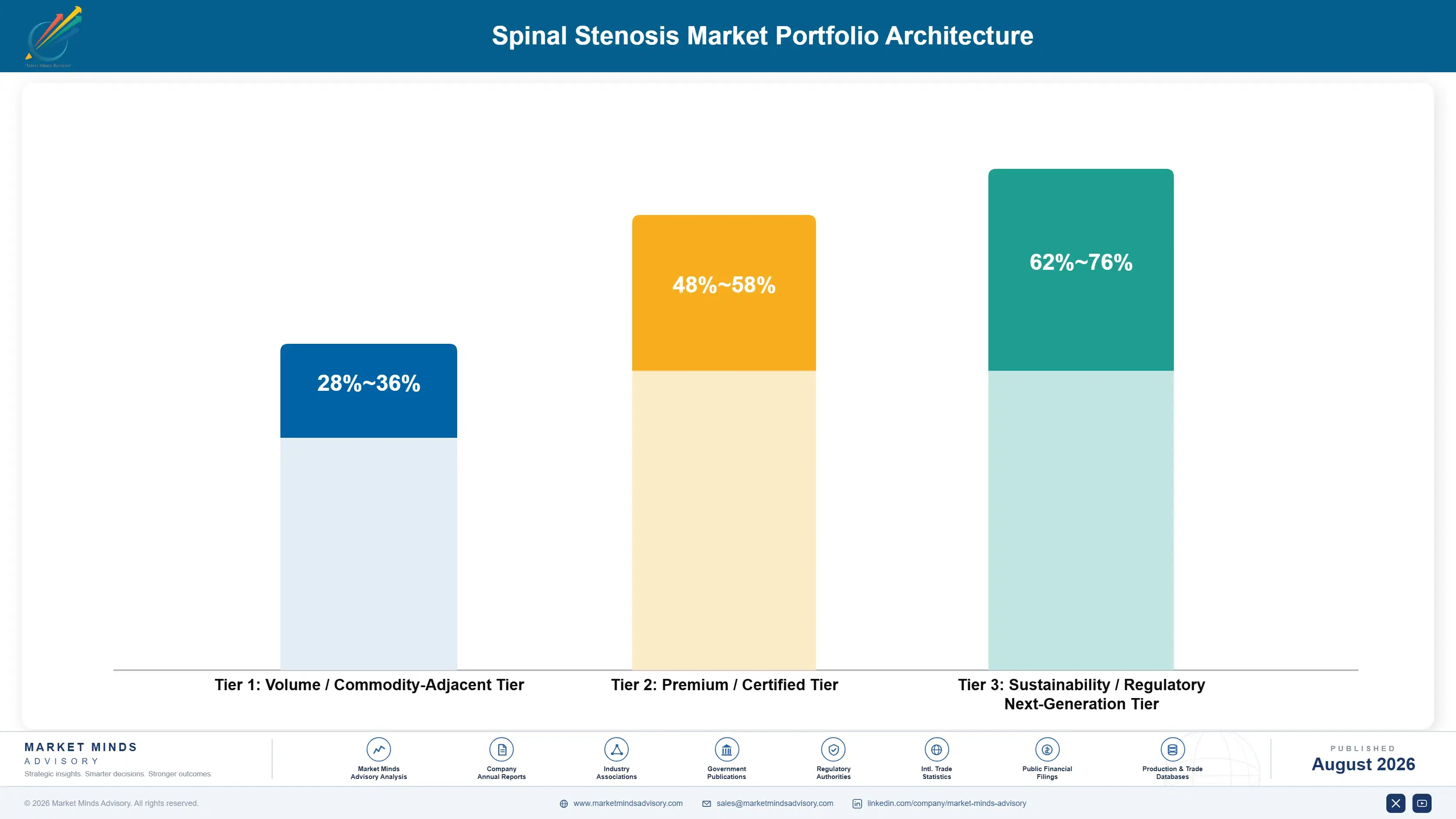
The portfolio separates on how much of the spine each approach alters and how much implant it consumes. Open decompression instrumentation is low-value and durable. Endoscopic systems are capital plus instruments with modest implant content. Interspinous spacers are a single low-cost device. Posterior and interbody fusion carry the highest implant revenue per case and the weakest evidence in uncomplicated stenosis. Motion preservation sits between the two on both counts.
The tension is uncomfortable and worth stating directly. The procedure generating 4.6 times the implant revenue is the one payers are auditing hardest and guidance discourages, while the fastest-growing technique deliberately reduces implant content. A manufacturer optimising for revenue per case is defending a position the evidence does not support, and one optimising for technique leadership accepts lower revenue per procedure.

High-value pools concentrate where a genuine barrier exists. Endoscopic training networks, documented-instability fusion cases and spacer positioning in the too-comorbid-for-surgery population all qualify, and none of them is won on implant specification. What they share is that the barrier is a surgeon, a payer or a comorbidity rather than anything about the device itself, which is where the durable positions sit.

Volume / Commodity-Adjacent Tier

Open decompression instrumentation and basic posterior instrumentation sold through group purchasing agreements on price. Clinically settled, minimally differentiated between manufacturers, and steadily eroded by both endoscopic substitution and tendered pricing pressure.
Gross Margin: 38-52%

Premium / Certified Tier

Posterior and interbody fusion implants for stenosis with documented instability or deformity. Highest implant revenue per case at roughly 4.6 times decompression, and increasingly dependent on authorisation documentation rather than surgeon preference.
Gross Margin: 62-76%

Sustainability / Regulatory / Next-Generation Tier

Endoscopic and ultra-minimally invasive decompression systems plus interspinous spacers and motion-preserving stabilisation. The wide margin range separates established training networks from newer systems still funding surgeon conversion at a loss.
Gross Margin: 44-72%
spinal-stenosis-market-portfolio-architecture-1787309299075

High-value Sub-segments and Strategic Watch-out

Endoscopic and Ultra-Minimally Invasive Decompression

Compounding at 10.35% on a recovery profile that discharges roughly 78% of patients the same day and removes bed days from the episode. The 45 case learning curve rather than any clinical objection is what limits adoption. Instrument and capital revenue replaces implant content here.
Gross Margin: 50-72%

Interspinous Spacer Devices

Growing at 8.6% among patients too comorbid for open surgery, where the comparison is no intervention rather than a decompression. An earlier generation's revision history is what surgeons still need to be talked past. Durability evidence beyond four years remains considerably thinner than for decompression.
Gross Margin: 56-70%

Posterior and Interbody Fusion Implants

The revenue core at 5.1%, carrying roughly 4.6 times the implant value of decompression and the weakest evidence in uncomplicated stenosis. Payer audit and national guidance both attack it directly and continuously. It remains simultaneously the largest revenue pool here and the least defensible one.
Gross Margin: 62-76%

Motion-Preserving Posterior Stabilisation

The strategic watch-out. Preserving segmental motion should reduce adjacent level degeneration and the long-term evidence remains thin, so the argument stays theoretical while fusion accumulates decades of outcome data. Fusion has accumulated decades of outcome data against which a theoretical adjacent level argument struggles to compete at all.
Gross Margin: 44-68%

Operated Once, Frequently Again

Revenue here is procedural rather than recurring, with an unusual twist. Roughly 34% of decompressed patients return to preoperative symptom levels within five years as degeneration continues, and a meaningful share of those undergo further surgery at the same or an adjacent level. That produces revision demand from the treated population itself, which is uncomfortable clinically and material commercially across a decade. Revision volume is a real and uncomfortable part of the base.
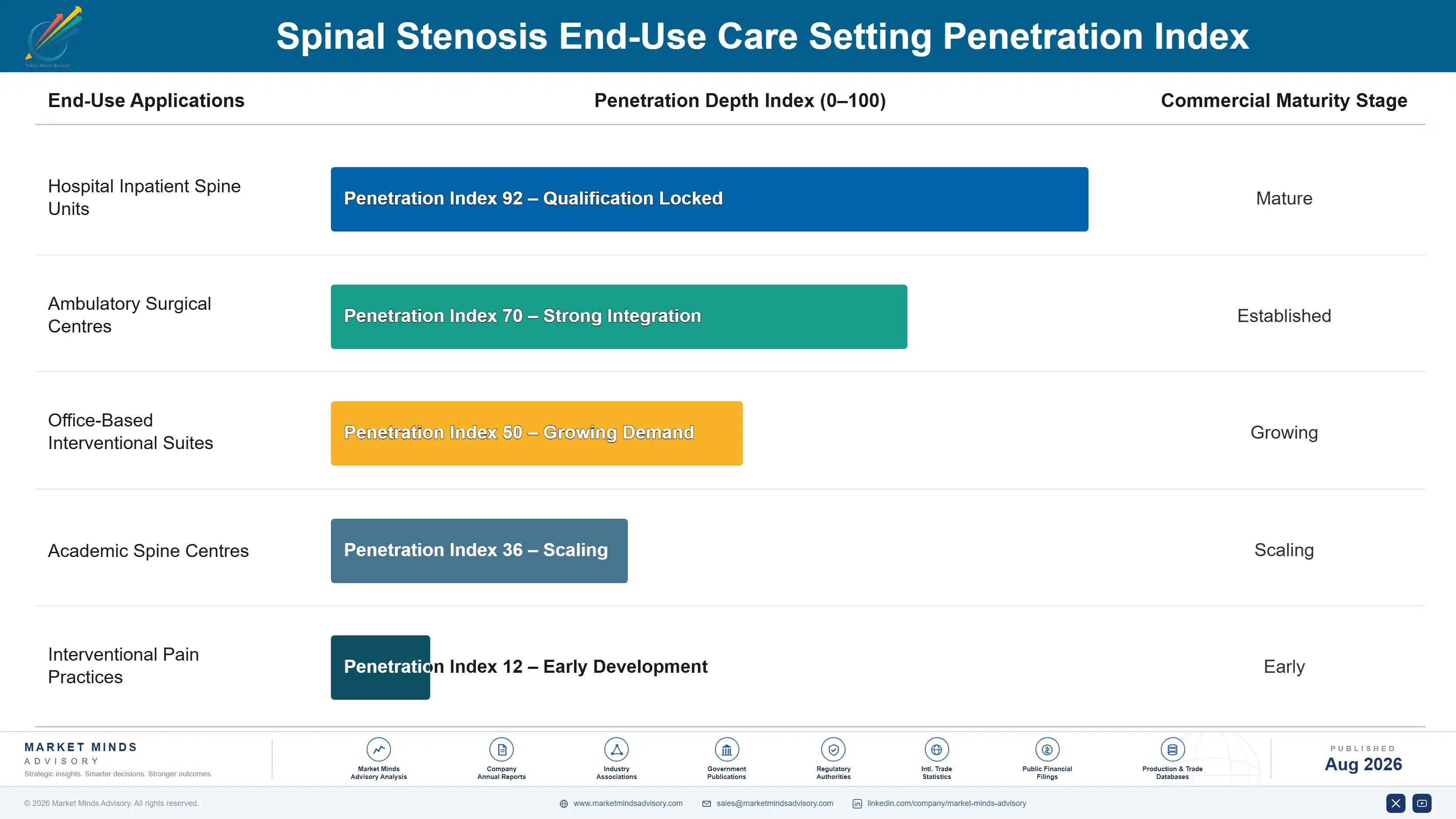
Depth varies by patient fitness and by what a system funds. Fit patients under seventy with single level stenosis and documented instability generate the highest-value fusion cases. Multi-level stenosis without instability generates decompression alone. Patients over seventy-five with significant comorbidity generate spacer or no intervention. Revision cases after prior decompression generate the most complex and highest-value instrumented procedures of all.

The deciding party depends on which argument is running. Implant selection sits with the surgeon and preference is close to immovable. Approach selection increasingly sits with guidance and payer authorisation. Recovery pathway and bed day saving reach operational and finance leadership, and that group has become considerably more influential as inpatient capacity has tightened across developed systems.
spinal-stenosis-market-end-use-penetration-index-1787309299569

Where Spine Manufacturers Win

These are among the four positions where our research anticipates prominent divergence between winners and laggards over the coming forecast period. Each is grounded in the demand model, the regulatory perimeter, and the announced capacity pipeline.
01 / LEARNING CURVE INVESTMENT

The barrier is a surgeon's forty-five hard cases

Consistent endoscopic operative times require around 45 cases, during which a surgeon with good open results operates more slowly through a worse field for no clinical reward. Manufacturers funding cadaveric training, proctoring and simulation convert surgeons who would otherwise never adopt the technique at all. Surgeons who complete the curve on one instrument system become durable users, because transferring the technique elsewhere means partly relearning it from scratch, which makes the training investment unusually durable for a manufacturer, and the training investment is unusually durable.
02 / EPISODE COST FRAMING

Bed days matter more to a hospital than implant price

Roughly 78% of endoscopic decompressions discharge the same day, removing inpatient bed days, nursing hours and much of the rehabilitation pathway from the treatment episode entirely. Health systems under inpatient capacity pressure value that considerably above any implant discount available to them. Framing the sale around total episode cost rather than device price reaches operational and finance leadership rather than a procurement function comparing implant catalogues, and that audience has become considerably more influential as capacity has tightened, and that audience has grown considerably more.
03 / AUTHORISATION DOCUMENTATION SUPPORT

Fusion denials turn on paperwork, not clinical disagreement

Payers refuse around 19% of fusion authorisations in stenosis, and refusal concentrates where documentation of instability or deformity is thin rather than where the clinical case is genuinely absent. Manufacturers supplying imaging and documentation protocols that evidence instability properly recover authorisations that would otherwise fail outright. Fusion carries roughly 4.6 times the implant revenue of a decompression, so each recovered authorisation is worth far more than any pricing concession, and the protocol costs a manufacturer almost nothing to supply, and the protocol itself costs a.
04 / COMPARATOR SELECTION DISCIPLINE

Spacers lose to decompression and beat doing nothing

Interspinous spacers compare poorly against decompression in randomised trials and considerably better against conservative management, and a substantial share of the stenosis population over seventy-five is too comorbid for open surgery in any case. Positioning the device against no intervention rather than against a procedure it will lose to changes the whole comparison. Spacers grow at 8.6% almost entirely inside that older and more comorbid population, where the honest alternative is no intervention at all rather than surgery, and no intervention is the honest comparator.

Engagement Snapshot From the Field

A live engagement with an industry participant carrying material or product regulatory and market exposure ahead of a defining policy shift, showing how our research translates into a defensible multi-year portfolio strategy.
MARKET MINDS ADVISORY · CLIENT ENGAGEMENT SUMMARY
Spinal Stenosis Producer Strategic Portfolio Review and Transition Roadmap 2026·Investment Scenario on Spinal Stenosis Exposure Evaluation 2025-26
CLIENT PROFILE
A private hospital group operating spine services at six sites with roughly 4,200 lumbar decompression and fusion procedures annually, and about USD 640 million in surgical revenue (client-reported, unverified by MMA). Fusion was added to decompression in 46% of stenosis cases, well above published benchmarks, and no site performed endoscopic decompression at all. Neither figure had been benchmarked externally.
STRATEGIC CHALLENGE
Insurer authorisation denials for fusion had risen for three consecutive years and inpatient bed occupancy was constraining elective throughput at four of the six sites. Leadership treated these as separate problems, one commercial and one operational, and had responded to each independently without examining whether the case mix connected them.
MMA APPROACH
MMA reviewed 340 consecutive stenosis cases across all six sites, classifying each by whether instability was documented, whether fusion was added, and what the authorisation outcome was. Bed occupancy attributable to spine surgery was measured separately against the recovery pathway each approach required. Surgeon training histories were reviewed to identify latent endoscopic capability within the existing consultant body.
KEY FINDINGS
  1. Fusion was added in 46% of stenosis cases while documented instability was present in only 21%, and denial rates were four times higher in the undocumented group than in the documented one.
  2. Spine surgery accounted for 31% of orthopaedic inpatient bed days across the group, and essentially all of it followed open approaches requiring at least one overnight stay after the procedure.
  3. Two surgeons had trained in endoscopic decompression during fellowship and had abandoned it after appointment because no site held the instrument system or the proctoring support.
  4. The authorisation problem and the bed occupancy problem shared a single cause in the case mix, which nobody had connected because they sat with different executives entirely.
CLIENT PROFILE
A private hospital group operating spine services at six sites with roughly 4,200 lumbar decompression and fusion procedures annually, and about USD 640 million in surgical revenue (client-reported, unverified by MMA). Fusion was added to decompression in 46% of stenosis cases, well above published benchmarks, and no site performed endoscopic decompression at all. Neither figure had been benchmarked externally.
STRATEGIC CHALLENGE
Insurer authorisation denials for fusion had risen for three consecutive years and inpatient bed occupancy was constraining elective throughput at four of the six sites. Leadership treated these as separate problems, one commercial and one operational, and had responded to each independently without examining whether the case mix connected them.
MMA APPROACH
MMA reviewed 340 consecutive stenosis cases across all six sites, classifying each by whether instability was documented, whether fusion was added, and what the authorisation outcome was. Bed occupancy attributable to spine surgery was measured separately against the recovery pathway each approach required. Surgeon training histories were reviewed to identify latent endoscopic capability within the existing consultant body.
KEY FINDINGS
  1. Fusion was added in 46% of stenosis cases while documented instability was present in only 21%, and denial rates were four times higher in the undocumented group than in the documented one.
  2. Spine surgery accounted for 31% of orthopaedic inpatient bed days across the group, and essentially all of it followed open approaches requiring at least one overnight stay after the procedure.
  3. Two surgeons had trained in endoscopic decompression during fellowship and had abandoned it after appointment because no site held the instrument system or the proctoring support.
  4. The authorisation problem and the bed occupancy problem shared a single cause in the case mix, which nobody had connected because they sat with different executives entirely.
RECOMMENDED STRATEGY
Phase 1: Phase 1 (months 1 to 4): Introduce instability documentation protocols before every fusion authorisation request is submitted across all six sites. Phase 2: Phase 2 (months 4 to 12): Equip two sites for endoscopic decompression around the fellowship-trained surgeons and fund proctoring through the learning curve. Phase 3: Phase 3 (months 12 to 22): Extend endoscopic capability and day case pathways to the remaining sites as surgeon capability develops.
OUTCOME
Fusion authorisation denials fell by roughly 62% within seven months of introducing documentation protocols (client-reported, unverified by MMA). Endoscopic decompression reached 280 annual cases across the two equipped sites, with 81% discharged the same day and spine inpatient bed days down by a fifth (client-reported, unverified by MMA). Case mix and bed occupancy are now reviewed together.

Frequently Asked Questions

Foundational context covering the market sizes, CAGR, scope, country, region and competition that inform every finding below. This section is provided to cover basics and most often pre-purchase conversations, answered from the MMA Primary Research Dataset.

What is the current size of the Spinal Stenosis Market?

The global market was worth USD 4.9 billion in 2025, reaching USD 5.24 billion in 2026. East Asia holds the largest regional share at 30% of demand.

How large will the Spinal Stenosis Market be by 2036?

MMA forecasts USD 10.21 billion by 2036, an expansion multiple of 1.95 times the 2026 base. That represents roughly USD 4.97 billion of incremental value.

What is the CAGR for the Spinal Stenosis Market 2026 to 2036?

The base case compounds at 6.9% annually, with a bull case of 8.1% and a bear case of 5.6%. Historical growth from 2020 to 2025 ran at 5.7%.

Which segment is growing fastest?

Endoscopic and ultra-minimally invasive decompression compounds at 10.35%, exactly 1.50 times the market rate. Same day discharge for roughly 78% of patients drives that growth.

Who are the major companies in the Spinal Stenosis Market?

Medtronic, Johnson & Johnson MedTech, Stryker, Globus Medical and Joimax hold a combined 52% of the market. Fusion portfolio breadth sustains most of those positions.

Which country is growing fastest?

China compounds at 9.6%, ahead of every other national market. Surgical capacity extending into provincial hospitals and early endoscopic adoption both drive that growth forward.

Report Segmentation Architecture

The full report scope spans multiple orthogonal segmentation dimensions, with cross-tabulated demand data provided for each dimension pair. Coverage extends further to regional breakdowns, trend trajectories, and the competitive detail needed to support segment-level decision-making.

By Surgical Approach and Implant Burden

  • Open Decompression Instrumentation
  • Endoscopic and Ultra-Minimally Invasive Decompression
  • Interspinous Spacer Devices
  • Posterior Lumbar Fusion Implants
  • Interbody Fusion Devices for Stenosis
  • Motion-Preserving Posterior Stabilisation

By End-Use Industry

  • Hospital Orthopaedic and Neurosurgical Spine Units
  • Ambulatory Surgery Centres
  • Private Spine Specialty Hospitals
  • Academic Teaching and Training Centres
  • Public Health System Spine Services

By Commercial Dimension

  • Group Purchasing and Tender Supply
  • Direct Hospital and Surgeon Sales
  • Capital Equipment and Instrument Systems
  • Distributor Channel in Emerging Markets

By Region

  • North America
  • Western Europe
  • East Asia
  • South Asia and Pacific
  • Latin America
  • Middle East and Africa
  • Eastern Europe

Scope, Methodology, and Coverage

Every figure in this report is reproducible from documented input assumptions. The scope below maps the historical period, the forecast horizon, the segmentation dimensions, and the countries covered, alongside the underlying primary and qualitative methodology.
Historical Period
2020 to 2025
Forecast Period
2026 to 2036
Base Year
2025 (USD billions; MMA Primary Research Dataset, August 2026)
Market Definition
The market covers implants, instruments and devices used to treat degenerative lumbar and cervical spinal stenosis, spanning open decompression instrumentation, endoscopic and ultra-minimally invasive decompression systems, interspinous spacer devices, posterior lumbar fusion implants, interbody fusion devices used for stenosis indications, and motion-preserving posterior stabilisation, together with the associated instrument systems and training programmes. Interventional pain injections and neuromodulation, spinal deformity correction implants, tumour and trauma instrumentation, surgical navigation and robotic platforms, imaging equipment, and biologics and bone graft substitutes are excluded. Sizing is measured at manufacturer revenue in current prices.
Quantitative Units
USD billions (current prices); procedure volumes, implanted device counts and recurrence rates where applicable
Segmentation Dimensions
By Surgical Approach and Implant Burden; By End-Use Industry; By Commercial Dimension; By Region
Regions Covered
North America, Western Europe, East Asia, South Asia and Pacific, Latin America, Middle East and Africa, Eastern Europe
Countries Covered
China, USA, Japan, South Korea, Germany, India, France, UK, Italy, Spain, Canada, Brazil, Mexico, Taiwan, Thailand, Malaysia, Indonesia, Australia, Turkey, Saudi Arabia, UAE, South Africa, Egypt, Poland, Czech Republic, Netherlands, Sweden, Argentina, Colombia, Switzerland, and additional markets relevant to this sector
Key Companies Profiled
Medtronic, Johnson & Johnson MedTech, Stryker, Globus Medical, Joimax, Zimmer Biomet, NuVasive, Orthofix, SeaSpine, Alphatec Holdings, RTI Surgical, Vertos Medical, Boston Scientific, Elliquence, RIWOspine, Karl Storz, Richard Wolf, Shanghai MicroPort, WEGO Orthopedic, Sanyou Medical
Quantitative Methodology
Primary survey, n=3,800 respondents, Q4 2025, six countries; demand-side model with trade association cross-validation
Qualitative Methodology
47 expert interviews, Q4 2025; applied to validate demand model assumptions, identify emerging dynamics, and assess competitive positioning
Report Format
PDF and XLSX data workbook (Word format preview document)
Publisher
Market Minds Advisory
Report Code
MMA-2026-MED-969
Published
August 2026
Contact
sales@marketmindsadvisory.com | www.marketmindsadvisory.com

Purchase the full Spinal Stenosis Market Report (2026 to 2036).

The full report sizes spinal stenosis devices across six surgical approaches, three commercial dimensions and seven regions, with annual forecasts to 2036 under base, bull and bear scenarios. Fusion authorisation denial rates are measured against instability documentation quality, which explains most of the variance in approved case mix. Endoscopic learning curve completion is tracked by surgeon cohort and training model. Day case discharge rates and attributable bed day savings are quantified by approach. Recurrence and revision rates are compiled across all six surgical approaches, and twenty manufacturers are profiled on a consistent stenosis-indicated device revenue basis.
Fusion denial rates measured against instability documentation quality
Endoscopic learning curve completion tracked by surgeon cohort
Day case discharge rates and bed savings by approach
Recurrence and revision rates compiled across surgical approaches
National guidance positions on fusion mapped by jurisdiction
Spacer outcomes compared against conservative management in comorbid patients

Built For The People Who Decide

From boardroom strategy to bench-side execution, this report is read cover-to-cover by leaders shaping the next decade of their industry, turning demand scenarios, market dynamics and valuation benchmarks into decisions.
CXOs/ Presidents/ VPs/ Managers
M&A and Corporate Development
Strategy Teams and R&D Heads
Procurement and Product Directors
Regulatory and Compliance Leaders
Investor Relations and Equity Analysts