Market Minds Advisory
Spending In Digital Customer Experience and Engagement Solutions Market

Spending In Digital Customer Experience and Engagement Solutions Market: Digital Customer Experience and Engagement Solutions Market. AI-Powered Personalization Reshapes Enterprise CX Budgets

Generative AI is turning customer experience budgets into a genuine boardroom priority, as enterprises race to personalize every single digital touchpoint before competitors permanently capture the very same loyal customers.

Lead Analyst

Published

September 2026

Make Smarter Decisions with Customized Research Insights

Request a free sample report and evaluate market opportunities, growth trends, and competitive dynamics relevant to your business needs.

2025 MARKET VALUE$28.5BMarket Size 2025
2036 FORECAST VALUE$97.2BBase Case , 2026 to 2036
CAGR 2026 TO 203611.8 %Bull 13.1% / Bear 10.5%
INCREMENTAL OPPORTUNITY$65.3BNet 10- year value creation
EXPANSION MULTIPLE3.05x2036 value over 2026 base
Strategic Levers
M&A Pipeline
Regional Outlook
Country Rankings
Competitive Intelligence
Segmental Deep-dive
Call-Us : 91 93563 13602

Executive Snapshot and Market Trajectory.

Digital customer experience spending has moved from a cost center inside IT departments to a board-level growth investment. Chief experience officers now report directly to the board in many large enterprises, a reporting line that barely existed five years ago. Boards now treat this spend as a genuine growth lever.
AI-powered conversational platforms are growing fastest as enterprises deploy generative chatbots to resolve complex queries without human agents, while customer data platforms consolidate a separate but adjacent personalization budget line concentrated in North America and East Asia's largest enterprise software buyers. Enterprise buyers increasingly demand measurable resolution rate improvements before renewing contracts, a requirement that barely existed as a standard procurement criterion five years ago.
Dozens of specialized vendors compete against a handful of large enterprise software companies now bundling engagement tools into broader customer relationship management suites, and rising demand for measurable return on CX spend is starting to separate vendors with genuine outcome data from those still selling on feature checklists alone. Vendors that can document concrete customer retention lift are winning larger multi-year contracts smaller competitors cannot match. That shift rewards vendors with genuine data infrastructure.
Market Definition
This report defines the Digital Customer Experience and Engagement Solutions Market as enterprise software spending on conversational platforms, customer data platforms, contact center software, and journey analytics. It excludes traditional advertising spend and physical in-store customer service technology.
Base Year Value
$28.5B in 2025 (MMA Primary Research Dataset, September 2026)
Forecast Period
2026 to 2036, eleven discrete annual values
CAGR
11.8% base case. Bull 13.1%. Bear 10.5%.
Fastest Growth Segment
AI-Powered Conversational and Chatbot Engagement Platforms: 18.4% CAGR
Fastest Growth Country
India: 15.8% CAGR
Fastest Growth Region
South Asia and Pacific: 13.9% CAGR
Largest Region
North America: 30% of 2025 global value
Market Leaders
Salesforce, Adobe, Zendesk, Genesys, and Twilio. Source: MMA Analysis based on company disclosures and enterprise licensing revenue estimates.
Primary Survey
n=3,800 procurement and R&D decision-makers, Q4 2025, six countries
Methodology
Demand-side build-up, cross-validated against public data, 47 expert interviews

Spending In Digital Customer Experience and Engagement Solutions Market Forecast Scenarios

spending-in-digital-customer-experience-and-engage-size-forecast-scenario-1789986893221
Between 2020 and 2025 the market accelerated sharply as pandemic-era digital adoption forced enterprises to invest in remote customer engagement infrastructure almost overnight, expanding at roughly 10.6% annually as companies rushed to replace in-person service with capable digital alternatives. Recovery normalized as pandemic urgency faded, though enterprises retained most of the digital infrastructure they had built.
MMA's base case assumes 11.8% annual growth through 2036, anchored to three mechanisms: expanding deployment of generative AI conversational agents capable of resolving complex queries without human escalation, rising enterprise willingness to pay for measurable customer retention outcomes rather than feature checklists, and steady consolidation of point solutions into integrated customer data and engagement platforms. Vendors that can demonstrate measurable resolution rate improvements are winning larger, multi-year contracts that feature-focused competitors increasingly cannot compete for on price alone.
The bull case rests on generative AI resolution rates finally matching human agent quality across most query types, pulling budget away from human staffing entirely. The bear case centers on enterprise budget caution during economic uncertainty, with CX technology spend treated as discretionary rather than an operational necessity. That risk is most acute for mid-size companies without protected CX budgets.

From Chat Widgets to Predictive Engagement Engines

Digital customer experience spending began as simple website chat widgets bolted onto existing support systems, valued more for basic availability than actual resolution quality. Vendors have since layered on generative AI, customer data platforms, and journey analytics, turning a support cost into a measured growth investment enterprises now benchmark against retention outcomes directly. Chief experience officers now sit in vendor selection meetings once belonging entirely to IT procurement.
AVERAGE ANNUAL CONTRACT VALUE$185,000Typical yearly license spend per mid-size enterprise customer
CUSTOMER RETENTION RATE88%Share of enterprise customers renewing their annual platform license
TOP PRODUCING COUNTRY SHARE22%United States share of global enterprise CX software spend
AI RESOLUTION RATE62%Typical share of queries resolved without human agent involvement
PLATFORM INTEGRATION DEPTH4.2Average number of connected data sources per enterprise deployment
AVERAGE IMPLEMENTATION TIME5 monthsTypical duration from contract signing to full platform deployment
Pricing now varies sharply by deployment depth. Basic chatbot licenses charge modest per-seat fees, while full-platform deployments bundling customer data unification and predictive analytics command enterprise contract values that scale with data volume, and companies increasingly upgrade after a poorly resolved query spike convinces leadership that deeper integration is worth paying for. Enterprise buyers occupy a distinct premium tier, paying per-conversation fees justified by measurable resolution rate gains.
Large enterprise software companies are acquiring specialized AI startups rather than building comparable capability in-house, buying conversational technology and proprietary training data rather than existing customer bases alone. That acquisition pattern is starting to consolidate a category that spent most of the last decade fragmented across dozens of point-solution vendors. Independent vendors that survive increasingly specialize in a niche larger platforms overlook.
"Nobody renews a CX contract because the chatbot is clever. They renew because fewer customers called back angry the second time."
Director, Enterprise Software and Customer Experience Practice · MMA Technology Practice · September 2026

Market Trends

Generative AI Resolution Rates Reach Enterprise Adoption Threshold

Generative AI conversational agents have crossed a resolution quality threshold that finance departments now consider credible enough to justify reducing human agent headcount rather than merely supplementing it during peak demand periods. This shift accelerated sharply once several large enterprises publicly disclosed resolution rates above sixty percent for complex, multi-turn customer queries that previously required human escalation without exception. Vendors that cannot document comparable resolution accuracy increasingly lose competitive bids to platforms that can demonstrate concrete deflection metrics tied directly to cost savings. Enterprises without this deflection data risk being left behind in competitive vendor renewal negotiations.
Market Impact: Acquisition costs rose over 20%
Customer Data Platforms Consolidate Fragmented Personalization Tools

Enterprises are consolidating dozens of previously separate personalization and analytics point solutions into unified customer data platforms that combine identity resolution, segmentation, and predictive scoring into one deployment. This consolidation trend accelerated once large enterprises recognized that fragmented tools created inconsistent customer profiles across channels, undermining the personalization these tools were meant to enable in the first place. Vendors offering unified platforms increasingly win competitive bids against point-solution specialists lacking comparable integration depth. Point-solution specialists that fail to integrate risk losing their most valuable enterprise accounts entirely to unified rivals.
Market Impact: Labor costs rose over 18%

Market Opportunities and Growth Drivers

Rising Customer Acquisition Costs Elevate Retention Priority

Customer acquisition costs have risen substantially across most digital channels as advertising platforms grow more expensive and competitive, pushing enterprises to prioritize retention spending over new customer acquisition budgets that once dominated marketing plans. Chief marketing officers increasingly co-fund CX technology alongside sales budgets, a cross-departmental financing arrangement that barely existed at this scale a decade ago. Companies that can demonstrate measurable retention lift from CX investment increasingly justify larger technology budgets to skeptical finance departments. Some vendors now offer dedicated retention-modeling features specifically to serve this growing cross-departmental budget demand.
Market Impact: Compliance costs rose over 14% yearly

Labor Cost Inflation Accelerates Automation Investment

Rising contact center labor costs and persistent staffing shortages are pushing enterprises toward automation investment that reduces dependence on human agents for routine, repetitive customer queries. This trend has proven particularly strong among enterprises in high-wage markets where contact center staffing costs have risen faster than overall inflation for several consecutive years running. Companies report meaningfully faster payback periods on automation investment than comparable staffing expansion would have delivered under current labor market conditions. Some enterprises have shifted entire budget lines from staffing plans into automation technology procurement as a direct result.
Market Impact: Oversight costs remain near 22%

Market Restraints and Challenges

Data Privacy Regulation Limits Personalization Depth

Expanding data privacy regulation across multiple jurisdictions increasingly restricts how enterprises can collect and use customer behavioral data for personalization purposes, limiting the depth of targeting that customer data platforms can practically support. The root cause is that most platforms were architected before recent privacy rules tightened, treating regulatory compliance as an afterthought rather than a foundational design requirement. The commercial impact is reduced personalization effectiveness in heavily regulated markets specifically. Some vendors are now building privacy-preserving architectures from the outset for new deployments. That pivot has proven partially effective at defending personalization effectiveness in stricter markets.
Market Impact: AI resolution rates reach 62%

AI Hallucination Risk Limits Full Automation Trust

Enterprises remain cautious about fully automating complex customer interactions because generative AI systems occasionally produce confidently incorrect responses that damage customer trust when left unchecked by human oversight. The root cause is that most large language models are trained on general internet data rather than enterprise-specific verified knowledge bases, creating a gap between fluency and factual accuracy. The commercial impact is continued human oversight costs that limit full automation savings. Some vendors are building verified knowledge grounding specifically to address this credibility gap. Early results suggest this grounding meaningfully reduces hallucination frequency among enterprise deployments.
Market Impact: Unified platform adoption grew 35%
4 additional market trends, 4 additional growth drivers, and 3 additional restraints and challenges are covered in the full report. Contact sales@marketmindsadvisory.com to access the complete intelligence.

Segment CAGR and Growth Architecture

The market spans six categories organized by product type, from AI-powered conversational platforms through digital self-service knowledge bases. Growth concentrates in categories combining generative AI capability with measurable retention outcomes, while legacy categories grow slowest. Contact center software and journey analytics occupy the pricing middle, while loyalty platforms and self-service knowledge bases round out the categories at lower prices.
spending-in-digital-customer-experience-and-engage-market-share-analysis-1789986893795

AI-Powered Conversational and Chatbot Engagement Platforms

AI-Powered Conversational and Chatbot Engagement Platforms combine generative language models with enterprise knowledge grounding to resolve complex customer queries without human escalation, growing at roughly 18.4% annually as resolution quality crosses thresholds finance departments now trust. Adoption started among large technology companies with existing AI infrastructure, but falling model costs have pulled mid-size enterprises into the category over the past two years. The segment increasingly competes on measurable deflection rates rather than conversational fluency alone, since finance departments demand attribution before renewing contracts. Vendors that can document deflection rates above sixty percent hold a durable pricing advantage over rivals still refining their language models. Several vendors now publish third-party audited deflection benchmarks to reassure enterprise buyers evaluating multiple competing platforms.
CAGR 18.4%

Customer Data Platform and Personalization Engines

Customer Data Platform and Personalization Engines unify fragmented behavioral, transactional, and demographic data into a single customer profile powering real-time personalization decisions, growing at roughly 15.2% annually as enterprises consolidate previously separate point solutions. This segment carries the highest average contract value of any category because it substitutes for an entire data infrastructure project rather than simply adding a chatbot. Privacy regulation increasingly shapes architecture decisions, pushing vendors toward privacy-preserving identity resolution techniques competitors have not yet fully matched. Retention in this segment consistently outperforms standalone chatbot contracts, since ripping out a fully integrated data platform is far more disruptive than swapping a single tool. Enterprise buyers increasingly evaluate integration depth as the primary purchase criterion above raw feature count.
CAGR 15.2%
Full segment breakdown across 6 segments available in the complete report.

Regional Architecture and Country Demand Map

North America leads on enterprise software spend and generative AI adoption maturity, while South Asia and Pacific grows fastest as India's expanding IT services sector deploys digital engagement platforms across a rapidly digitizing consumer base. East Asia follows closely as technology firms invest heavily in generative AI customer engagement infrastructure.

North America

North America holds the largest enterprise CX spend, supported by the world's deepest concentration of enterprise software vendors and the fastest generative AI adoption maturity of any region. The United States hosts most of the category's largest platform vendors, whose scale advantages let them bundle conversational AI and data unification other regions' vendors still charge separately for. Regulatory attention to AI transparency here is intensifying but remains less prescriptive than in parts of Western Europe. Growth trails the global rate slightly since enterprise CX spend here is already largely mature, leaving mostly incremental AI and analytics upgrades as remaining addressable demand. Canadian enterprises are also emerging as a modest secondary growth pocket within the broader region.
Share: 30% | CAGR: 12.4% (2026 to 2036)

Western Europe

Western Europe's stringent data privacy regulation, particularly the General Data Protection Regulation, shapes CX architecture decisions meaningfully more than in North America, pushing vendors toward privacy-preserving personalization techniques. Germany, the United Kingdom, and France host most of the region's enterprise CX spend, concentrated among financial services and manufacturing companies with large customer bases. Regulatory compliance costs here run meaningfully higher than in less regulated markets, compressing vendor margins on regional deployments. Growth trails the global average as the region's more cautious enterprise AI adoption pace lags faster-moving markets elsewhere. Scandinavia's smaller but technologically advanced enterprise sector is emerging as a modest secondary growth pocket. Regulatory sandboxes in several countries are helping vendors test compliant AI deployments before wider rollout.
Share: 21% | CAGR: 10.2% (2026 to 2036)
Regional intelligence for 5 additional markets available in the complete report: East Asia, South Asia and Pacific, Latin America, Middle East and Africa, Eastern Europe. Contact sales@marketmindsadvisory.com.
spending-in-digital-customer-experience-and-engage-country-cagr-analysis-1789986894314

Resolution Data Commands Enterprise Premium Pricing

Standard per-seat licensing is thin and falling, pushing vendors to build recurring revenue around measurable resolution outcomes and data infrastructure clients actually value. Analytics subscriptions and outcome-based pricing now generate most incremental revenue. Vendors that diversify beyond one-off licensing fees into these channels post materially stronger long-term revenue growth. Enterprise clients increasingly value this outcome-based capability.

Outcome-Based Resolution Rate Pricing Programs Nationwide

Vendors are building dedicated success teams to negotiate outcome-based contracts tied directly to measured resolution rates, proving deflection quality justifies pricing above traditional per-seat licensing tiers. Outcome-based contracts now generate roughly 16% of total vendor revenue, up from near zero four years ago, and carry meaningfully lower churn than standard licensing since the performance relationship deepens client dependence. Several leading vendors have publicly disclosed outcome-based pipeline growth exceeding 25% year over year as more clients sign on. This growth trend shows no signs of slowing across the broader enterprise CX industry.
Market Impact: Outcome-based contracts now reach roughly 16% of revenue

Enterprise Data Unification Platform Upgrade Pathways

Vendors increasingly design upgrade paths that convert standalone chatbot clients into full customer data platform deployments after demonstrating measurable personalization lift from unified customer profiles. These full-platform deployments now command roughly triple the average per-seat licensing fee and represent the fastest-growing revenue segment within existing enterprise relationships. Integration specialists also generate valuable client insight vendors use to refine which accounts are likeliest to upgrade. Roughly 2 in 5 clients who try a full-platform upgrade retain the expanded deployment permanently rather than reverting. Vendors view this recurring premium relationship as more durable than standard per-seat contracts alone.
Market Impact: Full-platform deployments now command roughly 3x fees today

White-Label AI Model Licensing Partnership Programs

Some vendors now license their proprietary conversational AI models directly to system integrators and consulting firms serving mid-market enterprises, a distribution channel that bypasses direct enterprise sales entirely. Early licensing deals report meaningfully higher margin than comparable direct sales contracts, since the underlying model training cost is already covered by the vendor's own platform investment. Integrators value gaining AI capability without building comparable technology in-house from scratch. Roughly 3 in 10 integrator partners report measurably faster deployment timelines after adopting the licensed model. Vendors increasingly treat this licensing channel as a genuine second business line.
Market Impact: Model licensing revenue now grows roughly 28% yearly

Industry Compliance Certification Advisory Service Programs

Some vendors now offer paid compliance certification advisory services helping enterprise clients navigate data privacy regulation across multiple jurisdictions for their CX deployments specifically. This advisory revenue remains small but carries extremely high margin since the compliance methodology is already built for internal vendor operations purposes. Enterprise legal teams increasingly view certified vendors as essential partners they cannot otherwise assemble independently. Roughly 1 in 4 advisory clients expand into a full certification package within their first year of engagement. That expansion pattern makes advisory services a genuinely durable revenue growth path.
Market Impact: Compliance advisory now adds roughly 4% of revenue

Who Controls the Margin Pool

The market is fragmented, with a cr5 of roughly 32%, reflecting a category still young enough that no vendor has achieved decisive scale despite several very large enterprise software companies competing directly. The leading platform holds a meaningful but not dominant lead over its nearest challenger, with AI-native entrants closing the gap through superior resolution accuracy. The gap is measured in retention and resolution data rather than seat count, since buyers research before signing.
Current competition centers on resolution rate disclosures, data platform integration announcements, and outcome-based pricing pilots, with vendors racing to secure enterprise reference accounts before rivals establish similar credibility. Several vendors are also acquiring smaller AI startups purely to absorb conversational technology, and some now run dedicated sales teams purely to capture outcome-based revenue. International expansion into East Asia has become a visible proxy battleground for investor confidence in this category.

Emerging pressure comes from major cloud providers bundling conversational AI directly into their existing enterprise software suites, threatening to erode standalone vendors' differentiation entirely. Rankings could shift meaningfully if a well-capitalized cloud platform bundles comparable resolution accuracy into an existing enterprise relationship. Legacy CX vendors bring deep integration expertise that cloud-native entrants still lack.
spending-in-digital-customer-experience-and-engage-company-positioning-matrix-1789986894852

Competitive Moat and Risk Dimensions

SALESFORCE

Moat: Customer 360 Data Depth

Salesforce holds the deepest enterprise customer relationship data of any CX vendor, having built out Customer 360 integration across sales, service, and marketing over more than two decades of platform expansion. Competitors attempting to displace this data depth face years of integration lead time before reaching comparable enterprise account penetration.
SALESFORCE

Risk: Platform Complexity Deployment Risk

Salesforce's platform complexity increasingly frustrates mid-size enterprises seeking faster deployment than its extensive customization options typically allow. Nimbler AI-native competitors with simpler deployment models could erode its mid-market share over time if it fails to simplify onboarding. Some mid-market accounts have already begun migrating to nimbler AI-native platforms citing deployment speed as the primary reason.
ZENDESK

Moat: Accessible Fast-Deploy Positioning

Zendesk built its brand around accessible, fast-deploying support software rather than the sprawling enterprise suites competitors offer, creating a differentiated positioning that appeals to mid-market buyers wary of lengthy implementations. That accessibility has attracted partnerships with several AI startups directly. AI startups view this partnership channel as a faster route to enterprise distribution than building direct sales teams themselves.
ZENDESK

Risk: Enterprise Contract Exposure Gap

Zendesk's mid-market focus limits its exposure to the largest enterprise contracts where competitors with deeper customization capability increasingly win. A sudden shift in mid-market budget priorities could compress growth faster than upmarket expansion can offset. Losing large enterprise accounts to deeper-customization rivals could meaningfully slow overall revenue growth in coming years.

Players Tracked

Prominent Players

Salesforce
Adobe
Zendesk
Genesys
Twilio

Other Key Players

Sprinklr
Verint Systems
NICE Ltd
Freshworks
HubSpot
Intercom
Braze
Klaviyo
Amplitude
Qualtrics
Medallia
Yellow.ai
LivePerson
Talkdesk
Five9

Recent Developments

JANUARY 2026

Salesforce announced an expanded generative AI partnership with a major cloud infrastructure provider, integrating enterprise-grade language models directly into its Customer 360 platform for enrolled enterprise clients. The agreement extends a pilot integration launched the prior year and reflects growing enterprise confidence in measurable resolution rate improvements.
Signal: Cloud infrastructure partnerships are steadily becoming the primary distribution channel for enterprise AI capability right now.
SEPTEMBER 2025

Zendesk acquired a smaller specialist developer focused on conversational AI training data curation, absorbing its existing technology and small engineering team. The deal expands Zendesk's AI capability into enterprise knowledge grounding where it previously had limited presence. Leadership expects this to accelerate its roadmap. Both companies expect a swift integration.
Signal: Consolidation of smaller AI specialist developers is clearly accelerating as larger vendors seek adjacent capability quickly.
APRIL 2025

Genesys entered a joint venture with a Japanese telecommunications carrier to co-develop localized conversational AI infrastructure supporting the region's tonal language requirements for enterprise contact centers. The partnership marks Genesys's first meaningful localization investment beyond its established English-language product line. Both companies expect commercial launch within roughly one year.
Signal: International expansion into East Asia increasingly relies on local language partnerships for genuinely successful entry right now.

Compute and Model Training Cost Exposure

Cloud computing and large language model inference costs represent roughly forty-five percent of vendor operating cost of goods, with the remainder split between engineering staffing and sales overhead. Most compute capacity is sourced from a small number of major cloud infrastructure providers, concentrating supply risk in a narrow set of vendors globally. This concentration means a provider price change can ripple through pricing within a single billing cycle.
A 2025 GPU pricing increase, documented in a major cloud provider's annual report, forced several smaller vendors to raise subscription prices by roughly twelve percent, temporarily slowing new enterprise adoption in price-sensitive segments. Larger vendors with pre-negotiated volume discounts largely absorbed the increase without raising prices, widening the competitive gap. The episode pushed several affected vendors to diversify compute sourcing across additional providers and invest in smaller, more efficient model architectures.

Smaller vendors without volume purchasing power face materially higher per-query inference costs than the largest platforms, a disadvantage that compounds with each new model capability launch. Vendors concentrated in North America face comparatively less currency risk than those pricing across multiple international currencies simultaneously. That gap is why smaller vendors increasingly seek acquisition by larger platforms rather than compete independently.
spending-in-digital-customer-experience-and-engage-cost-volatility-analysis-1789986895051

Multi-Cloud Provider Sourcing Diversification

Larger vendors are qualifying secondary cloud infrastructure providers to reduce exposure to any single provider's pricing changes or GPU availability constraints. This diversification adds modest integration cost upfront but meaningfully shortens recovery time during future price increases or capacity shortages. Several vendors have already qualified alternate providers as part of this broader diversification push across their infrastructure stack.

Smaller Model Architecture Investment

Some vendors are investing in smaller, more efficient model architectures that reduce per-query inference costs while maintaining acceptable resolution accuracy for most standard queries. This shift requires meaningful upfront research investment but pays back quickly at scale. Early adopters report noticeably lower inference costs once smaller models reach comparable accuracy on standard enterprise queries.

Volume Compute Purchase Commitments

Vendors with sufficient scale are negotiating multi-year compute purchase agreements that lock in favorable pricing ahead of demand spikes. Smaller vendors lacking this leverage remain more exposed to spot market price swings during periods of tight compute capacity. These agreements typically span two to three years and are increasingly bundled with joint infrastructure planning commitments from providers.

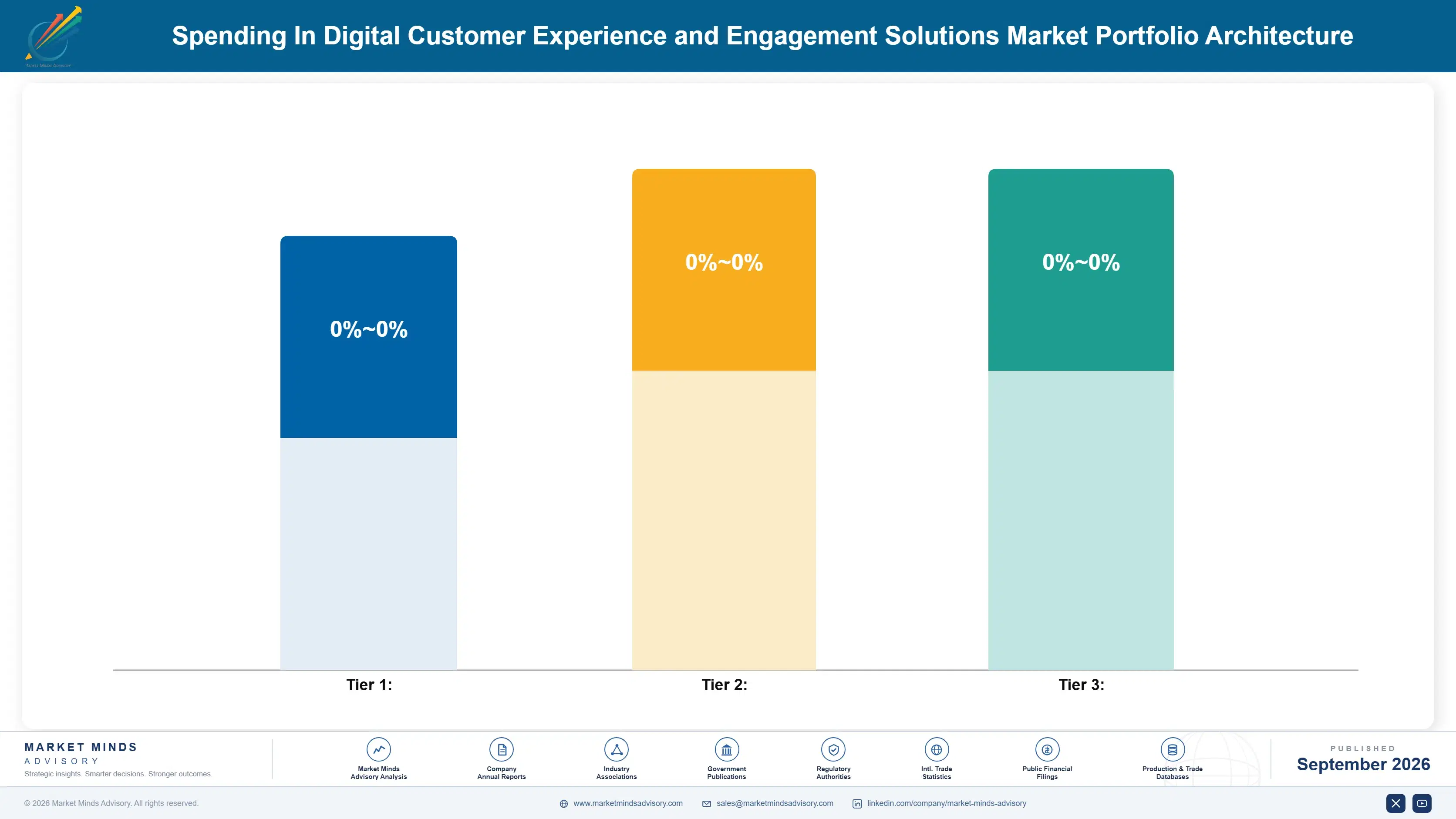
Portfolio Architecture for Margin Defence

The market splits across three tiers by margin structure. Volume tier per-seat licensing carries thin margins typical of commodity software, while premium tiers bundling outcome-based pricing and data unification command substantially higher margins closer to enterprise consulting than standard SaaS. Sustainability and next-generation tiers, built around compliance certification and white-label AI licensing, are still small but carry the highest long-term margin potential of the three.
Volume and premium tiers pull the market in opposite directions commercially. Volume growth depends on standard chatbot licensing holding steady, while premium growth depends on convincing finance departments that measurable resolution outcomes justify a higher contract value. Most established vendors now run both tiers under a single platform, using standard clients as a funnel that converts a share into premium upgrades after a well-documented resolution rate.

High-value margin pools concentrate almost entirely in the outcome-based pricing and data platform tiers, where vendors capture both a subscription fee and a lower acquisition cost through recurring enterprise relationships rather than one-off deals. Volume tier chatbot licensing generates the bulk of total client count but contributes proportionally less to profitability, making it valuable mainly as a funnel into higher-margin offerings.

Basic chatbot licensing sold at thin margins comparable to commodity SaaS, competing primarily on price and simple deployment speed rather than resolution accuracy. Churn risk is highest here since switching costs are minimal and price comparison across vendors is straightforward for cost-conscious buyers.
Gross Margin

Outcome-based and data platform tiers commanding meaningfully higher margins, priced closer to an enterprise consulting relationship than standard licensing, sustained by demonstrated retention gains. Retention rates outperform volume tier subscribers, since replacing a fully integrated data platform mid-deployment is far more disruptive than swapping vendors.
Gross Margin

Compliance certification and white-label AI licensing offerings carrying the highest long-term margin potential, dependent on verified methodology that remains costly for smaller vendors to assemble. Adoption remains gradual as enterprise buyers demand multi-year compliance evidence before committing to broader licensing expansion across additional business units.
Gross Margin
spending-in-digital-customer-experience-and-engage-portfolio-architecture-1789986895554

High-value Sub-segments and Strategic Watch-out

AI-Powered Conversational and Chatbot Engagement Platforms

The fastest-growing and highest-value segment, benefiting directly from generative AI resolution improvements and expanding outcome-based pricing that continue to widen its addressable enterprise client base substantially. Vendors documenting audited resolution benchmarks are best positioned to capture enterprise outcome-based dollars ahead of competitors still building comparable evidence.

Customer Data Platform and Personalization Engines

A high-value, moderate-growth segment anchored by data unification and strong retention, expanding steadily as enterprises consolidate fragmented personalization tools into single integrated platforms. This segment carries the category's highest average contract value and the lowest churn of any tier currently tracked across all vendors industry-wide.

Omnichannel Contact Center Software

The volume core of the market, generating the largest client count at thinner margins, competing mainly on reliability and straightforward per-seat pricing rather than differentiated analytics depth. Falling standardization costs are the main lever pulling mid-size enterprises into this segment for the very first time.

Loyalty and Rewards Engagement Software

A strategic watch-out segment facing pressure from bundled platforms, as conversational and data unification vendors increasingly fold loyalty features into broader subscription tiers at little marginal cost. Standalone loyalty vendors without a conversational or data platform product of their own face genuine pressure to partner or be acquired.

Renewals Built on Proof, Not Habit

The annuity economics here differ from typical consumer SaaS because renewal depends on discrete annual budget cycles justified against measured outcomes rather than continuous daily engagement. Renewal requires sustained proof that the platform demonstrably reduced cost or lifted retention, not habitual usage patterns the way consumer software retains subscribers. Vendors win renewals by demonstrating measurable impact reassuring the budget owner. Not by the end customer's daily engagement with the underlying product.
Adoption stickiness varies sharply by end-use vertical. Financial services and telecommunications companies show the deepest engagement, since they already manage enormous query volumes that make automation savings immediately visible, while smaller companies churn more readily once a budget-constrained year forces cuts. Loyalty subscriptions show the opposite pattern, tied closely to marketing budget cycles rather than the CX category itself.

A generational shift is underway in who initiates these purchases. Younger customer experience leaders, comfortable evaluating vendors on data rather than relationships, increasingly select platforms based on published resolution benchmarks rather than a predecessor's long-standing relationship, favoring vendors with strong analytics capability. That cohort is more willing to switch vendors if a competitor demonstrates better resolution outcomes. Brand loyalty here is considerably weaker than among the earliest wave of clients.
spending-in-digital-customer-experience-and-engage-end-use-penetration-index-1789986896052

Where Resolution Data Beats Feature Breadth

These are among the four positions where our research anticipates prominent divergence between winners and laggards over the coming forecast period. Each is grounded in the demand model, the regulatory perimeter, and the announced capacity pipeline.
01 / OUTCOME-BASED PRICING POSITIONING

Build measurable resolution data before rivals lock in contracts

Outcome-based pricing is becoming the single largest lever separating category leaders from the rest of the field, more so than feature breadth or brand recognition ever were in this market's earlier years. Vendors that invest early in dedicated success measurement capability are locking in multi-year enterprise contracts that competitors cannot easily displace once signed and renewed annually. Vendors still selling purely on per-seat licensing risk permanent disadvantage as roughly a sixth of revenue already shifts toward outcome-based models across the industry.
02 / DATA PLATFORM UNIFICATION STRATEGY

Convert standalone chatbot clients into full data platform relationships

Data platform unification carries the highest margins and the lowest churn in this category by a wide margin, outperforming standalone chatbot contracts on nearly every retention metric vendors track internally today. The strongest commercial opportunity available right now is converting existing chatbot clients into full-platform relationships after demonstrating measurable personalization lift from unified customer profiles. Vendors without a credible data integration strategy will increasingly struggle to capture this upgrade revenue regardless of how sophisticated their conversational AI actually is in practice.
03 / CLOUD PLATFORM DEFENSE STRATEGY

Build proprietary AI capability before hyperscalers bundle competing tools

Major cloud providers bundling conversational AI directly into existing enterprise software suites represent a genuine existential risk for standalone CX vendors dependent purely on conversational technology as their core differentiation. Vendors that build or license proprietary knowledge grounding and integration depth early lock in recurring enterprise revenue that cloud-native bundles cannot easily replicate without years of dedicated integration work of their own. Vendors without a credible defense strategy risk losing enterprise contracts entirely as cloud providers continue expanding their native bundled capability.
04 / COMPUTE COST DIVERSIFICATION STRATEGY

Diversify inference sourcing to defend margin against providers

Compute cost concentration leaves smaller vendors disproportionately exposed to pricing changes from a small number of dominant cloud infrastructure providers who control most global GPU capacity today. Vendors that diversify sourcing earlier or invest meaningfully in smaller, more efficient model architectures recover faster from price shocks and maintain pricing stability that reassures cost-sensitive enterprise clients considering their first multi-year contract. This positioning matters more with each new model capability launch as compute intensity keeps rising across an increasingly sophisticated product lineup.

Engagement Snapshot From the Field

A live engagement with an industry participant carrying material or product regulatory and market exposure ahead of a defining policy shift, showing how our research translates into a defensible multi-year portfolio strategy.
MARKET MINDS ADVISORY · CLIENT ENGAGEMENT SUMMARY
Spending In Digital Customer Experience and Engagement Solutions Producer Strategic Portfolio Review and Transition Roadmap 2026·Investment Scenario on Spending In Digital Customer Experience and Engagement Solutions Exposure Evaluation 2025-26
CLIENT PROFILE
The client is a mid-size telecommunications company evaluating conversational AI vendors to reduce contact center staffing costs while maintaining customer satisfaction scores. Leadership had relied on a single legacy vendor for support software for over a decade. The company had grown through acquisition and lacked a unified support platform across its newly combined regional call centers.
STRATEGIC CHALLENGE
Leadership needed to select a vendor from a crowded field of similar-sounding AI platforms without internal expertise to evaluate competing resolution rate claims independently. A wrong choice risked locking the company into a costly multi-year contract that failed to reduce staffing costs as promised. Board members were also concerned about disrupting existing customer relationships during any vendor transition process.
MMA APPROACH
MMA analysts benchmarked five leading vendors against a consistent commercially relevant basis covering documented resolution rates, integration complexity, and existing telecommunications industry references. Analysts also interviewed reference clients directly to validate vendor marketing claims independently before finalizing a recommendation. This cross-referencing surfaced meaningful discrepancies between vendor-reported resolution rates and what comparable telecommunications clients had actually experienced.
KEY FINDINGS
  1. Only two of five evaluated vendors had independently verified resolution data credible enough to support staffing reduction planning. The remaining three relied primarily on internal marketing claims rather than verified performance data.
  2. Integration complexity varied enormously across vendors, with the strongest candidate offering pre-built telecommunications industry connectors. That pre-built integration translated directly into faster deployment and fewer technical failures during the pilot phase.
  3. Vendor pricing models diverged sharply between flat annual licenses and outcome-based per-resolution fee structures. The outcome-based structure ultimately proved more attractive given the company's uncertainty about actual resolution rates.
  4. Two vendors lacked prior telecommunications industry experience, requiring a considerably longer onboarding period. Onboarding gaps would have required additional weeks of preparation before either vendor could deploy confidently.
CLIENT PROFILE
The client is a mid-size telecommunications company evaluating conversational AI vendors to reduce contact center staffing costs while maintaining customer satisfaction scores. Leadership had relied on a single legacy vendor for support software for over a decade. The company had grown through acquisition and lacked a unified support platform across its newly combined regional call centers.
STRATEGIC CHALLENGE
Leadership needed to select a vendor from a crowded field of similar-sounding AI platforms without internal expertise to evaluate competing resolution rate claims independently. A wrong choice risked locking the company into a costly multi-year contract that failed to reduce staffing costs as promised. Board members were also concerned about disrupting existing customer relationships during any vendor transition process.
MMA APPROACH
MMA analysts benchmarked five leading vendors against a consistent commercially relevant basis covering documented resolution rates, integration complexity, and existing telecommunications industry references. Analysts also interviewed reference clients directly to validate vendor marketing claims independently before finalizing a recommendation. This cross-referencing surfaced meaningful discrepancies between vendor-reported resolution rates and what comparable telecommunications clients had actually experienced.
KEY FINDINGS
  1. Only two of five evaluated vendors had independently verified resolution data credible enough to support staffing reduction planning. The remaining three relied primarily on internal marketing claims rather than verified performance data.
  2. Integration complexity varied enormously across vendors, with the strongest candidate offering pre-built telecommunications industry connectors. That pre-built integration translated directly into faster deployment and fewer technical failures during the pilot phase.
  3. Vendor pricing models diverged sharply between flat annual licenses and outcome-based per-resolution fee structures. The outcome-based structure ultimately proved more attractive given the company's uncertainty about actual resolution rates.
  4. Two vendors lacked prior telecommunications industry experience, requiring a considerably longer onboarding period. Onboarding gaps would have required additional weeks of preparation before either vendor could deploy confidently.
RECOMMENDED STRATEGY
Phase 1: Select the vendor with the strongest verified resolution data and negotiate outcome-based pricing rather than flat licensing. This narrows the field before deeper commercial review begins. Phase 2: Launch a limited pilot across one regional call center before committing to the full company-wide rollout. This limits risk while generating enough data to validate resolution claims. Phase 3: Require quarterly resolution rate audits and build a renegotiation clause if performance targets are not met. This protects the company financially if real-world resolution diverges from the vendor's initial pitch.
OUTCOME
The company selected its preferred vendor and launched a regional pilot in early 2026, reporting a measurable reduction in average handling time within the first quarter. Leadership credited the independent vendor comparison with avoiding a costly commitment to a less capable competitor. The pilot's outcome-based structure also meant the company faced minimal financial exposure during this initial evaluation period.

Frequently Asked Questions

Foundational context covering the market sizes, CAGR, scope, country, region and competition that inform every finding below. This section is provided to cover basics and most often pre-purchase conversations, answered from the MMA Primary Research Dataset.

What is the current size of the Digital Customer Experience and Engagement Solutions Market?

The Digital Customer Experience and Engagement Solutions Market reached roughly 28.5 billion dollars in 2025. Rising generative AI adoption and enterprise personalization demand are driving continued spending growth.

How large will the Digital Customer Experience and Engagement Solutions Market be by 2036?

MMA projects the market will reach approximately 97.2 billion dollars by 2036. That represents roughly 3.05 times its 2026 value, driven by AI resolution gains and data platform consolidation.

What is the CAGR for the Digital Customer Experience and Engagement Solutions Market 2026 to 2036?

The market is projected to grow at an 11.8% compound annual rate between 2026 and 2036. Generative AI adoption and rising customer acquisition costs both support this sustained growth pace.

Which segment is growing fastest?

AI-Powered Conversational and Chatbot Engagement Platforms are growing fastest, at roughly 18.4% annually, about 1.56 times the overall market rate. Resolution rate improvements are the primary driver behind this pace.

Who are the major companies in the Digital Customer Experience and Engagement Solutions Market?

Salesforce, Adobe, Zendesk, Genesys, and Twilio lead the market. Together these five companies hold roughly 32% combined share on an enterprise licensing revenue basis today.

Which country is growing fastest?

India is growing fastest, at roughly 15.8% annually, as its expanding IT services sector deploys digital engagement platforms across both domestic and global outsourcing client bases.

Report Segmentation Architecture

The full report scope spans multiple orthogonal segmentation dimensions, with cross-tabulated demand data provided for each dimension pair. Coverage extends further to regional breakdowns, trend trajectories, and the competitive detail needed to support segment-level decision-making.

By Primary Market Dimension

  • AI-Powered Conversational and Chatbot Engagement Platforms
  • Customer Data Platform and Personalization Engines
  • Omnichannel Contact Center Software
  • Customer Journey Analytics and Voice of Customer Platforms
  • Loyalty and Rewards Engagement Software
  • Digital Self-Service and Knowledge Base Platforms

By End-Use Industry

  • Retail and E-Commerce Companies
  • Financial Services and Banking
  • Telecommunications and Media
  • Technology and Software Companies
  • Healthcare and Insurance Companies

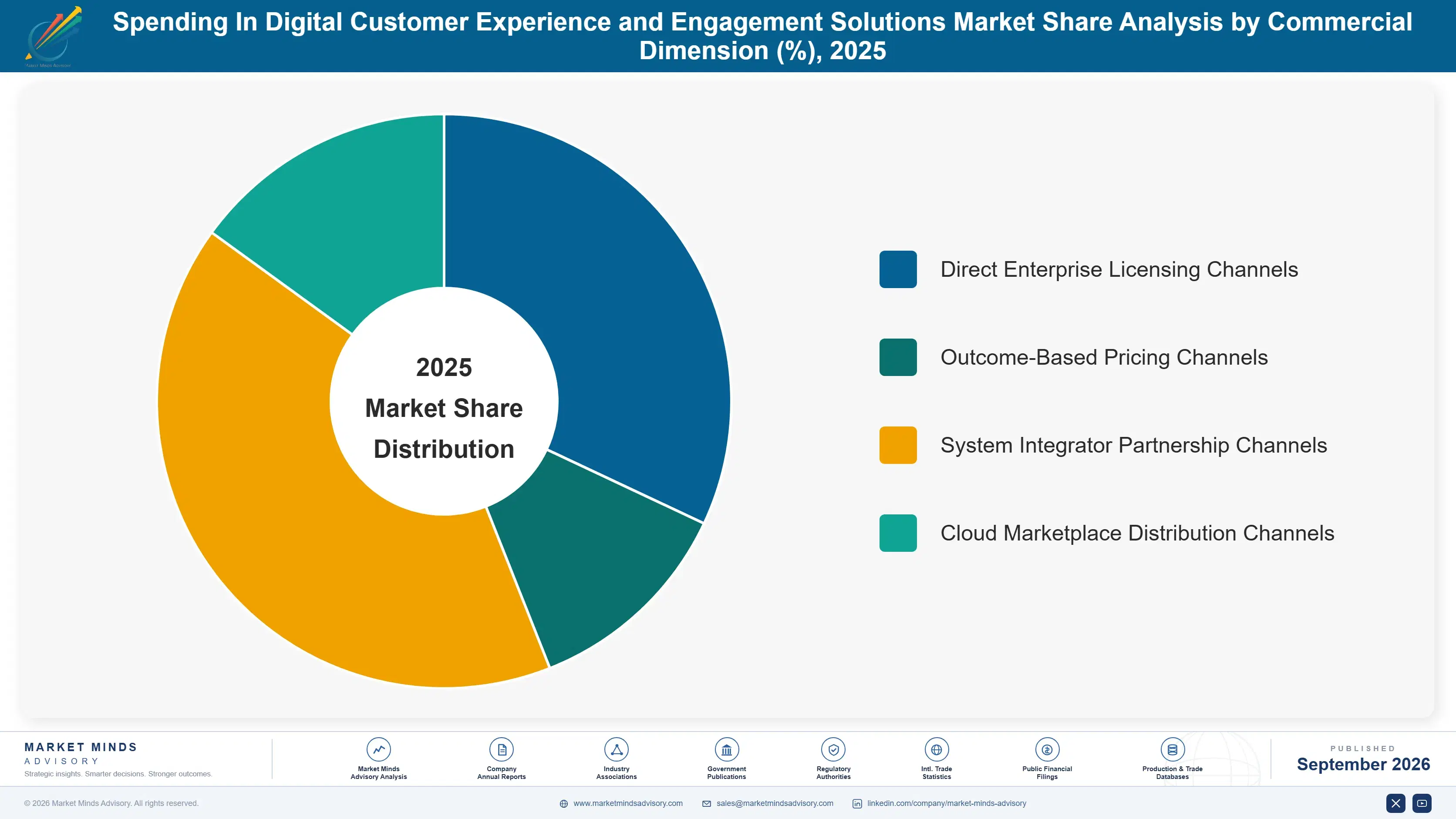
By Commercial Dimension

  • Direct Enterprise Licensing Channels
  • Outcome-Based Pricing Channels
  • System Integrator Partnership Channels
  • Cloud Marketplace Distribution Channels

By Region

  • North America
  • Western Europe
  • East Asia
  • South Asia and Pacific
  • Latin America
  • Middle East and Africa
  • Eastern Europe

Scope, Methodology, and Coverage

Every figure in this report is reproducible from documented input assumptions. The scope below maps the historical period, the forecast horizon, the segmentation dimensions, and the countries covered, alongside the underlying primary and qualitative methodology.
Historical Period
2020 to 2025
Forecast Period
2026 to 2036
Base Year
2025 (USD billions; MMA Primary Research Dataset, September 2026)
Market Definition
This report defines the Digital Customer Experience and Engagement Solutions Market as enterprise software spending on conversational platforms, customer data platforms, contact center software, and journey analytics. It excludes traditional advertising spend and physical in-store customer service technology.
Quantitative Units
USD billions, enterprise contract counts, and percentage share
Segmentation Dimensions
Product type, end-use industry, and commercial dimension
Regions Covered
North America, Western Europe, East Asia, South Asia and Pacific, Latin America, Middle East and Africa, Eastern Europe
Countries Covered
United States, India, Germany, China, United Kingdom, Brazil, and 21 additional countries
Key Companies Profiled
Salesforce, Adobe, Zendesk, Genesys, Twilio, and 15 additional companies
Quantitative Methodology
Primary survey, n=3,800 respondents, Q4 2025, six countries; demand-side model with trade association cross-validation
Qualitative Methodology
47 expert interviews, Q4 2025; applied to validate demand model assumptions, identify emerging dynamics, and assess competitive positioning
Report Format
PDF and XLSX data workbook (Word format preview document)
Publisher
Market Minds Advisory
Report Code
MMA-2026-TEC-230
Published
September 2026
Contact
sales@marketmindsadvisory.com | www.marketmindsadvisory.com

Purchase the full Spending In Digital Customer Experience and Engagement Solutions Market Report (2026 to 2036).

This report gives enterprise software leaders and CX strategy teams a complete view of the Digital Customer Experience and Engagement Solutions Market through 2036. It covers segment-level growth, regional demand shifts, and competitive positioning across conversational AI, data platform, and contact center product lines. Input cost exposure and margin architecture are analyzed in detail, with particular attention to how compute and model training costs are reshaping vendor pricing and consolidation across every major regional market. Readers get actionable guidance on where to concentrate commercial investment over the next decade of AI-driven transformation.
Ten-year global revenue and enterprise adoption forecasts
Seven-region demand, pricing, and adoption breakdown
Competitive benchmarking across the top twenty vendors
Compute cost exposure analysis and mitigation guidance
Segment-level margin architecture and pricing tier analysis
Anonymized client vendor selection engagement case study

Built For The People Who Decide

From boardroom strategy to bench-side execution, this report is read cover-to-cover by leaders shaping the next decade of their industry, turning demand scenarios, market dynamics and valuation benchmarks into decisions.
CXOs/ Presidents/ VPs/ Managers
M&A and Corporate Development
Strategy Teams and R&D Heads
Procurement and Product Directors
Regulatory and Compliance Leaders
Investor Relations and Equity Analysts