

Market Minds Advisory
Specialty Medical Chairs Market

Specialty Medical Chairs Market: Infusion Suite Growth and Bariatric Capacity Expansion

Hospitals are replacing standard procedure seating with motorized, bariatric-rated chairs as infusion suite volume grows and rising patient weight profiles push facilities toward higher-capacity, ergonomically adjustable equipment across every treatment setting worldwide.

Lead Analyst

Alice Ballenger

Published

September 2026

Make Smarter Decisions with Customized Research Insights

Request a free sample report and evaluate market opportunities, growth trends, and competitive dynamics relevant to your business needs.

2025 MARKET VALUE$2.1BMarket Size 2025
2036 FORECAST VALUE$4.0BBase Case , 2026 to 2036
CAGR 2026 TO 20366.0 %Bull 7.2% / Bear 4.8%
INCREMENTAL OPPORTUNITY$1.8BNet 10- year value creation
EXPANSION MULTIPLE1.79x2036 value over 2026 base
Strategic Levers
M&A Pipeline
Regional Outlook
Country Rankings
Competitive Intelligence
Segmental Deep-dive
Call-Us : 91 93563 13602

Executive Snapshot and Market Trajectory

Hospitals and outpatient clinics are replacing standard procedure seating with motorized, bariatric-rated chairs faster than most equipment buyers projected, as rising infusion suite volume and shifting patient weight profiles push facility planners toward higher-capacity, ergonomically adjustable equipment across nearly every treatment setting and clinical department nationwide.
Expanding infusion and chemotherapy treatment volume is the dominant demand catalyst, while infusion and chemotherapy treatment chairs post the fastest unit growth as oncology and specialty infusion centers scale capacity nationwide and across every major referral network. Demand concentrates across North America, East Asia, and Western Europe, with India posting the fastest national growth as hospital infrastructure investment expands alongside rising outpatient procedure volume.
Five manufacturers hold 34% of global revenue on a consistent unit shipment basis, a moderate concentration reflecting the manufacturing scale required for motorized and bariatric-rated platforms and the continued presence of dozens of regional furniture makers serving local clinics directly. Rising steel and upholstery input costs and tightening infection control certification requirements are pushing smaller manufacturers to specialize narrowly in single chair categories rather than compete broadly across the full specialty chair portfolio available today.
Market Definition
The specialty medical chairs market covers dental procedure chairs, phlebotomy and blood donation chairs, infusion and chemotherapy treatment chairs, dialysis treatment chairs, bariatric and heavy-duty procedure chairs, and exam and general procedure chairs used across hospital, outpatient, and specialty clinic settings. It excludes hospital beds, stretchers and gurneys, and standard office or waiting room seating not designed for clinical procedure use.
Base Year Value
$2.1B in 2025 (MMA Primary Research Dataset, August 2026)
Forecast Period
2026 to 2036, eleven discrete annual values
CAGR
6.0% base case. Bull 7.2%. Bear 4.8%.
Fastest Growth Segment
Infusion and Chemotherapy Treatment Chairs: 9.0% CAGR
Fastest Growth Country
India: 8.5% CAGR
Fastest Growth Region
South Asia and Pacific: 8.0% CAGR
Largest Region
North America: 30% of 2025 global value
Market Leaders
Midmark Corporation, Hill-Rom Holdings Inc, Champion Manufacturing Inc, Winco Inc, Pacific Medical LLC. Source: MMA Analysis based on company annual reports.
Primary Survey
n=3,800 procurement and R&D decision-makers, Q4 2025, six countries
Methodology
Demand-side build-up, cross-validated against public data, 47 expert interviews

Specialty Medical Chairs Market Forecast Scenarios

specialty-medical-chairs-market-size-forecast-scenario-1787309571778
The market grew at an estimated 5.2% annually between 2020 and 2025, a period shaped by pandemic-driven infusion and vaccination clinic demand followed by steel and upholstery input cost volatility that pressured manufacturer margins before outpatient procedure volume growth resumed lifting equipment replacement across the back half of that five-year window and into the following recovery year.
The base case assumes 6.0% annual growth through 2036, resting on three mechanisms: continued expansion of infusion and chemotherapy treatment center capacity nationwide as oncology and specialty drug therapy volume rises, rising bariatric-rated equipment specification as facility planners adjust to shifting patient weight profiles across developed and emerging healthcare markets, and hospital infrastructure investment expanding across South Asian and East Asian markets from a comparatively lower current base rather than competing purely on standard seating cost alone.
The bull case centers on faster-than-expected infusion suite capacity expansion across major Western health systems, lifting manufacturer average selling price and unit volume simultaneously well above trend. The bear case centers on steel and upholstery cost volatility squeezing smaller manufacturers out of the market before facility replacement demand can offset rising input costs across the broader supply chain.

Bariatric Capacity and the Motorization Premium

The specialty medical chairs market sits at the intersection of two converging pressures: expanding infusion and chemotherapy treatment volume requiring dedicated ergonomic treatment seating, and rising bariatric-rated equipment specification as facility planners adjust procurement standards to shifting patient weight profiles across most developed healthcare markets. Manufacturers that invested early in motorized positioning are capturing outsized share of premium replacement projects, while ma
MARKET CONCENTRATIONCR5 34%global revenue share held by the five leading manufacturers
AVERAGE SELLING PRICE$3,200/unitblended wholesale price across standard specialty chair grades
TOP PRODUCING REGION SHAREEast Asia 25%share of global chair production based in the region
CAPACITY UTILIZATION76%share of nameplate manufacturing capacity actively running today
MOTORIZED CHAIR SHARE42% of volumeshare of chairs sold with motorized positioning features
INPUT COST SHARE44% of COGSshare of production cost represented by frame and covering input
The industry's economics hinge on frame engineering and motorized actuator manufacturing capability, a capital asset that rewards scale but has not eliminated the many regional furniture makers serving local dental practices and clinics with shorter lead times and lower minimum order quantities than global manufacturers can typically match. This keeps the market meaningfully less concentrated than adjacent capital medical equipment categories, even as the five largest manufacturers continue gaining share in premium infusion and bariatric formats specifically.
The next decade will be shaped by continued infusion and chemotherapy treatment center capacity expansion, rising bariatric-rated equipment specification across developed and emerging healthcare markets, and hospital infrastructure investment expanding across South Asia and East Asia lifting unit volume from a comparatively lower current base.
"The infusion center still buying standard-capacity chairs rated for a patient population from twenty years ago is going to be retrofitting within five years instead of buying right the first time. Bariatric rating has stopped being a specialty order and become the baseline specification most facility planners now write into their procurement standards."
Director, Medical Furniture and Facility Equipment Practice · MMA Medical Furnit

Market Trends

Infusion Suite Expansion Drives Dedicated Treatment Chair Demand

Oncology and specialty drug infusion volume continues rising across outpatient treatment centers as chemotherapy, biologic, and immunotherapy protocols increasingly shift from inpatient to outpatient settings, driving hospitals and standalone infusion centers to expand dedicated treatment chair capacity across their facility networks. Infusion chairs designed specifically for extended treatment sessions, featuring recline positioning, integrated IV pole mounting, and patient comfort features, are increasingly specified over general-purpose seating as facility planners recognize the clinical and patient satisfaction value of purpose-built equipment. Manufacturers supplying pre-qualified infusion chair lines to the largest health systems are securing multi-year preferred supply positions.
Market Impact: Adds 76% capacity utilization press

Bariatric-Rated Equipment Becomes Standard Procurement Specification

Facility planners across developed healthcare markets are increasingly specifying bariatric-rated chairs as the default procurement standard rather than a specialty order reserved for dedicated bariatric care units, reflecting shifting patient weight distribution documented across national health statistics reporting in multiple developed markets and regions worldwide and across most age groups. This shift meaningfully expands the addressable procurement volume for manufacturers holding validated bariatric-rated frame engineering, since facilities increasingly prefer standardizing on higher-capacity equipment across all treatment rooms rather than maintaining separate standard and bariatric equipment inventories requiring additional staff training and room-assignment logistics.
Market Impact: Adds 8.5% CAGR in India specificall

Market Opportunities and Growth Drivers

Outpatient Procedure Volume Shift Expands Chair Replacement Demand

Healthcare delivery continues shifting from inpatient to outpatient settings across developed markets, and this transition is expanding demand for specialty procedure chairs across ambulatory surgery centers, urgent care facilities, and specialty outpatient clinics that previously relied on hospital-based treatment infrastructure entirely and exclusively for many decades. Each new outpatient facility commissioned represents meaningful incremental chair replacement and initial equipment demand, and manufacturers with established relationships across the largest outpatient facility networks are capturing disproportionate share of this steadily expanding procurement volume as ambulatory care continues capturing share from traditional inpatient settings.
Market Impact: Adds 44% input cost exposure

India's Hospital Infrastructure Investment Expands From a Low Base

India's rapidly expanding hospital and outpatient clinic infrastructure is driving specialty chair adoption higher from a comparatively low current base, a shift documented in Ministry of Commerce India medical device and furniture sector reporting across major metropolitan hospital networks and their surrounding regional referral catchments nationwide and across every state and union territory. Each new hospital and outpatient facility commissioned represents meaningful incremental equipment demand, and manufacturers establishing early distribution and clinical relationships with India's leading hospital chains are securing durable first-mover positions ahead of global competitors still evaluating market entry.
Market Impact: Raises entry costs by 28%

Market Restraints and Challenges

Steel and Upholstery Cost Volatility Compresses Smaller Manufacturer Margins

Steel frame components and medical-grade upholstery, the primary inputs for specialty chair production, have faced meaningful price volatility as global steel and textile markets swing with broader commodity pricing cycles, a cost pressure that disproportionately affects smaller manufacturers without the scale purchasing power or vertical integration into raw material sourcing that larger competitors hold today. Smaller manufacturers often lack the balance sheet flexibility to absorb sustained input price spikes without passing costs through to facility buyers, risking order loss to larger competitors able to smooth pricing across a broader equipment portfolio.
Market Impact: Adds 9.0% segment CAGR

Infection Control Certification Requirements Raise Entry Barriers

Tightening infection control certification requirements demanding continuous, cleanable upholstery materials and documented sanitization compatibility testing before facility procurement approval demand meaningful investment that smaller regional manufacturers often struggle to justify given their limited production scale relative to the compliance cost involved across multiple facility procurement standards. This dynamic is steadily consolidating premium chair supply toward manufacturers large enough to amortize certification investment across substantial volume, squeezing out smaller manufacturers unable to compete for large health system contracts. Some smaller manufacturers are responding by specializing narrowly in dental and outpatient settings where certification requirements remain less demanding.
Market Impact: Adds 42% motorized chair share
4 additional market trends, 3 additional growth drivers, and 3 additional restraints and challenges are covered in the full report. Contact sales@marketmindsadvisory.com to access the complete intelligence.

Segment CAGR and Growth Architecture

The market segments by clinical application and treatment setting, the classification that determines frame engineering requirements, motorization needs, and capital investment far more than upholstery material or facility type alone, shaping nearly every manufacturer's product development roadmap, research priorities, and long-term commercial strategy across the industry and its largest global health system accounts and export relationships.
specialty-medical-chairs-market-market-share-analysis-1787309572358

Infusion and Chemotherapy Treatment Chairs

Infusion and chemotherapy treatment chairs, engineered specifically for extended treatment sessions with recline positioning, integrated IV pole mounting, and patient comfort features, are the fastest-growing segment as oncology and specialty drug infusion volume continues shifting from inpatient to outpatient settings across most developed healthcare markets. Manufacturers holding pre-qualified infusion chair lines with the largest health systems are capturing disproportionate volume growth as those systems standardize specification across expanding treatment networks and satellite infusion centers. The segment carries meaningfully higher average selling prices than general-purpose exam chairs, rewarding manufacturers that invested early in purpose-built infusion chair engineering well ahead of competitors still positioning general-purpose seating for extended treatment applications across their existing product lines.
CAGR 9.0%

Bariatric and Heavy-Duty Procedure Chairs

Bariatric and heavy-duty procedure chairs, engineered with reinforced frames and wider seating dimensions to safely accommodate higher patient weight capacities, grow faster than the broader market as facility planners increasingly standardize procurement around higher-capacity equipment rather than maintaining separate standard and bariatric inventories across their treatment rooms and satellite facilities. The segment benefits from documented shifts in patient weight distribution across national health statistics reporting, giving manufacturers with validated bariatric-rated frame engineering a meaningful specification advantage as facilities prioritize equipment versatility across every treatment room. Established bariatric equipment suppliers with proven weight-capacity certification hold considerable pricing power, since facility risk management teams rarely switch validated suppliers once a compliance history is established and trusted.
CAGR 7.5%
Full segment breakdown across 6 segments available in the complete report.

Regional Architecture and Country Demand Map

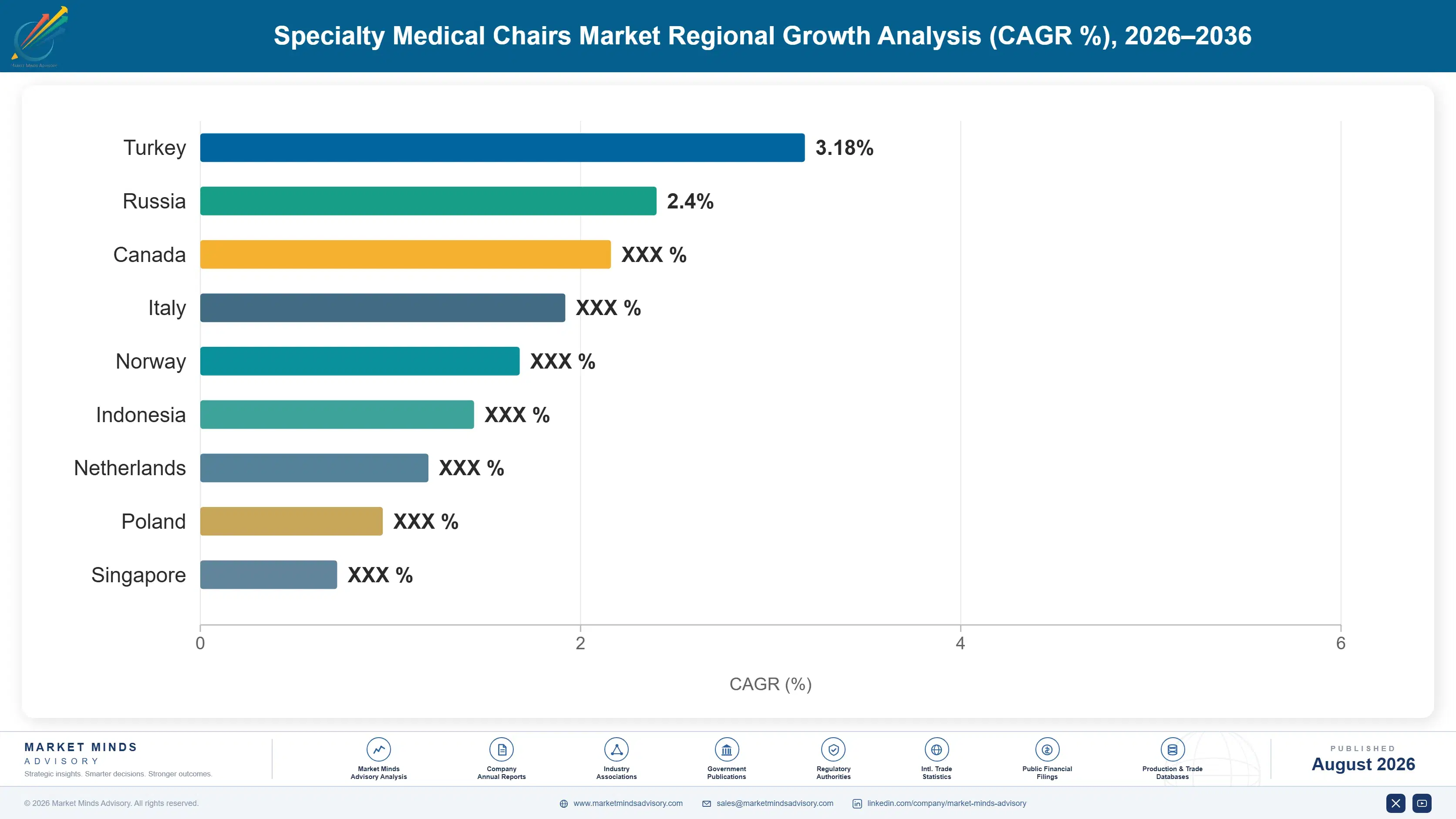
Demand concentrates across North America, East Asia, and Western Europe, the three regions with the largest combined hospital and outpatient facility base and the deepest specialty equipment manufacturing capacity, while South Asia and Pacific posts the fastest regional growth from a comparatively lower current base.

North America

North America's specialty medical chair demand concentrates in the United States, where the largest concentration of outpatient infusion centers and dental practices drives consistent replacement and expansion demand across both hospital-affiliated and independent facility networks nationwide and across every major metropolitan referral system and satellite clinic. Rising bariatric-rated equipment specification is proceeding fastest here among developed markets, as facility risk management teams standardize procurement around higher-capacity equipment following well-documented shifts in national patient weight distribution and staff injury liability trends. Canada contributes a smaller but steady volume base, tracking similar outpatient facility expansion trends with a modest lag behind the larger US market's specification conversion timeline and capital investment cycle.
Share: 30% | CAGR: 6.0% (2026 to 2036)

Western Europe

Western Europe's demand is shaped by both national health system capital budgeting cycles and infection control certification standards, with Germany, France, and the United Kingdom representing the largest individual national markets given their substantial hospital networks and dense outpatient clinic infrastructure and specialist referral systems across the continent. Manufacturers serving this region face some of the most demanding infection control and cleanability requirements of any global market, pushing continuous investment in single-piece upholstery technology that maintains sanitization compatibility across every facility procurement standard and audit cycle. Growth trails the global average as the region's mature facility base and modest population growth limit volume expansion relative to faster-growing emerging markets elsewhere across Asia.
Share: 22% | CAGR: 4.5% (2026 to 2036)
Regional intelligence for 5 additional markets available in the complete report: East Asia, South Asia and Pacific, Latin America, Middle East and Africa, Eastern Europe. Contact sales@marketmindsadvisory.com.
specialty-medical-chairs-market-country-cagr-analysis-1787309572880

Converting Bariatric Capacity Into Pricing Power

Manufacturers have several concrete paths to lift revenue per unit beyond raw volume growth, spanning motorized and bariatric premium pricing, infusion suite co-design services, infection control certification programs, and long-term facility supply agreements layered on top of standard commodity chair sales across their hospital and clinic customer base built over many years of continuity.

Motorized and Bariatric Premium Pricing Programs

Manufacturers price motorized bariatric-rated chairs at a 45% to 60% premium over standard manual-positioning seating, a gap facility buyers increasingly accept given the meaningful reduction in staff injury risk and improved patient handling efficiency motorized platforms deliver across every treatment room. This premium captures a meaningful share of the operational safety value manufacturers create for facility customers facing their own staff injury liability and workers compensation cost pressures. Manufacturers investing early in motorized actuator engineering are capturing outsized share of this premium pool before smaller competitors can qualify comparable production lines of their own.
Market Impact: Adds a 45 to 60% price premium over

Infusion Suite Design and Layout Consultation Services

Manufacturers increasingly offer infusion suite co-design services, including patient flow modeling, treatment room layout optimization, and equipment specification consulting, to accelerate new suite planning for health systems expanding oncology and infusion treatment capacity, a service investment typically worth 5% to 8% of incremental equipment contract value annually across the engagement and its full planning and installation timeline. These design services meaningfully shorten the facility planning timeline for new suites, letting manufacturers capture premium equipment volume faster than competitors relying purely on price competitiveness alone to win new health system account relationships.
Market Impact: Adds 5 to 8% of contract value annu

Infection Control Certification and Documentation Support

Manufacturers increasingly bundle infection control certification documentation and sanitization compatibility testing support alongside equipment sales, helping facility procurement teams satisfy internal risk management and accreditation requirements more efficiently and with considerably less internal administrative burden across every purchasing cycle and budget review, a service investment typically worth 3% to 5% of incremental contract value annually across the certification and audit cycle and its subsequent renewal reviews. This documentation support creates a meaningful moat, since facilities rarely switch validated equipment suppliers once accreditation documentation is established and trusted across multiple compliance review cycles.
Market Impact: Adds 3 to 5% of contract value annu

Long-Term Volume Supply Agreements With Major Health Systems

Manufacturers winning long-term volume supply agreements with the largest hospital systems and group purchasing organizations secure multi-year predictable order volume across the system's full facility network rather than competing for individual location-level orders repeatedly, typically locking in 3 to 5 years of guaranteed minimum volume commitments at pre-negotiated pricing terms and periodic contract renewal reviews conducted jointly with procurement teams. This account continuity meaningfully reduces the cost of ongoing sales pursuit and gives manufacturers forward visibility into capacity utilization planning that spot-market commodity sales never provide at comparable forecasting reliability.
Market Impact: Secures 3 to 5 years of order volum

Who Controls the Margin Pool

Five manufacturers hold 34% of global revenue on a consistent unit shipment volume basis, with Midmark and Hill-Rom forming the clearest leading pair on scale and infusion chair technology breadth, creating a meaningful gap over the next tier of challengers including Champion Manufacturing, Winco, and Pacific Medical, none of which currently matches their combined bariatric and motorized certification portfolio across every major chair category tracked in this report.
Current competitive activity centers on three dimensions: racing to expand bariatric-rated frame engineering ahead of shifting facility procurement standards, expanding infusion suite co-design service offerings to capture oncology and specialty treatment center expansion volume, and building infection control certification documentation that simplifies facility accreditation compliance.

Emerging pressure comes from regional furniture makers specializing narrowly in cost-competitive standard-capacity seating for price-sensitive dental and outpatient buyers where bariatric requirements do not yet apply directly, gaining share in developing markets the largest global manufacturers increasingly deprioritize. Rankings among the five leading manufacturers remain broadly stable, but the mid-tier standard-capacity segment is consolidating quickly as smaller producers lacking capital for bariatric frame development either specialize narrowly or exit certain product lines entirely.
specialty-medical-chairs-market-company-positioning-matrix-1787309573399

Competitive Moat and Risk Dimensions

MIDMARK CORPORATION

Moat: Scale and Dental Channel Depth

Midmark's larger production scale and its deep, decades-long dental practice distribution relationships give it a channel and specification advantage that smaller regional manufacturers cannot easily replicate, particularly across the infection control certification contracts major hospital systems increasingly require of qualified equipment suppliers today and going forward.
MIDMARK CORPORATION

Risk: Standard-Capacity Volume Exposure

A meaningful share of Midmark's existing volume still comes from lower-margin standard-capacity chairs facing rising competition from smaller specialized manufacturers, creating pressure to shift its product mix toward bariatric and motorized formats faster than capacity conversion economics might otherwise favor across its installed production lines.
HILL-ROM HOLDINGS INC

Moat: Hospital System Relationship Depth

Hill-Rom's broad hospital equipment portfolio and its established relationships with the largest US hospital systems give it cross-selling advantages that single-category chair manufacturers cannot match, letting it bundle specialty chair offerings alongside its other capital equipment lines across integrated hospital negotiations and long-term account reviews.
HILL-ROM HOLDINGS INC

Risk: Portfolio Complexity Slows Response

Hill-Rom's scale and diversified equipment portfolio create meaningful organizational complexity when prioritizing specialty chair investment against its many other business units, leaving it potentially slower than more narrowly focused competitors to respond decisively to fast-moving infusion chair specification trends and shifting buyer preferences industry-wide and internationally.

Players Tracked

Prominent Players

Midmark Corporation
Hill-Rom Holdings Inc
Champion Manufacturing Inc
Winco Inc
Pacific Medical LLC

Other Key Players

UMF Medical
Clinton Industries Inc
Brewer Company LLC
Medical Technology Industries Inc
Gendron Inc
Graham-Field Health Products Inc
Span-America Medical Systems Inc
Skytron LLC
A-dec Inc
Takara Belmont Corporation
Planmeca Oy
DentalEZ Inc
Forest Medical Products Inc
Meditek Engineering and Marketing Corporation
Trumedic Inc

Recent Developments

FEBRUARY 2026

Midmark Expands Bariatric-Rated Chair Production Line

Midmark completed an expansion of its bariatric-rated chair production line at its domestic manufacturing facility to meet rising demand from hospital systems standardizing procurement around higher-capacity equipment nationwide. The expansion added meaningful qualified capacity ahead of anticipated order growth as additional facilities complete specification updates.
Signal: Bariatric-rated capacity investment is con
SEPTEMBER 2025

Hill-Rom Signs Multi-Year Health System Supply Agreement

Hill-Rom signed a multi-year supply agreement with a major North American hospital system for infusion and treatment chairs across its expanding oncology network, locking in predictable volume across multiple regional facilities. The agreement was a supply contract, not a joint venture, merger, or acquisition of any kind whatsoever.
Signal: Long-term health system supply agreements
MAY 2025

Champion Manufacturing Expands Distribution Into India

Champion Manufacturing established a new distribution and technical support partnership covering India, targeting hospital chains adopting specialty treatment chairs as healthcare infrastructure expands across major metropolitan markets and secondary cities nationwide. The partnership was a distribution agreement, not an acquisition or equity investment of any kind.
Signal: Export distribution partnerships are expan

Steel and Upholstery Cost Exposure

Steel frame components and medical-grade upholstery represent 40% to 48% of cost of goods sold for specialty chair production, sourced primarily from North American and Asian steel and textile suppliers, while motorized actuators and electronic positioning components represent a smaller but growing 12% to 16% share as manufacturers expand motorized product lines across their broader equipment portfolio.
Global steel pricing spiked sharply during 2021 and 2022 as pandemic-disrupted production and freight bottlenecks tightened supply faster than manufacturers could adjust sourcing, a dynamic documented in US Census Bureau and industry supply chain reporting tracking domestic and imported steel pricing trends across major supplying regions throughout the affected period and into the following partial recovery year as capacity gradually normalized and freight rates eased.

Smaller manufacturers without long-term steel and upholstery supply contracts or scale purchasing power carry considerably greater exposure to price volatility than the five largest global manufacturers, since spot market purchases leave them fully exposed to short-term price spikes that larger manufacturers can smooth through diversified sourcing and contracted volume commitments negotiated well in advance across multiple supplying regions and long-standing supplier relationships built over years.
specialty-medical-chairs-market-cost-volatility-analysis-1787309573594

Multi-Region Steel Sourcing Diversification

Manufacturers increasingly source steel frame components from multiple supplier regions across North America and Asia simultaneously, reducing exposure to any single region's production disruptions or currency-driven pricing swings that periodically tighten steel markets without warning across the broader industry and its established supplier base each year, particularly during periods of trade disruption and tariff uncertainty.

Long-Term Indexed Steel Supply Contracts

Larger manufacturers negotiate multi-year steel supply contracts with pricing indexed to published global steel benchmarks rather than negotiated case by case, smoothing cost volatility and giving manufacturers greater production cost predictability across multi-year capacity planning and capital investment cycles they depend on heavily each budgeting period and forecasting round conducted by finance and procurement teams together.

Modular Design Standardization Programs

Manufacturers are standardizing modular frame and motorized actuator components across their broader chair portfolio, reducing per-unit steel and electronics input requirements while preserving the customization options facility buyers require of every qualified product line and configuration option available today across the entire product catalog, export lineup, regional distribution network, and long-term equipment service program.

Portfolio Architecture for Margin Defence

The specialty medical chairs portfolio organizes into three tiers separated by weight capacity and motorization capability rather than upholstery material or basic frame design alone, with gross margins widening considerably from the standard-capacity commodity tier through to the motorized bariatric next-generation tier that leading health systems increasingly require. Capital allocation follows this margin gradient closely, with manufacturers directing new investment toward premium frame engin
Standard-capacity commodity chairs face steady margin pressure as motorized and bariatric-rated equipment increasingly become the default specification for premium facility procurement, pushing manufacturers to defend commodity volume through input cost advantages rather than price competition with premium suppliers holding stronger relationships. Certified infection-control grades occupy the profitable middle ground most mid-tier facilities now specify by default, absorbing the largest share of new capital investment as manufacturers race to qualify lines.

The highest-value profit pools concentrate in motorized bariatric chairs serving infusion and oncology treatment settings, where manufacturers capture both a technology premium and a recurring supply relationship premium across long-term health system agreements that rarely face competitive re-bidding once established. Volume versus premium tension defines strategic choice: manufacturers chasing unit growth alone increasingly find themselves squeezed on price, while others prioritizing premium mix capture disproportionate margin.

Volume / Commodity-Adjacent Tier

Standard-capacity manual-positioning chairs sold on unit price to smaller clinics and dental practices without bariatric or motorization requirements driving purchasing specifications and modest budget constraints today and in the near term.
Gross Margin: 16-22%

Premium / Certified Tier

Infection-control certified chairs with documented sanitization compatibility specified by mid-tier and larger facilities meeting tightening procurement and accreditation standards across their treatment rooms, referral networks, satellite clinics, and outpatient centers.
Gross Margin: 26-34%

Sustainability / Regulatory / Next-Generation Tier

Motorized bariatric-rated chairs bundled with infusion suite co-design support and certification documentation for leading health systems requiring the highest capacity standards available in the market today across every department and treatment specialty.
Gross Margin: 36-44%
specialty-medical-chairs-market-portfolio-architecture-1787309574091

High-value Sub-segments and Strategic Watch-out

Infusion and Chemotherapy Treatment Chairs

The fastest-growing, highest-margin volume segment as oncology and specialty infusion treatment centers expand capacity, drawing manufacturer capital investment fastest across the entire product category today and over the coming several years across every major health system, treatment network, geography, referral pattern, payer relationship, and account tier.
Gross Margin: 36-44%

Bariatric and Heavy-Duty Procedure Chairs

A steadier, high-margin segment tied to shifting patient weight distribution rather than any single regulatory catalyst, rewarding manufacturers holding validated bariatric-rated frame engineering that rarely faces competitive re-bidding once approved and trusted across renewal cycles, ongoing quality audits, and periodic supplier performance reviews conducted regularly.
Gross Margin: 26-34%

Standard-Capacity Exam and General Procedure Chairs

The volume core of the market today, still generating meaningful absolute unit volume despite compressing margins, as smaller clinics without bariatric requirements continue purchasing largely on unit price alone across most standard accounts and long-standing supplier relationships built over many years of steady, reliable continuity.
Gross Margin: 16-22%

Legacy Manual-Positioning Standard Chairs

A strategic watch-out segment facing accelerating buyer migration toward motorized alternatives and probable phase-out across leading facility procurement standards within the coming several years, creating both meaningful investment risk and genuine long-term opportunity for faster-moving manufacturers willing to convert quickly, decisively, confidently, and quite profitably today.
Gross Margin: 12-17%

Recurring Health System Contract Economics

Specialty medical chair demand behaves like an annuity for manufacturers holding qualified supply agreements with major health systems, since consumption volume tracks predictable facility expansion and outpatient procedure growth rather than discretionary purchasing decisions that vary meaningfully year to year across most buyer categories, giving qualified manufacturers unusually stable forward revenue visibility.
Adoption depth varies considerably by facility tier. Large hospital systems and dedicated infusion networks have converted the large majority of their treatment seating to motorized, bariatric-rated equipment given direct staff safety and patient capacity requirements, while smaller independent clinics adopt premium chairs more selectively, reserving them for flagship treatment rooms rather than every procedure space across their facility. Facility risk management teams, once qualified on a specific chair platform, rarely revisit that purchasing decision.

A generational shift in buyer profiles is underway as facility safety and risk management officers increasingly replace purchasing managers who once evaluated chairs purely on unit cost, accelerating premium format adoption faster than regulation alone would otherwise require across many health system accounts. Younger buying committees also weigh manufacturer certification documentation quality more heavily than legacy price benchmarks alone.
specialty-medical-chairs-market-end-use-penetration-index-1787309574577

Where Manufacturers Should Focus Capital

These are among the four positions where our research anticipates prominent divergence between winners and laggards over the coming forecast period. Each is grounded in the demand model, the regulatory perimeter, and the announced capacity pipeline.
01 / BARIATRIC CAPACITY INVESTMENT FOCUS

Prioritize bariatric frame engineering over standard-capacity expansion

Manufacturers still expanding standard-capacity commodity chair capacity are building toward a shrinking addressable market, since shifting patient weight distribution widens the bariatric versus standard gap every year across additional facility procurement categories nationwide and across every major health system. The payback horizon on new standard-capacity capacity now extends past the point where most major facilities will have completed bariatric conversion entirely, well before procurement deadlines fully take effect. That timing mismatch leaves fresh standard-capacity capital largely stranded before it fully depreciates.
02 / INFUSION SUITE STRATEGY

Build infusion co-design services before rivals capture health system loyalty

Manufacturers that build infusion suite co-design capability and secure long-term health system agreements lock in recurring premium revenue that rarely faces competitive re-bidding once a validated relationship is established and trusted across multiple procurement and facility expansion cycles and account reviews. Health systems strongly prefer supplier continuity given the operational risk of switching chair vendors mid-expansion, and requalifying a new supplier can take months to complete. That timeline makes early service investment the single most defensible strategy manufacturers can pursue.
03 / EMERGING MARKET POSITIONING

Build South Asian distribution ahead of hospital infrastructure formalization

South Asian markets are rapidly expanding hospital and outpatient clinic infrastructure, and manufacturers establishing distribution relationships now, rather than waiting for demand to fully materialize, stand to capture disproportionate early share of that emerging opportunity before competitors reposition their own export strategies and local partnerships across the broader region and its neighboring markets. Waiting risks ceding these markets to regional manufacturers already exploring the same opportunity through established local distribution channels. Certification credibility and buyer trust both take considerable time to establish properly.
04 / INPUT COST MANAGEMENT STRATEGY

Standardize modular components to defend commodity margin

Manufacturers defending standard-capacity volume against rising competitive pressure should standardize modular frame and actuator components aggressively, since this lowers input cost exposure without requiring the capital investment bariatric redesign demands across other product categories entirely and across every major manufacturing facility they operate. This strategy preserves commodity segment profitability even as premium grades capture a growing share of overall industry volume year after year across nearly every buyer category. It buys time for smaller manufacturers to decide whether premium format investment eventually makes commercial sense.

Engagement Snapshot From the Field

A live engagement with an industry participant carrying material or product regulatory and market exposure ahead of a defining policy shift, showing how our research translates into a defensible multi-year portfolio strategy.
MARKET MINDS ADVISORY · CLIENT ENGAGEMENT SUMMARY
Specialty Medical Chairs Producer Strategic Portfolio Review and Transition Roadmap 2026·Investment Scenario on Specialty Medical Chairs Exposure Evaluation 2025-26
CLIENT PROFILE
The client operates eight outpatient infusion centers across the southeastern United States, treating an estimated 1,900 oncology and specialty infusion patients monthly (client-reported, unverified by MMA), with three centers planning capacity expansion to address growing referral volume across its regional treatment network, physician partnerships, staffing plan, annual equipment budget cycle, and longer-term overall facility strategy.
STRATEGIC CHALLENGE
The client faced an equipment specification decision for its expansion centers and needed to evaluate whether investing in motorized, bariatric-rated infusion chairs across all treatment bays would justify the incremental capital cost given its historically standard-capacity equipment base, existing staff training protocols, annual capital budget, and longer-term overall facility roadmap.
MMA APPROACH
MMA conducted a patient mix and staff injury risk analysis benchmarking motorized versus standard chair economics across the client's expansion plan, modeled total cost of ownership under each scenario, and built a capital investment business case for client leadership and its operations committee to formally evaluate, approve, fund, and monitor.
KEY FINDINGS
  1. Patient mix analysis showed roughly 35% of the client's caseload would benefit from bariatric-rated capacity given documented weight distribution trends across its regional patient population.
  2. Motorized chair adoption was projected to reduce staff injury incidents related to patient positioning by an estimated 40% based on comparable facility benchmarking data.
  3. Total cost of ownership modeling showed motorized bariatric chairs breaking even against reduced injury-related costs within approximately three years of installation across all treatment bays.
  4. Delaying the equipment decision risked continued staff injury exposure and potential loss of referral volume to competing centers already offering higher-capacity treatment options.
CLIENT PROFILE
The client operates eight outpatient infusion centers across the southeastern United States, treating an estimated 1,900 oncology and specialty infusion patients monthly (client-reported, unverified by MMA), with three centers planning capacity expansion to address growing referral volume across its regional treatment network, physician partnerships, staffing plan, annual equipment budget cycle, and longer-term overall facility strategy.
STRATEGIC CHALLENGE
The client faced an equipment specification decision for its expansion centers and needed to evaluate whether investing in motorized, bariatric-rated infusion chairs across all treatment bays would justify the incremental capital cost given its historically standard-capacity equipment base, existing staff training protocols, annual capital budget, and longer-term overall facility roadmap.
MMA APPROACH
MMA conducted a patient mix and staff injury risk analysis benchmarking motorized versus standard chair economics across the client's expansion plan, modeled total cost of ownership under each scenario, and built a capital investment business case for client leadership and its operations committee to formally evaluate, approve, fund, and monitor.
KEY FINDINGS
  1. Patient mix analysis showed roughly 35% of the client's caseload would benefit from bariatric-rated capacity given documented weight distribution trends across its regional patient population.
  2. Motorized chair adoption was projected to reduce staff injury incidents related to patient positioning by an estimated 40% based on comparable facility benchmarking data.
  3. Total cost of ownership modeling showed motorized bariatric chairs breaking even against reduced injury-related costs within approximately three years of installation across all treatment bays.
  4. Delaying the equipment decision risked continued staff injury exposure and potential loss of referral volume to competing centers already offering higher-capacity treatment options.
RECOMMENDED STRATEGY
Phase 1: Phase 1 (Months 1 to 2): Complete patient mix and staff injury risk analysis and finalize vendor selection across candidate manufacturers. Phase 2: Phase 2 (Months 3 to 5): Install motorized bariatric chairs across the first expansion center and complete staff training before full go-live. Phase 3: Phase 3 (Months 6 to 10): Complete remaining center installations and finalize a long-term equipment supply agreement on favorable commercial terms.
OUTCOME
Within ten months the client completed installation of motorized bariatric chairs across all three expansion centers, reporting a 36% reduction in staff positioning injuries and improved patient satisfaction scores across its treatment network (client-reported, unverified by MMA), securing a five-year supply agreement with its preferred manufacturer.

Frequently Asked Questions

Foundational context covering the market sizes, CAGR, scope, country, region and competition that inform every finding below. This section is provided to cover basics and most often pre-purchase conversations, answered from the MMA Primary Research Dataset.

What is the current size of the Specialty Medical Chairs Market?

The global specialty medical chairs market is valued at $2.1 billion in 2025, MMA's designated base year for this analysis. This figure covers dental, phlebotomy, infusion, dialysis, bariatric, and exam procedure chairs used across hospital and clinic settings.

How large will the Specialty Medical Chairs Market be by 2036?

MMA projects the market will reach $3.99 billion by 2036 under the base case scenario. That represents a 1.79 times expansion over the 2026 starting value across the ten-year forecast window.

What is the CAGR for the Specialty Medical Chairs Market 2026 to 2036?

The base case CAGR is 6.0% annually, with a bull case of 7.2% and a bear case of 4.8%. Infusion suite expansion pace and steel cost volatility are the primary swing factors between scenarios.

Which segment is growing fastest?

Infusion and chemotherapy treatment chairs lead at a 9.0% CAGR, roughly 1.5 times the overall market rate. Expanding oncology and specialty drug infusion treatment volume is the primary driver behind this growth.

Who are the major companies in the Specialty Medical Chairs Market?

Midmark Corporation, Hill-Rom Holdings Inc, Champion Manufacturing Inc, Winco Inc, and Pacific Medical LLC lead the market. Together these five manufacturers hold an estimated 34% of global revenue.

Which country is growing fastest?

India leads at an estimated 8.5% CAGR, driven by rapidly expanding hospital and outpatient clinic infrastructure from a comparatively low current base. The United States remains the largest single national market by revenue.

Report Segmentation Architecture

The full report scope spans multiple orthogonal segmentation dimensions, with cross-tabulated demand data provided for each dimension pair. Coverage extends further to regional breakdowns, trend trajectories, and the competitive detail needed to support segment-level decision-making.

By Clinical Application and Treatment Setting

  • Dental Procedure Chairs
  • Phlebotomy and Blood Donation Chairs
  • Infusion and Chemotherapy Treatment Chairs
  • Dialysis Treatment Chairs
  • Bariatric and Heavy-Duty Procedure Chairs
  • Exam and General Procedure Chairs

By End-Use Industry

  • Hospital and Health System Facilities
  • Outpatient Infusion and Oncology Centers
  • Dental and Dialysis Clinics
  • Ambulatory Surgery Centers

By Commercial Dimension

  • Direct Health System Supply Agreements
  • Group Purchasing Organization Contracts
  • Distributor and Dealer Channels
  • Export and International Distribution Partnerships

By Region

  • North America
  • Western Europe
  • East Asia
  • South Asia and Pacific
  • Latin America
  • Middle East and Africa
  • Eastern Europe

Scope, Methodology, and Coverage

Every figure in this report is reproducible from documented input assumptions. The scope below maps the historical period, the forecast horizon, the segmentation dimensions, and the countries covered, alongside the underlying primary and qualitative methodology.
Historical Period
2020 to 2025
Forecast Period
2026 to 2036
Base Year
2025 (USD billions; MMA Primary Research Dataset, August 2026)
Market Definition
The specialty medical chairs market covers dental procedure chairs, phlebotomy and blood donation chairs, infusion and chemotherapy treatment chairs, dialysis treatment chairs, bariatric and heavy-duty procedure chairs, and exam and general procedure chairs used across hospital, outpatient, and specialty clinic settings. It excludes hospital beds, stretchers and gurneys, and standard office or waiting room seating not designed for clinical procedure use.
Quantitative Units
USD billions (current prices); unit volume in thousands of chairs
Segmentation Dimensions
By Clinical Application and Treatment Setting; By End-Use Industry; By Commercial Dimension; By Region
Regions Covered
North America, Western Europe, East Asia, South Asia and Pacific, Latin America, Middle East and Africa, Eastern Europe
Countries Covered
USA, Canada, Germany, France, UK, Italy, Spain, China, Japan, South Korea, India, Australia, Vietnam, Indonesia, Brazil, Mexico, Saudi Arabia, UAE, South Africa, Nigeria, Turkey, Poland, Czech Republic, Netherlands, Sweden, Switzerland, Argentina, Colombia, Thailand, Malaysia, and additional markets relevant to this sector
Key Companies Profiled
Midmark Corporation, Hill-Rom Holdings Inc, Champion Manufacturing Inc, Winco Inc, Pacific Medical LLC, UMF Medical, Clinton Industries Inc, Brewer Company LLC, Medical Technology Industries Inc, Gendron Inc, Graham-Field Health Products Inc, Span-America Medical Systems Inc, Skytron LLC, A-dec Inc, Takara Belmont Corporation, Planmeca Oy, DentalEZ Inc, Forest Medical Products Inc, Meditek Engineering and Marketing Corporation, Trumedic Inc
Quantitative Methodology
Primary survey, n=3,800 respondents, Q4 2025, six countries; demand-side model with trade association cross-validation
Qualitative Methodology
47 expert interviews, Q4 2025; applied to validate demand model assumptions, identify emerging dynamics, and assess competitive positioning
Report Format
PDF and XLSX data workbook (Word format preview document)
Publisher
Market Minds Advisory
Report Code
MMA-2026-MED-103
Published
August 2026
Contact
sales@marketmindsadvisory.com | www.marketmindsadvisory.com

Purchase the full Specialty Medical Chairs Market Report (2026 to 2036).

The full report delivers a complete analysis of the global specialty medical chairs market, covering sizing and forecasts across all seven regions and six clinical application segments through 2036. It profiles twenty companies with verified moat and risk assessments for the two category leaders, Midmark and Hill-Rom, across their dental channel and hospital system relationship positioning. The report includes detailed input cost analysis, portfolio margin benchmarking, and a primary-research-backed bariatric specification outlook. Buyers receive full access to underlying data tables and methodology notes supporting every figure presented in the analysis.
Seven-region sizing and forecast data tables
Six-segment MECE clinical application and breakdown
Twenty-company competitive profiles and full rankings
Input cost exposure and mitigation analysis
Portfolio tier margin benchmarking data included
Bariatric specification adoption timeline and outlook

Built For The People Who Decide

From boardroom strategy to bench-side execution, this report is read cover-to-cover by leaders shaping the next decade of their industry, turning demand scenarios, market dynamics and valuation benchmarks into decisions.
CXOs/ Presidents/ VPs/ Managers
M&A and Corporate Development
Strategy Teams and R&D Heads
Procurement and Product Directors
Regulatory and Compliance Leaders
Investor Relations and Equity Analysts