

Market Minds Advisory
Specialty Control Plasma Market

Specialty Control Plasma Market: Rare Donor Supply, Accreditation Demand and the Instrument-Matched Lock

Nobody buys quality control material because they want it, which is why a forty-dollar vial of rare donor plasma sells on accreditation rules and analyser compatibility rather than on anything resembling preference.

Lead Analyst

Alice Ballenger

Published

September 2026

Make Smarter Decisions with Customized Research Insights

Request a free sample report and evaluate market opportunities, growth trends, and competitive dynamics relevant to your business needs.

2025 MARKET VALUE$0.3BMarket Size 2025
2036 FORECAST VALUE$0.7BBase Case , 2026 to 2036
CAGR 2026 TO 20366.4 %Bull 7.6% / Bear 5.2%
INCREMENTAL OPPORTUNITY$0.3BNet 10- year value creation
EXPANSION MULTIPLE1.86x2036 value over 2026 base
Strategic Levers
M&A Pipeline
Regional Outlook
Country Rankings
Competitive Intelligence
Segmental Deep-dive
Call-Us : 91 93563 13602

Executive Snapshot and Market Trajectory

Demand here is created by regulation, not by clinical need. A laboratory runs control plasma because its accreditation body requires documented performance verification at stated intervals, and roughly 74% of purchases exist for exactly that reason rather than because anybody wanted the material. That makes the demand curve unusually predictable.
Specialty haemostasis calibrators compound at 9.6%, exactly 1.50 times the market, as anticoagulant and anti-Xa measurement moves from reference laboratories into routine hospital haemostasis. North America holds 29% of spend, driven by accreditation regimes mandating third-party control material at frequencies other systems do not require. Average vial pricing sits near USD 42 on laboratory contract. Testing sites, not sample numbers, are what this category actually counts. Asian accreditation growth is adding sites quickly.
Five suppliers ship 71% of vials, and the position rests on analyser compatibility as much as on material quality. Roughly 68% of controls are supplied by the same company that made the coagulation analyser, which converts an instrument placement into a consumable annuity nobody bids against. Source plasma from rare donors, particularly factor-deficient material, accounts for 31% of delivered cost and cannot simply be manufactured to order.
Market Definition
Covers quality control plasmas, calibrators and reference materials used to verify performance of coagulation and specialty haemostasis assays, spanning normal and abnormal coagulation controls, factor-deficient plasmas, lupus anticoagulant and antiphospholipid controls, specialty haemostasis calibrators for heparin, direct oral anticoagulant and anti-Xa measurement, von Willebrand and platelet function controls, and thrombophilia marker controls. Sizing is at laboratory realised price per vial. Excludes diagnostic reagents used to generate patient results, coagulation analysers, therapeutic plasma products, blood grouping controls and general clinical chemistry quality control materials.
Base Year Value
$0.3B in 2025 (MMA Primary Research Dataset, August 2026)
Forecast Period
2026 to 2036, eleven discrete annual values
CAGR
6.4% base case. Bull 7.6%. Bear 5.2%.
Fastest Growth Segment
Specialty Haemostasis Calibrators: 9.6% CAGR
Fastest Growth Country
India: 9.2% CAGR
Fastest Growth Region
South Asia and Pacific: 8.6% CAGR
Largest Region
North America: 29% of 2025 global value
Market Leaders
Werfen, Siemens Healthineers, Bio-Rad Laboratories, Technoclone, HYPHEN BioMed. Source: MMA Analysis based on company annual reports.
Primary Survey
n=3,800 procurement and R&D decision-makers, Q4 2025, six countries
Methodology
Demand-side build-up, cross-validated against public data, 47 expert interviews

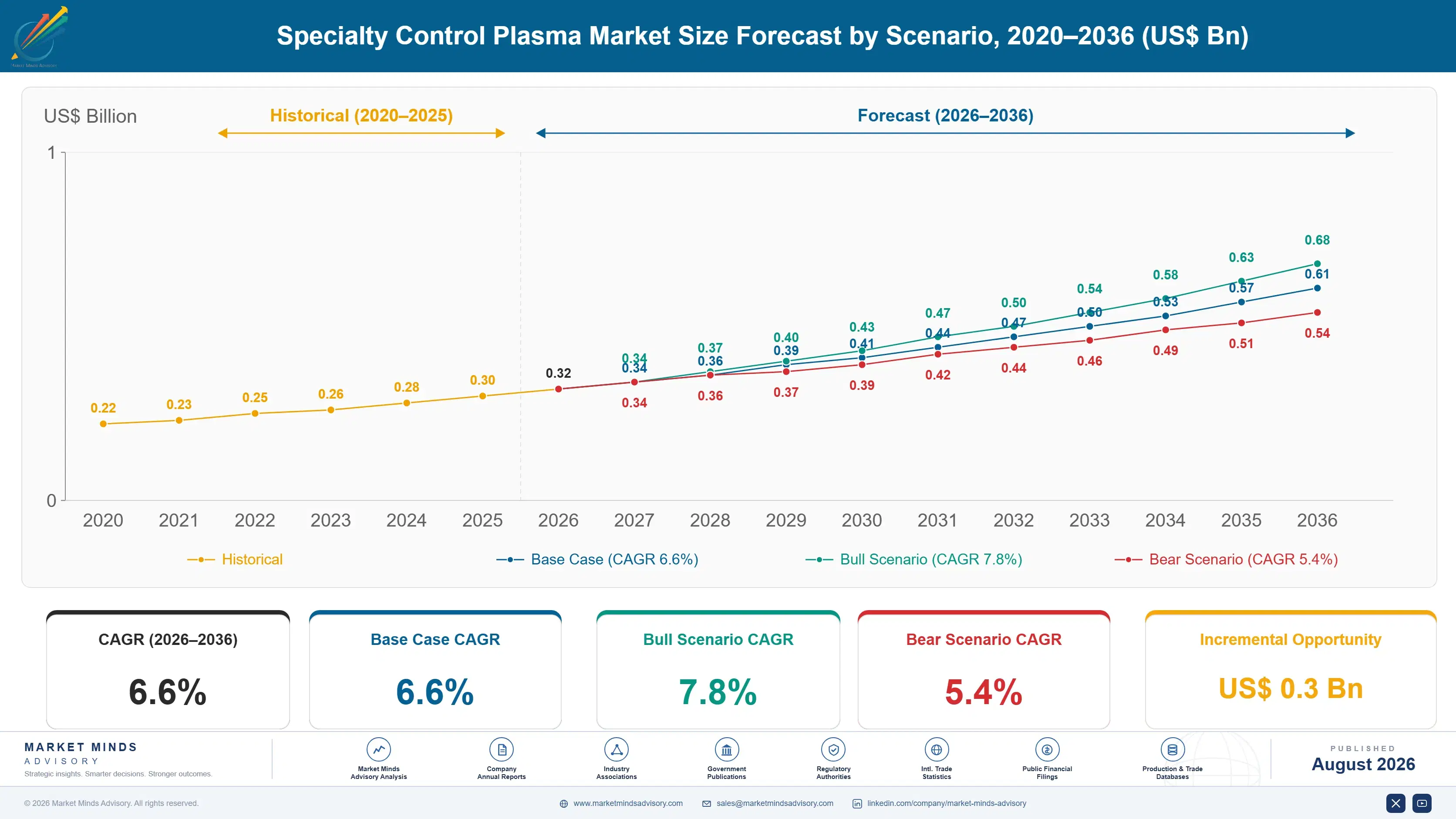
Specialty Control Plasma Market Forecast Scenarios

specialty-control-plasma-market-size-forecast-scenario-1787309283804
Category revenue grew steadily across 2020 to 2025 as coagulation testing volume expanded alongside rising surgical case volume and growing anticoagulant therapy monitoring requirements across major healthcare systems. Growth decelerated briefly in 2021 amid deferred elective procedures during the pandemic before resuming its prior trajectory through the remainder of the historical period into 2025. Reference laboratory networks led this early testing volume expansion.
The base case assumes continued mid-single-digit growth in multi-analyte combination product adoption, expanding laboratory accreditation requirements across emerging markets, and steady replacement demand as labs standardize daily quality control protocols across analyzer platforms and instrument brands. Laboratory budget cycles, accreditation documentation complexity, and instrument platform compatibility remain the binding constraints on faster diffusion across smaller independent laboratories still building formal quality management systems. Regional distribution partnerships continue expanding to reach these smaller sites gradually.
The bull case rests on expanding accreditation requirements across emerging markets pulling forward laboratory quality assurance investment industry-wide and accelerating premium product conversion. The bear case centers on laboratory budget consolidation pressure among smaller independent labs, which could compress purchasing volume and depress category growth through the middle of the forecast period nationwide. Manufacturers are watching both scenarios closely as requirements evolve nationwide.

Why Accreditation Rules Set the Demand Curve

This category exists because somebody wrote a rule. A haemostasis laboratory verifies assay performance using control material at frequencies its accreditation body specifies, documents the results and keeps them for inspection, and roughly 74% of purchasing exists to satisfy that obligation. Nothing about it improves a patient result directly. The consequence is demand almost detached from clinical volume: a laboratory running half its usual samples still runs the same controls, which is why th
TOP FIVE CONCENTRATION71%Vials shipped by the leading control material suppliers
AVERAGE VIAL PRICEUSD 42Laboratory contract price per single lyophilised control vial
SOURCE PLASMA COST SHARE31%Donor plasma share within delivered control material cost
INSTRUMENT-MATCHED SHARE68%Controls supplied by the analyser maker rather than independently
LOT CHANGEOVER FREQUENCY2.8 per yearControl lot transitions requiring laboratory revalidation each year
ACCREDITATION-DRIVEN DEMAND74%Purchases arising from external quality requirements rather than preference
The second defining feature is that most of it is not competitively purchased at all. Around 68% of controls come from whoever manufactured the coagulation analyser, supplied inside a reagent contract and validated as part of the system. An independent with better material faces a laboratory that must revalidate its assays to switch, and revalidation costs technologist time nobody has. Independents therefore compete only where no matched option exists.
Two forces shape the next decade. Specialty measurement keeps moving out of reference laboratories into routine hospital practice, and each new site needs its own controls and calibrators. And source plasma from rare donors remains the binding physical constraint, since factor-deficient material comes from people who have the deficiency.
"Factor-deficient control plasma comes from donors who have the deficiency, which is a supply chain built on a few hundred people worldwide who are willing to be bled regularly. Everybody discusses this market as though it were a reagent business. It is closer to a rare mineral business with a lyophiliser attached, and the people who understand that are the ones who never run out."
Director, In Vitro Diagnostics and Laboratory Medicine Practice · MMA Healthcare

Market Trends

Anticoagulant measurement migrates into routine hospital haemostasis

Direct oral anticoagulant concentration and anti-Xa activity measurement sat in reference laboratories for a decade, sent out from hospitals that had no calibrators for it. Bleeding management and perioperative decisions now require same-day answers, and hospital haemostasis laboratories have taken the assays in house accordingly. Every new testing site needs its own calibrators, controls and verification programme, which is why this segment compounds at 9.6% against 6.4% for the category. The driver is turnaround time rather than any change in clinical evidence. Calibrator demand therefore scales with testing locations rather than with sample numbers.
Market Impact: Adds over 1,000 accredited Indian s

Accreditation scope widens to previously exempt specialty assays

External quality assessment schemes and laboratory accreditation bodies have progressively extended documented verification requirements to assays that were once handled at the laboratory's discretion. Specialty haemostasis testing, particularly lupus anticoagulant and von Willebrand panels, has moved inside that scope across most developed systems. Roughly 74% of control purchasing now exists to satisfy such requirements. Demand created this way is unusually reliable, because a laboratory failing to document verification risks its accreditation rather than merely its assay quality, and nobody negotiates with that. Demand created by rule rather than preference is also demand nobody discounts to win.
Market Impact: Requires results within 1 hour

Market Opportunities and Growth Drivers

Asian laboratory accreditation spreads beyond teaching hospitals

International laboratory accreditation has expanded rapidly across Chinese, Indian and Southeast Asian hospital and private laboratory networks, driven partly by insurance and partly by competition for referral work. Accreditation obliges documented performance verification using third-party control material, which converts testing that previously ran without any into new demand. Indian private laboratory chains accredited over a thousand sites in the past five years. That growth arrives at prices well below Western levels, and it arrives in volume that compensates for much of the difference. Accreditation is a commercial credential here rather than a clinical one.
Market Impact: Depends on 31% donor plasma cost

Anticoagulant reversal decisions require rapid quantitative measurement

Reversal agents for direct oral anticoagulants are expensive and carry their own risks, so administering one on the assumption a patient is anticoagulated has become clinically unacceptable where measurement is available. Emergency departments and perioperative teams now request quantitative levels within the hour. That places calibrated specialty assays in hospital haemostasis laboratories rather than in reference facilities, each requiring its own verification programme. Around 2.8 control lot transitions per year per assay means the consumable demand recurs continuously rather than at purchase. Reversal agent cost is what made measurement worth the laboratory investment.
Market Impact: Excludes independents from 68% shar

Market Restraints and Challenges

Rare donor dependence limits factor-deficient material supply

Factor-deficient control plasma comes from donors who have the deficiency, and the root cause is biological rather than industrial: no recombinant or fermentation route produces plasma with a single factor absent and everything else intact. Supply therefore depends on a small, ageing donor population willing to donate regularly under medical supervision. Collection shortfalls through 2020 and 2021 made several materials genuinely scarce. Participants manage it through long-term donor relationships, cryopreserved reserves, and immunodepletion of normal plasma where the assay tolerates the resulting matrix differences. None of those routes fully replaces a donor.
Market Impact: Grows calibrator demand at 9.6% yea

Instrument-matched bundling excludes independent control suppliers entirely

Around 68% of controls arrive from the analyser manufacturer inside a reagent contract, often priced near nothing because the margin sits in the reagents. The root cause is validation rather than pricing: a laboratory switching control material must revalidate assay performance, and technologist time for that does not exist in any staffing plan. Independent suppliers therefore reach only specialty and reference applications with no matched option. They respond by supplying analyser manufacturers under contract, and by concentrating on materials the instrument companies do not make. Competing directly against a bundled control is close to futile.
Market Impact: Drives 74% of all control purchasin
3 additional market trends, 4 additional growth drivers, and 2 additional restraints and challenges are covered in the full report. Contact sales@marketmindsadvisory.com to access the complete intelligence.

Segment CAGR and Growth Architecture

Segmentation follows the control material itself, because material type determines the donor or manufacturing route, the assay it verifies and the price a laboratory will pay. Analyser compatibility, laboratory type and procurement route all matter commercially but cut across every material, so they belong in later discussion. Six material classes cover the category cleanly.
specialty-control-plasma-market-market-share-analysis-1787309284337

Specialty Haemostasis Calibrators

Calibrators for heparin, direct oral anticoagulant and anti-Xa activity measurement grow at 9.6%, exactly 1.50 times the market rate. The driver is site proliferation rather than test volume. These assays moved from a handful of reference laboratories into hospital haemostasis departments because bleeding and perioperative decisions need answers within the hour, and every new site requires its own calibrator set regardless of how few samples it runs. Commercially that matters because calibrator demand scales with testing locations, not with patient numbers, so a fragmenting testing landscape is favourable. Independent suppliers reach this segment more easily than most, since instrument manufacturers were slower to offer matched calibrators for newer anticoagulant assays.
CAGR 9.6%

von Willebrand and Platelet Function Controls

Control materials for von Willebrand factor antigen, activity and multimer analysis together with platelet function testing grow at 8.2%, second fastest in the category. Two forces drive it. Accreditation scope has extended to von Willebrand panels across most developed systems, which converted discretionary verification into mandatory documentation. And platelet function testing has moved into perioperative antiplatelet management, adding sites rather than volume. The material itself is technically demanding: von Willebrand multimer structure degrades on handling, so lyophilisation and reconstitution behaviour matter more than in most control plasmas. That difficulty is precisely why specialist manufacturers hold disproportionate share here. Instrument manufacturers have been slow to offer matched multimer controls, which leaves the field to companies that understand the handling behaviour.
CAGR 8.2%
Full segment breakdown across 6 segments available in the complete report.

Regional Architecture and Country Demand Map

North America leads at 29% of spend, driven by accreditation regimes mandating third-party control material at higher frequencies than elsewhere. Western Europe holds 26% and most specialist manufacturing. East Asia holds 24%. South Asia and Pacific grows fastest at 8.6%. Eastern Europe trails on tendered pricing rather than on testing.

North America

Twenty-nine percent of global spend sits in North America, growing at 5.7%, and the position comes from regulation rather than from testing volume. Note: American laboratory accreditation and federal clinical laboratory requirements mandate third-party control material at documented frequencies that exceed what most other systems specify, which raises consumption per testing site well above comparable European laboratories. Laboratory consolidation into large reference networks concentrates purchasing power and reduces site counts, which works against volume growth. Instrument-matched supply is deeply entrenched, with coagulation analyser contracts routinely including control material. Canadian provincial laboratory systems procure centrally and secure pricing materially below American levels for identical products. Verification frequency, not test volume, is what makes this the largest market.
Share: 29% | CAGR: 5.7% (2026 to 2036)

Western Europe

Growth of 4.9% is the slowest anywhere, and 26% of spend understates the region's role because most specialist control plasma is manufactured here. Technoclone in Austria, HYPHEN BioMed in France and several German and Swiss manufacturers supply materials that instrument companies sell under their own labels worldwide. Accreditation under international laboratory standards is universal and demanding, though verification frequencies are specified less prescriptively than American requirements, which lowers consumption per site. External quality assessment schemes are well established and influential in defining which assays need documented verification. Public laboratory tendering keeps realised pricing under continuous pressure regardless of accreditation obligation. The region therefore matters far more as a manufacturing base than its share of spending suggests.
Share: 26% | CAGR: 4.9% (2026 to 2036)
Regional intelligence for 5 additional markets available in the complete report: East Asia, South Asia and Pacific, Latin America, Middle East and Africa, Eastern Europe. Contact sales@marketmindsadvisory.com.
specialty-control-plasma-market-country-cagr-analysis-1787309284860

Four Ways Past the Instrument Lock

Around 68% of this category is supplied by whoever made the analyser, and no material advantage overcomes the revalidation cost of switching. The available levers therefore involve supplying those manufacturers, reaching assays they neglect, or securing the donor material nobody else can obtain. Each carries a quantified return tested against disclosed diagnostics economics. None needs new capability.

Supply the analyser manufacturers under contract instead

Instrument companies control 68% of control material supply and manufacture comparatively little of it themselves, particularly the technically difficult materials. Contract supply into those brands reaches an installed base an independent could never sell against directly, at gross margins roughly 14 points above what tendered independent sales achieve on the same materials. The customer relationship stays with the instrument company, which is the trade-off and usually the right one. Several European specialists already earn the majority of revenue this way rather than from their own labels. It is not a comfortable strategy and it is frequently the correct one.
Market Impact: Earns about 14 points of higher gro

Target newer assays before matched controls exist

Instrument manufacturers add matched controls for new assays slowly, because validation and registration follow reagent launch rather than accompanying it. That leaves a window of two to three years where a laboratory adopting direct oral anticoagulant or anti-Xa measurement has no matched option and buys independently. Suppliers moving into that window capture accounts that then require revalidation to displace, and specialty calibrators are growing at 9.6% precisely there. Speed matters more than material superiority, which suits smaller manufacturers. Registration timelines at instrument companies slip regularly, which widens the window rather than closing it. Moving early is the entire play.
Market Impact: Opens a 3-year window with no match

Secure rare donor relationships as a supply asset

Factor-deficient plasma comes from a donor population measured in hundreds worldwide, and source plasma already accounts for 31% of delivered cost. Long-term relationships with those donors, including medical support and travel arrangements, are the only reliable route to material no fermentation process can produce. Manufacturers holding established donor panels maintained supply through the 2020 and 2021 collection shortfall while competitors rationed. Building such a panel takes years and it cannot be acquired quickly at any price. Immunodepletion covers part of the requirement and not the assays most sensitive to matrix differences. Donor relationships remain the only complete answer.
Market Impact: Secures the whole 31% delivered mat

Sell accreditation documentation alongside the material

Laboratories buy control plasma to satisfy an accreditation obligation, and the documentation burden around lot transitions is what actually consumes their time, at roughly 2.8 lot changeovers per assay each year. Supplying validation templates, statistical reports and inspection-ready records alongside the vials addresses the real problem rather than the nominal one. Suppliers offering that package retain accounts at renewal rates roughly 20 points above material-only competitors. It costs software and technical writing rather than manufacturing capability. Laboratory managers appointed recently treat inspection readiness as their own responsibility, which makes this an easier conversation than it was.
Market Impact: Lifts account renewal rates about 2

Who Controls the Margin Pool

Five suppliers ship 71% of vials, the basis on which MMA assesses every participant here, and that concentration reflects analyser installed bases rather than material quality. Werfen and Siemens Healthineers hold position through coagulation instrument franchises. Bio-Rad competes as the largest genuinely independent quality control specialist across laboratory disciplines.
Competitive activity runs along three lines. Contract manufacturing for instrument brands is expanding, since those companies sell far more control material than they make. Specialty calibrators for newer anticoagulant assays are being contested by independents moving faster than instrument manufacturers can register matched products. And donor panel access has become a competitive asset that several participants now discuss in supply security terms rather than as procurement.

Pressure is arriving from two quarters. Chinese and Indian manufacturers are taking routine control material volume in their domestic markets at prices imported product cannot approach, and their material quality is improving faster than Western participants assume. Meanwhile laboratory network consolidation reduces the number of sites needing separate control programmes, which subtracts demand quietly. Rankings shift toward suppliers holding both donor material access and instrument brand contracts, since independent selling alone reaches under a third of the category.
specialty-control-plasma-market-company-positioning-matrix-1787309285377

Competitive Moat and Risk Dimensions

WERFEN

Moat: Coagulation analyser installed base

The company holds one of the largest haemostasis analyser installed bases worldwide, and control material travels with the instrument inside reagent contracts that laboratories do not tender separately. Switching requires assay revalidation nobody has staff for. Combined with its own specialty material development, that gives it demand it never has to compete for on quality or price.
WERFEN

Risk: Dependence on instrument placement

Control revenue follows analyser placement, so losing an instrument tender removes years of consumable demand at a stroke. Chinese analyser manufacturers competing aggressively on price in Asian and Middle Eastern tenders threaten exactly that. The control material business cannot be defended independently of the hardware, which puts its fate in a different competitive contest entirely.
BIO-RAD LABORATORIES

Moat: Independent quality control breadth

The company is the largest genuinely independent quality control supplier across clinical laboratory disciplines, which gives it purchasing scale, statistical reporting infrastructure and inspection documentation capability that specialist haemostasis manufacturers cannot match. Laboratories running its interlaboratory comparison programmes across multiple disciplines have a reason to consolidate haemostasis controls there too.
BIO-RAD LABORATORIES

Risk: Blocked by instrument-matched supply

Around 68% of haemostasis control material arrives with the analyser, and no amount of quality or reporting capability overcomes the revalidation barrier to switching. That confines the company largely to specialty applications and to laboratories running open systems. Growing beyond that means contract supply to instrument competitors, which is commercially awkward and increasingly common.

Players Tracked

Prominent Players

Werfen
Siemens Healthineers
Bio-Rad Laboratories
Technoclone
HYPHEN BioMed

Other Key Players

Diagnostica Stago
Sysmex
Helena Laboratories
Precision BioLogic
Affinity Biologicals
George King Bio-Medical
Haematologic Technologies
Randox Laboratories
Sekisui Diagnostics
Tulip Diagnostics
Erba Mannheim
Maccura Biotechnology
Quadratech Diagnostics
Cryopep
Shanghai Sun Biotech

Recent Developments

JUNE 2025

Werfen expanded control plasma lyophilisation capacity in Spain

The company commissioned additional freeze drying and vial filling capacity supporting haemostasis control and calibrator production. It was an organic capacity expansion rather than an acquisition or partnership, and it addresses both its own instrument-matched demand and contract supply commitments to other brands. Capacity figures were not disclosed.
Signal: Lyophilisation capacity is now being built
OCTOBER 2025

Bio-Rad acquired a specialty haemostasis control product line

The transaction brought a range of factor-deficient and thrombophilia control materials, along with the donor panel relationships behind them, into the company's quality control portfolio. Terms were not disclosed. It was an asset acquisition rather than a corporate merger, and the donor access mattered as much as the products.
Signal: Donor panel access is now being acquired o
FEBRUARY 2026

Technoclone signed China distribution agreement for specialty controls

The agreement grants a Chinese diagnostics distributor rights to supply the company's specialty haemostasis controls across mainland hospital laboratories, with registration support included. It is a distribution agreement rather than a joint venture, licence or acquisition, and it reaches accreditation-driven demand the company could not serve directly.
Signal: Accreditation growth across China is now b

Donor Plasma, Lyophilisation and Cold Chain

Source plasma accounts for roughly 31% of delivered cost and behaves nothing like an industrial input. Normal plasma comes from commercial donor centres in the United States and Europe, while factor-deficient material comes from small managed panels of donors carrying the deficiency. Lyophilisation, vial filling and quality release together add 22%. Cold chain adds 9% and characterisation testing a further 8%.
The 2020 and 2021 collection shortfall showed how directly donor availability translates into product availability. Plasma Protein Therapeutics Association reporting documented collection volumes falling sharply, and specialty material suffered disproportionately because its panels were small already. Bio-Rad and Werfen both disclosed input availability pressure in annual reports covering that period. The impact was allocation rather than price: several factor-deficient materials went on back order for quarters.

Exposure varies by donor access model, and the mechanism is panel ownership. Manufacturers holding long-standing relationships with deficiency donors, including medical support and travel arrangements, kept supplying throughout. Those buying specialty plasma from brokers were rationed behind larger customers. The exposure is inherent in the biology rather than in any commercial decision, which is why panel access now appears in acquisition rationales rather than procurement discussions.
specialty-control-plasma-market-cost-volatility-analysis-1787309285572

Build and maintain owned deficiency donor panels

Broker-sourced specialty plasma leaves a manufacturer rationed whenever collection tightens, and the 2020 shortfall demonstrated exactly that. Recruiting and retaining deficiency donors directly, with medical support and travel costs covered, takes years and produces supply nobody can outbid. Every manufacturer that maintained factor-deficient supply through that period held its own panel already. Nobody else could help them.

Qualify immunodepleted normal plasma where assays tolerate it

Selective immunodepletion of normal plasma produces factor-deficient material without a deficiency donor, at the cost of matrix differences some assays detect and others do not. Qualifying it for the assays that tolerate it reduces rare donor dependence considerably. The validation work is substantial and it converts a biological constraint into a manufacturing process the company controls.

Hold cryopreserved reserves across a full collection cycle

Plasma can be held frozen far longer than finished lyophilised product, which makes raw material inventory the sensible place to carry safety stock. Holding twelve to eighteen months of specialty plasma frozen costs storage and working capital and removes the back order risk that damaged supplier relationships during the last shortfall. Several manufacturers moved permanently to that posture afterwards.

Portfolio Architecture for Margin Defence

Portfolio economics separate on donor difficulty and instrument compatibility rather than on volume. Routine normal and abnormal coagulation controls earn gross margin in the high forties, competing against instrument-matched supply priced near nothing inside reagent contracts. Specialty calibrators earn considerably more, helped by a window where no matched option exists. Factor-deficient and von Willebrand materials earn most of all, because the donor supply and the lyophilisation behaviour to
The tension is that routine material carries laboratory relationships while specialty material carries the return, and instrument manufacturers control the routine business through analyser contracts. An independent supplier abandoning routine controls loses the account presence that specialty sales travel through. Several have found that supplying instrument brands under contract solves both problems at once, at the cost of never owning the customer relationship at all.

High-value pools concentrate in three places: factor-deficient and thrombophilia materials where donor access is scarce, specialty calibrators for newly decentralised assays, and contract supply to instrument manufacturers who sell far more control material than they make. None is large in vial volume. Each is defended by donor access or technical difficulty rather than by commercial position.

Volume / Commodity-Adjacent Tier

Normal and abnormal coagulation control plasmas supplied instrument-matched inside reagent contracts or tendered against domestic Asian alternatives. Pricing is set by what the analyser company chooses to charge, which is frequently close to nothing because the margin sits elsewhere.
Gross Margin: 42-50%

Premium / Certified Tier

Specialty haemostasis calibrators and thrombophilia marker controls carrying full characterisation against reference methods. Margin comes from the validation window before matched options exist, and the ten-point range reflects the gap between newly decentralised assays and established ones.
Gross Margin: 58-68%

Sustainability / Regulatory / Next-Generation Tier

Factor-deficient and von Willebrand multimer materials dependent on rare donor panels, together with immunodepleted alternatives reducing that dependence. The twelve-point range reflects the gap between established donor-derived products and immunodepleted routes still under assay-by-assay qualification.
Gross Margin: 66-78%
specialty-control-plasma-market-portfolio-architecture-1787309286064

High-value Sub-segments and Strategic Watch-out

Factor-deficient donor-derived materials

The highest-margin pool and the least contestable, since supply depends on a donor population measured in hundreds worldwide that nobody can expand on demand. Panel ownership is the whole competitive position. Immunodepletion threatens it slowly and only for assays that tolerate matrix differences. Panel building takes years and resists capital.
Gross Margin: 68-78%

Specialty anticoagulant calibrators

Growing at 9.6% as measurement decentralises into hospital haemostasis, with a two to three year window before instrument manufacturers register matched products. Speed of entry matters more than material quality. Accounts won during that window then require revalidation to displace. Registration delays at instrument companies keep widening it.
Gross Margin: 58-68%

Routine instrument-matched controls

The largest segment by vials, supplied with the analyser at prices set to win reagent contracts rather than to earn margin. It carries the laboratory relationships everything else travels through. Independents reach barely a third of it and cannot change that alone. Contract supply is the only realistic route in.
Gross Margin: 42-50%

Domestic Asian routine material

Chinese and Indian manufacturers supplying routine control plasma domestically at prices imported product cannot approach, with quality improving faster than Western suppliers generally assume. It looks confined to home markets today. Export registration is the only thing currently delaying that. Export registration is the only real delay left.
Gross Margin: 30-38%

How Control Demand Actually Recurs

This is the most reliable annuity in diagnostics and the least discussed. An accredited laboratory runs control material at frequencies its accreditation body specifies, documents the results and repeats the exercise indefinitely, with roughly 2.8 lot transitions per assay each year each requiring revalidation. Patient volume barely affects it. What varies between suppliers is whether they hold the analyser contract, since 68% of material travels with the instrument and is never separately purch
Adoption depth varies sharply by laboratory type. Reference and specialist haemostasis laboratories run the widest control programmes, including factor-deficient and multimer materials that routine laboratories never touch. Large hospital laboratories run comprehensive programmes on instrument-matched material and buy independently only where no matched option exists. Private laboratory chains in accrediting markets run whatever the accreditation standard requires and nothing more. Laboratories in systems without enforced accreditation frequently run minimal control programmes, which is where the untapped demand sits.

Buyer profiles are shifting in a way that favours documentation over material. Laboratory managers appointed in the last decade treat inspection readiness as a core responsibility and value suppliers who reduce that workload. Their predecessors judged control material on analytical performance and handled the paperwork themselves.
specialty-control-plasma-market-end-use-penetration-index-1787309286552

What We Would Do Here

These are among the four positions where our research anticipates prominent divergence between winners and laggards over the coming forecast period. Each is grounded in the demand model, the regulatory perimeter, and the announced capacity pipeline.
01 / CONTRACT SUPPLY POSITIONING

Supply the instrument brands rather than competing with them

Analyser manufacturers control 68% of control material supply and make comparatively little of the technically difficult material themselves, which makes contract supply the only route to an installed base no independent can address directly at all. It earns roughly 14 points above tendered independent sales on exactly the same materials. The cost is never owning the laboratory relationship, and several European specialists have already concluded that owning the customer relationship was worth considerably less than reaching the installed volume behind it.
02 / DONOR PANEL OWNERSHIP

Own the deficiency donor relationships, do not broker them

Factor-deficient plasma comes from a few hundred donors worldwide and accounts for much of the 31% source plasma cost share, and no fermentation route substitutes for any of it. Manufacturers holding their own panels kept supplying throughout the 2020 collection shortfall, while broker-dependent competitors went on back order for quarters. Building a panel takes years, cannot be accelerated with capital, and is the only genuinely defensible asset anywhere in this category, which is why it now appears in acquisition rationales.
03 / ASSAY ENTRY TIMING

Enter new assays before matched controls are registered

Instrument manufacturers register matched controls two to three years after reagent launch, which leaves a window in which laboratories adopting anticoagulant measurement have no matched option and buy independently instead. Specialty calibrators compound at 9.6% almost entirely inside that particular window. Accounts won there then require assay revalidation to displace afterwards, so speed of entry is worth considerably more than material superiority, and it suits smaller manufacturers better than large ones, since the window closes before any big-company approval cycle completes.
04 / DOCUMENTATION PACKAGE SELLING

Sell inspection readiness, not analytical performance

Laboratories buy this material to satisfy accreditation obligations, and the work that actually consumes their time is documenting roughly 2.8 control lot transitions per assay in every single year. Suppliers packaging validation templates and inspection-ready statistical reports alongside the vials retain accounts at renewal rates about 20 points above material-only competitors. It requires technical writing and software rather than manufacturing investment, which makes it the cheapest differentiation available anywhere in this category, and the one competitors consistently decline to fund.

Engagement Snapshot From the Field

A live engagement with an industry participant carrying material or product regulatory and market exposure ahead of a defining policy shift, showing how our research translates into a defensible multi-year portfolio strategy.
MARKET MINDS ADVISORY · CLIENT ENGAGEMENT SUMMARY
Specialty Control Plasma Producer Strategic Portfolio Review and Transition Roadmap 2026·Investment Scenario on Specialty Control Plasma Exposure Evaluation 2025-26
CLIENT PROFILE
A European manufacturer of specialty haemostasis control plasmas and calibrators with revenue near EUR 41 million annually (client-reported, unverified by MMA), owned lyophilisation capacity, established relationships with deficiency donor panels across two countries, and roughly 44% of revenue from contract supply to instrument manufacturers. The company held excellent technical reputation among reference laboratories and almost no presence in routine hospital haemostasis testing.
STRATEGIC CHALLENGE
Management proposed launching an own-brand routine control range to reduce dependence on contract customers, two of whom accounted for most of that 44%. The board questioned whether an independent brand could reach laboratories running instrument-matched material. Nobody had quantified how much of the accessible market sat outside analyser-bundled supply, nor what the donor panels were actually worth commercially.
MMA APPROACH
MMA sized accessible demand by separating instrument-matched supply from independently purchased material across five European markets and North America, then modelled contribution on the proposed own-brand range against realistic switching rates. Forty-seven expert interviews with laboratory managers, haemostasis specialists and instrument company product managers established what would make a laboratory revalidate to change control supplier. Donor panel scarcity was benchmarked against competitor alternatives.
KEY FINDINGS
  1. Independently purchased control material accounted for under a third of accessible demand, and the own-brand routine range would compete for that fraction against established independents with far larger sales organisations.
  2. Laboratory managers cited revalidation workload as the reason they had never changed control supplier, and none interviewed had switched on analytical performance grounds in the previous five years.
  3. The client's deficiency donor panels were the scarcest asset it held, and two contract customers were paying materially less for factor-deficient material than its scarcity warranted.
  4. Instrument company product managers indicated appetite for expanded contract supply of difficult materials, including assays where their own registration timelines had slipped repeatedly.
CLIENT PROFILE
A European manufacturer of specialty haemostasis control plasmas and calibrators with revenue near EUR 41 million annually (client-reported, unverified by MMA), owned lyophilisation capacity, established relationships with deficiency donor panels across two countries, and roughly 44% of revenue from contract supply to instrument manufacturers. The company held excellent technical reputation among reference laboratories and almost no presence in routine hospital haemostasis testing.
STRATEGIC CHALLENGE
Management proposed launching an own-brand routine control range to reduce dependence on contract customers, two of whom accounted for most of that 44%. The board questioned whether an independent brand could reach laboratories running instrument-matched material. Nobody had quantified how much of the accessible market sat outside analyser-bundled supply, nor what the donor panels were actually worth commercially.
MMA APPROACH
MMA sized accessible demand by separating instrument-matched supply from independently purchased material across five European markets and North America, then modelled contribution on the proposed own-brand range against realistic switching rates. Forty-seven expert interviews with laboratory managers, haemostasis specialists and instrument company product managers established what would make a laboratory revalidate to change control supplier. Donor panel scarcity was benchmarked against competitor alternatives.
KEY FINDINGS
  1. Independently purchased control material accounted for under a third of accessible demand, and the own-brand routine range would compete for that fraction against established independents with far larger sales organisations.
  2. Laboratory managers cited revalidation workload as the reason they had never changed control supplier, and none interviewed had switched on analytical performance grounds in the previous five years.
  3. The client's deficiency donor panels were the scarcest asset it held, and two contract customers were paying materially less for factor-deficient material than its scarcity warranted.
  4. Instrument company product managers indicated appetite for expanded contract supply of difficult materials, including assays where their own registration timelines had slipped repeatedly.
RECOMMENDED STRATEGY
Phase 1: Phase 1 (0 to 6 months): Shelve the own-brand routine range, and reprice factor-deficient contract supply against demonstrated donor scarcity rather than against historical terms. Phase 2: Phase 2 (6 to 18 months): Expand contract supply into difficult materials instrument companies cannot register quickly, and enter newer anticoagulant calibrators independently before matched products appear. Phase 3: Phase 3 (18 to 36 months): Recruit additional deficiency donors in a third country, and package inspection documentation with specialty materials sold to reference laboratories.
OUTCOME
The own-brand launch was cancelled. Factor-deficient contract pricing was renegotiated with both major customers, lifting blended gross margin by roughly five points within four quarters (client-reported, unverified by MMA). Two additional contract materials entered supply. Donor recruitment in the third country proved slower than planned and remains incomplete.

Frequently Asked Questions

Foundational context covering the market sizes, CAGR, scope, country, region and competition that inform every finding below. This section is provided to cover basics and most often pre-purchase conversations, answered from the MMA Primary Research Dataset.

What is the current size of the Specialty Control Plasma Market?

MMA sizes the global specialty control plasma market at USD 0.34 billion in 2025, rising to USD 0.36 billion in 2026. That covers quality control plasmas, calibrators and reference materials for haemostasis assays at laboratory realised prices.

How large will the Specialty Control Plasma Market be by 2036?

MMA forecasts USD 0.67 billion by 2036, an expansion multiple of 1.86 times the 2026 base. That represents roughly USD 0.31 billion of incremental value over the forecast period.

What is the CAGR for the Specialty Control Plasma Market 2026 to 2036?

The base case compounds at 6.4% annually, with a bull case of 7.6% and a bear case of 5.2%. Accreditation scope and testing site proliferation matter more than patient volume.

Which segment is growing fastest?

Specialty haemostasis calibrators compound at 9.6%, exactly 1.50 times the market rate. Anticoagulant measurement moving into hospital laboratories adds testing sites, and each site needs its own calibrators.

Who are the major companies in the Specialty Control Plasma Market?

Werfen, Siemens Healthineers, Bio-Rad Laboratories, Technoclone and HYPHEN BioMed together ship 71% of vials. Fifteen further participants including Diagnostica Stago, Precision BioLogic and Erba Mannheim are profiled.

Which country is growing fastest?

India compounds at 9.2%, ahead of every other national market MMA tracks. Private laboratory chains accrediting more than a thousand sites in five years account for most of that growth.

Report Segmentation Architecture

The full report scope spans multiple orthogonal segmentation dimensions, with cross-tabulated demand data provided for each dimension pair. Coverage extends further to regional breakdowns, trend trajectories, and the competitive detail needed to support segment-level decision-making.

By Control Material Type

  • Normal and Abnormal Coagulation Control Plasmas
  • Factor-Deficient Plasmas
  • Lupus Anticoagulant and Antiphospholipid Controls
  • Specialty Haemostasis Calibrators
  • von Willebrand and Platelet Function Controls
  • Thrombophilia Marker Control Plasmas

By End-Use Laboratory Type

  • Reference and Specialist Haemostasis Laboratories
  • Hospital Central Laboratories
  • Private Diagnostic Chains
  • Blood Centre and Transfusion Laboratories
  • Research and Clinical Trial Laboratories

By Supply and Procurement Route

  • Instrument-Matched Reagent Contract Supply
  • Independent Direct Purchase
  • Contract Manufacturing to Instrument Brands
  • Distributor and Tender Supply

By Region

  • North America
  • Western Europe
  • East Asia
  • South Asia and Pacific
  • Latin America
  • Middle East and Africa
  • Eastern Europe

Scope, Methodology, and Coverage

Every figure in this report is reproducible from documented input assumptions. The scope below maps the historical period, the forecast horizon, the segmentation dimensions, and the countries covered, alongside the underlying primary and qualitative methodology.
Historical Period
2020 to 2025
Forecast Period
2026 to 2036
Base Year
2025 (USD billions; MMA Primary Research Dataset, August 2026)
Market Definition
The market comprises quality control plasmas, calibrators and reference materials used to verify and calibrate coagulation and specialty haemostasis assays, spanning normal and abnormal coagulation controls, factor-deficient plasmas, lupus anticoagulant and antiphospholipid controls, specialty haemostasis calibrators for heparin, direct oral anticoagulant and anti-Xa measurement, von Willebrand and platelet function controls, and thrombophilia marker controls. Sizing is at laboratory realised price per vial and includes contract manufacturing supply at transfer prices. Diagnostic reagents generating patient results, coagulation analysers, therapeutic plasma products, blood grouping controls and general chemistry quality control materials are outside scope.
Quantitative Units
USD billions (current prices); million vials shipped annually; USD per vial at laboratory realised price
Segmentation Dimensions
By Control Material Type; By End-Use Laboratory Type; By Supply and Procurement Route; By Region
Regions Covered
North America, Western Europe, East Asia, South Asia and Pacific, Latin America, Middle East and Africa, Eastern Europe
Countries Covered
USA, China, Germany, France, UK, Japan, South Korea, India, Australia, Canada, Brazil, Mexico, Indonesia, Vietnam, Thailand, Malaysia, UAE, Saudi Arabia, South Africa, Nigeria, Turkey, Poland, Netherlands, Italy, Spain, Sweden, Switzerland, Argentina, Colombia, Singapore, and additional markets relevant to this sector
Key Companies Profiled
Werfen, Siemens Healthineers, Bio-Rad Laboratories, Technoclone, HYPHEN BioMed, Diagnostica Stago, Sysmex, Helena Laboratories, Precision BioLogic, Affinity Biologicals, George King Bio-Medical, Haematologic Technologies, Randox Laboratories, Sekisui Diagnostics, Tulip Diagnostics, Erba Mannheim, Maccura Biotechnology, Quadratech Diagnostics, Cryopep, Shanghai Sun Biotech.
Quantitative Methodology
Primary survey, n=3,800 respondents, Q4 2025, six countries; demand-side model with trade association cross-validation
Qualitative Methodology
47 expert interviews, Q4 2025; applied to validate demand model assumptions, identify emerging dynamics, and assess competitive positioning
Report Format
PDF and XLSX data workbook (Word format preview document)
Publisher
Market Minds Advisory
Report Code
MMA-2026-HLT-074
Published
August 2026
Contact
sales@marketmindsadvisory.com | www.marketmindsadvisory.com

Purchase the full Specialty Control Plasma Market Report (2026 to 2036).

The full report sizes the specialty control plasma market across six material types, five laboratory types, four procurement routes and seven regions, with annual forecasts to 2036 in revenue and vials shipped. It separates instrument-matched supply from independently purchased material market by market, which is the calculation that determines how much of the category any independent can actually address. Twenty participants are assessed on a consistent vials shipped basis, with donor panel access and contract manufacturing relationships mapped separately from own-label position. Accreditation verification requirements are compared across regimes, and factor-deficient donor supply is quantified against demand.
Six material types sized and forecast annually
Instrument-matched supply separated from independent purchasing
Twenty participants on consistent vials shipped basis
Donor panel access mapped supplier by supplier
Accreditation verification requirements compared across regimes
Factor-deficient donor supply quantified against demand

Built For The People Who Decide

From boardroom strategy to bench-side execution, this report is read cover-to-cover by leaders shaping the next decade of their industry, turning demand scenarios, market dynamics and valuation benchmarks into decisions.
CXOs/ Presidents/ VPs/ Managers
M&A and Corporate Development
Strategy Teams and R&D Heads
Procurement and Product Directors
Regulatory and Compliance Leaders
Investor Relations and Equity Analysts