Market Minds Advisory
Specialty Adhesives & Sealants Market

Specialty Adhesives & Sealants Market: Bonding Replaces the Weld and the Rivet

A commercial reading of specialty adhesives and sealants, where automotive lightweighting replaces fasteners with structural bonds, electric battery assembly creates entirely new demand, and feedstock volatility keeps squeezing formulation margins.

Lead Analyst

Bilal Shaikh

Published

September 2026

Make Smarter Decisions with Customized Research Insights

Request a free sample report and evaluate market opportunities, growth trends, and competitive dynamics relevant to your business needs.

2025 MARKET VALUE$24.5BMarket Size 2025
2036 FORECAST VALUE$48.5BBase Case , 2026 to 2036
CAGR 2026 TO 20366.4 %Bull 7.6% / Bear 5.2%
INCREMENTAL OPPORTUNITY$22.4BNet 10- year value creation
EXPANSION MULTIPLE1.86x2036 value over 2026 base
Strategic Levers
M&A Pipeline
Regional Outlook
Country Rankings
Competitive Intelligence
Segmental Deep-dive
Call-Us : 91 93563 13602

Executive Snapshot and Market Trajectory

Bonding is quietly replacing the weld and the rivet across automotive and electronics manufacturing, and battery assembly for electric vehicles has created a demand category that barely existed a decade ago, reshaping who actually wins formulation contracts across the industry today.
The market stands at USD 24.5 billion in 2025 and reaches USD 48.48 billion by 2036 at a 6.4% CAGR. UV-curable and hot-melt adhesives grow fastest at 8.6%, about 1.34 times the overall rate, as electronics miniaturisation and battery pack assembly both demand fast, precise cure profiles. East Asia holds 29% of value on manufacturing density, while Vietnam posts the quickest national growth at 9.4% on electronics assembly relocation.
Concentration is moderate to high, with the top five holding roughly 48% of specialty revenue against a long tail of formulation specialists serving narrow, technically demanding applications across many varied industries worldwide. Two distinct forces reshape demand right now. Automotive lightweighting is substituting structural adhesives for welds and rivets at a pace mechanical fastening suppliers did not anticipate, and petrochemical feedstock volatility keeps compressing formulation margins across nearly every chemistry the category depends on today.
Market Definition
The specialty adhesives and sealants market covers performance-engineered bonding and sealing chemistries, including epoxy, polyurethane, silicone, acrylic, cyanoacrylate, UV-curable, and hot-melt formulations sold for industrial, automotive, electronics, and construction applications. Commodity paper and packaging adhesives, pressure-sensitive tapes sold as finished converted products, and construction mortars or grouts are excluded.
Base Year Value
$24.5B in 2025 (MMA Primary Research Dataset, August 2026)
Forecast Period
2026 to 2036, eleven discrete annual values
CAGR
6.4% base case. Bull 7.6%. Bear 5.2%.
Fastest Growth Segment
UV-Curable and Hot-Melt Adhesives: 8.6% CAGR
Fastest Growth Country
Vietnam: 9.4% CAGR
Fastest Growth Region
South Asia and Pacific: 8.5% CAGR
Largest Region
East Asia: 29% of 2025 global value
Market Leaders
Henkel, 3M, H.B. Fuller, Sika, Arkema. Source: MMA Analysis based on company annual reports.
Primary Survey
n=3,800 procurement and R&D decision-makers, Q4 2025, six countries
Methodology
Demand-side build-up, cross-validated against public data, 47 expert interviews

Specialty Adhesives & Sealants Market Forecast Scenarios

specialty-adhesives-sealants-market-size-forecast-scenario-1787324238711
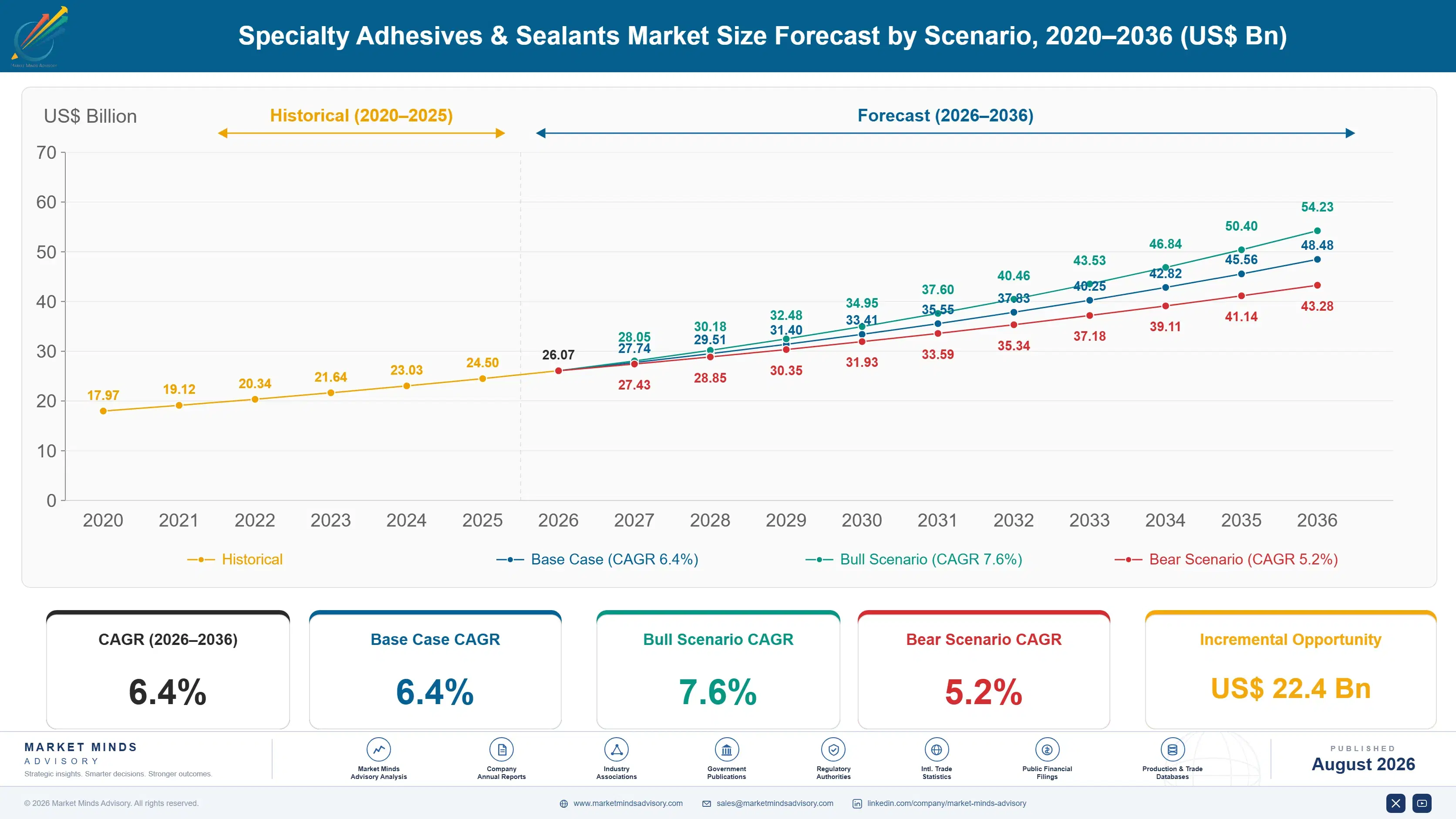
Growth from 2020 to 2025 compounded near 5.6%, held back early by pandemic construction and automotive production stoppages that idled formulation and packaging lines across multiple regions simultaneously. Freight and resin supply disruption compounded the slowdown considerably through 2021. Demand recovered through 2022 as automotive output normalised and electronics assembly accelerated considerably worldwide, pulling specialty formulation volume back above pre-pandemic levels by 2023.
Three mechanisms carry the base case to 6.4%. First, automotive lightweighting, as structural adhesives replace welds and rivets in multi-material vehicle bodies to cut weight without sacrificing joint strength or long-term durability. Second, electric vehicle battery assembly, which requires thermal interface and structural bonding chemistries with no direct precedent in internal combustion manufacturing. Third, electronics miniaturisation, which demands UV-curable and hot-melt formulations capable of precise, fast cure in increasingly compact and densely packed assemblies.
The bull case at 7.6% assumes electric vehicle production scales faster than current plans and battery chemistry bonding requirements broaden further across cell and pack formats. The bear case at 5.2% assumes construction activity softens in major markets and automotive production growth slows, both of which would compress the volume base underlying every specialty chemistry in the category.

Why Bonding Now Competes With the Weld and the Rivet

Three forces set demand. Automotive and industrial production provide the base, since specialty adhesives displace mechanical fasteners wherever weight, sealing, or vibration performance matters more than assembly line habit. Electronics miniaturisation adds a fast-growing layer, as components shrink and bonding tolerances tighten beyond what screws or clips can achieve reliably. Construction renovation activity provides a third, steadier layer through sealant demand in building envelope and gla
MARKET CONCENTRATIONCR5: 48%Concentrated among global specialty chemical and adhesive producers
AVERAGE SELLING PRICEUSD 3.50 to 28 per kilogramReflects formulation complexity and application performance requirements closely
TOP PRODUCING COUNTRYChina: 26% of global outputReflects downstream electronics and automotive manufacturing base scale
CAPACITY UTILIZATION70 to 82%Cyclical alongside automotive, construction, and electronics production volume
FEEDSTOCK COST SHAREResins and polymers: 45 to 58%Petrochemical feedstock pricing drives most formulation cost swings
R&D SPEND INTENSITY3 to 6% of revenueFormulation innovation sustains differentiation against commodity adhesive competition
The commercial character rewards formulation depth over manufacturing scale alone. A specialty adhesive qualified into an automotive or aerospace bonding application generates years of locked-in revenue, since requalification cost deters switching suppliers even when a cheaper alternative exists. Petrochemical feedstock pricing nonetheless squeezes margin regardless of formulation quality, since resin and polymer inputs move with crude oil and naphtha markets largely outside any formulator's control.
The next decade turns on two things. Whether electric vehicle battery assembly standardises around a smaller set of bonding chemistries, which would concentrate demand and reward early qualification leaders. And whether automotive lightweighting continues substituting adhesives for welds and rivets at the pace of the past five years, or whether cost pressure slows that substitution in mass-market vehicle segments specifically.
"Every adhesive company wants to talk about innovation, and the real story is qualification. Once your resin is bonding a battery pack or an aircraft panel, nobody switches suppliers to save four percent on unit cost. That lock-in is worth more than any patent."
Director, Specialty Chemicals and Materials Practice · MMA Chemicals and Materia

Market Trends

Electric Vehicle Battery Assembly Creates New Bonding Demand

Battery pack assembly requires thermal interface materials, cell-to-cell bonding, and structural adhesives sealing the pack enclosure, a demand category with no direct precedent in internal combustion vehicle manufacturing. Each battery pack uses several kilograms of specialty adhesive across these functions, and formulation requirements differ meaningfully by cell chemistry and pack architecture, which keeps qualification cycles long and supplier relationships sticky once established. Henkel, 3M, and Dow have all expanded battery-specific adhesive portfolios considerably in response. The commercial consequence is a genuinely new revenue pool growing directly with electric vehicle production volume rather than with the broader automotive adhesive base.
Market Impact: Adhesive use rises 2.5 kg
Electronics Miniaturisation Pushes Formulations Toward UV Cure

Component density in consumer electronics and semiconductor packaging has increased steadily, and UV-curable adhesives offer the fast, precise cure profile that miniaturised assembly lines require without the heat exposure hot-melt or thermal-cure chemistries can impose on sensitive components. Assembly line speed increasingly depends on cure time, which has made UV chemistry the default specification for new electronics production lines across several major contract manufacturers. The commercial consequence is that UV-curable adhesives now grow meaningfully faster than the broader specialty adhesive category, and formulators without UV capability are increasingly locked out of new electronics design wins entirely.
Market Impact: Retrofit funding covers 30% of proj

Market Opportunities and Growth Drivers

Automotive Lightweighting Substitutes Adhesives for Welds and Rivets

Multi-material vehicle bodies combining aluminium, composites, and steel cannot be joined reliably by welding alone, since dissimilar materials require adhesive bonding to prevent galvanic corrosion and distribute stress across the joint evenly. Structural adhesive use per vehicle has risen considerably as automakers pursue weight reduction targets tied to fuel economy and electric range requirements simultaneously. The shift also reduces assembly line noise and vibration relative to mechanical fastening, an incidental benefit automakers have started marketing directly to consumers. Henkel and Sika both report structural adhesive volume growth outpacing overall automotive production meaningfully across recent reporting periods.
Market Impact: Feedstock costs reach 58% of COGS

Building Renovation Activity Sustains Sealant Demand

Ageing building stock across North America and Western Europe requires periodic building envelope and glazing resealing, a maintenance-driven demand layer that persists independent of new construction cycles entirely. Energy efficiency retrofit programmes in several European countries specifically fund window and envelope sealing upgrades, which has pulled sealant demand forward in markets where new construction has otherwise slowed considerably. This demand layer is less cyclical than adhesive demand tied to automotive or electronics production, since renovation timing tracks building age and regulation rather than economic conditions alone. Sika and RPM International both hold strong positions in this specific renovation-driven sealant category.
Market Impact: Requalification adds 18 months typi

Market Restraints and Challenges

Petrochemical Feedstock Volatility Squeezes Formulation Margins

Resin and polymer feedstocks derived from crude oil and naphtha account for 45% to 58% of cost of goods sold, and pricing moves with global petrochemical markets largely outside any formulator's control regardless of end-market discipline. The root cause is that adhesive resins compete for the same cracker capacity as broader plastics and chemical production, so formulators have limited ability to smooth volatility through their own operational choices. Commercially this compresses margin fastest for formulators without long-term supply contracts. Companies are responding with feedstock hedging, longer-term resin contracts, and gradual reformulation toward bio-based inputs where performance allows the substitution.
Market Impact: Battery bonding adds 4 kg

Regulatory Restriction on Isocyanates and VOC Raises Reformulation Cost

European Union restrictions on diisocyanate content and tightening volatile organic compound limits in several jurisdictions require polyurethane and solvent-based formulators to reformulate products qualified into customer applications for years, forcing requalification cost onto both formulator and customer simultaneously and without much advance warning. The root cause is genuine occupational health and environmental concern, not commercial friction, but the compliance timeline frequently outpaces reformulation and requalification cycles that can run eighteen months or longer. Formulators are responding with early reformulation programmes and closer regulatory monitoring than the category previously ever maintained.
Market Impact: UV-curable segment grows at 8.6%
3 additional market trends, 4 additional growth drivers, and 3 additional restraints and challenges are covered in the full report. Contact sales@marketmindsadvisory.com to access the complete intelligence.

Segment CAGR and Growth Architecture

Segmentation follows adhesive and sealant chemistry, a single technology logic describing the polymer base and cure mechanism involved rather than the end market it eventually serves at all. Each chemistry carries distinct performance characteristics, qualification requirements, and cost structure, so commercial position tracks chemistry rather than end-use application, which appears separately within the framework below.
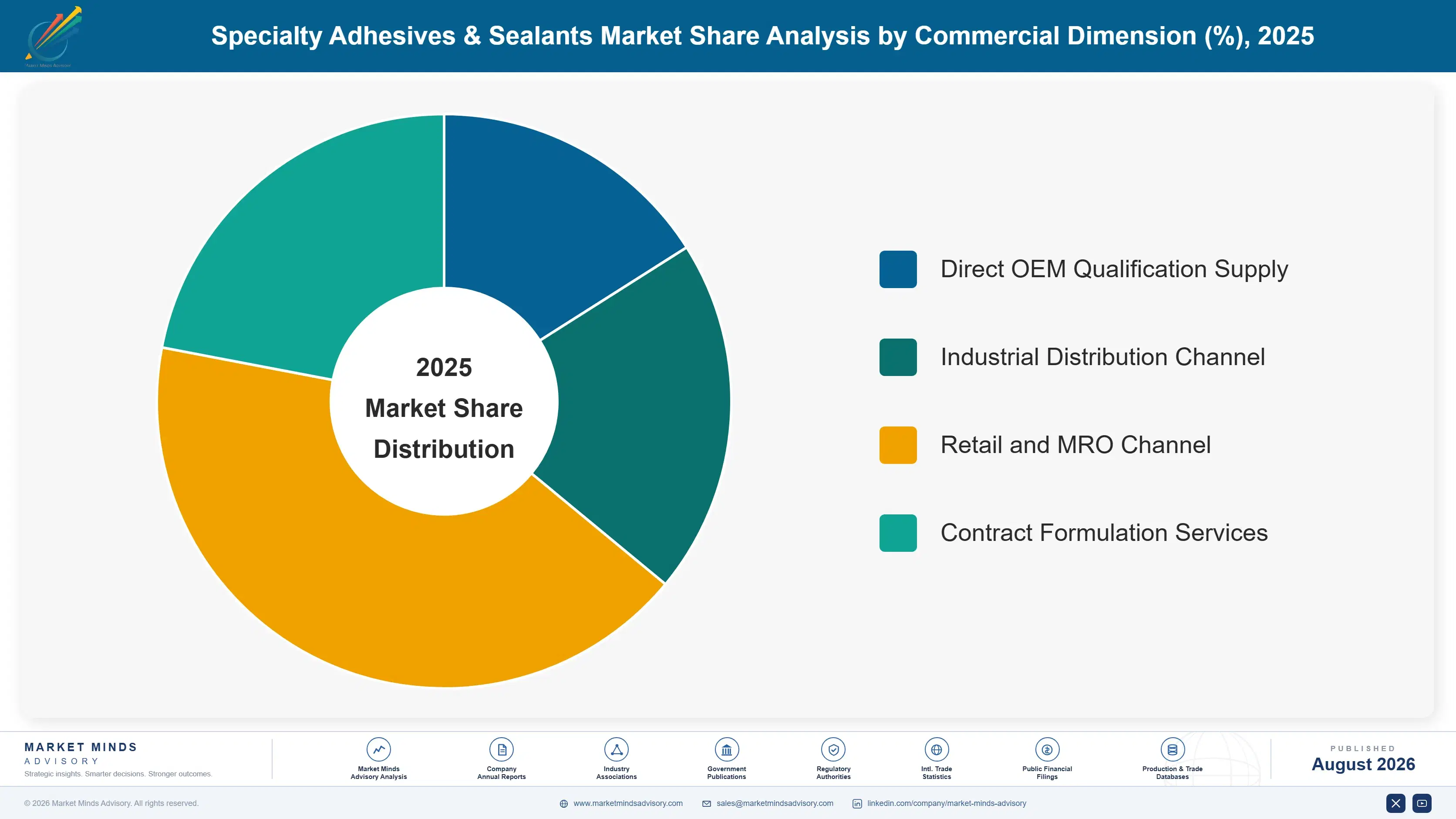
specialty-adhesives-sealants-market-market-share-analysis-1787324239254

UV-Curable and Hot-Melt Adhesives

UV-curable and hot-melt adhesives grow fastest at 8.6%, about 1.34 times the overall 6.4% rate, driven by electronics miniaturisation and packaging automation that both reward fast, precise cure profiles over traditional thermal or solvent-based chemistry. UV cure in particular has become the default specification for new electronics assembly lines, since it avoids the heat exposure that can damage sensitive components during bonding. Hot-melt formulations continue gaining share in packaging and disposable hygiene product assembly given comparable speed advantages at lower equipment cost. Henkel and H.B. Fuller both hold strong positions across this combined category, having invested in cure chemistry research well ahead of most formulation competitors. Equipment compatibility increasingly determines which formulator wins a given production line.
CAGR 8.6%

Polyurethane Adhesives and Sealants

Polyurethane adhesives and sealants grow at 6.8%, the second-fastest chemistry, serving automotive structural bonding, construction sealing, and footwear assembly applications that value flexibility and durability together in a single formulation. Automotive lightweighting has pulled structural polyurethane demand upward considerably as multi-material vehicle bodies require adhesives tolerant of differing thermal expansion rates across bonded materials of varying stiffness. Regulatory restriction on isocyanate content is forcing meaningful reformulation across the category, which has raised near-term compliance cost while ultimately favouring formulators with stronger regulatory and technical resources. Sika and BASF both hold leading positions in structural and construction polyurethane applications specifically. Reformulation timelines are testing customer qualification patience across the industry broadly and openly.
CAGR 6.8%
Full segment breakdown across 5 segments available in the complete report.

Regional Architecture and Country Demand Map

Manufacturing density rather than construction activity alone sets this distribution, since automotive and electronics production concentrate specialty adhesive demand geographically. East Asia leads on manufacturing scale, while South Asia and Pacific posts the fastest growth as electronics assembly relocates into the region from established manufacturing centres.

North America

Automotive and aerospace qualification depth defines North American demand more than raw manufacturing volume alone. Structural adhesive use per vehicle has risen steadily as domestic and transplant automakers pursue lightweighting targets tied to fuel economy standards, and aerospace bonding applications carry qualification cycles that lock in suppliers for the life of an aircraft programme entirely. 3M and Henkel both maintain deep technical service capability supporting these qualification-intensive applications across the region. Construction sealant demand tracks renovation activity in ageing commercial and residential building stock steadily. Growth of 5.9% reflects steady automotive and aerospace demand alongside gradual renovation-driven sealant growth. Feedstock cost exposure remains a persistent margin pressure across every major formulator here.
Share: 24% | CAGR: 5.9% (2026 to 2036)

Western Europe

Regulation shapes formulation choices here more directly than almost anywhere else, with European Union isocyanate and volatile organic compound restrictions forcing reformulation cycles that formulators elsewhere have not yet faced at comparable scale. Western Europe holds 22% of value, and automotive lightweighting is furthest advanced here given stringent emission and efficiency standards across the bloc. Henkel, Sika, and Arkema all maintain significant manufacturing and technical development presence domestically, exporting formulation expertise well beyond the region. Energy efficiency retrofit programmes across several countries sustain construction sealant demand even as new construction activity has slowed considerably. Growth of 4.9%, the slowest of the seven, reflects mature end-markets and reformulation cost absorbing resource that might otherwise fund expansion.
Share: 22% | CAGR: 4.9% (2026 to 2036)
Regional intelligence for 5 additional markets available in the complete report: East Asia, South Asia and Pacific, Latin America, Middle East and Africa, Eastern Europe. Contact sales@marketmindsadvisory.com.
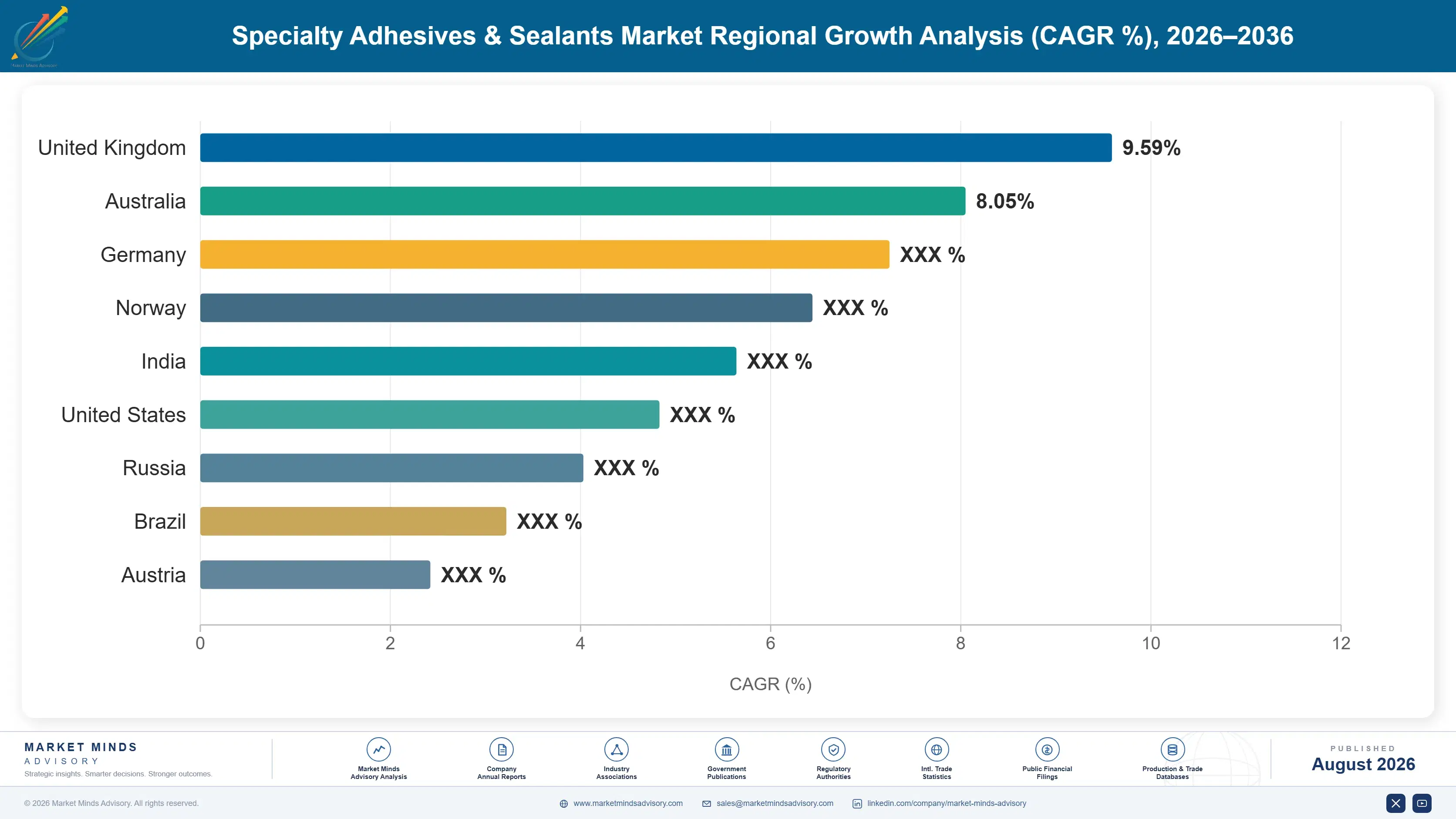
specialty-adhesives-sealants-market-country-cagr-analysis-1787324239759

Where Specialty Adhesive Margin Actually Concentrates

Competing on price per kilogram concentrates margin in exactly the commodity chemistry segment carrying the thinnest returns across the entire whole category today. The four moves below shift value toward positions that qualification lock-in and technical differentiation genuinely protect over time: battery bonding chemistry, structural automotive applications, UV cure capability, and feedstock hedging discipline.

Build Battery Bonding Chemistry Ahead of Standardisation

Electric vehicle battery assembly requires thermal interface, cell-to-cell, and structural bonding chemistries with no direct precedent in combustion vehicle manufacturing, and formulators qualifying into a battery platform early capture revenue that persists for the life of that platform given how disruptive requalification would be to a running assembly line. Each pack uses roughly 4 kilograms of specialty adhesive across multiple bonding functions, and formulation requirements still vary meaningfully by cell chemistry and pack architecture. Companies should prioritise qualification relationships with battery and vehicle manufacturers now, ahead of the chemistry standardisation that will eventually narrow the field of qualified suppliers considerably.
Market Impact: Battery packs use roughly 4 kg per

Prioritise Structural Bonding in Automotive Applications

Structural adhesive use per vehicle has risen by roughly 2.5 kilograms as multi-material vehicle bodies substitute bonding for welds and rivets across aluminium, composite, and steel joints of varying thickness. This substitution rewards formulators with genuine structural qualification credentials over those offering only general-purpose bonding products, since automotive structural applications carry safety-critical certification requirements competitors cannot easily replicate quickly. Building technical service capability alongside the formulation itself, not just the chemistry, is what actually wins these qualification programmes and keeps them locked in for years afterward across multiple vehicle generations.
Market Impact: Structural adhesive use rises 2.5 k

Invest in UV Cure Capability for Electronics Wins

UV-curable adhesives grow at 8.6% against a 6.4% overall market because electronics miniaturisation strongly rewards fast, precise cure profiles that avoid the heat exposure thermal chemistries impose on sensitive components during automated high-speed assembly processes. Formulators without UV capability are increasingly excluded from new electronics design wins entirely, regardless of how competitive their broader adhesive portfolio might otherwise be across other applications. Building UV cure formulation and equipment compatibility expertise now captures share in the fastest-growing chemistry segment before competitors close the technical gap that currently still exists industry-wide today.
Market Impact: UV-curable segment growth reaches 8

Hedge Feedstock Exposure Rather Than Absorb It

Resin and polymer feedstocks account for 45% to 58% of cost of goods sold, and formulators without long-term supply contracts absorb petrochemical price volatility that better-hedged competitors avoid considerably across every reporting period and full pricing cycle they collectively face. Long-term resin agreements, feedstock price adjustment clauses passed through to customers, and gradual reformulation toward bio-based inputs where performance allows all reduce this exposure meaningfully over time. Companies treating feedstock strategy as a procurement afterthought rather than a genuine margin lever consistently underperform better-hedged competitors across pricing cycles industry-wide today.
Market Impact: Feedstock costs run 45 to 58% of CO

Who Controls the Margin Pool

Concentration is moderate to high: the top five hold roughly 48% of specialty revenue, with a long tail of formulation specialists competing effectively in narrow, technically demanding applications. The gap between leaders and challengers is qualification depth and technical service capability rather than raw manufacturing scale, which is fairly widely distributed. All participants here are assessed on global specialty adhesives and sealants revenue as disclosed in company segment reporting, he
Competition runs along four lines. First, qualification depth in safety-critical automotive and aerospace bonding applications. Second, UV and hot-melt cure chemistry capability for electronics manufacturing. Third, feedstock hedging discipline, which increasingly separates margin performance between comparable formulators. Fourth, battery bonding chemistry positioning ahead of eventual industry standardisation.

Pressure is building from two directions. Chinese and Korean formulators have built genuine technical capability in electronics bonding chemistry that once belonged almost exclusively to Western and Japanese suppliers. Meanwhile battery chemistry standardisation, once it arrives, will concentrate demand around whichever formulators secured early qualification relationships. Rankings should favour companies with genuine structural and battery qualification depth over those competing mainly on commodity chemistry price alone.
specialty-adhesives-sealants-market-company-positioning-matrix-1787324240277

Competitive Moat and Risk Dimensions

HENKEL

Moat: Qualification breadth across industries

Henkel holds qualified positions across automotive structural bonding, electronics assembly, and battery pack applications simultaneously, a breadth few competitors can match given the distinct technical requirements of each. Decades of automotive qualification relationships built through Loctite and other brands are difficult to displace quickly. Manufacturing footprint spanning every major region supports consistent technical service delivery globally.
HENKEL

Risk: Feedstock exposure and Chinese competition

Petrochemical feedstock volatility compresses margin regardless of qualification depth, and Henkel's broad commodity chemistry exposure makes this a meaningful earnings variable each reporting period. Chinese formulators are closing the technical gap in electronics bonding specifically, an area where Henkel has historically held clear leadership. Reformulation cost from tightening isocyanate regulation also falls disproportionately on a portfolio this broad.
3M

Moat: Technical service and cross-division expertise

3M draws formulation and application expertise from across its broader industrial and electronics businesses, giving its adhesives division technical depth that a standalone adhesive company cannot replicate easily. Strong positions in aerospace and electronics bonding benefit from decades of qualification relationships built through consistent technical service delivery. Its diversified corporate structure spreads risk beyond any single end-market downturn.
3M

Risk: Corporate litigation and portfolio distraction

Broader corporate litigation exposure across other 3M businesses has absorbed management attention and capital that could otherwise fund adhesive-specific technical investment and capacity expansion. Competitors including Henkel and Sika have moved faster on battery bonding qualification in certain accounts as a result. Feedstock cost exposure affects 3M's commodity-adjacent adhesive lines just as it does every other formulator in the category.

Players Tracked

Prominent Players

Henkel
3M
H.B. Fuller
Sika
Arkema

Other Key Players

Dow
Wacker Chemie
Avery Dennison
Illinois Tool Works
Ashland
DuPont
Huntsman Corporation
Mapei
RPM International
Franklin International
Master Bond
Permabond
DELO Industrial Adhesives
Elantas
Parker Lord

Recent Developments

MARCH 2025

Henkel expands battery adhesive production capacity in China

Henkel announced expanded production capacity for battery pack bonding and thermal interface adhesives at its Chinese manufacturing facility, responding to electric vehicle production growth across the region. This was an organic capacity expansion rather than any acquisition or joint venture, reflecting confidence in battery bonding demand specifically.
Signal: Capacity investment now follows battery pr
SEPTEMBER 2024

Sika completes acquisition of regional construction sealant manufacturer

Sika completed the acquisition of a regional construction sealant manufacturer to strengthen its distribution footprint and formulation capability in building envelope applications. This was a genuine acquisition of manufacturing and distribution assets rather than a joint venture or supply agreement, extending Sika's construction chemistry portfolio directly.
Signal: Construction chemistry consolidation conti
JANUARY 2025

Arkema and battery cell manufacturer sign joint development agreement

Arkema signed a joint development agreement with a battery cell manufacturer to co-develop thermal interface and structural bonding chemistries specific to next-generation cell formats. This was a technology development agreement rather than an acquisition or merger, aimed at securing early qualification ahead of broader chemistry standardisation.
Signal: Early co-development relationships with ce

Petrochemical Resins, Polymers, and Specialty Additives

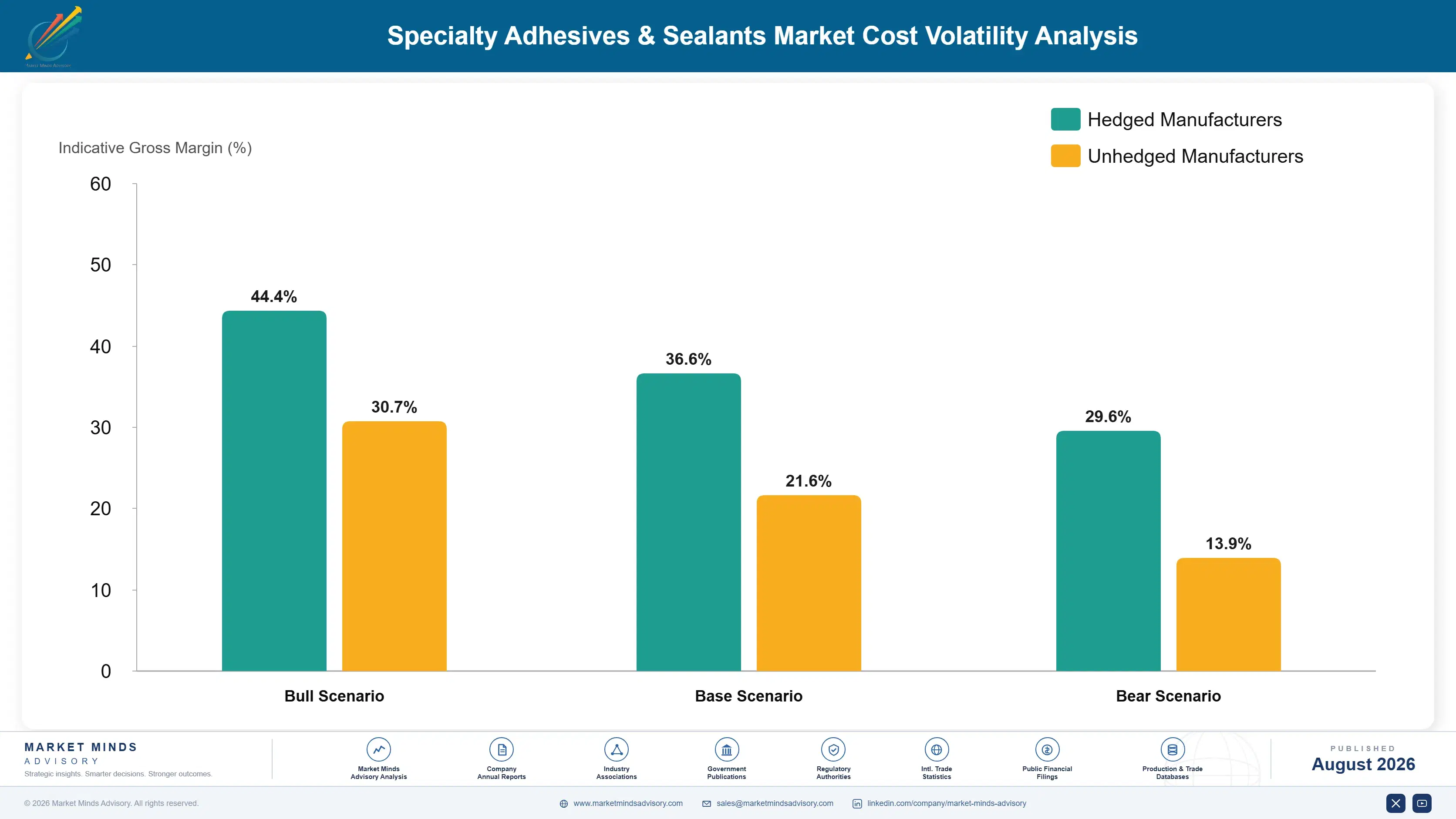
Resin and polymer feedstocks derived from crude oil and naphtha dominate specialty adhesive cost structure, accounting for 45% to 58% of cost of goods sold depending on chemistry. Specialty additives including catalysts, tackifiers, and performance modifiers add a further 12% to 20%, while manufacturing and formulation labour account for the remainder. Feedstock sourcing runs through global petrochemical markets regardless of where final formulation and blending occurs.
Feedstock volatility through 2021 and 2022 illustrated the exposure clearly, with global epoxy resin and isocyanate prices rising sharply amid pandemic-related supply disruption and elevated naphtha costs, according to IEA petrochemical market analysis. Formulators with long-term resin supply contracts absorbed less of that swing than spot-market buyers, and several disclosed meaningful gross margin compression in annual reports covering that period specifically. Prices have since eased but remain above pre-pandemic levels.

Exposure separates clearly by contract structure and formulation flexibility. Formulators with long-term resin contracts and price pass-through clauses absorb volatility better than smaller competitors buying on spot markets without that protection. Bio-based feedstock alternatives offer a partial hedge where performance requirements allow substitution, though qualification cost for a new feedstock in an already-qualified application can be substantial and slow.
specialty-adhesives-sealants-market-cost-volatility-analysis-1787324240471

Secure long-term resin supply contracts with pass-through clauses

Spot-market resin buying exposed smaller formulators to margin compression that larger competitors with long-term contracts avoided considerably during the recent volatility cycle entirely. Multi-year agreements with price pass-through clauses smooth that volatility across the production cycle. The trade-off is reduced flexibility to benefit when prices fall, which most formulators readily accept for planning certainty.

Qualify bio-based feedstock alternatives where performance allows

Bio-based resin alternatives reduce petrochemical exposure but require requalification in every application where they replace a conventional feedstock, a process that can take a year or longer. Formulators starting this qualification work now build a hedge that petrochemical-dependent competitors will lack when volatility next strikes. The investment only pays off where genuine performance parity is achievable.

Pass volatility through via index-linked customer pricing

Fixed-price contracts leave formulators absorbing feedstock swings entirely on their own, while index-linked pricing tied to published resin benchmarks shares that risk with customers directly and transparently. This requires genuine negotiating position, which qualification depth and technical service capability both support considerably over time. Customers in safety-critical applications generally accept this trade-off for supply reliability.

Portfolio Architecture for Margin Defence

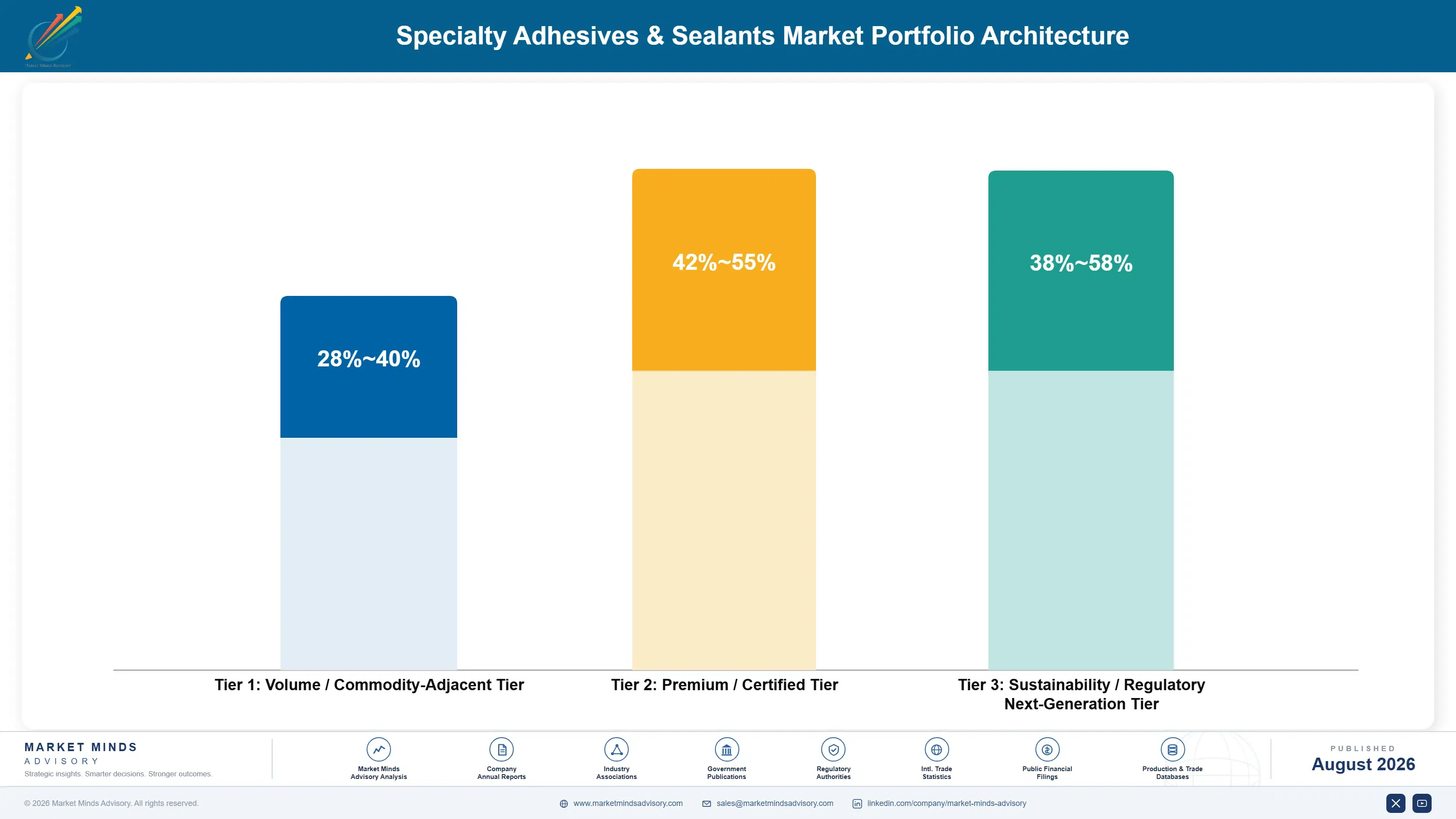
The portfolio splits into three tiers with distinct economics. Commodity-adjacent chemistries competing mainly on price form the volume tier, with margin set largely by feedstock cost and manufacturing scale. Qualified structural and safety-critical applications earn considerably more because requalification cost deters customer switching regardless of price competition elsewhere. Battery bonding and UV-cure electronics chemistries sit differently again, priced against qualification value rather
The tension runs between commodity volume that funds the business today and qualification-intensive technical investment that positions it for the next decade. A formulator defending commodity share too aggressively under-invests in the qualification relationships that generate durable margin, while one chasing every qualification opportunity spreads technical resource too thin to execute well. Companies managing this tension successfully concentrate qualification investment on applications with genuine long-term volume potential.

High-value pools concentrate where qualification cost, technical complexity, or safety certification limit competition: automotive structural bonding, aerospace applications, battery pack chemistry, and UV-cure electronics formulations specifically. Commodity construction sealants and general-purpose industrial adhesives sit at the other end, competing almost entirely on price and manufacturing scale against every credible regional producer worldwide today.

Volume / Commodity-Adjacent Tier

General-purpose industrial adhesives and commodity construction sealants competing primarily on price and manufacturing scale, with limited formulation differentiation between suppliers and thin margin protection against feedstock cost swings across cycles.
Gross Margin: 28-40%

Premium / Certified Tier

Automotive structural bonding, aerospace applications, and industrial adhesives requiring formal qualification and certification that deters customer switching once established, supporting durable margin across the entire qualified product life cycle fully.
Gross Margin: 42-55%

Sustainability / Regulatory / Next-Generation Tier

Battery pack bonding chemistry, UV-curable electronics adhesives, and bio-based reformulated products developed ahead of tightening isocyanate and VOC regulation, priced against qualification value rather than commodity chemistry benchmarks directly today.
Gross Margin: 38-58%
specialty-adhesives-sealants-market-portfolio-architecture-1787324240971

High-value Sub-segments and Strategic Watch-out

UV-Curable and Hot-Melt Adhesives

High value and high growth at 8.6%, the fastest chemistry in the category, driven by electronics miniaturisation and packaging automation that reward fast, precise cure profiles over traditional thermal chemistry entirely today. Formulators without UV capability increasingly lose new electronics design wins to better-equipped competitors.
Gross Margin: 42-55%

Polyurethane Adhesives and Sealants

High value with strong growth at 6.8%, second-fastest chemistry, serving automotive structural bonding and construction sealing applications across most major markets worldwide today. Isocyanate regulation is forcing costly reformulation across the category, though it ultimately favours better-resourced formulators over smaller regional competitors lacking technical depth.
Gross Margin: 38-58%

Epoxy Adhesives

The volume core by revenue, growing near 5.8% as structural bonding demand in automotive and aerospace applications sustains steady volume across mature and emerging markets alike consistently every single calendar year. Mature chemistry with well-established qualification pathways across most major end-markets and geographies worldwide today.
Gross Margin: 42-55%

Acrylic and Cyanoacrylate Adhesives

The strategic watch-out, growing near 6.0% and facing substitution pressure from UV-curable alternatives in several electronics and general assembly applications across the wider industry today already noticeably. Volume persists mainly in cost-sensitive general-purpose bonding applications currently, though that base keeps steadily eroding over time considerably.
Gross Margin: 28-40%

How Adhesive Qualification Locks In Revenue

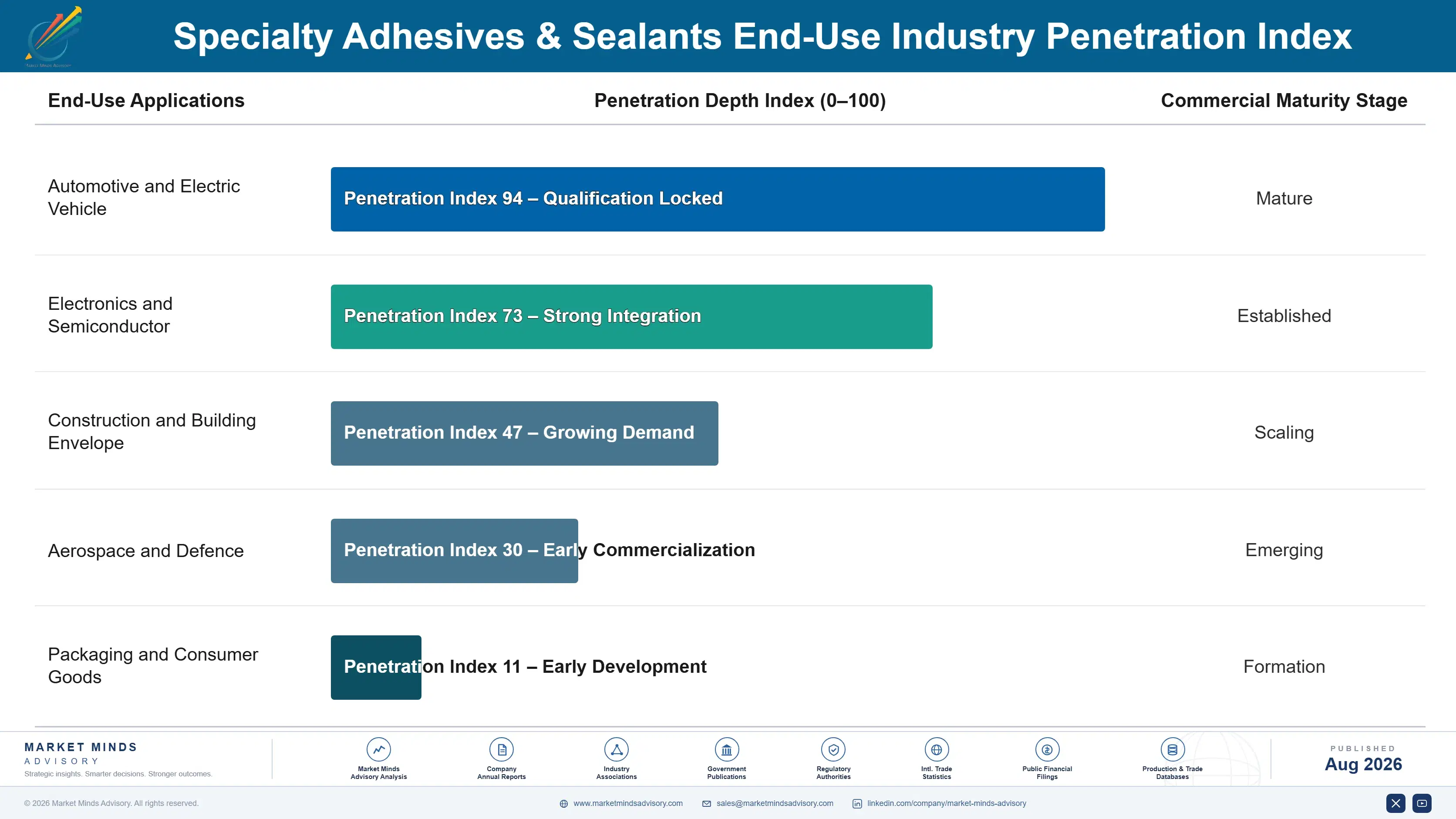
Revenue depends on qualification depth rather than transactional selling, and a formulation qualified into an automotive or aerospace bonding programme generates revenue for the platform's life, often a decade or longer. Requalification cost deters customer switching even when a cheaper alternative exists, which makes qualification relationships the most valuable asset a formulator holds. Losing a qualified relationship costs far more than losing a single commodity order.
Adoption depth varies sharply by end-use vertical. Aerospace and automotive structural applications stick hardest, since safety certification and requalification cost make switching suppliers a multi-year undertaking few customers attempt casually. Electronics assembly sits in the middle, with cure chemistry compatibility mattering more than loyalty once a line is qualified. Commodity sealants switch most readily, since performance differentiation between suppliers is often minimal.

Buyer profiles have shifted from purchasing departments toward joint engineering teams who co-develop formulations with suppliers ahead of production launch. Battery and electric vehicle manufacturers increasingly treat adhesive qualification as a design partnership rather than a procurement transaction, given how integral bonding chemistry has become to pack safety and performance. Sustainability requirements are also reshaping specification, as customers increasingly ask for bio-based content alongside performance data.
specialty-adhesives-sealants-market-end-use-penetration-index-1787324241461

Our Call on Specialty Adhesives

These are among the four positions where our research anticipates prominent divergence between winners and laggards over the coming forecast period. Each is grounded in the demand model, the regulatory perimeter, and the announced capacity pipeline.
01 / QUALIFICATION BEATS PRICE

Requalification cost is the real competitive moat

A formulation qualified into an automotive or aerospace bonding programme generates revenue for the life of that platform, often a decade or longer, because requalification cost deters customer switching even when a cheaper alternative genuinely exists. Formulators competing mainly on price per kilogram compete in exactly the segment with the thinnest margin available in the category. Companies should prioritise qualification depth in safety-critical applications over broad commodity volume, since qualified revenue persists through pricing cycles that commodity volume never survives intact.
02 / BATTERY CHEMISTRY STILL OPEN

Early qualification wins before standardisation narrows the field

Electric vehicle battery assembly requires bonding chemistries with no direct precedent in combustion vehicle manufacturing, and formulation requirements still vary meaningfully by cell chemistry and pack architecture across different manufacturers and production platforms today. Formulators qualifying into a battery platform early capture revenue that persists for the entire platform's life, given how disruptive requalification would be to a running assembly line. Companies should invest in battery bonding qualification now, before eventual chemistry standardisation narrows the field of suppliers considerably further.
03 / UV CURE GATES ACCESS

Cure chemistry capability now gates design wins

UV-curable adhesives grow at 8.6% against a 6.4% overall market because electronics miniaturisation strongly rewards fast, precise cure profiles that avoid the heat exposure thermal chemistries impose on sensitive components during automated high-speed assembly lines everywhere today. Formulators without UV capability are increasingly excluded from new electronics design wins entirely, regardless of broader portfolio strength elsewhere in their catalogue. Developers should build UV formulation and equipment compatibility expertise now, before competitors close the technical gap that currently still exists industry-wide.
04 / FEEDSTOCK STRATEGY SETS MARGIN

Hedging discipline now separates winners from laggards

Resin and polymer feedstocks account for 45% to 58% of cost of goods sold, and formulators without long-term supply contracts absorb petrochemical price volatility that better-hedged competitors avoid considerably across every single pricing cycle they collectively face each and every year without exception. Long-term resin agreements and index-linked customer pricing both reduce this exposure meaningfully over time. Companies treating feedstock strategy as a genuine margin lever rather than a procurement afterthought consistently outperform less disciplined competitors through volatile market periods.

Engagement Snapshot From the Field

A live engagement with an industry participant carrying material or product regulatory and market exposure ahead of a defining policy shift, showing how our research translates into a defensible multi-year portfolio strategy.
MARKET MINDS ADVISORY · CLIENT ENGAGEMENT SUMMARY
Specialty Adhesives & Sealants Producer Strategic Portfolio Review and Transition Roadmap 2026·Investment Scenario on Specialty Adhesives & Sealants Exposure Evaluation 2025-26
CLIENT PROFILE
A mid-sized specialty adhesive formulator with strong positions in industrial and construction bonding engaged MMA ahead of a planned expansion into electric vehicle battery adhesives and related chemistries. The client reported specialty adhesive revenue near USD 340 million annually, with less than 5% currently derived from automotive or battery applications specifically across its full product portfolio (client-reported, unverified by MMA).
STRATEGIC CHALLENGE
Leadership wanted to enter battery bonding chemistry but lacked clarity on which cell and pack architectures were likely to standardise, risking investment in formulation capability that might not match eventual industry direction. Commercial teams had received inbound interest from two battery manufacturers but no clear framework for prioritising qualification investment. The board wanted an entry strategy rather than reactive responses to individual customer requests.
MMA APPROACH
MMA benchmarked bonding requirements across the major cell chemistries and pack architectures currently in production and development pipelines. We assessed the client's existing formulation capability against the technical gaps each architecture would require to close. We then modelled qualification investment cost against the revenue potential of each architecture reaching production scale.
KEY FINDINGS
  1. One of the two inbound battery manufacturer relationships targeted a pack architecture with limited scale-up prospects based on the client's own product roadmap disclosures.
  2. The client's existing thermal interface formulation capability required moderate rather than extensive modification to meet the higher-priority architecture's technical requirements adequately within the available development timeline.
  3. Qualification investment for the higher-priority architecture was estimated at roughly 8% of annual specialty adhesive revenue, recoverable within three years of design win (client-reported, unverified by MMA).
  4. Competitors including two larger formulators had already begun qualification work on the same architecture, narrowing the client's window to secure an early position.
CLIENT PROFILE
A mid-sized specialty adhesive formulator with strong positions in industrial and construction bonding engaged MMA ahead of a planned expansion into electric vehicle battery adhesives and related chemistries. The client reported specialty adhesive revenue near USD 340 million annually, with less than 5% currently derived from automotive or battery applications specifically across its full product portfolio (client-reported, unverified by MMA).
STRATEGIC CHALLENGE
Leadership wanted to enter battery bonding chemistry but lacked clarity on which cell and pack architectures were likely to standardise, risking investment in formulation capability that might not match eventual industry direction. Commercial teams had received inbound interest from two battery manufacturers but no clear framework for prioritising qualification investment. The board wanted an entry strategy rather than reactive responses to individual customer requests.
MMA APPROACH
MMA benchmarked bonding requirements across the major cell chemistries and pack architectures currently in production and development pipelines. We assessed the client's existing formulation capability against the technical gaps each architecture would require to close. We then modelled qualification investment cost against the revenue potential of each architecture reaching production scale.
KEY FINDINGS
  1. One of the two inbound battery manufacturer relationships targeted a pack architecture with limited scale-up prospects based on the client's own product roadmap disclosures.
  2. The client's existing thermal interface formulation capability required moderate rather than extensive modification to meet the higher-priority architecture's technical requirements adequately within the available development timeline.
  3. Qualification investment for the higher-priority architecture was estimated at roughly 8% of annual specialty adhesive revenue, recoverable within three years of design win (client-reported, unverified by MMA).
  4. Competitors including two larger formulators had already begun qualification work on the same architecture, narrowing the client's window to secure an early position.
RECOMMENDED STRATEGY
Phase 1: Phase 1 (0 to 6 months): Concentrate qualification resource on the higher-priority battery architecture and formally deprioritise the lower-potential manufacturer relationship. Phase 2: Phase 2 (6 to 18 months): Complete formulation modification and pursue joint development qualification directly with the target battery manufacturer. Phase 3: Phase 3 (18 to 36 months): Scale production capacity ahead of the anticipated design win and pursue additional manufacturer relationships broadly.
OUTCOME
The client redirected qualification resource toward the higher-priority battery architecture and secured a joint development agreement well within the recommended engagement window. Battery-related revenue began contributing meaningfully to the specialty adhesive segment within two years, a result leadership had not expected this quickly (client-reported, unverified by MMA).

Frequently Asked Questions

Foundational context covering the market sizes, CAGR, scope, country, region and competition that inform every finding below. This section is provided to cover basics and most often pre-purchase conversations, answered from the MMA Primary Research Dataset.

What is the current size of the Specialty Adhesives & Sealants Market?

The global specialty adhesives and sealants market is valued at USD 24.5 billion in 2025, covering epoxy, polyurethane, silicone, acrylic, UV-curable, and hot-melt chemistries. Commodity paper adhesives and pressure-sensitive tapes are excluded.

How large will the Specialty Adhesives & Sealants Market be by 2036?

The market is forecast to reach USD 48.48 billion by 2036 in the base case, about 1.86 times the 2026 level. That represents incremental value of roughly USD 22.41 billion across the decade.

What is the CAGR for the Specialty Adhesives & Sealants Market 2026 to 2036?

The market grows at a 6.4% CAGR in the base case, with bull and bear scenarios at 7.6% and 5.2%. The spread turns mainly on electric vehicle production scale and construction activity strength.

Which segment is growing fastest?

UV-curable and hot-melt adhesives grow fastest at 8.6%, about 1.34 times the overall rate, driven by electronics miniaturisation. Polyurethane adhesives and sealants follow at 6.8%.

Who are the major companies in the Specialty Adhesives & Sealants Market?

Leading companies include Henkel, 3M, HB Fuller, Sika, and Arkema. Concentration is moderate to high, with the top five holding roughly 48% of specialty revenue.

Which country is growing fastest?

Vietnam grows fastest at a 9.4% CAGR, as electronics contract manufacturers relocate assembly capacity from China into new industrial parks. India follows closely on domestic manufacturing expansion and industrial policy support.

Report Segmentation Architecture

The full report scope spans multiple orthogonal segmentation dimensions, with cross-tabulated demand data provided for each dimension pair. Coverage extends further to regional breakdowns, trend trajectories, and the competitive detail needed to support segment-level decision-making.

By Chemistry Type

  • Epoxy Adhesives
  • Polyurethane Adhesives and Sealants
  • Silicone Sealants
  • Acrylic and Cyanoacrylate Adhesives
  • UV-Curable and Hot-Melt Adhesives

By End-Use Industry

  • Automotive and Electric Vehicle
  • Electronics and Semiconductor
  • Construction and Building Envelope
  • Aerospace and Defence
  • Packaging and Consumer Goods

By Commercial Dimension

  • Direct OEM Qualification Supply
  • Industrial Distribution Channel
  • Retail and MRO Channel
  • Contract Formulation Services

By Region

  • North America
  • Western Europe
  • East Asia
  • South Asia and Pacific
  • Latin America
  • Middle East and Africa
  • Eastern Europe

Scope, Methodology, and Coverage

Every figure in this report is reproducible from documented input assumptions. The scope below maps the historical period, the forecast horizon, the segmentation dimensions, and the countries covered, alongside the underlying primary and qualitative methodology.
Historical Period
2020 to 2025
Forecast Period
2026 to 2036
Base Year
2025 (USD billions; MMA Primary Research Dataset, August 2026)
Market Definition
The specialty adhesives and sealants market comprises performance-engineered bonding and sealing chemistries, valued at manufacturer revenue for formulated products sold into industrial, automotive, electronics, aerospace, and construction applications. It spans epoxy, polyurethane, silicone, acrylic, cyanoacrylate, UV-curable, and hot-melt formulations designed for specific performance, qualification, or regulatory requirements beyond general-purpose bonding. Commodity paper and packaging adhesives, pressure-sensitive tapes sold as finished converted products, construction mortars and grouts, and raw resin or polymer sales not formulated into finished adhesive products are excluded.
Quantitative Units
USD billions (current prices); volume in metric tons where applicable
Segmentation Dimensions
By Chemistry Type; By End-Use Industry; By Commercial Dimension; By Region
Regions Covered
North America, Western Europe, East Asia, South Asia and Pacific, Latin America, Middle East and Africa, Eastern Europe
Countries Covered
USA, China, Germany, France, UK, Japan, South Korea, India, Australia, Canada, Brazil, Mexico, Indonesia, Vietnam, Thailand, Malaysia, UAE, Saudi Arabia, South Africa, Nigeria, Turkey, Poland, Netherlands, Italy, Spain, Sweden, Switzerland, Argentina, Colombia, Singapore, and additional markets relevant to this sector
Key Companies Profiled
Henkel, 3M, H.B. Fuller, Sika, Arkema, Dow, Wacker Chemie, Avery Dennison, Illinois Tool Works, Ashland, DuPont, Huntsman Corporation, Mapei, RPM International, Franklin International, Master Bond, Permabond, DELO Industrial Adhesives, Elantas, Parker Lord
Quantitative Methodology
Primary survey, n=3,800 respondents, Q4 2025, six countries; demand-side model with trade association cross-validation
Qualitative Methodology
47 expert interviews, Q4 2025; applied to validate demand model assumptions, identify emerging dynamics, and assess competitive positioning
Report Format
PDF and XLSX data workbook (Word format preview document)
Publisher
Market Minds Advisory
Report Code
MMA-2026-CHM-102
Published
August 2026
Contact
sales@marketmindsadvisory.com | www.marketmindsadvisory.com

Purchase the full Specialty Adhesives & Sealants Market Report (2026 to 2036).

The full MMA Specialty Adhesives and Sealants report sizes the market across five chemistry types, five end-use industries, four commercial channels, and seven regions through 2036. It profiles 20 companies on a consistent specialty revenue basis, scoring each on qualification depth, UV cure capability, battery bonding positioning, and feedstock hedging discipline. Scenario models quantify how automotive lightweighting, electric vehicle battery assembly, and electronics miniaturisation move both volume demand and achievable margin by chemistry. The report also includes qualification cycle benchmarking, feedstock volatility exposure analysis, and battery chemistry standardisation tracking for formulation and commercial strategy teams.
Five-chemistry and four-channel market sizing to 2036
Twenty-company benchmark on specialty revenue basis
Battery bonding chemistry standardisation tracking and analysis
Feedstock volatility exposure modelling by chemistry type
Qualification cycle benchmarking across end-use verticals
UV cure and electronics design win competitive tracking

Built For The People Who Decide

From boardroom strategy to bench-side execution, this report is read cover-to-cover by leaders shaping the next decade of their industry, turning demand scenarios, market dynamics and valuation benchmarks into decisions.
CXOs/ Presidents/ VPs/ Managers
M&A and Corporate Development
Strategy Teams and R&D Heads
Procurement and Product Directors
Regulatory and Compliance Leaders
Investor Relations and Equity Analysts