Market Minds Advisory
Spatial Light Modulator Market

Spatial Light Modulator Market: Beam Steering, Holographic Display, and Laser Shaping Optics Worldwide.

Solid-state LiDAR beam steering and holographic augmented reality displays are pulling spatial light modulators out of laboratory optics benches into automotive and consumer electronics volume manufacturing considerably faster than component suppliers anticipated.

Lead Analyst

Published

September 2026

Make Smarter Decisions with Customized Research Insights

Request a free sample report and evaluate market opportunities, growth trends, and competitive dynamics relevant to your business needs.

2025 MARKET VALUE$0.9BMarket Size 2025
2036 FORECAST VALUE$3.5BBase Case , 2026 to 2036
CAGR 2026 TO 203613.0 %Bull 14.3% / Bear 11.7%
INCREMENTAL OPPORTUNITY$2.4BNet 10- year value creation
EXPANSION MULTIPLE3.39x2036 value over 2026 base
Strategic Levers
M&A Pipeline
Regional Outlook
Country Rankings
Competitive Intelligence
Segmental Deep-dive
Call-Us : 91 93563 13602

Executive Snapshot and Market Trajectory.

Spatial light modulators are moving beyond specialized laboratory and projector applications into automotive LiDAR beam steering and consumer augmented reality displays, as solid-state alternatives to mechanical scanning systems reach commercial reliability standards manufacturers previously considered unattainable. This shift is redefining how suppliers prioritize manufacturing investment across every major product category.
LiDAR beam steering modulators are absorbing the largest share of new demand as automotive suppliers move away from mechanical scanning systems, while holographic display and augmented reality modulators grow nearly as fast on the strength of consumer headset development. North America and East Asia concentrate the bulk of demand, reflecting both automotive LiDAR development and Asian display and optics manufacturing concentration. Suppliers serving both segments increasingly report cross-selling opportunities between these two distinct product categories.
Competitive intensity remains high among established photonics suppliers, with Hamamatsu Photonics, Meadowlark Optics, and Texas Instruments holding durable advantages from decades of optical component manufacturing and semiconductor fabrication scale. Specialized beam-steering startups are gaining share in automotive LiDAR applications where established vendors' broader photonics catalogs fit less precisely into demanding automotive-grade reliability specifications. Customers increasingly weigh a supplier's manufacturing yield track record alongside traditional optical performance when awarding new contracts.
Market Definition
The market covers liquid crystal, micromirror, and micro-electro-mechanical systems-based spatial light modulator devices used for beam steering, holographic display, laser beam shaping, and optical computing applications. It excludes standard flat-panel display panels without spatial light modulation function, conventional camera image sensors, and passive optical lenses and mirrors.
Base Year Value
$0.9B in 2025 (MMA Primary Research Dataset, September 2026)
Forecast Period
2026 to 2036, eleven discrete annual values
CAGR
13.0% base case. Bull 14.3%. Bear 11.7%.
Fastest Growth Segment
LiDAR Beam Steering SLMs: 18.0% CAGR
Fastest Growth Country
Japan: 14.3% CAGR
Fastest Growth Region
South Asia and Pacific: 15.0% CAGR
Largest Region
North America: 30% of 2025 global value
Market Leaders
Hamamatsu Photonics, Meadowlark Optics, Texas Instruments, Jenoptik, HOLOEYE Photonics. Source: MMA Analysis based on company annual reports and photonics industry disclosures.
Primary Survey
n=3,800 procurement and R&D decision-makers, Q4 2025, six countries
Methodology
Demand-side build-up, cross-validated against public data, 47 expert interviews

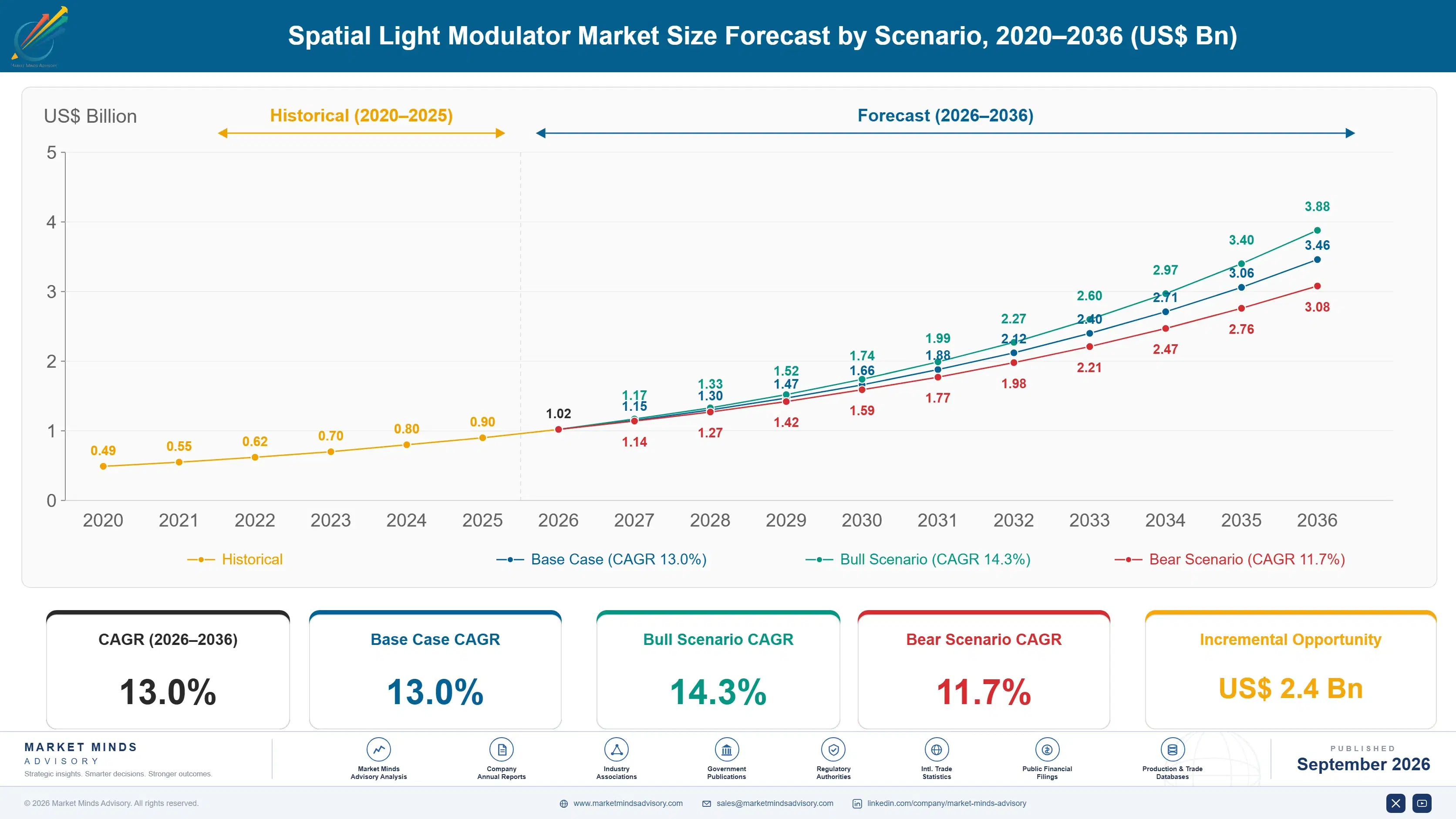
Spatial Light Modulator Market Forecast Scenarios

spatial-light-modulator-market-size-forecast-scenario-1790003921311
Between 2020 and 2025 spatial light modulator demand grew at an estimated 12.0% historical annual rate as automotive LiDAR development programs and early augmented reality headset prototypes drove steady growth, while broader commercial adoption remained constrained by manufacturing yield and cost challenges limiting volume production. Suppliers investing early in automotive qualification during this period report steadier order pipelines than late-moving competitors.
The base case assumes accelerating expansion through 2036 as three mechanisms compound: automotive suppliers transitioning from mechanical LiDAR scanning to solid-state beam steering as reliability and cost improve, augmented reality headset manufacturers scaling holographic display production beyond current prototype volumes, and manufacturing yield improvements reducing per-unit costs enough to enable previously uneconomical applications. Automotive suppliers piloting solid-state LiDAR programs illustrate how reliability data increasingly determines procurement timing more than raw technical performance specifications alone.
The bull case centers on augmented reality headset adoption accelerating faster than currently modeled as major consumer electronics companies launch mainstream products, pulling forward holographic display modulator demand considerably. The bear case hinges on alternative LiDAR beam steering approaches, including optical phased arrays, capturing automotive design wins that spatial light modulator suppliers currently expect to win themselves.

Photonics Manufacturing Economics and Application Scaling

Spatial light modulators sit at the intersection of photonics manufacturing capability and rapidly expanding automotive and consumer electronics application demand, converting what was once a specialized laboratory and projector component into a considerably higher-volume automotive and display industry part. Automotive LiDAR beam steering is increasingly the dominant near-term demand driver across the broader modulator category.
MARKET CONCENTRATION (CR5)58%Reflects established photonics manufacturer incumbency across major applications
AVERAGE MODULATOR UNIT PRICE$420Typical automotive-grade beam steering modulator assembly cost per unit
TOP PRODUCING COUNTRY SHAREJapanLargest single-country photonics component manufacturing production volume currently
LIDAR DESIGN WIN RATE34%Share of new LiDAR programs selecting solid-state modulator approaches
MANUFACTURING YIELD RATE72%Typical production yield for automotive-grade modulator manufacturing runs
COGS SEMICONDUCTOR SUBSTRATE SHARE38%Silicon and specialty substrate materials as share of unit cost
Commercial character today increasingly favors suppliers capable of meeting automotive-grade reliability and manufacturing yield requirements simultaneously with consumer electronics cost targets, rather than serving only laboratory and industrial customers with more forgiving specifications. Original equipment manufacturers increasingly involve both procurement and photonics engineering teams jointly in supplier qualification decisions. This joint approach increasingly requires suppliers to speak credibly to both technical performance and total qualification cost considerations.
Over the next decade, expect continued consolidation around suppliers capable of serving both automotive and consumer electronics volume manufacturing simultaneously, while manufacturing yield improvement becomes the primary qualification differentiator as automotive and consumer applications push cost targets considerably below what earlier laboratory and industrial-grade modulators were originally engineered to achieve. Suppliers slow to build this narrative risk losing renewal conversations to competitors offering clearer measurable yield performance evidence.
"Nobody cares about optical performance in a spec sheet anymore if the manufacturing yield can't support automotive volume. The suppliers winning LiDAR contracts are the ones who solved yield first, not the ones with the best lab demo."
Director, Photonics and Optical Components Practice · MMA Technology / Photonics and Optical Components Practice · September 2026

Market Trends

Automotive Suppliers Transition to Solid-State LiDAR Beam Steering

Automotive suppliers developing next-generation LiDAR systems are increasingly transitioning from mechanical scanning approaches toward solid-state beam steering using spatial light modulators, reflecting the automotive industry's broader push toward eliminating moving parts that introduce reliability risk and higher manufacturing cost over a vehicle's operational lifetime. Major automotive LiDAR suppliers across the United States, Germany, and China have each announced solid-state beam steering programs targeting production vehicle deployment within the next several years, directly driving modulator demand growth considerably faster than overall LiDAR unit volume alone would suggest. Automotive design wins increasingly reward reliability data over raw specification sheets.
Market Impact: Cuts unit manufacturing cost 40%

Augmented Reality Headset Manufacturers Scale Holographic Display Production

Augmented reality headset manufacturers are scaling holographic display modulator production beyond current prototype volumes as consumer electronics companies prepare mainstream product launches requiring considerably higher manufacturing volume than earlier developer-focused headsets achieved. Manufacturing yield improvements have made holographic display modulators economically viable for consumer price points that earlier laboratory-grade components could not support at meaningful production scale. Suppliers report holographic display modulator order volumes growing considerably faster than industrial and scientific instrumentation categories as consumer electronics customers scale toward mainstream launch volumes. Consumer electronics customers now represent one of the fastest-scaling buyer segments within the broader modulator category overall.
Market Impact: Grows quantum photonics demand 28%

Market Opportunities and Growth Drivers

Manufacturing Yield Improvements Enable New Applications

Manufacturing yield improvements across semiconductor fabrication processes used for spatial light modulator production have reduced per-unit costs considerably, enabling automotive and consumer electronics applications that earlier, lower-yield manufacturing processes could not economically support at meaningful production volume. This yield improvement lets suppliers serve considerably more price-sensitive customer segments than the laboratory and industrial-grade market historically supported. Suppliers report yield-driven cost reductions now represent the primary factor determining which new applications become commercially viable within a given planning horizon. This shift also broadens the addressable customer base beyond automotive and consumer electronics into industrial and scientific segments.
Market Impact: Extends qualification timelines 16 months

Growing Optical Computing and Quantum Photonics Research Investment

Research institutions and technology companies are expanding investment in optical computing and quantum photonics applications that rely on spatial light modulators for precise beam manipulation and control, creating a growing specialty demand category distinct from automotive and consumer display applications. Government research funding programs across the United States, European Union, and China have directed considerable investment toward optical and quantum computing research infrastructure, directly driving demand for research-grade modulator products. Suppliers report specialized optical computing modulator orders commanding meaningfully higher per-unit pricing than standard commercial products. Suppliers developing wavelength-specific research modulators report faster adoption among institutions seeking specialized experimental capability.
Market Impact: Splits design wins across 3 technologies

Market Restraints and Challenges

Manufacturing Yield Challenges Limit Automotive-Grade Scaling

Spatial light modulator manufacturing continues facing yield challenges that limit how quickly suppliers can scale production to meet automotive-grade volume and reliability requirements simultaneously, since automotive customers demand consistency standards considerably beyond what laboratory and industrial applications historically required. The root cause is that achieving both high optical performance and consistent manufacturing yield at automotive volume requires considerable process engineering investment that smaller specialized suppliers often cannot justify without guaranteed automotive design wins first. This constrains how quickly the supply base can respond to automotive LiDAR's rapid growth. Suppliers mitigate the constraint through foundry partnerships already operating at automotive-grade standards.
Market Impact: Cuts LiDAR failure rates by 45%

Competing Beam Steering Technologies Threaten Market Share

Alternative beam steering approaches, including optical phased arrays and micro-electro-mechanical mirror systems, compete directly against spatial light modulators for automotive LiDAR design wins, creating genuine technology selection uncertainty that complicates supplier investment planning. The root cause traces to the fact that no single beam steering technology has yet demonstrated clear superiority across the full combination of automotive-grade reliability, manufacturing cost, and optical performance that customers ultimately require. This creates investment risk for suppliers committing considerable capital to modulator-specific capacity. Suppliers mitigate the risk by pursuing design wins across multiple beam steering approaches rather than one technology alone.
Market Impact: Adds 3x production volume per launch
3 additional market trends, 4 additional growth drivers, and 3 additional restraints and challenges are covered in the full report. Contact sales@marketmindsadvisory.com to access the complete intelligence.

Segment CAGR and Growth Architecture

Spatial light modulators are segmented by end-use application rather than by underlying technology or geography, since customer qualification requirements and performance specifications differ considerably by application category. This lens separates automotive and consumer applications from scientific and industrial categories with distinct volume and reliability requirements. Reliability standards also differ meaningfully across these categories. Buyer teams differ too.
spatial-light-modulator-market-market-share-analysis-1790003921870

LiDAR Beam Steering SLMs

LiDAR beam steering spatial light modulators represent the fastest-growing segment as automotive suppliers transition from mechanical scanning approaches toward solid-state alternatives that eliminate moving parts and their associated reliability risk over a vehicle's operational lifetime. This segment covers modulators specifically engineered for automotive-grade temperature range, vibration tolerance, and manufacturing consistency requirements that laboratory-grade products historically did not need to meet. Major automotive LiDAR suppliers across the United States, Germany, and China have announced solid-state beam steering programs targeting production vehicle deployment within the next several years, directly driving demand considerably faster than overall LiDAR unit volume growth. Suppliers report automotive qualification programs now represent their fastest-growing new business development priority.
CAGR 18.0%

Holographic Display and AR/VR SLMs

Holographic display and augmented reality spatial light modulators represent the second-fastest-growing segment as consumer electronics companies scale headset production beyond current prototype volumes toward mainstream consumer launches requiring considerably higher manufacturing scale. This segment covers modulators engineered for compact form factor integration and consumer-acceptable cost points that earlier laboratory-grade holographic display components could not achieve at meaningful production volume. Manufacturing yield improvements have made these modulators economically viable for consumer price points that earlier components could not support commercially. Suppliers report this segment commanding considerably higher unit volume growth than industrial and scientific instrumentation categories as consumer launches scale. This segment continues expanding as consumer electronics companies scale production toward mainstream launch volumes.
CAGR 15.0%
Full segment breakdown across 6 segments available in the complete report.

Regional Architecture and Country Demand Map

North America and East Asia concentrate the largest share of demand, reflecting automotive LiDAR development and Asian display and optics manufacturing concentration, while South Asia and the Pacific show the fastest growth from a smaller installed base. Latin America and Eastern Europe trail but grow steadily.

North America

United States automotive LiDAR suppliers and semiconductor manufacturers lead regional demand, supported by substantial venture capital investment in solid-state beam steering technology development across several well-funded startups. American consumer electronics companies are also expanding augmented reality headset development considerably, adding meaningful commercial demand alongside the region's automotive LiDAR development base. Canadian photonics research institutions contribute meaningful specialized demand, though at smaller absolute scale given the country's considerably smaller automotive and consumer electronics manufacturing base relative to its southern neighbor. Vendors report bidding activity from both automotive and consumer electronics buyers growing steadily each quarter across major accounts. This bidding activity increasingly shapes vendor market share across the broader employer base.
Share: 30% | CAGR: 13.0% (2026 to 2036)

Western Europe

German automotive suppliers lead regional demand through substantial LiDAR development programs supporting the country's premium automotive manufacturing sector, reflecting considerable original equipment manufacturer investment in autonomous driving technology. France and the United Kingdom's photonics research institutions add further meaningful regional demand through government-funded optical computing and quantum photonics research programs. Regional demand growth generally lags North American and East Asian markets, reflecting the region's somewhat more research-focused demand profile relative to faster-scaling automotive and consumer volume elsewhere. Nordic countries generally lead the region's photonics research collaboration, often cited as a benchmark for peers pursuing comparable programs. Italy's photonics component sector adds further meaningful regional manufacturing capacity alongside German automotive demand.
Share: 20% | CAGR: 11.5% (2026 to 2036)
Regional intelligence for 5 additional markets available in the complete report: East Asia, South Asia and Pacific, Latin America, Middle East and Africa, Eastern Europe. Contact sales@marketmindsadvisory.com.
spatial-light-modulator-market-country-cagr-analysis-1790003922402

Where Suppliers Capture Value Beyond Unit Sales

Beyond standard modulator unit sales, suppliers are building recurring income through design engineering services, long-term automotive supply agreements, and manufacturing yield optimization consulting that convert one-time component sales into multi-year recurring customer relationships worth considerably more over time. This pattern mirrors how enterprise technology vendors monetize installed customer bases well after the initial component sale closes.

Design Engineering and Integration Support Services

Suppliers increasingly offer dedicated design engineering support helping customers integrate modulators into demanding automotive LiDAR and augmented reality display system designs, capturing engineering services revenue that scales with the complexity of a given customer's design challenge rather than depending entirely on standard unit pricing alone. This engineering support layer helps customers navigate increasingly demanding optical performance and manufacturing yield requirements, creating a durable advisory relationship beyond the initial component sale itself. Engineering services revenue now represents roughly 22% of total contract value on the most technically demanding automotive programs. Adoption continues expanding across most major automotive program categories.
Market Impact: Grows engineering services revenue by nearly 24% overall

Long-Term Automotive Supply Agreement and Capacity Commitments

Suppliers increasingly offer long-term automotive supply agreements with capacity commitments, letting automotive customers secure guaranteed production allocation during periods of tight manufacturing yield capacity in exchange for multi-year volume commitments that provide suppliers with considerably more predictable revenue visibility. These agreements typically carry premium pricing relative to standard spot-market unit sales, since customers value the guaranteed capacity access during periods when qualified modulator supply cannot easily expand on short notice. Long-term agreement pricing typically carries a premium of roughly 18% above comparable spot-market unit sales. Adoption continues expanding across automotive customer segments industry-wide.
Market Impact: Adds roughly 18% pricing premium on new contracts

Manufacturing Yield Optimization Consulting Program Growth

Suppliers increasingly offer dedicated manufacturing yield optimization consulting services helping customers building in-house modulator production improve their own manufacturing yield rates, capturing services revenue that scales with the complexity of a given customer's manufacturing challenge. This consulting layer requires considerable specialized process engineering expertise that most customers cannot justify maintaining internally, creating a durable advisory relationship beyond the initial component sale. Consulting revenue now represents roughly 15% of total contract value among customers pursuing in-house manufacturing capability development. Adoption continues expanding among customers pursuing in-house manufacturing capability. This service now generates roughly 10% of total revenue among suppliers offering it.
Market Impact: Expands consulting services revenue by nearly 25% overall

Optical Computing and Research License Revenue Sharing

Suppliers increasingly license specialized optical computing and quantum photonics research modulator designs to research institutions and technology companies, capturing incremental licensing revenue from applications requiring highly customized modulator specifications beyond standard commercial product offerings. This licensing layer typically carries considerably higher margins than standard commercial product sales, since it monetizes existing specialized engineering investment across multiple research customer relationships rather than requiring dedicated per-customer development. Licensing revenue now represents roughly 12% of total revenue among suppliers offering this specialized research-focused service. Adoption continues expanding among research institutions and technology companies alike.
Market Impact: Adds roughly $2.2 million per year in revenue

Who Controls the Margin Pool

Concentration is high at a CR5 of 58%, reflecting decades of established photonics manufacturing relationships and semiconductor fabrication scale that create meaningful switching costs and a wide gap between the five leading suppliers and smaller, specialized beam-steering startups focused on narrower automotive applications. No single supplier commands the overwhelming incumbency advantage that concentrated telecom or defense equipment markets sometimes exhibit.
Current competitive activity centers on three fronts: scaling manufacturing yield to meet automotive-grade volume requirements, developing holographic display modulators for consumer augmented reality applications, and pursuing design wins across multiple beam steering technology approaches to hedge against automotive customer technology selection uncertainty. Suppliers increasingly compete on manufacturing yield and reliability track record rather than standalone optical performance specifications alone. Financing and bundling flexibility increasingly serve as a tiebreaker between comparable vendor proposals evaluated by budget-conscious automotive customers.

Emerging pressure comes from specialized beam-steering startups offering superior automotive-specific engineering within narrow categories, challenging broader photonics incumbents on pure automotive design win rate even without comparable manufacturing scale. Rankings could shift meaningfully if a major automotive electronics supplier enters modulator manufacturing directly through acquisition, or if consolidation among smaller specialists concentrates competitive pressure among fewer, better-capitalized challengers.
spatial-light-modulator-market-company-positioning-matrix-1790003922936

Competitive Moat and Risk Dimensions

HAMAMATSU PHOTONICS

Moat: Broad Photonics Manufacturing Scale

Hamamatsu Photonics' decades of photonics component manufacturing experience across multiple product categories give it manufacturing scale and customer relationship breadth that specialized single-application competitors cannot match. Its considerable research and development investment also positions its next-generation modulator technology favorably against smaller, less-resourced competitors facing similar technical requirements.
HAMAMATSU PHOTONICS

Risk: Slower Automotive-Specific Innovation

Hamamatsu's broad, diversified photonics focus means its automotive-specific engineering pace sometimes lags smaller, specialized competitors focused purely on optimizing modulators for automotive LiDAR applications exclusively. Customers prioritizing pure automotive specialization over broad photonics scale may increasingly favor these more focused competitors instead. Losing ground here over time could gradually erode Hamamatsu's leadership position.
TEXAS INSTRUMENTS

Moat: Deep Semiconductor Fabrication Integration

Texas Instruments' established semiconductor fabrication capability gives it considerable manufacturing scale and cost advantage producing micromirror-based modulators at volumes that smaller specialized photonics suppliers struggle to match economically. Its existing automotive semiconductor qualification relationships reduce sales cycle friction for new modulator product introductions. This positioning has helped it win several major automotive design wins competitors have been slower to secure.
TEXAS INSTRUMENTS

Risk: Less Specialized for Niche Applications

Texas Instruments' broad semiconductor product portfolio focus means its modulator offerings sometimes lack the deep application-specific customization that dedicated photonics specialists can offer for the most demanding scientific and research applications. Institutions and research customers requiring highly customized specifications may increasingly favor smaller, more flexible specialists instead.

Players Tracked

Prominent Players

Hamamatsu Photonics
Meadowlark Optics
Texas Instruments
Jenoptik
HOLOEYE Photonics

Other Key Players

Boulder Nonlinear Systems
Santec Corporation
Forth Dimension Displays
CITIZEN FINEDEVICE
Kopin Corporation
Himax Technologies
Syndiant
Silicon Light Machines (Coherent)
Lumentum
Thorlabs
Newport Corporation (MKS Instruments)
Edmund Optics
Compound Photonics
Innolux Corporation
AU Optronics

Recent Developments

JANUARY 2025

Hamamatsu Photonics Expands Automotive LiDAR Modulator Manufacturing Capacity

Hamamatsu Photonics announced expanded manufacturing capacity for automotive-grade beam steering modulators at facilities serving major automotive LiDAR customers, addressing rapidly rising demand as solid-state adoption accelerates. The expansion includes new precision manufacturing equipment specifically for automotive reliability testing. Financial terms of the expansion were not disclosed.
Signal: Leading suppliers continue investing ahead of demand to secure automotive design wins before capacity constraints limit competitor responses.
MAY 2025

Texas Instruments Wins Multi-Year Automotive LiDAR Supply Agreement

Texas Instruments announced a multi-year supply agreement with a major automotive LiDAR supplier covering micromirror-based beam steering modulators across several vehicle platforms. The agreement includes capacity reservation commitments ensuring guaranteed production allocation throughout the contract term. Deal terms and specific contract value were not publicly disclosed.
Signal: Long-term supply agreements with capacity guarantees continue becoming standard practice as automotive LiDAR demand outpaces available capacity.
SEPTEMBER 2025

HOLOEYE Photonics Introduces New Holographic Display Modulator Product Line

HOLOEYE Photonics introduced a new modulator product line specifically engineered for augmented reality holographic display applications, addressing rising manufacturing volume requirements as consumer electronics companies scale toward mainstream headset production. The product line addresses cost targets earlier laboratory-grade components could not achieve. Terms were not disclosed.
Signal: Consumer-grade manufacturing cost targets are becoming a baseline qualification requirement rather than a premium differentiator industry-wide.

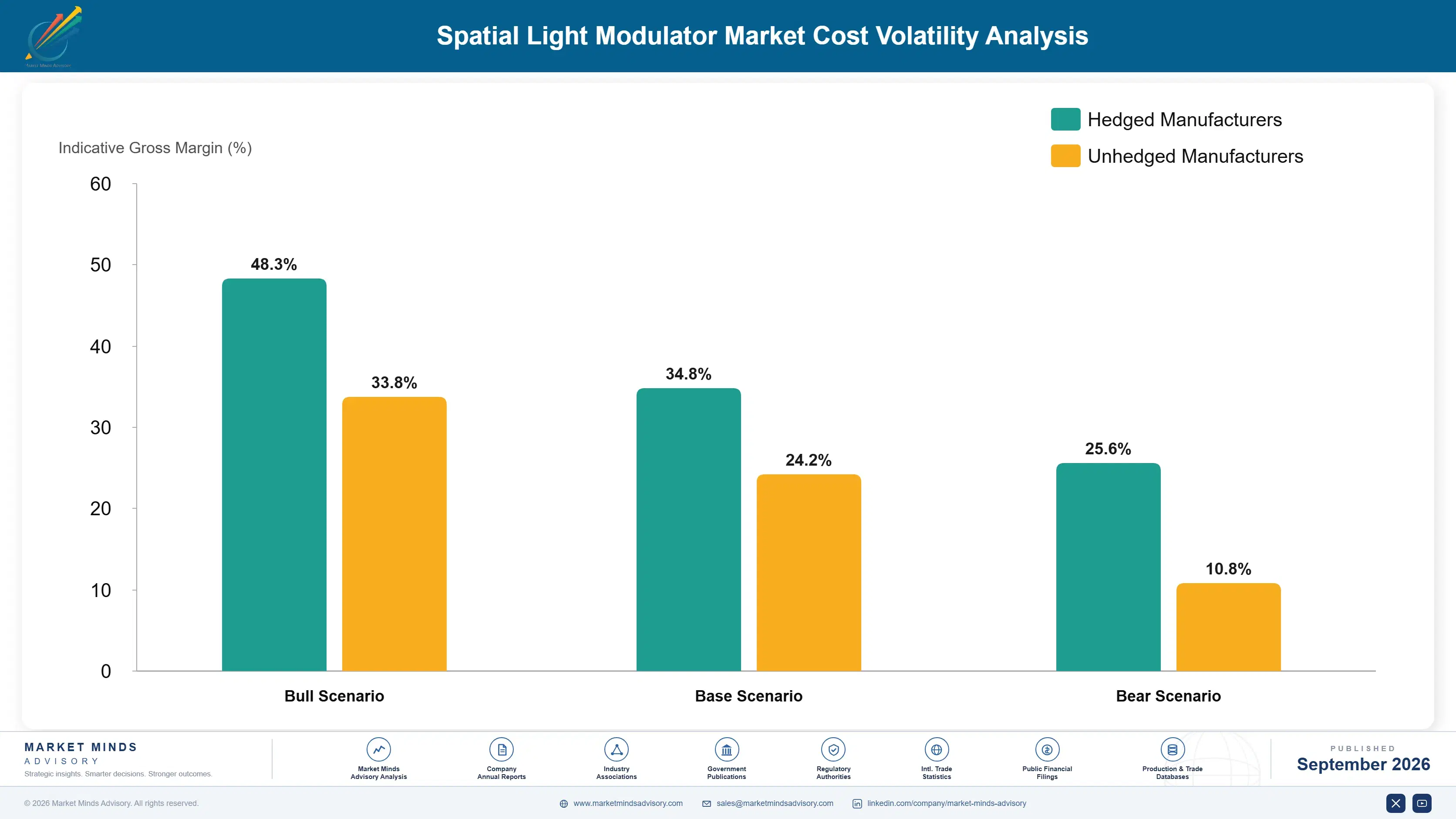
Semiconductor Substrate and Optical Coating Cost Exposure

Silicon and specialty semiconductor substrate materials together with precision optical coatings represent roughly 38% of unit cost of goods sold, sourced predominantly from specialized semiconductor foundries and optical coating suppliers concentrated in Japan, Taiwan, and the United States, with pricing subject to broader semiconductor commodity market movements. Vendors relying more heavily on domestic foundry sourcing face a somewhat different exposure profile than those importing internationally.
Semiconductor substrate pricing rose meaningfully during the 2021 through 2022 global chip shortage, with several vendor annual reports documenting extended lead times across specialized photonics-grade substrate categories that delayed several publicly disclosed automotive qualification programs by multiple quarters during that period, frustrating automotive customers already committed to aggressive development timelines. Vendors without pre-existing foundry relationships experienced comparatively longer delays than those holding standing supply agreements already in place.

Smaller specialized suppliers carry disproportionately higher exposure since they lack the purchase volume to negotiate favorable long-term substrate supply agreements the way large diversified vendors like Texas Instruments or Hamamatsu Photonics can. This dynamic compounds during periods of elevated semiconductor demand, since smaller suppliers sit further back in allocation queues behind larger customers holding standing volume contracts across multiple product categories simultaneously.
spatial-light-modulator-market-cost-volatility-analysis-1790003923135

Multi-Source Substrate Qualification Programs

Leading suppliers qualify semiconductor substrate materials from at least two independent foundry partners per critical product line, reducing exposure to any single supplier's capacity constraints during periods of tight semiconductor market conditions. These arrangements often span multiple years. These arrangements typically span multiple years and include negotiated price ceilings tied to commodity indices. Terms vary considerably by supplier and region.

Long-Term Foundry Capacity Reservation Agreements

Larger suppliers increasingly sign multi-year volume commitments with semiconductor foundries, trading pricing flexibility for guaranteed allocation priority during future shortage conditions that could otherwise delay automotive qualification programs significantly. Smaller suppliers often cannot secure comparable terms given their limited annual purchase volume relative to larger competitors. Adoption remains slow but growing across the industry.

Vertical Integration of Coating Capability

Suppliers increasingly invest in in-house optical coating capability rather than depending entirely on external specialized coating vendors, reducing exposure to coating supplier capacity constraints. This approach requires considerable upfront capital investment. This approach has become increasingly common among suppliers seeking to differentiate on manufacturing quality control. Customers increasingly favor suppliers offering this capability. Costs remain notable.

Portfolio Architecture for Margin Defence

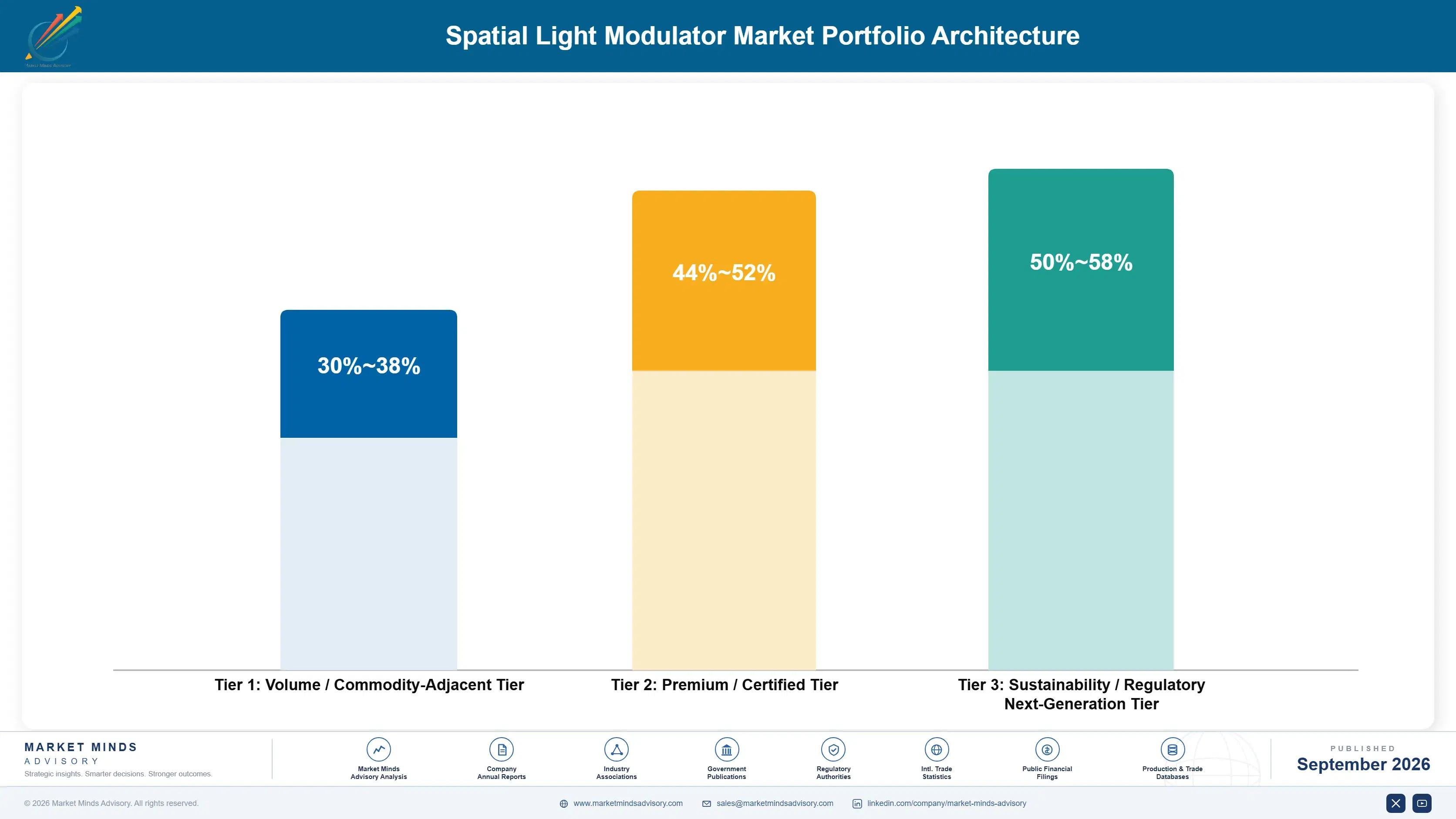
The market organizes into three tiers reflecting application complexity and revenue durability. Volume-tier standard modulators sold into less demanding laboratory and industrial applications carry thinner margins driven by price competition among several similarly capable suppliers, while premium automotive-grade and consumer electronics products command considerably better economics for suppliers positioned there. This tiering reflects both application complexity and how much of a given contract's value is recurring rather than one-time.
Tension between commoditizing standard laboratory-grade product sales and premium recurring engineering and consulting services revenue defines supplier strategy today, as standard product vendors face continuous margin pressure while those successfully building services and long-term agreement revenue construct more durable, higher-margin recurring income streams over time. Suppliers making this shift successfully report meaningfully steadier revenue than peers still dependent on lumpy unit sale cycles.

High-value pools concentrate in automotive-grade beam steering modulators, engineering support services, and long-term supply agreements, where suppliers capture recurring revenue well beyond the initial component transaction itself. Next-generation holographic display and quantum photonics research products represent the newest and fastest-growing high-margin pool available to suppliers currently. Suppliers positioned early in holographic display and consulting capture the largest share of this expanding high-margin opportunity.

Volume / Commodity-Adjacent Tier

Standard spatial light modulators sold primarily on price into less demanding laboratory and industrial applications with limited qualification requirements attached. Replacement cycles here typically run several years before major design refresh across product categories.
Gross Margin: 30%-38%

Premium / Certified Tier

Automotive-grade and consumer electronics qualified modulators bundled with multi-year supply agreements and engineering support services. Renewal rates on these bundled contracts run considerably higher than volume-tier relationships alone. Demand keeps rising steadily.
Gross Margin: 44%-52%

Sustainability / Regulatory / Next-Generation Tier

Holographic display, quantum photonics research products, and manufacturing yield optimization consulting for advanced applications. Demand keeps rising. Margins benefit from limited direct competition and considerable specialized photonics engineering expertise required.
Gross Margin: 50%-58%
spatial-light-modulator-market-portfolio-architecture-1790003923640

High-value Sub-segments and Strategic Watch-out

Automotive LiDAR Design Win Revenue

Automotive-grade modulator revenue growing fastest as suppliers secure design wins across multiple next-generation LiDAR programs simultaneously. Margins remain attractive. Source: MMA Estimate, July 2026. Growth here outpaces every other tracked category. Adoption keeps rising quickly. Vendor count here remains relatively small. Margins remain quite attractive.
Gross Margin: 48%-56%

Holographic Display Manufacturing Revenue

Consumer holographic display modulators growing steadily as manufacturing yield improvements enable mainstream augmented reality headset production volumes. Margins remain solid. Source: MMA Estimate, July 2026. Contract renewal rates remain notably strong. Adoption keeps accelerating steadily. Adoption keeps expanding across most launches. Margins remain quite solid.
Gross Margin: 44%-52%

Standard Laboratory and Industrial Sales

The volume core of the market, sold primarily into less demanding laboratory applications where price competition among established suppliers keeps margins comparatively thinner overall. Pricing pressure persists across most competing supplier tiers. Vendor count here remains high. Vendor count here remains the highest overall. Competition stays intense throughout.
Gross Margin: 32%-38%

Legacy Mechanical Scanning Alternatives

Declining mechanical beam steering systems facing sustained pressure as automotive customers increasingly migrate toward solid-state modulator alternatives across most programs. Suppliers are exiting this category gradually over time. Decline pace varies by application. Suppliers with diversified portfolios face less exposure. Decline pace varies notably. Suppliers exit steadily.
Gross Margin: 18%-26%

Recurring Qualified Supplier Relationships Over Time

Demand increasingly behaves like an annuity rather than a one-time component sale, since qualified modulator relationships require continuous supply reliability and technical support for the life of a customer's product platform, which typically runs five to eight years before a full design refresh across most automotive and consumer electronics applications. Suppliers that let this qualification relationship lapse risk losing the account at the next major platform design refresh.
Adoption depth varies meaningfully by customer type: automotive customers tend toward long-term, single-qualified-supplier relationships once they commit to a vendor given the extensive qualification testing involved, while consumer electronics and research customers often evaluate multiple suppliers simultaneously to maintain competitive pricing pressure and supply chain redundancy across their production volumes. This uneven pattern means suppliers must maintain both large-scale volume manufacturing capability and smaller specialized qualification expertise simultaneously.

Buyer profiles are shifting generationally as photonics systems engineers, rather than purely traditional procurement specialists, increasingly influence supplier qualification decisions around manufacturing yield capability, favoring suppliers who can demonstrate measurable reliability advantages rather than pure unit price comparison that procurement teams historically prioritized. Suppliers slow to build this technical fluency risk being sidelined in qualification conversations increasingly led by photonics engineers.
spatial-light-modulator-market-end-use-penetration-index-1790003924133

Where MMA Sees the Real Opportunity

These are among the four positions where our research anticipates prominent divergence between winners and laggards over the coming forecast period. Each is grounded in the demand model, the regulatory perimeter, and the announced capacity pipeline.
01 / AUTOMOTIVE QUALIFICATION STRATEGY

Accelerate automotive LiDAR qualification programs now

Suppliers should accelerate automotive LiDAR qualification programs now, since automotive customers increasingly favor suppliers who can demonstrate proven manufacturing yield and reliability performance across multiple vehicle platforms simultaneously. Qualification cycles in automotive typically span multiple years, meaning suppliers slow to begin this process risk missing the current wave of platform design decisions entirely, particularly as competing beam steering technologies also pursue these same design win opportunities aggressively. Suppliers with existing semiconductor fabrication scale hold a meaningful head start, since much of the underlying process expertise translates directly across demanding applications.
02 / MANUFACTURING YIELD INVESTMENT

Prioritize yield improvement over pure optical performance

The suppliers capturing the most durable new revenue are those investing in manufacturing yield improvement now rather than pursuing marginal optical performance gains that matter less to automotive and consumer electronics customers than consistent, cost-effective production volume. Building this yield capability early positions suppliers to win design contracts as automotive and consumer applications increasingly prioritize guaranteed production allocation over raw technical specifications. Suppliers without adequate yield improvement risk losing qualification opportunities entirely to competitors who can credibly commit to meeting rapidly rising volume requirements.
03 / TECHNOLOGY DIVERSIFICATION STRATEGY

Hedge across multiple beam steering technology approaches

Given genuine technology selection uncertainty in automotive LiDAR beam steering, suppliers should hedge their research and development investment across multiple beam steering technology approaches rather than committing exclusively to spatial light modulator technology alone. This diversified approach reduces the risk of being excluded entirely if automotive customers ultimately favor a competing beam steering technology for a majority of future vehicle platforms. Suppliers overly committed to a single technology approach risk considerable revenue concentration risk if that specific approach loses favor among automotive customers.
04 / CONSUMER ELECTRONICS EXPANSION

Build consumer-grade manufacturing cost capability broadly

Consumer electronics augmented reality applications require manufacturing cost targets considerably below what automotive and laboratory-grade applications historically demanded, and suppliers with credible consumer-grade manufacturing cost capability stand to capture disproportionate share of this rapidly scaling buyer segment. This consumer expansion increasingly differentiates suppliers beyond their traditional automotive and laboratory roots, particularly among consumer electronics companies evaluating which supplier can meet mainstream product cost and volume requirements simultaneously. Suppliers slow to build this capability risk ceding the fastest-growing buyer segment entirely to competitors already meeting mainstream cost targets.

Engagement Snapshot From the Field

A live engagement with an industry participant carrying material or product regulatory and market exposure ahead of a defining policy shift, showing how our research translates into a defensible multi-year portfolio strategy.
MARKET MINDS ADVISORY · CLIENT ENGAGEMENT SUMMARY
Spatial Light Modulator Producer Strategic Portfolio Review and Transition Roadmap 2026·Investment Scenario on Spatial Light Modulator Exposure Evaluation 2025-26
CLIENT PROFILE
The client is a tier-one automotive LiDAR supplier developing next-generation solid-state beam steering systems for several major global automakers, seeking to qualify a spatial light modulator supplier as it transitioned away from mechanical scanning systems that faced reliability concerns during extended field testing programs. Supplier leadership had previously deferred qualification investment for several years given other competing engineering priorities.
STRATEGIC CHALLENGE
The supplier needed to qualify a solid-state modulator partner within a compressed eighteen-month timeline to meet automaker production commitments while maintaining the reliability and manufacturing yield standards its automotive customers required, without disrupting ongoing development across currently active vehicle platform programs. Engineering leadership also required proof of consistent manufacturing quality before approving the full transition.
MMA APPROACH
MMA's team benchmarked qualified modulator supplier options against the client's specific reliability and volume scaling requirements, evaluating both established photonics suppliers and specialized beam-steering startups. MMA modeled total cost of ownership across a seven-year platform horizon and structured a phased qualification plan aligned with the client's production ramp schedule. MMA also benchmarked reliability data against comparable industry field performance records.
KEY FINDINGS
  1. Transitioning to solid-state beam steering was projected to reduce field failure rates by approximately 45% (client-reported, unverified by MMA) relative to the client's existing mechanical scanning approach.
  2. Roughly 20% of the client's existing system specifications required minor design adjustments to accommodate the new supplier's manufacturing tolerances without compromising performance.
  3. A phased fourteen-month qualification timeline, completed well ahead of the client's original internal timeline projection, was expected to meet the production deadline.
  4. Client engineering leadership had significantly underestimated how quickly the new supplier's manufacturing yield would improve once production volume scaled past initial qualification runs.
CLIENT PROFILE
The client is a tier-one automotive LiDAR supplier developing next-generation solid-state beam steering systems for several major global automakers, seeking to qualify a spatial light modulator supplier as it transitioned away from mechanical scanning systems that faced reliability concerns during extended field testing programs. Supplier leadership had previously deferred qualification investment for several years given other competing engineering priorities.
STRATEGIC CHALLENGE
The supplier needed to qualify a solid-state modulator partner within a compressed eighteen-month timeline to meet automaker production commitments while maintaining the reliability and manufacturing yield standards its automotive customers required, without disrupting ongoing development across currently active vehicle platform programs. Engineering leadership also required proof of consistent manufacturing quality before approving the full transition.
MMA APPROACH
MMA's team benchmarked qualified modulator supplier options against the client's specific reliability and volume scaling requirements, evaluating both established photonics suppliers and specialized beam-steering startups. MMA modeled total cost of ownership across a seven-year platform horizon and structured a phased qualification plan aligned with the client's production ramp schedule. MMA also benchmarked reliability data against comparable industry field performance records.
KEY FINDINGS
  1. Transitioning to solid-state beam steering was projected to reduce field failure rates by approximately 45% (client-reported, unverified by MMA) relative to the client's existing mechanical scanning approach.
  2. Roughly 20% of the client's existing system specifications required minor design adjustments to accommodate the new supplier's manufacturing tolerances without compromising performance.
  3. A phased fourteen-month qualification timeline, completed well ahead of the client's original internal timeline projection, was expected to meet the production deadline.
  4. Client engineering leadership had significantly underestimated how quickly the new supplier's manufacturing yield would improve once production volume scaled past initial qualification runs.
RECOMMENDED STRATEGY
Phase 1: Phase 1 (Months 1-5): Complete initial technical qualification testing against the client's existing reliability and performance specifications., coordinating closely with the client's photonics engineering team throughout Phase 2: Phase 2 (Months 6-11): Validate manufacturing consistency across production-representative sample volumes from the new supplier's facility., prioritizing the highest-volume production platforms first Phase 3: Phase 3 (Months 12-14): Finalize long-term supply agreement and begin phased production volume transition., while documenting lessons learned for future qualification programs
OUTCOME
The supplier approved the qualification plan and completed Phase 1 testing on schedule in mid-2026, with full qualification targeted for completion by early 2027 (client-reported, unverified by MMA). Projected annual field failure cost avoidance was estimated at approximately $5.4 million (client-reported, unverified by MMA) once solid-state beam steering reaches full production deployment.

Frequently Asked Questions

Foundational context covering the market sizes, CAGR, scope, country, region and competition that inform every finding below. This section is provided to cover basics and most often pre-purchase conversations, answered from the MMA Primary Research Dataset.

What is the current size of the Spatial Light Modulator Market?

The global Spatial Light Modulator Market was valued at approximately $0.9 billion in 2025. Growth reflects both automotive LiDAR beam steering adoption and expanding augmented reality display demand.

How large will the Spatial Light Modulator Market be by 2036?

MMA projects the market will reach approximately $3.45 billion by 2036, roughly triple its 2026 value. Automotive LiDAR and consumer augmented reality both contribute meaningfully to this growth.

What is the CAGR for the Spatial Light Modulator Market 2026 to 2036?

The market is projected to grow at a 13.0% compound annual growth rate over the forecast period. This places it within the nascent, early-stage technology growth band.

Which segment is growing fastest?

LiDAR Beam Steering SLMs lead growth at an 18.0% CAGR, roughly 1.38 times the overall market growth rate. Automotive design wins drive most of this segment's momentum.

Who are the major companies in the Spatial Light Modulator Market?

Leading companies include Hamamatsu Photonics, Meadowlark Optics, Texas Instruments, Jenoptik, and HOLOEYE Photonics. Together these five hold an estimated 58% combined global market presence today.

Which country is growing fastest?

Japan leads global growth at an estimated 14.3% CAGR, driven by the country's strong photonics manufacturing base across automotive and consumer electronics applications nationwide today.

Report Segmentation Architecture

The full report scope spans multiple orthogonal segmentation dimensions, with cross-tabulated demand data provided for each dimension pair. Coverage extends further to regional breakdowns, trend trajectories, and the competitive detail needed to support segment-level decision-making.

By Application Type

  • LiDAR Beam Steering SLMs
  • Holographic Display and AR/VR SLMs
  • Laser Beam Shaping and Materials Processing SLMs
  • Optical Computing and Quantum Photonics SLMs
  • Adaptive Optics SLMs
  • Industrial and Scientific Instrumentation SLMs

By End-Use Industry

  • Automotive
  • Consumer Electronics
  • Research and Academic Institutions
  • Industrial Manufacturing
  • Defense and Aerospace

By Commercial Dimension

  • Standard Unit Sales
  • Long-Term Supply Agreements
  • Design Engineering Services
  • Manufacturing Consulting Services

By Region

  • North America
  • Western Europe
  • East Asia
  • South Asia and Pacific
  • Latin America
  • Middle East and Africa
  • Eastern Europe

Scope, Methodology, and Coverage

Every figure in this report is reproducible from documented input assumptions. The scope below maps the historical period, the forecast horizon, the segmentation dimensions, and the countries covered, alongside the underlying primary and qualitative methodology.
Historical Period
2020 to 2025
Forecast Period
2026 to 2036
Base Year
2025 (USD billions; MMA Primary Research Dataset, September 2026)
Market Definition
The market covers liquid crystal, micromirror, and micro-electro-mechanical systems-based spatial light modulator devices used for beam steering, holographic display, laser beam shaping, and optical computing applications. It excludes standard flat-panel display panels without spatial light modulation function, conventional camera image sensors, and passive optical lenses and mirrors.
Quantitative Units
USD billions (current prices); modulator unit shipment counts; automotive design win counts
Segmentation Dimensions
By Application Type; By End-Use Industry; By Commercial Dimension; By Region
Regions Covered
North America, Western Europe, East Asia, South Asia and Pacific, Latin America, Middle East and Africa, Eastern Europe
Countries Covered
USA, China, Germany, France, UK, Japan, South Korea, India, Australia, Canada, Brazil, Mexico, Indonesia, Vietnam, Thailand, Malaysia, UAE, Saudi Arabia, South Africa, Nigeria, Turkey, Poland, Netherlands, Italy, Spain, Sweden, Switzerland, Argentina, Colombia, Singapore, and additional markets relevant to this sector
Key Companies Profiled
Hamamatsu Photonics, Meadowlark Optics, Texas Instruments, Jenoptik, HOLOEYE Photonics, Boulder Nonlinear Systems, Santec Corporation, Forth Dimension Displays, CITIZEN FINEDEVICE, Kopin Corporation, Himax Technologies, Syndiant, Silicon Light Machines (Coherent), Lumentum, Thorlabs, Newport Corporation (MKS Instruments), Edmund Optics, Compound Photonics, Innolux Corporation, AU Optronics
Quantitative Methodology
Primary survey, n=3,800 respondents, Q4 2025, six countries; demand-side model with trade association cross-validation
Qualitative Methodology
47 expert interviews, Q4 2025; applied to validate demand model assumptions, identify emerging dynamics, and assess competitive positioning
Report Format
PDF and XLSX data workbook (Word format preview document)
Publisher
Market Minds Advisory
Report Code
MMA-2026-TEC-237
Published
September 2026
Contact
sales@marketmindsadvisory.com | www.marketmindsadvisory.com

Purchase the full Spatial Light Modulator Market Report (2026 to 2036).

The full report provides detailed market sizing, ten-year forecasts, and competitive benchmarking across the spatial light modulator category worldwide. It includes country-level automotive LiDAR development tracking, supplier manufacturing yield capability comparisons, and segment-level growth analysis across automotive, consumer, and research applications. Buyers receive access to MMA's proprietary automotive design win tracker updated quarterly throughout the subscription period. The report also includes detailed input-cost analysis for semiconductor substrate and optical coating material sourcing. Subscribers can request a customized briefing call to discuss findings relevant to their specific sourcing or investment questions.
Country-level LiDAR development tracking dashboard updates
Supplier manufacturing yield capability scorecards included
Segment-level ten-year growth forecasts by category
Competitive benchmarking covering every profiled supplier
Automotive design win tracker updated each quarter
Input-cost and semiconductor supply risk analysis

Built For The People Who Decide

From boardroom strategy to bench-side execution, this report is read cover-to-cover by leaders shaping the next decade of their industry, turning demand scenarios, market dynamics and valuation benchmarks into decisions.
CXOs/ Presidents/ VPs/ Managers
M&A and Corporate Development
Strategy Teams and R&D Heads
Procurement and Product Directors
Regulatory and Compliance Leaders
Investor Relations and Equity Analysts