Market Minds Advisory
Space Grade Microcontrollers Market

Space Grade Microcontrollers Market: Space Grade Microcontrollers Market. Smallsat Constellation Buildout and Radiation-Tolerant COTS Expansion to 2036

Mega-constellation buildout is pulling procurement away from fully radiation-hardened parts toward radiation-tolerant commercial-off-the-shelf microcontrollers, forcing established suppliers to qualify cheaper devices at satellite volumes never before required. at record production scale.

Lead Analyst

Published

September 2026

Make Smarter Decisions with Customized Research Insights

Request a free sample report and evaluate market opportunities, growth trends, and competitive dynamics relevant to your business needs.

2025 MARKET VALUE$0.8BMarket Size 2025
2036 FORECAST VALUE$3.4BBase Case , 2026 to 2036
CAGR 2026 TO 203613.5 %Bull 14.8% / Bear 12.2%
INCREMENTAL OPPORTUNITY$2.5BNet 10- year value creation
EXPANSION MULTIPLE3.55x2036 value over 2026 base
Strategic Levers
M&A Pipeline
Regional Outlook
Country Rankings
Competitive Intelligence
Segmental Deep-dive
Call-Us : 91 93563 13602

Executive Snapshot and Market Trajectory.

Space grade microcontroller demand is shifting from fully radiation-hardened parts toward radiation-tolerant COTS devices, as satellite manufacturers pursue constellation-scale volumes that legacy hardened-only supply chains cannot deliver. Qualification testing service investment is compounding this shift across major North American and East Asian space markets simultaneously.
COTS radiation-tolerant microcontrollers remain the fastest-growing segment as satellite manufacturers increasingly favor qualified commercial devices over legacy fully hardened-only parts, despite these devices carrying higher qualification cost than conventional hardened microcontrollers across most established government deployments. North America absorbs the largest share of global demand, reflecting the concentration of major satellite manufacturing and radiation-hardened chip vendors headquartered domestically alongside dominant commercial launch capacity. Vendors continue standardizing radiation-tolerant qualification specification.
Competition concentrates among a small number of diversified radiation-hardened semiconductor majors offering integrated microcontroller and testing portfolios, alongside specialty vendors competing on documented radiation tolerance accuracy. Rising COTS adoption and qualification testing investment are reshaping category economics well beyond legacy hardened-only offerings, while wafer fabrication cost volatility and skilled radiation engineer shortages continue to complicate deployment across smaller regional vendors. Government mission procurement is emerging as a distinct new competitive consideration across several regions.
Market Definition
The space grade microcontrollers market covers radiation-hardened and radiation-tolerant microcontroller devices and associated qualification services used in satellite and spacecraft electronics, including radiation-hardened-by-design microcontrollers, radiation-hardened-by-process microcontrollers, commercial-off-the-shelf radiation-tolerant microcontrollers, microcontroller IP cores and reference designs, space qualification and radiation testing services, and flight software and firmware development tools. The market excludes ground-based aerospace electronics, general commercial microcontrollers not qualified for space environments, and satellite bus structural hardware.
Base Year Value
$0.8B in 2025 (MMA Primary Research Dataset, September 2026)
Forecast Period
2026 to 2036, eleven discrete annual values
CAGR
13.5% base case. Bull 14.8%. Bear 12.2%.
Fastest Growth Segment
COTS Radiation-Tolerant Microcontrollers: 19.5% CAGR
Fastest Growth Country
India: 16.0% CAGR
Fastest Growth Region
South Asia and Pacific: 15.5% CAGR
Largest Region
North America: 36% of 2025 global value
Market Leaders
Microchip Technology, BAE Systems, Cobham, Honeywell, and STMicroelectronics lead the field. Source: MMA Analysis based on company disclosures.
Primary Survey
n=3,800 procurement and R&D decision-makers, Q4 2025, six countries
Methodology
Demand-side build-up, cross-validated against public data, 47 expert interviews

Space Grade Microcontrollers Market Forecast Scenarios

space-grade-microcontrollers-market-size-forecast-scenario-1788427564080
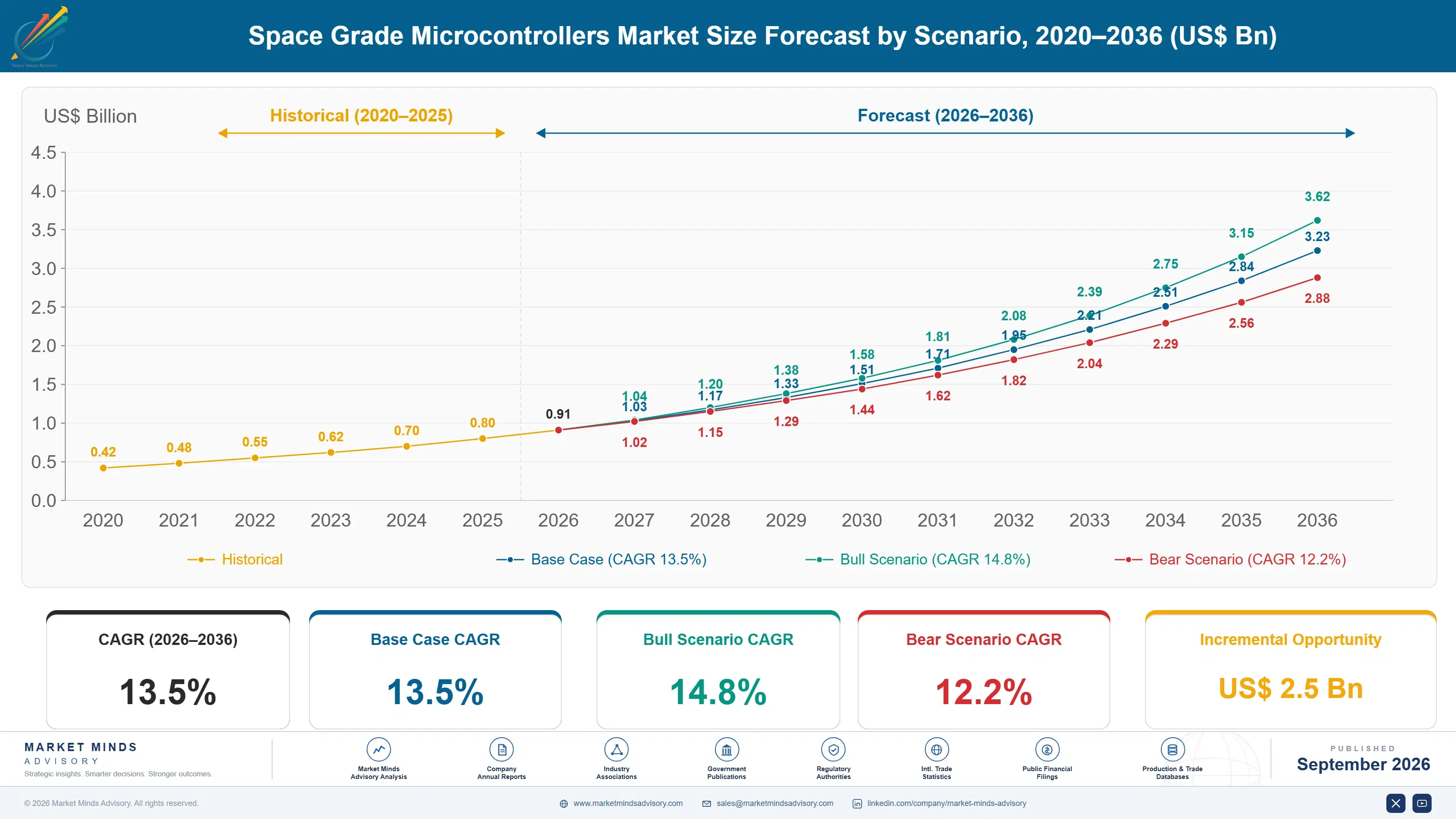
Between 2020 and 2025 space grade microcontroller demand grew at roughly 12.0 percent a year, steady as government satellite programmes expanded gradually across major developed space markets. Growth accelerated sharply from 2023 as commercial mega-constellation buildout intensified across several developed markets, pulling category demand toward COTS and testing service configurations. That shift accelerated further as additional operators committed to constellation expansion programmes.
The base case assumes continued growth as three mechanisms compound: satellite manufacturers increasingly specifying radiation-tolerant COTS devices to automate constellation-scale procurement without compromising mission reliability; launch providers expanding qualification testing capacity that requires reliable radiation validation infrastructure; and equipment vendors introducing flight software tools that reduce manual firmware development cost without full redesign. These mechanisms reinforce each other as constellation adoption and qualification standardization continue compounding across major space markets.
The bull case turns on faster-than-expected mega-constellation launch cadence across major North American and East Asian space markets. The bear case centers on sustained wafer fabrication cost volatility, which has historically delayed microcontroller procurement decisions and slowed new deployment capacity investment across smaller regional vendors facing thinner capital budgets overall. Both scenarios remain plausible given the pace of adoption.

Constellation Buildout Reshapes Microcontroller Procurement Economics

Space grade microcontrollers sit at the intersection of radiation physics engineering, commercial space capital cycles, and shifting satellite manufacturer procurement strategy. As COTS and qualification-focused formats spread, vendors increasingly compete on documented radiation tolerance and mission reliability rather than upfront device cost alone, even where standard fully hardened microcontrollers carry a substantial cost advantage over legacy COTS-only offerings.
MARKET CONCENTRATIONCR5: 68%Ownership concentrates heavily among diversified radiation-hardened semiconductor majors
AVERAGE PROGRAMME CONTRACT VALUE$8.5 million per constellation qualification programmePricing varies sharply by radiation tolerance and volume requirement
COTS PENETRATION29% of new smallsat installationsRadiation-tolerant commercial formats represent a growing minority of installations overall
TOP MANUFACTURING COUNTRY SHAREUnited States: 41% of global microcontroller qualificationQualification concentrates near established radiation-hardened fabrication clusters nationwide
AVERAGE DEVICE LIFECYCLE12 years per microcontroller designDevices typically span longer service cycles than terrestrial semiconductor parts
WAFER FABRICATION COST SHARE26% of cost of goods soldSpecialty fabrication pricing directly affects overall vendor profitability today
Commercially the category concentrates among a small number of diversified radiation-hardened semiconductor majors offering integrated microcontroller and testing portfolios, alongside specialty vendors competing on documented tolerance credentials. Diversified majors compete on installed satellite base breadth and multi-mission integration capability, while specialty vendors win on radiation physics engineering precision and qualification reliability, since government, commercial, and constellation applications each demand distinct tolerance specifications and mission requirements.
The next decade will be shaped by continued COTS premiumization, expanding qualification testing adoption across additional constellation segments, and diversification of wafer fabrication sourcing beyond concentrated manufacturing clusters facing periodic trade cost volatility. Vendors that pair documented tolerance credibility with reliable, cost-efficient qualification stand to capture share from competitors still offering undifferentiated fully hardened-only devices without comparable COTS positioning today. Vendors that delay this investment risk ceding share to more prepared rivals.
"A satellite operator discovering a microcontroller cannot survive its first solar flare is exactly the failure mode radiation qualification testing exists to catch on the ground, not in orbit."
Director, Radiation-Hardened Electronics and Space Systems Practice · MMA Radiation-Hardened Semiconductor Devices Practice · September 2026

Market Trends

COTS Devices Steadily Displace Fully Hardened Parts

Satellite manufacturers across major North American and East Asian markets are increasingly specifying radiation-tolerant COTS microcontrollers positioned against legacy fully hardened-only parts, responding to demand for constellation-scale procurement volumes that speed satellite assembly without compromising mission reliability across large orbital fleets. This shift has required vendors to invest in radiation testing and tolerance validation capability, a process that can take twelve to eighteen months per device generation given required mission qualification. Vendors are increasingly treating COTS specification as a competitive prerequisite for new constellation deployments, accelerating the transition well beyond fully hardened retention.
Market Impact: Adds 9 percent constellation-driven volume
Qualification Testing Services Gain Ground Across Manufacturers

Testing service vendors are increasingly developing qualification testing programmes that automatically validate radiation tolerance before satellite integration, responding to manufacturer demand for reduced mission failure risk that limited internal testing cannot reliably deliver across expanding constellation portfolios. Testing adoption increasingly differentiates qualification-focused vendors from standalone device-only competitors, since manufacturers evaluate a service primarily on documented tolerance accuracy rather than upfront pricing alone. Several major vendors have expanded dedicated testing product lines to serve this growing preference across commercial and government applications. This trend is accelerating fastest among manufacturers with the largest existing constellation portfolios requiring testing.
Market Impact: Adds 5 percent launch-driven volume

Market Opportunities and Growth Drivers

Rising Mega-Constellation Buildout Steadily Sustains Demand

Mega-constellation buildout continues rising across major space markets as operators pursue expanded broadband coverage following growing commercial satellite investment, sustaining steady demand for microcontrollers specified into new satellite production from the outset of manufacturing planning. Newly commissioned production lines typically require documented tolerance validation through standardized qualification testing, generating concentrated demand for vendors who can demonstrate quantified reliability data from comparable deployments. Vendors with established qualification testing credibility benefit from this demand pattern ahead of competitors relying primarily on generic tolerance claims alone across the market. This pattern is expected to strengthen further through 2027.
Market Impact: Adds up to 13 percent

Expanding Commercial Launch Investment Sustains Growth

Commercial launch investment continues expanding across major space and satellite markets as operators pursue reduced mission failure risk following growing constellation complexity, sustaining steady demand for microcontrollers that link radiation tolerance to automated testing infrastructure. Documented tolerance accuracy and qualification speed increasingly differentiate premium testing-focused vendors from standalone device-only suppliers. Vendors investing in testing engineering are capturing tolerance-driven contract share from those relying on device-only sales alone across most commercial segments today, particularly among rapidly expanding smallsat constellation programmes. This investment is concentrated among operators serving high-density orbital shells with complex multi-satellite integration needs, where reliability gaps carry mission exposure.
Market Impact: Adds up to 9 percent

Market Restraints and Challenges

Wafer Fabrication Cost Volatility Pressures Vendor Margins

Specialty radiation-hardened wafer fabrication costs continue fluctuating with broader semiconductor commodity markets, restricting microcontroller vendors' ability to maintain stable device pricing across multi-year satellite manufacturer procurement agreements negotiated well ahead of actual production consumption schedules. The root cause is that radiation-hardened die fabrication remains dependent on specialty foundry capacity with limited viable cost-competitive substitution at current pricing for demanding tolerance requirements. When fabrication costs spike, vendors either absorb margin compression or attempt mid-contract price renegotiation, both of which have strained manufacturer relationships during periods of volatility. Industry participants expect this pressure to persist through 2027.
Market Impact: Displaces 15 percent fully hardened volume

Skilled Radiation Engineer Shortages Restrict Deployment Speed

Skilled radiation engineer availability continues facing extended shortages across several major semiconductor design categories, restricting vendors' ability to convert device wins into completed qualification within the delivery windows manufacturers originally specified. Root causes include growing complexity of multi-orbit radiation environment modeling combined with increasingly demanding mission assurance requirements introduced following recent constellation reliability incidents. Vendors are addressing the pressure by expanding pre-engineered standardized testing packages that reduce the engineer training burden considerably, though smaller vendors still report longer average qualification timelines than larger, better-resourced competitors overall. The delays disproportionately affect smaller vendors with less established qualification relationships.
Market Impact: Adds 10 percent testing-service share
3 additional market trends, 4 additional growth drivers, and 3 additional restraints and challenges are covered in the full report. Contact sales@marketmindsadvisory.com to access the complete intelligence.

Segment CAGR and Growth Architecture

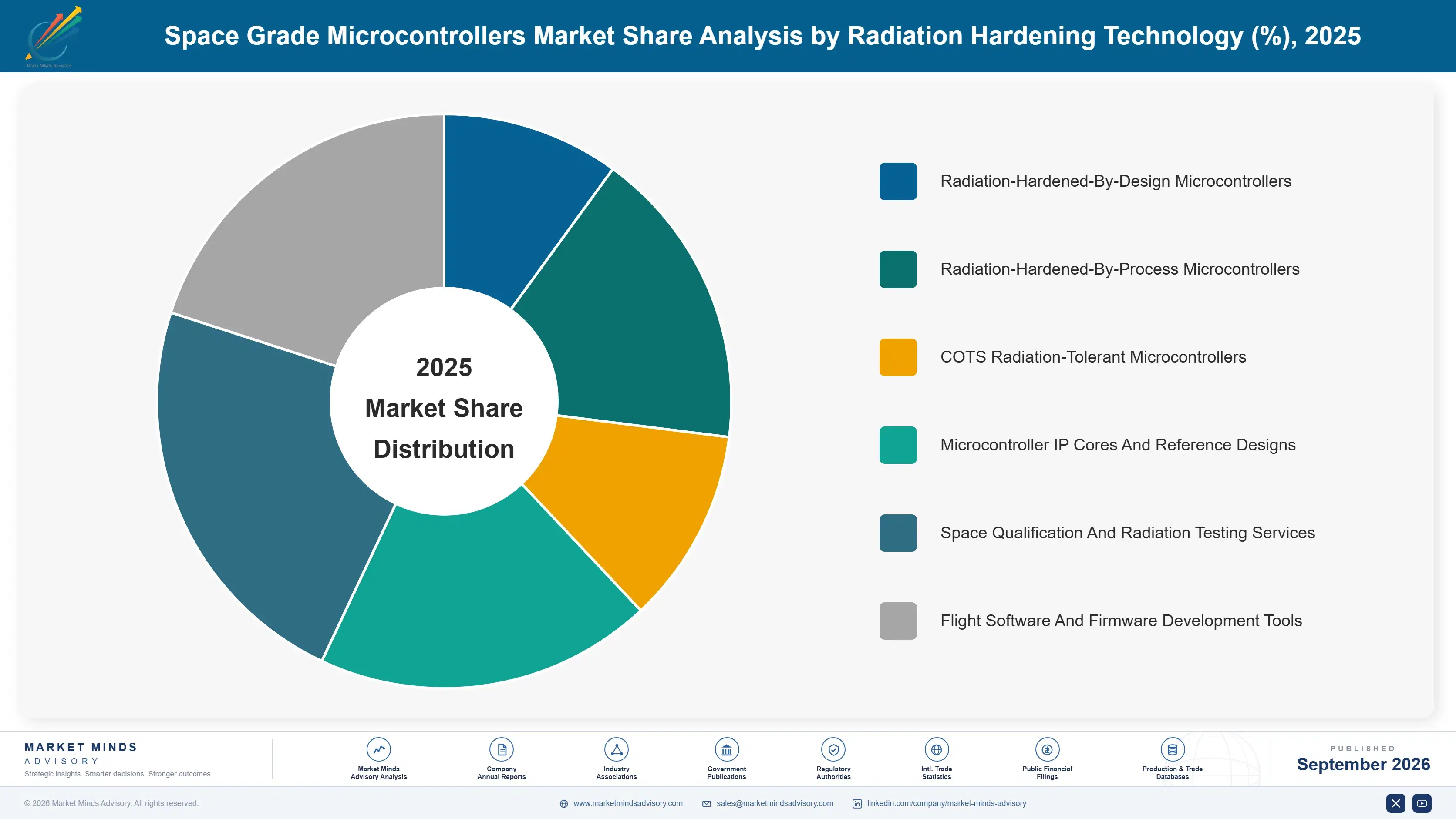
Space grade microcontrollers segment most usefully by radiation hardening technology, since design-hardened, process-hardened, COTS, IP core, testing, and firmware formats carry distinct engineering requirements. This framework mirrors how vendors organise product lines and how satellite manufacturers structure procurement decisions today, particularly as COTS adoption accelerates. Each category also aligns closely with how vendors allocate internal engineering budgets.
space-grade-microcontrollers-market-market-share-analysis-1788427564661

COTS Radiation-Tolerant Microcontrollers

COTS radiation-tolerant microcontrollers form the fastest-growing segment as satellite manufacturers increasingly favor qualified commercial devices over legacy fully hardened-only parts, despite these devices carrying meaningfully higher qualification cost than conventional hardened microcontrollers across most established government deployments currently. Developing reliable radiation-tolerant platforms requires substantial investment in tolerance engineering and mission validation, a barrier that favors vendors with dedicated radiation physics engineering teams over smaller hardened-only competitors lacking comparable infrastructure. Growth concentrates among vendors with documented tolerance credentials, since manufacturers increasingly expect quantified reliability data before procurement commitment. Growth is fastest in North America and East Asia. Vendors are responding by expanding dedicated tolerance engineering accordingly. Buyers increasingly expect quantified proof before final commitment.
CAGR 19.5%

Space Qualification And Radiation Testing Services

Space qualification and radiation testing services form the second-fastest-growing segment, benefiting from satellite manufacturers seeking automated tolerance validation that eliminates the manual testing burden legacy in-house-only programmes once imposed across expanding constellation portfolios. Documented testing reliability and mission compliance increasingly differentiate premium testing-focused vendors from standard in-house alternatives sold at lower service pricing. Growth is fastest in markets with well-developed commercial space infrastructure, particularly North America and East Asia, where testing platforms increasingly bundle with broader mission assurance upgrade programmes, providing vendors a natural cross-sell channel beyond standalone device sales. This trend is expected to strengthen further as more manufacturers standardize testing automation specification. Buyers increasingly expect measurable qualification reliability documentation before committing.
CAGR 16.5%
Full segment breakdown across 6 segments available in the complete report.

Regional Architecture and Country Demand Map

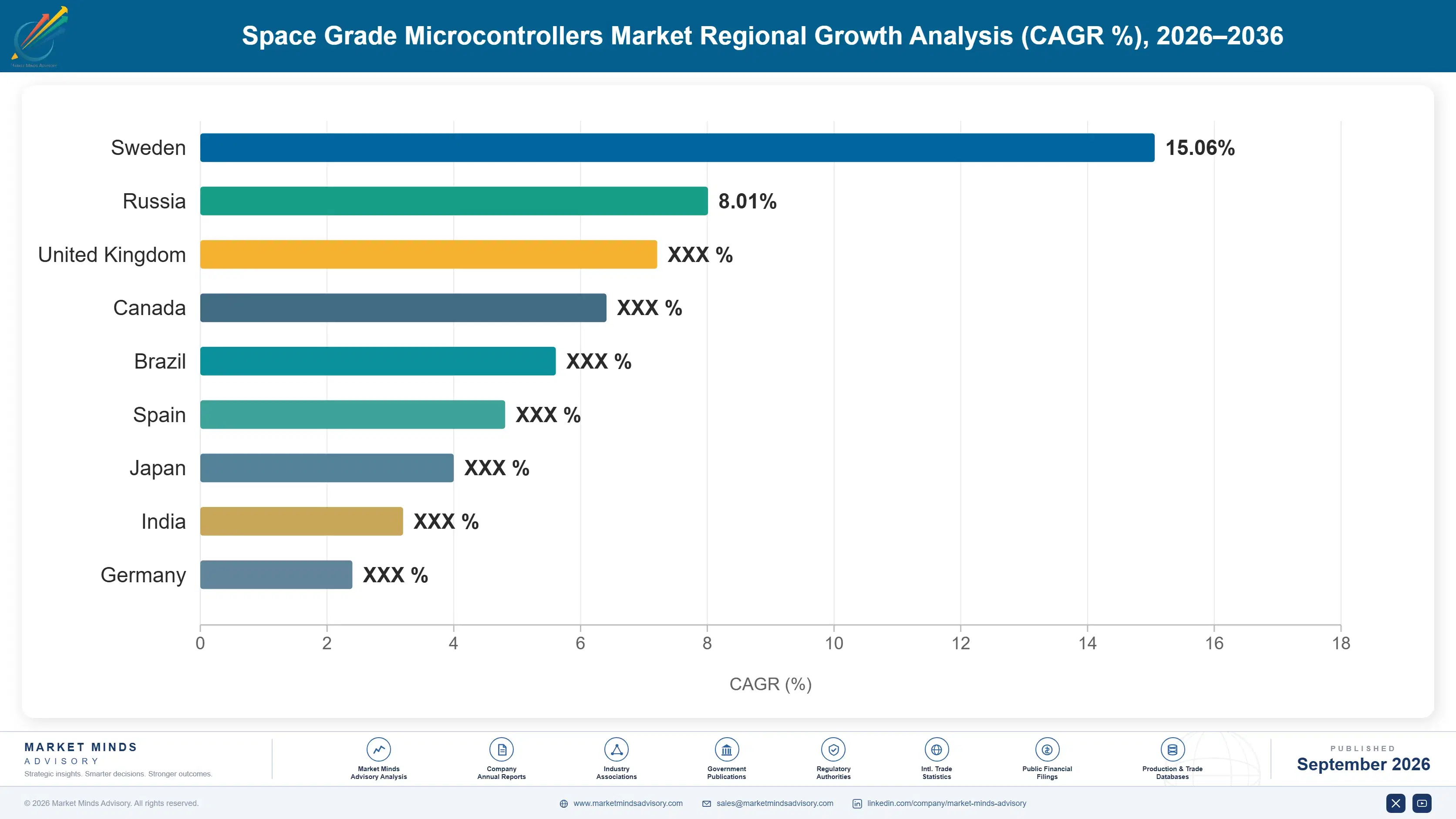
Space grade microcontroller demand concentrates overwhelmingly where satellite manufacturing and commercial launch capacity are most developed. North America accounts for the largest share of global demand by a wide margin, reflecting the concentration of major satellite manufacturers and radiation-hardened chip vendors headquartered domestically. East Asia follows next.

North America

The United States' concentration of major satellite manufacturers and radiation-hardened chip vendors, backed by the world's largest commercial launch cadence, drives by far the largest regional demand across all microcontroller categories. Rising COTS adoption and testing service investment are reshaping demand toward radiation-tolerant formats over legacy fully hardened offerings specifically. Canada's aerospace sector, closely integrated with United States satellite suppliers, mirrors American qualification specifications and procurement cycles closely. Growth is supported by continued hardened demand at the government tier alongside sustained premium COTS adoption across major commercial and constellation markets nationwide. California and Colorado increasingly anchor the fastest-growing microcontroller procurement activity nationally. This share reflects genuine satellite manufacturing and launch capacity concentration rather than a default assumption.
Share: 36% | CAGR: 14.5% (2026 to 2036)

Western Europe

Germany and France's established aerospace and satellite manufacturing base, tied to some of the world's most rigorous mission assurance standards, drive substantial regional demand for hardened and testing categories. The United Kingdom's satellite sector contributes additional demand from manufacturers favoring documented tolerance transparency. Italy and the Netherlands's aerospace sectors contribute meaningful additional demand, though COTS adoption there still lags the more advanced German and French markets. Growth trails the fastest-growing regions because the region's satellite manufacturing infrastructure is already comparatively mature, with further gains depending on incremental qualification upgrades. Nordic countries contribute smaller but steadily growing demand tied to expanding satellite infrastructure investment across the region. Vendors serving Western Europe increasingly emphasize documented mission assurance compliance alongside tolerance credentials.
Share: 18% | CAGR: 12.0% (2026 to 2036)
Regional intelligence for 5 additional markets available in the complete report: East Asia, South Asia and Pacific, Latin America, Middle East and Africa, Eastern Europe. Contact sales@marketmindsadvisory.com.
space-grade-microcontrollers-market-country-cagr-analysis-1788427565198

COTS And Qualification Testing Expansion

Vendors can grow revenue per device even where basic hardened volume growth is modest by shifting manufacturers toward COTS and testing-integrated formats, securing constellation operator design-in agreements, and expanding reliability service bundles across the entire installed base broadly. Each lever works best paired with documented performance data that gives manufacturers confidence before committing to unfamiliar COTS technology.

Developing Advanced Next-Generation COTS Tolerance Platforms

Vendors investing in documented COTS tolerance platforms targeted at constellation operators capture a device premium of roughly 27 to 39 percent over legacy fully hardened sourcing, reflecting the tolerance engineering and mission validation infrastructure these platforms require. This platform investment requires meaningful engineering and qualification testing work, but it pays back through access to premium constellation contracts that command higher pricing and stronger manufacturer loyalty among tolerance-focused clients. The approach works best for vendors already serving hardened channels seeking to extend into premium COTS distribution nationwide. Early movers report the fastest realized payback.
Market Impact: Commands a 27 to 39 percent device premium

Securing Long-Term Constellation Operator Design-In Agreements

Vendors securing multi-year design-in agreements with constellation operators gain long-duration revenue visibility uncommon in one-time device sales, since operator relationships rarely reverse once a manufacturing team standardizes specification around a particular vendor's tolerance framework. These agreements also create durable switching barriers, since operators face substantial requalification cost changing vendors mid-constellation-generation. Vendors with established operator relationships report device volume growth roughly 2.1 times higher than comparable vendors lacking dedicated design engineering infrastructure. That advantage compounds further as each successfully qualified deployment strengthens the vendor's reference base for subsequent competitive bids. Manufacturers value this predictability highly.
Market Impact: Lifts overall device volume by roughly 2.1 times

Expanding Reliability Testing And Qualification Service Bundles

Vendors bundling reliability testing and radiation qualification service coverage into device contracts capture margin previously lost to device-only competitors, while simultaneously reducing the testing burden that has historically discouraged smaller manufacturers from committing to unfamiliar COTS technology. This bundling investment requires meaningful testing staffing and lab infrastructure, but vendors who succeed report contract value improvement of roughly 18 percent compared with device-only service packages. The approach works best for vendors with sufficient technical scale to justify dedicated testing investment. Smaller vendors typically partner with third-party testing specialists instead, sharing part of the resulting margin.
Market Impact: Improves overall contract value by roughly 18 percent

Building Tolerance Accuracy Performance Guarantee Programmes

Vendors offering documented tolerance accuracy performance guarantees that transfer mission failure risk from manufacturers to established vendors are capturing incremental revenue previously lost to risk-averse procurement approval rejections, while simultaneously addressing manufacturer demand for quantified accuracy accountability structures. This guarantee approach requires modest actuarial and reserve capital investment, but vendors who succeed report contract closure improvement of roughly 11 percent compared with contracts lacking documented performance guarantees. The approach works best for vendors with established balance sheet capacity across their device portfolio. Manufacturers increasingly favor vendors offering these guarantees when approving budget for new COTS investment.
Market Impact: Lifts overall contract closure rate by roughly 11 percent

Who Controls the Margin Pool

The space grade microcontrollers market shows heavy concentration, with an estimated CR5 near 68 percent, reflecting a category where radiation physics engineering heritage and installed satellite base breadth matter significantly. Microchip Technology and BAE Systems lead on combined radiation engineering scale and installed base breadth, but the gap to specialty COTS vendors is narrower on tolerance engineering precision than on standard hardened categories overall.
Competitive activity centers on three fronts: COTS tolerance platform development aimed at capturing constellation operator demand, constellation operator design-in development to secure durable long-duration deployment relationships, and reliability bundling expansion to secure premium testing service contracts. Acquisitions of specialty COTS vendors with established tolerance engineering credibility have picked up as diversified semiconductor majors seek to close COTS credibility gaps rather than through internal development alone.

Emerging pressure comes from specialty COTS vendors rapidly closing the tolerance credibility gap through dedicated radiation physics engineering expertise, threatening established semiconductor majors on premium technical positioning. Independent testing platform firms are also pushing further into qualification analytics through direct manufacturer partnerships, threatening to disintermediate diversified majors who rely on traditional bundled device-and-testing contracts. Rankings could shift if a specialty vendor achieves COTS scale parity with established competitors.
space-grade-microcontrollers-market-company-positioning-matrix-1788427565735

Competitive Moat and Risk Dimensions

MICROCHIP TECHNOLOGY

Moat: Deep Radiation-Hardened Portfolio Scale

Microchip Technology's decades-long dominance across radiation-hardened microcontroller and semiconductor engineering, built through consistent capital investment across multiple product generations, gives it durable competitive advantages that newer entrants cannot easily replicate. That radiation engineering depth lets Microchip Technology command preferred access to constellation contracts where many satellite manufacturers depend heavily on its tolerance roadmap.
MICROCHIP TECHNOLOGY

Risk: Exposure To Export Control Concentration

Microchip Technology's substantial exposure to export control restrictions on advanced radiation-hardened technology shipments leaves it more vulnerable to geopolitical policy shifts than smaller vendors selling less strategically sensitive microcontroller categories. A sustained tightening of export licensing has, at times, required costly compliance and regional distribution investment that narrower-focused competitors did not need to build simultaneously.
BAE SYSTEMS

Moat: Strong Diversified Aerospace Portfolio

BAE Systems's integrated portfolio spanning hardened microcontroller and mission assurance engineering support, built through decades of technology investment, gives it bundled contract credibility that specialty single-function competitors struggle to replicate. That integrated portfolio breadth helps BAE Systems command preferred access to manufacturers seeking single-vendor accountability across the entire space electronics value chain.
BAE SYSTEMS

Risk: Limited COTS Segment Depth

BAE Systems's hardened-focused positioning leaves it less specialized in COTS radiation-tolerant applications than boutique vendors with dedicated commercial device credentials. COTS-focused competitors have, at times, captured demanding constellation-scale applications that BAE Systems's hardened-first strategy left comparatively underserved among premium smallsat customers. This gap has occasionally cost BAE Systems share in cost-sensitive constellation contracts.

Players Tracked

Prominent Players

Microchip Technology
BAE Systems
Cobham
Honeywell
STMicroelectronics

Other Key Players

Texas Instruments
Renesas Electronics
Infineon Technologies
AMD
Vorago Technologies
Frontgrade Technologies
Ramon.Space
GomSpace
CAES Systems
Teledyne e2v
3D Plus
Space Micro
Airbus Defence and Space
Thales Alenia Space
Data Device Corporation

Recent Developments

JANUARY 2026

Microchip Technology Expands COTS Engineering Capacity

Microchip Technology completed a significant expansion of its COTS radiation-tolerant engineering capacity across domestic and export-oriented product teams, aimed directly at capturing growing constellation operator demand for scalable tolerance capability, with the expanded capacity reaching full operational output by mid-2026 to meet accelerating satellite demand nationwide.
Signal: Signals leading semiconductor majors are increasingly prioritising COTS capacity investment over continued reliance on legacy fully hardened-only device stacks.
AUGUST 2025

BAE Systems Announces Constellation Operator Design-In Programme

BAE Systems introduced a dedicated constellation operator design-in programme bundling documented tolerance engineering with long-duration device agreements, providing performance documentation increasingly demanded by operators evaluating competing vendors for multi-year deployment relationships across several regions. The programme is expected to expand further as additional operators enter discussions.
Signal: Confirms constellation design-in bundling is quickly becoming a standard competitive requirement among microcontroller vendors industry-wide overall.
APRIL 2026

Cobham Acquires Specialty Radiation Testing Software Firm

Cobham acquired a specialty radiation testing software firm to expand its qualification credibility beyond its traditional device-focused product lines, reducing exposure to the testing credibility gap that has periodically limited its competitiveness against boutique specialists. The acquisition is expected to close within the year overall.
Signal: Confirms diversified semiconductor majors are increasingly acquiring specialty testing expertise rather than building comparable in-house capability from scratch.

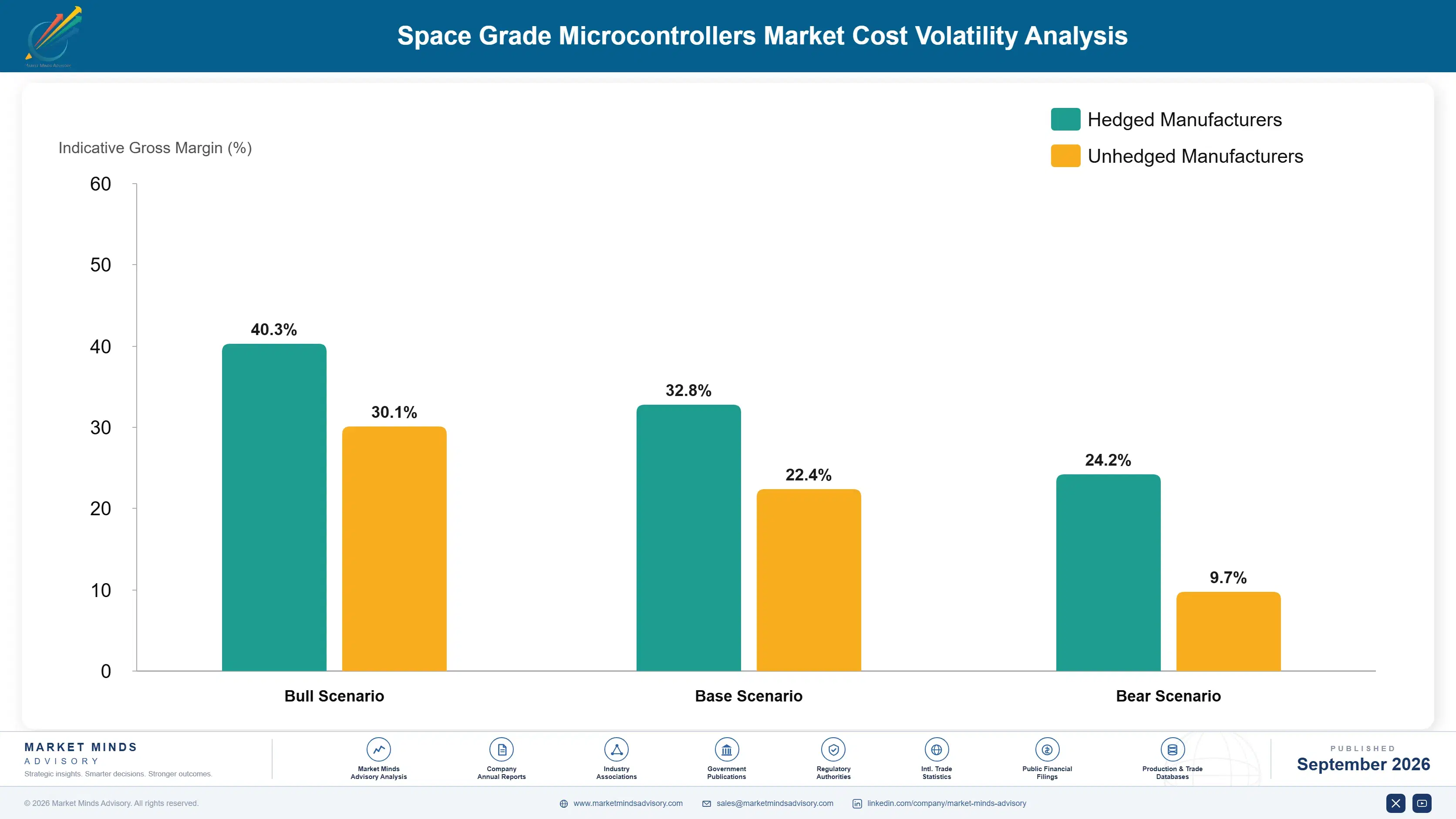
Wafer Fabrication And Foundry Exposure

Specialty radiation-hardened wafer fabrication accounts for 26 percent of cost of goods sold across most microcontroller production, with design engineering, testing, and support labor costs making up most of the remainder. Fabrication capacity concentrates among a small number of accredited foundry facilities, tying vendor procurement costs to specialty foundry pricing alongside broader semiconductor manufacturing market trends.
Global radiation-hardened wafer price increases during 2024, driven by surging demand for accredited foundry capacity following expanding constellation deployment, pushed vendor fabrication costs up by more than 16 percent within a year according to trade body reporting, forcing vendors with fixed multi-year manufacturer contract pricing to absorb margin compression. Vendors without diversified foundry sourcing faced the sharpest impact, and smaller regional vendors reported delayed delivery timelines while renegotiating supplier terms.

Exposure varies by vendor type: larger integrated majors like Microchip Technology, with direct foundry relationships and diversified sourcing across multiple fabrication facilities, weather cost spikes with less margin disruption than smaller vendors reliant on third-party fabrication procurement contracts. Geographic exposure differs, since vendors concentrated in single-region fabrication sourcing face different risk timing than those with diversified fabrication infrastructure, meaning cost impact varies across the industry.
space-grade-microcontrollers-market-cost-volatility-analysis-1788427565932

Diversifying Wafer Fabrication Sourcing Across Multiple Facilities

Vendors are increasingly securing wafer fabrication capacity from multiple accredited foundry facilities across different geographies rather than concentrating entirely with single suppliers, so a cost spike from one facility does not halt device delivery entirely. This diversification raises procurement coordination complexity but significantly reduces the risk of the sharp, single-facility cost spikes that hit under-diversified vendors hardest across the industry.

Securing Long-Term Fixed-Price Fabrication Supply Contracts

Vendors are increasingly signing long-term fixed-price contracts directly with accredited foundry facilities, securing guaranteed input costs ahead of market fluctuation and capturing pricing stability that smaller vendors reliant on spot-market purchasing cannot access. Some vendors pursue group purchasing consortiums instead. This approach requires committed capital most smaller vendors cannot guarantee, reinforcing a durable cost advantage for established majors.

Investing In Reduced-Fabrication-Dependency Design Research

Larger vendors are increasingly investing in reduced-fabrication-dependency design research that decreases long-term dependency on specialty foundry pricing volatility, positioning them ahead of competitors still fully reliant on conventional fabrication-intensive designs. This gap is expected to widen further as design engineering research budgets continue expanding among the largest players industry-wide. Smaller vendors typically lack comparable research capital available.

Portfolio Architecture for Margin Defence

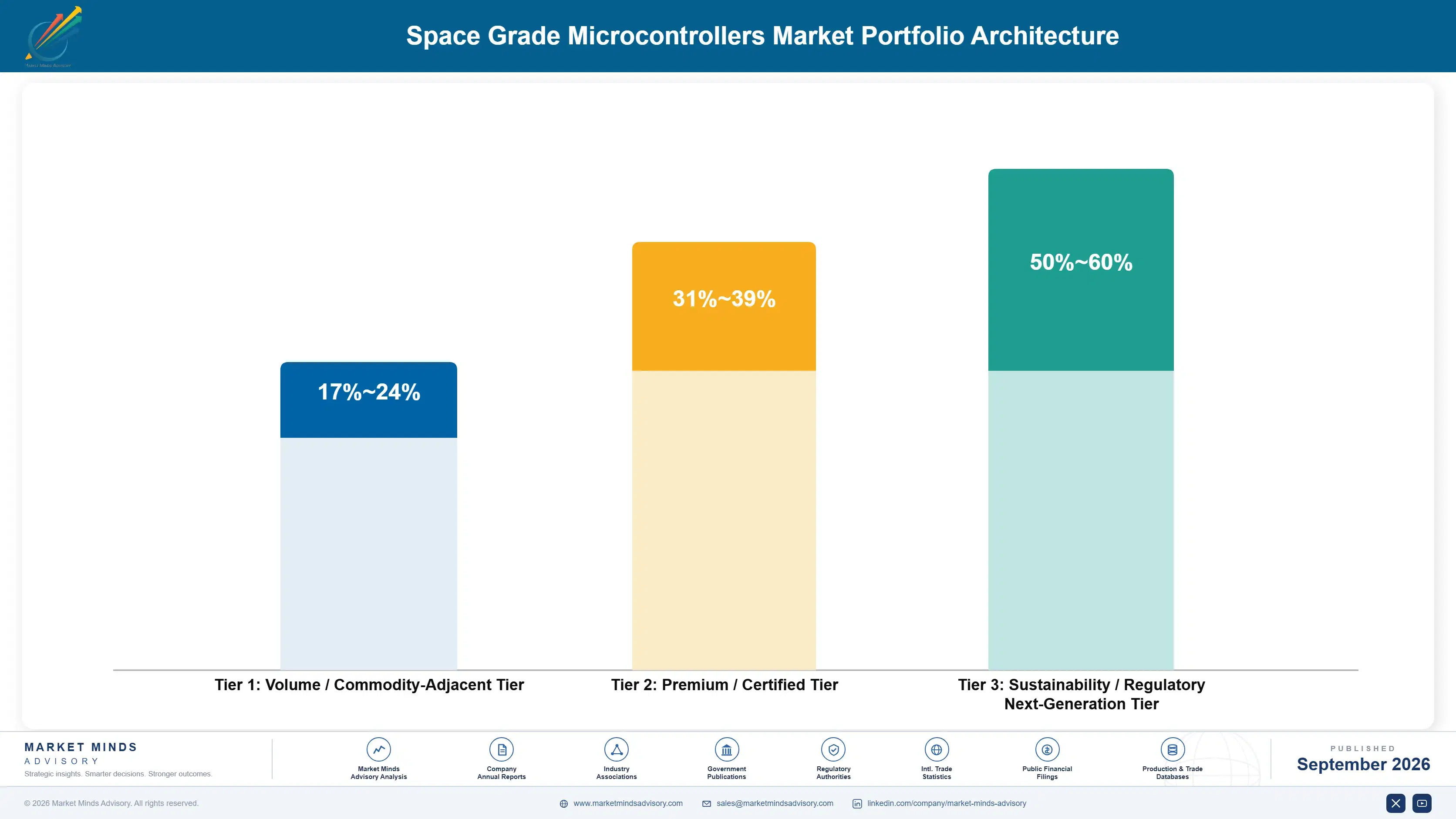
Space grade microcontrollers organise into three commercial tiers running from basic COTS and standard commercial supply through certified IP core and firmware formats to premium and next-generation fully hardened platforms. Gross margins widen sharply moving up the tiers, since commodity formats compete largely on device cost and delivery timeline, while hardened and testing formats capture value from documented tolerance validation, mission reliability, and support guarantees.
The tension between commodity volume and premium format revenue shapes vendor strategy: basic COTS contracts generate the device volume that supports engineering scale and manufacturing utilization, but hardened and testing formats generate the margin that justifies continued radiation research and qualification investment. Vendors overweighted toward commodity-only sales face intensifying fabrication cost exposure, while premium-forward vendors carry steadier, higher-margin profitability less exposed to material cost cycles across market conditions.

High-value pools concentrate among hardened formats sold into government mission channels, and among testing formats sold into constellation operators facing multi-year qualification schedules. Both pools reward vendors who can pair documented tolerance accuracy with reliable, cost-efficient delivery rather than competing purely on unit price alone, a distinction becoming more pronounced as hardened and testing investment accelerates across major markets.

Volume / Commodity-Adjacent Tier

Basic COTS and standard commercial microcontrollers sold largely on device cost and delivery timeline, competing on price sensitivity across broad commodity smallsat channels nationwide. This tier serves budget-constrained operators with limited appetite for premium hardened features.
Gross Margin: 17-24%

Premium / Certified Tier

Certified IP core and firmware formats backed by documented reliability credentials, sold at a meaningful premium to mission-conscious manufacturers. This tier increasingly commands loyalty from manufacturers who prioritize measurable tolerance accuracy over upfront cost alone.
Gross Margin: 31-39%

Sustainability / Regulatory / Next-Generation Tier

Premium fully hardened and testing-bundled platforms sold to government agencies and constellation operators, priced on documented tolerance accuracy and performance outcomes rather than device volume alone, commanding the highest margins. Adoption remains concentrated among the most technically sophisticated operators.
Gross Margin: 50-60%
space-grade-microcontrollers-market-portfolio-architecture-1788427566425

High-value Sub-segments and Strategic Watch-out

Hardened Premiumisation Platforms

Hardened formats sold into government mission channels command the category's highest margins and fastest growth, concentrated among vendors with proven radiation engineering capability and established tolerance credentials reaching mission-focused agencies across developed markets today. Adoption is expected to broaden further as additional agencies finalize mission infrastructure expansion plans.
Gross Margin: 52-62%

Testing Growth Formats

Testing formats sold into constellation operators facing multi-year qualification schedules carry strong margins tied to tolerance relationship depth, though growth is more moderate than hardened formats since adoption depends on individual qualification timelines across regions. Vendors serving this segment increasingly compete on documented validation speed.
Gross Margin: 34-42%

Basic COTS Commodity Formats

Basic COTS and standard commercial microcontrollers remain the largest volume category by far, generating steady device revenue across cost-sensitive commodity applications, even as growth increasingly shifts toward hardened and testing formats elsewhere in the portfolio, particularly among newly launched constellation programmes. Pricing pressure here remains intense industry-wide.
Gross Margin: 16-23%

Fabrication Cost And Engineer Complexity Risk

Volatile wafer fabrication pricing combined with persistent skilled radiation engineer shortages represents a meaningful ongoing risk, since vendors dependent heavily on single-facility sourcing and unresolved qualification capacity gaps must monitor closely across supplier and manufacturer relationships, particularly as scrutiny increases overall. Diversified sourcing offers the clearest mitigation path.
Gross Margin: n/a

Qualification-Locked Satellite Economics

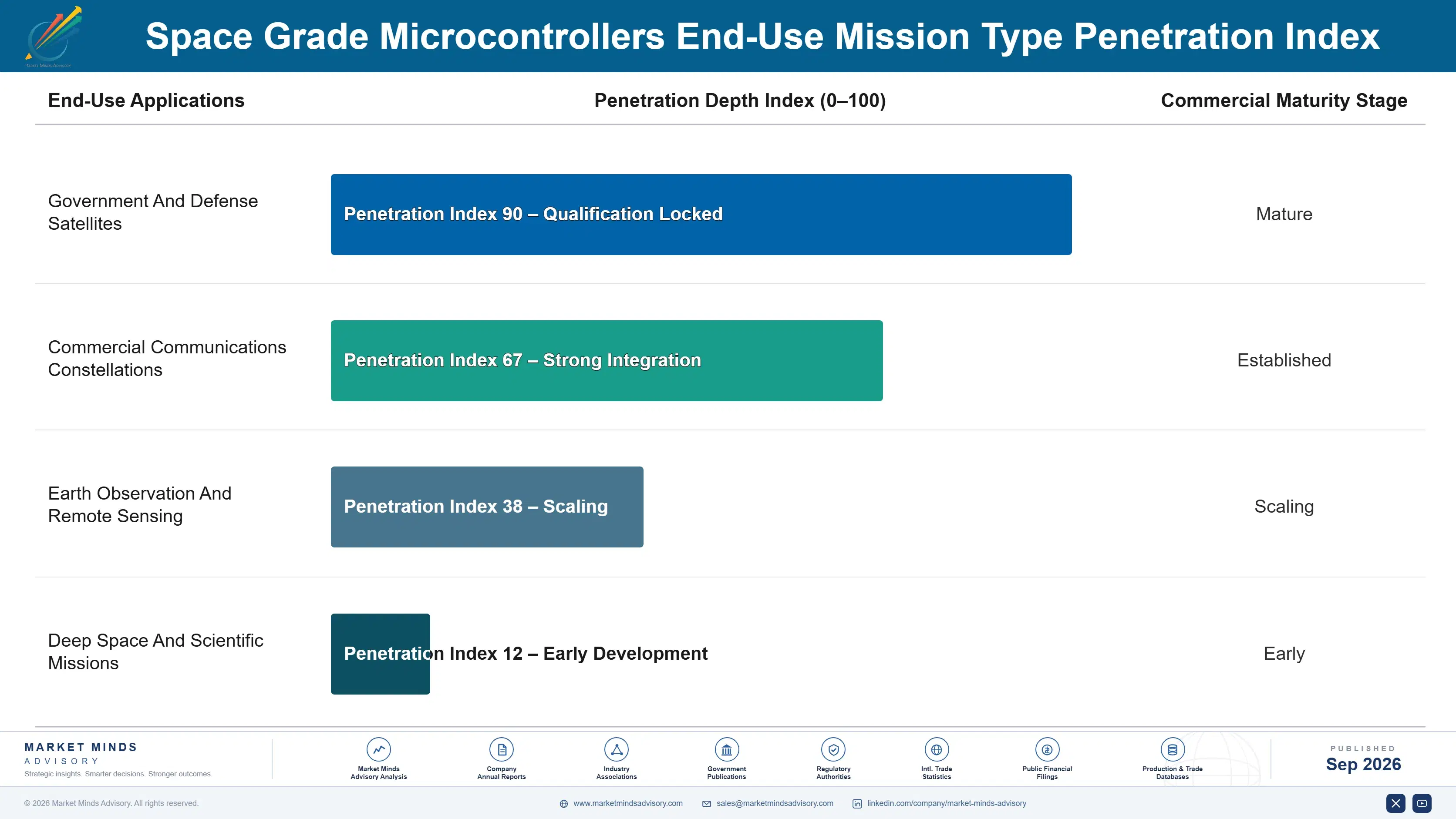
Space grade microcontroller demand behaves like a multi-year device annuity within a manufacturer relationship once a constellation deployment is finalized, since switching vendors requires requalifying an entire tolerance and mission specification that most manufacturers strongly prefer to avoid absent a serious radiation failure. That device loyalty shapes how vendors price and structure constellation design-in and testing relationships, particularly for premium hardened formats.
Adoption depth varies sharply by end use: government agencies and constellation operators penetrate deepest into documented, device-loyal vendor relationships, often exclusively favoring a single trusted vendor across multiple satellite generations, while smaller commercial manufacturers adopt more transactionally, switching vendors more readily based on price and delivery timeline. Enterprise satellite buyers sit between the two, balancing vendor reliability against periodic competitive bid review.

A generational shift in buyer profiles is underway as younger satellite engineers, increasingly exposed to radiation tolerance economics and testing training through industry conferences, demand documented tolerance data and performance proof before committing to a vendor, replacing an older generation that selected microcontroller partners primarily on upfront price and relationship familiarity. Vendors slow to adapt risk losing share to COTS-forward competitors, particularly among newly launched constellation deployments.
space-grade-microcontrollers-market-end-use-penetration-index-1788427566914

Where To Focus Investment Next

These are among the four positions where our research anticipates prominent divergence between winners and laggards over the coming forecast period. Each is grounded in the demand model, the regulatory perimeter, and the announced capacity pipeline.
01 / COTS PLATFORM INVESTMENT

Prioritise COTS Development Over Hardened Volume

COTS formats are growing fastest and carry the category's widest margins, driven by manufacturers prioritizing documented tolerance accuracy and constellation-scale performance across most major North American and East Asian markets. Vendors that invest in tolerance engineering and mission validation are capturing this premium demand at a faster rate than competitors still offering legacy hardened systems without comparable performance credentials. Capital allocated toward tolerance engineering and qualification testing will likely generate better returns than commodity hardened capacity expansion over the next several years, spanning multiple applications simultaneously.
02 / CONSTELLATION DESIGN-IN DEVELOPMENT

Secure Operator Contracts Ahead Of Deployment Cycles

Constellation operator design-in opportunities are accelerating rapidly across major North American and East Asian satellite development pipelines. Vendors who secure early design-in relationships gain capital-efficient revenue visibility and durable switching barriers uncommon in one-time device sales, particularly given limited access to comparable operator engineering data and tolerance expertise that competitors cannot easily replicate. Vendors that delay building these relationships risk ceding fast-growing operator volume entirely to more established competitors, spanning multiple regions, deployment cycles, and manufacturer engineering relationships simultaneously across the industry.
03 / FABRICATION SOURCING DIVERSIFICATION

Diversify Fabrication Sourcing Across Multiple Facilities

Wafer fabrication cost volatility periodically compresses margins across the industry, and vendors who diversify fabrication sourcing across multiple facilities and geographies gain meaningfully more stable input cost availability than competitors reliant entirely on single-facility concentration during periods of commodity market disruption. This diversification requires substantial coordination investment across multiple facility relationships that smaller vendors cannot easily replicate. Vendors that delay this diversification risk continued cost volatility that better-diversified competitors have already substantially reduced, spanning multiple foundry networks and regional markets simultaneously.
04 / TESTING BUNDLE DEVELOPMENT

Build Tolerance Capability Ahead Of Contract Standardisation

Testing and qualification bundling opportunities are opening substantial addressable revenue among manufacturers seeking reduced mission risk, and vendors who build dedicated testing capability capture premium contract share before competitors recognise the opportunity clearly at scale. This service-forward approach is already commanding stronger manufacturer loyalty among vendors serving constellations entering COTS requirements for the first time. Vendors that delay building this capability risk ceding service-driven contract volume entirely to more prepared competitors, spanning multiple regional markets and manufacturer types simultaneously, particularly across COTS and testing segments.

Engagement Snapshot From the Field

A live engagement with an industry participant carrying material or product regulatory and market exposure ahead of a defining policy shift, showing how our research translates into a defensible multi-year portfolio strategy.
MARKET MINDS ADVISORY · CLIENT ENGAGEMENT SUMMARY
Space Grade Microcontrollers Producer Strategic Portfolio Review and Transition Roadmap 2026·Investment Scenario on Space Grade Microcontrollers Exposure Evaluation 2025-26
CLIENT PROFILE
The client is a regional commercial constellation operator with an estimated $56 million in annual microcontroller procurement spend across North American fully hardened installations, evaluating a strategic shift toward COTS capability to reduce satellite unit cost (client-reported, unverified by MMA). The operator needed to determine optimal deployment sequencing ahead of a planned multi-year constellation expansion programme, particularly across its fastest-growing smallsat production segments.
STRATEGIC CHALLENGE
Procurement and engineering leadership needed to evaluate COTS investment against limited capital budgets, but lacked reliable data on expected reliability performance given the operator's specific satellite mix and orbital composition. Prior internal estimates relied heavily on vendor sales projections rather than independent benchmarking, leaving leadership uncertain which production lines to prioritise first.
MMA APPROACH
MMA analysts benchmarked comparable regional operator COTS deployment programmes against documented reliability performance data, modeling expected outcomes across representative deployment sequencing scenarios. The engagement combined primary interviews with the operator's procurement and engineering teams, vendor capability comparison, and analysis against MMA's broader dataset of COTS deployment outcomes across comparable constellation operators.
KEY FINDINGS
  1. The recommended deployment sequence increased projected reliability performance by roughly 19 percent compared with the operator's initial conservative rollout proposal, based on comparable industry benchmarks (client-reported, unverified by MMA).
  2. Two of five benchmarked vendors lacked sufficient tolerance engineering depth to guarantee consistent deployment quality across the operator's particular orbital mix, particularly for high-radiation orbital segments.
  3. Production lines with the highest historical reliability incidents showed meaningfully higher COTS deployment payback than lines with stable production histories across the pilot programme.
  4. The recommended vendor included pre-packaged tolerance qualification documentation, reducing the operator's internal engineering review burden compared with competing proposals considerably during the pilot phase.
CLIENT PROFILE
The client is a regional commercial constellation operator with an estimated $56 million in annual microcontroller procurement spend across North American fully hardened installations, evaluating a strategic shift toward COTS capability to reduce satellite unit cost (client-reported, unverified by MMA). The operator needed to determine optimal deployment sequencing ahead of a planned multi-year constellation expansion programme, particularly across its fastest-growing smallsat production segments.
STRATEGIC CHALLENGE
Procurement and engineering leadership needed to evaluate COTS investment against limited capital budgets, but lacked reliable data on expected reliability performance given the operator's specific satellite mix and orbital composition. Prior internal estimates relied heavily on vendor sales projections rather than independent benchmarking, leaving leadership uncertain which production lines to prioritise first.
MMA APPROACH
MMA analysts benchmarked comparable regional operator COTS deployment programmes against documented reliability performance data, modeling expected outcomes across representative deployment sequencing scenarios. The engagement combined primary interviews with the operator's procurement and engineering teams, vendor capability comparison, and analysis against MMA's broader dataset of COTS deployment outcomes across comparable constellation operators.
KEY FINDINGS
  1. The recommended deployment sequence increased projected reliability performance by roughly 19 percent compared with the operator's initial conservative rollout proposal, based on comparable industry benchmarks (client-reported, unverified by MMA).
  2. Two of five benchmarked vendors lacked sufficient tolerance engineering depth to guarantee consistent deployment quality across the operator's particular orbital mix, particularly for high-radiation orbital segments.
  3. Production lines with the highest historical reliability incidents showed meaningfully higher COTS deployment payback than lines with stable production histories across the pilot programme.
  4. The recommended vendor included pre-packaged tolerance qualification documentation, reducing the operator's internal engineering review burden compared with competing proposals considerably during the pilot phase.
RECOMMENDED STRATEGY
Phase 1: Phase 1 (Months 1 to 3): Complete tolerance engineering and validation across the operator's highest-risk flagship smallsat segments to reduce reliability exposure. Phase 2: Phase 2 (Months 4 to 7): Extend the COTS deployment programme to remaining production lines using performance data carried forward from the pilot phase. Phase 3: Phase 3 (Months 8 to 10): Finalise long-term vendor device agreements with terms informed by rollout outcomes ahead of the following constellation cycle.
OUTCOME
The operator completed its COTS deployment programme across all flagship smallsat segments within ten months, ahead of the planned multi-year constellation calendar. Early operating data showed meaningful reduction in satellite unit cost without disrupting existing production operations (client-reported, unverified by MMA). Procurement leadership credited the phased deployment approach for the result.

Frequently Asked Questions

Foundational context covering the market sizes, CAGR, scope, country, region and competition that inform every finding below. This section is provided to cover basics and most often pre-purchase conversations, answered from the MMA Primary Research Dataset.

What is the current size of the Space Grade Microcontrollers Market?

The global space grade microcontrollers market was valued at approximately $0.85 billion in 2025. Demand is driven by mega-constellation buildout, commercial launch investment, and qualification testing expansion.

How large will the Space Grade Microcontrollers Market be by 2036?

MMA forecasts the market will reach approximately $3.41 billion by 2036, roughly 3.55 times its 2026 value. Growth is driven by continued COTS adoption and expanding testing platform specification.

What is the CAGR for the Space Grade Microcontrollers Market 2026 to 2036?

The market is projected to grow at a compound annual growth rate of 13.5 percent between 2026 and 2036. Bull and bear scenarios range from roughly 12.2 to 14.8 percent depending on mega-constellation launch cadence.

Which segment is growing fastest?

COTS radiation-tolerant microcontrollers form the fastest-growing segment, expanding at approximately 19.5 percent annually, driven by satellite manufacturers favoring qualified commercial devices over legacy fully hardened-only parts.

Who are the major companies in the Space Grade Microcontrollers Market?

Leading vendors include Microchip Technology, BAE Systems, Cobham, Honeywell, and STMicroelectronics. Competition centers on radiation physics engineering heritage, installed satellite base breadth, and tolerance depth, rather than price alone.

Which country is growing fastest?

India is the fastest-growing major market, expanding at approximately 16.0 percent annually, driven by its rapidly expanding commercial space sector and growing domestic constellation investment.

Report Segmentation Architecture

The full report scope spans multiple orthogonal segmentation dimensions, with cross-tabulated demand data provided for each dimension pair. Coverage extends further to regional breakdowns, trend trajectories, and the competitive detail needed to support segment-level decision-making.

By Radiation Hardening Technology

  • Radiation-Hardened-By-Design Microcontrollers
  • Radiation-Hardened-By-Process Microcontrollers
  • COTS Radiation-Tolerant Microcontrollers
  • Microcontroller IP Cores And Reference Designs
  • Space Qualification And Radiation Testing Services
  • Flight Software And Firmware Development Tools

By End-Use Mission Type

  • Government And Defense Satellites
  • Commercial Communications Constellations
  • Earth Observation And Remote Sensing
  • Deep Space And Scientific Missions

By Commercial Dimension

  • Government Direct Procurement Contracts
  • Commercial Satellite Manufacturer Contracts
  • Original Equipment Manufacturer Integration Agreements
  • Long-Term Qualification And Testing Service Agreements

By Region

  • North America
  • Western Europe
  • East Asia
  • South Asia and Pacific
  • Latin America
  • Middle East and Africa
  • Eastern Europe

Scope, Methodology, and Coverage

Every figure in this report is reproducible from documented input assumptions. The scope below maps the historical period, the forecast horizon, the segmentation dimensions, and the countries covered, alongside the underlying primary and qualitative methodology.
Historical Period
2020 to 2025
Forecast Period
2026 to 2036
Base Year
2025 (USD billions; MMA Primary Research Dataset, September 2026)
Market Definition
The space grade microcontrollers market covers radiation-hardened and radiation-tolerant microcontroller devices and associated qualification services used in satellite and spacecraft electronics, including radiation-hardened-by-design microcontrollers, radiation-hardened-by-process microcontrollers, commercial-off-the-shelf radiation-tolerant microcontrollers, microcontroller IP cores and reference designs, space qualification and radiation testing services, and flight software and firmware development tools. It excludes ground-based aerospace electronics, general commercial microcontrollers not qualified for space environments, and satellite bus structural hardware.
Quantitative Units
USD billions (current prices); installed base in number of qualified microcontroller units where cited
Segmentation Dimensions
By Radiation Hardening Technology; By End-Use Mission Type; By Commercial Dimension; By Region
Regions Covered
North America, Western Europe, East Asia, South Asia and Pacific, Latin America, Middle East and Africa, Eastern Europe
Countries Covered
USA, Canada, Germany, France, UK, Italy, Netherlands, China, Japan, South Korea, India, Australia, Singapore, Indonesia, Brazil, Mexico, Argentina, Saudi Arabia, UAE, South Africa, Poland, Russia, and additional markets relevant to this sector
Key Companies Profiled
Microchip Technology, BAE Systems, Cobham, Honeywell, STMicroelectronics, Texas Instruments, Renesas Electronics, Infineon Technologies, AMD, Vorago Technologies, Frontgrade Technologies, Ramon.Space, GomSpace, CAES Systems, Teledyne e2v, 3D Plus, Space Micro, Airbus Defence and Space, Thales Alenia Space, Data Device Corporation
Quantitative Methodology
Primary survey, n=3,800 respondents, Q4 2025, six countries; demand-side model with trade association cross-validation
Qualitative Methodology
47 expert interviews, Q4 2025; applied to validate demand model assumptions, identify emerging dynamics, and assess competitive positioning
Report Format
PDF and XLSX data workbook (Word format preview document)
Publisher
Market Minds Advisory
Report Code
MMA-2026-TEC-914
Published
September 2026
Contact
sales@marketmindsadvisory.com | www.marketmindsadvisory.com

Purchase the full Space Grade Microcontrollers Market Report (2026 to 2036).

The full report provides a quantitative and qualitative assessment of the global space grade microcontrollers market through 2036, including regional sizing across all seven MMA-tracked geographies and technology-level segmentation covering hardened, COTS, IP core, testing, and firmware categories. It profiles twenty leading vendors, benchmarking radiation physics engineering heritage, installed satellite base breadth, and tolerance depth across the competitive landscape. The report includes primary survey findings from 3,800 respondents and 47 expert interviews from Q4 2025, alongside wafer fabrication cost risk analysis. Buyers receive segment-level revenue models, editable data tables, and a framework for evaluating vendor and market decisions.
Seven-region market sizing with technology-level revenue breakdowns
Twenty-company competitive profiles with moat and risk analysis
Primary survey data from 3,800 respondents across six countries
Forty-seven expert interviews on COTS and testing platform trends
Editable data tables for custom scenario and sensitivity modeling
Wafer fabrication and foundry cost risk assessment

Built For The People Who Decide

From boardroom strategy to bench-side execution, this report is read cover-to-cover by leaders shaping the next decade of their industry, turning demand scenarios, market dynamics and valuation benchmarks into decisions.
CXOs/ Presidents/ VPs/ Managers
M&A and Corporate Development
Strategy Teams and R&D Heads
Procurement and Product Directors
Regulatory and Compliance Leaders
Investor Relations and Equity Analysts