Market Minds Advisory
Demand for Petroleum Liquid Feedstock in South Korea

Demand for Petroleum Liquid Feedstock in South Korea: Demand for Petroleum Liquid Feedstock in South Korea. Condensate Imports Meet the Petrochemical Cracker Feedstock Shift

South Korean petrochemical crackers are shifting feedstock slates toward imported condensate and away from domestic naphtha alone, reshaping which import terminals and splitter investments capture margin as global cracker capacity keeps expanding.

Lead Analyst

Published

September 2026

Make Smarter Decisions with Customized Research Insights

Request a free sample report and evaluate market opportunities, growth trends, and competitive dynamics relevant to your business needs.

2025 MARKET VALUE$9.2BMarket Size 2025
2036 FORECAST VALUE$14.5BBase Case , 2026 to 2036
CAGR 2026 TO 20364.2 %Bull 5.4% / Bear 3.0%
INCREMENTAL OPPORTUNITY$4.9BNet 10- year value creation
EXPANSION MULTIPLE1.51x2036 value over 2026 base
Strategic Levers
M&A Pipeline
Regional Outlook
Country Rankings
Competitive Intelligence
Segmental Deep-dive
Call-Us : 91 93563 13602

Executive Snapshot and Market Trajectory.

South Korean petrochemical crackers are steadily diversifying feedstock slates away from domestic naphtha alone, and that diversification is reshaping which import terminals and splitter investments capture the most durable margin advantage. Buyers now treat feedstock flexibility as a genuine competitive advantage rather than a secondary refining decision.
Commercial momentum concentrates around condensate splitting capacity, since cheaper imported condensate delivers a higher ethylene yield than conventional naphtha at several major coastal complexes. Ulsan and Yeosu account for the largest concentration of national cracking and import terminal capacity, reflecting decades of integrated refining and petrochemical cluster investment along the southeastern coast. Splitters that lock in favorable long-term condensate contracts increasingly outcompete rivals still tied to fixed naphtha supply agreements.
Competition splits between integrated refiners running captive naphtha production and independent splitters buying condensate on term contracts from Middle Eastern and American suppliers. Recycling mandates under Korea's extended producer responsibility framework and rising pyrolysis oil supply are increasingly shaping which feedstock pools operators prioritize for the next decade. Domestic recyclers are racing to scale pyrolysis oil output fast enough to meet mandated recycled feedstock targets. That race is now reshaping capital spending priorities industry-wide.
Market Definition
This market covers petroleum-derived liquid feedstocks, including naphtha, condensate, LPG, gas oil, and recycled pyrolysis oil, consumed by South Korean petrochemical crackers and refiners as cracking feedstock. It excludes crude oil purchased for fuel refining output and downstream olefin or polymer products themselves.
Base Year Value
$9.2B in 2025 (MMA Primary Research Dataset, September 2026)
Forecast Period
2026 to 2036, eleven discrete annual values
CAGR
4.2% base case. Bull 5.4%. Bear 3.0%.
Fastest Growth Segment
Recycled and Pyrolysis Oil Feedstocks: 11.8% CAGR
Fastest Growth Country
United States: 9.4% CAGR
Fastest Growth Region
South Asia and Pacific: 6.2% CAGR
Largest Region
East Asia: 30% of 2025 global value
Market Leaders
SK Geo Centric, LG Chem, Lotte Chemical, GS Caltex, Hanwha TotalEnergies Petrochemical. Source: MMA Analysis based on company annual reports.
Primary Survey
n=3,800 procurement and R&D decision-makers, Q4 2025, six countries
Methodology
Demand-side build-up, cross-validated against public data, 47 expert interviews

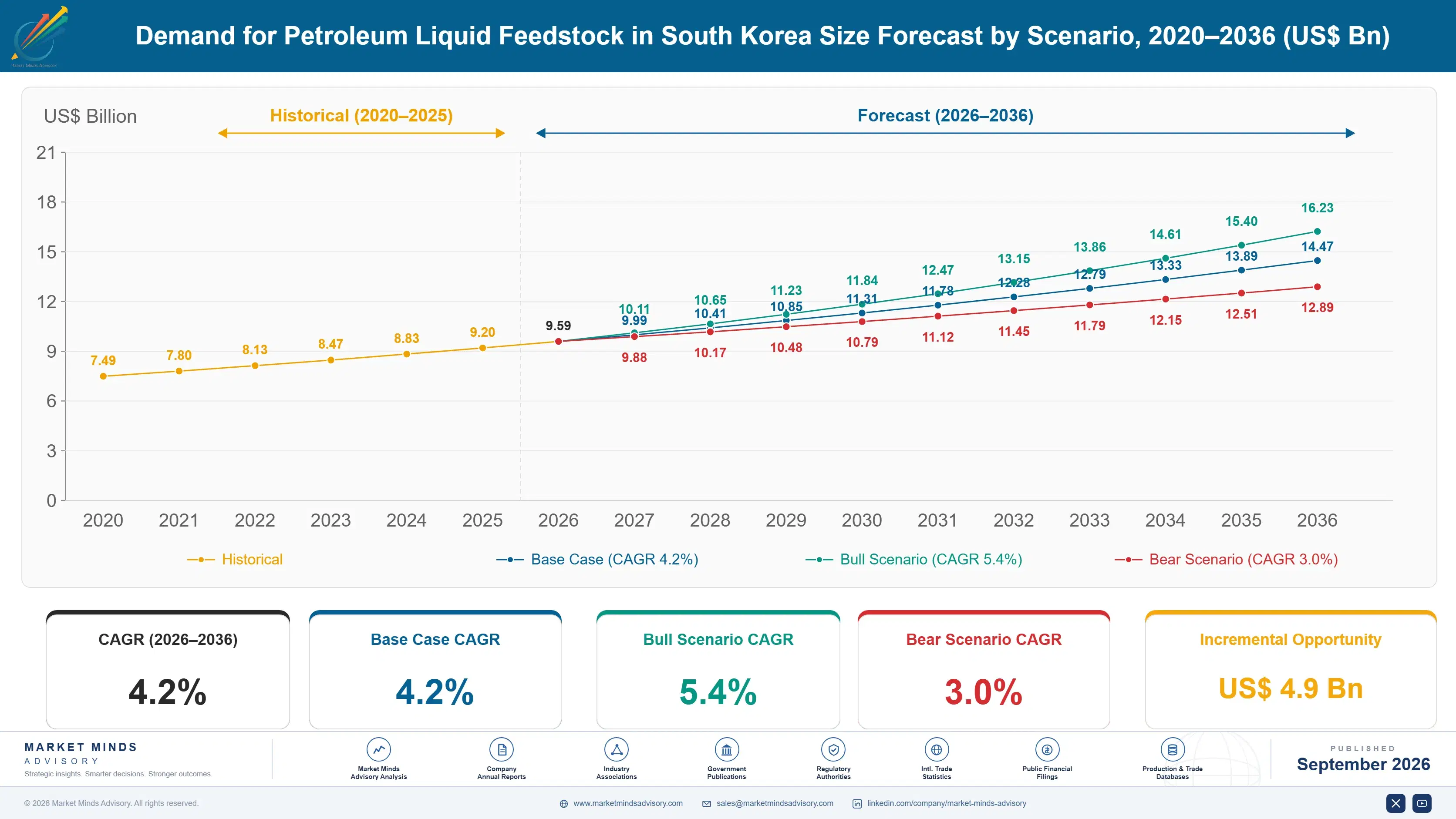
Demand for Petroleum Liquid Feedstock in South Korea Market Forecast Scenarios

south-korea-petroleum-liquid-feedstock-market-size-forecast-scenario-1788234510100
Between 2020 and 2025, South Korean feedstock demand grew steadily as cracker utilization recovered from pandemic disruption and splitters expanded condensate processing capacity to capture better ethylene yields than conventional naphtha offered at prevailing import spreads. Historical growth ran close to 3.6 percent annually over that period. Refiners with flexible splitter infrastructure ahead of the recovery captured the strongest volume gains.
The base case assumes continued gradual feedstock diversification, driven by three commercial mechanisms working together: splitters expanding condensate intake as long-term supply contracts mature and come up for renewal, government recycling mandates pulling pyrolysis oil into the feedstock mix at meaningful scale, and integrated refiners optimizing naphtha and condensate ratios dynamically against prevailing global price spreads rather than fixed historical proportions. These mechanisms together sustain moderate but durable growth even as regional cracker capacity additions slow.
A bull scenario assumes faster pyrolysis oil scale-up and sustained condensate price advantage over naphtha, pushing growth toward the top of the forecast range. The bear risk centers on global cracker overcapacity, which could idle some domestic capacity and reduce feedstock intake meaningfully. Either scenario leaves demand well below the double-digit rates of earlier buildout decades.

Where Feedstock Flexibility Meets Cracker Economics

Converging forces are reshaping national feedstock strategy: falling condensate import prices relative to naphtha, government recycling mandates, and cracker operators chasing every available ethylene yield advantage are pushing feedstock sourcing decisions from routine procurement into a genuine strategic priority. Board-level scrutiny of margin volatility has made feedstock diversification a standing agenda item across nearly every major domestic petrochemical complex.
MARKET CONCENTRATIONCR5 62%top five processors hold a majority of national intake
AVERAGE FEEDSTOCK IMPORT PRICE$520-$680 per tonne condensatevaries with global crude and freight spreads seasonally
IMPORT DEPENDENCE SHARE78% of total feedstock volumereflecting heavy reliance on seaborne condensate and naphtha
NAPHTHA TO CONDENSATE RATIO58 to 42 percent splitshifting gradually toward condensate as splitter capacity expands
CRACKER UTILIZATION RATEaverage 88% across major complexesreflecting generally healthy regional ethylene demand conditions currently
RECYCLED FEEDSTOCK PENETRATION6% of total intake volumerising steadily under extended producer responsibility regulation targets
Commercial character in this market splits between integrated refiners running captive naphtha production alongside their fuel refining operations and independent splitters buying condensate purely on term contracts. Import terminal capacity and storage flexibility increasingly determine which operators can respond fastest to shifting price spreads. Operators that lack sufficient storage capacity increasingly find themselves paying spot premiums that erode margin during periods of tight global condensate supply.
Recycling mandates, condensate price volatility tied to global crude benchmarks, and rising Southeast Asian cracker competition will shape sourcing strategy over the next decade. Operators that delay diversification risk losing cost competitiveness against regional rivals with more flexible feedstock slates already in place. That lock-in dynamic already favors early movers who invested in flexible splitter infrastructure well ahead of their peers across the industry.
"Every splitter operator says they want supply security, but the ones actually locking in flexible take-or-pay contracts are the ones who will still be running at full rates when the next price spike hits."
Director, Chemicals and Materials Practice · MMA Chemicals and Materials Practice · September 2026

Market Trends

Condensate Splitting Capacity Expands Across Coastal Complexes

Domestic operators are investing in additional condensate splitting capacity at Ulsan and Yeosu, chasing the higher ethylene yield that lighter imported condensate delivers over conventional naphtha feedstock under current price spreads. Hanwha TotalEnergies Petrochemical and SK Geo Centric have both announced splitter capacity additions exceeding two million tonnes combined annual throughput by 2027, a scale that smaller independent operators are increasingly studying as a template for their own facility expansion plans across the same industrial cluster. Smaller independent splitters are increasingly forming joint ventures to access comparable scale without bearing the full capital cost alone.
Market Impact: Adds 15 percent to imports

Extended Producer Responsibility Rules Pull Pyrolysis Oil Into Cracking

Korea's Ministry of Environment is expanding extended producer responsibility rules requiring a rising share of recycled content in plastics, pushing chemical recyclers to scale pyrolysis oil output for direct cracker feedstock use rather than fuel blending alone. LG Chem and SK Geo Centric have both committed to processing several hundred thousand tonnes of pyrolysis oil annually within the next three years, a pace that is reshaping how crackers plan feedstock procurement well beyond conventional naphtha and condensate volumes. Regulatory pressure is expected to intensify further as the government tightens recycled content targets over subsequent compliance periods.
Market Impact: Expands splitter investment 20 percent

Market Opportunities and Growth Drivers

US Shale Condensate Exports Deepen Import Relationships

US shale condensate exports to South Korean splitters have grown substantially over the past decade, as American producers seek stable Asian offtake and Korean operators seek lower-cost feedstock alternatives to conventional Middle Eastern naphtha supply contracts. American condensate now accounts for a meaningfully larger share of splitter feedstock intake than a decade ago, and several long-term supply agreements signed in the past two years extend this relationship well into the next decade, giving Korean operators genuine diversification away from Middle Eastern supply concentration. Splitters continue negotiating additional long-term agreements to lock in this favorable diversification further.
Market Impact: Adds 8-12 percent margin volatility

Government Petrochemical Cluster Investment Incentives Expand

South Korea's Ministry of Trade, Industry and Energy continues offering tax incentives and infrastructure support for petrochemical cluster expansion at Ulsan and Yeosu, treating feedstock flexibility investment as a national industrial competitiveness priority rather than a purely private capital decision. These incentives are lowering the effective capital cost of new splitter and storage infrastructure meaningfully, encouraging operators to commit to expansion projects they might otherwise have deferred given uncertain near-term ethylene margin conditions across the broader region. Several additional cluster expansion announcements are expected as these incentive programmes continue through the decade.
Market Impact: Compresses margins 20 percent regionally

Market Restraints and Challenges

Heavy Import Dependence Exposes Operators to Price Shocks

South Korea imports roughly 78 percent of its total feedstock volume, and the root cause is straightforward: the country has negligible domestic crude production and must source nearly all cracking feedstock through seaborne trade routes exposed to global price volatility. A sudden freight rate spike or supply disruption in a key exporting region can compress refiner margins sharply within a single quarter. Operators are mitigating this exposure through diversified sourcing across multiple exporting regions and longer-term contracts that smooth price volatility, though full insulation from global price shocks remains impossible given the scale of import dependence.
Market Impact: Adds 2 million tonnes capacity

Regional Cracker Overcapacity Compresses Ethylene Margins

Chinese cracker capacity additions have expanded regional ethylene supply faster than demand growth, and the underlying cause traces to aggressive state-backed capacity buildout across multiple new coastal complexes over the past five years. This oversupply compresses regional ethylene margins, reducing the profitability of feedstock processing regardless of which feedstock slate an operator chooses to run domestically. Korean operators are responding by shifting toward higher-value specialty derivatives and export markets less exposed to Chinese domestic oversupply, though this transition takes considerable capital and years to execute fully across an entire production complex.
Market Impact: Lifts recycled feedstock to 10 percent
4 additional market trends, 3 additional growth drivers, and 2 additional restraints and challenges are covered in the full report. Contact sales@marketmindsadvisory.com to access the complete intelligence.

Segment CAGR and Growth Architecture

Segmentation follows feedstock type, since South Korean crackers and refiners procure, price, and budget cracking feedstock by physical product category rather than by end-use application or customer type, and each type carries distinct sourcing economics. This dimension also lines up cleanly with how import terminal infrastructure and long-term supply contracts are structured across the industry.
south-korea-petroleum-liquid-feedstock-market-market-share-analysis-1788234510657

Recycled and Pyrolysis Oil Feedstocks

Recycled and pyrolysis oil feedstocks are converted from post-consumer plastic waste into a liquid product suitable for direct cracker feedstock use, bypassing the fuel blending pathway that dominated early chemical recycling efforts. This segment is growing fastest because extended producer responsibility regulation increasingly mandates recycled content in plastics, giving major producers like LG Chem and SK Geo Centric a regulatory floor demand that did not exist five years ago. Scale-up remains capital intensive and feedstock quality inconsistent relative to virgin naphtha, but investment is accelerating as compliance deadlines approach and processing technology matures further across multiple domestic facilities. Vendors supplying pyrolysis oil processing equipment report a steady pipeline of new domestic orders extending well into the next several years.
CAGR 11.8%

Condensate

Condensate, a light hydrocarbon liquid separated from natural gas production, delivers a higher ethylene yield per tonne than conventional naphtha, making it increasingly attractive to splitters chasing margin advantage under current feedstock price spreads. Growth here is driven by expanding American shale condensate export availability and continued domestic splitter capacity additions at Ulsan and Yeosu. This segment increasingly competes directly with naphtha for cracker allocation, and the ratio between the two now shifts meaningfully with relative import price movements each quarter across the major producing complexes. Splitter operators that locked in favorable long-term American condensate contracts ahead of peers are now capturing the strongest margin advantage in the segment. Demand keeps rising steadily.
CAGR 7.4%
Full segment breakdown across 6 segments available in the complete report.

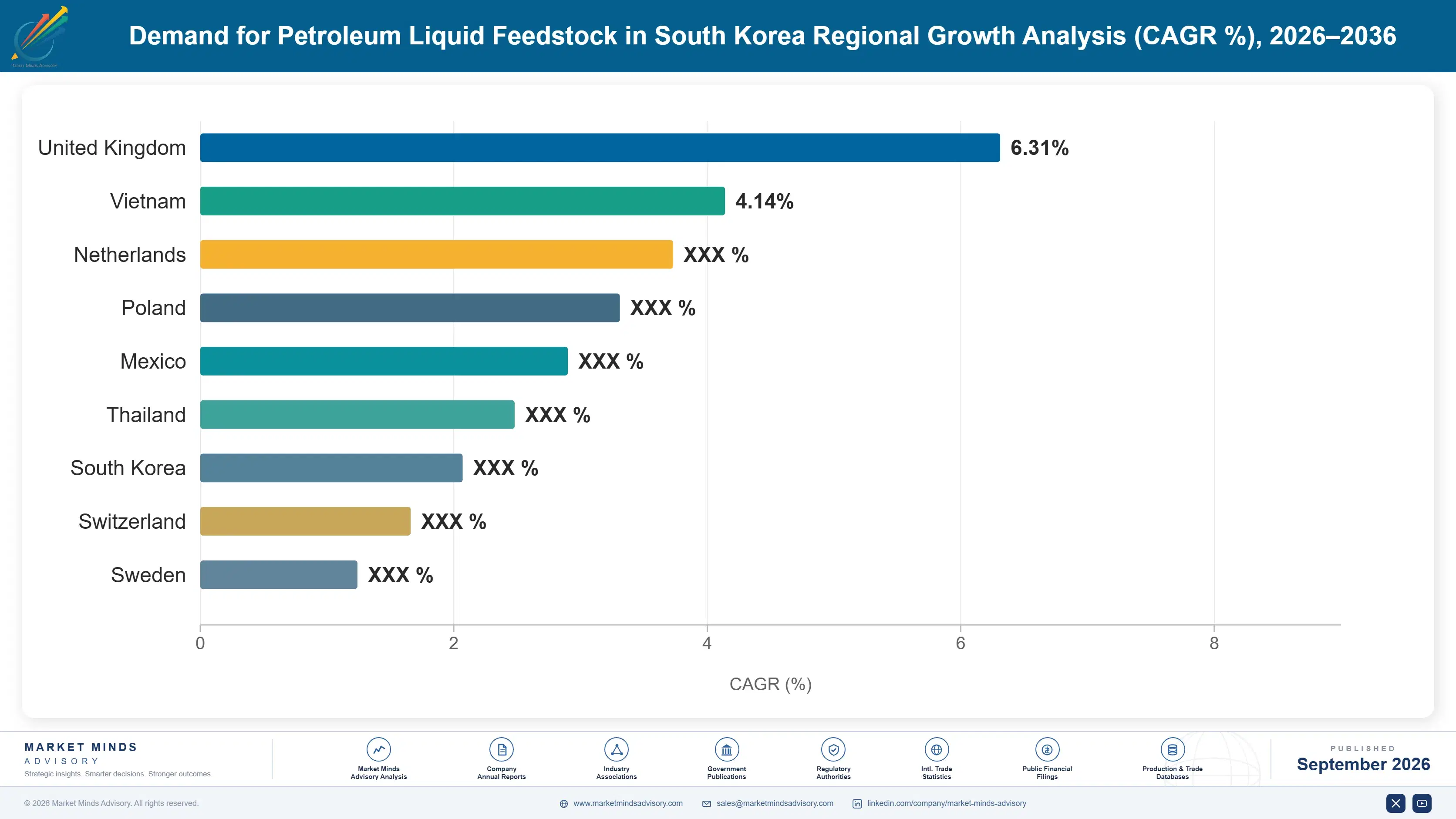
Regional Architecture and Country Demand Map

Regional shares here represent the geographic origin of feedstock supplying South Korean crackers, since the demand pool sits entirely within one country. Middle Eastern and domestic East Asian sourcing dominate, with rising American condensate supply and smaller Southeast Asian volumes. Sourcing patterns shift with global price spreads each year.

North America

American shale condensate exports have become a meaningful and fast-growing source of South Korean cracker feedstock, as Eagle Ford and Permian Basin producers seek stable Asian offtake and Korean splitters seek lower-cost alternatives to conventional Middle Eastern supply. This share sits modestly below the standard regional band because condensate remains a supplementary rather than dominant sourcing region despite its rapid growth trajectory. Several long-term supply agreements signed in the past two years extend well into the next decade, and this region posts a notably fast sourcing growth rate, reflecting genuinely accelerating diversification away from traditional Middle Eastern concentration among major domestic splitter operators. Vendors expect this share to keep climbing steadily over the coming decade.
Share: 20% | CAGR: 5.7% (2026 to 2036)

Western Europe

European trading houses and refiners supply a modest share of South Korean feedstock through spot cargo trades, particularly during periods when Middle Eastern or American supply tightens unexpectedly and buyers seek alternative sources quickly. This share sits well below the standard regional band because Europe functions as a secondary, opportunistic supply source rather than a durable sourcing relationship comparable to the Middle East or North America for this specific demand pool. Norwegian and North Sea condensate occasionally reaches Korean splitters through intermediary traders, though volumes remain inconsistent year to year. This role is expected to remain marginal rather than durable through the forecast period given the region's distance from Korean import terminals.
Share: 8% | CAGR: 2.7% (2026 to 2036)
Regional intelligence for 5 additional markets available in the complete report: East Asia, South Asia and Pacific, Latin America, Middle East and Africa, Eastern Europe. Contact sales@marketmindsadvisory.com.
south-korea-petroleum-liquid-feedstock-market-country-cagr-analysis-1788234511167

Where Feedstock Flexibility Pays Off

Beyond core feedstock procurement, four commercial mechanisms let processors capture additional margin from existing cracking capacity without expanding installed capacity or import terminal footprint they already operate. Processors executing on several of these simultaneously consistently outperform peers relying on fixed procurement approaches alone. These four levers increasingly separate the strongest performers from those still operating on rigid, contract-bound procurement schedules.

Optimizing the Naphtha-Condensate Ratio Dynamically Against Price

Operators with flexible splitter and cracker configurations can shift the naphtha to condensate ratio week to week against prevailing price spreads, capturing meaningful margin advantage over rivals locked into fixed feedstock proportions by contract or equipment limitation. Splitters running this dynamic optimization approach report roughly 8 percent higher effective margin than peers running fixed ratios, since they capture favorable price spreads that fixed-ratio operators simply cannot access when spreads shift quickly. This dynamic optimization approach is spreading quickly as more operators upgrade splitter flexibility across their production complexes. Few smaller operators can match this level of flexibility.
Market Impact: Lifts effective processing margin by roughly 8 percent

Positioning Recycled Feedstock Under Premium Long-Term Contracts

Processors that secure long-term recycled pyrolysis oil supply contracts ahead of tightening extended producer responsibility mandates position themselves to sell compliant output at a meaningful premium over conventional virgin feedstock derivatives. Early movers locking in pyrolysis oil supply now avoid the spot market premium that laggards will likely face once mandated recycled content thresholds tighten further, a premium industry estimates place at roughly 12 percent above current contract pricing. Processors that delay securing these contracts risk losing access as available pyrolysis oil supply tightens further. Few smaller recyclers can match this level of scale.
Market Impact: Captures roughly a 12 percent pricing premium overall

Diversifying Term Contracts Across Multiple Supply Regions

Splitters that diversify term contracts across Middle Eastern, American, and Southeast Asian condensate sources reduce exposure to any single region's price volatility or supply disruption, smoothing overall feedstock cost more effectively than single-region buyers. This diversification strategy has already reduced quarter to quarter feedstock cost volatility by roughly 15 percent for operators that have fully implemented it, a meaningful advantage when regional ethylene margins are already thin. Splitters that have not yet diversified term contracts are increasingly vulnerable during periods of regional supply stress. Few single-region buyers can match this level of resilience.
Market Impact: Reduces feedstock cost volatility by 15 percent overall

Expanding Import Terminal and Storage Capacity Footprint

Operators investing in expanded import terminal and storage capacity can buy condensate and naphtha opportunistically during favorable price windows rather than purely on fixed delivery schedules, capturing meaningful spot market advantage over storage-constrained rivals. Operators with expanded storage capacity report capturing roughly 10 percent lower average landed feedstock cost than storage-constrained peers, since they can wait out unfavorable pricing windows rather than buying reactively under operational pressure. Vendors expect storage investment to remain a genuine competitive differentiator well into the next decade. Few smaller operators can match this level of capital investment.
Market Impact: Lowers average landed feedstock cost by 10 percent

Who Controls the Margin Pool

The top five processors hold roughly 62 percent of national feedstock intake, a concentration built on decades of integrated refining and petrochemical cluster investment that smaller independents cannot easily replicate. The gap between leaders and mid-tier challengers is widening as splitter capacity investment accelerates. Several mid-tier processors have pursued joint ventures with recyclers to compete more effectively on feedstock diversity.
Current competitive activity centers on three fronts: expanding condensate splitting capacity to capture yield advantage, securing long-term diversified supply contracts across multiple sourcing regions, and investing in pyrolysis oil processing to meet tightening recycled content mandates. Integrated refiners increasingly compete with independent splitters for the same import terminal capacity. This convergence has become the dominant competitive pattern across nearly every major supply contract renewal cycle.

Emerging pressure comes from chemical recyclers scaling pyrolysis oil supply and smaller independent splitters entering condensate processing directly rather than buying refined naphtha from incumbents. Rankings could shift meaningfully if a recycler successfully locks in exclusive long-term supply agreements with a major cracker operator, which several are actively pursuing. Several such recycler partnerships are already under negotiation at major domestic cracker complexes as of this writing.
south-korea-petroleum-liquid-feedstock-market-company-positioning-matrix-1788234511701

Competitive Moat and Risk Dimensions

SK GEO CENTRIC

Moat: Integrated Refining and Recycling

SK Geo Centric combines captive naphtha refining capacity with the country's largest pyrolysis oil recycling investment, giving it access to both conventional and recycled feedstock pools that specialist competitors must access through third-party contracts alone. This dual position across virgin and recycled feedstock makes displacement genuinely difficult.
SK GEO CENTRIC

Risk: Recycling Scale-Up Execution Risk

Scaling pyrolysis oil processing to the volumes needed for meaningful recycled content compliance requires technology and capital deployment that has proven slower and costlier across the industry than early public targets suggested, and execution has been uneven. Investors have flagged this scale-up timeline as a genuine execution risk worth monitoring closely over coming quarters.
LG CHEM

Moat: Diversified Global Supply Relationships

LG Chem's global scale and long-standing relationships across Middle Eastern, American, and domestic naphtha suppliers give it sourcing flexibility that smaller domestic-only competitors lack, particularly valuable when regional price spreads shift quickly between feedstock types. Few domestic-only competitors can match this breadth of supplier relationships built across three separate continents.
LG CHEM

Risk: Exposure to Global Chemical Margins

LG Chem's broader global chemicals exposure means feedstock sourcing decisions increasingly compete for capital against unrelated business lines facing their own margin pressure, potentially slowing domestic feedstock diversification investment relative to more narrowly focused rivals. This internal capital competition could slow LG Chem's domestic feedstock diversification relative to more narrowly focused rivals.

Players Tracked

Prominent Players

SK Geo Centric
LG Chem
Lotte Chemical
GS Caltex
Hanwha TotalEnergies Petrochemical

Other Key Players

S-Oil Corporation
Hyundai Oilbank
SK Energy
Yeochun NCC
Daelim Industrial Co Ltd
Kumho Petrochemical Co Ltd
Samsung Total Petrochemicals
Isu Chemical Co Ltd
Hanwha Solutions Corporation
SK Incheon Petrochemical
GS Energy Corporation
Korea National Oil Corporation
Aramco Trading Company
ADNOC Trading
Vitol Group

Recent Developments

FEBRUARY 2025

SK Geo Centric Expands Pyrolysis Oil Processing Capacity At Ulsan

SK Geo Centric commissioned additional pyrolysis oil processing capacity at its Ulsan facility, expanding recycled feedstock throughput to meet tightening extended producer responsibility mandates ahead of upcoming compliance deadlines across the domestic plastics value chain and export markets. Analysts view this as a meaningful scale advantage over smaller domestic recyclers.
Signal: Signals accelerating recycled feedstock capacity investment ahead of upcoming regulatory compliance deadlines. Rivals are expected to respond.
SEPTEMBER 2024

Hanwha TotalEnergies Petrochemical Signs Long-Term US Condensate Supply Deal

Hanwha TotalEnergies Petrochemical signed a multi-year supply agreement with an American shale condensate exporter, locking in favorable pricing terms and reducing reliance on traditional Middle Eastern naphtha supply contracts for its Daesan cracking complex operations. The deal locks in pricing for at least five years going forward.
Signal: Signals deepening American condensate supply relationships among major domestic splitter operators. Expect this trend to continue.
MAY 2024

GS Caltex Announces Condensate Splitter Capacity Expansion At Yeosu

GS Caltex announced plans to expand condensate splitting capacity at its Yeosu complex, targeting improved ethylene yield economics as the company shifts a larger share of its feedstock slate away from conventional naphtha processing. The expansion is expected to complete within the next two years.
Signal: Signals continued splitter capacity investment across major coastal petrochemical complexes nationwide. Expect similar moves quite soon.

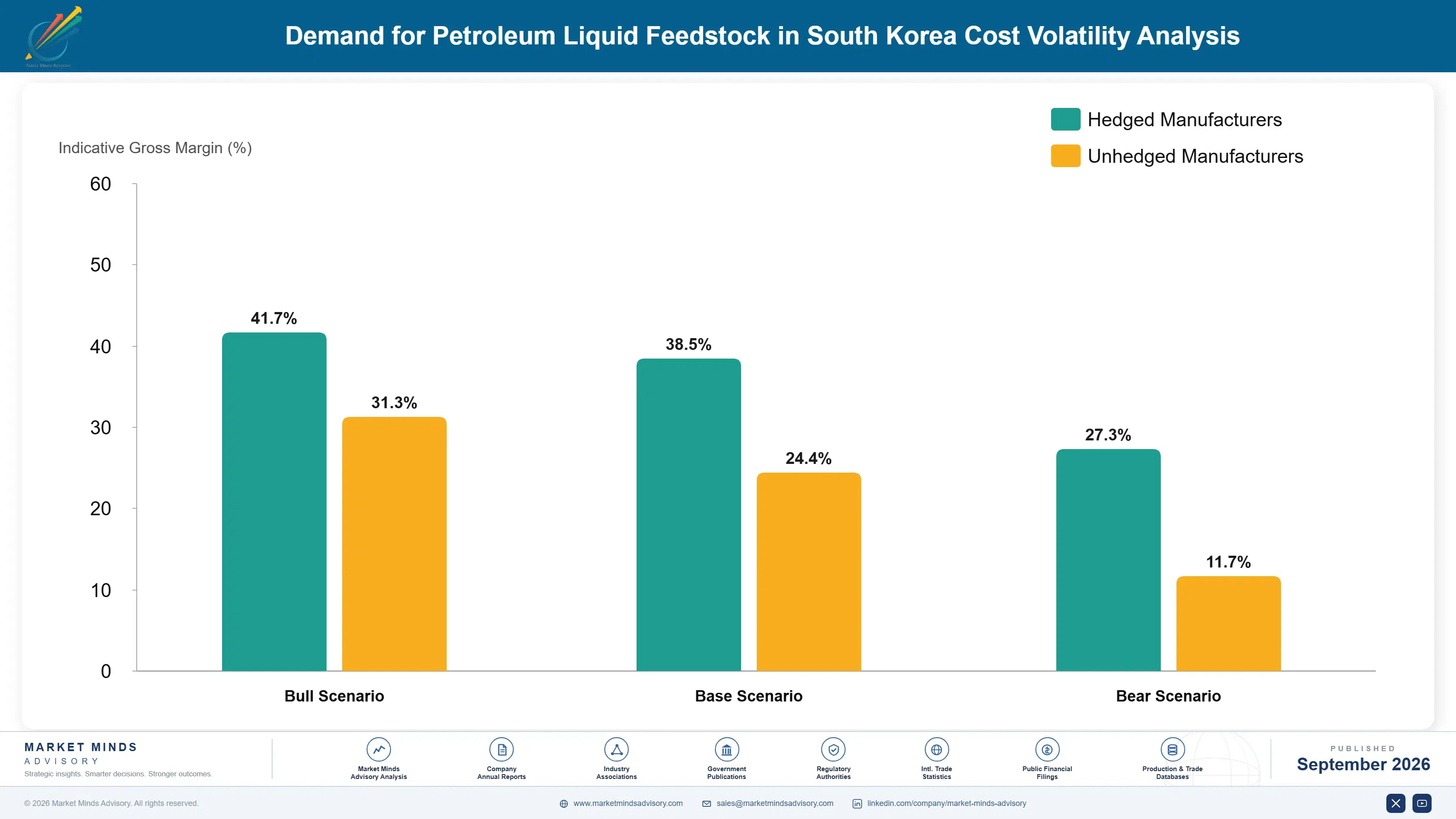
Global Crude and Freight Rate Exposure

Imported crude-linked feedstock, primarily naphtha and condensate, accounts for roughly 70 percent of total processing cost for domestic splitters, sourced primarily from the Middle East, the United States, and neighboring East Asian refiners, with freight and shipping insurance adding a further meaningful cost share for seaborne cargo. This concentration leaves domestic processors exposed to geopolitical and trade route disruption beyond their control.
The 2022 global energy price spike, documented extensively by the IEA's oil market reports, pushed condensate and naphtha import prices sharply higher within months, compressing domestic splitter margins considerably as feedstock costs rose faster than downstream ethylene and polymer prices could adjust in response across export contracts. Splitters that had pre-negotiated long-term supply contracts at fixed pricing weathered the spike considerably better than those relying on spot market purchasing during the tightest months.

Cost exposure varies meaningfully by player type: integrated refiners with captive naphtha production absorb crude price volatility directly into refining margin, while independent splitters buying condensate purely on term or spot contracts face more direct and immediate exposure to global price spreads without an offsetting refining margin cushion. This divergence shapes which processors sustain competitive pricing without eroding margin below acceptable levels.
south-korea-petroleum-liquid-feedstock-market-cost-volatility-analysis-1788234511896

Multi-Region Term Contract Diversification

Processors are diversifying term contracts across Middle Eastern, American, and Southeast Asian sourcing regions rather than depending on a single supply relationship, reducing exposure to any single region's price volatility or trade route disruption. This diversification adds modest contract management complexity but meaningfully reduces the risk of margin compression during future price spike cycles.

Long-Term Fixed-Price Supply Agreements

Larger processors are locking in multi-year condensate and naphtha pricing agreements ahead of anticipated market tightness, smoothing cost exposure across quarters in ways smaller independent splitters without comparable purchasing scale generally cannot replicate. This approach proved decisive during the 2022 price spike for processors that had it in place. Few smaller processors can match this negotiating scale today.

Feedstock Flexibility Through Splitter Investment

Processors are investing in flexible splitter infrastructure that allows rapid switching between naphtha and condensate feedstock depending on prevailing price spreads, reducing dependence on any single feedstock type during periods of relative price dislocation. This flexibility increasingly substitutes for pure contract-based hedging as a primary cost mitigation approach across the industry. Adoption is spreading quickly across the domestic splitter fleet.

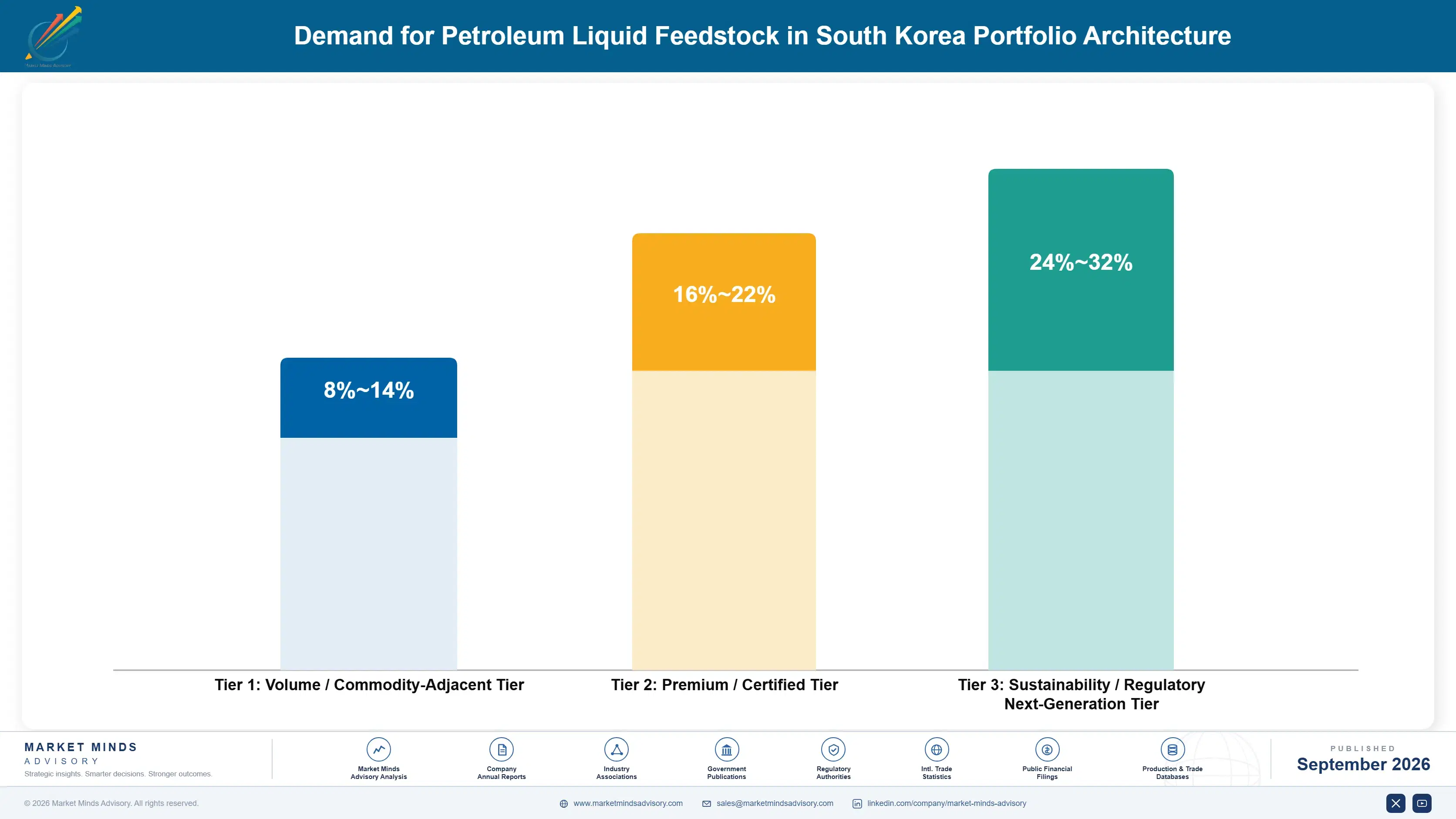
Portfolio Architecture for Margin Defence

Feedstock processing splits into three commercial tiers with distinct margin economics. Volume commodity naphtha processing sells through standard refining and cracker allocation, sustaining moderate margins that reward scale and integration rather than sourcing sophistication among competing processors. Distribution reach and refining integration matter more than any single feature claim at this level of the market.
Premium certified condensate processing, backed by demonstrated ethylene yield advantage and diversified sourcing, commands meaningfully wider margins by trading on optimized feedstock economics rather than pure processing volume. Processors serving this tier increasingly compete on splitter flexibility and contract diversification rather than unit cost alone, favoring established players with proven infrastructure. These processors increasingly view splitter flexibility as their primary defense against price spread volatility.

Sustainability and next-generation formats, including recycled pyrolysis oil feedstock, remain a smaller share of total processed volume today but carry the widest margins of the three tiers, since technical scarcity and regulatory scarcity still constrain competition meaningfully. High-value pools concentrate squarely within this tier and the premium tier immediately below it. That tension between volume and premium credibility defines competitive positioning across the category broadly.

Volume / Commodity-Adjacent Tier

Standard naphtha processing sold through conventional refining and cracker allocation, competing primarily on scale and integrated refining margin rather than sourcing sophistication, with limited pricing power against established regional processors.
Gross Margin: 8-14%

Premium / Certified Tier

Condensate processing with demonstrated ethylene yield advantage and diversified multi-region sourcing, commanding wider margins on optimized feedstock economics and splitter flexibility, where proven yield performance makes switching genuinely costly for processors.
Gross Margin: 16-22%

Sustainability / Regulatory / Next-Generation Tier

Recycled pyrolysis oil feedstock addressing tightening extended producer responsibility mandates, where limited processing capability and regulatory scarcity sustain the widest margins across the category despite still-modest processed volume. Volume remains modest today relative to the two tiers below it.
Gross Margin: 24-32%
south-korea-petroleum-liquid-feedstock-market-portfolio-architecture-1788234512396

High-value Sub-segments and Strategic Watch-out

High-value high-growth segment

Recycled pyrolysis oil feedstock paired with diversified condensate sourcing sits at the intersection of premium margin and the fastest processing volume growth, as major producers standardize procurement around compliant recycled content ahead of tightening extended producer responsibility deadlines across the domestic plastics value chain. This is the clearest growth vector.
Gross Margin: 26-34%

High-value moderate-growth segment

American shale condensate sourcing carries strong per-tonne margins tied to favorable yield economics, though adoption grows more gradually as splitters work through existing long-term Middle Eastern supply contracts before shifting meaningful additional volume toward American sourcing relationships. Processors treat this as a durable, if slower-building, opportunity.
Gross Margin: 18-24%

Volume core segment

Standard domestic naphtha processing remains the largest processed volume base across the national refining and cracking complex, sustaining steady if unremarkable margins as the category matures and price competition among established processors intensifies across nearly every major producing complex. Scale and integration determine who wins share here.
Gross Margin: 8-12%

Strategic watch-out segment

Chinese cracker overcapacity threatens to compress regional ethylene margins further over the coming decade, particularly where Korean processors compete directly with heavily subsidized Chinese complexes for the same export markets and feedstock allocation advantages. Independent processors are responding through deeper export market diversification and higher-value specialty derivative production.
Gross Margin: n/a

Term Contracts Behave Like Annuities

Feedstock supply contracts generate value well beyond the initial term negotiation, since processors standardize logistics, storage allocation, and quality specifications around whichever supply relationship a facility built its splitter infrastructure around originally. That locked specification behavior turns a single sourcing decision into a multi-year annuity relationship across the facility's operating life. Switching to a different supply region mid-contract carries real requalification cost, which keeps incumbent suppliers entrenched long after the original agreement closes.
Adoption depth varies sharply by processor type. Integrated refiners embed feedstock sourcing into fleet-wide refining strategy spanning a decade or more, while smaller independent splitters treat sourcing as a more opportunistic, spot-driven decision. Specialty derivative producers sit between the two, adopting diversified sourcing selectively where export contract terms demand documented feedstock traceability. That spread explains why processing margin and sourcing sophistication diverge so sharply across these three processor categories.

Buyer profiles are shifting generationally as well. A younger cohort of procurement engineers, trained on data-driven price spread modeling rather than relationship-based term negotiation alone, increasingly favors dynamic multi-region sourcing, even where legacy procurement teams still default to familiar Middle Eastern supply relationships on habit alone. This generational split is reshaping which suppliers win new term contract negotiations.
south-korea-petroleum-liquid-feedstock-market-end-use-penetration-index-1788234512888

Where Processors Should Focus Next

These are among the four positions where our research anticipates prominent divergence between winners and laggards over the coming forecast period. Each is grounded in the demand model, the regulatory perimeter, and the announced capacity pipeline.
01 / SOURCING DIVERSIFICATION PRIORITY

Lock in American condensate contracts before spreads normalize

American shale condensate still trades at a meaningful discount to comparable Middle Eastern grades, and that spread is narrowing as more Asian buyers discover the same arbitrage opportunity across the region. Processors that lock in long-term supply agreements now capture favorable pricing that latecomers will not access once the spread compresses further toward parity with traditional sourcing benchmarks, since spot-market buyers face steeper premiums during tight periods. This window will not stay open indefinitely as global condensate trade flows continue rebalancing across competing Asian buyers.
02 / RECYCLED FEEDSTOCK INVESTMENT TIMING

Scale pyrolysis oil capacity ahead of tightening compliance mandates

Extended producer responsibility mandates are tightening on a known schedule, giving processors a rare opportunity to plan capacity investment years ahead of binding compliance deadlines rather than scrambling reactively later once penalties apply. Early movers that scale pyrolysis oil processing now secure both regulatory compliance headroom and a genuine cost advantage over rivals forced into the tighter spot market for compliant feedstock as deadlines approach. This timing advantage compounds meaningfully the longer a processor waits to act on capacity investment.
03 / SPLITTER FLEXIBILITY INVESTMENT

Invest in dynamic splitter infrastructure over fixed processing lines

Fixed naphtha-only or condensate-only processing lines increasingly lock operators out of the margin advantage that price spread arbitrage between the two feedstock types can deliver across a full operating year, particularly when spreads move quickly. Processors with flexible splitter infrastructure captured meaningfully higher margins during recent price volatility than peers locked into single-feedstock configurations unable to respond to shifting spreads quickly enough. This flexibility advantage will only grow further as feedstock price spreads keep widening across the entire forecast period ahead.
04 / REGIONAL SUPPLY CHAIN RESILIENCE

Build genuine sourcing redundancy against Chinese export market pressure

Chinese cracker overcapacity and aggressive export pricing pose a lasting threat to Korean processors competing in the same regional derivative markets, and that pressure will intensify as additional Chinese capacity comes online through the decade. Processors that diversify export markets and pursue higher-value specialty derivatives reduce direct exposure to Chinese price competition more effectively than those still competing head to head on commodity-grade output alone. This repositioning takes years to execute properly, favoring processors that start the transition now rather than later.

Engagement Snapshot From the Field

A live engagement with an industry participant carrying material or product regulatory and market exposure ahead of a defining policy shift, showing how our research translates into a defensible multi-year portfolio strategy.
MARKET MINDS ADVISORY · CLIENT ENGAGEMENT SUMMARY
Demand for Petroleum Liquid Feedstock in South Korea Producer Strategic Portfolio Review and Transition Roadmap 2026·Investment Scenario on Demand for Petroleum Liquid Feedstock in South Korea Exposure Evaluation 2025-26
CLIENT PROFILE
The client is a mid-size independent condensate splitter operator based at a major South Korean coastal industrial complex, with annual processing revenue in the low hundreds of millions of dollars (client-reported, unverified by MMA). The company had historically sourced condensate through a single long-term Middle Eastern supply contract without meaningful geographic diversification, treating sourcing strategy as a fixed operational input rather than an active commercial decision worth periodic review.
STRATEGIC CHALLENGE
Rising condensate price volatility tied to Middle Eastern geopolitical tension, combined with growing American shale condensate availability at more attractive pricing, forced the client to reconsider its single-source sourcing approach. Management needed to decide whether to diversify supply contracts across multiple regions, renegotiate existing Middle Eastern terms, or continue single-source procurement while absorbing rising price volatility risk across its processing operations.
MMA APPROACH
MMA conducted structured interviews with the client's procurement and trading leadership alongside a benchmarking exercise against four peer splitter operators' sourcing diversification strategies and contract structures. The engagement combined primary qualitative interviews with MMA's proprietary feedstock trade flow dataset to assess pricing differentials, contract flexibility, and total landed cost under each sourcing option under active consideration.
KEY FINDINGS
  1. Diversifying to a two-region sourcing structure reduced the client's exposure to single-supplier price shocks by roughly 30 percent within the first year.
  2. Peer operators with diversified sourcing reported measurably lower quarter to quarter feedstock cost volatility than those still relying on single-region contracts alone.
  3. Renegotiating the existing Middle Eastern contract alone would have captured only a fraction of the total available cost savings identified in the study.
  4. Operators that delayed diversification faced meaningfully higher spot market premiums during the most recent regional price volatility episode tracked in the study.
CLIENT PROFILE
The client is a mid-size independent condensate splitter operator based at a major South Korean coastal industrial complex, with annual processing revenue in the low hundreds of millions of dollars (client-reported, unverified by MMA). The company had historically sourced condensate through a single long-term Middle Eastern supply contract without meaningful geographic diversification, treating sourcing strategy as a fixed operational input rather than an active commercial decision worth periodic review.
STRATEGIC CHALLENGE
Rising condensate price volatility tied to Middle Eastern geopolitical tension, combined with growing American shale condensate availability at more attractive pricing, forced the client to reconsider its single-source sourcing approach. Management needed to decide whether to diversify supply contracts across multiple regions, renegotiate existing Middle Eastern terms, or continue single-source procurement while absorbing rising price volatility risk across its processing operations.
MMA APPROACH
MMA conducted structured interviews with the client's procurement and trading leadership alongside a benchmarking exercise against four peer splitter operators' sourcing diversification strategies and contract structures. The engagement combined primary qualitative interviews with MMA's proprietary feedstock trade flow dataset to assess pricing differentials, contract flexibility, and total landed cost under each sourcing option under active consideration.
KEY FINDINGS
  1. Diversifying to a two-region sourcing structure reduced the client's exposure to single-supplier price shocks by roughly 30 percent within the first year.
  2. Peer operators with diversified sourcing reported measurably lower quarter to quarter feedstock cost volatility than those still relying on single-region contracts alone.
  3. Renegotiating the existing Middle Eastern contract alone would have captured only a fraction of the total available cost savings identified in the study.
  4. Operators that delayed diversification faced meaningfully higher spot market premiums during the most recent regional price volatility episode tracked in the study.
RECOMMENDED STRATEGY
Phase 1: Phase 1 (Months 1-4): Qualify an American condensate supplier and negotiate an initial term contract alongside the existing Middle Eastern relationship immediately and decisively. Phase 2: Phase 2 (Months 5-10): Rebalance feedstock intake toward a target two-region split while monitoring realized cost savings against the original contract baseline quite carefully. Phase 3: Phase 3 (Months 11-18): Formalize a third sourcing relationship in Southeast Asia and expand storage capacity to support opportunistic spot market purchasing even further.
OUTCOME
Within eighteen months of implementation, the client reported a reduction in feedstock cost volatility of approximately 25 percent and improved overall processing margin stability (client-reported, unverified by MMA). The diversified sourcing structure also improved the client's negotiating position in subsequent contract renewals, and the client has since begun exploring a fourth sourcing relationship in Latin America.

Frequently Asked Questions

Foundational context covering the market sizes, CAGR, scope, country, region and competition that inform every finding below. This section is provided to cover basics and most often pre-purchase conversations, answered from the MMA Primary Research Dataset.

What is the current size of the Demand for Petroleum Liquid Feedstock in South Korea?

South Korean demand for petroleum liquid feedstock reached approximately 9.2 billion dollars in 2025. Growth is driven primarily by condensate splitting expansion and rising recycled pyrolysis oil feedstock adoption.

How large will the market be by 2036?

MMA projects this demand will reach approximately 14.47 billion dollars by 2036. That represents roughly a 1.51 times expansion over the eleven-year forecast window from 2026 onward.

What is the CAGR for the market 2026 to 2036?

The market is forecast to grow at a 4.2 percent compound annual rate between 2026 and 2036. Bull and bear scenarios range from 3.0 to 5.4 percent.

Which segment is growing fastest?

Recycled and Pyrolysis Oil Feedstocks is the fastest-growing segment at an 11.8 percent CAGR through 2036. That is roughly 2.81 times the overall market growth rate.

Who are the major companies in this market?

Leading processors include SK Geo Centric, LG Chem, Lotte Chemical, GS Caltex, and Hanwha TotalEnergies Petrochemical. Together these five companies hold an estimated 62 percent combined share of national feedstock intake.

Which country is growing fastest as a supply source?

The United States leads growth among individual supplier countries, driven by expanding shale condensate export volume into South Korean splitter contracts. Its growth outpaces every other single sourcing country tracked.

Report Segmentation Architecture

The full report scope spans multiple orthogonal segmentation dimensions, with cross-tabulated demand data provided for each dimension pair. Coverage extends further to regional breakdowns, trend trajectories, and the competitive detail needed to support segment-level decision-making.

By Primary Market Dimension

  • Naphtha
  • LPG Feedstock
  • Condensate
  • Gas Oil and Other Heavy Liquid Feedstocks
  • Bio-Based and Renewable Liquid Feedstocks
  • Recycled and Pyrolysis Oil Feedstocks

By End-Use Industry

  • Ethylene and Propylene Cracking
  • Aromatics Production
  • Fuel Blending and Refining
  • Specialty Chemical Manufacturing
  • Polymer and Derivative Production

By Commercial Dimension

  • Term Contract Sourcing
  • Spot Market Sourcing
  • Captive Refining Supply
  • Recycled Feedstock Compliance Sourcing

By Region

  • North America
  • Western Europe
  • East Asia
  • South Asia and Pacific
  • Latin America
  • Middle East and Africa
  • Eastern Europe

Scope, Methodology, and Coverage

Every figure in this report is reproducible from documented input assumptions. The scope below maps the historical period, the forecast horizon, the segmentation dimensions, and the countries covered, alongside the underlying primary and qualitative methodology.
Historical Period
2020 to 2025
Forecast Period
2026 to 2036
Base Year
2025 (USD billions; MMA Primary Research Dataset, September 2026)
Market Definition
This market covers petroleum-derived liquid feedstocks, including naphtha, condensate, LPG, gas oil, and recycled pyrolysis oil, consumed by South Korean petrochemical crackers and refiners as cracking feedstock. It excludes crude oil purchased for fuel refining output and downstream olefin or polymer products themselves.
Quantitative Units
USD billions (current prices); processed volume in million tonnes where noted
Segmentation Dimensions
By Primary Market Dimension; By End-Use Industry; By Commercial Dimension; By Region
Regions Covered
North America, Western Europe, East Asia, South Asia and Pacific, Latin America, Middle East and Africa, Eastern Europe
Countries Covered
South Korea, with sourcing analysis covering USA, Saudi Arabia, UAE, Qatar, China, Japan, Malaysia, Indonesia, Brazil, Mexico, and additional exporting markets relevant to this sector
Key Companies Profiled
SK Geo Centric, LG Chem, Lotte Chemical, GS Caltex, Hanwha TotalEnergies Petrochemical, S-Oil Corporation, Hyundai Oilbank, SK Energy, Yeochun NCC, Daelim Industrial Co Ltd, Kumho Petrochemical Co Ltd, Samsung Total Petrochemicals, Isu Chemical Co Ltd, Hanwha Solutions Corporation, SK Incheon Petrochemical, GS Energy Corporation, Korea National Oil Corporation, Aramco Trading Company, ADNOC Trading, Vitol Group
Quantitative Methodology
Primary survey, n=3,800 respondents, Q4 2025, six countries; demand-side model with trade association cross-validation
Qualitative Methodology
47 expert interviews, Q4 2025; applied to validate demand model assumptions, identify emerging dynamics, and assess competitive positioning
Report Format
PDF and XLSX data workbook (Word format preview document)
Publisher
Market Minds Advisory
Report Code
MMA-2026-CHM-138
Published
September 2026
Contact
sales@marketmindsadvisory.com | www.marketmindsadvisory.com

Purchase the full Demand for Petroleum Liquid Feedstock in South Korea Report (2026 to 2036).

The full report delivers comprehensive market sizing, segmentation, and sourcing analysis for South Korean petroleum liquid feedstock demand through 2036. It profiles twenty leading processors and traders across naphtha, condensate, and recycled feedstock supply, covering their sourcing relationships, processing capacity, and recent corporate developments. Sourcing chapters detail import origin trends across all seven world trading regions with quantified volume mechanisms. The report also includes forecast scenarios, crude and freight cost analysis, and a strategic verdict identifying where processors should prioritize investment. Analysts additionally benchmark contract structures and margin economics across the full processor portfolio landscape.
Eleven-year market sizing and forecast model
Six-segment MECE segmentation by feedstock type
Full seven-region sourcing origin volume breakdown
Twenty-company competitive benchmarking and profiling analysis
Crude and freight cost risk analysis
Anonymized client case study with recommendations

Built For The People Who Decide

From boardroom strategy to bench-side execution, this report is read cover-to-cover by leaders shaping the next decade of their industry, turning demand scenarios, market dynamics and valuation benchmarks into decisions.
CXOs/ Presidents/ VPs/ Managers
M&A and Corporate Development
Strategy Teams and R&D Heads
Procurement and Product Directors
Regulatory and Compliance Leaders
Investor Relations and Equity Analysts