Market Minds Advisory
South Korea Intellectual Property Market

South Korea Intellectual Property Market: South Korea Intellectual Property Market. Trends and Forecast 2026 to 2036

Surging semiconductor and battery patent filings are pushing South Korean conglomerates into aggressive cross-border licensing and litigation, forcing IP service providers to prove valuation and enforcement expertise as global technology rivalry intensifies patent disputes.

Lead Analyst

Published

September 2026

Make Smarter Decisions with Customized Research Insights

Request a free sample report and evaluate market opportunities, growth trends, and competitive dynamics relevant to your business needs.

2025 MARKET VALUE$2.3BMarket Size 2025
2036 FORECAST VALUE$6.2BBase Case , 2026 to 2036
CAGR 2026 TO 20369.5 %Bull 10.8% / Bear 8.3%
INCREMENTAL OPPORTUNITY$3.7BNet 10- year value creation
EXPANSION MULTIPLE2.48x2036 value over 2026 base
Strategic Levers
M&A Pipeline
Regional Outlook
Country Rankings
Competitive Intelligence
Segmental Deep-dive
Call-Us : 91 93563 13602

Executive Snapshot and Market Trajectory.

South Korea's intellectual property market is expanding as Samsung, SK Hynix, LG, and Hyundai file record patent volumes tied to semiconductor, battery, and display technology leadership across most product categories. Cross-border licensing and enforcement activity increasingly determines commercial value, not just domestic patent registration volume alone.
Commercial demand concentrates around semiconductor and artificial intelligence patent licensing services, where Korean conglomerates increasingly monetize proprietary chip and battery technology through licensing agreements with global manufacturers rather than litigation alone across most industries and technology categories. Foreign filing activity into the United States, Europe, and China represents a growing share of total service revenue as Korean companies protect intellectual property across every major market where their products and licensees actually operate globally.
Competitive intensity remains moderate, with the top five IP service providers controlling roughly 44% of market revenue given specialized technical expertise required for semiconductor and battery patent prosecution across the industry today. Rising demand for sophisticated patent valuation and cross-border enforcement capability is reshaping which firms win the largest conglomerate mandates, favoring providers with proven international litigation experience over smaller domestic-focused practices lacking comparable global reach.
Market Definition
The South Korea Intellectual Property Market covers patent prosecution, trademark registration, licensing advisory, and enforcement litigation services provided to South Korean entities and covering their intellectual property assets both domestically and across major foreign filing jurisdictions. It excludes general corporate legal services unrelated to intellectual property matters.
Base Year Value
$2.3B in 2025 (MMA Primary Research Dataset, September 2026)
Forecast Period
2026 to 2036, eleven discrete annual values
CAGR
9.5% base case. Bull 10.8%. Bear 8.3%.
Fastest Growth Segment
Semiconductor and AI Patent Licensing Services: 14.5% CAGR
Fastest Growth Country
United States: 13.0% CAGR
Fastest Growth Region
South Asia and Pacific: 11.5% CAGR
Largest Region
East Asia: 30% of 2025 global value
Market Leaders
Leading participants include Kim & Chang, Lee & Ko, Yulchon, Bae Kim & Lee, and Yoon & Yang. Source: MMA Analysis based on company annual reports.
Primary Survey
n=3,800 procurement and R&D decision-makers, Q4 2025, six countries
Methodology
Demand-side build-up, cross-validated against public data, 47 expert interviews

South Korea Intellectual Property Market Forecast Scenarios

south-korea-intellectual-property-market-size-forecast-scenario-1789988609083
South Korea's intellectual property market grew steadily through 2020 to 2025 as domestic conglomerates expanded semiconductor and battery patent filing volume tracking rising research and development investment. Growth accelerated toward the end of the historical period as artificial intelligence patent filings surged alongside broader industry investment, pushing the historical CAGR to 8.5% by the period's close.
The base case assumes semiconductor, battery, and artificial intelligence patent activity keeps expanding as Korean conglomerates sustain heavy research investment through the forecast decade. Three mechanisms drive this: rising cross-border licensing revenue as Korean chip and battery technology gains global market share, expanding foreign patent filing volume protecting intellectual property across every major manufacturing destination, and growing demand for sophisticated patent valuation services supporting licensing negotiations and merger transactions involving technology-heavy Korean companies.
The bull case centers on accelerated global adoption of Korean battery and semiconductor technology, pulling licensing revenue forward faster than the base case assumes. The bear risk is patent litigation cost escalation: if international enforcement disputes intensify faster than expected, smaller Korean technology companies could face disproportionate legal cost burden relative to their revenue base, constraining innovation investment across the broader domestic economy.

Where Patent Enforcement Determines Commercial Value

South Korea's intellectual property market has shifted from a filing volume competition into a monetization and enforcement competition, since conglomerates increasingly measure IP portfolio success by licensing revenue and litigation outcomes rather than raw patent count alone. Law firms and IP consultancies that combine technical semiconductor expertise with international litigation capability are capturing disproportionate share of the highest-value conglomerate mandates.
MARKET CONCENTRATION44% CR5Top five IP service providers control domestic market revenue share
AVERAGE PATENT FILING COST$8,400 per patentBlended average cost across domestic and foreign patent filing categories
TOP FILER COMPANY SHARE22%Samsung's share of total domestic annual patent filing volume currently
FOREIGN FILING RATE58%Share of Korean patents also filed in foreign jurisdictions annually
LICENSING REVENUE SHARE31% of IP revenueCross-border licensing portion of total intellectual property service revenue
PATENT PROSECUTION TIMELINE18 to 24 monthsTypical duration from initial filing to patent grant approval decision
Samsung's patent filing volume alone represents a substantial share of total domestic activity, though the broader market increasingly depends on foreign filing strategy as Korean companies protect intellectual property across every jurisdiction where their products and licensees operate commercially. Cross-border licensing revenue has grown into a meaningful share of total IP service revenue, reflecting a shift from purely defensive patent filing toward active technology monetization strategy.
Patent prosecution timelines remain lengthy given the technical complexity of semiconductor and battery chemistry patent applications requiring specialized examiner review across most application categories. This extended timeline creates a durable service relationship between filing companies and their chosen IP service provider, since switching providers mid-prosecution carries meaningful continuity risk that most conglomerates prefer to avoid across active patent application portfolios.
"Patent filing used to be a defensive checkbox exercise. Now it's a revenue line item, and the firms that understand licensing negotiation as well as patent law are the ones winning the biggest conglomerate mandates."
Director, Intellectual Property and Technology Licensing Practice · MMA Technology Practice · September 2026

Market Trends

AI and Semiconductor Patent Filings Surge Nationally

Korean conglomerates are filing artificial intelligence and next-generation semiconductor patents at an accelerating pace as Samsung, SK Hynix, and smaller technology companies race to protect innovations tied to advanced chip fabrication and memory technology leadership. This surge is straining domestic patent examiner capacity, extending prosecution timelines for the most technically complex applications requiring specialized review beyond standard examination resources. Law firms with deep semiconductor technical expertise are capturing disproportionate share of this filing volume, since drafting defensible claims for complex chip architecture requires specialized engineering knowledge that generalist intellectual property practices cannot easily replicate at comparable quality and speed.
Market Impact: Sustains filing growth above 10% annually
Cross-Border Licensing Revenue Becomes Primary Monetization Strategy

Korean technology companies increasingly monetize patent portfolios through active licensing negotiation with global manufacturers rather than relying primarily on defensive litigation or domestic-only enforcement strategy alone across most industries. This shift reflects growing confidence in the commercial value of Korean semiconductor and battery technology, as global manufacturers increasingly need licensed access to patented processes Korean companies control across multiple product categories worldwide. Licensing negotiation requires distinct commercial and valuation expertise beyond traditional patent prosecution work, creating demand for specialized advisory services that combine technical patent knowledge with commercial deal structuring capability.
Market Impact: Expands licensing revenue by roughly 18%

Market Opportunities and Growth Drivers

Semiconductor Export Competitiveness Drives Patent Filing Volume

South Korea's semiconductor export leadership requires continuous patent protection to defend proprietary chip fabrication and memory technology processes against increasingly capable competitors in China and elsewhere seeking to replicate Korean manufacturing advantages. Companies view extensive patent portfolios as essential defensive infrastructure protecting export revenue and technology licensing income that represents a substantial share of national economic output tied directly to the semiconductor sector. This dynamic sustains consistent filing volume growth even during periods of broader economic slowdown, since patent protection investment is viewed as strategically essential rather than discretionary corporate spending during difficult periods.
Market Impact: Extends prosecution timelines by 6 months

Battery Technology Licensing Expands International Revenue

Korean battery manufacturers including LG Energy Solution and Samsung SDI are increasingly licensing proprietary battery chemistry and manufacturing process patents to global electric vehicle manufacturers seeking access to proven, commercially validated technology rather than developing competing solutions independently from scratch. This licensing activity generates substantial recurring royalty revenue that these companies value alongside direct battery cell manufacturing revenue, creating dual revenue streams from the same underlying patent portfolio investment. Growing global electric vehicle production volume is expanding the addressable licensing market meaningfully faster than domestic battery production capacity alone would support.
Market Impact: Litigation costs exceed $2 million

Market Restraints and Challenges

Patent Examiner Capacity Constraints Extend Prosecution Timelines

Rising filing volume for technically complex semiconductor and artificial intelligence patent applications is straining domestic patent examiner capacity, extending prosecution timelines beyond historical norms for the most sophisticated technical applications requiring specialized review expertise. The root cause is that specialized examiner training for advanced semiconductor and AI technology takes years to develop, and the pace of examiner hiring has not kept pace with accelerating filing volume growth across the industry. The patent office is mitigating this through expanded examiner recruitment programs and expedited examination tracks for applications tied to strategically important national technology priorities.
Market Impact: AI patent filings grow 22%

Cross-Border Litigation Cost Burdens Smaller Companies

International patent enforcement litigation carries substantial legal cost that disproportionately burdens smaller Korean technology companies lacking the litigation budget and international legal relationships that large conglomerates maintain routinely. The root cause is that patent litigation in major foreign jurisdictions like the United States requires specialized local counsel and extensive discovery process costs that scale poorly for companies without dedicated legal infrastructure supporting international disputes. Smaller companies are mitigating this exposure through patent litigation insurance products and collective licensing arrangements that pool enforcement resources across multiple smaller rights holders facing similar infringement challenges.
Market Impact: Licensing revenue grows over 16% annually
3 additional market trends, 4 additional growth drivers, and 2 additional restraints and challenges are covered in the full report. Contact sales@marketmindsadvisory.com to access the complete intelligence.

Segment CAGR and Growth Architecture

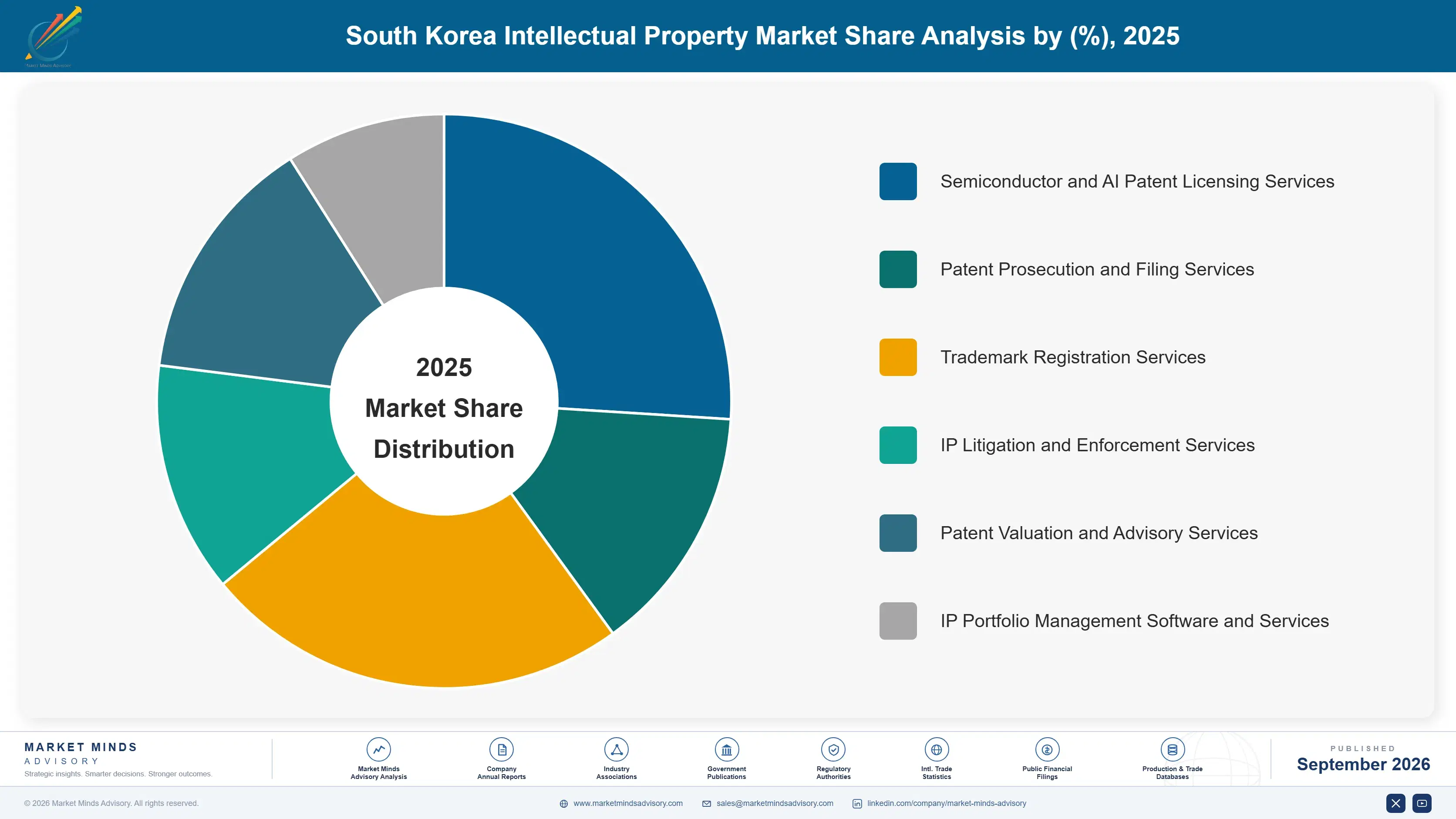
South Korea's intellectual property market segments by service type across six categories spanning patent licensing, prosecution, trademark registration, litigation, valuation advisory, and portfolio management services sold to domestic conglomerates. Each reflects a distinct professional service delivery model rather than overlapping capability tiers within a single practice area, reflecting how clients actually procure specialized expertise.
south-korea-intellectual-property-market-market-share-analysis-1789988609647

Semiconductor and AI Patent Licensing Services

Semiconductor and AI patent licensing services form the fastest-growing segment, expanding at 14.5% CAGR as Korean conglomerates increasingly monetize proprietary chip fabrication and artificial intelligence technology through commercial licensing agreements with global manufacturers across most major markets, product categories, and industry verticals. This segment requires specialized commercial and valuation expertise beyond traditional patent prosecution work, since structuring cross-border licensing agreements demands deep understanding of both patent law and technology transfer commercial negotiation practices. Advisory firms combining semiconductor technical expertise with international licensing deal experience are capturing disproportionate share as Korean companies increasingly view patent portfolios as active revenue-generating assets rather than purely defensive legal protection tools requiring minimal ongoing commercial engagement.
CAGR 14.5%

Patent Valuation and Advisory Services

Patent valuation and advisory services form the second-fastest-growing segment at 12.0% CAGR, driven by rising demand for sophisticated intellectual property valuation supporting licensing negotiations, merger transactions, and financial reporting requirements involving technology-heavy Korean companies across most industry sectors, company sizes, and ownership structures. This segment benefits from growing recognition that patent portfolios represent substantial and quantifiable corporate asset value requiring professional valuation methodology comparable to other major balance sheet assets held by large enterprises. Advisory firms combining financial valuation expertise with deep technical patent knowledge are winning the largest mandates, since accurately valuing complex semiconductor and battery chemistry patents requires specialized technical understanding that generalist valuation firms typically lack entirely.
CAGR 12.0%
Full segment breakdown across 6 segments available in the complete report.

Regional Architecture and Country Demand Map

East Asia anchors this market given domestic South Korean filing and prosecution activity, while North America follows closely as the leading destination for cross-border licensing and enforcement litigation given the scale and enforcement intensity of the entire United States patent system and its federal courts.

North America

The United States represents the single most important foreign filing and litigation destination for Korean intellectual property, given the size of the American consumer electronics and automotive market where Korean semiconductor and battery technology is embedded extensively. Cross-border licensing negotiations between Korean chipmakers and American technology companies increasingly determine the commercial value of major patent portfolios, more so than domestic Korean enforcement outcomes alone. Patent litigation filed in United States federal courts against alleged infringers carries substantial strategic weight given the scale of potential damages awards and the precedent-setting nature of major technology patent disputes decided there. Korean conglomerates increasingly staff dedicated in-house counsel teams focused specifically on managing the volume of American patent litigation and licensing negotiation activity.
Share: 28% | CAGR: 10.0% (2026 to 2036)

Western Europe

Germany and the broader European Union represent a significant foreign filing destination for Korean automotive and battery technology patents, given the concentration of European automotive manufacturers increasingly dependent on licensed Korean battery chemistry and semiconductor components. The European Patent Office's unified examination process gives Korean filers efficient access to protection across multiple European markets through a single application, differing meaningfully from the country-by-country filing complexity found elsewhere. Growing European Union industrial policy attention to battery supply chain security is increasing scrutiny of, and interest in, licensing arrangements involving Korean battery technology providers specifically. German automotive manufacturers in particular are negotiating multi-year licensing arrangements to secure predictable access to Korean battery cell technology roadmaps.
Share: 20% | CAGR: 8.0% (2026 to 2036)
Regional intelligence for 5 additional markets available in the complete report: East Asia, South Asia and Pacific, Latin America, Middle East and Africa, Eastern Europe. Contact sales@marketmindsadvisory.com.
south-korea-intellectual-property-market-country-cagr-analysis-1789988610167

Where Firms Can Command Premium Fees

IP service firms face price competition on standard trademark and prosecution work, but four commercial levers let disciplined firms command premium fees and win the largest conglomerate mandates across the coming forecast decade. Each requires different capability investment, and firms combining several simultaneously are pulling ahead of generalist competitors across most client segments today.

Semiconductor Technical Expertise and Patent Drafting

Firms employing patent attorneys with genuine semiconductor engineering backgrounds capture the highest-value conglomerate mandates, since drafting defensible claims for complex chip architecture requires specialized technical knowledge that generalist intellectual property practices cannot easily replicate at comparable quality. This capability requires recruiting and retaining scarce technical talent commanding premium compensation, but delivers pricing power that generalist competitors lacking equivalent depth cannot access regardless of general legal reputation or client relationships. Firms with proven semiconductor expertise are commanding roughly 30% higher fees than generalist practices among the largest technology conglomerate clients specifically.
Market Impact: Commands roughly 30% higher fees overall each year

Cross-Border Licensing Deal Structuring and Advisory Capability

Firms combining patent law expertise with commercial licensing negotiation and deal structuring capability capture premium advisory mandates that pure prosecution-focused competitors cannot fulfill, particularly for large cross-border technology licensing transactions spanning multiple jurisdictions. This capability requires developing genuine commercial dealmaking skills beyond traditional legal practice, but delivers meaningfully higher per-engagement fees than standard prosecution work commands across most client relationships. Firms offering integrated licensing advisory services are achieving engagement fees roughly 45% above standard patent prosecution billing rates for comparable time investment across similar client engagements. Fee structures also tend to include ongoing retainer components rather than one-time engagement billing.
Market Impact: Achieves fees roughly 45% above standard prosecution rates

International Litigation and Enforcement Track Record

Firms with proven international patent litigation experience, particularly successful outcomes in United States federal courts, capture the largest enforcement mandates that domestic-only competitors cannot credibly pursue given their lack of comparable track record and relationships. This capability requires sustained investment in international legal relationships and litigation experience built over many years of active case management and courtroom practice. Firms with established international litigation track records are winning enforcement mandates at fee levels roughly 40% above firms without comparable demonstrated cross-border litigation success and experience. Referral relationships from earlier successful cases also compound this advantage across future enforcement mandates.
Market Impact: Wins mandates at fees roughly 40% above peers

Patent Valuation and Financial Advisory Integration

Firms integrating financial valuation expertise alongside traditional patent law practice capture growing demand for sophisticated intellectual property valuation supporting merger transactions and financial reporting requirements across most industry sectors. This capability requires developing genuine financial analysis skills beyond traditional legal training, but positions firms to capture advisory mandates that pure legal practices cannot fulfill independently without external valuation partnership arrangements or subcontracting. Integrated valuation advisory practices are capturing client relationships worth roughly 25% more in total annual billing than firms offering prosecution services alone without comparable financial advisory integration. over time.
Market Impact: Captures client relationships worth roughly 25% more annually

Who Controls the Margin Pool

South Korea's intellectual property services market shows moderate concentration, with the top five law firms controlling roughly 44% of market revenue given the specialized technical expertise required for semiconductor and battery patent prosecution at scale. Kim & Chang holds a substantial scale advantage over Lee & Ko and the remaining challengers, backed by decades of relationships with Samsung and other major conglomerates that competitors cannot quickly replicate.
Current competitive activity centers on building semiconductor and artificial intelligence technical expertise, with leading firms recruiting patent attorneys holding advanced engineering degrees to serve growing conglomerate demand for sophisticated chip architecture patent drafting. Several firms are expanding cross-border licensing advisory capability, combining traditional patent prosecution with commercial deal structuring services previously outsourced to separate investment banking or consulting advisors.

Emerging pressure comes from international law firms establishing Korean offices specifically to capture cross-border litigation and licensing mandates that require both Korean market knowledge and foreign jurisdiction expertise simultaneously. Rankings could shift meaningfully as artificial intelligence patent drafting tools begin automating routine prosecution work, potentially commoditizing standard filing services while premium value increasingly concentrates in complex litigation and licensing advisory work instead.
south-korea-intellectual-property-market-company-positioning-matrix-1789988610698

Competitive Moat and Risk Dimensions

KIM & CHANG

Moat: Deep Conglomerate Relationship Depth

Kim & Chang maintains the deepest and longest-standing relationships with Samsung and other major Korean conglomerates, built through decades of continuous engagement across patent prosecution, licensing, and litigation matters. This relationship depth creates substantial switching cost for clients, since transferring complex, ongoing patent portfolios to a new firm risks continuity gaps that most conglomerates prefer to avoid entirely.
KIM & CHANG

Risk: Premium Pricing Limits Smaller Clients

Kim & Chang's premium fee structure, reflecting its scale and relationship depth, limits its addressable market primarily to the largest conglomerates able to absorb top-tier billing rates, potentially ceding smaller technology company clients to more cost-competitive rivals. Expanding downmarket would require a distinct service and pricing model that could dilute the firm's premium positioning.
LEE & KO

Moat: Strong International Litigation Network

Lee & Ko has built strong relationships with international law firms across major foreign jurisdictions, giving Korean clients coordinated representation for cross-border patent litigation and licensing disputes without managing multiple disconnected legal relationships independently. This network advantage is particularly valuable for clients facing simultaneous disputes across multiple countries requiring coordinated legal strategy.
LEE & KO

Risk: Narrower Semiconductor Technical Depth

Lee & Ko has historically built less specialized semiconductor patent drafting depth compared to some competitors, potentially limiting its ability to win the most technically demanding chip architecture patent mandates against firms with deeper engineering-trained attorney benches. Building comparable technical depth requires sustained recruiting investment over multiple years.

Players Tracked

Prominent Players

Kim & Chang
Lee & Ko
Yulchon
Bae Kim & Lee
Yoon & Yang

Other Key Players

Shin & Kim
Hwang Mok Park
Kasan IP & Law
Barun Law
Jipyong
Kim Choi & Lim
Y.P. Lee, Mock & Partners
Nam & Nam Law Firm
Aju IP & Law
Central International Law Firm
Lee International IP & Law Group
Muhan Patent & Law Firm
Global IP & Law Firm
Dentons Lee
Kim & Song

Recent Developments

MARCH 2025

Kim & Chang expanded its semiconductor patent practice group with a group of engineering-trained patent attorneys specializing in advanced chip fabrication technology, targeting growing conglomerate demand for sophisticated patent drafting supporting next-generation memory and processor development programs across multiple client relationships and technology categories. for the coming several years.
Signal: Recruiting engineering-trained patent attorneys is becoming an increasingly key competitive differentiator among most established Korean firms.
JULY 2025

Yulchon announced a strategic alliance with a major American law firm to provide coordinated cross-border patent litigation representation for Korean technology clients facing enforcement disputes across United States federal court jurisdictions specifically and other related international venues, forums, and appellate courts as well nationwide and abroad.
Signal: International alliance partnerships are becoming an increasingly preferred path to cross-border litigation capability much more quickly.
NOVEMBER 2025

Bae Kim & Lee launched a dedicated patent valuation and licensing advisory practice combining financial analysis expertise with traditional patent law services, targeting conglomerate clients seeking integrated support for major technology licensing transactions across multiple industries, regions, negotiation contexts, and quite complex deal structures overall.
Signal: Law firms are increasingly building integrated financial advisory capability to capture more valuable client mandates overall.

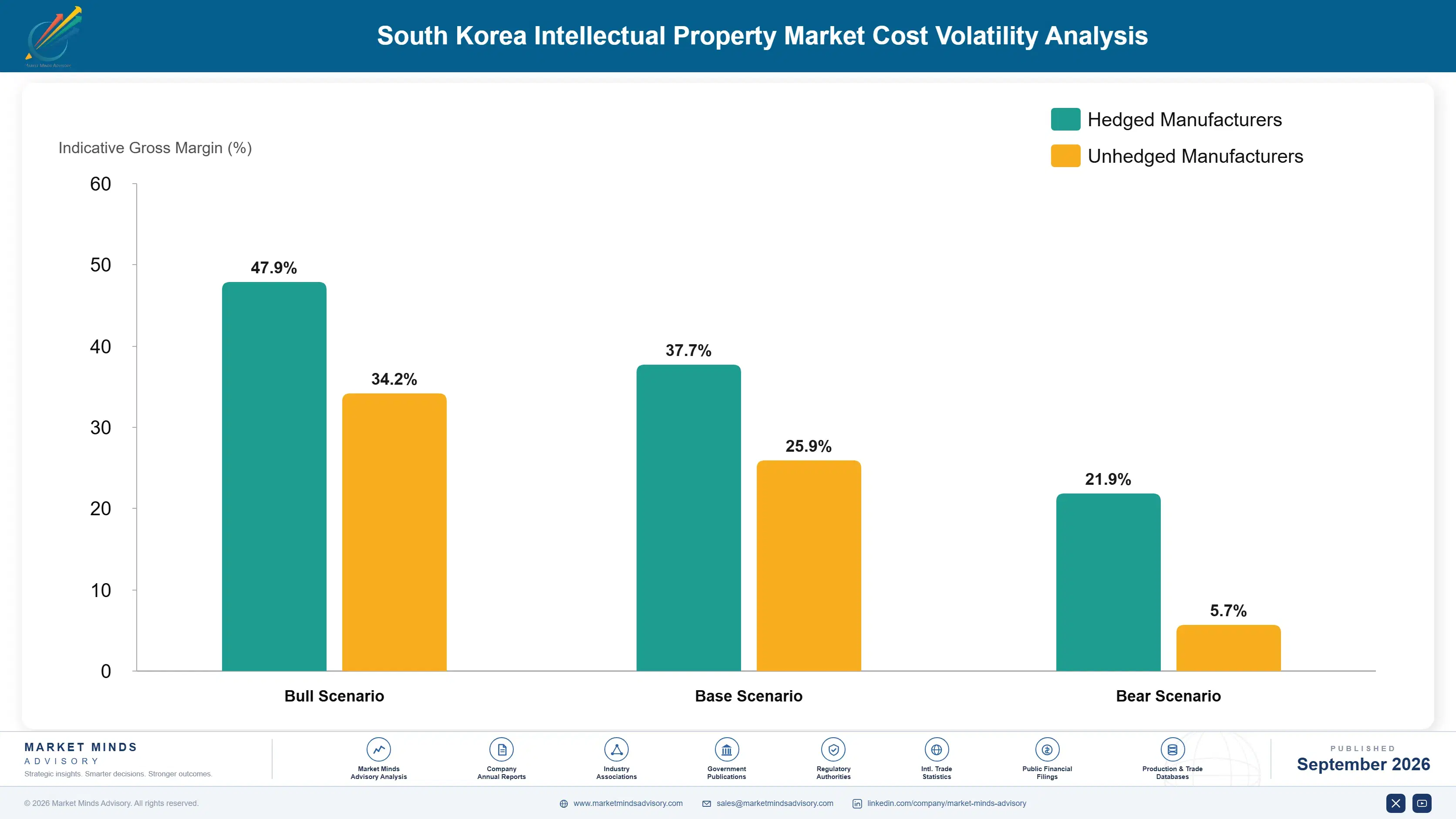
Specialized Patent Attorney Talent Cost Exposure

Specialized patent attorney compensation, particularly for attorneys holding advanced semiconductor or electrical engineering degrees, represents approximately 52% of total operating cost for Korean intellectual property firms, reflecting intense competition for a limited talent pool with both legal qualification and deep technical training. Foreign-qualified attorneys supporting cross-border litigation command additional premium compensation given their dual jurisdiction expertise.
Compensation for patent attorneys holding semiconductor engineering credentials rose an estimated 14% between 2023 and 2025 amid intensifying competition for scarce technical talent, according to Statistics Korea's national professional services labor market survey tracking comparable technical talent competition trends across major Korean technology hubs including Seoul and Gyeonggi Province during the same two-year reporting period, reflecting sustained demand pressure across the entire legal services sector nationwide.

This exposure disadvantages smaller firms lacking the scale to compete for top technical talent against larger firms offering higher compensation and more prestigious conglomerate client rosters overall. Firms with established training programs developing technical expertise internally, rather than competing purely on recruitment compensation, maintain a meaningful and durable cost advantage over competitors dependent entirely on external talent acquisition in a tight labor market.
south-korea-intellectual-property-market-cost-volatility-analysis-1789988610893

Internal Technical Training Programs

Leading firms are developing internal training programs that take generalist patent attorneys and build semiconductor and engineering technical expertise over several years, reducing dependence on scarce, expensive external technical talent recruitment. This approach requires patience and sustained investment, but delivers a more cost-stable talent pipeline than firms relying entirely on competitive recruitment against well-capitalized rivals for the same limited pool.

Long-Term Attorney Retention Incentive Structures

Some firms are restructuring compensation to include long-term equity or partnership track incentives that reward attorney retention over multiple years, reducing costly turnover among technically trained staff who are otherwise frequently recruited by competing firms. This approach requires restructuring traditional law firm compensation models, but reduces the recurring recruitment cost firms face when technical talent departs for competitor offers.

University Partnership Talent Pipeline Development

Firms are establishing partnerships with engineering universities to identify and recruit technically talented graduates earlier, before competitors can offer comparable compensation packages to the same limited candidate pool. This approach requires sustained relationship investment with academic institutions, but delivers a more predictable talent pipeline than firms depending entirely on reactive recruitment from a shrinking pool of experienced technical patent attorneys.

Portfolio Architecture for Margin Defence

South Korea's intellectual property services market divides along three tiers driven by technical complexity and client relationship depth. Standard trademark and basic patent prosecution generates gross margins around 22 to 30%, while specialized semiconductor patent drafting commands 40 to 50%, and integrated litigation and licensing advisory services reach 55 to 65% given the technical and relationship differentiation competitors cannot quickly replicate.
Standard prosecution work still represents substantial revenue given the sheer volume of routine filings, but the highest-value pools now concentrate in specialized semiconductor patent drafting and integrated licensing advisory services serving major conglomerates. Firms must balance capital allocation between broad prosecution accessibility and premium technical talent investment, since the two require fundamentally different recruiting and training capability.

High-value margin pools concentrate specifically in cross-border litigation and licensing advisory work serving semiconductor and battery technology conglomerates, since these command both premium fees and multi-year client relationship commitment given switching cost and specialized expertise barriers. Firms positioned across all three tiers rather than concentrated purely in commodity prosecution work are best placed to capture disproportionate profit as licensing and enforcement activity keeps expanding through the forecast period.

Standard trademark registration and basic patent prosecution sold to small and mid-market companies, competing mainly on price with gross margin around 22 to 30% amid intense firm competition and frequent client switching.
Gross Margin

Specialized semiconductor and battery patent drafting requiring engineering-trained attorneys, commanding gross margin of 40 to 50% through technical differentiation and established conglomerate relationship depth built over many years and cycles.
Gross Margin

Integrated cross-border litigation and licensing advisory services combining legal and financial expertise, commanding the highest margin as international patent monetization activity keeps expanding across most technology sectors and jurisdictions worldwide.
Gross Margin
south-korea-intellectual-property-market-portfolio-architecture-1789988611397

High-value Sub-segments and Strategic Watch-out

Semiconductor and AI Patent Licensing Services

The fastest-growing and highest-value segment, commanding premium fees as Korean conglomerates increasingly monetize chip and AI technology through commercial licensing rather than defensive filing alone. Firms combining technical semiconductor expertise with commercial deal structuring capability are capturing disproportionate share of this expanding category through the forecast period.

Patent Valuation and Advisory Services

A high-value segment growing steadily as merger transactions and financial reporting requirements increasingly demand sophisticated intellectual property valuation for technology-heavy Korean companies. Firms integrating financial expertise alongside traditional patent law practice are capturing disproportionate share of this expanding recurring advisory revenue opportunity across most conglomerate clients.

Patent Prosecution and Filing Services

The volume core of domestic IP activity, sold heavily to conglomerates and mid-market companies requiring standard patent filing and prosecution support across most industries. Growth remains steady but margin stays moderate given competitive intensity among numerous established firms, making this segment primarily a scale play for most participants.

Trademark Registration Services

A strategic watch-out segment where growth trails the broader category as trademark filing increasingly commoditizes through simplified online registration processes across most jurisdictions and filing systems worldwide. Firms overexposed to this narrowing commodity category risk meaningful revenue erosion absent diversification into higher-growth patent or licensing advisory alternatives.

Why Conglomerates Stay With Firms

Intellectual property engagements generate durable, multi-year revenue rather than one-time transactions, since ongoing patent portfolio management requires continuous filing, prosecution monitoring, and renewal work spanning the entire twenty-year patent lifecycle. Once a firm establishes deep familiarity with a conglomerate's technology portfolio and business strategy, switching to a new firm carries meaningful continuity risk and knowledge transfer cost that most clients prefer to avoid across active matters.
Adoption depth varies sharply by client type. Large conglomerates like Samsung and SK Hynix show near-total stickiness once a firm relationship is established, given the scale and complexity of their combined patent portfolios spanning thousands of active filings. Mid-market technology companies show more willingness to switch firms periodically based on price and service quality, while smaller startups typically engage firms only for specific transactional matters rather than maintaining ongoing comprehensive relationships.

A generational shift is underway in buyer profile as conglomerate intellectual property departments increasingly employ dedicated licensing and commercialization specialists rather than treating patent management purely as defensive legal risk mitigation. Younger corporate technology strategy leaders increasingly expect integrated commercial and legal advisory support, pushing firms toward combined patent law and licensing deal structuring capability that differs meaningfully from traditional prosecution-only service models.
south-korea-intellectual-property-market-end-use-penetration-index-1789988611882

Where Firms Should Invest Now

These are among the four positions where our research anticipates prominent divergence between winners and laggards over the coming forecast period. Each is grounded in the demand model, the regulatory perimeter, and the announced capacity pipeline.
01 / SEMICONDUCTOR TECHNICAL RECRUITING

Engineering-trained attorneys now determine mandate competitiveness

Patent attorneys with genuine semiconductor engineering backgrounds have become more consequential to winning conglomerate mandates than general legal reputation alone, since drafting defensible chip architecture claims requires specialized technical knowledge generalist practices cannot replicate. Firms without this technical depth increasingly find themselves excluded from the highest-value semiconductor and AI patent drafting work regardless of overall firm prestige or historical client relationships. Investing in technical recruiting now, despite scarce talent and rising compensation cost, compounds into a durable competitive advantage that late movers cannot easily close.
02 / CROSS-BORDER LICENSING CAPABILITY

Commercial deal structuring skills access the highest-margin mandates

Firms combining patent law expertise with commercial licensing negotiation capability are capturing premium advisory mandates that pure prosecution-focused competitors cannot fulfill, particularly for large cross-border technology licensing transactions across multiple industries. This capability requires developing genuine commercial dealmaking skills beyond traditional legal training, but delivers meaningfully higher engagement fees than standard prosecution work commands across most client relationships and industries. Firms building this capability now will capture disproportionate share of the growing licensing advisory opportunity before competitors recognize its full strategic value.
03 / INTERNATIONAL LITIGATION PARTNERSHIPS

United States enforcement capability increasingly determines client retention

Korean conglomerates increasingly require coordinated representation across United States federal courts given the scale of the American market for their semiconductor and battery technology products and licensees operating there. Firms without established international litigation partnerships risk losing the largest enforcement mandates to competitors who can offer smooth cross-border legal coordination without requiring clients to manage multiple disconnected relationships independently or separately. Building these partnerships now, rather than treating international coordination as secondary, will separate durable market leaders from firms losing ground.
04 / INTEGRATED VALUATION ADVISORY SERVICES

Financial advisory integration captures growing merger transaction demand

Firms integrating financial valuation expertise alongside traditional patent law practice are capturing growing demand for sophisticated intellectual property valuation supporting merger transactions and financial reporting requirements across technology-heavy Korean companies and industries. This capability requires developing genuine financial analysis skills beyond traditional legal training, but positions firms to capture advisory mandates that pure legal practices cannot fulfill independently or effectively. Firms building this integrated capability now will capture disproportionate share of the growing valuation advisory opportunity ahead of slower-moving competitors.

Engagement Snapshot From the Field

A live engagement with an industry participant carrying material or product regulatory and market exposure ahead of a defining policy shift, showing how our research translates into a defensible multi-year portfolio strategy.
MARKET MINDS ADVISORY · CLIENT ENGAGEMENT SUMMARY
South Korea Intellectual Property Producer Strategic Portfolio Review and Transition Roadmap 2026·Investment Scenario on South Korea Intellectual Property Exposure Evaluation 2025-26
CLIENT PROFILE
The client is a mid-sized Korean battery technology manufacturer holding a substantial patent portfolio in solid-state battery chemistry, previously pursuing patent protection primarily for defensive purposes without an active licensing or commercialization strategy in place. Rising interest from global automakers seeking access to the client's proprietary chemistry prompted leadership to evaluate transitioning toward active patent monetization.
STRATEGIC CHALLENGE
The client lacked internal expertise in patent valuation and cross-border licensing negotiation, having relied entirely on domestic prosecution counsel without commercial licensing experience. Multiple automakers had expressed informal interest in licensing discussions, but the client had no systematic framework for valuing its portfolio or structuring a licensing program that would maximize revenue while protecting its competitive positioning.
MMA APPROACH
MMA conducted a comprehensive patent portfolio valuation using comparable licensing transaction benchmarks and interviews with industry licensing specialists across the battery technology sector and adjacent segments. The engagement modeled licensing revenue scenarios across exclusive versus non-exclusive licensing structures, weighing near-term revenue against the client's own long-term manufacturing competitive positioning strategy.
KEY FINDINGS
  1. The client's solid-state battery patent portfolio was valued at approximately 40% above the client's own internal preliminary estimate (client-reported, unverified by MMA).
  2. Non-exclusive licensing to multiple automakers generated projected revenue roughly 25% higher than pursuing a single exclusive licensing arrangement (client-reported, unverified by MMA).
  3. Three of the client's patents showed meaningfully stronger enforcement potential than the remainder of the portfolio, warranting prioritized licensing focus (client-reported, unverified by MMA).
  4. Structuring licensing deals with milestone-based royalty escalation clauses increased projected total contract value by approximately 18% overall across the full agreement (client-reported, unverified by MMA).
CLIENT PROFILE
The client is a mid-sized Korean battery technology manufacturer holding a substantial patent portfolio in solid-state battery chemistry, previously pursuing patent protection primarily for defensive purposes without an active licensing or commercialization strategy in place. Rising interest from global automakers seeking access to the client's proprietary chemistry prompted leadership to evaluate transitioning toward active patent monetization.
STRATEGIC CHALLENGE
The client lacked internal expertise in patent valuation and cross-border licensing negotiation, having relied entirely on domestic prosecution counsel without commercial licensing experience. Multiple automakers had expressed informal interest in licensing discussions, but the client had no systematic framework for valuing its portfolio or structuring a licensing program that would maximize revenue while protecting its competitive positioning.
MMA APPROACH
MMA conducted a comprehensive patent portfolio valuation using comparable licensing transaction benchmarks and interviews with industry licensing specialists across the battery technology sector and adjacent segments. The engagement modeled licensing revenue scenarios across exclusive versus non-exclusive licensing structures, weighing near-term revenue against the client's own long-term manufacturing competitive positioning strategy.
KEY FINDINGS
  1. The client's solid-state battery patent portfolio was valued at approximately 40% above the client's own internal preliminary estimate (client-reported, unverified by MMA).
  2. Non-exclusive licensing to multiple automakers generated projected revenue roughly 25% higher than pursuing a single exclusive licensing arrangement (client-reported, unverified by MMA).
  3. Three of the client's patents showed meaningfully stronger enforcement potential than the remainder of the portfolio, warranting prioritized licensing focus (client-reported, unverified by MMA).
  4. Structuring licensing deals with milestone-based royalty escalation clauses increased projected total contract value by approximately 18% overall across the full agreement (client-reported, unverified by MMA).
RECOMMENDED STRATEGY
Phase 1: Phase one: complete a comprehensive patent portfolio valuation and identify the highest-priority patents for active licensing pursuit and negotiation efforts. Phase 2: Phase two: negotiate non-exclusive licensing agreements with multiple automaker counterparties simultaneously to maximize total aggregate royalty revenue collected over time. Phase 3: Phase three: establish an ongoing licensing program with milestone-based royalty structures applied consistently to all future patent filings and renewals.
OUTCOME
The client signed its first two licensing agreements within eight months of the engagement, generating meaningful new recurring royalty revenue while preserving manufacturing competitive positioning through carefully structured non-exclusive licensing terms across both signed agreements and several future planned negotiation rounds (client-reported, unverified by MMA).

Frequently Asked Questions

Foundational context covering the market sizes, CAGR, scope, country, region and competition that inform every finding below. This section is provided to cover basics and most often pre-purchase conversations, answered from the MMA Primary Research Dataset.

What is the current size of the South Korea Intellectual Property Market?

The South Korea Intellectual Property Market was valued at approximately $2.3 billion in 2025, the base year for this analysis. This figure covers patent prosecution, licensing, litigation, and portfolio management service revenue.

How large will the South Korea Intellectual Property Market be by 2036?

The market is projected to reach approximately $6.25 billion by 2036, driven by semiconductor and battery patent licensing growth. This represents a 2.48x expansion over the 2026 starting value.

What is the CAGR for the South Korea Intellectual Property Market 2026 to 2036?

The market is forecast to grow at a compound annual growth rate of 9.5% between 2026 and 2036. The bull case reaches 10.8% while the bear case falls to 8.3%.

Which segment is growing fastest?

Semiconductor and AI Patent Licensing Services is the fastest-growing segment, expanding at 14.5% CAGR, roughly 1.53x the overall market rate. Demand is driven by conglomerates monetizing chip and battery technology.

Who are the major companies in the South Korea Intellectual Property Market?

Leading participants include Kim & Chang, Lee & Ko, Yulchon, Bae Kim & Lee, and Yoon & Yang, alongside numerous specialized boutique and international firms. Competitive positioning centers on technical expertise and litigation reach.

Which country is growing fastest?

United States is the fastest-growing foreign filing and licensing destination, expanding at approximately 13.0% CAGR. Scale of the American market drives accelerating cross-border patent activity there.

Report Segmentation Architecture

The full report scope spans multiple orthogonal segmentation dimensions, with cross-tabulated demand data provided for each dimension pair. Coverage extends further to regional breakdowns, trend trajectories, and the competitive detail needed to support segment-level decision-making.
  • Semiconductor and AI Patent Licensing Services
  • Patent Prosecution and Filing Services
  • Trademark Registration Services
  • IP Litigation and Enforcement Services
  • Patent Valuation and Advisory Services
  • IP Portfolio Management Software and Services
  • Semiconductors
  • Battery and Energy Storage
  • Automotive
  • Consumer Electronics
  • Telecommunications
  • Biotechnology and Pharmaceuticals
  • Direct Corporate Client Engagement
  • Cross-Border Licensing Advisory
  • Litigation Support Services
  • Retainer-Based Ongoing Counsel

By Region

  • North America
  • Western Europe
  • East Asia
  • South Asia and Pacific
  • Latin America
  • Middle East and Africa
  • Eastern Europe

Scope, Methodology, and Coverage

Every figure in this report is reproducible from documented input assumptions. The scope below maps the historical period, the forecast horizon, the segmentation dimensions, and the countries covered, alongside the underlying primary and qualitative methodology.
Historical Period
2020 to 2025
Forecast Period
2026 to 2036
Base Year
2025 (USD billions; MMA Primary Research Dataset, September 2026)
Market Definition
The South Korea Intellectual Property Market covers patent prosecution, trademark registration, licensing advisory, and enforcement litigation services provided to South Korean entities and covering their intellectual property assets both domestically and across major foreign filing jurisdictions. It excludes general corporate legal services unrelated to intellectual property matters.
Quantitative Units
USD Billion, patent filings, CAGR percentage
Segmentation Dimensions
IP Service Type, End-Use Industry, Commercial Dimension, Region
Regions Covered
North America, Western Europe, East Asia, South Asia and Pacific, Latin America, Middle East and Africa, Eastern Europe
Countries Covered
South Korea, United States, Canada, Germany, United Kingdom, France, China, Japan, India, Australia, Brazil, Mexico, United Arab Emirates, Israel, Poland
Key Companies Profiled
Kim & Chang, Lee & Ko, Yulchon, Bae Kim & Lee, Yoon & Yang, Shin & Kim, Hwang Mok Park, Kasan IP & Law, Barun Law, Jipyong, Kim Choi & Lim, Y.P. Lee, Mock & Partners, Nam & Nam Law Firm, Aju IP & Law, Central International Law Firm, Lee International IP & Law Group, Muhan Patent & Law Firm, Global IP & Law Firm, Dentons Lee, Kim & Song
Quantitative Methodology
Primary survey, n=3,800 respondents, Q4 2025, six countries; demand-side model with trade association cross-validation
Qualitative Methodology
47 expert interviews, Q4 2025; applied to validate demand model assumptions, identify emerging dynamics, and assess competitive positioning
Report Format
PDF and XLSX data workbook (Word format preview document)
Publisher
Market Minds Advisory
Report Code
MMA-2026-TEC-935
Published
September 2026
Contact
sales@marketmindsadvisory.com | www.marketmindsadvisory.com

Purchase the full South Korea Intellectual Property Market Report (2026 to 2036).

This report provides a comprehensive assessment of the South Korea Intellectual Property Market through 2036. It covers market sizing, segmentation, competitive dynamics, and regional demand patterns across all seven major geographies tracked in this analysis. The analysis examines how semiconductor and battery patent monetization are reshaping competitive positioning across the Korean intellectual property services industry, alongside specialized talent cost exposure across the broader legal services sector. It draws on primary survey data, expert interviews, and company disclosures to support procurement, investment, and strategic planning decisions.
Ten-year market sizing and forecast model
Seven-region demand and competitive intensity breakdown
Five-firm competitive benchmarking and moat analysis
Segment-level growth trajectory and margin analysis
Talent cost exposure and mitigation pathways
Anonymized client case study with recommendations

Built For The People Who Decide

From boardroom strategy to bench-side execution, this report is read cover-to-cover by leaders shaping the next decade of their industry, turning demand scenarios, market dynamics and valuation benchmarks into decisions.
CXOs/ Presidents/ VPs/ Managers
M&A and Corporate Development
Strategy Teams and R&D Heads
Procurement and Product Directors
Regulatory and Compliance Leaders
Investor Relations and Equity Analysts