Market Minds Advisory
South Korea Industrial Drum Market

South Korea Industrial Drum Market: The Money Is in the Return Trip

A steel drum gets filled roughly four times before retirement, so whoever controls the return flow controls a business considerably larger and steadier than the one making new drums ever was.

Lead Analyst

Bilal Shaikh

Published

September 2026

Make Smarter Decisions with Customized Research Insights

Request a free sample report and evaluate market opportunities, growth trends, and competitive dynamics relevant to your business needs.

2025 MARKET VALUE$0.3BMarket Size 2025
2036 FORECAST VALUE$0.5BBase Case , 2026 to 2036
CAGR 2026 TO 20363.8 %Bull 5.0% / Bear 2.6%
INCREMENTAL OPPORTUNITY$0.1BNet 10- year value creation
EXPANSION MULTIPLE1.45x2036 value over 2026 base
Strategic Levers
M&A Pipeline
Regional Outlook
Country Rankings
Competitive Intelligence
Segmental Deep-dive
Call-Us : 91 93563 13602

Executive Snapshot and Market Trajectory

Everybody counts new drums and the interesting business is the used ones. A Korean steel drum gets filled around four times before retirement, and reconditioned units sell at roughly 47% below new on equivalent specification, which makes collection and refurbishment the position worth holding rather than the press line.
Plastic drums grow fastest at 5.7% as chemical fillers move away from steel for corrosive and food grade products, while open-head steel declines steadily. Export volumes carry the higher specification work, because a drum leaving Yeosu or Ulsan is built to whatever the destination regulator requires rather than to any Korean standard. Domestic filling runs largely on reconditioned units. Two different businesses sit inside one market.
Underneath that, the best niche is quietly disappearing. Semiconductor and display chemicals paid the most for ultra-clean containers and are converting to bulk delivery systems and returnable totes, with around 22% of that volume already moved. Drum makers still describing electronics as a growth account are describing something that peaked several years ago and has been shrinking since. Drum suppliers still describing electronics as a growth account are describing something that peaked years ago.
Market Definition
Industrial drums of 100 to 250 litre capacity supplied and reconditioned within South Korea, covering tight-head steel drums, open-head steel drums, plastic drums, composite drums, fibre drums, and stainless steel drums. Measured at supplier selling value across new and reconditioned units. Excludes intermediate bulk containers, pails and jerricans below 100 litres, road tankers and isotanks, bulk chemical delivery systems, and drum closures sold separately.
Base Year Value
$0.3B in 2025 (MMA Primary Research Dataset, August 2026)
Forecast Period
2026 to 2036, eleven discrete annual values
CAGR
3.8% base case. Bull 5.0%. Bear 2.6%.
Fastest Growth Segment
Plastic Drums: 5.7% CAGR
Fastest Growth Country
South Korea: 3.8% CAGR
Fastest Growth Region
South Asia and Pacific: 5.6% CAGR
Largest Region
East Asia: 89% of 2025 global value
Market Leaders
Greif, Mauser Packaging Solutions, Schutz, Time Technoplast, Balmer Lawrie. Source: MMA Primary Research Dataset, July 2026.
Primary Survey
n=3,800 procurement and R&D decision-makers, Q4 2025, six countries
Methodology
Demand-side build-up, cross-validated against public data, 47 expert interviews

South Korea Industrial Drum Market Forecast Scenarios

south-korea-industrial-drum-market-2025-size-forecast-scenario-1787595320001
Growth ran near 3.4% between 2020 and 2025, tracking Korean petrochemical and specialty chemical output more closely than any packaging variable. Steel pricing moved sharply across the period and passed through into drum pricing with a lag that squeezed makers holding fixed contracts. Reconditioning volumes grew faster than new drum production throughout, as fillers took the cost saving wherever specification allowed them to.
Base case 3.8% rests on three mechanisms. Plastic drums grow at 5.7% as chemical fillers move corrosive and food grade products off steel entirely. Export specification requirements lift value per unit as destination market rules tighten around hazardous goods packaging. And reconditioning consolidates under chemical residue and worker safety enforcement, which raises pricing in a segment that had been competing informally on cost alone. None of the three depends on Korean packaging demand itself.
The bull case at 5.0% assumes Korean specialty chemical export volumes growing faster than the general petrochemical cycle, which would pull high specification new drum demand with them. The bear case at 2.6% is bulk delivery conversion accelerating beyond the 22% of electronics chemical volume already moved, taking the highest value applications out of drums permanently rather than cyclically.

Four Fills and a Reconditioning Yard

The obvious way to look at this market counts drums leaving a press line, and it misses most of the money. A Korean steel drum is filled roughly four times before it is finally retired, which means the fleet in circulation is several times the annual production figure. Reconditioned units sell around 47% below new on equivalent specification, and whoever controls collection and refurbishment holds a steadier position than any manufacturing line.
TOP FIVE CONCENTRATION58%Reconditioning remains fragmented while new drum making consolidated
RECONDITIONED PRICE DISCOUNT47%Saving against a new drum on equivalent specification
STEEL COST SHARE58%Cold rolled coil portion of finished steel drum cost
STANDARD FORMAT VOLUME200 LCapacity of the dominant format across industrial filling
AVERAGE FILL COUNT4Times a steel drum is filled before final retirement
BULK DELIVERY CONVERSION22%Electronics chemical volume already moved out of drums
Specification is set outside Korea for a large share of volume. A drum leaving the Yeosu or Ulsan complexes with specialty chemical inside is built to whatever United Nations packaging requirement the destination regulator enforces, not to any domestic standard. That pushes export work toward high specification new units while domestic filling runs on reconditioned drums, so two different businesses sit inside one market.
The highest margin niche is shrinking rather than growing. Semiconductor and display chemical suppliers paid the most for ultra-clean drums with controlled interior surfaces, and around 22% of that volume has already converted to bulk chemical delivery systems and returnable totes. The conversion is one way, because a fab that installs bulk delivery infrastructure does not go back.
"Ask a Korean drum maker about growth and they will tell you about electronics chemicals, which is the one application actively leaving. The reconditioning yards nobody wants to talk about are where the volume actually sits, and enforcement is about to make several of them considerably more valuable."
Director, Industrial Packaging and Chemical Logistics Practice · MMA Packaging Practice · August 2026

Market Trends

Reconditioning consolidating under residue and safety enforcement

Korean reconditioning has operated as a fragmented trade competing largely on collection cost, with chemical residue handling and worker exposure standards applied unevenly across a long tail of small yards. Enforcement has tightened enough that compliance investment is now the price of operating, which is quietly removing capacity and lifting pricing in a segment that never had any. Reconditioned drums still sell around 47% below new, but the gap has narrowed and the operators left standing hold considerably better positions than before. Integrated groups buying that capacity now are buying it at pre-consolidation pricing.
Market Impact: Lifts unit value above 20%
Bulk delivery removing the highest value drum application

Semiconductor and display chemical suppliers were the best customers this market had, paying substantial premiums for ultra-clean interiors and controlled handling. Around 22% of that volume has converted to bulk chemical delivery systems and returnable totes, and the conversion does not reverse because a fab that installs bulk infrastructure will not return to drum handling for the same chemical. Drum suppliers still counting electronics as a growth account are counting an application that peaked several years ago. Serving the transition with tote fleet management keeps a qualified customer relationship that resisting it simply loses to somebody else entirely.
Market Impact: Plastic drums growing at 5.7%

Market Opportunities and Growth Drivers

Specialty chemical exports specifying to destination market rules

A drum leaving the Yeosu, Daesan or Ulsan complexes with specialty chemical inside is built to whatever United Nations packaging requirement the destination regulator enforces, which is generally more demanding than Korean domestic practice. That lifts value per unit on export volume without any change in the underlying chemical business, and it favours makers holding certification across multiple destination regimes. Korean specialty chemical export growth therefore converts directly into higher specification drum demand. Certification breadth rather than manufacturing cost therefore decides which exporters a supplier can serve at all. Domestic approvals alone are not enough.
Market Impact: Steel carries 58% of cost

Plastic drums displacing steel in corrosive and food applications

Plastic drums grow at 5.7% as fillers move corrosive chemicals, food grade products and water treatment materials off steel to avoid liner failure, contamination risk and the reconditioning complications that come with aggressive residues. The unit cost is comparable but the total handling cost is lower for those products specifically. Korean converters have added extrusion blow moulding capacity accordingly, and the shift is application driven rather than any general preference for plastic over steel. Reconditioning economics differ sharply too, since plastic drums are more often reprocessed into resin than refurbished for another filling cycle.
Market Impact: Removes 22% of electronics volume

Market Restraints and Challenges

Steel pricing exposure with limited pass-through timing

Cold rolled coil carries around 58% of finished steel drum cost, purchased from domestic mills at prices set against international steel markets rather than Korean demand. The root cause is that Korean steel is priced for export competitiveness, not for domestic converters. Commercially it means drum makers holding fixed price filling contracts absorb steel movements for the contract duration. Indexed pricing clauses and shorter contract terms are the mitigations makers pursue, with mixed success against large chemical customers. Reconditioning revenue dilutes the exposure more effectively than either. Neither removes the underlying exposure entirely.
Market Impact: Discount narrowing from 47% baseline

Bulk conversion removing volume permanently rather than cyclically

Around 22% of electronics chemical volume has moved from drums to bulk delivery systems and returnable totes, and none of it has come back. The root cause is that bulk infrastructure is a capital investment a customer amortises over years, which makes reversal commercially irrational regardless of drum pricing. Commercially it removes the highest margin application available. Serving the bulk transition with tote and container fleet services is the mitigation a few participants have chosen instead of resisting it. Resisting the transition simply hands the relationship to a container management specialist.
Market Impact: Around 22% already converted away
3 additional market trends, 4 additional growth drivers, and 2 additional restraints and challenges are covered in the full report. Contact sales@marketmindsadvisory.com to access the complete intelligence.

Segment CAGR and Growth Architecture

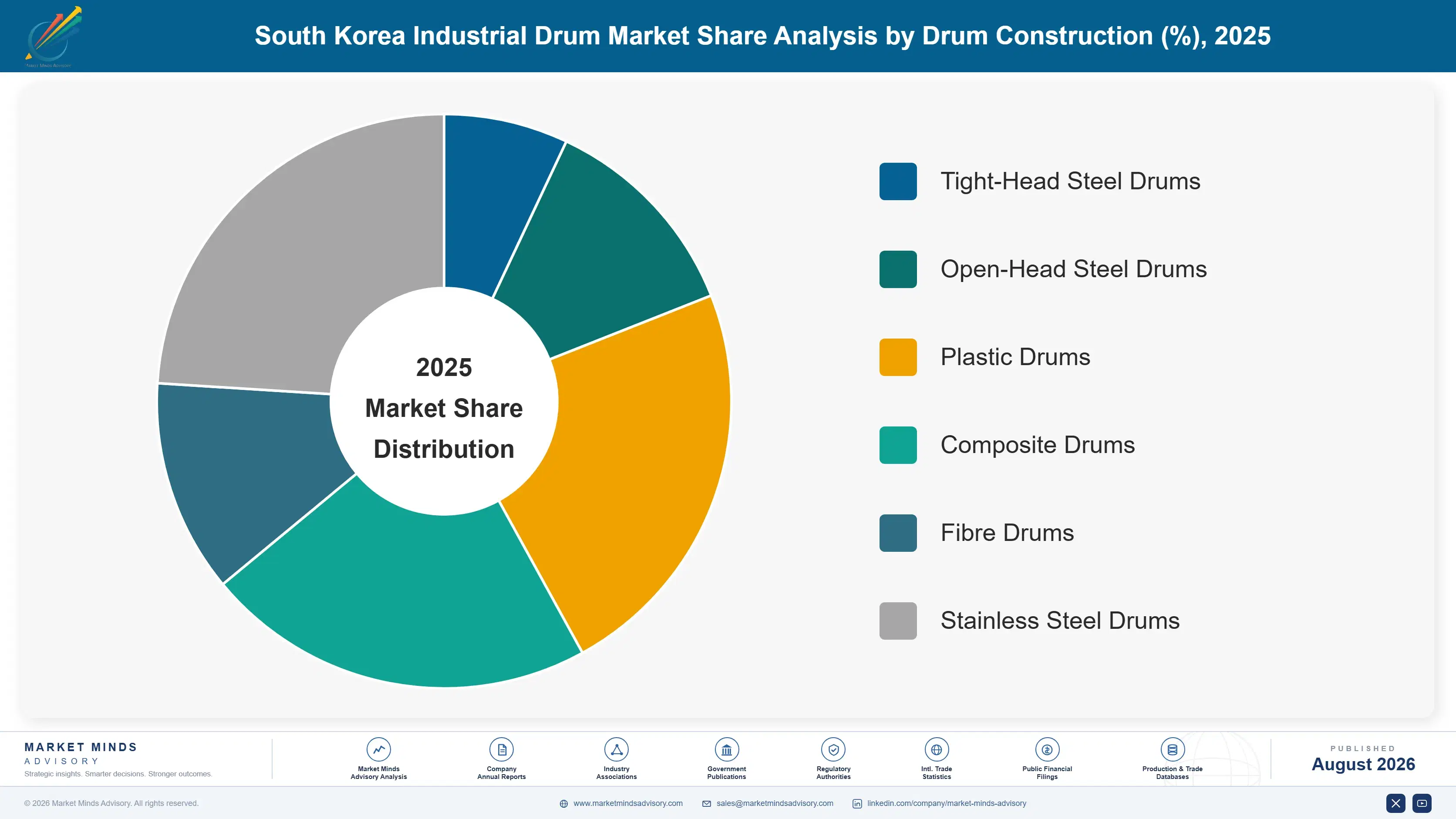
Six segments are split by drum construction, because construction determines the chemical compatibility, the certification available, the reconditioning economics and the filling equipment a customer already owns. Capacity variants and closure types sit inside each construction. New against reconditioned supply and channel structure are handled separately in the framework instead. Certification sits with construction as well.
south-korea-industrial-drum-market-2025-market-share-analysis-1787595320556

Plastic Drums

Growing at 5.7%, half again the market rate of 3.8%, extrusion blow moulded high density polyethylene drums are displacing steel in corrosive chemicals, food grade products and water treatment materials where liner failure, contamination risk and difficult reconditioning residues all count against steel. Unit cost is broadly comparable but total handling cost is lower for those applications specifically. Korean converters have added moulding capacity accordingly. Reconditioning economics differ sharply from steel, since plastic drums are more often reprocessed into resin than refurbished for refilling, which changes the whole return flow business model. Korean filler demand has been shifting steadily rather than suddenly, which gives converters time to add capacity in step with it.
CAGR 5.7%

Composite Drums

At 4.9% composite drums pair a plastic inner container with an outer steel or fibre casing, which delivers chemical compatibility with the structural strength that hazardous goods certification requires for export shipment. Demand follows Korean specialty chemical exports rather than domestic filling, because destination market regulators frequently specify performance the domestic market never asks for. The inner container is replaceable while the casing is reused, which produces reconditioning economics unlike either steel or plastic. Certification across multiple destination regimes is what separates suppliers here, considerably more than manufacturing capability does. Volumes are modest against steel and plastic, but the pricing holds through cycles that flatten ordinary domestic drum demand entirely, and the relationships run through regulatory affairs rather than purchasing.
CAGR 4.9%
Full segment breakdown across 6 segments available in the complete report.

Regional Architecture and Country Demand Map

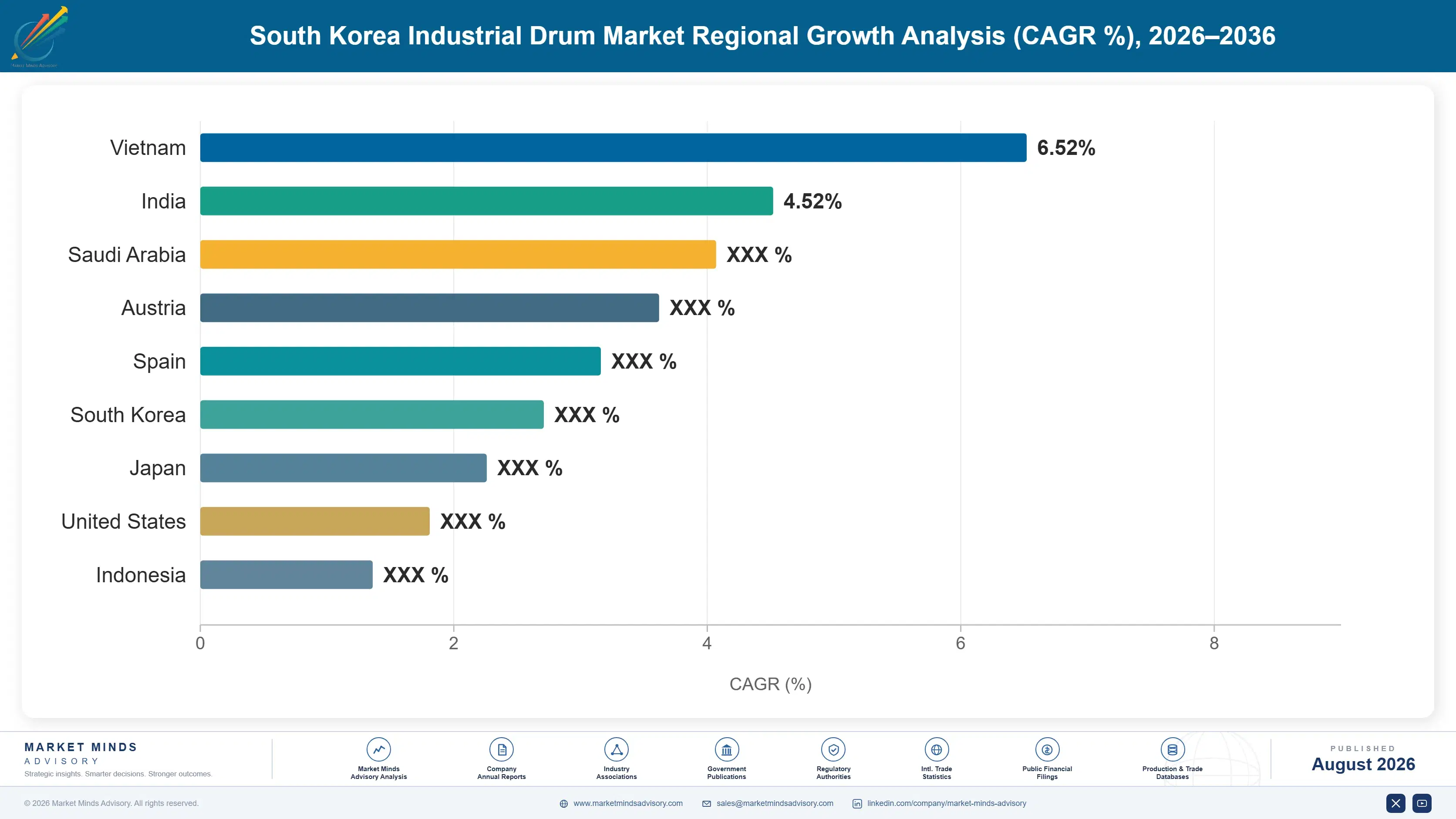
East Asia holds 89% of value because this market is scoped to drums supplied and reconditioned within South Korea, and the remaining shares represent value captured by international groups serving Korean chemical customers from overseas operations. All seven shares therefore fall outside the standard bands.

North America

Share sits at 3%, far below the standard band, because this market covers drums supplied and reconditioned inside South Korea and North American participation runs through international groups serving Korean chemical exporters. Those groups supply certified packaging into destination markets and handle drums arriving with Korean chemical inside, which is a genuine commercial position even though the manufacturing sits elsewhere. Growth at 3.2% follows Korean export volumes into North America rather than any domestic Korean demand movement at all. Certification depth across hazardous goods regimes is what those groups actually sell, and Korean exporters increasingly consolidate supply onto whoever holds the broadest coverage available. Manufacturing sits elsewhere entirely. Manufacturing capacity is not the point.
Share: 3% | CAGR: 3.2% (2026 to 2036)

Western Europe

At 3% the share falls well outside the standard band for the same scope reason, since supply and reconditioning are measured within Korea. European groups hold certification depth across hazardous goods regimes that Korean exporters need when shipping specialty chemical into the region, and they capture value through destination handling and reconditioning of drums Korean chemical arrived in. Growth of 2.4% reflects mature European chemical volumes rather than any weakness in the Korean export relationship itself. Those positions are durable because destination approvals are supplier specific and slow to replicate, which matters more to a Korean exporter than any delivered price argument does. Reconditioning of arriving drums adds a second value layer these groups capture.
Share: 3% | CAGR: 2.4% (2026 to 2036)
Regional intelligence for 5 additional markets available in the complete report: East Asia, South Asia and Pacific, Latin America, Middle East and Africa, Eastern Europe. Contact sales@marketmindsadvisory.com.
south-korea-industrial-drum-market-2025-country-cagr-analysis-1787595321071

Four Moves Around the Fleet

New drum manufacturing is a steel conversion business competing on delivered cost, and the position worth holding sits in the fleet that circulates afterwards. Collection, reconditioning and export certification all earn considerably better returns than a press line does, and enforcement is now clearing the field in the first two. The press line is the least of it.

Consolidate reconditioning capacity while enforcement clears it

Residue handling and worker exposure enforcement is removing small Korean reconditioning yards that never carried compliance cost, and the operators left will hold pricing power a fragmented trade never had. Acquiring or partnering with compliant capacity now costs a fraction of what the position will be worth once consolidation finishes. Reconditioned drums still sell around 47% below new, and that gap is narrowing rather than widening for the first time in years. Availability rather than price is the binding constraint on acquiring it, and that window closes. Compliance investment is the entry price.
Market Impact: Narrows the 47% reconditioning discount steadily now onward

Certify across destination hazardous goods regimes

A drum leaving Korea with specialty chemical inside is built to the destination regulator's requirement, and certification across multiple regimes decides which exporters a supplier can serve at all. That work lifts unit value more than 20% above domestic specification and cannot be matched by a maker holding only Korean approvals. Korean specialty chemical exports keep growing, and each new destination market opens demand for a supplier already certified for it. The work is documentation and testing rather than capital investment, which makes it unusually cheap for what it protects.
Market Impact: Lifts unit value above 20% of domestic specification

Serve the bulk transition rather than resisting it

Around 22% of electronics chemical volume has already left drums for bulk delivery and returnable totes, and none of it is coming back. Suppliers treating that as a loss are ceding a customer relationship they could keep by supplying and managing tote fleets instead. The margin on fleet management is comparable to high specification drums, the customer is already qualified, and somebody is going to provide the service regardless of who. Keeping the relationship costs far less than winning a new one back later. Somebody is going to run those fleets regardless.
Market Impact: Retains the 22% of converting electronics chemical volume

Index steel exposure into filling contracts explicitly

Cold rolled coil carries around 58% of steel drum cost and moves on international pricing that no Korean converter influences, yet many filling contracts remain fixed for their duration. Indexation is achievable with mid-sized chemical customers even where the largest resist it, and shifting mix toward those accounts reduces the exposure directly. Makers who absorbed the last steel cycle without a clause lost more margin than any operating programme could recover. Makers absorbing the last cycle without a clause lost more than any efficiency programme recovers. Mid-sized chemical accounts accept indexation readily.
Market Impact: Covers 58% of the steel drum unit cost

Who Controls the Margin Pool

Participation is measured on annual drum units supplied and reconditioned within Korea, and the top five hold 58%. New drum manufacturing has consolidated considerably while reconditioning remains fragmented across a long tail of yards, which is where most of the remaining share sits. Greif and Mauser Packaging Solutions lead through combining manufacturing with collection and reconditioning networks that independent makers cannot match. The gap to challengers is network density rather than manufacturing capability.
Competition runs on three fronts. Collection network density decides reconditioning economics, since a drum that costs too much to retrieve is not worth refurbishing at any price. Certification breadth decides access to export specification work. And delivered cost decides domestic new drum volume, where steel conversion efficiency is the only real variable available. Enforcement is now raising the cost of holding a collection network, which favours participants already carrying compliance investment.

Pressure ahead comes from residue and safety enforcement consolidating reconditioning, and from bulk delivery removing electronics volume permanently. Expect the integrated groups to buy compliant reconditioning capacity while it is still cheap. Rankings shift on who ends up holding the collection network once enforcement finishes clearing the field. Concentration should rise as the reconditioning tail disappears.
south-korea-industrial-drum-market-2025-company-positioning-matrix-1787595321596

Competitive Moat and Risk Dimensions

GREIF

Moat: Integrated collection and reconditioning network

Combining drum manufacturing with a collection and reconditioning network captures value across roughly four fills rather than one, which is a fundamentally different business from selling new units. Building an equivalent network requires geographic density that takes years to assemble, and enforcement tightening around residue handling is making new entry considerably more expensive than it was.
GREIF

Risk: Electronics application erosion

Exposure to semiconductor and display chemical packaging ties part of the portfolio to the one application actively leaving drums for bulk delivery systems, with around 22% already converted and no realistic path back. Defending that revenue requires moving into tote fleet services, which is a different operating model competing against established container management specialists.
MAUSER PACKAGING SOLUTIONS

Moat: Reconditioning scale and closure control

Scale in reconditioning combined with control of closure and fitting supply gives cost advantages across the refurbishment process that independent yards cannot reach, particularly as compliance investment raises the fixed cost of operating at all. That combination becomes more valuable as enforcement removes smaller operators from the Korean market entirely.
MAUSER PACKAGING SOLUTIONS

Risk: Steel price pass-through timing

Heavy steel drum weighting exposes the business to cold rolled coil movements carrying around 58% of unit cost, with pass-through timing decided by contract structures that large chemical customers resist reopening. That exposure is contractual rather than operational, and it compressed margins materially through the last steel price cycle.

Players Tracked

Prominent Players

Greif
Mauser Packaging Solutions
Schutz
Time Technoplast
Balmer Lawrie

Other Key Players

Fibrestar Drums
Skolnik Industries
C.L. Smith
Muller
Hoover Ferguson
Snyder Industries
Great Western Containers
Meiwa
Kodama Plastics
Sunrise Containers
Pyramid Technoplast
Shandong Yongtai Group
Sicagen India
Rahway Steel Drum
Enviro Tech Industrial Products

Recent Developments

APRIL 2026

Residue handling enforcement closes several Korean reconditioning yards

Tightened enforcement of chemical residue handling and worker exposure standards led several small Korean reconditioning operations to cease trading rather than fund compliance investment. Remaining compliant operators absorbed the volume at pricing above what the fragmented trade had sustained. Collection routes were absorbed rather than rebuilt.
Signal: Compliance cost is consolidating a trade that competed on collection cost for decades without much notice
NOVEMBER 2025

Electronics chemical supplier converts drum volume to bulk delivery

A Korean electronics chemical supplier converted a further tranche of drum volume to bulk chemical delivery infrastructure at customer fabs, citing handling labour and contamination control rather than packaging cost. Installed infrastructure makes any return to drum supply unrealistic for that chemical. Packaging cost never entered the calculation.
Signal: Bulk conversion is a capital decision at the customer, so it never reverses on packaging price
AUGUST 2025

Specialty chemical exporter requires multi-regime packaging certification

A Korean specialty chemical exporter consolidated drum supply onto suppliers holding hazardous goods certification across several destination regimes, having previously managed separate suppliers per market. Certification breadth rather than delivered price decided which suppliers were retained through the consolidation. Managing separate suppliers per market had become administratively unworkable.
Signal: Destination regulators set the specification, so certification breadth beats manufacturing cost advantage every time here as well

Coil, Resin and Collection

Cold rolled steel coil carries around 58% of finished steel drum cost, bought from Korean mills at pricing set against international steel markets rather than domestic demand. Closures, fittings and gaskets take about 11%. Coating, lining and finishing account for around 9%. Labour, plant overhead and outbound delivery absorb the balance, and for reconditioned units collection logistics replaces coil as the dominant cost element entirely.
Steel pricing moved sharply through 2021 and 2022 and again with subsequent energy cost movements, per IEA industrial energy reporting alongside POSCO Annual Report 2025 disclosures on cold rolled product pricing. Drum makers holding fixed price filling contracts absorbed the movement for the contract duration with no recovery mechanism. Several reported margin compression through that period, and contract structures with the largest chemical customers were not renegotiated afterwards.

Exposure divides on product mix and contract structure rather than on scale. A steel-weighted maker on fixed contracts carries the full coil movement across 58% of cost, while a plastic-weighted converter carries resin exposure that moves differently. Reconditioning operations carry almost no material exposure at all, which is one more reason the return flow business is steadier than manufacturing through any commodity cycle.
south-korea-industrial-drum-market-2025-cost-volatility-analysis-1787595321791

Write steel indexation into filling contracts wherever achievable

Cold rolled coil at around 58% of steel drum cost moves on international pricing no Korean converter influences, and a fixed price filling contract is an unhedged position held for its duration. Indexation is achievable with mid-sized chemical customers even where the largest resist it, and mix shift toward those accounts reduces exposure directly.

Grow reconditioning share to dilute material cost exposure

Reconditioning carries collection logistics and labour rather than steel, which makes it far steadier through a commodity cycle than manufacturing has ever been. Growing that share of volume reduces the whole business exposure to coil pricing while capturing value across roughly four fills instead of one, which is the better position on both counts.

Balance mix between steel and plastic drum production

Resin and steel pricing move on different drivers and rarely peak together, so a converter holding meaningful capacity in both smooths an exposure that a single-material maker carries in full. Korean filler demand supports both, since plastic is winning corrosive and food grade applications while steel holds general chemical and export volume. Neither material dominates the mix.

Portfolio Architecture for Margin Defence

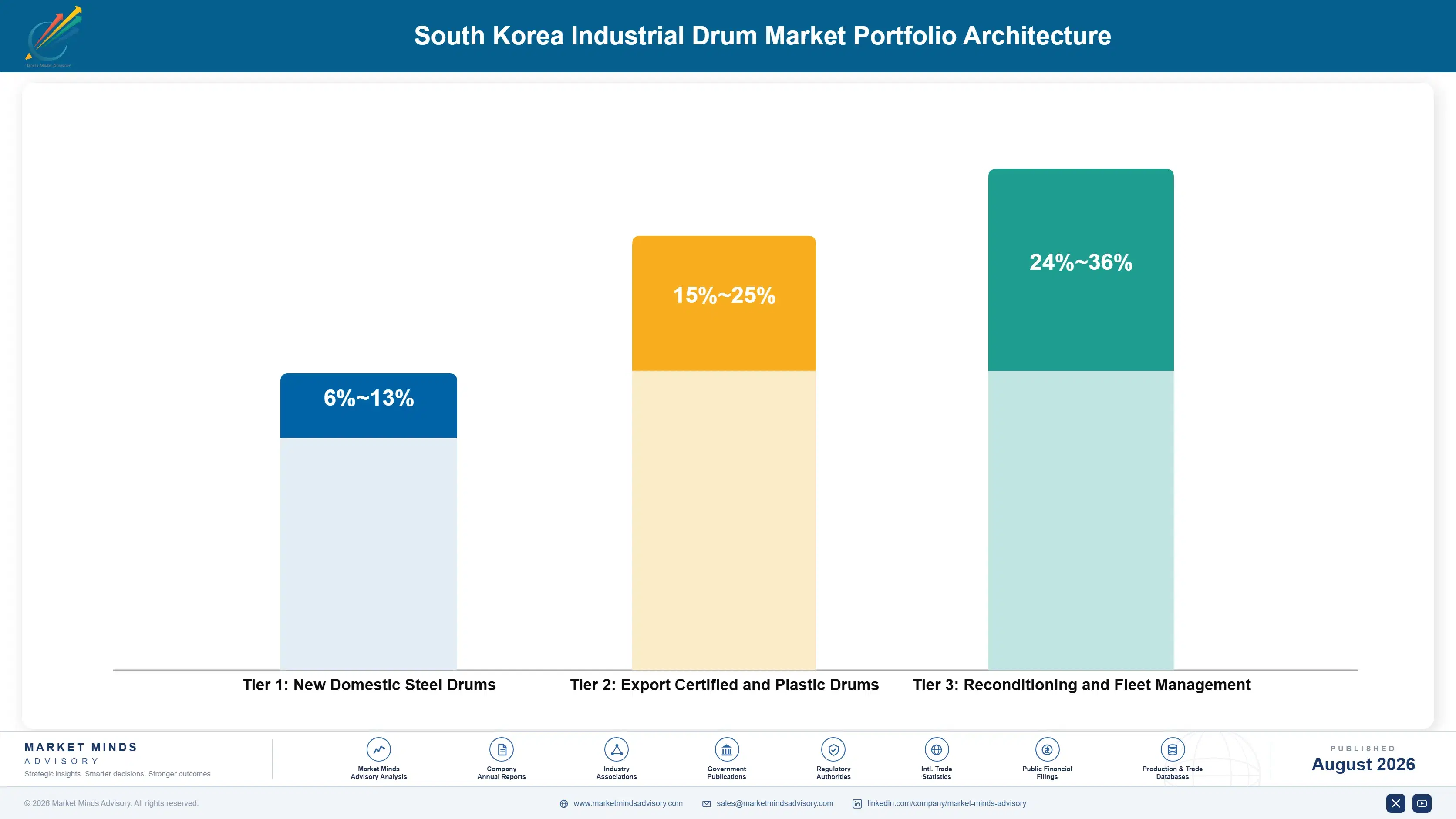
Margin here follows control of the return flow rather than any advantage in manufacturing. New domestic steel drums earn margins in the mid single digits to low teens, because steel carries 58% of cost, conversion is well understood and Korean chemical customers compare delivered price directly against a common specification at every renewal. Conversion efficiency is the only variable left there.
Export certified drums and plastic drums for corrosive and food applications do better in the mid teens to mid twenties, because destination regulator requirements and chemical compatibility both narrow the field of suppliers a filler can actually use, which removes the direct price comparison that governs ordinary domestic volume. Destination approvals are supplier specific and slow to replicate, which holds those positions through cycles that flatten domestic volume.

Reconditioning and fleet management hold the strongest position, reaching into the mid thirties, where collection network density decides economics and compliance investment has raised the barrier to entry considerably. Those margins reflect logistics control and regulatory standing rather than any manufacturing capability, and they are steadier through steel cycles than anything else here. Enforcement is raising that barrier further, which makes the position more valuable each year rather than less.

New Domestic Steel Drums

Standard steel drums supplied to Korean fillers against common specifications where delivered price decides awards. The seven point range reflects steel contract structure and conversion efficiency rather than any product difference customers can detect.
Gross Margin: 6-13%

Export Certified and Plastic Drums

Hazardous goods certified export units and plastic drums for corrosive and food applications where compatibility narrows supplier choice. The ten point range reflects certification breadth across destination regimes and how demanding the chemical application actually is.
Gross Margin: 15-25%

Reconditioning and Fleet Management

Collection, refurbishment and returnable container fleet services capturing value across roughly four fills. The twelve point range reflects collection network density and compliance standing as residue enforcement removes smaller operators from the field.
Gross Margin: 24-36%
south-korea-industrial-drum-market-2025-portfolio-architecture-1787595322287

High-value Sub-segments and Strategic Watch-out

Reconditioning and Collection

High value and growing as enforcement consolidates a fragmented trade that competed on collection cost alone. Compliant operators are gaining pricing power for the first time, and the 47% discount to new drums is narrowing rather than widening. Availability rather than price limits acquisition now.
Gross Margin: 26-36%

Export Certified Drums

High value and growing with Korean specialty chemical exports, where destination regulators set the specification rather than any domestic standard. Certification breadth across multiple regimes decides which exporters a supplier can serve at all. Documentation rather than capital is what the certification actually costs. Capital is not required.
Gross Margin: 17-25%

New Domestic Steel Drums

The volume core, where steel at 58% of cost and a common specification leave delivered price as the only variable. Conversion efficiency is the sole differentiator available and it is thin ground to compete on. Steel contract structure decides whether the margin survives a cycle.
Gross Margin: 6-13%

Electronics Chemical Packaging

The strategic watch-out. Around 22% of the volume has converted to bulk delivery permanently, and the range reflects whether a supplier has moved into tote fleet services or is still defending drum supply into a departing application. Tote fleet management is the only route that keeps the customer.
Gross Margin: 4-30%

Fleet Economics Beat Unit Sales

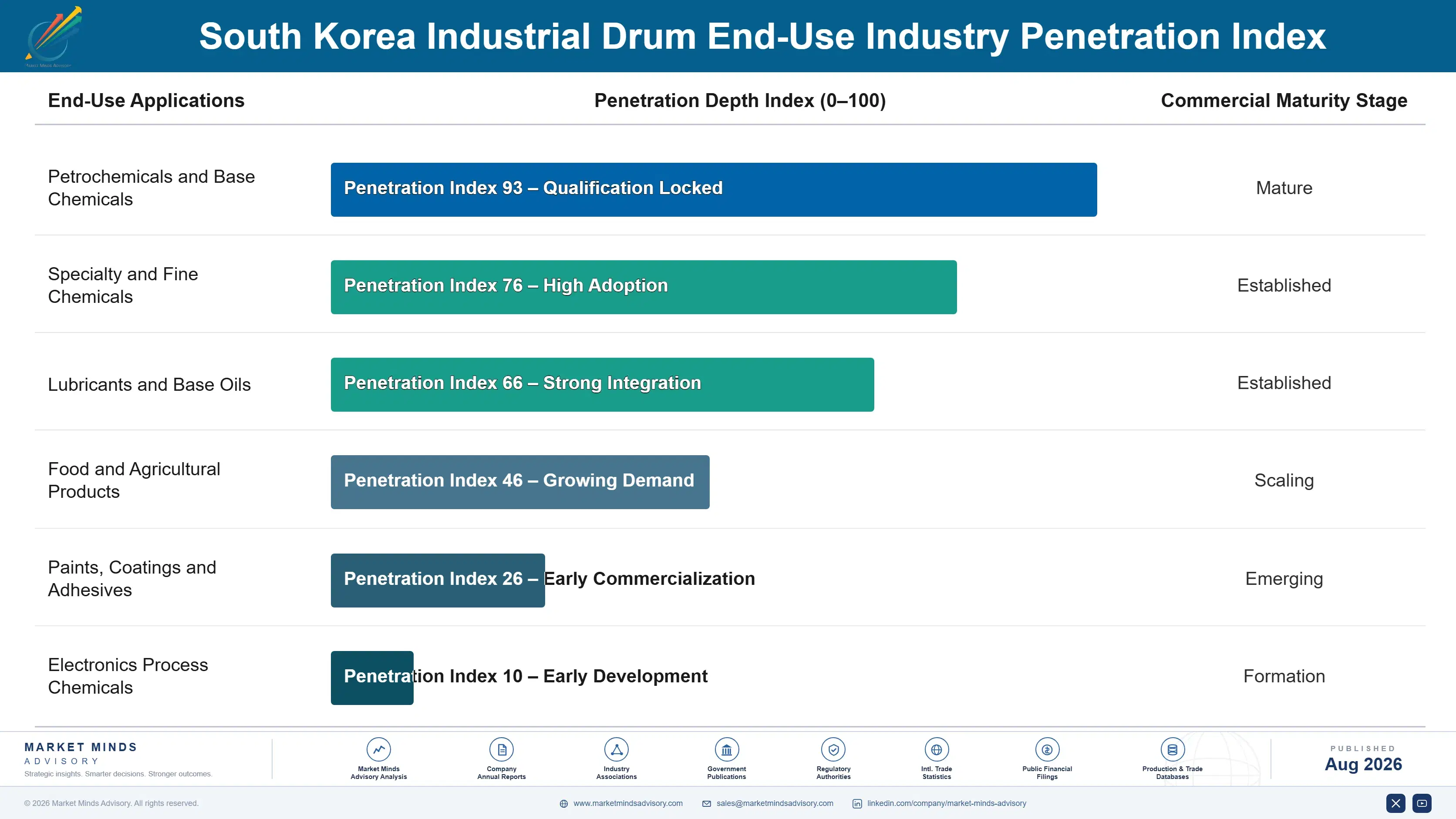
Demand here works on a fleet rather than a purchase. A steel drum is filled around four times before retirement, so the volume circulating exceeds annual production by a wide margin and the commercial relationship that matters is collection rather than sale. Fillers buying new units are replacing fleet attrition, and the reconditioning yard behind them determines how much attrition there actually is.
Stickiness follows logistics rather than specification. A filler with an established collection arrangement, matched drum specification and reliable turnaround has genuine switching friction, because changing supplier means changing the whole return flow at once. New drum supply switches on delivered price at renewal. Export certified positions hold well because destination approvals are supplier specific and slow to replicate.

Deciding functions have shifted as compliance tightened. Reconditioning arrangements once sat with logistics or purchasing on cost alone, and now involve environment, health and safety functions checking residue handling and disposal documentation. Export packaging decisions involve regulatory affairs alongside purchasing. Only new domestic drum supply still sits purely with a buyer comparing delivered price, and that is the least valuable volume available. Most suppliers still sell to it first.
south-korea-industrial-drum-market-2025-end-use-penetration-index-1787595322776

Where We Would Put Effort

These are among the four positions where our research anticipates prominent divergence between winners and laggards over the coming forecast period. Each is grounded in the demand model, the regulatory perimeter, and the announced capacity pipeline.
01 / RECONDITIONING NETWORK CONSOLIDATION

Buy the yards while enforcement is clearing them

Residue handling and worker exposure enforcement is removing small Korean reconditioning operations that never carried compliance cost, and the operators remaining will hold pricing power a fragmented trade never had at any point. Acquiring compliant capacity now costs a fraction of what the position becomes worth once consolidation completes. Reconditioned drums still sell around 47% below new, and that gap is narrowing for the first time in many years, which changes the return on every yard acquired before the window closes.
02 / DESTINATION CERTIFICATION BREADTH

The regulator abroad writes your specification

A drum leaving Korea with specialty chemical inside is built to whatever the destination regulator enforces, which is generally more demanding than domestic Korean practice and lifts unit value well above ordinary specification. Certification across multiple regimes decides which exporters a supplier can serve at all, and it cannot be matched by a maker holding only domestic approvals. Each new export destination opens demand for whoever is already certified to supply it, at documentation and testing cost rather than any capital investment at all.
03 / BULK TRANSITION PARTICIPATION

Follow the volume out rather than defending it

Around 22% of electronics chemical volume has already converted from drums to bulk delivery and returnable totes, and a capital investment at the customer means none of it comes back on any packaging price argument. Suppliers treating that as a loss are giving up a qualified customer relationship they could keep by managing tote fleets instead. Somebody will provide that service, and the margin is comparable to high specification drum supply against a customer relationship that has already been qualified and paid for.
04 / STEEL CONTRACT STRUCTURE

Stop carrying coil risk for free

Cold rolled coil carries around 58% of steel drum cost and moves on international pricing that no Korean converter influences in any way whatsoever. Many filling contracts nonetheless remain fixed for their whole duration, which is an unhedged commodity position taken on the customer's behalf. Indexation is achievable with mid-sized chemical accounts even where the largest resist it, and mix shift toward those customers reduces the exposure directly and permanently rather than merely repricing it after the movement has already happened.

Engagement Snapshot From the Field

A live engagement with an industry participant carrying material or product regulatory and market exposure ahead of a defining policy shift, showing how our research translates into a defensible multi-year portfolio strategy.
MARKET MINDS ADVISORY · CLIENT ENGAGEMENT SUMMARY
South Korea Industrial Drum Producer Strategic Portfolio Review and Transition Roadmap 2026·Investment Scenario on South Korea Industrial Drum Exposure Evaluation 2025-26
CLIENT PROFILE
A Korean industrial packaging producer manufacturing steel drums for petrochemical and specialty chemical fillers across the southern industrial complexes, at annual revenue near 96 billion won (client-reported, unverified by MMA). Reconditioning was handled through independent yards on arms length terms with no ownership or commercial control at all. Export certification covered only two destination regimes.
STRATEGIC CHALLENGE
Steel price movements had compressed margins for two consecutive years under fixed filling contracts, and electronics chemical volume had fallen sharply without any clear explanation from the sales organisation. Management wanted to understand whether the business had a permanent problem or a cyclical one, and wanted the answer quickly. Capacity plans were on hold.
MMA APPROACH
MMA reconstructed the circulating drum fleet against annual production to size reconditioning economics properly, established where electronics volume had actually gone through direct customer interviews, assessed export certification position against destination regime requirements, and modelled steel exposure by contract structure. Interviews with 47 experts covered industrial packaging, chemical logistics and drum reconditioning operations.
KEY FINDINGS
  1. The circulating fleet exceeded annual production by roughly four times, and the client captured value on only the first fill of every drum it manufactured.
  2. Electronics chemical volume had converted to bulk delivery infrastructure at customer sites rather than moving to competitors, and none of it was recoverable at any price.
  3. Residue enforcement was already removing independent reconditioning yards the client relied on, which threatened supply continuity before it created any acquisition opportunity.
  4. Export certification covered only two destination regimes, which excluded the client from consolidated supply arrangements that Korean exporters were actively putting in place.
CLIENT PROFILE
A Korean industrial packaging producer manufacturing steel drums for petrochemical and specialty chemical fillers across the southern industrial complexes, at annual revenue near 96 billion won (client-reported, unverified by MMA). Reconditioning was handled through independent yards on arms length terms with no ownership or commercial control at all. Export certification covered only two destination regimes.
STRATEGIC CHALLENGE
Steel price movements had compressed margins for two consecutive years under fixed filling contracts, and electronics chemical volume had fallen sharply without any clear explanation from the sales organisation. Management wanted to understand whether the business had a permanent problem or a cyclical one, and wanted the answer quickly. Capacity plans were on hold.
MMA APPROACH
MMA reconstructed the circulating drum fleet against annual production to size reconditioning economics properly, established where electronics volume had actually gone through direct customer interviews, assessed export certification position against destination regime requirements, and modelled steel exposure by contract structure. Interviews with 47 experts covered industrial packaging, chemical logistics and drum reconditioning operations.
KEY FINDINGS
  1. The circulating fleet exceeded annual production by roughly four times, and the client captured value on only the first fill of every drum it manufactured.
  2. Electronics chemical volume had converted to bulk delivery infrastructure at customer sites rather than moving to competitors, and none of it was recoverable at any price.
  3. Residue enforcement was already removing independent reconditioning yards the client relied on, which threatened supply continuity before it created any acquisition opportunity.
  4. Export certification covered only two destination regimes, which excluded the client from consolidated supply arrangements that Korean exporters were actively putting in place.
RECOMMENDED STRATEGY
Phase 1: Phase one: acquire or partner with compliant reconditioning capacity before enforcement completes, since availability rather than price is the binding constraint. Phase 2: Phase two: extend hazardous goods certification across the destination regimes Korean specialty chemical exporters actually ship into most frequently. Documentation rather than capital is required. Phase 3: Phase three: stop pursuing electronics drum volume and evaluate tote fleet services for the same qualified customer relationships instead. The relationships are already qualified.
OUTCOME
The producer acquired a compliant reconditioning operation during 2026 and extended certification into three further destination regimes (client-reported, unverified by MMA). Electronics drum pursuit was discontinued, and margin stabilised as reconditioning revenue diluted steel exposure. Fixed price filling contracts were renegotiated onto indexed terms across the same period.

Frequently Asked Questions

Foundational context covering the market sizes, CAGR, scope, country, region and competition that inform every finding below. This section is provided to cover basics and most often pre-purchase conversations, answered from the MMA Primary Research Dataset.

What is the current size of the South Korea Industrial Drum Market?

MMA sizes it at USD 0.32 billion in 2025, rising to USD 0.33 billion in 2026. The figure covers new and reconditioned drums supplied within South Korea at supplier selling value.

How large will the South Korea Industrial Drum Market be by 2036?

USD 0.48 billion by 2036, an incremental USD 0.15 billion over the 2026 base and an expansion multiple of 1.45 times. Plastic drums account for a disproportionate share of that.

What is the CAGR for the South Korea Industrial Drum Market 2026 to 2036?

3.8% in the base case, with a bull case at 5.0% and a bear case at 2.6%. The spread turns on export volumes against continued bulk delivery conversion in electronics.

Which segment is growing fastest?

Plastic drums at 5.7%, half again the market rate of 3.8%. Corrosive chemicals, food grade products and water treatment materials are moving off steel for handling reasons.

Who are the major companies in the South Korea Industrial Drum Market?

Greif, Mauser Packaging Solutions, Schutz, Time Technoplast and Balmer Lawrie lead on units supplied and reconditioned. Fifteen further participants are profiled in the full report.

Which country is growing fastest?

The market is scoped to South Korea alone at 3.8%. Within it the Yeosu and Daesan petrochemical belts grow fastest on specialty chemical export filling volume.

Report Segmentation Architecture

The full report scope spans multiple orthogonal segmentation dimensions, with cross-tabulated demand data provided for each dimension pair. Coverage extends further to regional breakdowns, trend trajectories, and the competitive detail needed to support segment-level decision-making.

By Drum Construction

  • Tight-Head Steel Drums
  • Open-Head Steel Drums
  • Plastic Drums
  • Composite Drums
  • Fibre Drums
  • Stainless Steel Drums

By End-Use Industry

  • Petrochemicals and Base Chemicals
  • Specialty and Fine Chemicals
  • Lubricants and Base Oils
  • Food and Agricultural Products
  • Paints, Coatings and Adhesives
  • Electronics Process Chemicals

By Commercial Dimension

  • New Drum Direct Supply
  • Reconditioned Drum Supply
  • Collection and Fleet Management Services
  • Export Certified Packaging Supply
  • Distributor and Trading Channels
  • Toll Filling Arrangements

By Region

  • North America
  • Western Europe
  • East Asia
  • South Asia and Pacific
  • Latin America
  • Middle East and Africa
  • Eastern Europe

Scope, Methodology, and Coverage

Every figure in this report is reproducible from documented input assumptions. The scope below maps the historical period, the forecast horizon, the segmentation dimensions, and the countries covered, alongside the underlying primary and qualitative methodology.
Historical Period
2020 to 2025
Forecast Period
2026 to 2036
Base Year
2025 (USD billions; MMA Primary Research Dataset, August 2026)
Market Definition
Industrial drums of 100 to 250 litre capacity supplied and reconditioned within South Korea, covering tight-head steel drums, open-head steel drums, plastic drums, composite drums, fibre drums, and stainless steel drums. Measured at supplier selling value across both new and reconditioned units. Intermediate bulk containers, pails and jerricans below 100 litres, road tankers and isotanks, bulk chemical delivery systems, and drum closures sold separately are excluded from scope.
Quantitative Units
USD billions (current prices); million units supplied; USD per unit by construction type
Segmentation Dimensions
Drum construction; end-use industry; commercial dimension; participation region
Regions Covered
North America, Western Europe, East Asia, South Asia and Pacific, Latin America, Middle East and Africa, Eastern Europe
Countries Covered
South Korea, with participation coverage for Japan, China, Taiwan, India, Singapore, Malaysia, Germany, Netherlands, Belgium, United Kingdom, United States, Canada, Brazil, Saudi Arabia, Poland
Key Companies Profiled
Greif, Mauser Packaging Solutions, Schutz, Time Technoplast, Balmer Lawrie, Fibrestar Drums, Skolnik Industries, C.L. Smith, Muller, Hoover Ferguson, Snyder Industries, Great Western Containers, Meiwa, Kodama Plastics, Sunrise Containers, Pyramid Technoplast, Shandong Yongtai Group, Sicagen India, Rahway Steel Drum, Enviro Tech Industrial Products
Quantitative Methodology
Primary survey, n=3,800 respondents, Q4 2025, six countries; demand-side model with trade association cross-validation
Qualitative Methodology
47 expert interviews, Q4 2025; applied to validate demand model assumptions, identify emerging dynamics, and assess competitive positioning
Report Format
PDF and XLSX data workbook (Word format preview document)
Publisher
Market Minds Advisory
Report Code
MMA-2026-PAC-119
Published
August 2026
Contact
sales@marketmindsadvisory.com | www.marketmindsadvisory.com

Purchase the full South Korea Industrial Drum Market Report (2026 to 2036).

The full report sizes the circulating drum fleet against annual production, because value accrues across roughly four fills and counting new units misses most of it. It forecasts all six drum constructions independently through 2036, models reconditioning economics under tightening residue and worker safety enforcement, and quantifies bulk delivery conversion in electronics chemicals by application. Participation analysis covers every region capturing value from Korean drum supply and destination handling. Competitive profiling covers 20 participants on one consistent unit basis throughout. Collection network density is assessed by participant throughout.
Six drum constructions sized independently through 2036
Circulating fleet reconstructed against annual production volumes
Reconditioning economics modelled under tightening residue enforcement
Bulk delivery conversion quantified across electronics chemical applications
Export certification requirements mapped by destination regulatory regime
Twenty participants profiled on one consistent unit basis

Built For The People Who Decide

From boardroom strategy to bench-side execution, this report is read cover-to-cover by leaders shaping the next decade of their industry, turning demand scenarios, market dynamics and valuation benchmarks into decisions.
CXOs/ Presidents/ VPs/ Managers
M&A and Corporate Development
Strategy Teams and R&D Heads
Procurement and Product Directors
Regulatory and Compliance Leaders
Investor Relations and Equity Analysts