Market Minds Advisory
South Korea Glassine Paper Market

South Korea Glassine Paper Market: South Korea Glassine Paper: An Electronics Input Wearing a Paper Industry's Clothes

Most Korean glassine ends up silicone coated and stuck to a display panel or a battery cell rather than to a label, and almost none of the base paper behind it is made in Korea.

Lead Analyst

Bilal Shaikh

Published

August 2026

Make Smarter Decisions with Customized Research Insights

Request a free sample report and evaluate market opportunities, growth trends, and competitive dynamics relevant to your business needs.

2025 MARKET VALUE$0.1BMarket Size 2025
2036 FORECAST VALUE$0.2BBase Case , 2026 to 2036
CAGR 2026 TO 20365.4 %Bull 6.6% / Bear 4.2%
INCREMENTAL OPPORTUNITY$0.1BNet 10- year value creation
EXPANSION MULTIPLE1.67x2036 value over 2026 base
Strategic Levers
M&A Pipeline
Regional Outlook
Country Rankings
Competitive Intelligence
Segmental Deep-dive
Call-Us : 91 93563 13602

Executive Snapshot and Market Trajectory.

Korean glassine is not really a packaging story. Around 68% of it is silicone coated into release liner, and the fastest growing part of that goes into display panel protection, battery cell process tapes and semiconductor handling rather than onto any label or food wrapper at all.
That reframes the whole market. Electronics and industrial tape liner grows at 8.1% while envelope and graphic applications shrink, and the buyer specifying it is a process engineer worried about silicone transfer and cleanliness rather than a packaging manager comparing cost per square metre. Very few base paper suppliers have organised around that difference in any serious way. They still sell grammage, gloss and delivered price.
Supply is the uncomfortable part. Roughly 82% of the base paper arrives from Nordic, German and Chinese mills, because supercalendering to glassine density requires equipment and furnish that Korean mills largely do not run. A critical electronics input therefore sits behind an import position nobody in Korea controls, and PET film liner is waiting whenever paper supply gets difficult. Requalification onto film happens once and never reverses, which makes continuity worth more than price.
Market Definition
Glassine and greaseproof supercalendered paper consumed within South Korea, covering label release liner, electronics and industrial tape liner, food packaging and interleaving, pharmaceutical and medical packaging, hygiene product liner, and envelope and graphic applications. Measured at delivered base paper value whether domestically produced or imported. Excludes silicone coating and converting services, polyethylene terephthalate film liner, machine glazed kraft, and finished labels or packaging.
Base Year Value
$0.1B in 2025 (MMA Primary Research Dataset, August 2026)
Forecast Period
2026 to 2036, eleven discrete annual values
CAGR
5.4% base case. Bull 6.6%. Bear 4.2%.
Fastest Growth Segment
Electronics and Industrial Tape Liner: 8.1% CAGR
Fastest Growth Country
South Korea: 5.4% CAGR
Fastest Growth Region
South Asia and Pacific: 7.2% CAGR
Largest Region
East Asia: 88% of 2025 global value
Market Leaders
Ahlstrom, UPM Specialty Papers, Nordic Paper, Delfortgroup, Moorim P and P. Source: MMA Primary Research Dataset, July 2026.
Primary Survey
n=3,800 procurement and R&D decision-makers, Q4 2025, six countries
Methodology
Demand-side build-up, cross-validated against public data, 47 expert interviews

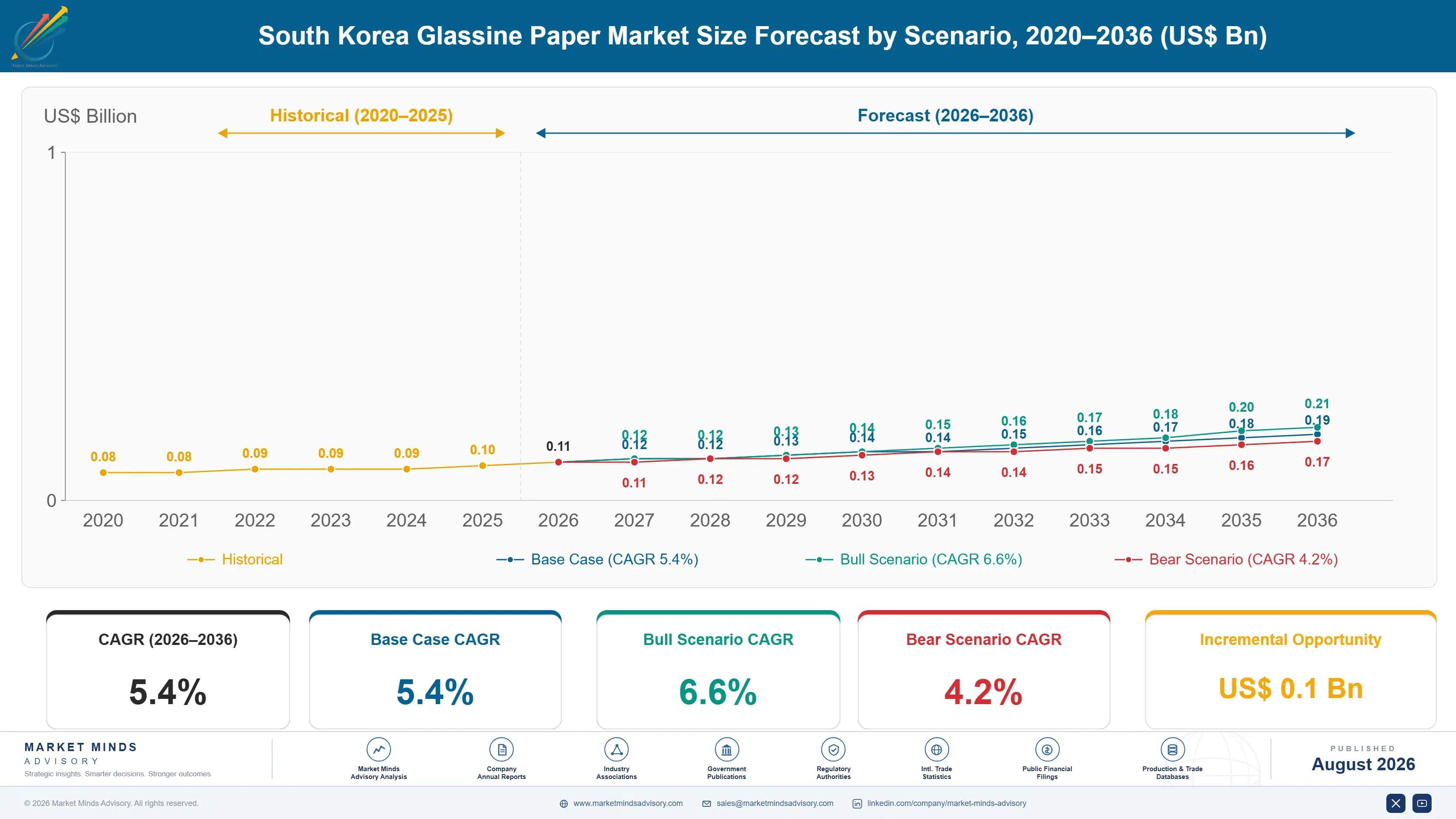
South Korea Glassine Paper Market Forecast Scenarios

south-korea-glassine-paper-market-2025-size-forecast-scenario-1787595300506
Growth ran near 4.4% between 2020 and 2025, and the composition changed considerably more than the total did. Label liner demand was broadly flat as Korean retail packaging matured, envelope and graphic applications declined steadily, and electronics tape liner grew fast enough to carry the whole market forward. Import dependence rose across the same period as domestic specialty capacity was redirected toward higher volume packaging grades.
Base case 5.4% rests on three mechanisms. Electronics and industrial tape liner grows at 8.1% as display, battery and semiconductor manufacturing consume protective and process tapes at rising volume per unit produced. Food packaging and interleaving grows at 6.4% as extended producer responsibility rules push converters away from plastic film. And hygiene liner declines with a birth rate that has fallen further than any forecast assumed. Composition shifts considerably more than the total does.
The bull case at 6.6% assumes packaging waste regulation tightening enough that paper liner displaces film in applications currently specified on performance. The bear case at 4.2% is PET film liner taking electronics share on cleanliness and dimensional stability, particularly if import supply of base paper tightens and Korean converters conclude that film is the more reliable input.

Silicone Coated and Stuck to a Battery

Calling this a packaging market misleads almost everybody who looks at it. Around 68% of Korean glassine gets silicone coated into release liner, and the growth inside that is protective film for display panels, process tape for battery cell assembly and carrier liner for semiconductor handling. The customer is an electronics materials converter selling into panel, cell and semiconductor manufacturing, and the paper is a process consumable rather than a package.
TOP FIVE CONCENTRATION71%Few mills anywhere can supercalender to this density
IMPORT DEPENDENCE82%Base paper share arriving from outside the domestic market
RELEASE LINER CONVERSION68%Portion of demand converted into silicone coated liner
ELECTRONICS GRAMMAGE60 gsmTypical basis weight supplied for electronics liner applications
SUPERCALENDER NIPS12Passes needed to reach required density and translucency
FILM LINER COST RATIO1.9xFilm liner cost against paper on equivalent coated area
That changes what the specification looks like. A process engineer qualifying liner for battery electrode handling cares about silicone anchorage, fibre release, dimensional behaviour under coating heat and contamination reaching a cell. Cost per square metre barely enters until those are settled. Base paper mills selling on grammage, gloss and delivered price are answering a question the customer stopped asking some time ago.
Supply sits awkwardly underneath all of it. Supercalendering to glassine density takes around 12 nips and a furnish most Korean mills do not run, so roughly 82% of base paper arrives from Nordic, German and Chinese producers. Korean converters build electronics qualification around an input they cannot secure domestically, and film liner at roughly 1.9 times the cost gets more attractive every time supply tightens.
"The interesting question is not who supplies Korean label liner, because that has been settled for a decade. It is what happens the first time a battery maker cannot get qualified paper liner and discovers that film works fine, because that conversion runs one way only."
Director, Specialty Papers and Electronics Materials Practice · MMA Packaging Practice · August 2026

Market Trends

Electronics converting pulling glassine out of packaging

Display panel protection, battery cell process tapes and semiconductor carrier liner now drive the growth in Korean glassine, and that demand grows at 8.1% against a market barely above five. The buyer is a materials converter qualifying against silicone anchorage, fibre release and contamination limits rather than a packaging manager comparing delivered cost per square metre. Base paper suppliers organised around label and food converting are selling to the wrong function, with the wrong data sheet, at the wrong point in the qualification cycle. Almost nobody has restructured their Korean commercial effort around it.
Market Impact: Rises with each 1 GWh added
Extended producer responsibility pushing converters back toward paper

Korean packaging waste rules and extended producer responsibility charges have made plastic film progressively more expensive to use in food and consumer applications, which pushes converters toward paper based structures including glassine interleaving and greaseproof wrapping. Food packaging demand grows at 6.4% on that basis rather than on any change in food volume. The same regulatory pressure has not yet reached electronics process materials, where performance qualification still overrides waste considerations entirely. Converters replacing an established film structure need technical support on grease resistance, sealing and machinability rather than a price list, which favours suppliers willing to do conversion work.
Market Impact: Limits suppliers to under 10

Market Opportunities and Growth Drivers

Battery cell manufacturing consuming process tape at scale

Korean battery cell producers use silicone coated liner extensively across electrode handling, cell stacking and module assembly, and consumption per gigawatt hour of capacity has risen as process automation increased rather than fallen. Domestic and overseas Korean owned capacity both qualify materials through Korean converting operations, which keeps the base paper demand onshore even where the cells are built elsewhere. Qualification cycles are long and the resulting positions are genuinely difficult for a competitor to displace afterwards. Consumption per gigawatt hour is rising rather than falling, which is unusual in a maturing manufacturing process.
Market Impact: Leaves 82% of supply imported

Display panel protection specifying tighter cleanliness every generation

Protective film liner for display panel handling has tightened its cleanliness and fibre release requirements with each panel generation, which narrows the field of qualified base paper suppliers considerably rather than widening it. That works in favour of mills able to hold contamination specifications consistently and against those competing on price. Korean panel manufacturing remains among the largest anywhere, and the material qualification decisions made here propagate into overseas plants those same companies operate. Winning a position therefore depends on holding contamination performance consistently across long runs rather than on any commercial argument a supplier might prefer to make.
Market Impact: Film costs 1.9 times paper

Market Restraints and Challenges

Import dependence on a critical electronics process input

Around 82% of Korean glassine base paper arrives from Nordic, German and Chinese mills, because supercalendering to the required density takes roughly 12 nips and a furnish Korean mills largely stopped running. The root cause is capital allocation rather than capability, since domestic mills chose packaging board and printing grades. Commercially it leaves electronics converters holding qualification on an input they cannot secure locally. Dual sourcing across mills and buffer inventory are the mitigations converters actually use. Neither of those creates domestic capacity, and none is being built. Domestic capacity would solve it and nobody is building any.
Market Impact: Electronics liner growing at 8.1%

Film liner substitution waiting on any supply disruption

Polyethylene terephthalate film liner outperforms paper on dimensional stability and cleanliness and costs roughly 1.9 times as much on equivalent coated area, which keeps paper specified while supply holds. The root cause of the risk is that requalification onto film happens once and never reverses, so a single supply failure can move an account permanently. Commercially it caps how hard a base paper supplier can push on price. Buffer stock and qualified second sources are the mitigations in use. A single failure at the wrong moment removes an application permanently rather than temporarily.
Market Impact: Food packaging growing at 6.4%
3 additional market trends, 4 additional growth drivers, and 2 additional restraints and challenges are covered in the full report. Contact sales@marketmindsadvisory.com to access the complete intelligence.

Segment CAGR and Growth Architecture

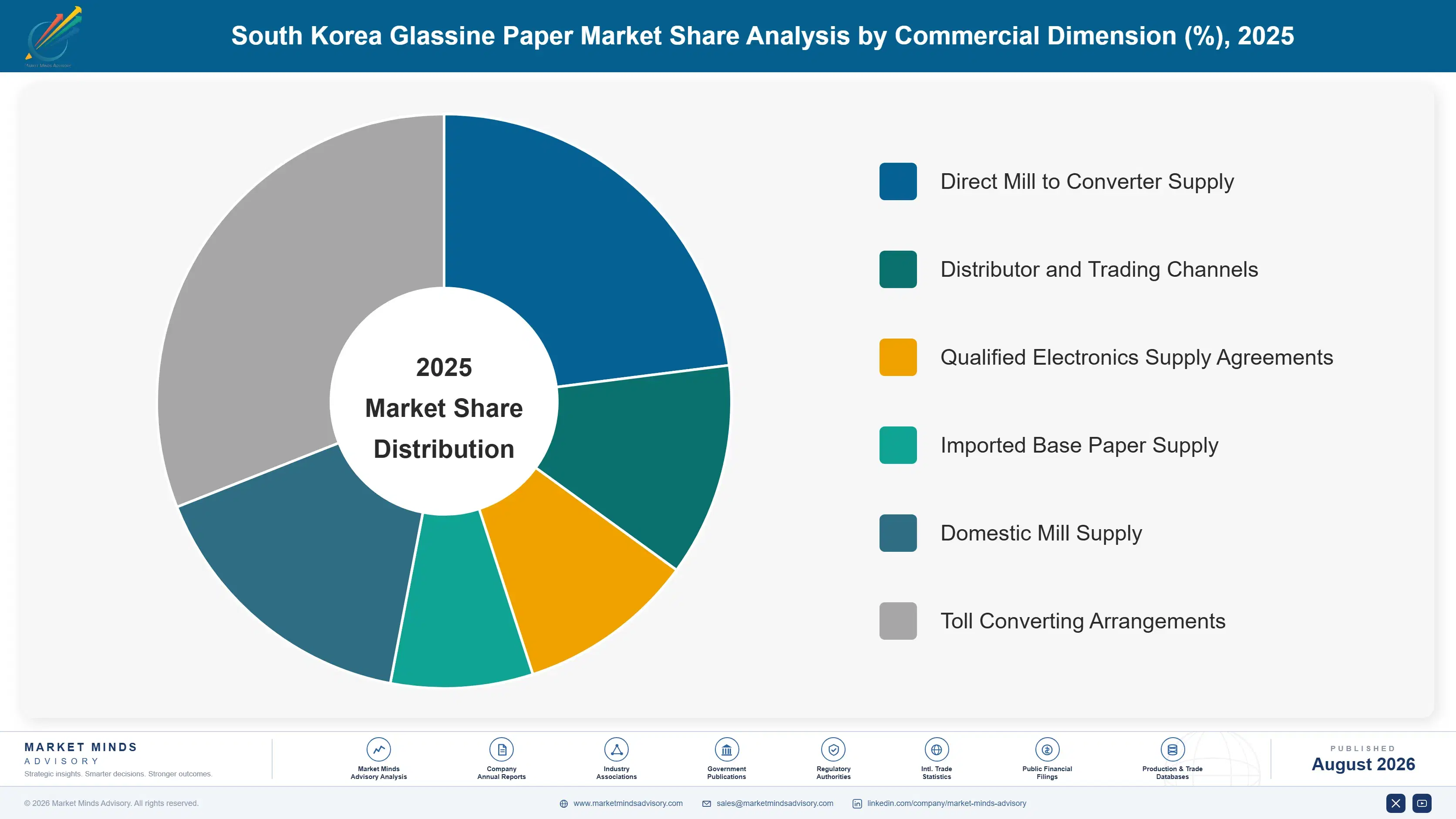
Six segments are split by end-use application, because application determines the specification a converter writes, the qualification cycle involved, the function inside the customer that decides and the price the base paper can command. Grammage and width variants sit inside each application. Supply origin and channel are handled separately in the framework instead. Grade names follow application.
south-korea-glassine-paper-market-2025-market-share-analysis-1787595301086

Electronics and Industrial Tape Liner

Growing at 8.1%, half again the market rate of 5.4%, this covers silicone coated liner for display panel protection, battery cell process tapes, semiconductor carrier applications and industrial tape backing. Specification is written around silicone anchorage, fibre release, dimensional behaviour under coating heat and contamination limits, with delivered cost entering only after those are satisfied. Qualification cycles run long and positions hold for years once established, which makes this both the hardest segment to enter and the most defensible to hold. Korean converters qualify materials that then propagate into overseas plants their customers operate. That propagation is worth several times the Korean volume originally awarded, and almost nobody resources it deliberately.
CAGR 8.1%

Food Packaging and Interleaving

At 6.4% this covers bakery interleaving, greaseproof wrapping, confectionery liner and food service applications where grease resistance without fluorochemical treatment matters commercially. Growth comes from extended producer responsibility charges making plastic film progressively more expensive rather than from any expansion in food volume itself. Korean converters have moved several established film structures to paper on that basis alone. Specification is considerably less demanding than electronics work, so the competitive field is wider and delivered price carries more weight, but regulation rather than performance is now setting the direction of travel. Fluorochemical restrictions have removed several alternative grease barrier approaches from consideration entirely, which narrows the technical field even as the commercial one stays wide.
CAGR 6.4%
Full segment breakdown across 6 segments available in the complete report.

Regional Architecture and Country Demand Map

East Asia holds 88% of value because this market is scoped to glassine consumed within South Korea, and the remaining shares represent value captured by overseas mills supplying imported base paper into Korean converting operations. Every regional share therefore falls outside the standard bands. Scope explains it.

North America

Share sits at 3%, far below the standard band, because this market measures glassine consumed within South Korea and North American participation runs entirely through imported specialty grades. American mills supply a narrow band of high specification liner base into electronics converting where a particular furnish or contamination performance has been qualified and cannot easily be substituted. Volume is small and pricing is the highest in the market. Growth at 4.6% follows those qualified positions rather than any broader Korean demand movement. Those positions renew when a customer extends an existing specification into a new product generation rather than reopening the qualification work entirely. Volume stays small and pricing stays the highest in the market throughout.
Share: 3% | CAGR: 4.6% (2026 to 2036)

Western Europe

At 4% the share falls well outside the standard band for the same scope reason, since consumption is measured inside Korea. Nordic and German mills supply the largest share of imported base paper by some distance, on supercalendering capability and furnish consistency that Korean converters have qualified over many years. Those positions are genuinely durable because requalification is expensive and slow. Pricing holds well against Chinese competition on electronics grades specifically. Growth of 3.8% reflects a mature position rather than any weakness in demand. Lead time and ocean freight remain the weak point, and they matter most precisely when supply tightens and continuity is being tested by a converter. Chinese competition is closer than it was.
Share: 4% | CAGR: 3.8% (2026 to 2036)
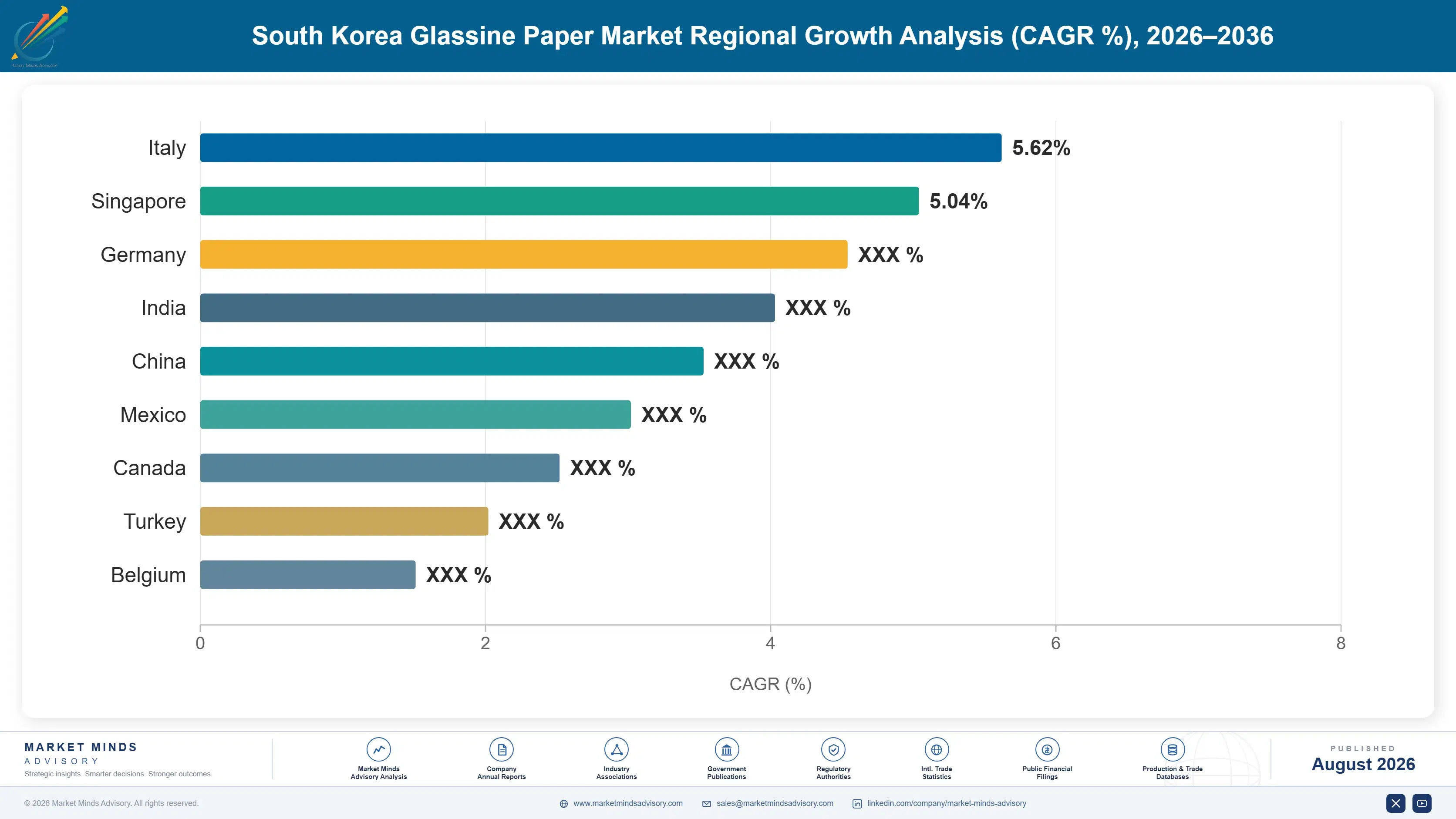
Regional intelligence for 5 additional markets available in the complete report: East Asia, South Asia and Pacific, Latin America, Middle East and Africa, Eastern Europe. Contact sales@marketmindsadvisory.com.
south-korea-glassine-paper-market-2025-country-cagr-analysis-1787595301763

Four Moves Toward the Process Engineer

Label liner in Korea has been settled for a decade and food packaging is decided by waste regulation, so the growth and the margin both sit in electronics converting. That customer qualifies rather than purchases, which means the commercial work happens years before the order and almost never happens through a purchasing department. Purchasing arrives last.

Sell into qualification rather than into procurement

Electronics liner grows at 8.1% and the decision belongs to a process engineer testing silicone anchorage, fibre release and contamination behaviour long before anybody discusses delivered price. Suppliers arriving through a purchasing department arrive after the specification is written around somebody else's paper. Getting sample material into a qualification programme costs comparatively little and the resulting positions hold for years, because requalification is expensive enough that converters avoid it. It also means the commercial effort has to sit with technical people rather than with a sales organisation, which most base paper mills find genuinely uncomfortable.
Market Impact: Serves 8.1% electronics liner growth in every year

Guarantee supply continuity against the film alternative

Film liner costs roughly 1.9 times as much on equivalent coated area and wins permanently whenever paper supply fails, because requalification onto film happens once and never reverses. Offering committed volume with buffer inventory held in Korea converts that risk into a reason to stay with paper. It is an unglamorous commitment and it protects the entire application rather than any single account, which is worth considerably more than a price concession. Working capital is the cost and the entire application is what it protects. Converters notice which suppliers make that commitment and which only talk about it.
Market Impact: Defends against film liner costing 1.9 times more

Position paper structures against packaging waste charges

Extended producer responsibility charges have made plastic film progressively more expensive across Korean food and consumer packaging, and food glassine grows at 6.4% on that alone. Converters replacing established film structures need technical support on grease resistance, sealing and machinability rather than a price list. Suppliers who bring conversion data rather than samples win those projects, and the regulatory direction means the pipeline keeps refilling without any commercial effort. The regulatory direction is settled, which is rare enough to be worth building around. Few competitors bring anything beyond a sample and a quotation.
Market Impact: Supports 6.4% growth in food packaging each year

Follow Korean qualification into overseas customer plants

Korean battery and display manufacturers qualify materials through domestic converting operations and then propagate those specifications into plants they operate overseas. A supplier qualified in Korea therefore holds an option on volume several times larger than the Korean consumption it was awarded for. Almost nobody tracks that propagation deliberately or resources it, which leaves 3 to 4 times the original volume available to whoever follows the specification abroad. Tracking it requires nothing more than asking a customer where else the specification is being used. Most suppliers never think to ask the question at all.
Market Impact: Opens 3 to 4 times the original volume

Who Controls the Margin Pool

Participation is measured on annual base paper tonnage supplied into Korean converting, and the top five hold 71%. Concentration is high because supercalendering to glassine density requires equipment few mills run and furnish consistency fewer still can hold. Ahlstrom and UPM Specialty Papers lead on qualified electronics positions rather than on tonnage alone, and the gap to challengers is qualification history rather than manufacturing capability. Domestic Korean supply covers under a fifth of consumption.
Competition runs on three fronts. Qualification depth in electronics converting decides access to the only segment growing meaningfully at all. Supply reliability decides whether an account stays with paper or moves permanently to film. And delivered price decides food and label volume, where Chinese mills compete effectively against lighter specifications. Qualification is where the contest is actually decided, and it happens long before anybody issues an order.

Pressure ahead comes from Chinese mills working upward from food and label grades toward electronics qualification, and from film liner waiting on any supply interruption. Expect European suppliers to defend through qualification depth and inventory rather than price. Rankings shift if any qualified supplier fails on continuity at the wrong moment. Concentration should hold while qualification remains the barrier.
south-korea-glassine-paper-market-2025-company-positioning-matrix-1787595302415

Competitive Moat and Risk Dimensions

AHLSTROM

Moat: Qualified electronics liner positions

Qualification history across Korean display and battery converting operations creates positions that competitors cannot bid for, since requalification carries cost and process risk that converters avoid unless something forces it. That history took years of technical work to build and it renews itself each time a customer extends an existing specification into a new product generation rather than reopening it.
AHLSTROM

Risk: Freight and lead time exposure

Supplying Korean converters from European mills means long lead times and freight exposure that Chinese competitors do not carry, which matters most precisely when supply gets tight and continuity is being tested. A disruption at the wrong moment risks a permanent conversion to film liner rather than a temporary switch to another paper supplier.
UPM SPECIALTY PAPERS

Moat: Supercalendering scale and furnish consistency

Scale in supercalendered specialty grades combined with consistent furnish across long production runs delivers the contamination and fibre release performance that electronics qualification depends on. Very few mills anywhere hold that combination, and it cannot be assembled quickly because it depends on pulp sourcing and equipment configuration rather than on any process adjustment.
UPM SPECIALTY PAPERS

Risk: Label liner demand stagnation

Substantial exposure to label release liner ties volume to a Korean application that has been flat for years and faces long-term pressure from linerless label technology removing the liner entirely. Growth requires shifting mix toward electronics qualification, which is slow work and competes for the same production capacity currently serving label volume.

Players Tracked

Prominent Players

Ahlstrom
UPM Specialty Papers
Nordic Paper
Delfortgroup
Moorim P and P

Other Key Players

Sappi
Mondi
Pixelle Specialty Solutions
Gascogne Papier
Twin Rivers Paper
Zhejiang Kan Specialities Material
Shandong Huatai Paper
Hansol Paper
Moorim SP
Dongwon Systems
Lintec
Nitto Denko
Oji Holdings
Siliconature
Rayven

Recent Developments

MARCH 2026

Battery converter qualifies second base paper source on continuity

A Korean battery materials converter qualified a second glassine base paper source explicitly for supply continuity rather than for any cost or performance reason, following a lead time disruption. The incumbent retained most volume but lost the sole position it had held for several years.
Signal: Continuity failures cost commercial position even where the product itself performed exactly as specified originally specified
OCTOBER 2025

Food converter replaces film structure with greaseproof paper

A Korean food packaging converter replaced an established plastic film structure with greaseproof glassine across a bakery product range, citing extended producer responsibility charges rather than any performance advantage. Technical support on sealing and machinability decided which paper supplier won the conversion. Machinability data decided which supplier won it.
Signal: Waste charges rather than performance are now driving film to paper conversions in food packaging applications
JULY 2025

Chinese mill wins Korean label liner volume on delivered price

A Chinese specialty mill won meaningful Korean label release liner volume on delivered price and lead time, in an application where specification requirements are considerably lighter than electronics work. The mill has since begun submitting samples into electronics qualification programmes. Lead times from Chinese mills were also materially shorter.
Signal: Chinese suppliers are working upward from light specification grades toward electronics qualification deliberately over several years

Pulp, Energy and Ocean Freight

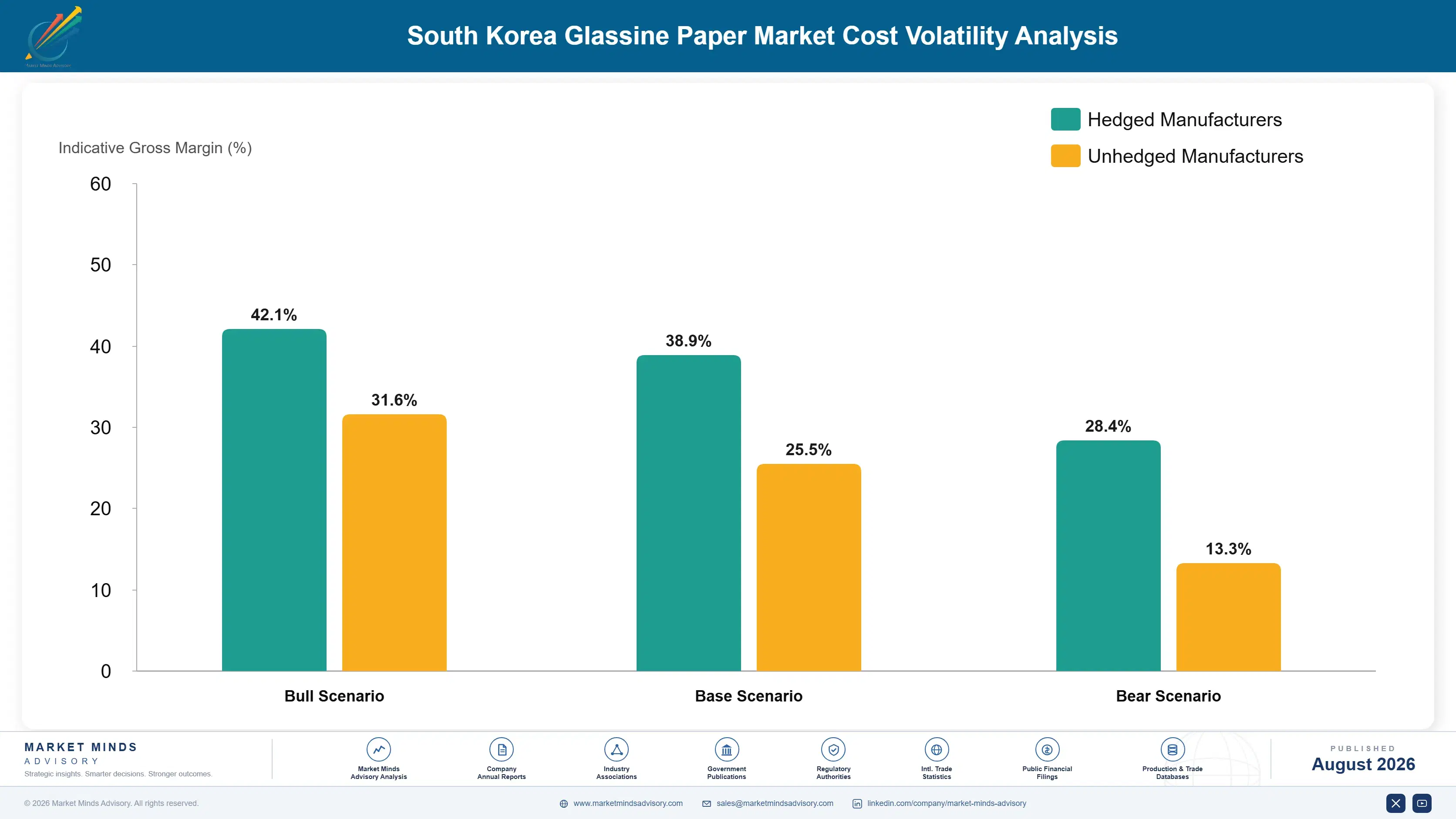
Bleached chemical pulp carries around 47% of base paper cost and is priced on international markets regardless of mill location. Energy takes about 21%, and supercalendering is unusually energy intensive because reaching glassine density requires roughly 12 nips at high pressure and temperature. Chemicals and additives account for around 9%. Ocean freight and inland delivery into Korea absorb the balance.
Pulp pricing and European industrial energy costs both moved sharply through 2022, per IEA industrial energy reporting alongside UPM Annual Report 2025 disclosures on pulp and energy exposure in specialty paper operations. Supercalendered grades absorbed that energy movement more heavily because of the calendering load. Several suppliers repriced Korean contracts mid-term, which is exactly when converters begin evaluating film seriously. Converters remember which suppliers held their terms and which did not.

Exposure divides on mill location and integration. An integrated Nordic producer holding its own pulp carries far less of that swing than a mill buying on market terms, while Chinese suppliers carry lower energy cost but greater furnish variability. Korean converters carry currency exposure on imported base paper that domestic supply would remove, which is one reason import dependence at 82% is a commercial concern, not a logistical one.
south-korea-glassine-paper-market-2025-cost-volatility-analysis-1787595302615

Hold buffer inventory inside Korea against lead time exposure

Ocean freight from European mills makes lead time the binding constraint during any disruption, and a continuity failure risks permanent conversion to film liner rather than a temporary switch of paper supplier. Buffer stock held in Korea costs working capital and protects the entire application, which is worth considerably more than the carrying cost.

Contract pulp exposure or supply from integrated operations

Bleached chemical pulp at around 47% of cost is the largest single exposure and it moves on international markets no mill controls. Integrated producers absorb far less of it, and non-integrated mills serving Korean electronics accounts need contracted pulp positions to avoid the mid-term repricing that pushes converters toward evaluating film. Integration is the durable answer.

Reduce calendering energy through furnish and process work

Supercalendering to glassine density is unusually energy intensive at roughly 12 nips, which made energy movements bite harder here than across ordinary paper grades. Furnish adjustments and calendering process work that reach target density in fewer passes cut the exposure permanently rather than repricing it, though the qualification implications require careful handling. Requalification risk limits how far it goes.

Portfolio Architecture for Margin Defence

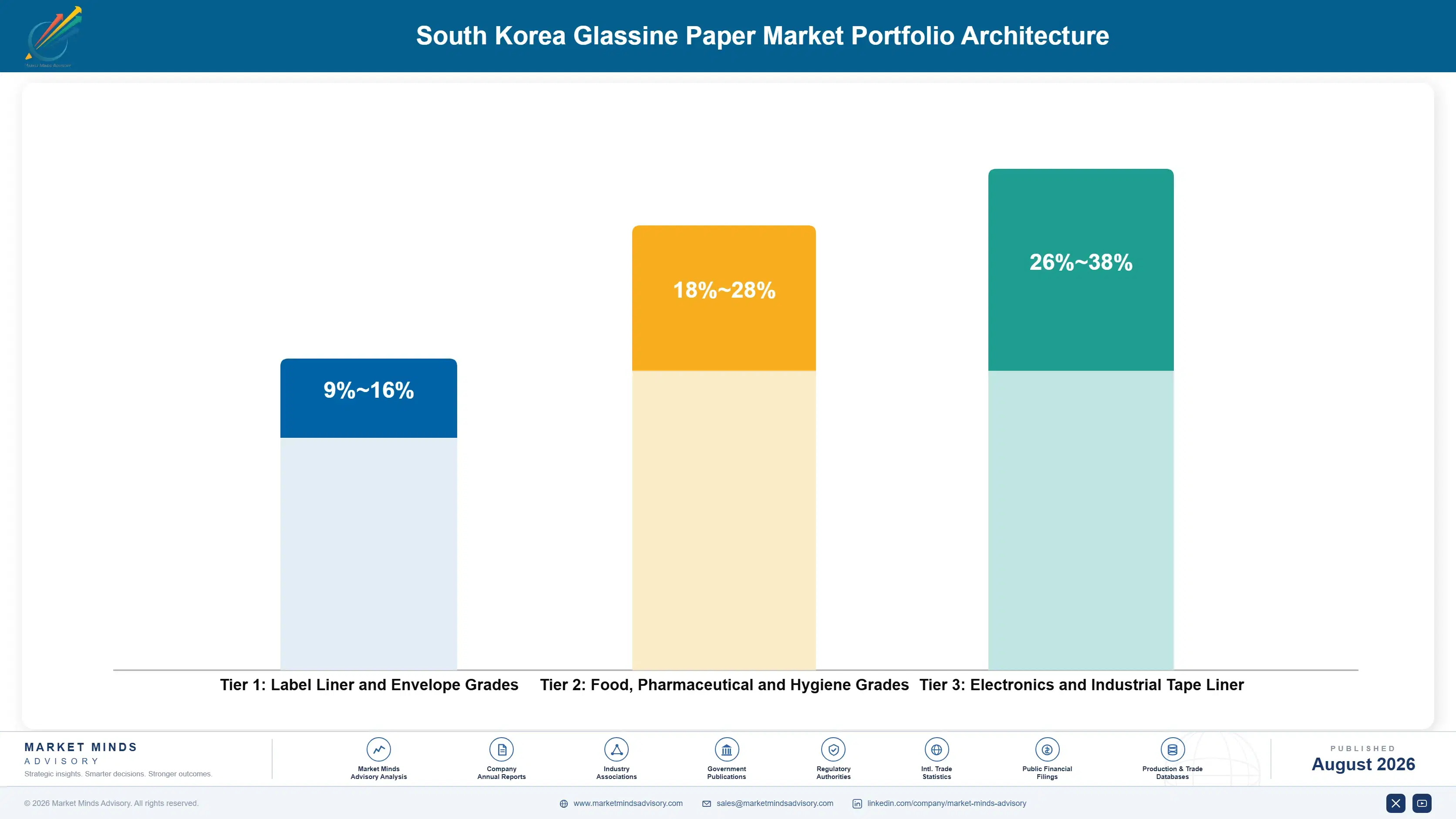
Margin here follows qualification depth rather than any difference in the paper itself. Label release liner and envelope grades earn margins in the high single digits to mid teens, because specification requirements are light enough that Chinese and Korean supply compete directly on delivered price and converters treat the grades as interchangeable at equivalent grammage. Nothing else separates one mill from another there.
Food packaging, pharmaceutical and hygiene grades do better in the high teens to high twenties, because grease resistance without fluorochemical treatment, food contact compliance and consistent machinability all require capability that lighter specification suppliers cannot demonstrate reliably enough to displace an incumbent on price alone. Fluorochemical restrictions have narrowed the technical field considerably, which helps suppliers able to demonstrate barrier performance without them.

Electronics and industrial tape liner holds the strongest position, reaching into the high thirties, where qualification against silicone anchorage, fibre release and contamination limits decides supply and requalification costs enough that converters avoid it. Those margins reflect qualification history rather than any advantage in pulp cost or calendering efficiency at all. Sole source positions sit at the top of that range and shared ones considerably below it.

Label Liner and Envelope Grades

Light specification grades where converters compare delivered price at equivalent grammage and treat suppliers as interchangeable. The seven point range reflects mill location and freight position rather than any difference in product capability at all.
Gross Margin: 9-16%

Food, Pharmaceutical and Hygiene Grades

Compliance grades requiring grease resistance without fluorochemical treatment plus food contact documentation and consistent machinability. The ten point range reflects certification depth and how much technical support the supplier provides during conversion projects.
Gross Margin: 18-28%

Electronics and Industrial Tape Liner

Qualified grades meeting silicone anchorage, fibre release and contamination limits for display, battery and semiconductor converting. The twelve point range reflects qualification depth and whether the position is sole source or shared with a second supplier.
Gross Margin: 26-38%
south-korea-glassine-paper-market-2025-portfolio-architecture-1787595303115

High-value Sub-segments and Strategic Watch-out

Electronics and Industrial Tape Liner

High value and the fastest growth at 8.1% on display, battery and semiconductor converting. Qualification cycles run long and positions hold for years, and Korean specifications frequently propagate into overseas plants the same customers operate. Process engineering decides, not purchasing. Qualification runs for months. Positions hold.
Gross Margin: 28-38%

Food Packaging and Interleaving

High value and growing at 6.4% as extended producer responsibility charges make plastic film progressively more expensive. Conversion projects are won on technical support with sealing and machinability rather than on any delivered price advantage. Fluorochemical restrictions narrow the technical field further. Conversion data wins these projects.
Gross Margin: 20-28%

Label Release Liner

The volume core, flat for years and facing long-term pressure from linerless label technology that removes the liner entirely. Chinese mills compete effectively here because specification requirements are light enough to make suppliers interchangeable. Linerless technology is the long-run threat to the whole category. Price decides every renewal.
Gross Margin: 9-16%

Import Dependence and Film Substitution

The strategic watch-out. Around 82% of base paper is imported and film liner wins permanently on any continuity failure, and the range reflects how far a supplier has committed inventory and second sourcing inside Korea against that risk. No domestic capacity expansion is planned anywhere.
Gross Margin: 5-34%

Qualification Beats Purchasing

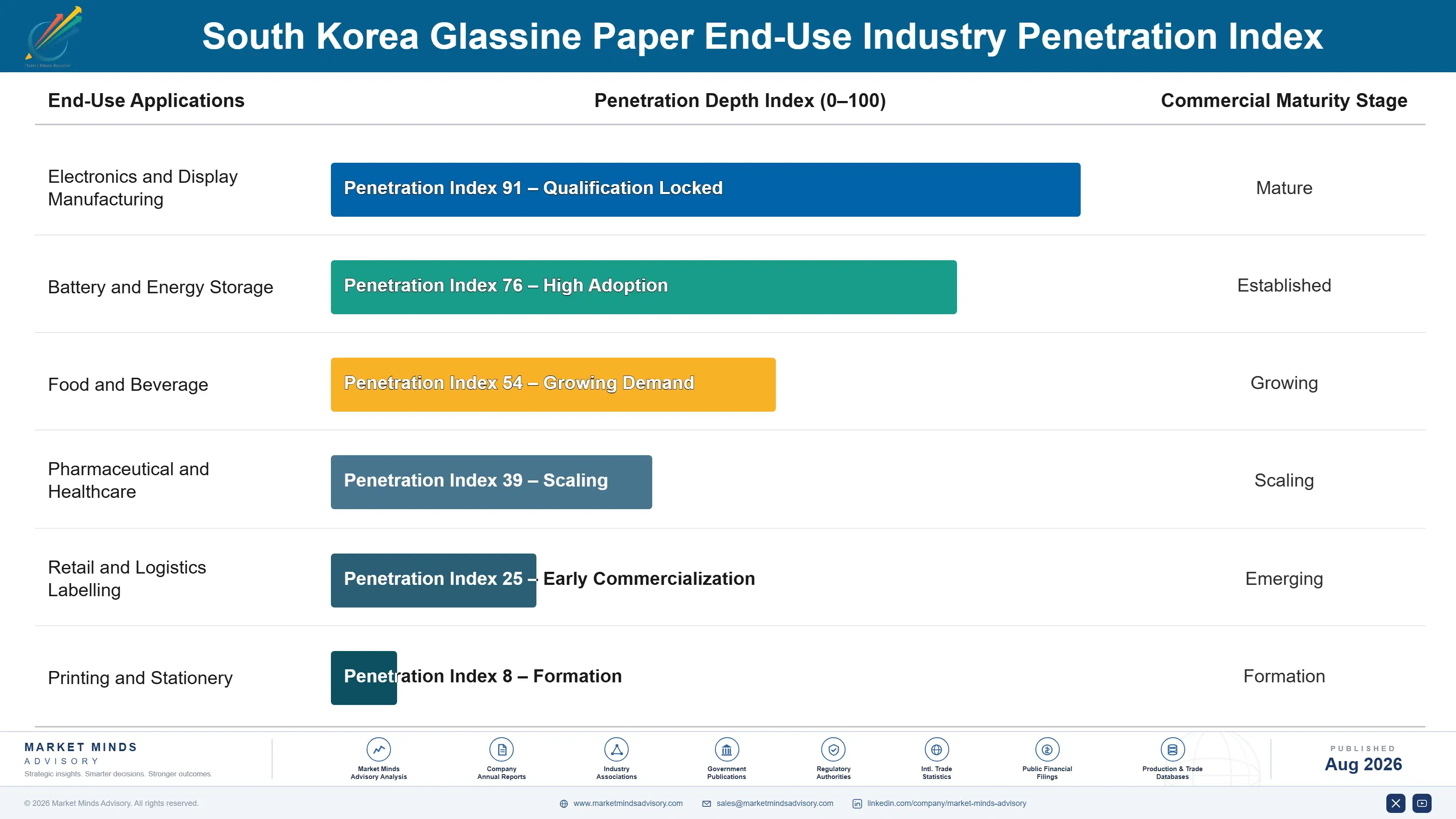
Demand splits between applications that qualify a supplier and applications that simply buy paper. Electronics converting runs a qualification programme testing silicone anchorage, fibre release and contamination behaviour over months before any volume moves. Label and envelope converting compares grammage and delivered price at each renewal. Food and pharmaceutical sit between the two, requiring compliance documentation but nothing like an electronics qualification cycle.
Stickiness follows that split precisely. An electronics position holds for years because requalification carries cost and process risk a converter will not accept without cause, and specifications often extend into new product generations rather than reopening. Label liner switches on delivered price at every contract. The one thing that breaks an electronics position is a continuity failure, and film liner rather than another paper supplier is usually what replaces it.

Deciding functions differ just as sharply. Process and materials engineering own electronics qualification and rarely involve purchasing until commercial terms are the only open item. Packaging development owns food conversions and wants machinability data. Purchasing owns label and envelope volume outright. A supplier running one commercial approach across all three is winning only where the approach happens to fit.
south-korea-glassine-paper-market-2025-end-use-penetration-index-1787595303607

Where We Would Put Effort

These are among the four positions where our research anticipates prominent divergence between winners and laggards over the coming forecast period. Each is grounded in the demand model, the regulatory perimeter, and the announced capacity pipeline.
01 / ELECTRONICS QUALIFICATION ENTRY

The commercial work happens years before the order

Electronics and industrial tape liner grows at 8.1% against a market rate of 5.4%, and the decision belongs to a process engineer testing silicone anchorage and contamination behaviour rather than to anybody in a purchasing function. Suppliers arriving through procurement arrive after the specification has been written around another mill's paper. Getting material into qualification programmes costs little and the positions that result hold for years, because requalification is expensive enough that converters actively avoid it unless something forces the question open again.
02 / SUPPLY CONTINUITY COMMITMENT

Film wins once and never gives it back

Film liner costs roughly 1.9 times as much on equivalent coated area, which keeps paper specified only while supply holds reliably through every disruption. Requalification onto film happens once and does not reverse, so a single continuity failure can remove an application permanently rather than move it to a competing paper mill. Committed volume with buffer inventory held inside Korea is unglamorous work that protects considerably more than any individual account relationship in this market ever could, and it costs only working capital.
03 / WASTE CHARGE CONVERSION

Bring conversion data, not a price list

Extended producer responsibility charges have made plastic film progressively more expensive across Korean food packaging, and glassine demand there grows at 6.4% on that regulatory pressure alone rather than on any change in food volume. Converters replacing established film structures need technical support on grease resistance, sealing and machinability. Suppliers arriving with conversion data rather than samples win those projects, and the regulatory direction keeps refilling the pipeline without any further commercial effort being required from the supplier at all.
04 / SPECIFICATION PROPAGATION TRACKING

Korean qualification is an option on overseas volume

Korean battery and display manufacturers qualify materials through domestic converting operations and then extend those specifications into plants they operate overseas without reopening them. A supplier qualified in Korea therefore holds an option on volume several times larger than what the original award covered. Almost nobody tracks that propagation deliberately or resources it, which leaves substantial demand available to whoever follows a qualified specification abroad first, at effectively no additional technical cost and against no competing bid or tender process whatsoever.

Engagement Snapshot From the Field

A live engagement with an industry participant carrying material or product regulatory and market exposure ahead of a defining policy shift, showing how our research translates into a defensible multi-year portfolio strategy.
MARKET MINDS ADVISORY · CLIENT ENGAGEMENT SUMMARY
South Korea Glassine Paper Producer Strategic Portfolio Review and Transition Roadmap 2026·Investment Scenario on South Korea Glassine Paper Exposure Evaluation 2025-26
CLIENT PROFILE
A European specialty paper producer supplying supercalendered glassine into Korean label and food converting operations, at annual revenue near 47 million euros from the Korean market (client-reported, unverified by MMA). Electronics converting was served indirectly through distributors with no qualification programme participation at all. Korean volumes had been flat for four years and mix was deteriorating steadily.
STRATEGIC CHALLENGE
Korean label liner volumes had been flat for four years while Chinese mills took share on delivered price, and management could not see where growth would come from. The board wanted to understand whether the Korean position was worth defending before committing further capacity to it. Capacity decisions were waiting on the answer.
MMA APPROACH
MMA sized Korean glassine demand by end-use application independently, reconstructed how electronics converters actually run base paper qualification programmes through direct interviews, assessed film liner substitution risk by application, and mapped Korean specification propagation into overseas plants the same customers operate. Interviews with 47 experts covered specialty paper production, release liner converting and electronics materials qualification.
KEY FINDINGS
  1. Electronics and industrial tape liner accounted for the entire growth in Korean glassine demand, and the client had no direct commercial contact with any converter serving it.
  2. Qualification decisions were made by process engineering months before purchasing became involved, which the client's distributor led approach could not reach at any point.
  3. Film liner had already displaced paper in two applications following supply interruptions, and neither had reverted despite paper costing considerably less per coated area.
  4. Specifications qualified through Korean converting had propagated into overseas plants for three of the client's competitors, generating volume none of them had originally bid for.
CLIENT PROFILE
A European specialty paper producer supplying supercalendered glassine into Korean label and food converting operations, at annual revenue near 47 million euros from the Korean market (client-reported, unverified by MMA). Electronics converting was served indirectly through distributors with no qualification programme participation at all. Korean volumes had been flat for four years and mix was deteriorating steadily.
STRATEGIC CHALLENGE
Korean label liner volumes had been flat for four years while Chinese mills took share on delivered price, and management could not see where growth would come from. The board wanted to understand whether the Korean position was worth defending before committing further capacity to it. Capacity decisions were waiting on the answer.
MMA APPROACH
MMA sized Korean glassine demand by end-use application independently, reconstructed how electronics converters actually run base paper qualification programmes through direct interviews, assessed film liner substitution risk by application, and mapped Korean specification propagation into overseas plants the same customers operate. Interviews with 47 experts covered specialty paper production, release liner converting and electronics materials qualification.
KEY FINDINGS
  1. Electronics and industrial tape liner accounted for the entire growth in Korean glassine demand, and the client had no direct commercial contact with any converter serving it.
  2. Qualification decisions were made by process engineering months before purchasing became involved, which the client's distributor led approach could not reach at any point.
  3. Film liner had already displaced paper in two applications following supply interruptions, and neither had reverted despite paper costing considerably less per coated area.
  4. Specifications qualified through Korean converting had propagated into overseas plants for three of the client's competitors, generating volume none of them had originally bid for.
RECOMMENDED STRATEGY
Phase 1: Phase one: place technical resource directly with Korean electronics converters to enter qualification programmes, bypassing the distributor relationship entirely for that segment. Phase 2: Phase two: commit buffer inventory inside Korea for qualified accounts, since continuity failure converts applications to film permanently rather than temporarily. Phase 3: Phase three: track specification propagation into overseas customer plants and resource the resulting demand deliberately rather than reactively. Ask customers where else it is used.
OUTCOME
The producer entered two electronics qualification programmes during 2026 and established Korean buffer inventory for existing accounts (client-reported, unverified by MMA). Label liner volume continued declining, but mix improvement lifted Korean margins materially across the same period. Two further qualification programmes were opened before the year ended.

Frequently Asked Questions

Foundational context covering the market sizes, CAGR, scope, country, region and competition that inform every finding below. This section is provided to cover basics and most often pre-purchase conversations, answered from the MMA Primary Research Dataset.

What is the current size of the South Korea Glassine Paper Market?

MMA sizes it at USD 0.14 billion in 2025, rising to USD 0.15 billion in 2026. The figure covers glassine consumed within South Korea at delivered base paper value, imported or domestic.

How large will the South Korea Glassine Paper Market be by 2036?

USD 0.25 billion by 2036, an incremental USD 0.10 billion over the 2026 base and an expansion multiple of 1.67 times. Electronics liner accounts for most of that growth.

What is the CAGR for the South Korea Glassine Paper Market 2026 to 2036?

5.4% in the base case, with a bull case at 6.6% and a bear case at 4.2%. The spread turns on packaging waste rules against film liner substitution in electronics.

Which segment is growing fastest?

Electronics and industrial tape liner at 8.1%, half again the market rate of 5.4%. Display panel protection, battery cell process tapes and semiconductor handling drive that demand.

Who are the major companies in the South Korea Glassine Paper Market?

Ahlstrom, UPM Specialty Papers, Nordic Paper, Delfortgroup and Moorim P and P lead on tonnage supplied. Fifteen further participants are profiled in the full report on that basis.

Which country is growing fastest?

The market is scoped to South Korea alone at 5.4%. Within it the Chungcheong and Gyeonggi electronics converting clusters grow fastest on display and battery demand.

Report Segmentation Architecture

The full report scope spans multiple orthogonal segmentation dimensions, with cross-tabulated demand data provided for each dimension pair. Coverage extends further to regional breakdowns, trend trajectories, and the competitive detail needed to support segment-level decision-making.

By End-Use Application

  • Label Release Liner
  • Electronics and Industrial Tape Liner
  • Food Packaging and Interleaving
  • Pharmaceutical and Medical Packaging
  • Hygiene Product Liner
  • Envelope and Graphic Applications

By End-Use Industry

  • Electronics and Display Manufacturing
  • Battery and Energy Storage
  • Food and Beverage
  • Pharmaceutical and Healthcare
  • Retail and Logistics Labelling
  • Printing and Stationery

By Commercial Dimension

  • Direct Mill to Converter Supply
  • Distributor and Trading Channels
  • Qualified Electronics Supply Agreements
  • Imported Base Paper Supply
  • Domestic Mill Supply
  • Toll Converting Arrangements

By Region

  • North America
  • Western Europe
  • East Asia
  • South Asia and Pacific
  • Latin America
  • Middle East and Africa
  • Eastern Europe

Scope, Methodology, and Coverage

Every figure in this report is reproducible from documented input assumptions. The scope below maps the historical period, the forecast horizon, the segmentation dimensions, and the countries covered, alongside the underlying primary and qualitative methodology.
Historical Period
2020 to 2025
Forecast Period
2026 to 2036
Base Year
2025 (USD billions; MMA Primary Research Dataset, August 2026)
Market Definition
Glassine and greaseproof supercalendered paper consumed within South Korea, covering label release liner, electronics and industrial tape liner, food packaging and interleaving, pharmaceutical and medical packaging, hygiene product liner, and envelope and graphic applications. Measured at delivered base paper value whether domestically produced or imported. Silicone coating and converting services, polyethylene terephthalate film liner, machine glazed kraft, and finished labels or packaging are excluded from scope.
Quantitative Units
USD billions (current prices); thousand tonnes consumed; USD per tonne by application grade
Segmentation Dimensions
End-use application; end-use industry; commercial dimension; supply origin region
Regions Covered
North America, Western Europe, East Asia, South Asia and Pacific, Latin America, Middle East and Africa, Eastern Europe
Countries Covered
South Korea, with supply origin coverage for Finland, Sweden, Germany, France, Netherlands, United Kingdom, China, Japan, Taiwan, India, Indonesia, United States, Canada, Poland, Brazil
Key Companies Profiled
Ahlstrom, UPM Specialty Papers, Nordic Paper, Delfortgroup, Moorim P and P, Sappi, Mondi, Pixelle Specialty Solutions, Gascogne Papier, Twin Rivers Paper, Zhejiang Kan Specialities Material, Shandong Huatai Paper, Hansol Paper, Moorim SP, Dongwon Systems, Lintec, Nitto Denko, Oji Holdings, Siliconature, Rayven
Quantitative Methodology
Primary survey, n=3,800 respondents, Q4 2025, six countries; demand-side model with trade association cross-validation
Qualitative Methodology
47 expert interviews, Q4 2025; applied to validate demand model assumptions, identify emerging dynamics, and assess competitive positioning
Report Format
PDF and XLSX data workbook (Word format preview document)
Publisher
Market Minds Advisory
Report Code
MMA-2026-PAC-118
Published
August 2026
Contact
sales@marketmindsadvisory.com | www.marketmindsadvisory.com

Purchase the full South Korea Glassine Paper Market Report (2026 to 2036).

The full report treats Korean glassine as an electronics materials input rather than a packaging grade, because that is where the growth and the margin both sit. It sizes all six end-use applications independently through 2036, reconstructs how electronics converters run base paper qualification programmes, and assesses film liner substitution risk application by application. Supply origin analysis covers every region contributing imported base paper against the 82% import position. Competitive profiling covers 20 participants on one consistent tonnage basis throughout. Qualification cycle length is modelled by application throughout.
Six end-use applications sized independently through 2036
Electronics qualification programmes reconstructed from direct converter interviews
Film liner substitution risk assessed application by application
Import dependence analysed by supply origin and lead time
Specification propagation into overseas customer plants mapped deliberately
Twenty participants profiled on one consistent tonnage basis

Built For The People Who Decide

From boardroom strategy to bench-side execution, this report is read cover-to-cover by leaders shaping the next decade of their industry, turning demand scenarios, market dynamics and valuation benchmarks into decisions.
CXOs/ Presidents/ VPs/ Managers
M&A and Corporate Development
Strategy Teams and R&D Heads
Procurement and Product Directors
Regulatory and Compliance Leaders
Investor Relations and Equity Analysts