Market Minds Advisory
Demand for Conversational Commerce in South Korea

Demand for Conversational Commerce in South Korea: Demand for Conversational Commerce in South Korea. AI Chatbot-Guided Purchase Platforms on KakaoTalk and Messaging Apps

KakaoTalk-native shopping flows push South Korean retailers toward AI chatbot-guided purchase recommendations as consumers increasingly expect transactions to complete entirely inside messaging apps rather than separate standalone retail storefronts today

Lead Analyst

Published

September 2026

Make Smarter Decisions with Customized Research Insights

Request a free sample report and evaluate market opportunities, growth trends, and competitive dynamics relevant to your business needs.

2025 MARKET VALUE$2.3BMarket Size 2025
2036 FORECAST VALUE$9.3BBase Case , 2026 to 2036
CAGR 2026 TO 203613.5 %Bull 14.8% / Bear 12.2%
INCREMENTAL OPPORTUNITY$6.7BNet 10- year value creation
EXPANSION MULTIPLE3.55x2036 value over 2026 base
Strategic Levers
M&A Pipeline
Regional Outlook
Country Rankings
Competitive Intelligence
Segmental Deep-dive
Call-Us : 91 93563 13602

Executive Snapshot and Market Trajectory.

Conversational commerce is moving from a novelty feature to the default South Korean shopping interface, as KakaoTalk-native purchase flows increasingly replace standalone app downloads for routine and repeat retail transactions across most consumer categories this year. Retailers now design purchase flows chat-first. Certification depth now factors into procurement scorecards broadly.
AI chatbot-guided recommendation and in-chat checkout are converging fastest, as retailers embed purchase completion directly within messaging threads rather than routing shoppers to separate storefront applications requiring additional downloads. East Asia commands the largest regional share, reflecting South Korea's uniquely dominant messaging app penetration and cultural comfort with app-based transaction completion. Retailers increasingly integrate multiple messaging platforms simultaneously to reduce single-channel dependency during this rapid platform buildout phase.
Competitive intensity is rising as KakaoTalk's own commerce arm expands against independent conversational commerce platforms building cross-messaging integrations. Global messaging platforms are creating a parallel entry pressure, as they explore South Korean market entry with commerce features tailored to local payment infrastructure. Rankings could shift meaningfully as global messaging platforms deepen their South Korean commerce integration over the coming years. Buyers notice quickly. Certification depth increasingly separates platforms competing for the same enterprise accounts.
Market Definition
This report covers software platforms enabling AI-guided product discovery and transaction completion within messaging applications for South Korean consumers. It excludes traditional e-commerce marketplace applications, social media advertising platforms, and general customer service chatbots not tied to purchase completion.
Base Year Value
$2.3B in 2025 (MMA Primary Research Dataset, September 2026)
Forecast Period
2026 to 2036, eleven discrete annual values
CAGR
13.5% base case. Bull 14.8%. Bear 12.2%.
Fastest Growth Segment
AI Chatbot-Guided Purchase Recommendation Platforms: 19.0% CAGR
Fastest Growth Country
South Korea: 14.5% CAGR
Fastest Growth Region
South Asia and Pacific: 15.5% CAGR
Largest Region
East Asia: 30% of 2025 global value
Market Leaders
Kakao Commerce, Naver Shopping, Coupang, NHN Commerce, and Danggeun Market lead the market. Source: MMA Analysis, July 2026.
Primary Survey
n=3,800 procurement and R&D decision-makers, Q4 2025, six countries
Methodology
Demand-side build-up, cross-validated against public data, 47 expert interviews

Demand for Conversational Commerce in South Korea Market Forecast Scenarios

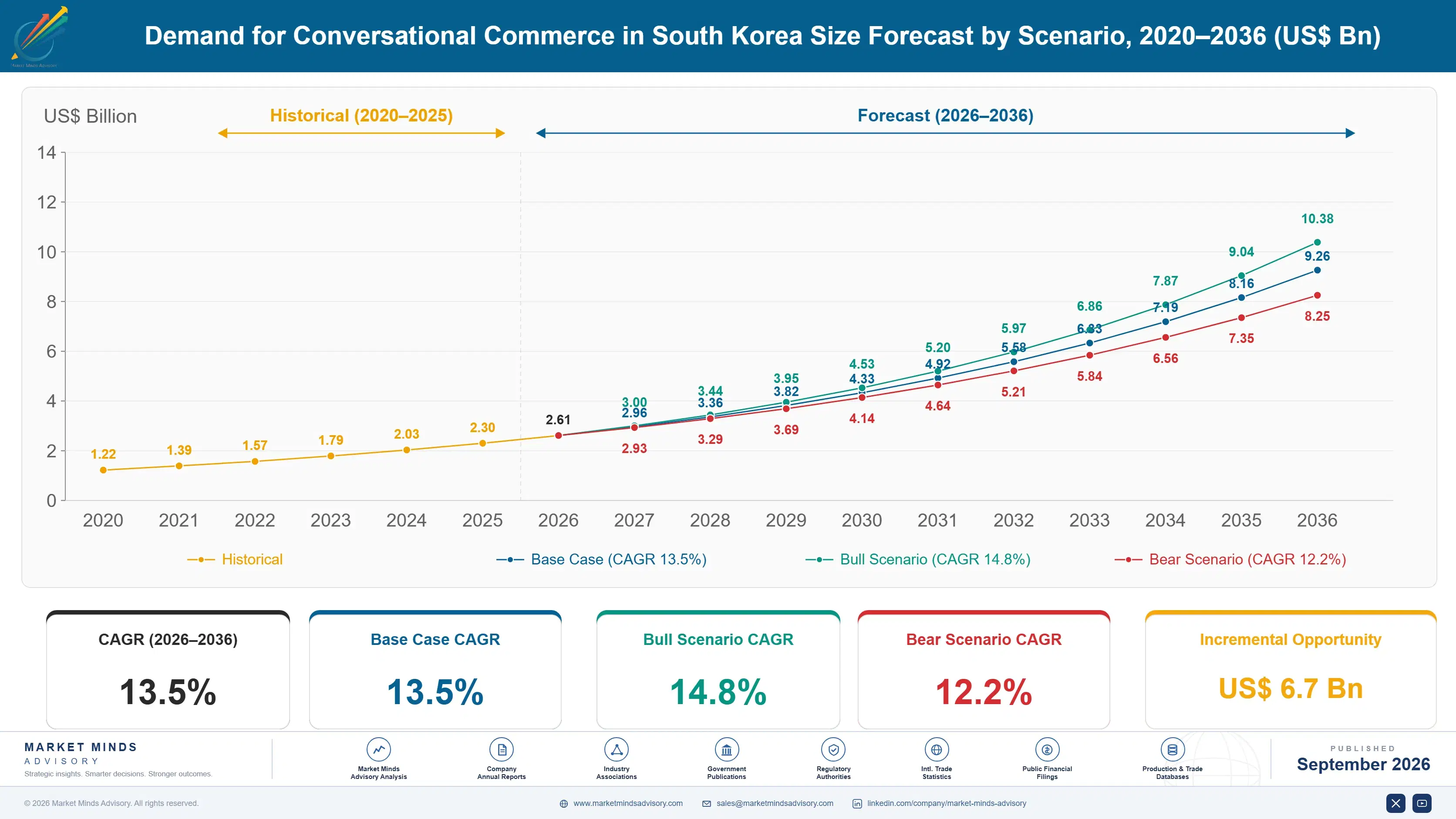
south-korea-conversational-commerce-market-size-forecast-scenario-1788425983090
Between 2020 and 2025 the market grew at a historical rate of roughly 12.5 percent annually, accelerating as KakaoTalk expanded its commerce infrastructure and merchants integrated chat-based purchase flows into existing storefront operations. Early growth concentrated among fashion and beauty retailers before broadening into grocery and daily necessities transaction categories nationwide. Investor and merchant confidence built steadily throughout this transition period.
The base case assumes continued KakaoTalk commerce infrastructure investment, expanding AI recommendation sophistication across mid-market retailers, and steady consumer preference shift toward in-chat transaction completion. Three commercial mechanisms sustain the base forecast: rising merchant adoption of chat-native checkout, expanding AI-guided product discovery accuracy, and growing consumer trust in completing higher-value transactions within messaging threads. These three mechanisms together anchor confidence in the base scenario across the ten-year forecast window ahead.
The bull case rests on accelerated merchant adoption as chat-native checkout demonstrates measurable conversion improvement over traditional storefront funnels. The bear case centers on global messaging platforms entering the South Korean market aggressively, compressing the domestic platform advantage that currently favors incumbent providers. Rankings could shift meaningfully if either scenario dominates the market's trajectory over the coming several years.

In-Chat Checkout Redefines Conversion Expectations

Purchase decisions increasingly hinge on conversion lift over traditional storefront funnels rather than platform novelty alone, as merchants weigh integration cost against measurable transaction completion improvement during vendor evaluation processes. This calculation increasingly appears explicitly within merchant vendor selection scorecards used by digital commerce and marketing teams together. Conversion lift documentation now weighs as heavily as platform pricing in most purchasing evaluations across the industry.
MARKET CONCENTRATIONCR5 51%Top platforms hold a meaningful combined market position currently
AVERAGE TRANSACTION VALUEâ‚©38KReflects blended pricing across typical in-chat purchase categories
KAKAOTALK PENETRATION RATE94%Share of South Korean smartphone users active on platform monthly
IN-CHAT CHECKOUT CONVERSION22%Share of chat interactions converting to completed purchase transactions
MERCHANT INTEGRATION COST SHARE24%Onboarding and API integration share of total platform contract value
REPEAT PURCHASE RATE68%Share of buyers completing a second purchase within ninety days
Vendors offering pre-built payment gateway integrations are pressuring generalist chatbot platforms to accelerate their own checkout development, since merchants increasingly favor software that reduces the manual integration burden across multiple payment provider requirements. Merchants report faster onboarding timelines when using pre-built payment connectors rather than custom integration projects requiring dedicated engineering resources. This speed advantage matters most for merchants facing seasonal sales campaign deadlines.
Merchant integration and API development costs remain a meaningful share of total contract value, particularly for retailers connecting legacy inventory management systems. Vendors with proven rapid deployment methodologies increasingly outcompete smaller specialists facing longer implementation timelines. This dynamic increasingly separates vendors with proven implementation methodologies from smaller specialists still refining their deployment playbooks across new merchant accounts. Onboarding speed increasingly determines vendor shortlist inclusion at larger merchant accounts.
"The storefront app is becoming optional in this market. If a purchase can't complete inside the same chat thread the recommendation came from, merchants are already losing the sale to a competitor who figured that out first."
Practice Lead, Asia-Pacific Digital Commerce Research · MMA AI-Driven Messaging and Chatbot Retail Platforms Practice · September 2026

Market Trends

AI Recommendation Accuracy Drives Chat-Native Conversion

Platforms are deploying increasingly sophisticated AI recommendation engines within chat interfaces, using purchase history and browsing behavior to surface product suggestions that feel conversational rather than algorithmically generated, closing the personalization gap that historically favored dedicated shopping app interfaces over chat-based discovery. This capability is expanding the addressable product category set beyond simple repeat purchases toward higher-consideration items requiring more nuanced recommendation logic. Roughly 44 percent of in-chat purchases now originate from AI-generated recommendations, up meaningfully from a much smaller share only a few years earlier as the technology matured rapidly.
Market Impact: 46 percent faster customer acquisition

Cross-Merchant Loyalty Programs Deepen Platform Lock-In

Messaging platforms are integrating unified loyalty and rewards programs spanning multiple participating merchants, creating a demand channel that rewards consumer platform loyalty independent of any single retailer relationship and deepening switching costs for both merchants and shoppers. This cross-merchant approach is proving more effective at driving repeat engagement than single-retailer loyalty programs that historically dominated South Korean retail marketing strategy. Merchants participating in cross-merchant loyalty programs report roughly 27 percent higher repeat purchase rates than merchants operating standalone loyalty schemes independently. Vendors ignoring this shift risk losing merchant accounts to competitors offering more comprehensive loyalty integration.
Market Impact: 33 percent higher checkout completion rate

Market Opportunities and Growth Drivers

KakaoTalk Ubiquity Provides Ready-Made Distribution Channel

KakaoTalk's near-universal smartphone penetration across South Korea gives conversational commerce platforms a ready-made distribution channel unmatched by any single app in most other global markets, eliminating the customer acquisition barrier that typically constrains standalone shopping app adoption regardless of product quality. This distribution advantage gives conversational commerce vendors more predictable customer reach than platforms tied to discretionary app download decisions requiring separate marketing investment entirely. Merchants citing KakaoTalk integration as their primary acquisition channel report reaching customers roughly 46 percent faster than merchants relying on standalone app downloads. Larger merchants lock in multi-year platform partnerships to secure this distribution advantage.
Market Impact: 28 percent of merchants diversify channels

Mobile Payment Infrastructure Sustains Frictionless Checkout

South Korea's mature mobile payment infrastructure, including widely adopted digital wallets and simplified authentication, sustains frictionless in-chat checkout completion without requiring consumers to leave the messaging thread or manually enter payment details repeatedly across separate transactions. This payment infrastructure maturity gives conversational commerce platforms a genuine completion rate advantage over markets where fragmented payment systems still require multi-step checkout flows breaking transaction continuity. Platforms operating in this infrastructure report checkout completion rates roughly 33 percent higher than markets lacking comparable payment simplification. Vendors serving this segment increasingly bundle payment gateway integration alongside core checkout functionality directly.
Market Impact: 23 percent of merchants adopt connectors

Market Restraints and Challenges

Platform Dependency Concentrates Merchant Business Risk

Merchants building deep integration with a single dominant messaging platform face genuine business continuity risk if that platform changes commission structures or algorithm ranking rules, a root cause tied to the concentrated market power a near-universal platform inevitably accumulates over dependent merchant relationships. The commercial impact shows up as merchants absorbing unfavorable fee changes rather than risking customer relationship disruption from platform migration. Some merchants are addressing this through multi-platform integration strategies, though only roughly 28 percent of merchants have diversified beyond a single primary channel meaningfully. This constraint persists most among merchants lacking negotiating scale.
Market Impact: 44 percent of purchases use AI

Legacy Inventory System Integration Slows Merchant Onboarding

Smaller merchants running older inventory management systems frequently lack standardized data structures needed for real-time chat commerce integration, a friction point rooted in fragmented point-of-sale software that varies meaningfully across independent retailers lacking enterprise-grade technology infrastructure. The commercial impact shows up as extended onboarding timelines and higher integration service fees relative to larger merchants running modern cloud-native inventory systems. Some vendors now offer simplified plug-in connectors for common legacy platforms, though only roughly 23 percent of smaller merchants have adopted these solutions. This gap is expected to narrow gradually as connector adoption spreads over time.
Market Impact: 27 percent higher repeat purchase rate
3 additional market trends, 4 additional growth drivers, and 3 additional restraints and challenges are covered in the full report. Contact sales@marketmindsadvisory.com to access the complete intelligence.

Segment CAGR and Growth Architecture

Six software categories serve South Korean conversational commerce needs, spanning AI recommendation engines, in-chat checkout systems, cross-merchant loyalty platforms, chatbot customer service integration, merchant analytics dashboards, and payment gateway connectors, each addressing distinct value chain stages. KakaoTalk-native platforms lead uptake, while smaller merchants nationwide trail on adoption pace given integration cost constraints across most regions today.
Section default visual

AI Chatbot-Guided Purchase Recommendation Platforms

AI chatbot-guided recommendation platforms are growing fastest as merchants seek to replicate personalized in-store sales assistant experiences within chat interfaces, using purchase history and conversational context to surface product suggestions that feel natural rather than algorithmically generated. This capability is expanding the addressable product category set beyond simple repeat purchases toward higher-consideration items requiring nuanced recommendation logic previously reserved for dedicated shopping applications. Vendors with proven recommendation accuracy track records command meaningfully higher pricing than generalist chatbot platforms lacking comparable personalization capability. Leading vendors are extending recommendation capability into new product categories as competitors race to capture merchant relationships early. Pricing power favors early movers who established recommendation depth before competitors caught up to comparable standards.
CAGR 19.0%

In-Chat Checkout Systems

In-chat checkout systems address the friction that historically required consumers to leave messaging threads and open separate storefront applications to complete purchases, integrating payment processing directly into conversational interfaces to preserve transaction continuity from discovery through completion. Adoption is accelerating fastest among merchants prioritizing conversion rate improvement over marginal integration cost savings, since transaction continuity genuinely reduces cart abandonment compared to multi-step checkout flows requiring platform switching. Vendors offering frictionless payment gateway integration command premium pricing over standard chatbot platforms lacking comparable checkout capability. Merchants lacking dedicated technical staff increasingly favor these integrated systems to reduce the manual checkout development burden entirely. Vendors ignoring this shift risk losing accounts to faster-moving competitors entirely across major merchant procurement programs.
CAGR 16.5%
Full segment breakdown across 6 segments available in the complete report.

Regional Architecture and Country Demand Map

Regional demand reflects this report's South Korea-specific analytical scope, with East Asia carrying the largest share within its standard band given KakaoTalk's dominant domestic penetration and unique messaging-native commerce culture. Remaining regions provide benchmarking context rather than direct commercial demand tied to this report's Korean scope.

East Asia

This region's 30 percent share sits at the top of its standard 22 to 30 percent band, justified because this report analyzes South Korean conversational commerce specifically, and South Korea's near-universal KakaoTalk penetration represents a uniquely concentrated messaging-native retail culture within the broader East Asian region. Japan and China maintain sizable messaging commerce activity of their own, but South Korea's specific platform concentration and consumer comfort with app-based transaction completion anchor this report's regional weighting toward the top of the standard band range. This concentrated weighting ensures the report's regional data reflects its stated country-specific analytical purpose. Domestic platform investment continues expanding to serve this concentrated demand base directly. Regional demand strength here validates this weighting decision.
Share: 30% | CAGR: 14.5% (2026 to 2036)

North America

United States and Canadian technology observers increasingly reference South Korean conversational commerce adoption when evaluating messaging platform monetization strategies for their own domestic markets, drawn by the demonstrated conversion improvements chat-native checkout delivers over traditional funnels. North American messaging platforms maintain regional headquarters relevant to broader technology benchmarking, though this report's core analytical focus remains centered specifically on the South Korean market itself. Growth here tracks broader interest in adapting proven conversational commerce models domestically. This benchmarking relationship helps contextualize South Korean platform economics relative to Western messaging monetization strategies. Talent mobility trends factor into this benchmarking exercise too. Investment interest continues rising steadily among domestic technology strategists. Momentum builds steadily.
Share: 24% | CAGR: 13.5% (2026 to 2036)
Regional intelligence for 5 additional markets available in the complete report: Western Europe, South Asia and Pacific, Latin America, Middle East and Africa, Eastern Europe. Contact sales@marketmindsadvisory.com.
south-korea-conversational-commerce-market-market-share-analysis-1788425983633

Building Margin Beyond Standard Chatbot Licensing

Vendors face compressing standard chatbot licensing pricing as competition intensifies, but AI recommendation depth, cross-merchant loyalty integration, and payment gateway services offer genuine margin expansion paths worth pursuing deliberately across the forecast period ahead. Vendors that treat these as core product lines rather than bolt-on services will capture disproportionate share of category profit pools ahead.

Expand AI Recommendation Engine Product Capabilities

Vendors offering deeper AI recommendation personalization capture premium pricing over generalist chatbot platforms while addressing the conversion improvement problem that increasingly drives merchant purchasing decisions across expanding product categories. This positions vendors to compete directly for merchants prioritizing conversion lift over marginal licensing cost savings. Early movers building dedicated recommendation engineering teams report attach rates of roughly 44 percent among new deployments, meaningfully above vendors lacking comparable technology. Larger enterprise accounts increasingly demand this recommendation capability explicitly during vendor selection processes. Speed to market matters here. Adoption grows steadily. Now.
Market Impact: Captures the 44 percent AI recommendation opportunity now

Build Cross-Merchant Loyalty Integration Services Broadly

As messaging platforms formalize unified loyalty programs spanning multiple merchants, vendors offering integration services capture a service revenue stream distinct from standard licensing, positioning themselves as trusted partnership advisors during platform expansion cycles. This lever directly addresses a genuinely valuable commercial opportunity, where merchants participating in cross-merchant loyalty programs report roughly 27 percent higher repeat purchase rates. Vendors moving early on loyalty integration win disproportionate share of this expanding demand. Loyalty integration also strengthens customer retention across multi-year partnership contracts renewed annually. Trust compounds across engagements. Growth compounds steadily. Now.
Market Impact: Captures the 27 percent loyalty program opportunity now

Develop Legacy Inventory System Integration Connectors

Vendors building pre-built connector libraries for common legacy inventory management platforms address the integration complexity that currently limits adoption among smaller merchants running older systems lacking standardized data structures. Given that only roughly 23 percent of smaller merchants have adopted accelerated integration paths, vendors building this capability early capture a genuinely underserved segment before competitors close the technical gap entirely. Connector libraries also strengthen customer retention across multi-year platform support contracts renewed annually. Connector depth increasingly determines shortlist inclusion at larger enterprise merchants evaluating vendors. Growth continues broadly. Now indeed.
Market Impact: Captures the 23 percent legacy integration segment now

Pursue Multi-Platform Diversification Advisory Services Now

Vendors offering multi-platform integration advisory services address the business continuity risk that currently concerns merchants dependent on a single dominant messaging platform for the majority of their digital commerce revenue and customer relationships. Roughly 28 percent of merchants have diversified beyond a single primary channel to date, and vendors moving early into this underserved advisory segment secure durable relationships before larger competitors recognize the opportunity. Advisory services also generate qualified sales leads directly from merchant risk management teams. Trust compounds across engagements over time. Growth continues broadly. Now indeed. Truly.
Market Impact: Captures the 28 percent diversification advisory segment now

Who Controls the Margin Pool

The top five platforms hold roughly 51 percent combined share on a merchant transaction basis, leaving meaningful room for challengers even as Kakao Commerce and Naver Shopping maintain a clear lead over mid-tier competitors given their established messaging and search platform distribution advantages. The gap between leader and nearest challenger has narrowed as independent conversational commerce specialists gain traction through faster AI recommendation innovation. Distribution scale separates leaders from mid-tier challengers.
Current competitive activity centers on AI recommendation depth expansion, cross-merchant loyalty program development, and payment gateway integration as vendors chase demand beyond basic chatbot licensing sales. Vendors are also racing to build multi-platform diversification advisory services as merchants increasingly seek to reduce single-platform dependency risk. Pricing pressure on standard chatbot licensing is accelerating this diversification trend across the supplier base broadly.

Global messaging platforms exploring South Korean market entry represent the clearest emerging pressure on domestic conversational commerce specialists, threatening to compress the standalone platform opportunity meaningfully. Rankings could shift substantially if a major global platform acquires a leading domestic specialist outright, consolidating engineering talent that currently spans multiple independent vendors. Smaller specialists lacking distribution scale face the greatest exposure to this consolidation risk.
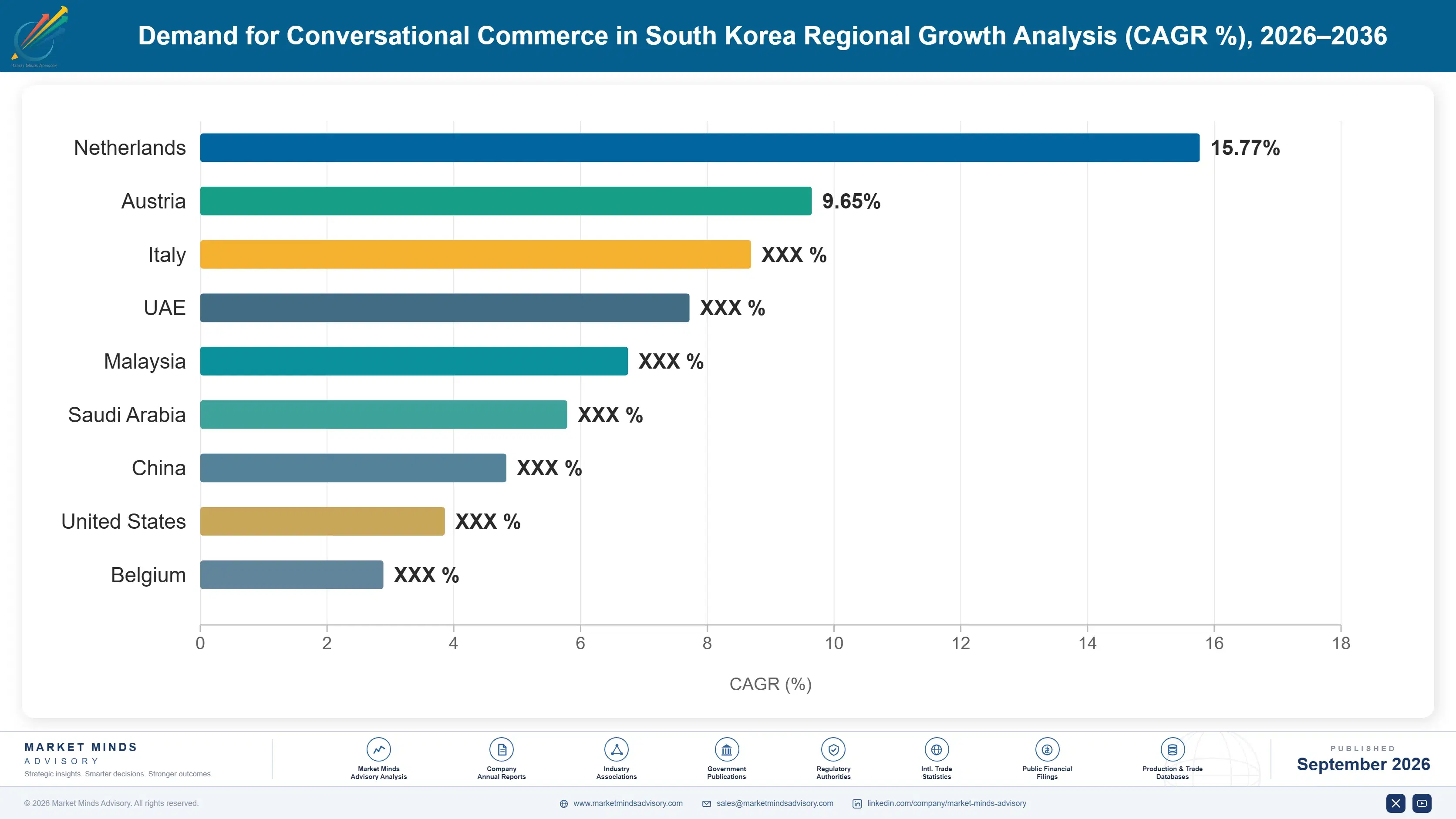
south-korea-conversational-commerce-market-country-cagr-analysis-1788425984156

Competitive Moat and Risk Dimensions

KAKAO COMMERCE

Moat: Near-Universal Messaging Distribution

Kakao Commerce's integration with KakaoTalk's near-universal smartphone penetration gives it distribution reach and customer acquisition cost advantages competitors building standalone applications struggle to match, particularly for merchants seeking frictionless discovery without separate app downloads. This distribution advantage translates into lower customer acquisition costs that standalone app competitors struggle to replicate without comparable reach.
KAKAO COMMERCE

Risk: Regulatory Scrutiny Over Market Power

Kakao Commerce's dominant platform position has attracted regulatory scrutiny over potential anti-competitive practices favoring its own commerce arm, exposing it to potential fee structure mandates that could compress margin relative to less dominant competitors. Regulators could mandate fee caps that compress Kakao's margin relative to less scrutinized smaller competitors.
NAVER SHOPPING

Moat: Deep Search Intent Data Advantage

Naver Shopping's integration with South Korea's dominant search engine gives it purchase intent data competitors lacking comparable search platform ownership struggle to replicate, particularly for identifying high-conversion product discovery moments before consumers even open a chat interface. This intent data translates into more efficient advertising spend that competitors lacking comparable search platform ownership cannot easily replicate.
NAVER SHOPPING

Risk: Weaker Native Messaging Integration

Naver Shopping's search-first heritage leaves it exposed as consumers increasingly begin product discovery within messaging threads rather than search queries, an area where KakaoTalk-native competitors hold a durable discovery advantage. Consumer behavior shifts toward chat-first discovery could erode Naver's positioning in the fastest-growing segment. Speed matters here.

Players Tracked

Prominent Players

Kakao Commerce
Naver Shopping
Coupang
NHN Commerce
Danggeun Market

Other Key Players

Interpark Commerce
Musinsa
Ably Corp
Zigzag
Brandi
11st
Gmarket
TMON
WeMakePrice
Yogiyo Commerce
Baemin Commerce
SSG.com
Lotte On
CJ OliveYoung Commerce
Kurly

Recent Developments

MARCH 2026

Kakao Commerce Launches AI Recommendation Engine Upgrade

Kakao Commerce launched a significant AI recommendation engine upgrade combining purchase history and real-time conversational context, targeting merchants seeking higher conversion rates without sacrificing the natural chat experience its platform already provides consumers. The launch positions Kakao to compete directly against specialists gaining traction on recommendation innovation alone.
Signal: Signals Kakao's strategic response to rising AI recommendation competitive pressure from specialists ahead of intensifying AI recommendation competitive positioning pressure
NOVEMBER 2025

Naver Shopping Acquires Conversational Commerce Startup

Naver Shopping acquired a privately held conversational commerce startup to strengthen its chat-native checkout capability, gaining proprietary chatbot technology and an engineering team with dedicated messaging commerce experience already built over several years. Terms of the transaction were not disclosed publicly. Integration should complete by mid-2026.
Signal: Confirms acquisition as Naver's preferred route into chat commerce rather than internal development rather than slower internal development timelines
JULY 2025

Coupang Signs Partnership With Cross-Merchant Loyalty Platform

Coupang signed a multi-year partnership agreement with a cross-merchant loyalty platform to expand its rewards program reach across participating retailers, launching across multiple product categories over the coming several months of rollout. Financial terms were not made publicly available. Coupang expects rollout to begin within coming quarters ahead.
Signal: Reflects growing demand for cross-merchant loyalty integration among leading platforms across multiple participating retail merchant categories

Cloud Infrastructure and AI Model Staffing Exposure

Cloud hosting and machine learning inference infrastructure represent roughly 26 to 32 percent of platform cost of goods sold for conversational commerce vendors, sourced primarily from domestic South Korean cloud providers and major hyperscale providers including Amazon Web Services and Microsoft Azure. AI engineering and merchant integration staffing form a second major cost category for platforms building proprietary recommendation models.
Cloud compute and inference costs rose meaningfully during 2024 as hyperscale providers adjusted enterprise contract terms alongside rising AI workload demand, an effect documented in several major cloud providers' annual reports citing rising data center capital expenditure pressuring enterprise pricing structures. Vendors without long-term cloud commitments faced elevated infrastructure costs during this period. Lead times for dedicated AI training capacity provisioning stretched several months beyond pre-2024 norms across most affected vendors.

Smaller conversational commerce vendors lacking dedicated AI engineering expertise face a genuine competitive disadvantage relative to larger incumbents able to hire specialized recommendation model talent supporting complex merchant integration requirements. This exposure varies meaningfully by segment, with vendors serving cross-merchant loyalty integration facing steeper staffing requirements than vendors offering simpler chatbot modules. This gap is widening as demand for specialized recommendation model talent continues outpacing available candidate supply.
south-korea-conversational-commerce-market-company-positioning-matrix-1788425984351

Negotiate Multi-Year Hyperscale Cloud Commitments

Vendors committing to multi-year cloud spending guarantees secure meaningfully discounted compute and inference rates from hyperscale providers, offsetting rising infrastructure costs directly and preserving margin as model inference volume continues climbing steadily across expanding merchant accounts. This approach also strengthens provider relationships that pay dividends during future infrastructure cost pressure across the industry. Margin holds.

Build Shared AI Engineering Service Teams

Vendors building centralized AI engineering teams serving multiple merchant implementations simultaneously reduce per-customer staffing cost meaningfully, maintaining recommendation quality without absorbing the compensation premium that dedicated single-customer specialist staffing requires. Shared staffing models also improve recommendation consistency across geographically distributed merchant accounts and deployment timelines. This model scales efficiently as merchant count grows across the vendor pipeline.

Portfolio Architecture for Margin Defence

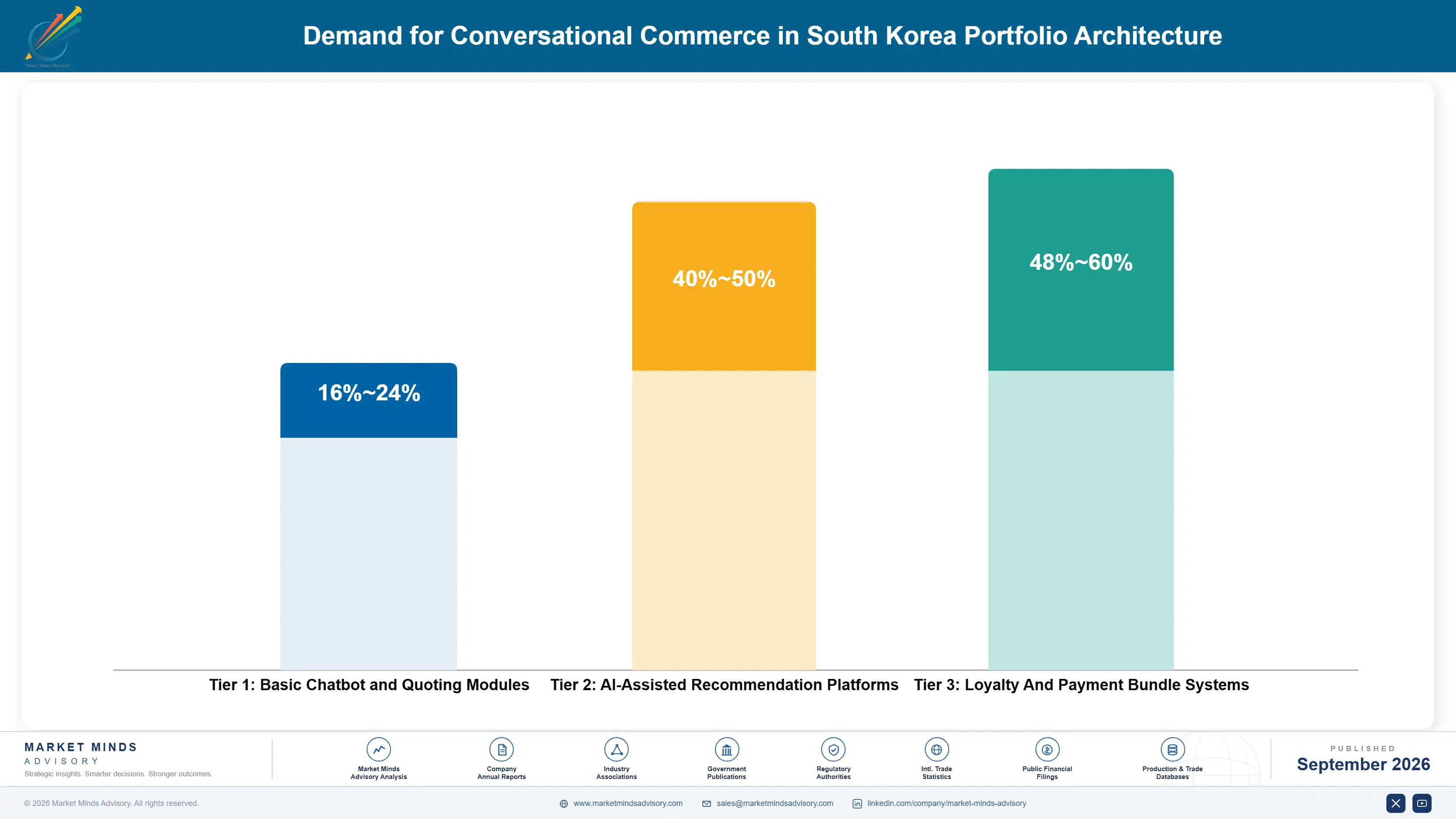
Conversational commerce vendors operate across three margin tiers, from basic chatbot modules carrying thin economics through AI recommendation platforms commanding stronger margin, up to loyalty integration and payment bundle systems capturing the richest gross margins. Volume tiers monetize through per-merchant licensing scale, while premium tiers monetize through AI capability and cross-merchant loyalty bundling. Vendors misjudging tier boundaries risk cannibalizing their own premium accounts over time.
Tension persists between volume growth, which favors standardized low-cost modules sold at scale to smaller price-sensitive merchants, and premium positioning, which favors AI-assisted recommendation and loyalty integration depth commanding materially higher willingness to pay among enterprise accounts. Vendors chasing both simultaneously risk diluting brand positioning across a fragmented buyer base with sharply different purchasing criteria. This dynamic increasingly separates category leaders from smaller, undercapitalized regional challengers.

High-value margin pools concentrate in AI recommendation and cross-merchant loyalty integration, both commanding meaningfully higher gross margin than basic chatbot modules sold without additional capability bundling. Vendors building durable AI model capability and merchant partnerships capture disproportionate margin relative to their merchant count across the broader competitive landscape. Vendors ignoring this shift risk ceding the most profitable accounts. Enterprise accounts increasingly demand this bundling explicitly during vendor evaluation.

Basic Chatbot and Quoting Modules

Standardized chatbot and product discovery tools sold at scale to smaller merchants prioritizing baseline digital capability over advanced AI recommendation, carrying thin unit economics but broad market reach. Replacement of this tier by AI-assisted platforms is accelerating across most new merchant deployments.
Gross Margin: 16-24%

AI-Assisted Recommendation Platforms

AI-powered platforms bundling personalized product discovery and in-chat checkout, commanding stronger recurring revenue and materially higher gross margin than basic modules sold without recommendation capability included. Merchants increasingly request this depth explicitly during vendor evaluation and procurement processes.
Gross Margin: 40-50%

Loyalty And Payment Bundle Systems

Integrated platforms bundling cross-merchant loyalty programs with payment gateway integration, carrying the richest margin profile in the category given urgent commercial demand and expanding buyer willingness to pay. Adoption here is accelerating fastest among enterprise accounts facing urgent competitive pressure.
Gross Margin: 48-60%
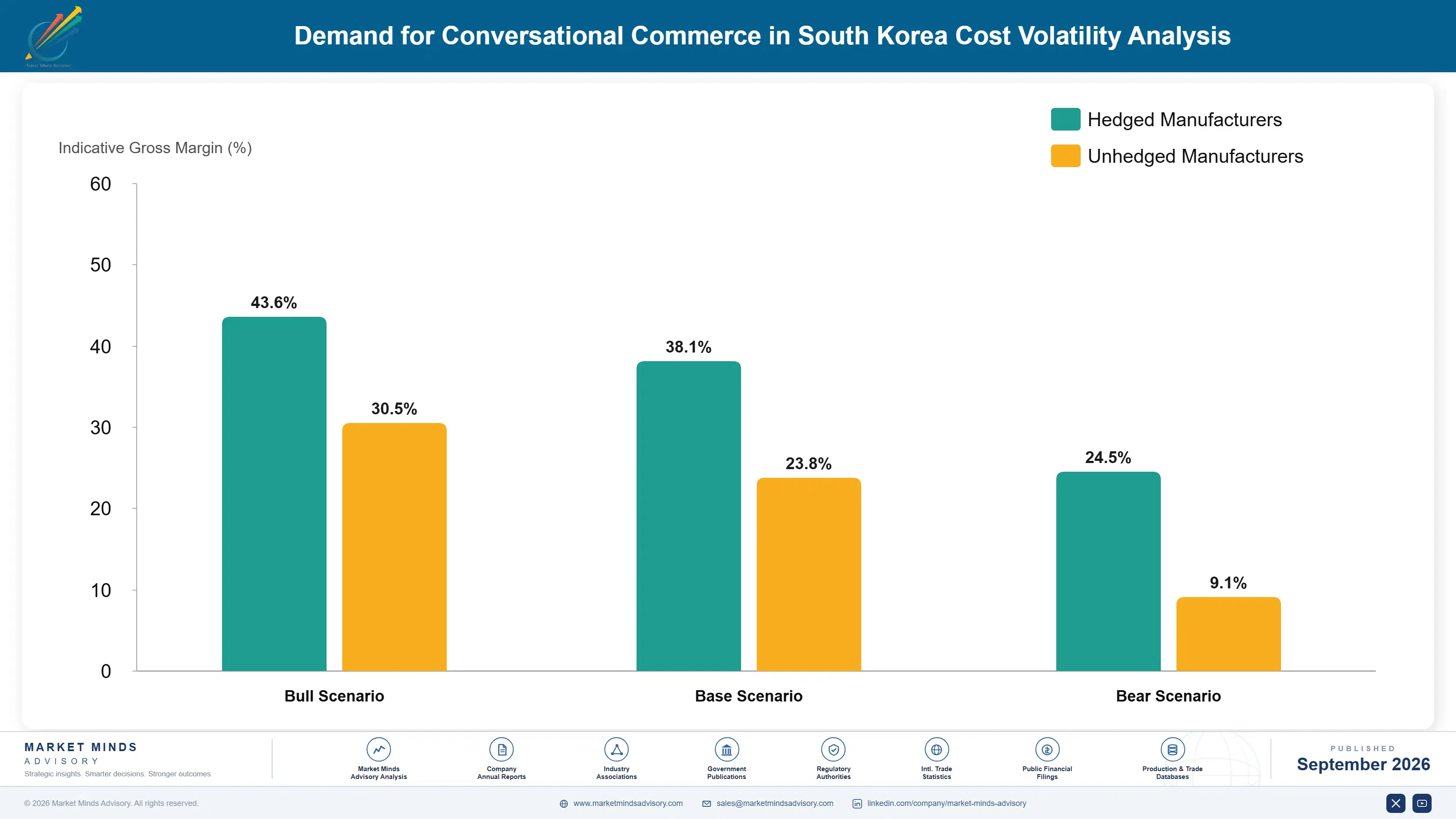
south-korea-conversational-commerce-market-cost-volatility-analysis-1788425984846

High-value Sub-segments and Strategic Watch-out

AI Chatbot-Guided Purchase Recommendation Platforms

Fastest-growing and highest-value segment, combining strong pricing power with accelerating adoption as merchants seek personalized product discovery across chat interfaces nationwide and across broader retail categories. Vendors moving early capture outsized long-term partnership relationships across this segment. Vendors here shape category standards. Precision wins accounts.
Gross Margin: 42-52%

In-Chat Checkout Systems

High-value segment with moderate growth, anchored by urgent commercial pressure from conversion rate optimization, though smaller merchant budgets constrain broader adoption pace relative to enterprise accounts. Long-term account value here rewards vendors investing in AI model depth. Providers expanding here gain volume steadily. Steady growth continues.
Gross Margin: 40-50%

Standard Chatbot and Discovery Software

Volume core of the market, delivering steady merchant counts and established margin, serving as the primary entry point into AI recommendation and checkout integration upgrades over time. Retention in this segment anchors long-term vendor revenue predictability across cycles. Renewal rates here anchor vendor cash flow.
Gross Margin: 24-34%

Legacy Single-Merchant Loyalty Programs

Strategic watch-out segment facing intensifying cross-merchant loyalty competition, pushing merchants toward integrated platform adoption and requiring vendors to differentiate through implementation speed and pricing accessibility. Differentiation now determines which vendors convert this segment successfully ahead. Act early to capture conversion demand. Now watch closely. Truly.
Gross Margin: 0-8%

Renewal Cycles Anchor Merchant Relationships

Conversational commerce software purchasing behaves less like a discretionary spend and more like an annuity tied to seasonal sales campaign cycles, with merchants committing to multi-year platform contracts once initial integration proves conversion improvement rather than treating it as a one-time purchase. Vendors offering bundled AI optimization see meaningfully higher renewal rates than modules-only competitors.
Adoption stickiness varies considerably by end-use vertical. Large enterprise retailers show the deepest stickiness given tightly integrated loyalty program workflows tied to specific merchant systems, while smaller independent merchants see comparatively higher vendor switching as facilities reconfigure vendor relationships more frequently between budget cycles. Mid-market retail chains occupy a middle position, balancing integration continuity against periodic customer-driven system reevaluation. This spread shapes how vendors prioritize account management staffing across merchant size tiers.

Younger merchant technology leadership increasingly favors AI-native platforms purchased as integrated systems rather than assembling point solutions from multiple software vendors, shifting negotiating leverage toward suppliers offering complete recommendation and checkout stacks. Veteran retail operators still favor incremental module upgrades from established suppliers with long reliability track records, creating a generational split vendors must navigate carefully across account types.
Section default visual

Where Conversational Commerce Vendors Focus

These are among the four positions where our research anticipates prominent divergence between winners and laggards over the coming forecast period. Each is grounded in the demand model, the regulatory perimeter, and the announced capacity pipeline.
01 / AI RECOMMENDATION INVESTMENT

Accelerate AI recommendation depth ahead of rivals

Merchants increasingly prioritize conversion improvement over marginal licensing cost, and vendors slow to build deeper AI recommendation capability risk ceding the fastest-growing segment of the market to faster-moving competitors already shipping personalized platforms at scale. Engineering investment here carries real near-term cost, but the segment's growth rate justifies front-loading development spend now rather than waiting for competitive pressure to force the issue later across major merchant accounts. Vendors delaying this investment will find catch-up increasingly expensive as recommendation depth becomes the default buyer expectation.
02 / LOYALTY INTEGRATION SERVICES

Build cross-merchant loyalty capability ahead of rivals

Messaging platforms are formalizing unified loyalty programs spanning multiple merchants, and vendors offering integration services capture a genuinely valuable commercial channel before competitors close the gap on partnership capability. This lever requires dedicated integration engineering investment distinct from standard chatbot product lines, but the addressable loyalty-driven demand remains substantial and largely untapped by generalist platforms. Vendors moving early on loyalty integration will hold a durable advantage as cross-merchant programs expand further across the sector, where repeat purchase economics increasingly determine long-term merchant retention outcomes.
03 / LEGACY INTEGRATION CAPABILITY

Develop connector libraries for common inventory platforms

Legacy system integration complexity currently limits adoption among smaller merchants running older inventory systems lacking standardized data structures needed for real-time chat commerce integration. Vendors building pre-built connector libraries address this friction directly, capturing a genuinely underserved segment before competitors close the technical gap on integration capability. Vendors delaying this investment risk losing legacy-system merchants to competitors offering faster, lower-cost implementation pathways entirely across comparable engagements, where implementation speed increasingly determines vendor shortlist inclusion during procurement evaluation across most retail categories.
04 / PLATFORM DIVERSIFICATION ADVISORY

Offer multi-platform advisory services to merchants

Merchants dependent on a single dominant messaging platform face genuine business continuity risk, and vendors offering multi-platform diversification advisory services capture this underserved segment before larger competitors recognize the commercial opportunity and adjust their own service offerings accordingly. This advisory capability requires genuine cross-platform technical expertise distinct from single-platform integration work, but the addressable risk-conscious merchant segment continues expanding as platform concentration concerns grow. Waiting risks permanent exclusion from this segment as merchant awareness of concentration risk continues increasing across the broader retail technology purchasing landscape.

Engagement Snapshot From the Field

A live engagement with an industry participant carrying material or product regulatory and market exposure ahead of a defining policy shift, showing how our research translates into a defensible multi-year portfolio strategy.
MARKET MINDS ADVISORY · CLIENT ENGAGEMENT SUMMARY
Demand for Conversational Commerce in South Korea Producer Strategic Portfolio Review and Transition Roadmap 2026·Investment Scenario on Demand for Conversational Commerce in South Korea Exposure Evaluation 2025-26
CLIENT PROFILE
A mid-size South Korean fashion retailer operating several physical stores and an existing e-commerce application approached MMA seeking guidance on integrating conversational commerce ahead of a major seasonal sales campaign targeting younger mobile-first consumers across its core market segments. The client's marketing leadership had limited prior experience evaluating conversational commerce vendors relative to the traditional app development it had historically pursued.
STRATEGIC CHALLENGE
The client faced declining app download rates among younger consumers who increasingly preferred discovering and purchasing products directly within KakaoTalk rather than separate applications. Leadership needed a vendor selection framework balancing AI recommendation quality against integration timeline ahead of the seasonal campaign launch date. Delayed action risked losing meaningful seasonal sales revenue to competitors already offering chat-native purchase options.
MMA APPROACH
MMA conducted a vendor capability audit across leading conversational commerce platforms alongside interviews with the client's marketing leadership to define selection criteria weighted toward recommendation accuracy and checkout conversion. The engagement benchmarked candidate vendors on integration timeline, AI capability, and total deployment cost across comparable engagements. Recommendations were validated against comparable conversational commerce launches completed by peer fashion retailers facing similar timeline pressure.
KEY FINDINGS
  1. Vendors offering pre-built payment gateway integrations reduced implementation timeline meaningfully compared to platforms requiring custom checkout development for the seasonal campaign deadline.
  2. AI recommendation accuracy proved decisive in vendor selection given the client's exposure to younger consumers expecting personalized product suggestions in chat. This capability proved especially valuable given the campaign's tight seasonal timing requirements.
  3. Conversion rate testing revealed the client's existing app-only distribution was leaving meaningful sales opportunity on the table among mobile-first shoppers. This gap discovery reshaped the client's broader digital distribution investment priorities.
  4. Vendors with proven implementation methodologies reduced deployment risk considerably compared to newer entrants lacking comparable enterprise retailer deployment history. This factor ultimately outweighed marginal pricing differences between otherwise comparable finalist vendors.
CLIENT PROFILE
A mid-size South Korean fashion retailer operating several physical stores and an existing e-commerce application approached MMA seeking guidance on integrating conversational commerce ahead of a major seasonal sales campaign targeting younger mobile-first consumers across its core market segments. The client's marketing leadership had limited prior experience evaluating conversational commerce vendors relative to the traditional app development it had historically pursued.
STRATEGIC CHALLENGE
The client faced declining app download rates among younger consumers who increasingly preferred discovering and purchasing products directly within KakaoTalk rather than separate applications. Leadership needed a vendor selection framework balancing AI recommendation quality against integration timeline ahead of the seasonal campaign launch date. Delayed action risked losing meaningful seasonal sales revenue to competitors already offering chat-native purchase options.
MMA APPROACH
MMA conducted a vendor capability audit across leading conversational commerce platforms alongside interviews with the client's marketing leadership to define selection criteria weighted toward recommendation accuracy and checkout conversion. The engagement benchmarked candidate vendors on integration timeline, AI capability, and total deployment cost across comparable engagements. Recommendations were validated against comparable conversational commerce launches completed by peer fashion retailers facing similar timeline pressure.
KEY FINDINGS
  1. Vendors offering pre-built payment gateway integrations reduced implementation timeline meaningfully compared to platforms requiring custom checkout development for the seasonal campaign deadline.
  2. AI recommendation accuracy proved decisive in vendor selection given the client's exposure to younger consumers expecting personalized product suggestions in chat. This capability proved especially valuable given the campaign's tight seasonal timing requirements.
  3. Conversion rate testing revealed the client's existing app-only distribution was leaving meaningful sales opportunity on the table among mobile-first shoppers. This gap discovery reshaped the client's broader digital distribution investment priorities.
  4. Vendors with proven implementation methodologies reduced deployment risk considerably compared to newer entrants lacking comparable enterprise retailer deployment history. This factor ultimately outweighed marginal pricing differences between otherwise comparable finalist vendors.
RECOMMENDED STRATEGY
Phase 1: Phase one selected a vendor with proven AI recommendation capability and established payment gateway integration ahead of the seasonal campaign deadline. Phase 2: Phase two conducted parallel testing comparing chat-native conversion against the client's existing app funnel to validate improvement before scaling. Results informed final campaign creative and messaging adjustments before launch. Phase 3: Phase three formalized ongoing recommendation model tuning and cross-merchant loyalty exploration as standard quarterly optimization operating procedure. Marketing teams adopted the cadence as standard quarterly review policy.
OUTCOME
Within two quarters, the client reported (client-reported, unverified by MMA) meaningful conversion improvement among younger shoppers and successful seasonal campaign performance, validating the vendor selection framework MMA recommended ahead of launch. Leadership extended the conversational commerce budget for the following fiscal year based on these results.

Frequently Asked Questions

Foundational context covering the market sizes, CAGR, scope, country, region and competition that inform every finding below. This section is provided to cover basics and most often pre-purchase conversations, answered from the MMA Primary Research Dataset.

What is the current size of the Demand for Conversational Commerce in South Korea?

The market was valued at approximately 2.3 billion dollars in 2025, driven by KakaoTalk's near-universal penetration and AI chatbot-guided purchase recommendation adoption across the nation today.

How large will the Demand for Conversational Commerce in South Korea be by 2036?

The market is projected to reach roughly 9.3 billion dollars by 2036, more than tripling from its 2026 base as in-chat checkout expands merchant adoption broadly.

What is the CAGR for the Demand for Conversational Commerce in South Korea 2026 to 2036?

The market is forecast to grow at a compound annual rate of approximately 13.5 percent between 2026 and 2036, supported by AI recommendation depth and payment infrastructure maturity.

Which segment is growing fastest?

AI Chatbot-Guided Purchase Recommendation Platforms lead segment growth at approximately 19.0 percent annually, outpacing the broader market as personalized product discovery expands across categories rapidly.

Who are the major companies in the Demand for Conversational Commerce in South Korea?

Kakao Commerce, Naver Shopping, Coupang, NHN Commerce, and Danggeun Market lead the competitive landscape, collectively holding the largest position on a transaction basis nationwide currently.

Which country is growing fastest?

South Korea itself remains the fastest-growing market given the report's domestic focus, with growth concentrated in AI recommendation and in-chat checkout adoption specifically today across categories.

Report Segmentation Architecture

The full report scope spans multiple orthogonal segmentation dimensions, with cross-tabulated demand data provided for each dimension pair. Coverage extends further to regional breakdowns, trend trajectories, and the competitive detail needed to support segment-level decision-making.

By Software Type

    By End-Use Retail Category

      By Commercial Deployment Model

        By Region

        • North America
        • Western Europe
        • East Asia
        • South Asia and Pacific
        • Latin America
        • Middle East and Africa
        • Eastern Europe

        Scope, Methodology, and Coverage

        Every figure in this report is reproducible from documented input assumptions. The scope below maps the historical period, the forecast horizon, the segmentation dimensions, and the countries covered, alongside the underlying primary and qualitative methodology.
        Historical Period
        2020 to 2025
        Forecast Period
        2026 to 2036
        Base Year
        2025 (USD billions; MMA Primary Research Dataset, September 2026)
        Market Definition
        This report covers software platforms enabling AI-guided product discovery and transaction completion within messaging applications for South Korean consumers. It excludes traditional e-commerce marketplace applications, social media advertising platforms, and general customer service chatbots not tied to purchase completion.
        Quantitative Units
        USD billions, percent CAGR, percent share
        Segmentation Dimensions
        Software type, end-use retail category, commercial deployment model
        Regions Covered
        North America, Western Europe, East Asia, South Asia and Pacific, Latin America, Middle East and Africa, Eastern Europe
        Countries Covered
        South Korea, United States, Canada, Germany, France, United Kingdom, China, Japan, India, Australia, Indonesia, Vietnam, Brazil, Mexico, United Arab Emirates, Saudi Arabia, South Africa, Poland, Czech Republic, Hungary
        Key Companies Profiled
        Kakao Commerce, Naver Shopping, Coupang, NHN Commerce, Danggeun Market, Interpark Commerce, Musinsa, Ably Corp, Zigzag, Brandi, 11st, Gmarket, TMON, WeMakePrice, Yogiyo Commerce, Baemin Commerce, SSG.com, Lotte On, CJ OliveYoung Commerce, Kurly
        Quantitative Methodology
        Primary survey, n=3,800 respondents, Q4 2025, six countries; demand-side model with trade association cross-validation
        Qualitative Methodology
        47 expert interviews, Q4 2025; applied to validate demand model assumptions, identify emerging dynamics, and assess competitive positioning
        Report Format
        PDF and XLSX data workbook (Word format preview document)
        Publisher
        Market Minds Advisory
        Report Code
        MMA-2026-TEC-931
        Published
        September 2026
        Contact
        sales@marketmindsadvisory.com | www.marketmindsadvisory.com

        Purchase the full Demand for Conversational Commerce in South Korea Report (2026 to 2036).

        This report delivers a comprehensive assessment of the South Korean conversational commerce market, spanning market sizing, segmentation, competitive positioning, and regional demand dynamics through 2036. It profiles twenty leading vendors across recommendation, checkout, and loyalty integration categories, benchmarking each on a consistent transaction basis. Readers gain a detailed view of revenue levers, cloud cost exposure, and margin architecture across the category. The analysis draws on primary survey data, expert interviews, and company disclosures to support strategic planning and investment decisions across the full ten-year forecast period ahead.
        Ten-year market sizing and forecast model
        Six-segment MECE software type framework overview
        Twenty-company competitive benchmarking dataset included fully
        Seven-region demand share and CAGR analysis
        Cloud and staffing cost exposure mitigation playbook
        Anonymized client chat commerce case study included

        Built For The People Who Decide

        From boardroom strategy to bench-side execution, this report is read cover-to-cover by leaders shaping the next decade of their industry, turning demand scenarios, market dynamics and valuation benchmarks into decisions.
        CXOs/ Presidents/ VPs/ Managers
        M&A and Corporate Development
        Strategy Teams and R&D Heads
        Procurement and Product Directors
        Regulatory and Compliance Leaders
        Investor Relations and Equity Analysts