Market Minds Advisory
South Asia Geosynthetics Market

South Asia Geosynthetics Market: Specified by Engineers, Priced Out by Contractors

Road and canal codes across the region now permit geosynthetic reinforcement, yet the buying decision sits with a contractor bidding lowest capital cost who never sees the whole-life saving an engineer calculated.

Lead Analyst

Bilal Shaikh

Published

September 2026

Make Smarter Decisions with Customized Research Insights

Request a free sample report and evaluate market opportunities, growth trends, and competitive dynamics relevant to your business needs.

2025 MARKET VALUE$1.3BMarket Size 2025
2036 FORECAST VALUE$3.7BBase Case , 2026 to 2036
CAGR 2026 TO 20369.8 %Bull 11.0% / Bear 8.6%
INCREMENTAL OPPORTUNITY$2.3BNet 10- year value creation
EXPANSION MULTIPLE2.54x2036 value over 2026 base
Strategic Levers
M&A Pipeline
Regional Outlook
Country Rankings
Competitive Intelligence
Segmental Deep-dive
Call-Us : 91 93563 13602

Executive Snapshot and Market Trajectory

The engineering case was settled years ago and the commercial case still is not. Road and canal specifications across the region now permit geosynthetic reinforcement, but the contractor bidding lowest capital cost carries the decision and never sees the whole-life saving that justified the specification originally.
Geogrids grow fastest at 14.7% because pavement reinforcement removes around 30% of aggregate thickness, and aggregate has become genuinely scarce and expensive across much of northern India. That is a capital cost argument rather than a durability one, which is exactly why it works with the buyer who actually decides. Durability arguments have been failing for two decades. The buyer changed nothing; the argument did.
Canal lining is the largest untapped volume anywhere in the region. Unlined irrigation canals lose around 38% of conveyed water to seepage, and state irrigation departments rather than highway agencies hold that budget entirely. Bangladesh grows fastest of any country at 15.8% on embankment and river training work, funded largely through climate adaptation programmes rather than ordinary public works. Neither budget behaves like a highway programme, and neither has an incumbent supplier relationship worth defending.
Market Definition
Geosynthetic products supplied across South Asia, covering geotextiles, geomembranes, geogrids, geocells, geosynthetic clay liners, and geocomposite drainage products. Measured at manufacturer selling value for material consumed within India, Pakistan, Bangladesh, Sri Lanka and Nepal, whether domestically produced or imported. Excludes natural fibre erosion control products, conventional drainage pipe, concrete canal lining, installation and civil engineering services, and geotechnical design consultancy.
Base Year Value
$1.3B in 2025 (MMA Primary Research Dataset, August 2026)
Forecast Period
2026 to 2036, eleven discrete annual values
CAGR
9.8% base case. Bull 11.0%. Bear 8.6%.
Fastest Growth Segment
Geogrids: 14.7% CAGR
Fastest Growth Country
Bangladesh: 15.8% CAGR
Fastest Growth Region
South Asia and Pacific: 11.8% CAGR
Largest Region
South Asia and Pacific: 88% of 2025 global value
Market Leaders
Garware Technical Fibres, Strata Geosystems, TechFab India, Officine Maccaferri, SKAPS Industries. Source: MMA Primary Research Dataset, July 2026.
Primary Survey
n=3,800 procurement and R&D decision-makers, Q4 2025, six countries
Methodology
Demand-side build-up, cross-validated against public data, 47 expert interviews

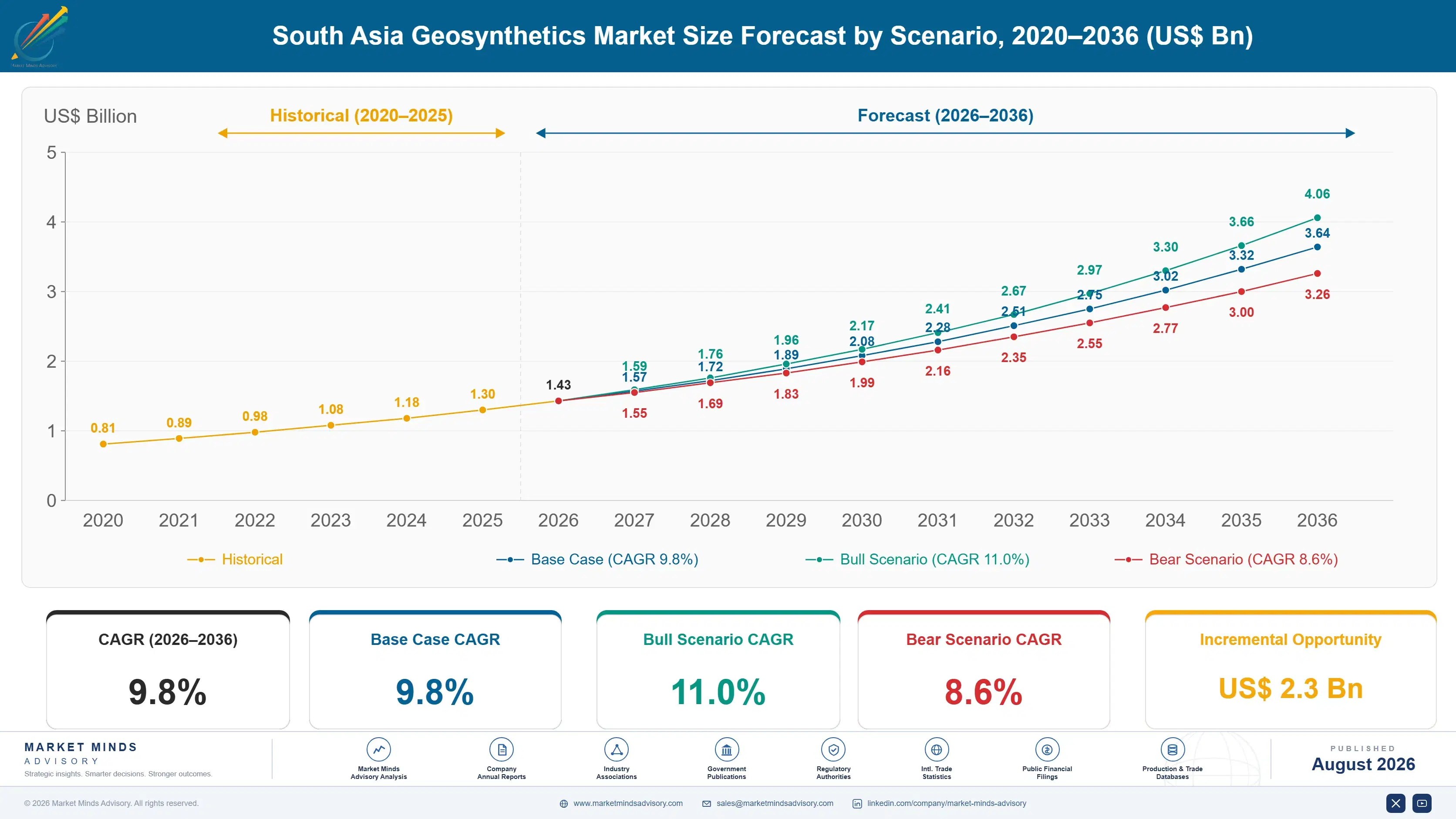
South Asia Geosynthetics Market Forecast Scenarios

south-asia-geosynthetics-market-trends-size-forecast-scenario-1787595278989
Growth ran near 8.4% between 2020 and 2025, driven almost entirely by national highway construction rather than by any broadening of application. Specification adoption moved considerably faster than actual consumption, because permitting a material in a code does not put it into a contractor's bid. Aggregate scarcity in northern India began changing that calculation late in the period, and it changed it on cost grounds rather than on engineering ones.
Base case 9.8% rests on three mechanisms. Geogrid demand grows at 14.7% as aggregate scarcity makes the 30% layer thickness reduction a capital cost saving rather than a durability upgrade. Canal lining programmes funded by state irrigation departments address seepage losses near 38% across unlined systems. And Bangladesh grows at 15.8% on embankment and river training work funded through climate adaptation rather than ordinary public works budgets. All three run on different funding cycles entirely.
The bull case at 11.0% assumes procurement reform that evaluates whole-life cost rather than lowest capital bid on public works, which would change the buying decision fundamentally. The bear case at 8.6% is continued under-specification passing uncontested through a testing infrastructure of only around 21 accredited laboratories, which lets non-compliant product win on price indefinitely.

Where the Specification Meets the Bid Sheet

Nothing about the engineering here is contested. Reinforcement beneath a pavement lets a designer take out around 30% of aggregate thickness for the same performance, lining a canal stops most of the seepage that unlined systems lose, and separation layers keep subgrade out of granular fill. All of it sits in Indian Roads Congress and irrigation guidance already. The problem has never been whether the material works.
TOP FIVE CONCENTRATION34%Low barriers to entry keep the supplier field wide
POLYMER COST SHARE64%Resin input share of finished product cost structure
CANAL SEEPAGE LOSS38%Irrigation water lost through seepage in unlined canals
ACCREDITED TEST LABORATORIES21Facilities able to certify full product specification across the region
PAVEMENT LAYER REDUCTION30%Aggregate thickness avoided using reinforcement beneath a road
DESIGN SERVICE LIFE60 yearsLife assumed for buried reinforcement in structural design
The problem is who decides. A public works contract awarded on lowest capital bid puts the geosynthetic decision in front of a contractor who sees an added line item, not the maintenance saving over 60 years of design life that persuaded the engineer. Whole-life evaluation exists in policy and rarely survives contact with a tender committee. That single procurement fact explains adoption here better than any awareness argument does.
Aggregate scarcity has finally changed the conversation. Sand and stone have become genuinely expensive across northern India, and a 30% reduction in granular layer thickness now shows up as a capital saving in the contractor's own bid rather than as a benefit accruing to somebody else later. Geogrids grow at 14.7% on that arithmetic, which is a cost argument rather than a durability one.
"Two decades of technical seminars explaining design life to people who are not paid for design life. The aggregate price rise did more for geogrid adoption in three years than the entire industry's education effort managed in twenty, because it finally put the saving in the right person's column."
Director, Infrastructure Materials and Geotechnical Practice · MMA Construction and Industrial Equipment Practice · August 2026

Market Trends

Aggregate scarcity turning reinforcement into a capital saving

Sand and crushed stone pricing has risen sharply across northern India as quarrying restrictions tightened and haul distances lengthened, which changes the geogrid argument completely. Removing around 30% of granular layer thickness used to be a durability benefit accruing to a maintenance budget somebody else held. It is now a capital cost saving inside the contractor's own bid, and that is why geogrids grow at 14.7% after twenty years of technical persuasion achieved comparatively little. Manufacturers still leading with design life arguments are addressing a benefit the bidder cannot capture and will not pay for.
Market Impact: Addresses 38% canal seepage loss
Testing capacity gap letting under-specified product win

Around 21 accredited laboratories across the region can certify full geosynthetic specification, against thousands of projects specifying the material annually. The practical result is that delivered product frequently falls short of what was specified and nobody establishes it before installation. That caps what a compliant manufacturer can charge, because the bid comparison treats a certified product and an under-specified one as equivalent offers against the same line item. Development bank funded work is the exception, because compliance there is genuinely verified before installation, and manufacturers who can pass that check earn considerably more for the same material.
Market Impact: Bangladesh growing at 15.8% annually

Market Opportunities and Growth Drivers

Canal lining programmes addressing very large seepage losses

Unlined irrigation canals across the region lose around 38% of conveyed water to seepage, and state irrigation departments have begun lining programmes at meaningful scale using geomembranes and geosynthetic clay liners. The budget sits entirely outside the highway agencies that most manufacturers sell to, which means the commercial relationships have to be built separately. Water scarcity rather than construction activity drives the funding, so the demand is far less correlated with the general infrastructure cycle. Volume potential across the region exceeds the entire current road application. Water scarcity is the driver, not construction spending.
Market Impact: Ignores 60 year design life

Bangladeshi embankment work funded through climate adaptation

Bangladesh grows fastest of any country at 15.8%, on river training, embankment protection and coastal defence work funded largely through climate adaptation programmes rather than ordinary public works budgets. That funding source matters commercially, because adaptation programmes generally specify performance and design life explicitly and evaluate against them, which removes the lowest capital bid problem that limits adoption elsewhere across the region. Geotextiles and geocells carry most of that volume. Programme managers evaluated on outcomes rather than tender savings make the buying decisions, which is a considerably better commercial audience than a contractor bidding capital cost.
Market Impact: Resin carries 64% of cost

Market Restraints and Challenges

Lowest capital bid procurement defeating whole-life economics

Public works contracts awarded on lowest capital cost put the geosynthetic decision in front of a contractor who carries the added line item but captures none of the maintenance saving across a 60 year design life. The root cause is procurement design rather than any lack of technical awareness. Commercially it caps adoption regardless of engineering merit. Capital cost arguments such as aggregate reduction are the mitigation that actually works, and design-build contracting is the procurement reform participants keep asking for. Neither is within a manufacturer's control. Manufacturers can only choose which argument they make.
Market Impact: Removes 30% of aggregate thickness

Polymer pricing exposure at import parity across the region

Polypropylene and polyethylene resin carries around 64% of finished product cost, and regional producers buy at import parity pricing regardless of where the resin physically originates. The root cause is that regional polymer capacity is priced against international markets rather than against local demand. Commercially it means currency movements hit margin directly with no domestic buffer available. Forward resin contracting and product redesign toward lower polymer content are the mitigations manufacturers are pursuing. Neither removes the exposure completely, and public tender pricing offers no escalation mechanism at all against a currency move mid-contract.
Market Impact: Only 21 accredited laboratories regionally
3 additional market trends, 4 additional growth drivers, and 2 additional restraints and challenges are covered in the full report. Contact sales@marketmindsadvisory.com to access the complete intelligence.

Segment CAGR and Growth Architecture

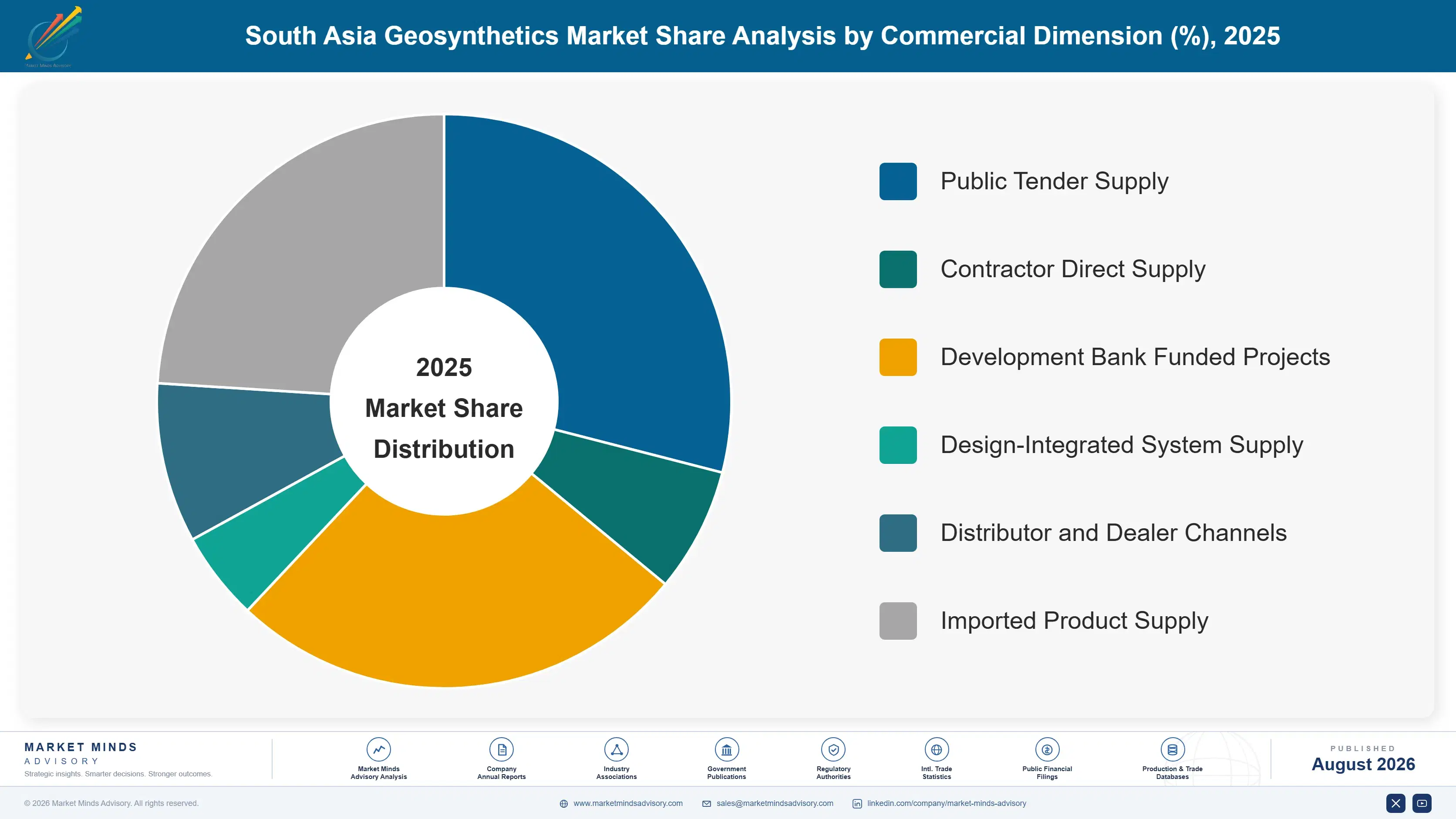
Six segments are split by product type, because product type determines the polymer and manufacturing process, the engineering function performed, the specification a designer writes and the budget holder who ultimately pays for it. Weight classes and polymer variants sit inside each product type. Application and channel are handled separately in the framework instead.
south-asia-geosynthetics-market-trends-market-share-analysis-1787595279547

Geogrids

Growing at 14.7%, half again the market rate of 9.8%, geogrids reinforce granular layers beneath pavements and retaining structures, letting a designer remove around 30% of aggregate thickness for equivalent performance. Aggregate scarcity across northern India has converted that from a durability benefit into a capital cost saving inside the contractor's own bid, which is why adoption accelerated after two decades of comparatively slow progress. Uniaxial products serve retaining walls and steep slopes while biaxial and triaxial products carry the pavement volume. Domestic manufacturing capacity has expanded considerably to serve the demand. Engineering support during design decides most specifications well before any tender is issued. Importers arrive after that and can only bid against a specification somebody else shaped.
CAGR 14.7%

Geocells

At 12.2% geocells confine granular fill within a three-dimensional honeycomb structure, which allows weaker local material to be used where imported aggregate would otherwise be required. That economic case is particularly strong across rural road programmes and hill roads where haul distances make aggregate genuinely expensive to deliver. Bangladeshi embankment and river training work uses them extensively for slope protection under climate adaptation funding. The products require correct installation to perform, and installation quality across the region varies considerably more than product quality does. Installation training and site supervision therefore matter more here than product certification does, which is an unusual commercial position and one that favours manufacturers with field engineering capability over pure converters.
CAGR 12.2%
Full segment breakdown across 6 segments available in the complete report.

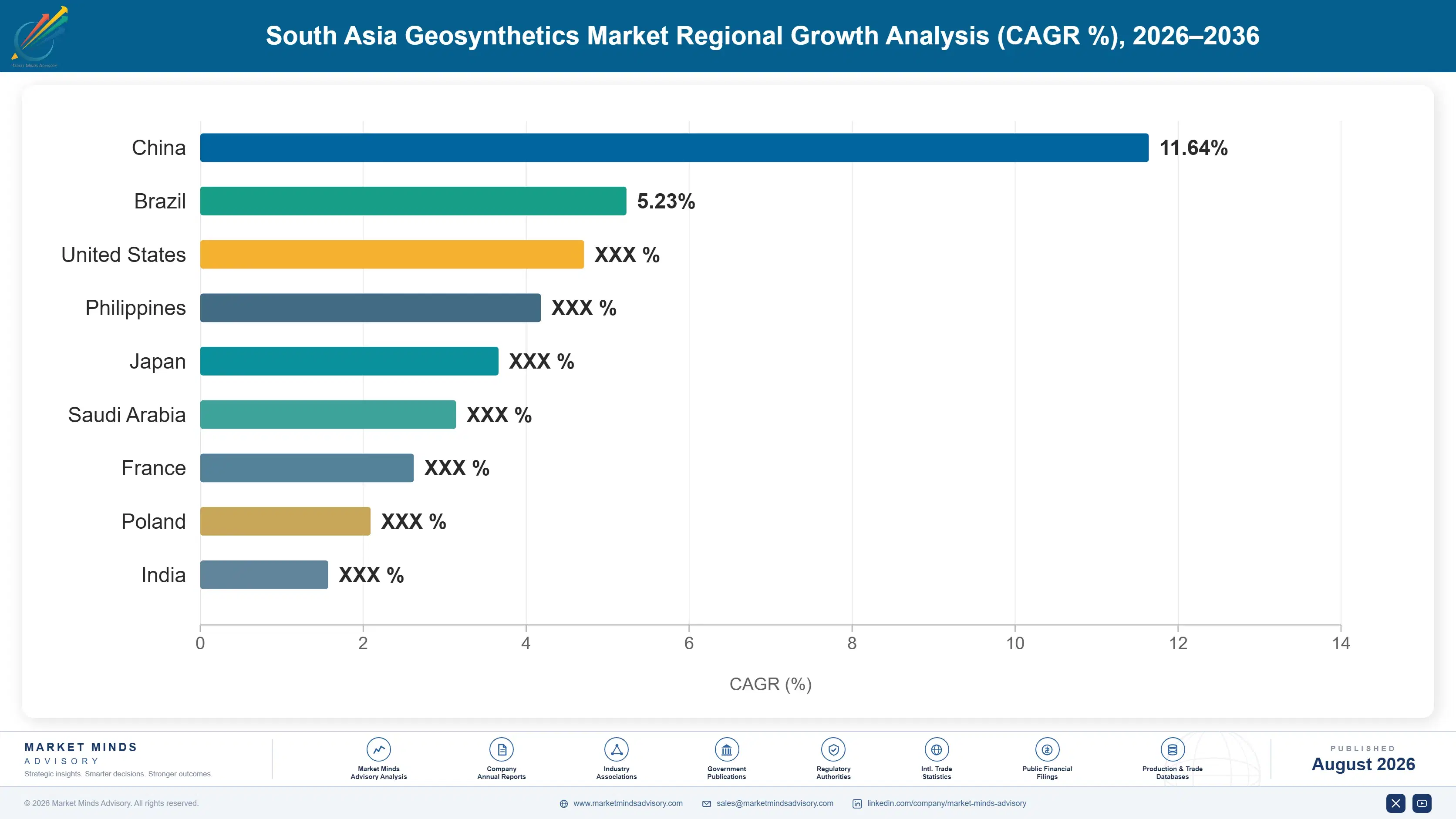
Regional Architecture and Country Demand Map

South Asia and Pacific holds 88% of value because the market is defined as material consumed within South Asia. The remaining shares represent value captured by international manufacturers supplying imported product into regional projects from their home bases. All other regional shares fall outside the standard bands for that reason.

North America

Share sits at 2%, far below the standard band, because this market is scoped to material consumed within South Asia and North American participation is limited to imported specialty product. American manufacturers supply high specification geomembranes and geosynthetic clay liners into landfill and industrial containment projects where international certification is required by a funding agency. Volume is small and pricing is high. Growth at 9.0% tracks the containment applications rather than the road and canal volume driving the regional total. Landfill and industrial containment specifications generally follow international standards precisely, which removes the under-specification problem affecting most regional public procurement and supports the pricing these manufacturers achieve. Volumes stay small regardless.
Share: 2% | CAGR: 9.0% (2026 to 2036)

Western Europe

At 2% the share falls well outside the standard band for the same scope reason, since consumption is measured within South Asia. European manufacturers supply engineered geogrids and specialty geocomposites into projects funded by multilateral development banks that specify to European standards explicitly. Those specifications are written to be enforceable, which removes the under-specification problem affecting most regional procurement. Volume is modest but the pricing is the strongest available anywhere in the regional market. Growth of 8.2% reflects that narrow niche. Design capability supplied alongside the material is the real differentiator, and it is what keeps European participation viable against pricing it could never otherwise match regionally. Nothing else would sustain it.
Share: 2% | CAGR: 8.2% (2026 to 2036)
Regional intelligence for 5 additional markets available in the complete report: East Asia, South Asia and Pacific, Latin America, Middle East and Africa, Eastern Europe. Contact sales@marketmindsadvisory.com.
south-asia-geosynthetics-market-trends-country-cagr-analysis-1787595280081

Four Moves Around the Bid Sheet

The engineering argument has been won for twenty years and adoption still lags, because the contractor holding the decision never captures the benefit an engineer calculated. Every move that works reframes the material as a capital cost saving, or reaches a budget holder who is evaluated on outcomes rather than on tender price. Both routes work now.

Sell aggregate reduction rather than design life

A geogrid removing around 30% of granular layer thickness is a capital saving in the contractor's own bid wherever aggregate has become expensive, which is now most of northern India. Selling it as a 60 year durability benefit puts the value in a maintenance budget the bidder does not hold and never sees. The arithmetic is identical either way, but only one version survives a tender committee, and geogrids grow at 14.7% on the version that does. Rebuilding sales material around state level aggregate pricing is cheap and it reaches the person holding the decision.
Market Impact: Removes 30% of the required aggregate layer thickness

Build the irrigation department channel separately

Canal lining addresses seepage losses near 38% and the budget sits with state irrigation departments rather than the highway agencies most manufacturers already sell to. Those buyers evaluate water saved rather than tender price, which removes the lowest capital bid problem entirely. Building that channel takes dedicated commercial resource and a different technical argument, and it reaches volume potential larger than the entire current road application across the region. The relationships take time to build but there is no incumbent to displace, which is a considerably easier position than competing for highway volume.
Market Impact: Targets recovery of the 38% seepage loss annually

Pursue development bank funded specification work

Projects funded by multilateral development banks specify to enforceable international standards and check compliance, which removes the under-specification problem that caps pricing across the rest of the market. Those projects pay 25% or more above domestic tender pricing for certified product. Getting onto approved supplier lists takes documentation work rather than capital investment, and most regional manufacturers have never attempted it seriously at all. Compliance is verified before installation on that work, which means a certified manufacturer competes against a much smaller field than it faces in ordinary public tendering across the region.
Market Impact: Earns roughly 25% above domestic tender pricing levels

Invest in accredited testing and publish results

With only around 21 accredited laboratories serving the region, delivered specification is rarely verified and compliant product competes against under-specified material on equal terms in every bid. A manufacturer funding accredited testing and publishing full results changes the comparison from price to compliance, at a cost well under 1% of revenue. It also gives an engineer something enforceable to write into a specification. That is a small investment against a problem which currently caps what every compliant manufacturer in the region can charge for the material it actually delivers. Nobody else publishes it.
Market Impact: Costs under 1% of annual manufacturing revenue overall

Who Controls the Margin Pool

Participation is measured on annual production volume supplied into South Asian projects, and the top five hold 34%. Concentration is low because manufacturing barriers are modest for standard woven geotextile and basic geogrid product, and imported material competes directly on price. Garware Technical Fibres and Strata Geosystems lead on domestic manufacturing scale combined with engineering support that importers cannot match on the ground. The gap to challengers is engineering presence rather than manufacturing capability.
Competition runs on three fronts. Delivered price decides most public tender awards outright, since weak enforcement makes certified and under-specified product look equivalent on paper. Engineering support decides the specification itself, well before the tender. And certification depth decides access to development bank funded work where compliance is genuinely checked. Getting into the design conversation early is worth more than any pricing move made later.

Pressure ahead comes from imported material at prices domestic producers cannot match on standard product, and from aggregate scarcity pulling demand toward engineered geogrids where support matters. Expect domestic manufacturers to move up the specification ladder rather than defend commodity volume. Rankings shift on who builds irrigation department relationships first. Concentration should rise modestly as specification work separates the field.
south-asia-geosynthetics-market-trends-company-positioning-matrix-1787595280598

Competitive Moat and Risk Dimensions

GARWARE TECHNICAL FIBRES

Moat: Domestic manufacturing with engineering support

Manufacturing scale within India combined with field engineering capability lets the company influence specification before a tender is written, which is where the commercial battle is actually decided in this market. Importers competing purely on delivered price arrive after the specification exists and can only bid against it, which is a considerably weaker position to occupy.
GARWARE TECHNICAL FIBRES

Risk: Standard product price exposure

Commodity woven geotextile and basic geogrid volume faces direct competition from East Asian imports at pricing that domestic manufacturing cannot match, and weak specification enforcement means the buyer often treats the two as equivalent. That exposure is a procurement problem rather than a product one, which makes it very difficult to address commercially.
STRATA GEOSYSTEMS

Moat: Reinforced soil structure design capability

Design capability in reinforced soil retaining structures and steep slopes puts the company into projects as a design partner rather than a material supplier, which changes both the margin and the competitive comparison entirely. That capability takes years to build and is genuinely difficult for an importer or a commodity manufacturer to assemble from a standing start.
STRATA GEOSYSTEMS

Risk: Highway programme cycle dependence

Heavy weighting toward national highway construction ties volume to a public capital programme whose pace is decided politically rather than commercially, and which has slowed sharply before. Canal lining and climate adaptation funded work offer different funding cycles but require commercial relationships with budget holders the company has not historically served.

Players Tracked

Prominent Players

Garware Technical Fibres
Strata Geosystems
TechFab India
Officine Maccaferri
SKAPS Industries

Other Key Players

Solmax
Naue
HUESKER
Tensar
Agru
Atarfil
Terram
Global Synthetics
Reliance Industries
Supreme Industries
Emmbi Industries
Kobond
Taian Modern Plastic
Shandong Hongxiang
Ace Geosynthetics

Recent Developments

MAY 2026

State irrigation department tenders large canal lining programme

A state irrigation department tendered a canal lining programme covering several hundred kilometres of distributary network, specifying geomembrane and geosynthetic clay liner systems against seepage reduction targets. Evaluation weighted water saved over conveyance losses rather than material cost per square metre. Material cost per square metre was a secondary criterion.
Signal: Irrigation budgets evaluate outcomes rather than tender price, which changes the commercial argument completely for manufacturers
DECEMBER 2025

Highway authority accepts geogrid layer reduction in pavement design

A highway authority accepted reduced granular layer thickness where geogrid reinforcement is used, formalising a design approach that had previously required project-specific approval. Contractors could then take the aggregate saving directly into their bids rather than treating the material as added cost. Approval no longer requires project by project justification.
Signal: Design acceptance converts a durability argument into a capital saving the bidder actually captures in their own bid
AUGUST 2025

Development bank project requires accredited third party testing

A multilateral development bank funded embankment project required accredited third party testing of delivered geosynthetic material against full specification before installation. Several suppliers who had won on price could not produce compliant material and were replaced during construction. Compliant manufacturers gained the volume mid-project instead.
Signal: Enforcement rather than specification is what actually separates compliant manufacturers from everybody else here in this market

Resin, Currency and Freight

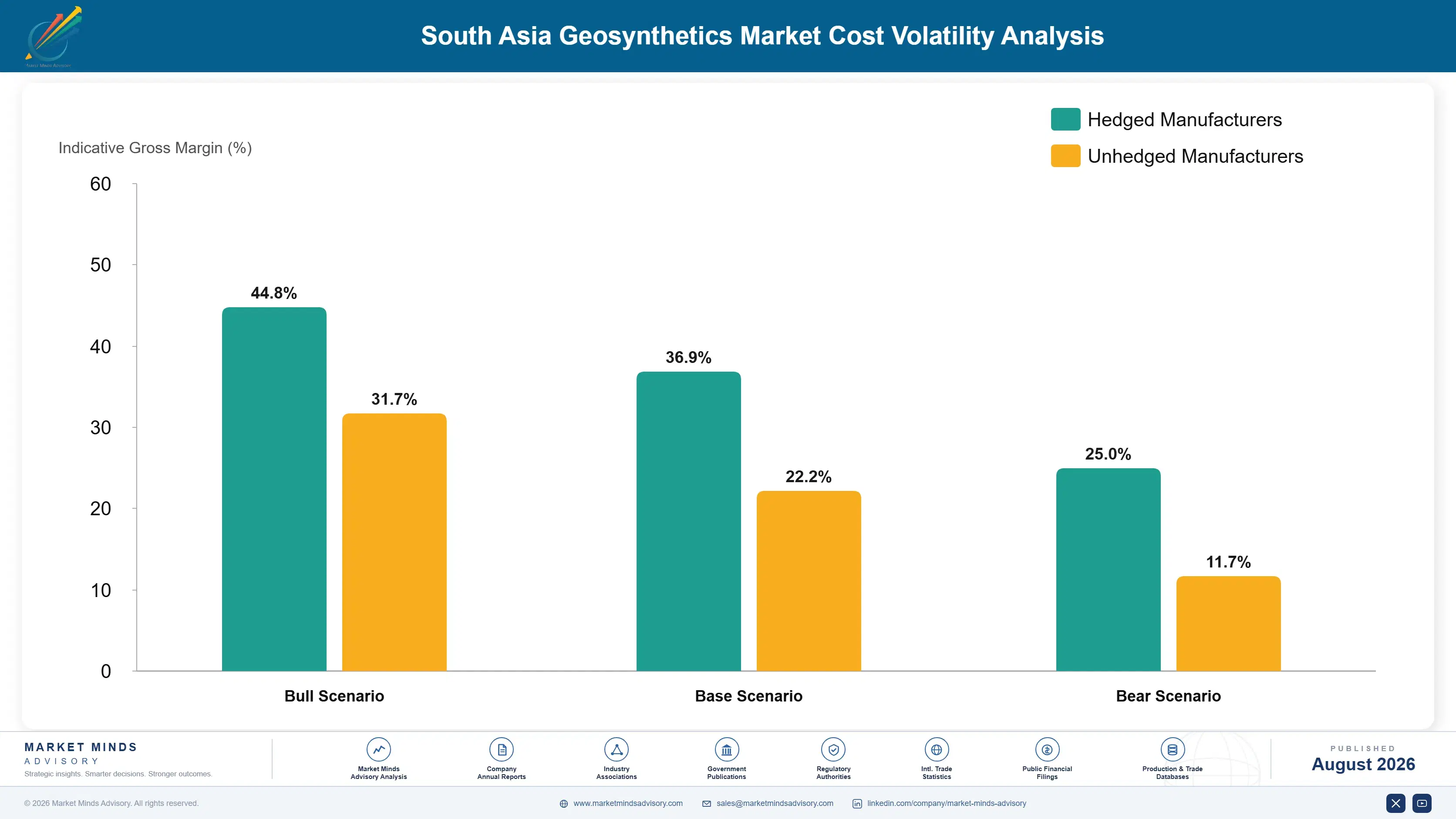
Polypropylene and polyethylene resin carries around 64% of finished product cost, purchased at import parity pricing whether it originates from domestic crackers or overseas. Additives, stabilisers and carbon black take about 8%. Conversion energy, labour and plant overhead account for around 15%. Inland freight absorbs the balance, and it matters considerably given how bulky most geosynthetic product is relative to its value.
Polymer pricing moved sharply through 2022 alongside energy costs and again with currency movements against the dollar, per IEA petrochemical reporting and Reliance Industries Annual Report 2025 disclosures on polymer realisations. Manufacturers holding fixed price tender commitments absorbed the increase entirely, and several regional producers reported margin compression through that period with no contractual mechanism available to recover it. The exposure has not been addressed since, and tender structures remain unchanged.

Exposure divides on contract structure rather than on scale. A manufacturer supplying against fixed price public tenders carries the full resin and currency movement across 64% of cost with no escalation clause available, while one selling into private or development bank funded work can often negotiate indexation. Importers carry currency exposure on the finished product instead, which is a larger swing on a smaller cost base.
south-asia-geosynthetics-market-trends-cost-volatility-analysis-1787595280794

Negotiate resin indexation into supply contracts where possible

With 64% of cost in polymer bought at import parity, a fixed price tender commitment is an unhedged currency and commodity position held for the contract duration. Indexation is achievable on private and development bank funded work even where public tendering resists it, and shifting mix toward those buyers reduces the exposure directly. Mix shift is the practical route.

Redesign products toward lower polymer content per function

Geogrid and geocell designs delivering equivalent tensile performance at reduced polymer mass cut the largest cost element directly and permanently. The engineering work is substantial and requires retesting against specification, but it is the only mitigation that reduces exposure rather than merely repricing it, and the benefit compounds across every unit produced. It is slow but genuinely permanent.

Hold forward resin positions against tendered order books

Matching forward resin purchases against committed tender volumes converts an open exposure into a closed one for the contract period. It requires working capital and disciplined order book visibility that many regional manufacturers lack, but it prevents the margin compression that fixed price commitments produced through the last polymer price cycle. Order book visibility is the binding constraint.

Portfolio Architecture for Margin Defence

Margin here follows how far a product sits from open tender price comparison. Standard woven geotextile and basic geogrid earn margins in the high single digits to low teens, because imported material competes directly and weak specification enforcement means the buyer treats certified and under-specified product as equivalent offers on the same line item. Price is the only variable left in that comparison.
Engineered geogrids, geocells and geocomposites do considerably better in the low to high twenties, because performance requirements are specific enough that substitution carries visible risk, and because engineering support during design creates a specification that competitors must then bid against rather than around. Field engineering capability rather than manufacturing scale is what earns that position, and comparatively few regional manufacturers have built it.

Design-integrated reinforced soil systems and development bank certified supply hold the strongest position, reaching into the mid thirties, where the manufacturer participates as a design partner and compliance is genuinely verified before installation. Those margins reflect engineering capability and certification depth rather than any advantage in manufacturing cost or scale. The volumes are smaller than highway supply but the margins hold through cycles that flatten commodity geotextile demand entirely.

Standard Geotextiles and Basic Geogrids

Commodity product bid into open tenders against imported material where specification enforcement is weak. The six point range reflects resin contract structure and freight position rather than any difference in the product supplied.
Gross Margin: 8-14%

Engineered Geogrids, Geocells and Geocomposites

Performance specified product where substitution carries visible risk and engineering support shapes the specification before tender. The nine point range reflects how early a manufacturer engages in design and how enforceable the specification proves.
Gross Margin: 19-28%

Design-Integrated and Certified Supply

Reinforced soil systems supplied with design responsibility and material certified against enforceable international standards. The ten point range reflects design capability depth and whether compliance is actually verified before installation on site.
Gross Margin: 26-36%
south-asia-geosynthetics-market-trends-portfolio-architecture-1787595281293

High-value Sub-segments and Strategic Watch-out

Geogrids for Pavement Reinforcement

High value and the fastest growth at 14.7%, driven by aggregate scarcity turning a 30% layer reduction into a capital saving inside the contractor's own bid rather than a maintenance benefit somebody else captures. Sales material across the industry still leads with durability instead. Two decades of it.
Gross Margin: 19-28%

Canal Lining Geomembranes and Clay Liners

High value and growing steadily on seepage losses near 38% across unlined irrigation systems. State irrigation departments evaluate water saved rather than tender price, which removes the lowest capital bid problem entirely. No incumbent supplier relationships exist in most of these programmes yet. Water saved is the metric.
Gross Margin: 21-30%

Standard Woven Geotextiles

The volume core, competing directly against imported material on delivered price where specification enforcement is weak enough that compliance rarely enters the comparison. There is no differentiation available in that contest at all. Domestic manufacturers cannot win this contest on delivered cost. Moving up the ladder is the answer.
Gross Margin: 8-14%

Specification Enforcement Exposure

The strategic watch-out. Only around 21 accredited laboratories serve the region, and the range reflects how much of a manufacturer's revenue sits in work where delivered specification is genuinely verified before installation. Enforced work earns substantially more for identical material. Only about twenty one laboratories can check it.
Gross Margin: 6-30%

Three Budgets, Three Arguments

Demand here comes from three budget holders who evaluate completely differently. Highway agencies award on lowest capital bid, which puts the decision with a contractor capturing none of the maintenance benefit. Irrigation departments evaluate water conveyed and losses avoided. Climate adaptation programmes specify performance and design life explicitly, then check delivery against what was specified before accepting it.
Stickiness follows enforcement rather than relationship. A public tender position carries nothing forward, since the next tender restarts from delivered price with no memory of past performance at all. Development bank and adaptation funded work holds far better, because approved supplier status takes documentation effort to obtain and is not casually reopened once a manufacturer has established it properly.

Buyer profiles are shifting as funding sources change. Design-build and hybrid annuity contracting places whole-life cost with the party who actually pays for maintenance, which is the single change that would most alter adoption. Climate adaptation funding brings programme managers evaluated on outcomes rather than procurement officers evaluated on tender savings into the decision. Manufacturers organised entirely around highway contractors are addressing the one buyer who cannot capture the benefit.
south-asia-geosynthetics-market-trends-end-use-penetration-index-1787595281784

Where We Would Put Effort

These are among the four positions where our research anticipates prominent divergence between winners and laggards over the coming forecast period. Each is grounded in the demand model, the regulatory perimeter, and the announced capacity pipeline.
01 / CAPITAL COST REFRAMING

Sell the aggregate saving, not the design life

A geogrid removing around 30% of granular layer thickness is worth the same arithmetic either way, but only the capital cost version reaches a contractor bidding lowest price on a public works tender. Aggregate scarcity across northern India has made that version genuinely compelling, and geogrids grow at 14.7% against a market rate of 9.8% because of it. Two decades of design life argument achieved considerably less than three years of aggregate price rises did, and the industry has been slow to notice why.
02 / IRRIGATION CHANNEL BUILDING

A different budget evaluates on different terms

Canal lining addresses seepage losses near 38% and the money sits with state irrigation departments rather than the highway agencies most manufacturers already know how to sell to. Those buyers evaluate water conveyed rather than material cost per square metre, which removes the lowest capital bid problem that caps adoption everywhere else. Building that channel requires dedicated commercial resource and a technical argument almost nobody in this industry currently makes, but there is no incumbent supplier relationship anywhere in it to displace either.
03 / CERTIFIED SUPPLY ACCESS

Go where compliance is actually checked

Development bank and climate adaptation funded projects specify to enforceable standards and verify delivered material before installation, which removes the under-specification problem capping pricing across the rest of this market. Certified product earns meaningfully above domestic tender pricing on that work. Getting onto approved supplier lists is documentation effort rather than capital investment, and most regional manufacturers have never seriously attempted it at all, which leaves the field considerably narrower than ordinary public tendering across this region ever manages to be.
04 / TESTING INFRASTRUCTURE INVESTMENT

Publish what competitors would rather not

With only around 21 accredited laboratories serving the entire region, compliant product competes against under-specified material as though the two were equivalent offers on the same line. Funding accredited testing and publishing full results costs well under one percent of revenue and changes the comparison from price to compliance. It also gives a specifying engineer something enforceable to write, which the specifying community across this region has been quietly asking somebody in this industry to provide for a good many years now.

Engagement Snapshot From the Field

A live engagement with an industry participant carrying material or product regulatory and market exposure ahead of a defining policy shift, showing how our research translates into a defensible multi-year portfolio strategy.
MARKET MINDS ADVISORY · CLIENT ENGAGEMENT SUMMARY
South Asia Geosynthetics Producer Strategic Portfolio Review and Transition Roadmap 2026·Investment Scenario on South Asia Geosynthetics Exposure Evaluation 2025-26
CLIENT PROFILE
An Indian geosynthetics manufacturer producing woven geotextiles and geogrids for national highway projects across seven states, at annual revenue near 3.1 billion rupees (client-reported, unverified by MMA). Sales effort was concentrated entirely on highway contractors and authorities, with no presence in irrigation or development bank funded work at all. Capacity utilisation had fallen below sixty percent.
STRATEGIC CHALLENGE
Margins on standard geotextile had compressed for three years against imported material, and highway programme awards had slowed enough to leave capacity underused. Management wanted to know whether the answer was cost reduction, capacity rationalisation or an entirely different set of customers to sell to. The board wanted an answer within one quarter.
MMA APPROACH
MMA sized canal lining demand across state irrigation department programmes independently of highway activity, reconstructed how contractors actually evaluate geosynthetic line items in tender bids, assessed the client's certification position against development bank supplier requirements, and modelled aggregate pricing effects on geogrid economics by state. Interviews with 47 experts covered highway engineering, irrigation programmes and geotechnical design.
KEY FINDINGS
  1. Contractors evaluated geosynthetic line items purely as added capital cost in every tender examined, and maintenance savings never appeared in any bid evaluation model at all.
  2. Aggregate pricing in four northern states had already made geogrid layer reduction a net capital saving, which the client's sales material did not mention anywhere.
  3. Canal lining demand across three neighbouring state irrigation programmes exceeded the client's total highway revenue and had no incumbent supplier relationship in place.
  4. Development bank supplier certification was achievable within existing product capability and required documentation rather than any capital investment or product change. No competitor held the certification either.
CLIENT PROFILE
An Indian geosynthetics manufacturer producing woven geotextiles and geogrids for national highway projects across seven states, at annual revenue near 3.1 billion rupees (client-reported, unverified by MMA). Sales effort was concentrated entirely on highway contractors and authorities, with no presence in irrigation or development bank funded work at all. Capacity utilisation had fallen below sixty percent.
STRATEGIC CHALLENGE
Margins on standard geotextile had compressed for three years against imported material, and highway programme awards had slowed enough to leave capacity underused. Management wanted to know whether the answer was cost reduction, capacity rationalisation or an entirely different set of customers to sell to. The board wanted an answer within one quarter.
MMA APPROACH
MMA sized canal lining demand across state irrigation department programmes independently of highway activity, reconstructed how contractors actually evaluate geosynthetic line items in tender bids, assessed the client's certification position against development bank supplier requirements, and modelled aggregate pricing effects on geogrid economics by state. Interviews with 47 experts covered highway engineering, irrigation programmes and geotechnical design.
KEY FINDINGS
  1. Contractors evaluated geosynthetic line items purely as added capital cost in every tender examined, and maintenance savings never appeared in any bid evaluation model at all.
  2. Aggregate pricing in four northern states had already made geogrid layer reduction a net capital saving, which the client's sales material did not mention anywhere.
  3. Canal lining demand across three neighbouring state irrigation programmes exceeded the client's total highway revenue and had no incumbent supplier relationship in place.
  4. Development bank supplier certification was achievable within existing product capability and required documentation rather than any capital investment or product change. No competitor held the certification either.
RECOMMENDED STRATEGY
Phase 1: Phase one: rebuild geogrid sales material around aggregate cost savings by state, since that argument reaches the contractor who actually holds the decision. Phase 2: Phase two: build dedicated irrigation department commercial resource, targeting canal lining programmes where evaluation weights water saved above material cost. Phase 3: Phase three: complete development bank supplier certification, which requires documentation effort rather than capital and opens enforced specification work. Documentation work starts immediately.
OUTCOME
The manufacturer reported geogrid volumes rising sharply in the four northern states after the sales argument changed, and won a first canal lining supply position during 2026 (client-reported, unverified by MMA). Standard geotextile capacity was partly redirected to geogrid production. Utilisation recovered across the following two quarters.

Frequently Asked Questions

Foundational context covering the market sizes, CAGR, scope, country, region and competition that inform every finding below. This section is provided to cover basics and most often pre-purchase conversations, answered from the MMA Primary Research Dataset.

What is the current size of the South Asia Geosynthetics Market?

MMA sizes it at USD 1.34 billion in 2025, rising to USD 1.47 billion in 2026. The figure covers all geosynthetic product consumed within South Asia at manufacturer selling value.

How large will the South Asia Geosynthetics Market be by 2036?

USD 3.74 billion by 2036, an incremental USD 2.27 billion over the 2026 base and an expansion multiple of 2.54 times. Geogrids account for a disproportionate share of that growth.

What is the CAGR for the South Asia Geosynthetics Market 2026 to 2036?

9.8% in the base case, with a bull case at 11.0% and a bear case at 8.6%. The spread turns largely on whether public procurement begins evaluating whole-life cost.

Which segment is growing fastest?

Geogrids at 14.7%, half again the market rate of 9.8%. Aggregate scarcity has turned a 30% layer thickness reduction into a capital saving inside the contractor's own bid.

Who are the major companies in the South Asia Geosynthetics Market?

Garware Technical Fibres, Strata Geosystems, TechFab India, Officine Maccaferri and SKAPS Industries lead on volume supplied. Fifteen further participants are profiled in the full report.

Which country is growing fastest?

Bangladesh at 15.8%, on river training, embankment protection and coastal defence work funded largely through climate adaptation programmes rather than ordinary public works budgets. Adaptation funding evaluates delivered performance.

Report Segmentation Architecture

The full report scope spans multiple orthogonal segmentation dimensions, with cross-tabulated demand data provided for each dimension pair. Coverage extends further to regional breakdowns, trend trajectories, and the competitive detail needed to support segment-level decision-making.

By Product Type

  • Geotextiles
  • Geomembranes
  • Geogrids
  • Geocells
  • Geosynthetic Clay Liners
  • Geocomposites and Drainage Products

By End-Use Industry

  • Highway and Road Construction
  • Irrigation and Canal Infrastructure
  • Railway Construction
  • Waste Containment and Landfill
  • Coastal and River Protection
  • Mining and Industrial Containment

By Commercial Dimension

  • Public Tender Supply
  • Contractor Direct Supply
  • Development Bank Funded Projects
  • Design-Integrated System Supply
  • Distributor and Dealer Channels
  • Imported Product Supply

By Region

  • North America
  • Western Europe
  • East Asia
  • South Asia and Pacific
  • Latin America
  • Middle East and Africa
  • Eastern Europe

Scope, Methodology, and Coverage

Every figure in this report is reproducible from documented input assumptions. The scope below maps the historical period, the forecast horizon, the segmentation dimensions, and the countries covered, alongside the underlying primary and qualitative methodology.
Historical Period
2020 to 2025
Forecast Period
2026 to 2036
Base Year
2025 (USD billions; MMA Primary Research Dataset, August 2026)
Market Definition
Geosynthetic products supplied across South Asia, covering geotextiles, geomembranes, geogrids, geocells, geosynthetic clay liners, and geocomposite drainage products. Measured at manufacturer selling value for material consumed within India, Pakistan, Bangladesh, Sri Lanka and Nepal, whether domestically produced or imported. Natural fibre erosion control products, conventional drainage pipe, concrete canal lining, installation and civil engineering services, and geotechnical design consultancy are excluded from scope.
Quantitative Units
USD billions (current prices); million square metres supplied; USD per square metre by product type
Segmentation Dimensions
Product type; end-use industry; commercial dimension; region
Regions Covered
North America, Western Europe, East Asia, South Asia and Pacific, Latin America, Middle East and Africa, Eastern Europe
Countries Covered
India, Pakistan, Bangladesh, Sri Lanka, Nepal, with supply origin coverage for China, South Korea, Taiwan, Germany, Netherlands, Italy, United Kingdom, United States, Canada, Turkey, Poland, United Arab Emirates, Saudi Arabia, Australia, Brazil
Key Companies Profiled
Garware Technical Fibres, Strata Geosystems, TechFab India, Officine Maccaferri, SKAPS Industries, Solmax, Naue, HUESKER, Tensar, Agru, Atarfil, Terram, Global Synthetics, Reliance Industries, Supreme Industries, Emmbi Industries, Kobond, Taian Modern Plastic, Shandong Hongxiang, Ace Geosynthetics
Quantitative Methodology
Primary survey, n=3,800 respondents, Q4 2025, six countries; demand-side model with trade association cross-validation
Qualitative Methodology
47 expert interviews, Q4 2025; applied to validate demand model assumptions, identify emerging dynamics, and assess competitive positioning
Report Format
PDF and XLSX data workbook (Word format preview document)
Publisher
Market Minds Advisory
Report Code
MMA-2026-CON-116
Published
August 2026
Contact
sales@marketmindsadvisory.com | www.marketmindsadvisory.com

Purchase the full South Asia Geosynthetics Market Report (2026 to 2036).

The full report explains adoption through procurement design rather than through technical awareness, because two decades of engineering argument have moved consumption far less than three years of aggregate price rises did. It sizes all six product types independently through 2036, models geogrid economics against aggregate pricing state by state, and sizes canal lining demand across irrigation department programmes separately from highway activity. Country chapters cover India, Pakistan, Bangladesh, Sri Lanka and Nepal with supply origin analysis throughout. Competitive profiling covers 20 participants on one consistent volume basis.
Six product types sized independently through 2036
Geogrid economics modelled against aggregate pricing state by state
Canal lining demand sized separately from highway construction activity
Specification enforcement assessed against accredited testing capacity regionally
Twenty participants profiled on one consistent supplied volume basis
Development bank certification requirements assessed by manufacturer capability

Built For The People Who Decide

From boardroom strategy to bench-side execution, this report is read cover-to-cover by leaders shaping the next decade of their industry, turning demand scenarios, market dynamics and valuation benchmarks into decisions.
CXOs/ Presidents/ VPs/ Managers
M&A and Corporate Development
Strategy Teams and R&D Heads
Procurement and Product Directors
Regulatory and Compliance Leaders
Investor Relations and Equity Analysts