Market Minds Advisory
Sound-Emitting Gift Packs Market

Sound-Emitting Gift Packs Market: Sound-Emitting Gift Packs Market. Interactive Audio Packaging Expands From Novelty Cards Into Mainstream Retail Gifting

Falling embedded sound-chip costs and rising demand for personalized, memorable unboxing experiences are pulling audio-enabled packaging beyond novelty greeting cards into mainstream retail gift sets faster than conventional packaging suppliers can respond.

Lead Analyst

Published

September 2026

Make Smarter Decisions with Customized Research Insights

Request a free sample report and evaluate market opportunities, growth trends, and competitive dynamics relevant to your business needs.

2025 MARKET VALUE$0.7BMarket Size 2025
2036 FORECAST VALUE$1.6BBase Case , 2026 to 2036
CAGR 2026 TO 20368.5 %Bull 9.7% / Bear 7.3%
INCREMENTAL OPPORTUNITY$0.9BNet 10- year value creation
EXPANSION MULTIPLE2.27x2036 value over 2026 base
Strategic Levers
M&A Pipeline
Regional Outlook
Country Rankings
Competitive Intelligence
Segmental Deep-dive
Call-Us : 91 93563 13602

Executive Snapshot and Market Trajectory.

Sound-emitting gift packs are moving decisively past novelty greeting card positioning into mainstream retail gift sets, a shift reshaping how packaging manufacturers structure embedded electronics sourcing pipelines. Manufacturers that once measured gift pack quality by print finish and structural sturdiness now benchmark against measurable emotional engagement in consumer testing panels.
Falling embedded sound-chip costs are pulling smaller regional packaging manufacturers into product categories that previously only justified themselves at premium prestige price points. East Asia's concentrated electronics component manufacturing and packaging consumption base gives regional suppliers a durable advantage over competitors serving fragmented, smaller-scale Western manufacturers. Manufacturers with strong existing electronics component supply relationships increasingly win multi-year retail shelf-space contracts that smaller regional competitors cannot realistically bid for given the certification and assembly overhead involved.
Competition spans legacy greeting card manufacturers, prestige gift packaging houses, and specialized interactive electronics startups, with incumbent manufacturers defending shelf space against faster-moving personalization-focused challengers. Consumer electronics safety regulation and recyclable packaging material standards across multiple jurisdictions continue expanding the addressable product footprint. Personalization-focused challengers compete on faster customization turnaround and direct-to-consumer voice recording features, forcing incumbent manufacturers to modernize their catalogs or risk losing shelf space to newer entrants.
Market Definition
This report defines the sound-emitting gift packs market as gift packaging products embedding electronic sound chips, voice recorders, or musical modules that play audio content when opened or activated. It excludes conventional silent gift packaging and standalone electronic greeting devices sold independently of gift packaging.
Base Year Value
$0.7B in 2025 (MMA Primary Research Dataset, September 2026)
Forecast Period
2026 to 2036, eleven discrete annual values
CAGR
8.5% base case. Bull 9.7%. Bear 7.3%.
Fastest Growth Segment
Personalized Voice-Recording Gift Boxes: 12.5% CAGR
Fastest Growth Country
India: 10.5% CAGR
Fastest Growth Region
South Asia and Pacific: 10.5% CAGR
Largest Region
North America: 28% of 2025 global value
Market Leaders
Hallmark, American Greetings, WowWee, Voice Caddy, Sound Cards International lead the category. Source: MMA Primary Research Dataset, July 2026.
Primary Survey
n=3,800 procurement and R&D decision-makers, Q4 2025, six countries
Methodology
Demand-side build-up, cross-validated against public data, 47 expert interviews

Sound-Emitting Gift Packs Market Forecast Scenarios

sound-emitting-gift-packs-market-size-forecast-scenario-1790013842730
Sound-emitting gift pack adoption grew steadily between 2020 and 2025, driven by pandemic-era remote celebration needs pushing consumers toward more memorable, emotionally resonant gifting alternatives, delivering a historical CAGR near 7.7 percent through a period when consumers sought interactive gifting out of physical distance concern rather than deliberate strategy. Manufacturers that moved fastest gained a head start on personalization credibility that competitors still work to replicate.
The base case assumes continued expansion into personalized voice-recording gift boxes, musical greeting packaging, and branded corporate gifting beyond basic novelty card positioning. These three commercial mechanisms together support a forecast CAGR of 8.5 percent through 2036, with North American retail gifting and personalization spending continuing to anchor the largest share of global sound-pack spending. Manufacturers with proven customization capability are positioned to capture this expanding budget allocation across the forecast.
A bull scenario centers on accelerated corporate gifting adoption pulling forward premium personalized packaging across mass and prestige retail tiers simultaneously. The bear risk is prolonged consumer preference for digital greeting alternatives, slowing category growth as messaging apps substitute for tangible interactive gift experiences. Either scenario shifts capital allocation across greeting card conglomerates, packaging houses, and electronics startups competing for retail shelf space.

Personalization Redefines Gift Packaging Value

Gift packaging has always centered on visual presentation, ribbon quality and box structure, but the center of gravity is shifting toward an experiential moment, the sound that plays when a recipient opens the box. That shift is reshaping design priorities toward electronics-capable manufacturers. Manufacturers increasingly fund consumer emotional response testing to substantiate claims that retail buyers now demand before accepting shelf placement pitches.
MARKET CONCENTRATIONCR5 34%Top five players hold a modest combined share
AVERAGE RETAIL PRICE$18 per unitSound-enabled packaging commands a meaningful price premium consistently
TOP PRODUCING COUNTRY SHAREChina 27%China leads global sound-chip component manufacturing volume share
PERSONALIZATION ATTACH RATE38% customCustom voice recording options remain a minority feature
REFORMULATION CYCLE LENGTH14 months averageBrands refresh catalog designs faster than conventional packaging lines
DIRECT-TO-CONSUMER REVENUE SHAREOnline 48%Online channels increasingly outweigh traditional retail counter sales
Embedded sound-chip costs have been remarkably consistent in decline, pulling smaller regional manufacturers into product categories that previously only premium gift houses could justify economically. Manufacturers without proven electronics assembly capability increasingly struggle to compete against incumbents who already cleared lengthy component certification processes years earlier. Smaller regional manufacturers, lacking assembly teams, partner with component suppliers offering pre-validated sound modules rather than developing proprietary assembly from scratch.
Personalized voice-recording features, letting gift-givers embed their own custom audio message rather than relying on pre-loaded generic sounds, are emerging as the category's clearest differentiation path beyond basic musical chip novelty. Manufacturers piloting voice personalization report measurable customer satisfaction gains that are increasingly cited in repeat purchase data. Manufacturers that can demonstrate measurable repeat purchase lift through pilots win expanded shelf placement faster than those relying on generic musical chips.
"Gift packaging used to mean choosing the right ribbon color. Now the winning products are the ones that let you record your own voice inside the box lid. That is a fundamentally different value proposition for an entire category."
Practice Lead, Consumer Packaging and Gifting Innovation, Market Minds Advisory · MMA Interactive Audio-Enabled Gift Packaging Products Practice · September 2026

Market Trends

Personalized Voice Recording Features Move Into Mainstream Retail

Manufacturers are moving personalized voice-recording features, letting gift-givers embed their own custom audio message rather than relying on pre-loaded generic sounds, from niche specialty gift shops into mainstream mass retail shelf placement. Product designers that adopted early voice-recording development are now expanding these features across broader packaging categories, having demonstrated measurable customer satisfaction advantages over static musical chip formats that historically offered no personalization. Manufacturers offering proven voice-recording formulations increasingly win expanded retail distribution as mainstream conglomerates scale successful pilot lines into permanent core product ranges. Adoption is spreading fastest among premium gift box and greeting card lines.
Market Impact: Raises sound-pack demand by 20 percent
Corporate Gifting Adoption Expands Across Business Channels

Corporations increasingly adopt sound-emitting gift packs for employee recognition, client appreciation, and holiday gifting programs, a formal recognition of the category's ability to create memorable brand impressions that previously relied on generic printed cards to reach store shelves without differentiation. Corporations implementing sound-enabled corporate gifting report meaningfully stronger recipient engagement metrics, since audio messages resolve the impersonal feeling that previously relied on generic branded merchandise alone to convey appreciation. Corporate buyers report expanding purchase activity directly tied to brands adopting customizable audio branding options. Adoption is accelerating fastest among technology and financial services companies currently.
Market Impact: Adds 5 million new category customers

Market Opportunities and Growth Drivers

Emotional Gifting Preference Expands Addressable Consumer Base

Consumer preference for emotionally memorable gifting experiences continues rising, driven substantially by social media content showcasing unboxing reactions that has reached audiences far beyond traditional print advertising channels ever could. Surveys of gift-giving consumers consistently rank memorability among their top purchasing priorities for special occasion gifts, giving manufacturers a clear mandate to expand sound-enabled product lines even during broader discretionary spending constraint periods affecting the category. Manufacturers that fail to address emotional engagement increasingly lose younger consumers to competitors already positioned around this messaging. Younger consumers show the strongest engagement with memorable gifting messaging currently.
Market Impact: Adds 3 months to compliance timelines

Social Media Unboxing Content Drives Category Awareness

Content creators posting unboxing videos featuring sound-emitting gift packs have driven unprecedented consumer awareness of the category's novelty appeal, translating a physical product feature into shareable digital content that traditional advertising rarely achieved at comparable scale or virality. These content creators have pushed manufacturers toward more shareable, camera-friendly packaging design, since audiences increasingly discover new products through influencer content before visiting physical retail stores. Manufacturers partnering directly with popular unboxing content creators win a disproportionate share of new customer discovery. This influence extends across most retail purchase decision categories now.
Market Impact: Adds 45 percent to production cost

Market Restraints and Challenges

Electronics Recycling Regulation Complicates Packaging Disposal

Sound-emitting gift packs containing embedded electronic components face increasingly complex disposal regulations in jurisdictions that classify them as electronic waste rather than conventional recyclable paper packaging, creating compliance burden that conventional greeting card manufacturers never previously encountered. The root cause is that regulatory bodies in most jurisdictions have not yet developed clear disposal classification standards specifically for small embedded electronics in consumer packaging, unlike the more established frameworks that already govern larger electronic device disposal. Manufacturers are mitigating this by designing easily removable sound modules that separate cleanly from recyclable paper components before disposal.
Market Impact: Cuts generic-message returns by 21 percent

Battery Component Cost Limits Mass-Market Accessibility

Embedded batteries required to power sound and voice-recording modules command meaningfully higher input cost than conventional silent packaging materials, limiting mass-market accessibility for price-sensitive consumers who might otherwise purchase sound-enabled gift packs for everyday occasions. The root cause is that battery-powered electronic modules require specialized manufacturing processes and safety testing that conventional paper packaging production never required, keeping unit costs elevated compared to standard packaging alternatives. Manufacturers are mitigating this by developing lower-cost battery alternatives that retain meaningful sound quality while reducing per-unit component cost considerably. Larger conglomerates with scale purchasing power absorb this cost more easily than smaller manufacturers.
Market Impact: Cuts corporate gift costs 18 percent
3 additional market trends, 3 additional growth drivers, and 3 additional restraints and challenges are covered in the full report. Contact sales@marketmindsadvisory.com to access the complete intelligence.

Segment CAGR and Growth Architecture

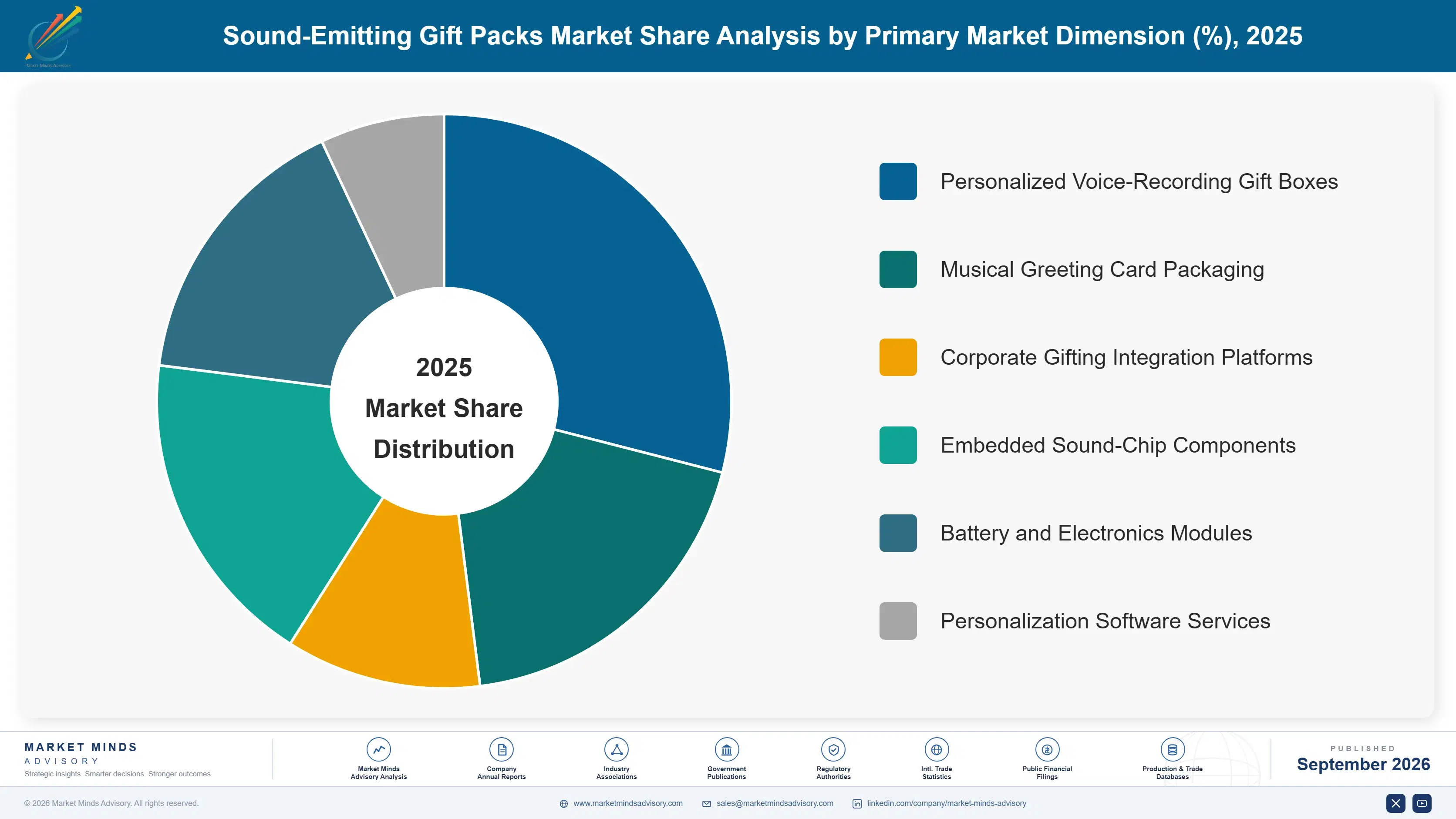
Sound-emitting gift pack segmentation follows product format rather than end-use vertical, since greeting boxes, voice-recording gift sets, and musical packaging each carry distinct manufacturing cost structures and competitive dynamics even where the same brand sells across formats. This layered structure means competitive intensity and margin economics differ sharply by segment, even where a single brand touches multiple product format layers.
sound-emitting-gift-packs-market-market-share-analysis-1790013843740

Personalized Voice-Recording Gift Boxes

Personalized voice-recording gift boxes form the fastest-growing segment as consumers move beyond basic pre-loaded musical chips toward customizable audio messages recorded directly by the gift-giver before purchase or delivery. Manufacturers adopting voice-recording technology report meaningfully higher consumer retention rates, since personalized audio delivers more emotional resonance than generic pre-loaded sounds within comparable price categories. Hallmark and WowWee lead premium recording technology supply, while indie personalization startups compete aggressively on customization speed for younger consumers seeking unique, shareable gifting experiences without established conglomerate branding. Smaller indie manufacturers increasingly access advanced recording technology through contract assemblers rather than developing proprietary electronics in-house, lowering the entry cost barrier considerably for this category. Adoption is accelerating fastest among younger buyers.
CAGR 12.5%

Musical Greeting Card Packaging

Musical greeting card packaging, embedding pre-loaded musical chips that play a fixed song or sound when the card opens, represents the second-fastest-growing segment as retailers expand seasonal and occasion-specific catalog offerings. Consumers switching to musical packaging report meaningfully higher gift satisfaction scores, since audio elements deliver more memorable unboxing moments than conventional silent card formats historically provided. This segment carries materially lower average price than voice-recording boxes, reflecting its positioning as a mass-market impulse category rather than a premium personalized product. Manufacturers offering seasonal catalog rotation, letting retailers refresh musical selections for holidays and occasions rather than requiring a single static product line, increasingly win against unchanging competitor catalogs. Retailers reward this flexibility.
CAGR 9.5%
Full segment breakdown across 6 segments available in the complete report.

Regional Architecture and Country Demand Map

North America leads sound-emitting gift pack demand given concentrated retail gifting and personalization spending, while East Asia and Western Europe sustain large manufacturing and consumption volume, and South Asia and Pacific accelerates fastest off expanding urban gift retail spending. as gift-givers increasingly prioritize memorable, personalized unboxing experiences.

North America

United States consumers drive the largest share of regional sound-emitting gift pack demand, spanning personalized voice-recording boxes, musical greeting cards, and corporate gifting programs sold predominantly through mass retail and e-commerce channels. Corporate gifting adoption for employee recognition and client appreciation drives outsized category volume relative to the region's underlying population size, given widespread corporate gifting budget allocation. Canada's market tracks similar patterns at smaller absolute scale. Hallmark, American Greetings, and WowWee maintain deep existing retail relationships across major mass and specialty channels that newer indie entrants struggle to replicate given established distribution infrastructure. Consumers increasingly evaluate brands on personalization capability rather than novelty alone. Retailers increasingly dedicate shelf space specifically to personalization-focused product categories across major chains.
Share: 28% | CAGR: 9.5% (2026 to 2036)

East Asia

China and Japan anchor East Asian sound-emitting gift pack demand through concentrated electronics component manufacturing and sophisticated domestic consumer awareness of interactive gifting well ahead of most Western markets. Chinese electronics manufacturers supply the bulk of embedded sound-chip components to gift packaging producers worldwide, giving the region a durable manufacturing cost advantage. Japan contributes steady demand through established novelty gift culture and gift-giving traditions tied to seasonal occasions. South Korea's advanced electronics manufacturing base supports faster component innovation than many comparable markets globally. Government-backed electronics export promotion programs in China keep the domestic component supply chain funded and internationally competitive. Taiwan's electronics manufacturing sector also contributes meaningful regional supply capacity.
Share: 25% | CAGR: 9.7% (2026 to 2036)
Regional intelligence for 5 additional markets available in the complete report: Western Europe, South Asia and Pacific, Latin America, Middle East and Africa, Eastern Europe. Contact sales@marketmindsadvisory.com.
sound-emitting-gift-packs-market-country-cagr-analysis-1790013844661

Capturing Margin Beyond The Gift Pack Sale

Sound-emitting gift pack economics reward manufacturers who move beyond one-time product sales toward personalization subscriptions, corporate contracts, and licensing revenue, since retail shelf pricing power has compressed while recurring relationships and proprietary technology still command genuine differentiation and durable margin. Manufacturers who stop treating the gift pack as the entire transaction capture a growing share of category profit pools annually.

Personalization Subscription And Repeat-Occasion Program Model

Manufacturers increasingly offer subscription-based personalization programs covering multiple gifting occasions throughout the year rather than relying solely on one-time seasonal purchases, creating a revenue stream that continues generating income throughout each customer's multi-year gifting relationship regardless of the original purchase channel or occasion involved. This shifts manufacturer economics toward customer retention and repeat-occasion value rather than winning new one-time purchases repeatedly. Leading direct-to-consumer brands report subscription revenue now representing roughly 34 percent of total online contract revenue. Churn rates on these subscriptions remain low once customers see personalized results. Retention rates improve considerably over time.
Market Impact: Reaches 34 percent of subscription revenue share broadly

Corporate Gifting Contract And Bulk Order Services

Manufacturers increasingly offer dedicated corporate gifting contracts covering bulk orders, custom branding, and account management services that raw consumer product sales alone cannot generate. This shifts revenue recognition from individual product transactions toward an ongoing corporate account relationship that continues generating value throughout the client's annual gifting calendar. Manufacturers with mature corporate gifting platforms report contract revenue approaching 29 percent of total annual revenue, a meaningful and growing share of total customer lifetime value captured well beyond individual purchases. Contract renewal rates remain high once corporate relationships are established. Larger corporations generate the highest contract values.
Market Impact: Reaches 29 percent of total corporate contract revenue

Sound-Chip Licensing And White-Label Manufacturing Deals

Leading sound-chip technology developers increasingly license proprietary voice-recording and musical playback technology to smaller manufacturers and white-label producers rather than competing directly for every retail shelf placement, generating royalty revenue that carries minimal incremental production cost once the underlying intellectual property has been developed and validated. This licensing approach lets technology innovators monetize research investment across a much broader manufacturer portfolio than their own production capacity could ever directly serve. Royalty rates on licensed technology typically run around 7 percent of licensee revenue. Adoption of this licensing model has expanded steadily across the category.
Market Impact: Generates a steady 7 percent royalty on revenue

Influencer Partnership Co-Branded Product Lines Directly

Manufacturers increasingly partner with popular unboxing content creators to develop co-branded product lines, sharing revenue in exchange for the audience reach and shareability that influencer social media presence provides beyond what traditional advertising typically delivers for comparable marketing investment. These partnerships command premium pricing relative to standard product lines, since consumers pay for the implied cultural relevance that influencer involvement signals. Co-branded product lines now represent roughly 11 percent of total revenue for manufacturers pursuing this partnership strategy actively. Adoption of this partnership model has grown steadily across major manufacturers.
Market Impact: Adds 11 percent from co-branded lines revenue share

Who Controls the Margin Pool

Sound-emitting gift packs market concentration remains modest, with the top five players controlling an estimated 34 percent of global revenue on a company-disclosed revenue basis, reflecting a category still fragmented across dozens of indie personalization startups and regional manufacturers. Hallmark and American Greetings lead through combined retail distribution and catalog development capability, while WowWee anchors substantial electronics manufacturing revenue. The gap between the leaders and the broader challenger field remains wide given deep existing retail relationships.
Current competitive activity centers on voice-recording technology development, corporate gifting platform investment, and continued catalog reformulation cycle acceleration across leading manufacturers. Hallmark and American Greetings both continue investing in proprietary recording technology to differentiate beyond commodity musical chips, while WowWee and Voice Caddy push personalization technology transparency as their primary differentiation against increasingly credible indie startups entering the category.

Rankings shift most where manufacturers successfully move beyond commodity musical chips toward personalization or corporate services differentiation, since these segments carry higher margins that fund continued research investment. Indie personalization startups are closing the credibility gap quickly on customization speed, but global incumbents still hold an edge in retail distribution depth and manufacturing scale breadth that indie competitors have not yet replicated.
sound-emitting-gift-packs-market-company-positioning-matrix-1790013845669

Competitive Moat and Risk Dimensions

HALLMARK

Moat: Global Retail Distribution Scale

Hallmark's global retail distribution network, built over decades of greeting card category leadership and existing retailer relationships, gives it shelf access that indie personalization startups cannot easily match without comparable retail relationships and marketing budget already in place across relevant retail channels globally. This scale advantage compounds each renewal cycle.
HALLMARK

Risk: Indie Personalization Speed Advantage

Faster-moving indie personalization startups increasingly win younger consumer segments by offering rapid custom voice-recording turnaround and founder-led social media credibility that Hallmark's traditional conglomerate catalog model typically struggles to replicate, threatening to erode its position among the most engaged personalization-conscious consumers over time. This gap widens each product cycle.
AMERICAN GREETINGS

Moat: Decades Of Catalog Manufacturing Depth

American Greetings' extensive catalog manufacturing relationships, developed over decades of greeting card production scale, give it a cost advantage in an increasingly personalization-focused market, allowing it to produce sound-enabled packaging at volumes that smaller competitors lacking comparable manufacturing infrastructure cannot yet match at scale. This manufacturing scale advantage compounds each cycle.
AMERICAN GREETINGS

Risk: Personalization Speed Disadvantage Persists

American Greetings' larger corporate catalog approval processes move considerably slower than indie startups, reducing its ability to capture emerging personalization trends quickly and forcing it to compete more directly on established brand trust rather than customization novelty against nimbler personalization-focused competitors. This gap persists across most emerging categories.

Players Tracked

Prominent Players

Hallmark
American Greetings
WowWee
Voice Caddy
Sound Cards International

Other Key Players

Paper Wallet
Cardstore
Blue Mountain Arts
Papyrus
Greeting Post
Recordable Cards Inc
Musical Card Company
TalkSoundz
EchoBox Gifts
MemoryVoice
Sonic Greetings
GiftSound Technologies
AudioMoments
VoiceKeeper
Chime Card Co

Recent Developments

MARCH 2026

Hallmark Expands Voice-Recording Technology Research Facility

Hallmark announced an organic expansion of its voice-recording technology research facility, adding dedicated engineers to serve growing demand from mass and specialty retailers seeking stable, shelf-viable formulations. New capacity begins phasing in over the coming fiscal year as engineers complete onboarding. Program details remain confidential for now.
Signal: Confirms Hallmark's continued commitment to defending its technology research leadership across its most contested technology category
MAY 2026

American Greetings Signs Corporate Gifting Contract With Retailer

American Greetings signed a multi-year corporate gifting supply contract with a major national retail chain, expanding its footprint to support employee recognition programs migrating from generic printed materials. Terms were not disclosed, though the agreement covers rollouts planned over eighteen months. The retailer's name was not disclosed.
Signal: Signals American Greetings' deepening strategic bet on corporate gifting revenue ahead of competing corporate gifting providers broadly
JULY 2026

TalkSoundz Acquires Personalization Software Firm

TalkSoundz completed the acquisition of a specialist personalization software firm, integrating its voice processing and customization capabilities into TalkSoundz's existing product platform to strengthen its recording offering for prestige customers. Financial terms were not disclosed, but the acquired firm's engineering team remains in place under TalkSoundz's product division.
Signal: Signals growing consolidation among specialized personalization gift vendors serving smaller specialized personalization customers directly nationwide broadly

Sound-Chip Components And Battery Exposure

Embedded sound chips and voice-recording modules represent roughly 42 percent of gift pack bill of materials cost, sourced predominantly from specialized electronics component producers concentrated in China and Taiwan. Embedded battery components add another meaningful cost share, sourced mainly from lithium cell manufacturers serving the broader small consumer electronics market. Printed packaging materials add a smaller but still meaningful cost share for premium formats.
A 2025 semiconductor component shortage, tied to allocation prioritization reported in major chipset suppliers' annual reports, briefly extended sound-chip production lead times and pushed several smaller manufacturers to delay planned catalog launches. The shortage eased within roughly two quarters, according to IEA-adjacent electronics manufacturing data tracked through published supplier disclosure records covering the affected fiscal period. Manufacturers with existing chipset allocation agreements weathered the shortage with minimal production delay.

Manufacturers without long-term component supply agreements face a persistent competitive disadvantage against larger vendors like Hallmark and American Greetings, which secured favorable multi-year chipset allocation terms well ahead of the 2025 shortage. Smaller regional manufacturers sourcing components through general distribution channels carry meaningfully higher lead time variability, compressing their ability to compete for time-sensitive retail shelf placement.
sound-emitting-gift-packs-market-cost-volatility-analysis-1790013846074

Long-Term Sound-Chip Supply Agreements

Manufacturers are converting general distribution chipset purchases into direct allocation agreements with electronics suppliers, trading some pricing flexibility for supply certainty that protects production schedules during industry-wide chipset tightening episodes affecting smaller competitors without comparable coverage. This approach has become increasingly standard among the largest manufacturers competing for major retail contracts. Coverage extends to smaller manufacturers too.

Dual-Sourcing Battery Cell Supply Regionally

Manufacturers increasingly qualify battery cell suppliers across both Chinese and Korean sources rather than relying on a single country's manufacturing base, reducing exposure to any single region's trade policy shifts or capacity constraints affecting overall battery cell availability. This approach has become more common as trade policy uncertainty affecting any single sourcing region has increased.

Modular Sound Module Design Standardization

Manufacturers increasingly design gift packs around standardized modular sound components that can be sourced from multiple suppliers interchangeably, reducing single-supplier dependency risk that would otherwise expose production schedules to any single component manufacturer's capacity constraints or pricing decisions. This approach also shortens overall manufacturing lead times considerably across production runs. Larger manufacturers benefit most from this approach.

Portfolio Architecture for Margin Defence

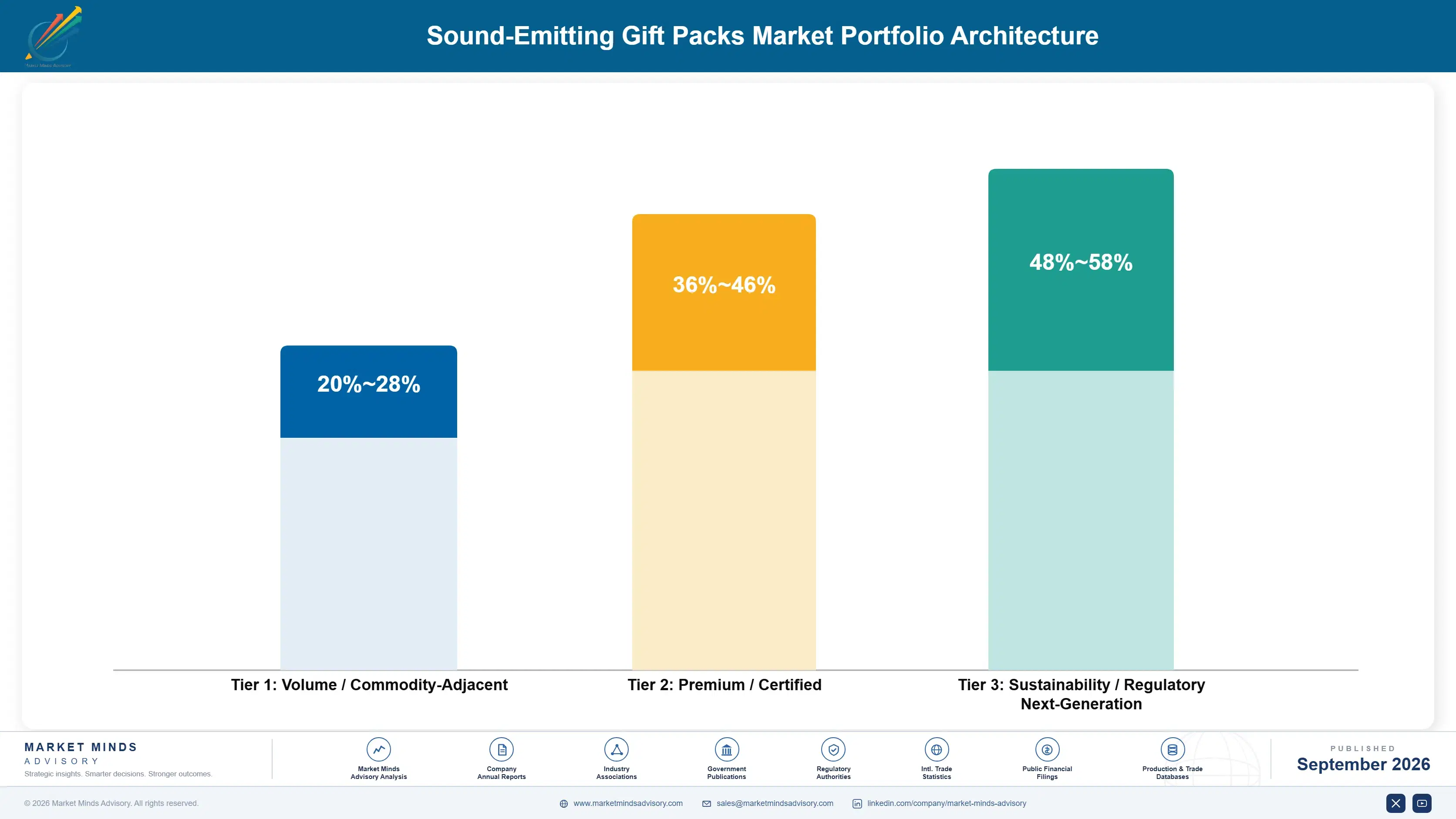
Sound-emitting gift pack economics split into three commercial tiers, from commodity musical greeting cards through certified personalization gift sets to next-generation voice-recording and corporate gifting platforms still scaling toward mainstream adoption. Gross margins widen substantially moving up this ladder, since customization technology, personalization sophistication, and corporate integration all scale with tier and application demands placed on the manufacturer. Manufacturers with strong balance sheets allocate capital toward higher tiers even where volume remains modest.
Volume economics still dominate unit shipments in the commodity tier, but margin pools concentrate disproportionately in personalization gift sets and corporate contracts where Hallmark, American Greetings, and WowWee compete on demonstrated technology credibility rather than price. The tension between chasing commodity volume and defending premium recurring margin shapes capital allocation across every major manufacturer's roadmap. Indie startups push hardest into the personalization tier.

High-value pools concentrate most heavily around voice-recording technology and corporate gifting platforms, where customization complexity and switching costs keep competitors thin and pricing power strong. Manufacturers positioning early in these categories are effectively trading commodity volume for a defensible position expected to command superior economics once broader corporate adoption fully matures. Customization timelines run considerably longer than commodity sales cycles.

Volume / Commodity-Adjacent

Commodity musical greeting cards and basic sound chips competing mainly on price against a large field of regional manufacturers. Volume scale defines this tier. These products ship in the highest unit volume of any tier tracked.
Gross Margin: 20-28%

Premium / Certified

Certified personalization gift sets and dual-recording hardware carrying verified customization data commanding higher pricing from discerning buyers. Loyalty runs deep here. This tier drives the strongest revenue growth among established manufacturers.
Gross Margin: 36-46%

Sustainability / Regulatory / Next-Generation

Voice-recording technology and corporate gifting integrated platforms, still early in broad commercialization but carrying the strongest margin ceiling. Innovation defines category leadership. Early volume remains limited but pricing power stays strong here.
Gross Margin: 48-58%
sound-emitting-gift-packs-market-portfolio-architecture-1790013846925

High-value Sub-segments and Strategic Watch-out

Personalized Voice-Recording Gift Boxes

Voice-recording boxes combine high per-unit value with rapidly expanding demand as consumers move beyond basic musical chips into targeted personalized formats. Manufacturing capacity constraints persist across leading vendors. Vendors continue expanding assembly lines to close this ordering gap. Order backlogs at leading vendors now extend several quarters here.
Gross Margin: 40-50%

Musical Greeting Card Packaging

Musical cards carry strong per-unit value driven by seasonal catalog rotation, though revenue growth trails voice-recording boxes as consumers scale purchase commitments cautiously. Retailer catalog trends drive adoption closely. This gap narrows as retailers specify seasonal rotation upfront. Seasonal demand cycles shape production planning across the year.
Gross Margin: 26-36%

Commodity Musical Greeting Chips

Basic musical chips remain the volume core of the category, generating the bulk of unit shipments even as margin per unit trails the premium recording tier. Formulator consolidation continues steadily. Consolidation among the smallest regional manufacturers continues steadily. Price competition remains intense among regional formulators broadly.
Gross Margin: 18-25%

Corporate Gifting Integration Services

Corporate service capacity warrants close monitoring, since a customization technology breakthrough or competitive pricing shift can rapidly reshape economics across every downstream manufacturer category. Analytics matter most here. Brands with proprietary corporate platforms hold a clear advantage. Integration pricing shifts ripple through the downstream value chain.
Gross Margin: 42-52%

Recurring Value Beyond The Gift Pack

Sound-emitting gift pack economics increasingly resemble an annuity business for manufacturers holding subscription personalization relationships, since a consumer adopting a personalized product typically continues repurchasing compatible products across successive gifting occasions rather than switching brands entirely. Switching platforms mid-relationship carries real personalization data loss, which favors incumbents once a relationship is established and trusted by the consumer. This dynamic compounds over successive purchase cycles.
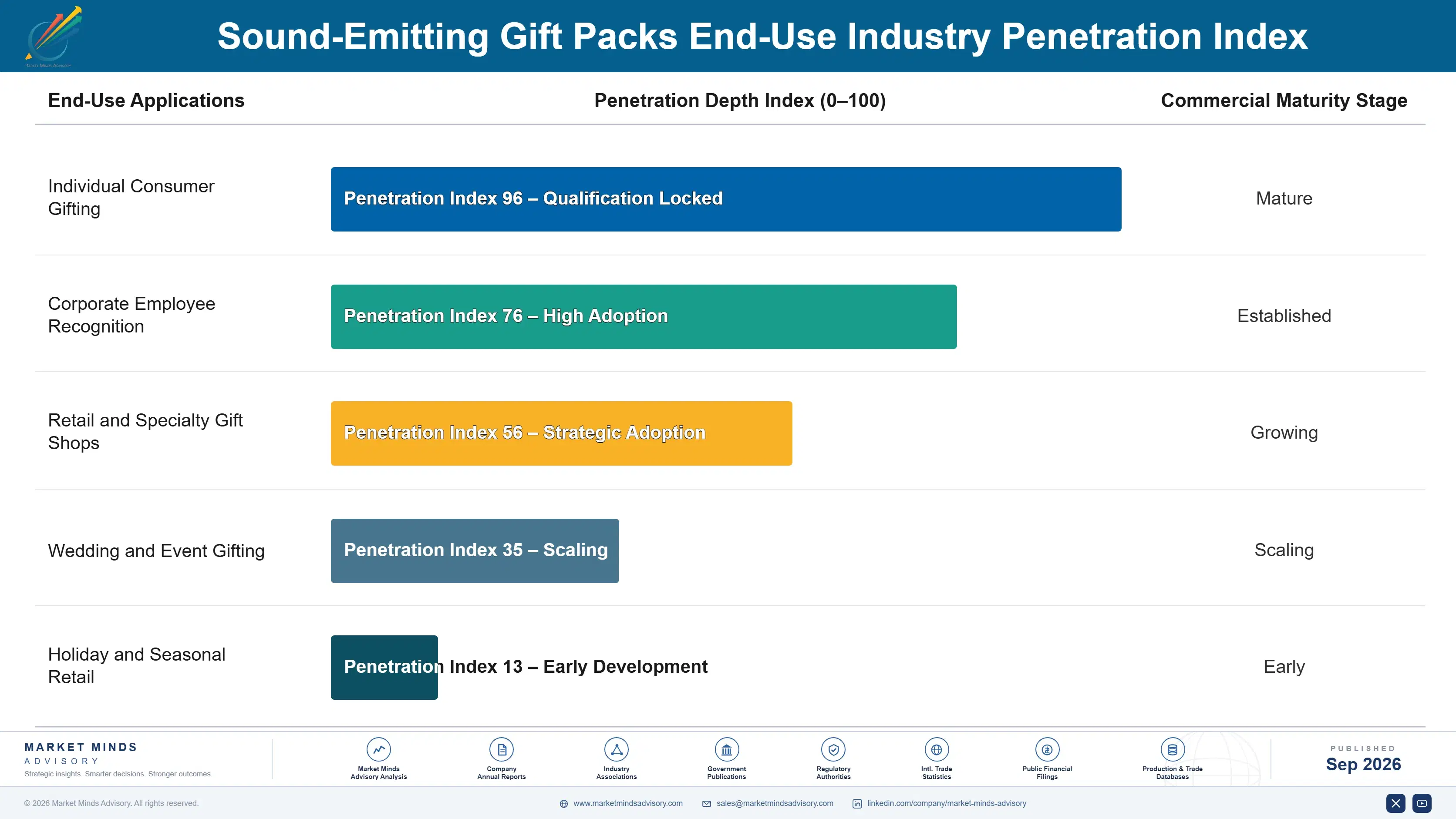
Adoption depth varies meaningfully by end-use vertical. Corporate buyers show deep engagement once pilot programs prove out, since employee satisfaction gains compound directly into measurable retention value each budget cycle. Individual consumers commit to long-term brand relationships given the emotional attachment any switching cost creates. Occasional gift-givers remain the most price-sensitive segment, treating products largely as commodity purchases with minimal recurring engagement.

Generational buyer shifts favor personalization-integrated adoption over time, since younger consumers entering the gifting category show greater comfort specifying custom audio products than consumers trained on purely conventional card giving. Corporate procurement teams increasingly weigh total lifecycle engagement value against upfront product price, a shift that favors manufacturers who can demonstrate verified long-term satisfaction data. Younger buyers research customization options extensively before purchase decisions.
sound-emitting-gift-packs-market-end-use-penetration-index-1790013847715

Priority Moves For Gift Brands Now

These are among the four positions where our research anticipates prominent divergence between winners and laggards over the coming forecast period. Each is grounded in the demand model, the regulatory perimeter, and the announced capacity pipeline.
01 / PORTFOLIO MIX REBALANCING

Rebalance Capital Away From Pure Commodity Chips

Manufacturers still allocating the bulk of new capital toward commodity musical chip formulations risk missing the faster-growing personalization and corporate gifting opportunities that carry meaningfully higher margins once specification relationships take hold. Commodity chips remain the largest revenue category today, but its growth trajectory trails these emerging categories by a wide margin. Capital committed now to personalization and corporate capability positions a manufacturer to capture disproportionate share of the higher-margin pools opening over the next several years across every major consumer segment.
02 / COMPONENT SUPPLY STRATEGY

Secure Dedicated Sound-Chip Supply Agreements Now

Manufacturers without secured dedicated sound-chip supply agreements remain exposed to standard commercial pricing volatility that can erase a meaningful share of production margin during any industry-wide component tightening episode. Competitors with dedicated agreements already in place demonstrated materially lower cost variability across the 2025 shortage. Securing comparable coverage now, even at a modest premium to standard commercial pricing, protects margin durability through the remainder of the forecast period and beyond, particularly as smaller manufacturers compete increasingly hard on price across every regional market.
03 / PERSONALIZATION TECHNOLOGY INVESTMENT

Build Or Acquire Voice-Recording Technology Capability

Musical chip and basic formulation differentiation continues eroding as indie personalization startups close the credibility gap on nearly every standard technology dimension that once separated premium manufacturers from lower-cost competitors. Manufacturers that build or acquire voice-recording capability capture a durable advantage that pure musical chip competitors cannot easily replicate without years of technology development investment. This advantage compounds in value as more consumers demand customization and increasingly expect an integrated personalization experience across their entire gifting occasion calendar throughout the year.
04 / CORPORATE GIFTING EXPANSION

Establish Corporate Gifting Contract Capability Now

Corporate gifting contract services represent a genuine differentiation opportunity that protects incumbent margins, meaning manufacturers who invest in corporate capability today capture disproportionate share of a persistently underdeveloped market before broader competitive entry closes that advantage window. Corporate buyers strongly prefer manufacturers with proven contract depth once a relationship begins. Early investment here compounds over subsequent contract cycles, making current corporate investment disproportionately valuable relative to its modest near-term cost across the entire client base over the next several years.

Engagement Snapshot From the Field

A live engagement with an industry participant carrying material or product regulatory and market exposure ahead of a defining policy shift, showing how our research translates into a defensible multi-year portfolio strategy.
MARKET MINDS ADVISORY · CLIENT ENGAGEMENT SUMMARY
Sound-Emitting Gift Packs Producer Strategic Portfolio Review and Transition Roadmap 2026·Investment Scenario on Sound-Emitting Gift Packs Exposure Evaluation 2025-26
CLIENT PROFILE
The client is a mid-sized corporate gifting company with an established presence in conventional branded merchandise across North American business channels, evaluating whether to launch a sound-emitting gift pack line as a differentiation strategy against larger competitors already active in the personalization category. Leadership sought outside validation before committing significant capital. The client had never previously launched an electronics-integrated product line at this scale.
STRATEGIC CHALLENGE
The client faced pressure to justify a significant product development investment without clear visibility into realistic component sourcing costs, corporate buyer willingness to pay a premium, or how proposed formats compared against broader market benchmarks for comparable corporate gifting launches. Internal teams were divided between an aggressive multi-segment simultaneous launch and a more conservative single-segment pilot approach to capital deployment.
MMA APPROACH
MMA conducted a structured assessment combining component sourcing cost benchmarking across three electronics suppliers, corporate buyer willingness-to-pay survey work across the client's core business markets, and a competitive format review to size realistic first-year volume and pricing scenarios before capital commitment. The engagement also modeled corporate account negotiation leverage under each launch scenario to inform final phasing.
KEY FINDINGS
  1. Corporate buyer willingness to pay a premium for sound-enabled features dropped sharply below a specific price threshold identified through survey work. Pricing above that threshold sharply reduced conversion intent among otherwise interested buyers.
  2. Component sourcing costs from accredited electronics suppliers ran approximately 19 percent above the client's initial internal cost assumptions. This gap materially changed the client's expected margin profile for launch.
  3. Voice-recording features, more than pre-loaded musical chips, showed the strongest predictor of corporate buyer acceptance among surveyed clients. Corporate buyers favored personalized messaging over unverified generic marketing language.
  4. A phased single-segment launch reduced initial capital exposure by roughly 28 percent versus the client's original simultaneous multi-segment plan. This freed capital for a stronger marketing push in the lead segment.
CLIENT PROFILE
The client is a mid-sized corporate gifting company with an established presence in conventional branded merchandise across North American business channels, evaluating whether to launch a sound-emitting gift pack line as a differentiation strategy against larger competitors already active in the personalization category. Leadership sought outside validation before committing significant capital. The client had never previously launched an electronics-integrated product line at this scale.
STRATEGIC CHALLENGE
The client faced pressure to justify a significant product development investment without clear visibility into realistic component sourcing costs, corporate buyer willingness to pay a premium, or how proposed formats compared against broader market benchmarks for comparable corporate gifting launches. Internal teams were divided between an aggressive multi-segment simultaneous launch and a more conservative single-segment pilot approach to capital deployment.
MMA APPROACH
MMA conducted a structured assessment combining component sourcing cost benchmarking across three electronics suppliers, corporate buyer willingness-to-pay survey work across the client's core business markets, and a competitive format review to size realistic first-year volume and pricing scenarios before capital commitment. The engagement also modeled corporate account negotiation leverage under each launch scenario to inform final phasing.
KEY FINDINGS
  1. Corporate buyer willingness to pay a premium for sound-enabled features dropped sharply below a specific price threshold identified through survey work. Pricing above that threshold sharply reduced conversion intent among otherwise interested buyers.
  2. Component sourcing costs from accredited electronics suppliers ran approximately 19 percent above the client's initial internal cost assumptions. This gap materially changed the client's expected margin profile for launch.
  3. Voice-recording features, more than pre-loaded musical chips, showed the strongest predictor of corporate buyer acceptance among surveyed clients. Corporate buyers favored personalized messaging over unverified generic marketing language.
  4. A phased single-segment launch reduced initial capital exposure by roughly 28 percent versus the client's original simultaneous multi-segment plan. This freed capital for a stronger marketing push in the lead segment.
RECOMMENDED STRATEGY
Phase 1: Phase one: launch in the client's strongest existing corporate segment first to validate demand before wider expansion. This approach limits downside exposure while generating real sales data. Phase 2: Phase two: secure component supply agreements with performance-based reliability guarantees rather than fixed-volume-only terms. Performance-based terms tie pricing to demonstrated component reliability outcomes. Phase 3: Phase three: expand to additional corporate segments only after first-segment sell-through data confirms viable unit economics. This staged approach protects capital while preserving competitive timing broadly.
OUTCOME
The client launched its first sound-emitting gift pack line in a single lead segment, achieving sell-through results that exceeded internal projections by approximately 14 percent (client-reported, unverified by MMA), and used that validated data to secure improved terms on its expansion agreements. The client also gave the marketing team time to refine messaging before wider rollout.

Frequently Asked Questions

Foundational context covering the market sizes, CAGR, scope, country, region and competition that inform every finding below. This section is provided to cover basics and most often pre-purchase conversations, answered from the MMA Primary Research Dataset.

What is the current size of the Sound-Emitting Gift Packs Market?

The global sound-emitting gift packs market reached an estimated 0.65 billion dollars in 2025. This valuation covers gift packaging embedding sound chips or voice-recording modules.

How large will the Sound-Emitting Gift Packs Market be by 2036?

The market is projected to reach approximately 1.6 billion dollars by 2036. That represents more than double the 2026 base value over the ten-year forecast period.

What is the CAGR for the Sound-Emitting Gift Packs Market 2026 to 2036?

The market is forecast to grow at an 8.5 percent compound annual growth rate between 2026 and 2036. Bull and bear scenarios range from 7.3 to 9.7 percent.

Which segment is growing fastest?

Personalized voice-recording gift boxes are growing fastest at a 12.5 percent CAGR, roughly 1.5 times the overall market rate. Musical greeting card packaging follows as the second-fastest segment.

Who are the major companies in the Sound-Emitting Gift Packs Market?

Hallmark and American Greetings lead the category, followed by WowWee, Voice Caddy, and Sound Cards International. Together these five players control an estimated 34 percent of global revenue.

Which country is growing fastest?

India is growing fastest at a 10.5 percent CAGR, reflecting expanding urban middle-class gifting spending and social media exposure. This closely tracks the broader South Asia and Pacific regional growth rate.

Report Segmentation Architecture

The full report scope spans multiple orthogonal segmentation dimensions, with cross-tabulated demand data provided for each dimension pair. Coverage extends further to regional breakdowns, trend trajectories, and the competitive detail needed to support segment-level decision-making.

By Primary Market Dimension

  • Personalized Voice-Recording Gift Boxes
  • Musical Greeting Card Packaging
  • Corporate Gifting Integration Platforms
  • Embedded Sound-Chip Components
  • Battery and Electronics Modules
  • Personalization Software Services

By End-Use Industry

  • Individual Consumer Gifting
  • Corporate Employee Recognition
  • Retail and Specialty Gift Shops
  • Wedding and Event Gifting
  • Holiday and Seasonal Retail

By Commercial Dimension

  • Direct Brand Retail Sales
  • Corporate Bulk Contract Sales
  • Subscription and Replenishment Programs
  • Technology Licensing and White-Label

By Region

  • North America
  • East Asia
  • Western Europe
  • South Asia and Pacific
  • Latin America
  • Middle East and Africa
  • Eastern Europe

Scope, Methodology, and Coverage

Every figure in this report is reproducible from documented input assumptions. The scope below maps the historical period, the forecast horizon, the segmentation dimensions, and the countries covered, alongside the underlying primary and qualitative methodology.
Historical Period
2020 to 2025
Forecast Period
2026 to 2036
Base Year
2025 (USD billions; MMA Primary Research Dataset, September 2026)
Market Definition
This report defines the sound-emitting gift packs market as gift packaging products embedding electronic sound chips, voice recorders, or musical modules that play audio content when opened or activated. It excludes conventional silent gift packaging and standalone electronic greeting devices sold independently of gift packaging.
Quantitative Units
USD billions, unit shipments, CAGR percent
Segmentation Dimensions
Product format, end-use vertical, commercial dimension
Regions Covered
North America, East Asia, Western Europe, South Asia and Pacific, Latin America, Middle East and Africa, Eastern Europe
Countries Covered
United States, Canada, Germany, France, United Kingdom, China, Japan, South Korea, India, Australia, Brazil, Mexico, Saudi Arabia, United Arab Emirates, South Africa, Poland, Czech Republic, Russia
Key Companies Profiled
Hallmark, American Greetings, WowWee, Voice Caddy, Sound Cards International, Paper Wallet, Cardstore, Blue Mountain Arts, Papyrus, Greeting Post, Recordable Cards Inc, Musical Card Company, TalkSoundz, EchoBox Gifts, MemoryVoice, Sonic Greetings, GiftSound Technologies, AudioMoments, VoiceKeeper, Chime Card Co
Quantitative Methodology
Primary survey, n=3,800 respondents, Q4 2025, six countries; demand-side model with trade association cross-validation
Qualitative Methodology
47 expert interviews, Q4 2025; applied to validate demand model assumptions, identify emerging dynamics, and assess competitive positioning
Report Format
PDF and XLSX data workbook (Word format preview document)
Publisher
Market Minds Advisory
Report Code
MMA-2026-CON-529
Published
September 2026
Contact
sales@marketmindsadvisory.com | www.marketmindsadvisory.com

Purchase the full Sound-Emitting Gift Packs Market Report (2026 to 2036).

This report delivers a comprehensive analysis of the global sound-emitting gift packs market across all major product formats, regions, and competitive dynamics through 2036. It covers detailed segmentation by product format, end-use vertical, and commercial dimension, alongside regional demand architecture across all seven world regions. Competitive profiling examines the top five players controlling 34 percent of global revenue, along with fifteen additional participants shaping category evolution. The report also includes a portfolio tier analysis, input cost risk assessment, and a strategic verdict section identifying priority actions for manufacturers navigating this rapidly evolving category.
Seven-region demand share and CAGR breakdown
Five-tier top and secondary player profiling
Ten-year revenue and volume forecast model
Input cost and supply chain risk assessment
Portfolio margin tier and watch segment analysis
Anonymized client case study with strategy recommendations

Built For The People Who Decide

From boardroom strategy to bench-side execution, this report is read cover-to-cover by leaders shaping the next decade of their industry, turning demand scenarios, market dynamics and valuation benchmarks into decisions.
CXOs/ Presidents/ VPs/ Managers
M&A and Corporate Development
Strategy Teams and R&D Heads
Procurement and Product Directors
Regulatory and Compliance Leaders
Investor Relations and Equity Analysts