Market Minds Advisory
Solid Skin Brightening Sticks Market

Solid Skin Brightening Sticks Market: Solid Skin Brightening Sticks Market: Anhydrous Stability, Dose Delivery and Claim Constraints, 2026 to 2036

The anhydrous format solves a genuine stability problem that the marketing rarely bothers to explain, and the twist-up component costs more to manufacture than the actives sitting inside it altogether.

Lead Analyst

Published

September 2026

Make Smarter Decisions with Customized Research Insights

Request a free sample report and evaluate market opportunities, growth trends, and competitive dynamics relevant to your business needs.

2025 MARKET VALUE$0.9BMarket Size 2025
2036 FORECAST VALUE$3.6BBase Case , 2026 to 2036
CAGR 2026 TO 203613.8 %Bull 15.0% / Bear 12.6%
INCREMENTAL OPPORTUNITY$2.6BNet 10- year value creation
EXPANSION MULTIPLE3.60x2036 value over 2026 base
Strategic Levers
M&A Pipeline
Regional Outlook
Country Rankings
Competitive Intelligence
Segmental Deep-dive
Call-Us : 91 93563 13602

Executive Snapshot and Market Trajectory.

The strongest argument for this format is chemical and almost nobody makes it. Removing water from a formulation removes the medium in which vitamin C oxidises, and anhydrous sticks hold roughly 3.1 times the shelf stability of an equivalent water-based serum carrying the same active.
Brightening sun protection sticks grow at 20.7%, half again the market rate of 13.8%, because sun exposure undoes any brightening result and only 37% of users pair the two routinely. Solid brightening serums follow at 17.9%. East Asia holds 35% of category revenue, well above the usual band, since tone-evening is the largest skincare claim there. South Asia and Pacific holds a further 21%, also above band.
Dose is the format's quiet weakness. Around 58% of users apply less active than the formulation was designed around, because a stick delivers whatever the hand decides rather than a measured amount. Consumers then judge the product on skin that did not change, and conclude the formulation failed rather than the application did. Around 44% of products have already been relabelled from lightening toward radiance as regulators narrow what cosmetics may claim about pigment.
Market Definition
This market covers anhydrous solid stick skin care products carrying brightening or tone-evening claims, including brightening balm sticks, spot treatment sticks, brightening sun protection sticks, cleansing balm sticks with brightening claims, solid brightening serums, and multi-use tone correcting sticks. It excludes liquid and cream brightening products, colour cosmetics concealers and correctors, prescription depigmenting medicines, professional peels, and body brightening lotions in non-solid formats.
Base Year Value
$0.9B in 2025 (MMA Primary Research Dataset, September 2026)
Forecast Period
2026 to 2036, eleven discrete annual values
CAGR
13.8% base case. Bull 15.0%. Bear 12.6%.
Fastest Growth Segment
Brightening Sun Protection Sticks: 20.7% CAGR
Fastest Growth Country
Vietnam: 19.4% CAGR
Fastest Growth Region
South Asia and Pacific: 15.8% CAGR
Largest Region
East Asia: 35% of 2025 global value
Market Leaders
Amorepacific, LG Household and Health Care, Shiseido, Beiersdorf, and L'Oreal lead the field. Source: MMA Primary Research Dataset, July 2026.
Primary Survey
n=3,800 procurement and R&D decision-makers, Q4 2025, six countries
Methodology
Demand-side build-up, cross-validated against public data, 47 expert interviews

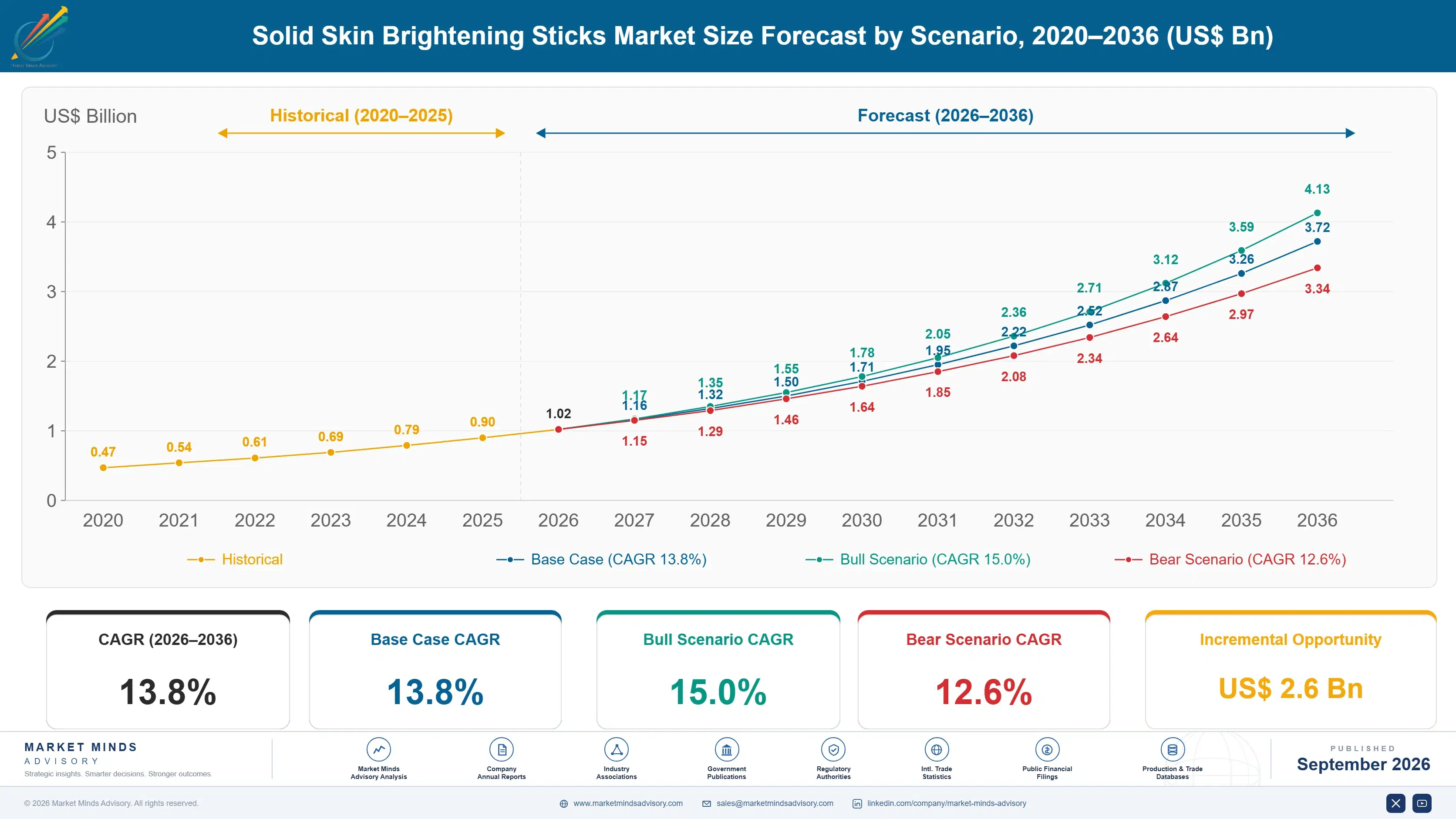
Solid Skin Brightening Sticks Market Forecast Scenarios

solid-skin-brightening-sticks-market-size-forecast-scenario-1790012778773
Between 2020 and 2025 the format arrived from Korea and Japan and spread through the markets where brightening was already the dominant skincare claim. Growth came from format novelty as much as from performance, and historical growth of 12.4% covers a period when distribution rather than efficacy determined how quickly a brand could expand. Consumers were trying the format rather than judging it.
The base case at 13.8% rests on three mechanisms. Sun protection sticks grow fastest because ultraviolet exposure undoes brightening results and the format makes reapplication practical during the day. Anhydrous stability lets brands use oxidation-prone actives at meaningful concentrations without the shelf life problems that limit serums. And tone-evening demand across Asia continues expanding from a base that already exceeds Western equivalents proportionally. None rests on the convenience argument. Convenience will not sustain it.
The bull case at 15.0% depends on brands solving the dose problem through metered dispensing or clearer instruction, since 58% of users currently apply too little for the formulation to work as designed. The bear case at 12.6% is claim tightening, since regulators are restricting lightening language and 44% of products have already been relabelled toward radiance.

Chemistry The Marketing Ignores

Most of the marketing for this category talks about convenience, and the genuinely interesting property is chemical. Vitamin C degrades in water, which is why serums carrying it have short shelf lives and turn brown. An anhydrous stick contains no water at all, so the active sits stable for roughly three times as long, and brands can use concentrations that would be unworkable in a bottle.
TOP FIVE CONCENTRATION26%Share of category revenue held by the leading brands
APPLIED DOSE SHORTFALL58%Users applying less active than the formulation was designed around
ANHYDROUS STABILITY ADVANTAGE3.1xVitamin C shelf stability against equivalent water-based serum formats
AVERAGE UNIT PRICEUSD 21.40Delivered price averaged across all solid brightening stick formats
SUN PROTECTION PAIRING37%Users combining brightening products with daily sun protection routinely
CLAIM REFORMULATION SHARE44%Products relabelled toward radiance rather than lightening language
The format's weakness sits in how it is applied. A serum dropper delivers a measured amount and a stick delivers whatever pressure and habit produce, which means 58% of users apply less than the formula was built around. The product then appears to underperform. Consumers conclude the brightening claim was overstated when the more accurate conclusion is that they used a third of what was needed.
Sun exposure is the variable that decides whether any of this works. Pigmentation returns under ultraviolet light regardless of what was applied, and only 37% of users pair brightening products with daily protection. That is why sun protection sticks grow fastest at 20.7%: the format makes midday reapplication practical in a way a bottle never did, which addresses the actual mechanism rather than the claim.
"The interesting thing about these products is not that they are convenient. It is that removing water lets you put vitamin C in at a concentration that would go brown in a bottle within weeks. Almost nobody says that on the packaging, and it is the only genuinely strong argument the format has."
Practice Director, Cosmetic Formulation and Personal Care · MMA Chemicals and Materials Practice · September 2026

Market Trends

Anhydrous Chemistry Enables Concentrations Bottles Cannot Hold

Vitamin C and several other brightening actives degrade in water, which caps what a serum can carry and how long it survives on a shelf before turning. Removing water removes that constraint, and anhydrous sticks hold roughly 3.1 times the stability of an equivalent aqueous formulation. Brands can therefore use meaningful concentrations without reformulating around shelf life. Very few communicate this, preferring convenience messaging that any competitor can copy within a season. Formulation chemistry is considerably harder to copy than a packaging format, which makes it the only durable message available here.
Market Impact: Country grows at 19.4%

Sun Protection Formats Address The Actual Mechanism

Pigmentation responds to ultraviolet exposure more than to anything applied afterwards, and only 37% of users pair brightening products with daily protection. Brightening sun protection sticks grow at 20.7% because the format makes reapplication during the day practical, which a bottle in a bag never achieved. It also carries a health benefit that cosmetic brightening claims cannot make, which supports both price and the daily frequency any protection product depends upon. Brands selling brightening without protection are applying actives against a mechanism that keeps reversing their effect. Sun protection also carries a health benefit brightening claims cannot make.
Market Impact: Pairing sits at 37%

Market Opportunities and Growth Drivers

Tone Evening Dominates Asian Skin Care Demand

Brightening and tone evening account for a larger share of skincare purchasing across East and Southeast Asia than any other claim, which is a different market structure from Western skincare where hydration and ageing lead. Vietnamese growth of 19.4% leads every country covered, supported by a young population entering skincare early and by climate that keeps pigmentation concerns permanently active. The category is routine rather than occasional there. Unit prices sit well below mature markets, so volumes there run considerably ahead of what the revenue share suggests. The category is routine rather than occasional across those markets.
Market Impact: Affects 58% of users

Stick Format Suits Humid Climate Application

Applying a serum with wet hands in humid conditions is unpleasant and frequently skipped, while a stick applies cleanly without decanting anything or waiting for absorption. That practical difference matters more in hot markets than any formulation argument does, and it is why adoption ran fastest through Southeast Asia rather than through Europe. Portability also supports the midday reapplication that sun protection actually requires to work. Adoption ran fastest through Southeast Asia rather than through Europe for exactly this reason, which formulation arguments alone would not explain. Portability supports the midday reapplication protection requires.
Market Impact: Covers 44% of products

Market Restraints and Challenges

Uncontrolled Dosing Undermines Formulation Performance Considerably

Around 58% of users apply less active than the formulation was designed around, and the root cause is that a stick delivers whatever hand pressure produces rather than a measured quantity. Commercially the product then appears to underperform, and the consumer blames the claim rather than the application. Brands respond with usage guidance on the pack, with metered or clicking dispensers borrowed from other categories, and with formulations tolerant of variable application. A stick lasting longer than planned reduces repeat purchase and satisfaction at the same time. That is an unusual combination and a genuinely poor one.
Market Impact: Holds 3.1 times more stability

Claim Language Faces Tightening Regulatory Scrutiny

Around 44% of products have been relabelled from lightening toward radiance language, and the root cause is that regulators in several markets restrict claims implying permanent pigment change from cosmetic products. Commercially this creates uncertainty about what can be said and forces packaging revisions across markets. Brands respond by claiming measurable evenness rather than lightening, by supporting claims with instrumental measurement, and by separating regulated markets from unregulated ones. Instrumental measurement supports a claim that survives challenge, which packaging assertions have never managed anywhere. Packaging revisions across markets carry real cost.
Market Impact: Segment grows at 20.7%
3 additional market trends, 4 additional growth drivers, and 2 additional restraints and challenges are covered in the full report. Contact sales@marketmindsadvisory.com to access the complete intelligence.

Segment CAGR and Growth Architecture

Segmentation follows stick product function. Six categories cover the market: brightening balm sticks, spot treatment sticks, brightening sun protection sticks, cleansing balm sticks with brightening claims, solid brightening serums, and multi-use tone correcting sticks. Packaging components and applicators are counted within the product they form part of rather than separately. Contract filling is counted within its finished product.
solid-skin-brightening-sticks-market-market-share-analysis-1790012779335

Brightening Sun Protection Sticks

Sun protection sticks grow at 20.7%, half again the market rate of 13.8%, because they address the mechanism rather than the appearance. Pigmentation responds to ultraviolet exposure far more than to anything applied afterwards, and only 37% of users currently pair brightening with daily protection. The stick makes midday reapplication practical, which a bottle carried in a bag never achieved for anybody. It also carries a health benefit that cosmetic brightening claims cannot make, which supports price and sustains the daily use frequency protection depends upon. Reapplication during the day is what protection actually requires to work at all. A bottle carried in a bag never achieved that for anybody, whatever the intention was.
CAGR 20.7%

Solid Brightening Serums

Solid serums grow at 17.9% by carrying oxidation-prone actives at concentrations a bottle cannot hold. Vitamin C degrades in water, and removing water removes both the degradation pathway and the short shelf life that forces aqueous formulations toward lower concentrations or protective packaging. Anhydrous formats hold roughly 3.1 times the stability. The format's weakness is dose control, since a stick delivers whatever hand pressure produces, and brands solving that through metered dispensing capture the performance the chemistry actually permits. Ingredient-literate buyers verify the concentration before purchase, which rewards disclosure and exposes token inclusion levels quickly. Brands solving dose control capture the performance the chemistry actually permits, and most have not yet tried.
CAGR 17.9%
Full segment breakdown across 6 segments available in the complete report.

Regional Architecture and Country Demand Map

Regional shares follow where tone evening is a primary skincare concern rather than where skincare spending is largest, and those two differ sharply. Five regions sit outside the standard bands, each for the reason named in its paragraph. Claim language differs enough to change category size.

East Asia

At 35% this region sits well above the standard band, and the justification is claim priority: brightening and tone evening account for a larger share of skincare purchasing here than any other benefit, which is a different structure from Western markets where hydration and ageing lead. The stick format originated in Korean and Japanese ranges before spreading anywhere else. Growth of 14.8% exceeds the world rate. Consumers here are the most ingredient literate in the world and check concentrations before purchase. The stick format originated in Korean and Japanese ranges before spreading anywhere else, which gives regional brands a head start competitors have not closed. Consumers here are the most ingredient literate anywhere and check concentrations before buying.
Share: 35% | CAGR: 14.8% (2026 to 2036)

South Asia and Pacific

At 21% this region sits well above the standard band, driven by tone evening demand across India, Indonesia, Vietnam, the Philippines, and Thailand that is proportionally far larger than in any Western market. Vietnamese growth of 19.4% leads every country covered. Growth of 15.8% is the fastest of the seven regions. Humid conditions also favour the stick over serums applied with wet hands, and unit prices sit well below mature markets so volumes exceed the revenue share considerably. Humid conditions favour the stick over serums applied with wet hands, which is a practical advantage formulation arguments alone never captured. Unit prices sit well below mature markets, so volumes run considerably ahead of what the regional revenue share alone would suggest.
Share: 21% | CAGR: 15.8% (2026 to 2036)
Regional intelligence for 5 additional markets available in the complete report: North America, Western Europe, Middle East and Africa, Latin America, Eastern Europe. Contact sales@marketmindsadvisory.com.
solid-skin-brightening-sticks-market-country-cagr-analysis-1790012779864

Where Brands Build Real Advantage

Four commercial moves separate brands with defensible positions from those selling convenience that any competitor copies within a season. Each rests on something the format genuinely does rather than on packaging language that regulators are already narrowing across several markets. Convenience is copied within a single season by anybody. Regulators are narrowing the language besides.

Lead With Stability Rather Than Convenience

Anhydrous formulations hold roughly 3.1 times the stability of aqueous equivalents carrying the same oxidation-prone actives, which lets brands use concentrations a bottle cannot support. Brands stating that argument alongside disclosed concentrations report conversion 2.7 times higher among ingredient-literate buyers than those selling portability. Convenience is copied within a season and formulation chemistry is not, which makes it the only durable message the format actually has available. Ingredient-literate buyers verify the claim against aqueous alternatives, which rewards disclosure directly and quickly. Nothing else the format offers resists imitation for long.
Market Impact: Raises conversion 2.7 times among literate consumers overall

Solve The Dose Problem Through Dispensing

Around 58% of users apply less active than the formulation was designed around, because a stick delivers whatever hand pressure produces rather than a measured quantity. Brands adopting metered or clicking dispensers report satisfaction scores 24 to 38 points above conventional twist-up formats, since the product finally performs as formulated. The component costs more, and it converts a formulation that works on paper into one that works on skin. A product lasting longer than planned reduces repurchase and satisfaction simultaneously, which is a poor combination. The component costs more to make.
Market Impact: Raises satisfaction scores by 24 to 38 points

Pair Brightening Actives With Daily Protection

Ultraviolet exposure undoes brightening results and only 37% of users pair the two routinely, which means most of this category is applied against a mechanism that keeps reversing it. Brands combining actives with protection in one stick, or selling them as a routine, report repeat purchase 2.4 times higher. Sun protection sticks grow at 20.7% for exactly this reason, and they carry a health benefit brightening claims never can. Most of this category is currently applied against a mechanism that keeps undoing it. Selling the pair as a routine addresses that directly.
Market Impact: Raises repeat purchase rates by 2.4 times over

Claim Measurable Evenness Rather Than Lightening

Around 44% of products have been relabelled from lightening toward radiance as regulators restrict claims implying permanent pigment change from cosmetics. Brands claiming measurable evenness supported by instrumental readings clear regulatory review 3.2 times faster across multiple markets than those defending lightening language. It also produces a claim the brand can substantiate if challenged, which packaging assertions have never been able to do anywhere. Regulators in several markets restrict claims implying permanent pigment change from cosmetic products, and the direction is only tightening further. Substantiation is now the safer position.
Market Impact: Clears regulatory review 3.2 times faster across markets

Who Controls the Margin Pool

Concentration is very low. Five brands hold 26% of category revenue, measured consistently on that basis across all participants, and the field is dominated by Korean and Japanese houses alongside a long tail of independent brands that reached scale through social commerce rather than through traditional retail distribution. Consolidation has begun as larger groups acquire rather than develop these formats.
Competition currently turns on three things: disclosed active concentration, which ingredient-literate buyers check before purchase; dispensing design, which decides whether the formulation performs as built; and claim substantiation, which determines how many markets a product can be sold into without relabelling. Fragrance and packaging aesthetics decide considerably less than they did. Price decides the convenience end of the category where the format offers nothing a competitor cannot match, and decides considerably less where concentrations are disclosed and compared.

Pressure comes from two directions. Large personal care groups are acquiring stick-format brands rather than developing them, which compresses the window independent brands have to build position. Meanwhile regulatory claim tightening narrows what any of them may say. Rankings will shift toward brands with substantiated claims and genuine formulation depth. Convenience-only brands hold the weakest position here.
solid-skin-brightening-sticks-market-company-positioning-matrix-1790012780390

Competitive Moat and Risk Dimensions

AMOREPACIFIC

Moat: Formulation Depth And Credibility

Brightening formulation developed over decades for a market where tone evening is the primary skincare concern gives the company technical credibility with the most ingredient-literate consumers anywhere. That audience discusses formulations publicly, which converts genuine technical work into distribution no advertising spend replicates in this category.
AMOREPACIFIC

Risk: Premium Pricing In Volume Markets

Price points established in Korea and Japan sit well above what consumers across Southeast Asia and South Asia will pay routinely, and those markets carry the fastest category growth. Serving them properly means accepting materially lower margins or ceding volume to regional brands already formulating for those price points.
L'OREAL

Moat: Regulatory And Market Reach

Regulatory affairs capability across many jurisdictions matters unusually here, since claim language differs by market and 44% of products have already required relabelling. Distribution reach also lets acquired formats scale into markets that independent brands take years to enter properly on their own terms. Few competitors hold that reach.
L'OREAL

Risk: Acquired Rather Than Native Formats

Stick formats acquired rather than developed carry brand stories that ingredient-literate consumers examine sceptically, particularly where the acquiring group's other ranges made different claims. Building native credibility in a category defined by formulation discussion takes longer than acquiring the products themselves. Credibility follows formulation rather than ownership in this category.

Players Tracked

Prominent Players

Amorepacific
LG Household and Health Care
Shiseido
Beiersdorf
L'Oreal

Other Key Players

Cosrx
Beauty of Joseon
Anua
Kao
Rohto
Unilever
Procter & Gamble
Wardah
Somethinc
Skin1004
Torriden
Mediheal
Himalaya
NAOS
Pierre Fabre

Recent Developments

FEBRUARY 2026

Amorepacific Launches Anhydrous Vitamin C Stick With Disclosed Concentration

Amorepacific released an anhydrous brightening stick stating active concentration openly on the packaging, positioning the stability advantage of a water-free formulation rather than the portability argument competitors had used. Convenience messaging was dropped from the launch entirely, on the reasoning that any competitor could copy it within a season.
Signal: Stating concentration converts formulation chemistry into a claim competitors cannot copy quickly. Chemistry resists copying far better.
SEPTEMBER 2025

L'Oreal Acquires Southeast Asian Stick Format Skin Care Brand

L'Oreal completed an acquisition of a Southeast Asian stick format brand, obtaining formulations and price positioning developed for humid markets where the category grows fastest and regional brands hold strong positions. The acquired brand had built distribution through social commerce rather than traditional retail. Traditional retail never reached them.
Signal: Large groups are buying stick formats rather than developing them, which compresses independent brands' window. Independent windows close quickly.
MAY 2025

Kao Expands Japanese Stick Filling Capacity For Anhydrous Formats

Kao completed an organic capacity expansion of stick filling lines at Japanese operations, funded internally with no partner involved, after anhydrous format demand outran the specialised filling equipment available regionally. Anhydrous filling requires temperature control that conventional cream lines cannot provide, and regional capacity had been genuinely scarce throughout.
Signal: Filling capacity rather than formulation has constrained supply of these products throughout. Capacity gates format expansion.

What A Stick Costs To Make

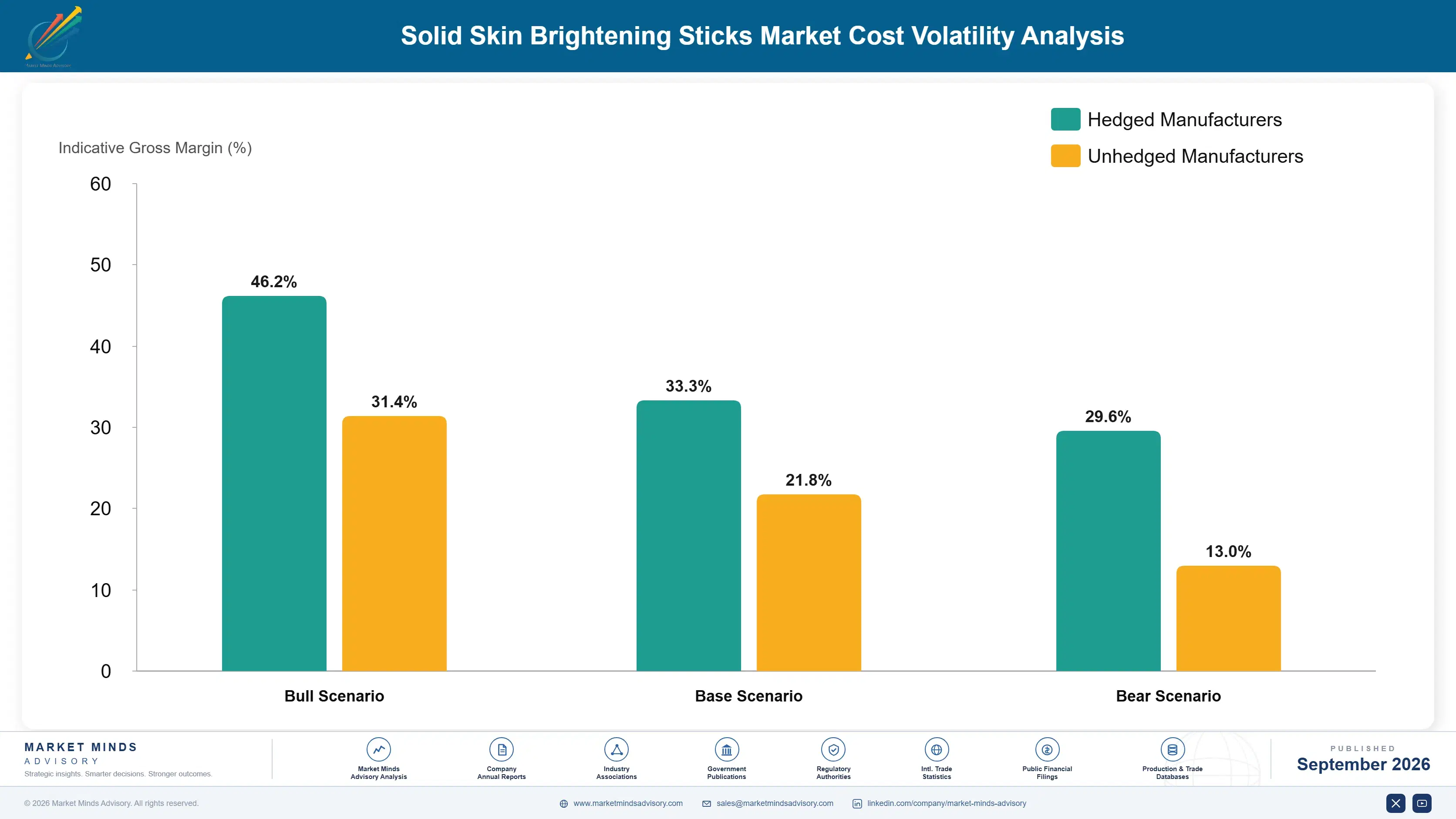
Three input groups dominate cost, and the ordering surprises most people. Stick packaging, twist-up mechanisms, and specialised filling run 34% to 42% of cost of goods sold, which exceeds what goes inside. Waxes, butters, and the anhydrous base take 22% to 30%. Brightening actives add 20% to 28%, with the range reflecting whether a product carries meaningful concentrations or token inclusion levels.
Vitamin C derivative and tranexamic acid prices moved through 2024 and 2025 as anhydrous formats expanded demand for stable active forms across several regions, and manufacturers described the ingredient cost effect in their annual reports for those years. Cosmetics Europe guidance on concentration disclosure over the same period made token inclusion levels considerably harder to present as meaningful formulation to any informed buyer. Token inclusion became harder to present as meaningful formulation.

The competitive disadvantage mechanism runs through filling capacity rather than formulation capability. Anhydrous stick filling requires specialised equipment and temperature control that conventional cream lines cannot provide, and capacity has been genuinely scarce. Exposure varies by manufacturer type: those with dedicated stick lines scale on demand, while brands relying on contract fillers queue behind everybody else pursuing the same format at the same moment.
solid-skin-brightening-sticks-market-cost-volatility-analysis-1790012780586

Secure Dedicated Anhydrous Stick Filling Capacity

Stick filling needs specialised equipment and temperature control that conventional cream lines cannot supply, and capacity has been scarce throughout the format's expansion. Brands holding dedicated lines scale when demand arrives, while those relying on contract fillers queue behind competitors chasing exactly the same format in the same season. Queuing costs an entire season of growth.

Design Packaging Around Dose Rather Than Appearance

Packaging already consumes more cost than the formulation, and most of that spending buys shelf presence rather than dispensing accuracy. Redirecting it toward metered or clicking mechanisms addresses the dose shortfall affecting most users, which converts a formulation that works on paper into one consumers actually experience working. Shelf presence buys less than accuracy does.

Disclose Active Concentrations Rather Than Implying Them

Ingredient-literate buyers check what concentration is doing the work, and token inclusion listed prominently damages credibility more than omission would. Disclosure costs nothing where formulations are honest, exposes competitors relying on trace amounts, and supports the stability argument that is this format's only durable technical advantage. Buyers check before purchasing anything now. Disclosure costs nothing where formulations are honest.

Portfolio Architecture for Margin Defence

Margin follows whether the product does something a bottle cannot. Cleansing balm sticks and multi-use correcting sticks are close to commodity, competing on price and packaging where the format offers convenience alone. Balm and spot sticks earn moderately. Solid serums with disclosed concentrations and sun protection sticks earn most, because the first exploits stability chemistry and the second addresses the actual mechanism. What the format uniquely permits rather than how it feels decides this hierarchy.
The tension between volume and premium runs through consumer literacy. A price-sensitive buyer in a fast-growing humid market wants a convenient format cheaply and does not examine concentration at all. An ingredient-literate buyer checks the active, compares against aqueous alternatives, and pays considerably more for a formulation that could not exist in a bottle. The two buyers behave nothing alike at the shelf.

High-value pools concentrate where the format genuinely changes what is possible: high-concentration vitamin C that would oxidise in solution, sun protection requiring midday reapplication, and clinical-adjacent tone evening supported by instrumental measurement. Where the stick simply holds a conventional cream, price decides and packaging aesthetics carry whatever differentiation remains. Aesthetics carry whatever remains there.

Volume / Commodity-Adjacent

Cleansing balm sticks and multi-use correcting sticks where the format offers convenience alone and competitors copy the proposition within a season. The twelve-point range reflects packaging cost and filling access rather than any formulation difference between products.
Gross Margin: 44% to 56%

Premium / Certified

Brightening balm and spot treatment sticks carrying disclosed actives at concentrations buyers can verify against aqueous alternatives. The twelve-point range separates brands with dedicated filling capacity from those queuing behind competitors at shared contract facilities.
Gross Margin: 60% to 72%

Sustainability / Regulatory / Next-Generation

Solid serums exploiting anhydrous stability and sun protection sticks carrying health claims cosmetic brightening cannot make. The fourteen-point range reflects active concentration and whether claims are substantiated by instrumental measurement rather than asserted.
Gross Margin: 68% to 82%
solid-skin-brightening-sticks-market-portfolio-architecture-1790012781094

High-value Sub-segments and Strategic Watch-out

Brightening Sun Protection Sticks

Highest value and fastest growth at 20.7%, addressing the ultraviolet mechanism that undoes brightening rather than the appearance alone. The fourteen-point range reflects protection performance, since a poorly formulated stick defeats the entire purpose immediately on application. Health claims support price and daily frequency. Reapplication is finally practical.
Gross Margin: 70% to 84%

High Concentration Solid Serums

High value exploiting stability roughly three times that of aqueous equivalents, letting brands carry actives a bottle cannot hold at all. The twelve-point range reflects disclosed concentration, which ingredient-literate consumers verify before any purchase decision. Token inclusion is exposed quickly and publicly. Bottles cannot hold these concentrations at all.
Gross Margin: 66% to 78%

Metered Dispensing Formats

Emerging value addressing the dose shortfall affecting most users, converting formulations that work on paper into ones consumers experience working. The twelve-point range reflects component cost against the satisfaction improvement metered dispensing genuinely produces. Most brands have not attempted this yet. Most brands have not attempted it yet.
Gross Margin: 62% to 74%

Convenience Only Stick Formats

The strategic watch-out. Portability is copied within a season, claim language is narrowing across markets, and nothing about the format itself resists competition. The twelve-point range reflects packaging and filling cost rather than anything defensible. Claim language is narrowing across every market. Portability is copied within one season.
Gross Margin: 42% to 54%

How This Demand Repeats

Repeat purchase depends entirely on whether the consumer observed a change, and dose shortfall affecting 58% of users works directly against that. A stick that lasts longer than expected because too little is applied generates fewer repurchases and less satisfaction simultaneously, which is an unusual combination and a poor one. Brands solving dispensing convert both the performance and the replenishment cycle at once. Solving dispensing fixes performance and replenishment together.
Attachment depth follows observed result rather than format preference. A consumer whose pigmentation genuinely evened over months attributes it to that specific formulation and repurchases for years. A consumer who bought a stick because it was convenient has no attachment whatever and moves to whichever competitor launches next, which describes most of the current buyer base in every market.

The buyer has shifted toward ingredient-literate younger consumers who research before purchase. Early demand came from convenience seekers and travellers comparing formats. Buyers now check concentration, compare stability against aqueous alternatives, and discuss formulations publicly, which rewards brands willing to disclose and penalises those whose actives are present at token levels. Disclosure is now a competitive act rather than a courtesy.
solid-skin-brightening-sticks-market-end-use-penetration-index-1790012781586

Where This Market Rewards

These are among the four positions where our research anticipates prominent divergence between winners and laggards over the coming forecast period. Each is grounded in the demand model, the regulatory perimeter, and the announced capacity pipeline.
01 / STABILITY ARGUMENT OWNERSHIP

Water is the problem, not portability

Vitamin C degrades in water, which caps what any serum can carry and how long it survives before turning brown on a shelf somewhere. Anhydrous sticks hold roughly 3.1 times the stability, letting brands use concentrations a bottle cannot support at all. Those stating this alongside disclosed concentrations convert 2.7 times better among ingredient-literate buyers, and convenience messaging is copied within a single season, and formulation chemistry is considerably harder to imitate than packaging, which makes it the only durable message this format holds.
02 / DOSE DELIVERY ENGINEERING

Most users apply far too little

Around 58% of users apply less active than the formulation was designed around, because a stick delivers whatever hand pressure produces rather than any measured quantity. Brands adopting metered or clicking dispensers report satisfaction 24 to 38 points higher, since the product finally performs as it was formulated to. The component costs more and it converts a formulation that works on paper into one that works on skin, which is the difference between a formula working on paper and on skin.
03 / MECHANISM ALIGNED PAIRING

Sunlight undoes everything applied beneath

Pigmentation responds to ultraviolet exposure far more than to anything applied afterwards, and only 37% of users pair brightening with daily protection at all. Brands combining actives with protection, or selling them as a routine, report repeat purchase 2.4 times higher than those selling brightening alone. Sun protection sticks grow at 20.7% precisely because they address the mechanism rather than the appearance, and it carries a health benefit brightening claims can never make, which supports both price and the daily frequency protection needs.
04 / SUBSTANTIATED CLAIM POSITIONING

Evenness survives review, lightening increasingly does not

Around 44% of products have already been relabelled from lightening toward radiance as regulators restrict claims implying permanent pigment change from cosmetic products. Brands claiming measurable evenness supported by instrumental readings clear regulatory review 3.2 times faster across multiple markets. It also produces a claim that can be substantiated when challenged, which packaging language has never managed to do anywhere, and the regulatory direction across markets is only tightening further, and substantiated claims travel across markets that assertions cannot at all.

Engagement Snapshot From the Field

A live engagement with an industry participant carrying material or product regulatory and market exposure ahead of a defining policy shift, showing how our research translates into a defensible multi-year portfolio strategy.
MARKET MINDS ADVISORY · CLIENT ENGAGEMENT SUMMARY
Solid Skin Brightening Sticks Producer Strategic Portfolio Review and Transition Roadmap 2026·Investment Scenario on Solid Skin Brightening Sticks Exposure Evaluation 2025-26
CLIENT PROFILE
A skin care brand selling across six Southeast Asian markets with annual revenue near USD 84 million, of which brightening sticks contributed roughly 22% after three years of rapid growth (client-reported, unverified by MMA). Repeat purchase rates on the stick range had fallen for four consecutive quarters. No dosing study had ever been run on the range.
STRATEGIC CHALLENGE
The brand assumed declining repeat purchase reflected competitive launches and had planned a reformulation with higher active concentration. Nobody had measured how much product consumers were actually applying, or whether the existing concentration was reaching skin in the amounts the formulation assumed. Reformulation tooling had already been quoted and budgeted.
MMA APPROACH
MMA measured applied dose across 240 users through weighed product over four weeks, compared observed application against the concentration the formulation was designed around, and tested outcomes for users given explicit dosing guidance against those given standard packaging instructions. Sun protection pairing behaviour was recorded alongside every participant's application data.
KEY FINDINGS
  1. Median applied dose was 41% of the amount the formulation assumed, and no user in the sample applied more than the design quantity at any point in the study.
  2. Users given explicit dosing guidance reported visible improvement at 2.6 times the rate of the control group, using the identical existing formulation without any change.
  3. Product lasted 3.4 months against the 2 months assumed in replenishment planning, which had quietly halved the repeat purchase rate the brand was measuring.
  4. Only 29% of users paired the brightening stick with daily sun protection, and improvement among that group was substantially higher than among the remainder.
CLIENT PROFILE
A skin care brand selling across six Southeast Asian markets with annual revenue near USD 84 million, of which brightening sticks contributed roughly 22% after three years of rapid growth (client-reported, unverified by MMA). Repeat purchase rates on the stick range had fallen for four consecutive quarters. No dosing study had ever been run on the range.
STRATEGIC CHALLENGE
The brand assumed declining repeat purchase reflected competitive launches and had planned a reformulation with higher active concentration. Nobody had measured how much product consumers were actually applying, or whether the existing concentration was reaching skin in the amounts the formulation assumed. Reformulation tooling had already been quoted and budgeted.
MMA APPROACH
MMA measured applied dose across 240 users through weighed product over four weeks, compared observed application against the concentration the formulation was designed around, and tested outcomes for users given explicit dosing guidance against those given standard packaging instructions. Sun protection pairing behaviour was recorded alongside every participant's application data.
KEY FINDINGS
  1. Median applied dose was 41% of the amount the formulation assumed, and no user in the sample applied more than the design quantity at any point in the study.
  2. Users given explicit dosing guidance reported visible improvement at 2.6 times the rate of the control group, using the identical existing formulation without any change.
  3. Product lasted 3.4 months against the 2 months assumed in replenishment planning, which had quietly halved the repeat purchase rate the brand was measuring.
  4. Only 29% of users paired the brightening stick with daily sun protection, and improvement among that group was substantially higher than among the remainder.
RECOMMENDED STRATEGY
Phase 1: Phase one: halt the planned reformulation, since the existing concentration performs well when applied at the quantity it was designed around. Phase 2: Phase two: add explicit dosing guidance to packaging and move the range toward metered dispensing at the next component tooling cycle. Phase 3: Phase three: sell the brightening stick alongside a sun protection stick as a routine rather than as a standalone product.
OUTCOME
Repeat purchase recovered to previous levels within two quarters of the dosing guidance change (client-reported, unverified by MMA). Reported visible improvement rose materially without any formulation change. The routine pairing lifted average order value by 34% among adopters. Metered dispensing entered the next component tooling cycle.

Frequently Asked Questions

Foundational context covering the market sizes, CAGR, scope, country, region and competition that inform every finding below. This section is provided to cover basics and most often pre-purchase conversations, answered from the MMA Primary Research Dataset.

What is the current size of the Solid Skin Brightening Sticks Market?

The market was worth USD 0.9 billion in 2025 and reaches USD 1.0 billion in 2026. Value covers anhydrous stick formats carrying brightening or tone evening claims.

How large will the Solid Skin Brightening Sticks Market be by 2036?

MMA forecasts USD 3.6 billion by 2036, an increase of USD 2.6 billion across the forecast period. That represents 3.60 times the 2026 base of USD 1.0 billion.

What is the CAGR for the Solid Skin Brightening Sticks Market 2026 to 2036?

The base case compound annual growth rate is 13.8%, with a bull case at 15.0% and a bear case at 12.6%. Historical growth from 2020 to 2025 ran at 12.4%.

Which segment is growing fastest?

Brightening sun protection sticks grow at 20.7%, half again the market rate of 13.8%. Ultraviolet exposure undoes brightening results, and only a minority pair the two.

Who are the major companies in the Solid Skin Brightening Sticks Market?

Amorepacific, LG Household and Health Care, Shiseido, Beiersdorf, and L'Oreal lead, holding 26% of category revenue. A long tail of independent brands holds the remainder.

Which country is growing fastest?

Vietnam grows at 19.4%, supported by a young population entering skincare early alongside a climate that keeps pigmentation concerns permanently active right through the year.

Report Segmentation Architecture

The full report scope spans multiple orthogonal segmentation dimensions, with cross-tabulated demand data provided for each dimension pair. Coverage extends further to regional breakdowns, trend trajectories, and the competitive detail needed to support segment-level decision-making.

By Stick Product Function

  • Brightening Balm Sticks
  • Spot Treatment Sticks
  • Brightening Sun Protection Sticks
  • Cleansing Balm Sticks with Brightening Claims
  • Solid Brightening Serums
  • Multi-Use Tone Correcting Sticks

By End-Use Industry

  • Mass Market Retail
  • Premium and Department Store
  • Pharmacy and Dermocosmetic
  • Direct to Consumer Brands
  • Travel Retail and Convenience
  • Professional and Clinic Retail

By Commercial Dimension

  • Modern Trade Distribution
  • Social Commerce and Live Selling
  • Pharmacy Channel Supply
  • Contract Manufacture Supply
  • Regional Brand Licensing
  • Subscription and Replenishment

By Region

  • East Asia
  • South Asia and Pacific
  • North America
  • Western Europe
  • Middle East and Africa
  • Latin America
  • Eastern Europe

Scope, Methodology, and Coverage

Every figure in this report is reproducible from documented input assumptions. The scope below maps the historical period, the forecast horizon, the segmentation dimensions, and the countries covered, alongside the underlying primary and qualitative methodology.
Historical Period
2020 to 2025
Forecast Period
2026 to 2036
Base Year
2025 (USD billions; MMA Primary Research Dataset, September 2026)
Market Definition
This market covers anhydrous solid stick skin care products carrying brightening or tone evening claims, including brightening balm sticks, spot treatment sticks, brightening sun protection sticks, cleansing balm sticks with brightening claims, solid brightening serums, and multi-use tone correcting sticks. It excludes liquid and cream brightening products, colour cosmetics, prescription depigmenting medicines, professional peels, and body brightening lotions in non-solid formats.
Quantitative Units
USD billions, retail value at manufacturer selling price
Segmentation Dimensions
Stick product function, end-use industry, commercial dimension, region
Regions Covered
East Asia, South Asia and Pacific, North America, Western Europe, Middle East and Africa, Latin America, Eastern Europe
Countries Covered
South Korea, Japan, China, Taiwan, Vietnam, Indonesia, Philippines, Thailand, Malaysia, India, United States, Canada, Mexico, France, Germany, United Kingdom, Spain, Italy, Netherlands, Poland, Brazil, Colombia, Chile, Argentina, Saudi Arabia, United Arab Emirates, Egypt, Morocco, Nigeria, South Africa
Key Companies Profiled
Amorepacific, LG Household and Health Care, Shiseido, Beiersdorf, L'Oreal, Cosrx, Beauty of Joseon, Anua, Kao, Rohto, Unilever, Procter & Gamble, Wardah, Somethinc, Skin1004, Torriden, Mediheal, Himalaya, NAOS, Pierre Fabre
Quantitative Methodology
Primary survey, n=3,800 respondents, Q4 2025, six countries; demand-side model with trade association cross-validation
Qualitative Methodology
47 expert interviews, Q4 2025; applied to validate demand model assumptions, identify emerging dynamics, and assess competitive positioning
Report Format
PDF and XLSX data workbook (Word format preview document)
Publisher
Market Minds Advisory
Report Code
MMA-2026-CHM-921
Published
September 2026
Contact
sales@marketmindsadvisory.com | www.marketmindsadvisory.com

Purchase the full Solid Skin Brightening Sticks Market Report (2026 to 2036).

The full report sizes the solid skin brightening stick market across six product functions, seven regions, and thirty countries, with forecasts to 2036 under base, bull, and bear cases. It examines why anhydrous formulation is the format's strongest and least communicated advantage, how uncontrolled dosing undermines formulations that work as designed, and what claim tightening means for products sold across multiple jurisdictions. Competitive analysis covers twenty participants evaluated consistently on category revenue, with detailed treatment of filling capacity and claim substantiation. Cost structure, margin architecture, and regional claim priorities are analysed throughout. Primary research includes 3,800 survey responses and 47 expert interviews.
Six stick product functions sized and forecast separately
Twenty participants evaluated on category revenue consistently
Regional claim priorities mapped across seven distinct geographies
Margin architecture by function and formulation advantage
Applied dose measured against formulation design assumptions across users
Anhydrous stability compared against aqueous alternatives carrying identical actives

Built For The People Who Decide

From boardroom strategy to bench-side execution, this report is read cover-to-cover by leaders shaping the next decade of their industry, turning demand scenarios, market dynamics and valuation benchmarks into decisions.
CXOs/ Presidents/ VPs/ Managers
M&A and Corporate Development
Strategy Teams and R&D Heads
Procurement and Product Directors
Regulatory and Compliance Leaders
Investor Relations and Equity Analysts