Market Minds Advisory
Solar Micro Inverter Market

Solar Micro Inverter Market: Module-Level Power Electronics and the Rapid-Shutdown Mandate

Microinverter makers are converting US rapid-shutdown safety codes and rooftop battery attach rates into a durable share shift from string inverters, even as Chinese entrants undercut pricing and installation volumes cool in mature markets.

Lead Analyst

David Horsley

Published

September 2026

Make Smarter Decisions with Customized Research Insights

Request a free sample report and evaluate market opportunities, growth trends, and competitive dynamics relevant to your business needs.

2025 MARKET VALUE$2.8BMarket Size 2025
2036 FORECAST VALUE$9.2BBase Case , 2026 to 2036
CAGR 2026 TO 203611.4 %Bull 12.6% / Bear 10.1%
INCREMENTAL OPPORTUNITY$6.1BNet 10- year value creation
EXPANSION MULTIPLE2.95x2036 value over 2026 base
Strategic Levers
M&A Pipeline
Regional Outlook
Country Rankings
Competitive Intelligence
Segmental Deep-dive
Call-Us : 91 93563 13602

Executive Snapshot and Market Trajectory

Module-level power electronics keep gaining share from central and string inverter architectures as residential installers standardize on microinverters to satisfy rapid-shutdown wiring codes in a single design. That code-driven default, more than any efficiency argument, is what keeps microinverter attach rates climbing on new rooftop systems.
Battery-integrated hybrid microinverters are pulling ahead fastest as homeowners pair rooftop solar with storage in a single module-level package rather than a separate inverter and battery system. North America remains the deepest single demand pool because its electrical code treats module-level rapid shutdown as close to mandatory, while Chinese and Southeast Asian entrants are scaling export volume into Europe and South Asia on price, narrowing the historical cost gap further with branded Western suppliers.
Competitive intensity concentrates around a small set of branded suppliers even as unbranded Chinese microinverters proliferate at the low end. Enphase Energy's installer lock-in through its monitoring software and battery pairing sets the pace that challengers chase, while falling module-level electronics costs and new safety certifications in India and Australia are pulling the addressable base wider each year, exactly where price-focused Chinese entrants are now aiming their next expansion push.
Market Definition
The solar micro inverter market covers module-level power electronics devices that convert direct current output from individual or small groups of solar panels into grid-compatible alternating current, sold for residential, commercial, and small utility-scale rooftop installations. It excludes central and string inverters, DC power optimizers that do not perform inverter-level conversion, and standalone battery storage inverters sold without integrated solar conversion.
Base Year Value
$2.8B in 2025 (MMA Primary Research Dataset, August 2026)
Forecast Period
2026 to 2036, eleven discrete annual values
CAGR
11.4% base case. Bull 12.6%. Bear 10.1%.
Fastest Growth Segment
Battery-Integrated Hybrid Microinverters: 14.8% CAGR
Fastest Growth Country
India: 13.8% CAGR
Fastest Growth Region
South Asia and Pacific: 13.6% CAGR
Largest Region
North America: 31% of 2025 global value
Market Leaders
Enphase Energy, APsystems, Hoymiles Power Electronics, Deye, Darfon Electronics. Source: MMA Analysis based on company annual reports and investor filings.
Primary Survey
n=3,800 procurement and R&D decision-makers, Q4 2025, six countries
Methodology
Demand-side build-up, cross-validated against public data, 47 expert interviews

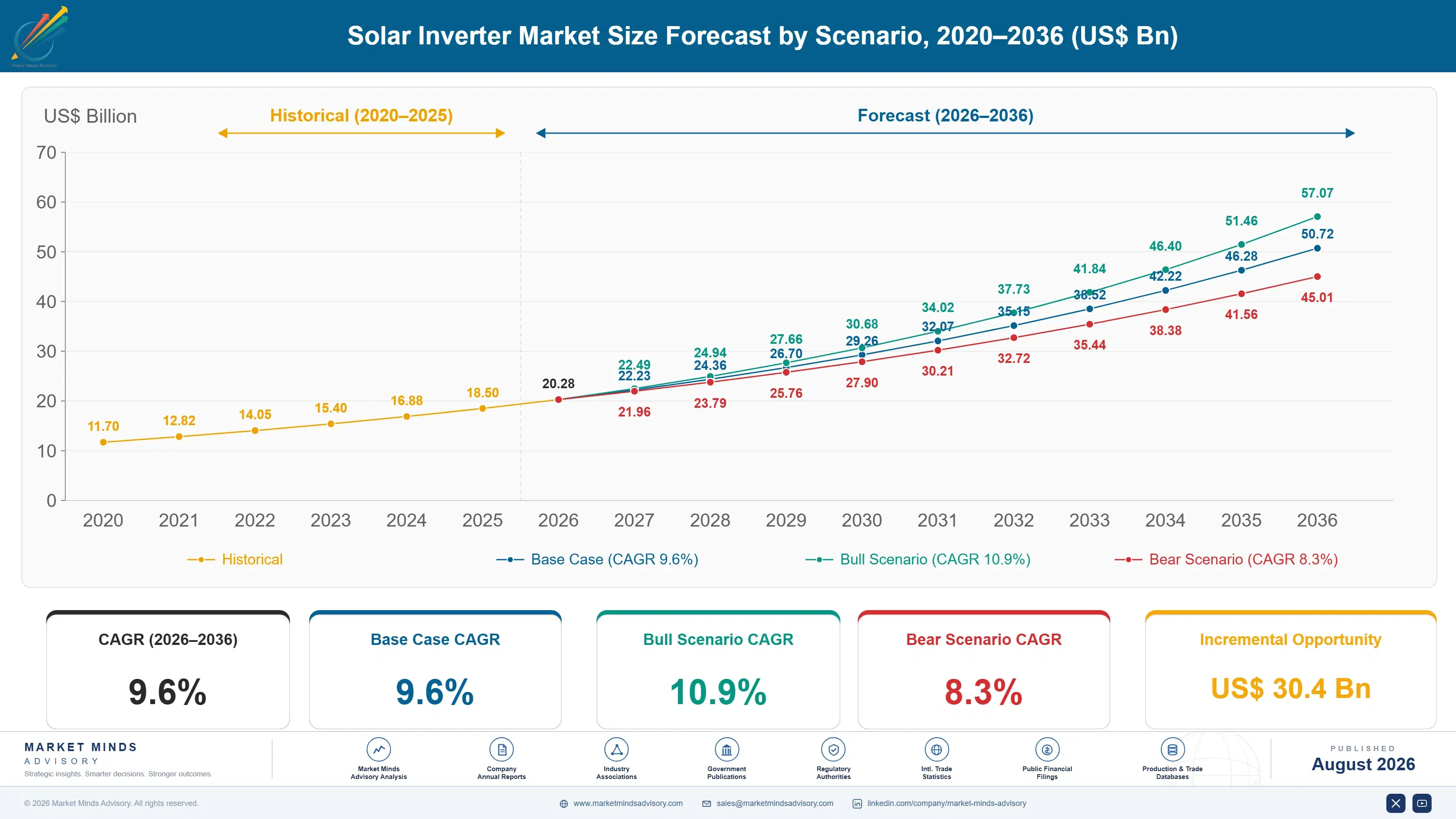
Solar Inverter Market Forecast Scenarios

solar-micro-inverter-market-size-forecast-scenario-1787300533646
Between 2020 and 2025 the market grew at roughly 8.6% annually, propelled by falling module costs that pulled overall system economics down and made utility-scale and residential solar viable across dozens of new markets simultaneously. Growth accelerated sharply after 2022 as European energy security concerns and United States tax credit clarity under the Inflation Reduction Act pulled forward both utility and residential installations.
The base case carries the market to 9.6% annual growth through three mechanisms. First, global solar capacity additions keep compounding as module prices stay near record lows, directly lifting inverter unit demand. Second, residential and commercial storage attach rates are climbing fast, pulling buyers toward higher-value hybrid inverters rather than standalone string units. Third, ageing first-generation utility-scale inverter fleets installed a decade ago are reaching replacement age, creating a retrofit demand stream largely independent of new installation volume.
The bull case, 10.9%, assumes accelerated grid-forming mandates across major grids pull forward replacement demand faster than utilities currently plan, alongside continued storage attach rate growth. The bear case, 8.3%, assumes a prolonged Chinese oversupply cycle keeps average selling prices falling faster than shipment volume can offset, compressing manufacturer revenue even as installed capacity keeps expanding steadily worldwide.

Rapid-Shutdown Codes and the Module-Level Power Shift

Microinverters sit at the intersection of two converging forces: electrical safety codes that increasingly favor module-level shutdown, and homeowners who want panel-level production data rather than a single system-wide output figure. Both forces reward a device that costs more per watt than a central inverter but removes the single point of failure that string architectures carry. That combination is unlikely to reverse over the forecast period.
MARKET CONCENTRATION64% CR5A handful of branded suppliers hold most global shipment volume
AVERAGE SELLING PRICE$62-95 per unitPrice varies by power class and battery integration features
TOP PRODUCING COUNTRYChina, 46% shareChinese contract manufacturing supplies most global unit volume
CAPACITY UTILISATION71%Utilisation swings closely with residential installation demand cycles
TRADE INTENSITY58% cross-borderMost units cross a border between manufacture and installation
FEEDSTOCK COST SHARE34% of COGSPower semiconductors and copper windings dominate component spending
Commercially, the market behaves less like a component category and more like a software-attached hardware platform. Enphase and its closest peers bundle monitoring software, warranty extensions, and battery pairing into the purchase decision, and installers increasingly standardize on one brand across their install base to simplify training and service calls rather than mixing vendors project by project. That instinct is exactly what gives early movers durable installer relationships.
Over the next decade, the balance between residential dominance and commercial-scale adoption will shift as larger microinverter units close the efficiency gap with string inverters on bigger rooftop and carport systems. Battery integration will keep deepening, and the suppliers that pair storage and generation most tightly at the module level stand to capture outsized share of new installations.
"Microinverters won the residential rooftop argument on safety code compliance, not efficiency. The next fight is whether that same module-level logic can win commercial rooftops, where string inverters still have a real cost advantage."
Director, Distributed Energy Technology Practice · MMA Energy Practice &mi

Market Trends

Battery-Ready Microinverters Merge Generation and Storage

Suppliers are shipping microinverters designed from the ground up to pair with modular battery systems at the module level, letting installers add storage without replacing existing inverter hardware. Enphase's IQ Battery platform and comparable offerings from APsystems and Hoymiles are converting what used to be a separate hybrid inverter purchase into an incremental battery module addition on an existing microinverter fleet. Attach rates for battery pairing on new US residential systems have climbed past 35% in 2025 from roughly 20% two years earlier, shortening quote-to-install cycles by removing a separate hybrid inverter design step.
Market Impact: Covers 90%+ of new US systems
Commercial Rooftop Adoption Expands Beyond Residential Base

Larger-format three-phase microinverters are opening commercial and small utility-scale rooftop and carport installations that string inverters have dominated on cost grounds for a decade. Enphase's commercial IQ8 line and similar three-phase products from Hoymiles now target systems up to several hundred kilowatts, offering panel-level monitoring and shading resilience that large commercial roof layouts with partial shading value highly. Commercial microinverter shipment volume grew faster than residential volume for the first time in 2025, though commercial still represents a smaller absolute base, leaving significant runway if the segment sustains its current growth trajectory into 2027 and beyond.
Market Impact: Battery attach nearly tripled since 2021

Market Opportunities and Growth Drivers

US Rapid-Shutdown Codes Default New Systems to Module-Level

The National Electrical Code's Section 690.12 rapid-shutdown requirements, adopted across all fifty US states, effectively require module-level shutdown capability on new rooftop solar systems, and microinverters satisfy that requirement natively without added shutdown devices that string systems require. More than 90% of new US residential solar installations in 2025 used either microinverters or DC optimizers with add-on shutdown devices, and installers report microinverters winning the majority of that split because they eliminate a separate component entirely. Code cycles renew roughly every three years, and installers surveyed do not expect any near-term rollback.
Market Impact: Adds 15-20% per-watt cost premium

Residential Battery Attach Rates Keep Climbing

Homeowners are pairing rooftop solar with battery storage at a rate that has more than doubled since 2021, driven by rising retail electricity rates, reduced net-metering export credits in several US states, and grid outage concerns in wildfire and hurricane-prone regions. Battery-integrated microinverter packages let installers quote a single module-level system rather than a separate hybrid inverter and battery combination, cutting design complexity and installation time. MMA's primary survey found battery-attached systems now represent close to 40% of new California residential installations, up from under 15% in 2021, a shift favoring suppliers with native battery pairing.
Market Impact: Chinese units undercut 20-30% on price

Market Restraints and Challenges

Higher Per-Watt Cost Limits Utility-Scale Adoption

Microinverters cost meaningfully more per watt of installed capacity than central inverters at utility scale, a consequence of needing one power electronics unit per panel rather than one large unit for an entire array, and that cost gap keeps microinverters almost entirely out of ground-mount utility-scale solar. Large-scale developers building hundred-megawatt-plus projects continue to specify central inverters almost exclusively, since the labor and component cost of installing thousands of individual microinverters outweighs the module-level monitoring benefit at scale. Suppliers are responding with larger-format three-phase commercial units and simplified mounting hardware that cuts installation labor, though utility-scale remains outside realistic reach.
Market Impact: Lifts battery attach rate above 35%

Chinese Price Competition Compresses Branded Margins

Chinese manufacturers including Hoymiles, Deye, and a growing set of smaller entrants are shipping microinverters at prices 20 to 30% below established Western brands, a gap rooted in domestic power semiconductor supply chains and lower labor costs that Western-branded suppliers assembling in Mexico or Vietnam cannot fully match. That pricing pressure compresses gross margins for mid-tier branded suppliers fastest, since they lack both Enphase's software platform lock-in and the Chinese entrants' cost structure. Established suppliers are responding by leaning harder into monitoring software, extended warranties, and installer training programs that low-cost entrants have not yet matched.
Market Impact: Commercial volume growth exceeds 18% annually
3 additional market trends, 3 additional growth drivers, and 2 additional restraints and challenges are covered in the full report. Contact sales@marketmindsadvisory.com to access the complete intelligence.

Segment CAGR and Growth Architecture

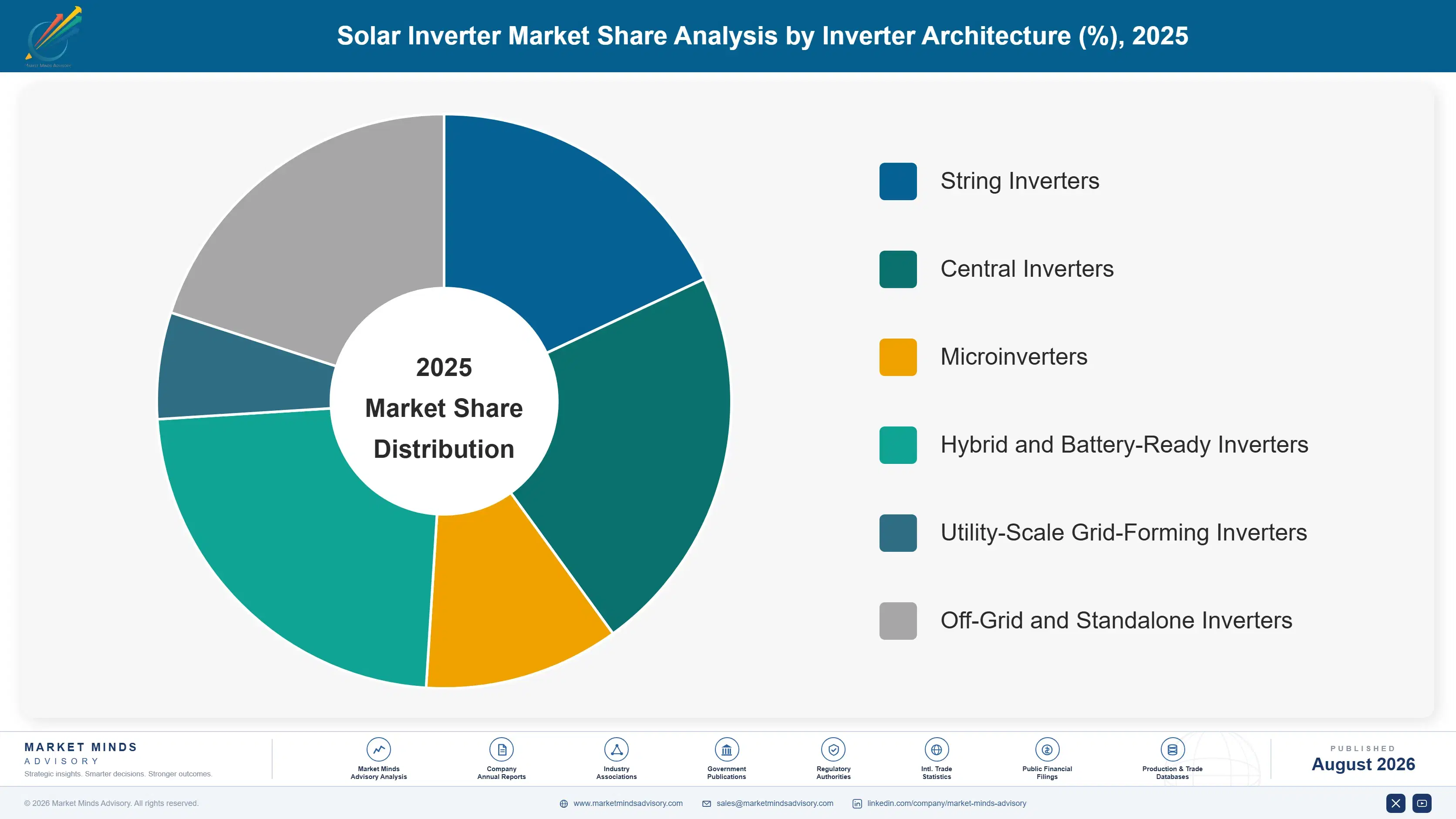
Segmentation follows module compatibility and configuration rather than end-use application, since the number of panels a single unit serves and its battery integration determine installation cost and target system size more than the building type it powers. Single-module units remain the volume base, but multi-module and battery-integrated configurations now address use cases single-module units cannot serve as cost-effectively.
solar-micro-inverter-market-market-share-analysis-1787300534183

Battery-Integrated Hybrid Microinverters

Battery-integrated hybrid microinverters are the fastest-growing configuration, expanding at an estimated 14.8% CAGR against a market average of 11.4%, roughly 1.30 times the overall pace. Growth tracks directly with residential battery attach rates, which have climbed as homeowners weigh rising electricity rates and grid outage risk against the added upfront cost of storage. These units integrate battery management and inverter functions in a single module-level package, letting installers avoid a separate hybrid inverter design step that adds both cost and installation time. Enphase and APsystems currently lead on shipped volume, though Chinese suppliers are closing the technology gap faster in this segment than in standard single-module units, since battery integration rewards software and firmware capability more than raw manufacturing scale.
CAGR 14.8%

Commercial-Scale Microinverters

Commercial-scale microinverters rank second-fastest, growing at an estimated 13.2% CAGR as larger three-phase units close the cost gap with string inverters on commercial rooftop and carport installations. The segment benefits from partial-shading resilience that commercial roof layouts, often broken up by HVAC equipment and structural obstructions, value more than open residential roofs do. Adoption still trails residential microinverter penetration by a wide margin, since commercial developers remain more cost-sensitive per watt and slower to move away from proven string inverter designs. Growth is concentrated among suppliers including Enphase and Hoymiles that have released dedicated three-phase commercial product lines within the past two years, with qualification cycles for large commercial accounts running six to twelve months.
CAGR 13.2%
Full segment breakdown across 5 segments available in the complete report.

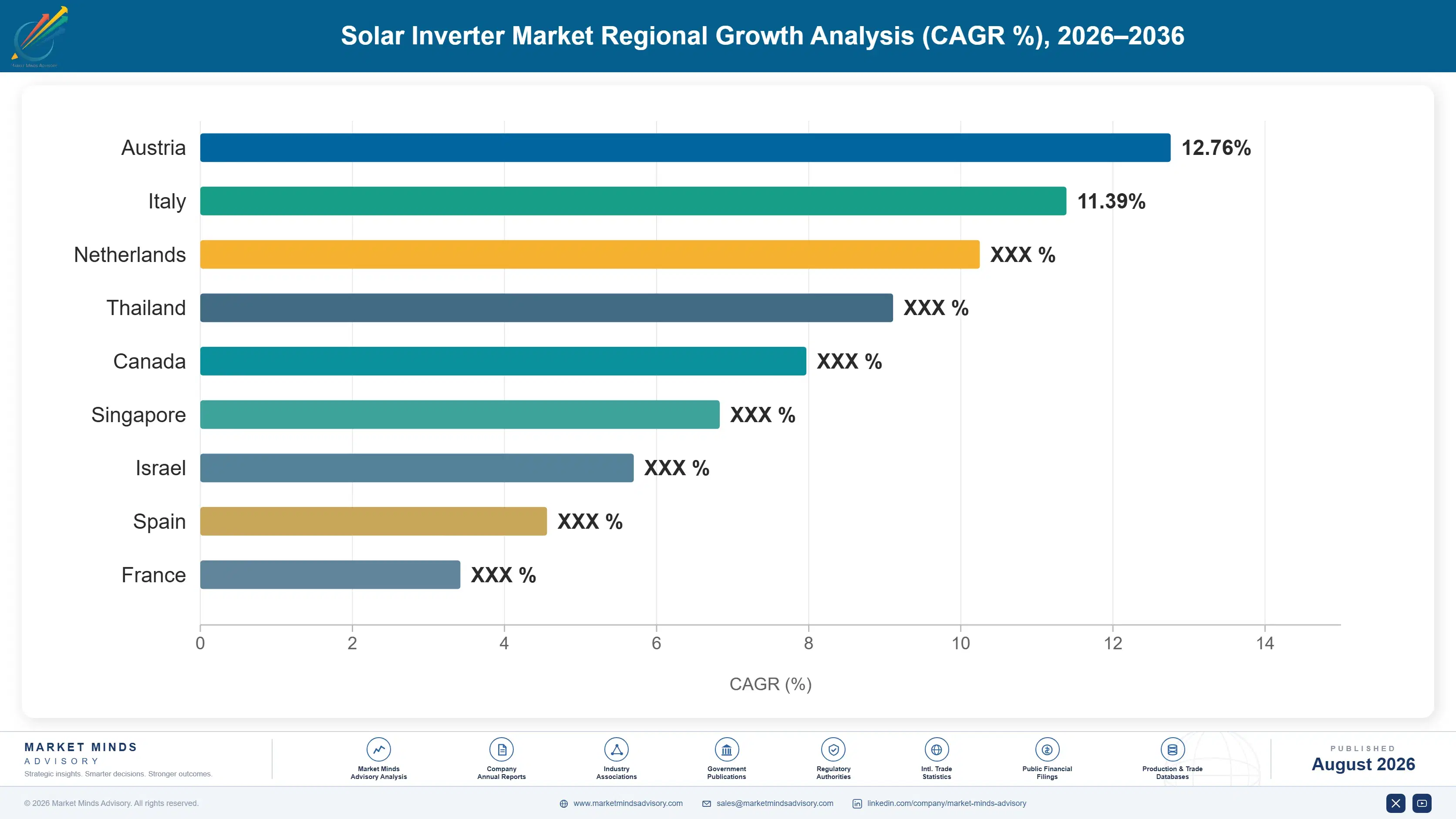
Regional Architecture and Country Demand Map

Microinverter demand concentrates where electrical safety codes and residential battery adoption overlap. North America leads on both code-driven mandates and battery attach rates, East Asia follows on manufacturing scale and its own expanding rooftop base, and South Asia and Pacific grows fastest as India and Australia adopt module-level safety standards.

North America

Electrical code, not incentive policy alone, anchors North America's leading share of global microinverter demand. The National Electrical Code's rapid-shutdown requirements adopted across all fifty US states push new residential installations toward module-level power electronics by default, and California, Texas, and Florida together account for the largest share of new residential rooftop volume. Battery attach rates are climbing fastest in wildfire and hurricane-prone states, where grid outage risk makes storage pairing a practical necessity rather than an optional upgrade. Canada contributes a smaller, slower-growing share tied to provincial net-metering programs in Ontario and Alberta, while commercial rooftop adoption is beginning to scale in warehouse-dense US metro corridors as three-phase products mature.
Share: 31% | CAGR: 12.7% (2026 to 2036)

Western Europe

Rooftop solar policy shifts, not a single dominant code requirement, shape Western Europe's microinverter demand. Germany and the Netherlands lead on installed residential volume, driven by high retail electricity prices that make self-consumption economics attractive even without generous feed-in tariffs. France and the UK are expanding module-level monitoring requirements in newer building codes, gradually pulling installer preference away from string inverters on smaller residential systems. Battery attach rates trail North America but are rising as several governments phase down feed-in export payments, pushing households toward self-consumption and storage. Growth here trails the global average, reflecting a more mature, policy-dependent residential base than North America's code-anchored market. Italy and Spain add a smaller contribution as electricity prices there stay elevated.
Share: 19% | CAGR: 10.1% (2026 to 2036)
Regional intelligence for 5 additional markets available in the complete report: East Asia, South Asia and Pacific, Latin America, Middle East and Africa, Eastern Europe. Contact sales@marketmindsadvisory.com.
solar-micro-inverter-market-country-cagr-analysis-1787300534696

Where Microinverter Margin Concentrates Next

Four commercial moves separate suppliers capturing outsized margin from those competing purely on per-unit price. Each depends on shifting revenue toward software, storage attach, installer relationships, or commercial-scale product lines that current shipment volume does not yet fully reflect, particularly as residential unit pricing keeps compressing under Chinese competitive pressure at the low end of the product range.

Monitoring Software and Data Subscription Fees

Suppliers that charge separately for advanced panel-level monitoring, performance guarantees, and installer fleet management dashboards are converting a one-time hardware sale into a recurring software relationship. Premium monitoring tiers typically carry subscription fees of $5 to $15 per system monthly, a small figure per household but a meaningful aggregate revenue stream across an installed base numbering in the millions of systems. Suppliers without a compelling software layer increasingly lose installer partnership negotiations to rivals whose dashboards reduce service call volume and improve customer retention, making the software layer less an add-on than a competitive requirement for scaled installer relationships.
Market Impact: Adds $5 to $15 per system monthly in software fees

Extended Warranty and Performance Guarantee Programs

Suppliers are bundling extended 25-year warranties and production guarantees that cost more upfront but reduce the total cost of ownership uncertainty installers must explain to homeowners, capturing willingness to pay that a bare hardware warranty leaves on the table. A 25-year extended warranty upgrade typically adds 3 to 6% to the system price while meaningfully reducing homeowner objections during the sales process, since rooftop solar buyers weigh multi-decade reliability heavily against unbranded competitors offering shorter or unclear warranty terms. Suppliers with the balance-sheet strength to credibly back 25-year commitments capture a disproportionate share of premium-tier installer relationships.
Market Impact: Adds 3 to 6% to system price per install

Installer Certification and Training Program Investment

Branded suppliers running formal installer certification programs convert training investment into channel loyalty that is difficult for lower-cost entrants to replicate quickly. Certified installers typically commit to specifying a single brand across 80% or more of their project volume in exchange for priority technical support, co-marketing funds, and faster warranty claims processing, a trade that meaningfully reduces the supplier's customer acquisition cost per installed watt. Suppliers without a certification program compete purely on unit price and installer margin, a weaker position as certified programs mature and lock in the highest-volume installers first.
Market Impact: Locks in 80% or more of certified installer volume

Three-Phase Commercial Product Line Market Expansion

Suppliers expanding into larger three-phase commercial-scale units are capturing a segment growing faster than the residential base, at gross margins comparable to residential units despite lower per-watt hardware markup, because commercial accounts carry lower customer acquisition cost per watt installed. A single commercial rooftop or carport project can represent 50 to 200 times the unit volume of a typical residential sale, letting suppliers amortize sales and support costs across far more shipped hardware per deal closed. Suppliers still concentrated purely on residential-scale units risk ceding this faster-growing segment to rivals with mature three-phase product lines already qualified.
Market Impact: Commercial deals ship 50 to 200 times residential volume

Who Controls the Margin Pool

The top five suppliers hold an estimated 64% of global microinverter shipment volume, a meaningfully higher concentration than most power electronics categories, reflecting Enphase's early scale advantage and the software platform lock-in that keeps installers from switching brands casually. Enphase and APsystems lead on breadth and installer relationships, while a wide second tier of Chinese suppliers competes mainly on price rather than software or brand.
Current competitive activity centers on three fronts. Battery-integrated product launches are redrawing the premium tier, with Enphase, APsystems, and Hoymiles racing to ship deeper storage integration. Commercial three-phase product expansion is opening a second growth avenue beyond the residential base. And several Chinese suppliers are pursuing Western market certification and distributor partnerships to move beyond export pricing into branded competition.

Emerging pressure comes from Chinese suppliers including Hoymiles and Deye moving up the value chain into battery-integrated and three-phase commercial products once dominated by Enphase and APsystems, aided by domestic power semiconductor supply that keeps their input costs consistently lower. If installer trust in Chinese brands' software and warranty commitments keeps building, expect share to shift meaningfully, particularly in Europe and South Asia where price sensitivity runs higher than in North America.
solar-micro-inverter-market-company-positioning-matrix-1787300535213

Competitive Moat and Risk Dimensions

ENPHASE ENERGY

Moat: Installer Network and Software Lock-In

Enphase built a deep installer relationship and monitoring software platform that competitors have struggled to replicate, and its battery pairing platform keeps homeowners and installers inside a single-vendor system that is costly to switch away from once installed, reinforcing its lead even as hardware-only competitors undercut on unit price and installers weigh switching costs against modest savings.
ENPHASE ENERGY

Risk: Premium Pricing Under Chinese Pressure

Enphase's premium pricing model depends on installers and homeowners valuing its software and warranty platform enough to pay meaningfully more than Chinese alternatives, and that willingness to pay could erode if lower-cost competitors close the reliability and software gap faster than Enphase can defend its premium position in price-sensitive markets.
HOYMILES POWER ELECTRONICS

Moat: Cost Structure and Manufacturing Scale

Hoymiles built its business on a domestic Chinese power semiconductor and manufacturing base that gives it a durable cost advantage over Western-branded competitors, letting it compete aggressively on price across both export and, increasingly, its own domestic Chinese residential rooftop market growth, a dual-market position few Western rivals can match.
HOYMILES POWER ELECTRONICS

Risk: Brand Trust in Western Markets

Hoymiles still lacks the installer trust and software platform depth that Enphase built over a decade, so expanding share in North America and Western Europe requires overcoming brand skepticism among installers who have standardized service and training around established Western suppliers already, a slow process even with a genuine cost advantage.

Key Players

Enphase Energy
APsystems
Hoymiles Power Electronics
Deye
Darfon Electronics

Others

SolarEdge Technologies
Growatt New Energy
GoodWe
SMA Solar Technology
Sungrow Power Supply
Chilicon Power
TSUN (Shenzhen Sunway Technology)
Envertech
Zeversolar
Fronius International
Delta Electronics
Yotta Energy
AEconversion
ReneSola
Sparq Systems

Recent Developments

FEBRUARY 2025

Enphase Launches Third-Generation Battery-Integrated Microinverter Platform

Enphase Energy introduced its third-generation IQ battery-integrated microinverter platform, adding faster charge-discharge cycling and expanded backup power coverage for US residential customers. The launch followed eighteen months of field testing across California and Texas installer networks, and Enphase reported the new platform cut installation time per system meaningfully.
Signal: Signals battery integration becoming the primary product differentiation axis among leading microinverter brands as hardware margins keep compressing industry-wide.
OCTOBER 2024

Hoymiles Opens Assembly Facility in Vietnam to Diversify Export Manufacturing

Hoymiles Power Electronics commissioned a new assembly facility in Vietnam dedicated to final microinverter assembly for export to North American and European markets, reducing its reliance on direct China-origin shipments amid ongoing trade policy uncertainty. The facility complements Hoymiles' existing Chinese manufacturing base rather than replacing it.
Signal: Signals Chinese suppliers diversifying manufacturing footprint to manage trade policy and tariff exposure risk across their largest export markets.
MAY 2025

APsystems Acquires Commercial Monitoring Software Startup

APsystems acquired a commercial fleet monitoring software startup to strengthen its three-phase commercial product line's data analytics capability, aiming to compete more directly with Enphase's commercial monitoring offering. The acquisition adds roughly forty engineering staff to APsystems' existing product development team. The financial terms of the deal were not disclosed.
Signal: Signals commercial-scale software capability becoming a competitive battleground beyond residential monitoring as suppliers chase higher-volume commercial accounts.

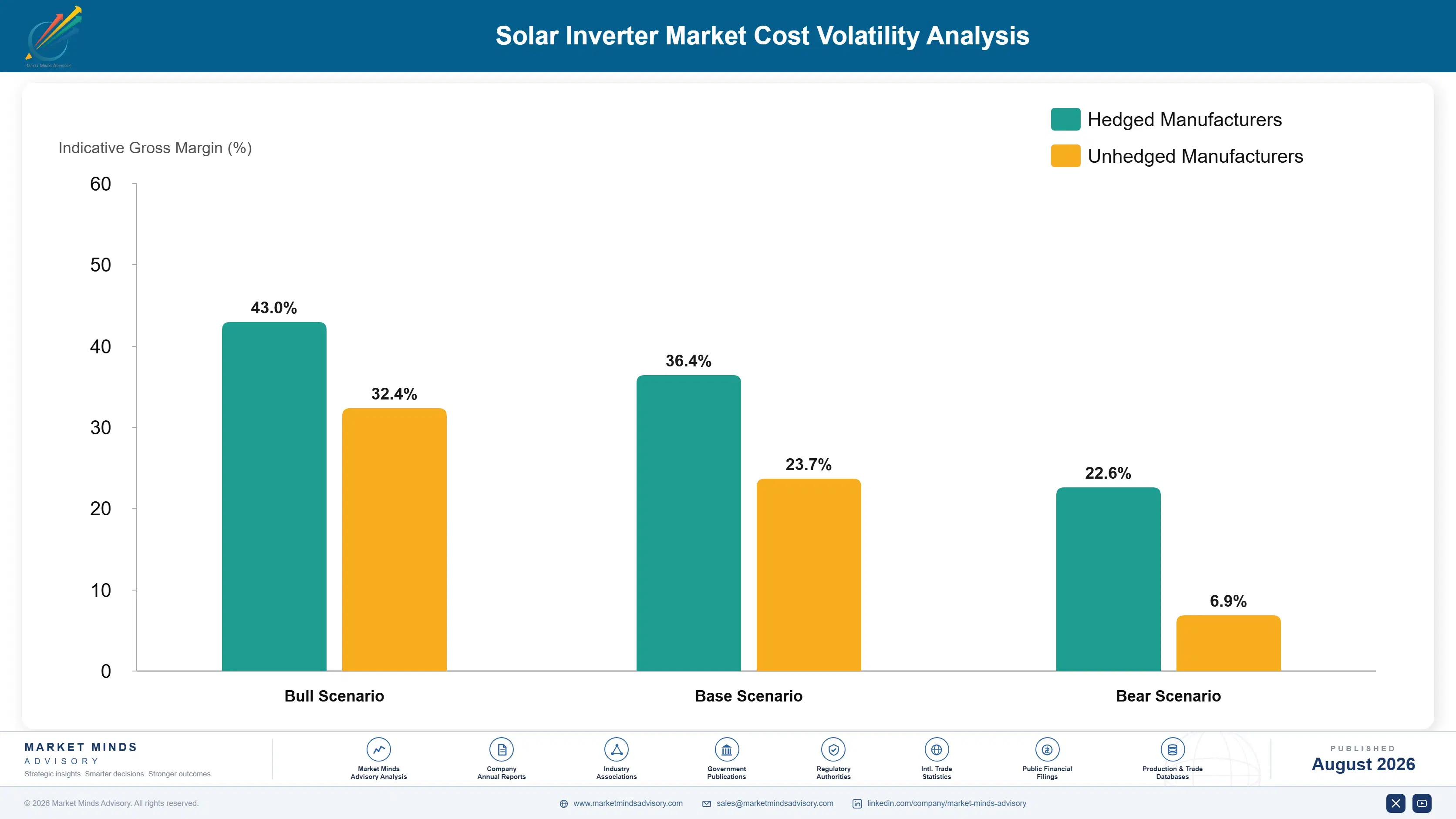
Power Semiconductor and Copper Cost Exposure

Power semiconductors, including MOSFETs and gate drivers, together with copper magnetic winding components, account for roughly 34% of cost of goods sold in microinverter manufacturing, with semiconductor supply concentrated among a handful of Taiwanese and Chinese foundries. Aluminum enclosure and connector components add a further meaningful share, sourced predominantly from Chinese contract manufacturers regardless of final brand.
Power semiconductor prices spiked sharply during the 2021 to 2022 global chip shortage, with several microinverter suppliers reporting lead time extensions past six months in their 2022 annual reports as automotive and consumer electronics demand crowded out smaller power electronics orders. The EIA's 2024 supply chain review of clean energy components flagged power semiconductors as a persistent bottleneck risk given the small number of foundries capable of automotive-grade component qualification that microinverter suppliers also require.

Smaller regional suppliers without long-term semiconductor allocation agreements absorbed the 2022 shortage hardest, losing shipment volume to larger suppliers including Enphase that had negotiated priority allocation. Chinese suppliers with closer domestic foundry relationships weathered the shortage somewhat better than Western-branded suppliers dependent on the same constrained global semiconductor pool, a durable cost and supply advantage that persists in tighter allocation cycles.
solar-micro-inverter-market-cost-volatility-analysis-1787300535409

Multi-Year Semiconductor Allocation Agreements

Larger suppliers are locking multi-year semiconductor supply agreements directly with foundries, trading some pricing flexibility for guaranteed allocation priority that protects production continuity during future shortage cycles, an increasingly standard practice among the top five branded suppliers following the 2022 shortage experience. Smaller suppliers without that scale increasingly pool orders through distributors to gain similar allocation priority.

Dual-Sourcing Critical Component Qualification

Suppliers are qualifying second and third semiconductor and connector sources for critical components, reducing single-foundry dependence even though dual-sourcing raises design complexity and qualification cost, a tradeoff most suppliers now consider worthwhile after 2022's shortage exposed the risk of relying on one primary supplier. Qualification typically takes six to nine months per new component source before it enters production.

Vertical Integration of Enclosure Manufacturing

Several larger suppliers are bringing aluminum enclosure and connector manufacturing in-house or under closer contractual control, cutting exposure to spot-market component pricing swings and improving quality control consistency across production batches at meaningfully higher fixed capital cost. Smaller suppliers without the capital for vertical integration instead negotiate longer-term fixed-price contracts with existing component vendors to achieve similar cost predictability.

Portfolio Architecture for Margin Defence

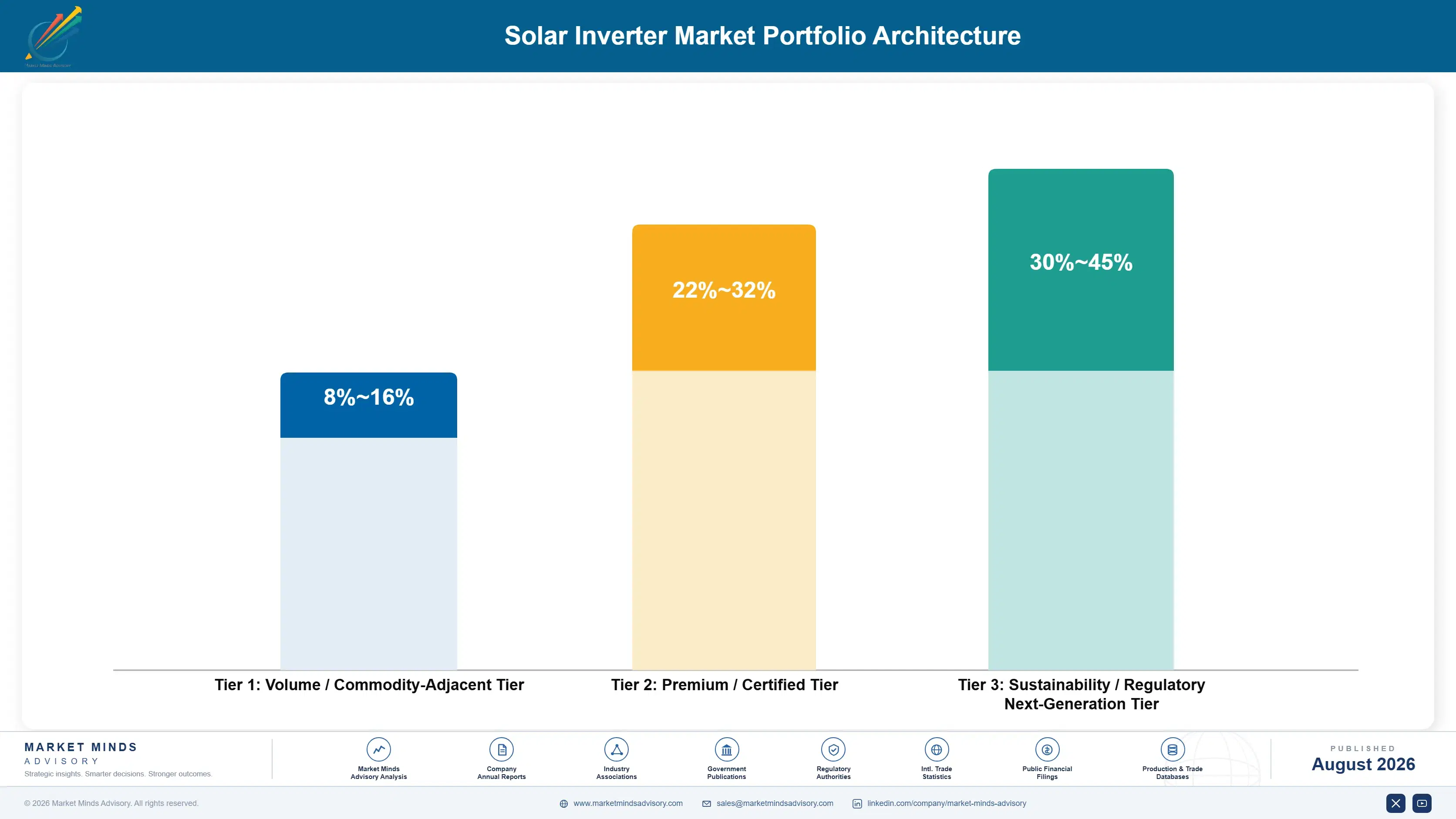
Microinverter portfolios split across three tiers with meaningfully different margin economics. The volume tier, standard single and dual-module residential units, competes largely on price against Chinese entrants and delivers gross margins in the 30 to 40% range. Premium certified units bundling advanced monitoring and extended warranties command materially higher margins, reflecting installer trust and software subscription revenue layered on top of hardware.
The tension between volume and premium tiers shapes product development priorities across the industry. Volume residential capacity is easiest to scale and fastest to fund, but Chinese price competition keeps margin pressure constant in that tier. Premium and next-generation battery-integrated capacity requires deeper software investment and slower qualification cycles, but rewards patient capital with margins that hold up even as volume-tier pricing keeps eroding.

High-value margin pools concentrate in battery-integrated systems, commercial three-phase units, and the software and monitoring layer that increasingly separates branded suppliers from commodity hardware sellers. These pools remain a modest share of total shipment volume today, but they are growing faster than the residential hardware base and are where most supplier research and development spending is now directed. Suppliers slow to shift capital toward these pools risk losing ground to faster-moving rivals.

Volume / Commodity-Adjacent Tier

Standard single and dual-module residential microinverters sold primarily on unit price and delivery availability, facing the heaviest direct competition from Chinese entrants. These units carry the thinnest margins in the portfolio and depend on volume and manufacturing efficiency rather than brand differentiation to stay profitable.
Gross Margin: 30-40%

Premium / Certified Tier

Branded residential and light-commercial units bundling advanced monitoring software, extended warranty coverage, and installer certification support that homeowners and installers pay a premium to access. This tier generates the steadiest repeat business, since certified installers rarely switch away from a platform their technicians already know.
Gross Margin: 44-56%

Sustainability / Regulatory / Next-Generation Tier

Battery-integrated hybrid units and three-phase commercial products tied to rapid-shutdown code compliance and rising residential storage attach rates across mature solar markets. This tier draws the heaviest research and development spending, since battery firmware and three-phase commercial qualification both require sustained engineering investment to defend.
Gross Margin: 48-60%
solar-micro-inverter-market-portfolio-architecture-1787300535908

High-value Sub-segments and Strategic Watch-out

Battery-Integrated Hybrid Microinverters

The fastest-growing, highest-margin pool in the market, driven by rising residential battery attach rates that reward suppliers with mature storage pairing software and firmware capability already in the field. Suppliers without that capability risk losing the fastest-growing accounts to rivals that qualified battery firmware earlier in the product cycle.
Gross Margin: 50-60%

Commercial Three-Phase Microinverters

A smaller but rapidly scaling high-value pool as larger units close the cost gap with string inverters on commercial rooftops, gated by qualification cycles with large commercial installer accounts. Suppliers that secure early qualification with large commercial accounts tend to hold that relationship for years, since switching platforms is costly.
Gross Margin: 45-55%

Standard Residential Single-Module Units

The volume core of the market, serving cost-sensitive residential installations where Chinese price competition keeps margins under the most sustained pressure of any product tier. This segment still generates the largest absolute shipment volume industry-wide, and defending share here funds the research spending that premium and next-generation tiers require.
Gross Margin: 28-36%

Unbranded Chinese Low-Cost Imports

A strategic watch-out segment where rapidly expanding low-cost, low-brand-recognition units could pull residential-tier pricing down faster than installer software preferences can defend branded margins. Branded suppliers without a genuine software or warranty advantage against these entrants should expect continued price erosion, making faster movement into commercial tiers the defensible path.
Gross Margin: 16-26%

The Installer Relationship as the Moat

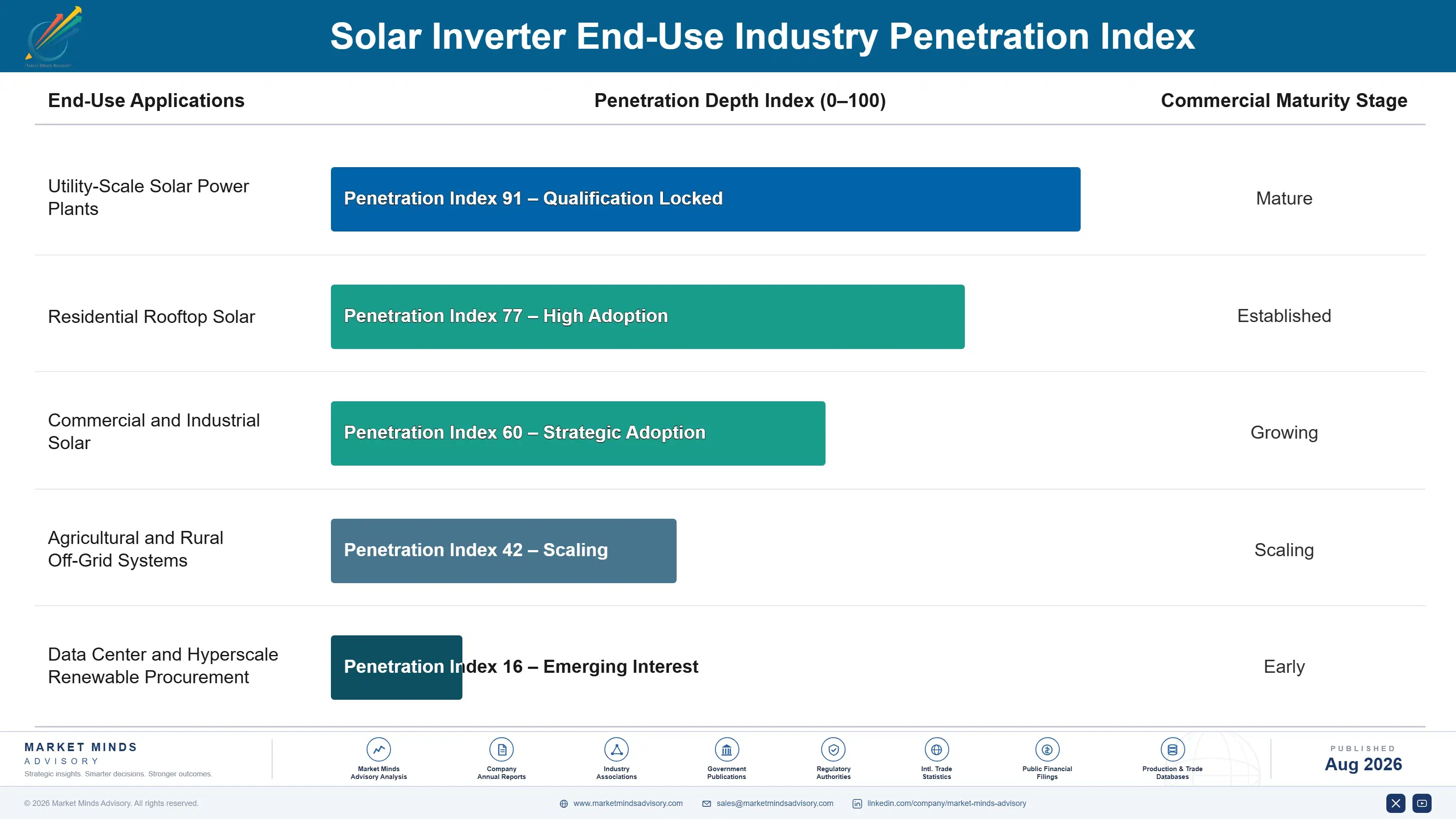
Microinverter economics increasingly resemble a platform business built around the installer relationship rather than a simple hardware sale. Monitoring software subscriptions, warranty claims processing, and training program access generate recurring engagement with installer networks that persists well beyond the initial hardware purchase, and suppliers that own that relationship can forecast replacement and expansion demand with more confidence than pure hardware competitors.
Adoption depth varies by end-use vertical. Residential installers, once trained and certified on a given brand's product line and monitoring software, rarely switch given the cost of retraining technicians and reconfiguring service processes across an existing customer base. Commercial and light-industrial accounts show shallower stickiness so far, since three-phase commercial product lines are newer and installers in that segment have not yet standardized as heavily around a single brand.

A generational shift in buyer profiles is underway as homeowners increasingly research battery attach and monitoring app quality before selecting an installer, rather than leaving equipment brand entirely to installer discretion. That shift rewards suppliers with strong consumer-facing software and app reputations over those competing purely on installer-facing wholesale pricing. The trend is uneven across regions but favors software-capable brands.
solar-micro-inverter-market-end-use-penetration-index-1787300536394

Where MMA Sees the Opportunity

These are among the four positions where our research anticipates prominent divergence between winners and laggards over the coming forecast period. Each is grounded in the demand model, the regulatory perimeter, and the announced capacity pipeline.
01 / BATTERY INTEGRATION INVESTMENT

Prioritize battery-pairing capability over incremental hardware cost cuts

Battery-integrated hybrid microinverters are growing roughly 1.30 times faster than the overall market, driven by residential storage attach rates that show no sign of slowing given rising electricity rates and grid outage concerns. Suppliers still competing purely on standalone hardware cost risk ceding the fastest-growing, highest-margin accounts to rivals that built battery pairing software and firmware capability earlier. Capital directed toward deeper storage integration now should pay back faster than incremental cost reduction on standard single-module units facing constant Chinese price pressure.
02 / INSTALLER RELATIONSHIP BUILD-OUT

Treat installer certification programs as a core moat investment

Suppliers that still compete purely on unit price and basic warranty terms are leaving significant value on the table that installer certification, monitoring software, and training program investment are already capturing for established brands. These installer relationships carry materially higher switching costs than the underlying hardware sale, locking installers into renewal patterns that price-only competitors struggle to break. Building this capability now, before Chinese entrants close the software and training gap further, is worth more than matching a rival's unit price cut for cut.
03 / SEMICONDUCTOR SUPPLY HEDGING

Lock multi-year power semiconductor allocation agreements now

Power semiconductor and copper input costs already run close to 34% of cost of goods sold, and the 2022 shortage showed foundry allocation constraints can extend supplier lead times past six months without warning. Suppliers without multi-year allocation agreements risk losing shipment volume to better-hedged rivals during the next constrained cycle, damaging installer trust built over years in a single sharp shortage. Locking allocation now, even at a premium to spot foundry pricing, protects production continuity and the installer confidence that scaled growth depends on.
04 / REGIONAL CAPACITY POSITIONING

Weigh Chinese cost scale against Western brand trust carefully

East Asia now holds the largest manufacturing base for microinverter production and continues adding capacity faster than most other regions, making cost leadership there increasingly difficult for Western-branded suppliers to contest directly on hardware price. Western suppliers still hold a genuine advantage in installer trust, monitoring software depth, and warranty credibility that Chinese entrants have not yet fully closed. The sounder strategy is not chasing Chinese manufacturing cost scale directly, but doubling down on the software and service capability that Chinese competitors still cannot replicate at comparable installer trust levels.

Engagement Snapshot From the Field

A live engagement with an industry participant carrying material or product regulatory and market exposure ahead of a defining policy shift, showing how our research translates into a defensible multi-year portfolio strategy.
MARKET MINDS ADVISORY · CLIENT ENGAGEMENT SUMMARY
Solar Micro Inverter Producer Strategic Portfolio Review and Transition Roadmap 2026·Investment Scenario on Solar Micro Inverter Exposure Evaluation 2025-26
CLIENT PROFILE
The client is a regional residential solar installer network operating across three US Southwestern states, completing roughly 3,200 residential installations annually through a mix of direct sales and dealer partnerships. The company had historically split its microinverter purchasing across three brands opportunistically based on unit pricing and needed an independent assessment of whether standardizing on a single primary vendor would improve margins and reduce operational complexity (client-reported, unverified by MMA).
STRATEGIC CHALLENGE
The installer network needed to decide whether consolidating microinverter purchasing around a single primary brand would meaningfully reduce technician training costs and warranty processing time, against the risk of losing negotiating leverage and supply flexibility that multi-vendor purchasing had historically provided during past component shortages. Leadership also worried that reversing course later, after retraining technicians around a single platform, would be costly and disruptive.
MMA APPROACH
MMA conducted a vendor-neutral total cost of ownership assessment comparing the client's current three-vendor purchasing pattern against single-vendor and two-vendor consolidation scenarios, benchmarking technician training cost, warranty claims processing time, monitoring software support burden, and realistic volume-discount pricing tiers across the client's five most-used suppliers. The assessment drew on structured interviews with the client's own technicians and dispatch coordinators alongside published vendor pricing schedules.
KEY FINDINGS
  1. Technician training and certification costs ran roughly 2.4 times higher under the three-vendor model than a projected single-vendor scenario, driven by the need to maintain current certification across three separate monitoring platforms and warranty systems.
  2. Warranty claims processing time averaged eleven days under the fragmented three-vendor model, compared to a projected five to six days under single-vendor consolidation with a dedicated account relationship and priority support tier.
  3. Volume discount tiers from the client's top-performing vendor would improve materially if the installer consolidated at least 70% of purchasing volume with that single brand, based on that vendor's disclosed tiered pricing structure.
  4. Multi-vendor flexibility had provided real supply continuity benefit during the 2022 semiconductor shortage, suggesting full single-vendor consolidation carried genuine supply risk worth preserving some hedge against.
CLIENT PROFILE
The client is a regional residential solar installer network operating across three US Southwestern states, completing roughly 3,200 residential installations annually through a mix of direct sales and dealer partnerships. The company had historically split its microinverter purchasing across three brands opportunistically based on unit pricing and needed an independent assessment of whether standardizing on a single primary vendor would improve margins and reduce operational complexity (client-reported, unverified by MMA).
STRATEGIC CHALLENGE
The installer network needed to decide whether consolidating microinverter purchasing around a single primary brand would meaningfully reduce technician training costs and warranty processing time, against the risk of losing negotiating leverage and supply flexibility that multi-vendor purchasing had historically provided during past component shortages. Leadership also worried that reversing course later, after retraining technicians around a single platform, would be costly and disruptive.
MMA APPROACH
MMA conducted a vendor-neutral total cost of ownership assessment comparing the client's current three-vendor purchasing pattern against single-vendor and two-vendor consolidation scenarios, benchmarking technician training cost, warranty claims processing time, monitoring software support burden, and realistic volume-discount pricing tiers across the client's five most-used suppliers. The assessment drew on structured interviews with the client's own technicians and dispatch coordinators alongside published vendor pricing schedules.
KEY FINDINGS
  1. Technician training and certification costs ran roughly 2.4 times higher under the three-vendor model than a projected single-vendor scenario, driven by the need to maintain current certification across three separate monitoring platforms and warranty systems.
  2. Warranty claims processing time averaged eleven days under the fragmented three-vendor model, compared to a projected five to six days under single-vendor consolidation with a dedicated account relationship and priority support tier.
  3. Volume discount tiers from the client's top-performing vendor would improve materially if the installer consolidated at least 70% of purchasing volume with that single brand, based on that vendor's disclosed tiered pricing structure.
  4. Multi-vendor flexibility had provided real supply continuity benefit during the 2022 semiconductor shortage, suggesting full single-vendor consolidation carried genuine supply risk worth preserving some hedge against.
RECOMMENDED STRATEGY
Phase 1: Phase 1 (Months 1 to 3): Consolidate 70% of purchasing volume with the top-performing primary vendor while retaining a secondary vendor relationship. Phase 2: Phase 2 (Months 4 to 9): Retrain technician certification around the primary vendor's monitoring platform and negotiate improved volume-discount pricing tiers. Phase 3: Phase 3 (Months 10 to 15): Evaluate warranty processing time and margin improvement against baseline, adjusting the secondary vendor allocation as needed.
OUTCOME
The installer network implemented a 70/30 primary-secondary vendor split beginning in early 2026, retaining supply flexibility while capturing most of the projected training and warranty processing efficiency gains. Early data through mid-2026 showed warranty processing time improving toward the projected five to six day range, though full-year margin impact will not be confirmed until year-end (client-reported, unverified by MMA).

Frequently Asked Questions

Foundational context covering the market sizes, CAGR, scope, country, region and competition that inform every finding below. This section is provided to cover basics and most often pre-purchase conversations, answered from the MMA Primary Research Dataset.

What is the current size of the Solar Micro Inverter Market?

The global solar micro inverter market reached an estimated $2.8 billion in 2025. Growth concentrates in residential rooftop systems where rapid-shutdown electrical codes favor module-level power electronics by default.

How large will the Solar Micro Inverter Market be by 2036?

MMA forecasts the market reaching approximately $9.19 billion by 2036, nearly three times its 2026 value. Battery-integrated hybrid units are expected to drive the largest share of that incremental growth.

What is the CAGR for the Solar Micro Inverter Market 2026 to 2036?

The base case CAGR is 11.4% across the forecast period, with a bull case near 12.6% and a bear case near 10.1% depending on battery attach rates and net-metering policy trends.

Which segment is growing fastest?

Battery-integrated hybrid microinverters are the fastest-growing segment, expanding at roughly 14.8% CAGR, about 1.30 times the overall market pace, driven by rising residential storage attach rates.

Who are the major companies in the Solar Micro Inverter Market?

Leading suppliers include Enphase Energy, APsystems, Hoymiles Power Electronics, Deye, and Darfon Electronics. The top five hold an estimated 64% of global shipment volume, reflecting a moderately concentrated but still fragmented competitive landscape.

Which country is growing fastest?

China leads growth in absolute manufacturing volume, but India is expanding fastest in percentage terms, driven by national rooftop solar subsidy programs and new safety certification requirements.

Report Segmentation Architecture

The full report scope spans multiple orthogonal segmentation dimensions, with cross-tabulated demand data provided for each dimension pair. Coverage extends further to regional breakdowns, trend trajectories, and the competitive detail needed to support segment-level decision-making.

By Module Configuration Type

  • Single-Module Microinverters
  • Dual-Module Microinverters
  • Multi-Module Microinverters
  • Battery-Integrated Hybrid Microinverters
  • Commercial-Scale Three-Phase Microinverters

By End-Use Industry

  • Residential Rooftop Solar
  • Commercial and Light-Industrial Rooftop
  • Carport and Canopy Solar
  • Small Utility-Scale Rooftop
  • Building-Integrated Photovoltaics

By Commercial Dimension

  • Original Equipment Sales
  • Monitoring Software Subscriptions
  • Installer Certification and Training Programs
  • Extended Warranty Services

By Region

  • North America
  • Western Europe
  • East Asia
  • South Asia and Pacific
  • Latin America
  • Middle East and Africa
  • Eastern Europe

Scope, Methodology, and Coverage

Every figure in this report is reproducible from documented input assumptions. The scope below maps the historical period, the forecast horizon, the segmentation dimensions, and the countries covered, alongside the underlying primary and qualitative methodology.
Historical Period
2020 to 2025
Forecast Period
2026 to 2036
Base Year
2025 (USD billions; MMA Primary Research Dataset, August 2026)
Market Definition
The solar micro inverter market covers module-level power electronics devices that convert direct current output from individual or small groups of solar panels into grid-compatible alternating current, sold for residential, commercial, and small utility-scale rooftop installations. It excludes central and string inverters, DC power optimizers that do not perform inverter-level conversion, and standalone battery storage inverters sold without integrated solar conversion.
Quantitative Units
USD billions (current prices); unit shipment volume in millions of microinverters where disclosed
Segmentation Dimensions
By Module Configuration Type; By End-Use Industry; By Commercial Dimension; By Region
Regions Covered
North America, Western Europe, East Asia, South Asia and Pacific, Latin America, Middle East and Africa, Eastern Europe
Countries Covered
USA, China, Germany, France, UK, Japan, South Korea, India, Australia, Canada, Brazil, Mexico, Indonesia, Vietnam, Thailand, Malaysia, UAE, Saudi Arabia, South Africa, Nigeria, Turkey, Poland, Netherlands, Italy, Spain, Sweden, Switzerland, Argentina, Colombia, Singapore, and additional markets relevant to this sector
Key Companies Profiled
Enphase Energy, APsystems, Hoymiles Power Electronics, Deye, Darfon Electronics, SolarEdge Technologies, Growatt New Energy, GoodWe, SMA Solar Technology, Sungrow Power Supply, Chilicon Power, TSUN (Shenzhen Sunway Technology), Envertech, Zeversolar, Fronius International, Delta Electronics, Yotta Energy, AEconversion, ReneSola, Sparq Systems
Quantitative Methodology
Primary survey, n=3,800 respondents, Q4 2025, six countries; demand-side model with trade association cross-validation
Qualitative Methodology
47 expert interviews, Q4 2025; applied to validate demand model assumptions, identify emerging dynamics, and assess competitive positioning
Report Format
PDF and XLSX data workbook (Word format preview document)
Publisher
Market Minds Advisory
Report Code
MMA-2026-ENE-207
Published
August 2026
Contact
sales@marketmindsadvisory.com | www.marketmindsadvisory.com

Purchase the full Solar Micro Inverter Market Report (2026 to 2036).

The full Solar Micro Inverter Market report delivers a comprehensive assessment of module configuration technology, competitive positioning, and regional demand through 2036. It includes detailed segmentation by configuration type, end-use industry, and commercial dimension, alongside profiles of all twenty companies covered in this summary. The report quantifies regional market size and growth across all seven world regions, with country-level detail for the thirty-plus markets MMA tracks. Buyers receive access to MMA's underlying primary survey dataset and expert interview transcripts, enabling further custom analysis. A dedicated chapter benchmarks power semiconductor cost exposure and mitigation strategies across supplier types.
Configuration-level segmentation across five product technology categories
Profiles of twenty leading microinverter suppliers worldwide
Regional sizing and forecasts across all seven world regions
Power semiconductor cost exposure and mitigation strategy chapter
Primary survey dataset access covering 3,800 respondent interviews
Competitive development tracking with dated corporate event log

Built For The People Who Decide

From boardroom strategy to bench-side execution, this report is read cover-to-cover by leaders shaping the next decade of their industry, turning demand scenarios, market dynamics and valuation benchmarks into decisions.
CXOs/ Presidents/ VPs/ Managers
M&A and Corporate Development
Strategy Teams and R&D Heads
Procurement and Product Directors
Regulatory and Compliance Leaders
Investor Relations and Equity Analysts