

Market Minds Advisory
Solar Encapsulation Market

Solar Encapsulation Market: Solar Encapsulation Market. Bifacial Module Adoption Redraws Encapsulant Chemistry Standards.

Rapid bifacial and PERC module adoption is pushing solar encapsulant chemistry away from standard EVA toward POE and co-extruded formats across China, India, and the United States at an accelerating pace now.

Lead Analyst

Published

September 2026

Make Smarter Decisions with Customized Research Insights

Request a free sample report and evaluate market opportunities, growth trends, and competitive dynamics relevant to your business needs.

2025 MARKET VALUE$4.6BMarket Size 2025
2036 FORECAST VALUE$12.5BBase Case , 2026 to 2036
CAGR 2026 TO 20369.5 %Bull 10.8% / Bear 8.2%
INCREMENTAL OPPORTUNITY$7.5BNet 10- year value creation
EXPANSION MULTIPLE2.48x2036 value over 2026 base
Strategic Levers
M&A Pipeline
Regional Outlook
Country Rankings
Competitive Intelligence
Segmental Deep-dive
Call-Us : 91 93563 13602

Executive Snapshot and Market Trajectory.

Bifacial and PERC module manufacturers are shifting encapsulant specifications away from standard EVA toward POE and co-extruded formats well ahead of demand forecasts made only two years earlier, reshaping resin procurement faster than most producers anticipated. Producers are scrambling to adjust their coating line configurations accordingly across major facilities.
Commercial momentum concentrates around POE and co-extruded EVA-POE encapsulants, both required to resist potential-induced degradation across bifacial module designs that standard EVA formulations struggle to prevent adequately. East Asia leads volume production given China's dominant module manufacturing base, while India and the United States expand domestic encapsulant capacity under recent content requirement policies. Domestic content requirements are further reshaping where encapsulant coating capacity gets built over the coming several years.
The competitive field remains moderately concentrated among established polymer film producers with decades of lamination material expertise, though Chinese domestic suppliers are expanding aggressively on price and delivery scale. Resin innovation and coating line flexibility will determine which suppliers capture the largest share of bifacial module contracts over the coming decade, with rankings likely shifting as domestic suppliers gain ground. Early movers should see meaningful benefits.
Market Definition
This report covers polymer encapsulant films used to laminate and protect solar photovoltaic cells within module assemblies, including EVA, POE, and co-extruded formats. It excludes backsheet materials, glass cover components, and junction box encapsulation compounds.
Base Year Value
$4.6B in 2025 (MMA Primary Research Dataset, September 2026)
Forecast Period
2026 to 2036, eleven discrete annual values
CAGR
9.5% base case. Bull 10.8%. Bear 8.2%.
Fastest Growth Segment
POE Encapsulants: 14.0% CAGR
Fastest Growth Country
India: 11.5% CAGR
Fastest Growth Region
South Asia and Pacific: 11.5% CAGR
Largest Region
East Asia: 34% of 2025 global value
Market Leaders
STR Holdings, Hangzhou First Applied Material, Sveck New Materials, Mitsui Chemicals, Borealis AG. Source: MMA Primary Research Dataset, July 2026.
Primary Survey
n=3,800 procurement and R&D decision-makers, Q4 2025, six countries
Methodology
Demand-side build-up, cross-validated against public data, 47 expert interviews

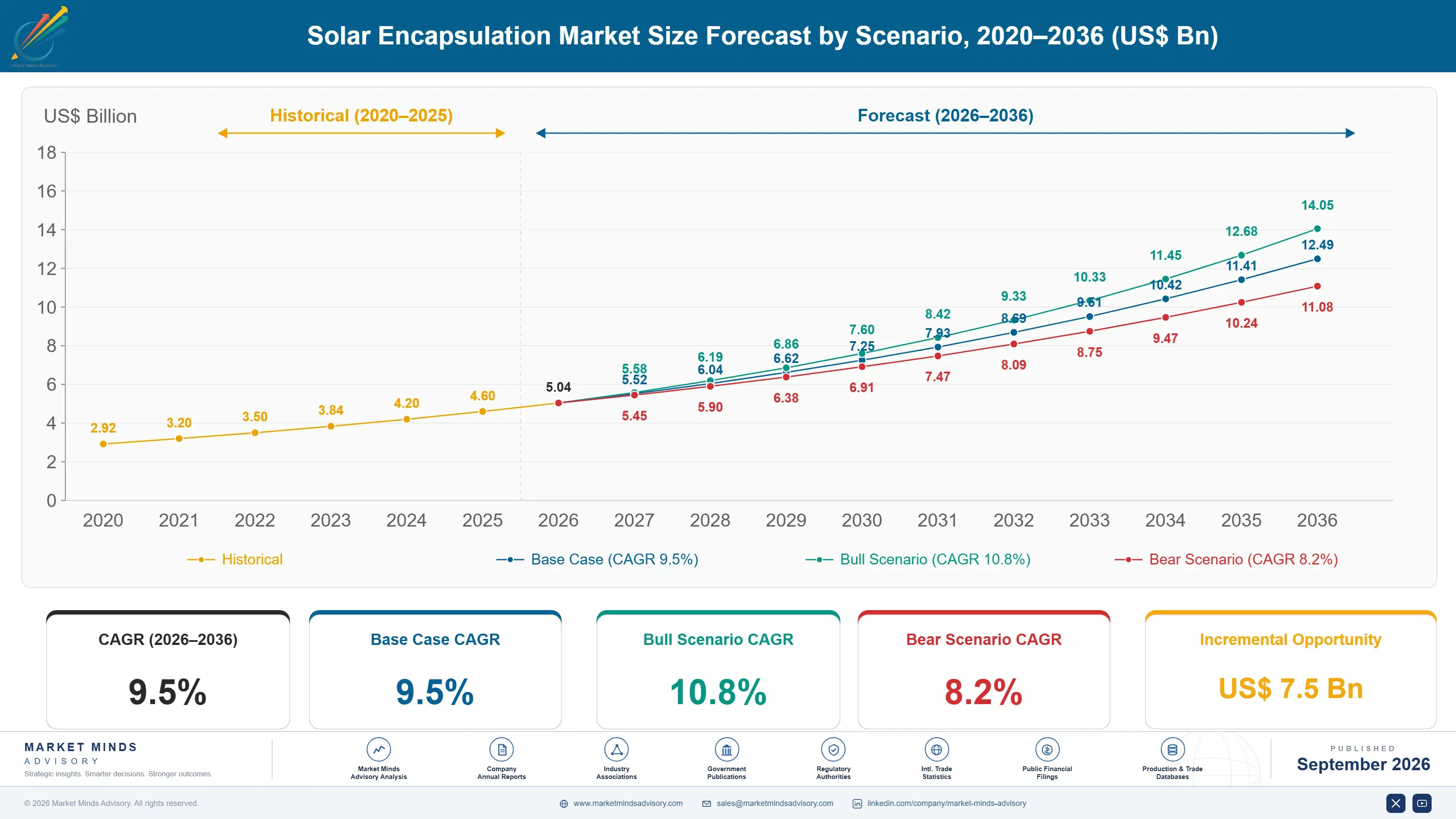
Solar Encapsulation Market Forecast Scenarios

solar-encapsulation-market-size-forecast-scenario-1788254947195
Solar encapsulant demand grew steadily between 2020 and 2025, expanding at roughly 8.5 percent annually as module production volume scaled rapidly across major manufacturing regions while standard EVA remained the dominant material choice throughout most of this period. Most demand growth tracked overall module shipment volume rather than any specific encapsulant chemistry shift. Standard EVA remained dominant.
The base case assumes steady commercial acceleration driven by three mechanisms: rapid bifacial module adoption requiring potential-induced degradation resistant formulations, growing PERC cell architecture penetration favoring co-extruded encapsulant structures, and domestic content requirements pushing coating capacity investment closer to module production hubs. Combined, these forces support 9.5 percent compound annual growth through 2036 as specialized formulations gain further share of total encapsulant volume. Encapsulant producers are already retooling coating lines to handle POE and co-extruded resin formulations across major facilities.
A bull scenario built around accelerated bifacial module adoption beyond current utility-scale deployment rates could push growth toward 10.8 percent, while a bear case tied to resin price volatility and slower module manufacturer qualification cycles could pull growth down toward 8.2 percent across the full forecast period. Either path implies higher specialized encapsulant volume than currently supplied across major manufacturing hubs.

Bifacial Adoption Redraws Encapsulant Chemistry Standards

Solar encapsulant demand is shifting from commodity EVA volume toward specialized POE and co-extruded formats as bifacial and PERC module manufacturers require enhanced potential-induced degradation resistance. Module manufacturers increasingly specify encapsulant suppliers by qualification testing rather than treating film selection as an interchangeable commodity purchase decision. Certification and qualification programmes now take several months to complete, a genuine barrier for producers lacking established testing infrastructure.
MARKET CONCENTRATIONCR5 48%Top five producers hold roughly half industry revenue
AVERAGE SELLING PRICE$2.10 per sqmReflects typical bifacial-grade encapsulant film unit market pricing
TOP COUNTRY SHAREChina 30%Leads global demand through dominant module manufacturing base
CAPACITY UTILISATION79%Reflects steady coating throughput across established production lines
TRADE INTENSITY40%Share of encapsulant value sourced through cross-border supply chains
FEEDSTOCK COST SHARE56% of COGSEthylene and octene resin inputs drive most manufacturing cost
Producers face growing pressure to invest in specialized coating lines and resin sourcing capability, a requirement module manufacturers now expect as standard for bifacial contracts. This shift favors established suppliers with strong resin supply relationships over smaller regional producers focused purely on standard EVA coating. Suppliers lagging on resin sourcing investment risk losing shortlist positions even where their standard EVA quality remains genuinely competitive.
Demand growth through 2036 depends heavily on bifacial and PERC module adoption rates translating into firm specification changes rather than continued commodity EVA purchasing patterns. China has moved furthest toward domestic content requirements, while many emerging solar markets still rely on imported commodity encapsulant rather than specialized domestic capability. Coating line lead times of six to twelve months mean today's ordering decisions will shape which suppliers dominate the coming demand shift.
"Nobody expected bifacial chemistry to fragment this market so quickly. Producers without qualified POE capability are already losing shortlist positions they held for years on utility-scale module contracts."
Senior Analyst, Solar Materials Practice · MMA Chemicals and Materials Practice · September 2026

Market Trends

Bifacial Module Deployment Drives POE Adoption

Utility-scale bifacial module manufacturers are rapidly shifting encapsulant specifications toward POE and co-extruded EVA-POE formats over standard EVA, requiring enhanced potential-induced degradation resistance and lower water vapor transmission rates suited to the rear-side glass or transparent backsheet configurations bifacial designs use. Leading module manufacturers have expanded qualified supplier lists specifically for POE-based encapsulants, favoring producers demonstrating proven degradation testing results over standard EVA qualification records alone. This shift is pulling forward resin sourcing investment that producers had previously modeled only for the early 2030s, compressing supplier qualification timelines considerably across the entire bifacial supply chain.
Market Impact: Adds 10 percent bonus credit

PERC Cell Architecture Requires Co-Extruded Structures

PERC and TOPCon cell architectures increasingly require co-extruded encapsulant structures combining EVA and POE layers to balance cost, adhesion, and degradation resistance in a single laminate format optimized for these advanced cell designs. This shift reflects module manufacturer efforts to maximize cell efficiency gains that depend heavily on encapsulant chemical stability across the module's twenty-five-year operating life. Suppliers without qualified co-extrusion capability are increasingly excluded from tier-one manufacturer supply agreements entirely, a meaningful threat to producers whose commercial position historically rested on single-layer EVA quality alone without co-extrusion tooling investment.
Market Impact: Adds 45 GW annual capacity

Market Opportunities and Growth Drivers

Domestic Content Requirements Reshape Encapsulant Supply Chains

The United States Inflation Reduction Act's domestic content bonus credit incentivizes module manufacturers to source encapsulant films from domestic producers, pushing several global suppliers to expand or establish new coating capacity within the country rather than relying entirely on imported material. This policy shift is meaningfully reshaping where encapsulant investment gets allocated, favoring established domestic producers and joint ventures over pure importers who previously supplied the bulk of United States module manufacturing demand. Similar content requirements are emerging in India and parts of Europe, extending this domestic sourcing preference well beyond the American market specifically.
Market Impact: Adds 12 to 18 percent

Utility-Scale Solar Buildout Sustains Volume Demand

Continued utility-scale solar capacity additions across major markets sustain baseline demand for encapsulant film even as bifacial and PERC architectures gradually capture share from conventional monofacial module designs over the forecast period. This volume floor provides revenue stability for producers navigating the transition toward specialized POE and co-extruded encapsulant formats, allowing gradual coating line investment rather than abrupt capacity reallocation. Producers serving both commodity and specialized segments simultaneously are better positioned to weather this technology transition than single-segment specialists exposed entirely to one encapsulant category. This stability matters most for mid-sized regional producers.
Market Impact: Adds 6 to 12 months

Market Restraints and Challenges

Resin Price Volatility Compresses Producer Margins

Ethylene and octene resin prices fluctuate significantly given their exposure to global petrochemical feedstock costs and cracker capacity utilization, exposing encapsulant producers to significant margin risk during periods of elevated commodity volatility that are difficult to hedge across multi-year module supply contracts. The root cause traces to resin production's dependence on naphtha and natural gas liquid feedstock pricing, which fluctuates alongside broader energy market conditions globally. Producers are mitigating this exposure through long-term supply agreements with petrochemical makers and by passing through commodity cost adjustments in supply contracts rather than absorbing volatility entirely internally.
Market Impact: Adds 60 GW bifacial-qualified capacity annually

Qualification Cycles Delay New Supplier Entry

Tier-one module manufacturers require extensive potential-induced degradation and yellowing resistance testing before qualifying new encapsulant suppliers, a process that regularly extends six to twelve months and creates a meaningful barrier for smaller regional producers seeking entry into bifacial segments specifically. The root cause lies in module manufacturers' reluctance to risk warranty claims tied to unproven encapsulant suppliers given the twenty-five-year performance guarantees typical across the industry. New entrants are mitigating this through partnership arrangements with established suppliers and by pursuing qualification in lower-risk monofacial segments first before attempting bifacial qualification.
Market Impact: Cuts power loss 6 percent
4 additional market trends, 3 additional growth drivers, and 3 additional restraints and challenges are covered in the full report. Contact sales@marketmindsadvisory.com to access the complete intelligence.

Segment CAGR and Growth Architecture

Solar encapsulants segment by resin chemistry, the primary axis of technical differentiation and cost structure across producers. Six chemistry categories span mature EVA formulations through fast-growing POE and co-extruded formats. Terminal buyers increasingly evaluate encapsulant suppliers on degradation testing track record and coating line flexibility rather than price alone now. Manufacturers must invest in both dimensions to compete effectively.
solar-encapsulation-market-market-share-analysis-1788254947785

POE Encapsulants

POE encapsulants represent the fastest-growing chemistry category, expanding at an estimated 14.0 percent annually as bifacial and PERC module manufacturers require enhanced potential-induced degradation resistance and lower water vapor transmission rates. These formulations command meaningfully higher average selling prices than standard EVA, reflecting the added octene copolymer content and specialized coating process bundled into the material package. Established producers with strong resin sourcing relationships are capturing a disproportionate share of this segment's growth, while smaller regional producers focused purely on commodity EVA coating struggle to compete on technical specification alone against qualified incumbents. Continued bifacial capacity additions should sustain this segment's above-average growth pace well through the remainder of the forecast period.
CAGR 14.0%

EPE Co-Extruded Encapsulants

Co-extruded EVA-POE encapsulants are expanding at an estimated 12.0 percent annually, the second-fastest pace in the category, driven heavily by PERC and TOPCon cell manufacturers seeking a balanced structure combining adhesion and degradation resistance in a single laminate. This format's layered structure requires specialized co-extrusion tooling investment beyond standard single-layer coating lines, favoring producers with established multi-layer film processing capability. Manufacturers offering qualified co-extruded encapsulant supply are winning a growing share of tier-one manufacturer contracts as cell architecture transitions accelerate across major module production hubs globally. Continued PERC and TOPCon transition should sustain this segment's above-average growth pace well through the remainder of the forecast period considerably. This configuration is increasingly favored across critical accounts.
CAGR 12.0%
Full segment breakdown across 7 segments available in the complete report.

Regional Architecture and Country Demand Map

Regional demand concentrates heavily around China's dominant solar module and encapsulant manufacturing base, while India and the United States expand domestic capacity under recent content requirement policies. Western markets follow at a measured pace as bifacial and PERC adoption gradually reshapes encapsulant specification requirements across their module manufacturing bases.

East Asia

China's module manufacturing base drives the overwhelming majority of regional demand, with domestic encapsulant producers like Hangzhou First Applied Material and Sveck New Materials supplying both domestic and export-oriented module producers extensively. This concentration justifies a share above the typical regional band, since China alone represents the world's largest single solar module manufacturing base by production volume. South Korea and Japan contribute meaningful demand through specialized high-efficiency module production rather than commodity volume manufacturing. Continued module export growth should sustain above-average regional growth relative to more mature Western markets elsewhere over the forecast period. South Korean producers are also positioning to export qualified encapsulant film to neighboring Southeast Asian module manufacturing markets.
Share: 34% | CAGR: 10.5% (2026 to 2036)

North America

United States encapsulant producers are rapidly expanding domestic capacity to capture Inflation Reduction Act domestic content bonus credits, with several new coating facilities announced specifically targeting POE and co-extruded film qualification. Utility-scale bifacial module deployment across Texas, California, and the broader Sun Belt region drives the bulk of domestic demand growth currently underway. Canadian demand remains comparatively modest, tied primarily to smaller-scale commercial and residential installations rather than utility-scale bifacial projects. Growth here should outpace the global average as domestic content policy continues favoring locally qualified suppliers over imported encapsulant. Several announced coating facilities target production startup before 2028, positioning the region as a meaningful secondary manufacturing hub behind East Asia.
Share: 22% | CAGR: 10.0% (2026 to 2036)
Regional intelligence for 5 additional markets available in the complete report: Western Europe, South Asia and Pacific, Latin America, Middle East and Africa, Eastern Europe. Contact sales@marketmindsadvisory.com.
solar-encapsulation-market-country-cagr-analysis-1788254948310

Where Encapsulant Producers Can Capture More Value

Beyond commodity film sales, encapsulant producers can capture additional value through qualification services, resin innovation, and integrated lamination positioning that extend well beyond a single coating transaction entirely now. Suppliers capturing these adjacent revenue streams early build deeper, stickier module manufacturer relationships than those competing purely on unit price. Contract structure shapes competitive positioning as much as underlying resin technology.

Offer Dedicated Bifacial Qualification Support Services

Producers offering dedicated engineering support during module manufacturer qualification testing capture meaningful advisory revenue while shortening the qualification timeline for both parties involved in the process. This approach suits established producers already possessing extensive degradation and yellowing resistance testing infrastructure from prior bifacial qualification work. These support services typically add 8 to 12 percent to total contract value over the qualification and initial supply period, a meaningfully profitable addition given the largely fixed cost of maintaining dedicated qualification engineering staff internally across accounts. Early adopters of this model report meaningfully higher customer retention across successive qualification and supply cycles.
Market Impact: Adds 8 to 12 percent qualification service value

Develop Proprietary Resin Formulations for Bifacial Applications

Producers developing proprietary resin formulations optimized specifically for bifacial degradation resistance and dimensional stability requirements can command meaningfully higher average selling prices than suppliers offering standard commodity POE film. This approach suits manufacturers with dedicated polymer research capability able to demonstrate measurable performance advantages during module manufacturer qualification testing. Proprietary resin formulations typically command a 15 to 20 percent price premium over standard commodity alternatives given the demonstrated performance and reliability advantages involved across bifacial applications specifically. This capability also strengthens the producer's negotiating position during formal qualification review discussions considerably.
Market Impact: Commands 15 to 20 percent resin price premium

Expand Into Integrated Lamination Service Offerings

Producers expanding into integrated lamination and module assembly support services, rather than supplying raw encapsulant film alone, capture a substantially larger share of total value per module manufactured. This approach suits established producers already possessing coating and lamination process capability from other product lines beyond solar applications specifically. Integrated lamination service contracts typically expand total addressable contract value by 20 to 30 percent compared to raw film supply alone, positioning suppliers as strategic manufacturing partners rather than commodity material vendors. This shift meaningfully strengthens their position against competitors still offering only raw film supply arrangements.
Market Impact: Expands total contract value 20 to 30 percent

Provide Long-Term Volume Supply Agreements Broadly

Suppliers offering multi-year volume supply agreements tied to module manufacturer production forecasts capture predictable recurring revenue while reducing customer switching risk across successive production cycles industry-wide. This approach suits module manufacturers seeking supply chain certainty amid ongoing resin price volatility and qualification switching costs across their broader supplier base. Long-term volume agreements typically generate 10 to 15 percent price stability premiums for both parties relative to spot market purchasing, a meaningfully valuable arrangement given persistent commodity price uncertainty across the category. This arrangement also deepens long-term customer relationships across multiple successive production cycles.
Market Impact: Generates an estimated 10 to 15 percent premium

Who Controls the Margin Pool

Concentration in this market sits at 48 percent among the top five producers, reflecting the technical barriers to entry facing new encapsulant film developers given resin sourcing scale and coating line qualification requirements. STR Holdings leads through established polymer film engineering credentials extended into POE applications, while the gap between it and mid-tier challengers remains meaningful given the specialized coating expertise required. Mid-tier producers compete primarily on price rather than proprietary resin technology, a genuine gap in the market today.
Current competitive activity centers on POE and co-extruded qualification expansion, domestic capacity investment tied to content requirements, and resin formulation research for bifacial applications specifically. Several producers have announced joint qualification programmes with module manufacturers to accelerate approved supplier status ahead of anticipated demand growth rather than waiting for formal tender processes to unfold naturally.

Emerging pressure comes from Chinese domestic encapsulant producers who lack the same global qualification track record but compete aggressively on price for standard EVA film tiers. Rankings could shift meaningfully over the next three to five years if these producers successfully expand POE and co-extruded qualification capability, potentially displacing established suppliers whose commercial position rests heavily on legacy qualification relationships and long-standing module manufacturer partnerships.
solar-encapsulation-market-company-positioning-matrix-1788254948838

Competitive Moat and Risk Dimensions

STR HOLDINGS

Moat: Early POE Qualification Investment

STR Holdings' early investment in POE qualification testing and degradation certification gives it a proven track record with major module manufacturers that smaller specialist producers cannot easily replicate within a comparable timeframe given the multi-year qualification cycles involved. This qualification track record compounds over time as reference installations accumulate across major module manufacturer accounts.
STR HOLDINGS

Risk: Exposure to Regional Price Competition

The company's premium pricing position leaves it exposed to Chinese domestic producers competing aggressively on price for standardized EVA film tiers, particularly across emerging solar markets less focused on bifacial qualification. Continued margin pressure in these segments could gradually erode overall profitability if the shift toward premium products doesn't accelerate meaningfully.
HANGZHOU FIRST APPLIED MATERIAL

Moat: Domestic Chinese Manufacturing Scale

Hangzhou First Applied Material's established domestic Chinese manufacturing scale gives it a genuine cost and delivery advantage as Chinese module manufacturers increasingly favor locally qualified encapsulant supply given content requirement preferences and shorter logistics chains. This scale advantage strengthens further as domestic content requirements tighten across additional Chinese solar procurement programmes.
HANGZHOU FIRST APPLIED MATERIAL

Risk: Slower International Qualification Pace

The company has moved more slowly than some rivals into international qualification for tier-one Western module manufacturers, risking share loss outside China as global bifacial demand accelerates further. Competitors moving faster on Western qualification could capture meaningful share before Hangzhou First closes this international gap.

Players Tracked

Prominent Players

STR Holdings
Hangzhou First Applied Material
Sveck New Materials
Mitsui Chemicals
Borealis AG

Other Key Players

3M
Dow Inc
Arkema
Zhejiang Feida
Jiangsu Sun EVA
Cybrid Technologies
Hiuv New Material
Cheerray Advanced Materials
Zhejiang Kangdi
Lushan New Materials
Toray Industries
SKC Co
Bridgestone Corporation
Zhejiang Yongsheng
Suzhou Enrich Materials

Recent Developments

JANUARY 2026

STR Holdings Expands POE Production Capacity

STR Holdings announced a capacity expansion at its United States manufacturing facility specifically to meet anticipated demand from bifacial module manufacturers under Inflation Reduction Act domestic content requirements over the coming several years of committed orders. The expansion increases annual qualified POE film output meaningfully beyond current levels.
Signal: Indicates established producers are committing capital ahead of confirmed order volume materializing fully. Order volume already reflects this confidence broadly.
SEPTEMBER 2025

Mitsui Chemicals Signs Multi-Year Supply Agreement

Mitsui Chemicals signed a multi-year supply agreement with a major module manufacturer covering co-extruded encapsulant film tied to PERC and TOPCon cell architecture production across the manufacturer's global module facilities. The agreement establishes preferred supplier status ahead of individual project-level tenders over the coming years.
Signal: Shows module manufacturers increasingly prioritizing co-extruded formats in supplier selection criteria. More such agreements are expected industry-wide soon.
MAY 2025

Sveck New Materials Completes Bifacial Qualification

Sveck New Materials completed qualification testing for its proprietary POE encapsulant formulation with a leading Chinese module manufacturer, reporting degradation resistance results comparable to established international competitors under equivalent testing conditions throughout the qualification process. Independent verification follows within several months from a third-party testing laboratory.
Signal: Suggests domestic Chinese suppliers are closing the technical gap with global leaders, intensifying price pressure. Global leaders should respond.

Ethylene and Octene Resin Cost Exposure

Ethylene and octene resin together represent an estimated 56 percent of encapsulant manufacturing cost of goods sold, given their role as the core polymer feedstock, with supply sourced predominantly from petrochemical crackers in the United States, Middle East, and China serving the broader plastics industry. Ethylene supply follows naphtha and natural gas liquid cracking economics, which shift meaningfully with broader energy market conditions across producing regions worldwide.
Resin prices spiked sharply during 2021 and 2022 following pandemic-related petrochemical plant disruptions and surging global demand across multiple end markets, a volatility event documented in IEA and broader petrochemical industry reporting, which pushed manufacturing costs higher for producers with fixed-price contracts already signed. Suppliers with flexible-price supply arrangements absorbed the volatility more effectively than those locked into long-term fixed contracts negotiated before the disruption began, underscoring the value of adjustable pricing mechanisms.

Producers reliant on spot market resin purchasing face a genuine cost disadvantage against competitors with long-term supply agreements or vertically integrated petrochemical sourcing that reduces exposure to feedstock volatility. This disadvantage is most acute for smaller regional producers lacking established petrochemical relationships. Producers with vertically integrated sourcing maintain meaningfully better margin stability than smaller developers.
solar-encapsulation-market-cost-volatility-analysis-1788254949032

Diversify Resin Supply Agreements

Producers are pursuing long-term supply agreements with petrochemical crackers across multiple geographies, including North American and Middle Eastern producers, to reduce single-region dependence and improve price predictability across multi-year encapsulant manufacturing and procurement contracts. This diversification has already reduced average exposure to any single cracker by roughly one-quarter among leading producers pursuing the approach.

Expand Vertically Integrated Feedstock Sourcing

Several larger producers are pursuing vertically integrated resin sourcing relationships or equity stakes in petrochemical producers specifically to reduce exposure to spot market volatility, even while continuing to purchase supplemental volume from independent third-party suppliers as needed. Several producers expect broader vertical integration to meaningfully reduce cost volatility within the next three to five years across the industry.

Portfolio Architecture for Margin Defence

The solar encapsulant market organizes into three commercial tiers with meaningfully different margin economics. Volume-commodity EVA products compete primarily on price and delivery reliability, generating moderate margins given standardized designs and intense regional price competition. Premium POE and co-extruded products command higher margins by offering verified degradation resistance. Producers still selling mostly into the volume tier face gradual margin pressure as buyers grow more sophisticated.
Sustainability and next-generation formats, particularly proprietary bifacial-optimized resin formulations, represent the smallest but fastest-growing tier, carrying the highest margins given genuine technical differentiation and rising bifacial procurement pressure. Producers face a persistent tension between defending volume-tier revenue, still the largest absolute dollar pool today, and investing in premium capability where growth concentrates most heavily. Producers hedging across tiers weather transitions more smoothly than single-tier specialists.

High-value pools increasingly concentrate around qualified POE and co-extruded formats and bundled advisory services rather than standalone commodity film sales alone across most tier-one accounts. Producers positioned only in the volume-commodity tier face gradual margin erosion as certified competitors capture disproportionate share of new qualification specifications, reinforcing the strategic case for premium tier investment ahead. This shift accelerates as buyers professionalize procurement and demand independently verified qualification records.

Standard EVA encapsulant competes on price and delivery reliability across mature replacement demand, generating the thinnest margins given intense competition among numerous regional producers. These products remain the industry's proven commercial default despite emerging premium technology pressure from bifacial segments.
Gross Margin

Certified POE and co-extruded formats with verified qualification data command meaningfully higher margins, reflecting module manufacturer willingness to pay for demonstrated reliability and degradation resistance. Module manufacturers view this certification as a genuine risk-reduction investment rather than discretionary spending.
Gross Margin

Proprietary bifacial-optimized resin formulations carry the highest margins given limited competition and genuine engineering differentiation across emerging bifacial procurement programmes. Early commercial success here could meaningfully reshape long-term competitive positioning across the broader encapsulant category.
Gross Margin
solar-encapsulation-market-portfolio-architecture-1788254949537

High-value Sub-segments and Strategic Watch-out

POE Encapsulants

This segment combines the highest current margins with the fastest growth trajectory, making it the clearest priority for producer investment across resin research, coating tooling, and qualification testing capability. Producers moving early capture disproportionate reference project value across major module manufacturer accounts. Source: MMA Estimate, July 2026.

EPE Co-Extruded Encapsulants

Strong margins paired with rapid growth make this segment a reliable secondary investment priority, particularly for producers developing co-extrusion tooling to win PERC and TOPCon contracts. Qualification success here strengthens negotiating position across the producer's broader global supply chain considerably. Source: MMA Estimate, July 2026.

EVA Encapsulants

This large, mature segment anchors current category revenue despite slower growth, and producers must defend this volume base carefully while shifting incremental investment toward faster-growing premium categories. This remains the proven commercial default for most standard replacement contracts across the industry today. Source: MMA Estimate, July 2026.

Standard Ionomer Encapsulants

This segment faces meaningful displacement risk as module manufacturers increasingly favor POE alternatives for bifacial applications, making it a genuine strategic watch-out for producers still exposed here. Few new commodity-only orders are expected going forward across most major module markets. Source: MMA Estimate, July 2026.

Qualification Cycles Anchor Supplier Relationships

Encapsulant sales increasingly bundle qualification and supply agreements, converting a single coating order into a recurring relationship spanning multiple production cycles. Module manufacturers require extensive qualification testing before approving an encapsulant supplier for bifacial applications specifically, creating meaningful switching costs that favor incumbent suppliers who win the initial qualification contract. Suppliers passing qualification early retain relationships across cycles rather than competing solely on price.
Adoption depth varies by end-use vertical. Utility-scale bifacial module producers show the deepest commitment given binding qualification requirements from tier-one manufacturers, while residential module assemblers adopt more cautiously, weighing encapsulant cost against simpler monofacial alternatives already in wide use. Commercial and industrial installations sit between these two poles, adopting steadily as bifacial module costs decline further. This pattern means suppliers must tailor commercial terms across each buyer category.

Buyer profiles are shifting as module manufacturer procurement teams staffed by materials engineers replace generalist purchasing agents less familiar with resin formulation tradeoffs. Younger procurement teams increasingly demand third-party degradation testing data and yellowing resistance guarantees rather than relying on supplier reputation alone, reshaping how producers must present technical evidence during qualification reviews. Producers unable to produce this evidence risk losing reviews to rivals with stronger track records.
solar-encapsulation-market-end-use-penetration-index-1788254950020

Strategic Priorities For Encapsulant Producers

These are among the four positions where our research anticipates prominent divergence between winners and laggards over the coming forecast period. Each is grounded in the demand model, the regulatory perimeter, and the announced capacity pipeline.
01 / POE TECHNOLOGY INVESTMENT

Accelerate POE qualification ahead of Chinese rivals

POE encapsulants carry the fastest segment growth in the entire category, expanding at more than four-tenths faster than the overall market average through 2036 as bifacial module deployment scales. Producers still relying entirely on standard commodity EVA formulations risk ceding the highest-margin, fastest-growing tier to competitors already scaling resin sourcing and coating tooling investment. Redirecting capital toward POE qualification now positions a producer to capture premium bifacial contracts before established rivals lock in tier-one module manufacturer relationships across the industry.
02 / REGIONAL MANUFACTURING FOOTPRINT

Expand East Asian capacity while defending Western share

East Asia accounts for the largest single share of global demand, driven by China's dominant module manufacturing base and vertically integrated encapsulant supply chain. North America and Western Europe remain meaningfully sized and faster-growing markets given domestic content requirement policies, so producers cannot treat them as afterthoughts despite East Asia's clear lead. A balanced footprint spanning multiple regions captures the largest share of near-term qualified supply contracts across the industry as content requirements tighten further over the coming several years.
03 / RESIN INNOVATION PRIORITY

Invest in proprietary bifacial resin formulations now

Co-extruded encapsulants represent the second-fastest growing segment in the category, and producers lacking dedicated internal polymer research capability risk gradually losing valuable qualification opportunities to competitors already demonstrating measurable performance advantages. Proprietary resin development requires sustained metallurgical and chemical investment before commercial qualification results materialize with tier-one module manufacturers globally across every major account. Producers that commit to this research path early will capture disproportionate share of bifacial supply agreements before the qualification window narrows further across the industry considerably.
04 / SUSTAINABILITY POSITIONING STRATEGY

Build recycled content capability for procurement advantage

Module manufacturers increasingly favor lower embodied carbon encapsulant sourcing to meet corporate sustainability procurement commitments across their global supply chains, creating a genuine and lasting competitive opening for producers investing early in recycled content capability. These sustainability credentials increasingly influence qualification decisions alongside traditional technical performance criteria across most major accounts today. Producers building this capability now, rather than treating recycled content as a niche offering, will capture a disproportionate share of sustainability-conscious procurement volume across major module manufacturer accounts ahead.

Engagement Snapshot From the Field

A live engagement with an industry participant carrying material or product regulatory and market exposure ahead of a defining policy shift, showing how our research translates into a defensible multi-year portfolio strategy.
MARKET MINDS ADVISORY · CLIENT ENGAGEMENT SUMMARY
Solar Encapsulation Producer Strategic Portfolio Review and Transition Roadmap 2026·Investment Scenario on Solar Encapsulation Exposure Evaluation 2025-26
CLIENT PROFILE
The client is a regional encapsulant producer serving module manufacturers across North America and Europe, with an established EVA product line generating meaningful annual revenue (client-reported, unverified by MMA). The company had supplied standard EVA film for over a decade but had not yet entered POE or co-extruded categories, prompting concern about competitive positioning as bifacial module specifications shifted.
STRATEGIC CHALLENGE
Leadership needed to decide whether to invest in POE manufacturing capability internally, pursue a licensing arrangement with an established technology holder, or exit the category entirely as certified competitors captured increasing module manufacturer specification share. Internal estimates suggested the standard EVA product line would lose meaningful share within three to five years absent a clear technology response (client-reported, unverified by MMA).
MMA APPROACH
MMA conducted a structured assessment combining primary interviews with module manufacturer procurement contacts, competitive benchmarking against established POE suppliers, and margin modeling across build-versus-license scenarios. The engagement drew on MMA's primary research dataset and expert interview programme to quantify realistic capture timelines and capital requirements under each strategic path under consideration.
KEY FINDINGS
  1. Module manufacturer procurement contacts indicated POE qualification would become a baseline requirement within roughly three procurement cycles across most bifacial module platforms.
  2. A licensing arrangement offered faster market entry than internal development, though at a meaningfully lower long-term margin ceiling once the license fee was accounted for (client-reported, unverified by MMA).
  3. Competitors who had invested early in POE capability were already securing multi-year supply agreements, narrowing the realistic entry window for new participants considerably.
  4. The client's existing coating lines could be retrofitted for co-extruded production at a lower capital cost than a full POE greenfield investment would require.
CLIENT PROFILE
The client is a regional encapsulant producer serving module manufacturers across North America and Europe, with an established EVA product line generating meaningful annual revenue (client-reported, unverified by MMA). The company had supplied standard EVA film for over a decade but had not yet entered POE or co-extruded categories, prompting concern about competitive positioning as bifacial module specifications shifted.
STRATEGIC CHALLENGE
Leadership needed to decide whether to invest in POE manufacturing capability internally, pursue a licensing arrangement with an established technology holder, or exit the category entirely as certified competitors captured increasing module manufacturer specification share. Internal estimates suggested the standard EVA product line would lose meaningful share within three to five years absent a clear technology response (client-reported, unverified by MMA).
MMA APPROACH
MMA conducted a structured assessment combining primary interviews with module manufacturer procurement contacts, competitive benchmarking against established POE suppliers, and margin modeling across build-versus-license scenarios. The engagement drew on MMA's primary research dataset and expert interview programme to quantify realistic capture timelines and capital requirements under each strategic path under consideration.
KEY FINDINGS
  1. Module manufacturer procurement contacts indicated POE qualification would become a baseline requirement within roughly three procurement cycles across most bifacial module platforms.
  2. A licensing arrangement offered faster market entry than internal development, though at a meaningfully lower long-term margin ceiling once the license fee was accounted for (client-reported, unverified by MMA).
  3. Competitors who had invested early in POE capability were already securing multi-year supply agreements, narrowing the realistic entry window for new participants considerably.
  4. The client's existing coating lines could be retrofitted for co-extruded production at a lower capital cost than a full POE greenfield investment would require.
RECOMMENDED STRATEGY
Phase 1: Phase one: pursue a technology licensing agreement to enter co-extruded production within twelve months, avoiding a multi-year internal development timeline. Phase 2: Phase two: retrofit existing coating lines incrementally while building internal resin research capability toward eventual POE production independence over the following two years. Phase 3: Phase three: transition to owned POE technology once internal capability matures, reducing long-term licensing fee exposure and improving margin capture.
OUTCOME
The client secured a licensing agreement and began co-extruded shipments within eleven months, ahead of the internal target, capturing several new module manufacturer qualification slots in the following cycle (client-reported, unverified by MMA). The phased approach preserved capital for the subsequent internal POE development phase now underway.

Frequently Asked Questions

Foundational context covering the market sizes, CAGR, scope, country, region and competition that inform every finding below. This section is provided to cover basics and most often pre-purchase conversations, answered from the MMA Primary Research Dataset.

What is the current size of the Solar Encapsulation Market?

The solar encapsulation market reached an estimated 4.6 billion dollars in 2025. Growth is driven by bifacial and PERC module adoption requiring specialized encapsulant chemistry.

How large will the Solar Encapsulation Market be by 2036?

MMA projects the market will reach approximately 12.5 billion dollars by 2036. This reflects rapid adoption of POE and co-extruded formats across major solar manufacturing regions.

What is the CAGR for the Solar Encapsulation Market 2026 to 2036?

The base case compound annual growth rate is 9.5 percent across the forecast period. Bull and bear scenarios range from 10.8 percent to 8.2 percent depending on bifacial adoption pace.

Which segment is growing fastest?

POE encapsulants are the fastest-growing segment, expanding at 14.0 percent annually. That is roughly 1.5 times the overall market growth rate through the forecast period.

Who are the major companies in the Solar Encapsulation Market?

Leading companies include STR Holdings, Hangzhou First Applied Material, Sveck New Materials, Mitsui Chemicals, and Borealis AG. Together these five companies hold an estimated 48 percent share.

Which country is growing fastest?

India leads regional growth at an estimated 11.5 percent annually through 2036. Expansion is driven by production-linked incentive schemes and domestic solar manufacturing capacity growth.

Report Segmentation Architecture

The full report scope spans multiple orthogonal segmentation dimensions, with cross-tabulated demand data provided for each dimension pair. Coverage extends further to regional breakdowns, trend trajectories, and the competitive detail needed to support segment-level decision-making.
  • EVA Encapsulants
  • POE Encapsulants
  • EPE Co-Extruded Encapsulants
  • Ionomer Encapsulants
  • TPO Encapsulants
  • UV-Cured Encapsulants
  • Utility-Scale Bifacial Modules
  • Utility-Scale Monofacial Modules
  • Commercial Rooftop Modules
  • Residential Rooftop Modules
  • Building-Integrated Photovoltaic Modules
  • Original Equipment Supply Contracts
  • Qualification Advisory Services
  • Long-Term Volume Supply Agreements
  • Integrated Lamination Services

By Region

  • East Asia
  • North America
  • Western Europe
  • South Asia and Pacific
  • Latin America
  • Middle East and Africa
  • Eastern Europe

Scope, Methodology, and Coverage

Every figure in this report is reproducible from documented input assumptions. The scope below maps the historical period, the forecast horizon, the segmentation dimensions, and the countries covered, alongside the underlying primary and qualitative methodology.
Historical Period
2020 to 2025
Forecast Period
2026 to 2036
Base Year
2025 (USD billions; MMA Primary Research Dataset, September 2026)
Market Definition
This report covers polymer encapsulant films used to laminate and protect solar photovoltaic cells within module assemblies, including EVA, POE, and co-extruded formats. It excludes backsheet materials, glass cover components, and junction box encapsulation compounds.
Quantitative Units
USD billions
Segmentation Dimensions
Regions Covered
East Asia, North America, Western Europe, South Asia and Pacific, Latin America, Middle East and Africa, Eastern Europe
Countries Covered
Key Companies Profiled
STR Holdings, Hangzhou First Applied Material, Sveck New Materials, Mitsui Chemicals, Borealis AG, 3M, Dow Inc, Arkema, Zhejiang Feida, Jiangsu Sun EVA, Cybrid Technologies, Hiuv New Material, Cheerray Advanced Materials, Zhejiang Kangdi, Lushan New Materials, Toray Industries, SKC Co, Bridgestone Corporation, Zhejiang Yongsheng, Suzhou Enrich Materials
Quantitative Methodology
Primary survey, n=3,800 respondents, Q4 2025, six countries; demand-side model with trade association cross-validation
Qualitative Methodology
47 expert interviews, Q4 2025; applied to validate demand model assumptions, identify emerging dynamics, and assess competitive positioning
Report Format
PDF and XLSX data workbook (Word format preview document)
Publisher
Market Minds Advisory
Report Code
MMA-2026-CHM-208
Published
September 2026
Contact
sales@marketmindsadvisory.com | www.marketmindsadvisory.com

Purchase the full Solar Encapsulation Market Report (2026 to 2036).

This report provides a comprehensive analysis of the global solar encapsulation market, covering market sizing, segmentation, regional dynamics, and competitive positioning through 2036. It examines the resin chemistry shift from standard EVA toward POE and co-extruded formats driven by bifacial adoption. The analysis quantifies regional demand concentration across seven world regions and profiles the twenty leading producers shaping category development. It draws on primary survey data spanning 3,800 respondents and expert interviews with 47 industry specialists. Company disclosures round out the evidence base supporting strategic decisions for producers, module manufacturers, and investors.
Ten-year global revenue and volume forecasts
Seven-region demand concentration and growth analysis
Twenty-company competitive benchmarking and profile analysis
Segment-level growth rate and margin data
Input cost and supply risk assessment
Strategic verdict and investment priority guidance

Built For The People Who Decide

From boardroom strategy to bench-side execution, this report is read cover-to-cover by leaders shaping the next decade of their industry, turning demand scenarios, market dynamics and valuation benchmarks into decisions.
CXOs/ Presidents/ VPs/ Managers
M&A and Corporate Development
Strategy Teams and R&D Heads
Procurement and Product Directors
Regulatory and Compliance Leaders
Investor Relations and Equity Analysts