Market Minds Advisory
Sodium Molybdate Market

Sodium Molybdate Market: A Specialty Chemical Priced by the Copper Mining Cycle

Molybdenum arrives mostly as a copper mining by-product, so input cost is set by copper output and steel alloying demand, and every price spike drives water treatment formulators permanently away.

Lead Analyst

Bilal Shaikh

Published

September 2026

Make Smarter Decisions with Customized Research Insights

Request a free sample report and evaluate market opportunities, growth trends, and competitive dynamics relevant to your business needs.

2025 MARKET VALUE$0.4BMarket Size 2025
2036 FORECAST VALUE$0.7BBase Case , 2026 to 2036
CAGR 2026 TO 20365.2 %Bull 6.4% / Bear 4.0%
INCREMENTAL OPPORTUNITY$0.3BNet 10- year value creation
EXPANSION MULTIPLE1.65x2036 value over 2026 base
Strategic Levers
M&A Pipeline
Regional Outlook
Country Rankings
Competitive Intelligence
Segmental Deep-dive
Call-Us : 91 93563 13602

Executive Snapshot and Market Trajectory

Nobody in this business controls their main input. Around 52% of world molybdenum arrives as a by-product of copper porphyry mining, so the price is set by copper mine output and by steel alloying demand, neither of which a sodium molybdate producer influences in any way at all.
Molybdenum carries roughly 74% of finished product cost and has swung 3.1 times between trough and peak in recent years. That volatility does lasting damage, because water treatment formulators who reformulate to molybdate-free chemistry during a spike rarely come back afterwards. The application base erodes by a ratchet rather than a cycle, and each spike moves it down another step. Each spike costs volume that never returns.
Agriculture is where the growth actually sits. Seed treatment delivers molybdenum at around 15 grams per hectare to soybean and pulse crops, and Brazil grows fastest anywhere at 9.4% on that basis. It is small in tonnage and largely ignored by producers organised around water treatment volume, which is exactly what makes it worth pursuing seriously now. Producers organised around industrial tonnage staff it as a minor line, so the position is available cheaply.
Market Definition
Sodium molybdate supplied as dihydrate and anhydrous grades across all purity levels, covering water treatment corrosion inhibition, agricultural micronutrient and seed treatment, animal feed supplementation, metal finishing and surface treatment, catalyst and chemical intermediate use, and pigment applications. Measured at producer selling value. Excludes molybdenum metal, ferromolybdenum, molybdenum trioxide sold as such, ammonium molybdate, and finished water treatment or fertiliser formulations.
Base Year Value
$0.4B in 2025 (MMA Primary Research Dataset, August 2026)
Forecast Period
2026 to 2036, eleven discrete annual values
CAGR
5.2% base case. Bull 6.4%. Bear 4.0%.
Fastest Growth Segment
Agricultural Micronutrient and Seed Treatment: 7.8% CAGR
Fastest Growth Country
Brazil: 9.4% CAGR
Fastest Growth Region
South Asia and Pacific: 7.4% CAGR
Largest Region
East Asia: 30% of 2025 global value
Market Leaders
Climax Molybdenum, Molymet, China Molybdenum, Jinduicheng Molybdenum, Taiyo Koko. Source: MMA Primary Research Dataset, July 2026.
Primary Survey
n=3,800 procurement and R&D decision-makers, Q4 2025, six countries
Methodology
Demand-side build-up, cross-validated against public data, 47 expert interviews

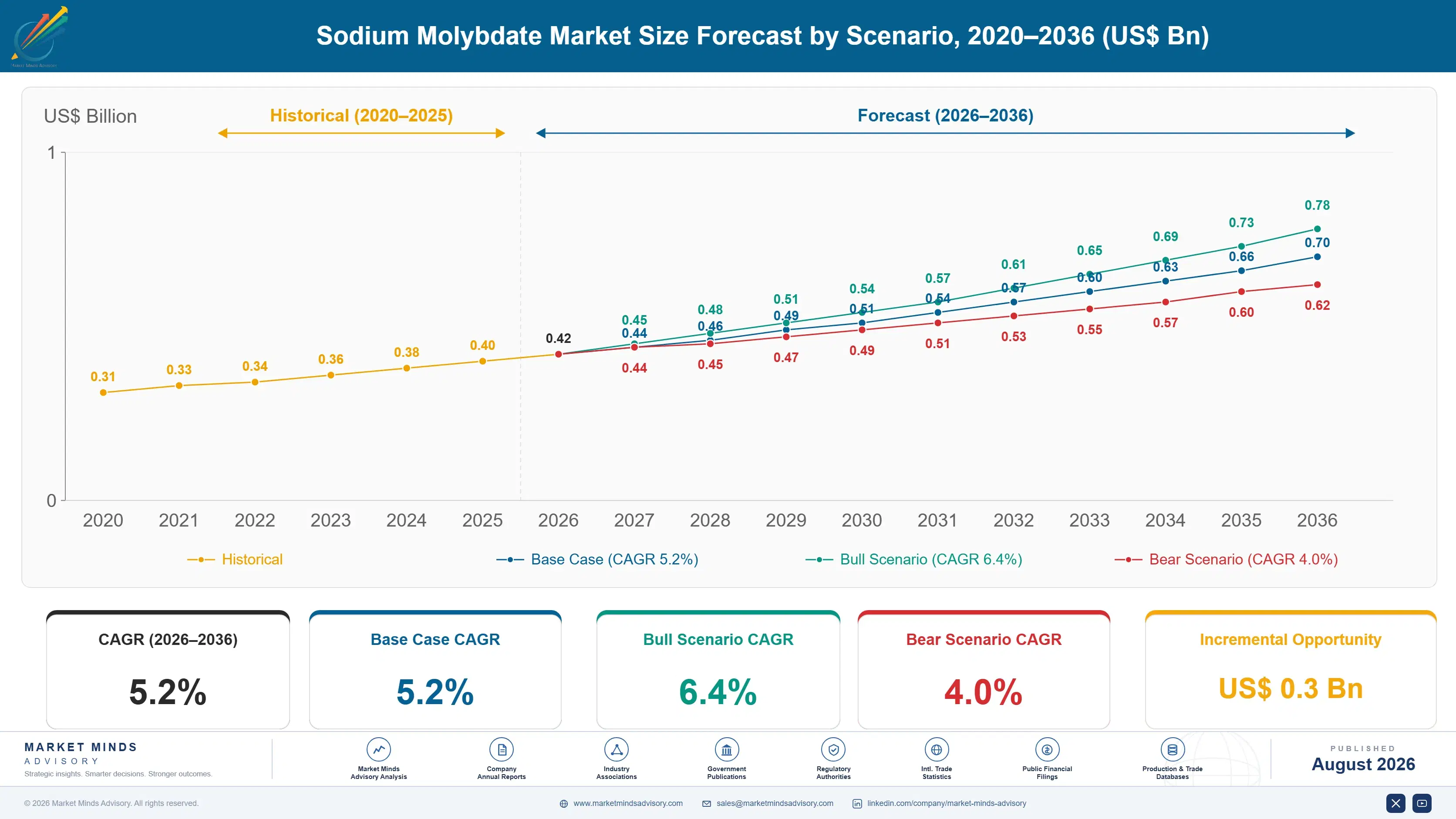
Sodium Molybdate Market Forecast Scenarios

sodium-molybdate-market-trends-size-forecast-scenario-1787595238114
Growth ran near 4.2% between 2020 and 2025, and the headline number hides how violent the period actually was underneath it. Molybdenum pricing swung 3.1 times between trough and peak, which pushed several water treatment formulators onto molybdate-free chemistry permanently. Agricultural and feed demand grew steadily throughout and was largely unaffected by input pricing, because the dose per hectare is small enough that cost barely registers with the farmer.
Base case 5.2% rests on three mechanisms. Agricultural micronutrient demand grows at 7.8% as soybean and pulse acreage expands and seed treatment displaces foliar application across Brazil and India. Feed supplementation grows on ruminant nutrition programmes managing copper antagonism. And water treatment holds rather than grows, because chromate replacement is long finished and organic treatment programmes now take share from molybdate at every plant that reformulates. A flat application inside a growing market.
The bull case at 6.4% assumes molybdenum pricing stays within a narrow band long enough that formulators stop treating molybdate as a supply risk and stop designing around it. The bear case at 4.0% is another price spike of the sort seen recently, driving a further step down in the water treatment base that no price fall reverses.

Downstream of Somebody Else's Copper Mine

The defining fact about this business is that nobody in it controls the input. Roughly 52% of world molybdenum comes out of copper porphyry mines as a by-product, which means supply responds to copper economics and steel alloying demand rather than to anything in specialty chemicals. A sodium molybdate producer converting oxide to salt is a price taker on 74% of its cost structure, and there is no realistic hedge available.
TOP FIVE CONCENTRATION41%Conversion is straightforward so the competitive field stays wide
COPPER BY-PRODUCT SUPPLY52%Molybdenum arriving as a by-product of copper porphyry mining
INPUT PRICE SWING3.1xRange between recent trough and peak molybdenum pricing
MOLYBDENUM COST SHARE74%Input share of finished sodium molybdate cost structure
SEED TREATMENT DOSE15 g/haMolybdenum applied to soybean and pulse crops through seed
COOLING LOOP RESERVE200 ppmConcentration maintained in closed loop industrial cooling systems
That matters more than it would in most chemicals because of what price volatility does to the largest application. Molybdate inherited its corrosion inhibitor position when chromate was withdrawn, and it holds it on performance at around 200 parts per million reserve in closed cooling loops. But when molybdenum runs up 3.1 times, formulators reformulate to phosphonate and polymer programmes, and they then stay on them.
Agriculture runs on entirely different logic. Molybdenum is essential to nitrogen fixation in legumes and to nitrate reduction generally, and seed treatment delivers it at around 15 grams per hectare. At that dose the input price is commercially irrelevant to the farmer, which insulates it completely from the volatility wrecking water treatment. Brazilian soybean acreage drives the fastest growth anywhere at 9.4%.
"The water treatment business is being lost one price spike at a time, and every producer keeps organising around it because that is where the tonnage still is. The grams per hectare going onto Brazilian soybean look trivial until you notice they are the only volumes nobody is walking away from."
Director, Specialty Inorganics and Agricultural Inputs Practice · MMA Chemicals and Materials Practice · August 2026

Market Trends

Price volatility permanently eroding the water treatment base

Molybdenum swung 3.1 times between trough and peak recently, and each such move pushes water treatment formulators onto molybdate-free phosphonate and polymer programmes that they then qualify and keep. The erosion is a ratchet rather than a cycle, because reformulation is a one-way cost and no subsequent price fall justifies reversing it. Producers reading the demand data as cyclical are misreading a permanent step down in the application base with every spike that passes. Contract structure and blended reduced reserve programmes offered early are the only things that slow it, and neither reverses a reformulation once it is qualified.
Market Impact: Brazil growing fastest at 9.4%
Seed treatment displacing foliar application in row crops

Seed applied molybdenum at around 15 grams per hectare reaches the developing root system directly and costs the farmer almost nothing at that dose, which is why it is displacing foliar programmes across soybean and pulse acreage. Brazil grows fastest anywhere at 9.4% on exactly this mechanism, with Indian pulse acreage following behind it. The application is completely insulated from input price volatility, because molybdenum cost per hectare is far too small to register commercially. Demand tracks planted area rather than any industrial cycle, which makes it far more predictable than water treatment volume.
Market Impact: Dosed at 2 milligrams per kilogram

Market Opportunities and Growth Drivers

Soybean and pulse acreage expanding across South America

Molybdenum is essential to nitrogen fixation in legumes, and Brazilian soybean acreage has expanded steadily enough to make it the fastest growing country anywhere at 9.4%. Seed treatment at around 15 grams per hectare has become standard practice rather than an agronomic option, and Indian pulse acreage is adopting the same approach. Demand here grows with planted area rather than with any industrial cycle, which makes it considerably more predictable than water treatment volume. Seed treatment formulators rather than farmers make the purchasing decision, which concentrates the commercial relationship into a manageable number of accounts worth building properly.
Market Impact: Reserve reduced below 200 ppm

Ruminant nutrition programmes managing copper antagonism deliberately

Sodium molybdate is dosed into ruminant feed to manage copper status, since molybdenum forms thiomolybdates that limit copper absorption and prevent toxicity in sheep and some cattle systems. Commercial feed formulation has become considerably more precise about trace mineral balance, which turns what was once a corrective treatment into a routine formulation component. Volumes are modest but the demand is genuinely steady, and it is entirely unaffected by molybdenum price movements at these inclusion rates. Feed grade qualification and traceability documentation narrow the competitive field considerably, and most technical grade suppliers never complete the work required to compete for it.
Market Impact: Leaves 74% of cost exposed

Market Restraints and Challenges

Organic treatment programmes taking share at every reformulation

All-organic phosphonate and polymer cooling water programmes now perform acceptably in most closed loop duties, and they carry no molybdenum price exposure at all. The root cause is that molybdate's advantage was always partly regulatory, inherited when chromate was withdrawn, and that inheritance has now been competed away on performance. Commercially it means water treatment holds rather than grows. Blended programmes at reduced molybdate reserve are the mitigation producers are pursuing, and they slow the loss without stopping it. Every reformulation cycle takes another step down that no price fall reverses.
Market Impact: Input price swung 3.1 times

By-product supply structure removing any input control

Around 52% of molybdenum arrives as a copper mining by-product, so supply responds to copper economics rather than to molybdenum demand at all. The root cause is geological, since molybdenum concentrates in porphyry deposits mined primarily for copper. Commercially it means 74% of cost sits outside producer control with no hedge available at reasonable liquidity. Long term oxide supply agreements and inventory positioning are the mitigations in use, and both carry working capital costs of their own. Backward integration is available only to participants holding mining or roasting assets already.
Market Impact: Applies 15 grams per hectare
3 additional market trends, 4 additional growth drivers, and 2 additional restraints and challenges are covered in the full report. Contact sales@marketmindsadvisory.com to access the complete intelligence.

Segment CAGR and Growth Architecture

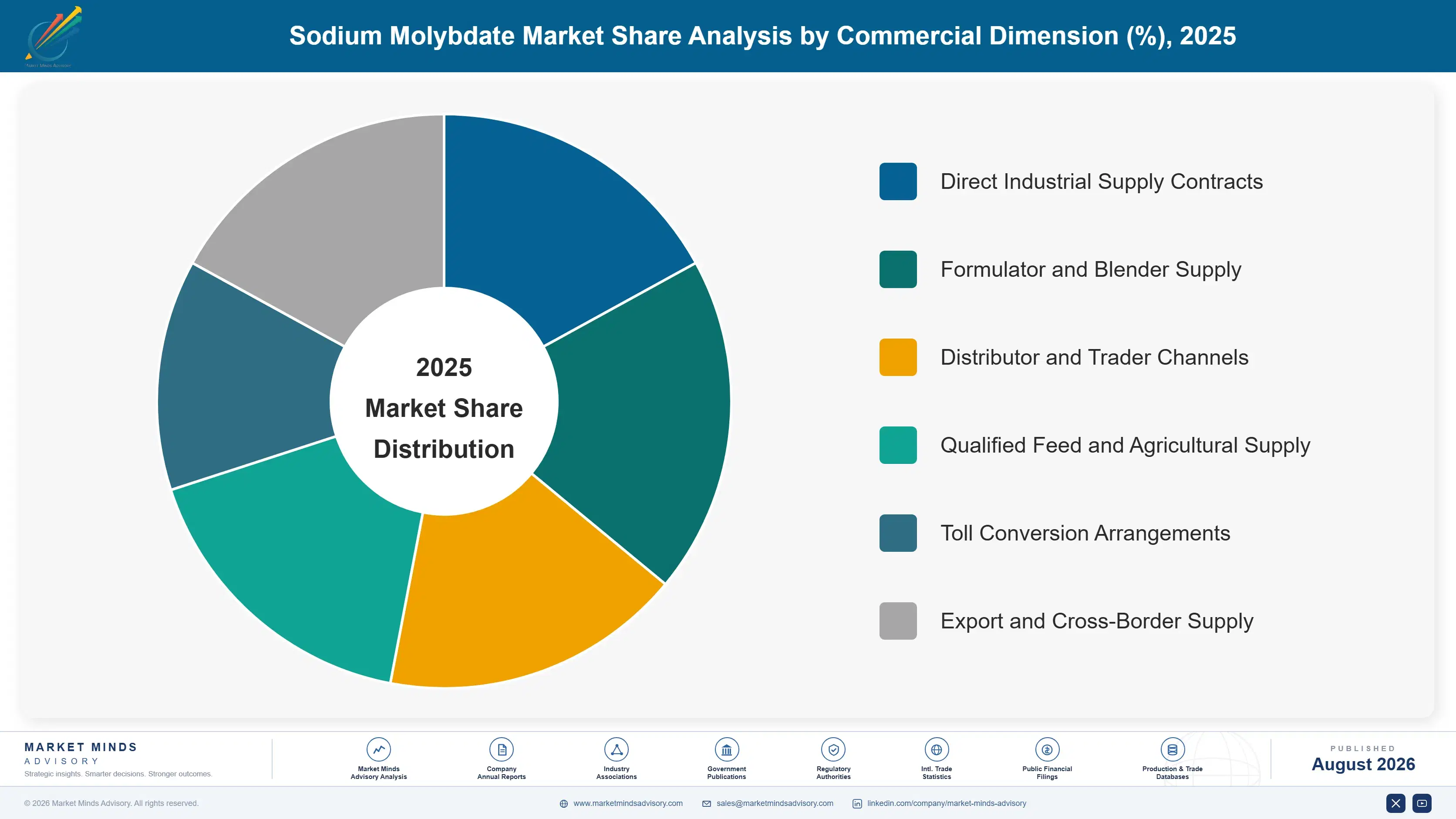
Six segments are split by application, because application determines the purity grade required, the qualification a customer imposes, the volume per account and how sensitive that account is to molybdenum price movements. Grade and physical form sit inside each application rather than beside it. Customer type and channel are handled separately in the framework.
sodium-molybdate-market-trends-market-share-analysis-1787595238653

Agricultural Micronutrient and Seed Treatment

Growing at 7.8%, half again the market rate of 5.2%, this is molybdenum delivered to legume and brassica crops where it enables nitrogen fixation and nitrate reduction. Seed treatment at around 15 grams per hectare has displaced foliar application as standard practice across Brazilian soybean and Indian pulse acreage. The dose is small enough that molybdenum price movements are commercially irrelevant to the farmer, which insulates this application entirely from the volatility eroding water treatment demand. Demand tracks planted area rather than any industrial cycle, and Brazil grows fastest anywhere at 9.4% on exactly this basis. Seed treatment formulators rather than farmers decide supply, which keeps the commercial relationship to a manageable number of accounts worth building properly.
CAGR 7.8%

Animal Feed Supplementation

At 6.2% sodium molybdate is dosed into ruminant feed at around two milligrams per kilogram to manage copper status, since molybdenum forms thiomolybdates that limit copper absorption and prevent toxicity in sheep and susceptible cattle systems. Commercial feed formulation has grown considerably more precise about trace mineral balance, turning a corrective treatment into a routine component of the formulation. Volumes are modest against water treatment but the demand is genuinely steady, unaffected by molybdenum pricing at these inclusion rates, and the feed grade qualification barrier keeps the field narrower than it looks. Approved supplier lists are narrowing as documentation requirements tighten across commercial feed formulation, and suppliers without the analytical paperwork are removed outright.
CAGR 6.2%
Full segment breakdown across 6 segments available in the complete report.

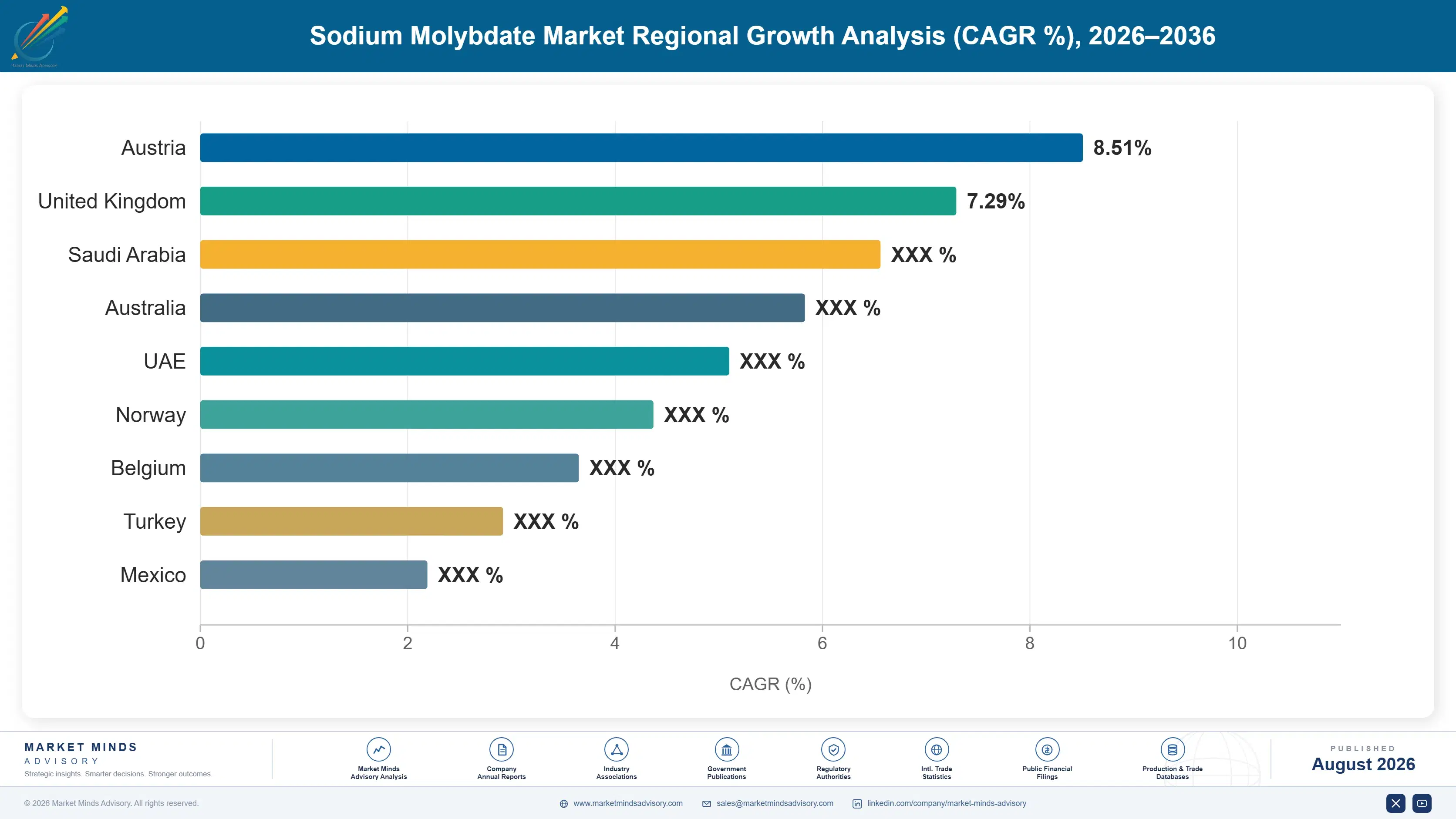
Regional Architecture and Country Demand Map

East Asia holds 30% of value on Chinese molybdenum mining and conversion capacity that no other region approaches in scale. North America follows at 24% on Climax production and established water treatment demand across industrial cooling installations. South Asia and Pacific grows fastest of the seven regions.

North America

Primary molybdenum production at Climax and Henderson gives producers here direct oxide supply rather than purchased feed, which matters when 74% of cost is input molybdenum and nobody else controls it. Water treatment demand is large and mature across industrial cooling installations, and it is exactly where organic programmes are taking share fastest at every reformulation. Agricultural demand is modest, since North American soybean receives molybdenum less consistently than South American acreage does. Growth at 4.6% reflects the water treatment drag against agricultural gains. Feed supplementation demand is steady across ruminant operations managing copper status on deficient pasture, and it is largely insulated from the input pricing that damages industrial volume.
Share: 24% | CAGR: 4.6% (2026 to 2036)

Western Europe

Discharge consent limits on molybdenum in industrial effluent are tighter here than anywhere, which pushes water treatment formulators toward molybdate-free chemistry for reasons that have nothing to do with price at all. That regulatory pressure compounds the organic programme competition affecting every region. Feed supplementation demand is steady across ruminant systems, and metal finishing demand is mature. Agricultural use is limited by soil molybdenum availability across much of the region. Growth of 3.6% is the slowest anywhere, held down by regulation. Catalyst precursor demand is meaningful given regional refining and chemical capacity, and it holds at higher purity grades where specification tolerance matters considerably more than delivered price does. Conversion capacity is mature.
Share: 20% | CAGR: 3.6% (2026 to 2036)
Regional intelligence for 5 additional markets available in the complete report: East Asia, South Asia and Pacific, Latin America, Middle East and Africa, Eastern Europe. Contact sales@marketmindsadvisory.com.
sodium-molybdate-market-trends-country-cagr-analysis-1787595239189

Four Moves Against an Uncontrolled Input

Molybdenum carries 74% of cost and nobody in this business controls it, so every worthwhile move is about which applications you sell into rather than how efficiently you convert. The applications that ignore input price are the ones worth building around, and they are not where the tonnage currently sits. That mismatch is the whole opportunity.

Build the agricultural position while it stays uncontested

Seed applied molybdenum at around 15 grams per hectare grows at 7.8% and is completely insulated from input price volatility, because the cost per hectare is too small for a farmer to notice. Producers organised around water treatment tonnage treat it as a minor line and staff it accordingly. Brazil alone grows at 9.4%, and building distribution into seed treatment formulators now costs a fraction of what it will once the position is contested. Seed treatment formulators rather than farmers decide supply, which keeps the commercial relationship to a manageable number of accounts.
Market Impact: Serves segment growth running at 7.8% each year

Contract oxide supply on multi-year indexed terms

With 74% of cost sitting in an input priced by copper mining economics, multi-year oxide contracting with indexation is the only meaningful protection available, since exchange hedging lacks the liquidity to be useful at this scale. Producers buying on spot through a 3.1 times price swing lost customers permanently to reformulation. Contracting does not remove the exposure but it converts a cliff into a slope, which is the difference between losing an account and repricing it. It also gives the sales team something credible to say when a customer raises price stability during a renewal discussion.
Market Impact: Covers the 74% of cost sitting in input

Sell blended programmes at reduced molybdate reserve

Water treatment customers reformulating away from molybdate are usually chasing price stability rather than performance, and a blended programme at reserve below 200 parts per million holds most of the corrosion protection at a fraction of the molybdenum exposure. Offering that before the customer reformulates keeps the account. Offering it afterwards almost never wins them back, because requalification is a cost nobody pays twice for the same duty. The economics are straightforward: retaining an account at reduced volume beats losing all of it, and the reduced molybdenum content lowers the exposure that triggered the customer's concern in the first place.
Market Impact: Holds treatment reserve safely under 200 parts million

Develop feed grade where qualification narrows the field

Feed supplementation grows at 6.2% and dosing at around two milligrams per kilogram means input price movements never reach the customer's decision at all. Feed grade qualification and traceability documentation narrow the competitive field considerably against technical grade supply. Most producers treat it as an incidental line rather than a position worth defending, which leaves steady demand available to anybody prepared to do the qualification work properly. Approved supplier lists are narrowing across commercial feed formulation, and suppliers without the documentation are being removed outright rather than merely deprioritised at renewal.
Market Impact: Captures 6.2% growth in feed supplementation demand annually

Who Controls the Margin Pool

Participation is measured on annual sodium molybdate production volume, and the top five hold 41%. Conversion from molybdenum oxide is technically straightforward, so the barrier is oxide access rather than process capability, and that keeps the field wide. Climax Molybdenum and Molymet lead through integration back into primary molybdenum production and roasting rather than through any conversion advantage. The gap to challengers is oxide access rather than any conversion capability.
Competition runs on three fronts. Oxide access decides cost position on 74% of the structure, which settles most of the argument before conversion efficiency matters. Application qualification decides which customers are reachable, particularly in feed and agriculture where documentation requirements narrow the field. Contract structure decides who survives a price spike intact rather than losing accounts to reformulation permanently.

Pressure ahead comes from Chinese integrated producers holding cost positions that Western converters buying oxide cannot match, and from the water treatment base eroding under organic programme competition. Expect participants to compete harder for agricultural and feed volume as industrial demand flattens. Rankings shift on who builds those positions before the others notice they need to. Concentration is unlikely to move much either way.
sodium-molybdate-market-trends-company-positioning-matrix-1787595239699

Competitive Moat and Risk Dimensions

CLIMAX MOLYBDENUM

Moat: Integration into primary molybdenum production

Owning primary molybdenum mines and roasting capacity removes the input exposure that defines every other participant's cost structure, since 74% of cost is oxide that competitors must purchase at prices set by copper mining economics. That position cannot be built by a converter at any reasonable capital cost, and it holds through exactly the price spikes that damage everybody else.
CLIMAX MOLYBDENUM

Risk: Water treatment demand erosion

Heavy exposure to industrial water treatment leaves the position tied to an application losing share to molybdate-free organic programmes at every reformulation cycle. Integration protects cost but does nothing about a customer who has decided to design molybdenum out of the treatment programme entirely, and those decisions have proven very difficult to reverse afterwards.
MOLYMET

Moat: Roasting capacity and concentrate access

Substantial molybdenum concentrate roasting capacity positioned close to South American copper mining gives access to by-product concentrate at the point it leaves the mine, ahead of the traded oxide market where everybody else buys. That access is genuinely difficult to replicate, since roasting capacity is capital intensive and concentrate relationships take years to establish properly.
MOLYMET

Risk: Copper mining cycle dependence

Concentrate availability follows copper mine output rather than molybdenum demand, so a copper production downturn tightens supply regardless of how strong molybdate demand happens to be. That dependence is geological rather than commercial, and it cuts in both directions across a cycle that nobody in specialty chemicals influences at all.

Players Tracked

Prominent Players

Climax Molybdenum
Molymet
China Molybdenum
Jinduicheng Molybdenum
Taiyo Koko

Other Key Players

Albemarle
Nippon Denko
Sadaci
Plansee
Luoyang Highnic
Xiamen Tungsten
Treibacher Industrie
American Elements
Noah Chemicals
GFS Chemicals
Hunan Nonferrous
SeAH M and S
Kennametal
Ereztech
Shanghai Xinglu Chemical

Recent Developments

FEBRUARY 2026

Industrial water treatment programme reformulated away from molybdate

A large industrial water treatment account reformulated a cooling programme onto phosphonate and polymer chemistry, citing molybdenum price volatility rather than performance as the reason. The molybdate supplier had offered no blended reduced reserve alternative before the reformulation work began. The account was retained by a competitor offering that option.
Signal: Reformulation is driven by price stability rather than performance, and it is very rarely reversed afterwards
SEPTEMBER 2025

Brazilian seed treatment formulator expands molybdenum supply agreement

A Brazilian seed treatment formulator expanded its sodium molybdate supply agreement to cover growing soybean acreage adopting seed applied micronutrients. Volume per hectare is small at around 15 grams, but planted area growth makes the aggregate demand genuinely substantial and steady. Contracted volumes now run across multiple crop seasons.
Signal: Agricultural volume grows with planted acreage and ignores the input pricing that damages industrial demand so badly
JUNE 2025

Molybdenum oxide pricing swings sharply on copper mine disruption

Molybdenum oxide pricing moved sharply following copper mine production disruption, demonstrating again that by-product supply responds to copper economics rather than to molybdenum demand. Converters buying oxide on spot terms carried the full movement through to customers within weeks. Integrated producers absorbed the movement without repricing anybody.
Signal: By-product supply structure means copper mining decisions end up setting specialty chemical input pricing entirely instead

Priced by Copper, Not Molybdenum

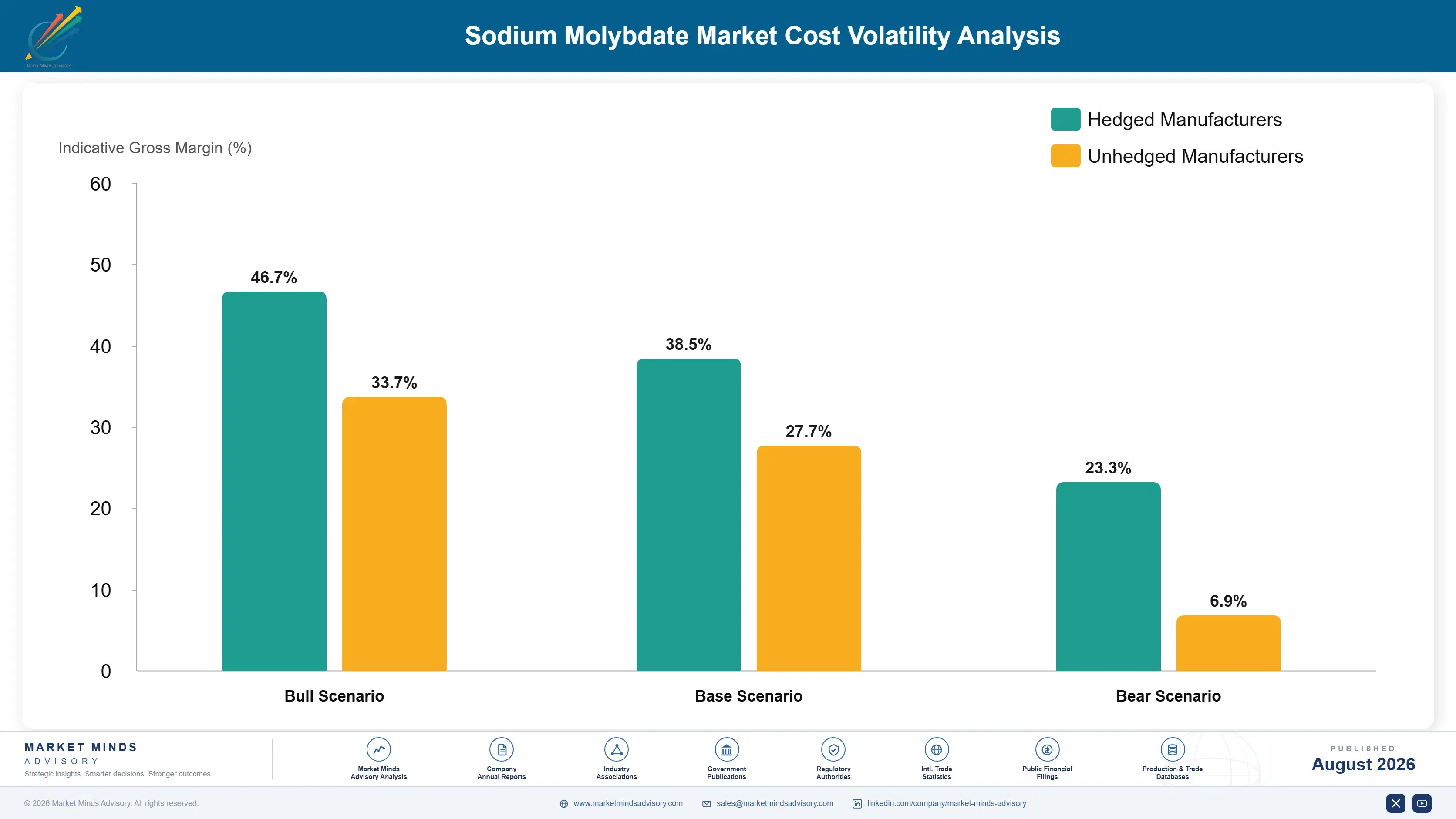
Molybdenum oxide carries around 74% of finished cost, and roughly 52% of world molybdenum supply arrives as a by-product of copper porphyry mining in Chile, Peru, the United States and China. Caustic soda and process reagents take about 9%. Energy, labour and conversion overhead account for around 11%, with packaging and freight absorbing the balance across most producers.
Molybdenum oxide pricing swung 3.1 times between trough and peak across the recent period, per EIA and USGS mineral commodity reporting alongside Freeport-McMoRan Annual Report 2025 disclosures on molybdenum realisations. Copper mine disruption drove much of the movement rather than anything happening in molybdenum demand. Converters buying on spot terms passed the full increase through, and several water treatment customers reformulated permanently rather than accept it.

Exposure divides sharply on integration. A converter purchasing oxide carries the full swing on 74% of cost with no meaningful hedge available, while an integrated producer holding mine and roasting capacity absorbs far less of it. Chinese integrated producers sit on the favourable side of that divide, which is why Western converters increasingly compete on qualification and application service rather than on delivered price.
sodium-molybdate-market-trends-cost-volatility-analysis-1787595239893

Contract molybdenum oxide supply on multi-year indexed terms

With 74% of cost in a single purchased input and no liquid hedging market available at useful scale, multi-year contracting with indexation is the only real protection. It converts a price cliff into a slope, which is the difference between losing an account to reformulation and simply repricing it with the customer. Spot buying through a spike costs accounts.

Shift mix toward applications where input price never reaches the customer

Seed treatment at around 15 grams per hectare and feed dosing at two milligrams per kilogram both put molybdenum cost far below the customer's decision threshold. Growing those segments reduces the share of revenue exposed to input volatility, which matters far more than any conversion efficiency programme could. Mix shift protects revenue that efficiency never reaches.

Offer reduced reserve blended programmes before customers reformulate

A blended water treatment programme at reserve below 200 parts per million holds most corrosion protection while cutting molybdenum exposure substantially, which addresses the price stability concern driving reformulation. Offering it before the customer starts qualification work retains the account. Offering it afterwards almost never recovers them. Timing decides the outcome here more than terms do.

Portfolio Architecture for Margin Defence

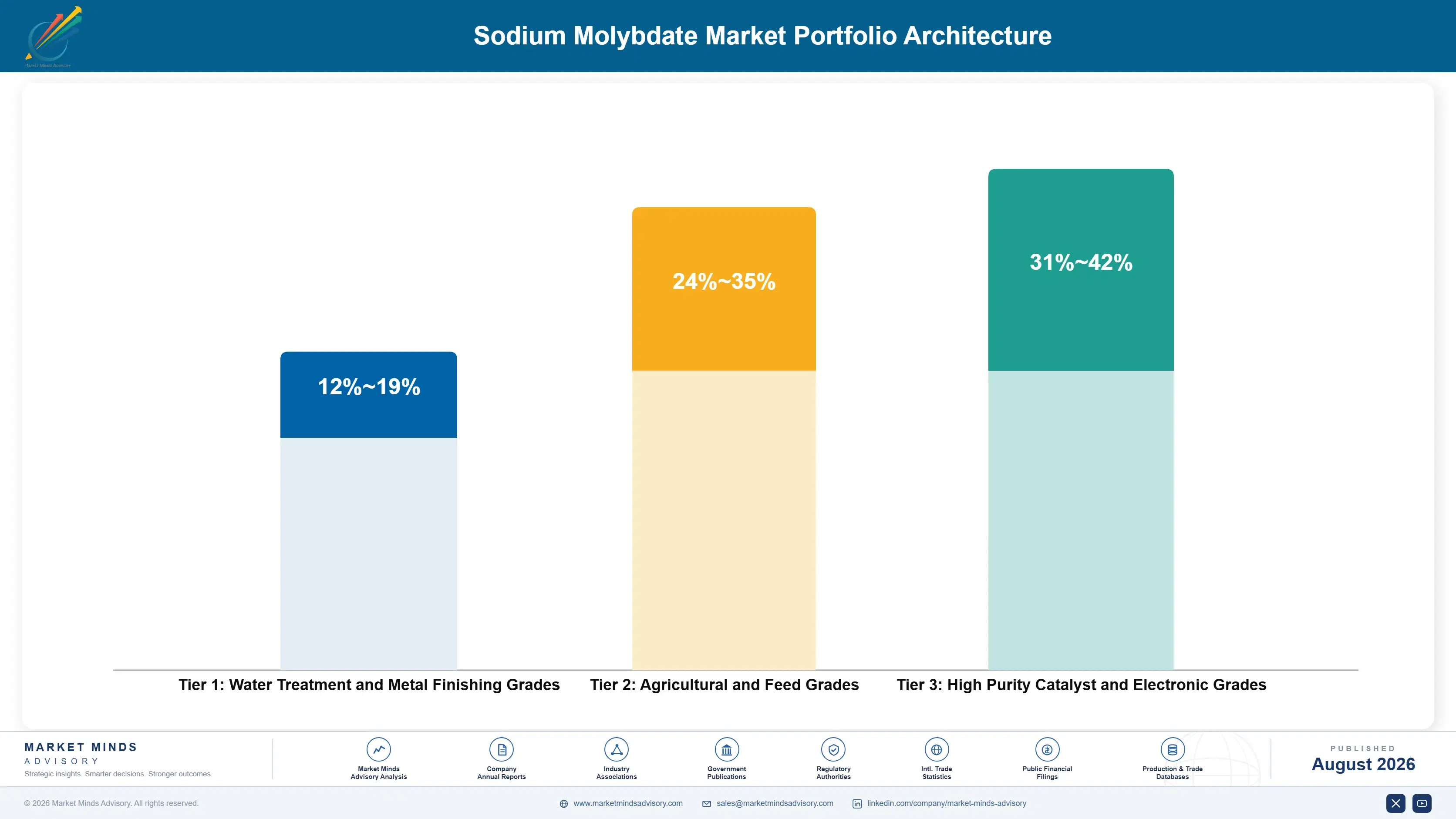
Margin here follows how far the customer sits from molybdenum pricing rather than any difference in the chemistry supplied. Water treatment and metal finishing grades earn margins in the low to high teens, because customers watch molybdenum pricing closely, reprice at every contract renewal and hold a credible reformulation threat that they have proven willing to use. Reformulation is a threat they have used.
Agricultural and feed grades do considerably better in the mid twenties to mid thirties, because dosing at 15 grams per hectare or two milligrams per kilogram puts input cost below the level at which a customer bothers negotiating it. Qualification documentation adds a further barrier that technical grade suppliers cannot cross without doing the work. That combination holds margin through input price movements that industrial accounts reprice immediately.

High purity catalyst and electronic grades hold the strongest position, reaching into the low forties, where specification tolerance and analytical documentation matter far more than delivered price. Those margins reflect purification capability and qualification rather than any advantage in oxide access, and very few producers have built the capability to serve them properly. The volumes are small but the position is genuinely defensible.

Water Treatment and Metal Finishing Grades

Technical grade material supplied against common specifications to customers watching molybdenum pricing closely. The seven point range reflects oxide access and contract structure rather than any product difference at all.
Gross Margin: 12-19%

Agricultural and Feed Grades

Qualified material with traceability and analytical documentation for seed treatment and feed formulation. The eleven point range reflects qualification depth and how far dosing removes input price from the buying decision.
Gross Margin: 24-35%

High Purity Catalyst and Electronic Grades

Purified material meeting tight specification tolerance for catalyst precursor and electronic applications. The eleven point range reflects purification capability and analytical documentation rather than any oxide access advantage held. Very few producers serve it.
Gross Margin: 31-42%
sodium-molybdate-market-trends-portfolio-architecture-1787595240418

High-value Sub-segments and Strategic Watch-out

Agricultural Micronutrient and Seed Treatment

High value and the fastest growth at 7.8%, insulated from input volatility because dosing at 15 grams per hectare puts molybdenum cost below the farmer's notice. Producers organised around water treatment tonnage barely staff it. Seed treatment formulators decide supply, which keeps the account list manageable.
Gross Margin: 26-35%

Animal Feed Supplementation

High value and growing at 6.2% on ruminant copper management programmes that dose at two milligrams per kilogram. Feed qualification documentation narrows the competitive field considerably against technical grade suppliers who never bother. Inclusion rates put input pricing well below the buying decision. Most never bother.
Gross Margin: 24-33%

Water Treatment Corrosion Inhibition

The volume core, holding rather than growing as organic programmes take share at every reformulation cycle. Customers watch molybdenum pricing closely and have proven entirely willing to design the chemistry out permanently. Retaining these accounts now depends on offering blended programmes early. Timing decides retention.
Gross Margin: 12-19%

By-Product Supply Dependence

The strategic watch-out. Around 52% of molybdenum arrives as copper mining by-product and carries 74% of cost, and the range reflects how far a producer has integrated backward or contracted forward against that exposure. No liquid hedging market exists at useful scale. Integration is the only real answer.
Gross Margin: 6-28%

Two Customers, Two Logics

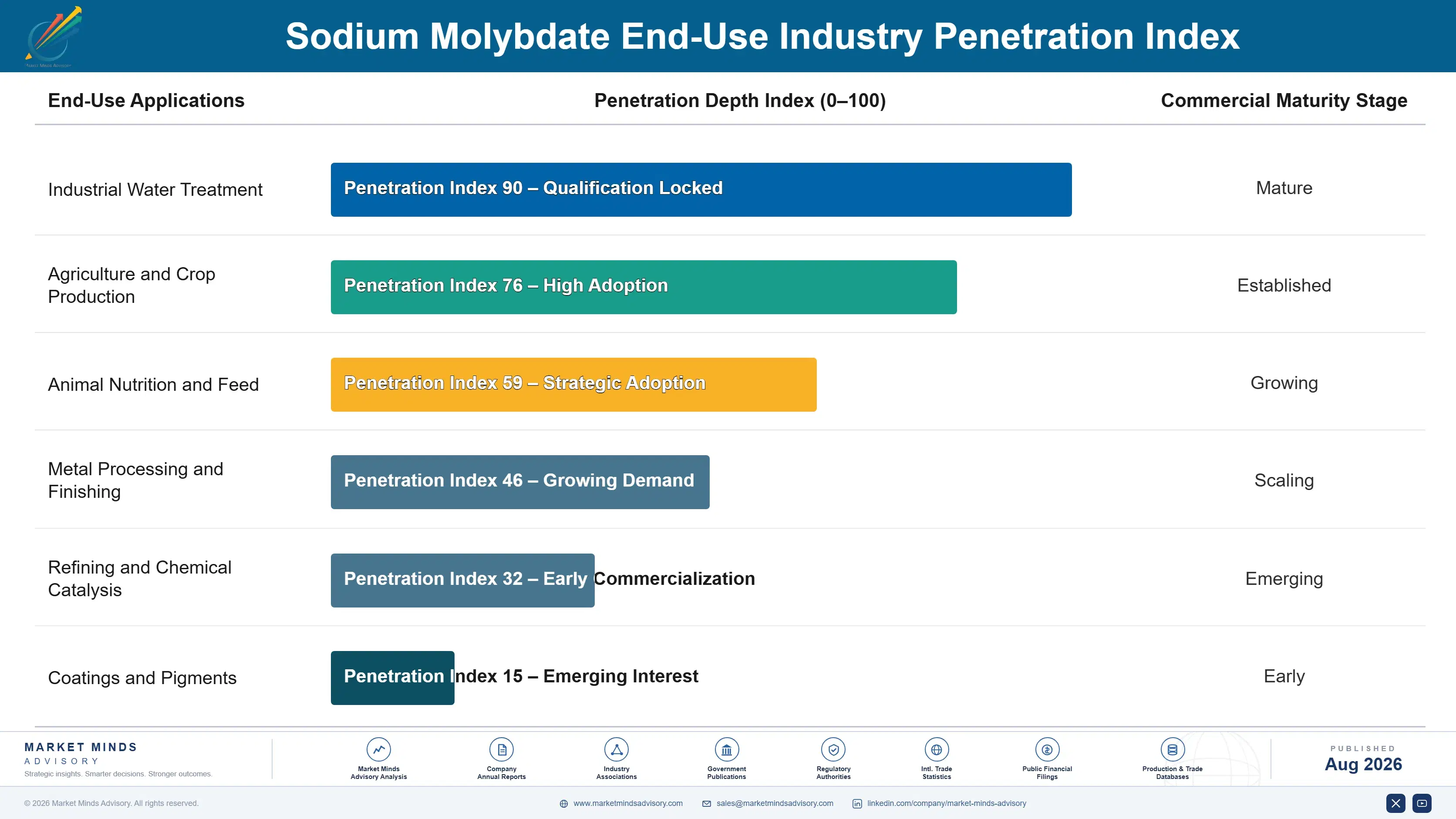
Demand here splits cleanly into applications that watch molybdenum pricing and applications that never see it. Water treatment and metal finishing customers track the input closely, reprice at renewal and reformulate when the swing gets uncomfortable. Agricultural and feed customers dose at levels where molybdenum cost is far below anything worth negotiating, and they buy on availability and documentation instead.
Stickiness follows that split exactly. A water treatment account holds only until the next price spike makes reformulation look worth the qualification cost, and it rarely returns afterwards. A feed or seed treatment position holds for years, because requalifying a trace mineral supplier against traceability documentation is genuinely disruptive and the input saving available would never justify it.

The deciding function differs just as sharply. Water treatment specification sits with plant engineering and procurement together, weighing corrosion performance against price exposure. Agricultural supply is decided by seed treatment formulators on availability and agronomic data. Feed supply sits with nutritionists and quality functions on documentation. A producer selling all three the same way is losing two of them. Most producers sell all three through one industrial sales structure, which is why two of them keep underperforming.
sodium-molybdate-market-trends-end-use-penetration-index-1787595240911

Where We Would Put Effort

These are among the four positions where our research anticipates prominent divergence between winners and laggards over the coming forecast period. Each is grounded in the demand model, the regulatory perimeter, and the announced capacity pipeline.
01 / AGRICULTURAL POSITION BUILDING

Build it now while nobody is contesting it

Seed applied molybdenum grows at 7.8% against a market rate of 5.2% and is completely insulated from the input volatility damaging every industrial application, because 15 grams per hectare costs a farmer almost nothing. Brazil alone grows at 9.4% on expanding soybean acreage adopting seed treatment as standard agronomic practice. Producers organised around water treatment tonnage staff this as a minor line, which is exactly why the position is available cheaply right now, before anybody else works out that it is the only demand nobody is walking away from.
02 / INPUT CONTRACT DISCIPLINE

Convert the price cliff into a slope

Molybdenum oxide carries 74% of cost and arrives 52% as a copper mining by-product, priced by decisions nobody in specialty chemicals influences and hedged by no market with useful liquidity. Multi-year indexed contracting is therefore the only protection genuinely available against swings that reached 3.1 times recently. It does not remove the exposure, but it is the difference between repricing an account and losing it permanently to reformulation, and that difference compounds across every account in the book over a cycle.
03 / WATER TREATMENT PRE-EMPTION

Offer the blend before they qualify alternatives

Water treatment customers reformulating away from molybdate are almost always chasing price stability rather than better corrosion performance, and a blended programme below 200 parts per million reserve addresses that directly. Offering it before qualification work starts retains the account at reduced volume rather than losing it entirely. Offering it afterwards effectively never works, because no customer pays requalification costs twice for the same cooling duty, whatever the delivered price on offer afterwards happens to look like against the alternatives on the table.
04 / FEED QUALIFICATION INVESTMENT

Documentation narrows the field more than cost does

Feed supplementation grows at 6.2% and dosing at two milligrams per kilogram means molybdenum pricing never reaches the buying decision at all. Traceability and analytical documentation requirements have tightened enough that technical grade suppliers are being removed from approved lists outright. That qualification work is cheap relative to what it protects, and most producers still treat feed as an incidental line rather than a defensible position worth the analytical and traceability work it actually requires in order to hold it properly.

Engagement Snapshot From the Field

A live engagement with an industry participant carrying material or product regulatory and market exposure ahead of a defining policy shift, showing how our research translates into a defensible multi-year portfolio strategy.
MARKET MINDS ADVISORY · CLIENT ENGAGEMENT SUMMARY
Sodium Molybdate Producer Strategic Portfolio Review and Transition Roadmap 2026·Investment Scenario on Sodium Molybdate Exposure Evaluation 2025-26
CLIENT PROFILE
A specialty inorganics producer converting purchased molybdenum oxide into sodium molybdate for water treatment and metal finishing customers across two continents, at annual revenue near 61 million dollars (client-reported, unverified by MMA). Agricultural and feed supply existed but was handled opportunistically with no dedicated commercial resource behind it at all. Water treatment accounted for most of the revenue.
STRATEGIC CHALLENGE
Two significant water treatment accounts had reformulated away from molybdate following a sharp oxide price movement, and management could not tell whether the losses were a cycle or the start of something permanent. Capacity investment decisions were waiting on that answer, and the board wanted clarity quickly. Nothing in the sales data separated the two.
MMA APPROACH
MMA reconstructed reformulation decisions at 14 industrial water treatment accounts to establish what actually triggered them, sized agricultural and feed demand growth independently of industrial volume, and assessed the client's qualification position against feed traceability requirements. Interviews with 47 experts covered water treatment formulation, trace mineral nutrition and molybdenum supply.
KEY FINDINGS
  1. Reformulation decisions were triggered by price volatility rather than performance in every case examined, and no account had reversed the decision afterwards at any point.
  2. Agricultural demand growth was entirely uncorrelated with molybdenum pricing, because dosing at 15 grams per hectare put input cost far below the farmer's decision threshold.
  3. Feed qualification was achievable within existing analytical capability and would have protected volumes the client was losing to better documented technical grade competitors.
  4. A blended reduced reserve programme offered before qualification work began would have retained one of the two lost accounts at approximately 60% of its previous volume.
CLIENT PROFILE
A specialty inorganics producer converting purchased molybdenum oxide into sodium molybdate for water treatment and metal finishing customers across two continents, at annual revenue near 61 million dollars (client-reported, unverified by MMA). Agricultural and feed supply existed but was handled opportunistically with no dedicated commercial resource behind it at all. Water treatment accounted for most of the revenue.
STRATEGIC CHALLENGE
Two significant water treatment accounts had reformulated away from molybdate following a sharp oxide price movement, and management could not tell whether the losses were a cycle or the start of something permanent. Capacity investment decisions were waiting on that answer, and the board wanted clarity quickly. Nothing in the sales data separated the two.
MMA APPROACH
MMA reconstructed reformulation decisions at 14 industrial water treatment accounts to establish what actually triggered them, sized agricultural and feed demand growth independently of industrial volume, and assessed the client's qualification position against feed traceability requirements. Interviews with 47 experts covered water treatment formulation, trace mineral nutrition and molybdenum supply.
KEY FINDINGS
  1. Reformulation decisions were triggered by price volatility rather than performance in every case examined, and no account had reversed the decision afterwards at any point.
  2. Agricultural demand growth was entirely uncorrelated with molybdenum pricing, because dosing at 15 grams per hectare put input cost far below the farmer's decision threshold.
  3. Feed qualification was achievable within existing analytical capability and would have protected volumes the client was losing to better documented technical grade competitors.
  4. A blended reduced reserve programme offered before qualification work began would have retained one of the two lost accounts at approximately 60% of its previous volume.
RECOMMENDED STRATEGY
Phase 1: Phase one: build dedicated agricultural commercial resource targeting seed treatment formulators, where demand growth ignores the input volatility damaging industrial accounts. Phase 2: Phase two: complete feed grade qualification documentation, since the analytical capability already exists and approved supplier lists are narrowing across the sector. Phase 3: Phase three: contract oxide supply on multi-year indexed terms and offer blended programmes to remaining water treatment accounts pre-emptively. Timing matters more than terms.
OUTCOME
The producer opened agricultural supply into two Brazilian seed treatment formulators during 2026 and completed feed qualification, reporting the new volumes offsetting roughly 70% of the water treatment loss (client-reported, unverified by MMA). Oxide contracting was restructured onto indexed terms. Water treatment retention improved after the blended programmes launched.

Frequently Asked Questions

Foundational context covering the market sizes, CAGR, scope, country, region and competition that inform every finding below. This section is provided to cover basics and most often pre-purchase conversations, answered from the MMA Primary Research Dataset.

What is the current size of the Sodium Molybdate Market?

MMA sizes it at USD 0.38 billion in 2025, rising to USD 0.40 billion in 2026. The figure covers dihydrate and anhydrous grades at producer selling value across all applications.

How large will the Sodium Molybdate Market be by 2036?

USD 0.66 billion by 2036, an incremental USD 0.26 billion over the 2026 base and an expansion multiple of 1.65 times. Agricultural demand accounts for a disproportionate share of that.

What is the CAGR for the Sodium Molybdate Market 2026 to 2036?

5.2% in the base case, with a bull case at 6.4% and a bear case at 4.0%. The spread turns almost entirely on molybdenum price stability and water treatment reformulation.

Which segment is growing fastest?

Agricultural micronutrient and seed treatment at 7.8%, half again the market rate of 5.2%. Seed applied molybdenum at around 15 grams per hectare is displacing foliar application.

Who are the major companies in the Sodium Molybdate Market?

Climax Molybdenum, Molymet, China Molybdenum, Jinduicheng Molybdenum and Taiyo Koko lead on production volume. Fifteen further participants are profiled in the full report on that same basis.

Which country is growing fastest?

Brazil at 9.4%, driven by soybean acreage where molybdenum seed treatment has become standard agronomic practice rather than an option growers weigh each season. Argentine acreage follows the same pattern.

Report Segmentation Architecture

The full report scope spans multiple orthogonal segmentation dimensions, with cross-tabulated demand data provided for each dimension pair. Coverage extends further to regional breakdowns, trend trajectories, and the competitive detail needed to support segment-level decision-making.

By Application

  • Water Treatment Corrosion Inhibition
  • Agricultural Micronutrient and Seed Treatment
  • Animal Feed Supplementation
  • Metal Finishing and Surface Treatment
  • Catalyst and Chemical Intermediate
  • Pigment and Specialty Applications

By End-Use Industry

  • Industrial Water Treatment
  • Agriculture and Crop Production
  • Animal Nutrition and Feed
  • Metal Processing and Finishing
  • Refining and Chemical Catalysis
  • Coatings and Pigments

By Commercial Dimension

  • Direct Industrial Supply Contracts
  • Formulator and Blender Supply
  • Distributor and Trader Channels
  • Qualified Feed and Agricultural Supply
  • Toll Conversion Arrangements
  • Export and Cross-Border Supply

By Region

  • North America
  • Western Europe
  • East Asia
  • South Asia and Pacific
  • Latin America
  • Middle East and Africa
  • Eastern Europe

Scope, Methodology, and Coverage

Every figure in this report is reproducible from documented input assumptions. The scope below maps the historical period, the forecast horizon, the segmentation dimensions, and the countries covered, alongside the underlying primary and qualitative methodology.
Historical Period
2020 to 2025
Forecast Period
2026 to 2036
Base Year
2025 (USD billions; MMA Primary Research Dataset, August 2026)
Market Definition
Sodium molybdate supplied as dihydrate and anhydrous grades across all purity levels, covering water treatment corrosion inhibition, agricultural micronutrient and seed treatment, animal feed supplementation, metal finishing and surface treatment, catalyst and chemical intermediate use, and pigment applications. Measured at producer selling value. Molybdenum metal, ferromolybdenum, molybdenum trioxide sold as such, ammonium molybdate, and finished water treatment or fertiliser formulations are excluded from scope.
Quantitative Units
USD billions (current prices); thousand tonnes produced; USD per tonne by application grade
Segmentation Dimensions
Application; end-use industry; commercial dimension; region
Regions Covered
North America, Western Europe, East Asia, South Asia and Pacific, Latin America, Middle East and Africa, Eastern Europe
Countries Covered
United States, Canada, Mexico, Germany, France, Italy, Spain, Netherlands, China, Japan, South Korea, India, Indonesia, Australia, Brazil, Argentina, Chile, Turkey, South Africa, Poland
Key Companies Profiled
Climax Molybdenum, Molymet, China Molybdenum, Jinduicheng Molybdenum, Taiyo Koko, Albemarle, Nippon Denko, Sadaci, Plansee, Luoyang Highnic, Xiamen Tungsten, Treibacher Industrie, American Elements, Noah Chemicals, GFS Chemicals, Hunan Nonferrous, SeAH M and S, Kennametal, Ereztech, Shanghai Xinglu Chemical
Quantitative Methodology
Primary survey, n=3,800 respondents, Q4 2025, six countries; demand-side model with trade association cross-validation
Qualitative Methodology
47 expert interviews, Q4 2025; applied to validate demand model assumptions, identify emerging dynamics, and assess competitive positioning
Report Format
PDF and XLSX data workbook (Word format preview document)
Publisher
Market Minds Advisory
Report Code
MMA-2026-CHM-138
Published
August 2026
Contact
sales@marketmindsadvisory.com | www.marketmindsadvisory.com

Purchase the full Sodium Molybdate Market Report (2026 to 2036).

The full report separates applications that watch molybdenum pricing from those that never see it, because that split explains almost everything about margin and account retention in this business. It sizes all six applications independently through 2036, reconstructs water treatment reformulation triggers from primary interviews, and models input exposure by integration position under oxide price scenarios. Regional chapters cover all seven regions with conversion capacity assessed alongside demand. Competitive profiling covers 20 participants on one consistent production volume basis throughout. Reformulation risk is scored by account type across all seven regions.
Six applications sized independently through 2036 with growth drivers
Water treatment reformulation triggers reconstructed from primary interviews
Input exposure modelled by integration position under price scenarios
Agricultural and feed demand sized independently of industrial volume
Twenty participants profiled on one consistent volume basis
Feed and agricultural qualification requirements assessed by producer capability

Built For The People Who Decide

From boardroom strategy to bench-side execution, this report is read cover-to-cover by leaders shaping the next decade of their industry, turning demand scenarios, market dynamics and valuation benchmarks into decisions.
CXOs/ Presidents/ VPs/ Managers
M&A and Corporate Development
Strategy Teams and R&D Heads
Procurement and Product Directors
Regulatory and Compliance Leaders
Investor Relations and Equity Analysts