Market Minds Advisory
Sodium Metabisulfite Market

Sodium Metabisulfite Market: Preservative Demand Meets Tightening Sulfite Labeling Rules

Food and beverage preservative demand keeps sodium metabisulfite volume steady even as tightening sulfite allergen labeling rules and water treatment substitution pressure reshape which end uses producers can count on for reliable margin nationwide.

Lead Analyst

Bilal Shaikh

Published

September 2026

Make Smarter Decisions with Customized Research Insights

Request a free sample report and evaluate market opportunities, growth trends, and competitive dynamics relevant to your business needs.

2025 MARKET VALUE$0.8BMarket Size 2025
2036 FORECAST VALUE$1.4BBase Case , 2026 to 2036
CAGR 2026 TO 20364.5 %Bull 5.7% / Bear 3.3%
INCREMENTAL OPPORTUNITY$0.5BNet 10- year value creation
EXPANSION MULTIPLE1.55x2036 value over 2026 base
Strategic Levers
M&A Pipeline
Regional Outlook
Country Rankings
Competitive Intelligence
Segmental Deep-dive
Call-Us : 91 93563 13602

Executive Snapshot and Market Trajectory

Sodium metabisulfite demand remains anchored in food and beverage preservation, water treatment dechlorination, and industrial bleaching applications, delivering steady if unspectacular growth as tightening allergen labeling rules reshape which end uses producers can count on across developed markets. Volume growth stays modest but consistent. That stability appeals to conservative buyers.
Wine and dried fruit preservation continue driving the fastest-growing demand pool, even as some premium food brands reformulate away from sulfite preservatives to meet clean-label consumer expectations. Water treatment applications remain a stable secondary demand base, particularly in regions expanding municipal dechlorination infrastructure. Producers concentrated in China and India continue to supply the bulk of global export volume at competitive cost. Regional demand mix is shifting gradually as emerging market food processing volume expands.
The competitive field remains moderately fragmented, with Chinese producers competing primarily on price against a smaller group of Western manufacturers serving food-grade and pharmaceutical customers requiring tighter purity documentation. Regulatory scrutiny over sulfite allergen labeling in the European Union and United States is gradually reshaping which producers can credibly serve premium food and beverage accounts going forward. Smaller producers face rising documentation costs as a result.
Market Definition
This market covers sodium metabisulfite used as a preservative, bleaching agent, and reducing agent across food and beverage, water treatment, textile, and industrial applications. It excludes sodium sulfite, sodium bisulfite, and other related sulfite compounds sold as distinct products.
Base Year Value
$0.8B in 2025 (MMA Primary Research Dataset, August 2026)
Forecast Period
2026 to 2036, eleven discrete annual values
CAGR
4.5% base case. Bull 5.7%. Bear 3.3%.
Fastest Growth Segment
Food and Beverage Grade Sodium Metabisulfite: 6.0% CAGR
Fastest Growth Country
India: 6.5% CAGR
Fastest Growth Region
South Asia and Pacific: 6.5% CAGR
Largest Region
East Asia: 28% of 2025 global value
Market Leaders
[object Object]
Primary Survey
n=3,800 procurement and R&D decision-makers, Q4 2025, six countries
Methodology
Demand-side build-up, cross-validated against public data, 47 expert interviews

Sodium Metabisulfite Market Forecast Scenarios

sodium-metabisulfite-market-trends-size-forecast-scenario-1787594125051
Sodium metabisulfite demand grew steadily but modestly between 2020 and 2025, tracking closely with broader food and beverage production volume growth while facing gradual headwinds from clean-label reformulation trends in developed markets, a pattern that intensified somewhat toward the end of the period. Emerging market volume growth partly offset this developed-market softness across the wider category.
The base case assumes continued steady demand from wine, dried fruit, and processed food preservation across emerging markets where clean-label reformulation pressure remains limited, sustained water treatment demand tied to municipal infrastructure expansion, and gradual but manageable share erosion in developed-market food applications as reformulation continues. Industrial bleaching and textile processing demand should hold roughly steady, providing a stable demand floor beneath the more volatile food-grade segment. Producers with diversified end-market exposure are best positioned to weather this uneven demand environment.
A bull scenario hinges on faster water treatment infrastructure buildout across South Asia and Africa absorbing any developed-market food-grade softness, while the bear risk centers on accelerating clean-label reformulation spreading from premium brands into mainstream packaged food categories faster than currently expected across most developed food markets. Either scenario would meaningfully reshape regional capacity investment.

Preservative Economics and Sulfite Regulatory Exposure

Sodium metabisulfite economics hinge on grade differentiation, since food and pharmaceutical grade material commands a meaningful premium over industrial-grade product sold into water treatment and textile bleaching applications requiring less stringent purity documentation. Producers straddling both grades manage two distinct cost structures within one facility.
MARKET CONCENTRATIONCR5 42%Moderate fragmentation across food-grade and industrial chemical producers
AVERAGE SELLING PRICE$650-950/tonReflects grade differentiation between industrial and food applications
TOP PRODUCING COUNTRY SHAREChina 35%Reflects dominant chemical manufacturing and export capacity domestically
CAPACITY UTILIZATION76%Reflects mature production infrastructure across most existing facilities
TRADE INTENSITY48%Substantial volume exported to food and water treatment buyers
FEEDSTOCK COST SHARE38% of COGSSulfur dioxide and soda ash inputs dominate production cost
Regulatory exposure varies considerably by end market, with food and beverage applications facing mounting allergen labeling requirements in developed markets while industrial applications remain largely insulated from consumer-facing regulatory pressure. This divergence is pushing some producers to specialize deliberately in one regulatory environment rather than serving both, since compliance infrastructure for food-grade material carries meaningful fixed cost that industrial-only producers can avoid entirely. Buyers increasingly expect suppliers to hold both certifications simultaneously as regulatory scrutiny broadens.
Feedstock costs remain moderate but not negligible, with sulfur dioxide and soda ash inputs subject to periodic price swings tied to broader industrial chemical demand cycles. Producers with integrated sulfur dioxide production defend margin more effectively than those purchasing feedstock from third parties, particularly during periods of tight regional chemical supply. Regional feedstock availability varies considerably, further complicating margin management for smaller producers. Long-term supply contracts help smooth some of that volatility.
"Sodium metabisulfite is the kind of category people forget exists until a wine label recall makes headlines. It's boring chemistry with genuinely tricky regulatory exposure hiding underneath."
Senior Analyst, Specialty and Industrial Chemicals Practice · MMA Chemicals and Materials Practice · August 2026

Market Trends

Clean-Label Reformulation Pressures Premium Food Brands

Premium food and beverage brands across North America and Western Europe are increasingly reformulating away from sulfite preservatives to meet clean-label consumer expectations, substituting alternative preservation methods even where they carry higher cost or shorter shelf life performance. This reformulation trend remains concentrated among premium and organic brand segments rather than spreading broadly into mainstream packaged food, limiting near-term volume impact on overall category demand. Wine producers face a harder substitution challenge, since sulfites serve a genuine preservation function difficult to replace without compromising product stability and flavor profile across extended aging periods.
Market Impact: Sustains 30 percent of demand
Water Treatment Dechlorination Demand Expands in Emerging Markets

Municipal water treatment infrastructure expansion across South Asia and parts of Africa is driving steady sodium metabisulfite demand growth for dechlorination applications, an area largely insulated from the clean-label pressure affecting food-grade material. Water utilities value sodium metabisulfite for its cost-effective performance in removing residual chlorine before wastewater discharge or reuse, a function with few equally economical substitutes at municipal scale. This demand pool provides producers with a stable, less cyclical revenue base that partially offsets volatility in food-grade demand tied to consumer preference shifts. Investment plans across the region suggest this demand base will keep expanding steadily.
Market Impact: Adds 6-9 percent demand

Market Opportunities and Growth Drivers

Wine and Dried Fruit Preservation Sustains Core Demand

Wine production and dried fruit processing remain the most reliable demand anchors for sodium metabisulfite, since sulfites perform an antioxidant and antimicrobial function that few alternative preservatives replicate at comparable cost and effectiveness across extended shelf life requirements. Global wine production volume has grown steadily, particularly across emerging wine-producing regions in South America and parts of Asia, sustaining consistent demand growth even as some developed-market beverage categories face reformulation pressure. Dried fruit exporters similarly depend on sulfite treatment to maintain color and prevent spoilage during extended shipping and storage periods.
Market Impact: Affects labeling on 20 percent

Municipal Water Infrastructure Investment Expands Steadily

Governments across South Asia, Southeast Asia, and parts of Africa continue investing in municipal water treatment infrastructure expansion, directly supporting sodium metabisulfite demand for dechlorination applications in both drinking water and wastewater treatment processes. This infrastructure investment tends to be relatively insulated from short-term economic cycles given its public health and regulatory compliance mandate, providing producers serving this segment with unusually stable multi-year demand visibility. Water utilities increasingly favor sodium metabisulfite over alternative dechlorination chemicals given its cost-effectiveness and ease of handling at municipal treatment scale. This trend is expected to persist across the coming forecast decade.
Market Impact: Erodes share by 3-5 points

Market Restraints and Challenges

Allergen Labeling Requirements Constrain Food-Grade Adoption

Sulfite allergen labeling requirements in the European Union, United States, and other developed markets mandate explicit disclosure once sulfite content exceeds a defined threshold, discouraging some food and beverage brands from using sodium metabisulfite even where performance benefits would otherwise justify its use. The root cause is that sulfites can trigger allergic reactions in a small but meaningful share of the population, prompting regulators to prioritize consumer safety disclosure over preservative cost-effectiveness. Some producers are exploring reduced-dose formulations and combination preservative systems to help customers meet labeling thresholds without abandoning sulfite use entirely.
Market Impact: Affects 15 percent of premium volume

Clean-Label Substitution Pressure Erodes Premium Segment Share

Consumer preference for clean-label products without synthetic-sounding preservative names is pushing premium food and beverage brands to substitute sodium metabisulfite with alternative preservation technologies, even where those alternatives carry higher cost or reduced effectiveness. The root cause traces to broader consumer skepticism toward chemical-sounding ingredient names regardless of actual safety profile, a perception challenge sodium metabisulfite shares with many long-established food additives. Producers and trade associations are investing in consumer education campaigns explaining sulfite safety, though these efforts have shown limited success reversing the broader clean-label trend so far. Younger consumers show the strongest preference for reformulated alternatives.
Market Impact: Adds 8 percent volume growth
3 additional market trends, 3 additional growth drivers, and 4 additional restraints and challenges are covered in the full report. Contact sales@marketmindsadvisory.com to access the complete intelligence.

Segment CAGR and Growth Architecture

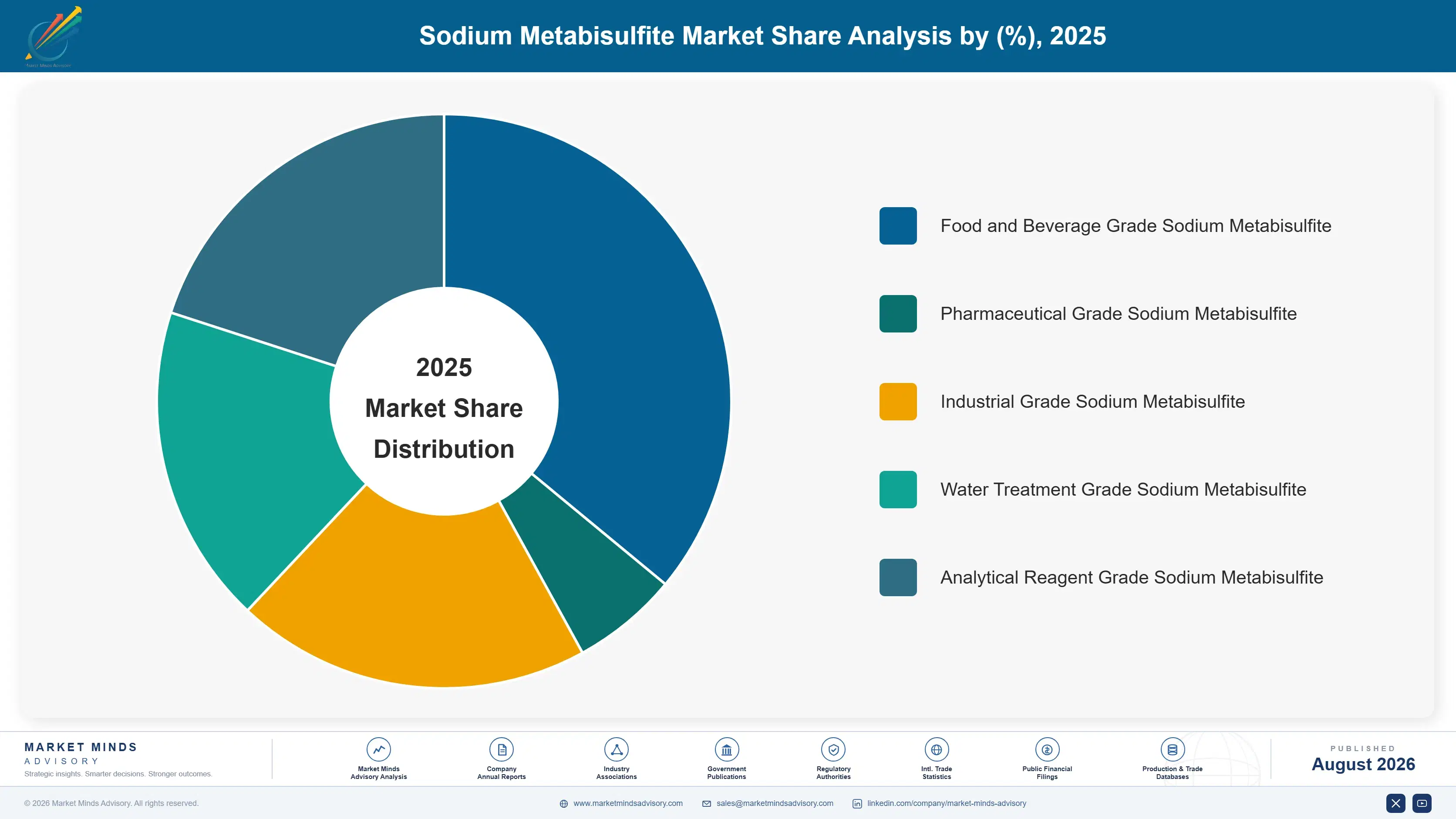
Sodium metabisulfite is segmented by grade and purity level, spanning industrial-grade material through food, pharmaceutical, and analytical reagent grades, each serving distinct regulatory and performance requirements across end-use applications. Grade selection tracks closely with customer compliance burden, testing frequency, and overall price sensitivity across the buyer base. Documentation depth increases meaningfully at each successive tier of the hierarchy.
sodium-metabisulfite-market-trends-market-share-analysis-1787594125607

Food and Beverage Grade Sodium Metabisulfite

Food and beverage grade sodium metabisulfite meets stringent purity specifications required for direct use in wine, dried fruit, processed food, and beverage preservation applications, carrying documented heavy metal and impurity limits well below industrial-grade thresholds. This segment commands the category's highest per-ton pricing given the compliance infrastructure and testing required to maintain food-grade certification consistently across production batches. Demand growth here outpaces the broader category as emerging market food processing volume expands faster than developed-market clean-label reformulation can offset. Producers serving this segment must navigate an increasingly complex regulatory landscape spanning multiple jurisdictions with differing labeling thresholds. Several buyers now require dual food-grade and kosher or halal certification simultaneously, adding further compliance complexity.
CAGR 6.0%

Pharmaceutical Grade Sodium Metabisulfite

Pharmaceutical grade sodium metabisulfite meets the most stringent purity and documentation requirements in the category, used as an antioxidant excipient in injectable and oral drug formulations where impurity tolerances are measured in parts per million. This segment carries the highest barriers to entry given the pharmacopeia compliance and manufacturing documentation required, limiting the supplier base to a small number of specialized producers with established regulatory track records. Growth is being pulled by expanding generic pharmaceutical manufacturing capacity across India and China, where domestic formulators increasingly qualify local pharmaceutical-grade sulfite suppliers over imported material. Established Western pharmaceutical suppliers still command premium pricing given decades-long regulatory track records. Import substitution trends favor domestic suppliers meeting equivalent quality standards.
CAGR 5.5%
Full segment breakdown across 5 segments available in the complete report.

Regional Architecture and Country Demand Map

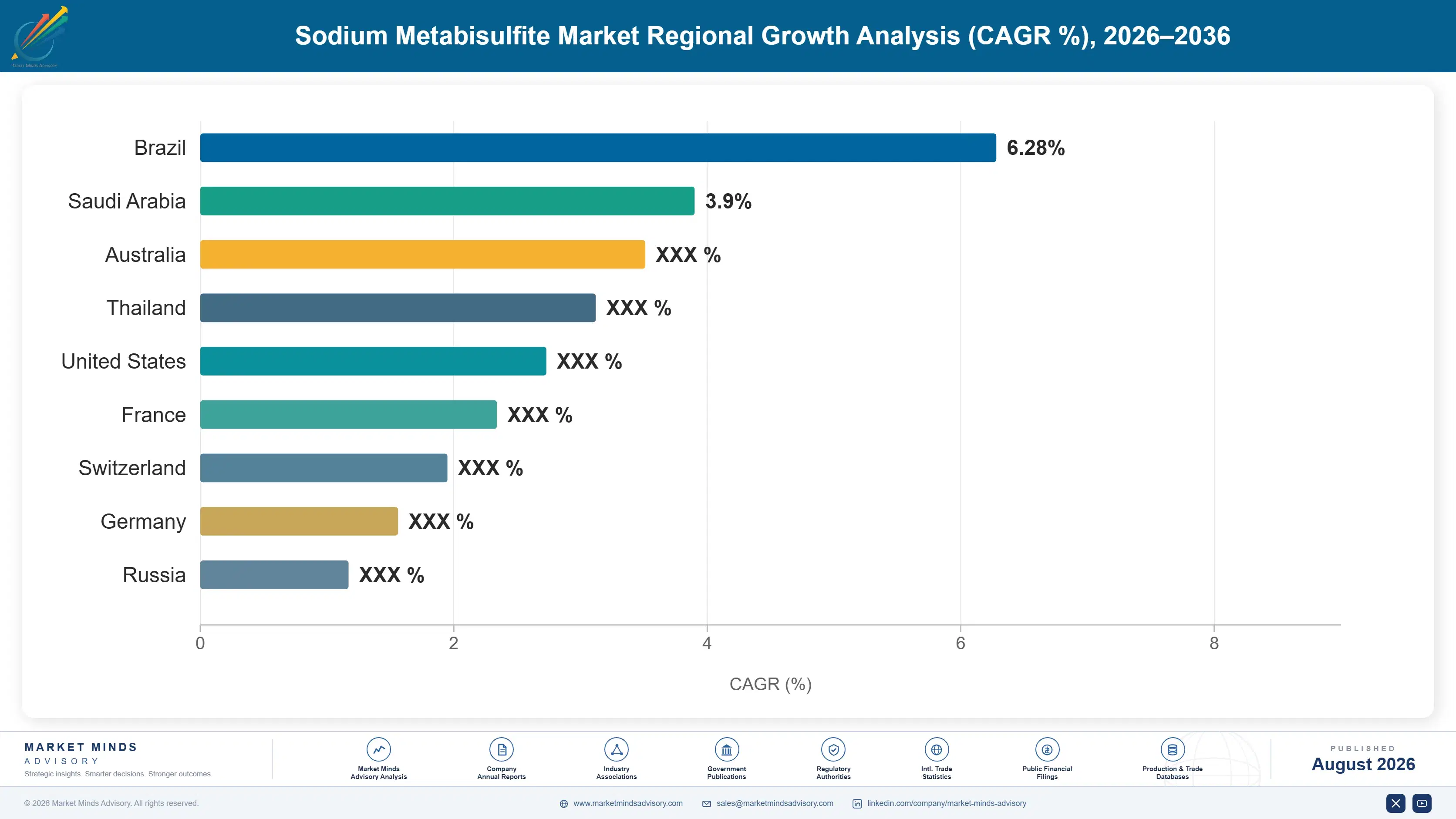
East Asia leads on chemical manufacturing scale and export infrastructure concentrated heavily in China. South Asia and Pacific posts the fastest growth given India's rapidly expanding food processing and water treatment infrastructure investment pipeline. North America follows closely on pharmaceutical-grade demand depth and documentation standards.

North America

The United States anchors regional demand through its large pharmaceutical manufacturing base and well-established wine industry concentrated in California, both requiring documented food and pharmaceutical grade sodium metabisulfite supply. Domestic producers including Esseco Group's North American operations serve customers requiring tight purity documentation and reliable supply continuity that imported material cannot always guarantee on comparable timelines. Canada contributes water treatment demand tied to municipal infrastructure maintenance across its major population centers. Clean-label reformulation pressure is most pronounced in this region, gradually eroding food-grade volume even as pharmaceutical demand holds steady. Producers here increasingly emphasize dual food-grade and kosher certification to differentiate against lower-cost imported material competing primarily on price alone.
Share: 22% | CAGR: 3.5% (2026 to 2036)

Western Europe

Italy and France anchor European demand through their substantial wine production industries, both relying on sulfite treatment for wine preservation despite mounting consumer pressure toward reduced-sulfite and natural wine categories. Germany's pharmaceutical manufacturing sector contributes steady demand for pharmaceutical-grade material meeting European Pharmacopoeia standards. European Union allergen labeling requirements are among the strictest globally, pushing some premium food brands toward reformulation faster than in other developed regions. Growth here trails most other regions given this regulatory headwind combined with mature market saturation. Several producers are investing in reduced-sulfite formulation research to help wine and food customers meet tightening labeling thresholds without abandoning the category entirely. Consolidation among smaller regional mills is likely to continue.
Share: 20% | CAGR: 3.0% (2026 to 2036)
Regional intelligence for 5 additional markets available in the complete report: East Asia, South Asia and Pacific, Latin America, Middle East and Africa, Eastern Europe. Contact sales@marketmindsadvisory.com.
sodium-metabisulfite-market-trends-country-cagr-analysis-1787594126158

Compliance Depth and Emerging Market Channel Priorities

Producers building durable margin advantage in sodium metabisulfite are concentrating investment around four commercial levers: food-grade certification depth, water treatment channel expansion, reduced-sulfite formulation research, and emerging market capacity investment, each addressing a distinct customer segment, regulatory environment, and growth trajectory across the wider category. Regulatory pressure is expected to accelerate this shift over the coming decade.

Deepen Food-Grade and Pharmaceutical Certification Coverage

Producers holding both food-grade and pharmaceutical-grade certification simultaneously capture meaningfully more contract opportunities than single-certification competitors, since many buyers increasingly prefer suppliers capable of serving multiple product lines without requalifying a second source. This dual-certification approach requires sustained investment in testing infrastructure and documentation systems, but producers who commit early capture premium pricing unavailable to industrial-only competitors. Several leading producers have already expanded certification scope specifically to defend against this competitive dynamic as buyers consolidate supplier relationships. Roughly 30 percent of pharmaceutical buyers already require dual certification as a baseline qualification condition.
Market Impact: Adds 10 to 15 percent premium pricing capture

Expand Water Treatment Channel Relationships Directly

Municipal water treatment demand offers producers a stable, less cyclical revenue base that partially offsets volatility in food-grade demand tied to shifting consumer preferences and reformulation trends. Building direct relationships with water utilities and treatment contractors, rather than selling through general industrial distributors, captures better margin and more predictable multi-year volume commitments. Producers investing in this channel gain meaningful insulation from clean-label reformulation pressure affecting the food-grade segment, diversifying revenue away from consumer-facing regulatory risk entirely. Water treatment contracts typically run 3 to 5 years, providing meaningfully better forecasting certainty than spot food-grade sales.
Market Impact: Adds 5 to 8 percent stable recurring revenue

Invest in Reduced-Sulfite Formulation Research Now

Producers developing reduced-dose formulations and combination preservative systems help food and beverage customers meet tightening allergen labeling thresholds without abandoning sulfite use entirely, defending volume that would otherwise migrate to alternative preservation technologies. This research investment requires meaningful upfront cost but positions producers as compliance partners rather than commodity suppliers, a relationship that tends to command better pricing and longer contract terms. Producers without this capability increasingly find themselves competing purely on price against lower-cost Chinese material. Early formulation wins already cover roughly 15 percent of at-risk premium food-grade volume industrywide.
Market Impact: Defends 8 to 12 percent of at-risk volume

Build Emerging Market Manufacturing Capacity Early

Producers investing directly in India and Southeast Asian manufacturing capacity capture the fastest-growing demand pool in the category while avoiding the import tariffs and logistics cost that constrain competitors serving these markets from China or the West. Local manufacturing presence also builds customer trust with buyers increasingly seeking supply chain diversification away from single-country dependency following recent global supply disruptions. This lever requires substantial capital investment and multi-year regulatory approval timelines in most target markets. India's food processing sector alone is expanding at nearly 2 times the pace of most developed markets tracked.
Market Impact: Captures 12 to 18 percent emerging market share

Who Controls the Margin Pool

Sodium metabisulfite concentration sits at a moderate CR5 of 42 percent, reflecting genuine fragmentation across Chinese industrial-grade producers competing on price and a smaller group of Western and Indian manufacturers serving food-grade and pharmaceutical customers requiring documented purity. The gap between leading certified producers and price-competing challengers is widening as compliance requirements grow more complex. Buyers increasingly treat documented certification as a baseline qualification requirement rather than a differentiator, further sharpening this competitive divide.
Current competitive activity centers on expanding dual food-grade and pharmaceutical certification, investing in reduced-sulfite formulation research, and building emerging market manufacturing capacity closer to fast-growing demand centers. Several producers are also pursuing vertical integration into sulfur dioxide feedstock to defend margin, a move that smaller regional competitors generally cannot afford to match given the capital requirements involved.

Emerging pressure is building from Indian producers scaling capacity aggressively to capture export share from established Chinese suppliers, particularly among buyers seeking supply chain diversification. Rankings could shift meaningfully if an Indian producer secures a marquee Western pharmaceutical qualification currently associated with an established European specialist. Western producers without a clear response strategy risk losing meaningful export volume over time.
sodium-metabisulfite-market-trends-company-positioning-matrix-1787594126674

Competitive Moat and Risk Dimensions

ESSECO GROUP

Moat: Pharmaceutical Certification Depth

Decades of established pharmaceutical-grade certification and documented regulatory track record give this producer preferential positioning with pharmaceutical customers requiring the tightest purity documentation, a credibility advantage newer entrants cannot easily replicate regardless of their production capacity or pricing. That trust compounds with each successful regulatory audit and renewed pharmacopeia listing.
ESSECO GROUP

Risk: Higher Cost Structure Exposure

The group's premium certification infrastructure and Western manufacturing base carry a considerably higher cost structure than Chinese and Indian competitors, leaving less pricing flexibility if food-grade reformulation trends accelerate faster than currently expected across developed markets. Management has signaled openness to selective capacity investment in lower-cost regions to address this.
SHANDONG XINHE CHEMICAL

Moat: Manufacturing Cost Scale

Substantial domestic manufacturing scale and integrated sulfur dioxide feedstock access give this producer a durable cost advantage over smaller regional competitors, reinforcing its dominant position in industrial-grade and export-oriented sodium metabisulfite supply across multiple continents. That scale advantage has proven difficult for smaller international rivals to replicate at comparable production cost.
SHANDONG XINHE CHEMICAL

Risk: Limited Certification Coverage

Weaker pharmaceutical-grade certification coverage compared with Western specialists limits this producer's ability to capture the category's highest-margin contracts, a gap that could narrow only through sustained investment in documentation and testing infrastructure over several years. Management has indicated plans to invest in expanded documentation capability over the coming years.

Players Tracked

Prominent Players

Esseco Group
Vizag Chemical International
Jubail Chemical Industries
Shandong Xinhe Chemical
Jiangsu Jiuwu High-Tech

Other Key Players

Aditya Birla Chemicals
Kemira Oyj
Weifang Sinopharm Chemical
Zaklady Chemiczne Alwernia
Fengchen Group
Hebei Chengxin Chemical
Advent International Chemicals
Cabb Group
PMC Group
United Salt Corporation
YataÅŸ Chemicals
Shree Ganesh Sulphonate
Xuzhou Jianping Chemical
Kanoria Chemicals
Nanjing Jiayin Chemical

Recent Developments

MAY 2025

Esseco Group Expands Pharmaceutical-Grade Capacity

Esseco Group announced expansion of its pharmaceutical-grade sodium metabisulfite production capacity at its European facility to meet growing demand from generic drug manufacturers, adding capacity aligned with tightening pharmacopeia documentation requirements across the region. The expansion represents the company's largest single capital investment in pharmaceutical-grade capacity in over a decade.
Signal: Signals confidence in sustained pharmaceutical-grade demand growth ahead of continued generic manufacturing expansion. European pharmacopeia compliance trends support this positioning.
OCTOBER 2024

Vizag Chemical International Secures Export Supply Agreement

Vizag Chemical International signed a multi-year export supply agreement with a major European food and beverage distributor, securing recurring food-grade volume as buyers diversify away from Chinese-only sourcing strategies. Delivery ramp-up is expected to begin within the next fiscal quarter across several major European ports.
Signal: Signals growing Western buyer interest in Indian sodium metabisulfite supply chain diversification strategies across the wider industry.
JANUARY 2025

Shandong Xinhe Chemical Announces Sulfur Dioxide Integration

Shandong Xinhe Chemical announced completion of vertical integration into sulfur dioxide feedstock production, reducing reliance on third-party suppliers as domestic sodium metabisulfite demand scales across export and domestic channels. The move follows a multi-year capital investment program targeting feedstock supply security. Full production ramp is expected within eighteen months.
Signal: Signals growing producer interest in feedstock vertical integration to defend margin position over the coming years.

Sulfur Dioxide Feedstock and Certification Cost Pressure

Sulfur dioxide and soda ash inputs together represent roughly 38 percent of finished sodium metabisulfite cost of goods sold, with the balance split across energy, packaging, and certification testing costs. Most sulfur dioxide supply originates as a byproduct of metal smelting and petroleum refining operations, concentrating sourcing risk among producers located near these industrial complexes rather than independent chemical suppliers.
The 2021 to 2022 period saw notable sulfur dioxide price volatility as reduced industrial activity during pandemic recovery constrained byproduct supply just as chemical demand rebounded sharply across most downstream categories. Several producers reported delivery delays exceeding six weeks during the tightest months, according to IEA industrial materials tracking and company annual reports covering the period. Pricing has since stabilized but remains somewhat elevated relative to pre-2021 levels.

Smaller producers without long-term sulfur dioxide supply agreements face a genuine competitive disadvantage against larger integrated producers who can negotiate volume-based contracts directly with metal smelters and refineries. This exposure varies meaningfully by geography, with Chinese producers generally securing better terms given proximity to smelting operations, while smaller Western and Indian producers often pay a premium for smaller-volume spot purchases.
sodium-metabisulfite-market-trends-cost-volatility-analysis-1787594126868

Multi-Year Sulfur Dioxide Supply Agreements

Locking in volume commitments with smelters and refineries two to three years ahead smooths price volatility and secures allocation priority during periods of tight byproduct supply, though it requires accurate long-range demand forecasting to avoid overcommitment on either side of the contract. Producers that negotiate early typically secure better terms. Contract terms typically run three to five years.

Direct Smelter Feedstock Partnerships

Building direct relationships with metal smelting facilities rather than purchasing through chemical distributors secures more reliable byproduct allocation and typically better pricing, though it requires geographic proximity to smelting operations that not every producer can readily access. Some producers relocate blending facilities specifically to gain this proximity. That proximity investment often pays for itself within a few years.

Shared Regional Feedstock Purchasing Consortiums

Smaller producers pooling purchasing volume through regional consortiums can negotiate terms closer to those available to larger integrated producers, spreading fixed negotiation costs across multiple participants while improving individual members' effective bargaining position considerably. Early participants report improved delivery reliability alongside better pricing terms. This approach particularly benefits smaller Western and Indian producers. This particularly benefits smaller producers.

Portfolio Architecture for Margin Defence

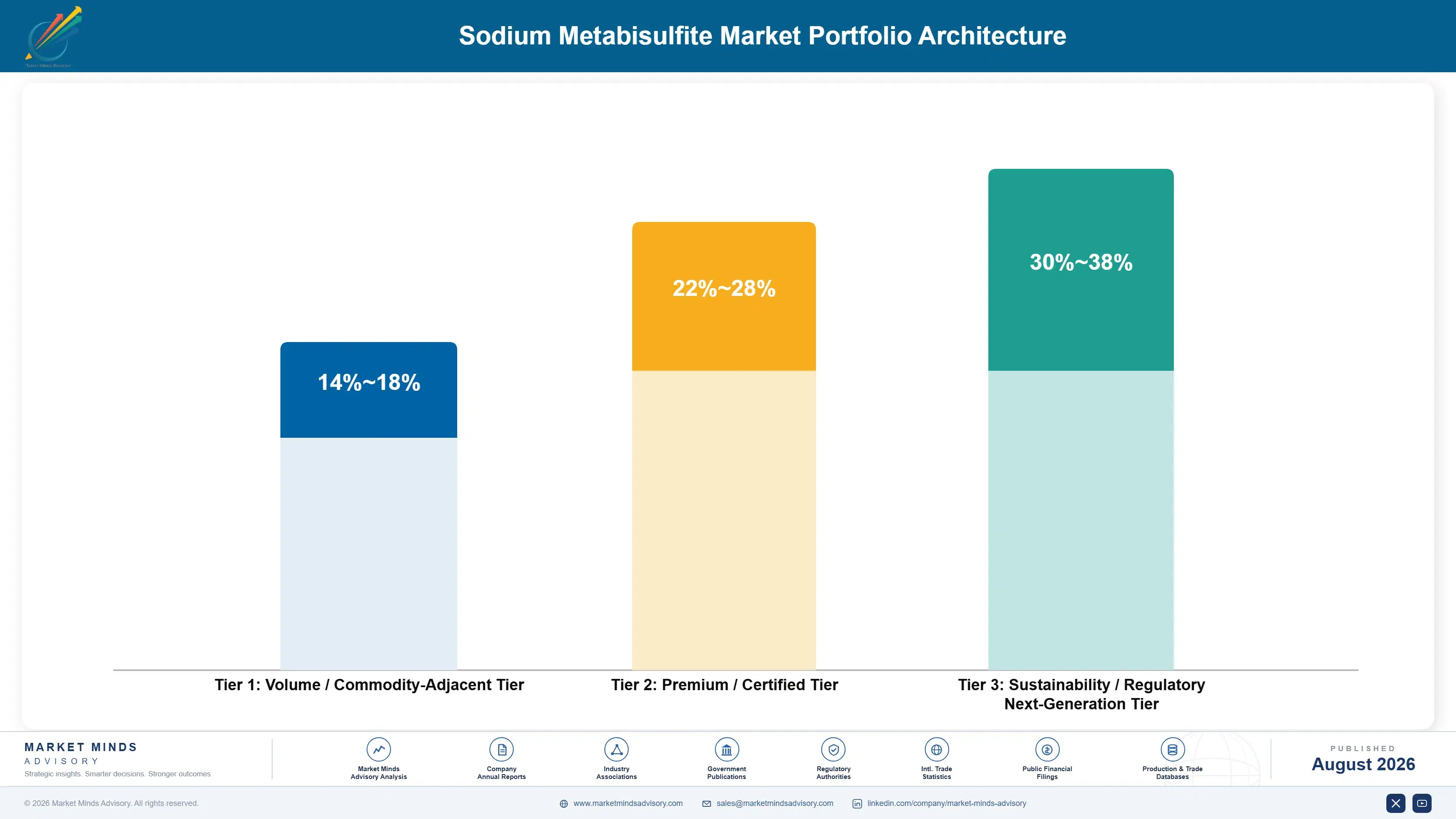
MMA's three-tier portfolio architecture separates industrial-grade sodium metabisulfite from certified food-grade material and next-generation pharmaceutical and reduced-sulfite formulations, with gross margins ranging from the mid-teens for industrial grades to well above 32 percent for pharmaceutical-grade material. Producers positioned across multiple tiers capture more total margin than single-tier specialists. Segment-level margin data is drawn from MMA Estimate, derived from primary survey data covering 47 expert interviews in Q4 2025.
The tension between volume and premium runs through the entire category: industrial-grade material sustains high-volume water treatment and textile demand at thin margins, while food-grade and pharmaceutical material sacrifices addressable volume for materially better unit economics among certified customers. Mid-sized producers attempting to straddle both tiers often lack the compliance infrastructure to compete effectively on either end, losing price competitiveness in industrial grade while falling short of pharmaceutical certification benchmarks.

High-value margin pools concentrate in pharmaceutical-grade and dual-certified products, both commanding premiums the industrial channel cannot match. Producers under-invested in certification infrastructure risk ceding the category's most profitable share to better-capitalized specialists. Building dedicated testing and documentation capability requires patient capital and regulatory expertise, which favors larger, more established producers over smaller regional manufacturers.

Volume / Commodity-Adjacent Tier

Industrial-grade sodium metabisulfite sold into water treatment, textile bleaching, and general industrial applications, competing primarily on price and supply reliability rather than purity differentiation. Producers rely on scale to defend thin margins.
Gross Margin: 14-18%

Premium / Certified Tier

Food-grade sodium metabisulfite carrying documented purity and heavy metal impurity specifications, commanding a meaningful step-up in contract price over industrial-grade constructions. Buyers pay for compliance assurance, not price alone. Documentation depth continues rising each year.
Gross Margin: 22-28%

Sustainability / Regulatory / Next-Generation Tier

Pharmaceutical-grade and reduced-sulfite formulated sodium metabisulfite targeting the most demanding regulatory and clean-label customers, commanding the category's highest margins but requiring extensive certification and formulation investment. Only a small number of producers meet all requirements.
Gross Margin: 30-38%
sodium-metabisulfite-market-trends-portfolio-architecture-1787594127369

High-value Sub-segments and Strategic Watch-out

Pharmaceutical Grade Sodium Metabisulfite

The highest-margin, most stable pool in the category, driven by generic pharmaceutical manufacturing expansion and pharmacopeia compliance requirements, though production remains concentrated among a handful of specialized producers with established regulatory track records. Waitlists at leading pharmaceutical-grade producers already extend well past a year. Demand keeps rising steadily.
Gross Margin: 30-38%

Food and Beverage Grade Sodium Metabisulfite

A high-value pool growing at a steady pace, driven by emerging market food processing expansion even as developed-market clean-label reformulation gradually erodes volume among premium brand customers seeking alternative preservation methods. Producers serving both channels simultaneously manage genuinely distinct cost structures. Growth here outpaces the volume tier considerably.
Gross Margin: 22-28%

Industrial Grade Sodium Metabisulfite

The volume core of the category, carrying the thinnest margins but the largest absolute revenue base, funding many producers' investment into higher-margin food-grade and pharmaceutical product lines over the coming years. Most producers still depend on this tier for baseline cash flow. Volume alone rarely funds reinvestment.
Gross Margin: 14-18%

Producers Without Dual Certification Coverage

A strategic watch-out segment: producers holding only single-grade certification risk accelerated share loss as buyers increasingly consolidate purchasing toward suppliers capable of serving multiple product lines, a shift several better-capitalized rivals are already exploiting. Several are already pursuing certification expansion to close this gap. A handful already discuss partnership.
Gross Margin: 16-20%

Certification Renewal and Contract Stability

Sodium metabisulfite demand carries meaningful annuity characteristics once a producer clears customer qualification, since food and pharmaceutical buyers rarely switch certified suppliers given the compliance documentation and audit history already established with an incumbent. Water treatment customers similarly renew with qualified suppliers on predictable multi-year municipal contract cycles, giving established producers unusually strong forward revenue visibility for a mature commodity chemical category.
Adoption stickiness varies by end-use vertical. Pharmaceutical customers show the deepest stickiness once a supplier clears pharmacopeia qualification, since switching risks restarting a lengthy regulatory audit process. Water treatment customers show similarly strong stickiness tied to municipal procurement cycles. Food and beverage customers show more variable stickiness, increasingly willing to reformulate away from sulfite preservatives entirely rather than simply switching suppliers.

Buyer profiles are shifting generationally as clean-label expectations gain weight alongside traditional cost and compliance criteria. Younger procurement teams inside food brands increasingly ask about reformulation alternatives before renewing sulfite supply contracts, a consideration largely absent from buying decisions a decade ago. Pharmaceutical and water treatment procurement teams remain more conservative, still weighting proven compliance history above emerging consumer preference trends. That gap will likely widen further.
sodium-metabisulfite-market-trends-end-use-penetration-index-1787594127857

Where Sodium Metabisulfite Producers Should Focus

These are among the four positions where our research anticipates prominent divergence between winners and laggards over the coming forecast period. Each is grounded in the demand model, the regulatory perimeter, and the announced capacity pipeline.
01 / DUAL CERTIFICATION INVESTMENT

Prioritize dual food-grade and pharmaceutical certification now

Producers holding only single-grade certification genuinely risk losing contract opportunities to competitors capable of serving multiple product lines without requalifying a second source across their entire customer relationship and broader account base. Early movers are already converting dual certification into meaningfully longer contract terms and better pricing with buyers seeking to consolidate supplier relationships across their broader procurement strategy and vendor list. Waiting until certification becomes table stakes effectively means competing for contracts that better-prepared rivals have already secured well in advance.
02 / FEEDSTOCK SUPPLY SECURITY

Secure sulfur dioxide agreements ahead of the next volatility cycle

Producers without long-term sulfur dioxide supply agreements remain genuinely exposed to the kind of byproduct volatility that disrupted delivery timelines meaningfully in 2021 and 2022 across the wider chemical industry. Negotiating volume-based contracts directly with smelters and refineries now measurably reduces that exposure while also improving cost position relative to spot-market buyers still exposed to volatility across every tight-supply cycle. Producers that fully commit to this will enter the next tight cycle with a genuinely durable, compounding cost advantage over less-prepared competitors.
03 / REFORMULATION RESEARCH FOCUS

Invest in reduced-sulfite formulations to defend at-risk volume

Producers developing reduced-dose formulations genuinely help customers meet tightening allergen labeling thresholds without abandoning sulfite use entirely, defending volume that would otherwise migrate to alternative preservatives across the premium segment and its adjacent categories entirely. Producers without this capability increasingly find themselves competing purely on price against lower-cost competitors offering undifferentiated material with no formulation advantage whatsoever to speak of. Continuing to ignore formulation research risks losing the category's most price-insensitive premium customers entirely to better-prepared rivals already investing heavily.
04 / EMERGING MARKET CAPACITY

Build India and Southeast Asia manufacturing ahead of demand

India's food processing and water treatment infrastructure investment is expanding at a pace that already outstrips most producers' current regional capacity plans and export logistics arrangements across nearly every major customer segment. Producers that build local capacity ahead of this curve secure meaningfully better contract terms than those relying entirely on imports from China or the West, since global buyers already treat local sourcing as a meaningful qualification advantage. This genuinely favors early regional investment over a cautious wait-and-see approach several competitors are already abandoning.

Engagement Snapshot From the Field

A live engagement with an industry participant carrying material or product regulatory and market exposure ahead of a defining policy shift, showing how our research translates into a defensible multi-year portfolio strategy.
MARKET MINDS ADVISORY · CLIENT ENGAGEMENT SUMMARY
Sodium Metabisulfite Producer Strategic Portfolio Review and Transition Roadmap 2026·Investment Scenario on Sodium Metabisulfite Exposure Evaluation 2025-26
CLIENT PROFILE
A mid-sized North American wine producer with vineyards across California and the Pacific Northwest, generating annual revenue in the low hundreds of millions (client-reported, unverified by MMA). The producer had relied on a single sodium metabisulfite supplier for over a decade and faced growing retailer pressure to demonstrate supply chain resilience and documented sourcing transparency.
STRATEGIC CHALLENGE
The producer's primary supplier announced a temporary capacity reduction tied to a facility upgrade, threatening supply continuity for the upcoming harvest season representing roughly forty percent of annual production volume (client-reported, unverified by MMA). Leadership needed to identify a qualified backup supplier quickly without disrupting existing winemaking operations. The producer had never previously qualified an alternate supplier.
MMA APPROACH
MMA conducted a supplier landscape assessment across food-grade sodium metabisulfite producers, evaluating certification status, production capacity, and pricing structure in close detail. The engagement combined primary interviews with four candidate suppliers and secondary analysis of comparable wine industry sourcing transitions to build a defensible, risk-managed backup sourcing roadmap. Timeline pressure required a decision within roughly three weeks.
KEY FINDINGS
  1. Only three of six candidate suppliers could meet the producer's harvest-season delivery timeline without a costly, expedited surcharge fee being applied upfront.
  2. Backup supplier pricing carried a fifteen to twenty percent premium over the primary contract terms during the transition period (client-reported, unverified by MMA).
  3. A dual-sourcing arrangement materially reduced future supply continuity risk compared with the single-supplier dependency that had originally created this exact serious vulnerability.
  4. Food-grade certification documentation varied significantly between the candidate suppliers, materially affecting the producer's overall qualification timeline estimates and final delivery confidence level.
CLIENT PROFILE
A mid-sized North American wine producer with vineyards across California and the Pacific Northwest, generating annual revenue in the low hundreds of millions (client-reported, unverified by MMA). The producer had relied on a single sodium metabisulfite supplier for over a decade and faced growing retailer pressure to demonstrate supply chain resilience and documented sourcing transparency.
STRATEGIC CHALLENGE
The producer's primary supplier announced a temporary capacity reduction tied to a facility upgrade, threatening supply continuity for the upcoming harvest season representing roughly forty percent of annual production volume (client-reported, unverified by MMA). Leadership needed to identify a qualified backup supplier quickly without disrupting existing winemaking operations. The producer had never previously qualified an alternate supplier.
MMA APPROACH
MMA conducted a supplier landscape assessment across food-grade sodium metabisulfite producers, evaluating certification status, production capacity, and pricing structure in close detail. The engagement combined primary interviews with four candidate suppliers and secondary analysis of comparable wine industry sourcing transitions to build a defensible, risk-managed backup sourcing roadmap. Timeline pressure required a decision within roughly three weeks.
KEY FINDINGS
  1. Only three of six candidate suppliers could meet the producer's harvest-season delivery timeline without a costly, expedited surcharge fee being applied upfront.
  2. Backup supplier pricing carried a fifteen to twenty percent premium over the primary contract terms during the transition period (client-reported, unverified by MMA).
  3. A dual-sourcing arrangement materially reduced future supply continuity risk compared with the single-supplier dependency that had originally created this exact serious vulnerability.
  4. Food-grade certification documentation varied significantly between the candidate suppliers, materially affecting the producer's overall qualification timeline estimates and final delivery confidence level.
RECOMMENDED STRATEGY
Phase 1: Phase one: qualify a secondary sodium metabisulfite supplier in parallel to eliminate single-source dependency risk entirely going forward long term. Phase 2: Phase two: negotiate standby capacity agreements that would activate automatically whenever primary supply falls below clearly defined minimum volume thresholds. Phase 3: Phase three: extend the dual-sourcing framework to other critical winemaking inputs using this transition as a proven, reliable reference case.
OUTCOME
The producer secured backup supply in time for the harvest season without disrupting production, preserving output worth roughly forty percent of annual revenue (client-reported, unverified by MMA). Dual-sourcing reduced future supply concentration risk, and the producer subsequently applied the same framework to two other critical winemaking inputs within the following year.

Frequently Asked Questions

Foundational context covering the market sizes, CAGR, scope, country, region and competition that inform every finding below. This section is provided to cover basics and most often pre-purchase conversations, answered from the MMA Primary Research Dataset.

What is the current size of the Sodium Metabisulfite Market?

The global sodium metabisulfite market reached an estimated 0.85 billion dollars in 2025. Growth is being driven by steady food, beverage, and water treatment preservative demand worldwide.

How large will the Sodium Metabisulfite Market be by 2036?

MMA projects the market will reach approximately 1.38 billion dollars by 2036. That represents roughly a 1.55 times expansion from the 2026 forecast base value.

What is the CAGR for the Sodium Metabisulfite Market 2026 to 2036?

The market is projected to grow at a 4.5 percent compound annual rate over the forecast period. The bull case reaches 5.7 percent, while the bear case falls to 3.3 percent.

Which segment is growing fastest?

Food and Beverage Grade Sodium Metabisulfite leads at a 6.0 percent CAGR, roughly 1.33 times the overall market rate. Pharmaceutical Grade Sodium Metabisulfite follows at 5.5 percent.

Who are the major companies in the Sodium Metabisulfite Market?

Leading producers include Esseco Group, Vizag Chemical International, Jubail Chemical Industries, Shandong Xinhe Chemical, and Jiangsu Jiuwu High-Tech. The top five hold an estimated 42 percent combined share on a production capacity basis.

Which country is growing fastest?

India leads at a 6.5 percent CAGR, driven by expanding food processing capacity and municipal water treatment infrastructure investment. Domestic producers are scaling capacity to serve both demand pools.

Report Segmentation Architecture

The full report scope spans multiple orthogonal segmentation dimensions, with cross-tabulated demand data provided for each dimension pair. Coverage extends further to regional breakdowns, trend trajectories, and the competitive detail needed to support segment-level decision-making.
  • Food and Beverage Grade Sodium Metabisulfite
  • Pharmaceutical Grade Sodium Metabisulfite
  • Industrial Grade Sodium Metabisulfite
  • Water Treatment Grade Sodium Metabisulfite
  • Analytical Reagent Grade Sodium Metabisulfite
  • Food and Beverage Processing
  • Pharmaceutical Manufacturing
  • Water and Wastewater Treatment
  • Textile and Industrial Bleaching
  • Direct Manufacturer Supply Contracts
  • Distributor and Wholesale Channels
  • Municipal and Government Procurement
  • Export and Trading House Channels

By Region

  • North America
  • Western Europe
  • East Asia
  • South Asia and Pacific
  • Latin America
  • Middle East and Africa
  • Eastern Europe

Scope, Methodology, and Coverage

Every figure in this report is reproducible from documented input assumptions. The scope below maps the historical period, the forecast horizon, the segmentation dimensions, and the countries covered, alongside the underlying primary and qualitative methodology.
Historical Period
2020 to 2025
Forecast Period
2026 to 2036
Base Year
2025 (USD billions; MMA Primary Research Dataset, August 2026)
Market Definition
This report covers sodium metabisulfite used as a preservative, bleaching agent, and reducing agent across food and beverage, water treatment, textile, and industrial applications. It excludes sodium sulfite, sodium bisulfite, and other related sulfite compounds sold as distinct products.
Quantitative Units
USD Billion, Volume in Metric Tons
Segmentation Dimensions
Product Grade, End-Use Industry, Commercial Channel, Region
Regions Covered
North America, Western Europe, East Asia, South Asia and Pacific, Latin America, Middle East and Africa, Eastern Europe
Countries Covered
United States, Canada, Germany, Italy, France, China, India, Japan, Brazil, South Africa
Key Companies Profiled
20
Quantitative Methodology
Primary survey, n=3,800 respondents, Q4 2025, six countries; demand-side model with trade association cross-validation
Qualitative Methodology
47 expert interviews, Q4 2025; applied to validate demand model assumptions, identify emerging dynamics, and assess competitive positioning
Report Format
PDF and XLSX data workbook (Word format preview document)
Publisher
Market Minds Advisory
Report Code
MMA-2026-CHM-127
Published
August 2026
Contact
sales@marketmindsadvisory.com | www.marketmindsadvisory.com

Purchase the full Sodium Metabisulfite Market Report (2026 to 2036).

This full report delivers comprehensive market sizing, segmentation, and competitive analysis for the global sodium metabisulfite market through 2036. Coverage spans industrial, food and beverage, pharmaceutical, and water treatment grade material across all major end-use applications. It includes detailed profiles of the twenty leading producers plus region-by-region demand forecasts across all seven tracked regions. Pricing trend analysis is tied directly to sulfur dioxide and feedstock cost movements. Subscribers also receive full access to the underlying primary survey dataset and complete expert interview transcripts referenced throughout this analysis.
Twenty detailed producer competitive profiles and rankings
Seven-region demand and pricing forecasts through 2036
Sulfur dioxide feedstock cost trend and volatility analysis
Segment-level growth rate breakdowns by product grade
Primary survey dataset access included with subscription
Quarterly market update subscription option available

Built For The People Who Decide

From boardroom strategy to bench-side execution, this report is read cover-to-cover by leaders shaping the next decade of their industry, turning demand scenarios, market dynamics and valuation benchmarks into decisions.
CXOs/ Presidents/ VPs/ Managers
M&A and Corporate Development
Strategy Teams and R&D Heads
Procurement and Product Directors
Regulatory and Compliance Leaders
Investor Relations and Equity Analysts