Market Minds Advisory
SocialFi NFTs Market

SocialFi NFTs Market: SocialFi NFTs Market. Trends and Forecast 2026 to 2036

Creators and platforms are shifting from speculative profile-picture collections toward tokenized fan engagement and social identity utility, forcing SocialFi projects to prove sustained community retention rather than short-lived trading volume spikes.

Lead Analyst

Published

September 2026

Make Smarter Decisions with Customized Research Insights

Request a free sample report and evaluate market opportunities, growth trends, and competitive dynamics relevant to your business needs.

2025 MARKET VALUE$0.3BMarket Size 2025
2036 FORECAST VALUE$1.6BBase Case , 2026 to 2036
CAGR 2026 TO 203616.0 %Bull 17.3% / Bear 14.7%
INCREMENTAL OPPORTUNITY$1.3BNet 10- year value creation
EXPANSION MULTIPLE4.41x2036 value over 2026 base
Strategic Levers
M&A Pipeline
Regional Outlook
Country Rankings
Competitive Intelligence
Segmental Deep-dive
Call-Us : 91 93563 13602

Executive Snapshot and Market Trajectory.

SocialFi NFT demand is shifting decisively away from speculative profile-picture collections toward tokenized fan engagement and creator monetization tools that reward sustained community participation rather than one-time secondary market trading activity, forcing platforms to prove genuine long-term retention metrics rather than headline mint volume figures across their communities and audiences.
Creator tokenization and fan engagement NFTs represent the fastest-growing application as musicians, streamers, and social media influencers increasingly issue tokenized access passes and collectible content that grant tangible community privileges rather than purely speculative ownership rights alone. Platform developers increasingly compete on retention mechanics and creator revenue-sharing terms rather than raw minting technology alone, since most technical infrastructure differences have narrowed considerably across competing blockchain networks, development frameworks, and toolchains.
Competitive dynamics remain volatile as venture-backed platforms compete against community-launched projects lacking comparable funding but often demonstrating stronger organic engagement metrics that attract users more effectively across social channels and communities worldwide. Regulatory uncertainty around token classification continues shaping platform design choices considerably, since projects structured as securities face materially different compliance obligations than those structured as pure utility or collectible tokens under current frameworks.
Market Definition
The SocialFi NFTs Market covers non-fungible tokens and associated platform infrastructure that combine social networking functionality with blockchain-based ownership, including creator access passes, tokenized fan communities, and social identity collectibles, measured by primary and secondary transaction revenue. It excludes purely financial DeFi protocols without social functionality, gaming-only NFTs unrelated to social community features, and traditional social media platforms without blockchain-based token issuance.
Base Year Value
$0.3B in 2025 (MMA Primary Research Dataset, September 2026)
Forecast Period
2026 to 2036, eleven discrete annual values
CAGR
16.0% base case. Bull 17.3%. Bear 14.7%.
Fastest Growth Segment
Creator Tokenization and Fan Engagement NFTs: 22.0% CAGR
Fastest Growth Country
Vietnam: 19.0% CAGR
Fastest Growth Region
South Asia and Pacific: 18.0% CAGR
Largest Region
North America: 30% of 2025 global value
Market Leaders
Leading participants include friend.tech, Farcaster, Lens Protocol, Rally, and Chiliz. Source: MMA Primary Research Dataset, July 2026.
Primary Survey
n=3,800 procurement and R&D decision-makers, Q4 2025, six countries
Methodology
Demand-side build-up, cross-validated against public data, 47 expert interviews

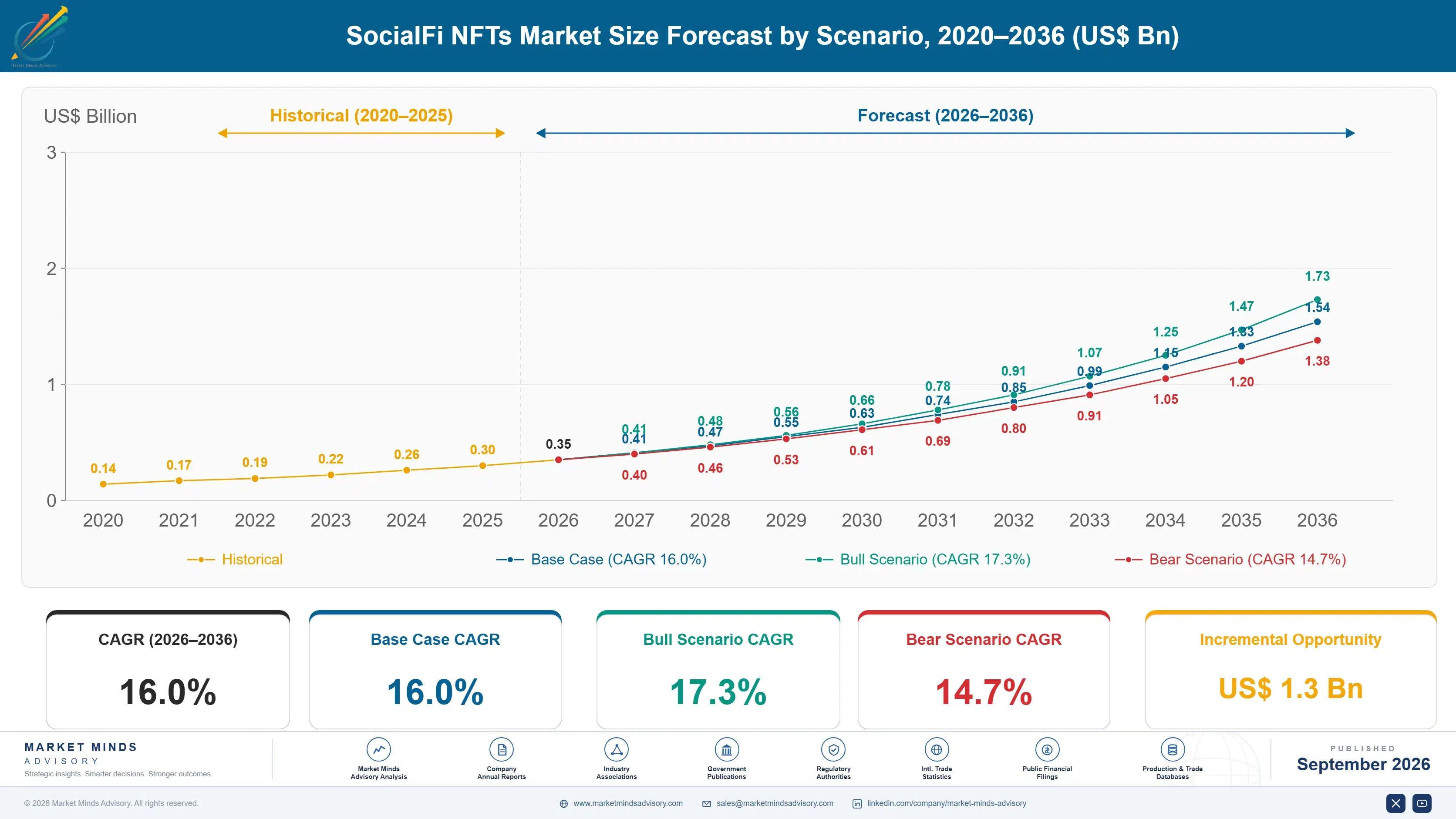
SocialFi NFTs Market Forecast Scenarios

socialfi-nfts-market-size-forecast-scenario-1788454851920
The SocialFi NFT category grew rapidly but unevenly between 2020 and 2025, expanding at roughly 15.0 percent annually as early profile-picture collection speculation gave way to more sustainable creator monetization and fan engagement use cases following several high-profile market corrections. Platform developers invested heavily in retention mechanics during this period as speculative trading volume alone proved insufficient to sustain long-term platform viability.
MMA's base case projects 16.0 percent annual growth through 2036, driven by three reinforcing commercial mechanisms. First, creators increasingly adopt tokenized fan engagement tools as a genuine revenue diversification strategy beyond traditional platform advertising and subscription models. Second, blockchain infrastructure costs continue falling considerably, making tokenization economically viable for smaller creators previously priced out of NFT issuance entirely. Third, regulatory clarity gradually emerging in key jurisdictions reduces platform design uncertainty, encouraging more mainstream creator and brand participation in the category.
A genuine bull catalyst would be a major mainstream social media platform integrating native tokenization features at scale, pulling forward adoption considerably faster than standalone SocialFi platforms could achieve independently. The primary bear risk is continued regulatory crackdowns on token classification in major markets, forcing platforms to restructure or exit jurisdictions entirely rather than navigate uncertain compliance requirements.

Where Speculation Gives Way to Retention

SocialFi NFT platforms have moved decisively away from pure speculative trading toward genuine utility mechanics, as creators and communities increasingly value token-gated access, exclusive content, and governance rights over resale value alone across most active communities. Platform developers increasingly compete on retention design and creator revenue-sharing terms rather than raw minting technology, since blockchain infrastructure differences have narrowed considerably across competing networks and most technical barriers to entry have fallen substantially over recent development cycles.
MARKET CONCENTRATION38% CR5 basisTop five platforms hold a moderately fragmented position
AVERAGE CREATOR PASS PRICE$45 per creator access passPrices vary widely by creator following and utility
TOP PLATFORM CATEGORY SHARE34% creator fan engagement toolsCreator tools drive the largest single revenue segment
SECONDARY TRADING VOLUME DECLINE22% year over yearSpeculative trading volume continues cooling from earlier peaks
RETENTION-BASED REVENUE SHARE41% of total platform revenueRecurring engagement revenue increasingly replaces one-time mint fees
AVERAGE COMMUNITY HOLDER RETENTION6 to 9 months typicalRetention windows lengthen as utility mechanics genuinely mature
Secondary market trading volume continues cooling from earlier speculative peaks, reflecting a genuinely maturing category where sustainable engagement mechanics increasingly matter more than short-term price appreciation among active community members. This shift pressures platforms built primarily around speculative flipping to either pivot toward utility-focused models or face declining user retention considerably faster than utility-first competitors currently experience across comparable community sizes.
Regulatory uncertainty around token classification continues shaping platform architecture decisions, as projects increasingly design token mechanics specifically to avoid securities classification wherever legally possible across major jurisdictions. MMA expects regulatory clarity to remain the single most important variable determining category growth through the remainder of the forecast period, outweighing purely technological differentiation among competing platforms and development teams.
"The floor price used to be the whole conversation. Now nobody asks that first, they ask whether the community is still active six months later."
Senior Analyst, Web3 and Digital Community Platforms Practice · MMA Technology Practice · September 2026

Market Trends

Utility Mechanics Replace Pure Speculative Trading Focus

Platform developers increasingly design token mechanics around tangible community utility, such as token-gated content access, governance voting rights, and exclusive event admission, rather than relying purely on scarcity-driven speculative resale value to attract initial buyers. This shift reflects genuine lessons learned from earlier market cycles where projects built entirely around speculation experienced dramatic engagement collapse once initial trading enthusiasm faded considerably. Platforms increasingly measure success through active holder retention and recurring engagement metrics rather than headline mint volume or secondary market trading statistics, fundamentally changing how creators and platform operators evaluate program success internally.
Market Impact: Creator tokenization adoption rose 32 percent
Creator Revenue-Sharing Models Gain Platform Adoption

Platforms increasingly build revenue-sharing mechanics that route a meaningful percentage of secondary market trading fees directly back to original creators, addressing a longstanding criticism that creators captured none of the ongoing value their community-driven token appreciation generated for platforms and collectors alike. This design choice increasingly determines which platforms attract established creators with substantial existing audiences versus which platforms rely primarily on speculative early adopters lacking genuine community followings. Creators increasingly evaluate platform selection based on documented revenue-sharing terms rather than technical features alone, since ongoing income potential matters more than one-time launch proceeds.
Market Impact: Mid-tier creator adoption grew 27 percent

Market Opportunities and Growth Drivers

Creator Monetization Diversification Drives Tokenization Adoption

Content creators increasingly seek revenue diversification beyond traditional platform advertising and subscription models, which remain vulnerable to sudden algorithm changes and platform policy shifts entirely outside creator control. Tokenized fan engagement tools offer creators a direct, disintermediated revenue channel tied to their own community rather than dependent on a centralized platform's advertising marketplace or subscription infrastructure decisions. This diversification motivation increasingly drives adoption among established creators with substantial existing audiences who previously viewed blockchain-based tools skeptically, since these creators bring genuine community trust that newer, purely speculative projects consistently struggle to establish and maintain over time.
Market Impact: Regulatory review delayed launches 20%

Falling Blockchain Infrastructure Costs Expand Creator Access

Blockchain transaction and deployment costs have fallen considerably as layer-two scaling solutions and more efficient network architectures reduce the technical and financial barriers that once confined tokenization to well-funded projects and established creators with substantial existing resources. This cost reduction directly expands the addressable creator base to include smaller, mid-tier creators previously priced out of NFT issuance entirely, broadening the category beyond its historical concentration among top-tier influencers and celebrity-backed projects. Platform developers increasingly market accessible, low-cost tokenization tools specifically targeting this expanding mid-tier creator segment as a genuine growth opportunity.
Market Impact: Brand partnership timelines extended 18 percent

Market Restraints and Challenges

Regulatory Uncertainty Complicates Token Classification Decisions

Inconsistent regulatory treatment of NFTs and social tokens across major jurisdictions creates genuine uncertainty for platform developers deciding how to structure token mechanics without triggering securities classification and associated compliance obligations. The root cause traces to regulators applying decades-old securities frameworks to fundamentally novel digital asset structures that do not map cleanly onto traditional investment contract definitions established before blockchain technology existed. This uncertainty directly slows platform development timelines, since legal review of token mechanics now represents a considerably larger share of development cost than in earlier, less scrutinized market cycles. Platforms increasingly consult specialized securities counsel before finalizing tokenomics.
Market Impact: Utility-focused token launches rose 34 percent

Speculative Reputation Damage Slows Mainstream Brand Adoption

Widely publicized NFT market crashes and speculative bubble narratives from earlier market cycles continue damaging mainstream brand and consumer perception of the category, making established brands and celebrities considerably more cautious about association with tokenized fan engagement products. The root cause traces to genuine consumer experiences with rapid value collapse during earlier speculative cycles, which created lasting skepticism that utility-focused improvements have not yet fully overcome among mainstream audiences. This reputation damage slows brand partnership deal timelines considerably, forcing platforms to invest heavily in education and trust-building efforts before securing mainstream commercial partnerships.
Market Impact: Creator revenue-sharing adoption grew 28 percent
4 additional market trends, 3 additional growth drivers, and 2 additional restraints and challenges are covered in the full report. Contact sales@marketmindsadvisory.com to access the complete intelligence.

Segment CAGR and Growth Architecture

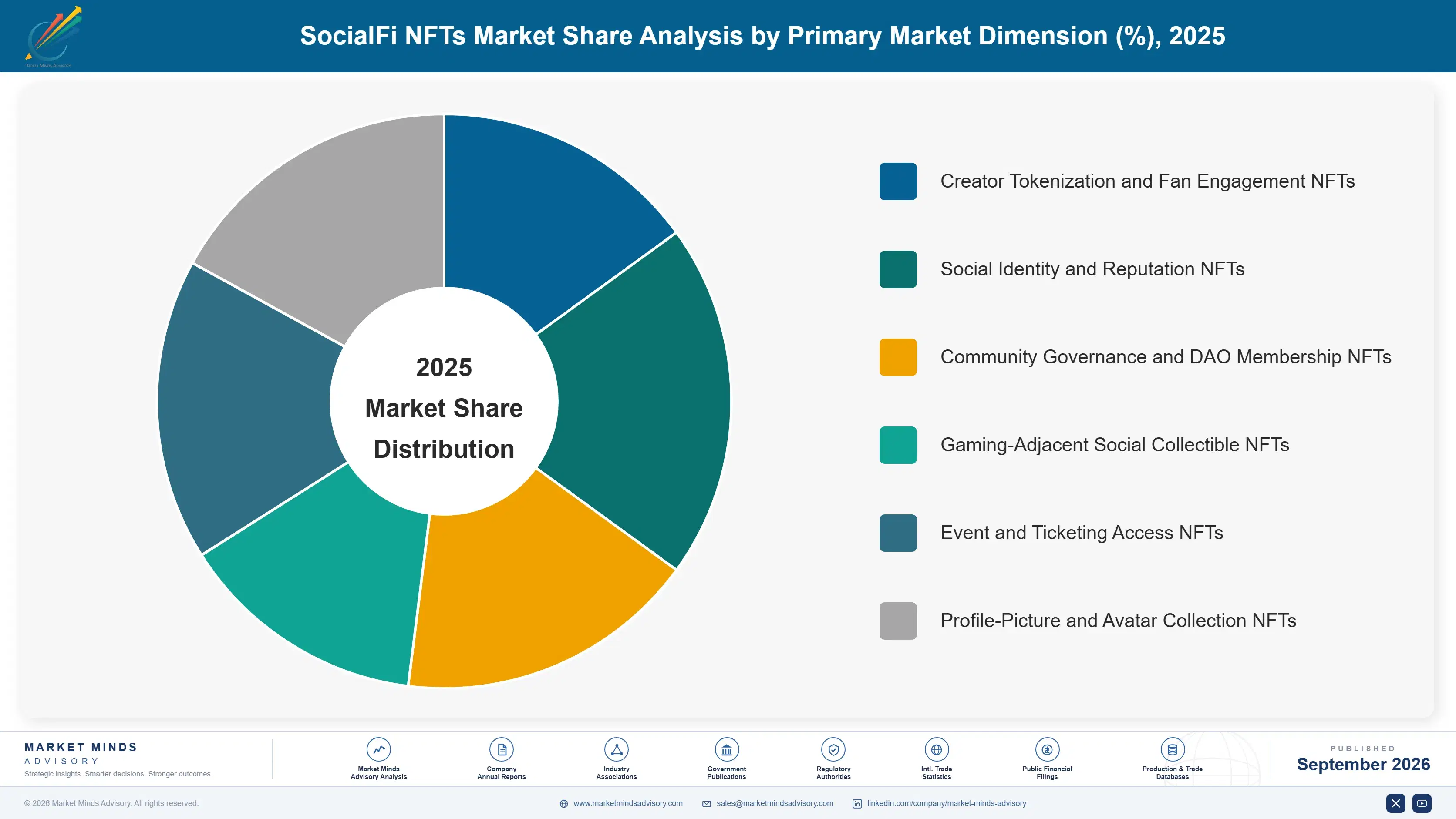
MMA identifies six primary product categories within the SocialFi NFTs market, segmented by underlying social utility function rather than by blockchain network, token standard, or wallet infrastructure used. Creator tokenization and fan engagement NFTs lead category growth given diversifying creator monetization needs, followed by social identity and reputation NFTs benefiting from expanding decentralized social network adoption.
socialfi-nfts-market-market-share-analysis-1788454852451

Creator Tokenization and Fan Engagement NFTs

Creator tokenization and fan engagement NFTs lead category growth by a substantial margin, driven overwhelmingly by musicians, streamers, and social media influencers increasingly seeking revenue diversification beyond traditional platform advertising and subscription models that remain vulnerable to sudden algorithm changes entirely outside their control. Platforms competing here differentiate primarily on documented revenue-sharing terms and retention mechanics rather than raw minting technology alone, since creators increasingly evaluate platform selection based on ongoing income potential rather than one-time launch proceeds. Falling blockchain infrastructure costs continue expanding the addressable creator base to include smaller, mid-tier creators previously priced out of tokenization entirely. MMA estimates this segment will represent well over a quarter of total category revenue by 2036.
CAGR 22.0%

Social Identity and Reputation NFTs

Social identity and reputation NFTs represent the second fastest-growing segment, anchored by expanding decentralized social network adoption where verifiable, portable identity credentials increasingly matter more than platform-specific profile data controlled by centralized intermediaries and gatekeepers across most major applications. Users increasingly value owning their social graph and reputation history independent of any single platform, particularly as concerns about centralized platform policy changes and account suspension risk continue growing among engaged online communities worldwide. Developers competing here differentiate primarily on interoperability across multiple social applications rather than closed, single-platform identity systems that limit portability. This segment carries meaningfully higher user retention than purely speculative collectible categories given its genuine daily utility function.
CAGR 18.0%
Full segment breakdown across 6 segments available in the complete report.

Regional Architecture and Country Demand Map

North America anchors global SocialFi NFT demand given concentrated venture funding and platform development activity, while East Asia builds substantial parallel scale through creator economy adoption and mobile-first user bases, and South Asia Pacific delivers the fastest regional growth of any market covered in this report.

North America

United States venture capital and platform development activity drive the largest share of category revenue, reflecting concentrated blockchain infrastructure investment and the world's most active creator economy sector seeking new monetization channels across nearly every content category, platform type, and audience segment nationwide. friend.tech, Farcaster, and Lens Protocol all maintain primary development operations domestically, giving American platforms disproportionate influence over emerging product design standards and tokenomics conventions. Securities and Exchange Commission regulatory scrutiny increasingly shapes platform architecture decisions for domestic developers pursuing token issuance without triggering securities classification. Canada contributes a smaller but meaningfully growing share through similar creator economy and blockchain development activity nationwide and across its startup sector.
Share: 30% | CAGR: 17.0% (2026 to 2036)

Western Europe

Western Europe's SocialFi NFT demand follows a more cautious regulatory pattern distinct from North America, with the European Union's Markets in Crypto-Assets regulation providing clearer but more restrictive token classification guidance than most other major markets currently offer developers, platform operators, and creators building new products, services, and community tools. Germany and France contribute steady developer talent and venture funding, though domestic platform adoption remains more measured than in less regulated markets. The region's clearer regulatory framework increasingly attracts platforms seeking compliance certainty over regulatory ambiguity elsewhere. The United Kingdom contributes meaningful demand through its substantial fintech and creator economy sectors, which increasingly explore tokenized fan engagement models and formats.
Share: 20% | CAGR: 14.5% (2026 to 2036)
Regional intelligence for 5 additional markets available in the complete report: East Asia, South Asia and Pacific, Latin America, Middle East and Africa, Eastern Europe. Contact sales@marketmindsadvisory.com.
socialfi-nfts-market-country-cagr-analysis-1788454852974

How SocialFi Platforms Monetize Communities

Platforms capturing outsized returns increasingly move beyond one-time mint fees toward creator revenue-sharing bundling, compliance-first tokenomics consulting, cross-platform identity interoperability, and retention mechanics licensing, all of which measurably deepen creator relationships and lift average account value across multi-year platform engagement cycles considerably across creator and community accounts worldwide and across most active global markets.

Bundle Revenue-Sharing Terms into Creator Onboarding

Platforms that offer documented, competitive revenue-sharing terms as a standard onboarding feature typically attract 25 to 35 percent more established creators than platforms competing purely on technical features or launch mechanics alone. Creators increasingly evaluate platform selection based on ongoing income potential rather than one-time launch proceeds, making revenue-sharing terms a genuine differentiator rather than a marginal contractual detail buried in lengthy platform agreements. Platforms offering superior revenue-sharing terms find creator acquisition costs fall meaningfully, since established creators increasingly refer peers once they experience genuinely favorable ongoing income arrangements firsthand.
Market Impact: Favorable revenue-sharing attracts 25 to 35 percent more creators

Offer Compliance-First Tokenomics Design Consulting Services

Platforms that provide specialized legal and tokenomics design consulting helping creators structure token mechanics to avoid securities classification typically command 18 to 28 percent premium pricing over platforms offering purely technical deployment tools. Creators and brands increasingly lack deep internal expertise in securities law as applied to novel digital asset structures, making this consulting capability a genuine differentiator rather than a marginal service offered after launch. Platforms building this compliance capability internally gain a durable advantage over competitors treating regulatory risk purely as the creator's independent legal responsibility to manage.
Market Impact: Compliance consulting commands 18 to 28 percent premium pricing

Expand into Cross-Platform Identity Interoperability Tools

Platforms that build genuine cross-platform identity and reputation portability typically add 15 to 22 percent incremental user retention by capturing engagement across multiple social applications rather than confining users to a single closed platform or walled garden. This expansion strategy applies established trust and technical infrastructure rather than requiring costly new user acquisition, since existing users already understand the platform's identity and reputation model. Platforms pursuing this strategy retain users longer, since portable identity investments raise the switching cost of migrating away from the underlying identity infrastructure entirely and permanently.
Market Impact: Identity interoperability adds 15 to 22 percent retention

License Retention Mechanics to Emerging Platforms

Leading platforms that develop proprietary retention and engagement mechanics can license this technology to smaller emerging platforms lacking equivalent product development capability, typically generating 8 to 15 percent incremental revenue without directly cannibalizing core platform user acquisition or existing subscription revenue. This licensing approach monetizes product development investment that would otherwise benefit only the originating platform's own user base, extracting additional value from accumulated retention design expertise across a broader network of platforms. Leading platforms increasingly treat mechanics licensing as a distinct commercial revenue stream separate from core platform operations.
Market Impact: Mechanics licensing adds 8 to 15 percent revenue

Who Controls the Margin Pool

Concentration in SocialFi NFTs remains moderate, with the top five participants controlling an estimated 38 percent of category revenue on a revenue basis. friend.tech holds a notable early leadership position given its rapid user growth and social token mechanics, while Farcaster commands strong positions through its decentralized social protocol and growing developer community. Lens Protocol and Rally compete from strong positions in specific niches. The gap between early breakout platforms and newer entrants has widened as retention mechanics determine positioning.
Current competitive activity centers on retention mechanics and creator revenue-sharing terms, with platforms racing to secure established creators with substantial existing audiences rather than competing on speculative early adopter volume alone. Partnership announcements between SocialFi platforms and mainstream creator management agencies have become increasingly common, replacing the purely transactional token launch relationships common in earlier market cycles. Pricing competition remains intense within commodity collectible segments.

Emerging pressure comes from mainstream social media platforms exploring native tokenization features, threatening the addressable market for standalone SocialFi specialists lacking comparable existing user bases. Rankings could shift if regulatory clarity emerges faster than expected in major markets, a scenario several compliance-focused platforms are positioning aggressively to capture.
socialfi-nfts-market-company-positioning-matrix-1788454853497

Competitive Moat and Risk Dimensions

FRIEND.TECH

Moat: Early Network Effect Advantage

friend.tech captured meaningful early user growth momentum that created genuine network effects, since social token value depends heavily on the size and engagement of the underlying community rather than technical features alone. This early mover advantage compounds as existing users' social graphs make joining competing platforms considerably less attractive without comparable network density.
FRIEND.TECH

Risk: Speculative Reputation Overhang

friend.tech's early growth relied heavily on speculative trading dynamics that later proved unsustainable, leaving the platform associated with boom-bust volatility that continues complicating efforts to attract risk-averse mainstream creators and brands seeking more stable, utility-focused platform associations for their long-term community engagement strategies and campaigns.
FARCASTER

Moat: Decentralized Protocol Developer Community

Farcaster benefits from a growing developer community building applications atop its decentralized social protocol, creating genuine platform lock-in as developers invest engineering resources into Farcaster-specific integrations that would require considerable rework to migrate toward competing protocols entirely, discouraging switching among active application builders and teams.
FARCASTER

Risk: Limited Mainstream User Awareness

Farcaster's user base remains considerably more concentrated among crypto-native early adopters than mainstream social media users, limiting its addressable market until the platform develops considerably more accessible onboarding experiences that do not require existing cryptocurrency wallet familiarity, technical understanding, or prior blockchain experience of any kind.

Players Tracked

Prominent Players

friend.tech
Farcaster
Lens Protocol
Rally
Chiliz

Other Key Players

OpenSea
Rarible
Foundation
SuperRare
Zora
Manifold
Sound.xyz
Highlight
Coinbase
Polygon Labs
Solana Foundation
Yat Labs
Party DAO
Mirror.xyz
POAP

Recent Developments

OCTOBER 2025

friend.tech launched an updated revenue-sharing model in October 2025 routing a larger percentage of secondary trading fees directly to key holders and original creators, addressing longstanding community criticism about value capture imbalances that had previously favored the platform over individual creators and their supporters across the platform.
Signal: Signals platforms increasingly responding to creator demands for improved revenue-sharing terms overall and consistently across the sector
JANUARY 2026

Farcaster secured a new venture funding round in January 2026 specifically earmarked for developer community grants, aiming to accelerate third-party application development atop its decentralized social protocol and strengthen its competitive position against centralized SocialFi alternatives currently dominating mainstream user attention, engagement metrics, and daily active usage.
Signal: Signals platforms increasingly investing in developer community growth to build durable network effects broadly and deliberately
APRIL 2026

Lens Protocol announced a compliance-focused tokenomics redesign in April 2026 specifically structured to avoid securities classification under evolving regulatory guidance in key markets, positioning the platform favorably ahead of anticipated regulatory clarity affecting the broader category over the coming years, development cycles, and product roadmap milestones.
Signal: Signals platforms increasingly and proactively redesigning tokenomics to reduce regulatory classification risk further and quite meaningfully

Blockchain Gas Fees and Audit Costs

Blockchain transaction gas fees and smart contract security audit costs represent the largest cost inputs for SocialFi platform operators, typically comprising 20 to 30 percent of platform operating cost depending on underlying blockchain network and transaction volume. Ethereum mainnet gas fees fluctuate considerably based on network congestion, creating meaningful cost unpredictability for platforms unable to migrate transaction volume to lower-cost layer-two scaling solutions.
Ethereum network gas fee volatility during periods of high network congestion in 2024 and 2025 pushed transaction costs meaningfully higher for platforms still operating primarily on mainnet infrastructure rather than migrated layer-two solutions, according to publicly disclosed network analytics. Platforms without layer-two migration strategies faced meaningfully higher per-transaction costs during peak congestion periods, compressing margins for smaller platforms lacking the technical resources to implement scaling solutions quickly.

Smaller SocialFi platforms lacking dedicated blockchain infrastructure engineering resources pay meaningfully higher effective transaction costs than scale leaders like friend.tech and Farcaster, which have invested in layer-two migration and gas optimization techniques unavailable to smaller competitors. This cost disadvantage compounds for platforms serving high-frequency social interactions, since transaction volume per user considerably exceeds that of simple one-time NFT minting applications.
socialfi-nfts-market-cost-volatility-analysis-1788454853691

Layer-Two Migration Reduces Gas Fee Exposure

Platforms increasingly migrate transaction processing to layer-two scaling solutions that settle periodically to Ethereum mainnet rather than processing every social interaction directly on the base layer, reducing per-transaction costs considerably. This approach requires meaningful engineering investment to implement securely, but reduces exposure to mainnet gas fee volatility that smaller, less technically resourced platforms continue to experience directly.

Batch Transaction Processing Lowers Per-Interaction Costs

Some platforms now batch multiple user social interactions into single blockchain transactions rather than processing each interaction individually, spreading fixed transaction costs across many actions and meaningfully reducing effective per-interaction expense. This approach requires meaningful architecture redesign, but reduces exposure to per-transaction gas costs that previously made frequent social interactions economically impractical at scale.

Portfolio Architecture for Margin Defence

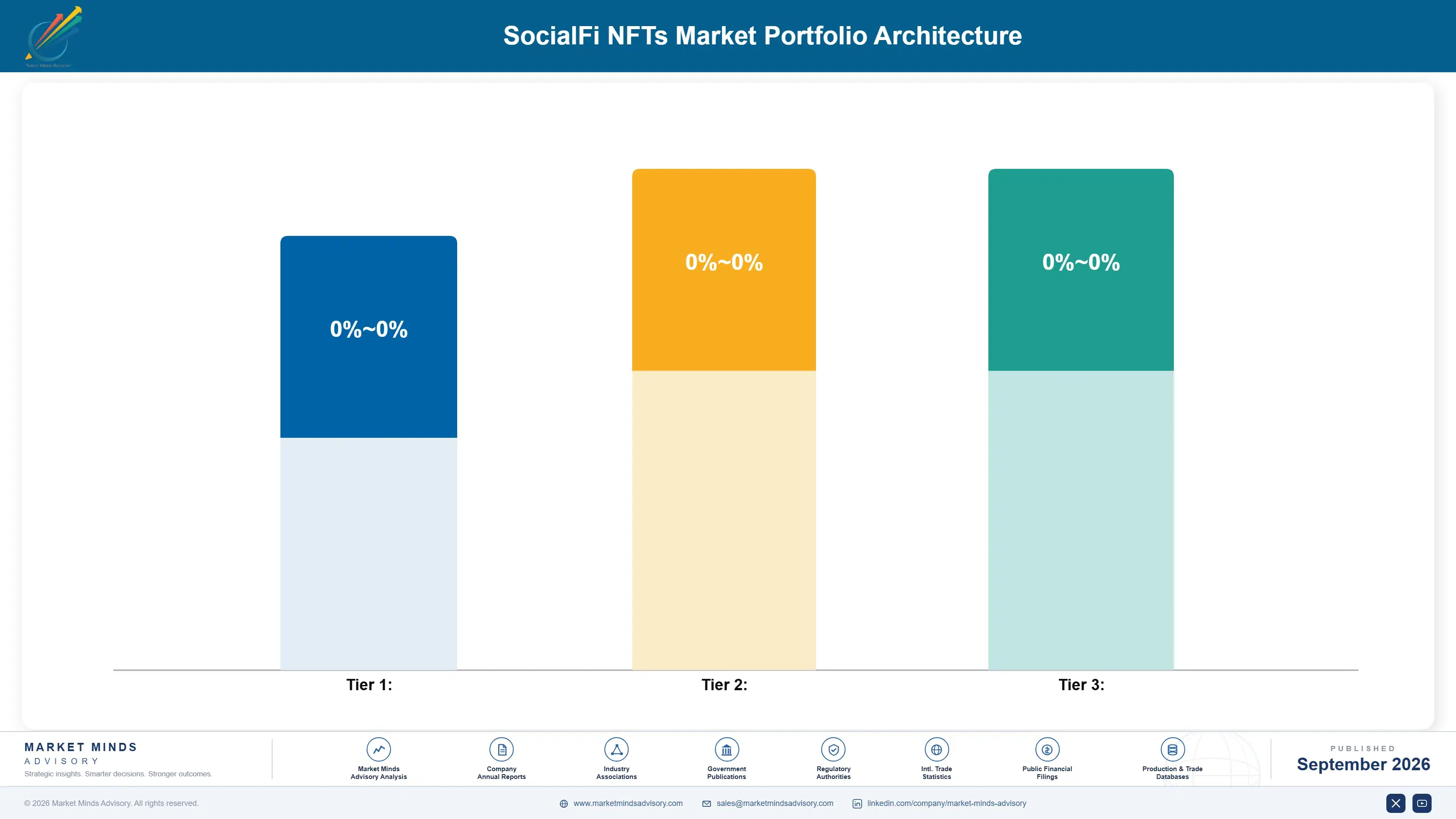
SocialFi NFT platforms organize commercial strategy around three tiers separated by utility depth and margin profile rather than by blockchain network alone. Volume tier products, largely profile-picture and avatar collections, carry gross margins in the 15 to 25 percent range typical of mature, highly speculative and increasingly commoditized offerings. Premium certified tier offerings, built around creator tokenization and verified social identity products, command materially higher margins given utility differentiation and multi-year creator relationships that discourage platform migration.
Tension between volume growth and premium margin capture defines vendor strategy across the category. Pursuing broad collectible volume dilutes average transaction value and invites aggressive price competition from low-effort copycat projects, while premium creator tokenization and identity focus limits addressable customer count but sustains materially healthier unit economics and deeper creator relationship retention over multi-year platform engagement cycles.

High-value revenue pools concentrate overwhelmingly in creator tokenization and social identity products, where utility differentiation and community trust create durable barriers smaller volume-tier competitors cannot easily cross. Platforms positioned in these premium pools increasingly command creator retention rates exceeding 70 percent, reflecting genuine relationship switching cost depth rather than simple customer inertia.

Profile-picture and avatar collectible NFTs sold at competitive price points across increasingly commoditized speculative categories, with gross margins around 15 to 25 percent reflecting declining novelty value and intense competition from numerous copycat projects entering the category.
Gross Margin

Creator tokenization and verified social identity products serving established creators and users requiring genuine utility and ongoing revenue-sharing, commanding gross margins around 35 to 45 percent given differentiation and multi-year platform relationships.
Gross Margin

Next-generation cross-platform identity and AI-personalized community engagement tokens purpose-built for emerging decentralized social applications, currently commanding premium pricing while broader interoperability standards and mainstream adoption remain in early, evolving stages.
Gross Margin
socialfi-nfts-market-portfolio-architecture-1788454854190

High-value Sub-segments and Strategic Watch-out

Creator Tokenization and Fan Engagement NFTs

Creator tokenization and fan engagement NFTs combine the fastest segment growth rate in the category with premium certified-tier margins, making it the single most attractive investment target for platforms and investors alike. MMA expects this segment's revenue share to expand meaningfully faster than any other through 2036, driven by diversification.

Social Identity and Reputation NFTs

Social identity and reputation NFTs deliver strong premium-tier margins with moderately slower growth than creator tokenization, anchored by expanding decentralized social network adoption and genuine daily utility. Platforms serving this segment benefit from multi-year user retention and high switching costs once portable identity investments are established.

Gaming-Adjacent Social Collectible NFTs

Gaming-adjacent social collectible NFTs remain a substantial revenue base by transaction count, though margins run considerably lower than premium segments given intense competition and established vendor substitutability across commodity collectible categories. This segment anchors overall category volume even as its share of total revenue gradually declines over time.

Profile-Picture and Avatar Collection NFTs

Profile-picture and avatar collection NFTs have grown well below overall category average as speculative interest continues cooling from earlier market peaks and novelty value diminishes across increasingly saturated collectible categories. Platforms concentrated here risk share erosion unless they diversify into adjacent, utility-focused application categories entirely.

Why Creator Platform Loyalty Endures

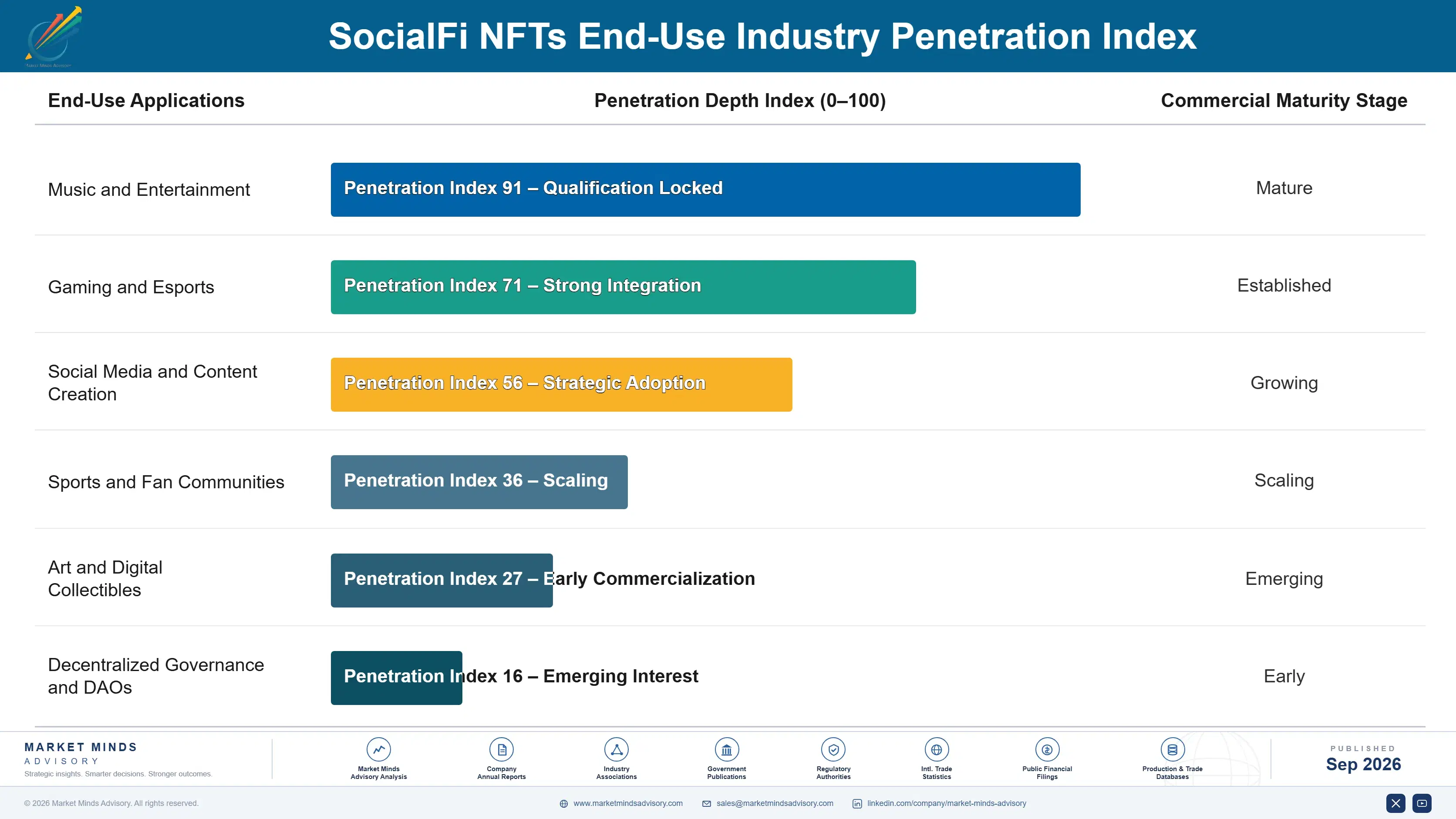
SocialFi platform relationships increasingly behave like annuity businesses rather than one-time token launches, since creators who build substantial communities around a specific platform rarely migrate mid-program given the extensive audience rebuilding work involved in switching to a competing platform entirely. Retention rates for established creator communities now regularly exceed 70 percent across multi-year platform relationships, reflecting genuine audience dependency rather than simple contractual inertia.
Stickiness varies considerably by end-use vertical. Established creators with substantial existing audiences embed their entire community relationship deeply into a specific platform's token and engagement infrastructure, making migration costly and operationally risky once fan communities depend on a specific platform's exact token mechanics and distribution channels. Speculative collectors show shallower stickiness, since profile-picture collections allow more straightforward switching between platforms offering comparable trading opportunities.

Buyer profiles are shifting as participation moves from purely speculative traders toward genuine community members who value ongoing engagement and utility over resale value alone. Younger creators increasingly expect tokenized fan engagement tools as a baseline monetization option rather than a novel experiment, accelerating the industry's shift toward utility-focused rather than purely speculative platform design and community building strategies.
socialfi-nfts-market-end-use-penetration-index-1788454854668

Where SocialFi Investment Pays Off

These are among the four positions where our research anticipates prominent divergence between winners and laggards over the coming forecast period. Each is grounded in the demand model, the regulatory perimeter, and the announced capacity pipeline.
01 / CREATOR RETENTION STRATEGY

Prioritize creator revenue-sharing terms over speculative launch mechanics

Established creators with substantial existing audiences bring genuine community trust and immediate engagement that purely speculative early adopter growth cannot replicate, making creator revenue-sharing terms the single most important competitive lever available to platforms today. Platforms competing purely on launch mechanics or speculative token appreciation risk attracting only short-term traders lacking genuine community investment, undermining long-term retention metrics that increasingly determine platform valuation and investor confidence. MMA recommends prioritizing creator revenue-sharing terms over speculative launch mechanics in all product design decisions.
02 / COMPLIANCE-FIRST PLATFORM DESIGN

Build compliance-first tokenomics before regulatory clarity fully emerges

Regulatory uncertainty around token classification already forces some platforms to restructure or exit key markets entirely, and platforms building compliance-first tokenomics now avoid the costly retroactive redesign that reactive competitors will eventually face as enforcement actions accelerate. Building this compliance capability proactively costs considerably less than reactive restructuring under regulatory pressure, since proactive design avoids the sunk cost of previously deployed token mechanics requiring complete replacement. MMA recommends investing in compliance-first tokenomics design now rather than waiting for regulatory clarity to fully emerge.
03 / IDENTITY INTEROPERABILITY INVESTMENT

Invest in cross-platform identity portability ahead of mainstream adoption

Cross-platform identity portability increasingly determines user retention as concerns about centralized platform policy changes and account suspension risk continue growing among engaged online communities across the broader digital landscape and social media environment. Platforms that build genuine interoperability capture disproportionate user loyalty compared to closed, single-platform identity systems that limit portability and increase user vulnerability to unilateral platform decisions beyond their control. MMA recommends investing in cross-platform identity infrastructure now, well ahead of anticipated mainstream adoption of decentralized social networking standards.
04 / GAS FEE COST MANAGEMENT

Migrate to layer-two infrastructure to protect transaction margins

Blockchain gas fee volatility has repeatedly compressed platform margins during periods of network congestion, and platforms lacking layer-two migration strategies consistently report weaker unit economics than better-positioned competitors during these recurring episodes across the broader technology industry landscape and marketplace. Building layer-two infrastructure retroactively under cost pressure costs considerably more than proactive migration pursued well ahead of confirmed congestion spikes across major blockchain networks and platforms. MMA recommends migrating to layer-two infrastructure now, before the next congestion cycle begins in earnest.

Engagement Snapshot From the Field

A live engagement with an industry participant carrying material or product regulatory and market exposure ahead of a defining policy shift, showing how our research translates into a defensible multi-year portfolio strategy.
MARKET MINDS ADVISORY · CLIENT ENGAGEMENT SUMMARY
SocialFi NFTs Producer Strategic Portfolio Review and Transition Roadmap 2026·Investment Scenario on SocialFi NFTs Exposure Evaluation 2025-26
CLIENT PROFILE
The client is an independent artist management agency representing a roster of mid-tier musicians and content creators seeking new revenue diversification channels beyond traditional streaming royalties and brand sponsorship deals nationwide. Facing pressure from artists frustrated with declining streaming payouts, leadership sought an independent SocialFi platform evaluation before recommending tokenization strategies to its represented artists.
STRATEGIC CHALLENGE
The agency's artists had received conflicting pitches from multiple SocialFi platforms promising favorable revenue-sharing terms, but lacked the internal technical expertise to evaluate which platforms offered genuinely competitive and sustainable tokenomics structures. Leadership needed to evaluate whether recommending platform adoption to its artist roster carried acceptable regulatory and reputational risk.
MMA APPROACH
MMA conducted a structured platform evaluation combining expert interviews with the agency's artist relations and business development leadership, competitive benchmarking across six leading SocialFi platforms, and analysis of documented revenue outcomes from peer artists that had already launched tokenized fan engagement programs. The engagement produced a phased platform recommendation framework prioritizing revenue-sharing terms and compliance posture.
KEY FINDINGS
  1. Peer artists using platforms with favorable revenue-sharing terms reported supplemental income increasing by approximately 30 percent (client-reported, unverified by MMA), primarily through recurring secondary market trading fee distributions.
  2. Vendor tokenomics structures varied considerably, with some platforms structuring tokens in ways that raised meaningful securities classification concerns under current regulatory guidance in key markets.
  3. Artists reported that platforms with genuine utility mechanics, such as exclusive content access, retained fan engagement considerably longer than platforms relying primarily on speculative collectible value alone.
  4. Integration with the agency's existing royalty and payment tracking systems proved more technically complex than most platforms initially represented during sales evaluation, requiring additional accounting support.
CLIENT PROFILE
The client is an independent artist management agency representing a roster of mid-tier musicians and content creators seeking new revenue diversification channels beyond traditional streaming royalties and brand sponsorship deals nationwide. Facing pressure from artists frustrated with declining streaming payouts, leadership sought an independent SocialFi platform evaluation before recommending tokenization strategies to its represented artists.
STRATEGIC CHALLENGE
The agency's artists had received conflicting pitches from multiple SocialFi platforms promising favorable revenue-sharing terms, but lacked the internal technical expertise to evaluate which platforms offered genuinely competitive and sustainable tokenomics structures. Leadership needed to evaluate whether recommending platform adoption to its artist roster carried acceptable regulatory and reputational risk.
MMA APPROACH
MMA conducted a structured platform evaluation combining expert interviews with the agency's artist relations and business development leadership, competitive benchmarking across six leading SocialFi platforms, and analysis of documented revenue outcomes from peer artists that had already launched tokenized fan engagement programs. The engagement produced a phased platform recommendation framework prioritizing revenue-sharing terms and compliance posture.
KEY FINDINGS
  1. Peer artists using platforms with favorable revenue-sharing terms reported supplemental income increasing by approximately 30 percent (client-reported, unverified by MMA), primarily through recurring secondary market trading fee distributions.
  2. Vendor tokenomics structures varied considerably, with some platforms structuring tokens in ways that raised meaningful securities classification concerns under current regulatory guidance in key markets.
  3. Artists reported that platforms with genuine utility mechanics, such as exclusive content access, retained fan engagement considerably longer than platforms relying primarily on speculative collectible value alone.
  4. Integration with the agency's existing royalty and payment tracking systems proved more technically complex than most platforms initially represented during sales evaluation, requiring additional accounting support.
RECOMMENDED STRATEGY
Phase 1: Pilot tokenized fan engagement programs with two established artists first, measuring documented supplemental income and fan retention over one full release cycle. Phase 2: Expand platform adoption across additional roster artists following successful pilot validation, prioritizing platforms with documented favorable revenue-sharing terms and compliance posture. Phase 3: Integrate tokenized revenue tracking directly into the agency's existing royalty and accounting systems, creating a permanent institutional capability for artist financial reporting.
OUTCOME
(Client-reported, unverified by MMA) The pilot program generated an estimated 22 percent supplemental income increase for participating artists within the first release cycle while maintaining strong fan engagement metrics compared to traditional promotional channels alone. Leadership subsequently approved expanded platform recommendations across additional roster artists beginning the following release cycle.

Frequently Asked Questions

Foundational context covering the market sizes, CAGR, scope, country, region and competition that inform every finding below. This section is provided to cover basics and most often pre-purchase conversations, answered from the MMA Primary Research Dataset.

What is the current size of the SocialFi NFTs Market?

The SocialFi NFTs Market reached an estimated $0.32 billion in 2025, reflecting a decisive shift from speculative collectibles toward creator monetization and fan engagement utility.

How large will the SocialFi NFTs Market be by 2036?

MMA projects the market will reach approximately $1.64 billion by 2036, driven by expanding creator tokenization adoption and continued blockchain infrastructure cost reductions across major markets worldwide.

What is the CAGR for the SocialFi NFTs Market 2026 to 2036?

The market is expected to grow at a compound annual growth rate of 16.0 percent between 2026 and 2036, reflecting sustained creator monetization demand across most platforms.

Which segment is growing fastest?

Creator tokenization and fan engagement NFTs are the fastest-growing segment, expanding at approximately 22.0 percent annually, roughly 1.38 times the overall market growth rate given diversification.

Who are the major companies in the SocialFi NFTs Market?

Leading participants include friend.tech, Farcaster, Lens Protocol, Rally, and Chiliz, together holding an estimated 38 percent of category revenue on a consistent revenue basis overall.

Which country is growing fastest?

Vietnam shows the fastest national growth trajectory at approximately 19.0 percent annually, driven by exceptionally high grassroots cryptocurrency and NFT adoption rates nationwide and consistently.

Report Segmentation Architecture

The full report scope spans multiple orthogonal segmentation dimensions, with cross-tabulated demand data provided for each dimension pair. Coverage extends further to regional breakdowns, trend trajectories, and the competitive detail needed to support segment-level decision-making.

By Primary Market Dimension

  • Creator Tokenization and Fan Engagement NFTs
  • Social Identity and Reputation NFTs
  • Community Governance and DAO Membership NFTs
  • Gaming-Adjacent Social Collectible NFTs
  • Event and Ticketing Access NFTs
  • Profile-Picture and Avatar Collection NFTs

By End-Use Industry

  • Music and Entertainment
  • Gaming and Esports
  • Social Media and Content Creation
  • Sports and Fan Communities
  • Art and Digital Collectibles
  • Decentralized Governance and DAOs

By Commercial Dimension

  • Creator Direct Monetization
  • Platform Transaction Fee Revenue
  • Brand and Sponsorship Partnerships
  • Secondary Marketplace Royalties

By Region

  • North America
  • Western Europe
  • East Asia
  • South Asia and Pacific
  • Latin America
  • Middle East and Africa
  • Eastern Europe

Scope, Methodology, and Coverage

Every figure in this report is reproducible from documented input assumptions. The scope below maps the historical period, the forecast horizon, the segmentation dimensions, and the countries covered, alongside the underlying primary and qualitative methodology.
Historical Period
2020 to 2025
Forecast Period
2026 to 2036
Base Year
2025 (USD billions; MMA Primary Research Dataset, September 2026)
Market Definition
The SocialFi NFTs Market covers non-fungible tokens and associated platform infrastructure that combine social networking functionality with blockchain-based ownership, including creator access passes, tokenized fan communities, and social identity collectibles, measured by primary and secondary transaction revenue. It excludes purely financial DeFi protocols without social functionality, gaming-only NFTs unrelated to social community features, and traditional social media platforms without blockchain-based token issuance.
Quantitative Units
USD billions, market share percentage, CAGR percentage
Segmentation Dimensions
By Primary Market Dimension, By End-Use Industry, By Commercial Dimension, By Region
Regions Covered
North America, Western Europe, East Asia, South Asia and Pacific, Latin America, Middle East and Africa, Eastern Europe
Countries Covered
United States, Canada, China, Japan, South Korea, Germany, France, United Kingdom, Vietnam, Philippines, India, Australia, Brazil, Mexico, United Arab Emirates, Saudi Arabia, South Africa, Poland
Key Companies Profiled
friend.tech, Farcaster, Lens Protocol, Rally, Chiliz, OpenSea, Rarible, Foundation, SuperRare, Zora, Manifold, Sound.xyz, Highlight, Coinbase, Polygon Labs, Solana Foundation, Yat Labs, Party DAO, Mirror.xyz, POAP
Quantitative Methodology
Primary survey, n=3,800 respondents, Q4 2025, six countries; demand-side model with trade association cross-validation
Qualitative Methodology
47 expert interviews, Q4 2025; applied to validate demand model assumptions, identify emerging dynamics, and assess competitive positioning
Report Format
PDF and XLSX data workbook (Word format preview document)
Publisher
Market Minds Advisory
Report Code
MMA-2026-TEC-649
Published
September 2026
Contact
sales@marketmindsadvisory.com | www.marketmindsadvisory.com

Purchase the full SocialFi NFTs Market Report (2026 to 2036).

The full report provides comprehensive market sizing, ten-year forecasts, competitive benchmarking, and regional analysis for SocialFi NFT demand across creator, identity, and community applications, drawing on primary survey data and expert interviews across major crypto and creator economy markets. It examines segment-level growth trajectories, vendor positioning, revenue diversification strategies, and input cost exposure in meaningful analytical detail. Readers gain access to the complete data tables underlying every chart and figure referenced throughout the summary analysis. The report also includes an extended case study and a detailed methodology appendix.
Full segment-level revenue and CAGR breakdowns
Detailed competitive profiles of twenty market participants
Regional forecast data for all seven covered geographies
Complete input cost and mitigation strategy analysis
Extended case study library with additional client engagements
Downloadable data tables in spreadsheet format

Built For The People Who Decide

From boardroom strategy to bench-side execution, this report is read cover-to-cover by leaders shaping the next decade of their industry, turning demand scenarios, market dynamics and valuation benchmarks into decisions.
CXOs/ Presidents/ VPs/ Managers
M&A and Corporate Development
Strategy Teams and R&D Heads
Procurement and Product Directors
Regulatory and Compliance Leaders
Investor Relations and Equity Analysts