Market Minds Advisory
Snow Boots For Women Market

Snow Boots For Women Market: Snow Boots For Women Market: Unregulated Cold Ratings, Traction Economics and the Fit Problem Nobody Solves

The temperature ratings printed on these boots rest on no recognised test method whatsoever, while the outsole compound that actually prevents winter falls appears on barely a seventh of models sold globally.

Lead Analyst

Published

September 2026

Make Smarter Decisions with Customized Research Insights

Request a free sample report and evaluate market opportunities, growth trends, and competitive dynamics relevant to your business needs.

2025 MARKET VALUE$4.2BMarket Size 2025
2036 FORECAST VALUE$7.4BBase Case , 2026 to 2036
CAGR 2026 TO 20365.4 %Bull 6.6% / Bear 4.2%
INCREMENTAL OPPORTUNITY$3.0BNet 10- year value creation
EXPANSION MULTIPLE1.68x2036 value over 2026 base
Strategic Levers
M&A Pipeline
Regional Outlook
Country Rankings
Competitive Intelligence
Segmental Deep-dive
Call-Us : 91 93563 13602

Executive Snapshot and Market Trajectory.

A cold rating on a women's snow boot means nothing verifiable. Sleeping bags carry EN 13537 and ski helmets carry EN 1077, but no standard governs the minus twenty-five printed on a boot box. Buyers read it as though someone tested it. Nobody did, and the method is never published.
Lace-up technical boots grow at 8.1%, half again the market rate of 5.4%, because winter hiking and cold-weather commuting have converged on the same construction: membrane lining, lugged outsole, adjustable fit through the instep. Heeled and wedge winter boots follow at 6.9%. Shearling-lined suede grows slowest at 3.6%, held back by hide cost and by an insulation story that fails in slush.
Traction is the safety issue and it is priced as a feature rather than treated as one. Outsole rubber that stays flexible below freezing appears on roughly 14% of models, and the rest harden into something closer to plastic on ice. Fit is the other unforced error: most women's lasts are still scaled from men's patterns, which drives online return rates near 31%. Neither problem is expensive to fix, and neither is expensive to solve.
Market Definition
This market covers women's footwear constructed and marketed for cold, wet or snow-covered conditions, spanning moulded rubber-bottom boots, pull-on insulated shaft boots, lace-up technical boots, shearling-lined suede, heeled and wedge winter styles and insulated ankle boots. Sizing is at wholesale value across all distribution channels. Men's and children's winter footwear, ski and snowboard boots, mountaineering boots, rain boots without insulation, and aftermarket traction devices are excluded.
Base Year Value
$4.2B in 2025 (MMA Primary Research Dataset, September 2026)
Forecast Period
2026 to 2036, eleven discrete annual values
CAGR
5.4% base case. Bull 6.6%. Bear 4.2%.
Fastest Growth Segment
Lace-Up Technical Boots: 8.1% CAGR
Fastest Growth Country
China: 7.9% CAGR
Fastest Growth Region
South Asia and Pacific: 7.2% CAGR
Largest Region
East Asia: 29% of 2025 global value
Market Leaders
Deckers Outdoor Corporation, Columbia Sportswear, VF Corporation, Wolverine World Wide, Anta Sports. Source: MMA Primary Research Dataset, July 2026.
Primary Survey
n=3,800 procurement and R&D decision-makers, Q4 2025, six countries
Methodology
Demand-side build-up, cross-validated against public data, 47 expert interviews

Snow Boots For Women Market Forecast Scenarios

snow-boots-for-women-market-size-forecast-scenario-1790021446581
Growth of 4.3% between 2020 and 2025 hides two opposing movements that largely cancelled. Pandemic outdoor recreation pulled technical winter footwear sharply upward through 2021 and 2022, while shearling and fashion-led styles fell as office attendance collapsed and city dressing lost its occasion. The two recovered on opposite schedules. Warm winters across Western Europe in 2023 and 2024 suppressed replacement demand independently of either trend.
Three mechanisms carry the base case forward. Winter hiking and cold-weather commuting continue converging on one construction, which sustains the lace-up technical segment at 8.1% and pulls average selling prices upward. Chinese northern-city demand keeps expanding as domestic brands close the technical performance gap at roughly half the imported price, and China grows at 7.9%. Replacement cycles of about 4.6 years return the pandemic purchase cohort to market across 2026 and 2027 regardless of weather.
The bull case is a traction standard. If any recognised body publishes a winter slip-resistance test that retailers adopt, the 14% of models carrying cold-flexible compounds gains a defensible claim and pricing moves with it. The bear case is warmth itself. Consecutive mild winters suppress replacement more effectively than any recession, and nothing compensates for a season that never arrives.

Warmth Claims Without Warmth Testing

Two claims sell this product and neither is verified by anyone. The temperature rating is the first: sleeping bags have EN 13537 and ski helmets have EN 1077, but a boot marked for minus twenty-five degrees has been through no test that any standards body recognises. Manufacturers set those numbers internally using methods they do not publish and are not asked to.
TOP FIVE CONCENTRATION33%Combined unit share held by the five largest participants
ONLINE RETURN RATE31%Units returned from direct and marketplace channels after purchase
AVERAGE SELLING PRICEUSD 118Weighted global wholesale price across all construction types
RATING STANDARDS RECOGNISED0No recognised test method underlies any printed cold rating
TRACTION COMPOUND SHARE14%Share of models specifying a cold-flexible outsole rubber compound
REPLACEMENT CYCLE LENGTH4.6 yearsAverage interval before buyers replace a winter boot pair
The second is waterproofing, where the failure mode is specific and repeatable. A membrane bootie inside a boot performs well until the seam where it meets the outsole flexes a few thousand times, which happens within one season of daily wear. Buyers experience this as the boot leaking, and they blame the membrane rather than the construction. Return and complaint data across the category cluster tightly around month five.
Traction is the claim nobody makes because so few models can support it. Ordinary outsole rubber stiffens sharply below freezing and behaves like hard plastic on ice, while compounds engineered to stay flexible appear on roughly 14% of models. Winter falls send a great many people to emergency departments each year, and this is the product standing between them.
"This category prints a temperature on the box that nobody tested and leaves off the outsole compound that actually stops people falling over. Whoever reverses that order first will find the market considerably more receptive than the current marketing suggests."
Director, Consumer Durables and Footwear Practice · MMA Consumer and Industrial Goods Practice · September 2026

Market Trends

Winter Hiking And City Commuting Converge On One Construction

The boot a woman wears to walk a frozen trail and the boot she wears for a slushy commute have become the same object over the past five years: membrane lining, lugged outsole, lace or speed-hook adjustment through the instep. That convergence is why lace-up technical construction grows at 8.1% while the category averages 5.4%. It also raises average selling prices, since technical construction carries genuine material and assembly cost that pull-on styles avoid. Brands built entirely on shearling or moulded rubber are watching their occasions migrate to a construction they do not make.
Market Impact: China grows 2.5 points above base
Cold Flexible Outsole Compounds Move Downmarket Slowly

Rubber compounds formulated to stay pliable below freezing, along with glass-fibre and mineral-embedded outsole technologies, deliver measurably better ice traction than standard compounds. They currently appear on around 14% of models, concentrated above USD 180 at retail. The compounds themselves add perhaps four to six dollars to a bill of materials, so the barrier is not cost but the absence of any recognised claim a marketing team can print. Brands are testing to their own internal protocols and describing results in language deliberately vague enough to avoid liability, which limits how far the feature travels.
Market Impact: Returns 2 purchase cohorts by 2027

Market Opportunities and Growth Drivers

Northern Chinese Urban Demand Expands On Domestic Brands

Winter footwear demand across Harbin, Shenyang, Changchun and the northern tier has grown steadily as disposable income rose and as the Beijing 2022 winter games pushed cold-weather activity into mainstream leisure. Anta, Li-Ning and Xtep have all built technical winter lines that close most of the performance gap with imported brands at roughly half the price. China grows at 7.9%, the fastest single national market covered here. Domestic manufacturing means those brands also avoid the ocean freight exposure that shapes Western brand economics so heavily. Value growth trails unit growth by a wide margin here.
Market Impact: Drives return rates near 31%

Replacement Cycles Return The Pandemic Cohort To Market

Average replacement interval across the category runs about 4.6 years, which places the large 2021 and 2022 purchase cohort back in the market across 2026 and 2027. That cohort bought technical construction disproportionately, having acquired boots for outdoor recreation rather than city wear, and repeat buyers in this category trade upward rather than sideways. The mechanism is unusually predictable for a consumer market, since it depends on wear rather than on fashion or weather. Retailers planning inventory against it have a clearer forward view than they normally get. Weather modulates timing rather than outcome.
Market Impact: Failures cluster at month 5

Market Restraints and Challenges

Women's Lasts Still Scaled From Men's Patterns

A large share of women's winter boots are built on lasts derived by proportional reduction from men's patterns, which ignores real morphological differences: narrower heel relative to forefoot, higher instep, different arch position. The root cause is tooling cost, since a separate last means separate moulds across every size in the range. The commercial impact lands as online return rates near 31%, most of them fit-related, and each return costs several dollars in handling before any markdown. Brands investing in women-specific lasts report return rates several points below category average.
Market Impact: Technical construction grows 2.7 points faster

Waterproof Membranes Fail At The Outsole Seam

Membrane booties perform as specified until the junction where the upper meets the moulded outsole flexes repeatedly, and that seam typically fails within a single season of daily wear. The root cause is construction rather than membrane quality: cement construction places a stress concentration exactly where waterproofing must hold. Complaint data across the category clusters around month five, and the commercial cost is warranty plus a customer who does not repurchase the brand. Injection-moulded and vulcanised constructions avoid the problem and cost more, which is why most brands accept the failure rate instead.
Market Impact: Present on only 14% of models
4 additional market trends, 3 additional growth drivers, and 2 additional restraints and challenges are covered in the full report. Contact sales@marketmindsadvisory.com to access the complete intelligence.

Segment CAGR and Growth Architecture

Segmentation follows boot construction, the dimension on which tooling, assembly method, material cost and retail positioning all divide together in this category. Six construction types are assessed and sized separately at wholesale value. Ski and snowboard boots, mountaineering footwear, uninsulated rain boots and aftermarket traction devices sit outside the defined scope entirely. Men's and children's winter footwear is excluded throughout.
snow-boots-for-women-market-market-share-analysis-1790021447158

Lace-Up Technical Boots

Lace-up technical construction grows at 8.1%, half again the market rate of 5.4%, because two previously separate occasions have converged on it. Winter hiking and cold-weather urban commuting now demand the same features: a membrane lining, a lugged outsole with real siping, and adjustment through the instep that a pull-on shaft cannot provide. Average selling prices here sit well above category, and the material and assembly cost genuinely justify them rather than merely accompanying them. This is also where cold-flexible outsole compounds appear most often, which makes it the only construction where the traction argument can currently be made. Brands without a technical platform are watching occasions migrate away from what they build.
CAGR 8.1%

Heeled And Wedge Winter Boots

Heeled and wedge winter construction grows at 6.9% and serves a requirement the technical segment cannot address: the boot has to work with the rest of what she is wearing. That is a genuine commercial need rather than a frivolous one, since a great many buyers face a workplace where technical footwear reads as wrong. The engineering compromise is severe. A raised heel reduces contact area exactly when traction matters most, and wedge geometry limits how aggressively an outsole can be lugged without looking wrong. Brands solving this properly, with cold-flexible compounds on a discreet lugged wedge, hold pricing that the styling alone would never support. Very few brands have attempted it seriously at any price point.
CAGR 6.9%
Full segment breakdown across 6 segments available in the complete report.

Regional Architecture and Country Demand Map

Regional shares are measured at wholesale value in the market where the boot is sold, not where snow actually falls. Every region sits inside its standard band. Travel purchasing materially inflates several warm-climate markets relative to their domestic weather. Travel purchase is a genuine demand mechanism here.

East Asia

Northern China carries this region to 29%, and the demand is genuinely climatic rather than aspirational. Harbin, Changchun and Shenyang sit through months of sustained sub-freezing weather, and winter footwear is a necessity purchase across a population larger than most countries. Anta, Li-Ning and Xtep have closed most of the technical gap with imported brands at roughly half the price, which is why unit growth outpaces value growth here. Japanese demand skews toward lighter urban constructions suited to Tokyo's occasional snow rather than Hokkaido's reliable snow. Korean buyers favour the heeled and wedge segment more strongly than any other market covered. Average selling prices sit well below the global figure across the region.
Share: 29% | CAGR: 6.5% (2026 to 2036)

North America

At 27%, this remains the highest-value region per pair, with average wholesale prices near USD 149 reflecting a technical mix that no other market matches. The upper Midwest, New England and the Canadian provinces buy for genuine winter conditions, while Sun Belt purchase is almost entirely travel-driven and concentrated in a narrow pre-holiday window. Sorel, UGG and The North Face hold most of the specialty outdoor shelf, and direct-to-consumer channels here carry a return rate above the global figure. Growth of 4.6% reflects a mature market where replacement rather than penetration drives volume. Cold-flexible outsole compounds appear more often here than anywhere else, though still on a small minority of models sold.
Share: 27% | CAGR: 4.6% (2026 to 2036)
Regional intelligence for 5 additional markets available in the complete report: Western Europe, South Asia and Pacific, Latin America, Eastern Europe, Middle East and Africa. Contact sales@marketmindsadvisory.com.
snow-boots-for-women-market-country-cagr-analysis-1790021447690

Four Ways To Earn Price

Each of these four addresses a gap between what this category charges for and what it can actually demonstrate, and each has been executed by at least one participant with results that can be measured. None requires a new factory, a new material science programme or a change to existing sourcing arrangements in any market.

Publish A Cold Rating Method Alongside The Number

No standards body governs the temperature printed on a boot box, and buyers assume one does. Publishing the internal test protocol alongside the rating, including duration, activity level and sock specification, converts an unverifiable marketing number into evidence at almost no cost. Participants doing this report price realisation running around 1.6 times comparable unrated models in the same channel. The move works precisely because the category has trained buyers to distrust these numbers without giving them any alternative. Whoever publishes first defines what the others are then measured against. The disclosure costs nothing beyond the decision.
Market Impact: Lifts price realisation to roughly 1.6 times higher

Specify Cold Flexible Outsole Compounds Below Premium

Rubber compounds that stay pliable below freezing add roughly four to six dollars to a bill of materials and currently appear on about 14% of models, nearly all above USD 180 at retail. Bringing them down to the mid tier costs less than most seasonal colour programmes and addresses the one performance attribute in this category with genuine safety consequence. Brands that have done it report repeat purchase rates about 1.7 times their range average. Winter falls are the outcome the product exists to prevent, and almost nobody currently builds for that.
Market Impact: Raises repeat purchase to roughly 1.7 times higher

Build Women Specific Lasts Across The Core Range

Most women's winter boots are still built on lasts proportionally reduced from men's patterns, which ignores real differences in heel width, instep height and arch position. Online return rates near 31% are the consequence, and most of those returns are fit-related rather than defect-related. Tooling a women-specific last across a core range costs meaningfully less than a single season of return handling and markdown at current volumes. Brands that have invested report return rates roughly 9 points below category average, which flows directly to contribution margin. Fit-related returns are the single largest controllable cost in the direct channel.
Market Impact: Cuts online return rates by around 9 points

Move Core Styles To Injection Moulded Construction

Membrane failure at the upper-to-outsole seam clusters around month five of daily wear and generates both warranty cost and a customer who does not repurchase. Injection-moulded and vulcanised constructions eliminate the stress concentration entirely because there is no cemented seam to fail. Unit cost rises by around 11%, which brands treat as prohibitive, while the warranty and repeat purchase arithmetic favours the change comfortably at any selling price above the mid tier. The construction is well understood and available at existing supplier factories today. Most participants have never modelled the warranty cost against the construction premium at all.
Market Impact: Adds 11% unit cost and removes seam failures

Who Controls the Margin Pool

Concentration is low at 33% held by the top five, measured consistently on wholesale shipment volume of women's winter boot units rather than on revenue. The leader to challenger gap is wide in brand permission, where a name that consumers already associate with winter carries pricing that a technically equivalent unknown cannot obtain, and almost absent in construction, since the same Vietnamese, Chinese and Indonesian factories build for nearly everyone across the mid and upper tiers.
Competition runs on three dimensions currently. Brand association with winter decides whether a premium is available at all, and it takes decades rather than seasons to build. Wholesale shelf position at specialty outdoor and department retail still determines most volume outside China. Direct channel economics increasingly decide profitability, because a 31% return rate destroys the margin advantage direct selling should deliver.

Pressure is building from Chinese domestic brands whose technical construction has closed most of the performance gap at roughly half the price, and that is where rankings will shift. Participants resting on shearling and fashion styling face the sharpest exposure, since those occasions are migrating toward construction they do not make. Traction capability is the defensible ground almost nobody has claimed.
snow-boots-for-women-market-company-positioning-matrix-1790021448218

Competitive Moat and Risk Dimensions

DECKERS OUTDOOR CORPORATION

Moat: Brand Permission In Winter

UGG holds an association with cold-weather comfort that took decades to build and that no competitor can purchase at any price. That permission supports selling prices well above what the construction alone would command, and it extends across categories, which gives the company far more latitude in styling and material choice than technically equivalent competitors enjoy.
DECKERS OUTDOOR CORPORATION

Risk: Shearling Cost And Performance

The core proposition depends on shearling, which carries volatile hide cost and performs poorly in slush, exactly the condition most urban buyers actually encounter. Migration toward technical construction moves occasions away from what the brand is built on, and the technical range does not yet carry the same permission with buyers.
COLUMBIA SPORTSWEAR

Moat: Technical Platform And Distribution

Sorel combines genuine winter construction credibility with Columbia's wholesale distribution reach across specialty outdoor and department channels in North America and Europe. That pairing places technical product on shelves that pure performance brands struggle to reach, and the manufacturing relationships behind it support consistent quality at mid-tier price points.
COLUMBIA SPORTSWEAR

Risk: Warm Winters Compress Replacement

Revenue concentration in North America and Western Europe leaves the business unusually exposed to consecutive mild seasons, which suppress replacement demand more effectively than any economic downturn. The 2023 and 2024 winters produced an inventory overhang across the region that took two full seasons to clear through the wholesale channel.

Players Tracked

Prominent Players

Deckers Outdoor Corporation
Columbia Sportswear
VF Corporation
Wolverine World Wide
Anta Sports

Other Key Players

Genfoot
Baffin
Amer Sports
La Sportiva
Lowa
Aigle
Hunter Boot
Rocky Brands
Bata
Li-Ning
Xtep
Decathlon
Skechers
Asolo
Blundstone

Recent Developments

SEPTEMBER 2024

Deckers expands UGG cold-weather technical footwear range

The company introduced lace-up technical winter styles carrying membrane linings and lugged outsoles alongside its established shearling range. This was an internal product development decision involving no partnership, acquisition or licensing arrangement of any kind. The shearling range continues unchanged alongside it, and both are sold through the same channels.
Signal: Even brands built on shearling now build for the technical construction that is steadily taking their occasions.
JANUARY 2025

Wolverine World Wide completes divestiture of Sperry brand

The company sold the Sperry brand to Authentic Brands Group, completing a portfolio simplification begun the previous year. The transaction was a brand asset sale rather than a merger, and Wolverine retains its winter and outdoor footwear operations entirely. No winter footwear assets changed hands in the transaction.
Signal: Portfolio concentration toward performance and winter footwear continues across the larger wholesale-led participants in this category.
MARCH 2025

Columbia Sportswear consolidates Sorel North American distribution

The company merged Sorel warehousing into a single North American distribution facility from two previously separate sites. This was an internal logistics decision taken on cost grounds, with no external party or capacity partner involved at any point. Wholesale service levels were maintained through the transition period.
Signal: Wholesale cost discipline is tightening as consecutive warm winters compress replacement volume across the whole region.

Where The Cost Actually Sits

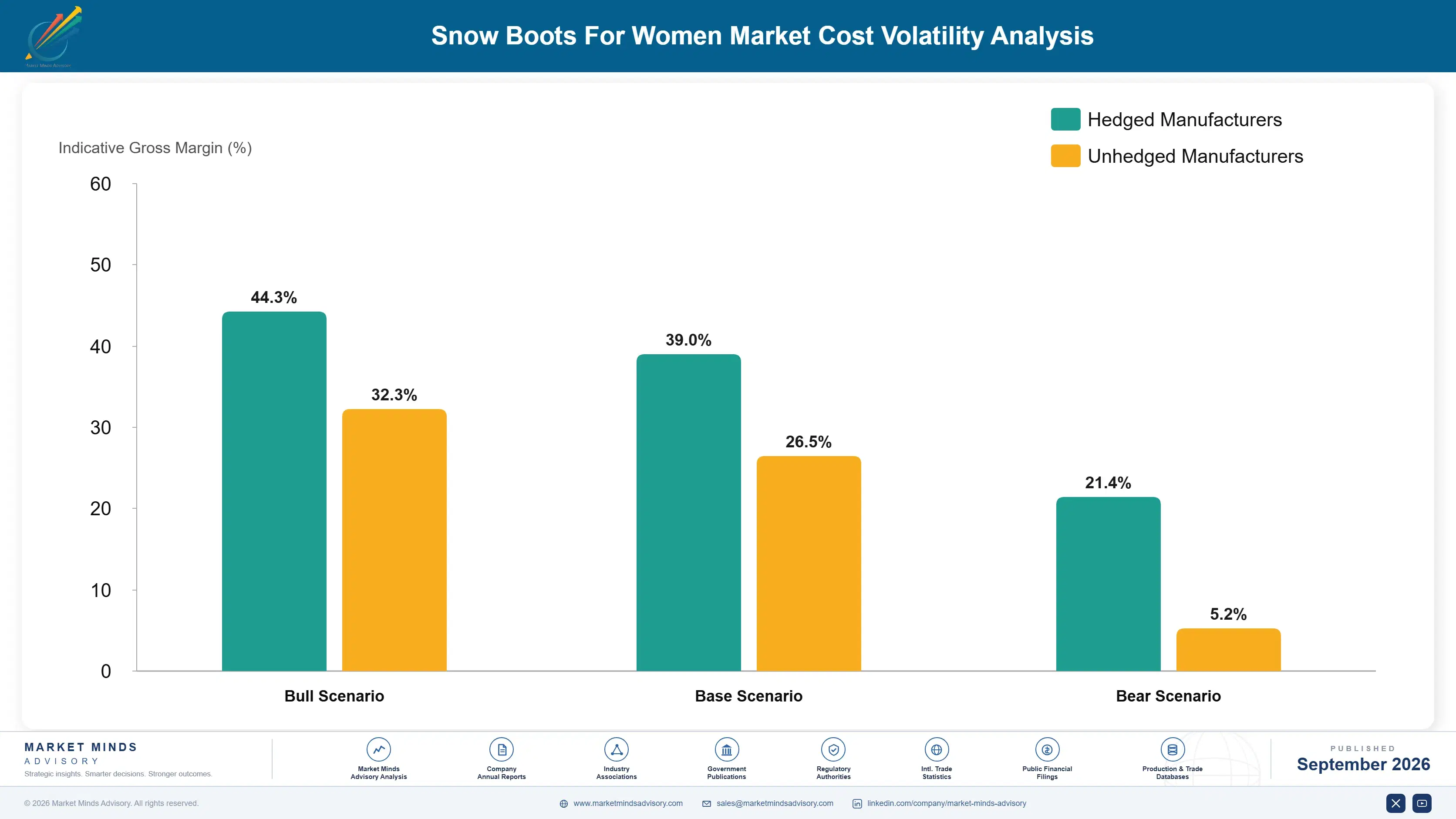
Upper materials account for roughly 24% of cost of goods, split between bovine leather and suede sourced largely from South American and North American hides, and synthetic textiles from Chinese and Taiwanese mills. Outsole rubber and midsole foam add about 17%, with cold-flexible compounds carrying a premium of four to six dollars per pair. Insulation ranges from 8% on entry construction to above 20% on shearling-led styles.
Ocean freight in 2021 and 2022 demonstrated the real exposure, and it sat outside the bill of materials entirely. Container rates on Asia to North America routes rose several times over within a year, and Deckers and Columbia Sportswear annual reports for that period both identify inbound freight as a material gross margin factor requiring price action. USDA hide price series show cattle hide values moving on a separate agricultural cycle throughout.

Exposure varies by construction and by sourcing position, which decides who absorbs a shock. Shearling-led brands carry hide price risk that synthetic-insulated competitors simply do not face. Brands sourcing from Vietnam and Indonesia hold freight exposure that Chinese domestic brands selling into China avoid completely. The smallest participants, buying container space on spot terms, miss a selling season when rates move.
snow-boots-for-women-market-cost-volatility-analysis-1790021448415

Contract container allocation before the pre-season shipping window

Winter footwear ships on a narrow calendar, and spot container rates rise precisely when the category needs space. Contracting allocation ahead of the pre-season window removes most of that exposure at a modest premium over average rates. Smaller wholesale participants rarely do it because the commitment falls in a cash-poor quarter, which is exactly the problem.

Qualify synthetic insulation equivalents alongside shearling ranges

Modern synthetic fills match shearling on measured warmth per gram and outperform it comfortably in wet conditions, which is where most urban buyers actually use the product. Qualifying equivalents across a shearling range removes hide price exposure and improves slush performance simultaneously. The obstacle is brand positioning rather than any technical or supply constraint at all.

Move outsole tooling to dual-source across two supplier regions

Outsole moulds are expensive and usually single-sourced, which turns any supplier disruption into a lost season rather than an inconvenience. Duplicating tooling across a second supplier region costs roughly one season of tooling amortisation and buys genuine continuity. Most participants only do this after being caught once, which is an expensive way to learn the lesson.

Portfolio Architecture for Margin Defence

Margin architecture divides by construction and by brand permission rather than by material cost, which is not obvious from a bill of materials. Entry moulded and pull-on styles sold through mass and marketplace channels run at gross margins in the high twenties to low thirties, and there is no route to widening that while Chinese domestic brands deliver comparable construction at half the price into the same channels.
Technical lace-up construction carrying membrane linings and genuine winter credentials holds gross margins in the mid forties to low fifties. The spread within that band reflects brand permission almost entirely: two boots from the same factory with the same specification can differ by twenty dollars at wholesale depending on whose name is on the tongue. Material and assembly cost explain very little of the difference.

The highest-value pool sits where technical construction meets a claim that can be substantiated. Boots specifying cold-flexible outsole compounds, published rating methodology or women-specific lasts carry margins in the low to mid fifties and resist markdown far better through the post-season clearance period. Volume construction fills the factory. It does not fund the design office or the brand.

Volume / Commodity-Adjacent

Moulded rubber-bottom and pull-on insulated styles sold through mass, marketplace and discount channels. Competes directly against Chinese domestic brands offering comparable construction at roughly half the wholesale price, so pricing power is minimal.
Gross Margin: 28 to 34%

Premium / Certified

Technical lace-up and premium shearling construction sold through specialty outdoor and department channels. The eight-point range reflects brand permission rather than specification, since identical factory output prices differently depending on the name attached.
Gross Margin: 44 to 52%

Sustainability / Regulatory / Next-Generation

Boots carrying cold-flexible outsole compounds, published rating methodology or women-specific lasts. These resist post-season markdown considerably better than the tier below, which is where most of the realised margin advantage actually comes from.
Gross Margin: 51 to 57%
snow-boots-for-women-market-portfolio-architecture-1790021448920

High-value Sub-segments and Strategic Watch-out

Technical Boots With Traction Compounds

High value and high growth. Cold-flexible outsole compounds add four to six dollars to a bill of materials and appear on only 14% of models, almost all premium. Repeat purchase runs roughly 1.7 times range average where they are specified. The claim is currently unoccupied at almost every price point.
Gross Margin: 52 to 57%

Women Specific Last Technical Ranges

High value and moderate growth. Tooling a dedicated last costs less than one season of fit-related return handling at current volumes. Brands that have invested report return rates around 9 points below the category average, flowing directly to contribution. Tooling amortises across several seasons rather than one.
Gross Margin: 46 to 52%

Pull-On Insulated Shaft Boots

Volume core, growing at 4.8% and steadily losing occasions to technical lace-up construction. It holds shelf space and factory utilisation without generating meaningful margin. Chinese domestic brands are taking this tier faster than anyone is defending it. Defending it on price alone has not worked for anyone yet.
Gross Margin: 28 to 33%

Shearling-Lined Suede Boots

Strategic watch-out. Growing slowest at 3.6%, carrying volatile hide cost exposure and performing poorly in the slush that most urban buyers encounter. The nine-point range reflects how much brand permission varies across participants in this construction. Hide cost and slush performance are both working against it.
Gross Margin: 38 to 47%

What Actually Drives Repurchase

Repeat demand here is wear-driven rather than fashion-driven, which makes it more predictable than most consumer footwear categories. Replacement intervals average about 4.6 years and cluster tightly, because a winter boot fails in identifiable ways: the outsole seam leaks, the lugs round off, the insulation compresses. Those failures arrive on a timetable that daily wear largely determines, and weather modulates the timing rather than the eventual outcome.
Stickiness varies sharply by purchase motivation. Climatic buyers in northern China, the Canadian provinces, Scandinavia and Eastern Europe repurchase reliably and increasingly trade upward, because a boot that failed teaches them what to specify next time. Travel buyers in the Gulf, Brazil and metropolitan India repurchase on a much longer and less predictable cycle tied to trips rather than seasons. Fashion-led urban buyers are least loyal.

Buyer profiles have shifted since 2020 in one specific direction. Women who bought technical winter footwear for outdoor recreation during the pandemic years have carried that specification into ordinary city use, and they now ask about outsole compound and membrane construction in a way earlier cohorts never did. That group is entering its replacement window across 2026 and 2027, and it trades upward rather than sideways.
snow-boots-for-women-market-end-use-penetration-index-1790021449415

Where Price Can Be Earned

These are among the four positions where our research anticipates prominent divergence between winners and laggards over the coming forecast period. Each is grounded in the demand model, the regulatory perimeter, and the announced capacity pipeline.
01 / RATING METHOD DISCLOSURE

Publish how the temperature number was actually produced

No standards body governs the cold rating printed on a boot box, and buyers assume one does because sleeping bags and helmets carry real standards. Publishing the internal protocol alongside the number, including duration, activity level and sock specification, costs nothing beyond the decision to do it. Participants who have done so report price realisation around 1.6 times comparable unrated models in the same channel, and whoever publishes first sets the benchmark others are then measured against, and the category currently offers buyers no alternative at all.
02 / TRACTION COMPOUND SPECIFICATION

Put cold flexible outsoles below the premium tier

Rubber that stays pliable below freezing adds roughly four to six dollars per pair and currently appears on only 14% of models, nearly all above USD 180 at retail. Bringing it into the mid tier costs less than a seasonal colour programme and addresses the one attribute in this category with genuine safety consequence. Brands doing it report repeat purchase around 1.7 times their range average, which makes the arithmetic straightforward at almost any volume, and winter falls are precisely the outcome this product exists to prevent.
03 / WOMEN SPECIFIC LASTS

Stop scaling women's boots down from men's patterns

Online return rates near 31% are overwhelmingly fit-related rather than defect-related, and the cause is lasts derived by proportional reduction from men's patterns. Heel width, instep height and arch position all differ in ways that scaling cannot address, and tooling a dedicated last across a core range costs less than a single season of return handling. Brands that have invested report return rates roughly 9 points below the category average, which flows straight to contribution margin in the direct channel where returns are paid for.
04 / CONSTRUCTION METHOD UPGRADE

Move core waterproof styles off cemented seams

Membrane failure clusters around month five of daily wear because cement construction places a stress concentration exactly where waterproofing must hold at the upper-to-outsole junction. Injection-moulded and vulcanised construction eliminates that seam entirely and raises unit cost by about 11%. Brands treat that as prohibitive, but the warranty saving and repeat purchase gain favour the change comfortably at any selling price above the mid tier, and the construction is well understood and available at existing supplier factories today, and most brands have never modelled the two figures against each other.

Engagement Snapshot From the Field

A live engagement with an industry participant carrying material or product regulatory and market exposure ahead of a defining policy shift, showing how our research translates into a defensible multi-year portfolio strategy.
MARKET MINDS ADVISORY · CLIENT ENGAGEMENT SUMMARY
Snow Boots For Women Producer Strategic Portfolio Review and Transition Roadmap 2026·Investment Scenario on Snow Boots For Women Exposure Evaluation 2025-26
CLIENT PROFILE
A European winter footwear brand selling through specialty outdoor and department wholesale across seven countries, with annual revenue of approximately USD 128 million (client-reported, unverified by MMA). Women's styles represented about 58% of units. The brand had recently built a direct online channel that was growing quickly and losing money, though nobody had established precisely why it was losing money.
STRATEGIC CHALLENGE
Direct channel gross margin was running roughly fifteen points below wholesale despite selling at full retail price, and management attributed the gap to marketing spend and fulfilment cost. Two rounds of logistics renegotiation had produced no improvement whatever. Nobody had examined the return stream itself or asked what customers were actually sending back and why.
MMA APPROACH
MMA analysed 34,000 individual return records across two winter seasons, coded free-text return reasons against a fit and performance taxonomy, and measured 12 core styles against women-specific last dimensions. Warranty claims were separately traced to construction type and to elapsed wear time, and 28 returning customers were interviewed about the specific circumstances of failure.
KEY FINDINGS
  1. Return rate on women's styles ran at 34% against 19% for men's, and 71% of women's returns cited fit rather than any performance or quality issue.
  2. All 12 core women's styles measured to lasts proportionally reduced from men's patterns, with heel width running several millimetres wide across the full size range.
  3. Warranty claims clustered tightly at months four to six of wear and traced almost entirely to cemented upper-to-outsole seams on membrane-lined styles.
  4. None of the range specified a cold-flexible outsole compound, and no competitor at comparable price points did either, leaving the claim entirely unoccupied in the channel.
CLIENT PROFILE
A European winter footwear brand selling through specialty outdoor and department wholesale across seven countries, with annual revenue of approximately USD 128 million (client-reported, unverified by MMA). Women's styles represented about 58% of units. The brand had recently built a direct online channel that was growing quickly and losing money, though nobody had established precisely why it was losing money.
STRATEGIC CHALLENGE
Direct channel gross margin was running roughly fifteen points below wholesale despite selling at full retail price, and management attributed the gap to marketing spend and fulfilment cost. Two rounds of logistics renegotiation had produced no improvement whatever. Nobody had examined the return stream itself or asked what customers were actually sending back and why.
MMA APPROACH
MMA analysed 34,000 individual return records across two winter seasons, coded free-text return reasons against a fit and performance taxonomy, and measured 12 core styles against women-specific last dimensions. Warranty claims were separately traced to construction type and to elapsed wear time, and 28 returning customers were interviewed about the specific circumstances of failure.
KEY FINDINGS
  1. Return rate on women's styles ran at 34% against 19% for men's, and 71% of women's returns cited fit rather than any performance or quality issue.
  2. All 12 core women's styles measured to lasts proportionally reduced from men's patterns, with heel width running several millimetres wide across the full size range.
  3. Warranty claims clustered tightly at months four to six of wear and traced almost entirely to cemented upper-to-outsole seams on membrane-lined styles.
  4. None of the range specified a cold-flexible outsole compound, and no competitor at comparable price points did either, leaving the claim entirely unoccupied in the channel.
RECOMMENDED STRATEGY
Phase 1: Phase one: tool women-specific lasts across the six highest-volume styles before the next development cycle closes, prioritising heel and instep. Phase 2: Phase two: move membrane-lined core styles from cemented to injection-moulded construction, accepting the unit cost increase against warranty savings. Model the warranty saving first. Phase 3: Phase three: specify cold-flexible outsole compound across the mid tier and publish the internal cold rating method alongside the number.
OUTCOME
Women's direct channel return rate fell from 34% to 23% across the following season (client-reported, unverified by MMA), moving direct gross margin above wholesale for the first time. Warranty claims on reconstructed styles fell by roughly two thirds, and the published rating method drew unexpected trade press attention that the brand had not paid for.

Frequently Asked Questions

Foundational context covering the market sizes, CAGR, scope, country, region and competition that inform every finding below. This section is provided to cover basics and most often pre-purchase conversations, answered from the MMA Primary Research Dataset.

What is the current size of the Snow Boots For Women Market?

The market was valued at USD 4.2 billion in 2025, rising to USD 4.4 billion in 2026. Sizing is at wholesale value across all construction types and distribution channels.

How large will the Snow Boots For Women Market be by 2036?

MMA forecasts USD 7.4 billion by 2036, an increase of USD 3.0 billion over the 2026 base. That represents expansion of 1.68 times across the forecast period.

What is the CAGR for the Snow Boots For Women Market 2026 to 2036?

The base case CAGR is 5.4%, with a bull case of 6.6% and a bear case of 4.2%. Historical growth between 2020 and 2025 ran at 4.3%.

Which segment is growing fastest?

Lace-up technical boots grow at 8.1%, half again the market rate, as winter hiking and cold-weather commuting converge on one construction. Heeled and wedge winter boots follow at 6.9%.

Who are the major companies in the Snow Boots For Women Market?

Deckers Outdoor, Columbia Sportswear, VF Corporation, Wolverine World Wide and Anta Sports lead on wholesale unit shipments, holding a combined 33%. Chinese domestic brands are closing the technical gap rapidly.

Which country is growing fastest?

China grows fastest at 7.9%, driven by northern urban demand across Harbin, Changchun and Shenyang and by domestic brands delivering technical construction at half the imported price.

Report Segmentation Architecture

The full report scope spans multiple orthogonal segmentation dimensions, with cross-tabulated demand data provided for each dimension pair. Coverage extends further to regional breakdowns, trend trajectories, and the competitive detail needed to support segment-level decision-making.

By Construction Type

  • Moulded Rubber-Bottom Boots
  • Pull-On Insulated Shaft Boots
  • Lace-Up Technical Boots
  • Shearling-Lined Suede Boots
  • Heeled and Wedge Winter Boots
  • Insulated Ankle Boots and Booties

By End-Use Occasion

  • Winter Hiking and Trail
  • Urban Commuting
  • Workplace and Professional
  • Winter Sports Travel
  • Rural and Agricultural Use
  • Casual and Leisure Wear

By Distribution Channel

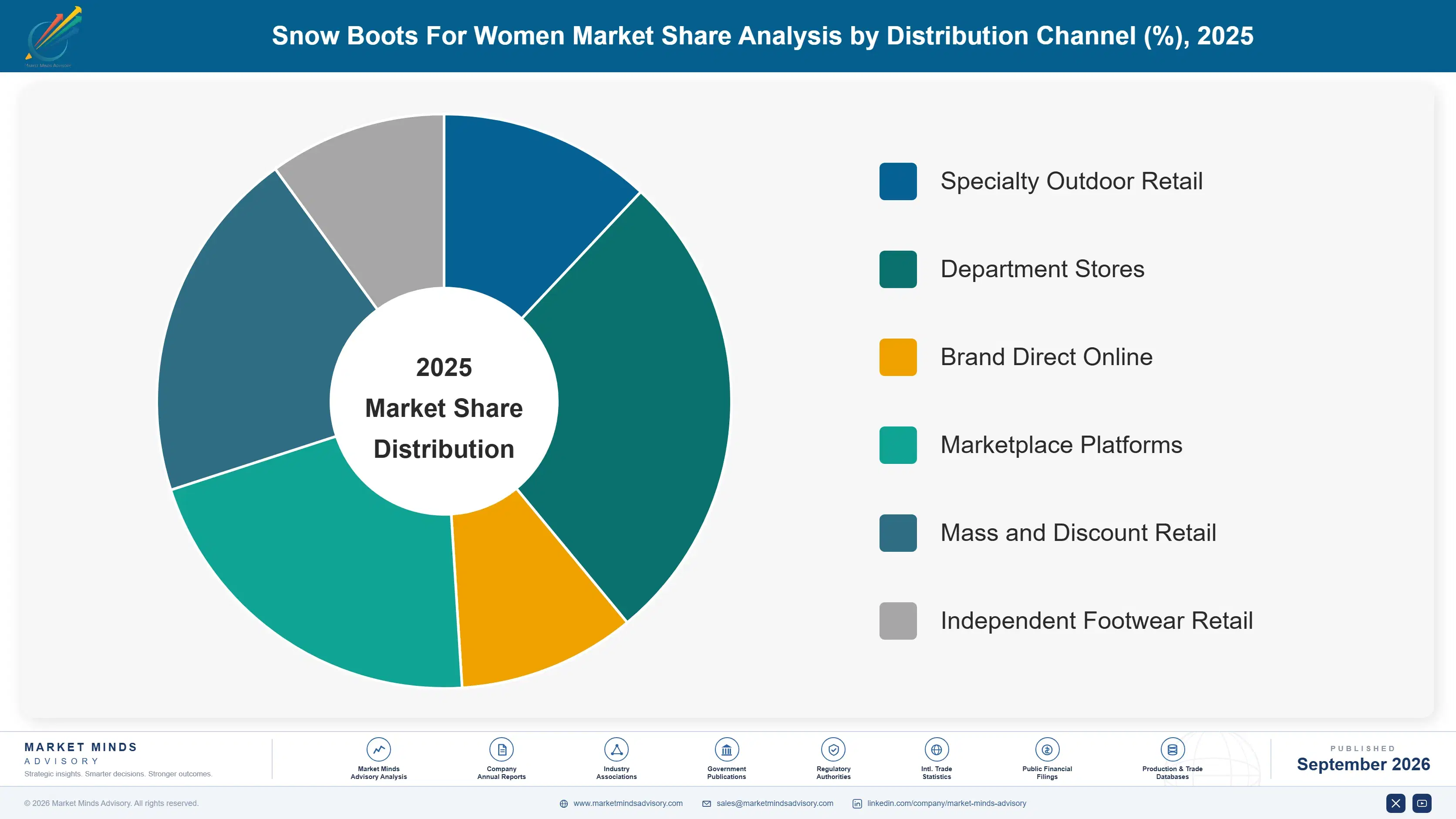
  • Specialty Outdoor Retail
  • Department Stores
  • Brand Direct Online
  • Marketplace Platforms
  • Mass and Discount Retail
  • Independent Footwear Retail

By Region

  • East Asia
  • North America
  • Western Europe
  • South Asia and Pacific
  • Latin America
  • Eastern Europe
  • Middle East and Africa

Scope, Methodology, and Coverage

Every figure in this report is reproducible from documented input assumptions. The scope below maps the historical period, the forecast horizon, the segmentation dimensions, and the countries covered, alongside the underlying primary and qualitative methodology.
Historical Period
2020 to 2025
Forecast Period
2026 to 2036
Base Year
2025 (USD billions; MMA Primary Research Dataset, September 2026)
Market Definition
This market covers women's footwear designed, constructed and marketed for cold, wet or snow-covered conditions, spanning moulded rubber-bottom boots, pull-on insulated shaft boots, lace-up technical boots, shearling-lined suede, heeled and wedge winter styles, and insulated ankle boots. Sizing is at wholesale value across specialty, department, mass, direct and marketplace channels. Men's and children's winter footwear, ski and snowboard boots, mountaineering boots, uninsulated rain boots and aftermarket traction devices are excluded.
Quantitative Units
USD billions at wholesale value; volume in millions of pairs; return and attach rates as percentages.
Segmentation Dimensions
Construction type, end-use occasion, distribution channel, and geographic region.
Regions Covered
East Asia, North America, Western Europe, South Asia and Pacific, Latin America, Eastern Europe, Middle East and Africa
Countries Covered
United States, China, Germany, Canada, Japan, Poland
Key Companies Profiled
Deckers Outdoor Corporation, Columbia Sportswear, VF Corporation, Wolverine World Wide, Anta Sports, Genfoot, Baffin, Amer Sports, La Sportiva, Lowa, Aigle, Hunter Boot, Rocky Brands, Bata, Li-Ning, Xtep, Decathlon, Skechers, Asolo, Blundstone
Quantitative Methodology
Primary survey, n=3,800 respondents, Q4 2025, six countries; demand-side model with trade association cross-validation
Qualitative Methodology
47 expert interviews, Q4 2025; applied to validate demand model assumptions, identify emerging dynamics, and assess competitive positioning
Report Format
PDF and XLSX data workbook (Word format preview document)
Publisher
Market Minds Advisory
Report Code
MMA-2026-CON-764
Published
September 2026
Contact
sales@marketmindsadvisory.com | www.marketmindsadvisory.com

Purchase the full Snow Boots For Women Market Report (2026 to 2036).

The full report sizes the women's snow boot market across six construction types, six end-use occasions and six distribution channels for all seven global regions. It includes return stream analysis coded by cause across two winter seasons, separating fit-related returns from performance and quality claims. Outsole compound specification is tracked model by model across leading participants alongside the price points at which cold-flexible rubber currently appears. Warranty claim timing is traced to construction method, and last geometry is measured against women-specific dimensional data. Competitive assessment covers 20 participants on a consistent wholesale unit basis.
Return stream coded by cause across seasons
Outsole compound specification tracked model by model
Warranty timing traced to construction method
Last geometry measured against women-specific dimensions
Six construction types sized through 2036
Twenty participants assessed on wholesale unit shipments

Built For The People Who Decide

From boardroom strategy to bench-side execution, this report is read cover-to-cover by leaders shaping the next decade of their industry, turning demand scenarios, market dynamics and valuation benchmarks into decisions.
CXOs/ Presidents/ VPs/ Managers
M&A and Corporate Development
Strategy Teams and R&D Heads
Procurement and Product Directors
Regulatory and Compliance Leaders
Investor Relations and Equity Analysts