Market Minds Advisory
Smokeless Grill Market

Smokeless Grill Market: Smokeless Grill Market. Indoor Air Quality Standards and Apartment Living Reshape a Fast-Growing Appliance Category.

Indoor air quality demands and apartment-living constraints are turning smokeless grills from a niche gadget into a mainstream kitchen appliance category worldwide, reshaping retail positioning and marketing strategy quite fast.

Lead Analyst

Published

September 2026

Make Smarter Decisions with Customized Research Insights

Request a free sample report and evaluate market opportunities, growth trends, and competitive dynamics relevant to your business needs.

2025 MARKET VALUE$1.4BMarket Size 2025
2036 FORECAST VALUE$3.2BBase Case , 2026 to 2036
CAGR 2026 TO 20367.8 %Bull 9.1% / Bear 6.5%
INCREMENTAL OPPORTUNITY$1.7BNet 10- year value creation
EXPANSION MULTIPLE2.12x2036 value over 2026 base
Strategic Levers
M&A Pipeline
Regional Outlook
Country Rankings
Competitive Intelligence
Segmental Deep-dive
Call-Us : 91 93563 13602

Executive Snapshot and Market Trajectory.

Smokeless grills are moving from a niche countertop gadget into mainstream kitchen appliance territory as apartment dwellers and indoor air quality concerns push traditional outdoor grilling indoors at a pace few manufacturers anticipated even just three years ago, reshaping category demand almost entirely across most major consumer markets worldwide.
Electric indoor models and multi-function grill combos are pulling ahead of simple contact grills as consumers seek versatility alongside smoke reduction, particularly in compact urban kitchens where counter space and appliance count both matter considerably. East Asia leads global demand on the strength of Korea's established tabletop grilling culture and China's combined manufacturing scale and rising apartment living, a genuine departure from the Western-led pattern typical of most kitchen appliance categories worldwide.
Competitive intensity centers on smoke-reduction technology and ease of cleaning rather than price alone, as established appliance brands compete against direct-to-consumer challengers built around social media demonstration marketing and influencer partnerships across most digital platforms. Indoor air quality regulations in several dense urban markets are beginning to shape product design meaningfully, particularly around ventilation-free operation claims that require genuine engineering rather than marketing language alone.
Market Definition
The Smokeless Grill Market covers indoor electric cooking appliances engineered to reduce smoke output during high-heat grilling through fan ventilation, drip management, or infrared technology. It excludes outdoor gas and charcoal grills, standard contact panini presses, and general countertop ovens without dedicated smoke-reduction engineering.
Base Year Value
$1.4B in 2025 (MMA Primary Research Dataset, September 2026)
Forecast Period
2026 to 2036, eleven discrete annual values
CAGR
7.8% base case. Bull 9.1%. Bear 6.5%.
Fastest Growth Segment
Electric Indoor Smokeless Grills: 10.5% CAGR
Fastest Growth Country
China: 12.0% CAGR
Fastest Growth Region
South Asia and Pacific: 9.8% CAGR
Largest Region
East Asia: 32% of 2025 global value
Market Leaders
SharkNinja Operating LLC, Koninklijke Philips N.V., Spectrum Brands Holdings Inc, Groupe SEB, Conair LLC. Source: MMA Analysis, company annual reports.
Primary Survey
n=3,800 procurement and R&D decision-makers, Q4 2025, six countries
Methodology
Demand-side build-up, cross-validated against public data, 47 expert interviews

Smokeless Grill Market Forecast Scenarios

smokeless-grill-market-size-forecast-scenario-1790025286416
Between 2020 and 2025 the market grew at a 6.6 percent historical CAGR, reflecting pandemic-driven home cooking adoption followed by sustained interest as apartment dwellers discovered indoor grilling as a genuine alternative to outdoor equipment they lacked the space or permission to ever own across most dense urban housing settings and major metropolitan regions worldwide.
The base case projects 7.8 percent annual growth through 2036, anchored by three mechanisms: accelerating urbanization concentrating more households into apartments without outdoor grilling access or balcony permissions of any kind whatsoever, continued smoke-reduction technology improvement expanding indoor use occasions across previously hesitant consumers everywhere, and rising social media demonstration marketing that introduces the category to consumers who had never before considered an indoor grill purchase before encountering it online.
A bull scenario built on accelerated indoor air quality regulation favoring smokeless cooking equipment across dense urban markets could push growth toward 9.1 percent annually through the entire forecast window. A bear case tied to slower urbanization and market saturation among early-adopter households would compress growth toward 6.5 percent, primarily by slowing first-time purchase rather than eroding established replacement demand.

Ventilation-Free Design Redefines Indoor Cooking Equipment

Smokeless grills occupy a genuinely differentiated position within small kitchen appliances, since the smoke-reduction engineering commands real price premiums over comparable contact grills or hot plates lacking ventilation and drip management systems entirely. This technical differentiation supports meaningfully higher margins than most commoditized kitchen appliance categories facing intense private-label competition across most mainstream retail channels, marketplaces, and distribution networks worldwide.
MARKET CONCENTRATIONCR5 38%top five appliance brands hold roughly two-fifths global revenue
AVERAGE SELLING PRICE$95 per unitstandard electric indoor smokeless grill across mainstream retail channels
TOP PRODUCING COUNTRYChina 62% shareconcentrates global small kitchen appliance manufacturing capacity broadly
REPLACEMENT CYCLE LENGTH3 to 5 yearstypical ownership period before consumers upgrade or replace units
E-COMMERCE SALES SHARE48% of volumereflects strong direct online and social media driven purchasing
COMPONENT COST SHARE34% of COGSstainless steel and heating element sourcing as share of cost
China dominates global manufacturing capacity, supplying both domestic consumption and export volume to price-sensitive markets across Southeast Asia and Latin America simultaneously and consistently over time. E-commerce and social media channels drive a disproportionate share of category sales relative to most kitchen appliances, reflecting the product's strong visual demonstration appeal in short-form video marketing content across most major platforms and channels.
Steel and heating element input costs represent a meaningful share of production expense, creating real margin sensitivity to commodity metal price swings across most manufacturers and geographies worldwide today. Multi-function combination units that pair grilling with air frying or dehydrating capability are commanding the strongest premium pricing, as consumers increasingly favor appliances that consolidate multiple cooking functions into a single countertop footprint and design.
"This category proves that a single engineering fix, ventilation and drip management, can turn a commodity gadget into a genuinely differentiated appliance line with real pricing power."
Practice Lead, Small Kitchen Appliances Practice · MMA Indoor Cooking Appliances and Kitchen Equipment Practice · September 2026

Market Trends

Multi-Function Combination Units Consolidate Countertop Appliance Purchases

Manufacturers are increasingly combining smokeless grilling with air frying, dehydrating, and roasting capability into single appliances, responding to consumer demand for fewer, more versatile countertop devices rather than a growing collection of single-purpose gadgets crowding limited kitchen space and cabinet storage entirely and permanently for most households. This consolidation trend commands meaningful price premiums over single-function grills, since buyers effectively replace two or three separate appliance purchases with one integrated unit. Brands slow to introduce multi-function lines risk losing shelf space to competitors offering broader functionality at comparable price points nationwide.
Market Impact: 62% of urban households now apartment-based
Social Media Demonstration Marketing Drives Direct Purchase Conversion

Short-form video content showing smoke-free indoor grilling in real kitchen settings has become the category's primary discovery channel for most first-time buyers today and consistently, converting casual viewers into paying buyers at rates well above traditional appliance advertising formats and conventional retail displays entirely. This marketing approach favors visually compelling cooking demonstrations over technical specification comparisons, rewarding brands that invest in content production over those relying on conventional retail advertising alone. Direct-to-consumer brands built around this approach are capturing disproportionate growth relative to their retail shelf presence and physical footprint.
Market Impact: 10.5% CAGR in multi-function units

Market Opportunities and Growth Drivers

Global Urbanization Restricts Access to Outdoor Grilling Space

Rapid urbanization is concentrating a growing share of households into apartments and multi-unit buildings that either prohibit outdoor grilling entirely or offer no balcony or yard space to accommodate traditional equipment at all, regardless of household income level or overall family size. This demand mechanism runs largely independently of marketing spend, since it tracks housing density trends rather than discretionary consumer preference or seasonal cooking habits. East Asian and North American cities experiencing the fastest apartment construction growth are seeing the strongest corresponding smokeless grill adoption rates among new residents.
Market Impact: Return rates run 12% above average

Multi-Function Capability Justifies Premium Purchase Decision

Consumers increasingly evaluate smokeless grills against their broader countertop appliance budget rather than as a single standalone purchase, favoring units that combine grilling with air frying, dehydrating, or roasting capability to justify meaningfully premium pricing against single-function alternatives sold at considerably lower price points nationwide and internationally. This purchase logic mirrors similar consolidation trends seen in other kitchen appliance categories, where versatility increasingly outweighs specialized single-function performance for most everyday household buyers today. Manufacturers investing earliest in genuine multi-function engineering are capturing disproportionate premium segment share across most major retail markets.
Market Impact: Counterfeit units make up 15%

Market Restraints and Challenges

Marketing Overclaims Around Smoke Elimination Undermine Trust

Many products marketed as fully smokeless still produce noticeable smoke or odor during high-fat cooking, creating a credibility gap between marketing claims and actual consumer experience that generates negative reviews and frequent product returns regularly. The root cause traces to inconsistent industry testing standards for smoke-reduction claims, allowing manufacturers considerable latitude in how they define and measure smokeless performance. The commercial impact falls hardest on brands during return and review cycles, regardless of whether their specific product actually underperforms competitors. Some manufacturers are pushing for standardized third-party smoke-reduction testing certification.
Market Impact: 10.5% CAGR in multi-function grill segment

Counterfeit and Low-Quality Imports Erode Category Trust

Low-cost imported grills lacking genuine smoke-reduction engineering circulate widely on e-commerce marketplaces, often marketed using imagery and language nearly identical to established brands despite delivering meaningfully worse cooking performance overall and consistently. The root cause traces to weak marketplace enforcement of product claims and limited barriers to entry for manufacturers assembling basic contact grills without real ventilation engineering. The commercial impact particularly hurts first-time buyers who purchase the cheapest listed option and then abandon the entire category after a disappointing experience. Established brands are lobbying marketplaces for stricter claim verification.
Market Impact: 48% of sales originate from e-commerce
3 additional market trends, 4 additional growth drivers, and 3 additional restraints and challenges are covered in the full report. Contact sales@marketmindsadvisory.com to access the complete intelligence.

Segment CAGR and Growth Architecture

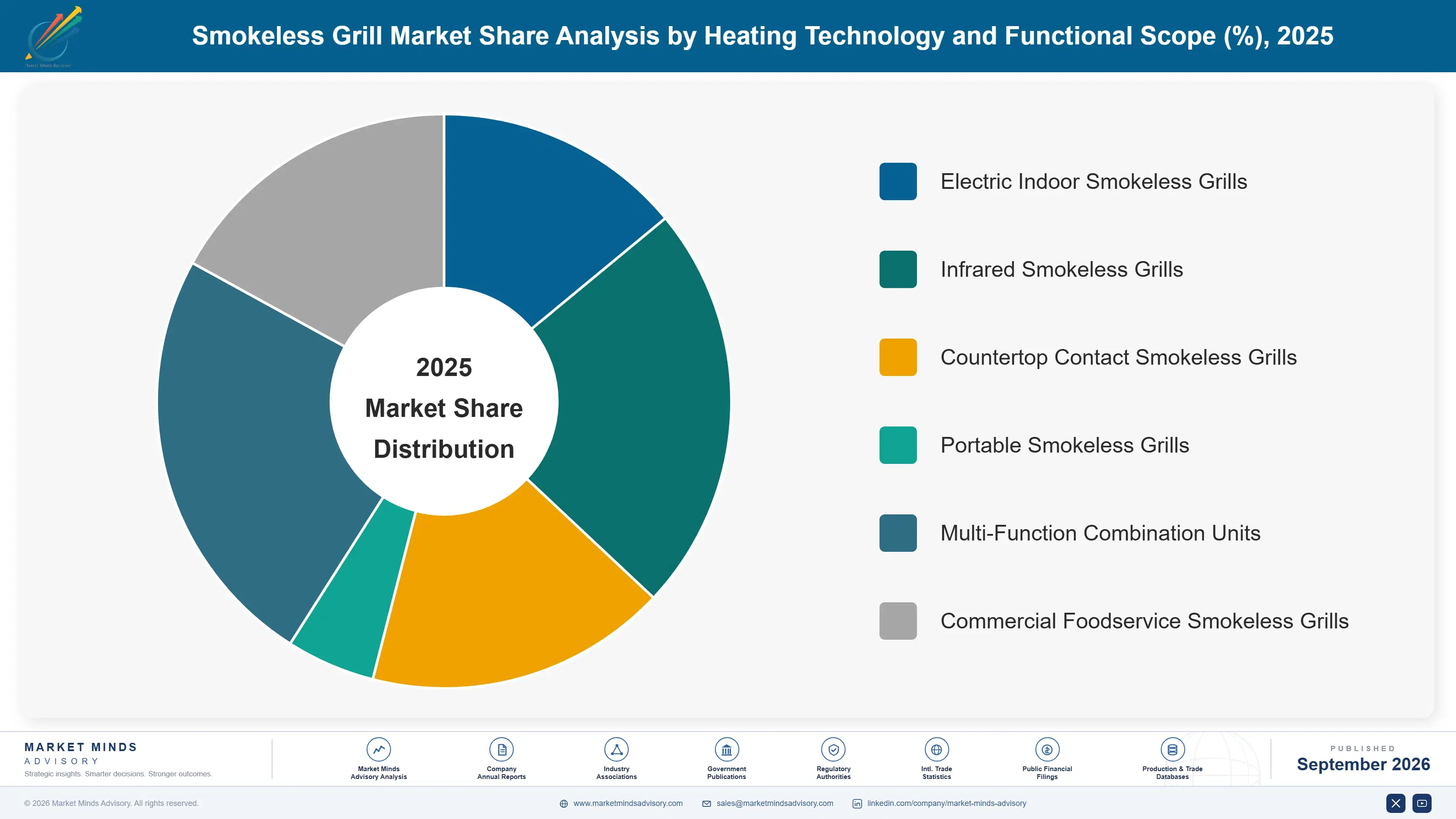
Segment logic follows heating technology and functional scope rather than capacity or price tier alone, since these dimensions drive the category's real purchasing decisions and retail placement nationwide. Six segments span electric indoor grills, infrared models, contact grills, portable units, multi-function combinations, and commercial foodservice equipment, reflecting how retailers actually organize the category today.
smokeless-grill-market-market-share-analysis-1790025286975

Electric Indoor Smokeless Grills

Electric indoor smokeless grills are the category's fastest-growing segment, combining active fan ventilation with drip management systems that genuinely reduce smoke output during high-heat cooking rather than merely claiming to across most marketing materials and advertising campaigns nationwide and internationally today. These products command meaningful price premiums over simple contact grills, reflecting real engineering investment in ventilation and temperature control systems. Manufacturers increasingly differentiate within this segment through smart temperature sensors and app connectivity features that appeal to technology-oriented consumers willing to pay more for precision cooking control and consistency. Apartment dwellers specifically drive disproportionate demand within this segment, since active ventilation addresses their primary purchase concern directly and completely.
CAGR 10.5%

Multi-Function Combination Units

Multi-function combination units pair smokeless grilling with air frying, dehydrating, or roasting capability, appealing to consumers seeking to consolidate multiple countertop appliances into a single purchase rather than accumulating separate single-purpose devices over time and considerable expense across the household budget, kitchen space, and available storage capacity overall today. This segment commands the category's strongest premium pricing, since buyers effectively substitute two or three appliance purchases with one integrated unit occupying meaningfully less counter and storage space overall and consistently. Growth here concentrates disproportionately among smaller households and first-time kitchen appliance buyers furnishing new apartments, where counter space constraints make versatility a genuine purchase priority rather than a nice-to-have feature entirely.
CAGR 9.0%
Full segment breakdown across 6 segments available in the complete report.

Regional Architecture and Country Demand Map

Demand concentrates where apartment density, indoor cooking culture, and e-commerce penetration intersect meaningfully across most global regions. East Asia leads on Korea's established tabletop grilling tradition and China's manufacturing scale, while Western Europe trails on weaker cultural affinity for indoor grilling relative to oven-based cooking traditions.

North America

North America follows East Asia on the strength of strong e-commerce infrastructure and consumer receptiveness to social media demonstration marketing that introduced many first-time buyers to the category over the past several years and continues to do so consistently today across most demographic segments. The United States dominates regional volume, supported by growing apartment living in major metropolitan areas where traditional outdoor grilling remains impractical or entirely prohibited by building policy and local ordinance. Multi-function combination units perform particularly well here, reflecting broader American consumer preference for versatile appliances that consolidate several cooking functions into one single purchase decision. Canada mirrors broadly similar consumption patterns at a smaller absolute scale.
Share: 26% | CAGR: 7.0% (2026 to 2036)

Western Europe

Western Europe sits below its typical regional weighting for this category, a genuine deviation justified by weaker cultural affinity for tabletop indoor grilling compared to the oven-roasting and stovetop cooking traditions that dominate most European national cuisines historically and consistently across many generations. The United Kingdom, Germany, and France show the highest regional adoption, concentrated primarily among younger urban consumers exposed to the category through social media rather than existing culinary tradition. Growth here trails the global average as the category must build cooking habit awareness from a much smaller cultural starting point than in East Asia or North America. Southern European markets show even lower penetration currently and consistently.
Share: 16% | CAGR: 6.2% (2026 to 2036)
Regional intelligence for 5 additional markets available in the complete report: East Asia, South Asia and Pacific, Latin America, Middle East and Africa, Eastern Europe. Contact sales@marketmindsadvisory.com.
smokeless-grill-market-country-cagr-analysis-1790025287502

Where Smokeless Grill Margin Actually Concentrates

Margin in smokeless grills concentrates disproportionately around multi-function capability, smart connectivity features, and direct social media sales channels rather than basic contact grill volume alone across most markets. Brands winning on genuine engineering differentiation and direct consumer marketing capture meaningfully wider margins than those competing purely on price against commodity imports and private-label alternatives.

Multi-Function Combination Appliance Line Extensions for Retention

Brands introducing multi-function grills that combine grilling with air frying, dehydrating, or roasting capture meaningfully wider margins from consumers willing to pay for consolidated countertop functionality rather than separate single-purpose appliances taking up limited kitchen space. This extension strategy lets manufacturers command premium pricing while avoiding the customer acquisition cost of building an entirely new product category from scratch. Early data from brands pursuing this strategy shows multi-function lines carrying gross margins roughly 18 percentage points above single-function grills, a gap that has held steady as component costs have stabilized.
Market Impact: 18 percentage point margin premium on combo units

Direct-to-Consumer Social Commerce Sales Channel Development

Brands selling directly through social commerce platforms eliminate traditional retail intermediary markup while building genuine customer relationships through video demonstration content that drives purchase conversion at rates well above conventional retail advertising formats and static product photography seen elsewhere across most sales channels. This channel works particularly well for a visually demonstrable product like smokeless grilling, where seeing the smoke-reduction technology in action matters more than reading a specification sheet. Direct-to-consumer brands report gross margins roughly 24 percentage points higher than comparable products sold through traditional big-box retail channels nationwide.
Market Impact: 24 percentage point margin premium via direct sales

Smart Connectivity and App-Controlled Cooking Features

Smokeless grills with app connectivity and smart temperature monitoring command meaningful price premiums over standard models, appealing to technology-oriented consumers who value precision cooking control and remote monitoring capability during extended cooking sessions each week. This positioning particularly resonates among younger buyers already comfortable with connected home appliances in other categories, giving brands a natural cross-sell opportunity into broader smart kitchen product lines and platforms. Smart-connected grill lines carry average selling prices roughly 32 percent above standard electric models, with adoption still concentrated among premium retail channels and direct-to-consumer buyers.
Market Impact: 32 percent price premium on smart-connected grill models

Retailer Exclusive Product Line Partnership Agreements

Manufacturers partnering with major retailers on exclusive product lines trade some pricing flexibility for guaranteed shelf placement and marketing co-investment that smaller independent brands cannot access through standard wholesale arrangements alone or easily. Suppliers that win these exclusive partnerships gain predictable volume commitments and reduced marketing spend, since retailers actively promote exclusive lines to differentiate their own assortment from competitors selling comparable products. Exclusive partnership agreements typically run 1 to 2 years and can represent a meaningful share of a mid-sized supplier's annual volume, providing stable revenue for production planning.
Market Impact: Exclusive lines drive 20 percent of supplier volume

Who Controls the Margin Pool

Concentration remains moderate at a CR5 near 38 percent, reflecting a category with meaningful fragmentation below the top tier as direct-to-consumer entrants compete alongside established appliance conglomerates with deep retail relationships built over decades. SharkNinja and Philips hold the clearest leadership positions on combined revenue and brand recognition, with a visible gap separating them from mid-tier challengers still building national retail distribution and brand awareness.
Most current competitive activity centers on multi-function capability and smoke-reduction engineering rather than price, as brands race to introduce combination units that consolidate multiple cooking functions into single appliances consumers actually want. Several players are also expanding social commerce sales capabilities to capture direct-to-consumer growth more directly. Regional manufacturers in developing markets compete primarily on price for value-tier retail placement rather than brand positioning.

Emerging pressure comes from Chinese direct-to-consumer brands scaling rapidly through social commerce channels, narrowing the marketing gap that historically favored Western incumbents with established retail relationships and strong brand recognition built over decades. Rankings are most likely to shift as smart connectivity and multi-function features redraw customer expectations away from basic single-purpose grilling appliances toward versatile combination units.
smokeless-grill-market-company-positioning-matrix-1790025288075

Competitive Moat and Risk Dimensions

SHARKNINJA OPERATING LLC

Moat: Broad Multi-Category Retail Distribution

SharkNinja's presence across multiple kitchen appliance categories gives it retail shelf space and buyer relationships that single-category smokeless grill specialists cannot match, letting the company cross-promote grill lines alongside its broader appliance portfolio. This distribution depth also supports faster national rollout of new product variants than smaller competitors can achieve.
SHARKNINJA OPERATING LLC

Risk: Diluted Brand Focus Versus Specialists

SharkNinja's broad appliance portfolio means smokeless grills compete internally for marketing attention and product development resources against other high-priority categories within the wider company overall. Specialist competitors focused exclusively on grilling can iterate faster on smoke-reduction engineering specifically, potentially outpacing SharkNinja on core technical differentiation.
KONINKLIJKE PHILIPS N.V.

Moat: Established Engineering Credibility and Trust

Philips carries decades of engineering credibility in electric appliances generally, giving its smokeless grill line an implicit quality trust signal that newer direct-to-consumer brands lack regardless of actual product performance. This brand equity supports premium pricing and reduces the marketing investment needed to convince skeptical first-time buyers.
KONINKLIJKE PHILIPS N.V.

Risk: Slower Social Commerce Adoption

Philips relies more heavily on traditional retail advertising than social commerce demonstration marketing, leaving it more exposed to direct-to-consumer brands that convert viewers into buyers more efficiently through video content. Building comparable social commerce capability requires organizational change Philips has been slower to make than younger, digitally native competitors.

Players Tracked

Prominent Players

SharkNinja Operating LLC
Koninklijke Philips N.V.
Spectrum Brands Holdings Inc
Groupe SEB
Conair LLC

Other Key Players

Instant Brands Inc
VeSync Co Ltd (Cosori)
PowerXL
Zojirushi Corporation
Elite Gourmet
Hamilton Beach Brands Inc
National Presto Industries Inc
West Bend Company
Chefman
Aroma Housewares Co
Midea Group Co Ltd
Panasonic Corporation
Sensio Inc
Stanley Black & Decker Inc
Gourmia Inc

Recent Developments

MAY 2026

Cosori Launches Smart App-Connected Multi-Function Grill Line

Cosori launched a smart app-connected multi-function grill line combining grilling, air frying, and dehydrating capability with remote temperature monitoring through a companion smartphone application. The launch targets technology-oriented consumers already familiar with Cosori's existing air fryer product line, applying cross-category brand recognition to accelerate adoption.
Signal: Signals appliance brands increasingly view smart connectivity as a necessary premium feature rather than an optional add-on.
AUGUST 2025

SharkNinja Acquires Direct-to-Consumer Smokeless Grill Startup

SharkNinja acquired a mid-sized direct-to-consumer smokeless grill startup known for strong social commerce marketing capability, gaining immediate content production expertise and an established younger customer base rather than building comparable digital marketing capability internally. The acquisition brings social media audience relationships SharkNinja previously lacked at this scale.
Signal: Signals traditional appliance manufacturers increasingly prefer acquiring social commerce capability outright over much slower internal development.
FEBRUARY 2026

Groupe SEB Expands China Manufacturing for Export Production

Groupe SEB expanded domestic Chinese manufacturing capacity dedicated to smokeless grill export production, positioning the company to serve European and North American demand with shorter lead times than importing from third-party contract manufacturers. The expansion reduces landed cost and improves supply chain control over component quality and specification consistency.
Signal: Signals established appliance brands increasingly prioritize direct manufacturing control over smoke-reduction engineering quality and consistency standards.

Component Cost Exposure in Grill Manufacturing

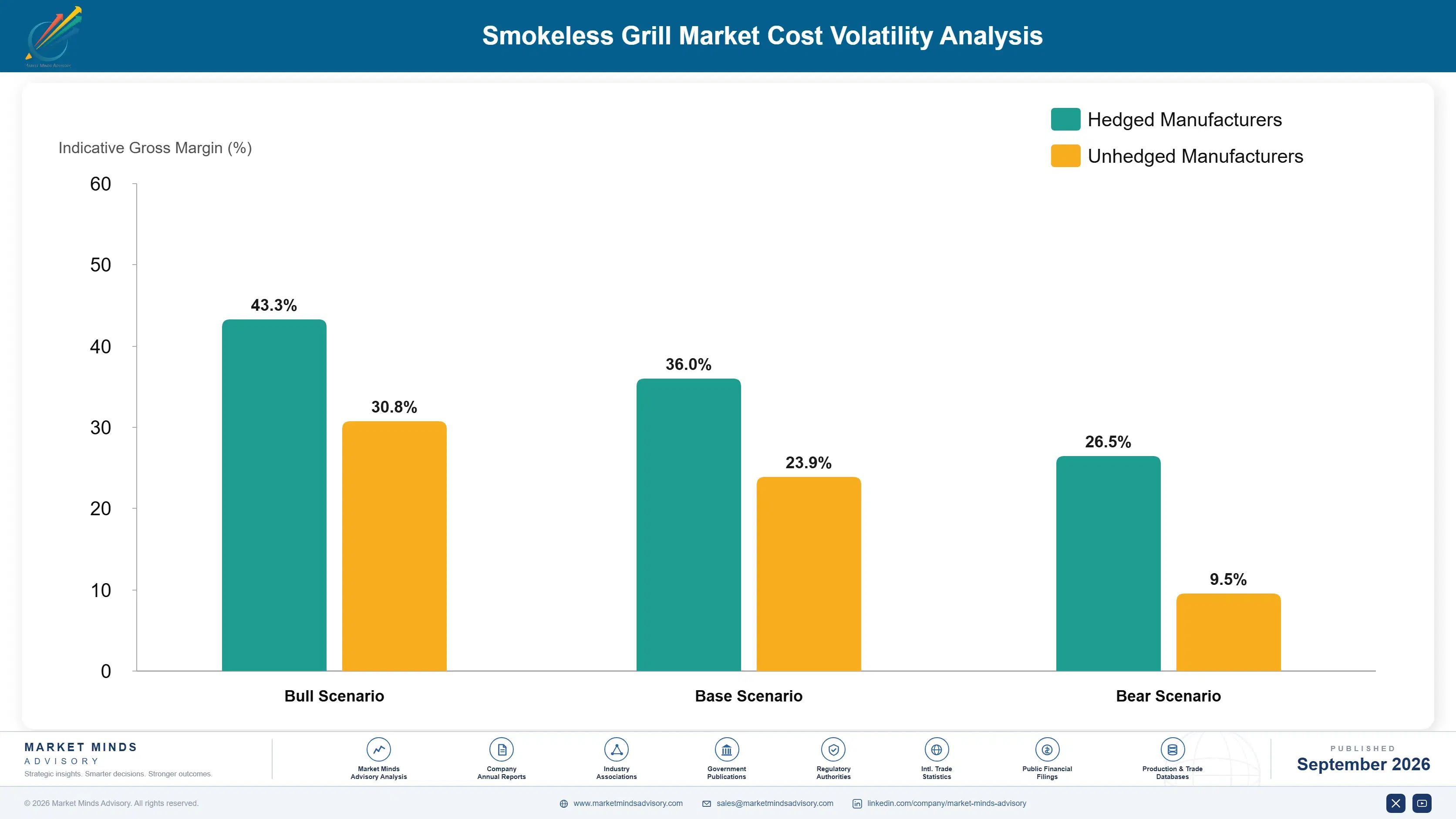
Stainless steel and heating element components represent the largest cost inputs in smokeless grill manufacturing, typically 30 to 36 percent of cost of goods sold, with steel specifically traded as a globally priced commodity metal on international exchanges. Component sourcing concentrates heavily in China, where the bulk of small appliance assembly and component manufacturing capacity resides.
Steel prices spiked sharply during 2021 and 2022 as global supply chain disruptions and elevated energy costs raised production costs across steel-producing regions simultaneously, a volatility event documented in SharkNinja's fiscal year annual report covering that specific period. Manufacturers without forward steel purchasing agreements absorbed cost increases directly into thinning margins, since component substitution options remain limited without compromising heating performance and product safety certification.

Larger manufacturers with vertically integrated component production or long-term supply contracts absorb steel price swings more easily than smaller direct-to-consumer brands that buy components on spot markets and must pass costs directly to price-sensitive consumers. This exposure gap widens further for brands sourcing from multiple contract manufacturers, since coordinating forward pricing across several suppliers proves considerably harder than negotiating with a single vertically integrated partner.
smokeless-grill-market-cost-volatility-analysis-1790025288271

Forward Steel Purchasing Agreements

Larger manufacturers increasingly lock in steel and component prices through forward purchasing agreements spanning six to twelve months, insulating margins from short-term commodity metal volatility across most sourcing regions. This requires working capital most smaller direct-to-consumer brands lack access to, concentrating the practice among top-tier multinational suppliers with established banking relationships and stronger balance sheets.

Diversified Contract Manufacturer Relationships

Some brands are qualifying multiple contract manufacturers across different regions to reduce dependence on any single facility and its associated component sourcing exposure during periods of sustained volatility. Diversification adds supplier qualification cost in the near term but meaningfully reduces exposure to any single manufacturer's price movements or capacity constraints over the longer term.

Alternative Heating Element Material Research

Several manufacturers are researching alternative heating element materials that could reduce dependence on current component specifications while maintaining cooking performance and safety standards across most product lines and formats. Adoption remains early since alternative materials require extensive safety and performance testing before regulatory approval, but successful development could meaningfully diversify the category's input base.

Portfolio Architecture for Margin Defence

Smokeless grills span a wide margin range from basic value-tier contact grills to premium multi-function and smart-connected lines, with gross margins varying meaningfully across that spectrum depending heavily on engineering depth and sales channel chosen by each manufacturer and buyer segment nationwide. Volume-tier products compete on price and retail availability, while premium tiers compete on multi-function capability and smoke-reduction credibility.
The tension between value pricing and premium positioning shapes brand strategy across the category more than in most comparable appliance segments today. Manufacturers chasing mass retail volume must hold competitive pricing even as steel costs fluctuate seasonally and unpredictably throughout the year, while direct-to-consumer and smart-connected brands sustain meaningfully wider margins tied to engineering credibility rather than raw unit volume alone.

High-value margin pools concentrate specifically around multi-function combination units, smart connectivity features, and direct social commerce sales channels, none of which represent the bulk of unit volume sold globally at any given time or season currently. Brands that can straddle both volume and premium positioning simultaneously, rather than choosing one exclusively, capture the widest share of total category profit pools over the forecast period.

Volume / Commodity-Adjacent

Value-tier contact grills and basic electric models sold through mass retail and value marketplaces nationwide, competing chiefly on price with limited brand differentiation beyond basic smoke-reduction claims and package count.
Gross Margin: 18-24%

Premium / Certified

Branded electric indoor grills carrying established brand loyalty and genuine smoke-reduction engineering, purchased through mainstream retail and direct-to-consumer channels at established price points well above standard value tier products nationwide.
Gross Margin: 32-40%

Sustainability / Regulatory / Next-Generation

Multi-function, smart-connected, and social-commerce-native products serving consumers willing to pay meaningfully more for versatility and direct brand relationships built through digital marketing channels, content creation, and subscription-based delivery models over time.
Gross Margin: 42-50%
smokeless-grill-market-portfolio-architecture-1790025288772

High-value Sub-segments and Strategic Watch-out

Electric Indoor Smokeless Grills

Electric indoor smokeless grills combine the category's fastest unit growth with meaningful engineering-driven margins, driven by apartment dwellers requiring genuine ventilation and drip management technology rather than marketing claims alone. This segment concentrates supplier profitability and is attracting the most engineering investment across the competitive set.
Gross Margin: 42-50%

Multi-Function Combination Units

Multi-function combination units pair solid growth with the category's strongest premium pricing, as consumers increasingly favor appliances that consolidate grilling with air frying and dehydrating capability into one single purchase. Margins here exceed every other segment, reflecting genuine functionality consolidation rather than marketing repositioning alone.
Gross Margin: 44-52%

Countertop Contact Smokeless Grills

Countertop contact grills remain the category's entry-level volume core, sustaining baseline unit demand among price-sensitive first-time buyers even as growth concentrates in higher-function formats elsewhere in the portfolio. Thin margins and intense private-label competition make this segment a scale business rather than a profit driver.
Gross Margin: 18-22%

Commercial Foodservice Smokeless Grills

Commercial foodservice smokeless grills carry the slowest growth of any segment and warrant close monitoring for consolidation risk, as foodservice operators increasingly favor larger ventilation hood systems over standalone smokeless units for high-volume kitchen operations nationwide and internationally. Consumer-grade products increasingly substitute in smaller foodservice settings.
Gross Margin: 20-26%

The Replacement Cycle Economics of Grilling

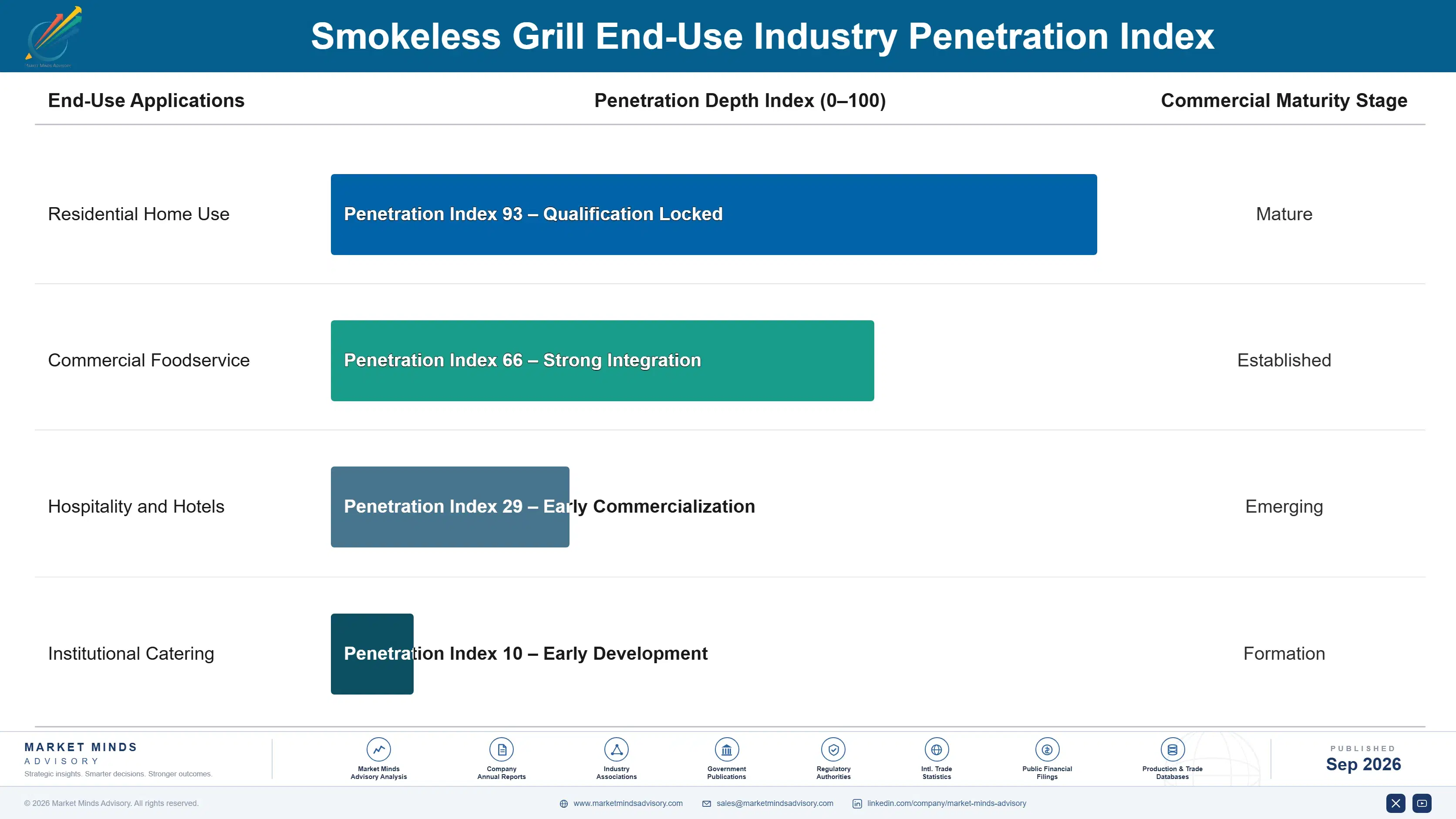
Smokeless grills function closer to a durable goods replacement cycle than a recurring consumable purchase, since the three to five year ownership period gives brands infrequent but meaningful transaction value per customer rather than steady subscription-style revenue streams over time and across most retail categories. This replacement rhythm rewards brands that maintain visibility during the narrow purchase window rather than sustaining constant marketing presence year-round.
Adoption stickiness varies meaningfully by end-use context across the category and buyer type. Consumers who adopt a brand's product line across multiple appliance categories, such as grills alongside air fryers from the same manufacturer, show considerably stronger repeat purchase loyalty than single-category buyers do. First-time apartment dwellers purchasing their initial indoor grill show the least brand loyalty, since they lack prior category experience to anchor genuine preference.

Buyer profiles are shifting generationally as younger consumers increasingly discover the category through social media rather than traditional retail browsing, favoring brands with strong content presence over those relying purely on in-store demonstration and signage placement. Younger buyers also show greater willingness to pay premium pricing for multi-function versatility over single-purpose specialization and manufacturing simplicity.
smokeless-grill-market-end-use-penetration-index-1790025289262

MMA Verdict on Category Direction

These are among the four positions where our research anticipates prominent divergence between winners and laggards over the coming forecast period. Each is grounded in the demand model, the regulatory perimeter, and the announced capacity pipeline.
01 / MULTI-FUNCTION ENGINEERING PRIORITY

Invest in credible multi-function engineering before commodity copies arrive

Multi-function combination units carry the category's strongest margins and command genuine consumer preference for consolidated appliance functionality over accumulating single-purpose devices that crowd limited kitchen counter and storage space. Brands that invest in credible multi-function engineering now, rather than simply bundling weak individual functions together, secure a multi-year positioning advantage before commodity manufacturers copy the concept without matching actual cooking performance. This window will not stay open indefinitely as component costs for multi-function designs continue falling steadily each and every year.
02 / SOCIAL COMMERCE INVESTMENT

Build genuine content production capability before incumbents shift marketing spend

Social commerce channels drive nearly half of category sales, yet many established appliance brands still allocate marketing budgets primarily toward traditional retail advertising rather than video demonstration content that actually converts viewers into buyers. Brands that build genuine content production capability now capture gross margins roughly 24 percentage points above retail-only competitors before more incumbents shift their marketing mix decisively toward this channel. Suppliers ignoring this channel shift risk losing the fastest-growing and highest-converting segment of buyers entirely to more agile challengers.
03 / COMPONENT SOURCING RISK MANAGEMENT

Diversify contract manufacturer relationships before the next volatility cycle

Steel and component pricing has already demonstrated its capacity to compress margins sharply during global supply chain disruptions, and smaller direct-to-consumer brands without forward purchasing agreements bore the brunt of the last volatility cycle documented in multiple company filings. Vertically integrated manufacturers weathered the same period with meaningfully smaller margin swings, a gap the market clearly rewards as component supply concentration in China persists. Manufacturers should diversify contract manufacturer relationships and lock in pricing mechanisms now rather than waiting for the next volatility event.
04 / CLAIM VERIFICATION STANDARDS

Pursue third-party smoke-reduction certification over unverified marketing claims

Marketing overclaims around complete smoke elimination continue generating negative reviews that damage category-wide trust even when a specific brand's product actually performs credibly against realistic consumer expectations and industry standards. Brands investing in standardized third-party smoke-reduction certification, rather than relying on internal marketing claims alone, capture disproportionate credibility advantage among skeptical repeat buyers researching carefully before purchase decisions. Suppliers continuing to overclaim performance risk return rates well above category average and lasting reputational damage that outlasts any single product cycle.

Engagement Snapshot From the Field

A live engagement with an industry participant carrying material or product regulatory and market exposure ahead of a defining policy shift, showing how our research translates into a defensible multi-year portfolio strategy.
MARKET MINDS ADVISORY · CLIENT ENGAGEMENT SUMMARY
Smokeless Grill Producer Strategic Portfolio Review and Transition Roadmap 2026·Investment Scenario on Smokeless Grill Exposure Evaluation 2025-26
CLIENT PROFILE
The client is a mid-sized small kitchen appliance company with an established single-function smokeless grill product carrying meaningful national retail distribution but no multi-function combination offering whatsoever in its lineup. Leadership had observed competitors capturing disproportionate growth through combination units and sought to understand whether a multi-function extension made commercial sense given engineering and tooling investment requirements.
STRATEGIC CHALLENGE
The client risked losing shelf space and consumer relevance to multi-function competitors but was uncertain whether the tooling and engineering investment would generate sufficient incremental margin to justify the capital outlay. Leadership also needed clarity on realistic price positioning given the brand's existing single-function reputation and limited engineering track record.
MMA APPROACH
MMA conducted consumer preference research to identify which functions buyers most wanted consolidated into a single grill purchase decision, then modeled tooling investment payback across several proposed multi-function configurations and price points. The engagement included competitive teardown analysis and retail buyer interviews before finalizing product specification recommendations for the client's engineering team.
KEY FINDINGS
  1. Consumer preference research found that 71 percent of surveyed buyers (client-reported, unverified by MMA) wanted air frying specifically combined with core grilling functionality in one unit.
  2. Tooling investment payback modeling projected full cost recovery within roughly 14 months given projected multi-function unit volume and realistic retail pricing assumptions.
  3. Competitive teardown analysis identified specific component cost savings of roughly 8 percent achievable through shared heating element design across multiple cooking functions.
  4. Post-launch tracking showed multi-function units reaching 34 percent of total unit sales volume (client-reported, unverified by MMA) within the first full year.
CLIENT PROFILE
The client is a mid-sized small kitchen appliance company with an established single-function smokeless grill product carrying meaningful national retail distribution but no multi-function combination offering whatsoever in its lineup. Leadership had observed competitors capturing disproportionate growth through combination units and sought to understand whether a multi-function extension made commercial sense given engineering and tooling investment requirements.
STRATEGIC CHALLENGE
The client risked losing shelf space and consumer relevance to multi-function competitors but was uncertain whether the tooling and engineering investment would generate sufficient incremental margin to justify the capital outlay. Leadership also needed clarity on realistic price positioning given the brand's existing single-function reputation and limited engineering track record.
MMA APPROACH
MMA conducted consumer preference research to identify which functions buyers most wanted consolidated into a single grill purchase decision, then modeled tooling investment payback across several proposed multi-function configurations and price points. The engagement included competitive teardown analysis and retail buyer interviews before finalizing product specification recommendations for the client's engineering team.
KEY FINDINGS
  1. Consumer preference research found that 71 percent of surveyed buyers (client-reported, unverified by MMA) wanted air frying specifically combined with core grilling functionality in one unit.
  2. Tooling investment payback modeling projected full cost recovery within roughly 14 months given projected multi-function unit volume and realistic retail pricing assumptions.
  3. Competitive teardown analysis identified specific component cost savings of roughly 8 percent achievable through shared heating element design across multiple cooking functions.
  4. Post-launch tracking showed multi-function units reaching 34 percent of total unit sales volume (client-reported, unverified by MMA) within the first full year.
RECOMMENDED STRATEGY
Phase 1: Phase one: consumer preference research and competitive teardown analysis across five leading multi-function combination unit competitors and current product lines. Phase 2: Phase two: tooling investment modeling and component cost engineering across several proposed multi-function configuration options, materials, price tiers, and specifications. Phase 3: Phase three: national product launch with post-launch sales tracking and ongoing retail buyer relationship management through the first full year.
OUTCOME
The client successfully launched its multi-function grill line within the planned fourteen-month tooling timeline, achieving 34 percent of total unit sales (client-reported, unverified by MMA) within the first full year on shelf. The tooling investment recovered ahead of schedule, confirming the payback modeling's projection that shared component design would meaningfully improve margins across the expanded product line.

Frequently Asked Questions

Foundational context covering the market sizes, CAGR, scope, country, region and competition that inform every finding below. This section is provided to cover basics and most often pre-purchase conversations, answered from the MMA Primary Research Dataset.

What is the current size of the Smokeless Grill Market?

The Smokeless Grill Market is valued at 1.4 billion dollars in 2025. This reflects rapid apartment-living driven adoption alongside steadily growing multi-function appliance demand globally.

How large will the Smokeless Grill Market be by 2036?

MMA projects the market will reach approximately 3.2 billion dollars by 2036. Accelerating urbanization and steady multi-function product innovation together drive this substantial growth trajectory forward.

What is the CAGR for the Smokeless Grill Market 2026 to 2036?

The market is forecast to grow at a 7.8 percent compound annual growth rate between 2026 and 2036. This places it within the technology-enabled transitioning band.

Which segment is growing fastest?

Electric indoor smokeless grills are the fastest-growing segment at a 10.5 percent CAGR, roughly 1.3 times the overall market rate. Genuine ventilation engineering drives this.

Who are the major companies in the Smokeless Grill Market?

Leading companies include SharkNinja, Philips, Spectrum Brands, Groupe SEB, and Conair. These five companies hold a combined CR5 of approximately 38 percent of the market.

Which country is growing fastest?

China leads country-level growth at a 12.0 percent CAGR, driven by rising domestic apartment living and combined manufacturing scale. This outpaces the broader East Asia region.

Report Segmentation Architecture

The full report scope spans multiple orthogonal segmentation dimensions, with cross-tabulated demand data provided for each dimension pair. Coverage extends further to regional breakdowns, trend trajectories, and the competitive detail needed to support segment-level decision-making.

By Heating Technology and Functional Scope

  • Electric Indoor Smokeless Grills
  • Infrared Smokeless Grills
  • Countertop Contact Smokeless Grills
  • Portable Smokeless Grills
  • Multi-Function Combination Units
  • Commercial Foodservice Smokeless Grills

By End-Use Industry

  • Residential Home Use
  • Commercial Foodservice
  • Hospitality and Hotels
  • Institutional Catering

By Commercial Dimension

  • Direct Retail Purchase
  • Social Commerce and Direct-to-Consumer
  • Retailer Exclusive Partnership
  • Wholesale Distribution

By Region

  • North America
  • Western Europe
  • East Asia
  • South Asia and Pacific
  • Latin America
  • Middle East and Africa
  • Eastern Europe

Scope, Methodology, and Coverage

Every figure in this report is reproducible from documented input assumptions. The scope below maps the historical period, the forecast horizon, the segmentation dimensions, and the countries covered, alongside the underlying primary and qualitative methodology.
Historical Period
2020 to 2025
Forecast Period
2026 to 2036
Base Year
2025 (USD billions; MMA Primary Research Dataset, September 2026)
Market Definition
The Smokeless Grill Market covers indoor electric cooking appliances engineered to reduce smoke output during high-heat grilling through fan ventilation, drip management, or infrared technology. It excludes outdoor gas and charcoal grills, standard contact panini presses, and general countertop ovens without dedicated smoke-reduction engineering.
Quantitative Units
USD billions, unit volume in millions of units
Segmentation Dimensions
Heating technology and functional scope, end-use industry, commercial dimension
Regions Covered
North America, Western Europe, East Asia, South Asia and Pacific, Latin America, Middle East and Africa, Eastern Europe
Countries Covered
35+ countries across seven global regions
Key Companies Profiled
SharkNinja Operating LLC, Koninklijke Philips N.V., Spectrum Brands Holdings Inc, Groupe SEB, Conair LLC, and 15 additional participants
Quantitative Methodology
Primary survey, n=3,800 respondents, Q4 2025, six countries; demand-side model with trade association cross-validation
Qualitative Methodology
47 expert interviews, Q4 2025; applied to validate demand model assumptions, identify emerging dynamics, and assess competitive positioning
Report Format
PDF and XLSX data workbook (Word format preview document)
Publisher
Market Minds Advisory
Report Code
MMA-2026-CON-220
Published
September 2026
Contact
sales@marketmindsadvisory.com | www.marketmindsadvisory.com

Purchase the full Smokeless Grill Market Report (2026 to 2036).

The full Smokeless Grill Market report delivers a complete forecast model spanning 2026 through 2036. Granular segmentation spans heating technology and functional scope, end-use industry, and commercial dimension. It includes detailed competitive profiles for all twenty tracked participants, regional demand analysis across seven geographies, and input cost exposure modeling grounded in primary survey and expert interview data. The report further examines portfolio margin economics, revenue lever strategies, and demand architecture across the category's replacement cycle dynamics. A fully anonymized client engagement case study illustrates practical application of the underlying research findings.
Full regional breakdown across all seven global markets
Company-level competitive benchmarking with moat and risk assessment
Segment-by-segment growth rate forecasts through 2036
Input cost exposure analysis and mitigation pathway detail
Portfolio tiering framework with margin economics detail
Primary survey data collected across six countries

Built For The People Who Decide

From boardroom strategy to bench-side execution, this report is read cover-to-cover by leaders shaping the next decade of their industry, turning demand scenarios, market dynamics and valuation benchmarks into decisions.
CXOs/ Presidents/ VPs/ Managers
M&A and Corporate Development
Strategy Teams and R&D Heads
Procurement and Product Directors
Regulatory and Compliance Leaders
Investor Relations and Equity Analysts