Market Minds Advisory
Smartphone 3D Camera Market

Smartphone 3D Camera Market: Smartphone 3D Camera Market. Depth Sensing, Facial Recognition, and Computational Photography Modules, 2026 to 2036

Smartphone makers are quietly retreating from dedicated 3D depth sensors as computational software increasingly replicates the depth effects that once justified the extra hardware cost and module complexity entirely on its own.

Lead Analyst

Published

September 2026

Make Smarter Decisions with Customized Research Insights

Request a free sample report and evaluate market opportunities, growth trends, and competitive dynamics relevant to your business needs.

2025 MARKET VALUE$3.6BMarket Size 2025
2036 FORECAST VALUE$7.2BBase Case , 2026 to 2036
CAGR 2026 TO 20366.5 %Bull 7.7% / Bear 5.3%
INCREMENTAL OPPORTUNITY$3.4BNet 10- year value creation
EXPANSION MULTIPLE1.88x2036 value over 2026 base
Strategic Levers
M&A Pipeline
Regional Outlook
Country Rankings
Competitive Intelligence
Segmental Deep-dive
Call-Us : 91 93563 13602

Executive Snapshot and Market Trajectory.

Dedicated 3D depth-sensing hardware, once marketed as the defining premium smartphone camera feature, is losing ground to computational photography software achieving comparable portrait and augmented reality effects without the added module cost and manufacturing complexity phones once genuinely required for the effect to work well at all.
Structured light sensors are declining fastest as manufacturers consolidate around simpler, cheaper time-of-flight alternatives or drop dedicated depth hardware entirely in favor of software-based approaches, while facial recognition and biometric authentication modules continue growing steadily since regulatory and security requirements in banking and government applications still demand hardware-verified depth data rather than software approximation alone across most jurisdictions. East Asian manufacturing hubs dominate global supply given their concentrated optical component and camera module assembly capacity.
Competitive intensity is rising as component suppliers consolidate around fewer, more capable sensor architectures serving multiple use cases simultaneously, while smartphone manufacturers increasingly negotiate module pricing aggressively given the category's declining strategic importance relative to computational imaging investment, a shift that has compressed supplier margins meaningfully since 2023 across nearly every tier of the global smartphone market and its many device manufacturers worldwide.
Market Definition
The Smartphone 3D Camera Market covers time-of-flight, structured light, stereo dual-camera depth modules, and associated facial recognition and computational depth processing components integrated into smartphones for photography, augmented reality, and biometric authentication. It excludes standard 2D image sensors, standalone AR headset hardware, and non-smartphone depth-sensing applications such as automotive or industrial machine vision.
Base Year Value
$3.6B in 2025 (MMA Primary Research Dataset, September 2026)
Forecast Period
2026 to 2036, eleven discrete annual values
CAGR
6.5% base case. Bull 7.7%. Bear 5.3%.
Fastest Growth Segment
3D Facial Recognition and Biometric Authentication Modules: 9.5% CAGR
Fastest Growth Country
Vietnam: 9.5% CAGR
Fastest Growth Region
South Asia and Pacific: 8.5% CAGR
Largest Region
East Asia: 30% of 2025 global value
Market Leaders
Sony, Largan Precision, Sunny Optical, ams OSRAM, and Lumentum lead by shipped module volume. Source: MMA Primary Research Dataset, July 2026.
Primary Survey
n=3,800 procurement and R&D decision-makers, Q4 2025, six countries
Methodology
Demand-side build-up, cross-validated against public data, 47 expert interviews

Smartphone 3D Camera Market Forecast Scenarios

smartphone-3d-camera-market-size-forecast-scenario-1789989996223
Between 2020 and 2025, smartphone 3D camera adoption peaked around 2021 as flagship devices widely marketed depth-sensing cameras as a premium differentiator, before computational photography software matured enough to fully replicate similar effects convincingly, causing several major manufacturers to quietly drop dedicated depth hardware from subsequent flagship model generations across most product tiers and regions.
The base case assumes continued decline in structured light and basic time-of-flight sensor volume as computational alternatives mature further, sustained growth in facial recognition and biometric modules given regulatory requirements that specifically demand hardware-verified depth data, and steady consolidation among component suppliers as smartphone manufacturers negotiate pricing more aggressively across the industry. Together these three mechanisms produce modest overall growth through 2036, masking sharply divergent trajectories across individual segments within the category.
A bull scenario assumes new augmented reality applications create fresh demand for higher-resolution depth sensing that current computational approaches cannot yet replicate convincingly at comparable quality. A bear scenario assumes computational photography advances faster than currently expected, accelerating dedicated hardware's decline across nearly every smartphone tier and shrinking the addressable market considerably faster than the base case projects.

Where Computational Software Now Displaces Dedicated Sensors

The smartphone 3D camera category has entered a genuine bifurcation, with structured light and basic time-of-flight sensors losing ground to computational alternatives while facial recognition and biometric authentication modules continue growing steadily on the back of regulatory requirements software approximation alone cannot satisfy legally in banking and government applications across most major markets today and tomorrow.
MARKET CONCENTRATION (CR5)52%Top five component suppliers hold over half of shipments
AVERAGE MODULE COST$8.50Typical per-unit cost for a standard depth-sensing camera module
EAST ASIA MANUFACTURING SHARE58%Regional share of global module production and assembly capacity
FLAGSHIP ADOPTION DECLINE24%Drop in flagship devices including dedicated depth hardware recently
OPTICS SHARE OF COGS35%Portion of module manufacturing cost from lens and sensor components
AVERAGE DESIGN CYCLE14 monthsTypical time from component selection to shipped device volume
East Asian manufacturing hubs dominate global module production, reflecting decades of concentrated optical component expertise and camera assembly capacity that other regions have struggled to replicate at comparable cost and quality despite repeated attempts at regional diversification over many years. This concentration has only deepened as the category's declining strategic importance reduces the incentive for new regional manufacturing investment elsewhere in the world.
Component suppliers increasingly consolidate around fewer, more capable sensor architectures serving multiple device tiers and use cases simultaneously, rather than maintaining separate product lines for each distinct application as they once did routinely. This consolidation reflects genuine margin pressure as smartphone manufacturers negotiate module pricing more aggressively given the category's diminished marketing importance relative to computational imaging investment receiving disproportionate budget attention instead across most manufacturers.
"Every phone maker spent years telling customers 3D cameras were the future. Now the software team down the hall can fake the same shot without the extra hardware line item at all."
Director, Mobile Imaging and Sensor Technology Practice · MMA Technology Practice · September 2026

Market Trends

Computational Photography Software Displaces Dedicated Hardware

Advances in AI-driven computational photography let smartphones generate portrait mode depth effects, background separation, and basic augmented reality functionality using standard 2D image sensors and machine learning processing rather than dedicated 3D depth-sensing hardware, eliminating a component cost and design complexity manufacturers once considered unavoidable. This shift has accelerated meaningfully since 2023 as processing chip capability improved enough to run sophisticated depth estimation models directly on-device without noticeable latency or battery drain penalties. Manufacturers increasingly reserve dedicated depth hardware for flagship devices specifically requiring the highest possible accuracy, rather than including it across entire product lines as standard equipment.
Market Impact: Compliance-driven demand grew 15% since 2024
Regulatory Biometric Requirements Sustain Hardware Demand

Banking, government identification, and payment authentication applications increasingly require hardware-verified depth data for facial recognition rather than accepting software-based approximation alone, a distinction regulators in multiple jurisdictions have formalized explicitly since 2024 in response to spoofing vulnerabilities discovered in purely software-based biometric systems worldwide. This regulatory requirement has sustained genuine demand for dedicated 3D facial recognition modules even as other depth-sensing applications decline, creating a bifurcated market where biometric-specific hardware commands premium pricing unavailable elsewhere in the broader camera module category. Component suppliers increasingly specialize specifically in this regulatory-compliant segment.
Market Impact: Sensor architecture variety fell by 30%

Market Opportunities and Growth Drivers

Biometric Authentication Regulation Expands Compliance Requirements

Government identification, banking, and payment authentication regulators across multiple jurisdictions have expanded mandatory biometric authentication requirements since 2024, specifying hardware-verified depth data standards that pure software-based facial recognition approaches cannot satisfy given documented spoofing vulnerabilities discovered in software-only systems worldwide. This regulatory expansion has created a durable, compliance-driven demand floor for dedicated 3D facial recognition modules even as other application categories within the broader smartphone camera market continue shifting toward computational software alternatives. Component suppliers serving this regulatory-compliant segment specifically have insulated themselves partially from the broader category's overall decline.
Market Impact: Basic module design wins fell 28%

Manufacturers Consolidate Around Fewer Sensor Architectures

Smartphone manufacturers increasingly standardize on a smaller number of sensor architectures capable of serving multiple use cases and device tiers all simultaneously, rather than sourcing separate specialized components for each distinct application as the industry historically did during the category's earlier growth phase several years ago now. This consolidation reduces total component variety manufacturers must qualify and manage across their broader product portfolios, simplifying supply chain complexity considerably while also concentrating purchasing volume among fewer, larger component suppliers capable of meeting this multi-use-case requirement at acceptable cost and quality levels.
Market Impact: Supplier margins compressed by 18%

Market Restraints and Challenges

Computational Alternatives Erode Category Strategic Importance

Smartphone manufacturers increasingly view dedicated 3D depth-sensing hardware as a declining strategic priority relative to computational photography and AI processing investment, and the root cause is that software-based alternatives now deliver visually comparable results for the vast majority of consumer use cases at meaningfully lower component cost. The commercial impact shows up directly in shrinking design wins for basic time-of-flight and structured light modules across mid-range and budget device tiers where cost sensitivity matters most. Component suppliers are mitigating this by pivoting toward higher-value biometric and specialized application segments that computational software genuinely cannot replicate.
Market Impact: Flagship inclusion fell 24% since 2021

Component Supplier Margin Pressure Intensifies Industry-Wide

Smartphone manufacturers negotiate module pricing considerably more aggressively as the category's declining strategic importance reduces suppliers' negotiating position relative to prior years when depth-sensing hardware commanded genuine marketing premium status across most device tiers, and the root cause here is straightforward buyer leverage shifting decisively as this technology's differentiation value fades among consumers. The commercial impact compresses supplier margins meaningfully across nearly every module tier below the specialized biometric segment specifically. Suppliers are mitigating this by consolidating around fewer, more capable architectures that reduce their own manufacturing and qualification costs.
Market Impact: Biometric module demand grew 12%
4 additional market trends, 3 additional growth drivers, and 4 additional restraints and challenges are covered in the full report. Contact sales@marketmindsadvisory.com to access the complete intelligence.

Segment CAGR and Growth Architecture

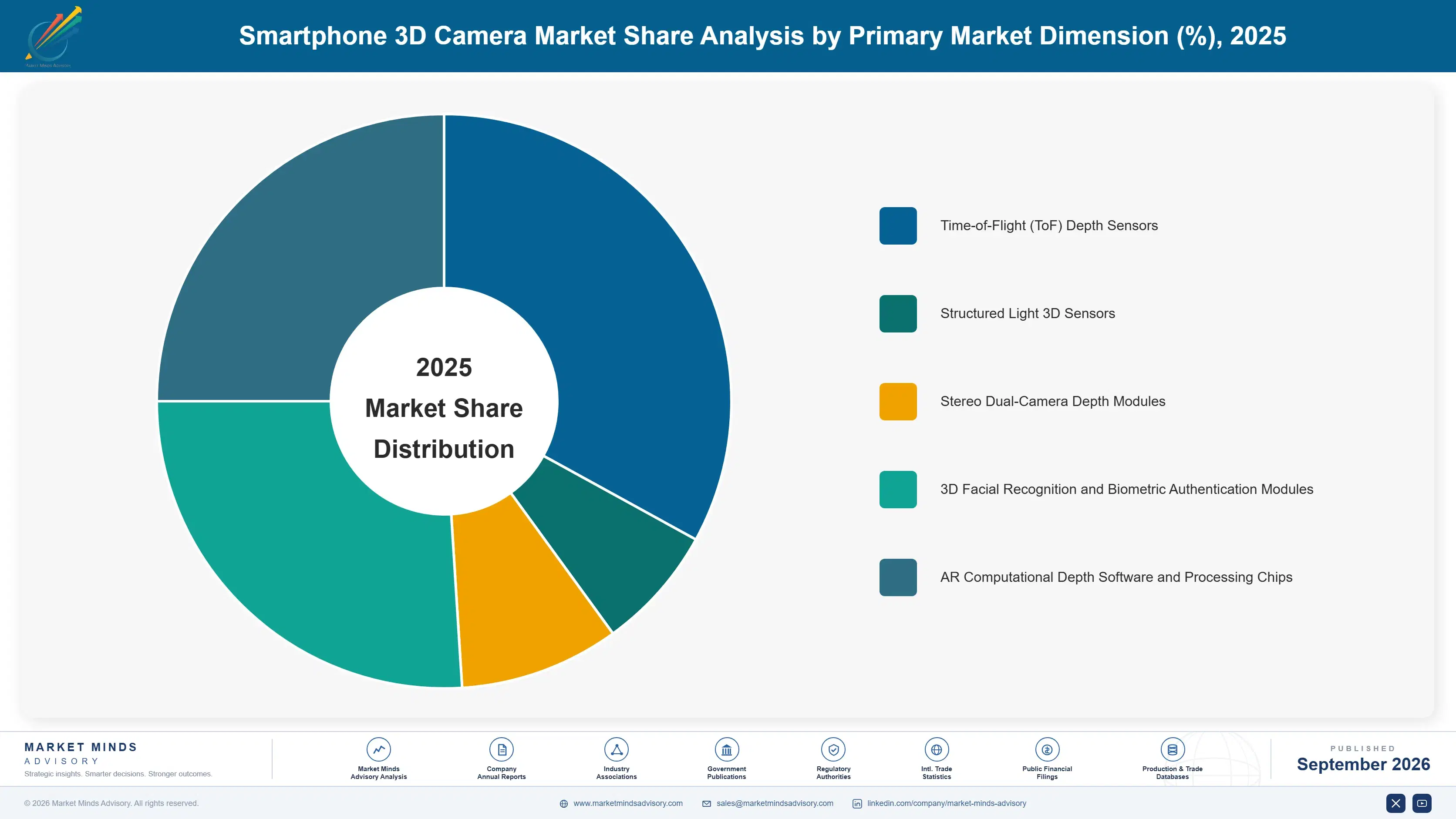
Smartphone 3D cameras divide into five categories distinguished by depth-sensing technology and target application, from consumer photography through regulated biometric authentication across the entire market. Time-of-flight sensors, structured light sensors, stereo dual-camera modules, 3D facial recognition and biometric authentication modules, and AR computational depth software each carry sharply different growth trajectories within the same broader category.
smartphone-3d-camera-market-market-share-analysis-1789989996821

3D Facial Recognition and Biometric Authentication Modules

3D facial recognition and biometric authentication modules have become the fastest-growing category precisely because they serve regulatory-mandated use cases in banking, government identification, and payment authentication that computational software approximation cannot legally satisfy given documented spoofing vulnerabilities discovered in purely software-based systems across multiple jurisdictions worldwide today and increasingly so. This regulatory insulation distinguishes the segment sharply from consumer photography applications, where computational alternatives have already displaced meaningful volume of basic depth-sensing hardware across mid-range and budget device tiers. Component suppliers increasingly specialize specifically in this compliance-driven niche, commanding premium pricing unavailable elsewhere in the broader camera module category given the durable regulatory demand floor this specific application enjoys consistently.
CAGR 9.5%

AR Computational Depth Software and Processing Chips

AR computational depth software and processing chips have grown quickly as manufacturers shift investment away from dedicated depth-sensing hardware toward on-device machine learning models capable of estimating depth information from standard 2D image sensor data alone, achieving visually comparable results at meaningfully lower component cost and design complexity across most device tiers and price points. This shift represents the primary force displacing structured light and basic time-of-flight sensor volume across consumer photography applications specifically, since the computational approach eliminates an entire hardware component category manufacturers once considered essential for premium camera positioning. Processing chip vendors increasingly market dedicated depth estimation acceleration as a standard feature within broader mobile application processors.
CAGR 9.0%
Full segment breakdown across 5 segments available in the complete report.

Regional Architecture and Country Demand Map

East Asia accounts for the largest share of smartphone 3D camera module revenue, reflecting the region's concentrated optical component manufacturing and camera assembly capacity built over decades. South Asia and Pacific posts the fastest regional growth rate as smartphone manufacturing shifts toward Vietnam and India.

North America

North America's smartphone 3D camera revenue reflects concentrated flagship device design and specification activity even though actual manufacturing occurs almost entirely overseas, with component sourcing decisions made by domestically headquartered smartphone brands still shaping global demand patterns considerably across the entire industry and its many supply chains worldwide today and well into the distant future ahead. Regulatory requirements around biometric authentication have intensified meaningfully since 2024, sustaining demand for hardware-verified facial recognition modules even as basic depth-sensing hardware declines across other consumer photography applications broadly nationwide and internationally. Component suppliers serving this region compete primarily on certification depth and biometric accuracy rather than raw unit pricing common in less regulated markets.
Share: 24% | CAGR: 6.5% (2026 to 2036)

Western Europe

Western Europe's smartphone 3D camera revenue reflects steady demand from premium device brands and stringent biometric authentication regulation shaping component requirements considerably across the region's financial services and government identification applications specifically and comprehensively across every single member state, territory, and jurisdiction nationwide and beyond its immediate borders. European Union data protection and biometric authentication standards have pushed component suppliers toward hardware-verified depth sensing certification exceeding requirements common in less regulated markets elsewhere around the wider world today and previously. Growth trails East Asia and North America given the region's limited domestic manufacturing base and its dependence on imported components from Asian supply chains for essentially all device production nationwide.
Share: 18% | CAGR: 5.0% (2026 to 2036)
Regional intelligence for 5 additional markets available in the complete report: East Asia, South Asia and Pacific, Latin America, Middle East and Africa, Eastern Europe. Contact sales@marketmindsadvisory.com.
smartphone-3d-camera-market-country-cagr-analysis-1789989997345

Where 3D Camera Suppliers Defend Margin

Component suppliers are testing new commercial structures to defend margin as the category's overall strategic importance declines and smartphone manufacturers negotiate module pricing more aggressively than during the market's earlier growth phase several years ago now and continuing. The levers below reflect where suppliers are actively investing to build higher-margin revenue beyond commodity module sales.

Specializing in Regulatory-Compliant Biometric Sensor Modules

Suppliers are increasingly focusing engineering and certification investment specifically on regulatory-compliant biometric authentication modules rather than competing across the entire declining basic depth-sensing category, capturing premium pricing of 25 to 35 percent over commodity modules given the durable regulatory demand floor this specific application enjoys consistently across most jurisdictions. This specialization strategy insulates suppliers partially from the broader category's overall pricing pressure, since regulatory-mandated hardware requirements cannot be substituted with cheaper computational software alternatives regardless of how sophisticated those alternatives become. Suppliers without this specialization increasingly compete purely on commodity pricing.
Market Impact: Commands a premium of 25 to 35 percent

Licensing Depth-Sensing Reference Designs to Smaller Manufacturers

Larger component suppliers with proprietary depth-sensing module reference designs are increasingly licensing that intellectual property to smaller regional manufacturers lacking comparable engineering capability to develop equivalent modules independently, capturing a licensing royalty typically running 10 to 16 percent of the licensee's resulting module revenue. This licensing approach lets larger suppliers monetize their engineering investment across a broader manufacturing base than their own production capacity alone could support, particularly valuable as the category's declining volume makes direct manufacturing scale economics increasingly difficult to sustain independently. Licensing revenue has grown steadily as manufacturing consolidates.
Market Impact: Licensing returns 10 to 16 percent in royalties

Bundling AI Depth Estimation Software With Sensor Hardware

Suppliers are packaging AI-driven depth estimation software directly with sensor hardware sales rather than selling hardware alone, letting manufacturers achieve improved accuracy from existing sensors without purchasing additional dedicated hardware components, commanding a price premium of 15 to 20 percent over hardware-only module sales across most product tiers sold today. This bundled approach helps suppliers defend against the broader shift toward pure computational alternatives by offering a hybrid hardware-software solution that outperforms software-only approaches while costing less than legacy hardware-only modules. Suppliers without competitive software capability increasingly lose design wins.
Market Impact: Bundled software adds 15 to 20 percent value

Consolidating Multi-Use-Case Sensor Platforms Across Product Lines

Suppliers are designing sensor platforms capable of serving multiple smartphone tiers and use cases simultaneously rather than maintaining separate specialized product lines for each distinct application, reducing their own manufacturing and qualification costs by roughly 12 percent while improving negotiating leverage with upstream component suppliers on unit pricing across larger consolidated purchase volumes negotiated annually. This consolidation strategy has become essential as declining category volume makes maintaining numerous specialized product lines increasingly uneconomical for suppliers competing on cost. Suppliers who consolidate successfully report meaningfully improved margins despite overall declining unit volume across the category.
Market Impact: Consolidation cuts manufacturing cost by roughly 12 percent

Who Controls the Margin Pool

Smartphone 3D camera component revenue concentrates fairly heavily at the top, with the five leading suppliers holding roughly 52 percent combined share, reflecting the capital intensity of optical component manufacturing and the consolidation pressure the category's overall decline has accelerated. Sony and Largan Precision lead by this measure, drawing on decades of image sensor and precision optics manufacturing scale newer entrants cannot easily replicate. Sunny Optical trails the two leaders somewhat in pure module revenue, though it holds a strong cost-competitive position.
Current competitive activity centers on regulatory-compliant biometric specialization, as suppliers race to capture the one segment genuinely insulated from computational software displacement. Several suppliers have announced bundled AI depth estimation software offerings alongside sensor hardware sales, while consolidation continues as smaller point suppliers unable to match larger vendors' certification depth exit the category.

Emerging pressure comes from processing chip vendors embedding depth estimation acceleration directly into mobile application processors, threatening to further commoditize dedicated sensor hardware across mainstream consumer photography applications. Rankings among established suppliers are likely to shift as biometric certification depth becomes the primary competitive differentiator, favoring suppliers who invested early in regulatory compliance over those still competing on basic module pricing.
smartphone-3d-camera-market-company-positioning-matrix-1789989997906

Competitive Moat and Risk Dimensions

SONY

Moat: Massive Sensor Manufacturing Scale

Sony's decades of image sensor manufacturing experience and massive production scale give it cost and yield advantages newer entrants cannot easily replicate, positioning it as a default supplier for manufacturers seeking proven reliability across both standard and biometric-grade sensor applications. This scale advantage lets Sony compete effectively even as overall category volume declines.
SONY

Risk: Broad Portfolio Dilutes Specialization Focus

Sony's broad image sensor portfolio spanning far beyond smartphone 3D cameras means its biometric-specific certification and specialization investment generally trails dedicated specialists focused entirely on regulatory-compliant depth sensing. This risks losing the highest-margin biometric segment to competitors offering deeper, more purpose-built certification depth and application-specific engineering expertise.
LARGAN PRECISION

Moat: Precision Optics Manufacturing Leadership

Largan Precision's decades of precision lens and optics manufacturing expertise give it a genuine quality advantage in the optical components depth-sensing modules require, letting it command premium pricing among manufacturers prioritizing image quality over pure cost minimization. This positioning has proven resilient even as overall category demand softens considerably.
LARGAN PRECISION

Risk: Limited Presence in Biometric Certification

Largan's strength concentrates heavily in optical lens manufacturing rather than the sensor and certification engineering biometric authentication modules increasingly require, leaving it less positioned than integrated competitors to capture share in the fastest-growing regulatory-compliant segment. This risks ceding the most durable, highest-margin part of the market to better-positioned rivals.

Players Tracked

Prominent Players

Sony
Largan Precision
Sunny Optical
ams OSRAM
Lumentum

Other Key Players

II-VI Incorporated
Himax Technologies
Cowell E Holdings
O-Film Group
Genius Electronic Optical
Truly International
Q Technology Group
LG Innotek
Sharp Corporation
Omnivision Technologies
STMicroelectronics
Infineon Technologies
Qualcomm
MediaTek
Melexis

Recent Developments

MARCH 2026

Sony Expands Biometric Certification Capability

Sony announced expanded biometric-grade sensor certification capability specifically targeting banking and government identification applications, responding to tightening regulatory requirements for hardware-verified depth data across multiple jurisdictions worldwide today and going forward. The expansion extends Sony's existing image sensor manufacturing scale into the fastest-growing segment of the category.
Signal: Signals established sensor manufacturers are prioritizing regulatory-compliant biometric applications over declining commodity segments broadly worldwide today
OCTOBER 2025

Largan Launches Biometric-Optimized Optics Line

Largan Precision launched an expanded optics line specifically optimized for biometric authentication modules, targeting manufacturers seeking premium image quality for regulatory-compliant facial recognition applications rather than basic consumer photography depth sensing hardware components today and previously. The launch reinforces Largan's specialization strategy in this durable segment.
Signal: Signals optics specialists are following sensor manufacturers into the durable biometric certification segment specifically today and beyond
JUNE 2025

Processor Vendor Embeds Depth Estimation Acceleration

A major mobile application processor vendor announced embedded AI depth estimation acceleration as a standard feature within its newest chipset generation, directly targeting the computational photography use cases previously requiring dedicated depth-sensing hardware. The announcement reinforced processing chips as a genuine competitive threat to hardware-based depth sensing.
Signal: Signals processing chip vendors are becoming direct competitors to dedicated depth-sensing hardware suppliers industry-wide overall today

What Drives 3D Camera Module Manufacturing Cost

Optical lens and image sensor components represent the dominant input cost for smartphone 3D camera modules, typically running 45 to 55 percent of total manufacturing cost, sourced primarily from specialized optics and sensor fabrication facilities concentrated in East Asian supply chains. Processing chip integration and module assembly labor round out the remaining major cost categories.
Image sensor and optics component pricing rose meaningfully during 2021 and 2022 as broader semiconductor supply constraints, documented extensively in industry supply chain reports covering that period, tightened availability across multiple mobile component categories competing for limited fabrication capacity at leading foundries. Manufacturers without long-term component supply agreements faced considerably longer lead times and higher spot market pricing during the tightest months of that period.

Smaller suppliers without long-term component supply agreements or in-house optics manufacturing capability absorb price and lead-time volatility directly into module cost, pricing them out of competing for the largest smartphone brand contracts against better-capitalized rivals with locked-in supply terms. This dynamic favors vertically integrated suppliers like Sony and Largan Precision that control significant portions of their own component production, while smaller firms face considerably thinner margins on comparable module capability.
smartphone-3d-camera-market-cost-volatility-analysis-1789989998108

Securing Long-Term Optics Supply Agreements

Suppliers are locking in multi-year optics and image sensor component supply agreements with key fabrication facilities, trading some pricing flexibility for protection against the spot market volatility and lead-time extension that squeezed the industry badly during 2021 and 2022 across nearly every mobile component category. This approach requires sufficient purchasing volume to interest suppliers in long-term commitments.

Vertically Integrating Optics Manufacturing Capability

Larger suppliers are building internal optics and sensor fabrication capability rather than remaining fully dependent on external component manufacturers, capturing margin previously paid to third parties while gaining direct control over supply reliability during periods of volatility across the broader supply chain and its many participants. This requires substantial capital investment smaller suppliers typically cannot justify.

Standardizing Sensor Platforms Across Product Tiers

Suppliers are consolidating sensor and optics platform choices across multiple product tiers rather than maintaining separate designs per device category, reducing duplicate component qualification effort and enabling larger consolidated purchase orders that improve negotiating leverage with upstream suppliers on unit pricing across the entire product portfolio and its many configurations sold each calendar year.

Portfolio Architecture for Margin Defence

Smartphone 3D cameras split into three margin tiers reflecting regulatory sensitivity and technology maturity across the industry today. Standardized basic time-of-flight and structured light sensors run on volume economics with thinner per-unit margins, while biometric authentication modules and AI depth estimation software command materially higher margins given their specialized certification and engineering requirements.
Tension between volume and premium tiers shows up in how suppliers allocate research investment, since biometric certification and computational software integration require ongoing specialized capability that standardized basic sensors no longer need at the same intensity as before across most product lines. Suppliers increasingly treat mature basic sensor products as a declining volume generator, funding premium biometric and software development from whatever remaining revenue that segment still produces.

High-value margin pools concentrate specifically in 3D facial recognition and biometric authentication modules, AI depth estimation software licensing, and specialized certification services, all of which combine strong pricing power with meaningful barriers to entry from regulatory and engineering expertise across the broader industry today. Standardized basic depth-sensing modules represent the largest remaining volume pool but the thinnest and most rapidly compressing margins, having become increasingly commoditized as computational alternatives erode demand.

Volume / Commodity-Adjacent

Standardized basic time-of-flight and structured light sensors sold at accessible unit pricing across mainstream smartphone tiers to maximize remaining shipment volume broadly across the entire market and wider industry today.
Gross Margin: 18-25%

Premium / Certified

Stereo dual-camera depth modules and AR-enabled sensor packages sold as differentiated products commanding stronger per-unit pricing power than commodity basic sensor alternatives available broadly across the wider market and industry today.
Gross Margin: 32-40%

Sustainability / Regulatory / Next-Generation

3D facial recognition modules, AI depth estimation software licensing, and specialized certification services addressing the industry's most demanding regulatory requirements across most jurisdictions and geographies found across the entire world.
Gross Margin: 40-50%
smartphone-3d-camera-market-portfolio-architecture-1789989998639

High-value Sub-segments and Strategic Watch-out

3D Facial Recognition and Biometric Authentication Modules

3D facial recognition and biometric authentication modules combine the strongest growth with strong margins, driven by regulatory requirements in banking and government identification that computational software approximation cannot legally satisfy given documented spoofing vulnerabilities discovered in software-only systems across multiple jurisdictions and global markets today.
Gross Margin: 42-50%

AR Computational Depth Software and Processing Chips

AR computational depth software and processing chips post healthy margins and strong growth as manufacturers shift investment away from dedicated hardware toward machine learning models capable of estimating depth from standard sensors, though absolute revenue remains smaller than biometric applications given a still-developing market and comparatively narrower customer base.
Gross Margin: 38-46%

Time-of-Flight and Structured Light Sensors

Standardized basic time-of-flight and structured light sensors remain a shrinking volume core of the market, still shipping into a meaningful share of mainstream devices across most price tiers, and suppliers rely on this segment for declining but still-material baseline revenue even as margins continue to compress.
Gross Margin: 18-24%

Stereo Dual-Camera Depth Modules

Stereo dual-camera depth modules warrant close monitoring as computational alternatives increasingly replicate their functionality using standard image sensors alone, threatening to displace a segment that once provided steady, dependable revenue without requiring any major ongoing product differentiation from competitors across the broader global smartphone industry.
Gross Margin: 26-33%

Why Biometric Contracts Outlast Consumer Demand

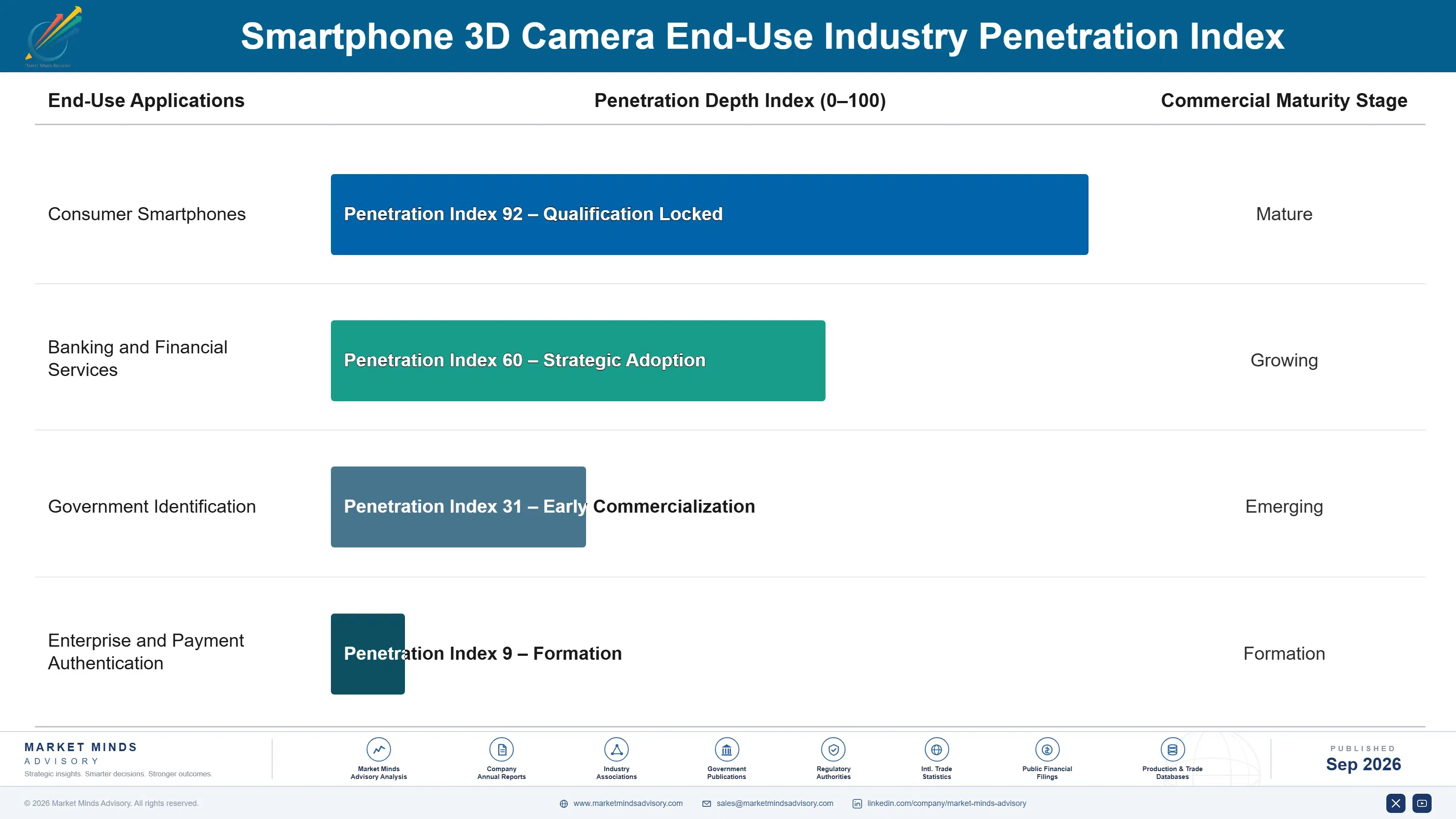
Smartphone 3D camera revenue increasingly behaves less like a consumer electronics annuity and more like a bifurcated business, since the basic depth-sensing segment faces genuine secular decline while biometric authentication contracts, once secured with a manufacturer, tend to persist across multiple device generations given the switching cost of re-certifying an entirely new component for regulatory compliance purposes at meaningful scale.
Adoption stickiness varies considerably by end-use vertical: banking and government identification applications exhibit the highest component retention rates given regulatory certification requirements, while consumer photography applications show declining stickiness as computational software increasingly substitutes for dedicated hardware across successive device generations released each and every year. This uneven pattern concentrates supplier revenue durability specifically in the regulated segment of the broader market.

Buyer profiles are shifting generationally as smartphone procurement increasingly involves dedicated computational imaging and AI specialists rather than relying solely on traditional camera hardware engineering leadership, pushing suppliers to demonstrate software integration capability alongside basic hardware reliability during evaluation. This generational shift favors suppliers who can speak credibly to both computational imaging and traditional optical engineering requirements simultaneously and quite consistently over time.
smartphone-3d-camera-market-end-use-penetration-index-1789989999151

Priorities for 3D Camera Suppliers

These are among the four positions where our research anticipates prominent divergence between winners and laggards over the coming forecast period. Each is grounded in the demand model, the regulatory perimeter, and the announced capacity pipeline.
01 / BIOMETRIC SPECIALIZATION INVESTMENT PRIORITY

Pivot Engineering Investment Toward Regulatory-Compliant Modules

Basic consumer depth-sensing hardware faces genuine secular decline as computational software increasingly replicates comparable results at lower cost, while biometric authentication modules remain insulated by regulatory requirements software approximation cannot legally satisfy anywhere in the world today. Suppliers who pivot engineering and certification investment toward this regulatory-compliant segment now capture durable, premium-priced revenue rather than competing in a shrinking commodity category. Suppliers who delay this pivot risk being left with declining volume in the segment computational alternatives are actively displacing.
02 / COMPUTATIONAL SOFTWARE INTEGRATION STRATEGY

Bundle AI Depth Estimation Software With Hardware Sales

Processing chip vendors increasingly embed depth estimation acceleration directly into mobile application processors, threatening to commoditize dedicated sensor hardware entirely across consumer photography applications across nearly every device tier and price point. Suppliers who bundle competitive AI depth estimation software directly with their sensor hardware defend against this threat by offering a hybrid solution outperforming pure software approaches while costing less than legacy hardware-only modules. Suppliers without competitive software capability increasingly lose design wins to bundled competitors and processor vendors alike.
03 / MULTI-USE-CASE PLATFORM CONSOLIDATION

Consolidate Sensor Architectures Across Product Tiers

Declining category volume makes maintaining numerous specialized sensor product lines increasingly uneconomical, and suppliers who consolidate around fewer, more capable architectures serving multiple use cases simultaneously reduce their own manufacturing and qualification costs considerably across the entire company board. This consolidation also improves negotiating leverage with upstream component suppliers through larger consolidated purchase volumes, a meaningful advantage as overall category revenue continues compressing. Suppliers who maintain excessive product line fragmentation risk margin erosion beyond what declining volume alone would produce.
04 / COMPONENT SUPPLY CHAIN SECURITY

Lock in Long-Term Optics Supply Agreements

Optics and image sensor component price volatility during 2021 and 2022 squeezed margins hardest for suppliers dependent on spot market purchasing rather than locked-in long-term supply relationships with established fabrication facilities across the broader supply chain. Suppliers who secure multi-year agreements trade some short-term pricing flexibility for meaningful protection against future volatility, a trade generally worth making given how frequently component supply disruptions have recurred across the broader mobile component industry. Suppliers still purchasing entirely on the spot market face real earnings risk.

Engagement Snapshot From the Field

A live engagement with an industry participant carrying material or product regulatory and market exposure ahead of a defining policy shift, showing how our research translates into a defensible multi-year portfolio strategy.
MARKET MINDS ADVISORY · CLIENT ENGAGEMENT SUMMARY
Smartphone 3D Camera Producer Strategic Portfolio Review and Transition Roadmap 2026·Investment Scenario on Smartphone 3D Camera Exposure Evaluation 2025-26
CLIENT PROFILE
The client is a mid-tier global smartphone brand producing roughly 40 million devices each year across many price tiers and various regional markets worldwide today and previously, facing declining consumer interest in its flagship depth-sensing camera feature despite continued significant component and marketing investment in the underlying technology over several years of dedicated product development.
STRATEGIC CHALLENGE
The brand needed to decide whether to continue including dedicated depth-sensing hardware across its flagship lineup, shift entirely to computational software alternatives, or pursue a hybrid approach instead, within a compressed product planning window ahead of its next major device launch cycle scheduled for release later that same calendar year.
MMA APPROACH
MMA modeled consumer feature usage data against component cost for dedicated hardware versus computational software alternatives across three separate device tiers, benchmarking against competitor product decisions and evaluating the biometric authentication segment specifically as a distinct strategic consideration entirely separate from mainstream consumer photography applications and other typical use cases.
KEY FINDINGS
  1. Fewer than 15 percent of consumers actively used dedicated depth-sensing camera features despite the brand's continued flagship marketing emphasis on the technology.
  2. Computational software alternatives delivered consumer-perceived image quality within a narrow margin of dedicated hardware at meaningfully lower component cost per device produced.
  3. Biometric authentication use cases justified retaining dedicated hardware specifically for devices targeting banking and enterprise customers requiring certified authentication compliance standards throughout.
  4. The brand's flagship consumer lineup transitioned to computational software while retaining dedicated hardware only for its enterprise-focused device variant line going forward.
CLIENT PROFILE
The client is a mid-tier global smartphone brand producing roughly 40 million devices each year across many price tiers and various regional markets worldwide today and previously, facing declining consumer interest in its flagship depth-sensing camera feature despite continued significant component and marketing investment in the underlying technology over several years of dedicated product development.
STRATEGIC CHALLENGE
The brand needed to decide whether to continue including dedicated depth-sensing hardware across its flagship lineup, shift entirely to computational software alternatives, or pursue a hybrid approach instead, within a compressed product planning window ahead of its next major device launch cycle scheduled for release later that same calendar year.
MMA APPROACH
MMA modeled consumer feature usage data against component cost for dedicated hardware versus computational software alternatives across three separate device tiers, benchmarking against competitor product decisions and evaluating the biometric authentication segment specifically as a distinct strategic consideration entirely separate from mainstream consumer photography applications and other typical use cases.
KEY FINDINGS
  1. Fewer than 15 percent of consumers actively used dedicated depth-sensing camera features despite the brand's continued flagship marketing emphasis on the technology.
  2. Computational software alternatives delivered consumer-perceived image quality within a narrow margin of dedicated hardware at meaningfully lower component cost per device produced.
  3. Biometric authentication use cases justified retaining dedicated hardware specifically for devices targeting banking and enterprise customers requiring certified authentication compliance standards throughout.
  4. The brand's flagship consumer lineup transitioned to computational software while retaining dedicated hardware only for its enterprise-focused device variant line going forward.
RECOMMENDED STRATEGY
Phase 1: Phase one: model consumer feature usage against component cost for dedicated hardware versus computational software across all device tiers considered. Phase 2: Phase two: transition mainstream consumer devices to computational software depth sensing while retaining hardware only where genuinely and clearly justified. Phase 3: Phase three: maintain dedicated biometric hardware exclusively for enterprise-focused device variants requiring certified authentication capability going forward each fiscal year.
OUTCOME
The brand reduced component cost meaningfully across its mainstream consumer lineup while maintaining consumer-perceived image quality through computational alternatives across most device tiers sold today (client-reported, unverified by MMA). The brand has since applied the same tiered approach to its next device generation planning process.

Frequently Asked Questions

Foundational context covering the market sizes, CAGR, scope, country, region and competition that inform every finding below. This section is provided to cover basics and most often pre-purchase conversations, answered from the MMA Primary Research Dataset.

What is the current size of the Smartphone 3D Camera Market?

The Smartphone 3D Camera Market was valued at $3.6 billion in 2025. This figure covers time-of-flight, structured light, stereo dual-camera, and biometric authentication depth-sensing modules integrated into smartphones.

How large will the Smartphone 3D Camera Market be by 2036?

MMA projects the market will reach $7.19 billion by 2036, up from $3.83 billion in 2026. This represents a 1.88-times expansion over the forecast decade.

What is the CAGR for the Smartphone 3D Camera Market 2026 to 2036?

The market is projected to grow at a 6.5% compound annual growth rate between 2026 and 2036. This compares to a historical CAGR of roughly 7.5% between 2020 and 2025, reflecting deceleration.

Which segment is growing fastest?

3D facial recognition and biometric authentication modules lead all segments at a 9.5% CAGR, roughly 1.46 times the overall market rate. AR computational depth software follows closely at 9.0%.

Who are the major companies in the Smartphone 3D Camera Market?

Sony, Largan Precision, Sunny Optical, ams OSRAM, and Lumentum lead by shipped module volume. LG Innotek and STMicroelectronics hold strong positions in specific component segments.

Which country is growing fastest?

Vietnam is the fastest-growing major market at a 9.5% CAGR, driven by smartphone assembly investment diversifying supply chains beyond China. Adoption is accelerating quickly across the region.

Report Segmentation Architecture

The full report scope spans multiple orthogonal segmentation dimensions, with cross-tabulated demand data provided for each dimension pair. Coverage extends further to regional breakdowns, trend trajectories, and the competitive detail needed to support segment-level decision-making.

By Primary Market Dimension

  • Time-of-Flight (ToF) Depth Sensors
  • Structured Light 3D Sensors
  • Stereo Dual-Camera Depth Modules
  • 3D Facial Recognition and Biometric Authentication Modules
  • AR Computational Depth Software and Processing Chips

By End-Use Industry

  • Consumer Smartphones
  • Banking and Financial Services
  • Government Identification
  • Enterprise and Payment Authentication

By Commercial Dimension

  • Direct Component Sales
  • Software Licensing
  • Bundled Hardware-Software Packages

By Region

  • North America
  • Western Europe
  • East Asia
  • South Asia and Pacific
  • Latin America
  • Middle East and Africa
  • Eastern Europe

Scope, Methodology, and Coverage

Every figure in this report is reproducible from documented input assumptions. The scope below maps the historical period, the forecast horizon, the segmentation dimensions, and the countries covered, alongside the underlying primary and qualitative methodology.
Historical Period
2020 to 2025
Forecast Period
2026 to 2036
Base Year
2025 (USD billions; MMA Primary Research Dataset, September 2026)
Market Definition
The Smartphone 3D Camera Market covers time-of-flight, structured light, stereo dual-camera depth modules, and associated facial recognition and computational depth processing components integrated into smartphones for photography, augmented reality, and biometric authentication. It excludes standard 2D image sensors, standalone AR headset hardware, and non-smartphone depth-sensing applications such as automotive or industrial machine vision.
Quantitative Units
USD Billion, Average Module Cost, CAGR %
Segmentation Dimensions
Depth Technology, End-Use Industry, Commercial Dimension, Region
Regions Covered
North America, Western Europe, East Asia, South Asia and Pacific, Latin America, Middle East and Africa, Eastern Europe
Countries Covered
United States, Canada, Germany, France, United Kingdom, China, Japan, South Korea, India, Vietnam, Australia, Brazil, Mexico, United Arab Emirates, South Africa
Key Companies Profiled
Sony, Largan Precision, Sunny Optical, ams OSRAM, Lumentum, II-VI Incorporated, Himax Technologies, Cowell E Holdings, O-Film Group, Genius Electronic Optical, Truly International, Q Technology Group, LG Innotek, Sharp Corporation, Omnivision Technologies, STMicroelectronics, Infineon Technologies, Qualcomm, MediaTek, Melexis
Quantitative Methodology
Primary survey, n=3,800 respondents, Q4 2025, six countries; demand-side model with trade association cross-validation
Qualitative Methodology
47 expert interviews, Q4 2025; applied to validate demand model assumptions, identify emerging dynamics, and assess competitive positioning
Report Format
PDF and XLSX data workbook (Word format preview document)
Publisher
Market Minds Advisory
Report Code
MMA-2026-TEC-199
Published
September 2026
Contact
sales@marketmindsadvisory.com | www.marketmindsadvisory.com

Purchase the full Smartphone 3D Camera Market Report (2026 to 2036).

This report examines the Smartphone 3D Camera Market across five depth-sensing technology categories and seven demand regions. It analyzes the competitive dynamics reshaping how suppliers price and deliver components as computational software displaces basic hardware. The analysis quantifies market size, growth, and segment-level trends through 2036, drawing on primary survey data covering three thousand eight hundred respondents and forty-seven expert interviews conducted in the fourth quarter of 2025. It also covers input cost pressure and revenue strategies available to suppliers navigating this declining then bifurcating category.
Ten-Year Market Sizing and Forecast Model
Five-Segment MECE Depth Technology Classification Taxonomy
Seven-Region Demand Breakdown and Growth Analysis
Competitive Benchmarking of Twenty Named Suppliers
Revenue Lever and Margin Economics Analysis
Anonymized Client Engagement Case Study Review

Built For The People Who Decide

From boardroom strategy to bench-side execution, this report is read cover-to-cover by leaders shaping the next decade of their industry, turning demand scenarios, market dynamics and valuation benchmarks into decisions.
CXOs/ Presidents/ VPs/ Managers
M&A and Corporate Development
Strategy Teams and R&D Heads
Procurement and Product Directors
Regulatory and Compliance Leaders
Investor Relations and Equity Analysts